Skip to content · ⁨ข้ามไปยังเนื้อหา⁩

Business and its environment · ⁨ธุรกิจและสภาพแวดล้อม⁩

A-Level Business · ⁨Business A-Level⁩ · Topic 1 · ⁨หัวข้อ 1⁩

Video lesson for this topic · ⁨บทเรียนวิดีโอสำหรับหัวข้อนี้⁩ Open the video page · ⁨เปิดหน้าวิดีโอ⁩
21:42

ธุรกิจและสิ่งแวดล้อม

ดูแก้วกาแฟ. เม็ดกาแฟข้างในมีราคาไม่กี่เซ็นต์. นม ถ้วย ฝา — เพิ่มอีกไม่กี่เซ็นต์. แต่ผู้คนยอมจ่ายสามดอลลาร์เพื่อมันอย่างสบายใจ. ดังนั้น…

English narration · English + 中文 subtitles burned in · ⁨การบรรยายภาษาอังกฤษ · คำบรรยายภาษาอังกฤษ + 中文 ลอยตัวบนภาพ⁩

1.1

Why businesses exist · ⁨ทำไมธุรกิจถึงมีอยู่⁩

Syllabus · ⁨หลักสูตร⁩
English
  1. explain the purpose of business activity, the concept of adding value and the role of the entrepreneur and intrapreneur
  2. explain the characteristics of successful entrepreneurs and the importance of enterprise to a country (business start-ups)
  3. explain the contents and purpose of a business plan
ไทย
  1. อธิบายวัตถุประสงค์ของ กิจกรรมทางธุรกิจ (business activity), แนวคิด关于 การเพิ่มมูลค่า (adding value) และบทบาทของ ผู้ประกอบการ (entrepreneur) และ ผู้ประกอบการภายในองค์กร (intrapreneur)
  2. อธิบายลักษณะของนักธุรกิจผู้สำเร็จและ importance ของ enterprise ต่อประเทศ (การเริ่มต้นธุรกิจ)
  3. อธิบายเนื้อหาและวัตถุประสงค์ของ แผนธุรกิจ (business plan)

Source: Cambridge International syllabus · ⁨แหล่งที่มา: หลักสูตร Cambridge International⁩

English

People have needs 需要 (things you must have, like food and shelter) and wants 欲望 (things you would like, like a phone or a holiday). A business exists to meet these needs and wants by making goods 商品 and services 服务.

To do this, a business uses resources 资源. We sort resources into four factors of production 生产要素:

  • land 土地 — natural things, such as soil, water and minerals.
  • labour 劳动力 — the work done by people.
  • capital 资本 — the machines, tools, buildings and money used to produce.
  • enterprise 创业精神 — the skill of bringing the other three together and taking the risk 风险 to start a business.

Resources are scarce 稀缺 — there are not enough to meet everyone's wants. So every business must choose how to use them well.

ไทย

คนมี ความต้องการ (สิ่งที่ต้องมี เช่น อาหารและที่อยู่อาศัย) และ ความต้องการอยากได้ (สิ่งที่ต้องการ เช่น โทรศัพท์หรือวันหยุด) ธุรกิจมีอยู่เพื่อตอบสนองความต้องการเหล่านี้通过将การผลิต สินค้า และ บริการ

ร้านค้าแข่งขันกันบนถนนหลัก
ร้านค้าที่แข่งขันกันบนถนนหลัก — ตลาดที่ธุรกิจดำเนินการ

เพื่อทำเช่นนี้ ธุรกิจต้องใช้ ทรัพยากร เราแบ่งทรัพยากรออกเป็นสี่ ปัจจัยการผลิต:

  • ที่ดิน — สิ่งธรรมชาติ เช่น ดิน น้ำ และแร่ธาตุ
  • แรงงาน — งานที่ทำโดยมนุษย์
  • ทุน — เครื่องจักร เครื่องมือ อาคาร และเงินที่ใช้ในการผลิต
  • ผู้ประกอบการ — ทักษะในการรวมสามอย่าง kia เข้าด้วยกันและรับ ความเสี่ยง ในการเริ่มต้นธุรกิจ

แผนภาพแสดงที่ดิน แรงทุน ทุน และผู้ประกอบการ เป็น inputs สี่อย่างที่ธุรกิจนำมารวมกันเพื่อผลิตสินค้าและบริการ *ที่ดิน แรงทุน ทุน และผู้ประกอบการ เป็นปัจจัยทั้งสี่ที่ธุรกิจนำมารวมกันเพื่อผลิตสินค้าและบริการ

ทรัพยากรมี จำกัด — มีไม่เพียงพอต่อความต้องการของทุกคน ดังนั้นธุรกิจทุกแห่งจึงต้องเลือกวิธีใช้ทรัพยากรให้ดีที่สุด

Vocabulary · ⁨คำศัพท์⁩ Train · ⁨ฝึกฝน⁩
English ไทย
needs/niːdz/ ต้องการ
wants/wɒnts/ ความต้องการ
goods/ɡʊdz/ สินค้า
services/ˈsɜːvɪsɪz/ บริการ
resources/rɪˈzɔːsɪz/ ทรัพยากร
factors of production/ˈfæktəz ɒv prəˈdʌkʃn/ ปัจจัยการผลิต
land/lænd/ ที่ดิน
labour/ˈleɪbə/ แรงงาน
inputs/ˈɪnpʊts/ อินพุต
branding/ˈbrændɪŋ/ การสร้างแบรนด์
1.1

Adding value · ⁨การเพิ่มมูลค่า⁩

English

Adding value 增值 means the selling price of a product is higher than the cost of the inputs 投入 (the bought-in materials) used to make it.

$$\text{value added} = \text{selling price} - \text{cost of bought-in materials}$$

A business can add value by branding 品牌, better quality, good design, fast service, or convenience. More value added can mean more profit 利润, but only if costs stay under control.

ไทย

การเพิ่มมูลค่า หมายถึงราคาขายของผลิตภัณฑ์สูงกว่าต้นทุนของ inputs (วัสดุที่ซื้อเข้ามา) ที่ใช้ในการผลิต

$$\text{value added} = \text{selling price} - \text{cost of bought-in materials}$$
กราฟแท่งซ้อนกัน แสดงต้นทุนวัสดุที่ซื้อเข้ามาด้านล่าง และค่าเพิ่มด้านบน รวมกันเป็นราคาขาย
การเพิ่มมูลค่าคือราคาขายลบด้วยต้นทุนวัตถุดิบที่ซื้อเข้ามา

ธุรกิจสามารถเพิ่มมูลค่าได้โดยการสร้างแบรนด์ คุณภาพที่ดีขึ้น การออกแบบที่ดี บริการที่รวดเร็ว หรือความสะดวกสบาย การเพิ่มมูลค่ามากขึ้นอาจหมายถึงกำไรที่มากขึ้น แต่จะเกิดขึ้นได้ก็ต่อเมื่อต้นทุนยังคงอยู่ภายใต้การควบคุมเท่านั้น

Explore · ⁨สำรวจ⁩

Value added lab · ⁨ห้องปฏิบัติการเพิ่มมูลค่า⁩

Change the bought-in cost, the selling price and other costs to see exactly where value added — and profit — come from. · ⁨เปลี่ยนต้นทุนวัตถุดิบ ราคาขาย และค่าใช้จ่ายอื่นๆ เพื่อดูว่าเพิ่มมูลค่าและกำไรมาจากจุดใดอย่างชัดเจน⁩

1.1

Entrepreneurs and intrapreneurs

English

An entrepreneur 企业家 is a person who takes the risk to set up and run a business. They have the idea, organise the factors of production, and make the decisions. If the business fails, they can lose their money.

An intrapreneur 内部创业者 is an employee inside a larger business who acts like an entrepreneur. They build new ideas, products or ways of working, using the company's resources.

Characteristics of successful entrepreneurs

Successful entrepreneurs are usually:

  • innovative 有创新精神的 — full of new ideas.
  • willing to take risks, but in a careful way.
  • hard-working and determined 有决心的 — they do not give up easily.
  • self-confident 自信的 and good at making decisions.
  • good leaders who can plan ahead and manage money.

Why enterprise matters to a country

When people start new businesses (business start-ups 初创企业), the whole country can gain:

  • new jobs are created, which lowers unemployment 失业.
  • more goods and services are made, which raises output 产出 (and the country's GDP 国内生产总值).
  • more competition 竞争, giving customers lower prices and more choice.
  • some firms grow and export 出口, bringing money into the country.
  • economic growth 经济增长 and a higher standard of living.
ไทย

Entrepreneur คือบุคคลที่รับความเสี่ยงในการจัดตั้งและดำเนินธุรกิจ พวกเขาเป็นต้นกำเนิดของไอเดีย จัดหาปัจจัยการผลิต และตัดสินใจ หากธุรกิจล้มเหลว他们也 может lose their money.

Intrapreneur คือพนักงานภายในธุรกิจขนาดใหญ่ที่ทำหน้าที่เหมือน entrepreneur พวกเขาสร้างไอเดียใหม่ ผลิตภัณฑ์หรือวิธีการทำงาน โดยใช้ทรัพยากรของบริษัท

รถขายอาหารริมทางสีสดใสพร้อมป้าย "OPEN" และเมนูอาหาร พร้อมลูกค้าสองคนกำลังสั่งอาหารที่หน้าต่าง
Food truck เป็นตัวอย่างของ enterprise ที่เห็นได้ชัดเจน เจ้าของมองเห็นช่องว่างในตลาด ใช้เงินออมของตนเองซื้อรถตู้และสินค้าสต็อก และตอนนี้ต้องเสี่ยงกับความเสี่ยงรายวันในการบริหารจัดการ — นี่คือแก่นแท้ของการเป็น entrepreneur

Characteristics of successful entrepreneurs

Successful entrepreneurs มักจะมี:

  • innovative — เต็มไปด้วยไอเดียใหม่ๆ
  • ยินดีที่จะรับความเสี่ยง แต่ด้วยความระมัดระวัง
  • ขยันและ determined — ไม่ยอมแพ้ได้ง่ายๆ
  • self-confident และ擅长 making decisions
  • ผู้นำที่ดี สามารถวางแผนล่วงหน้าและจัดการการเงินได้

Why enterprise matters to a country

เมื่อผู้คนเริ่มธุรกิจใหม่ (business start-ups) ทั้งประเทศจะได้รับประโยชน์:

  • มีการจ้างงานเพิ่มขึ้น ซึ่งลด unemployment
  • มีสินค้าและบริการมากขึ้น ซึ่งเพิ่ม output (และ GDP ของประเทศ)
  • มีการแข่งขันมากขึ้น ทำให้ลูกค้าได้ราคาสินค้าที่ต่ำกว่าและมีตัวเลือกมากขึ้น
  • บางบริษัทขยายตัวและ export นำเงินเข้าประเทศ
  • economic growth และมาตรฐานชีวิตที่สูงขึ้น
Vocabulary · ⁨คำศัพท์⁩ Train · ⁨ฝึกฝน⁩
English ไทย
enterprise/ˈentəpraɪz/ ผู้ประกอบการ (enterprise)
risk/rɪsk/ ความเสี่ยง (Risk)
scarce/skeəs/ หายาก
adding value/ˈædɪŋ ˈvæljuː/ การเพิ่มมูลค่า
entrepreneur/ˌɒntrɪprəˈnjʊə/ ผู้ประกอบการ
intrapreneur/ˌɪntrəprəˈnjʊə/ นักธุรกิจภายในองค์กร (intrapreneur)
innovative/ˈɪnəveɪtɪv/ สร้างสรรค์นวัตกรรม
determined/dɪˈtɜːmɪnd/ determined
self-confident/self ˈkɒnfɪdənt/ มั่นใจในตนเอง
business start-ups/ˈbɪznəs stɑːt ʌps/ ธุรกิจเริ่มต้น
unemployment/ʌnemˈplɔɪmənt/ อัตราการว่างงาน
output/ˈaʊtpʊt/ ผลผลิต
GDP/ˌdʒiː diː ˈpiː/ GDP
competition/ˌkɒmpəˈtɪʃn/ การแข่งขัน
export/ˈekspɔːt/ ส่งออก
economic growth/ˌiːkəˈnɒmɪk ɡrəʊθ/ การเติบโตทางเศรษฐกิจ
1.1

The business plan

English

A business plan 商业计划书 is a written document that describes the business idea and how it will work. It usually contains:

Part of the plan What it covers
The idea the product, and what makes it different
The market target customers, market size, competitors
Marketing price, promotion and place
Operations how the product is made or delivered
Finance start-up costs, a cash-flow forecast 现金流量预测, expected profit
People the owners and key staff

A business plan is useful because it helps the owner:

  • get finance 融资 from a bank or an investor 投资者.
  • set clear goals and lower the risk of failure.
  • guide decisions as the business grows.
ไทย

Business plan คือเอกสารที่เขียนอธิบายไอเดียธุรกิจและวิธีดำเนินงาน โดยทั่วไปจะประกอบด้วย:

ส่วนของแผน สิ่งที่ครอบคลุม
Idea ผลิตภัณฑ์ และความแตกต่างของผลิตภัณฑ์นั้น
ตลาด ลูกค้าเป้าหมาย ขนาดตลาด คู่แข่ง
Marketing ราคา การโปรโมท และสถานที่
Operations วิธีผลิตหรือจัดส่งผลิตภัณฑ์
Finance ต้นทุนเริ่มต้น Cash-flow forecast กำไรที่คาดการณ์ไว้
คน เจ้าของและพนักงานสำคัญ

Business plan มีประโยชน์เพราะช่วยให้เจ้าของ:

  • รับ finance จากธนาคารหรือ investor
  • ตั้งเป้าหมายที่ชัดเจนและลดความเสี่ยงในการล้มเหลว
  • ช่วยตัดสินใจเมื่อธุรกิจเติบโต
Vocabulary · ⁨คำศัพท์⁩ Train · ⁨ฝึกฝน⁩
English ไทย
business plan/ˈbɪznəs plæn/ แผนธุรกิจ
cash-flow forecast/kæʃ fləʊ ˈfɔːkæst/ คาดการณ์กระแสเงินสด
finance/ˈfaɪnæns/ finance
investor/ɪnˈvestə/ นักลงทุน
1.2

Sectors of business activity

Syllabus · ⁨หลักสูตร⁩
English
  1. explain the classification of business activity (primary, secondary, tertiary, quaternary sectors) and the private and public sectors
  2. describe the legal structure of business: sole trader, partnership, private and public limited company, franchise, joint venture, social enterprise
  3. explain limited and unlimited liability
ไทย
  1. อธิบายการจัดหมวดหมู่กิจกรรมทางธุรกิจ (primary, secondary, tertiary, quaternary) และ private sector กับ public sector
  2. อธิบายโครงสร้างทางกฎหมายของธุรกิจ: sole trader, partnership, private limited company และ public limited company, franchise, joint venture, social enterprise
  3. อธิบาย limited liability และ unlimited liability

Source: Cambridge International syllabus · ⁨แหล่งที่มา: หลักสูตร Cambridge International⁩

English

Every business works in one of four sectors:

Sector What it does Example
primary sector 第一产业 takes raw materials from nature farming, mining, fishing
secondary sector 第二产业 makes (manufactures) goods car factory, baker
tertiary sector 第三产业 provides services shops, banks, transport
quaternary sector 第四产业 knowledge and information services research, IT, consulting

Here raw materials 原材料 are the natural inputs a business starts with, and to manufacture 制造 means to make goods in large amounts. As a country develops, it usually moves from mostly primary work towards more tertiary and quaternary work.

ไทย

ทุกธุรกิจทำงานอยู่ใน salah one of four sectors:

Sector สิ่งที่ทำ ตัวอย่าง
primary sector เก็บวัตถุดิบจากธรรมชาติ การเกษตร การทำเหมือง การประมง
secondary sector ผลิต (manufactures) สินค้า โรงงานผลิตรถยนต์ ร้านเบเกอรี่
tertiary sector ให้บริการ ร้านค้า ธนาคาร การขนส่ง
quaternary sector บริการด้านความรู้และข้อมูล การวิจัย เทคโนโลยีสารสนเทศ การให้คำปรึกษา
กล่องสี่ใบเรียงกัน — ระดับพื้นฐาน, ระดับกลาง, ระดับสูง, ระดับพิเศษ — เชื่อมต่อกันด้วยลูกศร และมีตัวอย่างอยู่ภายใต้แต่ละกล่อง
Business activity ดำเนินการตั้งแต่ primary sector ไปจนถึง quaternary sector

ที่นี่ raw materials คืออินพุตทางธรรมชาติที่ธุรกิจเริ่มต้น และ manufacture หมายความว่าผลิตสินค้าในปริมาณมาก เมื่อประเทศพัฒนาขึ้น มักจะเปลี่ยนจากการทำงานประเภท primary เป็น tertiary และ quaternary มากขึ้น

Explore · ⁨สำรวจ⁩

Classify business activity · ⁨จัดประเภทกิจกรรมทางธุรกิจ⁩

Sort real firms by the sector they mainly belong to. · ⁨จำแนกบริษัทจริงตามภาคที่ส่วนใหญ่อยู่ใน⁩

Vocabulary · ⁨คำศัพท์⁩ Train · ⁨ฝึกฝน⁩
English ไทย
primary sector/ˈpraɪməri ˈsektə/ sector primary
secondary sector/ˈsekəndəri ˈsektə/ sector secondary
tertiary sector/ˈtɜːʃjəri ˈsektə/ sector tertiary
quaternary sector/kwəˈtɜːnəri ˈsektə/ ภาคควาเทินนารี
raw materials/rɔː məˈtɪərɪəlz/ วัตถุดิบ
manufacture/ˌmænjuːˈfæktʃə/ การผลิต
1.2

Private and public sectors

English
  • The private sector 私营部门 is made up of businesses owned by private people. Their main aim is usually profit.
  • The public sector 公共部门 is made up of organisations owned by the government, such as state schools and public hospitals. Their aim is usually to provide a service, not to make profit.
ไทย
  • Private sector ประกอบด้วยธุรกิจที่_filenameโดยบุคคลส่วนตัว เป้าหมายหลักมักจะเป็นกำไร
  • Public sector ประกอบด้วยองค์กรที่_filenameโดยรัฐบาล เช่น โรงเรียนรัฐและโรงพยาบาลสาธารณะ เป้าหมายคือให้บริการมากกว่าทำกำไร
Vocabulary · ⁨คำศัพท์⁩ Train · ⁨ฝึกฝน⁩
English ไทย
private sector/ˈpraɪvət ˈsektə/ ภาคเอกชน
public sector/ˈpʌblɪk ˈsektə/ ภาคสาธารณะ
1.2

Legal structures of business

English

A business must choose a legal form. The main ones are below.

  • A sole trader 个体经营者 is owned by one person. It is easy to set up and the owner keeps all the profit, but raising money is hard.
  • A partnership 合伙企业 is owned by two or more partners who share the work and profit. They often sign a deed of partnership 合伙协议 that sets out each partner's share.
  • A private limited company 私人有限公司 (Ltd) sells shares 股份 to a small group, such as family and friends. Its owners are shareholders 股东. Its shares are not sold to the public.
  • A public limited company 上市公司 (plc) sells its shares to the public on the stock exchange 证券交易所. It can raise large amounts of money, but it must follow more rules and faces the risk of a takeover 收购.
  • A franchise 特许经营 lets one firm use another firm's brand and business model. The franchisor 特许方 owns the brand; the franchisee 加盟方 pays a fee and a royalty 提成 to run a branch.
  • A joint venture 合资企业 is when two businesses join to run one project and share the costs and risks.
  • A social enterprise 社会企业 trades like a normal business but aims to do social or environmental 环境 good, and reinvests most of its profit.
ไทย
A modern corporate headquarters tower
A company headquarters: businesses ranging from sole traders to giant public limited companies.

ธุรกิจต้องเลือกรูปแบบทางกฎหมาย รูปแบบหลักมีดังนี้:

  • Sole trader_filenameโดยบุคคลเดียว ตั้งง่ายและเจ้าของเก็บกำไรทั้งหมดแต่ยากต่อการระดมทุน
  • **Partnership_filenameโดยพาร์ทเนอร์สองคนขึ้นไปที่แบ่งงานและกำไร มักจะลงลายมือชื่อใน deed of partnershipที่กำหนดสัดส่วนของแต่ละพาร์ทเนอร์
  • Private limited company (Ltd) ขาย shares ให้กับกลุ่มเล็กๆ เช่น ครอบครัวและเพื่อน เจ้าของ他们是 shareholders Shares ไม่ขายให้สาธารณชน
  • Public limited company (plc) ขาย shares ให้สาธารณชนบน stock exchange สามารถระดมทุนจำนวนมากได้แต่ต้องปฏิบัติตามกฎระเบียบมากขึ้นและมีความเสี่ยงจากการถูก takeover
  • Franchise อนุญาตให้หนึ่งบริษัทใช้แบรนด์และแบบจำลองธุรกิจของบริษัทอื่น **Franchisor_filenamebrand; Franchiseeจ่ายค่าธรรมเนียมและ royaltyเพื่อเปิดสาขา
  • Joint ventureคือการรวมกันของสองธุรกิจเพื่อดำเนินโครงการร่วมกันและแบ่งปันค่าใช้จ่ายและความเสี่ยง
  • Social enterpriseTrading like a normal business but aims to do social or environmental good และนำกำไรส่วนใหญ่ไปลงทุนใหม่
แผนภาพต้นไม้จำแนกโครงสร้างทางกฎหมายของธุรกิจออกเป็นแบบไม่มีตัวตนทางกฎหมาย (เจ้าของคนเดียว, หุ้นส่วน) ที่มีหนี้สินไม่จำกัด และแบบมีตัวตนทางกฎหมาย (บริษัทจำกัด, บริษัทมหาชนจำกัด) ที่มีหนี้สินจำกัด
รูปแบบทางกฎหมายแบ่งตามความรับผิดชอบ: แบบไม่มีตัวตนทางกฎหมาย (ไม่จำกัด) และแบบมีตัวตนทางกฎหมาย (จำกัด)
Explore · ⁨สำรวจ⁩

Choose the ownership form · ⁨เลือกรูปแบบความเป็นเจ้าของ⁩

Compare ownership, control and liability in real business types. · ⁨เปรียบเทียบความเป็น ownership, control และความรับผิดชอบในรูปแบบธุรกิจจริง⁩

Vocabulary · ⁨คำศัพท์⁩ Train · ⁨ฝึกฝน⁩
English ไทย
sole trader/səʊl ˈtreɪdə/ เจ้าของกิจการคนเดียว
partnership/ˈpɑːtnəʃɪp/ นิติบุคคล
deed of partnership/diːd ɒv ˈpɑːtnəʃɪp/ สัญญาหุ้นส่วน
private limited company/ˈpraɪvət ˈlɪmɪtɪd ˈkʌmpəni/ บริษัทจำกัด
shares/ʃeəz/ หุ้น
shareholders/ˈʃeəhəʊldəz/ ผู้ถือหุ้น
public limited company/ˈpʌblɪk ˈlɪmɪtɪd ˈkʌmpəni/ บริษัทมหาชนจำกัด
stock exchange/stɒk eksˈtʃeɪndʒ/ ตลาดหลักทรัพย์
takeover/ˈteɪkəʊvə/ การควบรวมกิจการ
franchise/ˈfræntʃaɪz/ แฟรนไชส์
franchisor/ˈfræntʃaɪzə/ ผู้ให้แฟรนไชส์ (franchisor)
franchisee/ˈfræntʃɪsiː/ ผู้รับแฟรนไชส์ (franchisee)
royalty/ˈrɔɪəlti/ рояลตี
joint venture/dʒɔɪnt ˈventʃə/ กิจการร่วมค้า
social enterprise/ˈsəʊʃl ˈentəpraɪz/ องค์กรเพื่อสังคม
environmental/enˌvaɪrənˈmentl/ สิ่งแวดล้อม
aims/eɪmz/ เป้าหมาย
1.2

Limited and unlimited liability

English

Liability 责任 means who must pay the business's debts 债务 if it cannot pay them itself.

  • limited liability 有限责任 — the owners can only lose the money they put in. Their personal things, like a house or car, are safe. Companies have limited liability.
  • unlimited liability 无限责任 — the owners are personally responsible for all the debts. They could lose personal things. Sole traders and most partnerships have unlimited liability.

A company is a separate legal identity 独立法人 — it can own things, owe money, and be taken to court in its own name, apart from its owners.

ไทย

Liability หมายความว่าใครต้องชำระ debts ของธุรกิจหากธุรกิจไม่สามารถชำระเองได้

  • หนี้สินจำกัด — เจ้าของสามารถสูญเสียเฉพาะเงินที่ลงทุนเท่านั้น สิ่งส่วนตัวเช่นบ้านหรือรถยนต์จะปลอดภัย บริษัทมีหนี้สินจำกัด
  • หนี้สินไม่จำกัด — เจ้าของมีความรับผิดชอบส่วนบุคคลต่อหนี้สินทั้งหมด พวกเขาอาจสูญเสียสิ่งส่วนตัวได้ เจ้าของคนเดียวและหุ้นส่วนส่วนใหญ่มีหนี้สินไม่จำกัด

บริษัทเป็น ตัวตนทางกฎหมายแยกต่างหาก — สามารถเป็นเจ้าของสิ่งต่างๆ เป็นหนี้ และถูกฟ้องร้องในศาลภายใต้ชื่อของตัวเอง แยกต่างหากจากเจ้าของ

หนี้สินจำกัด สำหรับบริษัท ความเสี่ยงคือเฉพาะเงินที่ลงทุน ในขณะที่สิ่งส่วนตัวปลอดภัย; หนี้สินไม่จำกัด สำหรับเจ้าของคนเดียวและหุ้นส่วน ความเสี่ยงรวมถึงบ้านและรถยนต์ส่วนตัวของเจ้าของด้วย
หนี้สินจำกัดความเสี่ยงเฉพาะเงินที่ลงทุน; หนี้สินไม่จำกัดความเสี่ยงถึงสิ่งส่วนตัวของเจ้าของด้วย
Vocabulary · ⁨คำศัพท์⁩ Train · ⁨ฝึกฝน⁩
English ไทย
liability/ˌlaɪəˈbɪlɪti/ หนี้สิน
debts/dets/ หนี้สิน
1.3

The size of a business · ⁨ขนาดของธุรกิจ⁩

Syllabus · ⁨หลักสูตร⁩
English
  1. explain how the size of a business is measured and the significance of small businesses
  2. explain internal and external growth (mergers and takeovers — horizontal, vertical, conglomerate) and the reasons for and problems of growth
  3. explain economies and diseconomies of scale
ไทย
  1. อธิบายวิธีการวัดขนาดของธุรกิจและความสำคัญของธุรกิจขนาดเล็ก
  2. อธิบาย internal growth และ external growth (mergers และ takeovers — horizontal, vertical, conglomerate) และเหตุผลพร้อมปัญหาของการเติบโต
  3. อธิบาย economies of scale และ diseconomies of scale

Source: Cambridge International syllabus · ⁨แหล่งที่มา: หลักสูตร Cambridge International⁩

English
Economies of scale: average cost falls

There is no single best way to measure how big a business is. Common measures are:

  • the number of employees 员工.
  • revenue 营业收入 (also called sales turnover) — the value of what it sells.
  • capital employed 所用资本 — the total money invested in the business.
  • market share 市场份额 — the firm's sales as a percentage of the whole market.
  • market capitalisation 市值 — the total value of a company's shares (for a plc).

Different measures can give different answers, so it is best to use more than one.

Why small businesses matter

Small businesses create jobs, serve local communities 社区, give personal service, react quickly to change, bring new ideas, and supply parts and services to large firms.

ไทย
ประโยชน์จากขนาด economy of scale: ค่าเฉลี่ยลดลง

ไม่มีวิธีการใดวิธีเดียวที่ดีที่สุดในการวัดขนาดธุรกิจ วิธีวัดทั่วไป ได้แก่:

  • จำนวน พนักงาน
  • รายได้ (หรือเรียกว่า ยอดขาย) — มูลค่าของสินค้าที่ขายได้
  • เงินทุนที่ใช้ไป — เงินรวมที่ลงทุนในธุรกิจ
  • ส่วนแบ่งตลาด — ยอดขายของบริษัทเป็นเปอร์เซ็นต์ของตลาดทั้งหมด
  • มูลค่าตลาด market capitalisation — มูลค่ารวมของหุ้นบริษัท (สำหรับบริษัทมหาชนจำกัด)

การวัดด้วยวิธีที่ต่างกันอาจให้ผลลัพธ์ที่แตกต่างกัน ดังนั้นจึงควรใช้หลายวิธีประกอบกัน

5 วิธีในการวัดขนาดธุรกิจ: จำนวนพนักงาน, รายได้, ทุนที่ใช้ผลิต, สัดส่วนตลาด และมูลค่าตลาด
5 วิธีในการวัดขนาดของธุรกิจ; ควรใช้มากกว่าหนึ่งวิธี

ทำไมธุรกิจขนาดเล็กถึงสำคัญ

ธุรกิจขนาดเล็กสร้างงาน, บริการในชุมชนท้องถิ่น, ให้บริการแบบส่วนบุคคล, ตอบสนองต่อการเปลี่ยนแปลงได้อย่างรวดเร็ว, นำไอเดียใหม่ๆ เข้ามา และจัดจำหน่ายชิ้นส่วนและบริการให้กับบริษัทขนาดใหญ่

Explore · ⁨สำรวจ⁩

Business case lab

Classify real decisions so the main business concept becomes concrete. · ⁨จำแนกการตัดสินใจจริงเพื่อให้แนวคิดธุรกิจหลักเป็นรูปธรรมขึ้น⁩

Vocabulary · ⁨คำศัพท์⁩ Train · ⁨ฝึกฝน⁩
English ไทย
capital/ˈkæpɪtl/ ทุน (capital)
market capitalisation/ˈmɑːkɪt ˌkæpɪtəlaɪˈzeɪʃn/ มูลค่าตลาด (market capitalisation)
communities/kəˈmjuːnɪtiz/ ชุมชน
internal growth/ɪnˈtɜːnl ɡrəʊθ/ การเติบโตภายใน
external growth/ekˈstɜːnl ɡrəʊθ/ การเติบโตภายนอก
Watch lesson · ⁨ดูบทเรียน⁩
1.3

Business growth · ⁨การเติบโตของธุรกิจ⁩

English

A business can grow in two ways.

Internal growth 内部增长 (organic growth) — the business grows by itself: selling more, opening new branches, or adding new products. It is slower but lower risk.

External growth 外部增长 — the business joins with another firm. This is called integration 整合, and it happens by:

  • a merger 合并 — two firms agree to join together as one.
  • a takeover — one firm buys control of another.

There are three types of integration:

  • horizontal integration 横向整合 — joining a firm at the same stage in the same industry (e.g. two car makers).
  • vertical integration 纵向整合 — joining a firm at a different stage in the same industry. Forward integration 前向整合 is towards the customer (e.g. buying a shop); backward integration 后向整合 is towards the supplier (e.g. buying a parts maker).
  • conglomerate integration 混合整合 — joining a firm in a completely different industry. This spreads risk, which is called diversification 多元化.

Firms grow to lower their costs, win a bigger market share and more market power 市场支配力, raise profit, and spread risk. But growth also brings problems: higher average costs, harder management and communication, different company cultures 企业文化 that may clash, and a need for a lot of finance.

ไทย

ธุรกิจสามารถเติบโตได้สองทาง

การเติบโตภายใน (การเติบโตจากภายใน) — ธุรกิจเติบโตเองโดยขายมากขึ้น เปิดสาขาใหม่ หรือเพิ่มสินค้าใหม่ เป็นไปอย่างช้าๆ แต่มีความเสี่ยงต่ำ

การเติบโตภายนอก — ธุรกิจรวมกับอีกบริษัทหนึ่ง การนี้เรียกว่า การบูรณาการ ซึ่งเกิดขึ้นได้โดย:

  • การ 합병 — บริษัทสองแห่งตกลงรวมตัวกันเป็นหนึ่งเดียว
  • การ吸收了 — บริษัทหนึ่งซื้อ控制权ของอีกบริษัทหนึ่ง

มีสามประเภทของการบูรณาการ:

  • การบูรณาการแนวนอน — รวมกับบริษัทที่อยู่ในขั้นตอนเดียวกันในอุตสาหกรรมเดียวกัน (เช่น ผู้ผลิตรถยนต์สองราย)
  • การบูรณาการแนวตั้ง — รวมกับบริษัทที่อยู่ในขั้นตอนต่างกันแต่อยู่ในอุตสาหกรรมเดียวกัน การบูรณาการไปข้างหน้า คือการมุ่งสู่ลูกค้า (เช่น การซื้อร้านค้า); การบูรณาการย้อนกลับ คือการมุ่งสู่ผู้จัดจำหน่าย (เช่น การซื้อผู้ผลิตชิ้นส่วน)
  • การบูรณาการกลุ่มธุรกิจ — รวมกับบริษัทในอุตสาหกรรมที่แตกต่างอย่างสิ้นเชิง สิ่งนี้ช่วยกระจายความเสี่ยง ซึ่งเรียกว่า การหลากหลาย
ตัวอย่างคู่ธุรกิจขนาดเล็กสามคู่แสดงถึงการบูรณาการแนวนอน (ขั้นตอนเดียวกัน), การบูรณาการแนวตั้ง (ขั้นตอนต่างกัน อุตสาหกรรมเดียวกัน) และการบูรณาการกลุ่มธุรกิจ (อุตสาหกรรมต่างกัน)
สามประเภทของการบูรณาการเมื่อบริษัทหนึ่งรวมกับอีกบริษัทหนึ่ง

บริษัทเติบโตเพื่อลดต้นทุน, ได้รับสัดส่วนตลาดที่ใหญ่ขึ้นและอำนาจตลาดมากขึ้น, เพิ่มกำไร และกระจายความเสี่ยง แต่การเติบโตก็นำมาซึ่งปัญหา: ต้นทุนเฉลี่ยที่สูงขึ้น, การจัดการและการสื่อสารที่ยากขึ้น, วัฒนธรรมองค์กรที่แตกต่างกันซึ่งอาจขัดแย้งกัน และความต้องการเงินทุนจำนวนมาก

Vocabulary · ⁨คำศัพท์⁩ Train · ⁨ฝึกฝน⁩
English ไทย
integration/ˌɪntɪˈɡreɪʃn/ integration
merger/ˈmɜːdʒə/ การควบรวมกิจการ
horizontal integration/ˌhɒrɪˈzɒntl ˌɪntɪˈɡreɪʃn/ การบูรณาการแนวนอน
vertical integration/ˈvɜːtɪkl ˌɪntɪˈɡreɪʃn/ การบูรณาการแนวตั้ง
forward integration/ˈfɔːwəd ˌɪntɪˈɡreɪʃn/ การขยายไปข้างหน้า (forward integration)
backward integration/ˈbækwəd ˌɪntɪˈɡreɪʃn/ การขยายย้อนกลับ (backward integration)
conglomerate integration/kənˈɡlɒməreɪt ˌɪntɪˈɡreɪʃn/ การบูรณาการกลุ่มธุรกิจ
diversification/daɪˌvɜːsɪfɪˈkeɪʃn/ การหลากหลาย
market power/ˈmɑːkɪt ˈpaʊə/ อำนาจตลาด
company culture/ˈkʌmpəni ˈkʌltʃə/ วัฒนธรรมองค์กร
1.3

Economies and diseconomies of scale · ⁨ประโยชน์และข้อเสียจากการขยายขนาด⁩

English

Economies of scale 规模经济 are the cost savings a business gets as it grows larger. The average cost 平均成本 of each unit falls as output rises. The main types are:

Type How it lowers cost
purchasing buying in bulk 大批量 earns discounts
technical large machines are more efficient
financial large firms borrow at lower interest 利息
managerial the firm can employ expert specialist managers
marketing advertising cost is spread over more units

Diseconomies of scale 规模不经济 happen when a firm grows too big and the average cost starts to rise again. The usual causes are:

  • communication 沟通 becomes slow and unclear.
  • the coordination 协调 of many departments is hard.
  • workers may feel unimportant and lose motivation 激励.

Worked example. A factory making 10,000 units has fixed costs of £200,000 and variable costs of £6 per unit. It expands to 50,000 units, and bulk buying cuts the variable cost to £5. Find the unit cost at each output and explain the fall. Unit cost = total cost ÷ output. At 10,000: total = 200,000 + (10,000 × 6) = £260,000, so the unit cost is 260,000 ÷ 10,000 = £26. At 50,000: total = 200,000 + (50,000 × 5) = £450,000, so the unit cost is 450,000 ÷ 50,000 = £9. Two economies of scale are at work: the fixed costs are spread over far more units (£20 down to £4 each), and purchasing economies cut the variable cost. Note that the fixed cost total does not change - only the fixed cost per unit falls. Writing "fixed costs fall" is the error that loses the mark.

ไทย

ประโยชน์จากการขยายขนาด คือการประหยัดต้นทุนที่ธุรกิจได้รับเมื่อขยายใหญ่ขึ้น ต้นทุนเฉลี่ยต่อหน่วยจะลดลงเมื่อปริมาณการผลิตเพิ่มขึ้น ประเภทหลักๆ มีดังนี้:

ประเภท วิธีลดต้นทุน
การซื้อ การซื้อในปริมาณมาก (bulk) รับส่วนลดได้
ด้านเทคนิค เครื่องจักรขนาดใหญ่มีประสิทธิภาพมากกว่า
ด้านการเงิน บริษัทขนาดใหญ่สามารถกู้ยืมเงินด้วย อัตราดอกเบี้ย ต่ำกว่า
ด้านการบริหารจัดการ บริษัทสามารถจ้างผู้จัดการผู้เชี่ยวชาญเฉพาะด้านได้
ด้านการตลาด ค่าโฆษณาถูกแบ่งจ่ายให้กับสินค้าจำนวนหน่วยมากขึ้น

ความไม่ประหยัดจากขนาด (Diseconomies of scale) เกิดขึ้นเมื่อบริษัทมีขนาดใหญ่เกินไปและต้นทุนเฉลี่ยเริ่มเพิ่มขึ้นอีกครั้ง สาเหตุทั่วไปคือ:

  • การ สื่อสาร ช้าลงและไม่ชัดเจน
  • การ ประสานงาน ของแผนกต่างๆ หลายแห่งทำได้ยาก
  • พนักงานอาจรู้สึกไม่มีค่าและสูญเสีย แรงจูงใจ
กราฟต้นทุนเฉลี่ยรูปตัว U ที่ลดลงทางซ้าย (ประหยัดจากขนาด), ถึงจุดต่ำสุด (ขนาดที่เหมาะสม), แล้วเพิ่มขึ้นทางขวา (ความไม่ประหยัดจากขนาด)
ต้นทุนต่อหน่วยลดลง (ประหยัดจากขนาด) แล้วเพิ่มขึ้น (ความไม่ประหยัดจากขนาด) เมื่อบริษัทขยายขนาด

ตัวอย่างวิธีทำ. โรงงานผลิต 10,000 หน่วย มีต้นทุนคงที่ £200,000 และต้นทุนแปรผัน £6 ต่อหน่วย หากขยายการผลิตเป็น 50,000 หน่วย และการซื้อแบบซื้อรวมจะลดต้นทุนแปรผันเหลือ £5 ต่อหน่วย จงหาค่าต้นทุนต่อหน่วยที่ผลผลิตแต่ละระดับและอธิบายการลดลง ต้นทุนต่อหน่วย = ต้นทุนทั้งหมด ÷ ผลผลิต ที่ 10,000: รวม = 200,000 + (10,000 × 6) = £260,000 ดังนั้นต้นทุนต่อหน่วยคือ 260,000 ÷ 10,000 = £26. ที่ 50,000: รวม = 200,000 + (50,000 × 5) = £450,000 ดังนั้นต้นทุนต่อหน่วยคือ 450,000 ÷ 50,000 = £9. มีการประหยัดจากขนาดสองอย่างทำงานอยู่: ต้นทุนคงที่ถูกแบ่งจ่ายให้สินค้าจำนวนหน่วยมากขึ้น (£20 ลดลงเหลือ £4 ต่อหน่วย) และการประหยัดจากการซื้อ (purchasing) ลดต้นทุนแปรผัน หมายเหตุว่ายอดรวมของต้นทุนคงที่ ไม่เปลี่ยนแปลง - เพียงแต่ต้นทุนคงที่ ต่อหน่วย ที่ลดลงเท่านั้น การเขียนว่า "ต้นทุนคงที่ลดลง" เป็นข้อผิดพลาดที่จะทำให้เสียคะแนน

Explore · ⁨สำรวจ⁩

Economies of scale · ⁨เศรษฐกิจของขนาด⁩

y = ax² + bx + c

Average cost falls then rises — economies, then diseconomies, of scale. · ⁨ต้นทุนเฉลี่ย ลดลงแล้วเพิ่มขึ้น — เศรษฐกิจของขนาด แล้วโรคเศรษฐกิจของขนาด⁩

Vocabulary · ⁨คำศัพท์⁩ Train · ⁨ฝึกฝน⁩
English ไทย
economies of scale/ɪˈkɒnəmiz ɒv skeɪl/ ประหยัดขนาด
average cost/ˈævrɪdʒ kɒst/ ต้นทุนเฉลี่ย
bulk/bʌlk/ ปริมาณมาก (bulk)
interest/ˈɪntrest/ interest
diseconomies of scale/ˌdɪsɪˈkɒnəmiz ɒv skeɪl/ diseconomies of scale
communication/kəˌmjuːnɪˈkeɪʃn/ การสื่อสาร
coordination/kəʊˈɔːdɪneɪʃn/ coordination
motivation/ˌməʊtɪˈveɪʃn/ แรงจูงใจ
1.4

Aims, objectives and mission · ⁨เป้าหมาย วัตถุประสงค์ และวิสัยทัศน์⁩

Syllabus · ⁨หลักสูตร⁩
English
  1. explain the importance of, and influences on, business objectives (mission statement, aims, objectives, SMART objectives, strategy and tactics)
  2. explain objectives such as profit maximisation, growth, survival, social and ethical objectives and corporate social responsibility (CSR)
ไทย
  1. อธิบายความสำคัญและปัจจัยที่มีอิทธิพลต่อวัตถุประสงค์ของธุรกิจ (mission statement, aims, objectives, SMART objectives, strategy and tactics)
  2. อธิบายวัตถุประสงค์ต่างๆ เช่น profit maximisation, การเติบโต, การอยู่รอด, วัตถุประสงค์ด้านสังคมและจริยธรรม และ corporate social responsibility (CSR)

Source: Cambridge International syllabus · ⁨แหล่งที่มา: หลักสูตร Cambridge International⁩

English

A mission statement 使命宣言 is a short sentence that says why the business exists and what it wants to be. It guides everyone in the firm.

From the mission come aims 目的 (broad, long-term goals), and then objectives 目标 (the specific targets that help reach the aims).

Good objectives are SMART — the first letters of:

  • Specific 具体的 — clear and exact.
  • Measurable 可衡量的 — you can check it with numbers.
  • Achievable 可实现的 — it is possible to reach.
  • Realistic 现实的 — sensible for the resources you have.
  • Time-bound 有时限的 — it has a deadline.

A strategy 战略 is the long-term plan to meet objectives. Tactics 策略 are the short-term actions that carry out the strategy. Objectives are shaped by the size and age of the firm, who owns it, the company culture, and conditions in the market.

ไทย

คำประกาศวิสัยทัศน์ (Mission statement) คือประโยคสั้นๆ ที่ระบุเหตุผลในการดำเนินธุรกิจและสิ่งที่ต้องการจะเป็น มันชี้แนะคนทุกคนในองค์กร

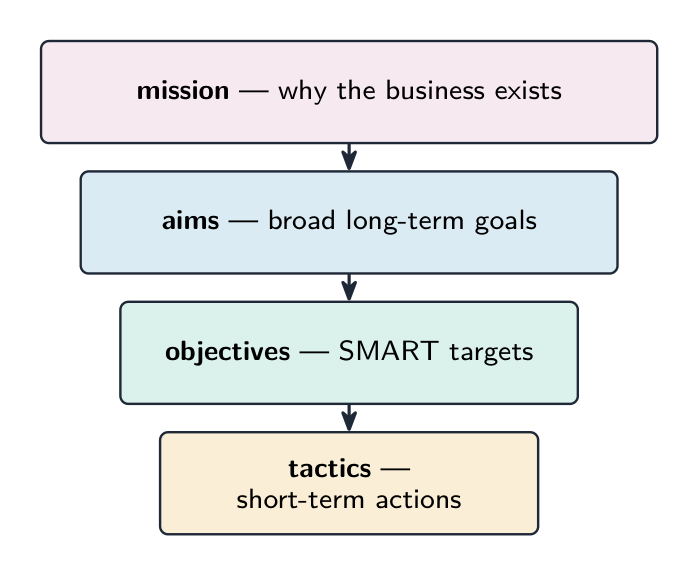
จากวิสัยทัศน์จะเกิด เป้าหมาย (Aims) ซึ่งเป็นเป้าหมายกว้างๆ ในระยะยาว และตามด้วย วัตถุประสงค์ (Objectives) ซึ่งเป็นเป้าหมายเฉพาะเจาะจงที่ช่วยให้บรรลุเป้าหมายเหล่านั้น

โครงสร้างแบบลำดับชั้นจากด้านบน: วิสัยทัศน์กว้างๆ นำไปสู่เป้าหมาย แล้วไปสู่วัตถุประสงค์ SMART ที่เฉพาะเจาะจง และสุดท้ายคือกลยุทธ์ระยะสั้น
เป้าหมายจะแคบลงและเฉพาะเจาะจงมากขึ้นตามลำดับ: วิสัยทัศน์กว้างๆ เปลี่ยนเป็นเป้าหมาย วัตถุประสงค์ SMART และกลยุทธ์รายวัน

วัตถุประสงค์ที่ดีควรมีคุณสมบัติ SMART — ซึ่งตัวอักษรแรกๆ ของคำเหล่านี้คือ:

  • เฉพาะเจาะจง (Specific) — ชัดเจนและแม่นยำ
  • วัดผลได้ (Measurable) — สามารถตรวจสอบด้วยตัวเลขได้
  • ทำได้จริง (Achievable) — เป็นไปได้ที่จะบรรลุถึง
  • สมเหตุสมผล (Realistic) — เหมาะสมกับทรัพยากรที่มีอยู่
  • มีกำหนดเวลา (Time-bound) — มีกำหนดเวลาสิ้นสุดชัดเจน

กลยุทธ์ (Strategy) คือแผนระยะยาวเพื่อบรรลุวัตถุประสงค์ ส่วน กลยุทธ์ย่อย (Tactics) คือการกระทำระยะสั้นที่ดำเนินการตามกลยุทธ์ วัตถุประสงค์ถูกกำหนดโดยขนาดและอายุของบริษัท ผู้เป็นเจ้าของ วัฒนธรรมองค์กร และสภาพตลาด

Explore · ⁨สำรวจ⁩

Business objectives lab · ⁨ห้องปฏิบัติการวัตถุประสงค์ทางธุรกิจ⁩

Match business examples to the objective they reveal. · ⁨จับคู่ตัวอย่างธุรกิจกับวัตถุประสงค์ที่แสดงออก⁩

Vocabulary · ⁨คำศัพท์⁩ Train · ⁨ฝึกฝน⁩
English ไทย
mission statement/ˈmɪʃn ˈsteɪtmənt/ คำประกาศวิสัยทัศน์/พันธกิจ (mission statement)
objectives/ɒbˈdʒektɪvz/ วัตถุประสงค์
specific/spəˈsɪfɪk/ เฉพาะเจาะจง
measurable/ˈmeʒərəbl/ วัดผลได้
achievable/əˈtʃiːvəbl/ ทำได้จริง
realistic/rɪəˈlɪstɪk/ สมจริง
time-bound/taɪm baʊnd/ กำหนดเวลา
strategy/ˈstrætədʒi/ กลยุทธ์
tactics/ˈtæktɪks/ ยุทธวิธี
1.4

Types of business objective · ⁨ประเภทของวัตถุประสงค์ทางธุรกิจ⁩

English
Objective What it means
profit maximisation 利润最大化 making the largest possible profit
growth getting bigger — more sales, more branches
survival 生存 staying in business, vital for new firms and in hard times
market share winning a larger share of the market
social and ethical 道德 objectives doing what is morally right, such as fair pay

Corporate social responsibility 企业社会责任 (CSR) is the idea that a business should act in the best interests of society and the environment, not just make profit. Examples are treating workers fairly, cutting pollution 污染, and helping the local community.

A firm's objectives can change over time. A new firm may aim to survive; later it may aim to grow; a large, safe firm may focus on profit or CSR.

ไทย
วัตถุประสงค์ ความหมาย
ทำกำไรสูงสุด (profit maximisation) การสร้างกำไรให้ได้มากที่สุดเท่าที่จะเป็นไปได้
การเติบโต (growth) การขยาย规模 — มียอดขายเพิ่มขึ้น สาขาเพิ่มขึ้น
การดำรงชีวิต (survival) การดำเนินกิจการต่อไป สำคัญมากสำหรับบริษัทใหม่และในช่วงวิกฤต
ส่วนแบ่งตลาด (market share) การชนะส่วนแบ่งตลาดที่ใหญ่ขึ้น
วัตถุประสงค์ด้านสังคมและ จริยธรรม (social and ethical objectives) การกระทำที่ถูกต้องตามหลักศีลธรรม เช่น การจ่ายค่าจ้างที่เป็นธรรม
การทดสอบความเหมาะสมของวัตถุประสงค์ที่ดี: เฉพาะเจาะจง, วัดผลได้, ทำได้จริง, สมเหตุสมผล, มีกำหนดเวลา
วัตถุประสงค์แบบ SMART: เฉพาะเจาะจง, วัดผลได้, ทำได้จริง, สมเหตุสมผล, มีกำหนดเวลา

ความรับผิดชอบทางสังคมขององค์กร (Corporate social responsibility - CSR) คือแนวคิดที่ว่าธุรกิจควรดำเนินการเพื่อผลประโยชน์ของสังคมและสิ่งแวดล้อม ไม่ใช่แค่การทำกำไร ตัวอย่างเช่น การปฏิบัติต่อพนักงานอย่างยุติธรรม การลด มลพิษ และการช่วยเหลือชุมชนท้องถิ่น

วัตถุประสงค์ของบริษัทสามารถเปลี่ยนแปลงไปตามเวลา บริษัทใหม่อาจมุ่งเน้นการดำรงชีวิต; ในภายหลังอาจมุ่งเน้นการเติบโต; บริษัทขนาดใหญ่ที่มีความมั่นคงอาจโฟกัสที่กำไรหรือ CSR

Vocabulary · ⁨คำศัพท์⁩ Train · ⁨ฝึกฝน⁩
English ไทย
profit/ˈprɒfɪt/ profit
market share/ˈmɑːkɪt ʃeə/ ส่วนแบ่งตลาด
profit maximisation/ˈprɒfɪt ˌmæksɪmaɪˈzeɪʃn/ การทำกำไรสูงสุด
survival/səˈvaɪvl/ การอยู่รอด
ethical/ˈeθɪkl/ จริยธรรม
corporate social responsibility/ˈkɔːpərət ˈsəʊʃl rɪˌspɒnsəˈbɪlɪti/ ความรับผิดชอบทางสังคมขององค์กร (corporate social responsibility)
pollution/pəˈluːʃn/ มลพิษ
1.5

Stakeholders · ⁨ผู้มีส่วนได้เสีย (Stakeholders)⁩

Syllabus · ⁨หลักสูตร⁩
English
  1. identify internal and external stakeholders and their objectives
  2. explain how and why the objectives of stakeholders may conflict and how conflicts can be managed
ไทย
  1. ระบุ internal stakeholders และ external stakeholders พร้อมวัตถุประสงค์ของแต่ละฝ่าย
  2. อธิบายว่าทำไมและอย่างไรที่วัตถุประสงค์ของผู้มีส่วนได้ส่วนเสียอาจขัดแย้งกัน以及如何 manage ความขัดแย้งเหล่านั้น

Source: Cambridge International syllabus · ⁨แหล่งที่มา: หลักสูตร Cambridge International⁩

English

A stakeholder 利益相关者 is any person or group with an interest in a business and how well it does.

Internal stakeholders 内部利益相关者 are inside the business:

  • owners and shareholders — want profit and a good return.
  • managers 管理者 — want growth, job security and bonuses.
  • employees — want fair pay, safe work and job security.

External stakeholders 外部利益相关者 are outside the business:

Stakeholder Main objective
customers 顾客 good quality at a fair price
suppliers 供应商 regular orders, paid on time
lenders 贷款方 (banks) to be repaid with interest
the government tax, jobs, and that the firm obeys the law
local community jobs, but little pollution or noise
pressure groups 压力团体 to protect a cause, such as the environment

Why stakeholder objectives conflict

Stakeholders often want different things, so their objectives can conflict 冲突 (clash). For example:

  • owners want higher profit, but employees want higher pay — and higher pay lowers profit.
  • customers want low prices, but owners want a high profit margin.
  • the local community wants less pollution, but cutting pollution can raise costs.

How conflict can be managed

  • keep good communication with every group.
  • compromise 妥协 — give each group part of what it wants.
  • negotiation 谈判 — talk until the groups reach an agreement.
  • decide which stakeholders matter most for each decision, and act on that.
ไทย

ผู้มีส่วนได้เสีย (stakeholder) คือบุคคลหรือกลุ่มคนใด ๆ ที่มีผลประโยชน์ในธุรกิจและผลการดำเนินงานของธุรกิจนั้น

แผนที่ผู้มีส่วนได้เสีย โดยธุรกิจอยู่ที่ศูนย์กลาง ล้อมรอบด้วยผู้มีส่วนได้เสียภายใน (เจ้าของ ผู้จัดการ พนักงาน) และภายนอก (ลูกค้า ผู้จัดจำหน่าย ผู้ให้กู้ รัฐบาล ชุมชน กลุ่มกดดัน)
ผู้มีส่วนได้เสียภายในและภายนอกทุกคนล้วนมีความสนใจในธุรกิจ

ผู้มีส่วนได้เสียภายใน (Internal stakeholders) อยู่ภายในธุรกิจ:

  • เจ้าของ (owners) และผู้ถือหุ้น — ต้องการกำไรและการผลตอบแทนที่ดี
  • ผู้จัดการ (managers) — ต้องการการเติบโต ความมั่นคงในหน้าที่งาน และโบนัส
  • พนักงาน — ต้องการค่าจ้างที่เป็นธรรม สภาพการทำงานปลอดภัย และความมั่นคงในหน้าที่งาน

ผู้มีส่วนได้เสียภายนอก (External stakeholders) อยู่ภายนอกธุรกิจ:

ผู้มีส่วนได้เสีย วัตถุประสงค์หลัก
ลูกค้า (customers) คุณภาพดีในราคาที่เป็นธรรม
ผู้จัดจำหน่าย (suppliers) คำสั่งซื้อสม่ำเสมอ และชำระเงินตรงเวลา
ผู้ให้กู้ (lenders) (ธนาคาร) ต้องการได้รับเงินต้นพร้อมดอกเบี้ยคืน
รัฐบาล taxpayar, สร้างงาน และให้บริษัทปฏิบัติตามกฎหมาย
ชุมชนท้องถิ่น งาน แต่ไม่มีการปล่อยมลพิษหรือเสียงรบกวนมากนัก
กลุ่มกดดัน (pressure groups) เพื่อปกป้องประเด็นสำคัญ เช่น สิ่งแวดล้อม

เหตุผลที่วัตถุประสงค์ของผู้มีส่วนได้เสียขัดแย้งกัน

ผู้มีส่วนได้เสียบ่อยครั้งต้องการสิ่งที่ไม่เหมือนกัน ดังนั้นวัตถุประสงค์ของพวกเขาจึงอาจ ขัดแย้ง (conflict) (ปะทะกัน) ตัวอย่างเช่น:

  • เจ้าของต้องการกำไรสูงขึ้น แต่พนักงานต้องการค่าจ้างสูงขึ้น — และการเพิ่มค่าจ้างจะทำให้กำไรลดลง
  • ลูกค้าต้องการราคาส่งต่ำ แต่เจ้าของต้องการอัตรากำไรสูง
  • ชุมชนท้องถิ่นต้องการลดมลพิษ แต่การลดมลพิษอาจทำให้ต้นทุนเพิ่มขึ้น

วิธีการจัดการความขัดแย้ง

  • รักษาการสื่อสารที่ดีกับทุกกลุ่ม
  • การประนีประนอม (compromise) — ให้แต่ละกลุ่มได้รับบางส่วนสิ่งที่พวกเขาต้องการ
  • การเจรจาต่อรอง (negotiation) — พูดคุยจนกว่ากลุ่มต่างๆ จะ達成 agreement ได้
  • ตัดสินใจว่าผู้มีส่วนได้เสียกลุ่มใดสำคัญที่สุดสำหรับแต่ละการตัดสินใจ และดำเนินการตามนั้น
Explore · ⁨สำรวจ⁩

Stakeholder interest lab · ⁨ห้องปฏิบัติการความสนใจของผู้มีส่วนได้ส่วนเสีย⁩

See how different stakeholders judge the same business decision. · ⁨ดูว่าผู้มีส่วนได้ส่วนเสียแต่ละกลุ่มตัดสินการตัดสินใจทางธุรกิจเดียวกันอย่างไร⁩

Vocabulary · ⁨คำศัพท์⁩ Train · ⁨ฝึกฝน⁩
English ไทย
stakeholder/ˈsteɪkhəʊldə/ ผู้มีส่วนได้เสีย
internal stakeholders/ɪnˈtɜːnl ˈsteɪkhəʊldəz/ ผู้มีส่วนได้เสียภายใน
external stakeholders/ekˈstɜːnl ˈsteɪkhəʊldəz/ ผู้มีส่วนได้เสียภายนอก
managers/ˈmænɪdʒəz/ ผู้จัดการ
customers/ˈkʌstəməz/ ลูกค้า
suppliers/səˈplaɪəz/ ผู้ขาย
lenders/ˈlendəz/ ผู้ให้กู้
pressure groups/ˈpreʃə ɡruːps/ กลุ่มกดดัน
conflict/ˈkɒnflɪkt/ ความขัดแย้ง
compromise/ˈkɒmprəmaɪz/ การประนีประนอม
negotiation/nɪˌɡəʊʃɪˈeɪʃn/ การเจรจา
1.5

Exam tips · ⁨ข้อแนะนำสำหรับการสอบ⁩

English
  • Define added value $=$ selling price $-$ cost of bought-in inputs, and give a way to raise it (branding, quality, design).
  • Distinguish unlimited vs limited liability and link it to sole trader/partnership versus Ltd/plc.
  • Measure business size in more than one way (employees, revenue, capital employed, market share) — note each has limits.
  • Distinguish objectives (SMART, specific) from a mission (overall purpose).
  • In evaluation, use stakeholder conflicts (owners vs employees vs community) to argue both sides.
ไทย
  • นิยาม มูลค่าเพิ่ม (added value) $=$ ราคาขาย $-$ ต้นทุนของวัตถุดิบที่ซื้อเข้ามา และเสนอวิธีการเพิ่มมัน (การสร้างแบรนด์, คุณภาพ, การออกแบบ)
  • แยกแยะ ความรับผิดไม่จำกัด vs ความรับผิดจำกัด (unlimited vs limited liability) และเชื่อมโยง它与 sole trader/partnership versus Ltd/plc
  • วัดขนาดธุรกิจ (business size) ด้วยหลายวิธี (จำนวนพนักงาน, รายได้, ทุนที่ใช้ในการผลิต, ส่วนแบ่งตลาด) — หมายเหตุว่าแต่ละวิธีมีข้อจำกัด
  • แยกแยะ วัตถุประสงค์ (objectives) (SMART, เฉพาะเจาะจง) ออกจาก วิสัยทัศน์ (mission) (วัตถุประสงค์โดยรวม)
  • ในการประเมินผล ใช้ ความขัดแย้งของผู้มีส่วนได้เสีย (เจ้าของ vs พนักงาน vs ชุมชน) เพื่อถกเถียงทั้งสองฝ่าย
Vocabulary · ⁨คำศัพท์⁩ Train · ⁨ฝึกฝน⁩
English ไทย
limited liability/ˈlɪmɪtɪd ˌlaɪəˈbɪlɪti/ ความรับผิดจำกัด
unlimited liability/ʌnˈlɪmɪtɪd ˌlaɪəˈbɪlɪti/ ความรับผิดไม่จำกัด
separate legal identity/ˈseprət ˈliːɡl aɪˈdentɪti/ separate legal identity
employees/emˈplɔɪiːz/ พนักงาน
revenue/ˈrevənjuː/ รายได้
capital employed/ˈkæpɪtl emˈplɔɪd/ capital employed

Interactive lessons on this topic · ⁨บทเรียนเชิงโต้ตอบสำหรับหัวข้อนี้⁩

Work through it step by step, with instant-check exercises. · ⁨ทำทีละขั้นตอน พร้อมแบบฝึกหัดตรวจสอบผลทันที⁩

Past Papers · ⁨ข้อสอบย้อนหลัง⁩

More topics in A-Level Business · ⁨Business A-Level⁩ · ⁨หัวข้อเพิ่มเติมใน A-Level Business · ⁨Business A-Level⁩⁩

Log in or create account · ⁨เข้าสู่ระบบหรือสร้างบัญชี⁩

IGCSE, A-Level & AP