Skip to content · ⁨ข้ามไปยังเนื้อหา⁩

Immunity · ⁨ภูมิคุ้มกัน⁩

A-Level Biology · ⁨Biology A-Level⁩ · Topic 11 · ⁨หัวข้อ 11⁩

Video lesson for this topic · ⁨บทเรียนวิดีโอสำหรับหัวข้อนี้⁩ Open the video page · ⁨เปิดหน้าวิดีโอ⁩
8:37

ภูมิคุ้มกัน

เป็นโรคหัดจีนครั้งเดียวแล้วคุณจะไม่มีวันเป็นอีก. ร่างกายไม่ได้แข็งแรงขึ้น และไวรัสไม่ได้อ่อนแอลง. มีอะไรเปลี่ยนไป…

English narration · English + 中文 subtitles burned in · ⁨การบรรยายภาษาอังกฤษ · คำบรรยายภาษาอังกฤษ + 中文 ลอยตัวบนภาพ⁩

11.1

Phagocytes — the first defence · ⁨Phagocytes — การป้องกันขั้นแรก⁩

Syllabus · ⁨หลักสูตร⁩
English
  1. describe the mode of action of phagocytes (macrophages and neutrophils)
  2. explain what is meant by an antigen (see 4.1.3) and state the difference between self antigens and non-self antigens
  3. describe the sequence of events that occurs during a primary immune response with reference to the roles of: • macrophages • B-lymphocytes, including plasma cells • T-lymphocytes, limited to T-helper cells and T-killer cells
  4. explain the role of memory cells in the secondary immune response and in long-term immunity
ไทย
  1. อธิบายกลไกการทำงานของ phagocytes (macrophages และ neutrophils)
  2. อธิบายความหมายของ antigen (ดู 4.1.3) และระบุความแตกต่างระหว่าง self antigens กับ non-self antigens
  3. อธิบายลำดับเหตุการณ์ที่เกิดขึ้นใน primary immune response โดยอ้างอิงถึงบทบาทของ: • macrophages • B-lymphocytes รวมถึง plasma cells • T-lymphocytes ซึ่งจำกัดอยู่ที่ T-helper cells และ T-killer cells
  4. อธิบายบทบาทของ memory cells ใน secondary immune response และภูมิคุ้มกันระยะยาว

Source: Cambridge International syllabus · ⁨แหล่งที่มา: หลักสูตร Cambridge International⁩

English

Your immune system 免疫系统 is the set of cells that defends the body against pathogens 病原体. The first cells to act are phagocytes 吞噬细胞, a group of white blood cells that includes macrophages 巨噬细胞 and neutrophils 中性粒细胞.

A phagocyte destroys a pathogen by phagocytosis 吞噬作用: it surrounds the pathogen, takes it inside in a vesicle, and digests it with enzymes. After this, a macrophage displays parts of the pathogen on its own surface, ready to alert other immune cells.

This false-coloured electron micrograph captures the moment in real life: a phagocyte reaching out to grab and engulf rod-shaped bacteria.

ไทย

ระบบภูมิคุ้มกัน ของคุณคือชุดเซลล์ที่ปกป้องร่างกายจาก เชื้อโรค เซลล์แรกที่เข้าทำงานคือ phagocytes, ซึ่งเป็นกลุ่มของเม็ดเลือดขาวที่ประกอบด้วย macrophages และ neutrophils.

A stained blood smear with red cells and several larger purple white blood cells
A blood smear: the large stained cells are white blood cells, scattered among the many red cells

Phagocyte ทำลายเชื้อโรค bằng phagocytosis: มันโอบล้อมเชื้อโรค นำเข้าไปภายในใน vesicle, และย่อยสลายด้วยเอนไซม์. หลังจากนั้น, macrophage แสดงส่วนหนึ่งของเชื้อโรคบนพื้นผิวของมันเอง พร้อมที่จะเตือนเซลล์ภูมิคุ้มกันอื่นๆ.

Three steps: a phagocyte engulfs a pathogen, digests it inside a vesicle with enzymes, then displays the pathogen's antigen on its surface
Phagocytosis: the phagocyte engulfs the pathogen, digests it, then displays its antigen

Micrograph นี้มีสีเทียมจับช่วงเวลาในชีวิตจริง: A phagocyte กำลังยื่นออกไปจับและ engulf rod-shaped bacteria.

A false-coloured scanning electron micrograph against a dark blue background: a yellow neutrophil with a ruffled surface stretching out finger-like projections to grasp several long, orange, rod-shaped anthrax bacteria
A real neutrophil (yellow), one kind of phagocyte, reaching out to engulf rod-shaped bacteria (orange) by phagocytosis
Explore · ⁨สำรวจ⁩

Phagocytosis · ⁨โฟเจโตซิส⁩

Step through how a phagocyte deals with a pathogen — engulf it, digest it, then display its antigen to call in the rest of the immune system. · ⁨อธิบายขั้นตอนที่โฟเจโอไซต์จัดการกับเชื้อโรค — ดูดกลืน, ย่อยสลาย, แล้วแสดงแอนติเจนเพื่อเรียกระบบภูมิคุ้มกันส่วนอื่นมาช่วย⁩

Vocabulary · ⁨คำศัพท์⁩ Train · ⁨ฝึกฝน⁩
English ไทย
pathogen/ˈpæθədʒn/ เชื้อโรค
phagocyte/ˈfæɡəsaɪt/ ฟาโกไซต์
macrophage/ˈmækrəfɪdʒ/ macrophage
neutrophil/ˈnjuːtrəfɪl/ นิวโทรฟิล
phagocytosis/ˌfæɡəsɪˈtəʊsɪs/ โฟเจโตซิส
antigen/ˈæntɪdʒen/ antigen
11.1

Antigens: self and non-self · ⁨Antigens: Self และ Non-self⁩

English

An antigen 抗原 is a molecule (usually a protein) on a cell surface that the immune system can recognise.

  • self antigens 自身抗原 are the body's own markers. The immune system learns to ignore them.
  • non-self antigens 非自身抗原 are foreign, for example the antigens on a pathogen. These trigger an immune response.
ไทย

Antigen เป็นโมเลกุล (มักจะเป็นโปรตีน) บนพื้นผิวเซลล์ที่ระบบภูมิคุ้มกันสามารถจดจำได้.

  • self antigens คือเครื่องหมายของร่างกายเรา ระบบภูมิคุ้มกันเรียนรู้ที่จะเพิกเฉยต่อมัน.
  • non-self antigens คือสิ่งแปลกปลอม ตัวอย่างเช่น antigens บนเชื้อโรค สิ่งเหล่านี้กระตุ้นการตอบสนองทางภูมิคุ้มกัน.
Clear zones on a culture plate: the immune system recognises non-self antigens and attacks foreign cells
Vocabulary · ⁨คำศัพท์⁩ Train · ⁨ฝึกฝน⁩
English ไทย
immune system/ɪˈmjuːn ˈsɪstəm/ ระบบภูมิคุ้มกัน
self antigen/self ˈæntɪdʒen/ แอนติเจนตัวเอง (self antigen)
non-self antigen/nɒn self ˈæntɪdʒen/ แอนติเจนต่างด้าว (non-self antigen)
11.1

The primary immune response

English

The first time a new pathogen enters, the body makes a slow immune response 免疫反应. The main steps are:

  1. a macrophage engulfs the pathogen and displays its antigen.
  2. T-helper cells 辅助性T细胞 recognise that antigen and become active. They release chemicals that switch on other cells.
  3. B-lymphocytes 淋巴细胞 with a matching shape are selected. They divide to form plasma cells 浆细胞, which pour out antibodies 抗体, and memory cells 记忆细胞.
  4. T-killer cells 杀伤性T细胞 destroy the body's own cells that have been infected.
ไทย

ครั้งแรกที่เชื้อโรคใหม่เข้าสู่ ร่างกายจะเกิด immune response ที่ช้า ขั้นตอนหลักๆ ได้แก่:

  1. A macrophage engulf เชื้อโรคและแสดง antigen ของมัน.
  2. T-helper cellsT จดจำ antigen นั้นและกลายเป็น active. They ปล่อยสารเคมีที่เปิดใช้งานเซลล์อื่นๆ.
  3. B-lymphocytes ที่มีรูปร่างตรงกันถูกเลือก. They แบ่งตัวเพื่อสร้าง plasma cells, ซึ่งหลั่ง antibodies, และ memory cells.
  4. T-killer cellsT ทำลายเซลล์ในร่างกายที่ถูกติดเชื้อแล้ว.
A flow from a macrophage presenting an antigen to an activated T-helper cell to a selected B-lymphocyte that divides into plasma cells (which make antibodies) and memory cells
เฉพาะ B-lymphocyte ที่มีรูปร่างตรงกับ antigen เท่านั้นที่ถูกเลือกและ clone — เป็น plasma cells ที่ผลิต antibodies และ memory cells ที่อยู่ได้นาน
Explore · ⁨สำรวจ⁩

The primary immune response · ⁨การตอบสนองของภูมิคุ้มกันขั้นต้น⁩

Step through the first time the body meets a pathogen — slow at first, but it leaves memory cells behind. · ⁨逐步浏览身体首次接触病原体的过程——起初较慢,但会留下记忆细胞。⁩

Vocabulary · ⁨คำศัพท์⁩ Train · ⁨ฝึกฝน⁩
English ไทย
immune response/ɪˈmjuːn rɪˈspɒns/ การตอบสนองทางภูมิคุ้มกัน
T-helper cell/tiː ˈhelpə sel/ T-helper cell
lymphocyte/ˈlɪmfəsaɪt/ ไลม์โฟไซต์
plasma cell/ˈplæzmə sel/ plasma cell
memory cell/ˈmeməri sel/ memory cell
T-killer cell/tiː ˈkɪlə sel/ เซลล์ T-killer
11.1

Memory cells and long-term immunity · ⁨Memory cells และภูมิคุ้มกันระยะยาว⁩

English

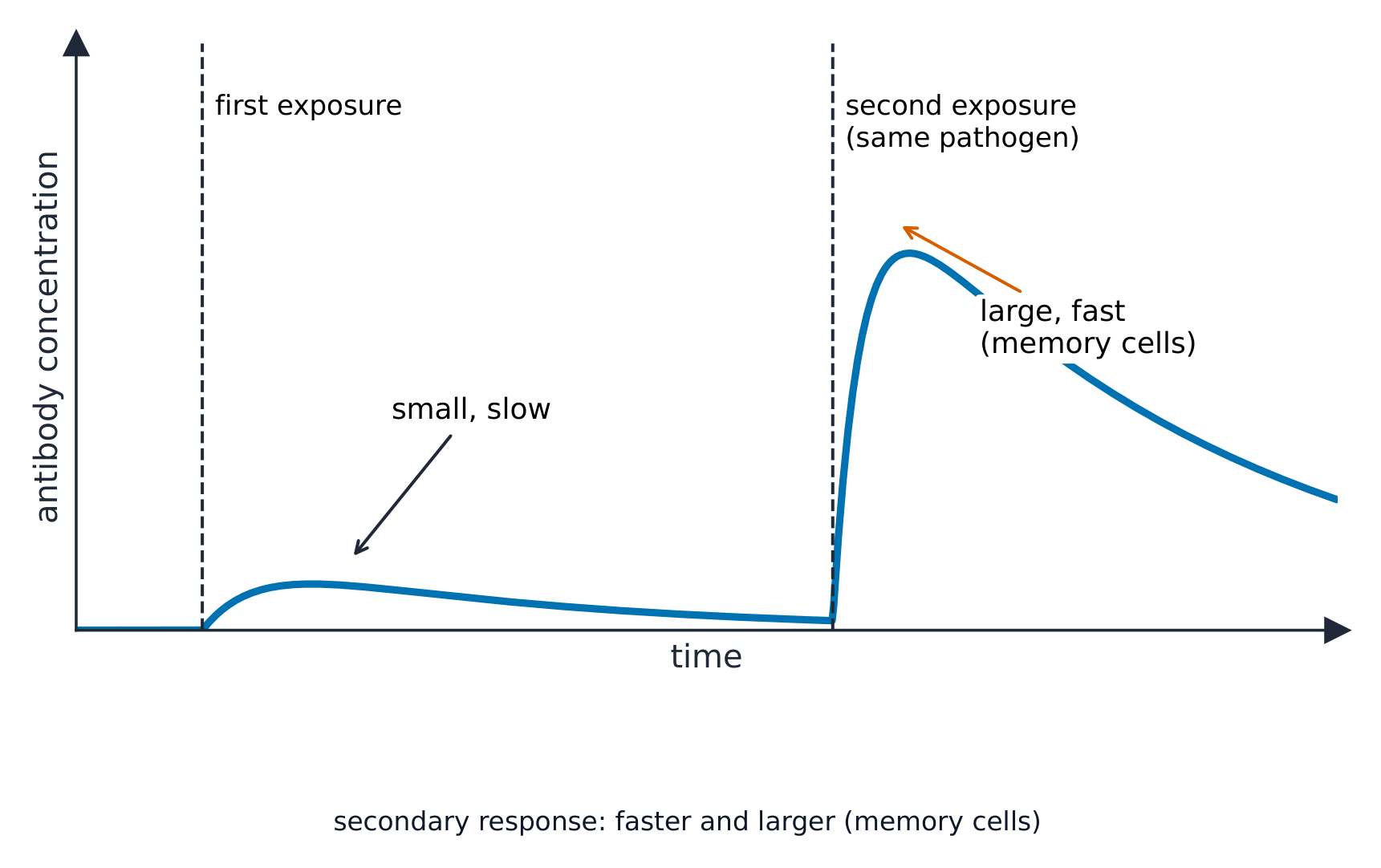
Memory cells stay in the body for years after the infection is over. If the same pathogen enters again, the memory cells start a secondary immune response that is much faster and larger than the first. The pathogen is destroyed before it can make you ill. This is what we mean by long-term immunity.

ไทย

Memory cells อยู่ในร่างกายเป็นเวลาหลายปีหลังการติดเชื้อสิ้นสุดลง. ถ้า same pathogen เข้ามาอีกครั้ง, Memory cells เริ่มต้น secondary immune response کهเร็วและมากกว่าครั้งก่อนมาก. เชื้อโรคจะถูกทำลายก่อนที่จะทำให้คุณเจ็บป่วย. นี่คือสิ่งที่เราหมายถึงภูมิคุ้มกันระยะยาว.

A graph of antibody concentration over time: a small slow rise after the first exposure, then a much larger faster rise after a second exposure to the same pathogen
The secondary response is faster and larger, because memory cells are ready
Vocabulary · ⁨คำศัพท์⁩ Train · ⁨ฝึกฝน⁩
English ไทย
antibody/ˈæntɪbɒdi/ แอนติบอดี
11.2

Antibodies

Syllabus · ⁨หลักสูตร⁩
English
  1. relate the molecular structure of antibodies to their functions
  2. outline the hybridoma method for the production of monoclonal antibodies
  3. outline the principles of using monoclonal antibodies in the diagnosis of disease and in the treatment of disease
  4. describe the differences between active immunity and passive immunity and between natural immunity and artificial immunity
  5. explain that vaccines contain antigens that stimulate immune responses to provide long-term immunity
  6. explain how vaccination programmes can help to control the spread of infectious diseases
ไทย
  1. เชื่อมโยงโครงสร้างโมเลกุลของ แอนติบอดี กับหน้าที่ของมัน
  2. อธิบาย hybridoma method สำหรับการผลิต monoclonal antibodies
  3. อธิบายหลักการการใช้ monoclonal antibodies ในการวินิจฉัยโรคและรักษาโรค
  4. อธิบายความแตกต่างระหว่าง active immunity กับ passive immunity และระหว่าง natural immunity กับ artificial immunity
  5. อธิบายว่า vaccines มีสารกระตุ้นภูมิคุ้มกันที่กระตุ้นการตอบสนองของระบบภูมิคุ้มกันเพื่อสร้างภูมิคุ้มกันระยะยาว
  6. อธิบายว่าโครงการฉีดวัคซีนสามารถช่วยควบคุมการแพร่ระบาดของโรคติดเชื้อได้อย่างไร

Source: Cambridge International syllabus · ⁨แหล่งที่มา: หลักสูตร Cambridge International⁩

English

An antibody is a Y-shaped protein made by plasma cells. The two tips of the Y are antigen-binding sites 抗原结合位点. Each site has a special shape, called the variable region 可变区, that fits one antigen only, like a lock and key.

Antibodies help in several ways: they stick to antigens, clump pathogens together so they are easier to deal with, mark pathogens so phagocytes find them, and block harmful toxins.

ไทย

Antibody เป็นโปรตีนรูปตัว Y ที่ผลิตโดย plasma cells. Two tips ของ Y คือ antigen-binding sites. แต่ละ site มีรูปร่างพิเศษเรียกว่า variable region, ที่เข้ากับ antigen เพียงตัวเดียว เปรียบเสมือนกุญแจและล็อก.

A Y-shaped antibody with an antigen fitting into each of the two tips, which are the variable regions that form the antigen-binding sites
An antibody is Y-shaped; the two tips are the variable regions that bind one specific antigen

Antibodies ช่วยได้ในหลายวิธี: They adheres to antigens, clump pathogens together so they are easier to deal with, mark pathogens so phagocytes find them, และ block harmful toxins.

Explore · ⁨สำรวจ⁩

Inside an antibody · ⁨ภายในแอนติบอดี⁩

Tap each part. The variable tips bind one specific antigen; the constant stem is the same in every antibody. · ⁨แตะแต่ละส่วน ปลายแปรผันจะจับกับแอนติเจนเฉพาะหนึ่งชนิด; ก้านคงที่เหมือนกันในทุกแอนติบอดี⁩

Vocabulary · ⁨คำศัพท์⁩ Train · ⁨ฝึกฝน⁩
English ไทย
antigen-binding site/ˈæntɪdʒen ˈbaɪndɪŋ saɪt/ ตำแหน่งจับแอนติเจน
variable region/ˈveərɪəbl ˈriːdʒn/ variable region
11.2

Monoclonal antibodies

English

A monoclonal antibody 单克隆抗体 is a single type of antibody, all identical. They are made by the hybridoma 杂交瘤 method:

  1. an animal is given an antigen, so it makes B-lymphocytes that produce the wanted antibody.
  2. these B-lymphocytes are fused with tumour cells, which divide endlessly.
  3. the fused cell (the hybridoma) both makes the antibody and divides without stopping, producing large amounts of one identical antibody.

Monoclonal antibodies are used in the diagnosis 诊断 of disease (to detect a specific molecule, as in a pregnancy test) and in treatment (to carry drugs to specific target cells, such as cancer cells).

ไทย

Monoclonal antibody เป็น antibody ประเภทเดียวทั้งหมดเหมือนกัน. They ผลิตโดยวิธีการ hybridoma :

  1. An animal receives an antigen, เพื่อให้มันสร้าง B-lymphocytes ที่ผลิต antibody ที่ต้องการ.
  2. B-ลิมโฟไซต์เหล่านี้ถูกหลอมรวมกับเซลล์มะเร็ง ซึ่งมีการแบ่งตัวอย่างไม่จำกัด
  3. เซลล์ที่หลอมรวมแล้ว (ไฮบริโดมา) จะสร้างแอนติบอดี และ แบ่งตัวโดยไม่หยุดยั้ง ผลิตแอนติบอดีชนิดเดียวกันในปริมาณมาก
B-ลิมโฟไซต์ที่ถูกหลอมรวมกับเซลล์มะเร็งเพื่อสร้างไฮบริโดมา ซึ่งทั้งสร้างแอนติบอดีที่ต้องการและแบ่งตัวอย่างไม่จำกัด ผลิตแอนติบอดีชนิดเดียวกันจำนวนมาก
การหลอมรวม B-ลิมโฟไซต์กับเซลล์มะเร็งจะสร้างไฮบริโดมาที่หลั่งแอนติบอดีชนิดเดียว (โมโนคลอนอล) ออกมาอย่างมหาศาล

แอนติบอดีโมโนคลอนอลถูกใช้ใน การวินิจฉัย โรค (เพื่อตรวจหาโมเลกุลเฉพาะ เช่น ในการทดสอบการตั้งครรภ์) และในการรักษา (เพื่อนำยาไปยังเซลล์เป้าหมายเฉพาะ เช่น เซลล์มะเร็ง)

คาสเซตต์ทดสอบการตั้งครรภ์ที่มีฉลาก hCG แสดงเส้นสีแดงสองเส้นข้างตัวอักษร C และ T
การทดสอบการตั้งครรภ์คือการทำงานของแอนติบอดีโมโนคลอนอล แอนติบอดีถูกยึดไว้ที่เส้น T และจับกับโมเลกุลเพียงชนิดเดียวเท่านั้น คือฮอร์โมนการตั้งครรภ์ hCG เส้น T จะเปลี่ยนเป็นสีแดงก็ต่อเมื่อมี hCG ในปัสสาวะ ส่วนเส้น C จะปรากฏเสมอเพื่อยืนยันว่าทดสอบได้ถูกต้อง
Vocabulary · ⁨คำศัพท์⁩ Train · ⁨ฝึกฝน⁩
English ไทย
monoclonal antibody/ˈmɒnəʊklɒnl ˈæntɪbɒdi/ monoclonal antibody
hybridoma/ˌhaɪbrɪˈdəʊmə/ hybridoma
diagnosis/ˌdaɪəɡˈnəʊsɪs/ การวินิจฉัย
active immunity/ˈæktɪv ɪˈmjuːnɪti/ ภูมิคุ้มกันเชิงรุก
11.2

Types of immunity · ⁨ประเภทของภูมิคุ้มกัน⁩

English

Immunity can be active or passive, and natural or artificial.

  • active immunity 主动免疫 — your own body meets an antigen and makes its own antibodies and memory cells. It is slow to start but long-lasting.
  • passive immunity 被动免疫 — ready-made antibodies are given to you from outside. It works at once but does not last, because there are no memory cells.
  • natural immunity 天然免疫 — gained in a natural way (active: after an infection; passive: antibodies passed from mother to baby).
  • artificial immunity 人工免疫 — gained on purpose (active: your body is made to respond to a safe dose of antigen; passive: you are injected with ready-made antibodies).
ไทย

ภูมิคุ้มกันสามารถเป็นแบบแอคทีฟหรือพาสซีฟ และเป็นแบบธรรมชาติหรือสังเคราะห์

  • ภูมิคุ้มกันแบบแอคทีฟ — ร่างกายของเราพบกับแอนติเจนและสร้างแอนติบอดีและเซลล์ความจำขึ้นเอง เริ่มช้าแต่คงอยู่ได้นาน
  • ภูมิคุ้มกันแบบพาสซีฟ — รับแอนติบอดีสำเร็จรูปจากภายนอกเข้ามา ใช้ผลได้ทันทีแต่ไม่持久的 เพราะไม่มีเซลล์ความจำ
  • ภูมิคุ้มกันแบบธรรมชาติ — ได้รับในรูปแบบธรรมชาติ (แบบแอคทีฟ: หลังติดเชื้อ; แบบพาสซีฟ: แอนติบอดีส่งต่อจากแม่สู่ลูก)
  • ภูมิคุ้มกันแบบสังเคราะห์ — ได้รับโดยเจตนา (แบบแอคทีฟ: ร่างกายถูกกระตุ้นให้ตอบสนองต่อยาต้านเชื้อโรคปลอดภัย; แบบพาสซีฟ: ฉีดยาแอนติบอดีสำเร็จรูป)
ตาราง 2x2 ของประเภทภูมิคุ้มกัน: active-natural หลังการติดเชื้อ, active-artificial通过对 vaccine, passive-natural จากแม่สู่ลูก, passive-artificial通过对 injection
ภูมิคุ้มกันแบบแอคทีฟ (ร่างกายตอบสนอง) ยาวนาน; ภูมิคุ้มกันแบบพาสซีฟ (แอนติบอดีสำเร็จรูป) เร็วแต่สั้น
Vocabulary · ⁨คำศัพท์⁩ Train · ⁨ฝึกฝน⁩
English ไทย
vaccine/vækˈsiːn/ วัคซีน
vaccination/ˌvæksɪˈneɪʃn/ การฉีดวัคซีน
11.2

Vaccination · ⁨การฉีดวัคซีน⁩

English

A vaccine 疫苗 contains antigens — often a dead or weakened pathogen, or part of one. The antigens trigger a primary immune response and make memory cells, so you gain long-term immunity without becoming ill.

Vaccination 疫苗接种 programmes can control the spread of a disease across a population. If enough people are vaccinated, the pathogen cannot pass easily from person to person. This protects even the people who are not vaccinated, an effect called herd immunity 群体免疫.

Worked example. Classify each as active or passive, natural or artificial: (a) a baby receives antibodies in breast milk; (b) a child is vaccinated against measles; (c) someone recovers from chickenpox; (d) a patient bitten by a snake is given antivenom. Ask two questions each time. Did the person make the antibodies themselves? If yes it is active; if they were handed ready-made ones, it is passive. Did it happen by chance or deliberately? Naturally, or artificially. So (a) is natural passive - ready-made antibodies by a natural route; (b) is artificial active - the vaccine's antigens make the child produce their own; (c) is natural active - the infection made them produce their own; (d) is artificial passive - ready-made antibodies given deliberately. Only active immunity makes memory cells, which is exactly why passive immunity acts immediately but is short-lived.

ไทย

วัคซีน มีแอนติเจน — มักเป็นเชื้อโรคที่ตายแล้วหรืออ่อนกำลังลง หรือส่วนหนึ่งของเชื้อ แอนติเจนจะกระตุ้นการตอบสนองทางภูมิคุ้มกันระดับแรกและสร้างเซลล์ความจำ ทำให้เราได้รับภูมิคุ้มกันระยะยาว โดยไม่ เป็นโรค

โครงการฉีดวัคซีน สามารถควบคุมการแพร่ระบาดของโรคในประชากร หากมีคนรับวัคซีนเพียงพอ เชื้อโรคจะไม่สามารถแพร่กระจายได้ง่ายจากบุคคลหนึ่งไปยังอีกบุคคลหนึ่ง สิ่งนี้ปกป้องแม้ผู้ที่ไม่ได้รับวัคซีน ซึ่งเป็นผลที่เรียกว่า ภูมิคุ้มกันกลุ่ม

บุคคลที่ติดเชื้อซึ่งการแพร่ disease ถูกกั้นด้วยกลุ่มผู้ได้รับวัคซีน ทำให้บุคคลที่ไม่ได้รับวัคซีนที่อยู่ใกล้เคียงได้รับการปกป้อง
ภูมิคุ้มกันกลุ่ม: เมื่อมีคนรับวัคซีนเพียงพอ เชื้อโรคจะไม่สามารถเข้าถึงกลุ่มคนที่เหลือไม่ได้รับวัคซีนได้

ตัวอย่างวิธีทำ. จำแนกแต่ละข้อว่าเป็นแบบแอคทีฟหรือพาสซีฟ ธรรมชาติหรือสังเคราะห์: (ก) ทารกได้รับแอนติบอดีในน้ำนมแม่; (ข) เด็กได้รับวัคซีนป้องกันหัดเยอรมัน; (ค) ผู้ป่วยหายจากไข้สุกใส; (ง) ผู้ป่วยถูกงูกัดและได้รับสารต้านพิษ Ask two questions each time. Did the person make the antibodies themselves? If yes it is active; if they were handed ready-made ones, it is passive. Did it happen by chance or deliberately? Naturally, or artificially. So (a) is natural passive - ready-made antibodies by a natural route; (b) is artificial active - the vaccine's antigens make the child produce their own; (c) is natural active - the infection made them produce their own; (d) is artificial passive - ready-made antibodies given deliberately. Only active immunity makes memory cells, which is exactly why passive immunity acts immediately but is short-lived.

Explore · ⁨สำรวจ⁩

How a vaccine works · ⁨วิธีที่วัคซีนทำงาน⁩

Step through it. A vaccine triggers a primary response and memory cells, so the real pathogen meets a fast, strong defence. · ⁨ไล่ขั้นตอนให้ดู วัคซีนกระตุ้นการตอบสนองปฐมภูมิและ memory cells ทำให้เชื้อโรคจริงเจอการป้องกันที่รวดเร็วและรุนแรง⁩

Vocabulary · ⁨คำศัพท์⁩ Train · ⁨ฝึกฝน⁩
English ไทย
passive immunity/ˈpæsɪv ɪˈmjuːnɪti/ ภูมิคุ้มกันเชิงรับ
natural immunity/ˈnætʃərəl ɪˈmjuːnɪti/ ภูมิคุ้มกันตามธรรมชาติ
artificial immunity/ˌɑːtɪˈfɪʃl ɪˈmjuːnɪti/ ภูมิคุ้มกันที่สร้างขึ้นเอง
herd immunity/hɜːd ɪˈmjuːnɪti/ ภูมิคุ้มกันกลุ่ม
11.2

Exam tips · ⁨ข้อแนะนำสำหรับการสอบ⁩

English
  • Distinguish phagocytes (engulf, non-specific) from lymphocytes: B cells → antibodies (humoral), T cells (helper/killer, cell-mediated).
  • Label an antibody (variable region, antigen-binding site) and explain agglutination and neutralisation.
  • Compare the primary and secondary response on a graph — memory cells make the secondary faster and larger.
  • Distinguish active vs passive and natural vs artificial immunity with an example of each; explain vaccination and herd immunity.
ไทย
  • แยกแยะ ฟากোসایت (กลืนกิน, ไม่จำเพาะ) จากลิมโฟไซต์: เซลล์ B → แอนติบอดี (แบบ体液), เซลล์ T (ช่วย/ฆ่า, แบบ cell-mediated).
  • ชี้ตำแหน่ง แอนติบอดี (บริเวณแปรผัน, สถานที่จับแอนติเจน) อธิบายการเกาะกลุ่มและการระงับฤทธิ์
  • เปรียบเทียบ การตอบสนองระดับแรกและระดับที่สอง บนกราฟ — เซลล์ความจำทำให้การตอบสนองระดับที่สองเร็วขึ้นและมีปริมาณมากขึ้น
  • แยกแยะ ภูมิคุ้มกันแบบแอคทีฟ vs พาสซีฟ และ ธรรมชาติ vs สังเคราะห์ พร้อมตัวอย่างของแต่ละประเภท อธิบายการฉีดวัคซีนและภูมิคุ้มกันกลุ่ม

Interactive lessons on this topic · ⁨บทเรียนเชิงโต้ตอบสำหรับหัวข้อนี้⁩

Work through it step by step, with instant-check exercises. · ⁨ทำทีละขั้นตอน พร้อมแบบฝึกหัดตรวจสอบผลทันที⁩

Past Papers · ⁨ข้อสอบย้อนหลัง⁩

More topics in A-Level Biology · ⁨Biology A-Level⁩ · ⁨หัวข้อเพิ่มเติมใน A-Level Biology · ⁨Biology A-Level⁩⁩

Log in or create account · ⁨เข้าสู่ระบบหรือสร้างบัญชี⁩

IGCSE, A-Level & AP