Skip to content · ⁨Перейти к содержанию⁩
Subjects · ⁨Предметы⁩

English Grammar · B2 · ⁨Англійська граматика · B2⁩

  • 1 Narrative tenses · ⁨Нарративные времена⁩
    1.1

    Простое прошедшее и Прошедшее длительное

    English

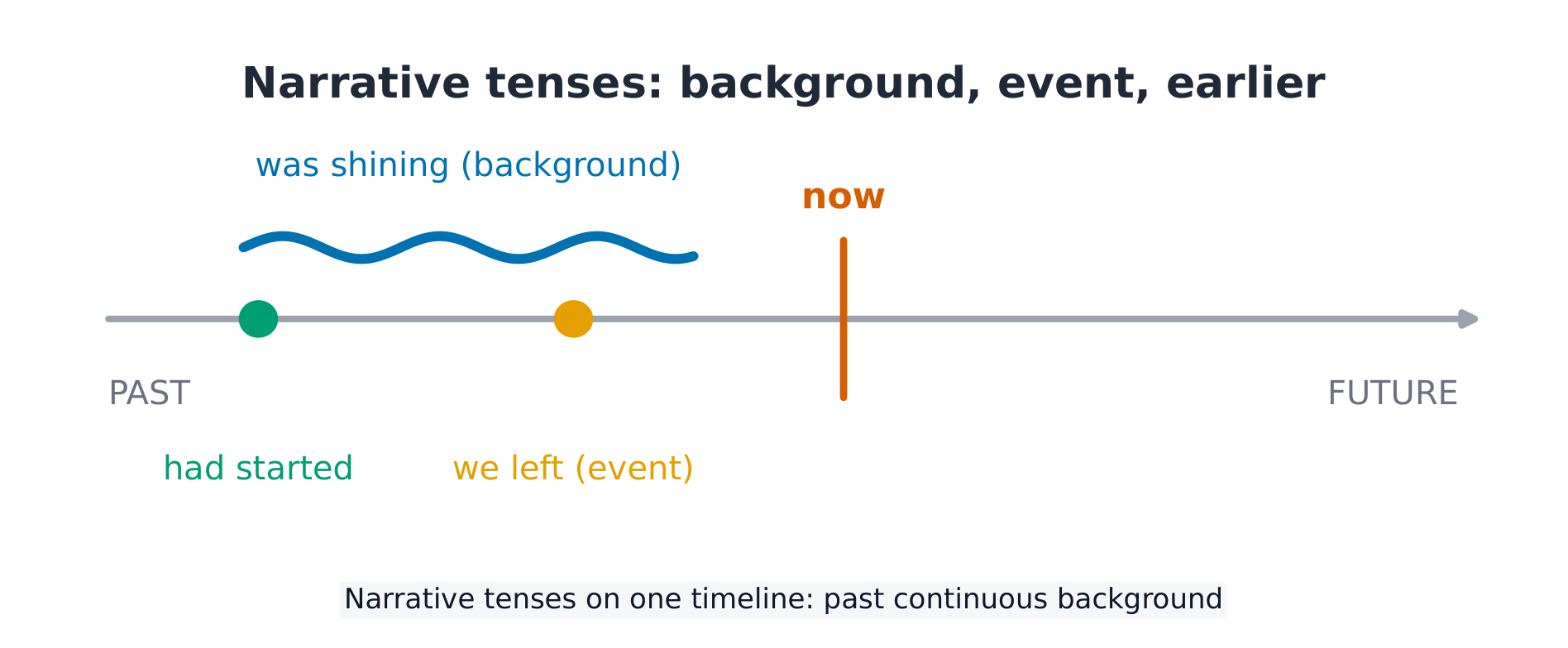
    When telling stories, English uses a set of narrative tenses in combination. The most basic two are:

    • Simple Past: The main actions that advance the plot (one after another).
    • Past Continuous: Setting the background, describing what was happening at that time.

    (冠词)The 太阳sun (过去进行)was 照耀shining 当...时when 我们we 出发left.

    We set off while the sun was shining brightly. (Background + main action)

    她She (过去进行)was 做饭cooking 当...时when (冠词)the 电话phone 响了rang.

    Her phone rang while she was cooking.

    Note A long background action uses the past continuous (was cooking); a short action interrupting it uses the simple past (rang).
    Русский
    Времена повествования: фон, событие, более раннее

    При повествовании в английском используется набор нарративных времен (narrative tenses), которые применяются совместно. Два самых базовых из них:

    • Простое прошедшее: основные действия, продвигающие сюжет (одно за другим).
    • Прошедшее длительное: создание фона, описание того, что происходило в данный момент.

    (冠词)The 太阳sun (过去进行)was 照耀shining 当...时when 我们we 出发left.

    Когда мы тронулись в путь, солнце ярко светило. (Фон + основное действие)

    她She (过去进行)was 做饭cooking 当...时when (冠词)the 电话phone 响了rang.

    Телефон звонил, пока она готовила еду.

    Внимание: длительное фоновое действие выражается Past Continuous (was cooking); короткое действие, прерывающее его, — Simple Past (rang).

    1.2

    Прошедшее совершенное для обозначения более раннего прошлого

    English

    To indicate an action that occurred before another past action, use the past perfect (had + past participle).

    当...时When 我们we 到达arrived (冠词), the 电影film (过去完成)had 已经already 开始started.

    By the time we arrived, the film had already started. (Started first, arrived later)

    Combination in Narrative:

    • Earliest → Past Perfect (had started).
    • Later → Simple Past (arrived).
    • Background → Past Continuous (was raining).

    Note These three tenses combined clearly convey the timeline of a story.

    Русский

    Если нужно показать, что одно действие произошло до другого действия в прошлом, используется Past Perfect (had + причастие прошедшего времени).

    当...时When 我们we 到达arrived (冠词), the 电影film (过去完成)had 已经already 开始started.

    Когда мы приехали, фильм уже начался. (Сначала начался, потом приехали)

    Сочетание в повествовании:

    • Самое раннее → Past Perfect (had started).
    • Позже → Simple Past (arrived).
    • Фон → Past Continuous (was raining).

    Обратите внимание: Использование этих трех времен вместе позволяет четко передать временные слои истории.

    1.3

    Прошедшее совершенное продолженное

    English

    The past perfect continuous (had been + V-ing) emphasizes an action that continued up until a specific point in the past.

    她She (过去)was 累tired 因为because 她she (过去完成)had (进行)been 工作working 一整天all day.

    She was tired because she had been working all day.

    Difference from Past Perfect:

    • Past Perfect Continuous: Emphasizes the continuous process / duration (had been working — kept doing it).
    • Past Perfect: Emphasizes completion / result (had finished — got it done).

    Note Stative verbs (know, be) do not take the continuous form: use had known, not ~~had been knowing~~.

    Common Errors

    • ❌ ~~When the phone rang, she cooked dinner.~~ (Meaning: "was cooking") → ✓ …she was cooking dinner. — Using simple past implies she started cooking after the phone rang.
    • ❌ ~~While I walked home, I was meeting a friend.~~ → ✓ While I was walking home, I met a friend. — Long background actions use continuous tense; short actions use simple past. Do not reverse this.
    • ❌ ~~She had finished the report, then she had sent it.~~ → ✓ She finished the report, then sent it. — When narrating in chronological order, simple past is sufficient; past perfect is only used to look back at an earlier event.
    • ❌ ~~It was the first time I saw snow.~~ → ✓ It was the first time I had seen snow. — "First time" in past narration requires past perfect.
    Русский

    Past Perfect Continuous (had been + V-ing) подчеркивает действие, которое длительно продолжалось до определенного момента в прошлом.

    她She (过去)was 累tired 因为because 她she (过去完成)had (进行)been 工作working 一整天all day.

    Она очень устала, потому что работала весь день.

    Отличие от Past Perfect:

    • Past Perfect Continuous: акцент на процессе / длительности (had been working — работал все это время).
    • Past Perfect: акцент на завершении / результате (had finished — закончил работать).

    Внимание: глаголы состояния (know, be) не используются в Continuous: говорят had known, а не ~~had been knowing~~.

    Частые ошибки

    • ❌ ~~When the phone rang, she cooked dinner.~~ (хотел сказать «она готовила ужин») → ✓ …she was cooking dinner. — Использование Simple Past изменит смысл на «она начала готовить ужин только после того, как позвонил телефон».
    • ❌ ~~While I walked home, I was meeting a friend.~~ → ✓ While I was walking home, I met a friend. — Длительное фоновое действие выражается Continuous, краткое действие — Past Simple, не перепутайте местами.
    • ❌ ~~She had finished the report, then she had sent it.~~ → ✓ She finished the report, then sent it. — При повествовании в хронологическом порядке достаточно простого прошедшего времени; Past Perfect используется только для «возврата» к событиям, произошедшим раньше основного действия.
    • ❌ ~~It was the first time I saw snow.~~ → ✓ It was the first time I had seen snow. — Конструкция «первый раз» в нарративном прошлом требует Past Perfect.
  • 2 Future continuous and perfect · ⁨Future continuous и future perfect⁩
    2.1

    Future Continuous (will be + V-ing)

    English

    Future Continuous indicates an action that will be in progress at a specific moment in the future.

    Structure: will be + 动词-ing

    这个时候This time 明天tomorrow 我, I 将will (进行)be 飞flying 去to 巴黎Paris.

    At this time tomorrow, I will be flying to Paris.

    不要Don't 打电话call 在at 八点eight 我们; we 将will (进行)be 吃having 晚饭dinner.

    Don't call at eight; we'll be having dinner then.

    Note: It is also frequently used to politely ask about someone's plans: Will you be using the car tonight?

    Русский
    Future Continuous vs Future Perfect

    Future Continuous (будущее длительное) обозначает действие, которое будет происходить в определенный момент в будущем.

    Структура: will be + 动词-ing

    这个时候This time 明天tomorrow 我, I 将will (进行)be 飞flying 去to 巴黎Paris.

    В это время завтра я буду в пути на Париж.

    不要Don't 打电话call 在at 八点eight 我们; we 将will (进行)be 吃having 晚饭dinner.

    Не звоните в восемь часов, мы будем ужинать.

    Важно: часто используется для вежливой проверки планов собеседника: Will you be using the car tonight? (Вы планируете пользоваться машиной сегодня вечером?)

    2.2

    Future Perfect (will have + past participle)

    English

    Future Perfect indicates an action that will be completed before a specific moment in the future.

    Structure: will have + 过去分词, often used with by + future time.

    到...时By 明年next year 我, I 将will (完成)have 完成finished 我的my 学业studies.

    By next year, I will have graduated.

    他们They 将will (完成)have 离开left 在...之前by ...时候the time 你you 到达arrive.

    They will have left by the time you arrive.

    Note: Common collocation by + time point (e.g., by 2030, by then, by the time…), meaning "by that time."

    Common Errors

    • ❌ ~~By 2030, I will finish my degree.~~ → ✓ By 2030, I will have finished my degree. — "by + future time" is a strong signal for future perfect.
    • ❌ ~~This time tomorrow I will fly to Paris.~~ → ✓ …I will be flying to Paris. — "Action in progress at a future moment" uses will be + -ing; will fly merely states a decision.
    • ❌ ~~I will have finish it by Friday.~~ → ✓ I will have finished it. — Past participle follows will have.
    • ❌ ~~When you will arrive, I will have cooked dinner.~~ → ✓ When you arrive, I will have cooked dinner. — Time clauses still take simple present; no exceptions even with advanced main clauses.
    Русский

    Future Perfect (будущее совершенное) обозначает действие, которое будет завершено до определенного момента в будущем.

    Структура: will have + 过去分词, часто сочетается с by + будущее время.

    到...时By 明年next year 我, I 将will (完成)have 完成finished 我的my 学业studies.

    К следующему году я закончу учёбу.

    他们They 将will (完成)have 离开left 在...之前by ...时候the time 你you 到达arrive.

    Когда ты пришёл, они уже ушли.

    Важно: типичная конструкция by + временная точка (by 2030, by then, by the time …), означающая «к тому моменту».

    Частые ошибки

    • ❌ ~~By 2030, I will finish my degree.~~ → ✓ By 2030, I will have finished my degree. — Конструкция by + будущее время является сильным маркером Future Perfect.
    • ❌ ~~This time tomorrow I will fly to Paris.~~ → ✓ …I will be flying to Paris. — Для действия, происходящего в конкретный момент в будущем, используется will be + -ing; will fly лишь констатирует факт решения.
    • ❌ ~~I will have finish it by Friday.~~ → ✓ I will have finished it. — После will have всегда ставится причастие прошедшего времени.
    • ❌ ~~When you will arrive, I will have cooked dinner.~~ → ✓ When you arrive, I will have cooked dinner. — В придаточных предложениях времени по-прежнему используется Present Simple, даже если главное предложение стоит в сложном времени.
  • 3 Third and mixed conditionals · ⁨Третий и смешанные условные предложения⁩
    3.1

    Третий тип условных предложений

    English

    Third Conditional discusses the past—an unreal assumption and its hypothetical result.

    Structure: If + 过去完成时, would have + 过去分词

    如果If 我I (过去完成)had 学习studied 我, I 会would (完成)have 通过passed.

    If I had studied, I would have passed. (But I didn't study, and I didn't pass)

    Note: It expresses a hypothesis contrary to past facts; often conveys regret or blame. Abbreviations: I'd have, would've.

    Русский
    Third and Mixed Conditionals

    Third Conditional (третье условное) относится к прошлому: нереальному предположению о том, что не произошло, и его гипотетическому результату.

    Структура: If + 过去完成时, would have + 过去分词

    如果If 我I (过去完成)had 学习studied 我, I 会would (完成)have 通过passed.

    Если бы я тогда учился, я бы сдал. (На самом деле не учился и не сдал)

    Важно: выражает предположение, противоречащее фактам прошлого; часто содержит сожаление или упрек. Сокращения: I'd have, would've.

    3.2

    Смешанные условные предложения

    English

    Mixed Conditional mixes different times. The most common type is: Past cause → Present result.

    Structure: If + 过去完成时, would + 动词原形

    如果If 我I (过去完成)had 存saved 钱money 我, I 会would (是)be 富有rich 现在now.

    If I had saved money, I would be rich now. (Past cause, present result)

    Note: Use would + base verb in the main clause (referring to present), not would have (which refers to the past).

    Русский

    Mixed Conditional (смешанное условное) объединяет разные временные рамки. Наиболее частый вариант: причина в прошлом → результат в настоящем.

    Структура: If + 过去完成时, would + 动词原形

    如果If 我I (过去完成)had 存saved 钱money 我, I 会would (是)be 富有rich 现在now.

    Если бы я тогда откладывал деньги, я был бы богат сейчас. (Причина в прошлом, результат в настоящем)

    Важно: в главном предложении используется would + инфинитив (относится к настоящему), а не would have (которое относилось бы к прошлому).

    3.3

    Обзор условных предложений

    English

    Comparing all four conditionals together:

    • Zero Conditional: If + present, present. (Universal truths)
    • First Conditional: If + present, will + base verb. (Real future)
    • Second Conditional: If + past, would + base verb. (Unreal present)
    • Third Conditional: If + past perfect, would have + past participle. (Unreal past)

    如果If 我I 是were 你you 我, I 会would 道歉apologize.

    If I were you, I would apologize. (Second conditional)

    Note: Identify the tense of the if-clause: present / past / past perfect determines the conditional type.

    Common Errors

    • ❌ ~~If I would have known, I would have come.~~ → ✓ If I had known, I would have come. — Never use would in the if-clause; this is the most frequent error in spoken English (especially influenced by American TV dramas).
    • ❌ ~~If I had studied, I would pass the exam yesterday.~~ → ✓ …I would have passed the exam. — Past results require would have + past participle.
    • Mixed conditionals are not "random mixing": Only logical combinations like past cause → present result (If I had saved money, I would be rich now) work correctly.
    • Decoding abbreviations: I'd followed by have + past participle → I'd = I would; I'd followed directly by a past participle → I'd = I had. I'd have helped (would) vs. I'd finished (had).
    Русский

    Сравним четыре типа условных предложений вместе:

    • Zero Conditional: If + present simple, present simple. (Общеизвестные факты)
    • First Conditional: If + present simple, will + infinitive. (Вероятное будущее)
    • Second Conditional: If + past simple, would + infinitive. (Нереальное настоящее)
    • Third Conditional: If + past perfect, would have + past participle. (Нереальное прошлое)

    如果If 我I 是were 你you 我, I 会would 道歉apologize.

    На твоем месте я бы извинился. (Второй тип)

    Важно: ключевой критерий — время в придаточном if: present simple / past simple / past perfect определяет тип условного предложения.

    Частые ошибки

    • ❌ ~~If I would have known, I would have come.~~ → ✓ If I had known, I would have come. — В придаточном if никогда не используется would; это самая частая ошибка в разговорной речи (особенно под влиянием американских сериалов).
    • ❌ ~~If I had studied, I would pass the exam yesterday.~~ → ✓ …I would have passed the exam. — Результат в прошлом требует конструкции would have + past participle.
    • Смешанное условное не означает «произвольное смешение»: допустимы только ситуации типа причина в прошлом → результат в настоящем (If I had saved money, I would be rich now), где логика сохраняется.
    • Расшифровка сокращения I'd: после него следует have + past participle → I'd = I would; если сразу за ним идет past participle → I'd = I had. I'd have helped (would) vs I'd finished (had).
  • 4 wish and if only
    4.1

    wish + past simple (сожаление о настоящем)

    English

    wish expresses a desire or regret. For dissatisfaction with the present, use past simple (subjunctive) after wish.

    Structure: wish + 一般过去时

    我I 但愿wish 我I 有had 更多more 时间time.

    I wish I had more time. (But I don't)

    她She 但愿wishes 她she 住lived 在by (冠词)the 海边sea.

    She wishes she lived by the sea. (But she doesn't)

    Note: Like the second conditional, the verb be is commonly were: I wish I were taller.

    Русский
    wish / if only

    Wish используется для выражения желания или сожаления. Если вы недовольны текущей ситуацией, после wish ставится past simple (субъективное наклонение).

    Структура: wish + 一般过去时

    我I 但愿wish 我I 有had 更多more 时间time.

    Жаль, что у меня нет больше времени. (На самом деле нет)

    她She 但愿wishes 她she 住lived 在by (冠词)the 海边sea.

    Ей хотелось жить у моря. (На самом деле нет)

    Важно: как и во втором условном предложении, глагол be чаще всего имеет форму were: I wish I were taller. (Жаль, что я ниже ростом.)

    4.2

    wish + past perfect / would

    English

    Two advanced usages:

    • Regret about the past: wish + 过去完成时 (should have… but didn't).
    • Dissatisfaction with others' behavior / desire for change: wish + 主语 + would.

    我I 但愿wish 我I (过去完成)had 学习studied 更努力harder.

    I wish I had studied harder. (Regret about the past)

    我I 但愿wish 你you 会would 听listen.

    I wish you could listen. (Dissatisfaction with others' behavior)

    Note: if only functions like wish but with stronger emphasis: If only I had known!

    Common Errors

    • ❌ ~~I wish I have more time.~~ → ✓ I wish I had more time. — Tense must "step back" after wish.
    • ❌ ~~I wish I studied harder last year.~~ → ✓ I wish I had studied harder last year. — Regrets about the past require past perfect.
    • ❌ ~~I wish I would be taller.~~ → ✓ I wish I were taller. — wish + would applies only to dissatisfaction with others' behavior, never oneself.
    • ❌ ~~I wish you will pass the exam.~~ → ✓ I hope you pass the exam. — Wishes for real possibilities use hope; wish + clause expresses "unreality" (except fixed phrases like I wish you good luck).
    Русский

    Два продвинутых использования:

    • Сожаление о прошлом: wish + 过去完成时 (следовало бы... но не сделал).
    • Недовольство поведением других / желание изменить: wish + 主语 + would.

    我I 但愿wish 我I (过去完成)had 学习studied 更努力harder.

    Жаль, что я тогда меньше учился. (Сожаление о прошлом)

    我I 但愿wish 你you 会would 听listen.

    Хотелось бы, чтобы ты прислушался. (Недовольство поведением)

    Важно: if only используется так же, как wish, но с более сильной интонацией: If only I had known! (Стоило мне знать заранее!)

    Частые ошибки

    • ❌ ~~I wish I have more time.~~ → ✓ I wish I had more time. — После wish время всегда «сдвигается назад» на шаг.
    • ❌ ~~I wish I studied harder last year.~~ → ✓ I wish I had studied harder last year. — Сожаление о прошлом требует перехода в Past Perfect.
    • ❌ ~~I wish I would be taller.~~ → ✓ I wish I were taller. — Конструкция wish + would выражает недовольство поведением других лиц, к самому себе она неприменима.
    • ❌ ~~I wish you will pass the exam.~~ → ✓ I hope you pass the exam. — Для желаний, которые могут реально сбыться, используется hope; wish + придаточное выражает «нереальность» (исключение составляют устойчивые пожелания вроде I wish you good luck).
  • 5 Advanced passive
    5.1

    Пассивный залог во всех временах

    English

    The passive voice can be used in any tense—simply change the form of be, which is always followed by a past participle.

    Tense Passive Structure
    Present Simple am / is / are + past participle
    Past Simple was / were + past participle
    Present Perfect has / have been + past participle
    Future will be + past participle
    Modal can / must be + past participle

    (冠词)The 桥bridge (完成)has (被动)been 修理repaired.

    This bridge has already been repaired. (Present Perfect Passive)

    (冠词)The 工作work 将will (被动)be 完成done 很快soon.

    The work will soon be completed. (Future Passive)

    Note: Regardless of the tense, the core of the passive structure is always be (changing) + past participle (unchanged).

    Русский
    Passive Voice in all tenses

    Passive Voice (пассивный залог) может использоваться в любом времени — достаточно изменить форму глагола be, после которого всегда следует причастие прошедшего времени.

    Время Структура пассива
    Present Simple am / is / are + past participle
    Past Simple was / were + past participle
    Present Perfect has / have been + past participle
    Future will be + past participle
    Modal can / must be + past participle

    (冠词)The 桥bridge (完成)has (被动)been 修理repaired.

    Этот мост уже построен. (Present Perfect Passive)

    (冠词)The 工作work 将will (被动)be 完成done 很快soon.

    Работа скоро будет завершена. (Future Passive)

    Важно: вне зависимости от времени, основа пассива всегда одна: be (изменяется) + past participle (не меняется).

    5.2

    Passive Reporting (it is said that…)

    English

    When reporting general opinions or rumors without specifying who said it, we often use the passive reporting structure:

    • It is said / believed / thought that + clause.
    • Subject + is said / believed to + infinitive / base verb.

    (形式主语)It (被动)is 说said (连词)that 他he 是is 非常very 富有rich.

    He is said to be very rich.

    他He (被动)is 说said (不定式)to 是be 非常very 富有rich.

    It is said that he is very rich. (Same meaning, subject moved forward)

    Note: Such structures are common in news and formal writing, allowing for objective reporting of unverified information.

    Common Errors

    • ❌ ~~The bridge has repaired.~~ → ✓ The bridge has been repaired. — In the perfect passive, been is easily omitted; without been, it means "the bridge repaired something else".
    • ❌ ~~The problem must be solve.~~ → ✓ The problem must be solved. — Modal passive = modal verb + be + past participle.
    • ❌ ~~He is said that he is rich.~~ → ✓ It is said that he is rich. / He is said to be rich. — The two "said" structures cannot be combined.
    • Additional: There is also a continuous passive — am / is / are being + past participle: The road is being repaired. (The road is currently being repaired.)
    Русский

    Когда передаём общее мнение / слухи, но не указываем, кто сказал, часто используется конструкция пассивного сообщения:

    • It is said / believed / thought that + предложение.
    • Subject + is said / believed to + инфинитив / bare infinitive.

    (形式主语)It (被动)is 说said (连词)that 他he 是is 非常very 富有rich.

    Говорят, он очень богат.

    他He (被动)is 说said (不定式)to 是be 非常very 富有rich.

    Говорят, он очень богат. (Синонимично, подлежащее вынесено вперед)

    Обратите внимание: такие конструкции часто встречаются в новостях и официальной письменной речи, позволяя объективно передать непроверенную информацию.

    Частые ошибки

    • ❌ ~~The bridge has repaired.~~ → ✓ The bridge has been repaired. — В пассивеPerfect最容易 потерять been; без него фраза приобретает смысл «мост починил (что-то другое)».
    • ❌ ~~The problem must be solve.~~ → ✓ The problem must be solved. — Пассив с модальным глаголом = модальный глагол + be + past participle.
    • ❌ ~~He is said that he is rich.~~ → ✓ It is said that he is rich. / He is said to be rich. — Две структуры «говорят, что» нельзя соединять вместе.
    • Дополнительно: есть пассив в Continuous — am / is / are being + past participle: The road is being repaired. (Дорогу сейчас ремонтируют.)
  • 6 Reported questions and commands
    6.1

    Косвенные вопросы

    English

    When reporting a question, the word order changes back to statement word order (subject + verb), and the question mark is removed.

    • Yes/No questions → introduced by if / whether.
    • Wh- questions → introduced by the original question word (what, where…).

    她She 问asked 哪里where 我I 住lived.

    She asked me where I lived. (Original: "Where do you live?")

    他He 问asked 是否if 我I (过去)was 忙busy.

    He asked me if I was busy. (Original: "Are you busy?")

    Note: In indirect questions, auxiliary verbs do / does / did are not used, and there is no inversion: ~~where did I live~~ ✗ → where I lived ✓.

    Русский
    Indirect Questions and Commands

    При передаче вопроса порядок слов меняется на порядок утверждения (подлежащее + глагол), а вопросительный знак убирается.

    • Yes/No вопросы → вводятся с помощью if / whether.
    • Special questions → вводятся с помощью исходного вопросительного слова (what, where…).

    她She 问asked 哪里where 我I 住lived.

    Она спросила меня, где я живу. (Прямая речь: "Where do you live?")

    他He 问asked 是否if 我I (过去)was 忙busy.

    Он спросил меня, занят ли я. (Прямая речь: "Are you busy?")

    Внимание В косвенных вопросах не используются вспомогательные глаголы do / does / did, а также нет инверсии:~~where did I live~~ ✗ → where I lived ✓.

    6.2

    Косвенные приказы и просьбы

    English

    When reporting a command, request, or suggestion, use tell / ask / advise + someone + (not) to + base verb.

    她She 叫told 我me (不定式)to 等wait.

    She told me to wait a moment. (Original: "Wait.")

    他He 请asked 我me 不要not to (是)be 迟到late.

    He asked me not to be late. (Original: "Please don't be late.")

    Note: Negative commands use not to: asked me not to go (asked me not to go).

    Common Errors

    • ❌ ~~He asked me am I busy.~~ → ✓ He asked me if I was busy. — You cannot simply insert the original sentence; it must become if + statement word order.
    • ❌ ~~She said me to wait.~~ → ✓ She told me to wait. — For reporting commands, use tell / ask / advise + person + to do; say cannot take this construction.
    • ❌ ~~He told me don't be late.~~ → ✓ He told me not to be late. — Negative commands become not to; don't cannot be inserted directly into reported speech.
    • ❌ ~~She suggested me to go home.~~ → ✓ She suggested that I (should) go home. / She suggested going home. — suggest cannot be followed by "person + to do".
    Русский

    При передаче приказов, просьб или рекомендаций используется конструкция tell / ask / advise + кто-то + (not) to + инфинитив.

    她She 叫told 我me (不定式)to 等wait.

    Она попросила меня подождать. (Прямая речь: "Wait.")

    他He 请asked 我me 不要not to (是)be 迟到late.

    Он попросил меня не опаздывать. (Прямая речь: "Please don't be late.")

    Внимание Отрицательный приказ строится с помощью not to:asked me not to go(попросил меня не идти).

    Частые ошибки

    • ❌ ~~He asked me am I busy.~~ → ✓ He asked me if I was busy. — Нельзя просто подставить прямую речь; нужно преобразовать в if + прямой порядок слов.
    • ❌ ~~She said me to wait.~~ → ✓ She told me to wait. — Для передачи приказа используются tell / ask / advise + лицо + to do; глагол say так не употребляется.
    • ❌ ~~He told me don't be late.~~ → ✓ He told me not to be late. — Отрицательный приказ преобразуется в not to; don't нельзя переносить дословно.
    • ❌ ~~She suggested me to go home.~~ → ✓ She suggested that I (should) go home. / She suggested going home. — После suggest нельзя использовать конструкцию "лицо + to do".
  • 7 Past modals · ⁨Модальные глаголы прошедшего времени⁩
    7.1

    must have / can't have(предположение)

    English

    When speculating about the past, use modal verb + have + past participle. When you are certain:

    • must have + past participle: Must have been… (in the past).
    • can't have + past participle: Cannot have been… (in the past).

    他He 一定must (完成)have 忘记forgotten.

    He must have forgotten. (A definite positive speculation about the past)

    她She 不可能can't (完成)have 看见seen 我们us.

    She can't have seen us.

    Note: Negative speculation uses can't have, not mustn't have.

    Русский
    Модальные глаголы прошедшего времени: предположение/сожаление/возможность

    Для высказывания предположений о прошлом используется модальный глагол + have + причастие прошедшего времени. При высокой степени уверенности:

    • must have + причастие прошедшего времени: точно было (в прошлом) …
    • can't have + причастие прошедшего времени: невозможно было (в прошлом) …

    他He 一定must (完成)have 忘记forgotten.

    Он, должно быть, забыл. (Уверенное положительное предположение о прошлом)

    她She 不可能can't (完成)have 看见seen 我们us.

    Ее не могло быть здесь, видевших нас.

    Внимание Для отрицательного предположения используется can't have, а не mustn't have.

    7.2

    should have(сожаление, упрек)

    English

    should have + past participle indicates "should have done but didn’t

    我I 本该should (完成)have 学习studied 更努力harder.

    I should have studied harder. (Regret)

    你You 本不该shouldn't (完成)have 说said 那that.

    You shouldn't have said that. (Criticism)

    Note: It refers to something not done (or done) in the past that is now regretted.

    Русский

    should have + причастие прошедшего времени означает «следовало бы… но не сделал» — часто выражает сожаление или упрек.

    我I 本该should (完成)have 学习studied 更努力harder.

    Мне следовало бы усерднее учиться. (Сожаление)

    你You 本不该shouldn't (完成)have 说said 那that.

    Тебе не следовало говорить эту фразу. (Критика)

    Обратите внимание: речь идет о том, что было сделано или не сделано в прошлом, и теперь об этом жалеют.

    7.3

    could have / might have(возможность)

    English

    could have / might have + past participle indicates something that was possible in the past (but not certain).

    他们They 可能might (完成)have 错过missed (冠词)the 火车train.

    They may have missed the train.

    (它)It 本可能could (完成)have 是been 更糟worse.

    Things could have been worse.

    Note: could have can also mean "could have done but didn't": I could have helped, but I didn't. (I could have helped, but I didn't.)

    Common Errors

    • ❌ ~~He must forgot.~~ → ✓ He must have forgotten. — Speculation about the past requires "modal + have + past participle"; there is no form like "must forgot".
    • ❌ ~~I should have went.~~ / Mishearing as oral speech ~~should of gone~~ → ✓ I should have gone. — After have comes the past participle; connected speech sounds like "of," but it must be written as "have."
    • ❌ ~~I could help you yesterday, but I was busy.~~ → ✓ I could have helped you yesterday… — "Could have done" expresses "could have but didn't"; could + base verb only expresses general ability in the past.
    • ❌ ~~You should had called.~~ → ✓ You should have called. — After a modal verb always comes the base form "have," never "had."
    Русский

    could have / might have + причастие прошедшего времени указывает на то, что в прошлом событие могло произойти (но это не подтверждено).

    他们They 可能might (完成)have 错过missed (冠词)the 火车train.

    Возможно, они опоздали на поезд.

    (它)It 本可能could (完成)have 是been 更糟worse.

    Ситуация могла бы быть хуже.

    Внимание Конструкция could have также может означать «мог бы сделать, но не сделал»: I could have helped, but I didn't.(Я мог бы помочь, но не сделал этого).

    Частые ошибки

    • ❌ ~~He must forgot.~~ → ✓ He must have forgotten. — Предположение о прошлом требует структуры «модальный глагол + have + причастие»; формы must forgot не существует.
    • ❌ ~~I should have went.~~ / Ошибка при прослушивании ~~should of gone~~ → ✓ I should have gone. — После have следует причастие прошедшего времени; в разговорной речи звучит как of, но пишется только have.
    • ❌ ~~I could help you yesterday, but I was busy.~~ → ✓ I could have helped you yesterday… — «Мог бы, но не сделал» строится через could have done; could + инфинитив обозначает лишь общую способность в прошлом.
    • ❌ ~~You should had called.~~ → ✓ You should have called. — После модального глагола всегда используется начальная форма have, а не had.
  • 8 Relative clauses (defining and non-defining) · ⁨Относительные придаточные (ограничительные и необъяснительные)⁩
    8.1

    Ограничительные vs Неограничительные придаточные

    English

    Relative clauses are divided into two types, distinguished by whether the information is essential:

    • Restrictive (defining): Provides essential information, identifying "which one," with no comma.
    • Non-restrictive (non-defining): Provides extra information; removing it does not affect identification, so it is set off by commas.

    (冠词)The 男人man (关系代词)who 打电话called 是is 我的my 老板boss.

    The man who called is my boss. (Restrictive: identifies which man)

    我的My 老板boss (关系代词), who 是is 非常very 友善kind 打电话, called 我me.

    My boss called me, and he is a very nice person. (Non-restrictive: supplementary information)

    Note: A comma signals a non-restrictive clause, indicating the information is an aside.

    Русский
    Ограничительные и неограничительные придаточные предложения

    Относительные придаточные делятся на два типа, различие заключается в том, является ли информация необходимой:

    • Ограничительное (defining): содержит необходимую информацию, уточняет «какой именно», без запятых.
    • Неограничительное (non-defining): добавляет дополнительную информацию, его отсутствие не влияет на понимание, отделяется запятыми.

    (冠词)The 男人man (关系代词)who 打电话called 是is 我的my 老板boss.

    Мужчина, позвонивший, — мой начальник. (Ограничительное: указывает, какого именно мужчину)

    我的My 老板boss (关系代词), who 是is 非常very 友善kind 打电话, called 我me.

    Мой начальник позвонил мне, он очень приятный человек. (Неограничительное: добавочная информация)

    Обратите внимание: наличие запятой означает неограничительное придаточное, информация внутри него — это «к слову сказать».

    8.2

    Запятые и which

    English

    There are also differences in the choice of relative pronouns between the two types of clauses:

    • Restrictive: Use who / that for people, which / that for things; may be omitted when functioning as an object.
    • Non-restrictive: Use who for people, which for things; that cannot be used, and it cannot be omitted.

    这This 书book (关系代词), which 我I 读read 去年last year 是, is 优秀excellent.

    *I read this book last year, which was excellent. (Non-restrictive, use which)

    Note: that is never used in non-restrictive clauses: ~~My boss, that is kind, …~~ ✗ → My boss, who is kind, … ✓.

    Common Errors

    • ❌ ~~My mother who lives in Beijing is a teacher.~~ → ✓ My mother**, who** lives in Beijing**,** is a teacher. — Unique people or things (mother, Beijing, sun) can only take non-restrictive clauses; omitting commas implies "you have several mothers".
    • ❌ ~~He failed the exam, it made his parents angry.~~ → ✓ …the exam**, which** made his parents angry. — A comma cannot directly join two sentences; a comma plus which refers to the entire preceding situation.
    • ❌ ~~My boss, I met yesterday, is kind.~~ → ✓ My boss, who(m) I met yesterday, is kind. — The relative pronoun in a non-restrictive clause cannot be omitted.
    • Commas must appear in pairs: When a clause is inserted mid-sentence, it requires commas on both sides: My boss, who is kind, called me.
    Русский

    Также есть различия в выборе относительных местоимений для двух типов придаточных:

    • Ограничительное: для лиц используются who / that, для предметов — which / that; в роли дополнения могут быть пропущены.
    • Неограничительное: для лиц используется who, для предметов — which; что запрещается, пропуск запрещен.

    这This 书book (关系代词), which 我I 读read 去年last year 是, is 优秀excellent.

    Я читал эту книгу в прошлом году, она очень хорошая. (Неограничительное, используется which)

    Внимание В неограничительном придаточном никогда не используется that:~~My boss, that is kind, …~~ ✗ → My boss, who is kind, … ✓.

    Частые ошибки

    • ❌ ~~My mother who lives in Beijing is a teacher.~~ → ✓ My mother**, who** lives in Beijing**,** is a teacher. — Уникальные лица / предметы (мама, Пекин, солнце) требуют только неограничительного придаточного; отсутствие запятой подразумевает наличие нескольких мам.
    • ❌ ~~He failed the exam, it made his parents angry.~~ → ✓ …the exam**, which** made his parents angry. — Запятая не может соединять два отдельных предложения; комбинация запятая + which ссылается на целое предыдущее высказывание.
    • ❌ ~~My boss, I met yesterday, is kind.~~ → ✓ My boss, who(m) I met yesterday, is kind. — Относительное местоимение в неограничительном придаточном нельзя опускать.
    • Запятые должны стоять парами: когда придаточное вставлено в середину предложения, оно должно обрамляться запятыми с обеих сторон:My boss, who is kind, called me.
  • 9 The causative · ⁨Кативный залог⁩
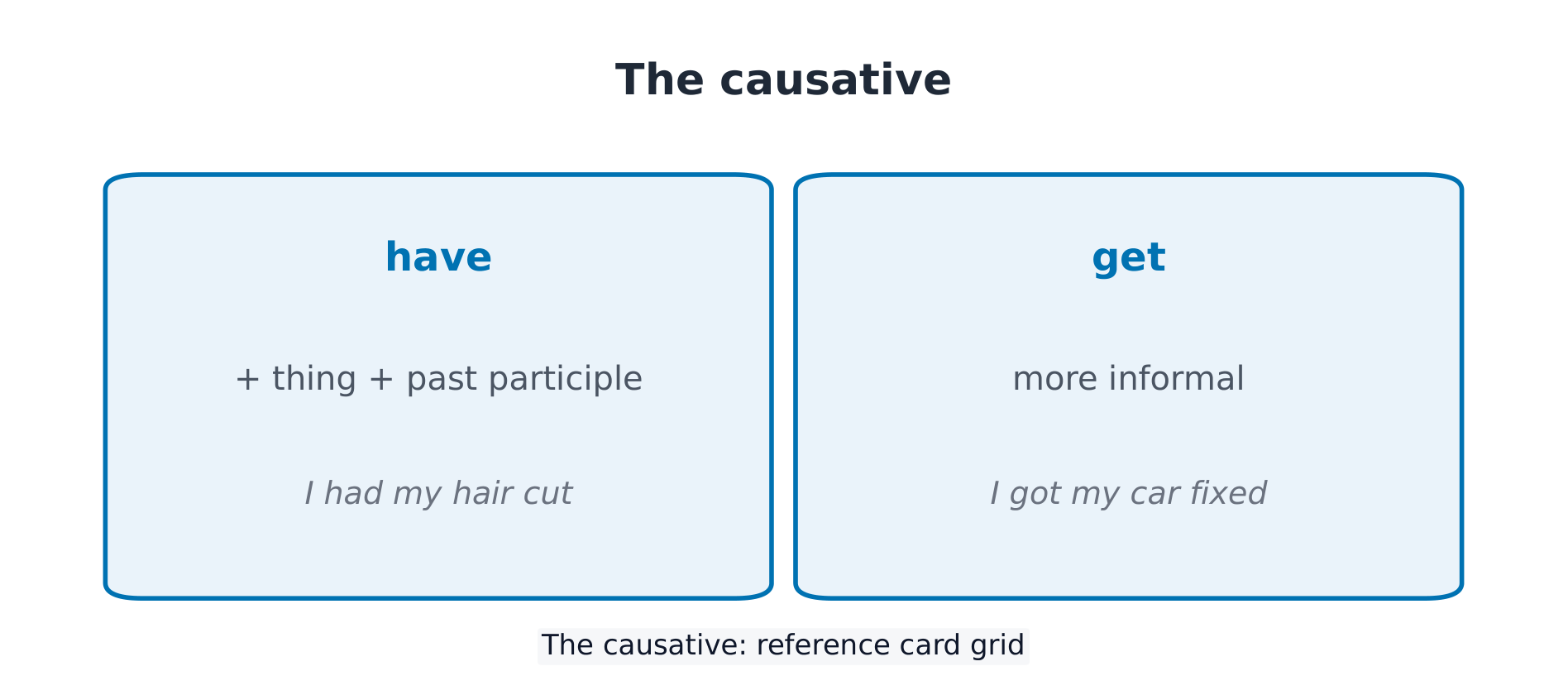
    9.1

    have something done

    English

    The causative structure expresses having someone else do something for you, rather than doing it yourself.

    Structure: have + 宾语 + 过去分词

    我I (使役)had 我的my 头发hair 剪cut 昨天yesterday.

    I got my hair cut yesterday. (Not by myself)

    我们We (be)are (使役)having 我们的our 房子house 粉刷painted.

    We are getting the house painted. (By someone else)

    Note: Pay attention to word order: have + object + past participle. I had my car repaired. (I sent it to be fixed) differs from I repaired my car. (I did it myself).

    Русский
    Конструкция каузатива: have/get something done

    Конструкция каузатива (the causative) означает «поручить кому-то сделать что-то за себя», а не делать самому.

    Структура: have + 宾语 + 过去分词

    我I (使役)had 我的my 头发hair 剪cut 昨天yesterday.

    Я подстригся вчера. (Не сам стригся, а попросили)

    我们We (be)are (使役)having 我们的our 房子house 粉刷painted.

    Мы красим дом. (По просили покрасить)

    Внимание Соблюдайте порядок слов: have + предмет + причастие прошедшего времени. I had my car repaired.(Я отдал машину в ремонт.) и I repaired my car.(Я сам починил машину) имеют разный смысл.

    9.2

    get something done

    English

    get + object + past participle functions similarly to have, but is more informal.

    我I 需要need to (使役)get 我的my 手机phone 修理fixed.

    *I need to get my phone repaired.

    她She (使役)got 她的her 照片photo 拍taken.

    She got a photo taken. (By someone else)

    Note: In causative structures, have and get are largely interchangeable; get carries a more casual, conversational tone.

    Common Errors

    • ❌ ~~I cut my hair yesterday.~~ (Actually at the salon) → ✓ I had my hair cut yesterday. — Using the active voice implies you cut it yourself with scissors.
    • ❌ Incorrect word order: ~~I had cut my hair~~ is the past perfect tense ("I had already cut it before then"), not causative; the causative form is have + object + past participle: I had my hair cut.
    • ❌ ~~I had my hair cutted.~~ → ✓ …cut. — The past participle in the causative structure must also be correct: cut–cut–cut remains unchanged.
    • To ask someone to do it: have + person + base form, get + person + to do: I'll have John fix it. / I'll get John to fix it.
    Русский

    get + дополнение + причастие прошедшего времени используется практически аналогично have, но является более разговорным вариантом.

    我I 需要need to (使役)get 我的my 手机phone 修理fixed.

    *Мне нужно отнести телефон в ремонт.

    她She (使役)got 她的her 照片photo 拍taken.

    *Она попросила сделать фото.

    Внимание В конструкции каузатива have и get во многих случаях взаимозаменяемы; however语气 более непринужденный и разговорный.

    Частые ошибки

    • ❌ ~~I cut my hair yesterday.~~(На самом деле стригся в парикмахерской)→ ✓ I had my hair cut yesterday. — Если сказать в активе, это будет означать, что вы сами резали ножницами.
    • ❌ Перепутан порядок слов:~~I had cut my hair~~ — это Past Perfect («До того момента я уже постригся»), а не каузатив; каузатив имеет структуру had + дополнение + причастие: I had my hair cut.
    • ❌ ~~I had my hair cutted.~~ → ✓ …cut. — Причастие прошедшего времени в каузативной конструкции тоже должно быть правильным: cut–cut–cut не изменяется.
    • Чтобы поручить конкретному человеку: have + лицо + начальная форма, get + лицо + to do: I'll have John fix it. / I'll get John to fix it.
  • 10 Contrast linkers · ⁨Союзные слова контраста⁩
    10.1

    although, though, even though

    English

    These conjunctions express contrast / concession ("although...but..."). They are followed by a complete sentence (subject + verb).

    • although / though: Although. even though: Stronger tone, meaning "even if / despite the fact that".

    虽然Although (天气it)it (过去)was 下雨raining 我们, we 去went 外出out.

    *Although it was raining, we still went out.

    他He 通过passed 尽管, even though 他he 没有hadn't 学习studied.

    *Even though he didn't study, he still passed.

    Note: though can also appear at the end of a sentence to mean "however" (informal): It's expensive. I like it, though.

    Русский
    Сравнение союзов: although/despite/however

    Эти союзы выражают уступку / контраст («хотя... но...»). После них следует полное предложение (подлежащее + сказуемое).

    • although / though: хотя. even though: более сильный оттенок, «несмотря на то что».

    虽然Although (天气it)it (过去)was 下雨raining 我们, we 去went 外出out.

    Хотя шел дождь, мы вышли на улицу.

    他He 通过passed 尽管, even though 他he 没有hadn't 学习studied.

    Несмотря на то что он не учился, он все же сдал.

    Внимание Though также может ставиться в конец предложения, означая «однако» (разговорный стиль):It's expensive. I like it, though.

    10.2

    despite, in spite of

    English

    despite and in spite of have the same meaning as although, but they are followed by nouns / gerunds, not complete sentences.

    尽管Despite (冠词)the 雨rain 我们, we 去went 外出out.

    *Despite the rain, we still went out.

    尽管In spite of 是being 累tired 她, she 继续kept 工作working.

    *Despite being very tired, she continued working.

    Note: Key distinction: although + sentence; despite / in spite of + noun / -ing. ~~despite it was raining~~ ✗ → despite the rain ✓.

    Русский

    despite и in spite of имеют тот же смысл, что и although, но после них ставятся существительные / герундий, а не полные предложения.

    尽管Despite (冠词)the 雨rain 我们, we 去went 外出out.

    Несмотря на дождь, мы вышли на улицу.

    尽管In spite of 是being 累tired 她, she 继续kept 工作working.

    Несмотря на усталость, она продолжала работать.

    Внимание Ключевое отличие: although + предложение; despite / in spite of + существительное / -ing.~~despite it was raining~~ ✗ → despite the rain ✓.

    10.3

    однако, тем не менее

    English

    however and nevertheless are conjunctive adverbs that connect two sentences, usually placed at the beginning of a sentence followed by a comma.

    (它)It (过去)was 贵expensive 然而. However 我们, we 买bought 它it.

    *It was expensive. However, we still bought it.

    Note: However typically forms its own sentence separated by a comma; do not use it to directly join two clauses like but.

    Common Errors

    • ❌ ~~Although it was raining, but we went out.~~ → ✓ Keep only one: Although it was raining, we went out. / It was raining, but we went out. — Chinese "although...but..." appears in pairs, but English allows only one.
    • ❌ ~~Despite of the rain…~~ → ✓ despite the rain / in spite of the rain — despite never takes of; in spite always takes of; do not mix them.
    • ❌ ~~Even he studied hard, he failed.~~ → ✓ Even though he studied hard… — even alone is not a conjunction; use even though / even if.
    • ❌ ~~It was expensive, however we bought it.~~ → ✓ It was expensive. However, we bought it. (Or using a semicolon: …expensive**; however,** we…) — However cannot join two clauses with just a comma like but.
    Русский

    однако и тем не менее — это связочные наречия, соединяющие два предложения; обычно ставятся в начало предложения после запятой.

    (它)It (过去)was 贵expensive 然而. However 我们, we 买bought 它it.

    Это дорого. Тем не менее, мы купили это.

    Внимание: однако обычно используется как отдельное предложение, выделяемое запятой; не используйте его для прямого соединения двух частей предложения, как это делает but.

    Частые ошибки

    • ❌ ~~Although it was raining, but we went out.~~ → ✓ Оставляйте только одно: Although it was raining, we went out. / It was raining, but we went out. — В китайском «хотя... но...» используются парами, а в английском выбирается только один вариант.
    • ❌ ~~Despite of the rain…~~ → ✓ despite the rain / in spite of the rain — despite никогда не используется с of; in spite всегда требует of; нельзя смешивать эти конструкции.
    • ❌ ~~Even he studied hard, he failed.~~ → ✓ Even though he studied hard… — even само по себе не является союзом, нужно использовать even though / even if.
    • ❌ ~~It was expensive, however we bought it.~~ → ✓ It was expensive. However, we bought it. (или с точкой с запятой: …expensive**; however,** we…) — however нельзя использовать для соединения частей предложения запятой, как but.
  • 11 Articles (advanced) · ⁨Артикли (продвинутый уровень)⁩
    11.1

    Общее указание vs Конкретное указание

    English

    At B2 level, the difficulty with articles lies in distinguishing generic reference from specific reference:

    • Generic reference (whole categories): Plural / uncountable nouns, no the.
    • Specific reference (particular ones): Use the.

    老虎Tigers 是are 危险dangerous.

    *Tigers are dangerous. (Refers to tigers in general, no the)

    (特指)The 老虎tigers 在at (冠词)the 动物园zoo 是are 困倦sleepy.

    *The tigers in the zoo are sleepy. (Specific, use the)

    Note: Abstract nouns are also used without the for generic reference: Love is important. (Love is important.) But the love of a mother uses the when referring specifically.

    Русский
    选择冠词:a/an · the · 零冠词

    На уровне B2 сложность артиклей заключается в различении общего и конкретного значения:

    • Общее указание (весь класс предметов): множественное число / неисчисляемые существительные, без артикля the.
    • Конкретное указание (конкретные объекты): используется the.

    老虎Tigers 是are 危险dangerous.

    Тигры опасны. (Общее указание на всех тигров, без the)

    (特指)The 老虎tigers 在at (冠词)the 动物园zoo 是are 困倦sleepy.

    Те тигры в зоопарке очень сонны. (Конкретное указание, с the)

    Внимание: абстрактные существительные при общем указании также не требуют the: Love is important. (Любовь важна.) Но при конкретном указании добавляется the: the love of a mother (материнская любовь).

    11.2

    Устойчивые сочетания

    English

    In many collocations, article usage is fixed and must be memorized as a whole:

    • No article: go to bed / school / work, by car / bus, at home, have breakfast.
    • Use the: in the morning, play the piano, the same, listen to the radio.

    我I 去go (介词)to 上班work 乘by 公交bus.

    *I go to work by bus. (Neither go to work nor by bus takes an article)

    Note: These collocations lack much logical reasoning; memorizing them as fixed phrases is most effective.

    Common Errors

    • ❌ ~~the China / the Japan~~ → ✓ China / Japan; but ✓ the US, the UK, the Netherlands, the Philippines — Only countries with plural forms or "organizational" names take the.
    • ❌ ~~Most of people agree.~~ → ✓ Most people agree. / Most of the people in this room agree. — most goes directly before a noun; most of must be followed by the / my / these etc.
    • Distinguish (British English): be in hospital (admitted as a patient) vs. go to the hospital (go to the building, e.g., to visit someone). The same applies to in prison / at school.
    • the + adjective refers to a class of people: The rich should help the poor.
    Русский

    Во многих сочетаниях употребление артиклей является фиксированным, их нужно запоминать целиком:

    • Без артикля: go to bed / school / work, by car / bus, at home, have breakfast.
    • С the: in the morning, play the piano, the same, listen to the radio.

    我I 去go (介词)to 上班work 乘by 公交bus.

    Я еду на работу на автобусе. (go to work и by bus — без артикля)

    Обратите внимание: у этих сочетаний нет логического обоснования, поэтому эффективнее всего выучить их как устойчивые фразы.

    Частые ошибки

    • ❌ ~~the China / the Japan~~ → ✓ China / Japan; но ✓ the US, the UK, the Netherlands, the Philippines — with the only for countries in plural form or "organizational" names.
    • ❌ ~~Most of people agree.~~ → ✓ Most people agree. / Most of the people in this room agree. — most ставится непосредственно перед существительным; most of требует после себя the / my / these и т. д.
    • Различение (британский вариант): be in hospital (находиться в больнице как пациент) vs go to the hospital (посетить здание больницы, например, чтобы навестить). То же самое для in prison / at school.
    • the + прилагательное обозначает группу людей: The rich should help the poor. (Богатые должны помогать бедным.)
  • 12 Emphasis · ⁨Акцент⁩
    12.1

    so и such для усиления

    English

    so and such are used to intensify meaning ('so...that' or 'such...that'), often followed by that to introduce a result.

    • so + adjective / adverb (+ that …).
    • such + (a/an) + adjective + noun (+ that …).

    (它)It (过去)was 如此so 冷cold 以至于that (冠词)the 湖lake 结冰froze.

    It is so cold that the lake has frozen over.

    (它)It (过去)was 如此such 一个a 好good 电影film 以至于that 我I 哭了cried.

    That movie was so good that I cried.

    Note: Follow so with an adjective (so cold); follow such with a noun phrase (such a good film).

    Русский
    Усиление: so / such / do

    so и such используются для усиления значения («так… что…»), после них часто следует that для введения результата.

    • so + прилагательное / наречие (+ that …).
    • such + (a/an) + прилагательное + существительное (+ that …).

    (它)It (过去)was 如此so 冷cold 以至于that (冠词)the 湖lake 结冰froze.

    Было слишком холодно, даже озеро замерзло.

    (它)It (过去)was 如此such 一个a 好good 电影film 以至于that 我I 哭了cried.

    Тот фильм был настолько хорош, что я плакал.

    Внимание: после so идет прилагательное (so cold); после such идет именная группа (such a good film).

    12.2

    so do I, neither do I

    English

    To express "Me too" or "Me neither," English uses a short inverted structure where the auxiliary verb must match the previous sentence:

    • Affirmative agreement: So + auxiliary verb + subject (So do I / So am I / So can I).
    • Negative agreement: Neither + auxiliary verb + subject (Neither do I / Neither am I).

    "I like tea." — 也So (助动词)do 我I.

    "I like tea." — "Me too."

    "I can't swim." — 也不Neither (助动词)can 我I.

    "I can't swim." — "Neither can I."

    Note: The auxiliary verb must match the tense/verb of the previous sentence: if the previous sentence uses are → So are they; if it uses don't → Neither do I.

    Common Errors

    • ❌ "I love this song." — ~~So am I.~~ → ✓ So do I. — The agreeing auxiliary must match the previous sentence: main verbs → do / does / did; be → am / is; can → can.
    • ❌ "I don't like it." — ~~Me too.~~ → ✓ Me neither. / Neither do I. — Do not use too for negative agreements.
    • ❌ "I can't swim." — ~~So can't I.~~ → ✓ Neither can I. — Negative inversion begins with neither / nor, never so + negative.
    • To emphasize "really," avoid using very + verb: ❌ ~~I very like it.~~ → ✓ I do like it. / I really like it. — Placing the auxiliary do before the verb creates emphasis.
    Русский

    Для выражения «тоже да / тоже нет» в английском используется короткая инвертированная конструкция, вспомогательный глагол должен соответствовать предыдущему предложению:

    • Согласие в утвердительной форме: So + вспомогательный глагол + подлежащее (So do I / So am I / So can I).
    • Согласие в отрицательной форме: Neither + вспомогательный глагол + подлежащее (Neither do I / Neither am I).

    "I like tea." — 也So (助动词)do 我I.

    «Мне нравится чай». «И мне.»

    "I can't swim." — 也不Neither (助动词)can 我I.

    «Я не умею плавать». «И я тоже.»

    Внимание: вспомогательный глагол должен соответствовать времени / глаголу предыдущего предложения: если в предыдущем are → So are they; если don't → Neither do I.

    Частые ошибки

    • ❌ "I love this song." — ~~So am I.~~ → ✓ So do I. — Вспомогательный глагол согласия должен соответствовать предыдущему предложению: смысловой глагол → do / does / did; to be → am / is; can → can.
    • ❌ "I don't like it." — ~~Me too.~~ → ✓ Me neither. / Neither do I. — Для согласования с отрицательными предложениями нельзя использовать too.
    • ❌ "I can't swim." — ~~So can't I.~~ → ✓ Neither can I. — При отрицательной инверсии начинайте с neither / nor, не используйте so + отрицание.
    • Для усиления значения «действительно» не используйте very + глагол: ❌ ~~I very like it.~~ → ✓ I do like it. / I really like it. — Вспомогательный глагол do перед основным глаголом служит для усиления.

Log in or create account · ⁨Войти или создать аккаунт⁩

IGCSE, A-Level & AP