This handout covers Topic 1, Number. Cambridge Maths has two levels: Core and Extended. Parts marked (Extended) are only tested on the Extended papers; everything else is for both levels.
Tips · Советы
IGCSE Mathematics (0580) охватывает темы: числа, алгебра и графики, координатная геометрия, геометрия, вычисление объемов и площадей, тригонометрия, преобразования и векторы, вероятность и статистика.
Экзамен делится на уровни Core (Базовый) и Extended (Расширенный); Extended значительно углубляет материал по алгебре и тригонометрии — подтвердите свой уровень перед выбором тем для практики.
Баллы за метод начисляются за письменные вычисления. Численный ответ может получить большинство баллов, если видны ход решения, тогда как правильный ответ без пояснений может получить меньше. Записывать каждую строку — это не аккуратность, это баллы.
-
1
Number · Число
Watch lesson · Смотреть урок1.1
Types of number

Syllabus · Программа
EnglishSubject content Notes and examples Identify and use: • natural numbers • integers (positive, zero and negative) • prime numbers • square numbers • cube numbers • common factors • common multiples • rational and irrational numbers • reciprocals. Example tasks include: • convert between numbers and words, e.g. six billion is 6000000000 10007 is ten thousand and seven • express 72 as a product of its prime factors • find the highest common factor (HCF) of two numbers • find the lowest common multiple (LCM) of two numbers. РусскийПредметное содержание Примечания и примеры Идентифицировать и использовать: • натуральные числа • целые числа (положительные, ноль и отрицательные) • простые числа • квадратные числа • кубические числа • общие делители • общие кратные • рациональные и иррациональные числа • обратные величины. Примеры заданий включают: • преобразование между числами и словами, например, six billion is 6000000000 10007 is ten thousand and seven • представление числа 72 в виде произведения простых множителей • нахождение наибольшего общего делителя (НОД) двух чисел • нахождение наименьшего общего кратного (НОК) двух чисел. Source: Cambridge International syllabus · Источник: Программа Cambridge International
You must know the words for the different kinds of number. Examiners give marks for using them correctly.
Each set sits inside the next: every natural number is an integer, every integer is rational, every rational is real. Irrational numbers are real but not rational. Counting numbers and integers
- natural numbers 自然数 — the counting numbers $1, 2, 3, 4, \dots$
- integers 整数 — whole numbers, positive, negative or zero: $\dots, -2, -1, 0, 1, 2, \dots$
Factors and multiples
- A factor 因数 of a number divides into it exactly, leaving no remainder 余数. The factors of $18$ are $1, 2, 3, 6, 9, 18$.
- A multiple 倍数 of a number is that number times an integer. Multiples of $6$ are $6, 12, 18, 24, \dots$
- A common factor 公因数 of two numbers is a factor of both.
- A common multiple 公倍数 of two numbers is a multiple of both.
Prime, square and cube numbers
- A prime number 质数 has exactly two factors: $1$ and itself. The first primes are $2, 3, 5, 7, 11, 13, \dots$ Note that $1$ is not prime.
- A square number 平方数 is a whole number times itself: $1, 4, 9, 16, 25, \dots$
- A cube number 立方数 uses a whole number three times: $1, 8, 27, 64, \dots$
Rational, irrational and reciprocal
- A rational number 有理数 can be written as a fraction 分数 $\frac{a}{b}$ of two integers. Examples: $\frac{3}{4}$, $5$, $0.7$.
- An irrational number 无理数 cannot be written this way. Examples: $\pi$ and $\sqrt{2}$.
- The reciprocal 倒数 of a number is $1$ divided by that number. The reciprocal of $4$ is $\frac{1}{4}$; the reciprocal of $0.25$ is $4$; the reciprocal of $\frac{2}{3}$ is $\frac{3}{2}$.
Prime factors, HCF and LCM
Every integer above $1$ is prime, or can be written as a product 乘积 of prime numbers. To write a number as a product of its prime factors 质因数, keep dividing by the smallest prime that fits.
Worked example. Write $72$ as a product of its prime factors.
$$72 = 2 \times 36 = 2 \times 2 \times 18 = 2 \times 2 \times 2 \times 9 = 2 \times 2 \times 2 \times 3 \times 3 = 2^{3} \times 3^{2}.$$
Keep splitting until every branch ends on a prime (circled); collecting them gives $72 = 2^{3} \times 3^{2}$. The highest common factor (HCF) 最大公因数 of two numbers is the largest factor they share. The lowest common multiple (LCM) 最小公倍数 is the smallest multiple they share. Prime factors give a quick method.
Worked example. Find the HCF and LCM of $72$ and $120$.
First write each as a product of primes:
$$72 = 2^{3} \times 3^{2}, \qquad 120 = 2^{3} \times 3 \times 5.$$- HCF: take the lowest power of each prime that appears in both: $2^{3} \times 3 = 24$.
- LCM: take the highest power of every prime that appears: $2^{3} \times 3^{2} \times 5 = 360$.
Explore · ИсследоватьSets of numbers · Множества чисел
Every counting number is also an integer, every integer a rational — see how the number sets nest, and how union and intersection combine them. · Каждое натуральное число является целым, каждое целое — рациональным — посмотрите, как множества чисел вкладываются друг в друга, а объединение и пересечение их связывают.
Vocabulary · Словарь Train · ТренироватьEnglish Русский natural number/ˈnætʃərəl ˈnʌmbə/ натуральное число integer/ˈɪntɪdʒə/ integer factor/ˈfæktə/ фактор remainder/rɪˈmeɪndə/ остаток multiple/ˈmʌltɪpl/ кратное common factor/ˈkɒmən ˈfæktə/ общий делитель common multiple/ˈkɒmən ˈmʌltɪpl/ общее кратное prime number/praɪm ˈnʌmbə/ простое число square number/skweə ˈnʌmbə/ квадрат числа cube number/kjuːb ˈnʌmbə/ куб числа rational number/ˈræʃənl ˈnʌmbə/ рациональное число fraction/ˈfrækʃn/ дроби ( фракции при перегонке ) irrational number/ɪˈræʃənl ˈnʌmbə/ иррациональное число reciprocal/rɪˈsɪprəkl/ обратной величиной product/ˈprɒdʌkt/ продукт prime factor/praɪm ˈfæktə/ простой множитель highest common factor/ˈhaɪɪst ˈkɒmən ˈfæktə/ наибольший общий делитель lowest common multiple/ˈləʊɪst ˈkɒmən ˈmʌltɪpl/ наименьшее общее кратное 1.2
Sets and Venn diagrams

Syllabus · Программа
EnglishSubject content Notes and examples Understand and use set language, notation and Venn diagrams to describe sets. Venn diagrams are limited to two sets. The following set notation will be used: • $n(A)$ Number of elements in set $A$ • $A'$ Complement of set $A$ • $\mathscr{E}$ Universal set • $A \cup B$ Union of $A$ and $B$ • $A \cap B$ Intersection of $A$ and $B$. Example definition of sets: $A = \{x : x \text{ is a natural number}\}$ $B = \{a, b, c, \dots\}$ $C = \{x : a \leqslant x \leqslant b\}$. РусскийПредметное содержание Примечания и примеры Понимать и использовать язык множеств, нотацию и диаграммы Венна для описания множеств. Диаграммы Венна ограничены двумя множествами. Будут использоваться следующие обозначения множеств: • $n(A)$ Количество элементов в множестве $A$ • $A'$ Дополнение множества $A$ • $\mathscr{E}$ Универсальное множество • $A \cup B$ Объединение $A$ и $B$ • $A \cap B$ Пересечение $A$ и $B$. Пример определения множеств: $A = \{x : x \text{ is a natural number}\}$ $B = \{a, b, c, \dots\}$ $C = \{x : a \leqslant x \leqslant b\}$. EnglishSubject content Notes and examples Understand and use set language, notation and Venn diagrams to describe sets and represent relationships between sets. Venn diagrams are limited to two or three sets. The following set notation will be used: • $n(A)$ Number of elements in set $A$ • $\in$ "... is an element of ..." • $\notin$ "... is not an element of ..." • $A'$ Complement of set $A$ • $\varnothing$ The empty set • $\mathscr{E}$ Universal set • $A \subseteq B$ $A$ is a subset of $B$ • $A \nsubseteq B$ $A$ is not a subset of $B$ • $A \cup B$ Union of $A$ and $B$ • $A \cap B$ Intersection of $A$ and $B$. Example definition of sets: $A = \{x : x \text{ is a natural number}\}$ $B = \{(x, y) : y = mx + c\}$ $C = \{x : a \leqslant x \leqslant b\}$ $D = \{a, b, c, \dots\}$. РусскийПредметное содержание Примечания и примеры Понимать и использовать язык множеств, нотацию и диаграммы Эйлера-Венна для описания множеств и представления отношений между ними. Диаграммы Эйлера-Венна ограничиваются двумя или тремя множествами. Будет использоваться следующая нотация множеств: • $n(A)$ Количество элементов в множестве $A$ • $\in$ «... является элементом ...» • $\notin$ «... не является элементом ...» • $A'$ Дополнение множества $A$ • $\varnothing$ Пустое множество • $\mathscr{E}$ Универсальное множество • $A \subseteq B$ $A$ является подмножеством $B$ • $A \nsubseteq B$ $A$ не является подмножеством $B$ • $A \cup B$ Объединение $A$ и $B$ • $A \cap B$ Пересечение $A$ и $B$. Пример определения множеств: $A = \{x : x \text{ is a natural number}\}$ $B = \{(x, y) : y = mx + c\}$ $C = \{x : a \leqslant x \leqslant b\}$ $D = \{a, b, c, \dots\}$. Source: Cambridge International syllabus · Источник: Программа Cambridge International
A set 集合 is a collection of objects. Each object in the set is an element 元素 of the set. You should know this notation:
Symbol Meaning $n(A)$ the number of elements in set $A$ $x \in A$ $x$ is an element of $A$ $x \notin A$ $x$ is not an element of $A$ $\mathscr{E}$ the universal set 全集 — everything being talked about $A'$ the complement 补集 of $A$ — everything not in $A$ $\varnothing$ the empty set 空集 — a set with no elements $A \subseteq B$ $A$ is a subset 子集 of $B$ — every element of $A$ is also in $B$ $A \cup B$ the union 并集 — elements in $A$ or $B$ or both $A \cap B$ the intersection 交集 — elements in both $A$ and $B$ A Venn diagram 维恩图 draws each set as a circle inside a rectangle (the universal set). Core uses two sets; Extended may use three.
Worked example. $\mathscr{E} = \{1,2,3,4,5,6,7,8,9,10\}$, $A = \{\text{even numbers}\}$, $B = \{\text{multiples of } 3\}$.
- $A = \{2,4,6,8,10\}$ and $B = \{3,6,9\}$.
- $A \cap B = \{6\}$ — the only number in both.
- $A \cup B = \{2,3,4,6,8,9,10\}$ — the numbers in either set.
- $n(A \cup B) = 7$.
$A \cap B = \{6\}$ is the only number in both circles; $A \cup B$ is everything inside either circle. You may also see a set written as a rule, e.g. $C = \{x : 1 \leqslant x \leqslant 5\}$ means "all values $x$ such that $1 \leqslant x \leqslant 5$".
Explore · ИсследоватьVenn diagrams · Диаграммы Эйлера-Венна
Tap the regions to see union, intersection and complement — the language of sets. · Нажмите на области, чтобы увидеть объединение, пересечение и дополнение — язык теории множеств.
Vocabulary · Словарь Train · ТренироватьEnglish Русский set/set/ множество element/ˈelɪmənt/ элемента universal set/ˌjuːnɪˈvɜːsl set/ универсальное множество complement/ˈkɒmplɪmənt/ дополнением empty set/ˈempti set/ пустое множество subset/ˈsʌbset/ подмножество union/ˈjuːnɪən/ профсоюзом intersection/ˌɪntəˈsekʃn/ пересечения Venn diagram/ven ˈdaɪəɡræm/ диаграмма Венна 1.3
Powers and roots
Syllabus · Программа
EnglishSubject content Notes and examples Calculate with the following: • squares • square roots • cubes • cube roots • other powers and roots of numbers. Includes recall of squares and their corresponding roots from 1 to 15, and recall of cubes and their corresponding roots of 1, 2, 3, 4, 5 and 10, e.g.: • Write down the value of $\sqrt{169}$ . • Work out $5^2 \times \sqrt[3]{8}$ . РусскийПредметное содержание Примечания и примеры Вычислять со следующими значениями: • квадраты • квадратные корни • кубы • кубические корни • другие степени и корни чисел. Включает воспроизведение квадратов и соответствующих им корней от 1 до 15, а также воспроизведение кубов и соответствующих им корней для 1, 2, 3, 4, 5 и 10, например: • Запишите значение $\sqrt{169}$. • Вычислите $5^2 \times \sqrt[3]{8}$. EnglishSubject content Notes and examples Calculate with the following: • squares • square roots • cubes • cube roots • other powers and roots of numbers. Includes recall of squares and their corresponding roots from 1 to 15, and recall of cubes and their corresponding roots of 1, 2, 3, 4, 5 and 10, e.g.: • Write down the value of $\sqrt{169}$. • Work out $5^2 \times \sqrt[3]{8}$. РусскийПредметное содержание Примечания и примеры Производить вычисления со следующими понятиями: • квадраты • квадратные корни • кубы • кубические корни • другие степени и корни чисел. Включает запоминание квадратов и соответствующих им корней от 1 до 15, а также запоминание кубов и соответствующих им корней для 1, 2, 3, 4, 5 и 10, например: • Записать значение $\sqrt{169}$. • Вычислить $5^2 \times \sqrt[3]{8}$. Source: Cambridge International syllabus · Источник: Программа Cambridge International
- A power 幂 (also called an index 指数, plural indices) shows how many times to multiply a number by itself: $2^{5} = 2 \times 2 \times 2 \times 2 \times 2 = 32$.
- A square root 平方根 of a number gives that number when squared: $\sqrt{169} = 13$ because $13^{2} = 169$.
- A cube root 立方根 works the same way for cubes: $\sqrt[3]{8} = 2$ because $2^{3} = 8$.
You should be able to recall the squares from $1^2$ to $15^2$ (and their roots), and the cubes of $1, 2, 3, 4, 5$ and $10$.
Worked example. Work out $5^{2} \times \sqrt[3]{8}$.
$$5^{2} \times \sqrt[3]{8} = 25 \times 2 = 50.$$Explore · ИсследоватьPowers and roots lab · Лабораторная работа по степеням и корням
square = x^2 · квадрат = x^2
Change the base and see powers grow while roots undo powers. · Измените основание и наблюдайте, как растут степени, пока корни отменяют степени.
Vocabulary · Словарь Train · ТренироватьEnglish Русский power/ˈpaʊə/ мощность index/ˈɪndeks/ индекс square root/skweə ruːt/ квадратный корень cube root/kjuːb ruːt/ кубический корень 1.7
The laws of indices

Syllabus · Программа
EnglishSubject content Notes and examples 1 Understand and use indices (positive, zero and negative integers). e.g. find the value of $7^{-2}$. 2 Understand and use the rules of indices. e.g. find the value of $2^{-3} \times 2^4$, $(2^3)^2$, $2^3 \div 2^4$. РусскийПредметное содержание Примечания и примеры 1 Понимать и использовать показатели (положительные, нулевые и отрицательные целые числа). Например, найти значение $7^{-2}$. 2 Понимать и использовать правила работы с показателями. Например, найти значение $2^{-3} \times 2^4$, $(2^3)^2$, $2^3 \div 2^4$. EnglishSubject content Notes and examples 1 Understand and use indices (positive, zero, negative, and fractional). Examples include: • $6^{\frac{1}{2}} = \sqrt{6}$ • $16^{\frac{1}{4}} = \sqrt[4]{16}$ • find the value of $7^{-2}$, $81^{\frac{1}{2}}$, $8^{-\frac{2}{3}}$. 2 Understand and use the rules of indices. e.g. find the value of $2^{-3} \times 2^4$, $(2^3)^2$, $2^3 \div 2^4$. РусскийПредметное содержание Примечания и примеры 1 Понимание и использование степеней (положительных, нулевых, отрицательных и дробных). Примеры включают: • $6^{\frac{1}{2}} = \sqrt{6}$ • $16^{\frac{1}{4}} = \sqrt[4]{16}$ • нахождение значения выражений $7^{-2}$, $81^{\frac{1}{2}}$, $8^{-\frac{2}{3}}$. 2 Понимать и использовать правила работы с показателями. Например, найти значение $2^{-3} \times 2^4$, $(2^3)^2$, $2^3 \div 2^4$. Source: Cambridge International syllabus · Источник: Программа Cambridge International
When you multiply or divide powers of the same base 底数, use these rules:
$$a^{m} \times a^{n} = a^{m+n}, \qquad a^{m} \div a^{n} = a^{m-n}, \qquad (a^{m})^{n} = a^{mn}.$$Some special powers:
$$a^{0} = 1, \qquad a^{-n} = \frac{1}{a^{n}}, \qquad a^{\frac{1}{n}} = \sqrt[n]{a}, \qquad a^{\frac{m}{n}} = \left(\sqrt[n]{a}\right)^{m}.$$(Fractional powers like $a^{\frac{m}{n}}$ are Extended.)
Worked examples.
- $2^{-3} \times 2^{4} = 2^{-3+4} = 2^{1} = 2.$
- $(2^{3})^{2} = 2^{6} = 64.$
- $2^{3} \div 2^{4} = 2^{3-4} = 2^{-1} = \dfrac{1}{2}.$
- $7^{-2} = \dfrac{1}{7^{2}} = \dfrac{1}{49}.$
- $81^{\frac{1}{2}} = \sqrt{81} = 9.$
- $8^{-\frac{2}{3}} = \dfrac{1}{8^{\frac{2}{3}}} = \dfrac{1}{\left(\sqrt[3]{8}\right)^{2}} = \dfrac{1}{2^{2}} = \dfrac{1}{4}.$
The three index laws: multiply adds the powers, divide subtracts them, a power of a power multiplies them Vocabulary · Словарь Train · ТренироватьEnglish Русский base/beɪs/ основанием 1.8
Standard form

Syllabus · Программа
EnglishSubject content Notes and examples 1 Use the standard form $A \times 10^n$ where $n$ is a positive or negative integer and $1 \leqslant A < 10$. 2 Convert numbers into and out of standard form. 3 Calculate with values in standard form. Core candidates are expected to calculate with standard form only on Paper 3. РусскийПредметное содержание Примечания и примеры 1 Использовать стандартный вид $A \times 10^n$, где $n$ — положительное или отрицательное целое число, а $1 \leqslant A < 10$. 2 Преобразовывать числа в стандартный вид и из него. 3 Выполнять вычисления со значениями в стандартном виде. Кандидаты основного уровня должны выполнять вычисления со значениями в стандартном виде только на Билете 3. EnglishSubject content Notes and examples 1 Use the standard form $A \times 10^n$ where $n$ is a positive or negative integer and $1 \leqslant A < 10$. 2 Convert numbers into and out of standard form. 3 Calculate with values in standard form. РусскийПредметное содержание Примечания и примеры 1 Использовать стандартный вид $A \times 10^n$, где $n$ — положительное или отрицательное целое число, а $1 \leqslant A < 10$. 2 Преобразовывать числа в стандартный вид и из него. 3 Производить вычисления со значениями в стандартном виде. Source: Cambridge International syllabus · Источник: Программа Cambridge International
A galaxy: huge distances are written compactly in standard form. Standard form 科学记数法 writes a number as $A \times 10^{n}$, where $1 \leqslant A < 10$ and $n$ is an integer. It is used for very large or very small numbers.
To convert, count how many places the decimal point moves:
- $4\,500\,000 = 4.5 \times 10^{6}$ — the point moves $6$ places left, so the power is positive.
- $0.00072 = 7.2 \times 10^{-4}$ — the point moves $4$ places right, so the power is negative.
Worked example. Work out $(3 \times 10^{5}) \times (2 \times 10^{-2})$.
Multiply the front numbers and add the powers:
$$3 \times 2 = 6, \qquad 10^{5} \times 10^{-2} = 10^{3}, \qquad \text{so the answer is } 6 \times 10^{3}.$$
Standard form: a number written as a × 10^n with 1 ≤ a < 10 Explore · ИсследоватьStandard form route · Путь к стандартному виду
Follow a large or small number into a x 10^n form. · Превратите большое или маленькое число в форму a × 10^n.
Vocabulary · Словарь Train · ТренироватьEnglish Русский standard form/ˈstændəd fɔːm/ стандартный вид 1.18
Surds (Extended)

Syllabus · Программа
EnglishSubject content Notes and examples 1 Understand and use surds, including simplifying expressions. Examples include: • $\sqrt{20} = 2\sqrt{5}$ • $\sqrt{200} - \sqrt{32} = 6\sqrt{2}$. 2 Rationalise the denominator. Examples include: • $\frac{10}{\sqrt{5}} = 2\sqrt{5}$ • $\frac{1}{-1 + \sqrt{3}} = \frac{1 + \sqrt{3}}{2}$. РусскийПредметное содержание Примечания и примеры 1 Понимать и использовать иррациональные числа, включая упрощение выражений. Примеры включают: • $\sqrt{20} = 2\sqrt{5}$ • $\sqrt{200} - \sqrt{32} = 6\sqrt{2}$. 2 Избавление от иррациональности в знаменателе. Примеры включают: • $\frac{10}{\sqrt{5}} = 2\sqrt{5}$ • $\frac{1}{-1 + \sqrt{3}} = \frac{1 + \sqrt{3}}{2}$. Source: Cambridge International syllabus · Источник: Программа Cambridge International
A surd 根式 is a root that is irrational, such as $\sqrt{5}$. Leave it in exact form instead of rounding. Two useful rules:
$$\sqrt{a} \times \sqrt{b} = \sqrt{ab}, \qquad \sqrt{\frac{a}{b}} = \frac{\sqrt{a}}{\sqrt{b}}.$$Simplify a surd by taking out the largest square factor.
Worked example. Simplify $\sqrt{20}$ and $\sqrt{200} - \sqrt{32}$.
$$\sqrt{20} = \sqrt{4 \times 5} = \sqrt{4}\,\sqrt{5} = 2\sqrt{5}.$$$$\sqrt{200} - \sqrt{32} = \sqrt{100 \times 2} - \sqrt{16 \times 2} = 10\sqrt{2} - 4\sqrt{2} = 6\sqrt{2}.$$Simplifying a surd: take out the largest square factor To rationalise the denominator 分母有理化 means to remove a surd from the bottom of a fraction (the denominator 分母). Multiply the top and bottom by a value that clears the surd.
Worked example. Rationalise $\dfrac{10}{\sqrt{5}}$ and $\dfrac{1}{-1+\sqrt{3}}$.
$$\frac{10}{\sqrt{5}} = \frac{10}{\sqrt{5}} \times \frac{\sqrt{5}}{\sqrt{5}} = \frac{10\sqrt{5}}{5} = 2\sqrt{5}.$$$$\frac{1}{-1+\sqrt{3}} = \frac{1}{\sqrt{3}-1} \times \frac{\sqrt{3}+1}{\sqrt{3}+1} = \frac{\sqrt{3}+1}{3-1} = \frac{1+\sqrt{3}}{2}.$$Explore · ИсследоватьSurd simplification route · Путь упрощения иррациональных чисел
Break a surd into square factors and simplify it. · Разложить корень на квадратные множители и упростить его.
Vocabulary · Словарь Train · ТренироватьEnglish Русский surd/sɜːd/ иррациональное число (корень) rationalise the denominator/ˈræʃənəlaɪz ðə dɪˈnɒmɪneɪtə/ избавиться от иррациональности в знаменателе denominator/dɪˈnɒmɪneɪtə/ знаменателе 1.4
Fractions, decimals and percentages

Syllabus · Программа
EnglishSubject content Notes and examples 1 Use the language and notation of the following in appropriate contexts: • proper fractions • improper fractions • mixed numbers • decimals • percentages. Candidates are expected to be able to write fractions in their simplest form. Candidates are not expected to use recurring decimal notation. 2 Recognise equivalence and convert between these forms. Candidates are not expected to demonstrate the conversion of a recurring decimal to a fraction and vice versa. РусскийПредметное содержание Примечания и примеры 1 Использовать язык и обозначения следующих видов в подходящих контекстах: • правильные дроби • неправильные дроби • смешанные числа • десятичные дроби • проценты. От кандидатов ожидается умение записывать дроби в несократимом виде. От кандидатов не требуется использование записи периодических десятичных дробей. 2 Распознавать эквивалентность и преобразовывать между этими формами. От кандидатов не требуется демонстрировать преобразование периодической десятичной дроби в обыкновенную дробь и обратно. EnglishSubject content Notes and examples 1 Use the language and notation of the following in appropriate contexts: • proper fractions • improper fractions • mixed numbers • decimals • percentages. Candidates are expected to be able to write fractions in their simplest form. Recurring decimal notation is required, e.g. • $0.1\dot{7} = 0.1777...$ • $0.1\dot{2}\dot{3} = 0.1232323...$ • $0.\dot{1}2\dot{3} = 0.123123...$ 2 Recognise equivalence and convert between these forms. Includes converting between recurring decimals and fractions and vice versa, e.g. write $0.1\dot{7}$ as a fraction. РусскийПредметное содержание Примечания и примеры 1 Использовать язык и нотацию следующих понятий в соответствующем контексте: • правильные дроби • неправильные дроби • смешанные числа • десятичные дроби • проценты. От кандидатов ожидается умение записывать дроби в наименьшем виде. Требуется нотация бесконечных периодических дробей, например: • $0.1\dot{7} = 0.1777...$ • $0.1\dot{2}\dot{3} = 0.1232323...$ • $0.\dot{1}2\dot{3} = 0.123123...$ 2 Распознавать эквивалентность и переводить между этими формами. Включает перевод между бесконечными периодическими дробями и обыкновенными дробями и обратно, например: запишите $0.1\dot{7}$ в виде дроби. Source: Cambridge International syllabus · Источник: Программа Cambridge International
A fraction has a numerator 分子 (the top) and a denominator (the bottom).
One value three ways: a fraction, a decimal and a percentage - proper fraction 真分数: numerator smaller than denominator, e.g. $\frac{3}{4}$.
- improper fraction 假分数: numerator the same or larger, e.g. $\frac{7}{4}$.
- mixed number 带分数: a whole number plus a fraction, e.g. $1\frac{3}{4}$.
Change between improper and mixed: $\frac{7}{4} = 1\frac{3}{4}$ because $7 \div 4 = 1$ remainder $3$.
A decimal 小数 uses place value after a point. A percentage 百分比 means "out of $100$", so $37\% = \frac{37}{100} = 0.37$.
Converting between forms
To change Method Example fraction → decimal divide top by bottom $\frac{3}{8} = 3 \div 8 = 0.375$ decimal → percentage multiply by $100$ $0.07 = 7\%$ percentage → fraction put over $100$, then simplify $7\% = \frac{7}{100}$ percentage → decimal divide by $100$ $34\% = 0.34$ Write a fraction in its simplest form 最简形式 by dividing the top and bottom by their HCF: $\frac{18}{24} = \frac{3}{4}$ (both divided by $6$).
Recurring decimals (Extended)
A recurring decimal 循环小数 repeats the same digits forever. Dots mark the repeating part: $0.1\dot{7} = 0.1777\ldots$ and $0.\dot{1}2\dot{3} = 0.123123\ldots$
To turn a recurring decimal into a fraction, multiply so the repeating parts line up, then subtract.
Worked example. Write $0.1\dot{7}$ as a fraction.
Let $x = 0.1777\ldots$ Only the $7$ repeats, so use $10x$ and $100x$:
$$100x = 17.777\ldots, \qquad 10x = 1.777\ldots$$$$100x - 10x = 16, \qquad 90x = 16, \qquad x = \frac{16}{90} = \frac{8}{45}.$$
Line up the repeating tails, subtract, and the tails cancel Explore · ИсследоватьNumber form lab · Лаборатория форм чисел
Classify equivalent number forms and operations. · Классифицируйте эквивалентные формы чисел и операции.
Vocabulary · Словарь Train · ТренироватьEnglish Русский numerator/ˈnjuːməreɪtə/ числителе proper fraction/ˈprɒpə ˈfrækʃn/ правильная дробь improper fraction/ɪmˈprɒpə ˈfrækʃn/ неправильная дробь mixed number/mɪkst ˈnʌmbə/ смешанное число decimal/ˈdesɪml/ десятичный percentage/pəˈsentɪdʒ/ процент simplest form/ˈsɪmpəlɪst fɔːm/ самый простой вид recurring decimal/rɪˈkɜːrɪŋ ˈdesɪml/ периодическая десятичная дробь 1.6
The four operations

Syllabus · Программа
EnglishSubject content Notes and examples Use the four operations for calculations with integers, fractions and decimals, including correct ordering of operations and use of brackets. Includes: • negative numbers • improper fractions • mixed numbers • practical situations, e.g. temperature changes. РусскийПредметное содержание Примечания и примеры Применять четыре арифметических действия при вычислениях с целыми числами, дробями и десятичными числами, включая правильный порядок выполнения действий и использование скобок. Включает: • отрицательные числа • неправильные дроби • смешанные числа • практические ситуации, например, изменения температуры. Source: Cambridge International syllabus · Источник: Программа Cambridge International
Order of operations
Work in this order — the order of operations 运算顺序: brackets first, then indices (powers and roots), then multiply and divide (left to right), then add and subtract (left to right).
Worked example. Work out $-6 \times -3 + 7 \times 2$.
Do the multiplications first: $-6 \times -3 = 18$ and $7 \times 2 = 14$. Then add: $18 + 14 = 32$.
The order of operations, applied to the worked example Negative numbers
- Adding a negative: $5 + (-3) = 5 - 3 = 2$.
- Subtracting a negative: $5 - (-3) = 5 + 3 = 8$.
- Multiplying or dividing: same signs give a positive; different signs give a negative. So $-6 \times -3 = 18$ but $-12 \div 4 = -3$.
A change in temperature from $-5\,{}^{\circ}\text{C}$ to $3\,{}^{\circ}\text{C}$ is a rise of $8\,{}^{\circ}\text{C}$.
Calculating with fractions
- Multiply: multiply the tops, multiply the bottoms: $\frac{2}{3} \times \frac{4}{5} = \frac{8}{15}$.
- Divide: multiply by the reciprocal of the second fraction: $\frac{2}{3} \div \frac{4}{5} = \frac{2}{3} \times \frac{5}{4} = \frac{10}{12} = \frac{5}{6}$.
- Add or subtract: use a common denominator (the LCM of the bottoms).
Worked example. Work out $1\frac{7}{15} - \frac{4}{5}$, giving the answer in its simplest form.
Change the mixed number to an improper fraction, then use denominator $15$:
$$1\frac{7}{15} = \frac{22}{15}, \qquad \frac{4}{5} = \frac{12}{15}, \qquad \frac{22}{15} - \frac{12}{15} = \frac{10}{15} = \frac{2}{3}.$$Vocabulary · Словарь Train · ТренироватьEnglish Русский order of operations/ˈɔːdə ɒv ˌɒpəˈreɪʃnz/ порядок выполнения операций 1.5
Ordering
Syllabus · Программа
EnglishSubject content Notes and examples Order quantities by magnitude and demonstrate familiarity with the symbols $=, \ne, >, <, \geqslant$ and $\leqslant$. РусскийПредметное содержание Примечания и примеры Упорядочивать величины по величине и демонстрировать знание символов $=, \ne, >, <, \geqslant$ и $\leqslant$. EnglishSubject content Notes and examples Order quantities by magnitude and demonstrate familiarity with the symbols $=, \neq, >, <, \geqslant$ and $\leqslant$. РусскийПредметное содержание Примечания и примеры Упорядочивать величины по величине и демонстрировать знание символов $=, \neq, >, <, \geqslant$ и $\leqslant$. Source: Cambridge International syllabus · Источник: Программа Cambridge International
Use these symbols to compare numbers by magnitude 大小 (size):
Symbol Meaning $=$ is equal to $\neq$ is not equal to $>$ is greater than $<$ is less than $\geqslant$ is greater than or equal to $\leqslant$ is less than or equal to To put a mixed list in order, change every value to a decimal first.
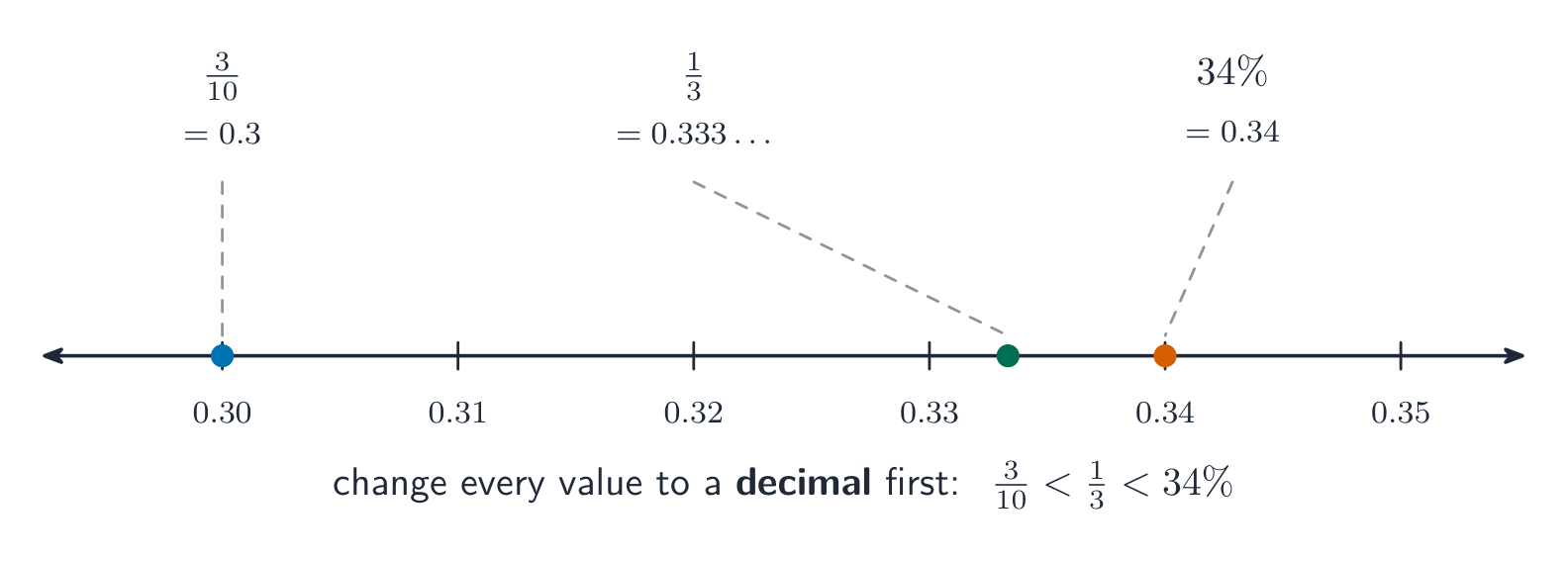
Worked example. Put $34\%$, $\frac{1}{3}$ and $\frac{3}{10}$ in order, smallest first.
As decimals: $34\% = 0.34$, $\frac{1}{3} = 0.333\ldots$, $\frac{3}{10} = 0.3$. So the order is
$$\frac{3}{10} < \frac{1}{3} < 34\%.$$Convert every value to a decimal, then place them on a number line Vocabulary · Словарь Train · ТренироватьEnglish Русский magnitude/ˈmæɡnɪtjuːd/ величина 1.13
Percentages

Syllabus · Программа
EnglishSubject content Notes and examples 1 Calculate a given percentage of a quantity. 2 Express one quantity as a percentage of another. 3 Calculate percentage increase or decrease. 4 Calculate with simple and compound interest. Formulas are not given. Percentage calculations may include: • deposit • discount • profit and loss (as an amount or a percentage) • earnings • percentages over 100%. РусскийПредметное содержание Примечания и примеры 1 Вычислять заданный процент от количества. 2 Выражать одно количество как процент другого. 3 Вычислять процентное увеличение или уменьшение. 4 Вычислять с простым и сложным процентом. Формулы не даны. Процентные расчеты могут включать: • депозит • скидка • прибыль и убытки (в сумме или в процентах) • заработок • проценты более 100%. EnglishSubject content Notes and examples 1 Calculate a given percentage of a quantity. 2 Express one quantity as a percentage of another. 3 Calculate percentage increase or decrease. 4 Calculate with simple and compound interest. Problems may include repeated percentage change. Formulas are not given. 5 Calculate using reverse percentages. e.g. find the cost price given the selling price and the percentage profit. Percentage calculations may include: • deposit • discount • profit and loss (as an amount or a percentage) • earnings • percentages over 100%. РусскийПредметное содержание Примечания и примеры 1 Вычислять заданный процент от количества. 2 Выражать одно количество как процент другого. 3 Вычислять процентное увеличение или уменьшение. 4 Производить вычисления с простым и сложным процентом. Задачи могут включать многократное изменение процента. Формулы не приводятся. 5 Производить вычисления с обратными процентами. Например: найти цену покупки, зная цену продажи и процент прибыли. Вычисления с процентами могут включать: • депозит • скидку • прибыль и убытки (в денежном выражении или в процентах) • заработок • проценты свыше 100%. Source: Cambridge International syllabus · Источник: Программа Cambridge International
Shops use percentages for discounts, sales tax and profit margins. Find a percentage of an amount. $15\%$ of $\$80 = 0.15 \times 80 = \$12$.
Write one amount as a percentage of another. A score of $18$ out of $25$ is $\frac{18}{25} \times 100\% = 72\%$.
Percentage increase or decrease uses
$$\text{percentage change} = \frac{\text{change}}{\text{original amount}} \times 100\%.$$Worked example. A price rises from $\$40$ to $\$50$. Find the percentage increase.
The change is $\$10$, so $\frac{10}{40} \times 100\% = 25\%$ increase.
A quick way is a multiplier 乘数. To increase by $15\%$, multiply by $1.15$; to decrease by $15\%$, multiply by $0.85$.
Simple and compound interest
Interest 利息 is money paid for borrowing or for saving. The principal 本金 is the starting amount.
- Simple interest 单利 pays the same amount each year, worked out on the principal only:
$$I = \frac{P \times r \times t}{100},$$where $P$ is the principal, $r$ is the rate per year (as a percentage) and $t$ is the number of years.
- Compound interest 复利 adds the interest on each year, so the next year earns interest on a larger total:
$$\text{final value} = P\left(1 + \frac{r}{100}\right)^{t}.$$
Worked example. Find the value of $\$500$ saved at $4\%$ compound interest for $3$ years.
$$500 \times 1.04^{3} = 500 \times 1.124864 = \$562.43 \ (\text{to the nearest cent}).$$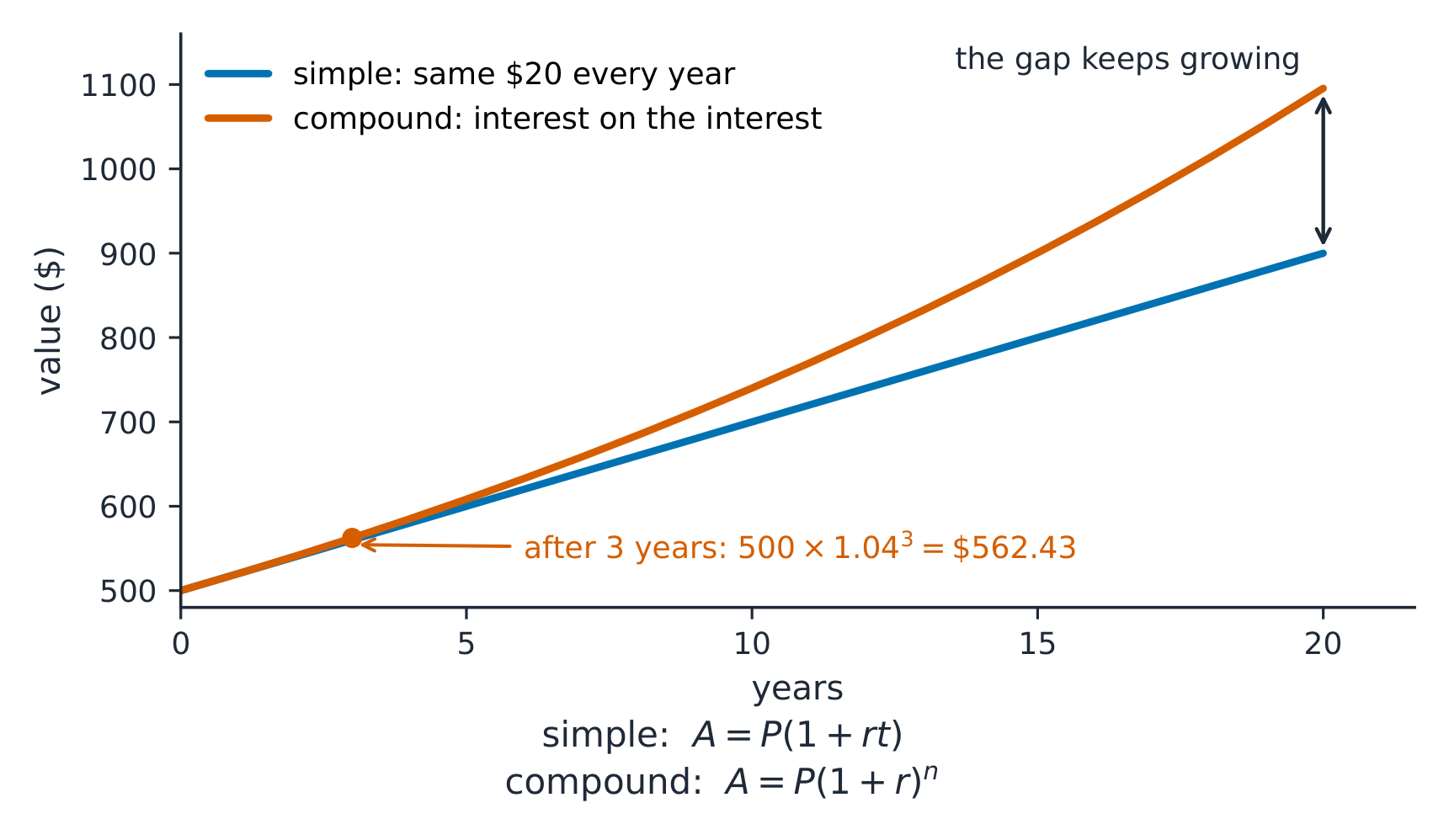
Simple interest grows in a straight line; compound interest grows faster every year Reverse percentages (Extended)
A reverse percentage 逆百分比 problem gives the amount after a change and asks for the original. To solve it, divide by the multiplier — do not just take the percentage off.
Worked example. A coat costs $\$60$ after a $20\%$ increase. Find the original price.
$\$60$ is $120\%$ of the original, so the original price is $60 \div 1.2 = \$50$.
Explore · ИсследоватьPercentage change lab · Лаборатория процентных изменений
new value = old value x multiplier · новое значение = старое значение × множитель
Change the multiplier and see the final value change. · Измените множитель и посмотрите, как изменится конечное значение.
Vocabulary · Словарь Train · ТренироватьEnglish Русский multiplier/ˌmʌltɪˈplaɪə/ мультипликатор interest/ˈɪntrest/ процент principal/ˈprɪnsɪpl/ главный simple interest/ˈsɪmpl ˈɪntrest/ простых процентов compound interest/ˈkɒmpaʊnd ˈɪntrest/ сложный процент reverse percentage/rɪˈvɜːs pəˈsentɪdʒ/ обратный процент 1.17
Exponential growth and decay (Extended)
Syllabus · Программа
EnglishSubject content Notes and examples Use exponential growth and decay. e.g. depreciation, population change. Knowledge of e is not required. РусскийПредметное содержание Примечания и примеры Использовать экспоненциальный рост и убывание. Например: амортизация, изменение численности населения. Знание числа e не требуется. Source: Cambridge International syllabus · Источник: Программа Cambridge International
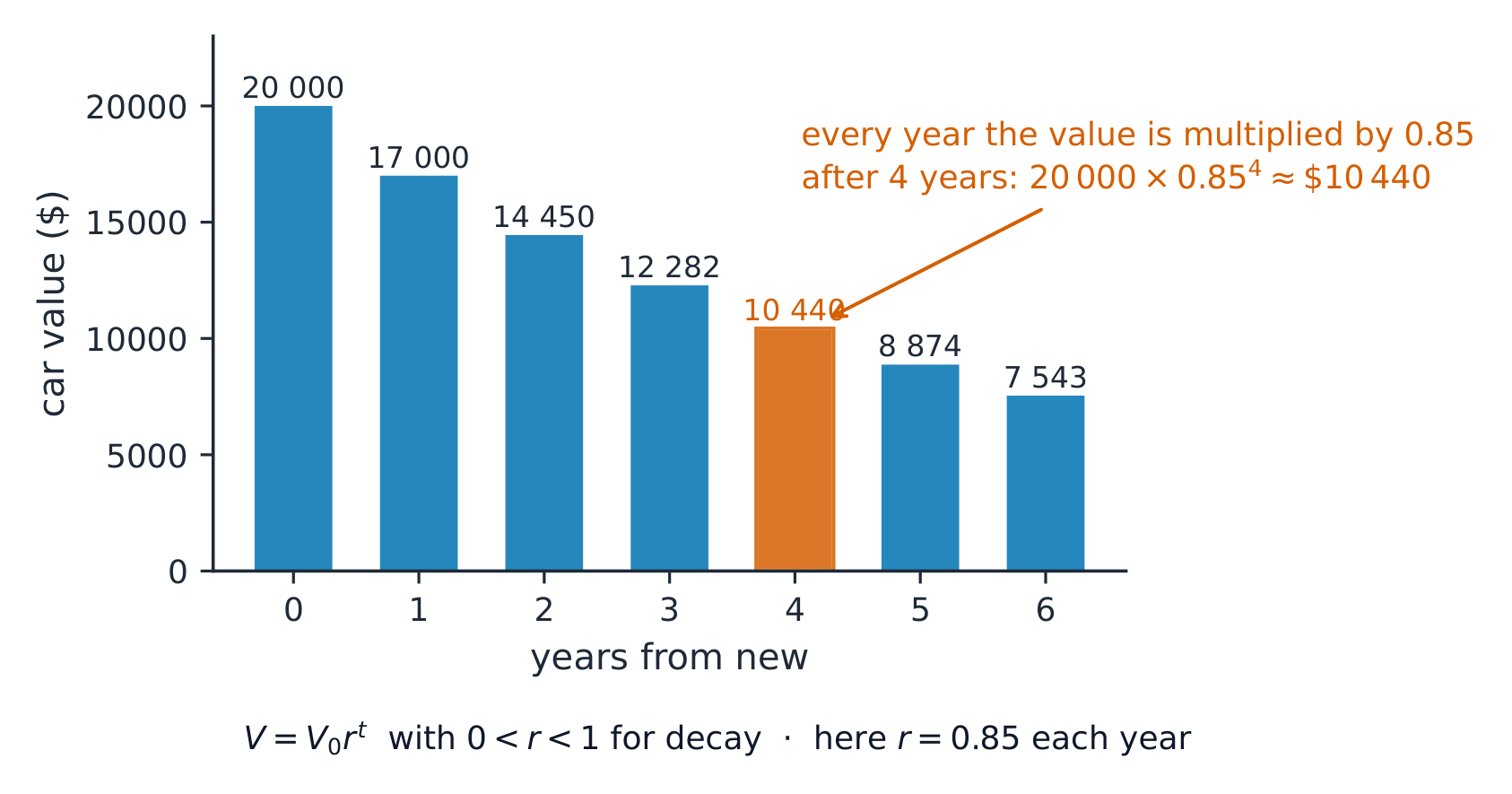
When a quantity changes by the same percentage in each time period, it shows exponential growth 指数增长 (it gets bigger) or exponential decay 指数衰减 (it gets smaller). Use the compound formula. Depreciation 折旧, where something like a car loses value each year, is decay.
Worked example. A car worth $\$20\,000$ loses $15\%$ of its value each year. Find its value after $4$ years.
The multiplier is $0.85$, so
$$20\,000 \times 0.85^{4} = 20\,000 \times 0.522\ldots = \$10\,440 \ (\text{to the nearest dollar}).$$Exponential decay: the car loses 15 percent of its current value every year Explore · ИсследоватьCompound interest · Сложный процент
Money grows by (1 + r) every year, so compound interest curves above simple interest. Drag the rate and the number of years. · Деньги растут на (1 + r) каждый год, поэтому график сложных процентов идет круче графика простых. Перетащите ставку и количество лет.
Explore · ИсследоватьExponential growth & decay · Экспоненциальный рост и спад
y = a·bˣ
Change the base b: b > 1 grows, 0 < b < 1 decays — useful for interest and populations. · Изменяйте основание b: b > 1 означает рост, 0 < b < 1 означает спад — полезно для процентов и популяций.
Vocabulary · Словарь Train · ТренироватьEnglish Русский exponential growth/ˌekspəˈnenʃl ɡrəʊθ/ экспоненциального роста exponential decay/ˌekspəˈnenʃl dɪˈkeɪ/ экспоненциального спада depreciation/dɪˌpriːʃɪˈeɪʃn/ деpreciация 1.11
Ratio and proportion

Syllabus · Программа
EnglishSubject content Notes and examples Understand and use ratio and proportion to: • give ratios in their simplest form e.g. 20:30:40 in its simplest form is 2:3:4. • divide a quantity in a given ratio • use proportional reasoning and ratios in context. e.g. adapt recipes; use map scales; determine best value. РусскийПредметное содержание Примечания и примеры Понимать и использовать пропорции и коэффициенты для: • приведения отношений к простейшему виду например, 20:30:40 в простейшем виде равно 2:3:4. • деления количества в заданном отношении • использования пропорционального мышления и отношений в контексте. например, адаптировать рецепты; использовать масштаб карт; определять выгодность покупки. Source: Cambridge International syllabus · Источник: Программа Cambridge International
A ratio 比 compares quantities, written like $a:b$. Simplify it like a fraction by dividing by the HCF: $20:30:40 = 2:3:4$.
Dividing in a ratio. Share $\$48$ in the ratio $3:5$.
The total number of parts is $3 + 5 = 8$. One part is $48 \div 8 = \$6$. So the shares are $3 \times 6 = \$18$ and $5 \times 6 = \$30$.
A bar model for sharing 48 dollars in the ratio 3 to 5 Proportion 比例 means two ratios are equal. Use it for recipes, map scales 比例尺 and finding best value.
Worked example. $3$ pens cost $\$1.80$. Find the cost of $7$ pens.
One pen costs $1.80 \div 3 = \$0.60$. So $7$ pens cost $7 \times 0.60 = \$4.20$.
Explore · ИсследоватьDirect proportion · Прямая пропорциональность
y = ax
Direct proportion is a straight line through the origin — double x and you double y. · Прямая пропорциональность — это прямая линия, проходящая через начало координат: удвойте x, и вы удвоите y.
Vocabulary · Словарь Train · ТренироватьEnglish Русский ratio/ˈreɪʃɪəʊ/ разность proportion/prəˈpɔːʃn/ доли scale/skeɪl/ масштаб 1.12
Rates and average speed

Syllabus · Программа
EnglishSubject content Notes and examples 1 Use common measures of rate. e.g. calculate with: • hourly rates of pay • exchange rates between currencies • flow rates • fuel consumption. 2 Apply other measures of rate. e.g. calculate with: • pressure • density • population density. Required formulas will be given in the question. 3 Solve problems involving average speed. Knowledge of speed/distance/time formula is required. e.g. A cyclist travels 45 km in 3 hours 45 minutes. What is their average speed? Notation used will be, e.g. m/s (metres per second), $\text{g/cm}^3$ (grams per cubic centimetre). РусскийПредметное содержание Примечания и примеры 1 Использовать распространенные меры скорости. например, вычислять: • почасовые ставки оплаты труда • валютные курсы обмена • скорости потока • расход топлива. 2 Применять другие меры скорости. например, вычислять: • давление • плотность • плотность населения. Необходимые формулы будут даны в задании. 3 Решать задачи, связанные со средней скоростью. Требуется знание формулы скорости/расстояния/времени. Например, велосипедист проехал 45 км за 3 часа 45 минут. Какова его средняя скорость? Используемая нотация, например, m/s (метры в секунду), $\text{g/cm}^3$ (граммы на кубический сантиметр). EnglishSubject content Notes and examples 1 Use common measures of rate. e.g. calculate with: • hourly rates of pay • exchange rates between currencies • flow rates • fuel consumption. 2 Apply other measures of rate. e.g. calculate with: • pressure • density • population density. Required formulas will be given in the question. 3 Solve problems involving average speed. Knowledge of speed/distance/time formula is required. e.g. A cyclist travels 45 km in 3 hours 45 minutes. What is their average speed? Notation used will be, e.g. m/s (metres per second), g/cm$^{3}$ (grams per cubic centimetre). РусскийПредметное содержание Примечания и примеры 1 Использовать распространенные меры скорости. например, вычислять: • почасовые ставки оплаты труда • валютные курсы обмена • скорости потока • расход топлива. 2 Применять другие меры скорости. например, вычислять: • давление • плотность • плотность населения. Необходимые формулы будут даны в задании. 3 Решать задачи на среднюю скорость. Требуется знание формулы скорости/расстояния/времени. Например: Велосипедист проехал 45 км за 3 часа 45 минут. Какова его средняя скорость? Используются следующие обозначения, например: м/с (метры в секунду), г/см$^{3}$ (граммы на кубический сантиметр). Source: Cambridge International syllabus · Источник: Программа Cambridge International
A rate 比率 compares two quantities measured in different units, such as price per kilogram, or distance per hour.
Average speed 平均速度 uses
$$\text{average speed} = \frac{\text{total distance}}{\text{total time}}.$$Worked example. A cyclist travels $45\text{ km}$ in $3$ hours $45$ minutes. Find the average speed.
First change the time to hours: $3$ h $45$ min $= 3.75$ h. Then
$$\text{average speed} = \frac{45}{3.75} = 12\text{ km/h}.$$The distance-speed-time triangle: cover the one you want Other rates work the same way. Density 密度 is found from mass 质量 and volume 体积:
$$\text{density} = \frac{\text{mass}}{\text{volume}}.$$Other examples are flow rate, fuel consumption and population density 人口密度. If a rate needs a special formula (such as pressure 压强), the question will give it to you.
Vocabulary · Словарь Train · ТренироватьEnglish Русский rate/reɪt/ скоростью average speed/ˈævrɪdʒ spiːd/ средняя скорость density/ˈdensɪti/ плотность mass/mæs/ масса volume/ˈvɒljuːm/ объем population density/ˌpɒpjʊˈleɪʃn ˈdensɪti/ плотность населения pressure/ˈpreʃə/ давление 1.9
Rounding and estimation
Syllabus · Программа
EnglishSubject content Notes and examples 1 Round values to a specified degree of accuracy. Includes decimal places and significant figures. 2 Make estimates for calculations involving numbers, quantities and measurements. e.g. write 5764 correct to the nearest thousand. e.g. by writing each number correct to 1 significant figure, estimate the value of $$\frac{41.3}{9.79 \times 0.765}$$.3 Round answers to a reasonable degree of accuracy in the context of a given problem. РусскийПредметное содержание Примечания и примеры 1 Округлять значения до заданной точности. Включает десятичные знаки и значащие цифры. 2 Делать оценки для вычислений, включающих числа, величины и измерения. Например, округлить 5764 до ближайшей тысячи. Например, записав каждое число с точностью до 1 значащей цифры, оцените значение $$\frac{41.3}{9.79 \times 0.765}$$.3 Округлять ответы до разумной точности в контексте данной задачи. EnglishSubject content Notes and examples 1 Round values to a specified degree of accuracy. Includes decimal places and significant figures. e.g. write 5764 correct to the nearest thousand. 2 Make estimates for calculations involving numbers, quantities and measurements. e.g. by writing each number correct to 1 significant figure, estimate the value of $$\frac{41.3}{9.79 \times 0.765}$$.3 Round answers to a reasonable degree of accuracy in the context of a given problem. РусскийПредметное содержание Примечания и примеры 1 Округлять значения до указанного уровня точности. Включает десятичные знаки и значащие цифры. Например: запишите 5764, округлив до ближайшей тысячи. 2 Делать оценки для вычислений с числами, величинами и измерениями. Например, записывая каждое число правильно до 1 значащей цифры, оцените значение $$\frac{41.3}{9.79 \times 0.765}$$.3 Округлять ответы до разумной точности в контексте данной задачи. Source: Cambridge International syllabus · Источник: Программа Cambridge International
Rounding
- decimal places (d.p.) 小数位: digits counted after the point. $3.14159$ to $2$ d.p. is $3.14$.
- significant figures (s.f.) 有效数字: digits counted from the first non-zero digit. $5764$ to $1$ s.f. is $6000$; $0.004067$ to $2$ s.f. is $0.0041$.
Rule: look at the next digit. If it is $5$ or more, round up; if it is less, round down.
Estimation
To estimate 估算 an answer, round every number to $1$ s.f., then calculate.
Worked example. Estimate $\dfrac{41.3}{9.79 \times 0.765}$.
$$\frac{41.3}{9.79 \times 0.765} \approx \frac{40}{10 \times 0.8} = \frac{40}{8} = 5.$$Explore · ИсследоватьRounding and bounds lab · Лаборатория округления и границ
Classify numbers by the decision needed for accuracy. · Классифицируйте числа по необходимому решению для обеспечения точности.
Vocabulary · Словарь Train · ТренироватьEnglish Русский decimal place/ˈdesɪml pleɪs/ позиция десятичной дроби significant figure/sɪɡˈnɪfɪkənt ˈfɪɡə/ значащая цифра estimate/ˈestɪmət/ оценкой 1.10
Limits of accuracy

Syllabus · Программа
EnglishSubject content Notes and examples Give upper and lower bounds for data rounded to a specified accuracy. e.g. write down the upper bound of a length measured correct to the nearest metre. Candidates are not expected to find the bounds of the results of calculations which have used data rounded to a specified accuracy. РусскийПредметное содержание Примечания и примеры Давать верхние и нижние границы для данных, округленных до указанной точности. например, запишите верхнюю границу длины, измеренной с точностью до ближайшего метра. От кандидатов не требуется находить границы результатов вычислений, в которых использовались данные, округленные до указанной точности. EnglishSubject content Notes and examples 1 Give upper and lower bounds for data rounded to a specified accuracy. e.g. write down the upper bound of a length measured correct to the nearest metre. 2 Find upper and lower bounds of the results of calculations which have used data rounded to a specified accuracy. Example calculations include: • calculate the upper bound of the perimeter or the area of a rectangle given dimensions measured to the nearest centimetre • find the lower bound of the speed given rounded values of distance and time. РусскийПредметное содержание Примечания и примеры 1 Определять верхнюю и нижнюю границы для данных, округлённых до указанной точности. напр. записать верхнюю границу длины, измеренной с точностью до ближайшего метра. 2 Находить верхнюю и нижнюю границы результатов вычислений, в которых использовались данные, округлённые до указанной точности. Примеры вычислений включают: • вычисление верхней границы периметра или площади прямоугольника при известной длине сторон, измеренных с точностью до ближайшего сантиметра; • нахождение нижней границы скорости при округлённых значениях расстояния и времени. Source: Cambridge International syllabus · Источник: Программа Cambridge International
A rounded value could really be anything that rounds to it. The smallest possible value is the lower bound 下界; the largest is the upper bound 上界. For a value rounded to the nearest unit, the bounds lie half a unit on each side.
Worked example. A height $h$ is $635\text{ m}$, correct to the nearest metre. Give the bounds.
$$634.5 \leqslant h < 635.5.$$Everything in the band rounds to 635: the lower bound is included, the upper bound is not So the lower bound is $634.5\text{ m}$ and the upper bound is $635.5\text{ m}$.
Bounds in calculations (Extended)
Combine the bounds to get the bound you want.
Worked example. A rectangle is $8\text{ cm}$ by $5\text{ cm}$, each side to the nearest cm. Find the largest possible area 面积.
Use the upper bounds of both sides: $8.5 \times 5.5 = 46.75\text{ cm}^{2}$. (The smallest area uses the lower bounds: $7.5 \times 4.5 = 33.75\text{ cm}^{2}$.)
For a divided quantity such as $\text{speed} = \dfrac{\text{distance}}{\text{time}}$, the largest speed comes from the largest distance divided by the smallest time.
Vocabulary · Словарь Train · ТренироватьEnglish Русский lower bound/ˈləʊə baʊnd/ нижняя граница upper bound/ˈʌpə baʊnd/ верхняя граница area/ˈeərɪə/ площадь 1.15
Time
Syllabus · Программа
EnglishSubject content Notes and examples 1 Calculate with time: seconds (s), minutes (min), hours (h), days, weeks, months, years, including the relationship between units. 1 year = 365 days. 2 Calculate times in terms of the 24-hour and 12-hour clock. In the 24-hour clock, for example, 3.15 a.m. will be denoted by 03 15 and 3.15 p.m. by 15 15. 3 Read clocks and timetables. Includes problems involving time zones, local times and time differences. РусскийПредметное содержание Примечания и примеры 1 Выполнять вычисления со временем: секунды (s), минуты (min), часы (h), дни, недели, месяцы, годы, включая взаимосвязь между единицами. 1 год = 365 дней. 2 Выполнять вычисления времени в формате 24-часового и 12-часового циферблата. В 24-часовом формате, например, 3.15 a.m. обозначается как 03 15, а 3.15 p.m. — как 15 15. 3 Читать часы и расписания. Включает задачи, связанные с часовыми поясами, местным временем и разницей во времени. EnglishSubject content Notes and examples 1 Calculate with time: seconds (s), minutes (min), hours (h), days, weeks, months, years, including the relationship between units. 1 year = 365 days. 2 Calculate times in terms of the 24-hour and 12-hour clock. In the 24-hour clock, for example, 3.15 a.m. will be denoted by 0315 and 3.15 p.m. by 1515. 3 Read clocks and timetables. Includes problems involving time zones, local times and time differences. РусскийПредметное содержание Примечания и примеры 1 Выполнять вычисления со временем: секунды (s), минуты (min), часы (h), дни, недели, месяцы, годы, включая взаимосвязь между единицами. 1 год = 365 дней. 2 Вычисление времени в формате 24-часового и 12-часового форматирования. В 24-часовом формате, например, время 3.15 утра обозначается как 0315, а время 3.15 вечера — как 1515. 3 Читать часы и расписания. Включает задачи, связанные с часовыми поясами, местным временем и разницей во времени. Source: Cambridge International syllabus · Источник: Программа Cambridge International
- $60$ seconds $= 1$ minute, $60$ minutes $= 1$ hour, $24$ hours $= 1$ day, and $1$ year $= 365$ days.
- The 24-hour clock writes a time as four digits: $3.15$ p.m. is $15\,15$.
Worked example. A film starts at $19\,35$ and lasts $70$ minutes. Find the time it finishes.
$70$ min $= 1$ h $10$ min. Adding $1$ hour gives $20\,35$; adding $10$ minutes gives $20\,45$.
For timetables and time zone 时区 problems, add or subtract the time difference between the places.
Explore · ИсследоватьTime, money and calculator lab · Лабораторная работа по времени, деньгам и калькулятору
Choose the operation that matches a real measurement problem. · Выберите операцию, соответствующую реальной измерительной задаче.
Vocabulary · Словарь Train · ТренироватьEnglish Русский time zone/taɪm zəʊn/ часовой пояс 1.16
Money
Syllabus · Программа
EnglishSubject content Notes and examples 1 Calculate with money. 2 Convert from one currency to another. РусскийПредметное содержание Примечания и примеры 1 Выполнять вычисления с деньгами. 2 Конвертировать из одной валюты в другую. Source: Cambridge International syllabus · Источник: Программа Cambridge International
Work with money as ordinary decimals, but give answers to $2$ d.p. (so $\$4.8$ is written $\$4.80$).
Currency conversion. Use the exchange rate 汇率 as a multiplier.
Worked example. The exchange rate is $\$1 = €0.92$. Convert $\$150$ to euros, and convert $€138$ back to dollars.
$$150 \times 0.92 = €138, \qquad 138 \div 0.92 = \$150.$$Vocabulary · Словарь Train · ТренироватьEnglish Русский exchange rate/eksˈtʃeɪndʒ reɪt/ валютный курс 1.14
Using a calculator
Syllabus · Программа
EnglishSubject content Notes and examples 1 Use a calculator efficiently. e.g. know not to round values within a calculation and to only round the final answer. 2 Enter values appropriately on a calculator. e.g. enter 2 hours 30 minutes as 2.5 hours or 2° 30’ 0’’. 3 Interpret the calculator display appropriately. e.g. in money 4.8 means $4.80; in time 3.25 means 3 hours 15 minutes. РусскийПредметное содержание Примечания и примеры 1 Эффективно использовать калькулятор. например, знать, что не следует округлять значения внутри вычисления и округлять только окончательный ответ. 2 Правильно вводить значения в калькулятор. например, вводить 2 часа 30 минут как 2.5 часов или 2° 30’ 0’’. 3 Правильно интерпретировать дисплей калькулятора. например, в деньгах 4.8 означает $4.80; во времени 3.25 означает 3 часа 15 минут. EnglishSubject content Notes and examples 1 Use a calculator efficiently. e.g. know not to round values within a calculation and to only round the final answer. 2 Enter values appropriately on a calculator. e.g. enter 2 hours 30 minutes as 2.5 hours or 2° 30' 0''. 3 Interpret the calculator display appropriately. e.g. in money 4.8 means $4.80; in time 3.25 means 3 hours 15 minutes. РусскийПредметное содержание Примечания и примеры 1 Эффективно использовать калькулятор. например, знать, что не следует округлять значения внутри вычисления и округлять только окончательный ответ. 2 Правильный ввод значений на калькуляторе. Например: ввод 2 часов 30 минут как 2.5 часа или 2° 30' 0''. 3 Правильно интерпретировать дисплей калькулятора. например, в деньгах 4.8 означает $4.80; во времени 3.25 означает 3 часа 15 минут. Source: Cambridge International syllabus · Источник: Программа Cambridge International
- Do not round part-way through a calculation. Keep the full value and round only the final answer.
- Enter time as a decimal of an hour: $2$ hours $30$ minutes is $2.5$ hours, not $2.30$.
- Read the display in context: in money, $4.8$ means $\$4.80$; in time, $3.25$ hours means $3$ hours $15$ minutes.
1.14
Exam tips
- Follow BIDMAS (brackets, indices, division/multiplication, addition/subtraction) in order, and remember a negative times a negative is positive.
- In standard form the number in front is between 1 and 10; a small number (like $0.0004$) has a negative power of 10.
- A percentage change is worked out on the original amount. For a reverse percentage, divide by the multiplier (e.g. $\div 1.2$ undoes a $20\%$ rise).
- Do not round part-way through — keep the full value and round only at the end, to the accuracy the question asks for (decimal places or significant figures).
- For limits of accuracy, a value rounded to the nearest whole number can be up to $0.5$ either side (so $8$ means $7.5 \le x < 8.5$).
-
2
Algebra and graphs · Алгебра и графики
Watch lesson · Смотреть урокThis handout covers Topic 2, Algebra and graphs. Parts marked (Extended) are only tested on the Extended papers; everything else is for both levels.
2.1
Working with algebra
Syllabus · Программа
EnglishSubject content Notes and examples 1 Know that letters can be used to represent generalised numbers. 2 Substitute numbers into expressions and formulas. РусскийПредметное содержание Примечания и примеры 1 Знать, что буквы могут использоваться для представления обобщенных чисел. 2 Подставлять числа в выражения и формулы. Source: Cambridge International syllabus · Источник: Программа Cambridge International
In algebra 代数 we use letters to stand for numbers. A letter whose value can change is a variable 变量. To substitute 代入 means to put a number in place of a letter.
Worked example. Find the value of $3x^{2} - 2y$ when $x = 4$ and $y = 5$.
$$3 \times 4^{2} - 2 \times 5 = 3 \times 16 - 10 = 48 - 10 = 38.$$Explore · ИсследоватьAlgebra manipulation route · Алгебраические преобразования
Follow expression work from collecting terms to solving. · Следуйте шагам решения выражения: от приведения подобных слагаемых до нахождения ответа.
Vocabulary · Словарь Train · ТренироватьEnglish Русский algebra/ˈældʒɪbrə/ алгебра variable/ˈveərɪəbl/ переменной substitute/ˈsʌbstɪtjuːt/ замещение 2.2
Simplifying and expanding

Syllabus · Программа
EnglishSubject content Notes and examples 1 Simplify expressions by collecting like terms. Simplify means give the answer in its simplest form, e.g. $2a + 3b + 5a - 9b = 7a - 6b$. 2 Expand products of algebraic expressions. e.g. expand $3x(2x - 4y)$. Includes products of two brackets involving one variable, e.g. expand $(2x + 1)(x - 4)$. 3 Factorise by extracting common factors. Factorise means factorise fully, e.g. $9x^2 + 15xy = 3x(3x + 5y)$. РусскийПредметное содержание Примечания и примеры 1 Упрощать выражения путем приведения подобных слагаемых. Упрощение означает получение ответа в наименьшем виде, например, $2a + 3b + 5a - 9b = 7a - 6b$. 2 Раскрывать произведения алгебраических выражений. Например, раскрыть $3x(2x - 4y)$. Включает произведения двух скобок, содержащих одну переменную, например, раскрыть $(2x + 1)(x - 4)$. 3 Разлагать на множители путем вынесения общего множителя. Разложение на множители означает разложение полностью, например, $9x^2 + 15xy = 3x(3x + 5y)$. EnglishSubject content Notes and examples 1 Simplify expressions by collecting like terms. Simplify means give the answer in its simplest form, e.g. $2a^2 + 3ab - 1 + 5a^2 - 9ab + 4 = 7a^2 - 6ab + 3$. 2 Expand products of algebraic expressions. e.g. expand $3x(2x - 4y)$, $(3x + y)(x - 4y)$. Includes products of more than two brackets, e.g. expand $(x - 2)(x + 3)(2x + 1)$. 3 Factorise by extracting common factors. Factorise means factorise fully, e.g. $9x^2 + 15xy = 3x(3x + 5y)$. 4 Factorise expressions of the form: • $ax + bx + kay + kby$ • $a^2x^2 - b^2y^2$ • $a^2 + 2ab + b^2$ • $ax^2 + bx + c$ • $ax^3 + bx^2 + cx$. 5 Complete the square for expressions in the form $ax^2 + bx + c$. РусскийПредметное содержание Примечания и примеры 1 Упрощать выражения путем приведения подобных слагаемых. Упрощение означает получение ответа в наименьшем виде, например, $2a^2 + 3ab - 1 + 5a^2 - 9ab + 4 = 7a^2 - 6ab + 3$. 2 Раскрывать скобки в произведениях алгебраических выражений. Например, раскрыть $3x(2x - 4y)$, $(3x + y)(x - 4y)$. Включает произведения более двух скобок, например, раскрыть $(x - 2)(x + 3)(2x + 1)$. 3 Разлагать на множители путем вынесения общего множителя. Разложение на множители означает разложение полностью, например, $9x^2 + 15xy = 3x(3x + 5y)$. 4 Разкладывать на множители выражения вида: • $ax + bx + kay + kby$ • $a^2x^2 - b^2y^2$ • $a^2 + 2ab + b^2$ • $ax^2 + bx + c$ • $ax^3 + bx^2 + cx$. 5 Выделять полный квадрат для выражений вида $ax^2 + bx + c$. Source: Cambridge International syllabus · Источник: Программа Cambridge International
A term 项 is a single part of an expression 表达式, such as $5a$ or $-9b$. Like terms 同类项 have exactly the same letters; you may add or subtract them. The number in front of the letter is the coefficient 系数.
Expanding a bracket with an area model 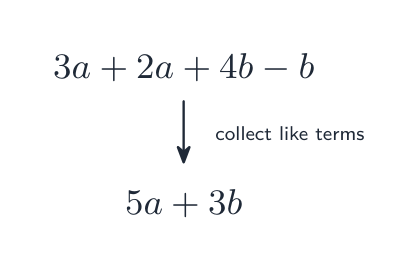
Collecting like terms: add terms with the same letter Worked example. Simplify $2a^{2} + 3ab - 1 + 5a^{2} - 9ab + 4$.
Collect like terms: $2a^{2} + 5a^{2} = 7a^{2}$, $3ab - 9ab = -6ab$, $-1 + 4 = 3$. So the answer is
$$7a^{2} - 6ab + 3.$$To expand 展开 means to multiply out brackets 括号. Multiply every term inside by the term outside; for two brackets, multiply every term in the first by every term in the second.
Worked examples.
$$3x(2x - 4y) = 6x^{2} - 12xy.$$$$(2x + 1)(x - 4) = 2x^{2} - 8x + x - 4 = 2x^{2} - 7x - 4.$$For three brackets (Extended), expand two first, then multiply by the third:
$$(x - 2)(x + 3)(2x + 1) = (x^{2} + x - 6)(2x + 1) = 2x^{3} + 3x^{2} - 11x - 6.$$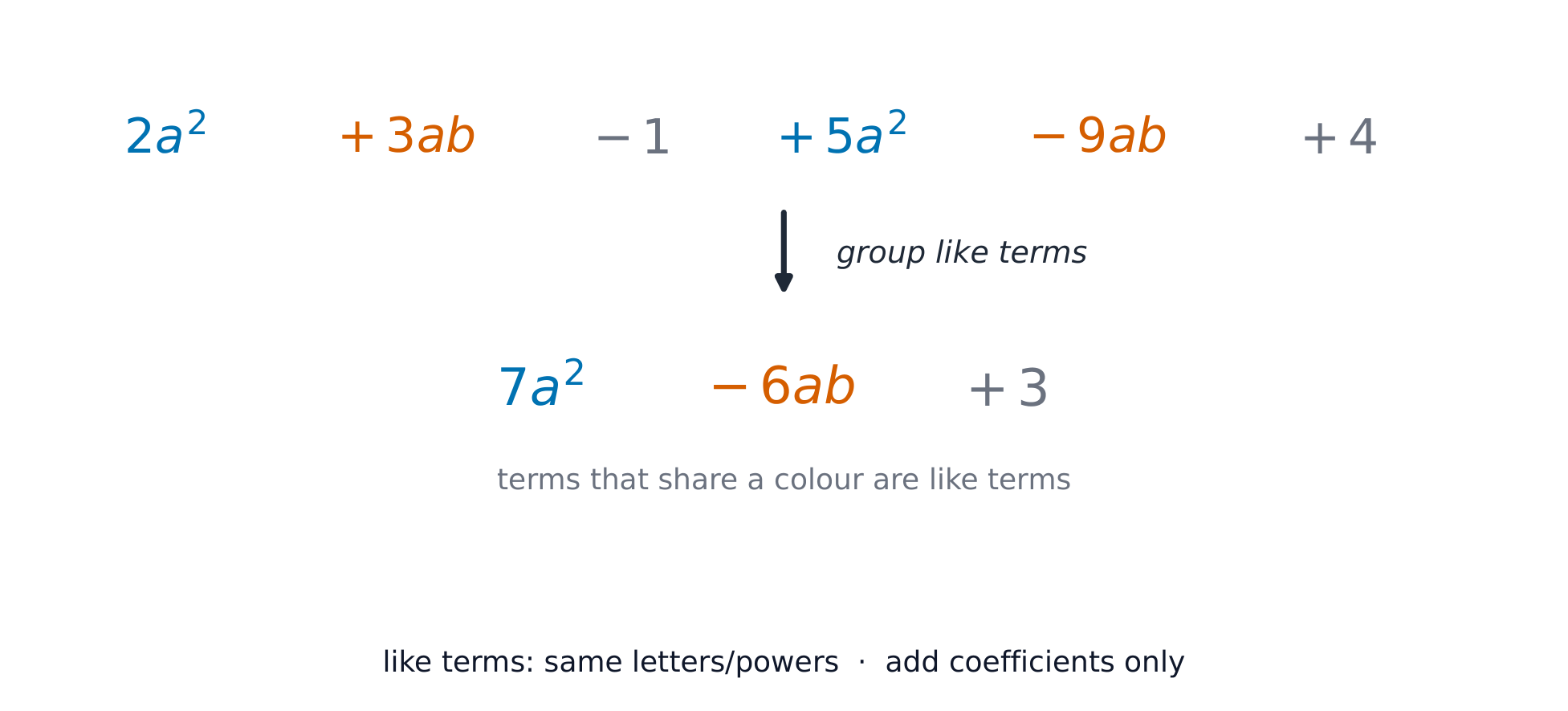
Like terms share the same letters and powers — add coefficients only 
Expand by distributing: a(b+c)=ab+ac (area model) Vocabulary · Словарь Train · ТренироватьEnglish Русский term/tɜːm/ член (последовательности) expression/ekˈspreʃn/ выражение like terms/laɪk tɜːmz/ подобные слагаемые coefficient/ˌkəʊɪˈfɪʃənt/ коэффициент expand/ekˈspænd/ раскрыть скобки brackets/ˈbrækɪts/ скобки 2.2
Factorising
Syllabus · Программа
EnglishSubject content Notes and examples 1 Simplify expressions by collecting like terms. Simplify means give the answer in its simplest form, e.g. $2a + 3b + 5a - 9b = 7a - 6b$. 2 Expand products of algebraic expressions. e.g. expand $3x(2x - 4y)$. Includes products of two brackets involving one variable, e.g. expand $(2x + 1)(x - 4)$. 3 Factorise by extracting common factors. Factorise means factorise fully, e.g. $9x^2 + 15xy = 3x(3x + 5y)$. РусскийПредметное содержание Примечания и примеры 1 Упрощать выражения путем приведения подобных слагаемых. Упрощение означает получение ответа в наименьшем виде, например, $2a + 3b + 5a - 9b = 7a - 6b$. 2 Раскрывать произведения алгебраических выражений. Например, раскрыть $3x(2x - 4y)$. Включает произведения двух скобок, содержащих одну переменную, например, раскрыть $(2x + 1)(x - 4)$. 3 Разлагать на множители путем вынесения общего множителя. Разложение на множители означает разложение полностью, например, $9x^2 + 15xy = 3x(3x + 5y)$. EnglishSubject content Notes and examples 1 Simplify expressions by collecting like terms. Simplify means give the answer in its simplest form, e.g. $2a^2 + 3ab - 1 + 5a^2 - 9ab + 4 = 7a^2 - 6ab + 3$. 2 Expand products of algebraic expressions. e.g. expand $3x(2x - 4y)$, $(3x + y)(x - 4y)$. Includes products of more than two brackets, e.g. expand $(x - 2)(x + 3)(2x + 1)$. 3 Factorise by extracting common factors. Factorise means factorise fully, e.g. $9x^2 + 15xy = 3x(3x + 5y)$. 4 Factorise expressions of the form: • $ax + bx + kay + kby$ • $a^2x^2 - b^2y^2$ • $a^2 + 2ab + b^2$ • $ax^2 + bx + c$ • $ax^3 + bx^2 + cx$. 5 Complete the square for expressions in the form $ax^2 + bx + c$. РусскийПредметное содержание Примечания и примеры 1 Упрощать выражения путем приведения подобных слагаемых. Упрощение означает получение ответа в наименьшем виде, например, $2a^2 + 3ab - 1 + 5a^2 - 9ab + 4 = 7a^2 - 6ab + 3$. 2 Раскрывать скобки в произведениях алгебраических выражений. Например, раскрыть $3x(2x - 4y)$, $(3x + y)(x - 4y)$. Включает произведения более двух скобок, например, раскрыть $(x - 2)(x + 3)(2x + 1)$. 3 Разлагать на множители путем вынесения общего множителя. Разложение на множители означает разложение полностью, например, $9x^2 + 15xy = 3x(3x + 5y)$. 4 Разкладывать на множители выражения вида: • $ax + bx + kay + kby$ • $a^2x^2 - b^2y^2$ • $a^2 + 2ab + b^2$ • $ax^2 + bx + c$ • $ax^3 + bx^2 + cx$. 5 Выделять полный квадрат для выражений вида $ax^2 + bx + c$. Source: Cambridge International syllabus · Источник: Программа Cambridge International
To factorise 因式分解 is the opposite of expanding: write the expression as a product of brackets. Always take out the common factor 公因式 first.
Worked example. $9x^{2} + 15xy = 3x(3x + 5y)$, because $3x$ divides both terms.
The following patterns are Extended.
Grouping (four terms): take a common factor from each pair.
$$xy + 2x + 3y + 6 = x(y + 2) + 3(y + 2) = (x + 3)(y + 2).$$Difference of two squares 平方差: $a^{2} - b^{2} = (a + b)(a - b)$.
$$9x^{2} - 16 = (3x + 4)(3x - 4).$$Perfect square 完全平方: $a^{2} + 2ab + b^{2} = (a + b)^{2}$.
$$x^{2} + 6x + 9 = (x + 3)^{2}.$$Quadratic 二次 expressions $ax^{2} + bx + c$: find two numbers that multiply to $a \times c$ and add to $b$, then split the middle term.
Worked example. Factorise $2x^{2} + 7x + 3$.
Here $a \times c = 6$ and $b = 7$. The numbers $1$ and $6$ work. Split and group:
$$2x^{2} + x + 6x + 3 = x(2x + 1) + 3(2x + 1) = (x + 3)(2x + 1).$$For $ax^{3} + bx^{2} + cx$, take out the common $x$ first: $2x^{3} + 7x^{2} + 3x = x(2x^{2} + 7x + 3) = x(x + 3)(2x + 1)$.
Vocabulary · Словарь Train · ТренироватьEnglish Русский factorise/ˈfæktəraɪz/ разложить на множители common factor/ˈkɒmən ˈfæktə/ общий делитель difference of two squares/ˈdɪfrəns ɒv tuː skweəz/ разность квадратов perfect square/ˈpɜːfekt skweə/ полный квадрат quadratic/kwɒˈdrætɪk/ квадратичной 2.2
Completing the square (Extended)

Syllabus · Программа
EnglishSubject content Notes and examples 1 Simplify expressions by collecting like terms. Simplify means give the answer in its simplest form, e.g. $2a^2 + 3ab - 1 + 5a^2 - 9ab + 4 = 7a^2 - 6ab + 3$. 2 Expand products of algebraic expressions. e.g. expand $3x(2x - 4y)$, $(3x + y)(x - 4y)$. Includes products of more than two brackets, e.g. expand $(x - 2)(x + 3)(2x + 1)$. 3 Factorise by extracting common factors. Factorise means factorise fully, e.g. $9x^2 + 15xy = 3x(3x + 5y)$. 4 Factorise expressions of the form: • $ax + bx + kay + kby$ • $a^2x^2 - b^2y^2$ • $a^2 + 2ab + b^2$ • $ax^2 + bx + c$ • $ax^3 + bx^2 + cx$. 5 Complete the square for expressions in the form $ax^2 + bx + c$. РусскийПредметное содержание Примечания и примеры 1 Упрощать выражения путем приведения подобных слагаемых. Упрощение означает получение ответа в наименьшем виде, например, $2a^2 + 3ab - 1 + 5a^2 - 9ab + 4 = 7a^2 - 6ab + 3$. 2 Раскрывать скобки в произведениях алгебраических выражений. Например, раскрыть $3x(2x - 4y)$, $(3x + y)(x - 4y)$. Включает произведения более двух скобок, например, раскрыть $(x - 2)(x + 3)(2x + 1)$. 3 Разлагать на множители путем вынесения общего множителя. Разложение на множители означает разложение полностью, например, $9x^2 + 15xy = 3x(3x + 5y)$. 4 Разкладывать на множители выражения вида: • $ax + bx + kay + kby$ • $a^2x^2 - b^2y^2$ • $a^2 + 2ab + b^2$ • $ax^2 + bx + c$ • $ax^3 + bx^2 + cx$. 5 Выделять полный квадрат для выражений вида $ax^2 + bx + c$. Source: Cambridge International syllabus · Источник: Программа Cambridge International
A suspension bridge cable hangs in a parabola — the graph of a quadratic. Completing the square 配方法 rewrites $x^{2} + bx + c$ as $(x + p)^{2} + q$. Take half of the $x$-coefficient, square it, then balance.
Worked example. Write $x^{2} + 6x + 1$ in completed-square form.
Half of $6$ is $3$, and $3^{2} = 9$:
$$x^{2} + 6x + 1 = (x + 3)^{2} - 9 + 1 = (x + 3)^{2} - 8.$$When the $x^{2}$ has a coefficient, take it out of the first two terms first:
$$2x^{2} + 8x + 3 = 2(x^{2} + 4x) + 3 = 2\big((x + 2)^{2} - 4\big) + 3 = 2(x + 2)^{2} - 5.$$Vocabulary · Словарь Train · ТренироватьEnglish Русский completing the square/kəmˈpliːtɪŋ ðə skweə/ выделение полного квадрата 2.3
Algebraic fractions (Extended)
Syllabus · Программа
EnglishSubject content Notes and examples 1 Manipulate algebraic fractions. Examples include: • $\frac{x}{3} + \frac{x - 4}{2}$ • $\frac{2x}{3} - \frac{3(x - 5)}{2}$ • $\frac{3a}{4} \times \frac{9a}{10}$ • $\frac{3a}{4} \div \frac{9a}{10}$ • $\frac{1}{x - 2} + \frac{x + 1}{x - 3}$. 2 Factorise and simplify rational expressions. e.g. $\frac{x^2 - 2x}{x^2 - 5x + 6}$. РусскийПредметное содержание Примечания и примеры 1 Преобразовывать алгебраические дроби. Примеры включают: • $\frac{x}{3} + \frac{x - 4}{2}$ • $\frac{2x}{3} - \frac{3(x - 5)}{2}$ • $\frac{3a}{4} \times \frac{9a}{10}$ • $\frac{3a}{4} \div \frac{9a}{10}$ • $\frac{1}{x - 2} + \frac{x + 1}{x - 3}$. 2 Разкладывать на множители и упрощать рациональные выражения. Например, $\frac{x^2 - 2x}{x^2 - 5x + 6}$. Source: Cambridge International syllabus · Источник: Программа Cambridge International
An algebraic fraction 分式 has algebra on the top or bottom. Add and subtract using a common denominator; multiply and divide as with ordinary fractions.
Worked examples.
$$\frac{x}{3} + \frac{x - 4}{2} = \frac{2x}{6} + \frac{3(x - 4)}{6} = \frac{2x + 3x - 12}{6} = \frac{5x - 12}{6}.$$$$\frac{3a}{4} \div \frac{9a}{10} = \frac{3a}{4} \times \frac{10}{9a} = \frac{30a}{36a} = \frac{5}{6}.$$To simplify a rational expression 有理式, factorise the top and bottom, then cancel common brackets.
$$\frac{x^{2} - 2x}{x^{2} - 5x + 6} = \frac{x(x - 2)}{(x - 2)(x - 3)} = \frac{x}{x - 3}.$$Explore · ИсследоватьAlgebraic fraction route · Алгебраические дроби: алгоритм
Simplify algebraic fractions by factorising before cancelling. · Упрощайте алгебраические дроби, раскладывая числитель и знаменатель на множители перед сокращением.
Vocabulary · Словарь Train · ТренироватьEnglish Русский algebraic fraction/ˌældʒɪˈbreɪɪk ˈfrækʃn/ алгебраическая дробь rational expression/ˈræʃənl ekˈspreʃn/ рациональное выражение 2.4
Indices in algebra
Syllabus · Программа
EnglishSubject content Notes and examples 1 Understand and use indices (positive, zero and negative). e.g. $2^x = 32$. Find the value of $x$. 2 Understand and use the rules of indices. e.g. simplify: • $(5x^3)^2$ • $12a^5 \div 3a^{-2}$ • $6x^7y^4 \times 5x^{-5}y$. Knowledge of logarithms is not required. РусскийПредметное содержание Примечания и примеры 1 Понимать и использовать показатели (положительные, нулевые и отрицательные). Например, $2^x = 32$. Найти значение $x$. 2 Понимать и использовать правила работы с показателями. Например, упростить: • $(5x^3)^2$ • $12a^5 \div 3a^{-2}$ • $6x^7y^4 \times 5x^{-5}y$. Знание логарифмов не требуется. EnglishSubject content Notes and examples 1 Understand and use indices (positive, zero, negative and fractional). e.g. solve: • $32^x = 2$ • $5^{x+1} = 25^x$. 2 Understand and use the rules of indices. e.g. simplify: • $3x^{-4} \times \frac{2}{3}x^{\frac{1}{2}}$ • $\frac{2}{5}x^{\frac{1}{2}} \div 2x^{-2}$ • $\left(\frac{2x^5}{3}\right)^3$. Knowledge of logarithms is not required. РусскийПредметное содержание Примечания и примеры 1 Понимать и использовать показатели (положительные, нулевые, отрицательные и дробные). Например, решить: • $32^x = 2$ • $5^{x+1} = 25^x$. 2 Понимать и использовать правила работы с показателями. Например, упростить: • $3x^{-4} \times \frac{2}{3}x^{\frac{1}{2}}$ • $\frac{2}{5}x^{\frac{1}{2}} \div 2x^{-2}$ • $\left(\frac{2x^5}{3}\right)^3$. Знание логарифмов не требуется. Source: Cambridge International syllabus · Источник: Программа Cambridge International
The laws of indices 指数 work with letters too: $a^{m} \times a^{n} = a^{m+n}$, $a^{m} \div a^{n} = a^{m-n}$, and $(a^{m})^{n} = a^{mn}$.
Worked examples.
$$(5x^{3})^{2} = 25x^{6}, \qquad 12a^{5} \div 3a^{-2} = 4a^{7}, \qquad 6x^{7}y^{4} \times 5x^{-5}y = 30x^{2}y^{5}.$$You can also solve simple index equations by writing both sides with the same base 底数.
Worked example. Solve $2^{x} = 32$. Since $32 = 2^{5}$, you get $x = 5$.
Explore · ИсследоватьAlgebraic index law lab · Лабораторная работа: свойства показателей степени
Classify index-law examples by the rule being used. · Классифицируйте примеры свойств показателей степени по используемому правилу.
Vocabulary · Словарь Train · ТренироватьEnglish Русский indices/ˈɪndɪsiːz/ показатели степени base/beɪs/ основанием 2.5
Equations

Syllabus · Программа
EnglishSubject content Notes and examples 1 Construct simple expressions, equations and formulas. e.g. write an expression for a number that is 2 more than $n$. Includes constructing linear simultaneous equations. 2 Solve linear equations in one unknown. Examples include: • $3x + 4 = 10$ • $5 - 2x = 3(x + 7)$. 3 Solve simultaneous linear equations in two unknowns. 4 Change the subject of simple formulas. e.g. change the subject of formulas where: • the subject only appears once • there is not a power or root of the subject. РусскийПредметное содержание Примечания и примеры 1 Составлять простые выражения, уравнения и формулы. Например, записать выражение для числа, которое на 2 больше, чем $n$. Включает составление линейных систем уравнений. 2 Решать линейные уравнения с одной переменной. Примеры включают: • $3x + 4 = 10$ • $5 - 2x = 3(x + 7)$. 3 Решать линейные системы уравнений с двумя неизвестными. 4 Изменять предмет формул простых формул. Например, изменить предмет формулы, где: • предмет встречается только один раз • нет степени или корня предмета. EnglishSubject content Notes and examples 1 Construct expressions, equations and formulas. e.g. write an expression for the product of two consecutive even numbers. Includes constructing simultaneous equations. 2 Solve linear equations in one unknown. Examples include: • $3x + 4 = 10$ • $5 - 2x = 3(x + 7)$. 3 Solve fractional equations with numerical and linear algebraic denominators. Examples include: • $\frac{x}{2x + 1} = 4$ • $\frac{2}{x + 2} + \frac{3}{2x - 1} = 1$ • $\frac{x}{x + 2} = \frac{3}{x - 6}$. 4 Solve simultaneous linear equations in two unknowns. 5 Solve simultaneous equations, involving one linear and one non-linear. With powers no higher than two. 6 Solve quadratic equations by factorisation, completing the square and by use of the quadratic formula. Includes writing a quadratic expression in completed square form. Candidates may be expected to give solutions in surd form. The quadratic formula is given in the List of formulas. 7 Change the subject of formulas. e.g. change the subject of a formula where: • the subject appears twice • there is a power or root of the subject. РусскийПредметное содержание Примечания и примеры 1 Составлять выражения, уравнения и формулы. Например, записать выражение для произведения двух последовательных четных чисел. Включает составление систем уравнений. 2 Решать линейные уравнения с одной переменной. Примеры включают: • $3x + 4 = 10$ • $5 - 2x = 3(x + 7)$. 3 Решать дробные уравнения с числовыми и линейными алгебраическими знаменателями. Примеры включают: • $\frac{x}{2x + 1} = 4$ • $\frac{2}{x + 2} + \frac{3}{2x - 1} = 1$ • $\frac{x}{x + 2} = \frac{3}{x - 6}$. 4 Решать системы линейных уравнений с двумя неизвестными. 5 Решать системы уравнений, включающие одно линейное и одно нелинейное. Со степенью не выше второй. 6 Решать квадратные уравнения методом разложения на множители, выделением полного квадрата и с использованием формулы корней квадратного уравнения. Включает запись квадратного выражения в виде полного квадрата. От кандидатов может требоваться дать решения в виде иррациональных чисел. Формула корней квадратного уравнения приводится в списке формул. 7 Выражать переменную из формул. Например, выразить переменную из формулы, где: • переменная встречается дважды • есть степень или корень от переменной. Source: Cambridge International syllabus · Источник: Программа Cambridge International
Simultaneous equations: where the lines cross An equation 方程 says two expressions are equal. To solve a linear 一次 equation, do the same operation to both sides until the unknown 未知数 is alone.
Solve by doing the same to both sides Worked example. Solve $5 - 2x = 3(x + 7)$.
$$5 - 2x = 3x + 21 \;\Rightarrow\; 5 - 21 = 3x + 2x \;\Rightarrow\; -16 = 5x \;\Rightarrow\; x = -\tfrac{16}{5}.$$Fractional equations (Extended)
A fractional equation 分式方程 has the unknown in a denominator. Multiply both sides by the denominator to clear it.
Worked example. Solve $\dfrac{x}{2x + 1} = 4$.
$$x = 4(2x + 1) = 8x + 4 \;\Rightarrow\; -7x = 4 \;\Rightarrow\; x = -\tfrac{4}{7}.$$Simultaneous equations
Simultaneous equations 联立方程 are two equations solved together. For two linear equations, add or subtract to remove one letter.
Worked example. Solve $2x + y = 7$ and $3x - y = 8$.
Adding removes $y$: $5x = 15$, so $x = 3$. Then $y = 7 - 2(3) = 1$.

The solution of simultaneous equations is where their graphs cross For one linear and one quadratic equation (Extended), substitute the linear into the curve.
Worked example. Solve $y = x + 2$ and $y = x^{2}$.
$$x^{2} = x + 2 \;\Rightarrow\; x^{2} - x - 2 = 0 \;\Rightarrow\; (x - 2)(x + 1) = 0,$$so $x = 2$ (giving $y = 4$) or $x = -1$ (giving $y = 1$).
Solving quadratic equations (Extended)
There are three methods.
- By factorising: $x^{2} + 5x + 6 = 0 \Rightarrow (x + 2)(x + 3) = 0 \Rightarrow x = -2$ or $x = -3$.
- By completing the square: $x^{2} + 6x + 1 = 0 \Rightarrow (x + 3)^{2} = 8 \Rightarrow x + 3 = \pm 2\sqrt{2} \Rightarrow x = -3 \pm 2\sqrt{2}$.
- By the quadratic formula 求根公式, which is given in the exam:
$$x = \frac{-b \pm \sqrt{b^{2} - 4ac}}{2a}.$$
Worked example (formula). Solve $2x^{2} + 3x - 1 = 0$. Here $a = 2$, $b = 3$, $c = -1$:
$$x = \frac{-3 \pm \sqrt{9 + 8}}{4} = \frac{-3 \pm \sqrt{17}}{4}.$$Changing the subject
To change the subject 公式变形 of a formula means to rearrange it so a chosen letter is alone on one side.
Worked example. Make $r$ the subject of $A = \pi r^{2}$ (Extended, because of the power).
$$r^{2} = \frac{A}{\pi} \;\Rightarrow\; r = \sqrt{\frac{A}{\pi}}.$$When the letter appears twice (Extended), collect those terms and factorise. To make $x$ the subject of $y = \dfrac{x + 1}{x - 1}$:
$$y(x - 1) = x + 1 \;\Rightarrow\; yx - x = 1 + y \;\Rightarrow\; x(y - 1) = 1 + y \;\Rightarrow\; x = \frac{1 + y}{y - 1}.$$Explore · ИсследоватьSolving an equation · Решение уравнений
y = ax² + bx + c
Solving means finding the roots — where the curve crosses the x-axis. · Решить — значит найти корни, то есть точки пересечения графика с осью x.
Vocabulary · Словарь Train · ТренироватьEnglish Русский equation/ɪˈkweɪʒn/ уравнение linear/ˈlɪnɪə/ линейной unknown/ʌnˈnəʊn/ неизвестно fractional equation/ˈfrækʃənl ɪˈkweɪʒn/ дробное уравнение simultaneous equations/ˌsɪməlˈteɪnɪəs ɪˈkweɪʒnz/ система уравнений quadratic formula/kwɒˈdrætɪk ˈfɔːmjʊlə/ формула корней квадратного уравнения change the subject/tʃeɪndʒ ðə ˈsʌbdʒekt/ выразить переменную / изменить тему 2.6
Inequalities

Syllabus · Программа
EnglishSubject content Notes and examples Represent and interpret inequalities, including on a number line. When representing and interpreting inequalities on a number line: • open circles should be used to represent strict inequalities (<, >) • closed circles should be used to represent inclusive inequalities ($\leqslant$, $\geqslant$) e.g. $-3 \leqslant x < 1$ РусскийПредметное содержание Примечания и примеры Представлять и интерпретировать неравенства, в том числе на числовой прямой. При представлении и интерпретации неравенств на числовой прямой: • пустые кружки следует использовать для обозначения строгих неравенств (<, >) • закрашенные кружки следует использовать для обозначения включительных неравенств ($\leqslant$, $\geqslant$), например, $-3 \leqslant x < 1$ EnglishSubject content Notes and examples 1 Represent and interpret inequalities, including on a number line. When representing and interpreting inequalities on a number line: • open circles should be used to represent strict inequalities (<, >) • closed circles should be used to represent inclusive inequalities ($\leqslant$, $\geqslant$). e.g. $-3 \leqslant x < 1$ 2 Construct, solve and interpret linear inequalities. Examples include: • $3x < 2x + 4$ • $-3 \leqslant 3x - 2 < 7$. 3 Represent and interpret linear inequalities in two variables graphically. The following conventions should be used: • broken lines should be used to represent strict inequalities (<, >) • solid lines should be used to represent inclusive inequalities ($\leqslant$, $\geqslant$) • shading should be used to represent unwanted regions (unless otherwise directed in the question). e.g. graphs of $x < 1$ and $y \geqslant 1$ 4 List inequalities that define a given region. Linear programming problems are not included. РусскийПредметное содержание Примечания и примеры 1 Представлять и интерпретировать неравенства, включая на числовой прямой. При представлении и интерпретации неравенств на числовой прямой: • пустые кружки должны использоваться для представления строгих неравенств (<, >) • заполненные кружки должны использоваться для представления включительных неравенств ($\leqslant$, $\geqslant$). Например, $-3 \leqslant x < 1$ 2 Составлять, решать и интерпретировать линейные неравенства. Примеры включают: • $3x < 2x + 4$ • $-3 \leqslant 3x - 2 < 7$. 3 Графически представлять и интерпретировать линейные неравенства с двумя переменными. Должны соблюдаться следующие правила: • пунктирные линии должны использоваться для представления строгих неравенств (<, >) • сплошные линии должны использоваться для представления включительных неравенств ($\leqslant$, $\geqslant$) • штриховка должна использоваться для обозначения ненужных областей (если иное не указано в задании). Например, графики $x < 1$ и $y \geqslant 1$ 4 Перечислять неравенства, определяющие данную область. Задачи линейного программирования не включены. Source: Cambridge International syllabus · Источник: Программа Cambridge International
An inequality 不等式 uses $<$, $>$, $\leqslant$ or $\geqslant$. Solve it like an equation, but reverse the sign if you multiply or divide by a negative number.
Worked example. Solve $-3 \leqslant 3x - 2 < 7$.
Add $2$ to all parts, then divide by $3$:
$$-1 \leqslant 3x < 9 \;\Rightarrow\; -\tfrac{1}{3} \leqslant x < 3.$$On a number line 数轴, use an open circle for $<$ or $>$ (value not included) and a closed circle for $\leqslant$ or $\geqslant$ (value included).
$-\tfrac{1}{3} \leqslant x < 3$: a closed circle includes the end value, an open circle excludes it. Regions (Extended)
An inequality in two letters describes a region 区域 of the graph. Draw the boundary line (broken for $<$ or $>$, solid for $\leqslant$ or $\geqslant$) and shade the unwanted side. You may also be asked to list the inequalities that define a given region.
Explore · ИсследоватьInequalities · Неравенства
y = ax + b
An inequality asks where the line is above or below a value. · Неравенство показывает где прямая находится выше или ниже определенного значения.
Vocabulary · Словарь Train · ТренироватьEnglish Русский inequality/ɪniːˈkwɒlɪti/ неравенстве number line/ˈnʌmbə laɪn/ числовая прямая region/ˈriːdʒn/ регион 2.7
Sequences

Syllabus · Программа
EnglishSubject content Notes and examples 1 Continue a given number sequence or pattern. e.g. write the next two terms in this sequence: 1, 3, 6, 10, 15, ... , ... 2 Recognise patterns in sequences, including the term-to-term rule, and relationships between different sequences. 3 Find and use the $n$th term of the following sequences: (a) linear (b) simple quadratic (c) simple cubic. e.g. find the $n$th term of 2, 5, 10, 17 РусскийПредметное содержание Примечания и примеры 1 Продолжать данную числовую последовательность или закономерность. Например, запишите два следующих члена этой последовательности: 1, 3, 6, 10, 15, ... , ... 2 Распознавать закономерности в последовательностях, включая правило перехода от члена к члену и связи между различными последовательностями. 3 Находить и использовать $n$-й член следующих последовательностей: (a) линейные (b) простые квадратичные (c) простые кубические. Например, найдите $n$-й член последовательности 2, 5, 10, 17 EnglishSubject content Notes and examples 1 Continue a given number sequence or pattern. Subscript notation may be used, e.g. $T_n$ is the $n$th term of sequence $T$. 2 Recognise patterns in sequences, including the term-to-term rule, and relationships between different sequences. Includes linear, quadratic, cubic and exponential sequences and simple combinations of these. 3 Find and use the $n$th term of sequences. РусскийПредметное содержание Примечания и примеры 1 Продолжать заданную числовую последовательность или закономерность. Может использоваться индексная нотация, например, $T_n$ является $n$-м членом последовательности $T$. 2 Распознавать закономерности в последовательностях, включая правило перехода от члена к члену и взаимосвязи между различными последовательностями. Включает линейные, квадратичные, кубические и показательные последовательности, а также их простые комбинации. 3 Находить и использовать $n$-й член последовательностей. Source: Cambridge International syllabus · Источник: Программа Cambridge International
Romanesco broccoli: self-similar spirals form a natural number pattern. A sequence 数列 is a list of numbers that follow a rule. The term-to-term rule 递推规则 tells you how to get the next term from the one before.
To find the rule for the term in position $n$ (the $n$th term), look at how the terms change.
Linear sequence (the terms go up by the same amount each time). The difference is the multiple of $n$.
Worked example. Find the $n$th term of $2, 5, 8, 11, \dots$
The terms go up by $3$, so start with $3n$. Since $3 \times 1 = 3$ but the first term is $2$, subtract $1$: the $n$th term is $3n - 1$.
Quadratic sequence (the differences themselves change by the same amount). The second difference equals $2 \times$ the coefficient of $n^{2}$.
Worked example. Find the $n$th term of $2, 5, 10, 17, \dots$
First differences are $3, 5, 7$; the second difference is $2$, so the $n^{2}$ part is $1n^{2}$. Subtracting $n^{2}$ ($1, 4, 9, 16$) from the sequence leaves $1, 1, 1, 1$. So the $n$th term is $n^{2} + 1$.
A cubic 三次 sequence such as $1, 8, 27, 64, \dots$ has $n$th term $n^{3}$. An exponential sequence 指数数列 such as $2, 6, 18, 54, \dots$ multiplies by a fixed number each time; here the $n$th term is $2 \times 3^{\,n-1}$.
Explore · ИсследоватьNumber sequences · Числовые последовательности
Build an arithmetic (add d) or geometric (times r) sequence term by term. · Постройте арифметическую (прибавление d) или геометрическую (умножение r) последовательность член за членом.
Vocabulary · Словарь Train · ТренироватьEnglish Русский sequence/ˈsiːkwəns/ последовательность term-to-term rule/tɜːm tə tɜːm ruːl/ правило от члена к члену cubic/ˈkjuːbɪk/ кубический exponential sequence/ˌekspəˈnenʃl ˈsiːkwəns/ показательная последовательность 2.8
Direct and inverse proportion (Extended)
Syllabus · Программа
EnglishSubject content Notes and examples Express direct and inverse proportion in algebraic terms and use this form of expression to find unknown quantities. Includes linear, square, square root, cube and cube root proportion. Knowledge of proportional symbol ($\propto$) is required. РусскийПредметное содержание Примечания и примеры Выражать прямую и обратную пропорциональность алгебраически и использовать эту форму записи для нахождения неизвестных величин. Включает линейную, квадратичную, квадратичный корень, кубическую и кубический корень пропорциональность. Требуется знание символа пропорциональности ($\propto$). Source: Cambridge International syllabus · Источник: Программа Cambridge International
Two quantities are in direct proportion 正比例 if one is always a fixed multiple of the other: $y \propto x$ means $y = kx$, where $k$ is a constant 常数. They are in inverse proportion 反比例 if one rises as the other falls: $y \propto \dfrac{1}{x}$ means $y = \dfrac{k}{x}$. The symbol $\propto$ is read "is proportional to". You can also have proportion to a square, square root, cube or cube root.
Worked example. $y$ is in direct proportion to $x$, and $y = 12$ when $x = 3$. Find $y$ when $x = 7$.
First find $k$: $12 = k \times 3$, so $k = 4$ and $y = 4x$. Then $y = 4 \times 7 = 28$.
Explore · ИсследоватьInverse proportion · Обратная пропорциональность
y = a/x
Inverse proportion: as x doubles, y halves — a reciprocal curve with two asymptotes. · Обратная пропорциональность: при удвоении x значение y уменьшается вдвое — это гипербола с двумя асимптотами.
Vocabulary · Словарь Train · ТренироватьEnglish Русский direct proportion/daɪˈrekt prəˈpɔːʃn/ прямая пропорциональность constant/ˈkɒnstənt/ постоянно inverse proportion/ɪnˈvɜːs prəˈpɔːʃn/ обратная пропорциональность 2.9
Graphs in practical situations
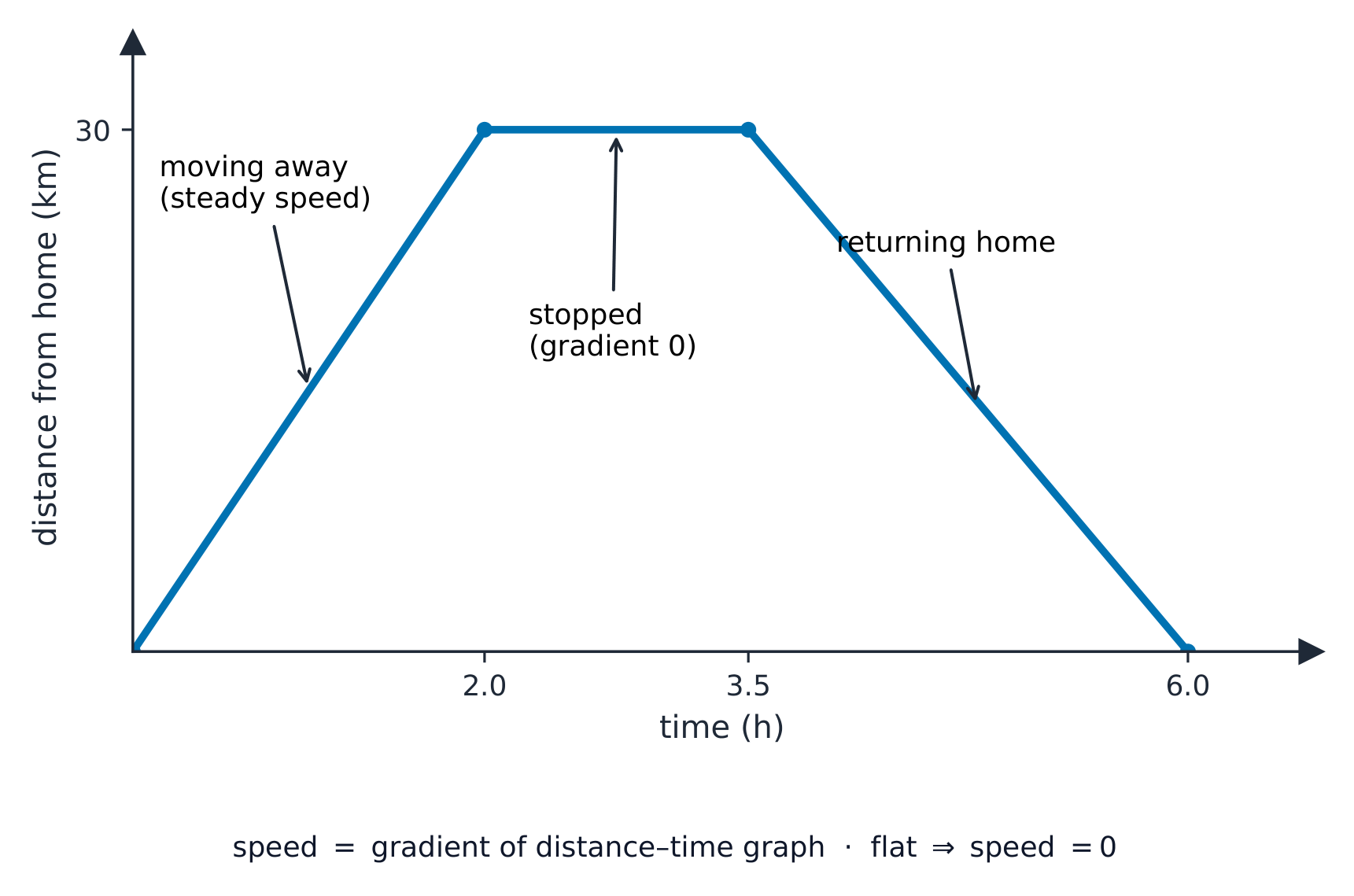
Syllabus · Программа
EnglishSubject content Notes and examples 1 Use and interpret graphs in practical situations including travel graphs and conversion graphs. e.g. interpret the gradient of a straight-line graph as a rate of change. 2 Draw graphs from given data. e.g. draw a distance–time graph to represent a journey. РусскийПредметное содержание Примечания и примеры 1 Использовать и интерпретировать графики в практических ситуациях, включая графики движения и графики перевода единиц. Например, интерпретировать наклон прямолинейного графика как скорость изменения. 2 Строить графики по заданным данным. Например, построить график «расстояние–время» для описания путешествия. EnglishSubject content Notes and examples 1 Use and interpret graphs in practical situations including travel graphs and conversion graphs. Includes estimation and interpretation of the gradient of a tangent at a point. 2 Draw graphs from given data. 3 Apply the idea of rate of change to simple kinematics involving distance–time and speed–time graphs, acceleration and deceleration. 4 Calculate distance travelled as area under a speed–time graph. Areas will involve linear sections of the graph only. РусскийПредметное содержание Примечания и примеры 1 Использовать и интерпретировать графики в практических ситуациях, включая графики движения и графики перевода единиц измерения. Включает оценку и интерпретацию углового коэффициента касательной в точке. 2 Строить графики по данным. 3 Применять понятие скорости изменения к простой кинематике,涉及 расстояние–время и скорость–время графики, ускорение и замедление. 4 Вычислять пройденное расстояние как площадь под графиком зависимости скорости от времени. Площади будут включать только линейные участки графика. Source: Cambridge International syllabus · Источник: Программа Cambridge International
Speed-time graphs: gradient and area The gradient 斜率 (steepness) of a graph shows a rate of change 变化率.
- A travel graph 行程图 (distance–time graph) has gradient equal to speed; a flat part means the object is not moving.
- A conversion graph 换算图 is a straight line used to change between two units (for example, miles and kilometres).
On a distance–time graph the gradient is the speed; a flat section means the object has stopped. Speed–time graphs (Extended)
On a speed–time graph the gradient is the acceleration 加速度 (or deceleration 减速度 if the speed falls), and the area 面积 under the graph is the distance 距离 travelled.
Worked example. A car speeds up from rest to $20\text{ m/s}$ in $8\text{ s}$, then stays at $20\text{ m/s}$ for $12\text{ s}$. Find the acceleration and the total distance.
Acceleration $= \dfrac{20}{8} = 2.5\text{ m/s}^{2}$. The distance is the area: a triangle plus a rectangle,
$$\tfrac{1}{2} \times 8 \times 20 + 12 \times 20 = 80 + 240 = 320\text{ m}.$$
On a speed–time graph the gradient is the acceleration and the area underneath is the distance travelled. Explore · ИсследоватьReal-life graphs · Реальные графики
y = ax + b
A distance–time or cost graph is read from its gradient and its intercept. · График зависимости расстояния от времени или стоимости читается по его угловому коэффициенту и точке пересечения с осью.
Vocabulary · Словарь Train · ТренироватьEnglish Русский gradient/ˈɡreɪdɪənt/ наклона (градиента) rate of change/reɪt ɒv tʃeɪndʒ/ скорость изменения travel graph/ˈtrævl ɡræf/ график движения conversion graph/kənˈvɜːʃn ɡræf/ график преобразования единиц acceleration/əkˌseləˈreɪʃn/ ускорения deceleration/dɪˌseləˈreɪʃn/ замедление area/ˈeərɪə/ площадь distance/ˈdɪstəns/ расстояние 2.10
Graphs of functions
Syllabus · Программа
EnglishSubject content Notes and examples 1 Construct tables of values, and draw, recognise and interpret graphs for functions of the following forms: • $ax + b$ • $\pm x^2 + ax + b$ • $\frac{a}{x} \ (x \neq 0)$ where $a$ and $b$ are integer constants. 2 Solve associated equations graphically, including finding and interpreting roots by graphical methods. e.g. find the intersection of a line and a curve. РусскийПредметное содержание Примечания и примеры 1 Составлять таблицы значений и строить, распознавать и интерпретировать графики для функций следующих форм: • $ax + b$ • $\pm x^2 + ax + b$ • $\frac{a}{x} \ (x \neq 0)$, где $a$ и $b$ — целые константы. 2 Решать связанные уравнения графически, включая нахождение и интерпретацию корней графическими методами. Например, найти пересечение прямой и кривой. EnglishSubject content Notes and examples 1 Construct tables of values, and draw, recognise and interpret graphs for functions of the following forms: • $a x^n$ (includes sums of no more than three of these) • $a b^x + c$ where $n = -2, -1, -\frac{1}{2}, 0, \frac{1}{2}, 1, 2, 3$; $a$ and $c$ are rational numbers; and $b$ is a positive integer. Examples include: • $y = x^3 + x - 4$ • $y = 2x + \frac{3}{x^2}$ • $y = \frac{1}{4} \times 2^x$. 2 Solve associated equations graphically, including finding and interpreting roots by graphical methods. e.g. finding the intersection of a line and a curve. 3 Draw and interpret graphs representing exponential growth and decay problems. РусскийПредметное содержание Примечания и примеры 1 Составлять таблицы значений и строить, распознавать и интерпретировать графики для функций следующих форм: • $a x^n$ (включая суммы не более чем трех таких) • $a b^x + c$ где $n = -2, -1, -\frac{1}{2}, 0, \frac{1}{2}, 1, 2, 3$; $a$ и $c$ являются рациональными числами; и $b$ является положительным целым числом. Примеры включают: • $y = x^3 + x - 4$ • $y = 2x + \frac{3}{x^2}$ • $y = \frac{1}{4} \times 2^x$. 2 Решать связанные уравнения графически, включая нахождение и интерпретацию корней графическими методами. Например: нахождение пересечения прямой и кривой. 3 Строить и интерпретировать графики, представляющие задачи на экспоненциальный рост и убывание. Source: Cambridge International syllabus · Источник: Программа Cambridge International
To draw a graph, make a table of values 数值表: choose values of $x$, work out $y$, then plot the coordinates 坐标 and join them with a smooth curve.
The points where a graph crosses the $x$-axis (the horizontal axis 坐标轴) are the roots 根 — the solutions of $y = 0$.
You can solve an equation by reading a graph. The intersection point 交点 of a line and a curve gives the solution of the two equations together.
For exponential growth 指数增长 and exponential decay 指数衰减, the graph of $y = a\,b^{x} + c$ rises (or falls) faster and faster and flattens towards a horizontal line.
Explore · ИсследоватьGraphing a quadratic · Граф квадратичной функции
y = ax² + bx + c
Drag a, b and c and watch the parabola move — its turning point and where it crosses the axes. · Перетащите коэффициенты a, b и c и наблюдайте движение параболы — её вершина и точки пересечения с осями координат.
Vocabulary · Словарь Train · ТренироватьEnglish Русский table of values/ˈteɪbl ɒv ˈvæljuːz/ таблица значений coordinates/kəʊˈɔːdɪnəts/ координаты axis/ˈæksɪs/ ось roots/ruːts/ корни intersection point/ˌɪntəˈsekʃn pɔɪnt/ точка пересечения exponential growth/ˌekspəˈnenʃl ɡrəʊθ/ экспоненциального роста exponential decay/ˌekspəˈnenʃl dɪˈkeɪ/ экспоненциального спада 2.11
Sketching curves
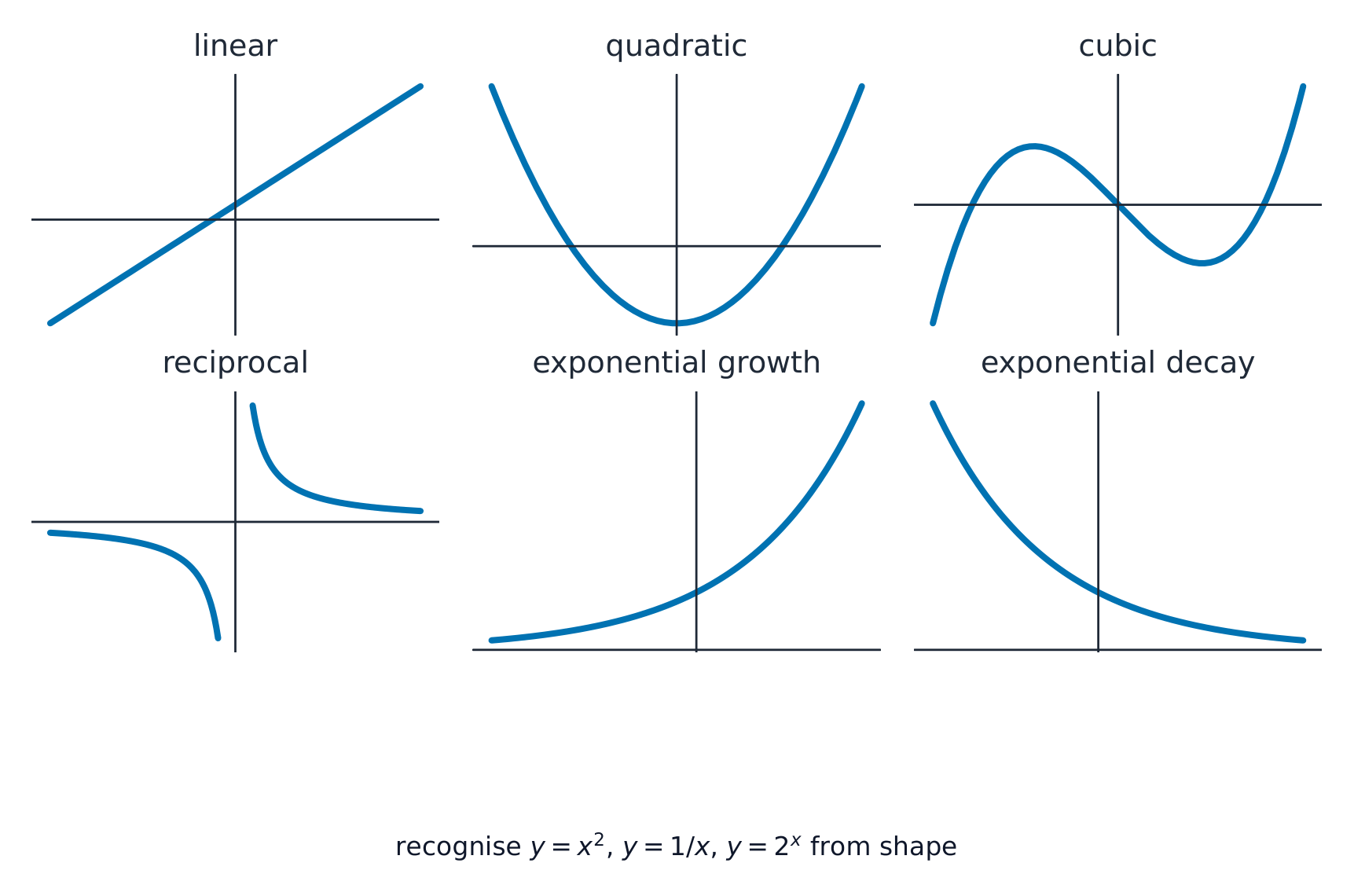
Syllabus · Программа
EnglishSubject content Notes and examples Recognise, sketch and interpret graphs of the following functions: (a) linear (b) quadratic. Knowledge of symmetry and roots is required. Knowledge of turning points is not required. РусскийПредметное содержание Примечания и примеры Распознавать, рисовать эскизы и интерпретировать графики следующих функций: (a) линейные (b) квадратичные. Требуется знание симметрии и корней. Знание точек экстремума не требуется. EnglishSubject content Notes and examples Recognise, sketch and interpret graphs of the following functions: (a) linear (b) quadratic (c) cubic (d) reciprocal (e) exponential. Functions will be equivalent to: • $ax + by = c$ • $y = ax^2 + bx + c$ • $y = ax^3 + b$ • $y = ax^3 + bx^2 + cx$ • $y = \frac{a}{x} + b$ • $y = ar^x + b$ where $a$, $b$ and $c$ are rational numbers and $r$ is a rational, positive number. Knowledge of turning points, roots and symmetry is required. Knowledge of vertical and horizontal asymptotes is required. Finding turning points of quadratics by completing the square is required. РусскийПредметное содержание Примечания и примеры Распознавать, строить эскизы и интерпретировать графики следующих функций: (a) линейная (b) квадратичная (c) кубическая (d) обратная (e) показательная. Функции будут эквивалентны: • $ax + by = c$ • $y = ax^2 + bx + c$ • $y = ax^3 + b$ • $y = ax^3 + bx^2 + cx$ • $y = \frac{a}{x} + b$ • $y = ar^x + b$ где $a$, $b$ и $c$ являются рациональными числами, а $r$ является рациональным положительным числом. Требуется знание точек экстремума, корней и симметрии. Требуется знание вертикальных и горизонтальных асимптот. Нахождение точек экстремума квадратичных функций методом выделения полного квадрата обязательно. Source: Cambridge International syllabus · Источник: Программа Cambridge International
A quick sketch should show the right shape and the key features: where it crosses the axes, any symmetry 对称, and any line the curve gets close to.
Function Shape linear, $y = mx + c$ straight line; gradient $m$, $y$-intercept 截距 $c$ quadratic, $y = ax^{2} + bx + c$ a parabola 抛物线 (U-shape if $a>0$, $\cap$-shape if $a<0$) cubic, $y = ax^{3} + bx + c$ an S-shaped curve reciprocal, $y = \dfrac{a}{x} + b$ two separate curves exponential, $y = a\,r^{x} + b$ fast growth or decay The basic graph shapes; knowing each shape lets you sketch quickly from the equation. For a parabola, completing the square gives the turning point 转折点 (the lowest or highest point). For example $y = (x + 3)^{2} - 8$ has its turning point at $(-3, -8)$.
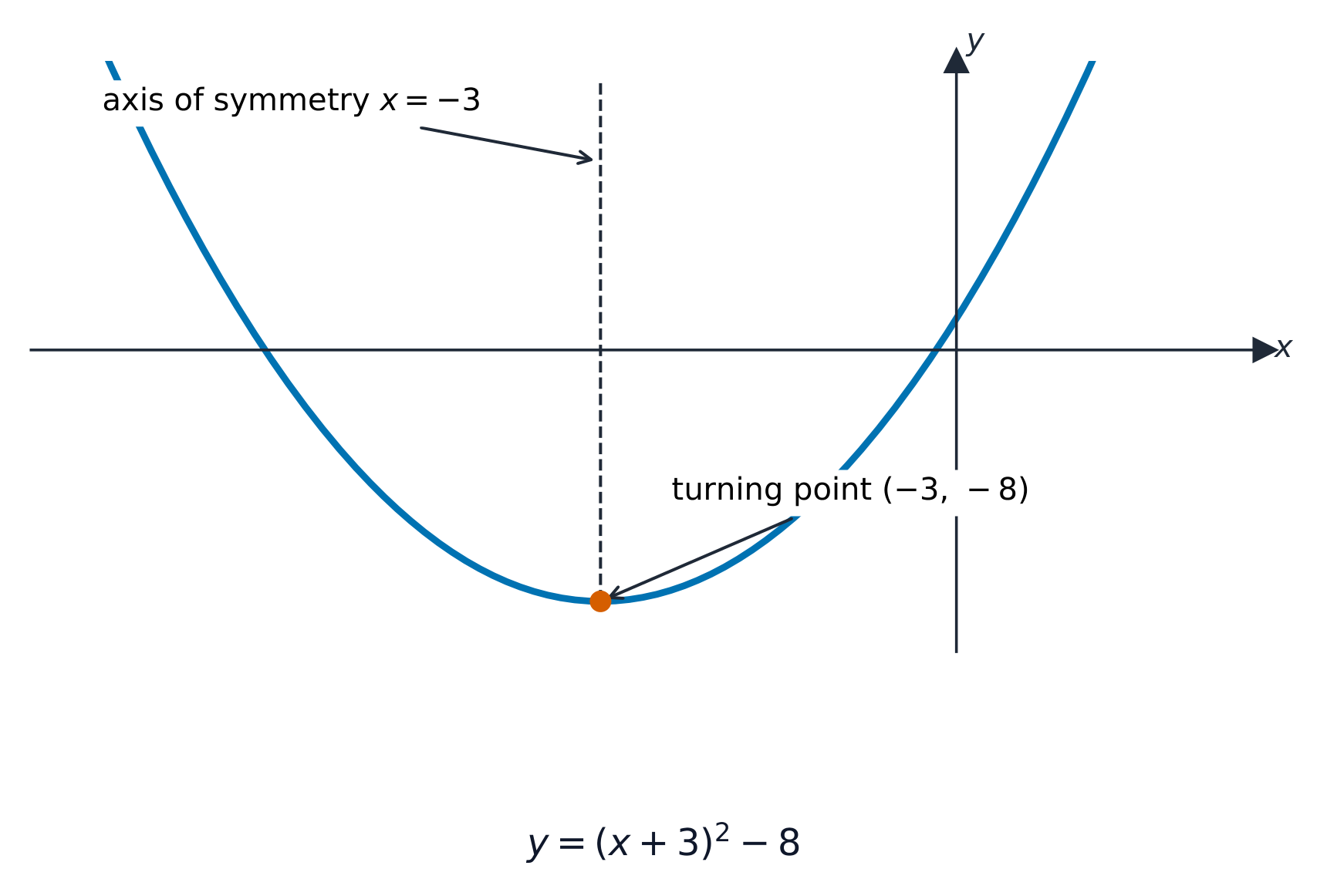
Completing the square, $y=(x+3)^2-8$, shows the turning point $(-3,-8)$ and the line of symmetry $x=-3$. An asymptote 渐近线 is a line that the curve gets closer and closer to but never touches — for example, the $x$-axis for $y = \dfrac{a}{x}$, or the line $y = b$ for $y = a\,r^{x} + b$.
Vocabulary · Словарь Train · ТренироватьEnglish Русский symmetry/ˈsɪmətri/ симметрию intercept/ˌɪntəˈsept/ пересечение parabola/pəˈræbələ/ параболу turning point/ˈtɜːnɪŋ pɔɪnt/ точке разворота asymptote/ˈæsɪmptəʊt/ асимптотой 2.12
Differentiation (Extended)
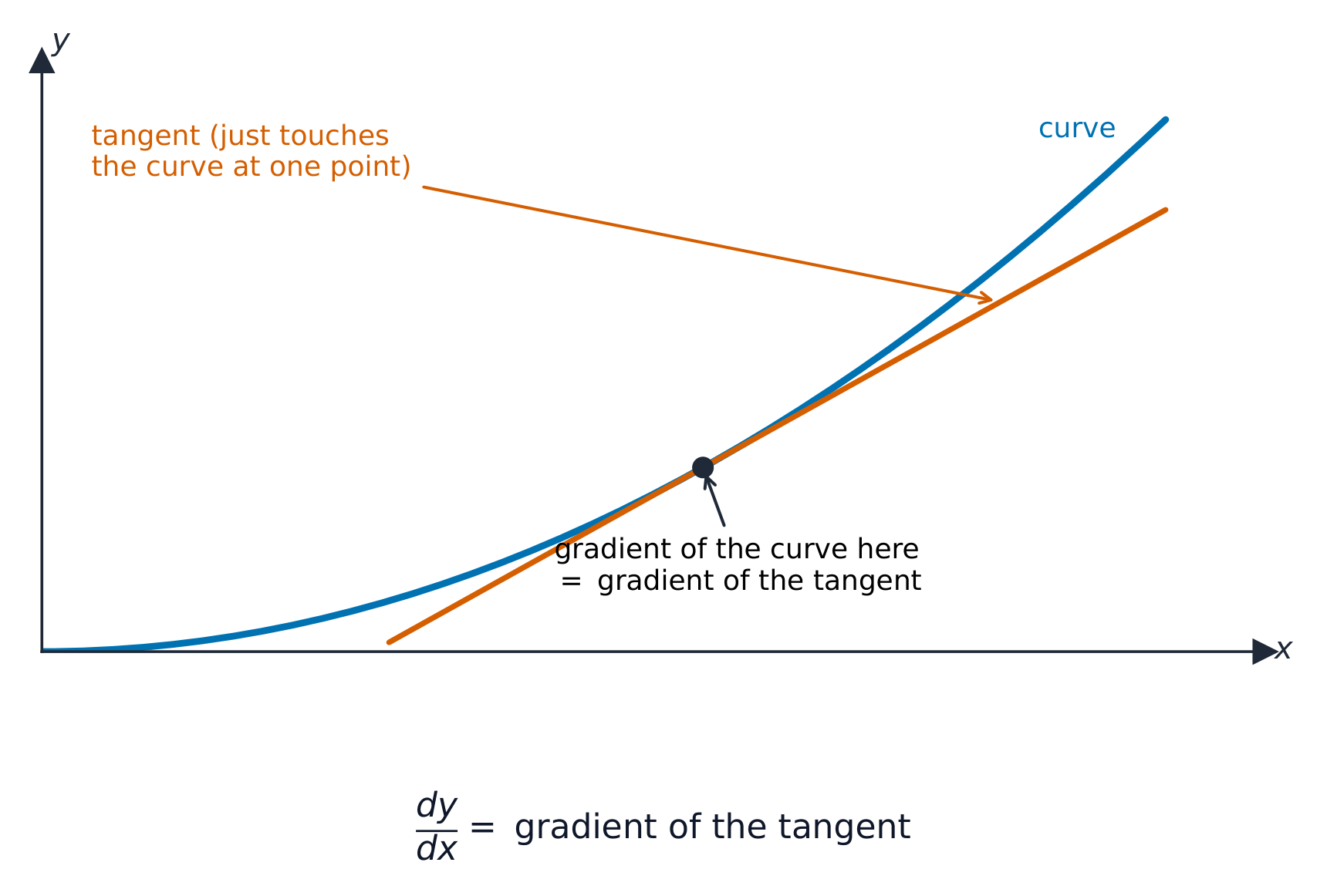
Syllabus · Программа
EnglishSubject content Notes and examples 1 Estimate gradients of curves by drawing tangents. 2 Use the derivatives of functions of the form $ax^n$, where $a$ is a rational constant and $n$ is a positive integer or zero, and simple sums of not more than three of these. $\frac{\mathrm{d}y}{\mathrm{d}x}$ notation will be expected. 3 Apply differentiation to gradients and stationary points (turning points). 4 Discriminate between maxima and minima by any method. Maximum and minimum points may be identified by: • an accurate sketch • use of the second differential • inspecting the gradient either side of a turning point. Candidates are not expected to identify points of inflection. РусскийПредметное содержание Примечания и примеры 1 Оценивать угловые коэффициенты касательных к кривым путем построения касательных. 2 Использовать производные функций вида $ax^n$, где $a$ является рациональной константой, а $n$ является положительным целым числом или нулем, и простых сумм не более чем трех таких. Ожидается использование нотации $\frac{\mathrm{d}y}{\mathrm{d}x}$. 3 Применять дифференцирование к угловым коэффициентам и стационарным точкам (точкам экстремума). 4 Различать максимумы и минимумы любым методом. Точки максимума и минимума могут быть определены: • точным эскизом • использованием второй производной • проверкой углового коэффициента с обеих сторон точки экстремума. От кандидатов не требуется определять точки перегиба. Source: Cambridge International syllabus · Источник: Программа Cambridge International
Differentiation 微分 finds the gradient of a curve at any point. You can estimate it by drawing a tangent 切线 (a line that just touches the curve) and measuring its gradient.
The gradient of a curve at a point equals the gradient of the tangent there — what differentiation finds. The exact rule: if $y = ax^{n}$, then the derivative 导数 is
$$\frac{\mathrm{d}y}{\mathrm{d}x} = a\,n\,x^{\,n-1}.$$Differentiate a sum term by term.
Worked example. If $y = x^{3} + 2x^{2} - 5x$, then $\dfrac{\mathrm{d}y}{\mathrm{d}x} = 3x^{2} + 4x - 5$.
A stationary point 驻点 (turning point) is where the gradient is zero, so set $\dfrac{\mathrm{d}y}{\mathrm{d}x} = 0$.
Worked example. Find the turning point of $y = x^{2} - 6x + 5$.
$$\frac{\mathrm{d}y}{\mathrm{d}x} = 2x - 6 = 0 \;\Rightarrow\; x = 3, \quad y = 3^{2} - 6(3) + 5 = -4.$$The turning point is $(3, -4)$. To decide whether a turning point is a maximum 最大值 or a minimum 最小值, check the sign of the gradient on each side, or use the second derivative (positive means a minimum).
Explore · ИсследоватьGradient of a curve · Производная кривой
y = ax³ + bx² + cx + d
Move the point: the tangent shows the gradient there, which is what differentiation finds. · Переместите точку: касательная показывает производную в этой точке, что и является результатом дифференцирования.
Vocabulary · Словарь Train · ТренироватьEnglish Русский differentiation/ˌdɪfəˌrenʃɪˈeɪʃn/ дифференцированию tangent/ˈtændʒənt/ касательную derivative/dɪˈrɪvətɪv/ производной stationary point/ˈsteɪʃənəri pɔɪnt/ стационарная точка maximum/ˈmæksɪməm/ максимальная minimum/ˈmɪnɪməm/ минимуму 2.13
Functions (Extended)

Syllabus · Программа
EnglishSubject content Notes and examples 1 Understand functions, domain and range and use function notation. Examples include: • $f(x) = 3x - 5$ • $g(x) = \frac{3(x + 4)}{5}$ • $h(x) = 2x^2 + 3$. 2 Understand and find inverse functions $f^{-1}(x)$. 3 Form composite functions as defined by $gf(x) = g(f(x))$. e.g. $f(x) = \frac{3}{x + 2}$ and $g(x) = (3x + 5)^2$. Find $fg(x)$. Give your answer as a fraction in its simplest form. Candidates are not expected to find the domains and ranges of composite functions. This topic may include mapping diagrams. РусскийПредметное содержание Примечания и примеры 1 Понимать функции, область определения и область значений, а также использовать обозначения функций. Примеры включают: • $f(x) = 3x - 5$ • $g(x) = \frac{3(x + 4)}{5}$ • $h(x) = 2x^2 + 3$. 2 Понимать и находить обратные функции $f^{-1}(x)$. 3 Составлять составные функции по определению $gf(x) = g(f(x))$. Например, $f(x) = \frac{3}{x + 2}$ и $g(x) = (3x + 5)^2$. Найдите $fg(x)$. Дайте ответ в виде дроби в наивысшем сокращенном виде. От кандидатов не требуется находить области определения и значения составных функций. Эта тема может включать диаграммы отображений. Source: Cambridge International syllabus · Источник: Программа Cambridge International
A function 函数 turns each input into one output. We write $f(x)$, for example $f(x) = 3x - 5$, so $f(2) = 1$. The set of allowed inputs is the domain 定义域; the set of possible outputs is the range 值域.
The inverse function 反函数 $f^{-1}(x)$ undoes the function. To find it, write $y = f(x)$, swap the roles, and make $x$ the subject.
Worked example. Find the inverse of $f(x) = 3x - 5$.
$$y = 3x - 5 \;\Rightarrow\; x = \frac{y + 5}{3}, \quad \text{so} \quad f^{-1}(x) = \frac{x + 5}{3}.$$A function as a machine; the inverse runs it backwards - reverse the order, undo each step A composite function 复合函数 applies one function after another: $gf(x)$ means "do $f$ first, then $g$".
Worked example. If $f(x) = 2x$ and $g(x) = x + 3$, then
$$gf(x) = g(2x) = 2x + 3, \qquad fg(x) = f(x + 3) = 2(x + 3) = 2x + 6.$$Explore · ИсследоватьFunctions · Функции
y = f(x)
A function turns each input into exactly one output — watch its shape. · Функция преобразует каждый вход ровно в один выход — следите за её формой.
Vocabulary · Словарь Train · ТренироватьEnglish Русский function/ˈfʌŋkʃn/ функцией domain/dəˈmeɪn/ области определения range/reɪndʒ/ область значений inverse function/ɪnˈvɜːs ˈfʌŋkʃn/ обратная функция composite function/ˈkɒmpəzɪt ˈfʌŋkʃn/ составная функция 2.13
Exam tips
- When you expand brackets, multiply every term and watch the signs, especially with a minus in front: $-(x - 3) = -x + 3$.
- To solve an equation, do the same thing to both sides. When you multiply or divide an inequality by a negative number, flip the sign.
- Factorise fully: take out the highest common factor first, then look for a difference of two squares or a quadratic pattern.
- A quadratic usually has two solutions — give both. Check whether the question wants factorising, the formula, or completing the square.
- When substituting into a formula, put each value in brackets first, so signs and powers come out right.
-
3
Coordinate geometry · Координатная геометрия
Watch lesson · Смотреть урокThis handout covers Topic 3, Coordinate geometry. Parts marked (Extended) are only tested on the Extended papers; everything else is for both levels.
3.1
Coordinates

Syllabus · Программа
EnglishSubject content Notes and examples Use and interpret Cartesian coordinates in two dimensions. РусскийПредметное содержание Примечания и примеры Использовать и интерпретировать декартовы координаты в двумерном пространстве. Source: Cambridge International syllabus · Источник: Программа Cambridge International
A city street grid: every place is fixed by its coordinates. A point on a graph is described by its coordinates 坐标, sometimes called Cartesian coordinates, written $(x, y)$. The first number is the across value and the second is the up value.
- The two number lines are the axes 坐标轴: the horizontal 水平 $x$-axis and the vertical 竖直 $y$-axis.
- They cross at the origin 原点, the point $(0, 0)$.
- The axes split the grid into four quadrants 象限.
So the point $(3, -2)$ is found by going $3$ to the right and $2$ down.

The axes meet at the origin $O$ and split the plane into four quadrants; $(3,-2)$ means 3 right then 2 down. Explore · ИсследоватьThe coordinate plane · Координатная плоскость
y = mx + c
Every point has an (x, y) coordinate. A straight line is the set of points where y depends on x in a fixed way. · У каждой точки есть координаты (x, y). Прямая линия — это множество точек, где y зависит от x определенным образом.
Vocabulary · Словарь Train · ТренироватьEnglish Русский coordinates/kəʊˈɔːdɪnəts/ координаты axes/ˈæksɪz/ оси координат horizontal/ˌhɒrɪˈzɒntl/ горизонтальная vertical/ˈvɜːtɪkl/ вертикален origin/ˈɒrɪdʒɪn/ начало координат quadrants/ˈkwɒdrənts/ четверти 3.5
The equation of a straight line
Syllabus · Программа
EnglishSubject content Notes and examples Interpret and obtain the equation of a straight-line graph in the form $y = mx + c$. Questions may: • use and request lines in the forms $y = mx + c$, $x = k$ • involve finding the equation when the graph is given • ask for the gradient or $y$-intercept of a graph from an equation, e.g. find the gradient and $y$-intercept of the graph with the equation $y = 6x + 3$. Candidates are expected to give equations of a line in a fully simplified form. РусскийПредметное содержание Примечания и примеры Интерпретируйте и выводите уравнение графика прямой линии в виде $y = mx + c$. Вопросы могут: • использовать и требовать прямые в формах $y = mx + c$, $x = k$; • включать нахождение уравнения при наличии графика; • запрашивать угловой коэффициент или $y$-пересечение графика по уравнению, например, найдите угловой коэффициент и $y$-пересечение графика с уравнением $y = 6x + 3$. От кандидатов ожидается предоставление уравнений прямой в полностью упрощенном виде. EnglishSubject content Notes and examples Interpret and obtain the equation of a straight-line graph. Questions may: • use and request lines in different forms, e.g. $ax + by = c$, $y = mx + c$, $x = k$ • involve finding the equation when the graph is given • ask for the gradient or $y$-intercept of a graph from an equation, e.g. find the gradient and $y$-intercept of the graph with equation $5x + 4y = 8$. Candidates are expected to give equations of a line in a fully simplified form. РусскийПредметное содержание Примечания и примеры Интерпретировать и получать уравнение прямолинейного графика. Вопросы могут: • использовать и запрашивать линии в различных формах, например, $ax + by = c$, $y = mx + c$, $x = k$ • требовать нахождения уравнения, когда дан график • спрашивать об угловом коэффициенте или пересечении с осью $y$ графика по уравнению, например, найти угловой коэффициент и пересечение с осью $y$ графика с уравнением $5x + 4y = 8$. От кандидатов ожидается, что они дадут уравнения прямой в полностью упрощенной форме. Source: Cambridge International syllabus · Источник: Программа Cambridge International
Most straight lines can be written as
$$y = mx + c,$$where $m$ is the gradient 斜率 (steepness) and $c$ is the intercept 截距 — the $y$-value where the line crosses the $y$-axis.
- A line like $x = k$ (for example $x = 3$) is vertical.
- A line like $y = k$ (for example $y = 3$) is horizontal.
A line may also be given as $ax + by = c$. Rearrange it into $y = mx + c$ to read off the gradient and intercept.
Worked example. Find the gradient and $y$-intercept of $5x + 4y = 8$.
$$4y = -5x + 8 \;\Rightarrow\; y = -\tfrac{5}{4}x + 2.$$So the gradient is $-\tfrac{5}{4}$ and the $y$-intercept is $2$.
Explore · Исследоватьy = mx + c
y = ax + b
Drag the gradient and the intercept. a is the gradient (steepness) and b is where the line crosses the y-axis. · Перетащите угол наклона и смещение. a — это угловой коэффициент (крутизна), а b — точка пересечения прямой с осью y.
Vocabulary · Словарь Train · ТренироватьEnglish Русский gradient/ˈɡreɪdɪənt/ наклона (градиента) intercept/ˌɪntəˈsept/ пересечение 3.3
Gradient

Syllabus · Программа
EnglishSubject content Notes and examples Find the gradient of a straight line. From a grid only. РусскийПредметное содержание Примечания и примеры Найдите угловой коэффициент прямой линии. Только по сетке координат. EnglishSubject content Notes and examples 1 Find the gradient of a straight line. 2 Calculate the gradient of a straight line from the coordinates of two points on it. РусскийПредметное содержание Примечания и примеры 1 Находить угловой коэффициент прямой линии. 2 Вычислять угловой коэффициент прямой линии по координатам двух точек на ней. Source: Cambridge International syllabus · Источник: Программа Cambridge International
y = mx + c: gradient and intercept, live A steep mountain road: gradient measures steepness as rise over run. The gradient measures how steep a line is:
$$m = \frac{\text{change in } y}{\text{change in } x} = \frac{\text{rise}}{\text{run}}.$$A positive gradient goes up to the right; a negative gradient goes down to the right.
Worked example. Find the gradient of the line through $(1, 2)$ and $(4, 11)$.
$$m = \frac{11 - 2}{4 - 1} = \frac{9}{3} = 3.$$
For $y=mx+c$, the line crosses the $y$-axis at $c$ and the gradient $m$ is the rise divided by the run. Explore · ИсследоватьGradient · Градиент
y = ax + b
The gradient a measures steepness — rise over run. · Градиент a измеряет крутизну — отношение подъема к горизонтальному перемещению.
3.2
Drawing a straight-line graph

Syllabus · Программа
EnglishSubject content Notes and examples Draw straight-line graphs for linear equations. Equations will be given in the form $y = mx + c$ (e.g. $y = -2x + 5$), unless a table of values is given. РусскийПредметное содержание Примечания и примеры Постройте графики линейных уравнений прямой линией. Уравнения будут даны в виде $y = mx + c$ (например, $y = -2x + 5$), если не приведена таблица значений. EnglishSubject content Notes and examples Draw straight-line graphs for linear equations. Examples include: • $y = -2x + 5$ • $y = 7 - 4x$ • $3x + 2y = 5$. РусскийПредметное содержание Примечания и примеры Строить прямые линии для линейных уравнений. Примеры включают: • $y = -2x + 5$ • $y = 7 - 4x$ • $3x + 2y = 5$. Source: Cambridge International syllabus · Источник: Программа Cambridge International
To draw $y = mx + c$, the quickest way is:
- Mark the intercept $c$ on the $y$-axis.
- Use the gradient to step to more points (for $m = 3$, go $1$ right and $3$ up).
- Join the points with a straight line.
You can also make a small table of values 数值表: choose two or three $x$-values, work out $y$, and plot the points.
Drawing a line fast: mark the intercept, then use the gradient to step to new points Vocabulary · Словарь Train · ТренироватьEnglish Русский table of values/ˈteɪbl ɒv ˈvæljuːz/ таблица значений 3.5
Finding the equation of a line
Syllabus · Программа
EnglishSubject content Notes and examples Interpret and obtain the equation of a straight-line graph in the form $y = mx + c$. Questions may: • use and request lines in the forms $y = mx + c$, $x = k$ • involve finding the equation when the graph is given • ask for the gradient or $y$-intercept of a graph from an equation, e.g. find the gradient and $y$-intercept of the graph with the equation $y = 6x + 3$. Candidates are expected to give equations of a line in a fully simplified form. РусскийПредметное содержание Примечания и примеры Интерпретируйте и выводите уравнение графика прямой линии в виде $y = mx + c$. Вопросы могут: • использовать и требовать прямые в формах $y = mx + c$, $x = k$; • включать нахождение уравнения при наличии графика; • запрашивать угловой коэффициент или $y$-пересечение графика по уравнению, например, найдите угловой коэффициент и $y$-пересечение графика с уравнением $y = 6x + 3$. От кандидатов ожидается предоставление уравнений прямой в полностью упрощенном виде. EnglishSubject content Notes and examples Interpret and obtain the equation of a straight-line graph. Questions may: • use and request lines in different forms, e.g. $ax + by = c$, $y = mx + c$, $x = k$ • involve finding the equation when the graph is given • ask for the gradient or $y$-intercept of a graph from an equation, e.g. find the gradient and $y$-intercept of the graph with equation $5x + 4y = 8$. Candidates are expected to give equations of a line in a fully simplified form. РусскийПредметное содержание Примечания и примеры Интерпретировать и получать уравнение прямолинейного графика. Вопросы могут: • использовать и запрашивать линии в различных формах, например, $ax + by = c$, $y = mx + c$, $x = k$ • требовать нахождения уравнения, когда дан график • спрашивать об угловом коэффициенте или пересечении с осью $y$ графика по уравнению, например, найти угловой коэффициент и пересечение с осью $y$ графика с уравнением $5x + 4y = 8$. От кандидатов ожидается, что они дадут уравнения прямой в полностью упрощенной форме. Source: Cambridge International syllabus · Источник: Программа Cambridge International
If you know the gradient $m$ and one point on the line, put the point into $y = mx + c$ to find $c$.
Worked example. A line has gradient $3$ and passes through $(1, 2)$. Find its equation.
$$y = 3x + c, \qquad 2 = 3(1) + c, \qquad c = -1.$$So the equation is $y = 3x - 1$. (If you are given two points, first find the gradient, then do this.)
3.4
Length and midpoint (Extended)

Syllabus · Программа
EnglishSubject content Notes and examples 1 Calculate the length of a line segment. 2 Find the coordinates of the midpoint of a line segment. РусскийПредметное содержание Примечания и примеры 1 Вычислять длину отрезка прямой. 2 Находить координаты середины отрезка прямой. Source: Cambridge International syllabus · Источник: Программа Cambridge International
A line segment 线段 is the straight piece between two points.
To find the length 长度 of the segment between $(x_1, y_1)$ and $(x_2, y_2)$, use Pythagoras' theorem 勾股定理 on the horizontal and vertical gaps:
$$\text{length} = \sqrt{(x_2 - x_1)^2 + (y_2 - y_1)^2}.$$To find the midpoint 中点 (the point exactly in the middle), average the coordinates:
$$\text{midpoint} = \left( \frac{x_1 + x_2}{2}, \; \frac{y_1 + y_2}{2} \right).$$Worked example. Find the length and midpoint of the segment from $(1, 2)$ to $(4, 6)$.
$$\text{length} = \sqrt{(4 - 1)^2 + (6 - 2)^2} = \sqrt{9 + 16} = \sqrt{25} = 5.$$$$\text{midpoint} = \left( \frac{1 + 4}{2}, \; \frac{2 + 6}{2} \right) = (2.5, \, 4).$$The horizontal gap (3) and vertical gap (4) make a right triangle, so the length is $\sqrt{3^2+4^2}=5$; the midpoint is the average of the coordinates. Explore · ИсследоватьLength and midpoint lab · Лабораторная работа по длине и середине отрезка
midpoint is halfway between endpoints · midpoint находится посередине между концами отрезка
Move along a line segment and see midpoint as halfway. · Перемещайтесь вдоль отрезка прямой и наблюдайте середину как midpoint.
Vocabulary · Словарь Train · ТренироватьEnglish Русский line segment/laɪn ˈseɡmənt/ отрезок прямой length/leŋθ/ длина Pythagoras' theorem/paɪˈθæɡərəs ˈθɪərəm/ Теорема Пифагора midpoint/ˈmɪdpɔɪnt/ середина 3.6
Parallel lines
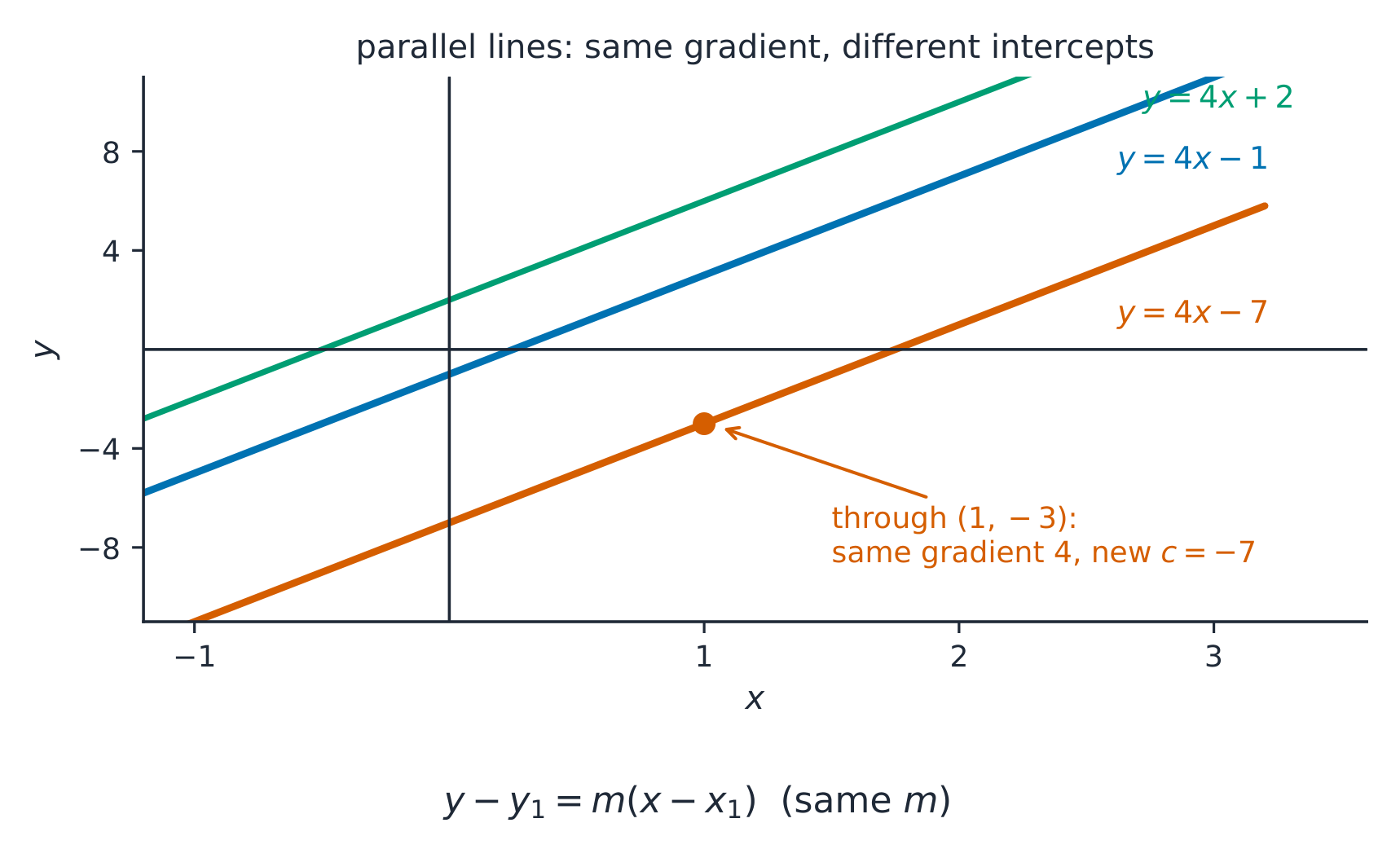
Syllabus · Программа
EnglishSubject content Notes and examples Find the gradient and equation of a straight line parallel to a given line. e.g. find the equation of the line parallel to $y = 4x - 1$ that passes through $(1, -3)$. РусскийПредметное содержание Примечания и примеры Найдите угловой коэффициент и уравнение прямой, параллельной данной прямой. Например, найдите уравнение прямой, параллельной $y = 4x - 1$, проходящей через точку $(1, -3)$. Source: Cambridge International syllabus · Источник: Программа Cambridge International
Parallel 平行 lines never meet, so they have the same gradient.
Worked example. Find the equation of the line parallel to $y = 4x - 1$ that passes through $(1, -3)$.
The gradient is also $4$. Put the point in:
$$-3 = 4(1) + c \;\Rightarrow\; c = -7,$$so the line is $y = 4x - 7$.
Parallel lines: same gradient, different intercepts Explore · ИсследоватьParallel & perpendicular · Параллельность и перпендикулярность
y = ax + b
Parallel lines share a gradient; perpendicular gradients multiply to −1. · Параллельные прямые имеют одинаковый угловой коэффициент; перпендикулярные угловые коэффициенты в произведении дают −1.
Vocabulary · Словарь Train · ТренироватьEnglish Русский parallel/ˈpærəlel/ параллельно 3.7
Perpendicular lines (Extended)

Syllabus · Программа
EnglishSubject content Notes and examples Find the gradient and equation of a straight line perpendicular to a given line. Examples include: • find the gradient of a line perpendicular to $2y = 3x + 1$ • find the equation of the perpendicular bisector of the line joining the points $(-3, 8)$ and $(9, -2)$. РусскийПредметное содержание Примечания и примеры Найти угловой коэффициент и уравнение прямой, перпендикулярной данной прямой. Примеры включают: • найти угловой коэффициент прямой, перпендикулярной $2y = 3x + 1$ • найти уравнение перпендикулярного биссектора отрезка, соединяющего точки $(-3, 8)$ и $(9, -2)$. Source: Cambridge International syllabus · Источник: Программа Cambridge International
Two lines are perpendicular 垂直 if they meet at a right angle 直角. Their gradients multiply to $-1$:
$$m_1 \times m_2 = -1, \qquad \text{so} \qquad m_2 = -\frac{1}{m_1}.$$In words: flip the fraction and change the sign.
Worked example. Find the gradient of a line perpendicular to $2y = 3x + 1$.
Rearrange: $y = \tfrac{3}{2}x + \tfrac{1}{2}$, so the gradient is $\tfrac{3}{2}$. The perpendicular gradient is $-\tfrac{2}{3}$.
Parallel lines share the same gradient; perpendicular gradients multiply to $-1$. Perpendicular bisector
The perpendicular bisector 垂直平分线 of a segment cuts it in half at a right angle. To find its equation: get the midpoint, then use the perpendicular gradient through that midpoint.
Worked example. Find the perpendicular bisector of the segment joining $(-3, 8)$ and $(9, -2)$.
- Midpoint: $\left( \frac{-3 + 9}{2}, \frac{8 + (-2)}{2} \right) = (3, 3)$.
- Gradient of the segment: $\frac{-2 - 8}{9 - (-3)} = \frac{-10}{12} = -\tfrac{5}{6}$.
- Perpendicular gradient: $\frac{6}{5}$.
Through $(3, 3)$: $\; 3 = \tfrac{6}{5}(3) + c \Rightarrow c = 3 - \tfrac{18}{5} = -\tfrac{3}{5}$. So the bisector is
$$y = \tfrac{6}{5}x - \tfrac{3}{5}.$$Vocabulary · Словарь Train · ТренироватьEnglish Русский perpendicular/ˌpɜːpənˈdɪkjʊlə/ перпендикулярны right angle/raɪt ˈæŋɡl/ прямой угол perpendicular bisector/ˌpɜːpənˈdɪkjʊlə baɪˈsektə/ перпендикулярный бисектор 3.7
Exam tips
- The straight line is $y = mx + c$: $m$ is the gradient and $c$ is where the line crosses the $y$-axis.
- Gradient = (change in $y$) ÷ (change in $x$). Keep the two coordinates in the same order on the top and the bottom.
- Parallel lines have the same gradient; perpendicular lines have gradients that multiply to $-1$ (the negative reciprocal).
- The midpoint is the average of the coordinates; the distance between two points comes from Pythagoras on the differences.
-
4
Geometry · Геометрия
Watch lesson · Смотреть урокThis handout covers Topic 4, Geometry. Parts marked (Extended) are only tested on the Extended papers; everything else is for both levels. In the exam you must give reasons using the correct names below, not just the numbers.
4.1
Lines and angles

Syllabus · Программа
EnglishSubject content Notes and examples 1 Use and interpret the following geometrical terms: • point • vertex • line • parallel • perpendicular • bearing • right angle • acute, obtuse and reflex angles • interior and exterior angles • similar • congruent • scale factor. Candidates are not expected to show that two shapes are congruent. 2 Use and interpret the vocabulary of: • triangles • special quadrilaterals • polygons • nets • simple solids. Includes the following terms: Triangles: • equilateral • isosceles • scalene • right-angled. Quadrilaterals: • square • rectangle • kite • rhombus • parallelogram • trapezium. Polygons: • regular and irregular polygons • pentagon • hexagon • octagon • decagon. Simple solids: • cube • cuboid • prism • cylinder • pyramid • cone • sphere (term ‘hemisphere’ not required) • face • surface • edge. 3 Use and interpret the vocabulary of a circle. Includes the following terms: • centre • radius (plural radii) • diameter • circumference • semicircle • chord • tangent • arc • sector • segment. РусскийПредметное содержание Примечания и примеры 1 Используйте и интерпретируйте следующие геометрические термины: • точка • вершина • линия • параллельный • перпендикулярный • пеленг • прямой угол • острый, тупой и развернутый углы • внутренние и внешние углы • подобный • равный (конгруэнтный) • масштабный коэффициент. От кандидатов не требуется доказывать равенство двух фигур. 2 Используйте и интерпретируйте лексику: • треугольников • специальных четырехугольников • многоугольников • разверток • простых тел. Включает следующие термины: Треугольники: • равносторонний • равнобедренный • разносторонний • прямоугольный. Четырехугольники: • квадрат • прямоугольник • дельтоид • ромб • параллелограмм • трапеция. Многоугольники: • правильные и неправильные многоугольники • пятиугольник • шестиугольник • восьмиугольник • десятиугольник. Простые тела: • куб • прямоугольный параллелепипед • призма • цилиндр • пирамида • конус • сфера (термин «полусфера» не требуется) • грань • поверхность • ребро. 3 Используйте и интерпретируйте лексику окружности. Включает следующие термины: • центр • радиус (множественное число — радиусы) • диаметр • длина окружности • полуокружность • хорда • касательная • дуга • сектор • сегмент. EnglishSubject content Notes and examples 1 Use and interpret the following geometrical terms: • point • vertex • line • plane • parallel • perpendicular • perpendicular bisector • bearing • right angle • acute, obtuse and reflex angles • interior and exterior angles • similar • congruent • scale factor. Candidates are not expected to show that two shapes are congruent. 2 Use and interpret the vocabulary of: • triangles • special quadrilaterals • polygons • nets • solids. Includes the following terms. Triangles: • equilateral • isosceles • scalene • right-angled. Quadrilaterals: • square • rectangle • kite • rhombus • parallelogram • trapezium. Polygons: • regular and irregular polygons • pentagon • hexagon • octagon • decagon. Solids: • cube • cuboid • prism • cylinder • pyramid • cone • sphere • hemisphere • frustum • face • surface • edge. 3 Use and interpret the vocabulary of a circle. Includes the following terms: • centre • radius (plural radii) • diameter • circumference • semicircle • chord • tangent • major and minor arc • sector • segment. РусскийПредметное содержание Примечания и примеры 1 Используйте и интерпретируйте следующие геометрические термины: • точка • вершина • прямая • плоскость • параллельный • перпендикулярный • перпендикулярный биссектор • азимут (пеленг) • прямой угол • острый, тупой и выпуклый углы • внутренние и внешние углы • подобие • равенство фигур • коэффициент подобия. От кандидатов не требуется доказывать равенство двух фигур. 2 Используйте и интерпретируйте лексику: • треугольников • специальных четырехугольников • многоугольников • разверток • тел. Включает следующие термины. Треугольники: • равносторонний • равнобедренный • разносторонний • прямоугольный. Четырехугольники: • квадрат • прямоугольник • дельтоид • ромб • параллелограмм • трапеция. Многоугольники: • правильные и неправильные многоугольники • пятиугольник • шестиугольник • восьмиугольник • десятиугольник. Тела: • куб • прямоугольный параллелепипед • призма • цилиндр • пирамида • конус • сфера • полусфера • усеченная пирамида (конус) • грань • поверхность • ребро. 3 Используйте и интерпретируйте лексику круга. Включает следующие термины: • центр • радиус (множественное число — радиусы) • диаметр • длина окружности • полуокружность • хорда • касательная • большая и малая дуги • сектор • сегмент. Source: Cambridge International syllabus · Источник: Программа Cambridge International
A corner where two lines meet is a vertex 顶点. Two lines are parallel 平行 if they never meet, and perpendicular 垂直 if they meet at a right angle. Angles are named by their size:
Name Size acute angle 锐角 less than $90^{\circ}$ right angle 直角 exactly $90^{\circ}$ obtuse angle 钝角 between $90^{\circ}$ and $180^{\circ}$ reflex angle 优角 between $180^{\circ}$ and $360^{\circ}$ Angles by size: acute (under $90^\circ$), right ($90^\circ$, shown by a square), obtuse ($90^\circ$–$180^\circ$) and reflex ($180^\circ$–$360^\circ$). We name an angle with three letters, e.g. angle $ABC$ is the angle at $B$.
Explore · ИсследоватьShape and angle lab · Лабораторная работа по фигурам и углам
Classify angle facts by the diagram feature that creates them. · Классифицируйте свойства углов по элементу диаграммы, который их образует.
Vocabulary · Словарь Train · ТренироватьEnglish Русский vertex/ˈvɜːteks/ вершина parallel/ˈpærəlel/ параллельно perpendicular/ˌpɜːpənˈdɪkjʊlə/ перпендикулярны acute angle/əˈkjuːt ˈæŋɡl/ острый угол right angle/raɪt ˈæŋɡl/ прямой угол obtuse angle/ɒbˈtjuːs ˈæŋɡl/ тупой угол reflex angle/ˈriːfleks ˈæŋɡl/ выпуклый угол 4.6
Angle facts

Syllabus · Программа
EnglishSubject content Notes and examples 1 Calculate unknown angles and give simple explanations using the following geometrical properties: • sum of angles at a point = 360° • sum of angles at a point on a straight line = 180° • vertically opposite angles are equal • angle sum of a triangle = 180° and angle sum of a quadrilateral = 360°. Knowledge of three-letter notation for angles is required, e.g. angle $ABC$. Candidates are expected to use the correct geometrical terminology when giving reasons for answers. 2 Calculate unknown angles and give geometric explanations for angles formed within parallel lines: • corresponding angles are equal • alternate angles are equal • co-interior angles sum to 180° (supplementary). 3 Know and use angle properties of regular polygons. Includes exterior and interior angles, and angle sum. РусскийПредметное содержание Примечания и примеры 1 Вычисляйте неизвестные углы и приводите простые объяснения, используя следующие геометрические свойства: • сумма углов вокруг точки = 360°; • сумма углов на прямой линии = 180°; • вертикальные углы равны; • сумма углов треугольника = 180° и сумма углов четырехугольника = 360°. Требуется знание трехбуквенного обозначения углов, например, угол $ABC$. От кандидатов ожидается использование правильной геометрической терминологии при обосновании ответов. 2 Вычисляйте неизвестные углы и приводите геометрические объяснения для углов, образованных внутри параллельных прямых: • соответственные углы равны; • накрест лежащие углы равны; • односторонние углы в сумме дают 180° (дополнительные). 3 Знать и применять свойства углов правильных многоугольников. Включает внешние и внутренние углы, а также сумму углов. EnglishSubject content Notes and examples 1 Calculate unknown angles and give simple explanations using the following geometrical properties: • sum of angles at a point = 360° • sum of angles at a point on a straight line = 180° • vertically opposite angles are equal • angle sum of a triangle = 180° and angle sum of a quadrilateral = 360°. Knowledge of 3-letter notation for angles is required, e.g. angle $ABC$. Candidates are expected to use the correct geometrical terminology when giving reasons for answers. 2 Calculate unknown angles and give geometric explanations for angles formed within parallel lines: • corresponding angles are equal • alternate angles are equal • co-interior angles sum to 180° (supplementary). 3 Know and use angle properties of regular and irregular polygons. Includes exterior and interior angles, and angle sum. РусскийПредметное содержание Примечания и примеры 1 Вычислять неизвестные углы и давать простые объяснения, используя следующие геометрические свойства: • сумма углов вокруг точки = 360° • сумма углов на прямой линии = 180° • вертикальные углы равны • сумма углов треугольника = 180° и сумма углов четырехугольника = 360°. Требуется знание обозначения углов из 3 букв, например, угол $ABC$. Кандидаты должны использовать правильную геометрическую терминологию при обосновании ответов. 2 Вычисляйте неизвестные углы и приводите геометрические объяснения для углов, образованных внутри параллельных прямых: • соответственные углы равны; • накрест лежащие углы равны; • односторонние углы в сумме дают 180° (дополнительные). 3 Знать и использовать свойства углов правильых и неправильых многоугольников. Включает внешние и внутренние углы, а также сумму углов. Source: Cambridge International syllabus · Источник: Программа Cambridge International
Learn these basic facts. Each one is a valid reason in the exam.
Angles around a point add up to 360 degrees 
Angles on a straight line add up to 180 degrees - Angles at a point add up to $360^{\circ}$.
- Angles on a straight line add up to $180^{\circ}$.
- Vertically opposite angles 对顶角 (made by two crossing lines) are equal.
Worked example. Three angles on a straight line are $x$, $50^{\circ}$ and $70^{\circ}$. Find $x$.
$$x + 50 + 70 = 180 \;\Rightarrow\; x = 60^{\circ}.$$Explore · ИсследоватьParallel line and polygon lab · Лабораторная работа по параллельным прямым и многоугольникам
Pick the angle rule that unlocks each diagram. · Выберите правило угла, которое раскрывает каждый рисунок.
Vocabulary · Словарь Train · ТренироватьEnglish Русский vertically opposite angles/ˈvɜːtɪkli ˈɒpəzɪt ˈæŋɡlz/ вертикальные углы 4.6
Angles in parallel lines

Syllabus · Программа
EnglishSubject content Notes and examples 1 Calculate unknown angles and give simple explanations using the following geometrical properties: • sum of angles at a point = 360° • sum of angles at a point on a straight line = 180° • vertically opposite angles are equal • angle sum of a triangle = 180° and angle sum of a quadrilateral = 360°. Knowledge of three-letter notation for angles is required, e.g. angle $ABC$. Candidates are expected to use the correct geometrical terminology when giving reasons for answers. 2 Calculate unknown angles and give geometric explanations for angles formed within parallel lines: • corresponding angles are equal • alternate angles are equal • co-interior angles sum to 180° (supplementary). 3 Know and use angle properties of regular polygons. Includes exterior and interior angles, and angle sum. РусскийПредметное содержание Примечания и примеры 1 Вычисляйте неизвестные углы и приводите простые объяснения, используя следующие геометрические свойства: • сумма углов вокруг точки = 360°; • сумма углов на прямой линии = 180°; • вертикальные углы равны; • сумма углов треугольника = 180° и сумма углов четырехугольника = 360°. Требуется знание трехбуквенного обозначения углов, например, угол $ABC$. От кандидатов ожидается использование правильной геометрической терминологии при обосновании ответов. 2 Вычисляйте неизвестные углы и приводите геометрические объяснения для углов, образованных внутри параллельных прямых: • соответственные углы равны; • накрест лежащие углы равны; • односторонние углы в сумме дают 180° (дополнительные). 3 Знать и применять свойства углов правильных многоугольников. Включает внешние и внутренние углы, а также сумму углов. EnglishSubject content Notes and examples 1 Calculate unknown angles and give simple explanations using the following geometrical properties: • sum of angles at a point = 360° • sum of angles at a point on a straight line = 180° • vertically opposite angles are equal • angle sum of a triangle = 180° and angle sum of a quadrilateral = 360°. Knowledge of 3-letter notation for angles is required, e.g. angle $ABC$. Candidates are expected to use the correct geometrical terminology when giving reasons for answers. 2 Calculate unknown angles and give geometric explanations for angles formed within parallel lines: • corresponding angles are equal • alternate angles are equal • co-interior angles sum to 180° (supplementary). 3 Know and use angle properties of regular and irregular polygons. Includes exterior and interior angles, and angle sum. РусскийПредметное содержание Примечания и примеры 1 Вычислять неизвестные углы и давать простые объяснения, используя следующие геометрические свойства: • сумма углов вокруг точки = 360° • сумма углов на прямой линии = 180° • вертикальные углы равны • сумма углов треугольника = 180° и сумма углов четырехугольника = 360°. Требуется знание обозначения углов из 3 букв, например, угол $ABC$. Кандидаты должны использовать правильную геометрическую терминологию при обосновании ответов. 2 Вычисляйте неизвестные углы и приводите геометрические объяснения для углов, образованных внутри параллельных прямых: • соответственные углы равны; • накрест лежащие углы равны; • односторонние углы в сумме дают 180° (дополнительные). 3 Знать и использовать свойства углов правильых и неправильых многоугольников. Включает внешние и внутренние углы, а также сумму углов. Source: Cambridge International syllabus · Источник: Программа Cambridge International
When a line crosses two parallel lines:
- Corresponding angles 同位角 (in matching positions, an "F" shape) are equal.
- Alternate angles 内错角 (opposite sides of the crossing line, a "Z" shape) are equal.
- Co-interior angles 同旁内角 (a "C" shape) add up to $180^{\circ}$; we say they are supplementary 互补.
Worked example. A straight line crosses two parallel lines. One angle is $110^{\circ}$. The co-interior angle $y$ satisfies $110 + y = 180$, so $y = 70^{\circ}$.
Corresponding (F) and alternate (Z) angles are equal; co-interior (C) angles add to $180^\circ$. Vocabulary · Словарь Train · ТренироватьEnglish Русский corresponding angles/ˌkɒrɪˈspɒndɪŋ ˈæŋɡlz/ соответственные углы alternate angles/ɔːlˈtɜːnət ˈæŋɡlz/ накрест лежащие углы co-interior angles/kəʊ ɪnˈtɪərɪə ˈæŋɡlz/ односторонние углы supplementary/ˌsʌplɪˈmentəri/ дополняющие друг друга 4.1
Triangles

Syllabus · Программа
EnglishSubject content Notes and examples 1 Use and interpret the following geometrical terms: • point • vertex • line • parallel • perpendicular • bearing • right angle • acute, obtuse and reflex angles • interior and exterior angles • similar • congruent • scale factor. Candidates are not expected to show that two shapes are congruent. 2 Use and interpret the vocabulary of: • triangles • special quadrilaterals • polygons • nets • simple solids. Includes the following terms: Triangles: • equilateral • isosceles • scalene • right-angled. Quadrilaterals: • square • rectangle • kite • rhombus • parallelogram • trapezium. Polygons: • regular and irregular polygons • pentagon • hexagon • octagon • decagon. Simple solids: • cube • cuboid • prism • cylinder • pyramid • cone • sphere (term ‘hemisphere’ not required) • face • surface • edge. 3 Use and interpret the vocabulary of a circle. Includes the following terms: • centre • radius (plural radii) • diameter • circumference • semicircle • chord • tangent • arc • sector • segment. РусскийПредметное содержание Примечания и примеры 1 Используйте и интерпретируйте следующие геометрические термины: • точка • вершина • линия • параллельный • перпендикулярный • пеленг • прямой угол • острый, тупой и развернутый углы • внутренние и внешние углы • подобный • равный (конгруэнтный) • масштабный коэффициент. От кандидатов не требуется доказывать равенство двух фигур. 2 Используйте и интерпретируйте лексику: • треугольников • специальных четырехугольников • многоугольников • разверток • простых тел. Включает следующие термины: Треугольники: • равносторонний • равнобедренный • разносторонний • прямоугольный. Четырехугольники: • квадрат • прямоугольник • дельтоид • ромб • параллелограмм • трапеция. Многоугольники: • правильные и неправильные многоугольники • пятиугольник • шестиугольник • восьмиугольник • десятиугольник. Простые тела: • куб • прямоугольный параллелепипед • призма • цилиндр • пирамида • конус • сфера (термин «полусфера» не требуется) • грань • поверхность • ребро. 3 Используйте и интерпретируйте лексику окружности. Включает следующие термины: • центр • радиус (множественное число — радиусы) • диаметр • длина окружности • полуокружность • хорда • касательная • дуга • сектор • сегмент. EnglishSubject content Notes and examples 1 Use and interpret the following geometrical terms: • point • vertex • line • plane • parallel • perpendicular • perpendicular bisector • bearing • right angle • acute, obtuse and reflex angles • interior and exterior angles • similar • congruent • scale factor. Candidates are not expected to show that two shapes are congruent. 2 Use and interpret the vocabulary of: • triangles • special quadrilaterals • polygons • nets • solids. Includes the following terms. Triangles: • equilateral • isosceles • scalene • right-angled. Quadrilaterals: • square • rectangle • kite • rhombus • parallelogram • trapezium. Polygons: • regular and irregular polygons • pentagon • hexagon • octagon • decagon. Solids: • cube • cuboid • prism • cylinder • pyramid • cone • sphere • hemisphere • frustum • face • surface • edge. 3 Use and interpret the vocabulary of a circle. Includes the following terms: • centre • radius (plural radii) • diameter • circumference • semicircle • chord • tangent • major and minor arc • sector • segment. РусскийПредметное содержание Примечания и примеры 1 Используйте и интерпретируйте следующие геометрические термины: • точка • вершина • прямая • плоскость • параллельный • перпендикулярный • перпендикулярный биссектор • азимут (пеленг) • прямой угол • острый, тупой и выпуклый углы • внутренние и внешние углы • подобие • равенство фигур • коэффициент подобия. От кандидатов не требуется доказывать равенство двух фигур. 2 Используйте и интерпретируйте лексику: • треугольников • специальных четырехугольников • многоугольников • разверток • тел. Включает следующие термины. Треугольники: • равносторонний • равнобедренный • разносторонний • прямоугольный. Четырехугольники: • квадрат • прямоугольник • дельтоид • ромб • параллелограмм • трапеция. Многоугольники: • правильные и неправильные многоугольники • пятиугольник • шестиугольник • восьмиугольник • десятиугольник. Тела: • куб • прямоугольный параллелепипед • призма • цилиндр • пирамида • конус • сфера • полусфера • усеченная пирамида (конус) • грань • поверхность • ребро. 3 Используйте и интерпретируйте лексику круга. Включает следующие термины: • центр • радиус (множественное число — радиусы) • диаметр • длина окружности • полуокружность • хорда • касательная • большая и малая дуги • сектор • сегмент. Source: Cambridge International syllabus · Источник: Программа Cambridge International
A triangle 三角形 has three sides and angles that add up to $180^{\circ}$.
The three angles of a triangle add up to 180 degrees Type Property equilateral 等边 all sides equal, all angles $60^{\circ}$ isosceles 等腰 two sides equal, two angles equal scalene 不等边 all sides and angles different right-angled has one right angle Worked example. A triangle has angles $x$, $2x$ and $90^{\circ}$. Find $x$.
$$x + 2x + 90 = 180 \;\Rightarrow\; 3x = 90 \;\Rightarrow\; x = 30^{\circ}.$$Vocabulary · Словарь Train · ТренироватьEnglish Русский triangle/ˈtraɪæŋɡl/ треугольник equilateral/ˌiːkwɪˈlætərəl/ равносторонний isosceles/aɪˈsɒsəliːz/ равнобедренный scalene/ˈskeɪliːn/ разносторонний 4.1
Quadrilaterals
Syllabus · Программа
EnglishSubject content Notes and examples 1 Use and interpret the following geometrical terms: • point • vertex • line • parallel • perpendicular • bearing • right angle • acute, obtuse and reflex angles • interior and exterior angles • similar • congruent • scale factor. Candidates are not expected to show that two shapes are congruent. 2 Use and interpret the vocabulary of: • triangles • special quadrilaterals • polygons • nets • simple solids. Includes the following terms: Triangles: • equilateral • isosceles • scalene • right-angled. Quadrilaterals: • square • rectangle • kite • rhombus • parallelogram • trapezium. Polygons: • regular and irregular polygons • pentagon • hexagon • octagon • decagon. Simple solids: • cube • cuboid • prism • cylinder • pyramid • cone • sphere (term ‘hemisphere’ not required) • face • surface • edge. 3 Use and interpret the vocabulary of a circle. Includes the following terms: • centre • radius (plural radii) • diameter • circumference • semicircle • chord • tangent • arc • sector • segment. РусскийПредметное содержание Примечания и примеры 1 Используйте и интерпретируйте следующие геометрические термины: • точка • вершина • линия • параллельный • перпендикулярный • пеленг • прямой угол • острый, тупой и развернутый углы • внутренние и внешние углы • подобный • равный (конгруэнтный) • масштабный коэффициент. От кандидатов не требуется доказывать равенство двух фигур. 2 Используйте и интерпретируйте лексику: • треугольников • специальных четырехугольников • многоугольников • разверток • простых тел. Включает следующие термины: Треугольники: • равносторонний • равнобедренный • разносторонний • прямоугольный. Четырехугольники: • квадрат • прямоугольник • дельтоид • ромб • параллелограмм • трапеция. Многоугольники: • правильные и неправильные многоугольники • пятиугольник • шестиугольник • восьмиугольник • десятиугольник. Простые тела: • куб • прямоугольный параллелепипед • призма • цилиндр • пирамида • конус • сфера (термин «полусфера» не требуется) • грань • поверхность • ребро. 3 Используйте и интерпретируйте лексику окружности. Включает следующие термины: • центр • радиус (множественное число — радиусы) • диаметр • длина окружности • полуокружность • хорда • касательная • дуга • сектор • сегмент. EnglishSubject content Notes and examples 1 Use and interpret the following geometrical terms: • point • vertex • line • plane • parallel • perpendicular • perpendicular bisector • bearing • right angle • acute, obtuse and reflex angles • interior and exterior angles • similar • congruent • scale factor. Candidates are not expected to show that two shapes are congruent. 2 Use and interpret the vocabulary of: • triangles • special quadrilaterals • polygons • nets • solids. Includes the following terms. Triangles: • equilateral • isosceles • scalene • right-angled. Quadrilaterals: • square • rectangle • kite • rhombus • parallelogram • trapezium. Polygons: • regular and irregular polygons • pentagon • hexagon • octagon • decagon. Solids: • cube • cuboid • prism • cylinder • pyramid • cone • sphere • hemisphere • frustum • face • surface • edge. 3 Use and interpret the vocabulary of a circle. Includes the following terms: • centre • radius (plural radii) • diameter • circumference • semicircle • chord • tangent • major and minor arc • sector • segment. РусскийПредметное содержание Примечания и примеры 1 Используйте и интерпретируйте следующие геометрические термины: • точка • вершина • прямая • плоскость • параллельный • перпендикулярный • перпендикулярный биссектор • азимут (пеленг) • прямой угол • острый, тупой и выпуклый углы • внутренние и внешние углы • подобие • равенство фигур • коэффициент подобия. От кандидатов не требуется доказывать равенство двух фигур. 2 Используйте и интерпретируйте лексику: • треугольников • специальных четырехугольников • многоугольников • разверток • тел. Включает следующие термины. Треугольники: • равносторонний • равнобедренный • разносторонний • прямоугольный. Четырехугольники: • квадрат • прямоугольник • дельтоид • ромб • параллелограмм • трапеция. Многоугольники: • правильные и неправильные многоугольники • пятиугольник • шестиугольник • восьмиугольник • десятиугольник. Тела: • куб • прямоугольный параллелепипед • призма • цилиндр • пирамида • конус • сфера • полусфера • усеченная пирамида (конус) • грань • поверхность • ребро. 3 Используйте и интерпретируйте лексику круга. Включает следующие термины: • центр • радиус (множественное число — радиусы) • диаметр • длина окружности • полуокружность • хорда • касательная • большая и малая дуги • сектор • сегмент. Source: Cambridge International syllabus · Источник: Программа Cambridge International
A quadrilateral 四边形 has four sides and angles that add up to $360^{\circ}$.
Shape Property square 正方形 four equal sides, four right angles rectangle 矩形 opposite sides equal, four right angles parallelogram 平行四边形 opposite sides parallel and equal rhombus 菱形 four equal sides, opposite sides parallel kite 鸢形 two pairs of equal sides next to each other trapezium 梯形 one pair of parallel sides Vocabulary · Словарь Train · ТренироватьEnglish Русский quadrilateral/ˌkwɒdrɪˈlætərəl/ четырехугольник square/skweə/ квадратом rectangle/ˈrektæŋɡl/ прямоугольник parallelogram/ˌpærəˈleləɡræm/ параллелограмм rhombus/ˈrɒmbəs/ ромб kite/kaɪt/ дельтоид (змейка) trapezium/trəˈpiːzɪəm/ трапеция 4.6
Polygons

Syllabus · Программа
EnglishSubject content Notes and examples 1 Calculate unknown angles and give simple explanations using the following geometrical properties: • sum of angles at a point = 360° • sum of angles at a point on a straight line = 180° • vertically opposite angles are equal • angle sum of a triangle = 180° and angle sum of a quadrilateral = 360°. Knowledge of three-letter notation for angles is required, e.g. angle $ABC$. Candidates are expected to use the correct geometrical terminology when giving reasons for answers. 2 Calculate unknown angles and give geometric explanations for angles formed within parallel lines: • corresponding angles are equal • alternate angles are equal • co-interior angles sum to 180° (supplementary). 3 Know and use angle properties of regular polygons. Includes exterior and interior angles, and angle sum. РусскийПредметное содержание Примечания и примеры 1 Вычисляйте неизвестные углы и приводите простые объяснения, используя следующие геометрические свойства: • сумма углов вокруг точки = 360°; • сумма углов на прямой линии = 180°; • вертикальные углы равны; • сумма углов треугольника = 180° и сумма углов четырехугольника = 360°. Требуется знание трехбуквенного обозначения углов, например, угол $ABC$. От кандидатов ожидается использование правильной геометрической терминологии при обосновании ответов. 2 Вычисляйте неизвестные углы и приводите геометрические объяснения для углов, образованных внутри параллельных прямых: • соответственные углы равны; • накрест лежащие углы равны; • односторонние углы в сумме дают 180° (дополнительные). 3 Знать и применять свойства углов правильных многоугольников. Включает внешние и внутренние углы, а также сумму углов. EnglishSubject content Notes and examples 1 Calculate unknown angles and give simple explanations using the following geometrical properties: • sum of angles at a point = 360° • sum of angles at a point on a straight line = 180° • vertically opposite angles are equal • angle sum of a triangle = 180° and angle sum of a quadrilateral = 360°. Knowledge of 3-letter notation for angles is required, e.g. angle $ABC$. Candidates are expected to use the correct geometrical terminology when giving reasons for answers. 2 Calculate unknown angles and give geometric explanations for angles formed within parallel lines: • corresponding angles are equal • alternate angles are equal • co-interior angles sum to 180° (supplementary). 3 Know and use angle properties of regular and irregular polygons. Includes exterior and interior angles, and angle sum. РусскийПредметное содержание Примечания и примеры 1 Вычислять неизвестные углы и давать простые объяснения, используя следующие геометрические свойства: • сумма углов вокруг точки = 360° • сумма углов на прямой линии = 180° • вертикальные углы равны • сумма углов треугольника = 180° и сумма углов четырехугольника = 360°. Требуется знание обозначения углов из 3 букв, например, угол $ABC$. Кандидаты должны использовать правильную геометрическую терминологию при обосновании ответов. 2 Вычисляйте неизвестные углы и приводите геометрические объяснения для углов, образованных внутри параллельных прямых: • соответственные углы равны; • накрест лежащие углы равны; • односторонние углы в сумме дают 180° (дополнительные). 3 Знать и использовать свойства углов правильых и неправильых многоугольников. Включает внешние и внутренние углы, а также сумму углов. Source: Cambridge International syllabus · Источник: Программа Cambridge International
A honeycomb tessellates the plane with regular hexagons. A polygon 多边形 is a shape with straight sides. A regular polygon 正多边形 has all sides and all angles equal.
Sides Name 5 pentagon 五边形 6 hexagon 六边形 8 octagon 八边形 10 decagon 十边形 For a polygon with $n$ sides:
$$\text{sum of interior angles} = (n - 2) \times 180^{\circ}, \qquad \text{sum of exterior angles} = 360^{\circ}.$$The interior angle 内角 and the exterior angle 外角 at each corner add up to $180^{\circ}$.
Worked example. Find each interior angle of a regular hexagon.
The exterior angle is $\dfrac{360^{\circ}}{6} = 60^{\circ}$, so each interior angle is $180^{\circ} - 60^{\circ} = 120^{\circ}$.

At each corner the interior and exterior angles add to $180^\circ$; a regular hexagon has $60^\circ$ exterior and $120^\circ$ interior angles. Vocabulary · Словарь Train · ТренироватьEnglish Русский polygon/ˈpɒlɪɡən/ многоугольник regular polygon/ˈreɡjʊlə ˈpɒlɪɡən/ правильный многоугольник pentagon/ˈpentæɡən/ пятиугольник hexagon/ˈheksæɡən/ шестиугольник octagon/ˈɒktæɡən/ восьмиугольник decagon/dɪˈkæɡən/ десятиугольник interior angle/ɪnˈtɪərɪə ˈæŋɡl/ внутренний угол exterior angle/ekˈstɪərɪə ˈæŋɡl/ внешний угол 4.5
Symmetry

Syllabus · Программа
EnglishSubject content Notes and examples Recognise line symmetry and order of rotational symmetry in two dimensions. Includes properties of triangles, quadrilaterals and polygons directly related to their symmetries. РусскийПредметное содержание Примечания и примеры Распознавайте осевую симметрию и порядок поворотной симметрии в двумерном пространстве. Включает свойства треугольников, четырехугольников и многоугольников, непосредственно связанные с их симметриями. EnglishSubject content Notes and examples 1 Recognise line symmetry and order of rotational symmetry in two dimensions. Includes properties of triangles, quadrilaterals and polygons directly related to their symmetries. 2 Recognise symmetry properties of prisms, cylinders, pyramids and cones. e.g. identify planes and axes of symmetry. РусскийПредметное содержание Примечания и примеры 1 Распознавайте осевую симметрию и порядок поворотной симметрии в двумерных фигурах. Включает свойства треугольников, четырехугольников и многоугольников, непосредственно связанные с их симметрией. 2 Распознавайте свойства симметрии призм, цилиндров, пирамид и конусов. Например, определите плоскости и оси симметрии. Source: Cambridge International syllabus · Источник: Программа Cambridge International
The Taj Mahal has a clear line of symmetry down its centre. - A shape has line symmetry 轴对称 if a mirror line splits it into two matching halves.
- A shape has rotational symmetry 旋转对称 if it fits onto itself as you turn it. The order is how many times it fits in one full turn.
For solids (Extended), a flat slice that splits the solid into mirror halves is a plane of symmetry 对称面, and a line you can spin it around is an axis of symmetry 对称轴.
Explore · ИсследоватьSymmetry as a reflection · Симметрия как отражение
A shape has line symmetry if reflecting it leaves it unchanged. Reflect the shape and watch what is preserved. · Фигура обладает осевой симметрией, если её отражение не изменяет. Отражайте фигуру и наблюдайте, что сохраняется.
Vocabulary · Словарь Train · ТренироватьEnglish Русский line symmetry/laɪn ˈsɪmətri/ осевая симметрия rotational symmetry/rəʊˈteɪʃənl ˈsɪmətri/ поворотная симметрия plane of symmetry/pleɪn ɒv ˈsɪmətri/ плоскость симметрии axis of symmetry/ˈæksɪs ɒv ˈsɪmətri/ ось симметрии 4.1
Circles: the parts

Syllabus · Программа
EnglishSubject content Notes and examples 1 Use and interpret the following geometrical terms: • point • vertex • line • parallel • perpendicular • bearing • right angle • acute, obtuse and reflex angles • interior and exterior angles • similar • congruent • scale factor. Candidates are not expected to show that two shapes are congruent. 2 Use and interpret the vocabulary of: • triangles • special quadrilaterals • polygons • nets • simple solids. Includes the following terms: Triangles: • equilateral • isosceles • scalene • right-angled. Quadrilaterals: • square • rectangle • kite • rhombus • parallelogram • trapezium. Polygons: • regular and irregular polygons • pentagon • hexagon • octagon • decagon. Simple solids: • cube • cuboid • prism • cylinder • pyramid • cone • sphere (term ‘hemisphere’ not required) • face • surface • edge. 3 Use and interpret the vocabulary of a circle. Includes the following terms: • centre • radius (plural radii) • diameter • circumference • semicircle • chord • tangent • arc • sector • segment. РусскийПредметное содержание Примечания и примеры 1 Используйте и интерпретируйте следующие геометрические термины: • точка • вершина • линия • параллельный • перпендикулярный • пеленг • прямой угол • острый, тупой и развернутый углы • внутренние и внешние углы • подобный • равный (конгруэнтный) • масштабный коэффициент. От кандидатов не требуется доказывать равенство двух фигур. 2 Используйте и интерпретируйте лексику: • треугольников • специальных четырехугольников • многоугольников • разверток • простых тел. Включает следующие термины: Треугольники: • равносторонний • равнобедренный • разносторонний • прямоугольный. Четырехугольники: • квадрат • прямоугольник • дельтоид • ромб • параллелограмм • трапеция. Многоугольники: • правильные и неправильные многоугольники • пятиугольник • шестиугольник • восьмиугольник • десятиугольник. Простые тела: • куб • прямоугольный параллелепипед • призма • цилиндр • пирамида • конус • сфера (термин «полусфера» не требуется) • грань • поверхность • ребро. 3 Используйте и интерпретируйте лексику окружности. Включает следующие термины: • центр • радиус (множественное число — радиусы) • диаметр • длина окружности • полуокружность • хорда • касательная • дуга • сектор • сегмент. EnglishSubject content Notes and examples 1 Use and interpret the following geometrical terms: • point • vertex • line • plane • parallel • perpendicular • perpendicular bisector • bearing • right angle • acute, obtuse and reflex angles • interior and exterior angles • similar • congruent • scale factor. Candidates are not expected to show that two shapes are congruent. 2 Use and interpret the vocabulary of: • triangles • special quadrilaterals • polygons • nets • solids. Includes the following terms. Triangles: • equilateral • isosceles • scalene • right-angled. Quadrilaterals: • square • rectangle • kite • rhombus • parallelogram • trapezium. Polygons: • regular and irregular polygons • pentagon • hexagon • octagon • decagon. Solids: • cube • cuboid • prism • cylinder • pyramid • cone • sphere • hemisphere • frustum • face • surface • edge. 3 Use and interpret the vocabulary of a circle. Includes the following terms: • centre • radius (plural radii) • diameter • circumference • semicircle • chord • tangent • major and minor arc • sector • segment. РусскийПредметное содержание Примечания и примеры 1 Используйте и интерпретируйте следующие геометрические термины: • точка • вершина • прямая • плоскость • параллельный • перпендикулярный • перпендикулярный биссектор • азимут (пеленг) • прямой угол • острый, тупой и выпуклый углы • внутренние и внешние углы • подобие • равенство фигур • коэффициент подобия. От кандидатов не требуется доказывать равенство двух фигур. 2 Используйте и интерпретируйте лексику: • треугольников • специальных четырехугольников • многоугольников • разверток • тел. Включает следующие термины. Треугольники: • равносторонний • равнобедренный • разносторонний • прямоугольный. Четырехугольники: • квадрат • прямоугольник • дельтоид • ромб • параллелограмм • трапеция. Многоугольники: • правильные и неправильные многоугольники • пятиугольник • шестиугольник • восьмиугольник • десятиугольник. Тела: • куб • прямоугольный параллелепипед • призма • цилиндр • пирамида • конус • сфера • полусфера • усеченная пирамида (конус) • грань • поверхность • ребро. 3 Используйте и интерпретируйте лексику круга. Включает следующие термины: • центр • радиус (множественное число — радиусы) • диаметр • длина окружности • полуокружность • хорда • касательная • большая и малая дуги • сектор • сегмент. Source: Cambridge International syllabus · Источник: Программа Cambridge International
Term Meaning circle 圆 all points the same distance from a centre centre 圆心 the middle point radius 半径 centre to edge (plural radii) diameter 直径 right across through the centre ($= 2 \times$ radius) circumference 圆周 the distance all the way round chord 弦 a straight line joining two points on the circle arc 弧 part of the circumference sector 扇形 a "pizza slice" between two radii segment 弓形 the region cut off by a chord semicircle 半圆 half a circle tangent 切线 a line that touches the circle at one point The main parts of a circle: a chord joins two points, while a tangent touches at just one. 
A sector is a slice between two radii, a segment is cut off by a chord, an arc is part of the circumference, and a semicircle is half the circle. Explore · ИсследоватьArc and sector · Дуга и сектор
Drag the angle and radius to see the arc (part of the circumference) and the sector (pie slice) it cuts off. · Перетащите угол и радиус, чтобы увидеть дугу (часть окружности) и сектор (кусочек пирога), которые они образуют.
Vocabulary · Словарь Train · ТренироватьEnglish Русский circle/ˈsɜːkl/ окружность centre/ˈsentə/ центре radius/ˈreɪdɪəs/ радиусу diameter/daɪˈæmɪtə/ диаметру circumference/sɜːˈkʌmfrəns/ окружности chord/kɔːd/ хорда arc/ɑːk/ дуга sector/ˈsektə/ сектора segment/ˈseɡmənt/ сегмент semicircle/ˈsemɪsɜːkl/ полуокружность tangent/ˈtændʒənt/ касательную 4.7 4.8
Circle theorems

Syllabus · Программа
EnglishSubject content Notes and examples Calculate unknown angles and give explanations using the following geometrical properties of circles: • angle in a semicircle = 90° • angle between tangent and radius = 90°. Candidates will be expected to use the geometrical properties listed in the syllabus when giving reasons for answers. РусскийПредметное содержание Примечания и примеры Вычисляйте неизвестные углы и приводите объяснения, используя следующие геометрические свойства круга: • угол в полуокружности = 90°; • угол между касательной и радиусом = 90°. От кандидатов ожидается использование геометрических свойств, перечисленных в программе, при обосновании ответов. EnglishSubject content Notes and examples Calculate unknown angles and give explanations using the following geometrical properties of circles: • angle in a semicircle = 90° • angle between tangent and radius = 90° • angle at the centre is twice the angle at the circumference • angles in the same segment are equal • opposite angles of a cyclic quadrilateral sum to 180° (supplementary) • alternate segment theorem. Candidates are expected to use the geometrical properties listed in the syllabus when giving reasons for answers. РусскийПредметное содержание Примечания и примеры Вычисляйте неизвестные углы и дайте объяснения, используя следующие геометрические свойства круга: • угол в полуокружности = 90° • угол между касательной и радиусом = 90° • угол в центре в два раза больше угла на окружности • углы, опирающиеся на одну дугу, равны • противоположные углы вписанного четырехугольника в сумме дают 180° (дополнительные) • теорема о касательной и хорде. От кандидатов ожидается использование перечисленных в программе геометрических свойств при приведении обоснований ответов. EnglishSubject content Notes and examples Use the following symmetry properties of circles: • equal chords are equidistant from the centre • the perpendicular bisector of a chord passes through the centre • tangents from an external point are equal in length. Candidates are expected to use the geometrical properties listed in the syllabus when giving reasons for answers. РусскийПредметное содержание Примечания и примеры Используйте следующие свойства симметрии круга: • равные хорды находятся на одинаковом расстоянии от центра • перпендикулярный биссектор хорды проходит через центр • касательные, проведенные из внешней точки, равны по длине. От кандидатов ожидается использование перечисленных в программе геометрических свойств при приведении обоснований ответов. Source: Cambridge International syllabus · Источник: Программа Cambridge International
Angle in a semicircle: always 90 degrees Angle at the centre: always double Use these to find unknown angles, always giving the reason.
For both levels:
- The angle in a semicircle is $90^{\circ}$.
- The angle between a tangent and a radius is $90^{\circ}$.
Two theorems for both levels: the angle in a semicircle is $90^\circ$, and a tangent meets a radius at $90^\circ$. Extended (theorems I):
- The angle at the centre is twice the angle at the circumference (standing on the same arc).
- Angles in the same segment are equal.
- Opposite angles of a cyclic quadrilateral 圆内接四边形 add up to $180^{\circ}$.
- The alternate segment theorem 弦切角定理: the angle between a tangent and a chord equals the angle in the other segment.
Extended (theorems II): equal chords are the same distance from the centre; the perpendicular bisector of a chord passes through the centre; two tangents from the same outside point are equal in length.
Worked example. A, B, C are on a circle. The angle at the circumference $ABC$ is $40^{\circ}$. Find the angle $AOC$ at the centre $O$.
The angle at the centre is twice the angle at the circumference: $2 \times 40^{\circ} = 80^{\circ}$.

The angle at the centre ($80^\circ$) is twice the angle at the circumference ($40^\circ$) standing on the same arc. Vocabulary · Словарь Train · ТренироватьEnglish Русский cyclic quadrilateral/ˈsaɪklɪk ˌkwɒdrɪˈlætərəl/ вписанный четырехугольник alternate segment theorem/ɔːlˈtɜːnət ˈseɡmənt ˈθɪərəm/ теорема о касательной и хорде (теорема о смежном секторе) 4.4
Similar shapes

Syllabus · Программа
EnglishSubject content Notes and examples Calculate lengths of similar shapes. РусскийПредметное содержание Примечания и примеры Вычисляйте длины подобных фигур. EnglishSubject content Notes and examples 1 Calculate lengths of similar shapes. 2 Use the relationships between lengths and areas of similar shapes and lengths, surface areas and volumes of similar solids. Includes use of scale factor, e.g. $$\frac{\text{Volume of } A}{\text{Volume of } B} = \frac{(\text{Length of } A)^3}{(\text{Length of } B)^3}$$3 Solve problems and give simple explanations involving similarity. Includes showing that two triangles are similar using geometric reasons. РусскийПредметное содержание Примечания и примеры 1 Вычисляйте длины подобных фигур. 2 Используйте соотношения между длинами и площадями подобных фигур, а также длинами, поверхностями и объемами подобных тел. Включает использование коэффициента подобия, например, $$\frac{\text{Volume of } A}{\text{Volume of } B} = \frac{(\text{Length of } A)^3}{(\text{Length of } B)^3}$$.3 Решайте задачи и дайте простые объяснения, связанные с подобием. Включает доказательство подобия двух треугольников на основе геометрических соображений. Source: Cambridge International syllabus · Источник: Программа Cambridge International
Two shapes are similar 相似 if one is an enlargement of the other: same angles, and all sides multiplied by the same scale factor 比例因子 $k$. (Shapes that are exactly the same size and shape are congruent 全等.)
Nesting dolls are similar shapes: each one is the same shape as the others, just multiplied by a scale factor For similar shapes and solids:
$$\frac{\text{area of } A}{\text{area of } B} = k^{2}, \qquad \frac{\text{volume of } A}{\text{volume of } B} = k^{3}.$$Worked example. Two similar solids have lengths in the ratio $2 : 3$. The smaller has volume $40\text{ cm}^{3}$. Find the volume of the larger.
The volume ratio is $2^{3} : 3^{3} = 8 : 27$. So the larger volume is $40 \times \dfrac{27}{8} = 135\text{ cm}^{3}$.
Explore · ИсследоватьSimilar shapes — enlargement · Подобные фигуры — подобие (увеличение)
Similar shapes are the same shape but a different size. An enlargement scales every length by the same factor; angles stay the same. · Подобные фигуры имеют одинаковую форму, но разный размер. При подобии все длины масштабируются одним коэффициентом; углы остаются неизменными.
Vocabulary · Словарь Train · ТренироватьEnglish Русский similar/ˈsɪmɪlə/ подобный scale factor/skeɪl ˈfæktə/ множитель масштабирования congruent/ˈkɒŋɡruːənt/ равновеликими (конгруэнтными) 4.6
Bearings

Syllabus · Программа
EnglishSubject content Notes and examples 1 Calculate unknown angles and give simple explanations using the following geometrical properties: • sum of angles at a point = 360° • sum of angles at a point on a straight line = 180° • vertically opposite angles are equal • angle sum of a triangle = 180° and angle sum of a quadrilateral = 360°. Knowledge of three-letter notation for angles is required, e.g. angle $ABC$. Candidates are expected to use the correct geometrical terminology when giving reasons for answers. 2 Calculate unknown angles and give geometric explanations for angles formed within parallel lines: • corresponding angles are equal • alternate angles are equal • co-interior angles sum to 180° (supplementary). 3 Know and use angle properties of regular polygons. Includes exterior and interior angles, and angle sum. РусскийПредметное содержание Примечания и примеры 1 Вычисляйте неизвестные углы и приводите простые объяснения, используя следующие геометрические свойства: • сумма углов вокруг точки = 360°; • сумма углов на прямой линии = 180°; • вертикальные углы равны; • сумма углов треугольника = 180° и сумма углов четырехугольника = 360°. Требуется знание трехбуквенного обозначения углов, например, угол $ABC$. От кандидатов ожидается использование правильной геометрической терминологии при обосновании ответов. 2 Вычисляйте неизвестные углы и приводите геометрические объяснения для углов, образованных внутри параллельных прямых: • соответственные углы равны; • накрест лежащие углы равны; • односторонние углы в сумме дают 180° (дополнительные). 3 Знать и применять свойства углов правильных многоугольников. Включает внешние и внутренние углы, а также сумму углов. EnglishSubject content Notes and examples 1 Calculate unknown angles and give simple explanations using the following geometrical properties: • sum of angles at a point = 360° • sum of angles at a point on a straight line = 180° • vertically opposite angles are equal • angle sum of a triangle = 180° and angle sum of a quadrilateral = 360°. Knowledge of 3-letter notation for angles is required, e.g. angle $ABC$. Candidates are expected to use the correct geometrical terminology when giving reasons for answers. 2 Calculate unknown angles and give geometric explanations for angles formed within parallel lines: • corresponding angles are equal • alternate angles are equal • co-interior angles sum to 180° (supplementary). 3 Know and use angle properties of regular and irregular polygons. Includes exterior and interior angles, and angle sum. РусскийПредметное содержание Примечания и примеры 1 Вычислять неизвестные углы и давать простые объяснения, используя следующие геометрические свойства: • сумма углов вокруг точки = 360° • сумма углов на прямой линии = 180° • вертикальные углы равны • сумма углов треугольника = 180° и сумма углов четырехугольника = 360°. Требуется знание обозначения углов из 3 букв, например, угол $ABC$. Кандидаты должны использовать правильную геометрическую терминологию при обосновании ответов. 2 Вычисляйте неизвестные углы и приводите геометрические объяснения для углов, образованных внутри параллельных прямых: • соответственные углы равны; • накрест лежащие углы равны; • односторонние углы в сумме дают 180° (дополнительные). 3 Знать и использовать свойства углов правильых и неправильых многоугольников. Включает внешние и внутренние углы, а также сумму углов. Source: Cambridge International syllabus · Источник: Программа Cambridge International
A bearing 方位角 gives a direction as a three-figure angle, measured clockwise 顺时针 from north, from $000^{\circ}$ to $360^{\circ}$. So due east is $090^{\circ}$ and due south is $180^{\circ}$.
Worked example. The bearing of $B$ from $A$ is $025^{\circ}$. Find the bearing of $A$ from $B$.
The return (back) bearing differs by $180^{\circ}$: $025^{\circ} + 180^{\circ} = 205^{\circ}$.
A bearing is measured clockwise from north as three figures; the back bearing differs by $180^\circ$. Explore · ИсследоватьBearings route · Маршрут азимутов
Follow how to measure a bearing correctly from north. · Изучите, как правильно измерить азимут от направления север.
Vocabulary · Словарь Train · ТренироватьEnglish Русский bearing/ˈbeərɪŋ/ азимут (bearing) clockwise/ˈklɒkwaɪz/ по часовой стрелке 4.2 4.3
Constructions, nets and solids

Syllabus · Программа
EnglishSubject content Notes and examples 1 Measure and draw lines and angles. A ruler should be used for all straight edges. Constructions of perpendicular bisectors and angle bisectors are not required. 2 Construct a triangle, given the lengths of all sides, using a ruler and pair of compasses only. e.g. construct a rhombus by drawing two triangles. Construction arcs must be shown. 3 Draw, use and interpret nets. Examples include: • draw nets of cubes, cuboids, prisms and pyramids • use measurements from nets to calculate volumes and surface areas. РусскийПредметное содержание Примечания и примеры 1 Измеряйте и чертите линии и углы. Для всех прямых сторон следует использовать линейку. Построение серединных перпендикуляров и биссектрис углов не требуется. 2 Постройте треугольник, зная длины всех сторон, используя только линейку и циркуль. Например, постройте ромб, начертив два треугольника. Дуги построения должны быть показаны. 3 Чертите, используйте и интерпретируйте развёртки. Примеры включают: • чертежи разворотов кубов, прямоугольных параллелепипедов, призм и пирамид; • использование размеров из разворотов для вычисления объемов и площадей поверхности. EnglishSubject content Notes and examples 1 Draw and interpret scale drawings. A ruler must be used for all straight edges. 2 Use and interpret three-figure bearings. Bearings are measured clockwise from north (000° to 360°). e.g. find the bearing of A from B if the bearing of B from A is 025°. Includes an understanding of the terms north, east, south and west. e.g. point D is due east of point C. РусскийПредметное содержание Примечания и примеры 1 Чертите и интерпретируйте масштабные чертежи. Для всех прямых сторон необходимо использовать линейку. 2 Используйте и интерпретируйте пеленги в трех цифрах. Пеленги отсчитываются по часовой стрелке от севера (от 000° до 360°). Например, найдите пеленг точки A относительно B, если пеленг B относительно A составляет 025°. Включает понимание терминов север, восток, юг и запад. Например, точка D находится точно на восток от точки C. EnglishSubject content Notes and examples 1 Draw and interpret scale drawings. A ruler must be used for all straight edges. 2 Use and interpret three-figure bearings. Bearings are measured clockwise from north ($000^{\circ}$ to $360^{\circ}$). e.g. find the bearing of $A$ from $B$ if the bearing of $B$ from $A$ is $025^{\circ}$. Includes an understanding of the terms north, east, south and west. e.g. point $D$ is due east of point $C$. РусскийПредметное содержание Примечания и примеры 1 Чертите и интерпретируйте масштабные чертежи. Для всех прямых сторон необходимо использовать линейку. 2 Использование и интерпретация азимутов (рудов) с тремя цифрами. Азимуты отсчитываются по часовой стрелке от севера (от $000^{\circ}$ до $360^{\circ}$). Например: найти азимут точки $A$ относительно точки $B$, если азимут точки $B$ относительно точки $A$ равен $025^{\circ}$. Включает понимание терминов «север», «восток», «юг» и «запад». Например: точка $D$ находится строго на восток от точки $C$. Source: Cambridge International syllabus · Источник: Программа Cambridge International
- To construct 作图 a triangle from three given sides, draw the base with a ruler, then use a pair of compasses 圆规 to mark each other side as an arc. Leave the construction arcs showing.
- A net 展开图 is a flat shape that folds up into a solid. You can use a net to work out surface areas.
- A scale drawing 比例图 shows a real object smaller (or larger) by a fixed scale, such as $1\text{ cm}$ to $5\text{ m}$.
Unfolding a solid gives its net. Add the areas of the pieces to get the surface area: a cylinder is $2\pi r^{2} + 2\pi r h$. Common solids 几何体 and their parts:
Solid Note cube 立方体 / cuboid 长方体 box shapes prism 棱柱 the same shape all along its length cylinder 圆柱 a circular prism pyramid 棱锥 / cone 圆锥 come to a point sphere 球 / hemisphere 半球 a ball / half a ball frustum 平截头体 a cone or pyramid with the top cut off A flat side of a solid is a face 面, two faces meet at an edge 棱, and the whole outside is its surface 表面.
Explore · ИсследоватьConstruction and solid lab · Построения и лаборатория твердых тел
Classify geometry tasks by the tool or representation needed. · Классифицируйте геометрические задачи по необходимому инструменту или представлению.
Vocabulary · Словарь Train · ТренироватьEnglish Русский construct/ˈkɒnstrʌkt/ построить compasses/ˈkʌmpəsɪz/ циркуль net/net/ чистым scale drawing/skeɪl ˈdrɔːɪŋ/ чертеж в масштабе solids/ˈsɒlɪdz/ твердых веществ cube/kjuːb/ куб cuboid/ˈkjuːbɔɪd/ прямоугольный параллелепипед prism/ˈprɪzəm/ призма cylinder/ˈsɪlɪndə/ цилиндр pyramid/ˈpɪrəmɪd/ пирамида cone/kəʊn/ конус sphere/sfɪə/ сфера hemisphere/ˈhemɪsfɪə/ полусфера frustum/ˈfrʌstəm/ усеченный конус face/feɪs/ грань edge/edʒ/ ребро surface/ˈsɜːfɪs/ поверхности 4.2 4.3
Exam tips
- Angles on a straight line add to $180°$, around a point to $360°$, and in a triangle to $180°$. Give a reason for every step of an angle question.
- Learn the circle theorems: the angle at the centre is twice the angle at the circumference; the angle in a semicircle is $90°$; angles in the same segment are equal; opposite angles of a cyclic quadrilateral add to $180°$.
- The exterior angles of any polygon add to $360°$, and each interior angle + its exterior angle = $180°$.
- Bearings are measured clockwise from north and always written with three figures (e.g. $072°$).
-
5
Mensuration · Измерение величин
Watch lesson · Смотреть урокEnglishThis handout covers Topic 5, Mensuration (measuring length, area and volume). The Core and Extended content here is almost the same. In the exam, some formulas are given in the List of formulas, but you should still learn them all.
РусскийЭтот раздаточный материал охватывает тему 5, Метрические величины (измерение длины, площади и объёма). Основной и расширенный контент здесь почти одинаковы. На экзамене некоторые формулы даны в Списке формул, но всё равно следует выучить их все.
5.1
Units of measure · Единицы измерения

Syllabus · Программа
EnglishSubject content Notes and examples Use metric units of mass, length, area, volume and capacity in practical situations and convert quantities into larger or smaller units. Units include: • mm, cm, m, km • $\text{mm}^2$, $\text{cm}^2$, $\text{m}^2$, $\text{km}^2$ • $\text{mm}^3$, $\text{cm}^3$, $\text{m}^3$ • ml, l • g, kg. Conversion between units includes: • between different units of area, e.g. $\text{cm}^2 \leftrightarrow \text{m}^2$ • between units of volume and capacity, e.g. $\text{m}^3 \leftrightarrow \text{litres}$. РусскийПредметное содержание Примечания и примеры Используйте метрические единицы массы, длины, площади, объема и емкости в практических ситуациях и переводите величины в большие или меньшие единицы. Единицы включают: • мм, см, м, км; • $\text{mm}^2$, $\text{cm}^2$, $\text{m}^2$, $\text{km}^2$; • $\text{mm}^3$, $\text{cm}^3$, $\text{m}^3$; • мл, л; • г, кг. Перевод между единицами включает: • между различными единицами площади, например, $\text{cm}^2 \leftrightarrow \text{m}^2$; • между единицами объема и емкости, например, $\text{m}^3 \leftrightarrow \text{litres}$. Source: Cambridge International syllabus · Источник: Программа Cambridge International
EnglishWe use metric 公制 units for mass 质量 (g, kg), length 长度 (mm, cm, m, km), area 面积, volume 体积 and capacity 容量 (ml, litres — the space inside a container).
To change units, be careful with squares and cubes:
- Length: $1\text{ m} = 100\text{ cm}$.
- Area: $1\text{ m}^{2} = 100^{2} = 10\,000\text{ cm}^{2}$.
- Volume: $1\text{ m}^{3} = 100^{3} = 1\,000\,000\text{ cm}^{3}$.
- Capacity: $1\text{ litre} = 1000\text{ cm}^{3}$, so $1\text{ m}^{3} = 1000$ litres.
Worked example. Convert $3\text{ m}^{2}$ to $\text{cm}^{2}$.
$$3 \times 10\,000 = 30\,000\text{ cm}^{2}.$$РусскийМы используем метрические единицы для массы (г, кг), длины (мм, см, м, км), площади, объёма и ёмкости (мл, литры — пространство внутри ёмкости).
Изменение единиц длины: умножать при движении вниз, делить при движении вверх При переходе от одних единиц измерения к другим будьте осторожны с квадратами и кубами:
- Длина: $1\text{ m} = 100\text{ cm}$.
- Площадь: $1\text{ m}^{2} = 100^{2} = 10\,000\text{ cm}^{2}$.
- Объём: $1\text{ m}^{3} = 100^{3} = 1\,000\,000\text{ cm}^{3}$.
- Ёмкость: $1\text{ litre} = 1000\text{ cm}^{3}$, следовательно, $1\text{ m}^{3} = 1000$ литров.
Разбор примера. Переведите $3\text{ m}^{2}$ в $\text{cm}^{2}$.
$$3 \times 10\,000 = 30\,000\text{ cm}^{2}.$$Explore · ИсследоватьUnit choice lab · Выбор единиц измерения
Choose the unit that matches the measurement scale. · Выберите единицу, соответствующую шкале измерения.
5.2
Perimeter and area of basic shapes · Периметр и площадь базовых фигур

Syllabus · Программа
EnglishSubject content Notes and examples Carry out calculations involving the perimeter and area of a rectangle, triangle, parallelogram and trapezium. Except for area of a triangle, formulas are not given. РусскийПредметное содержание Примечания и примеры Выполняйте вычисления, связанные с периметром и площадью прямоугольника, треугольника, параллелограмма и трапеции. За исключением площади треугольника, формулы не даются. EnglishSubject content Notes and examples Carry out calculations involving the perimeter and area of a rectangle, triangle, parallelogram and trapezium. Except for the area of a triangle, formulas are not given. РусскийПредметное содержание Примечания и примеры Выполняйте вычисления,涉及的 прямоугольника, треугольника, параллелограмма и трапеции. За исключением площади треугольника, формулы не приводятся. Source: Cambridge International syllabus · Источник: Программа Cambridge International
EnglishThe perimeter 周长 is the distance all the way round a shape. The area is the amount of flat space inside it. Here $b$ is the base 底 and $h$ is the perpendicular height 高.
Shape Area rectangle 矩形 $\text{length} \times \text{width}$ triangle 三角形 $\tfrac{1}{2} \times b \times h$ parallelogram 平行四边形 $b \times h$ trapezium 梯形 $\tfrac{1}{2}(a + b)h$, where $a$ and $b$ are the two parallel sides Worked example. A trapezium has parallel sides $6\text{ cm}$ and $10\text{ cm}$, and height $4\text{ cm}$. Find its area.
$$\tfrac{1}{2}(6 + 10) \times 4 = \tfrac{1}{2} \times 16 \times 4 = 32\text{ cm}^{2}.$$РусскийПериметр — это расстояние по периметру фигуры. Площадь — это количество плоского пространства внутри неё. Здесь $b$ — это основание, а $h$ — перпендикулярная высота.
Фигура Площадь прямоугольник $\text{length} \times \text{width}$ треугольник $\tfrac{1}{2} \times b \times h$ параллелограмм $b \times h$ трапеция $\tfrac{1}{2}(a + b)h$, где $a$ и $b$ — две параллельные стороны Площадь базовых фигур; $b$ — это основание, $h$ — перпендикулярная высота, а $a$ и $b$ — две параллельные стороны трапеции. Разобранный пример. У трапеции параллельные стороны равны $6\text{ cm}$ и $10\text{ cm}$, а высота — $4\text{ cm}$. Найдите её площадь.
$$\tfrac{1}{2}(6 + 10) \times 4 = \tfrac{1}{2} \times 16 \times 4 = 32\text{ cm}^{2}.$$Explore · ИсследоватьArea scaling lab · Лабораторная работа по масштабированию площади
area = side^2 · площадь = сторона^2
Change side length and see why area grows quadratically. · Измените длину стороны и посмотрите, почему площадь растёт квадратично.
Vocabulary · Словарь Train · ТренироватьEnglish Русский metric/ˈmetrɪk/ метрический mass/mæs/ масса length/leŋθ/ длина area/ˈeərɪə/ площадь 5.3
Circles · Круги

Syllabus · Программа
EnglishSubject content Notes and examples 1 Carry out calculations involving the circumference and area of a circle. Answers may be asked for in terms of $\pi$. 2 Carry out calculations involving arc length and sector area as fractions of the circumference and area of a circle, where the sector angle is a factor of $360^\circ$. Formulas are given in the List of formulas. РусскийПредметное содержание Примечания и примеры 1 Выполняйте вычисления, связанные с длиной окружности и площадью круга. Ответы могут быть запрошены в терминах $\pi$. 2 Выполняйте вычисления, связанные с длиной дуги и площадью сектора как долями длины окружности и площади круга, где угол сектора является множителем $360^\circ$. Формулы приведены в Списке формул. EnglishSubject content Notes and examples 1 Carry out calculations involving the circumference and area of a circle. Answers may be asked for in terms of $\pi$. Formulas are given in the List of formulas. 2 Carry out calculations involving arc length and sector area as fractions of the circumference and area of a circle. Includes minor and major sectors. РусскийПредметное содержание Примечания и примеры 1 Выполняйте вычисления,涉及 длины окружности и площади круга. Ответы могут требоваться в виде выражений через $\pi$. Формулы даны в Своде формул. 2 Выполняйте вычисления,涉及 длины дуги и площади сектора как долей длины окружности и площади круга. Включает малые и большие сектора. Source: Cambridge International syllabus · Источник: Программа Cambridge International
EnglishFor a circle 圆 with radius 半径 $r$ (and diameter 直径 $d = 2r$):
$$\text{circumference} = 2\pi r = \pi d, \qquad \text{area} = \pi r^{2}.$$The circumference 圆周 is the distance round the circle.
Worked example. A circle has radius $7\text{ cm}$. Find its circumference and area (leave $\pi$ in the answer).
$$\text{circumference} = 2\pi \times 7 = 14\pi\text{ cm}, \qquad \text{area} = \pi \times 7^{2} = 49\pi\text{ cm}^{2}.$$РусскийДля круга с радиусом $r$ (и диаметром $d = 2r$):
Круг: длина окружности = pi × d, площадь = pi × r в квадрате $$\text{circumference} = 2\pi r = \pi d, \qquad \text{area} = \pi r^{2}.$$Длина окружности — это расстояние по кругу.
Разобранный пример. У круга радиус равен $7\text{ cm}$. Найдите его длину окружности и площадь (оставьте $\pi$ в ответе).
$$\text{circumference} = 2\pi \times 7 = 14\pi\text{ cm}, \qquad \text{area} = \pi \times 7^{2} = 49\pi\text{ cm}^{2}.$$Vocabulary · Словарь Train · ТренироватьEnglish Русский circle/ˈsɜːkl/ окружность radius/ˈreɪdɪəs/ радиусу diameter/daɪˈæmɪtə/ диаметру circumference/sɜːˈkʌmfrəns/ окружности 5.3
Arcs and sectors · Дуги и сектора

Syllabus · Программа
EnglishSubject content Notes and examples 1 Carry out calculations involving the circumference and area of a circle. Answers may be asked for in terms of $\pi$. 2 Carry out calculations involving arc length and sector area as fractions of the circumference and area of a circle, where the sector angle is a factor of $360^\circ$. Formulas are given in the List of formulas. РусскийПредметное содержание Примечания и примеры 1 Выполняйте вычисления, связанные с длиной окружности и площадью круга. Ответы могут быть запрошены в терминах $\pi$. 2 Выполняйте вычисления, связанные с длиной дуги и площадью сектора как долями длины окружности и площади круга, где угол сектора является множителем $360^\circ$. Формулы приведены в Списке формул. EnglishSubject content Notes and examples 1 Carry out calculations involving the circumference and area of a circle. Answers may be asked for in terms of $\pi$. Formulas are given in the List of formulas. 2 Carry out calculations involving arc length and sector area as fractions of the circumference and area of a circle. Includes minor and major sectors. РусскийПредметное содержание Примечания и примеры 1 Выполняйте вычисления,涉及 длины окружности и площади круга. Ответы могут требоваться в виде выражений через $\pi$. Формулы даны в Своде формул. 2 Выполняйте вычисления,涉及 длины дуги и площади сектора как долей длины окружности и площади круга. Включает малые и большие сектора. Source: Cambridge International syllabus · Источник: Программа Cambridge International
EnglishAn arc 弧 is part of the circumference. A sector 扇形 is a "pizza slice" between two radii. If the sector angle is $\theta$, the arc and sector are that fraction $\dfrac{\theta}{360}$ of the whole circle:
$$\text{arc length} = \frac{\theta}{360} \times 2\pi r, \qquad \text{sector area} = \frac{\theta}{360} \times \pi r^{2}.$$A small slice is a minor sector 小扇形; the large rest is a major sector 大扇形.
Worked example. Find the arc length 弧长 and area of a sector with angle $90^{\circ}$ and radius $8\text{ cm}$.
The fraction is $\dfrac{90}{360} = \dfrac{1}{4}$, so
$$\text{arc} = \tfrac{1}{4} \times 2\pi \times 8 = 4\pi\text{ cm}, \qquad \text{area} = \tfrac{1}{4} \times \pi \times 8^{2} = 16\pi\text{ cm}^{2}.$$РусскийДуга — это часть окружности. Сектор — это «кусочек пиццы» между двумя радиусами. Если угол сектора равен $\theta$, то дуга и сектор составляют эту долю $\dfrac{\theta}{360}$ от всего круга:
$$\text{arc length} = \frac{\theta}{360} \times 2\pi r, \qquad \text{sector area} = \frac{\theta}{360} \times \pi r^{2}.$$Сектор составляет долю $\tfrac{\theta}{360}$ от всего круга, поэтому его дуга и площадь — это та же доля от длины окружности и площади. Маленький кусочек — это меньший сектор; большая оставшаяся часть — больший сектор.
Разобранный пример. Найдите длину дуги и площадь сектора с углом $90^{\circ}$ и радиусом $8\text{ cm}$.
Доля равна $\dfrac{90}{360} = \dfrac{1}{4}$, поэтому
$$\text{arc} = \tfrac{1}{4} \times 2\pi \times 8 = 4\pi\text{ cm}, \qquad \text{area} = \tfrac{1}{4} \times \pi \times 8^{2} = 16\pi\text{ cm}^{2}.$$Explore · ИсследоватьArcs & sectors · Дуги и сектора
s = rθ · A = ½r²θ
A bigger angle or radius means a longer arc and larger sector area. · Больший угол или радиус означают более длинную дугу и большую площадь сектора.
Explore · ИсследоватьArc length and sector area · Длина дуги и площадь сектора
Change the angle and radius and read off the arc length and sector area — a fraction of the whole circle. · Измените угол и радиус и считайте длину дуги и площадь сектора — долю от всей окружности.
Vocabulary · Словарь Train · ТренироватьEnglish Русский arc/ɑːk/ дуга sector/ˈsektə/ сектора minor sector/ˈmaɪnə ˈsektə/ малый сектор major sector/ˈmeɪdʒə ˈsektə/ большой сектор arc length/ɑːk leŋθ/ длину дуги 5.4
Surface area and volume of solids · Площадь поверхности и объём тел

Syllabus · Программа
EnglishSubject content Notes and examples Carry out calculations and solve problems involving the surface area and volume of a: • cuboid • prism • cylinder • sphere • pyramid • cone. Answers may be asked for in terms of $\pi$. The following formulas are given in the List of formulas: • curved surface area of a cylinder • curved surface area of a cone • surface area of a sphere • volume of a prism • volume of a pyramid • volume of a cylinder • volume of a cone • volume of a sphere. The term prism refers to any solid with a uniform cross-section, e.g. a cylindrical sector. РусскийПредметное содержание Примечания и примеры Выполнять вычисления и решать задачи, связанные с площадью поверхности и объёмом: • прямоугольного параллелепипеда • призмы • цилиндра • сферы • пирамиды • конуса. Ответы могут требоваться в виде $\pi$. Приведённые ниже формулы содержатся в Справочнике формул: • площадь боковой поверхности цилиндра • площадь боковой поверхности конуса • площадь поверхности сферы • объём призмы • объём пирамиды • объём цилиндра • объём конуса • объём сферы. Под термином «призма» понимается любое тело с постоянным поперечным сечением, например, цилиндральный сектор. Source: Cambridge International syllabus · Источник: Программа Cambridge International
EnglishThe surface area 表面积 is the total area of all the outside faces. The volume is the space inside. For these solids ($r$ = radius, $h$ = height):
Solid Volume Surface area cuboid 长方体 $\text{length} \times \text{width} \times \text{height}$ add the six faces prism 棱柱 (cross-section 横截面 area) $\times$ length — cylinder 圆柱 $\pi r^{2} h$ $2\pi r h$ (curved surface area 侧面积) $+\, 2\pi r^{2}$ pyramid 棱锥 $\tfrac{1}{3} \times \text{base area} \times h$ — cone 圆锥 $\tfrac{1}{3}\pi r^{2} h$ $\pi r l$ (curved) $+\, \pi r^{2}$, where $l$ is the slant height 斜高 sphere 球 $\tfrac{4}{3}\pi r^{3}$ $4\pi r^{2}$ Worked example. A cylinder has radius $5\text{ cm}$ and height $10\text{ cm}$. Find its volume and total surface area (in terms of $\pi$).
$$\text{volume} = \pi \times 5^{2} \times 10 = 250\pi\text{ cm}^{3}.$$$$\text{surface area} = 2\pi(5)(10) + 2\pi(5)^{2} = 100\pi + 50\pi = 150\pi\text{ cm}^{2}.$$Русский
Пирамиды Гизы являются квадратными пирамидами — телом 3-мерности.Площадь поверхности — это общая площадь всех внешних граней. Объем — это пространство внутри. Для этих тел ($r$ = радиус, $h$ = высота):
Тело Объём Площадь поверхности прямоугольный параллелепипед $\text{length} \times \text{width} \times \text{height}$ сложите шесть граней призма (площадь поперечного сечения) $\times$ × длина — цилиндр $\pi r^{2} h$ $2\pi r h$ (площадь боковой поверхности) × $+\, 2\pi r^{2}$ пирамида $\tfrac{1}{3} \times \text{base area} \times h$ — конус $\tfrac{1}{3}\pi r^{2} h$ $\pi r l$ (боковая) × $+\, \pi r^{2}$, где $l$ — образующая сфера $\tfrac{4}{3}\pi r^{3}$ $4\pi r^{2}$ 
Распространённые тела и размеры ($r$, $h$, $\ell$, образующая $l$), используемые в формулах для вычисления их объёма и площади поверхности. Разбор примера. Цилиндр имеет радиус $5\text{ cm}$ и высоту $10\text{ cm}$. Найдите его объем и полную площадь поверхности (выразив ответ через $\pi$).
$$\text{volume} = \pi \times 5^{2} \times 10 = 250\pi\text{ cm}^{3}.$$$$\text{surface area} = 2\pi(5)(10) + 2\pi(5)^{2} = 100\pi + 50\pi = 150\pi\text{ cm}^{2}.$$Explore · ИсследоватьVolume scaling lab · Лабораторная работа по масштабированию объёма
surface area grows with scale^2 · площадь поверхности растёт пропорционально scale^2
Change length scale and see volume grow faster than surface area. · Измените масштаб длины и посмотрите, как объём растёт быстрее, чем площадь поверхности.
Vocabulary · Словарь Train · ТренироватьEnglish Русский volume/ˈvɒljuːm/ объем capacity/kəˈpæsɪti/ емкостью perimeter/pəˈrɪmɪtə/ периметр base/beɪs/ основанием height/haɪt/ рост rectangle/ˈrektæŋɡl/ прямоугольник triangle/ˈtraɪæŋɡl/ треугольник parallelogram/ˌpærəˈleləɡræm/ параллелограмм trapezium/trəˈpiːzɪəm/ трапеция surface area/ˈsɜːfɪs ˈeərɪə/ площадью поверхности cuboid/ˈkjuːbɔɪd/ прямоугольный параллелепипед prism/ˈprɪzəm/ призма cross-section/krɒs ˈsekʃn/ поперечное сечение cylinder/ˈsɪlɪndə/ цилиндр curved surface area/kɜːvd ˈsɜːfɪs ˈeərɪə/ площадь криволинейной поверхности pyramid/ˈpɪrəmɪd/ пирамида cone/kəʊn/ конус slant height/slænt haɪt/ наклонная высота sphere/sfɪə/ сфера 5.5
Compound shapes and parts of shapes · Составные фигуры и части фигур

Syllabus · Программа
EnglishSubject content Notes and examples 1 Carry out calculations and solve problems involving perimeters and areas of: • compound shapes • parts of shapes. Answers may be asked for in terms of $\pi$. 2 Carry out calculations and solve problems involving surface areas and volumes of: • compound solids • parts of solids. e.g. find the volume of half of a sphere. РусскийПредметное содержание Примечания и примеры 1 Выполнять вычисления и решать задачи, связанные с периметрами и площадями: • составных фигур • частей фигур. Ответы могут требоваться в виде $\pi$. 2 Выполнять вычисления и решать задачи, связанные с площадями поверхностей и объёмами: • составных тел • частей тел. напр., найти объём половины сферы. EnglishSubject content Notes and examples 1 Carry out calculations and solve problems involving perimeters and areas of: • compound shapes • parts of shapes. Answers may be asked for in terms of $\pi$. 2 Carry out calculations and solve problems involving surface areas and volumes of: • compound solids • parts of solids. e.g. find the surface area and volume of a frustum. РусскийПредметное содержание Примечания и примеры 1 Выполнять вычисления и решать задачи, связанные с периметрами и площадями: • составных фигур • частей фигур. Ответы могут требоваться в виде $\pi$. 2 Выполняйте вычисления и решайте задачи,涉及 площадей поверхностей и объемов: • составных тел • частей тел. Например, найдите площадь поверхности и объем усеченной пирамиды (конуса). Source: Cambridge International syllabus · Источник: Программа Cambridge International
EnglishA compound shape 组合图形 is made by joining or cutting simple shapes. Split it into parts you know, then add or subtract.
For "parts" of a circle or solid, take the right fraction. For example, a hemisphere 半球 (half a sphere) has volume
$$\tfrac{1}{2} \times \tfrac{4}{3}\pi r^{3} = \tfrac{2}{3}\pi r^{3}.$$A frustum 平截头体 is a cone or pyramid with its top cut off; find its volume by subtracting the small top cone from the whole cone.
Worked example. Find the area of a shape made of a rectangle $8\text{ cm} \times 5\text{ cm}$ with a semicircle of diameter $5\text{ cm}$ on one end.
The semicircle has radius $2.5\text{ cm}$:
$$\text{area} = 8 \times 5 + \tfrac{1}{2}\pi (2.5)^{2} = 40 + 3.125\pi \approx 49.8\text{ cm}^{2}.$$Русский
*Нагруженные контейнеры представляют собой прямоугольные параллелепипеды; объём равен длине, умноженной на ширину и высоту.Составная фигура образуется путём соединения или вырезания простых фигур. Разбейте её на известные части, затем сложите или вычтите их.
Для «частей» круга или тела возьмите соответствующую долю. Например, полусфера (половина сферы) имеет объём
$$\tfrac{1}{2} \times \tfrac{4}{3}\pi r^{3} = \tfrac{2}{3}\pi r^{3}.$$Усечённая фигура — это конус или пирамида, у которой срезана верхняя часть; найдите её объём, вычтя объём маленького верхнего конуса из объёма целого конуса.
Разобранное решение. Найдите площадь фигуры, состоящей из прямоугольника $8\text{ cm} \times 5\text{ cm}$ с полукругом диаметром $5\text{ cm}$ на одном конце.

Разбейте составную фигуру на известные части — здесь прямоугольник плюс полукруг — затем сложите площади. Полукруг имеет радиус $2.5\text{ cm}$:
$$\text{area} = 8 \times 5 + \tfrac{1}{2}\pi (2.5)^{2} = 40 + 3.125\pi \approx 49.8\text{ cm}^{2}.$$Explore · ИсследоватьCompound shape route · Маршрут решения составных фигур
Break a compound shape into simple parts, then recombine. · Разбейте составную фигуру на простые части, затем объедините их.
Vocabulary · Словарь Train · ТренироватьEnglish Русский compound shape/ˈkɒmpaʊnd ʃeɪp/ сложная фигура hemisphere/ˈhemɪsfɪə/ полусфера frustum/ˈfrʌstəm/ усеченный конус 5.5
Exam tips · Советы для экзамена
English- Match the formula to the shape: the area of a circle is $\pi r^2$, the circumference is $\pi d$ (or $2\pi r$) — do not mix them up.
- Keep units consistent, and remember area units are squared and volume units cubed (e.g. $1\text{ m}^2 = 10\,000\text{ cm}^2$).
- For an arc or sector, take the fraction $\frac{\theta}{360}$ of the whole circumference or area.
- Surface area is the total of all the faces — draw the net if you are unsure. Leave an answer in terms of $\pi$ only if the question allows it.
Русский- Сопоставьте формулу с фигурой: площадь круга равна $\pi r^2$, длина окружности равна $\pi d$ (или $2\pi r$) — не перепутайте их.
- Сохраняйте согласованность единиц измерения и помните, что единицы площади возводятся в квадрат, а единицы объёма — в куб (например, $1\text{ m}^2 = 10\,000\text{ cm}^2$).
- Для дуги или сектора возьмите долю $\frac{\theta}{360}$ от всей окружности или площади.
- Площадь поверхности — это сумма всех граней — начертите развёртку, если не уверены. Оставляйте ответ в виде выражения через $\pi$ только если это разрешено заданием.
-
6
Trigonometry · Тригонометрия
Watch lesson · Смотреть урокThis handout covers Topic 6, Trigonometry. Parts marked (Extended) are only tested on the Extended papers; everything else is for both levels. Give angle answers to one decimal place.
6.1
Pythagoras' theorem

Syllabus · Программа
EnglishSubject content Notes and examples Know and use Pythagoras’ theorem. РусскийПредметное содержание Примечания и примеры Знать и применять теорему Пифагора. Source: Cambridge International syllabus · Источник: Программа Cambridge International
Pythagoras: the rearrangement proof Pythagoras' theorem 勾股定理 links the three sides of a right-angled triangle 直角三角形 (a triangle 三角形 with one $90^{\circ}$ angle). If the longest side (the hypotenuse 斜边, opposite the right angle) is $c$, then
$$a^{2} + b^{2} = c^{2}.$$Use it to find a missing side.
Pythagoras as areas: the squares on the two shorter sides ($9+16$) add up to the square on the hypotenuse ($25$). Worked example. A right-angled triangle has a hypotenuse of $13\text{ cm}$ and one short side of $5\text{ cm}$. Find the other short side.
$$b^{2} = 13^{2} - 5^{2} = 169 - 25 = 144, \qquad b = \sqrt{144} = 12\text{ cm}.$$Explore · ИсследоватьPythagoras' theorem · Теорема Пифагора
Change the two short sides and see $a^2 + b^2 = c^2$ — the squares on the sides really do add up. · Измените две короткие стороны и убедитесь в $a^2 + b^2 = c^2$ — квадраты, построенные на сторонах, действительно складываются.
Vocabulary · Словарь Train · ТренироватьEnglish Русский Pythagoras' theorem/paɪˈθæɡərəs ˈθɪərəm/ Теорема Пифагора right-angled triangle/raɪt ˈæŋɡld ˈtraɪæŋɡl/ прямоугольный треугольник triangle/ˈtraɪæŋɡl/ треугольник hypotenuse/haɪˈpɒtənjuːs/ гипотенузой 6.2
Trigonometry in right-angled triangles

Syllabus · Программа
EnglishSubject content Notes and examples 1 Know and use the sine, cosine and tangent ratios for acute angles in calculations involving sides and angles of a right-angled triangle. Angles will be given in degrees and answers should be written in degrees, with decimals correct to one decimal place. 2 Solve problems in two dimensions using Pythagoras’ theorem and trigonometry. Knowledge of bearings may be required. РусскийПредметное содержание Примечания и примеры 1 Знать и использовать соотношения синуса, косинуса и тангенса для острых углов при вычислениях со сторонами и углами прямоугольного треугольника. Углы задаются в градусах; ответы следует записывать в градусах, округляя до одного знака после запятой. 2 Решать задачи в двух измерениях с использованием теоремы Пифагора и тригонометрии. Может потребоваться знание пеленгов (азимутов). EnglishSubject content Notes and examples 1 Know and use the sine, cosine and tangent ratios for acute angles in calculations involving sides and angles of a right-angled triangle. Angles will be given in degrees and answers should be written in degrees, with decimals correct to one decimal place. 2 Solve problems in two dimensions using Pythagoras’ theorem and trigonometry. Knowledge of bearings may be required. 3 Know that the perpendicular distance from a point to a line is the shortest distance to the line. 4 Carry out calculations involving angles of elevation and depression. РусскийПредметное содержание Примечания и примеры 1 Знать и использовать соотношения синуса, косинуса и тангенса для острых углов при вычислениях со сторонами и углами прямоугольного треугольника. Углы задаются в градусах; ответы следует записывать в градусах, округляя до одного знака после запятой. 2 Решать задачи в двух измерениях с использованием теоремы Пифагора и тригонометрии. Может потребоваться знание пеленгов (азимутов). 3 Знать, что перпендикулярное расстояние от точки до прямой является кратчайшим расстоянием до этой прямой. 4 Выполняйте вычисления,涉及 углов возвышения и снижения. Source: Cambridge International syllabus · Источник: Программа Cambridge International
SOH CAH TOA: the ratio belongs to the angle Label the sides from the angle you are using: the opposite 对边 (across from the angle), the adjacent 邻边 (next to the angle), and the hypotenuse. The three ratios are the sine 正弦, cosine 余弦 and tangent ratio 正切 (sin, cos, tan):
$$\sin\theta = \frac{\text{opp}}{\text{hyp}}, \qquad \cos\theta = \frac{\text{adj}}{\text{hyp}}, \qquad \tan\theta = \frac{\text{opp}}{\text{adj}}.$$Remember them as SOH-CAH-TOA. To find an angle, use the inverse ($\sin^{-1}$, $\cos^{-1}$, $\tan^{-1}$).
Name the sides from the angle $\theta$: the opposite is across from it, the adjacent next to it, and the hypotenuse opposite the right angle (SOH-CAH-TOA). Worked example (find a side). In a right-angled triangle the hypotenuse is $10\text{ cm}$ and the angle is $30^{\circ}$. Find the opposite side.
$$\text{opp} = 10 \times \sin 30^{\circ} = 10 \times 0.5 = 5\text{ cm}.$$Worked example (find an angle). The opposite side is $4\text{ cm}$ and the adjacent side is $3\text{ cm}$.
$$\tan\theta = \frac{4}{3}, \qquad \theta = \tan^{-1}\!\left(\frac{4}{3}\right) = 53.1^{\circ}.$$Explore · ИсследоватьSine, cosine and tangent · Синус, косинус и тангенс
Drag the angle on the unit circle to see where sin, cos and tan come from. · Перетащите угол на единичной окружности, чтобы увидеть, откуда берутся sin, cos и tan.
Vocabulary · Словарь Train · ТренироватьEnglish Русский opposite/ˈɒpəzɪt/ противоположным adjacent/əˈdʒeɪsənt/ прилежащий sine/saɪn/ синусоида cosine/ˈkəʊsaɪn/ косинус tangent ratio/ˈtændʒənt ˈreɪʃɪəʊ/ отношение тангенса 6.2
Angles of elevation and depression (Extended)

Syllabus · Программа
EnglishSubject content Notes and examples 1 Know and use the sine, cosine and tangent ratios for acute angles in calculations involving sides and angles of a right-angled triangle. Angles will be given in degrees and answers should be written in degrees, with decimals correct to one decimal place. 2 Solve problems in two dimensions using Pythagoras’ theorem and trigonometry. Knowledge of bearings may be required. 3 Know that the perpendicular distance from a point to a line is the shortest distance to the line. 4 Carry out calculations involving angles of elevation and depression. РусскийПредметное содержание Примечания и примеры 1 Знать и использовать соотношения синуса, косинуса и тангенса для острых углов при вычислениях со сторонами и углами прямоугольного треугольника. Углы задаются в градусах; ответы следует записывать в градусах, округляя до одного знака после запятой. 2 Решать задачи в двух измерениях с использованием теоремы Пифагора и тригонометрии. Может потребоваться знание пеленгов (азимутов). 3 Знать, что перпендикулярное расстояние от точки до прямой является кратчайшим расстоянием до этой прямой. 4 Выполняйте вычисления,涉及 углов возвышения и снижения. Source: Cambridge International syllabus · Источник: Программа Cambridge International
Looking up at a tower involves an angle of elevation. The angle of elevation 仰角 is the angle up from the horizontal to an object above you. The angle of depression 俯角 is the angle down from the horizontal to an object below you. The shortest distance from a point to a line is the perpendicular 垂直 distance.

The angle of elevation looks up from the horizontal; the angle of depression looks down. Worked example. From a point $50\text{ m}$ from the foot of a tower, the angle of elevation to the top is $40^{\circ}$. Find the height of the tower.
$$\text{height} = 50 \times \tan 40^{\circ} = 50 \times 0.839 = 42.0\text{ m}.$$Vocabulary · Словарь Train · ТренироватьEnglish Русский angle of elevation/ˈæŋɡl ɒv ˌelɪˈveɪʃn/ угол возвышения angle of depression/ˈæŋɡl ɒv dɪˈpreʃn/ угол места (углубления) perpendicular/ˌpɜːpənˈdɪkjʊlə/ перпендикулярны 6.3
Exact trigonometric values (Extended)

Syllabus · Программа
EnglishSubject content Notes and examples Know the exact values of: 1 $\sin x$ and $\cos x$ for $x = 0^\circ, 30^\circ, 45^\circ, 60^\circ$ and $90^\circ$. 2 $\tan x$ for $x = 0^\circ, 30^\circ, 45^\circ$ and $60^\circ$. РусскийПредметное содержание Примечания и примеры Знать точные значения: 1 $\sin x$ и $\cos x$ для $x = 0^\circ, 30^\circ, 45^\circ, 60^\circ$ и $90^\circ$. 2 $\tan x$ для $x = 0^\circ, 30^\circ, 45^\circ$ и $60^\circ$. Source: Cambridge International syllabus · Источник: Программа Cambridge International
You must know these exact values without a calculator.
$x$ $0^{\circ}$ $30^{\circ}$ $45^{\circ}$ $60^{\circ}$ $90^{\circ}$ $\sin x$ $0$ $\tfrac{1}{2}$ $\tfrac{\sqrt{2}}{2}$ $\tfrac{\sqrt{3}}{2}$ $1$ $\cos x$ $1$ $\tfrac{\sqrt{3}}{2}$ $\tfrac{\sqrt{2}}{2}$ $\tfrac{1}{2}$ $0$ $\tan x$ $0$ $\tfrac{1}{\sqrt{3}}$ $1$ $\sqrt{3}$ — These two special triangles are where the exact values come from — worth memorising. 6.4
Graphs and trigonometric equations (Extended)

Syllabus · Программа
EnglishSubject content Notes and examples 1 Recognise, sketch and interpret the following graphs for $0^\circ \leqslant x \leqslant 360^\circ$: • $y = \sin x$ • $y = \cos x$ • $y = \tan x$. 2 Solve trigonometric equations involving $\sin x$, $\cos x$ or $\tan x$, for $0^\circ \leqslant x \leqslant 360^\circ$. e.g. solve: • $\sin x = \frac{\sqrt{3}}{2}$ for $0^\circ \leqslant x \leqslant 360^\circ$ • $2 \cos x + 1 = 0$ for $0^\circ \leqslant x \leqslant 360^\circ$. РусскийПредметное содержание Примечания и примеры 1 Распознавайте, чертите и интерпретируйте следующие графики для $0^\circ \leqslant x \leqslant 360^\circ$: • $y = \sin x$ • $y = \cos x$ • $y = \tan x$. 2 Решайте тригонометрические уравнения,涉及 $\sin x$, $\cos x$ или $\tan x$, для $0^\circ \leqslant x \leqslant 360^\circ$. Например, решите: • $\sin x = \frac{\sqrt{3}}{2}$ для $0^\circ \leqslant x \leqslant 360^\circ$ • $2 \cos x + 1 = 0$ для $0^\circ \leqslant x \leqslant 360^\circ$. Source: Cambridge International syllabus · Источник: Программа Cambridge International
A Ferris wheel: a point on the rim traces a sine curve as it turns. For $0^{\circ} \leqslant x \leqslant 360^{\circ}$:
- $y = \sin x$ is a wave starting at $0$, peaking at $90^{\circ}$, back to $0$ at $180^{\circ}$, down to $-1$ at $270^{\circ}$.
- $y = \cos x$ is the same wave but starting at $1$.
- $y = \tan x$ rises steeply and repeats every $180^{\circ}$.

$y=\sin x$ and $y=\cos x$ are smooth waves between $-1$ and $1$; cosine is sine shifted left by $90^\circ$. A trigonometric equation 三角方程 often has more than one answer in this range. Use the graph (or the symmetry of the wave) to find them all.
Worked example. Solve $\sin x = \tfrac{\sqrt{3}}{2}$ for $0^{\circ} \leqslant x \leqslant 360^{\circ}$.
One answer is $x = 60^{\circ}$. The sine wave is also $\tfrac{\sqrt{3}}{2}$ at $180^{\circ} - 60^{\circ} = 120^{\circ}$. So $x = 60^{\circ}$ or $120^{\circ}$.
Worked example. Solve $2\cos x + 1 = 0$ for $0^{\circ} \leqslant x \leqslant 360^{\circ}$.
$$\cos x = -\tfrac{1}{2} \;\Rightarrow\; x = 120^{\circ} \text{ or } 240^{\circ}.$$Explore · ИсследоватьTrig graphs & equations · Тригонометрические графики и уравнения
(cos θ, sin θ)
As θ turns, sin and cos trace their waves — and repeat every 360°. · По мере изменения θ синус и косинус описывают свои волны — и повторяются каждые 360°.
Vocabulary · Словарь Train · ТренироватьEnglish Русский trigonometric equation/ˌtrɪɡənəʊˈmetrɪk ɪˈkweɪʒn/ тригонометрическое уравнение 6.5
The sine and cosine rules (Extended)

Syllabus · Программа
EnglishSubject content Notes and examples 1 Use the sine and cosine rules in calculations involving lengths and angles for any triangle. Includes problems involving obtuse angles and the ambiguous case. 2 Use the formula $\text{area of triangle} = \frac{1}{2} ab \sin C$. The sine and cosine rules and the formula for area of a triangle are given in the List of formulas. РусскийПредметное содержание Примечания и примеры 1 Используйте теорему синусов и теорему косинусов в вычислениях,涉及 длин и углов любого треугольника. Включает задачи с тупыми углами и неоднозначным случаем. 2 Используйте формулу $\text{area of triangle} = \frac{1}{2} ab \sin C$. Формулы синусов и косинусов, а также формула площади треугольника приведены в списке формул. Source: Cambridge International syllabus · Источник: Программа Cambridge International
For any triangle (not just right-angled), with sides $a, b, c$ opposite angles $A, B, C$:
$$\text{sine rule:}\quad \frac{a}{\sin A} = \frac{b}{\sin B} = \frac{c}{\sin C},$$$$\text{cosine rule:}\quad a^{2} = b^{2} + c^{2} - 2bc\cos A.$$In any triangle, sides $a$, $b$, $c$ lie opposite the angles $A$, $B$, $C$ of the same letter. Use the sine rule 正弦定理 when you have a side and its opposite angle. Use the cosine rule 余弦定理 when you have two sides and the angle between them, or all three sides. With the sine rule, watch for the ambiguous case 两解情况, where an angle could be acute or obtuse.
The area of any triangle is
$$\text{area} = \tfrac{1}{2}ab\sin C.$$Worked example. A triangle has $b = 7\text{ cm}$, $c = 8\text{ cm}$ and the angle between them $A = 40^{\circ}$. Find side $a$.
$$a^{2} = 7^{2} + 8^{2} - 2(7)(8)\cos 40^{\circ} = 113 - 112 \times 0.766 = 27.2,$$$$a = \sqrt{27.2} = 5.2\text{ cm}.$$Explore · ИсследоватьSine & cosine rule · Теорема синусов и косинусов
Two sides and the angle between them fix the triangle: the cosine rule finds the third side, the sine rule the other angles. · Две стороны и угол между ними однозначно задают треугольник: теорема косинусов находит третью сторону, теорема синусов — остальные углы.
Explore · ИсследоватьWhat sin and cos mean · Что означают синус и косинус
Spin the angle on the unit circle: the horizontal leg is cos θ and the vertical leg is sin θ — the same ratios the sine and cosine rules use. · Покрутите угол на единичной окружности: горизонтальный катет — это cos θ, а вертикальный — sin θ; это те же самые отношения, что используются в теоремах синусов и косинусов.
Vocabulary · Словарь Train · ТренироватьEnglish Русский sine rule/saɪn ruːl/ теорему синусов cosine rule/ˈkəʊsaɪn ruːl/ теорему косинусов ambiguous case/æmˈbɪɡjuːəs keɪs/ неоднозначный случай 6.6
Pythagoras and trigonometry in 3D (Extended)
Syllabus · Программа
EnglishSubject content Notes and examples Carry out calculations and solve problems in three dimensions using Pythagoras' theorem and trigonometry, including calculating the angle between a line and a plane. РусскийПредметное содержание Примечания и примеры Выполняйте вычисления и решайте задачи в трёх измерениях с использованием теоремы Пифагора и тригонометрии, включая нахождение угла между прямой и плоскостью. Source: Cambridge International syllabus · Источник: Программа Cambridge International
In three dimensions, find a right-angled triangle inside the solid, then use Pythagoras or trigonometry on it. A common task is the angle between a line and a flat surface (a plane 平面).
Worked example. A box has a base $6\text{ cm}$ by $8\text{ cm}$ and height $5\text{ cm}$. Find the angle between a space diagonal and the base.
First the base diagonal: $\sqrt{6^{2} + 8^{2}} = \sqrt{100} = 10\text{ cm}$. This diagonal and the height form a right-angled triangle, so the angle $\theta$ with the base is
$$\tan\theta = \frac{5}{10} = 0.5, \qquad \theta = \tan^{-1}(0.5) = 26.6^{\circ}.$$Explore · ИсследоватьPythagoras' theorem · Теорема Пифагора
In a right-angled triangle a² + b² = c². The same idea, applied twice, gives lengths inside 3-D solids. · В прямоугольном треугольнике a² + b² = c². То же самое правило, применённое дважды, позволяет найти длины внутри объектов в 3 измерениях.
Vocabulary · Словарь Train · ТренироватьEnglish Русский plane/pleɪn/ плоскость 6.6
Exam tips
- Use Pythagoras ($a^2 + b^2 = c^2$) when there is no angle; use SOH-CAH-TOA when an angle is involved.
- The hypotenuse is always opposite the right angle. Label the sides (opposite, adjacent, hypotenuse) relative to the angle you are using.
- To find an angle, use the inverse ($\sin^{-1}$, $\cos^{-1}$, $\tan^{-1}$), and check your calculator is set to degrees.
- For a triangle with no right angle, use the sine rule or the cosine rule — the cosine rule when you know two sides and the angle between them.
-
7
Transformations and vectors · Преобразования и векторы
Watch lesson · Смотреть урокEnglishThis handout covers Topic 7, Transformations and vectors. Parts marked (Extended) are only tested on the Extended papers; everything else is for both levels. Vectors as a whole topic are Extended.
РусскийЭтот раздаточный материал охватывает Тема 7: Преобразования и векторы. Части, помеченные (Расширенная программа), проверяются только на расширенных экзаменах; всё остальное — для обоих уровней. Векторы как целая тема относятся к расширенной программе.
7.1
Transformations · Преобразования

Syllabus · Программа
EnglishSubject content Notes and examples Recognise, describe and draw the following transformations: Questions will not involve combinations of transformations. A ruler must be used for all straight edges. 1 Reflection of a shape in a vertical or horizontal line. 2 Rotation of a shape about the origin, vertices or midpoints of edges of the shape, through multiples of 90°. 3 Enlargement of a shape from a centre by a scale factor. Positive and fractional scale factors only. 4 Translation of a shape by a vector $\begin{pmatrix} x \\ y \end{pmatrix}$. РусскийПредметное содержание Примечания и примеры Распознавать, описывать и изображать следующие преобразования: Вопросы не будут включать комбинации преобразований. Для всех прямых линий обязательно использование линейки. 1 Отражение фигуры относительно вертикальной или горизонтальной прямой. 2 Поворот фигуры вокруг начала координат, вершин или середин сторон фигуры на угол, кратный 90°. 3 Увеличение (масштабирование) фигуры из центра с коэффициентом подобия. Только положительные и дробные коэффициенты подобия. 4 Перемещение (трансляция) фигуры с помощью вектора $\begin{pmatrix} x \\ y \end{pmatrix}$. EnglishTransformations Notes and examples Recognise, describe and draw the following transformations: Questions may involve combinations of transformations. A ruler must be used for all straight edges. 1 Reflection of a shape in a straight line. 2 Rotation of a shape about a centre through multiples of 90°. 3 Enlargement of a shape from a centre by a scale factor. Positive, fractional and negative scale factors may be used. 4 Translation of a shape by a vector $\begin{pmatrix} x \\ y \end{pmatrix}$. РусскийПреобразования Заметки и примеры Распознавайте, описывайте и изображайте следующие преобразования: Вопросы могут включать комбинации преобразований. Для всех прямых линий необходимо использовать линейку. 1 Отражение фигуры относительно прямой. 2 Поворот фигуры вокруг центра на угол, кратный 90°. 3 Увеличение (подобие) фигуры из центра с коэффициентом подобия. Могут использоваться положительные, дробные и отрицательные коэффициенты подобия. 4 Перемещение (трансляция) фигуры с помощью вектора $\begin{pmatrix} x \\ y \end{pmatrix}$. Source: Cambridge International syllabus · Источник: Программа Cambridge International
EnglishTranslate, reflect, rotate, enlarge A transformation 变换 changes the position or size of a shape. The original is the object and the result is the image. There are four types. When asked to describe one, you must name the type and give all the details below.
Reflection
A reflection 反射 flips the shape over a mirror line 对称轴. Each image point is the same distance from the line as the object point, on the other side.
- To describe it, give the equation of the mirror line (for Core, a horizontal or vertical line; Extended allows any line such as $y = x$).
Worked example. Reflect the point $(3, 2)$ in the $y$-axis. Only the sign of $x$ changes: the image is $(-3, 2)$. (In the $x$-axis it would be $(3, -2)$.)
Rotation
A rotation 旋转 turns the shape about a fixed point, the centre 中心 of rotation, through multiples of $90^{\circ}$.
- To describe it, give the centre, the angle, and the direction (clockwise or anticlockwise).
Worked example. Rotate $(3, 1)$ by $90^{\circ}$ anticlockwise about the origin. The rule is $(x, y) \to (-y, x)$, so the image is $(-1, 3)$.
Enlargement
An enlargement 放大 changes the size by a scale factor 比例因子 $k$, measured from a fixed centre. Each distance from the centre is multiplied by $k$.
- To describe it, give the centre and the scale factor. A fractional scale factor (between 0 and 1) makes the shape smaller. For Extended, $k$ may also be negative (the image appears on the other side of the centre).
Worked example. Enlarge $(1, 2)$ from the origin by scale factor $2$. Multiply both coordinates: the image is $(2, 4)$.
Translation
A translation 平移 slides the shape with no turning, by a vector 向量 written as a column vector 列向量 $\begin{pmatrix} x \\ y \end{pmatrix}$ ($x$ across, $y$ up).
Worked example. Translate $(5, 3)$ by $\begin{pmatrix} -2 \\ 4 \end{pmatrix}$: move $2$ left and $4$ up to get $(3, 7)$.
(Extended: a question may ask you to combine two transformations and describe the single transformation that has the same effect.)
РусскийПеренос, отражение, поворот, увеличение Геометрические плитки создаются путем отражения, вращения и переноса фигур. Преобразование меняет положение или размер фигуры. Исходная фигура называется объектом, а результат — образом. Существует четыре типа. Когда просят описать преобразование, необходимо назвать тип и привести все детали ниже.
Отражение
Отражение переворачивает фигуру через зеркальную линию. Каждая точка образа находится на том же расстоянии от линии, что и соответствующая точка объекта, но по другую сторону.
- Чтобы описать её, укажите уравнение зеркальной линии (для Core — горизонтальная или вертикальная линия; Extended допускает любую линию, например $y = x$).
Разобранный пример. Отобразите точку $(3, 2)$ относительно оси $y$. Меняется только знак $x$: изображение имеет координаты $(-3, 2)$. (Относительно оси $x$ оно было бы $(3, -2)$.)

При отражении фигура переворачивается через зеркальную линию (здесь ось $y$); каждая точка и её образ находятся на одинаковом расстоянии от этой линии. Вращение
Вращение поворачивает фигуру вокруг фиксированной точки — центра вращения, на угол, кратный $90^{\circ}$.
- Чтобы описать вращение, укажите центр, угол и направление (по часовой стрелке или против).
Разобранный пример. Поверните $(3, 1)$ на $90^{\circ}$ против часовой стрелки вокруг начала координат. Правило преобразования: $(x, y) \to (-y, x)$, поэтому изображение имеет координаты $(-1, 3)$.

Вращение поворачивает фигуру вокруг фиксированного центра — здесь на $90^\circ$ против часовой стрелки вокруг начала координат. Увеличение (Подобие)
Увеличение меняет размер фигуры с помощью коэффициента подобия $k$, отсчитываясь от фиксированного центра. Каждое расстояние от центра умножается на $k$.
- Чтобы описать преобразование, укажите центр и коэффициент масштабирования. Дробный коэффициент масштабирования (между 0 и 1) уменьшает фигуру. Для продвинутого уровня (Extended) коэффициент $k$ может быть также отрицательным (изображение появляется по другую сторону от центра).
Разобранный пример. Увеличьте $(1, 2)$ от начала координат с коэффициентом подобия $2$. Умножьте обе координаты: изображение имеет координаты $(2, 4)$.

Увеличение умножает каждое расстояние от центра на коэффициент подобия (здесь $2$). Перенос (Трансляция)
Перенос перемещает фигуру без поворота на вектор, записанный в виде столбца $\begin{pmatrix} x \\ y \end{pmatrix}$ ($x$ вправо, $y$ вверх).
Разобранный пример. Выполните перенос для точки $(5, 3)$ на вектор $\begin{pmatrix} -2 \\ 4 \end{pmatrix}$: переместите на $2$ влево и на $4$ вверх, чтобы получить точку $(3, 7)$.

Перенос сдвигает каждую точку на один и тот же столбец вектора, без поворота. (Extended: в задании может потребоваться объединить два преобразования и описать одно эквивалентное преобразование).
Explore · ИсследоватьTransforming a shape · Преобразование фигуры
Translate, reflect, rotate or enlarge the shape and watch where it lands. · Переведите, отразите, поверните или увеличьте фигуру и наблюдайте, куда она переместится.
Vocabulary · Словарь Train · ТренироватьEnglish Русский transformation/trænsfɔːˈmeɪʃn/ трансформация reflection/rɪˈflekʃn/ отражения mirror line/ˈmɪrə laɪn/ ось симметрии rotation/rəʊˈteɪʃn/ поворот centre/ˈsentə/ центре enlargement/enˈlɑːdʒmənt/ увеличение scale factor/skeɪl ˈfæktə/ множитель масштабирования translation/trænˈsleɪʃn/ трансляция 7.2
Vectors in two dimensions (Extended) · Векторы в двумерном пространстве (Extended)

Syllabus · Программа
EnglishVectors in two dimensions Notes and examples 1 Describe a translation using a vector represented by $\begin{pmatrix} x \\ y \end{pmatrix}$, $\overrightarrow{AB}$ or $\mathbf{a}$. Vectors will be printed as $\overrightarrow{AB}$ or $\mathbf{a}$. 2 Add and subtract vectors. 3 Multiply a vector by a scalar. РусскийВекторы в двух измерениях Заметки и примеры 1 Опишите перенос с помощью вектора, обозначаемого как $\begin{pmatrix} x \\ y \end{pmatrix}$, $\overrightarrow{AB}$ или $\mathbf{a}$. Векторы будут напечатаны как $\overrightarrow{AB}$ или $\mathbf{a}$. 2 Складывайте и вычитайте векторы. 3 Умножайте вектор на скаляр. Source: Cambridge International syllabus · Источник: Программа Cambridge International
EnglishA vector has both size and direction. It can be written as a column vector, as $\overrightarrow{AB}$ (from $A$ to $B$), or in bold as $\mathbf{a}$.
- Add or subtract by working on the top and bottom numbers separately.
- Multiply by a scalar 标量 (an ordinary number) by multiplying both numbers.
Worked example. If $\mathbf{a} = \begin{pmatrix} 3 \\ 1 \end{pmatrix}$ and $\mathbf{b} = \begin{pmatrix} 2 \\ -4 \end{pmatrix}$, then
$$\mathbf{a} + \mathbf{b} = \begin{pmatrix} 5 \\ -3 \end{pmatrix}, \qquad 3\mathbf{a} = \begin{pmatrix} 9 \\ 3 \end{pmatrix}.$$РусскийТакие величины, как ветер, являются векторами, имеющими и величину, и направление. Вектор имеет и величину, и направление. Его можно записать в виде столбца, например $\overrightarrow{AB}$ (от точки $A$ до точки $B$), или жирным шрифтом как $\mathbf{a}$.
- Сложение или вычитание выполняется путем сложения или вычитания верхних и нижних чисел отдельно.
- Умножение на скаляр (обычное число) выполняется путем умножения обоих компонентов вектора.
Разобранное решение. Если даны функции $\mathbf{a} = \begin{pmatrix} 3 \\ 1 \end{pmatrix}$ и $\mathbf{b} = \begin{pmatrix} 2 \\ -4 \end{pmatrix}$, то
$$\mathbf{a} + \mathbf{b} = \begin{pmatrix} 5 \\ -3 \end{pmatrix}, \qquad 3\mathbf{a} = \begin{pmatrix} 9 \\ 3 \end{pmatrix}.$$
Сложение по правилу треугольника: проведите $\mathbf{b}$ от конца $\mathbf{a}$, тогда $\mathbf{a}+\mathbf{b}$ идет от начала до конца. Explore · ИсследоватьAdding vectors · Сложение векторов
Drag two vectors and add them tip to tail to get the resultant. · Перетащите два вектора и сложите их конец к началу, чтобы получить результирующий вектор.
Vocabulary · Словарь Train · ТренироватьEnglish Русский vector/ˈvektə/ векторное column vector/ˈkɒlʌm ˈvektə/ столбцовый вектор scalar/ˈskeɪlə/ скаляр 7.3
Magnitude of a vector (Extended) · Модуль (длина) вектора (Extended)

Syllabus · Программа
EnglishMagnitude of a vector Notes and examples Calculate the magnitude of a vector $\begin{pmatrix} x \\ y \end{pmatrix}$ as $\sqrt{x^2 + y^2}$. The magnitudes of vectors will be denoted by modulus signs, e.g. • $|\mathbf{a}|$ is the magnitude of $\mathbf{a}$ • $|\overrightarrow{AB}|$ is the magnitude of $\overrightarrow{AB}$. РусскийМодуль вектора Заметки и примеры Вычисляйте модуль вектора $\begin{pmatrix} x \\ y \end{pmatrix}$ по формуле $\sqrt{x^2 + y^2}$. Модули векторов обозначаются вертикальными чертами (модулем), например: • $|\mathbf{a}|$ — это модуль вектора $\mathbf{a}$ • $|\overrightarrow{AB}|$ — это модуль вектора $\overrightarrow{AB}$. Source: Cambridge International syllabus · Источник: Программа Cambridge International
EnglishThe magnitude 模 (length) of a vector is found with Pythagoras. For $\begin{pmatrix} x \\ y \end{pmatrix}$,
$$\left| \begin{pmatrix} x \\ y \end{pmatrix} \right| = \sqrt{x^{2} + y^{2}}.$$Worked example. The magnitude of $\begin{pmatrix} 3 \\ 4 \end{pmatrix}$ is $\sqrt{3^{2} + 4^{2}} = \sqrt{25} = 5$.
РусскийМодуль (длина) вектора находится по теореме Пифагора. Для вектора $\begin{pmatrix} x \\ y \end{pmatrix}$,
$$\left| \begin{pmatrix} x \\ y \end{pmatrix} \right| = \sqrt{x^{2} + y^{2}}.$$Разобранный пример. Модуль вектора $\begin{pmatrix} 3 \\ 4 \end{pmatrix}$ равен $\sqrt{3^{2} + 4^{2}} = \sqrt{25} = 5$.
Модуль вектора $\begin{pmatrix}3\\4\end{pmatrix}$ находится по теореме Пифагора на основе его горизонтальной и вертикальной составляющих. Vocabulary · Словарь Train · ТренироватьEnglish Русский magnitude/ˈmæɡnɪtjuːd/ величина directed line segment/daɪˈrektɪd laɪn ˈseɡmənt/ направленный отрезок position vector/pəˈzɪʃn ˈvektə/ вектор положения parallel/ˈpærəlel/ параллельно collinear/ˈkɒlɪnɪə/ коллинеарный coplanar/ˌkəʊˈpleɪnə/ компланарный 7.4
Vector geometry (Extended) · Векторная геометрия (Extended)

Syllabus · Программа
EnglishVector geometry Notes and examples 1 Represent vectors by directed line segments. 2 Use position vectors. 3 Use the sum and difference of two or more vectors to express given vectors in terms of two coplanar vectors. 4 Use vectors to reason and to solve geometric problems. Examples include: • show that vectors are parallel • show that 3 points are collinear • solve vector problems involving ratio and similarity. РусскийВекторная геометрия Заметки и примеры 1 Изображайте векторы направленными отрезками. 2 Используйте радиус-векторы. 3 Используйте сумму и разность двух или более векторов для выражения заданных векторов через два копланарных вектора. 4 Используйте векторы для геометрических рассуждений и решения задач. Примеры: • показать, что векторы параллельны • показать, что 3 точки лежат на одной прямой • решить векторную задачу, связанную с отношением и подобием. Source: Cambridge International syllabus · Источник: Программа Cambridge International
EnglishA vector can be drawn as a directed line segment 有向线段 (an arrow). The position vector 位置向量 of a point is the vector from the origin $O$ to that point.
A key idea: the vector from $A$ to $B$ is
$$\overrightarrow{AB} = \mathbf{b} - \mathbf{a},$$where $\mathbf{a}$ and $\mathbf{b}$ are the position vectors of $A$ and $B$.
Two vectors are parallel 平行 if one is a scalar multiple of the other (for example $\overrightarrow{AB} = 2\,\overrightarrow{CD}$). Three points are collinear 共线 (in a straight line) if the vectors between them are parallel and share a point. You can express any vector in terms of two coplanar 共面 vectors.
Worked example. $O$ is the origin, with $\overrightarrow{OA} = \mathbf{a}$ and $\overrightarrow{OB} = \mathbf{b}$. $M$ is the midpoint of $AB$. Find $\overrightarrow{OM}$ in terms of $\mathbf{a}$ and $\mathbf{b}$.
$$\overrightarrow{OM} = \mathbf{a} + \tfrac{1}{2}\overrightarrow{AB} = \mathbf{a} + \tfrac{1}{2}(\mathbf{b} - \mathbf{a}) = \tfrac{1}{2}(\mathbf{a} + \mathbf{b}).$$РусскийВектор можно изобразить как направленный отрезок (стрелку). Радиус-вектор точки — это вектор от начала координат $O$ до данной точки.
Ключевая идея: вектор от точки $A$ до точки $B$ равен
$$\overrightarrow{AB} = \mathbf{b} - \mathbf{a},$$где $\mathbf{a}$ и $\mathbf{b}$ — радиус-векторы точек $A$ и $B$.
Чтобы попасть из $A$ в $B$, нужно пройти назад вдоль $\mathbf{a}$ до точки $O$, а затем вперед вдоль $\mathbf{b}$: значит, результат равен $\overrightarrow{AB} = \mathbf{b} - \mathbf{a}$. Два вектора называются параллельными, если один является скалярным множителем другого (например, $\overrightarrow{AB} = 2\,\overrightarrow{CD}$). Три точки называются коллинеарными (лежащими на одной прямой), если векторы между ними параллельны и имеют общую точку. Любой вектор можно выразить через два компланарных вектора.
Разобранный пример. Точка $O$ — начало координат, даны точки $\overrightarrow{OA} = \mathbf{a}$ и $\overrightarrow{OB} = \mathbf{b}$. Точка $M$ — середина отрезка $AB$. Найдите вектор $\overrightarrow{OM}$ через векторы $\mathbf{a}$ и $\mathbf{b}$.
$$\overrightarrow{OM} = \mathbf{a} + \tfrac{1}{2}\overrightarrow{AB} = \mathbf{a} + \tfrac{1}{2}(\mathbf{b} - \mathbf{a}) = \tfrac{1}{2}(\mathbf{a} + \mathbf{b}).$$Explore · ИсследоватьVector geometry · Векторная геометрия
resultant = a + b · равнодействующая = a + b
Combine vectors to reach a point — the resultant is the direct route. · Сложите векторы, чтобы достичь точки — равнодействующий показывает прямой путь.
7.4
Exam tips · Советы для экзамена
English- Fully describe each transformation: a translation (a vector), a reflection (the mirror line), a rotation (centre, angle and direction), an enlargement (centre and scale factor).
- A negative scale factor turns the image upside down through the centre; a fractional one (between 0 and 1) makes it smaller.
- Add vectors tip-to-tail — add the top numbers, then the bottom numbers. The magnitude of a vector comes from Pythagoras on its components.
- $\overrightarrow{AB} = \mathbf{b} - \mathbf{a}$ (end minus start). Two vectors are parallel if one is a scalar multiple of the other.
Русский- Полностью опишите каждое преобразование: перенос (вектор), отражение (зеркальная линия), вращение (центр, угол и направление), увеличение (центр и коэффициент подобия).
- Отрицательный коэффициент масштабирования переворачивает изображение вверх ногами относительно центра; дробный коэффициент (между 0 и 1) уменьшает его размер.
- Складывайте векторы «голова к хвосту» — складывайте верхние числа, затем нижние. Модуль вектора находится по теореме Пифагора на основе его компонент.
- Вектор равен разности координат конца и начала: $\overrightarrow{AB} = \mathbf{b} - \mathbf{a}$ (конец минус начало). Два вектора параллельны, если один является скалярным множителем другого.
-
8
Probability · Вероятность
Watch lesson · Смотреть урокThis handout covers Topic 8, Probability. Parts marked (Extended) are only tested on the Extended papers; everything else is for both levels.
8.1
The probability scale

Syllabus · Программа
EnglishSubject content Notes and examples 1 Understand and use the probability scale from 0 to 1. Probability notation is not required. Probabilities should be given as a fraction, decimal or percentage. Problems may require using information from tables, graphs or Venn diagrams (limited to two sets). 2 Calculate the probability of a single event. 3 Understand that the probability of an event not occurring = 1 – the probability of the event occurring. e.g. The probability that a counter is blue is 0.8. What is the probability that it is not blue? РусскийПредметное содержание Примечания и примеры 1 Понимать и использовать шкалу вероятностей от 0 до 1. Обозначения вероятностей не требуются. Вероятности следует указывать в виде дроби, десятичной дроби или процента. Задачи могут требовать использования информации из таблиц, графиков или диаграмм Венна (ограничено двумя множествами). 2 Вычислять вероятность одиночного события. 3 Понимание того, что вероятность ненаступления события равна 1 минус вероятность наступления этого события. Например: вероятность того, что счетчик синего цвета, составляет 0.8. Какова вероятность того, что он не синий? EnglishSubject content Notes and examples 1 Understand and use the probability scale from 0 to 1. $\text{P}(A)$ is the probability of $A$ 2 Understand and use probability notation. $\text{P}(A')$ is the probability of not $A$ 3 Calculate the probability of a single event. Probabilities should be given as a fraction, decimal or percentage. Problems may require using information from tables, graphs or Venn diagrams. 4 Understand that the probability of an event not occurring = 1 – the probability of the event occurring. e.g. $\text{P}(B) = 0.8$, find $\text{P}(B')$ РусскийПредметное содержание Примечания и примеры 1 Понимайте и используйте шкалу вероятностей от 0 до 1. $\text{P}(A)$ — это вероятность $A$ 2 Понимание и использование вероятностной нотации. $\text{P}(A')$ — это вероятность ненаступления события $A$ 3 Вычисляйте вероятность одного события. Вероятности следует указывать в виде дроби, десятичной дроби или процента. Задачи могут требовать использования данных из таблиц, графиков или диаграмм Эйлера-Венна. 4 Понимайте, что вероятность ненаступления события = 1 – вероятность наступления этого события. Например, зная $\text{P}(B) = 0.8$, найдите $\text{P}(B')$ Source: Cambridge International syllabus · Источник: Программа Cambridge International
Dice: the probability scale runs from impossible (0) to certain (1). Probability 概率 measures how likely an event 事件 is. It runs on a scale from $0$ (impossible) to $1$ (certain), and can be written as a fraction, decimal or percentage. We write $\text{P}(A)$ for the probability of event $A$.

Probability runs from $0$ (impossible) to $1$ (certain), with $\tfrac12$ an even chance. For equally likely outcomes 结果,
$$\text{P}(\text{event}) = \frac{\text{number of favourable outcomes}}{\text{total number of outcomes}}.$$
A roulette wheel: because every pocket is the same size, the outcomes are equally likely and the probability is just a count The probability that an event does not happen is
$$\text{P}(A') = 1 - \text{P}(A).$$Worked example. A bag has $3$ red and $5$ blue counters. Find the probability of not drawing red.
$$\text{P}(\text{red}) = \frac{3}{8}, \qquad \text{P}(\text{not red}) = 1 - \frac{3}{8} = \frac{5}{8}.$$Explore · ИсследоватьThe probability scale · Шкала вероятностей
Slide the marker from 0 (impossible) to 1 (certain) to place an event on the probability scale. · Переместите маркер от 0 (невозможно) до 1 (определено), чтобы разместить событие на шкале вероятностей.
Vocabulary · Словарь Train · ТренироватьEnglish Русский probability/ˌprɒbəˈbɪlɪti/ вероятность event/ɪˈvent/ события outcome/ˈaʊtkʌm/ результат 8.2
Relative frequency and expected frequency
Syllabus · Программа
EnglishSubject content Notes and examples 1 Understand relative frequency as an estimate of probability. e.g. use results of experiments with a spinner to estimate the probability of a given outcome. 2 Calculate expected frequencies. e.g. use probability to estimate an expected value from a population. Includes understanding what is meant by fair, bias and random. РусскийПредметное содержание Примечания и примеры 1 Понимать относительную частоту как оценку вероятности. напр. использовать результаты экспериментов с вращающимся стрелочным индикатором для оценки вероятности заданного исхода. 2 Вычислять ожидаемые частоты. напр. использовать вероятность для оценки ожидаемого значения из генеральной совокупности. Включает понимание понятий справедливость, смещение и случайность. EnglishSubject content Notes and examples 1 Understand relative frequency as an estimate of probability. e.g. use results of experiments with a spinner to estimate the probability of a given outcome. 2 Calculate expected frequencies. e.g. use probability to estimate an expected value from a population. Includes understanding what is meant by fair, bias and random. РусскийПредметное содержание Примечания и примеры 1 Понимать относительную частоту как оценку вероятности. напр. использовать результаты экспериментов с вращающимся стрелочным индикатором для оценки вероятности заданного исхода. 2 Вычисляйте ожидаемую частоту. Например, используйте вероятность для оценки ожидаемого значения из генеральной совокупности. Включает понимание понятий «справедливость», «смещение» (bias) и «случайность». Source: Cambridge International syllabus · Источник: Программа Cambridge International
When outcomes are not equally likely, do an experiment. The relative frequency 相对频率 estimates the probability:
$$\text{relative frequency} = \frac{\text{number of times it happened}}{\text{total number of trials}}.$$The more trials you do, the better the estimate. A fair 公平 object gives equal chances; one with bias 偏倚 does not; random 随机 means each outcome happens by chance.
The expected frequency 期望频数 is how many times you expect an event in $n$ trials:
$$\text{expected frequency} = \text{P}(\text{event}) \times n.$$Worked example. The probability of rolling a six is $\tfrac{1}{6}$. How many sixes are expected in $300$ rolls?
$$\frac{1}{6} \times 300 = 50.$$Explore · ИсследоватьTwo-dice probability · Вероятность броска двух костей
Roll the two dice many times: the bars start jumpy but settle into the theoretical triangle peaking at 7 — experimental probability closing in on theory. · Бросайте две кости много раз: столбцы сначала колеблются, но затем стабилизируются в теоретическом треугольнике с пиком у 7 — экспериментальная вероятность приближается к теоретической.
Vocabulary · Словарь Train · ТренироватьEnglish Русский relative frequency/ˈrelətɪv ˈfriːkwənsi/ относительная частота fair/feə/ fair (справедливый) bias/ˈbaɪəs/ предвзятость random/ˈrændəm/ случайный expected frequency/ekˈspektɪd ˈfriːkwənsi/ ожидаемая частота 8.3
Combined events

Syllabus · Программа
EnglishSubject content Notes and examples Calculate the probability of combined events using, where appropriate: • sample space diagrams • Venn diagrams • tree diagrams. Combined events will only be with replacement. Venn diagrams will be limited to two sets. In tree diagrams, outcomes will be written at the end of the branches and probabilities by the side of the branches. РусскийПредметное содержание Примечания и примеры Вычислять вероятность совместных событий, используя, где уместно: • диаграммы пространства элементарных исходов • диаграммы Венна • деревья вероятностей. Совместные события рассматриваются только с возвратом. Диаграммы Венна ограничиваются двумя множествами. В деревьях вероятностей исходы записываются в концах ветвей, а вероятности — вдоль ветвей. EnglishSubject content Notes and examples Calculate the probability of combined events using, where appropriate: • sample space diagrams • Venn diagrams Combined events could be with or without replacement. The notation $\text{P}(A \cap B)$ and $\text{P}(A \cup B)$ may be used in the context of Venn diagrams. • tree diagrams. On tree diagrams outcomes will be written at the end of branches and probabilities by the side of the branches. РусскийПредметное содержание Примечания и примеры Вычисляйте вероятность совместных событий, используя, где уместно: • диаграммы пространства элементарных исходов • диаграммы Эйлера-Венна Совместные события могут быть как с возвращением, так и без возвращения. Обозначения $\text{P}(A \cap B)$ и $\text{P}(A \cup B)$ могут использоваться в контексте диаграмм Эйлера-Венна. • деревья решений (деревья вероятностей). На деревьях решений результаты (исходы) записываются в конце ветвей, а вероятности — рядом с ветвями. Source: Cambridge International syllabus · Источник: Программа Cambridge International
A fair spinner: eight identical sectors, so each number is an equally likely outcome. For two or more events together (combined events 组合事件), two rules help:
- AND (both happen): multiply the probabilities — when the events are independent 独立事件 (one does not affect the other).
- OR (either happens): add the probabilities — when the events are mutually exclusive 互斥 (they cannot both happen).
Three pictures help you organise the work.
Sample space diagrams
A sample space diagram 样本空间图 is a table or grid listing every possible outcome — useful for two dice or two spinners. Count the outcomes you want out of the total.
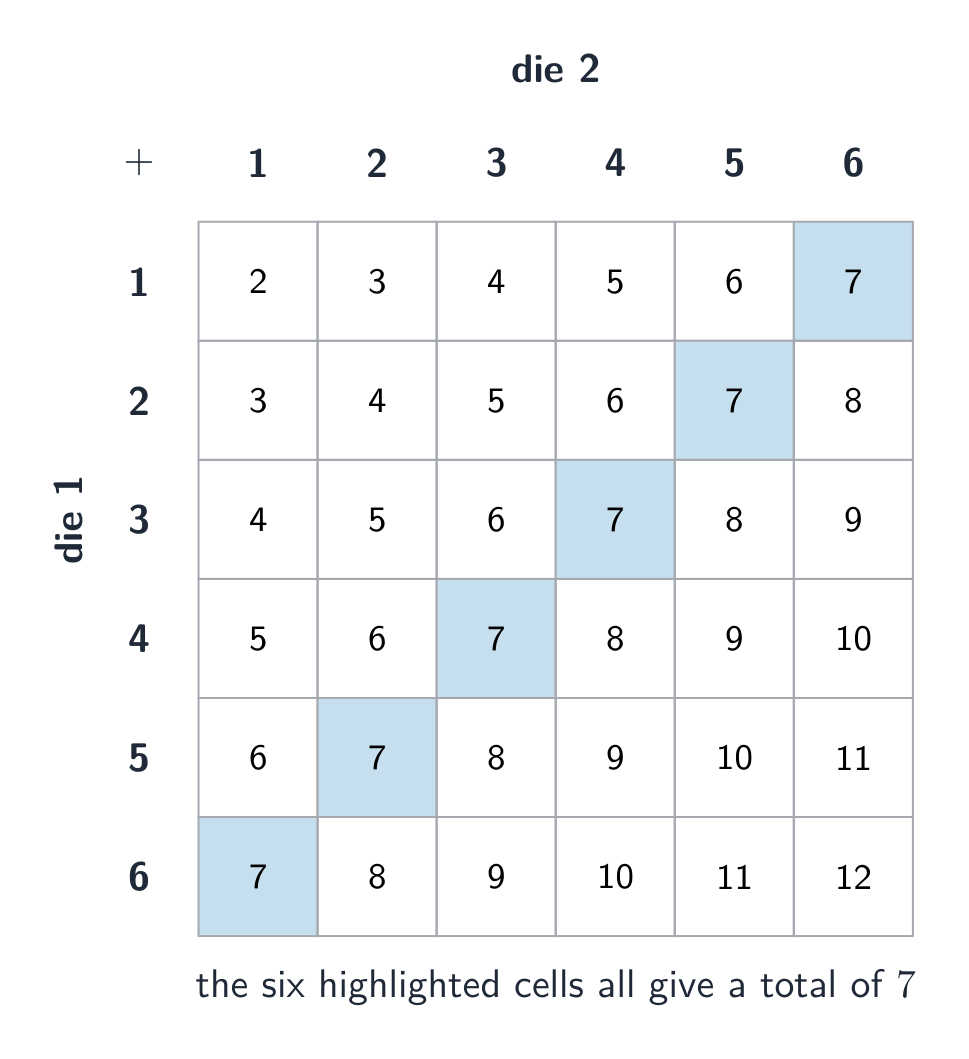
A sample space diagram lists every outcome; for the total of two dice there are $36$ equally likely cells. Venn diagrams
A Venn diagram 维恩图 sorts outcomes into overlapping sets. From it you can read $\text{P}(A \cap B)$ (in both) and $\text{P}(A \cup B)$ (in either).
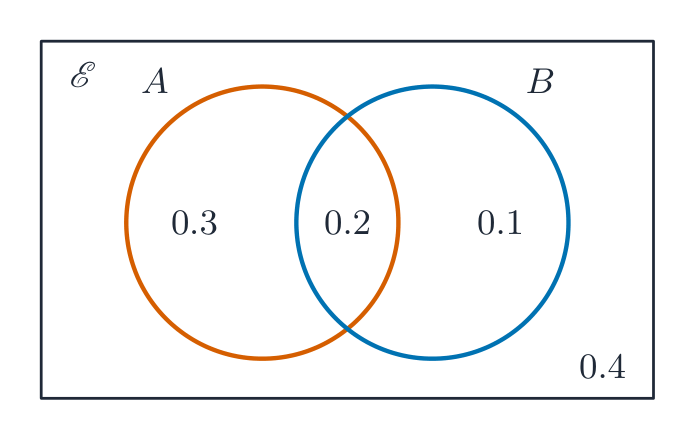
The overlap is $\text{P}(A\cap B)=0.2$; everything inside either circle is $\text{P}(A\cup B)=0.6$; outside both is $0.4$. Tree diagrams
A tree diagram 树状图 shows each stage as a set of branches. Write the probability on each branch and the outcome at the end. Multiply along the branches, then add the paths you want.
Worked example (with replacement). From the bag ($3$ red, $5$ blue), a counter is drawn, replaced, then a second is drawn. This is with replacement 有放回, so the chances do not change. Find the probability of two reds.
$$\text{P}(\text{red, red}) = \frac{3}{8} \times \frac{3}{8} = \frac{9}{64}.$$
On a tree diagram, multiply the probabilities along the branches; the four outcomes' probabilities add to $1$. Worked example (without replacement, Extended). Now the first counter is not replaced — drawing without replacement 无放回. After one red is taken, $2$ reds remain out of $7$:
$$\text{P}(\text{red, red}) = \frac{3}{8} \times \frac{2}{7} = \frac{6}{56} = \frac{3}{28}.$$Explore · ИсследоватьProbability tree · Дерево вероятностей
Multiply the probabilities along each branch; the four outcomes always add up to 1. · Перемножайте вероятности вдоль каждой ветви; четыре исхода всегда в сумме дают 1.
Explore · ИсследоватьCombined events · Комбинированные события
P(A ∩ B) = P(A)·P(B|A)
Combine two events: the area model shows AND (overlap) versus OR (union). · Объедините два события: площадная модель показывает И (пересечение) versus ИЛИ (объединение).
Vocabulary · Словарь Train · ТренироватьEnglish Русский combined events/kəmˈbaɪnd ɪˈvents/ совместные события independent events/ˌɪndɪˈpendənt ɪˈvents/ независимые события mutually exclusive/ˈmjuːtʃuːəli eksˈkluːsɪv/ взаимоисключающие sample space diagram/ˈsæmpl speɪs ˈdaɪəɡræm/ диаграмма пространства исходов Venn diagram/ven ˈdaɪəɡræm/ диаграмма Венна tree diagram/triː ˈdaɪəɡræm/ дерево вероятностей with replacement/wɪð rɪˈpleɪsmənt/ с возвращением without replacement/wɪˈðaʊt rɪˈpleɪsmənt/ без возвращения 8.4
Conditional probability (Extended)
Syllabus · Программа
EnglishSubject content Notes and examples Calculate conditional probability using Venn diagrams, tree diagrams and tables. Knowledge of notation, $\text{P}(A|B)$, and formulas relating to conditional probability is not required. РусскийПредметное содержание Примечания и примеры Вычисляйте условную вероятность с использованием диаграмм Эйлера-Венна, деревьев решений и таблиц. Знание обозначений, таких как $\text{P}(A|B)$, и формул, связанных с условной вероятностью, не требуется. Source: Cambridge International syllabus · Источник: Программа Cambridge International
Conditional probability 条件概率 is the probability of one event given that another has already happened. Read it from a Venn diagram, two-way table or tree diagram by looking only at the part that matches the condition.
Worked example. In a class of $30$, $18$ study French and, of those, $7$ also study German. A French student is picked. Find the probability they also study German.
Look only at the $18$ French students:
$$\text{P}(\text{German} \mid \text{French}) = \frac{7}{18}.$$Explore · ИсследоватьProbability trees · Деревья вероятностей
Change the branch probabilities and read combined and conditional probabilities off the tree. · Измените вероятности ветвлений и считайте совместные и условные вероятности с деревья.
Vocabulary · Словарь Train · ТренироватьEnglish Русский conditional probability/kənˈdɪʃənl ˌprɒbəˈbɪlɪti/ условная вероятность 8.4
Exam tips
- Every probability lies between $0$ and $1$, and the probabilities of all the outcomes add to $1$.
- For "and" (both events) multiply the probabilities; for "or" (either event) add them. On a tree diagram, multiply along the branches.
- Watch for without replacement: the second probability changes because one item has already been removed.
- Expected frequency = probability × number of trials.
-
9
Statistics · Статистика
Watch lesson · Смотреть урокThis handout covers Topic 9, Statistics. Parts marked (Extended) are only tested on the Extended papers; everything else is for both levels.
9.1 9.2
Collecting and showing data

Syllabus · Программа
EnglishSubject content Notes and examples Classify and tabulate statistical data. e.g. tally tables, two-way tables. РусскийПредметное содержание Примечания и примеры Классифицировать и систематизировать статистические данные. напр. таблицы подсчёта, двумерные таблицы. EnglishSubject content Notes and examples 1 Read, interpret and draw inferences from tables and statistical diagrams. 2 Compare sets of data using tables, graphs and statistical measures. e.g. compare averages and ranges between two data sets. 3 Appreciate restrictions on drawing conclusions from given data. РусскийПредметное содержание Примечания и примеры 1 Читать, интерпретировать и делать выводы на основе таблиц и статистических диаграмм. 2 Сравнивать наборы данных с помощью таблиц, графиков и статистических показателей. напр. сравнивать средние значения и размах между двумя наборами данных. 3 Осознавать ограничения при выводе заключений по имеющимся данным. EnglishSubject content Notes and examples 1 Read, interpret and draw inferences from tables and statistical diagrams. 2 Compare sets of data using tables, graphs and statistical measures. e.g. compare averages and measures of spread between two data sets. 3 Appreciate restrictions on drawing conclusions from given data. РусскийПредметное содержание Примечания и примеры 1 Читать, интерпретировать и делать выводы на основе таблиц и статистических диаграмм. 2 Сравнивайте наборы данных с помощью таблиц, графиков и статистических показателей. Например, сравнивайте средние значения и показатели разброса между двумя наборами данных. 3 Осознавать ограничения при выводе заключений по имеющимся данным. Source: Cambridge International syllabus · Источник: Программа Cambridge International
Data is collected from people — a sample drawn from a population. To organise statistical 统计 data 数据, use:
- a tally table 计数表 — make a mark for each value, then count.
- a two-way table 双向表 — sorts data by two features at once (for example, boys/girls against walk/bus).
When you read a diagram, only draw conclusions the data really supports.
Explore · ИсследоватьData handling cycle · Цикл работы с данными
Follow a statistical question from collection to display. · Следуйте статистическому вопросу от сбора до представления данных.
Vocabulary · Словарь Train · ТренироватьEnglish Русский statistical/stəˈtɪstɪkl/ статистические data/ˈdeɪtə/ данные tally table/ˈtælɪ ˈteɪbl/ таблица подсчета two-way table/tuː weɪ ˈteɪbl/ двумерная таблица 9.3
Averages and range

Syllabus · Программа
EnglishSubject content Notes and examples Calculate the mean, median, mode and range for individual data and distinguish between the purposes for which these are used. Data may be in a list or frequency table, but will not be grouped. РусскийПредметное содержание Примечания и примеры Вычислять среднее арифметическое, медиану, моду и размах для отдельных данных и различать цели их применения. Данные могут быть представлены списком или таблицей частот, но не должны быть сгруппированы. EnglishSubject content Notes and examples 1 Calculate the mean, median, mode, quartiles, range and interquartile range for individual data and distinguish between the purposes for which these are used. 2 Calculate an estimate of the mean for grouped discrete or grouped continuous data. 3 Identify the modal class from a grouped frequency distribution. РусскийПредметное содержание Примечания и примеры 1 Вычисляйте среднее арифметическое, медиану, моду, квартили, размах и межквартильный размах для отдельных данных и различайте цели их применения. 2 Вычисляйте оценку среднего арифметического для группированных дискретных или непрерывных данных. 3 Определяйте модальный класс по сгруппированному частотному распределению. Source: Cambridge International syllabus · Источник: Программа Cambridge International
Three averages describe a typical value of the data, and the range shows how spread out it is. Each is used for a different purpose:
Mean, median, mode and range of a small data set - mean 平均数 $= \dfrac{\text{sum of all values}}{\text{how many values}}$.
- median 中位数 $=$ the middle value when the data is put in order.
- mode 众数 $=$ the value that appears most often.
- range 极差 $=$ largest value $-$ smallest value (it shows how spread out the data is).
Worked example. Find the mean, median, mode and range of $4, 7, 7, 2, 5$.
Order the data: $2, 4, 5, 7, 7$.
$$\text{mean} = \frac{4 + 7 + 7 + 2 + 5}{5} = \frac{25}{5} = 5, \quad \text{median} = 5, \quad \text{mode} = 7, \quad \text{range} = 7 - 2 = 5.$$Explore · ИсследоватьAverage choice lab · Лабораторная работа: выбор среднего
Choose the average that fits the data situation. · Выберите среднее значение, подходящее для данной ситуации.
Vocabulary · Словарь Train · ТренироватьEnglish Русский mean/miːn/ среднее значение median/ˈmiːdiːən/ медианой mode/məʊd/ модой range/reɪndʒ/ область значений 9.3
Averages from a frequency table
Syllabus · Программа
EnglishSubject content Notes and examples Calculate the mean, median, mode and range for individual data and distinguish between the purposes for which these are used. Data may be in a list or frequency table, but will not be grouped. РусскийПредметное содержание Примечания и примеры Вычислять среднее арифметическое, медиану, моду и размах для отдельных данных и различать цели их применения. Данные могут быть представлены списком или таблицей частот, но не должны быть сгруппированы. EnglishSubject content Notes and examples 1 Calculate the mean, median, mode, quartiles, range and interquartile range for individual data and distinguish between the purposes for which these are used. 2 Calculate an estimate of the mean for grouped discrete or grouped continuous data. 3 Identify the modal class from a grouped frequency distribution. РусскийПредметное содержание Примечания и примеры 1 Вычисляйте среднее арифметическое, медиану, моду, квартили, размах и межквартильный размах для отдельных данных и различайте цели их применения. 2 Вычисляйте оценку среднего арифметического для группированных дискретных или непрерывных данных. 3 Определяйте модальный класс по сгруппированному частотному распределению. Source: Cambridge International syllabus · Источник: Программа Cambridge International
When data is listed with its frequency 频数 (how many times each value occurs), the mean is
$$\text{mean} = \frac{\sum (\text{value} \times \text{frequency})}{\sum \text{frequency}}.$$Worked example. Values $1, 2, 3$ occur with frequencies $4, 5, 1$. Find the mean.
$$\text{mean} = \frac{1(4) + 2(5) + 3(1)}{4 + 5 + 1} = \frac{17}{10} = 1.7.$$Grouped data (Extended)
For grouped data 分组数据, you cannot find the exact mean, so estimate it using the midpoint of each group as the value. The modal class 众数组 is simply the group with the highest frequency.
Vocabulary · Словарь Train · ТренироватьEnglish Русский frequency/ˈfriːkwənsi/ частоту grouped data/ɡruːpt ˈdeɪtə/ сгруппированные данные modal class/ˈməʊdl klæs/ модальный класс 9.3
Measures of spread (Extended)
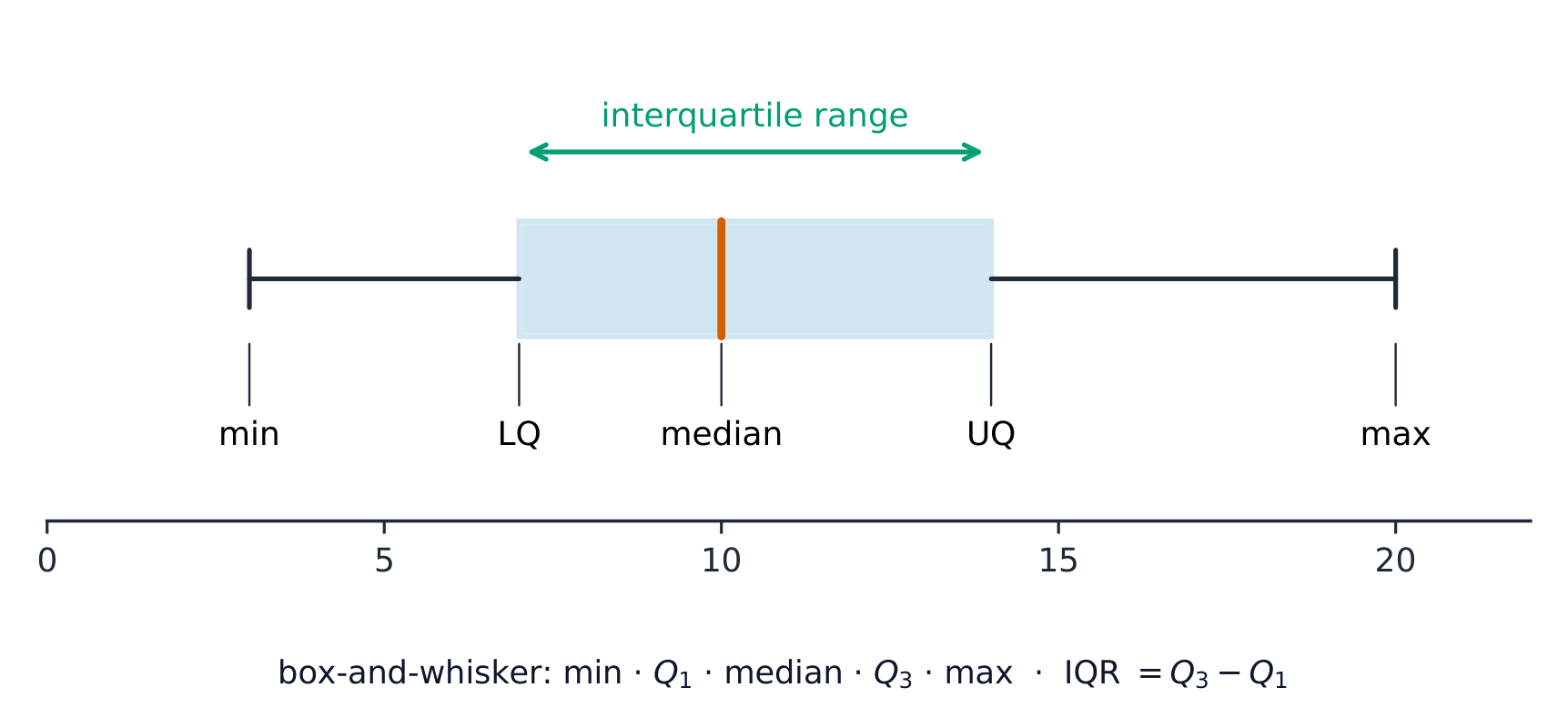
Syllabus · Программа
EnglishSubject content Notes and examples 1 Calculate the mean, median, mode, quartiles, range and interquartile range for individual data and distinguish between the purposes for which these are used. 2 Calculate an estimate of the mean for grouped discrete or grouped continuous data. 3 Identify the modal class from a grouped frequency distribution. РусскийПредметное содержание Примечания и примеры 1 Вычисляйте среднее арифметическое, медиану, моду, квартили, размах и межквартильный размах для отдельных данных и различайте цели их применения. 2 Вычисляйте оценку среднего арифметического для группированных дискретных или непрерывных данных. 3 Определяйте модальный класс по сгруппированному частотному распределению. Source: Cambridge International syllabus · Источник: Программа Cambridge International
When data is in order, the quartiles 四分位数 cut it into four equal parts. The lower quartile (LQ) is one quarter of the way up; the upper quartile (UQ) is three quarters of the way up. The interquartile range 四分位距 measures the spread of the middle half:
$$\text{interquartile range} = \text{UQ} - \text{LQ}.$$The interquartile range is useful because, unlike the range, it ignores extreme values.
A box-and-whisker plot shows the five-number summary; the box length is the interquartile range. Explore · ИсследоватьBox-and-whisker plot · Ящик с усами (box-and-whisker plot)
Build a box plot from the five-number summary: the box is the middle 50% (the interquartile range) and the median's position shows the skew. · Постройте ящик с усами по пятичисловому обзору: ящик представляет собой средние 50% (межквартильный размах), а положение медианы указывает на асимметрию.
Vocabulary · Словарь Train · ТренироватьEnglish Русский quartile/ˈkwɔːtaɪl/ квартиль interquartile range/ˌɪntəˈkwɔːtaɪl reɪndʒ/ межквартильный размах 9.4
Charts and diagrams

Syllabus · Программа
EnglishSubject content Notes and examples Draw and interpret: (a) bar charts (b) pie charts (c) pictograms (d) stem-and-leaf diagrams (e) simple frequency distributions. Includes composite (stacked) and dual (side-by-side) bar charts. Stem-and-leaf diagrams should have ordered data with a key. РусскийПредметное содержание Примечания и примеры Строить и интерпретировать: (a) столбчатые диаграммы (b) круговые диаграммы (c) пиктограммы (d) стеблевые диаграммы (e) простые распределения частот. Включают составные (стопочные) и двойные (расположенные рядом) столбчатые диаграммы. Стеблевые диаграммы должны содержать упорядоченные данные и условные обозначения. Source: Cambridge International syllabus · Источник: Программа Cambridge International
A Galton board shows how data piles up into a distribution. 
A pictogram uses a symbol to stand for a number of items 
A bar chart shows the frequency of each group Chart What it shows bar chart 条形图 a bar for each category; height is the frequency pie chart 饼图 a circle split into slices, each a fraction of $360^{\circ}$ pictogram 象形图 uses a symbol to stand for a number of items stem-and-leaf diagram 茎叶图 keeps the digits of ordered data, with a key frequency distribution 频数分布 a table of values and their frequencies Worked example (pie chart). Out of $120$ people, $30$ chose tea. Find the angle of the tea slice.
$$\frac{30}{120} \times 360^{\circ} = 90^{\circ}.$$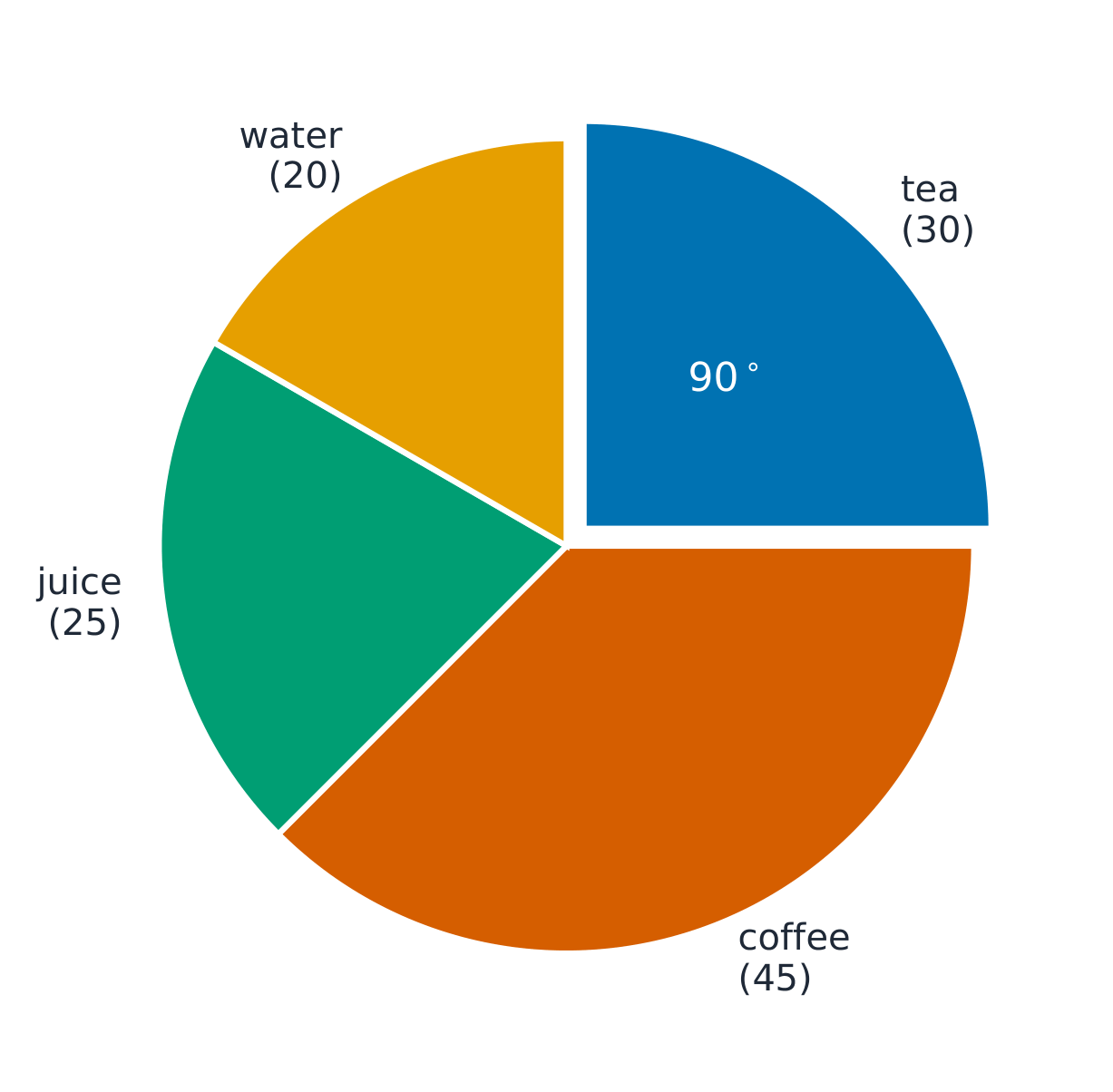
Each slice is its fraction of $360^\circ$; tea is $\tfrac{30}{120}\times360^\circ=90^\circ$. Explore · ИсследоватьPie-chart angles · Углы круговой диаграммы
Each slice's angle is its share of the whole turned into degrees — frequency ÷ total × 360 — and the slices always add to 360°. · Угол каждого сектора — это его доля от целого, переведенная в градусы — частота ÷ общее количество × 360 — и секторы всегда в сумме дают 360°.
Explore · ИсследоватьChart choice lab · Лабораторная работа: выбор диаграммы
Choose the chart that fits the kind of data. · Выберите диаграмму, подходящую для типа данных.
Vocabulary · Словарь Train · ТренироватьEnglish Русский bar chart/bɑː tʃɑːt/ столбчатая диаграмма pie chart/paɪ tʃɑːt/ круговая диаграмма pictogram/ˈpɪktəɡræm/ пиктограмма stem-and-leaf diagram/stem ænd liːf ˈdaɪəɡræm/ стебель-лист диаграмма frequency distribution/ˈfriːkwənsi ˌdɪstrɪˈbjuːʃn/ частотное распределение 9.5
Scatter diagrams and correlation

Syllabus · Программа
EnglishSubject content Notes and examples 1 Draw and interpret scatter diagrams. Plotted points should be clearly marked, for example as small crosses (×). 2 Understand what is meant by positive, negative and zero correlation. 3 Draw by eye, interpret and use a straight line of best fit. A line of best fit: • should be a single ruled line drawn by inspection • should extend across the full data set • does not need to coincide exactly with any of the points but there should be a roughly even distribution of points either side of the line over its entire length. РусскийПредметное содержание Примечания и примеры 1 Строить и интерпретировать точечные диаграммы. Отмеченные точки должны быть чётко видны, например, в виде маленьких крестиков (×). 2 Понимать понятие положительной, отрицательной и нулевой корреляции. 3 На глаз строить, интерпретировать и использовать линию тренда. Линия тренда: • должна представлять собой единственную прямую линию, проведённую визуально; • должна охватывать весь набор данных; • не обязана точно проходить через какие-либо точки, но над её всей длиной должно наблюдаться примерно равномерное распределение точек по обе стороны от неё. EnglishSubject content Notes and examples 1 Draw and interpret scatter diagrams. Plotted points should be clearly marked, for example as small crosses (x). 2 Understand what is meant by positive, negative and zero correlation. 3 Draw by eye, interpret and use a straight line of best fit. A line of best fit: • should be a single ruled line drawn by inspection • should extend across the full data set • does not need to coincide exactly with any of the points but there should be a roughly even distribution of points either side of the line over its entire length. РусскийПредметное содержание Примечания и примеры 1 Рисуйте и интерпретируйте диаграммы рассеяния. Нанесённые точки должны быть чётко обозначены, например, маленькими крестиками (x). 2 Понимать понятие положительной, отрицательной и нулевой корреляции. 3 На глаз строить, интерпретировать и использовать линию тренда. Линия тренда: • должна представлять собой единственную прямую линию, проведённую визуально; • должна охватывать весь набор данных; • не обязана точно проходить через какие-либо точки, но над её всей длиной должно наблюдаться примерно равномерное распределение точек по обе стороны от неё. Source: Cambridge International syllabus · Источник: Программа Cambridge International
A scatter diagram 散点图 plots pairs of values as points to show whether two things are linked. The link is the correlation 相关性:
- positive correlation 正相关 — as one goes up, the other goes up.
- negative correlation 负相关 — as one goes up, the other goes down.
- zero correlation 零相关 — no clear link.
Positive correlation rises together; negative falls as the other rises; zero shows no clear link. If there is correlation, draw a line of best fit 最佳拟合线: one straight ruled line through the middle of the points, with about the same number of points on each side. Use it to predict values.

A line of best fit is one straight ruled line through the middle of the points; use it to predict. Explore · ИсследоватьScatter and correlation · Точечная диаграмма и корреляция
Change the strength of the relationship and add a line of best fit to spot the trend. · Измените силу связи и добавьте линию тренда, чтобы выявить закономерность.
Vocabulary · Словарь Train · ТренироватьEnglish Русский scatter diagram/ˈskætə ˈdaɪəɡræm/ диаграмма рассеяния correlation/ˌkɒrɪˈleɪʃn/ корреляцию positive correlation/ˈpɒzɪtɪv ˌkɒrɪˈleɪʃn/ положительная корреляция negative correlation/ˈneɡətɪv ˌkɒrɪˈleɪʃn/ отрицательная корреляция zero correlation/ˈzɪərəʊ ˌkɒrɪˈleɪʃn/ нулевая корреляция line of best fit/laɪn ɒv best fɪt/ линия тренда 9.6
Cumulative frequency diagrams (Extended)
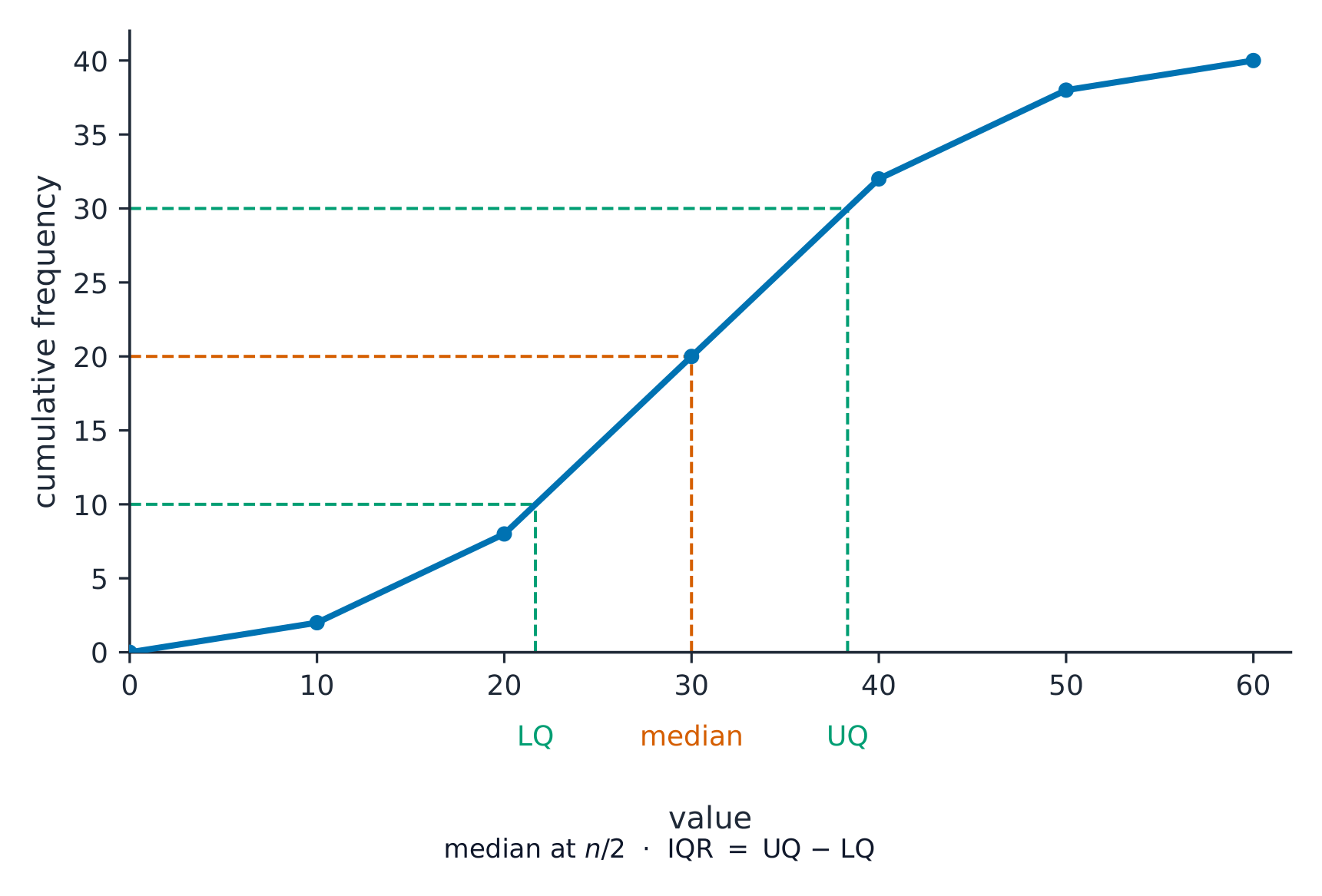
Syllabus · Программа
EnglishSubject content Notes and examples 1 Draw and interpret cumulative frequency tables and diagrams. Plotted points on a cumulative frequency diagram should be clearly marked, for example as small crosses (x), and be joined with a smooth curve. 2 Estimate and interpret the median, percentiles, quartiles and interquartile range from cumulative frequency diagrams. РусскийПредметное содержание Примечания и примеры 1 Рисуйте и интерпретируйте таблицы и диаграммы кумулятивных частот. Точки на кумулятивной частотной диаграмме должны быть чётко обозначены, например, маленькими крестиками (x), и соединены плавной кривой. 2 Оценивайте и интерпретируйте медиану, перцентили, квартили и межквартильный размах по кумулятивным частотным диаграммам. Source: Cambridge International syllabus · Источник: Программа Cambridge International
The cumulative frequency 累积频数 is a running total of the frequencies. Plot it against the upper end of each class and join the points with a smooth curve.
From the curve you can read the median (at half the total), the quartiles (at one quarter and three quarters), and any percentile 百分位数 (for example, the $90$th percentile is at $90\%$ of the total).
Read the median at half the total, and the quartiles at one quarter and three quarters: across to the curve, then down. Explore · ИсследоватьCumulative frequency route · Путь накопленной частоты
Follow raw data into a cumulative frequency curve and percentile reading. · Перейдите от исходных данных к кривой накопленной частоты и считыванию перцентилей.
Vocabulary · Словарь Train · ТренироватьEnglish Русский cumulative frequency/ˈkjuːmjʊlətɪv ˈfriːkwənsi/ накопительная частота percentile/pəˈsentaɪl/ перцентиль 9.7
Histograms (Extended)
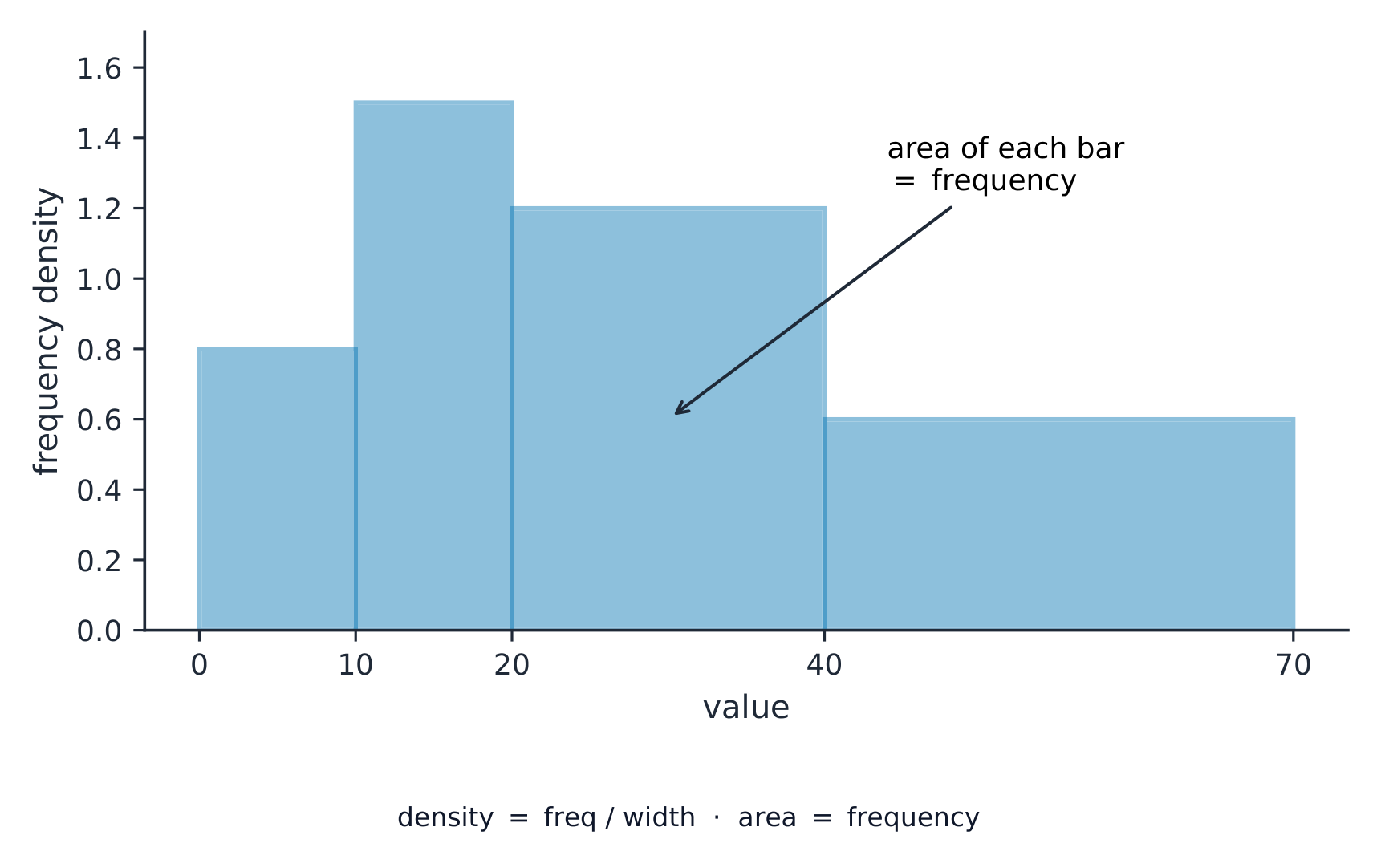
Syllabus · Программа
EnglishSubject content Notes and examples 1 Draw and interpret histograms. On histograms, the vertical axis is labelled 'Frequency density'. 2 Calculate with frequency density. Frequency density is defined as $\text{frequency density} = \text{frequency} \div \text{class width}$. РусскийПредметное содержание Примечания и примеры 1 Рисуйте и интерпретируйте гистограммы. На гистограммах вертикальная ось подписывается как 'Плотность частоты'. 2 Производите вычисления с плотностью частоты. Плотность частоты определяется как $\text{frequency density} = \text{frequency} \div \text{class width}$. Source: Cambridge International syllabus · Источник: Программа Cambridge International
A histogram 直方图 looks like a bar chart, but the bars can have different widths and the area of each bar (not its height) shows the frequency. The vertical axis is the frequency density 频数密度:
$$\text{frequency density} = \frac{\text{frequency}}{\text{class width}}.$$With unequal class widths the bar AREA (not its height) is the frequency, so the axis is frequency density. Worked example. A class has class width 组距 $10$ and frequency $25$. Find the frequency density.
$$\text{frequency density} = \frac{25}{10} = 2.5.$$Explore · ИсследоватьFrequency-density histogram · Гистограмма плотности частоты
With unequal class widths the bar height is frequency density, so the area (not the height) represents the frequency. · При неравных ширинах классов высота столбца — это плотность частоты, поэтому площадь (а не высота) представляет частоту.
Vocabulary · Словарь Train · ТренироватьEnglish Русский histogram/ˈhɪstəɡræm/ гистограмма frequency density/ˈfriːkwənsi ˈdensɪti/ плотность частоты class width/klæs wɪtθ/ ширина класса 9.7
Exam tips
- Know the three averages: mean (add up ÷ how many), median (the middle value when in order), mode (the most common). The range is highest − lowest.
- From a frequency table the mean is $\frac{\sum fx}{\sum f}$ — divide by the total frequency, not the number of rows.
- On a scatter diagram, describe the correlation as positive, negative or none, and draw the line of best fit through the mean point.
- For a histogram with unequal class widths, the height is the frequency density (frequency ÷ class width), not the frequency.