Skip to content · ⁨Перейти к содержанию⁩
Subjects · ⁨Предметы⁩

AP Physics 1 · ⁨AP Физика 1⁩

Tips · ⁨Советы⁩

AP Physics 1 — это механика на основе алгебры: кинематика, силы, работа, энергия и мощность, импульс, момент силы и вращение, колебания и жидкости. Дифференциальное исчисление не требуется — что делает курс концептуально сложнее, а не проще. Вы рассуждаете о ситуациях, а не просто применяете формулу.

Раздел свободных ответов оценивается отдельно. В нём от вас требуется обосновать, сравнить две ситуации и объяснить результат в словах. Правильный ответ без пояснения приносит очень мало баллов.

Назовите принцип сначала. Фраза «Поскольку импульс сохраняется и внешняя горизонтальная сила не действует…» соответствует тому, что ожидает видеть проверяющий. Рисуйте диаграмму свободного тела для каждой задачи, даже если кажется, что она не нужна — это самый ценный навык в курсе.

Примечания ниже последовательно проходят все разделы CED, от кинематики до простого гармонического движения, с разобранными примерами. Выпущенные вопросы со свободными ответами и критерии их оценивания находятся в библиотеке, а вопрос об экспериментальном проектировании стоит практиковать отдельно — он встречается ежегодно и оценивает четкую процедуру, а не формулу.

  • 1

    Kinematics · ⁨Кинематика⁩

    Watch lesson · ⁨Смотреть урок⁩
    1.1

    Scalars and Vectors in One Dimension

    Syllabus · ⁨Программа⁩
    English

    Learning Objective 1.1.A: Describe a scalar or vector quantity using magnitude and direction, as appropriate.

    • 1.1.A.1 Scalars are quantities described by magnitude only; vectors are quantities described by both magnitude and direction.
    • 1.1.A.2 Vectors can be visually modeled as arrows with appropriate direction and lengths proportional to their magnitude.
    • 1.1.A.3 Distance and speed are examples of scalar quantities, while position, displacement, velocity, and acceleration are examples of vector quantities.
      • 1.1.A.3.i Vectors are notated with an arrow above the symbol for that quantity.
        • Equation: $\vec{v} = \vec{v}_0 + \vec{a}t$
      • 1.1.A.3.ii Vector notation is not required for vector components along an axis. In one dimension, the sign of the component completely describes the direction of that component.
        • Derived equation: $v_x = v_{x0} + a_x t$

    Learning Objective 1.1.B: Describe a vector sum in one dimension.

    • 1.1.B.1 When determining a vector sum in a given one-dimensional coordinate system, opposite directions are denoted by opposite signs.
    Русский

    Цель обучения 1.1.A: Описывать скалярную или векторную величину с помощью модуля и направления, в зависимости от ситуации.

    • 1.1.A.1 Скаляры — это величины, описываемые только модулем; векторы — это величины, описываемые как модулем, так и направлением.
    • 1.1.A.2 Векторы можно визуализировать в виде стрелок с соответствующим направлением и длиной, пропорциональной их модулю.
    • 1.1.A.3 Расстояние и скорость являются примерами скалярных величин, тогда как положение, перемещение, скорость и ускорение — примерами векторных величин.
      • 1.1.A.3.i Векторы обозначаются стрелкой над символом этой величины.
        • Уравнение: $\vec{v} = \vec{v}_0 + \vec{a}t$
      • 1.1.A.3.ii Обозначение векторов не требуется для компонент вектора вдоль оси. В одномерном случае знак компоненты полностью описывает направление этой компоненты.
        • Выведенное уравнение: $v_x = v_{x0} + a_x t$

    Цель обучения 1.1.B: Описывать векторную сумму в одном измерении.

    • 1.1.B.1 При определении векторной суммы в заданной одномерной системе координат противоположные направления обозначаются противоположными знаками.
    Source: College Board AP Course and Exam Description · ⁨Источник: Описание курса и экзамена College Board AP⁩

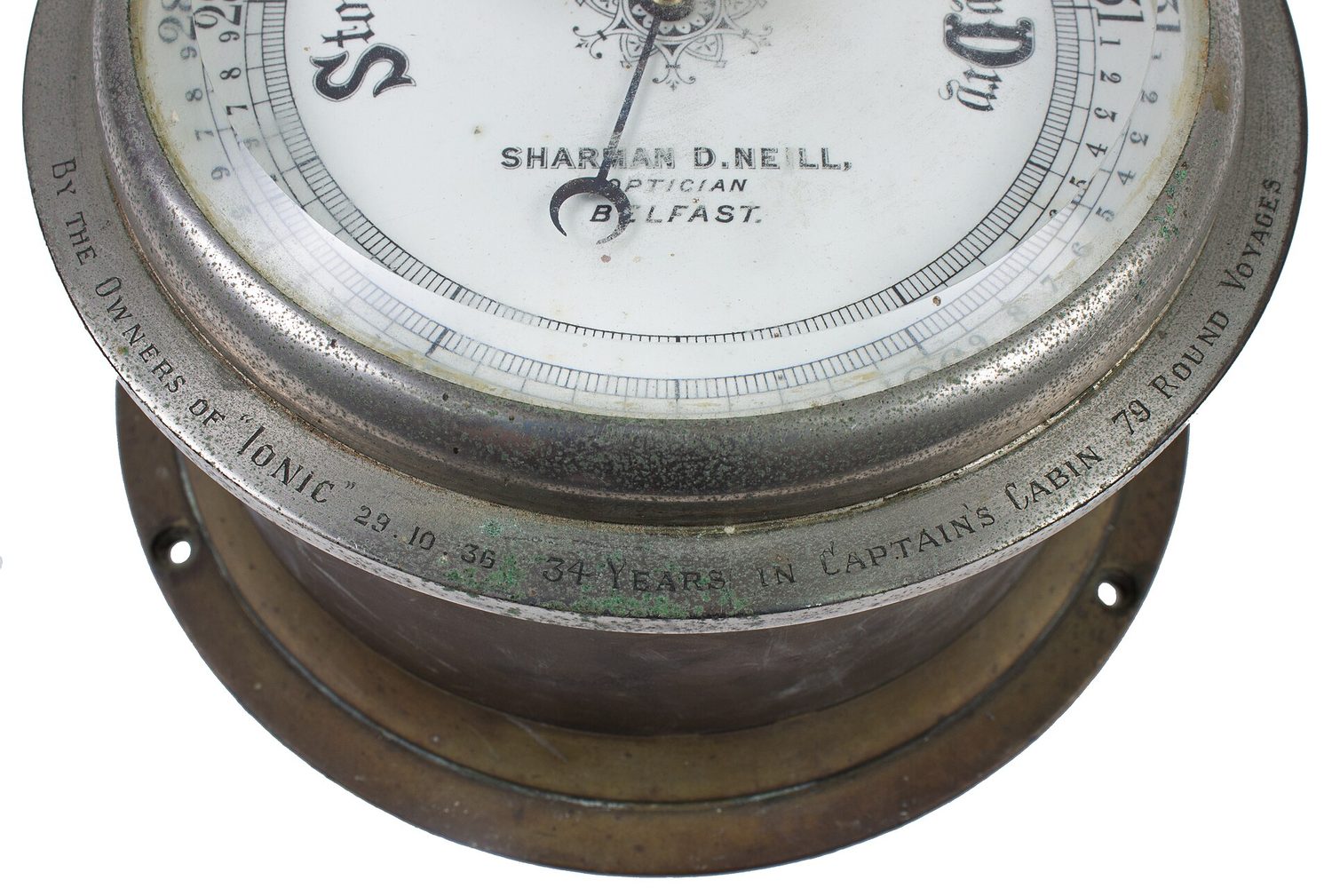
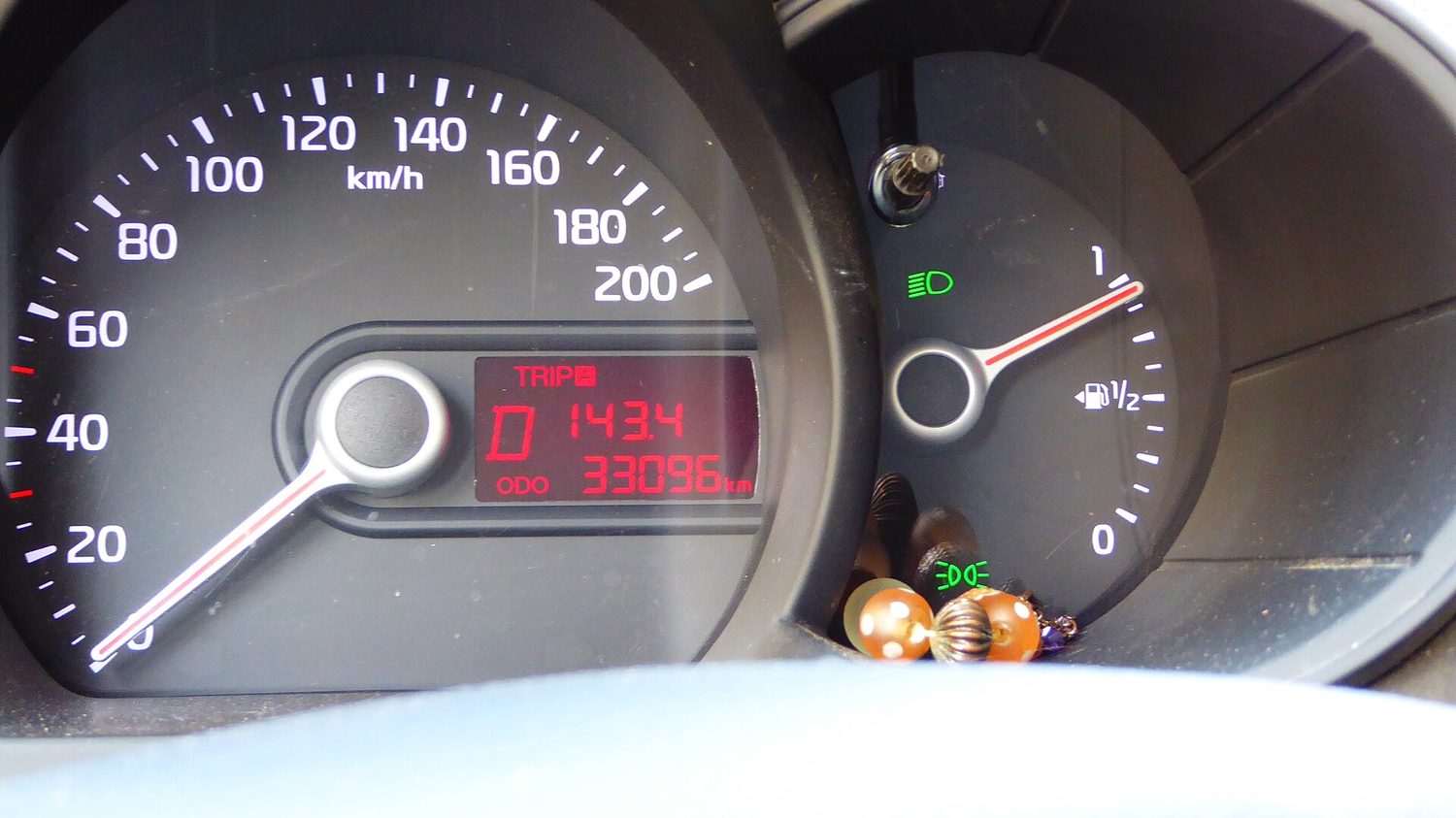
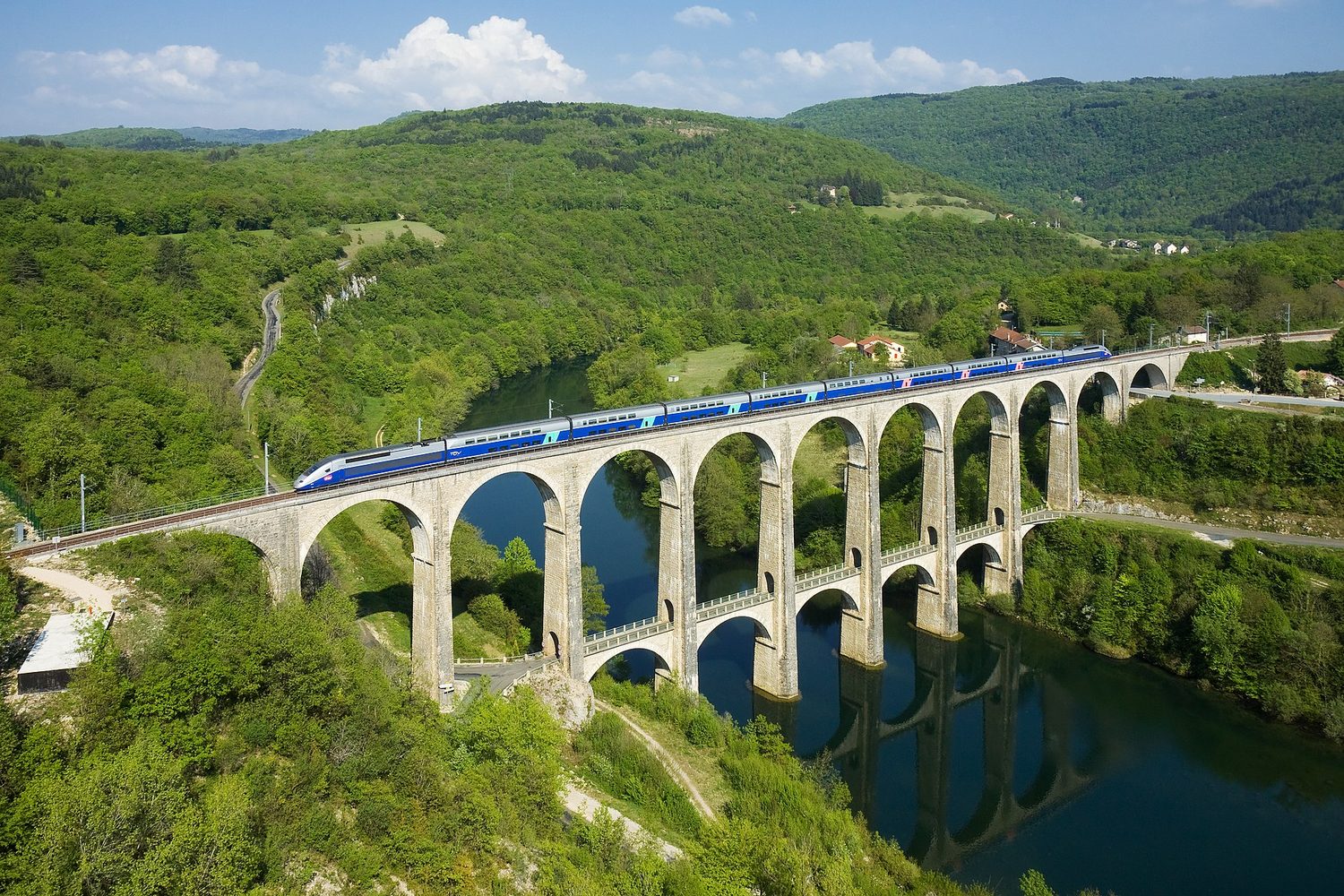
    A car speedometer: speed is the magnitude of velocity — a scalar rate of motion
    A car speedometer: speed is the magnitude of velocity — a scalar rate of motion

    Kinematics 运动学 describes how objects move, without asking why. First, two kinds of quantity:

    • A scalar 标量 has only size (magnitude 大小): distance 距离, speed, time, mass.
    • A vector 矢量 has magnitude and direction: displacement, velocity, acceleration, force.

    The difference matters. Distance is the total path length travelled – a scalar that only grows. Displacement is the straight-line change in position, with a direction. Walk $3\ \text{m}$ east then $1\ \text{m}$ back west: the distance is $4\ \text{m}$, but the displacement is only $2\ \text{m}$ east.

    In one dimension, direction is just a sign (+ or −) along a chosen axis. Choosing the positive direction first is essential – every vector's sign depends on it. A velocity of $-5\ \text{m/s}$ does not mean "slow"; it means $5\ \text{m/s}$ in the negative direction.

    Vocabulary · ⁨Словарь⁩ Train · ⁨Тренировать⁩
    English Русский
    Kinematics/ˌkɪnɪˈmætɪks/ Кинематика
    scalar/ˈskeɪlə/ скаляр
    magnitude/ˈmæɡnɪtjuːd/ величина
    vector/ˈvektə/ векторное
    distance/ˈdɪstəns/ расстояние
    1.2

    Displacement, Velocity, and Acceleration

    Syllabus · ⁨Программа⁩
    English

    Learning Objective 1.2.A: Describe a change in an object's position.

    • 1.2.A.1 When using the object model, the size, shape, and internal configuration are ignored. The object may be treated as a single point with extensive properties such as mass and charge.
    • 1.2.A.2 Displacement is the change in an object's position.
      • Equation: $\Delta x = x - x_0$

    Learning Objective 1.2.B: Describe the average velocity and acceleration of an object.

    • 1.2.B.1 Averages of velocity and acceleration are calculated considering the initial and final states of an object over an interval of time.
    • 1.2.B.2 Average velocity is the displacement of an object divided by the interval of time in which that displacement occurs.
      • Equation: $\vec{v}_{avg} = \dfrac{\Delta \vec{x}}{\Delta t}$
    • 1.2.B.3 Average acceleration is the change in velocity divided by the interval of time in which that change in velocity occurs.
      • Equation: $\vec{a}_{avg} = \dfrac{\Delta \vec{v}}{\Delta t}$

    Learning Objective 1.2.B: Describe the velocity and acceleration of an object.

    • 1.2.B.4 An object is accelerating if the magnitude and/or direction of the object's velocity are changing.
    • 1.2.B.5 Calculating average velocity or average acceleration over a very small time interval yields a value that is very close to the instantaneous velocity or instantaneous acceleration.
    Русский

    Цель обучения 1.2.A: Описывать изменение положения объекта.

    • 1.2.A.1 При использовании модели материальной точки размер, форма и внутренняя конфигурация игнорируются. Объект может рассматриваться как единая точка с экстенсивными свойствами, такими как масса и заряд.
    • 1.2.A.2 Перемещение — это изменение положения объекта.
      • Уравнение: $\Delta x = x - x_0$

    Цель обучения 1.2.B: Описывать среднюю скорость и среднее ускорение объекта.

    • 1.2.B.1 Средние значения скорости и ускорения вычисляются с учетом начального и конечного состояний объекта за интервал времени.
    • 1.2.B.2 Средняя скорость — это перемещение объекта, деленное на интервал времени, в течение которого это перемещение происходит.
      • Уравнение: $\vec{v}_{avg} = \dfrac{\Delta \vec{x}}{\Delta t}$
    • 1.2.B.3 Среднее ускорение — это изменение скорости, деленное на интервал времени, в течение которого это изменение скорости происходит.
      • Уравнение: $\vec{a}_{avg} = \dfrac{\Delta \vec{v}}{\Delta t}$

    Цель обучения 1.2.B: Описывать скорость и ускорение объекта.

    • 1.2.B.4 Объект ускоряется, если изменяется модуль и/или направление его скорости.
    • 1.2.B.5 Вычисление средней скорости или среднего ускорения за очень малый интервал времени дает значение, очень близкое к мгновенной скорости или мгновенному ускорению.

    Source: College Board AP Course and Exam Description · ⁨Источник: Описание курса и экзамена College Board AP⁩

    A high-speed train: kinematics describes displacement, velocity and acceleration over time
    A high-speed train: kinematics describes displacement, velocity and acceleration over time
    Projectile motion is two independent motions

    Three linked vectors describe motion along a line:

    • Displacement 位移 $\Delta x$ is the change in position – a vector from start to end (not the total path length, which is distance).
    • Velocity 速度 is the rate of change of position, $v=\dfrac{\Delta x}{\Delta t}$. Its sign gives direction; its magnitude is speed 速率.
    • Acceleration 加速度 is the rate of change of velocity, $a=\dfrac{\Delta v}{\Delta t}$.

    Be careful to separate average velocity 平均速度 (total displacement over total time) from instantaneous velocity 瞬时速度 (the velocity at one instant, the slope of the position–time graph at that point). They are equal only when the velocity is constant.

    An object speeds up when $v$ and $a$ have the same sign, and slows down (deceleration 减速) when they have opposite signs. Note that a negative acceleration does not always mean slowing down – a ball falling faster and faster has negative velocity and negative acceleration.

    For constant acceleration, the four kinematic equations (often called SUVAT) apply:

    $$v=v_0+at,\qquad \Delta x=v_0 t+\tfrac{1}{2}at^2,\qquad v^2=v_0^2+2a\,\Delta x,\qquad \Delta x=\tfrac{1}{2}(v_0+v)\,t.$$
    Pick the equation that contains the three quantities you know plus the one you want, so only one unknown is left. They apply only while $a$ is constant.

    Worked example. A car starts from rest and accelerates uniformly at $2.0\ \text{m/s}^2$ for $6.0\ \text{s}$. Find its final velocity and the distance it travels.

    List what you know: $v_0=0$, $a=2.0\ \text{m/s}^2$, $t=6.0\ \text{s}$.

    $$v=v_0+at=0+2.0\times 6.0=12\ \text{m/s},$$
    $$\Delta x=v_0 t+\tfrac12 at^2=0+\tfrac12\times 2.0\times 6.0^2=36\ \text{m}.$$

    Worked example (free fall). A ball is thrown straight up at $15\ \text{m/s}$. Taking $g=9.8\ \text{m/s}^2$ and up as positive, how high does it rise, and how long is it in the air before returning to the thrower's hand?

    At the highest point the velocity is momentarily zero, and $a=-g=-9.8\ \text{m/s}^2$ throughout (this is free fall 自由落体, ignoring air resistance 空气阻力):

    $$v^2=v_0^2+2a\,\Delta x \;\Rightarrow\; 0=15^2+2(-9.8)\Delta x \;\Rightarrow\; \Delta x=\frac{225}{19.6}=11.5\ \text{m}.$$
    Time to the top: $0=15-9.8\,t \Rightarrow t=1.53\ \text{s}$. By symmetry the fall takes the same time, so the total is $3.1\ \text{s}$.

    Vocabulary · ⁨Словарь⁩ Train · ⁨Тренировать⁩
    English Русский
    Displacement/dɪˈspleɪsmənt/ Вытеснение
    Velocity/vəˈlɒsɪti/ Скорость
    speed/spiːd/ скорости движения
    Acceleration/əkˌseləˈreɪʃn/ Ускорение
    average velocity/ˈævrɪdʒ vəˈlɒsɪti/ средняя скорость
    instantaneous velocity/ˌɪnstənˈteɪnɪəs vəˈlɒsɪti/ мгновенная скорость
    deceleration/dɪˌseləˈreɪʃn/ замедление
    free fall/friː fɔːl/ свободное падение
    air resistance/eə rɪˈzɪstəns/ сопротивление воздуха
    1.3

    Representing Motion

    Syllabus · ⁨Программа⁩
    English

    Learning Objective 1.3.A: Describe the position, velocity, and acceleration of an object using representations of that object's motion.

    • 1.3.A.1 Motion can be represented by motion diagrams, figures, graphs, equations, and narrative descriptions.
    • 1.3.A.2 For constant acceleration, three kinematic equations can be used to describe instantaneous linear motion in one dimension:
      • Equation: $v_x = v_{x0} + a_x t$
      • Equation: $x = x_0 + v_{x0}t + \dfrac{1}{2}a_x t^2$
      • Equation: $v_x^2 = v_{x0}^2 + 2a_x(x - x_0)$
      • Note: The equations above are written to indicate motion in the x-direction, but these equations can be used in any single dimension as appropriate.
    • 1.3.A.3 Near the surface of Earth, the vertical acceleration caused by the force of gravity is downward, constant, and has a measured value approximately equal to $a_g = g \approx 10 \ m/s^2$.
    • 1.3.A.4 Graphs of position, velocity, and acceleration as functions of time can be used to find the relationships between those quantities.
      • 1.3.A.4.i An object's instantaneous velocity is the rate of change of the object's position, which is equal to the slope of a line tangent to a point on a graph of the object's position as a function of time.
      • 1.3.A.4.ii An object's instantaneous acceleration is the rate of change of the object's velocity, which is equal to the slope of a line tangent to a point on a graph of the object's velocity as a function of time.
      • 1.3.A.4.iii The displacement of an object during a time interval is equal to the area under the curve of a graph of the object's velocity as a function of time (i.e., the area bounded by the function and the horizontal axis for the appropriate interval).
      • 1.3.A.4.iv The change in velocity of an object during a time interval is equal to the area under the curve of a graph of the acceleration of the object as a function of time.

    Boundary statement: AP Physics 1 does not expect students to quantitatively analyze nonuniform acceleration. However, students will be expected to be able to qualitatively analyze, sketch appropriate graphs of, and discuss situations in which acceleration is nonuniform.

    Boundary statement: For all situations in which a numerical quantity is required for $g$, the value $g \approx 10 \ m/s^2$ will be used. However, students will not be penalized for correctly using the more precise commonly accepted values of $g = 9.81 \ \text{m/s}^2$ or $g = 9.8 \ \text{m/s}^2$.

    Русский

    Цель обучения 1.3.A: Описывать положение, скорость и ускорение объекта с помощью представлений движения этого объекта.

    • 1.3.A.1 Движение может быть представлено диаграммами движения, рисунками, графиками, уравнениями и повествовательными описаниями.
    • 1.3.A.2 Для постоянного ускорения три кинематических уравнения могут использоваться для описания мгновенного линейного движения в одном измерении:
      • Уравнение: $v_x = v_{x0} + a_x t$
      • Уравнение: $x = x_0 + v_{x0}t + \dfrac{1}{2}a_x t^2$
      • Уравнение: $v_x^2 = v_{x0}^2 + 2a_x(x - x_0)$
      • Примечание: Приведенные выше уравнения написаны для демонстрации движения по оси x, но эти уравнения могут быть использованы в любой одномерной системе, в зависимости от необходимости.
    • 1.3.A.3 У поверхности Земли вертикальное ускорение, вызванное силой тяжести, направлено вниз, постоянно и имеет измеренное значение, приблизительно равное $a_g = g \approx 10 \ m/s^2$.
    • 1.3.A.4 Графики положения, скорости и ускорения как функций времени могут использоваться для определения соотношений между этими величинами.
      • 1.3.A.4.i Мгновенная скорость объекта — это скорость изменения положения объекта, которая равна наклону касательной к точке на графике положения объекта как функции времени.
      • 1.3.A.4.ii Мгновенное ускорение объекта — это скорость изменения скорости объекта, которая равна наклону касательной к точке на графике скорости объекта как функции времени.
      • 1.3.A.4.iii Перемещение объекта за интервал времени равно площади под кривой графика скорости объекта как функции времени (т. е. площади, ограниченной функцией и горизонтальной осью для соответствующего интервала).
      • 1.3.A.4.iv Изменение скорости объекта за интервал времени равно площади под кривой графика ускорения объекта как функции времени.

    Граничное условие: Экзамен AP Physics 1 не требует от студентов количественного анализа неоднородного ускорения. Однако от них ожидается способность качественно анализировать, строить подходящие графики и обсуждать ситуации, в которых ускорение является неоднородным.

    Граничное условие: Для всех ситуаций, когда требуется числовое значение для $g$, будет использоваться значение $g \approx 10 \ m/s^2$. Однако студенты не будут受到惩罚 (не понесут штраф) за правильное использование более точных общепринятых значений $g = 9.81 \ \text{m/s}^2$ или $g = 9.8 \ \text{m/s}^2$.

    Source: College Board AP Course and Exam Description · ⁨Источник: Описание курса и экзамена College Board AP⁩

    The same motion appears as a description, a graph, a table, or an equation, and you should move between them:

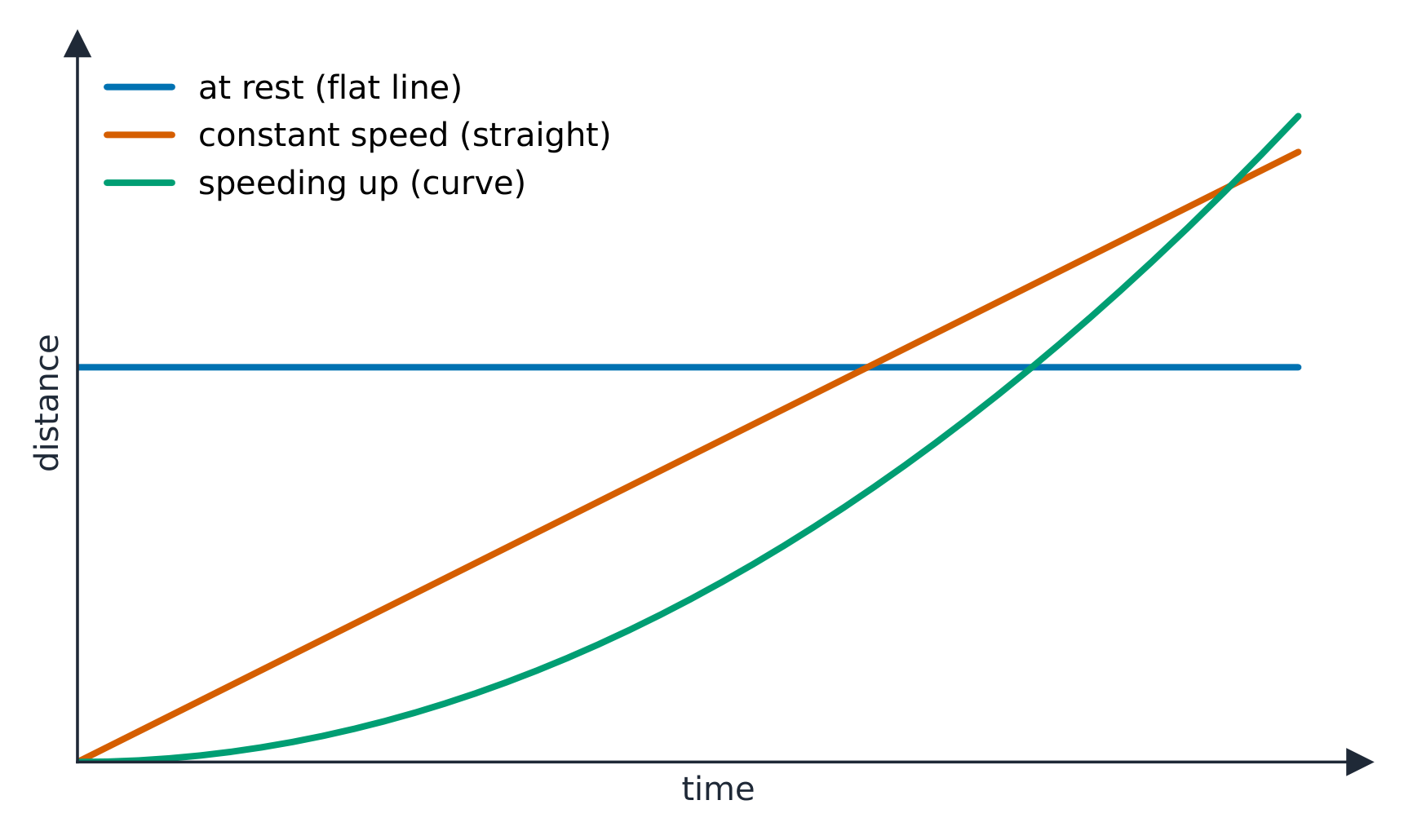
    Reading a distance-time graph: flat means at rest, a straight slope means constant speed
    Reading a distance-time graph: flat means at rest, a straight slope means constant speed
    • On a position–time graph, the slope is velocity (steeper = faster; a curve = changing velocity).
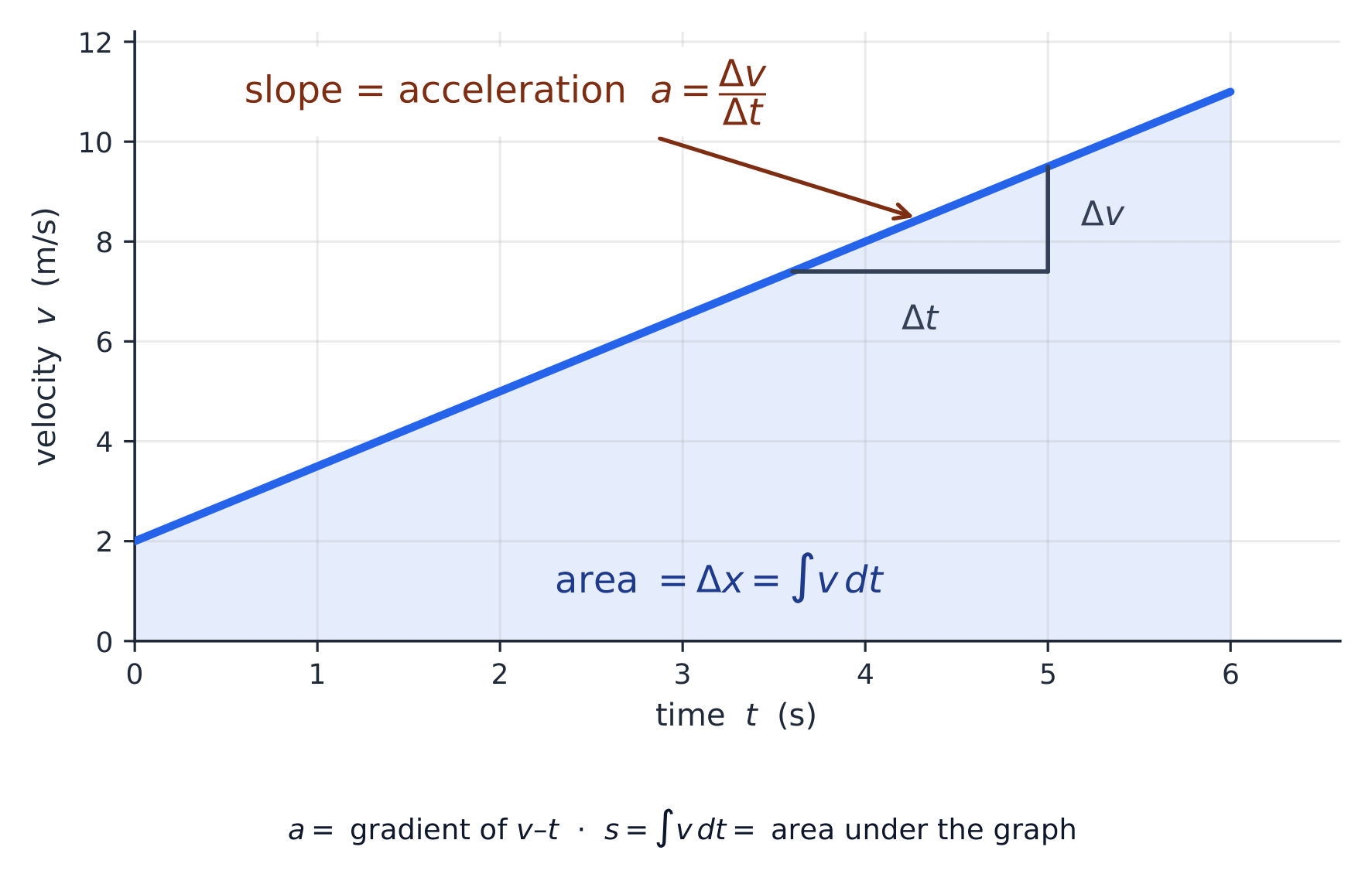
    • On a velocity–time graph, the slope is acceleration, and the area under the line is displacement.

    Reading slopes and areas off graphs is a core exam skill. To get displacement from a velocity–time graph, split the area into triangles and rectangles and add them up; area below the time axis counts as negative displacement (motion the other way).

    On a velocity-time graph the slope is the acceleration and the shaded area is the displacement
    On a velocity-time graph the slope is the acceleration and the shaded area is the displacement

    Worked example. A cyclist speeds up uniformly from rest to $8.0\ \text{m/s}$ in $4.0\ \text{s}$, then holds $8.0\ \text{m/s}$ for $6.0\ \text{s}$. Find the total distance from the velocity–time graph.

    The area is a triangle followed by a rectangle:

    $$\Delta x=\underbrace{\tfrac12\times 4.0\times 8.0}_{\text{triangle}}+\underbrace{6.0\times 8.0}_{\text{rectangle}}=16+48=64\ \text{m}.$$

    Explore · ⁨Исследовать⁩

    Explore the velocity–time graph · ⁨Исследовать график скорости от времени⁩

    Change the start velocity $u$ and the acceleration $a$. The gradient (slope) of the line is the acceleration; the area between the line and the time axis is the displacement. · ⁨Изменить начальную скорость $u$ и ускорение $a$. Градиент (наклон) линии — это ускорение; площадь между линией и осью времени — это перемещение.⁩

    1.4

    Reference Frames and Relative Motion

    Syllabus · ⁨Программа⁩
    English

    Learning Objective 1.4.A: Describe the reference frame of a given observer.

    • 1.4.A.1 The choice of reference frame will determine the direction and magnitude of quantities measured by an observer in that reference frame.

    Learning Objective 1.4.B: Describe the motion of objects as measured by observers in different inertial reference frames.

    • 1.4.B.1 Measurements from a given reference frame may be converted to measurements from another reference frame.
    • 1.4.B.2 The observed velocity of an object results from the combination of the object's velocity and the velocity of the observer's reference frame.
      • 1.4.B.2.i Combining the motion of an object and the motion of an observer in a given reference frame involves the addition or subtraction of vectors.
      • 1.4.B.2.ii The acceleration of any object is the same as measured from all inertial reference frames.

    Boundary statement: Unless otherwise stated, the frame of reference of any problem may be assumed to be inertial.

    Boundary statement: Adding or subtracting vectors to find relative velocities is restricted to motion along one dimension for AP Physics 1.

    Русский

    Цель обучения 1.4.A: Описывать систему отсчета данного наблюдателя.

    • 1.4.A.1 Выбор системы отсчета определит направление и величину величин, измеряемых наблюдателем в этой системе отсчета.

    Цель обучения 1.4.B: Описывать движение объектов как оно измеряется наблюдателями в различных инерциальных системах отсчета.

    • 1.4.B.1 Измерения из заданной системы отсчета могут быть преобразованы в измерения из другой системы отсчета.
    • 1.4.B.2 Наблюдаемая скорость объекта является результатом сложения скорости самого объекта и скорости системы отсчета наблюдателя.
      • 1.4.B.2.i Комбинирование движения объекта и движения наблюдателя в данной системе отсчета включает сложение или вычитание векторов.
      • 1.4.B.2.ii Ускорение любого объекта одинаково при измерении из всех инерциальных систем отсчета.

    Граничное утверждение: Если не указано иное, систему отсчета любой задачи можно считать инерциальной.

    Граничное утверждение: Сложение или вычитание векторов для нахождения относительных скоростей ограничено одномерным движением в рамках курса AP Physics 1.

    Source: College Board AP Course and Exam Description · ⁨Источник: Описание курса и экзамена College Board AP⁩

    All motion is measured against a reference frame 参考系. Velocities measured in different frames differ, and you combine them by vector addition. The velocity of A relative to C is

    $$\vec{v}_{A/C}=\vec{v}_{A/B}+\vec{v}_{B/C}.$$
    A person walking on a moving train has one velocity relative to the train and another relative to the ground – this is relative motion 相对运动. A useful shortcut: the velocity of A relative to B is $\vec{v}_{A/B}=\vec{v}_A-\vec{v}_B$ (subtract B's velocity).

    A frame that is not accelerating is an inertial reference frame 惯性参考系: one in which a free object (no net force) obeys Newton's first law, staying at rest or moving at constant velocity. A frame that accelerates – a braking car – is non-inertial, where objects seem to speed up with no force acting on them.

    Worked example. A boat points straight across a river and moves at $3.0\ \text{m/s}$ relative to the water. The current flows at $4.0\ \text{m/s}$ along the river. Find the boat's speed and direction relative to the bank.

    The two velocities are perpendicular, so add them as a right triangle:

    $$v=\sqrt{3.0^2+4.0^2}=5.0\ \text{m/s},\qquad \theta=\tan^{-1}\!\frac{4.0}{3.0}=53^{\circ}\ \text{downstream from straight across.}$$

    Vocabulary · ⁨Словарь⁩ Train · ⁨Тренировать⁩
    English Русский
    reference frame/ˈrefrəns freɪm/ система отсчета
    relative motion/ˈrelətɪv ˈməʊʃn/ относительное движение
    inertial reference frame/ɪˈnɜːʃl ˈrefrəns freɪm/ инерциальная система отсчета
    1.5

    Vectors and Motion in Two Dimensions

    Syllabus · ⁨Программа⁩
    English

    Learning Objective 1.5.A: Describe the perpendicular components of a vector.

    • 1.5.A.1 Vectors can be mathematically modeled as the resultant of two perpendicular components.
    • 1.5.A.2 Vectors can be resolved into components using a chosen coordinate system.
    • 1.5.A.3 Vectors can be resolved into perpendicular components using trigonometric functions and relationships.
      • Equation: $\sin \theta = \dfrac{a}{c}$
      • Equation: $\cos \theta = \dfrac{b}{c}$
      • Equation: $\tan \theta = \dfrac{a}{b}$
      • Equation: $a^2 + b^2 = c^2$

    Learning Objective 1.5.B: Describe the motion of an object moving in two dimensions.

    • 1.5.B.1 Motion in two dimensions can be analyzed using one-dimensional kinematic relationships if the motion is separated into components.
    • 1.5.B.2 Projectile motion is a special case of two-dimensional motion that has zero acceleration in one dimension and constant, nonzero acceleration in the second dimension.
    Русский

    Цель обучения 1.5.A: Описывать перпендикулярные компоненты вектора.

    • 1.5.A.1 Векторы могут быть математически смоделированы как результирующий двух перпендикулярных компонент.
    • 1.5.A.2 Векторы могут быть разложены на компоненты с использованием выбранной координатной системы.
    • 1.5.A.3 Векторы могут быть разложены на перпендикулярные компоненты с использованием тригонометрических функций и соотношений.
      • Уравнение: $\sin \theta = \dfrac{a}{c}$
      • Уравнение: $\cos \theta = \dfrac{b}{c}$
      • Уравнение: $\tan \theta = \dfrac{a}{b}$
      • Уравнение: $a^2 + b^2 = c^2$

    Цель обучения 1.5.B: Описывать движение объекта, движущегося в двух измерениях.

    • 1.5.B.1 Движение в двух измерениях может быть проанализировано с использованием кинематических соотношений для одномерного движения, если движение разделено на компоненты.
    • 1.5.B.2Projectile motion (движение под углом к горизонту) является частным случаем движения в двух измерениях, который имеет нулевое ускорение по одному измерению и постоянное ненулевое ускорение по второму измерению.

    Source: College Board AP Course and Exam Description · ⁨Источник: Описание курса и экзамена College Board AP⁩

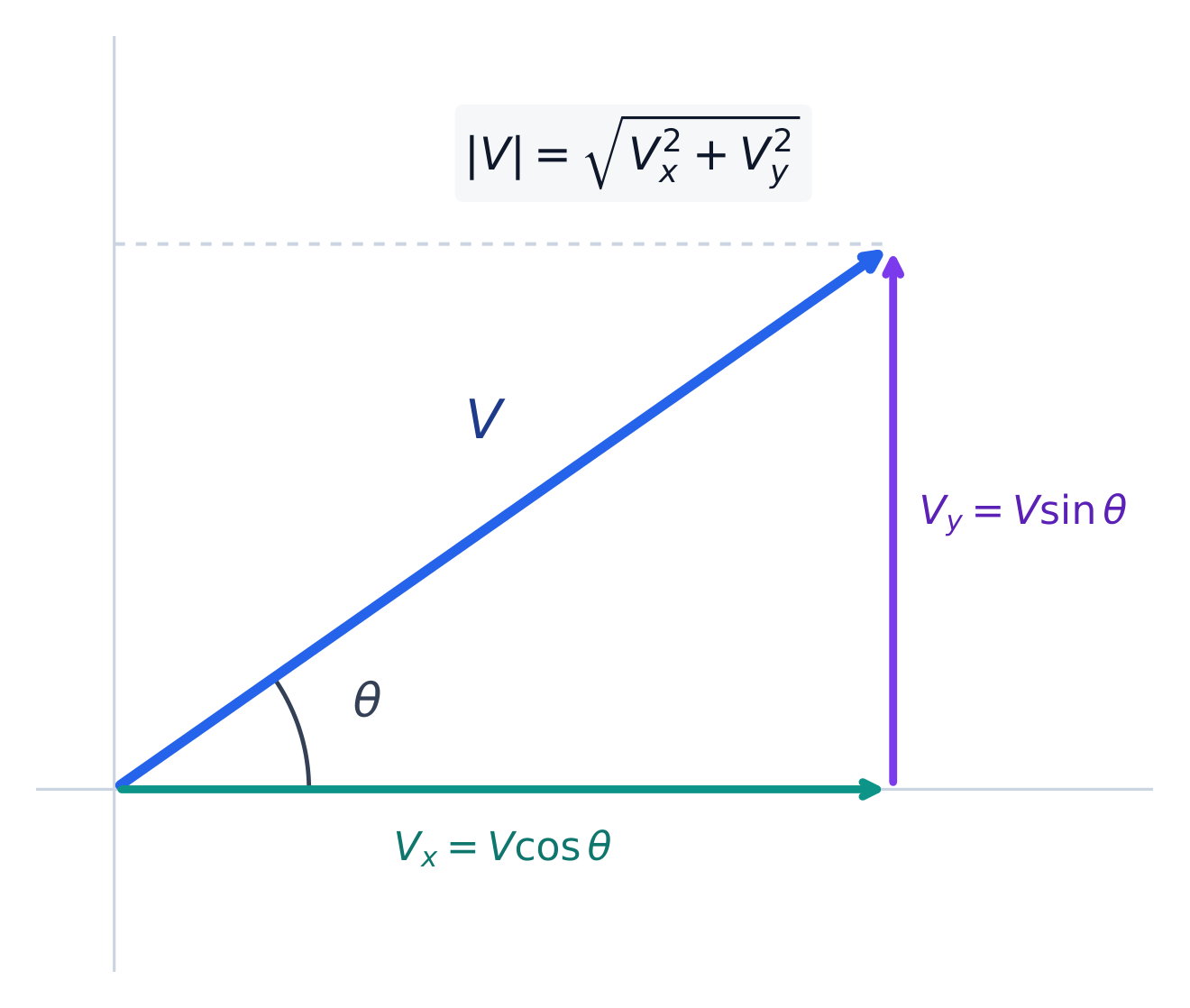
    In two dimensions, resolve each vector into components 分量 along perpendicular axes ($x$ and $y$), handle each axis separately, then recombine. A velocity $v$ at angle $\theta$ to the horizontal has components $v_x=v\cos\theta$ and $v_y=v\sin\theta$.

    A velocity vector resolved into its horizontal and vertical components
    A velocity vector resolved into its horizontal and vertical components

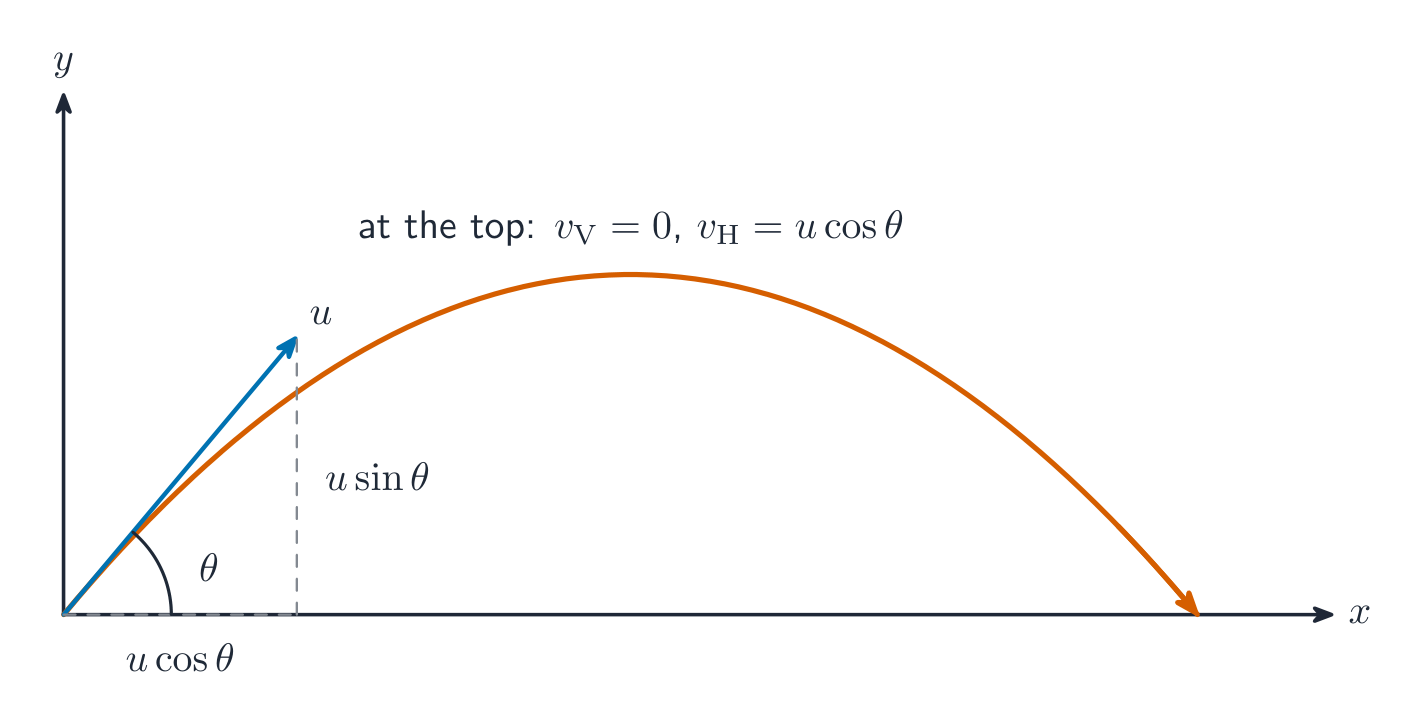
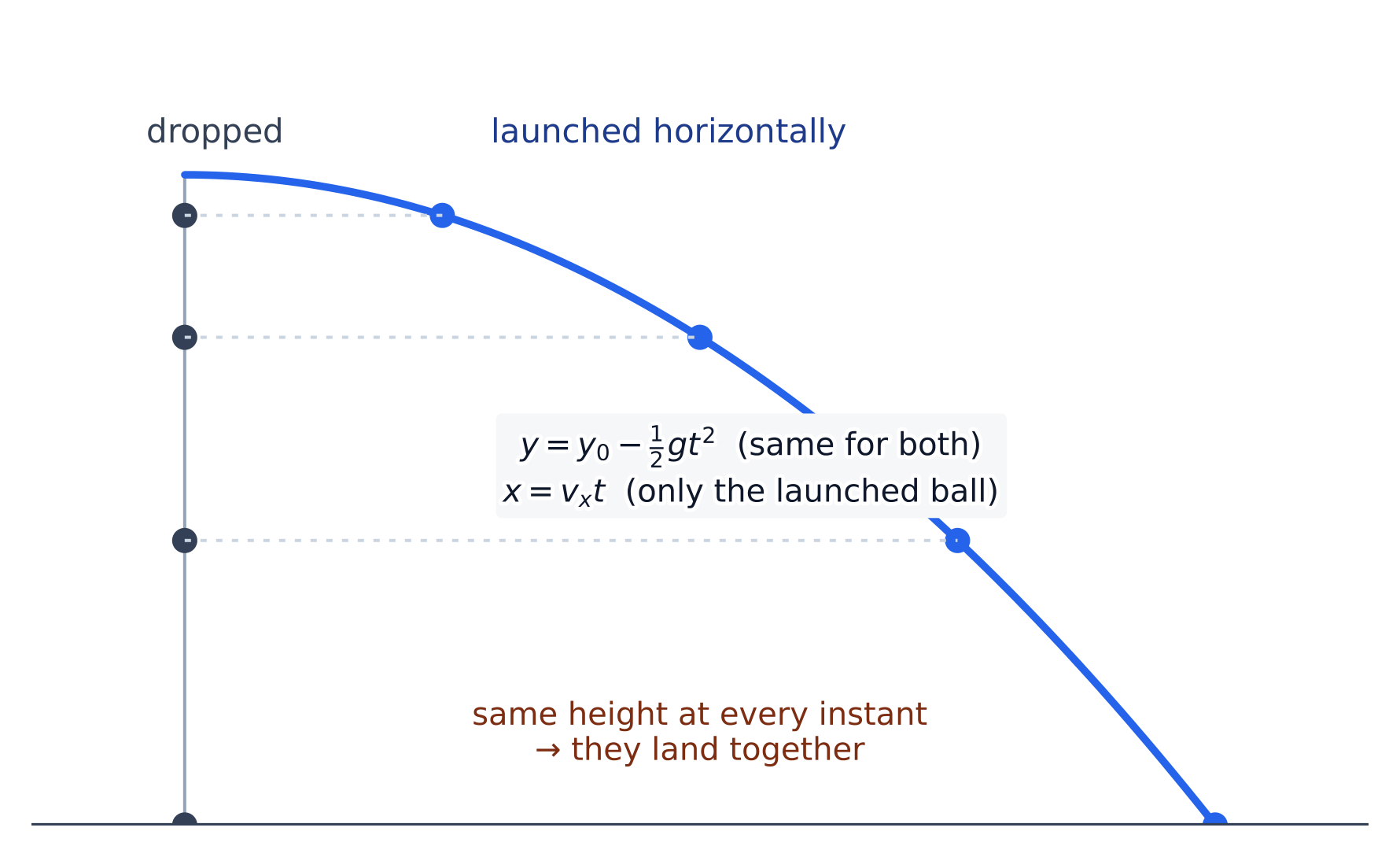
    For projectile motion 抛体运动 (an object moving under gravity alone): the horizontal and vertical motions are independent. Horizontally, velocity is constant ($a_x=0$); vertically, acceleration is $-g$ (down). The two motions share only the time. So a projectile's path (its trajectory 轨迹) is a parabola, and you solve it as two one-dimensional problems joined by $t$.

    A projectile launched at an angle: the horizontal and vertical motions are independent
    A projectile launched at an angle: the horizontal and vertical motions are independent
    A dropped ball and a horizontally launched ball fall together – the vertical motions are identical
    A dropped ball and a horizontally launched ball fall together – the vertical motions are identical

    Worked example. A ball is kicked at $20\ \text{m/s}$, $30^{\circ}$ above the horizontal. Taking $g=9.8\ \text{m/s}^2$, find the time of flight, the maximum height, and the horizontal range 射程 (assume it lands at launch height).

    Split the launch velocity into components:

    $$v_{0x}=20\cos 30^{\circ}=17.3\ \text{m/s},\qquad v_{0y}=20\sin 30^{\circ}=10\ \text{m/s}.$$
    Vertical motion sets the time. At the top $v_y=0$, so $0=10-9.8\,t \Rightarrow t_{\text{up}}=1.02\ \text{s}$, and the total flight is $2t_{\text{up}}=2.0\ \text{s}$. The maximum height is
    $$\Delta y=\frac{v_{0y}^2}{2g}=\frac{10^2}{19.6}=5.1\ \text{m}.$$
    Horizontal motion runs at constant $v_{0x}$ for the whole flight, so the range is
    $$R=v_{0x}\times t_{\text{flight}}=17.3\times 2.0=35\ \text{m}.$$

    A common trap: at the top of the flight the vertical velocity is zero, but the ball is not at rest – its horizontal velocity $v_{0x}$ never changes. The speed at the top equals $v_{0x}=17.3\ \text{m/s}$.

    Explore · ⁨Исследовать⁩

    Explore projectile motion · ⁨Исследовать движение тела, брошенного под углом⁩

    Fire the ball, then change the angle and speed. The horizontal motion stays steady while gravity pulls it down — together they trace a parabola. Find the launch angle that gives the longest range, and try the Moon. · ⁨Запустить мяч, затем изменить угол и скорость. Горизонтальное движение остается постоянным, пока гравитация тянет его вниз — вместе они образуют параболу. Найдите угол броска, дающий максимальную дальность, и попробуйте на Луне.⁩

    Explore · ⁨Исследовать⁩

    Explore vectors and their components · ⁨Исследовать векторы и их компоненты⁩

    Drag the vectors to change their $x$- and $y$-components. See how a single vector is built from independent horizontal and vertical parts, and how two vectors add tip-to-tail into a resultant. · ⁨Перетащите векторы, чтобы изменить их $x$- и $y$-компоненты. Увидьте, как один вектор строится из независимых горизонтальных и вертикальных частей, и как два вектора складываются конец к началу в результирующий вектор.⁩

    Vocabulary · ⁨Словарь⁩ Train · ⁨Тренировать⁩
    English Русский
    components/kəmˈpəʊnənts/ компоненты
    projectile motion/prəˈdʒektaɪl ˈməʊʃn/ бросок под углом к горизонту
    trajectory/trəˈdʒektəri/ траектория
    range/reɪndʒ/ область значений
    1.5

    Exam tips

    • Choose the right kinematic equation by listing the three quantities you know plus the one you want, so only one unknown remains; the SUVAT equations apply only while acceleration is constant.
    • Fix a positive direction first — every displacement, velocity, and acceleration then carries a sign; a negative velocity means "moving the other way", not "slow".
    • Treat a projectile as two independent 1-D problems sharing only the time $t$: constant velocity horizontally, $a=-g$ vertically. At the top $v_y=0$ but $v_x$ is unchanged.
    • On a velocity–time graph the gradient is the acceleration and the area is the displacement (area below the axis is negative).
    • Distinguish distance (scalar, total path) from displacement (vector, start-to-end), and speed from velocity.
  • 2

    Force and Translational Dynamics · ⁨Сила и трансlaçãoционная динамика⁩

    Watch lesson · ⁨Смотреть урок⁩
    2.1

    Systems and Center of Mass

    Syllabus · ⁨Программа⁩
    English

    Learning Objective 2.1.A: Describe the properties and interactions of a system.

    • 2.1.A.1 System properties are determined by the interactions between objects within the system.
    • 2.1.A.2 If the properties or interactions of the constituent objects within a system are not important in modeling the behavior of the macroscopic system, the system can itself be treated as a single object.
    • 2.1.A.3 Systems may allow interactions between constituent parts of the system and the environment, which may result in the transfer of energy or mass.
    • 2.1.A.4 Individual objects within a chosen system may behave differently from each other as well as from the system as a whole.
    • 2.1.A.5 The internal structure of a system affects the analysis of that system.
    • 2.1.A.6 As variables external to a system are changed, the system's substructure may change.

    Learning Objective 2.1.B: Describe the location of a system's center of mass with respect to the system's constituent parts.

    • 2.1.B.1 For systems with symmetrical mass distributions, the center of mass is located on lines of symmetry.
    • 2.1.B.2 The location of a system's center of mass along a given axis can be calculated using the equation
      • Equation: $\vec{x}_{cm} = \dfrac{\sum m_i \vec{x}_i}{\sum m_i}$
    • 2.1.B.3 A system can be modeled as a singular object that is located at the system's center of mass.

    Boundary statement: AP Physics 1 only expects students to calculate the center of mass for systems of five or fewer particles arranged in a two-dimensional configuration or for systems that are highly symmetrical.

    Русский

    Цель обучения 2.1.A: Описывать свойства и взаимодействия системы.

    • 2.1.A.1 Свойства системы определяются взаимодействиями между объектами внутри системы.
    • 2.1.A.2 Если свойства или взаимодействия составляющих объектов внутри системы не важны при моделировании поведения макроскопической системы, саму систему можно рассматривать как единый объект.
    • 2.1.A.3 Системы могут допускать взаимодействия между составляющими частью системы и окружающей средой, что может привести к передаче энергии или массы.
    • 2.1.A.4 Отдельные объекты внутри выбранной системы могут вести себя по-разному как друг относительно друга, так и по отношению к системе в целом.
    • 2.1.A.5 Внутренняя структура системы влияет на анализ этой системы.
    • 2.1.A.6 При изменении переменных, внешних по отношению к системе, ее субструктура может измениться.

    Цель обучения 2.1.B: Описывать положение центра масс системы относительно её составляющих частей.

    • 2.1.B.1 Для систем с симметричным распределением масс центр масс расположен на линиях симметрии.
    • 2.1.B.2 Положение центра масс системы вдоль данной оси может быть рассчитано с использованием уравнения ⟦number⟧
      • Уравнение: $\vec{x}_{cm} = \dfrac{\sum m_i \vec{x}_i}{\sum m_i}$
    • 2.1.B.3 Систему можно смоделировать как единичный объект, расположенный в центре масс системы.

    Граничное утверждение: AP Physics 1 требует от студентов только расчета центра масс для систем из пяти или менее частиц, расположенных в двумерной конфигурации, или для систем, обладающих высокой степенью симметрии.

    Source: College Board AP Course and Exam Description · ⁨Источник: Описание курса и экзамена College Board AP⁩

    A system 系统 is the object or group of objects you choose to analyze. A system can be treated as a single point at its center of mass 质心 – the average position of its mass. External forces change the motion of the center of mass; internal forces (between parts of the system) do not.

    This is why a wrench spinning across a table still has its center of mass move in a straight line: the spinning is internal, and only the (near-zero) external force matters for the center of mass. For two masses $m_1,m_2$ on a line at positions $x_1,x_2$, the center of mass sits at $x_{\text{cm}}=\dfrac{m_1x_1+m_2x_2}{m_1+m_2}$ – always closer to the heavier mass.

    Vocabulary · ⁨Словарь⁩ Train · ⁨Тренировать⁩
    English Русский
    system/ˈsɪstəm/ система
    center of mass/ˈsentə ɒv mæs/ центр масс
    2.2

    Forces and Free-Body Diagrams

    Syllabus · ⁨Программа⁩
    English

    Learning Objective 2.2.A: Describe a force as an interaction between two objects or systems.

    • 2.2.A.1 Forces are vector quantities that describe the interactions between objects or systems.
      • 2.2.A.1.i A force exerted on an object or system is always due to the interaction of that object with another object or system.
      • 2.2.A.1.ii An object or system cannot exert a net force on itself.
    • 2.2.A.2 Contact forces describe the interaction of an object or system touching another object or system and are macroscopic effects of interatomic electric forces.

    Learning Objective 2.2.B: Describe the forces exerted on an object or system using a free-body diagram.

    • 2.2.B.1 Free-body diagrams are useful tools for visualizing forces being exerted on a single object or system and for determining the equations that represent a physical situation.
    • 2.2.B.2 The free-body diagram of an object or system shows each of the forces exerted on the object by the environment.
    • 2.2.B.3 Forces exerted on an object or system are represented as vectors originating from the representation of the center of mass, such as a dot. A system is treated as though all of its mass is located at the center of mass.
    • 2.2.B.4 A coordinate system with one axis parallel to the direction of acceleration of the object or system simplifies the translation from free-body diagram to algebraic representation. For example, in a free-body diagram of an object on an inclined plane, it is useful to set one axis parallel to the surface of the incline.

    Boundary statement: AP Physics 1 only expects students to depict the forces exerted on objects, not the force components on free-body diagrams. On the AP Physics exams, individual forces represented on a free-body diagram must be drawn as individual straight arrows, originating on the dot and pointing in the direction of the force. Individual forces that are in the same direction must be drawn side by side, not overlapping.

    Русский

    Цель обучения 2.2.A: Описывать силу как взаимодействие между двумя объектами или системами.

    • 2.2.A.1 Силы — это векторные величины, описывающие взаимодействия между объектами или системами.
      • 2.2.A.1.i Сила, действующая на объект или систему, всегда обусловлена взаимодействием этого объекта с другим объектом или системой.
      • 2.2.A.1.ii Объект или система не может exert (прикладывать) равнодействующую силу самому себе.
    • 2.2.A.2 Контактные силы описывают взаимодействие объекта или системы, соприкасающегося с другим объектом или системой, и являются макроскопическим проявлением межатомных электрических сил.

    Цель обучения 2.2.B: Описывать силы, действующие на объект или систему, используя диаграмму свободного тела.

    • 2.2.B.1 Диаграммы свободного тела являются полезными инструментами для визуализации сил, действующих на отдельный объект или систему, а также для определения уравнений, представляющих физическую ситуацию.
    • 2.2.B.2 Диаграмма свободного тела объекта или системы показывает каждую из сил, действующих на объект со стороны окружающей среды.
    • 2.2.B.3 Силы, действующие на объект или систему, изображаются в виде векторов, исходящих из представления центра масс, например, точки. Система рассматривается так, будто вся её масса сосредоточена в центре масс.
    • 2.2.B.4 Координатная система, ось которой параллельна направлению ускорения объекта или системы, упрощает перевод диаграммы свободного тела в алгебраическое представление. Например, на диаграмме свободного тела объекта на наклонной плоскости полезно расположить одну ось параллельно поверхности наклона.

    Граничное утверждение: AP Physics 1 требует от студентов только изображения сил, действующих на объекты, а не компонент сил на диаграммах свободного тела. На экзаменах AP Physics индивидуальные силы, представленные на диаграмме свободного тела, должны быть нарисованы как отдельные прямые стрелки, исходящие из точки и указывающие в направлении силы. Индивидуальные силы, направленные в одну сторону, должны быть нарисованы рядом, без наложения друг на друга.

    Source: College Board AP Course and Exam Description · ⁨Источник: Описание курса и экзамена College Board AP⁩

    A skydiver: free-body diagrams balance gravity and air resistance at terminal speed
    A skydiver: free-body diagrams balance gravity and air resistance at terminal speed
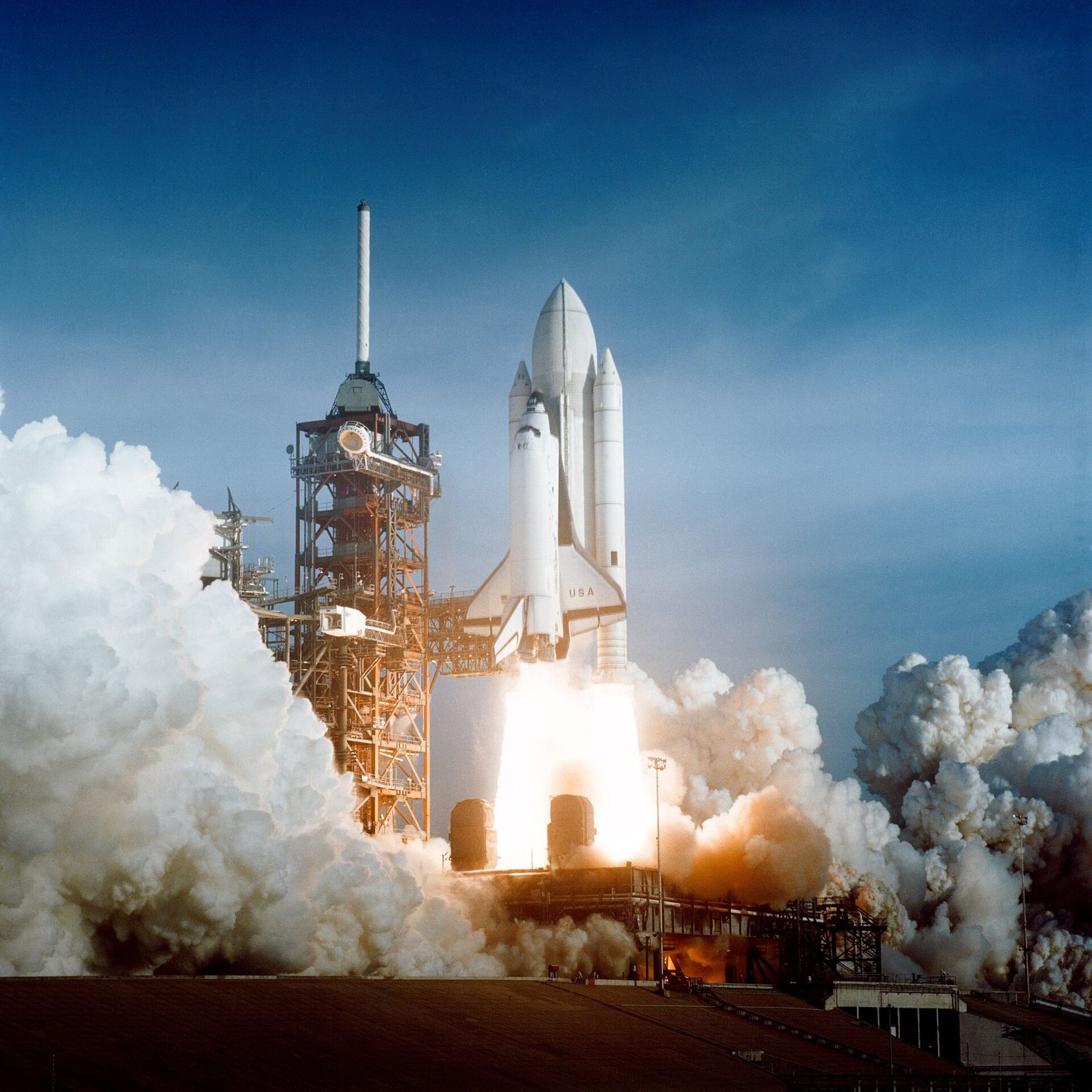
    A rocket launch: net force changes momentum — F_net = ma for translational dynamics
    A rocket launch: net force changes momentum — F_net = ma for translational dynamics

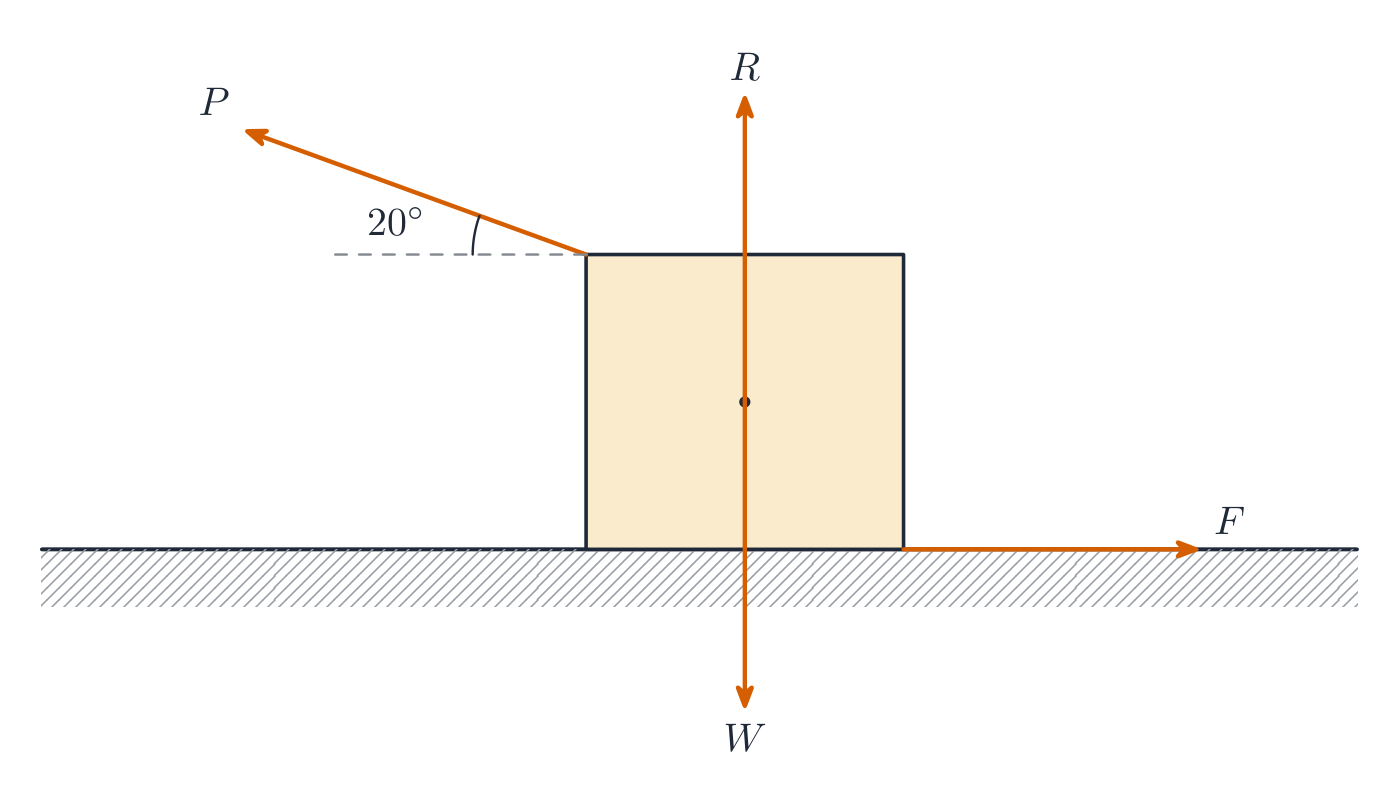
    A force 力 is a push or pull – a vector, measured in newtons (N). A free-body diagram 受力图 shows one object as a dot with arrows for every force acting on it (weight 重力, normal, tension 张力, friction, applied), each labelled and pointing the right way. Draw it before any dynamics problem; it is where most marks are won or lost.

    A free-body diagram shows every force acting on one object
    A free-body diagram shows every force acting on one object

    Two rules keep free-body diagrams honest: draw only forces acting on the chosen object (not forces it exerts on other things), and draw only real, physical forces (a rope, a surface, gravity, a hand) – never an "$ma$" arrow, which is the result of the forces, not a force itself.

    Explore · ⁨Исследовать⁩

    Balance the forces on a free-body diagram · ⁨Сбалансировать силы на диаграмме свободного тела⁩

    A free-body diagram shows every force on one object as an arrow. The object accelerates only if the forces don't cancel — the net force sets $a=F/m$. · ⁨Диаграмма свободного тела показывает все силы, действующие на один объект, стрелками. Объект ускоряется только если силы не компенсируют друг друга — равнодействующая сила определяет $a=F/m$.⁩
    Vocabulary · ⁨Словарь⁩ Train · ⁨Тренировать⁩
    English Русский
    force/fɔːs/ сила
    free-body diagram/friː ˈbɒdi ˈdaɪəɡræm/ диаграмма свободного тела
    weight/weɪt/ вес
    tension/ˈtenʃn/ натяжение
    2.3

    Newton's Third Law

    Syllabus · ⁨Программа⁩
    English

    Learning Objective 2.3.A: Describe the interaction of two objects using Newton's third law and a representation of paired forces exerted on each object.

    • 2.3.A.1 Newton's third law describes the interaction of two objects in terms of the paired forces that each exerts on the other.
      • Equation: $\vec{F}_{\text{A on B}} = -\vec{F}_{\text{B on A}}$
    • 2.3.A.2 Interactions between objects within a system (internal forces) do not influence the motion of a system's center of mass.
    • 2.3.A.3 Tension is the macroscopic net result of forces that segments of a string, cable, chain, or similar system exert on each other in response to an external force.
      • 2.3.A.3.i An ideal string has negligible mass and does not stretch when under tension.
      • 2.3.A.3.ii The tension in an ideal string is the same at all points within the string.
      • 2.3.A.3.iii In a string with nonnegligible mass, tension may not be the same at all points within the string.
      • 2.3.A.3.iv An ideal pulley is a pulley that has negligible mass and rotates about an axle through its center of mass with negligible friction.

    Boundary statement: AP Physics 1 only expects students to describe tension qualitatively in a string, cable, chain, or similar system with mass. For example, students might note that the tension in a hanging chain is greater toward the top of the chain.

    Boundary statement: The interaction between objects or systems at a distance is limited to gravitational forces in AP Physics 1. In AP Physics 2, gravitational, electric, and magnetic forces may be considered.

    Русский

    Цель обучения 2.3.A: Описать взаимодействие двух объектов с использованием третьего закона Ньютона и представления парных сил, действующих на каждый объект.

    • 2.3.A.1 Третий закон Ньютона описывает взаимодействие двух объектов через парные силы, которые каждая из них оказывает на другую.
      • Уравнение: $\vec{F}_{\text{A on B}} = -\vec{F}_{\text{B on A}}$
    • 2.3.A.2 Взаимодействия между объектами внутри системы (внутренние силы) не влияют на движение центра масс системы.
    • 2.3.A.3 Натяжение — это макроскопический результат сил, которые участки нити, троса, цепи или подобной системы оказывают друг на друга в ответ на внешнюю силу.
      • 2.3.A.3.i Идеальная нить имеет пренебрежимо малую массу и не растягивается под действием натяжения.
      • 2.3.A.3.ii Натяжение в идеальной нити одинаково во всех её точках.
      • 2.3.A.3.iii В нити с непренебрежимо малой массой натяжение может быть различным во всех её точках.
      • 2.3.A.3.iv Идеальный блок — это блок, имеющий пренебрежимо малую массу и вращающийся вокруг оси, проходящей через его центр масс, при пренебрежимо малом трении.

    Граничное утверждение: В курсе AP Physics 1 от студентов требуется только качественное описание натяжения в нити, тросе, цепи или подобной системе с массой. Например, студенты могут отметить, что натяжение в подвешенной цепи больше ближе к верху цепи.

    Граничное утверждение: Взаимодействие между объектами или системами на расстоянии ограничено гравитационными силами в курсе AP Physics 1. В курсе AP Physics 2 могут рассматриваться гравитационные, электрические и магнитные силы.

    Source: College Board AP Course and Exam Description · ⁨Источник: Описание курса и экзамена College Board AP⁩

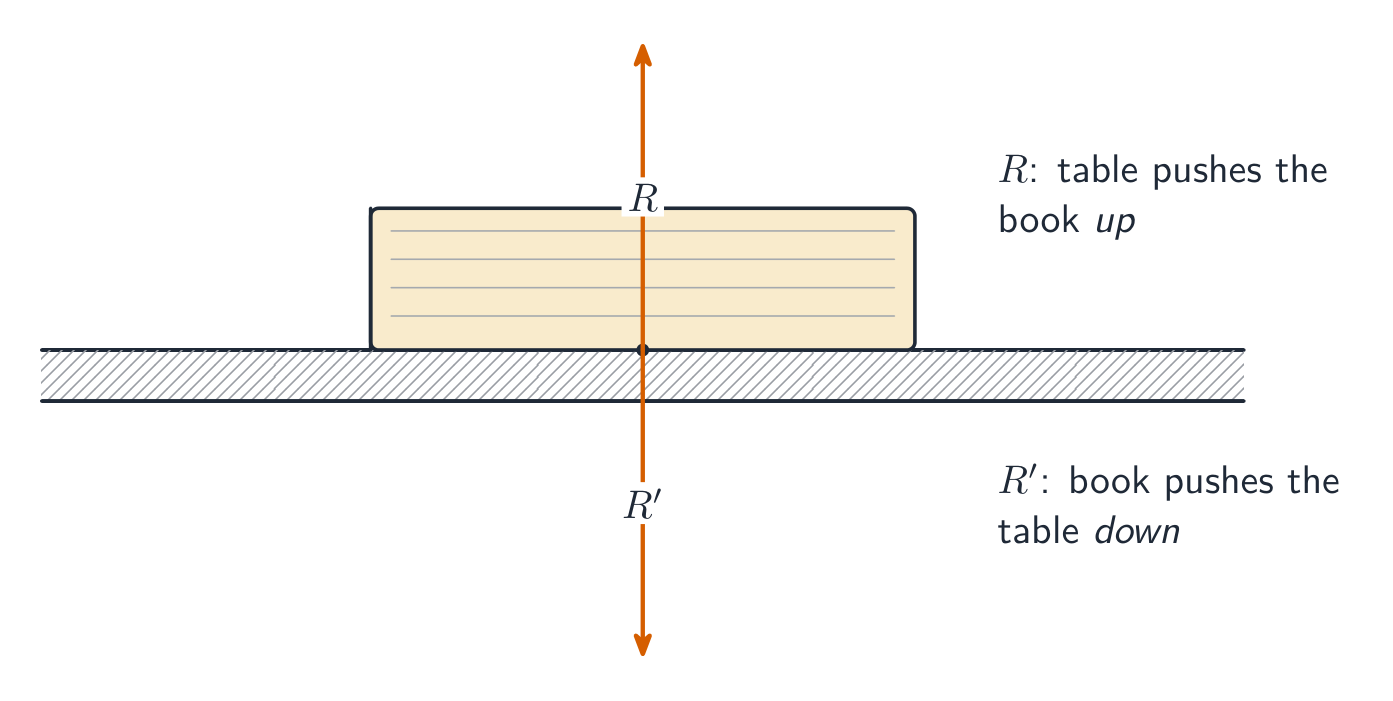
    Newton's third law 牛顿第三定律: if object A pushes on object B, then B pushes back on A with a force equal in size and opposite in direction. These two forces act on different objects, so they never cancel each other. Identify third-law pairs by the "A on B / B on A" wording.

    A Newton's third-law pair: equal and opposite forces on two different objects
    A Newton's third-law pair: equal and opposite forces on two different objects

    A classic trap: the weight of a book and the normal force from the table are not a third-law pair – they act on the same object (the book). The partner of the book's weight is the pull the book exerts on the Earth; the partner of the table's push is the push the book makes on the table.

    Vocabulary · ⁨Словарь⁩ Train · ⁨Тренировать⁩
    English Русский
    Newton's third law/ˈnjuːtnz θɜːd lɔː/ третьего закона Ньютона
    2.4

    Newton's First Law

    Syllabus · ⁨Программа⁩
    English

    Learning Objective 2.4.A: Describe the conditions under which a system's velocity remains constant.

    • 2.4.A.1 The net force on a system is the vector sum of all forces exerted on the system.
    • 2.4.A.2 Translational equilibrium is a configuration of forces such that the net force exerted on a system is zero.
      • Derived equation: $\sum_i \vec{F}_i = 0$
    • 2.4.A.3 Newton's first law states that if the net force exerted on a system is zero, the velocity of that system will remain constant.
    • 2.4.A.4 Forces may be balanced in one dimension but unbalanced in another. The system's velocity will change only in the direction of the unbalanced force.
    • 2.4.A.5 An inertial reference frame is one from which an observer would verify Newton's first law of motion.
    Русский

    Цель обучения 2.4.A: Описать условия, при которых скорость системы остается постоянной.

    • 2.4.A.1 Равнодействующая сила системы равна векторной сумме всех сил, действующих на систему.
    • 2.4.A.2 Трансляционное равновесие — это конфигурация сил, при которой равнодействующая сила, действующая на систему, равна нулю.
      • Выведенное уравнение: $\sum_i \vec{F}_i = 0$
    • 2.4.A.3 Первый закон Ньютона гласит, что если равнодействующая сила, действующая на систему, равна нулю, скорость этой системы останется постоянной.
    • 2.4.A.4 Силы могут быть скомпенсированы в одном измерении, но нескомпенсированы в другом. Скорость системы изменится только в направлении нескомпенсированной силы.
    • 2.4.A.5 Инерциальная система отсчета — это такая система, из которой наблюдатель может подтвердить первый закон движения Ньютона.

    Source: College Board AP Course and Exam Description · ⁨Источник: Описание курса и экзамена College Board AP⁩

    Newton's first law 牛顿第一定律 (the law of inertia 惯性): an object's velocity stays constant unless a net force 合力 acts on it. So zero net force means constant velocity (including rest) – the object is in translational equilibrium 平衡. Inertia is the tendency to resist changes in motion, measured by mass.

    Worked example. A $1200\ \text{kg}$ car cruises at a steady $25\ \text{m/s}$ on a level road. What is the net force on it? Because the velocity is constant, the acceleration is zero, so by the first law the net force is zero – the forward drive force exactly balances drag and friction. "Steady speed" always means balanced forces.

    Vocabulary · ⁨Словарь⁩ Train · ⁨Тренировать⁩
    English Русский
    Newton's first law/ˈnjuːtnz fɜːst lɔː/ Первый закон Ньютона
    inertia/ɪˈnɜːʃə/ инерция
    net force/net fɔːs/ равнодействующая сила
    translational equilibrium/trænˈsleɪʃənl ˌiːkwɪˈlɪbrɪəm/ трансляционное равновесие
    2.5

    Newton's Second Law

    Syllabus · ⁨Программа⁩
    English

    Learning Objective 2.5.A: Describe the conditions under which a system's velocity changes.

    • 2.5.A.1 Unbalanced forces are a configuration of forces such that the net force exerted on a system is not equal to zero.
    • 2.5.A.2 Newton's second law of motion states that the acceleration of a system's center of mass has a magnitude proportional to the magnitude of the net force exerted on the system and is in the same direction as that net force.
      • Equation: $\vec{a}_{\text{sys}} = \dfrac{\sum \vec{F}}{m_{\text{sys}}} = \dfrac{\vec{F}_{\text{net}}}{m_{\text{sys}}}$
    • 2.5.A.3 The velocity of a system's center of mass will only change if a nonzero net external force is exerted on that system.
    Русский

    Цель обучения 2.5.A: Описать условия, при которых скорость системы изменяется.

    • 2.5.A.1 Нескомпенсированные силы — это конфигурация сил, при которой равнодействующая сила, действующая на систему, не равна нулю.
    • 2.5.A.2 Второй закон Ньютона гласит, что ускорение центра масс системы по модулю пропорционально модулю равнодействующей силы, действующей на систему, и направлено в ту же сторону, что и эта равнодействующая сила.
      • Уравнение: $\vec{a}_{\text{sys}} = \dfrac{\sum \vec{F}}{m_{\text{sys}}} = \dfrac{\vec{F}_{\text{net}}}{m_{\text{sys}}}$
    • 2.5.A.3 Скорость центра масс системы изменится только тогда, когда на эту систему действует ненулевая внешняя равнодействующая сила.

    Source: College Board AP Course and Exam Description · ⁨Источник: Описание курса и экзамена College Board AP⁩

    Newton's second law 牛顿第二定律 relates net force to acceleration:

    $$\vec{a}=\frac{\sum \vec{F}}{m},\qquad\text{i.e.}\qquad \sum\vec{F}=m\vec{a}.$$
    Apply it one axis at a time: add the force components along each axis and set the sum equal to $ma$ for that axis. Acceleration points the same way as the net force.

    Worked example. A $4.0\ \text{kg}$ box is pulled along the floor by a horizontal force of $18\ \text{N}$. Friction on the box is $6.0\ \text{N}$. Find its acceleration. Along the direction of motion the net force is $18-6.0=12\ \text{N}$, so

    $$a=\frac{\sum F}{m}=\frac{12}{4.0}=3.0\ \text{m/s}^2.$$

    Worked example (incline 斜面). A block of mass $m$ slides down a frictionless ramp tilted at angle $\theta$. Find its acceleration. Resolve gravity into components along and perpendicular to the ramp; only the along-ramp part, $mg\sin\theta$, drives the motion, so

    $$a=\frac{mg\sin\theta}{m}=g\sin\theta.$$
    The steeper the ramp, the larger $\sin\theta$ and the faster it accelerates; at $\theta=90^{\circ}$ it is free fall.

    Vocabulary · ⁨Словарь⁩ Train · ⁨Тренировать⁩
    English Русский
    Newton's second law/ˈnjuːtnz ˈsekənd lɔː/ Второй закон Ньютона
    incline/ɪnˈklaɪn/ наклонная плоскость
    2.6

    Gravitational Force

    Syllabus · ⁨Программа⁩
    English

    Learning Objective 2.6.A: Describe the gravitational interaction between two objects or systems with mass.

    • 2.6.A.1 Newton's law of universal gravitation describes the gravitational force between two objects or systems as directly proportional to each of their masses and inversely proportional to the square of the distance between the systems' centers of mass.
      • Equation: $\left|\vec{F}_g\right| = G\dfrac{m_1 m_2}{r^2}$
      • 2.6.A.1.i The gravitational force is attractive.
      • 2.6.A.1.ii The gravitational force is always exerted along the line connecting the centers of mass of the two interacting systems.
      • 2.6.A.1.iii The gravitational force on a system can be considered to be exerted on the system's center of mass.
    • 2.6.A.2 A field models the effects of a noncontact force exerted on an object at various positions in space.
      • 2.6.A.2.i The magnitude of the gravitational field created by a system of mass $M$ at a point in space is equal to the ratio of the gravitational force exerted by the system on a test object of mass $m$ to the mass of the test object.
        • Equation: $\left|\vec{g}\right| = \dfrac{\left|\vec{F}_g\right|}{m} = G\dfrac{M}{r^2}$
      • 2.6.A.2.ii If the gravitational force is the only force exerted on an object, the observed acceleration of the object (in m/s$^2$) is numerically equal to the magnitude of the gravitational field strength (in N/kg) at that location.
    • 2.6.A.3 The gravitational force exerted by an astronomical body on a relatively small nearby object is called weight.
      • Equation: $\text{Weight} = F_g = mg$

    Learning Objective 2.6.B: Describe situations in which the gravitational force can be considered constant.

    • 2.6.B.1 If the gravitational force between two systems' centers of mass has a negligible change as the relative position of the two systems changes, the gravitational force can be considered constant at all points between the initial and final positions of the systems.
    • 2.6.B.2 Near the surface of Earth, the strength of the gravitational field is $g \approx 10 \text{ N/kg}$

    Learning Objective 2.6.C: Describe the conditions under which the magnitude of a system's apparent weight is different from the magnitude of the gravitational force exerted on that system.

    • 2.6.C.1 The magnitude of the apparent weight of a system is the magnitude of the normal force exerted on the system.
    • 2.6.C.2 If the system is accelerating, the apparent weight of the system is not equal to the magnitude of the gravitational force exerted on the system.
    • 2.6.C.3 A system appears weightless when there are no forces exerted on the system or when the force of gravity is the only force exerted on the system.
    • 2.6.C.4 The equivalence principle states that an observer in a noninertial reference frame is unable to distinguish between an object's apparent weight and the gravitational force exerted on the object by a gravitational field.

    Learning Objective 2.6.D: Describe inertial and gravitational mass.

    • 2.6.D.1 Objects have inertial mass, or inertia, a property that determines how much an object's motion resists changes when interacting with another object.
    • 2.6.D.2 Gravitational mass is related to the force of attraction between two systems with mass.
    • 2.6.D.3 Inertial mass and gravitational mass have been experimentally verified to be equivalent.
    Русский

    Цель обучения 2.6.A: Описать гравитационное взаимодействие между двумя объектами или системами с массой.

    • 2.6.A.1 Закон всемирного тяготения Ньютона описывает гравитационную силу между двумя объектами или системами как прямо пропорциональную каждой из их масс и обратно пропорциональную квадрату расстояния между центрами масс систем.
      • Уравнение: $\left|\vec{F}_g\right| = G\dfrac{m_1 m_2}{r^2}$
      • 2.6.A.1.i Гравитационная сила является притягивающей.
      • 2.6.A.1.ii Гравитационная сила всегда направлена вдоль линии, соединяющей центры масс двух взаимодействующих систем.
      • 2.6.A.1.iii Гравитационную силу, действующую на систему, можно считать приложенной к центру масс этой системы.
    • 2.6.A.2 Поле моделирует эффекты бесконтактной силы, действующей на объект в различных точках пространства.
      • 2.6.A.2.i Модуль гравитационного поля, создаваемого системой массы $M$ в точке пространства, равен отношению гравитационной силы, оказываемой системой на пробный объект массы $m$, к массе пробного объекта.
        • Уравнение: $\left|\vec{g}\right| = \dfrac{\left|\vec{F}_g\right|}{m} = G\dfrac{M}{r^2}$
      • 2.6.A.2.ii Если на объект действует только гравитационная сила, наблюдаемое ускорение объекта (в м/с$^2$) численно равно модулю напряженности гравитационного поля (в Н/кг) в данной точке.
    • 2.6.A.3 Гравитационная сила, оказываемая небесным телом на относительно небольшой близлежащий объект, называется весом.
      • Уравнение: $\text{Weight} = F_g = mg$

    Цель обучения 2.6.B: Описать ситуации, в которых гравитационную силу можно считать постоянной.

    • 2.6.B.1 Если изменение гравитационной силы между центрами масс двух систем пренебрежимо мало при изменении их относительного положения, гравитационную силу можно считать постоянной во всех точках между начальным и конечным положениями систем.
    • 2.6.B.2 Вблизи поверхности Земли напряженность гравитационного поля составляет $g \approx 10 \text{ N/kg}$

    Цель обучения 2.6.C: Описать условия, при которых модуль кажущегося веса системы отличается от модуля гравитационной силы, действующей на эту систему.

    • 2.6.C.1 Модуль кажущегося веса системы равен модулю силы нормальной реакции опоры, действующей на систему.
    • 2.6.C.2 Если система движется с ускорением, её кажущийся вес не равен модулю гравитационной силы, действующей на систему.
    • 2.6.C.3 Система кажется невесомой, когда на неё не действуют силы или когда единственной силой, действующей на систему, является сила тяжести.
    • 2.6.C.4 Принцип эквивалентности гласит, что наблюдатель в неинерциальной системе отсчета не может отличить видимый вес объекта от гравитационной силы, действующей на него со стороны гравитационного поля.

    Цель обучения 2.6.D: Описать инертную и гравитационную массу.

    • 2.6.D.1 Объекты обладают инертной массой, или инерцией, — свойством, определяющим сопротивление изменениям движения при взаимодействии с другими объектами.
    • 2.6.D.2 Гравитационная масса связана с силой притяжения между двумя системами, обладающими массой.
    • 2.6.D.3 Экспериментально подтверждено, что инертная и гравитационная массы эквивалентны.

    Source: College Board AP Course and Exam Description · ⁨Источник: Описание курса и экзамена College Board AP⁩

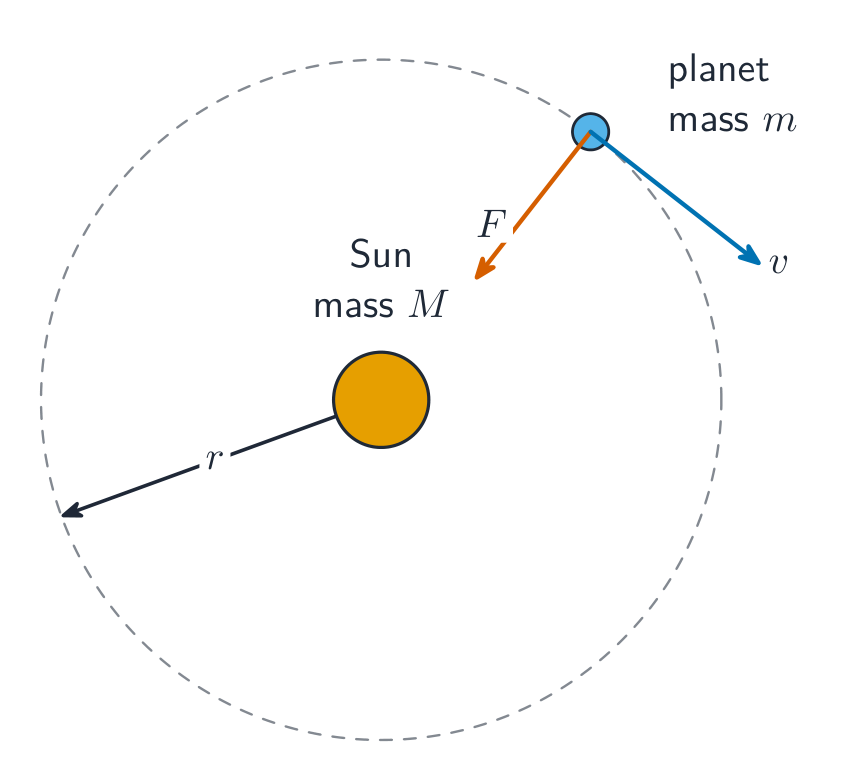
    Orbital motion (Kepler's 2nd law)

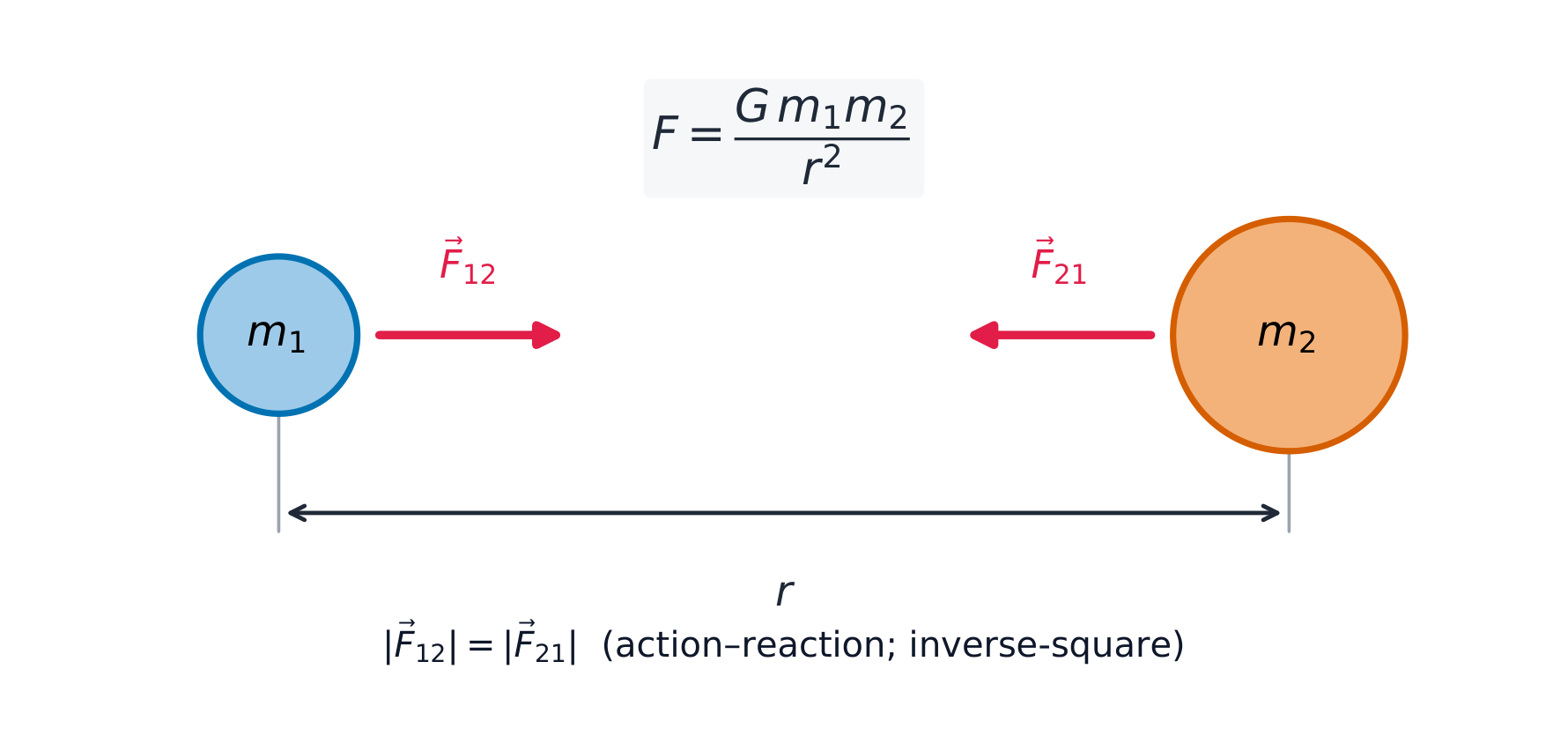
    Near a planet's surface, the gravitational force (weight) is $F_g=mg$, directed down, where $g$ is the gravitational field strength 重力场强度. More generally, Newton's law of gravitation 万有引力定律 gives the attraction between any two masses:

    $$F_g=\frac{G m_1 m_2}{r^2},$$
    directed along the line joining them, weaker as the distance $r$ grows (an inverse-square law). Doubling the separation quarters the force.

    Two masses attract each other with equal, opposite, inverse-square forces along the line joining them
    Two masses attract each other with equal, opposite, inverse-square forces along the line joining them

    Worked example. A $2.0\ \text{kg}$ object weighs $19.6\ \text{N}$ on Earth ($g=9.8\ \text{m/s}^2$). On the Moon $g_{\text{Moon}}=1.6\ \text{m/s}^2$. Its mass is unchanged ($2.0\ \text{kg}$), but its weight becomes $F_g=mg=2.0\times1.6=3.2\ \text{N}$. Mass measures inertia; weight is a force that depends on where you are.

    Mass actually plays two distinct roles. Inertial mass 惯性质量 sets how strongly an object resists acceleration ($F=ma$); gravitational mass 引力质量 sets how strongly it attracts other masses ($F=Gm_1m_2/r^2$). Experiments confirm the two are equal – which is exactly why every object, heavy or light, falls with the same $g$.

    Vocabulary · ⁨Словарь⁩ Train · ⁨Тренировать⁩
    English Русский
    gravitational field strength/ˌɡrævɪˈteɪʃənl fiːld streŋθ/ гравитационная напряжённость
    Newton's law of gravitation/ˈnjuːtnz lɔː ɒv ˌɡrævɪˈteɪʃn/ Закон всемирного тяготения Ньютона
    Inertial mass/ɪˈnɜːʃl mæs/ инертная масса
    gravitational mass/ˌɡrævɪˈteɪʃənl mæs/ гравитационная масса
    2.7

    Kinetic and Static Friction

    Syllabus · ⁨Программа⁩
    English

    Learning Objective 2.7.A: Describe kinetic friction between two surfaces

    • 2.7.A.1 Kinetic friction occurs when two surfaces in contact move relative to each other.
      • 2.7.A.1.i The kinetic friction force is exerted in a direction opposite to the motion of each surface relative to the other surface.
      • 2.7.A.1.ii The force of friction between two surfaces does not depend on the size of the surface area of contact.
    • 2.7.A.2 The magnitude of the kinetic friction force exerted on an object is the product of the normal force the surface exerts on the object and the coefficient of kinetic friction.
      • Equation: $\left|\vec{F}_{f,k}\right| = \left|\mu_k \vec{F}_n\right|$
      • 2.7.A.2.i The coefficient of kinetic friction depends on the material properties of the surfaces that are in contact.
      • 2.7.A.2.ii Normal force is the perpendicular component of the force exerted on an object by the surface with which it is in contact; it is directed away from the surface.

    Learning Objective 2.7.B: Describe static friction between two surfaces.

    • 2.7.B.1 Static friction may occur between the contacting surfaces of two objects that are not moving relative to each other.
    • 2.7.B.2 Static friction adopts the value and direction required to prevent an object from slipping or sliding on a surface.
      • Equation: $\left|\vec{F}_{f,s}\right| \leq \left|\mu_s \vec{F}_n\right|$
      • 2.7.B.2.i Slipping and sliding refer to situations in which two surfaces are moving relative to each other.
      • 2.7.B.2.ii There exists a maximum value for which static friction will prevent an object from slipping on a given surface.
        • Equation: $F_{f,s,\max} = \mu_s F_n$
    • 2.7.B.3 The coefficient of static friction is typically greater than the coefficient of kinetic friction for a given pair of surfaces.
    Русский

    Цель обучения 2.7.A: Описать кинетическое трение между двумя поверхностями

    • 2.7.A.1 Кинетическое трение возникает, когда две контактирующие поверхности движутся относительно друг друга.
      • 2.7.A.1.i Сила кинетического трения направлена противоположно движению каждой поверхности относительно другой поверхности.
      • 2.7.A.1.ii Сила трения между двумя поверхностями не зависит от площади контакта этих поверхностей.
    • 2.7.A.2 Модуль силы кинетического трения, действующей на объект, равен произведению нормальной силы, с которой поверхность действует на объект, на коэффициент кинетического трения.
      • Уравнение: $\left|\vec{F}_{f,k}\right| = \left|\mu_k \vec{F}_n\right|$
      • 2.7.A.2.i Коэффициент кинетического трения зависит от свойств материалов контактирующих поверхностей.
      • 2.7.A.2.ii Нормальная сила — это перпендикулярный компонент силы, с которой поверхность действует на объект; она направлена от поверхности.

    Цель обучения 2.7.B: Описать статическое трение между двумя поверхностями.
    • 2.7.B.1 Статическое трение может возникать между контактирующими поверхностями двух объектов, которые неподвижны относительно друг друга.
    • 2.7.B.2 Статическое трение принимает значение и направление, необходимые для предотвращения скольжения или проскальзывания объекта по поверхности.
      • Уравнение: $\left|\vec{F}_{f,s}\right| \leq \left|\mu_s \vec{F}_n\right|$
      • 2.7.B.2.i Проскальзывание и скольжение относятся к ситуациям, когда две поверхности движутся относительно друг друга.
      • 2.7.B.2.ii Существует предельное значение, при котором статическое трение предотвращает скольжение объекта по данной поверхности.
        • Уравнение: $F_{f,s,\max} = \mu_s F_n$
    • 2.7.B.3 Коэффициент статического трения обычно больше коэффициента кинетического трения для данной пары поверхностей.

    Source: College Board AP Course and Exam Description · ⁨Источник: Описание курса и экзамена College Board AP⁩

    Friction 摩擦力 acts along a surface, opposing relative sliding (or the tendency to slide):

    • Kinetic friction 动摩擦 (while sliding): $f_k=\mu_k N$.
    • Static friction 静摩擦 (while not yet sliding): $f_s\le \mu_s N$ – it adjusts up to a maximum to prevent motion.

    Here $N$ is the normal force 法向力 (surface push, perpendicular to the surface) and $\mu$ is the coefficient of friction 摩擦系数.

    Worked example. A $5.0\ \text{kg}$ crate sits on a level floor with $\mu_s=0.40$. Will a horizontal push of $15\ \text{N}$ move it? On a level floor $N=mg=5.0\times9.8=49\ \text{N}$, so the largest static friction is $f_{s,\max}=\mu_s N=0.40\times49=19.6\ \text{N}$. The $15\ \text{N}$ push is smaller than $19.6\ \text{N}$, so friction rises to match it and the crate stays still.

    Explore · ⁨Исследовать⁩

    Slide a block down a slope with friction · ⁨Скатить блок по склону с трением⁩

    Friction opposes motion up to a maximum $\mu N$. Tilt the slope until gravity's pull along it beats static friction and the block starts to slide. · ⁨Трение противодействует движению до максимума $\mu N$. Наклоните склон так, чтобытяга гравитации вдоль него превысила трение покоя, и блок начнет скользить.⁩

    Vocabulary · ⁨Словарь⁩ Train · ⁨Тренировать⁩
    English Русский
    Friction/ˈfrɪkʃn/ Трение
    Kinetic friction/kɪˈnetɪk ˈfrɪkʃn/ кинетическое трение
    Static friction/ˈstætɪk ˈfrɪkʃn/ Трение покоя
    normal force/ˈnɔːml fɔːs/ сила нормальной реакции опоры
    coefficient of friction/ˌkəʊɪˈfɪʃənt ɒv ˈfrɪkʃn/ коэффициент трения
    2.8

    Spring Forces

    Syllabus · ⁨Программа⁩
    English

    Learning Objective 2.8.A: Describe the force exerted on an object by an ideal spring

    • 2.8.A.1 An ideal spring has negligible mass and exerts a force that is proportional to the change in its length as measured from its relaxed length.
    • 2.8.A.2 The magnitude of the force exerted by an ideal spring on an object is given by Hooke's law:
      • Equation: $\vec{F}_s = -k\Delta\vec{x}$
    • 2.8.A.3 The force exerted on an object by a spring is always directed toward the equilibrium position of the object–spring system.
    Русский

    Цель обучения 2.8.A: Описать силу, действующую на объект со стороны идеальной пружины

    • 2.8.A.1 Идеальная пружина имеет пренебрежимо малой массой и создает силу, пропорциональную изменению своей длины по сравнению с длиной в нерастянутом состоянии.
    • 2.8.A.2 Модуль силы, создаваемой идеальной пружиной на объект, определяется законом Гука:
      • Уравнение: $\vec{F}_s = -k\Delta\vec{x}$
    • 2.8.A.3 Сила, действующая на объект со стороны пружины, всегда направлена к положению равновесия системы «объект–пружина».

    Source: College Board AP Course and Exam Description · ⁨Источник: Описание курса и экзамена College Board AP⁩

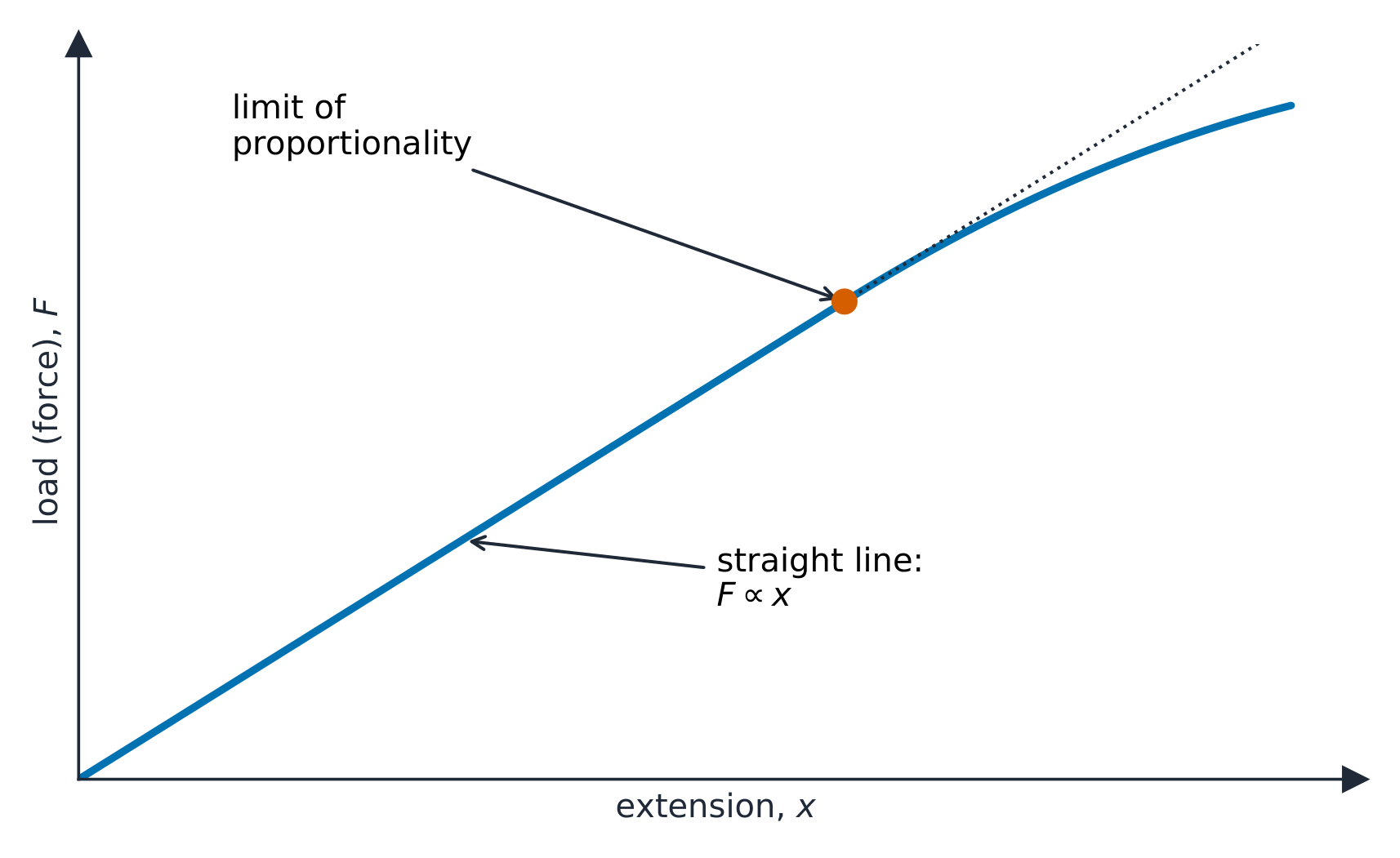
    Hooke's law & the elastic limit

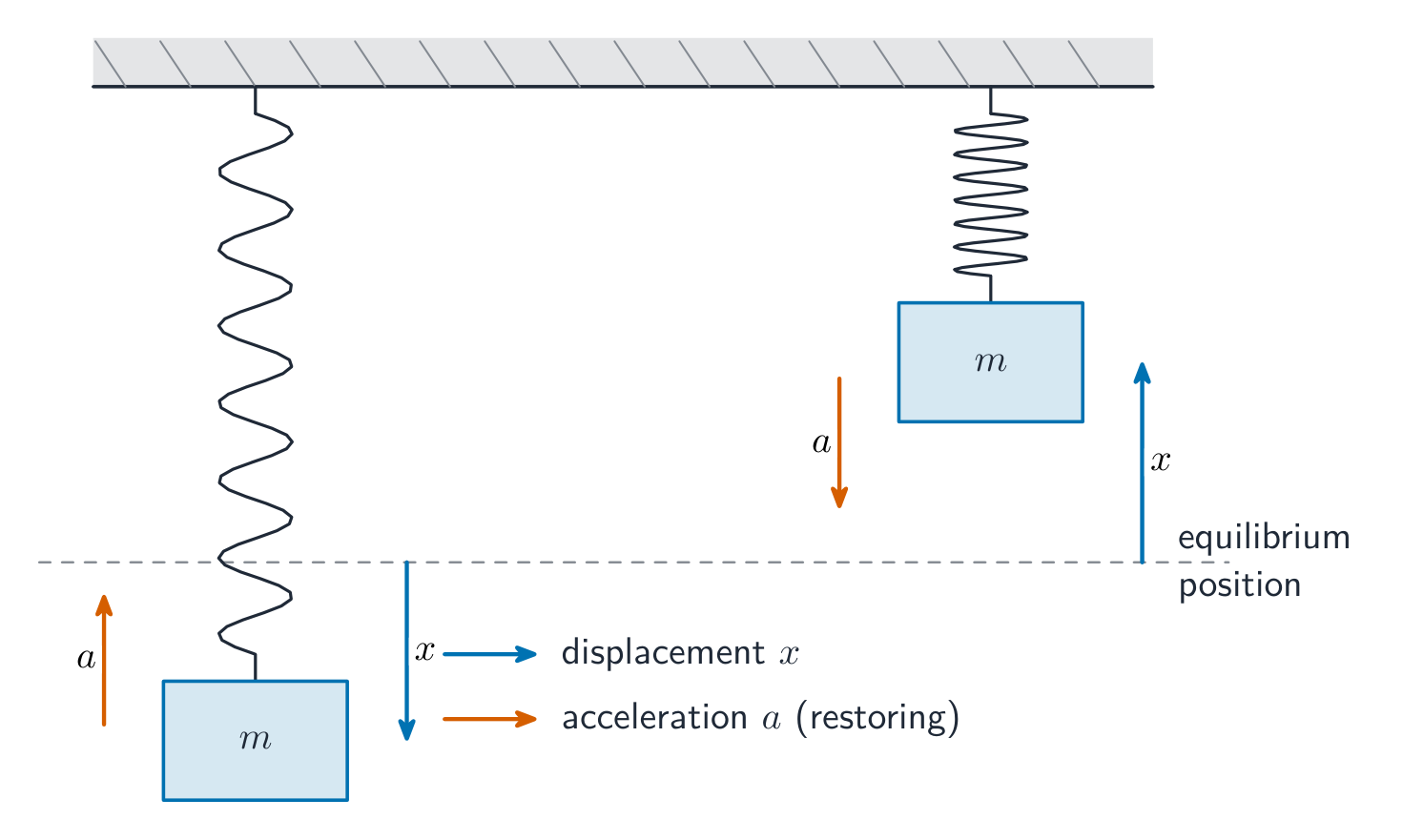
    An ideal spring exerts a restoring force 回复力 proportional to its stretch or compression – Hooke's law 胡克定律:

    $$F_s=-kx,$$
    where $k$ is the spring constant 弹簧常数 (stiffness) and $x$ is the displacement from the spring's natural length. The minus sign means the force points back toward equilibrium.

    Hooke's law: extension is proportional to load up to the limit of proportionality
    Hooke's law: extension is proportional to load up to the limit of proportionality

    Worked example. A spring with $k=200\ \text{N/m}$ hangs vertically and a $0.50\ \text{kg}$ mass is hung on it. How far does it stretch at rest? At rest the spring force balances the weight, $kx=mg$, so

    $$x=\frac{mg}{k}=\frac{0.50\times9.8}{200}=0.025\ \text{m}=2.5\ \text{cm}.$$

    Explore · ⁨Исследовать⁩

    Stretch a spring (Hooke's law) · ⁨Растянуть пружину (закон Гука)⁩

    A spring's force is proportional to its extension, $F=kx$ (Hooke's law). Pull harder and the extension grows in step — until the spring's limit. · ⁨Сила пружины пропорциональна ее удлинению, $F=kx$ (закон Гука). Тяните сильнее, и удлинение растет пропорционально —直到弹簧的极限。⁩

    Vocabulary · ⁨Словарь⁩ Train · ⁨Тренировать⁩
    English Русский
    restoring force/rɪˈstɔːrɪŋ fɔːs/ возвращающая сила
    Hooke's law/hʊks lɔː/ Закон Гука
    spring constant/sprɪŋ ˈkɒnstənt/ жёсткость пружины
    2.9

    Circular Motion

    Syllabus · ⁨Программа⁩
    English

    Learning Objective 2.9.A: Describe the motion of an object traveling in a circular path.

    • 2.9.A.1 Centripetal acceleration is the component of an object's acceleration directed toward the center of the object's circular path.
      • 2.9.A.1.i The magnitude of centripetal acceleration for an object moving in a circular path is the ratio of the object's tangential speed squared to the radius of the circular path.
        • Equation: $a_c = \dfrac{v^2}{r}$
      • 2.9.A.1.ii Centripetal acceleration is directed toward the center of an object's circular path.
    • 2.9.A.2 Centripetal acceleration can result from a single force, more than one force, or components of forces exerted on an object in circular motion.
      • 2.9.A.2.i At the top of a vertical, circular loop, an object requires a minimum speed to maintain circular motion. At this point, and with this minimum speed, the gravitational force is the only force that causes the centripetal acceleration.
        • Equation: $v = \sqrt{gr}$
      • 2.9.A.2.ii Components of the static friction force and the normal force can contribute to the net force producing centripetal acceleration of an object traveling in a circle on a banked surface.
      • 2.9.A.2.iii A component of tension contributes to the net force producing centripetal acceleration experienced by a conical pendulum.
    • 2.9.A.3 Tangential acceleration is the rate at which an object's speed changes and is directed tangent to the object's circular path.
    • 2.9.A.4 The net acceleration of an object moving in a circle is the vector sum of the centripetal acceleration and tangential acceleration.
    • 2.9.A.5 The revolution of an object traveling in a circular path at a constant speed (uniform circular motion) can be described using period and frequency.
      • 2.9.A.5.i The time to complete one full circular path, one full rotation, or a full cycle of oscillatory motion is defined as period, $T$.
      • 2.9.A.5.ii The rate at which an object is completing revolutions is defined as frequency, $f$.
        • Equation: $T = \dfrac{1}{f}$
      • 2.9.A.5.iii For an object traveling at a constant speed in a circular path, the period is given by the derived equation
        • Equation: $T = \dfrac{2\pi r}{v}$

    Learning Objective 2.9.B: Describe circular orbits using Kepler's third law.

    • 2.9.B.1 For a satellite in circular orbit around a central body, the satellite's centripetal acceleration is caused only by gravitational attraction. The period and radius of the circular orbit are related to the mass of the central body.
      • Equation: $T^2 = \dfrac{4\pi^2}{GM} R^3$

    Boundary statement: AP Physics 1 only expects students to quantitatively analyze banked curves in which no friction is required to maintain uniform circular motion. Analysis of situations in which friction is required on a banked curve is limited to qualitative descriptions.

    Boundary statement: AP Physics 1 does not expect students to know Kepler's first or second laws of planetary motion.

    Русский

    Цель обучения 2.9.A: Описать движение объекта, движущегося по круговой траектории.

    • 2.9.A.1 Центростремительное ускорение — это компонента ускорения объекта, направленная к центру его круговой траектории.
      • 2.9.A.1.i Модуль центростремительного ускорения для объекта, движущегося по круговой траектории, равен отношению квадрата тангенциальной скорости объекта к радиусу круговой траектории.
        • Уравнение: $a_c = \dfrac{v^2}{r}$
      • 2.9.A.1.ii Центростремительное ускорение направлено к центру круговой траектории объекта.
    • 2.9.A.2 Центростремительное ускорение может быть вызвано одной силой, несколькими силами или компонентами сил, действующих на объект при движении по окружности.
      • 2.9.A.2.i В верхней точке вертикальной петли объект требует минимальной скорости для поддержания кругового движения. В этой точке и при этой минимальной скорости единственной силой, создающей центростремительное ускорение, является сила тяжести.
        • Уравнение: $v = \sqrt{gr}$
      • 2.9.A.2.ii Компоненты силы статического трения и нормальной силы могут вносить вклад в результирующую силу, создающую центростремительное ускорение объекта, движущегося по кругу на наклонной поверхности.
      • 2.9.A.2.iii Компонента натяжения вносит вклад в результирующую силу, создающую центростремительное ускорение конического маятника.
    • 2.9.A.3 Тангенциальное ускорение — это скорость изменения скорости объекта и направлено по касательной к круговой траектории объекта.
    • 2.9.A.4 Результирующее ускорение объекта, движущегося по окружности, равно векторной сумме центростремительного ускорения и тангенциального ускорения.
    • 2.9.A.5 Оборот объекта, движущегося по круговой траектории с постоянной скоростью (равномерное движение по окружности), можно описать с помощью периода и частоты.
      • 2.9.A.5.i Время, необходимое для выполнения одного полного оборота по круговой траектории, одного полного вращения или полного цикла колебательного движения, называется периодом, $T$.
      • 2.9.A.5.ii Скорость выполнения оборотов называется частотой, $f$.
        • Уравнение: $T = \dfrac{1}{f}$
      • 2.9.A.5.iii Для объекта, движущегося с постоянной скоростью по круговой траектории, период определяется полученным уравнением
        • Уравнение: $T = \dfrac{2\pi r}{v}$

    Цель обучения 2.9.B: Описать круговые орбиты с использованием третьего закона Кеплера.

    • 2.9.B.1 Для спутника на круговой орбите вокруг центрального тела центростремительное ускорение спутника вызвано исключительно гравитационным притяжением. Период и радиус круговой орбиты связаны с массой центрального тела.
      • Уравнение: $T^2 = \dfrac{4\pi^2}{GM} R^3$

    Граничное заявление: AP Physics 1 предполагает от студентов только количественный анализ наклонных кривых, где для поддержания равномерного кругового движения трение не требуется. Анализ ситуаций, требующих наличия трения на наклонной кривой, ограничен качественными описаниями.

    Граничное утверждение: AP Physics 1 не требует от студентов знания первого или второго законов Кеплера о движении планет.

    Source: College Board AP Course and Exam Description · ⁨Источник: Описание курса и экзамена College Board AP⁩

    Uniform circular motion

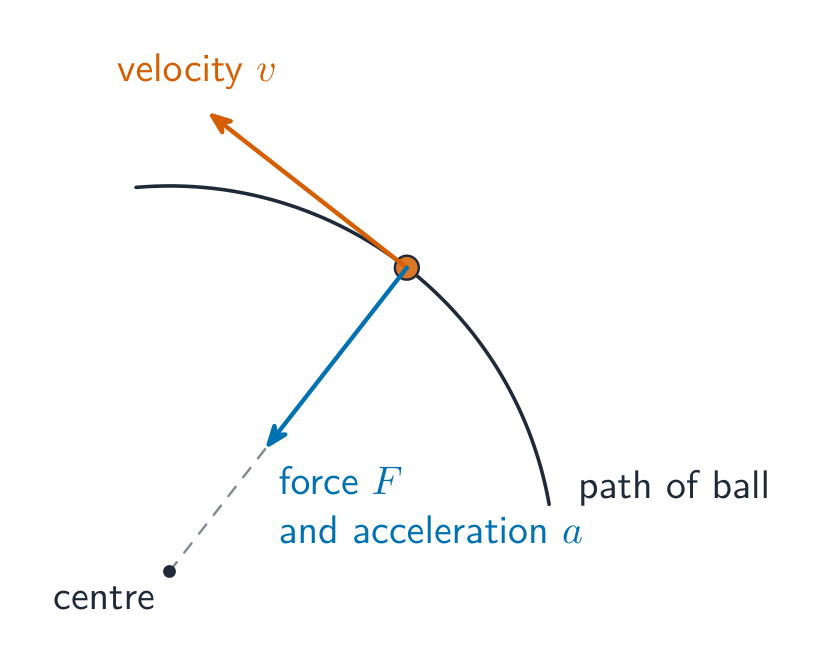
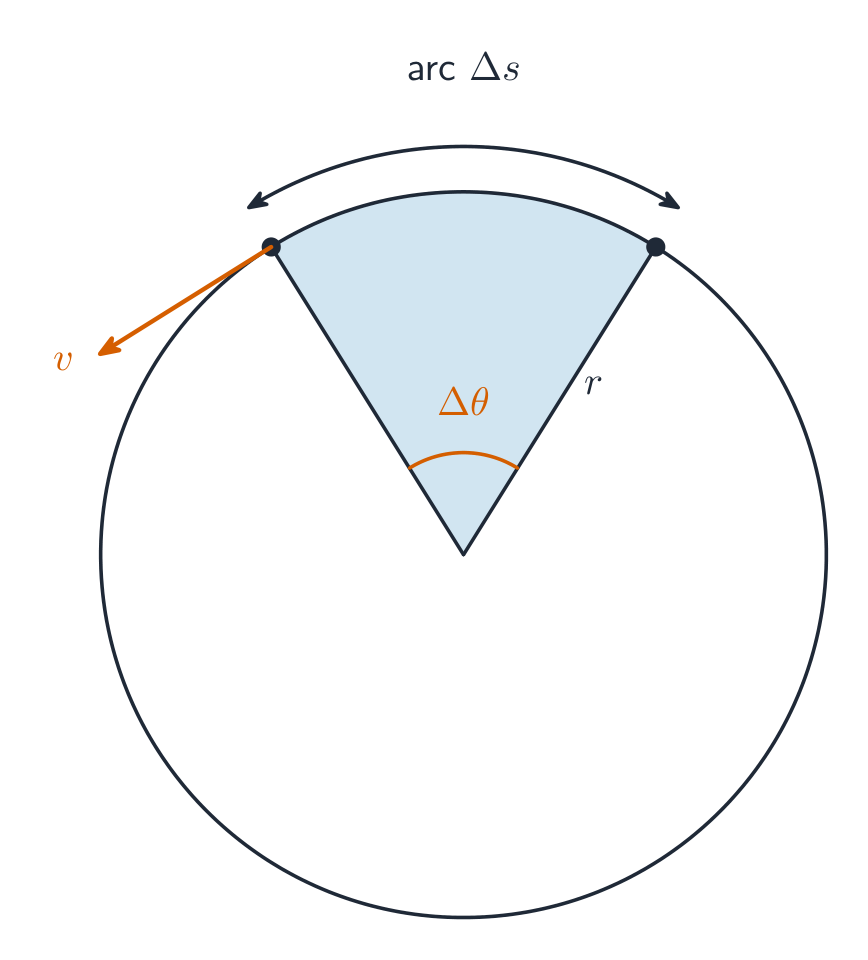
    An object moving in a circle at constant speed still accelerates, because its velocity direction keeps changing. This centripetal acceleration 向心加速度 points toward the center:

    $$a_c=\frac{v^2}{r}.$$
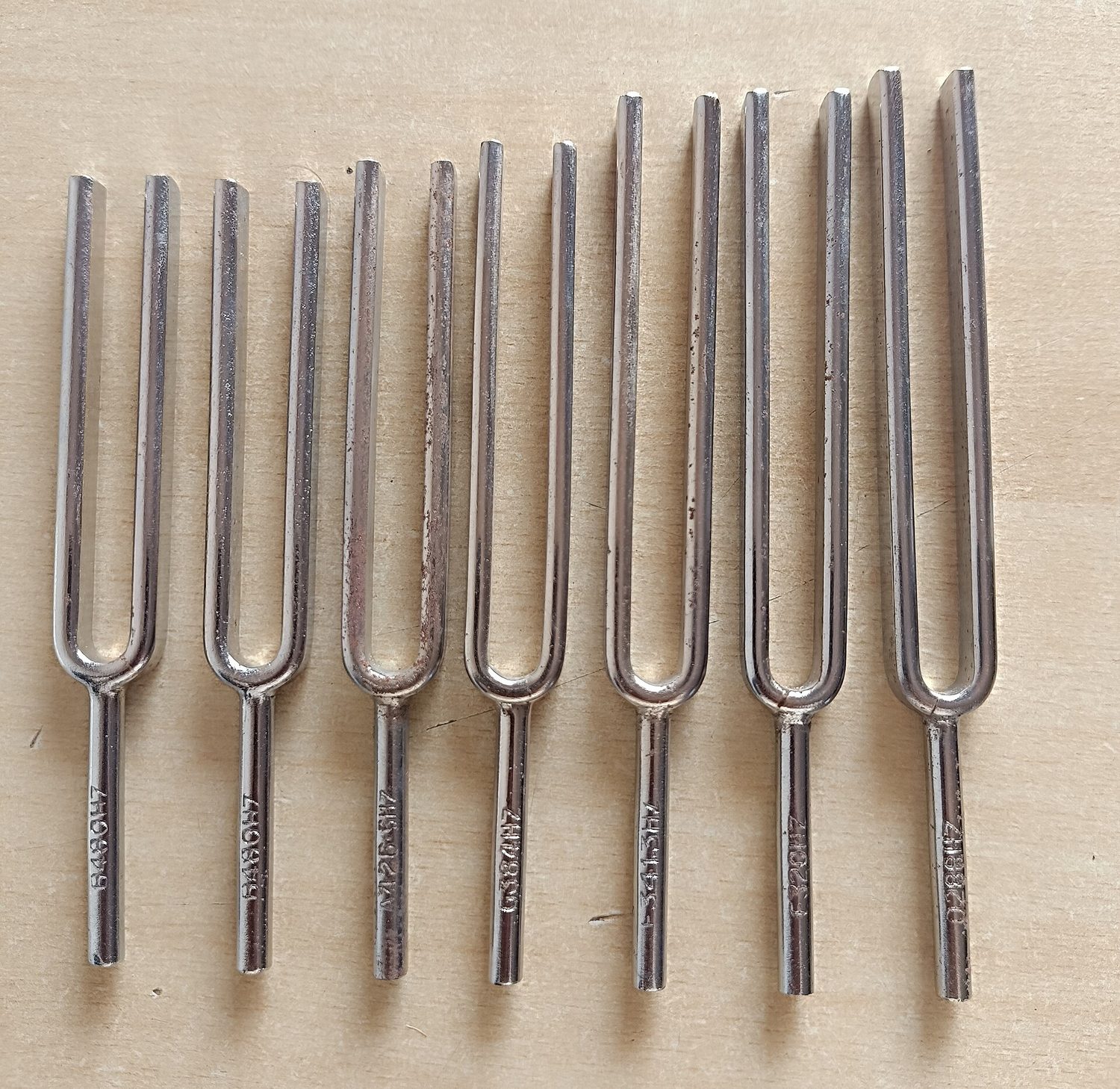
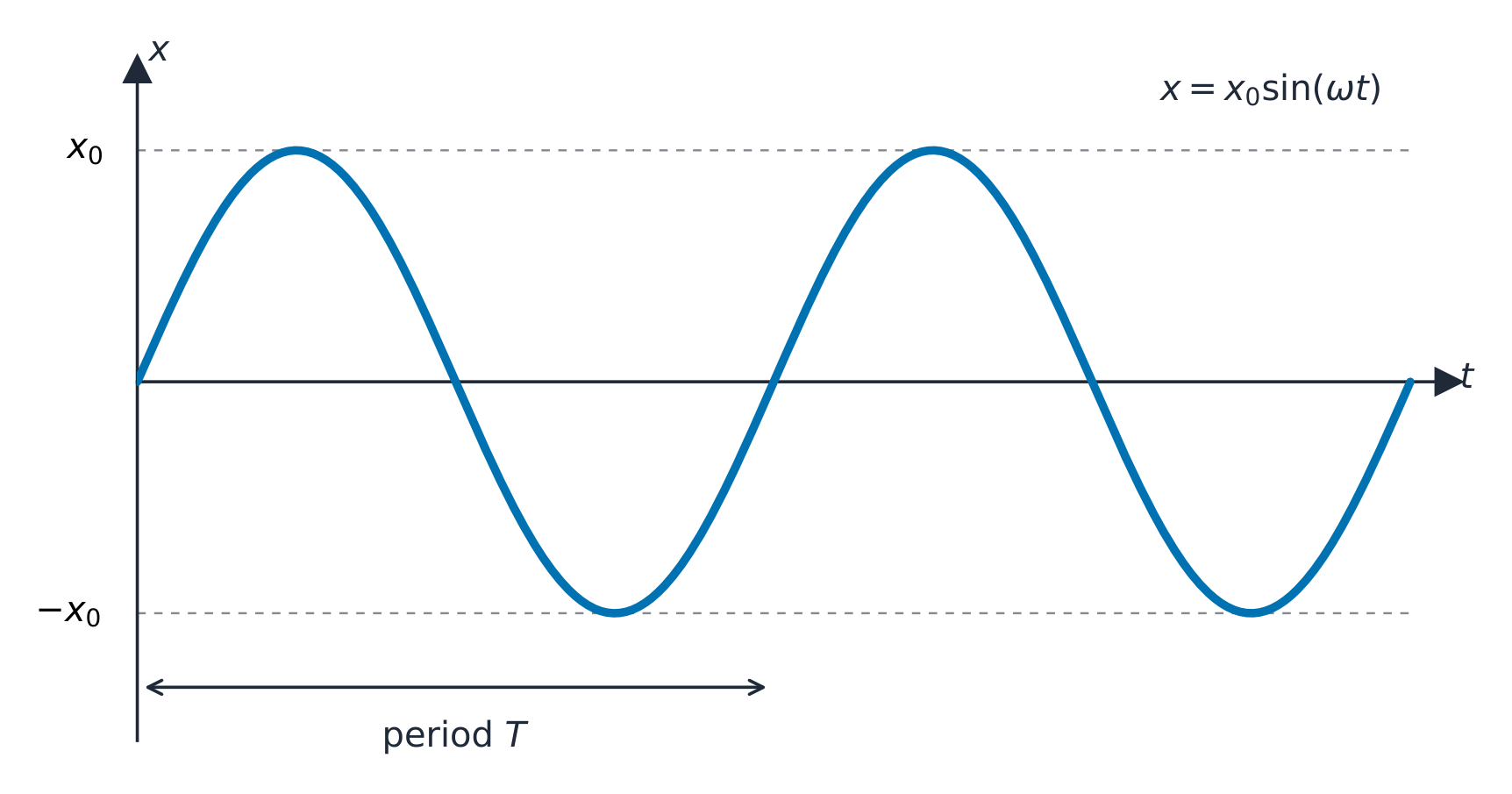
    It is produced by a net inward (centripetal) force 向心力 $F_c=\dfrac{mv^2}{r}$ – supplied by whatever real force points inward (tension, gravity, friction, normal). The time for one full revolution is the period 周期 $T$, and the number of revolutions per second is the frequency 频率 $f$; they are reciprocals, $f = 1/T$, and the same definitions describe any rotation or oscillation.There is no separate outward force; "centrifugal" is only an apparent effect.

    The velocity points along the tangent; the centripetal force and acceleration point to the centre
    The velocity points along the tangent; the centripetal force and acceleration point to the centre

    Worked example. A $0.30\ \text{kg}$ ball on a string is whirled in a horizontal circle of radius $0.80\ \text{m}$ at $4.0\ \text{m/s}$. Find the tension in the string. The tension supplies the whole centripetal force:

    $$T=\frac{mv^2}{r}=\frac{0.30\times4.0^2}{0.80}=6.0\ \text{N}.$$
    If the string can take at most $6.0\ \text{N}$, this is the fastest the ball can go at that radius – spin any faster and the string breaks.

    Vocabulary · ⁨Словарь⁩ Train · ⁨Тренировать⁩
    English Русский
    centripetal acceleration/senˈtrɪpɪtl əkˌseləˈreɪʃn/ центростремительное ускорение
    net inward (centripetal) force/net ˈɪnwəd fɔːs/ равнодействующая inward (центростремительная) сила
    period/ˈpɪərɪəd/ периода
    frequency/ˈfriːkwənsi/ частоту
    2.9

    Exam tips

    • Always draw a free-body diagram first: only real forces on the chosen object (weight, normal, tension, friction, applied) — never an "$ma$" arrow.
    • Apply $\sum F = ma$ one axis at a time; on an incline resolve gravity into $mg\sin\theta$ (along) and $mg\cos\theta$ (perpendicular).
    • A Newton's third-law pair acts on two different objects — a book's weight and the table's normal force are not a pair (both act on the book).
    • Static friction adjusts up to $\mu_s N$ (use it to test whether motion starts); once sliding, use kinetic friction $f_k=\mu_k N$.
    • Circular motion needs a net inward (centripetal) force $mv^2/r$ supplied by a real force — there is no outward "centrifugal" force.
  • 3

    Work, Energy, and Power · ⁨Работа, энергия и мощность⁩

    Watch lesson · ⁨Смотреть урок⁩
    3.1

    Translational Kinetic Energy · ⁨Трансляционная кинетическая энергия⁩

    Syllabus · ⁨Программа⁩
    English

    Learning Objective 3.1.A: Describe the translational kinetic energy of an object in terms of the object's mass and velocity.

    • 3.1.A.1 An object's translational kinetic energy is given by the equation
      • Equation: $K = \dfrac{1}{2}mv^2$
    • 3.1.A.2 Translational kinetic energy is a scalar quantity.
    • 3.1.A.3 Different observers may measure different values of the translational kinetic energy of an object, depending on the observer's frame of reference.
    Русский

    Цель обучения 3.1.A: Описать поступательную кинетическую энергию объекта с точки зрения массы и скорости этого объекта.

    • 3.1.A.1 Поступательная кинетическая энергия объекта задается уравнением
      • Уравнение: $K = \dfrac{1}{2}mv^2$
    • 3.1.A.2 Поступательная кинетическая энергия является скалярной величиной.
    • 3.1.A.3 Разные наблюдатели могут измерять различные значения поступательной кинетической энергии объекта в зависимости от системы отсчета наблюдателя.

    Source: College Board AP Course and Exam Description · ⁨Источник: Описание курса и экзамена College Board AP⁩

    English

    Energy 能量 is the capacity to do work, measured in joules 焦耳 (J). A moving object has kinetic energy 动能:

    $$K=\tfrac{1}{2}mv^2.$$
    It depends on the square of the speed, so doubling the speed quadruples the kinetic energy. Kinetic energy is a scalar and is never negative.

    Worked example. A $1500\ \text{kg}$ car travels at $20\ \text{m/s}$. Its kinetic energy is $K=\tfrac12\times1500\times20^2=3.0\times10^{5}\ \text{J}=300\ \text{kJ}$. If it speeds up to $40\ \text{m/s}$ (double), the kinetic energy becomes $4\times$ larger, $1200\ \text{kJ}$ – which is why stopping distance grows so fast with speed.

    Русский

    Энергия — это способность совершать работу, измеряется в джоулях (Дж). Движущееся тело обладает кинетической энергией:

    $$K=\tfrac{1}{2}mv^2.$$
    Она зависит от квадрата скорости, поэтому удвоение скорости увеличивает кинетическую энергию в четыре раза. Кинетическая энергия является скалярной величиной и никогда не бывает отрицательной.

    Разбор примера. Автомобиль массой $1500\ \text{kg}$ движется со скоростью $20\ \text{m/s}$. Его кинетическая энергия составляет $K=\tfrac12\times1500\times20^2=3.0\times10^{5}\ \text{J}=300\ \text{kJ}$. Если он ускоряется до $40\ \text{m/s}$ (удвоение), кинетическая энергия становится больше в $4\times$ раз, то есть $1200\ \text{kJ}$ — именно поэтому тормозной путь так быстро растет со скоростью.

    3.2

    Work · ⁨Работа⁩

    Syllabus · ⁨Программа⁩
    English

    Learning Objective 3.2.A: Describe the work done on an object or system by a given force or collection of forces.

    • 3.2.A.1 Work is the amount of energy transferred into or out of a system by a force exerted on that system over a distance.
      • 3.2.A.1.i The work done by a conservative force exerted on a system is path-independent and only depends on the initial and final configurations of that system.
      • 3.2.A.1.ii The work done by a conservative force on a system—or the change in the potential energy of the system—will be zero if the system returns to its initial configuration.
      • 3.2.A.1.iii Potential energies are associated only with conservative forces.
      • 3.2.A.1.iv The work done by a nonconservative force is path-dependent.
      • 3.2.A.1.v Examples of nonconservative forces are friction and air resistance.
    • 3.2.A.2 Work is a scalar quantity that may be positive, negative, or zero.
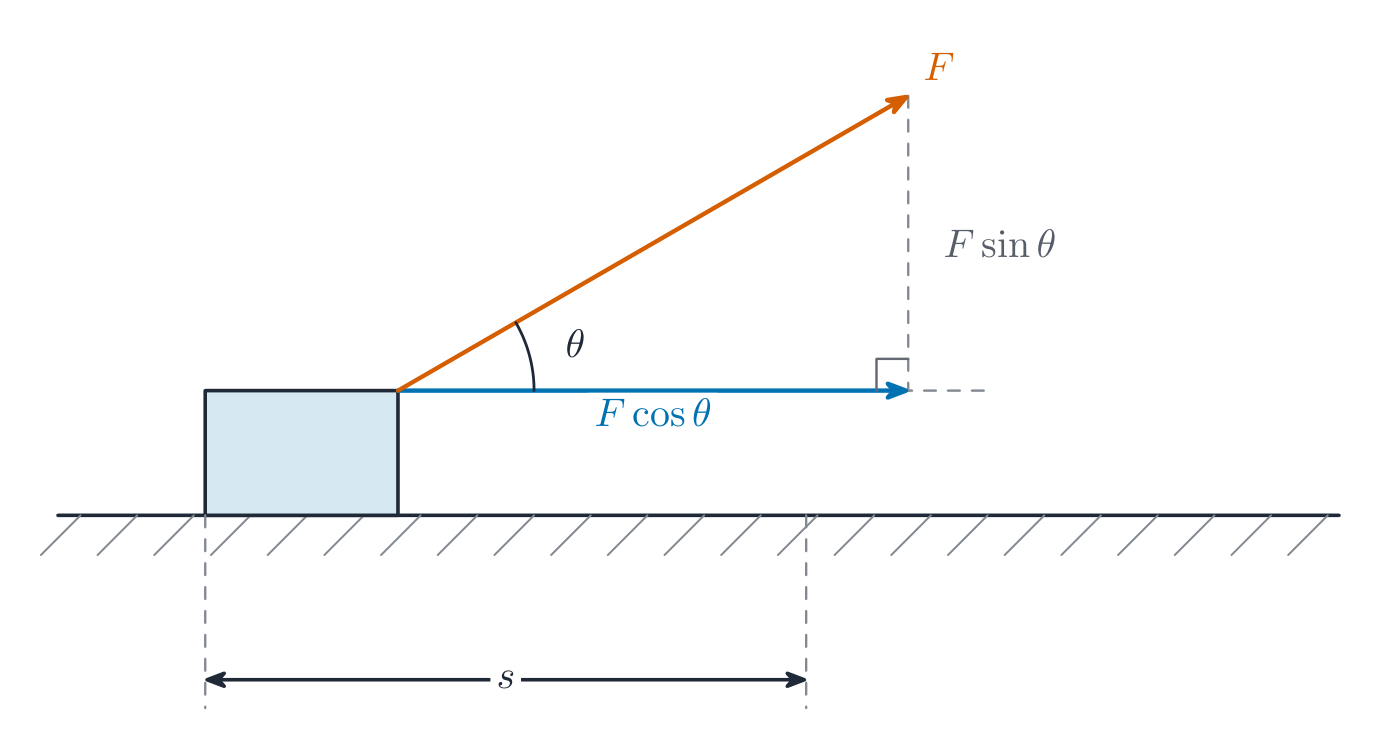
    • 3.2.A.3 The amount of work done on a system by a constant force is related to the components of that force and the displacement of the point at which that force is exerted.
      • 3.2.A.3.i Only the component of the force exerted on a system that is parallel to the displacement of the point of application of the force will change the system's total energy.
        • Equation: $W = F_{\parallel}d = Fd\cos\theta$
      • 3.2.A.3.ii The component of the force exerted on a system perpendicular to the direction of the displacement of the system's center of mass can change the direction of the system's motion without changing the system's kinetic energy.
    • 3.2.A.4 The work-energy theorem states that the change in an object's kinetic energy is equal to the sum of the work (net work) being done by all forces exerted on the object.
      • Equation: $\Delta K = \sum_{i} W_i = \sum_{i} F_{\parallel,i}\,d$
      • 3.2.A.4.i An external force may change the configuration of a system. The component of the external force parallel to the displacement times the displacement of the point of application of the force gives the change in kinetic energy of the system.
      • 3.2.A.4.ii If the system's center of mass and the point of application of the force move the same distance when a force is exerted on a system, then the system may be modeled as an object, and only the system's kinetic energy can change.
      • 3.2.A.4.iii The energy dissipated by friction is typically equated to the force of friction times the length of the path over which the force is exerted
        • Equation: $\Delta E_{\text{mech}} = F_f\,d\cos\theta$
    • 3.2.A.5 Work is equal to the area under the curve of a graph of $F_{\parallel}$ as a function of displacement.

    Boundary statement: AP Physics 1 only expects students to analyze the transfer of mechanical energy (as defined in Unit 3, Topic 4: Conservation of Energy), although students should be aware that mechanical energy may be dissipated in the form of thermal energy or sound. In AP Physics 2, students will also study how thermal energy can be transferred between systems through heating or cooling.

    Русский

    Цель обучения 3.2.A: Описать работу, совершаемую над объектом или системой данной силой или совокупностью сил.

    • 3.2.A.1 Работа — это количество энергии, переданное в систему или из нее силой, действующей на эту систему на определенном расстоянии.
      • 3.2.A.1.i Работа консервативной силы, действующей на систему, не зависит от пути и определяется только начальным и конечным состояниями этой системы.
      • 3.2.A.1.ii Работа консервативной силы над системой — или изменение потенциальной энергии системы — будет равно нулю, если система возвращается в свое начальное состояние.
      • 3.2.A.1.iii Потенциальные энергии связаны исключительно с консервативными силами.
      • 3.2.A.1.iv Работа неконсервативной силы зависит от пути.
      • 3.2.A.1.v Примерами неконсервативных сил являются сила трения и сопротивление воздуха.
    • 3.2.A.2 Работа — это скалярная величина, которая может быть положительной, отрицательной или равной нулю.
    • 3.2.A.3 Количество работы, совершенной над системой постоянной силой, связано с компонентами этой силы и перемещением точки приложения этой силы.
      • 3.2.A.3.i Только компонента силы, действующей на систему, параллельная перемещению точки приложения силы, изменяет полную энергию системы.
        • Уравнение: $W = F_{\parallel}d = Fd\cos\theta$
      • 3.2.A.3.ii Компонента силы, действующей на систему, перпендикулярная направлению перемещения центра масс системы, может изменить направление движения системы, не изменяя ее кинетическую энергию.
    • 3.2.A.4 Теорема о работе и кинетической энергии гласит, что изменение кинетической энергии объекта равно сумме работ (суммарной работе), совершаемых всеми силами, действующими на объект.
      • Уравнение: $\Delta K = \sum_{i} W_i = \sum_{i} F_{\parallel,i}\,d$
      • 3.2.A.4.i Внешняя сила может изменить конфигурацию системы. Произведение компоненты внешней силы, параллельной перемещению, на перемещение точки приложения силы дает изменение кинетической энергии системы.
      • 3.2.A.4.ii Если центр масс системы и точка приложения силы перемещаются на одинаковое расстояние при действии силы на систему, то систему можно моделировать как объект, и может изменяться только кинетическая энергия системы.
      • 3.2.A.4.iii Энергия, рассеиваемая трением, обычно приравнивается к силе трения, умноженной на длину пути, по которому действует эта сила.
        • Уравнение: $\Delta E_{\text{mech}} = F_f\,d\cos\theta$
    • 3.2.A.5 Работа равна площади под кривой графика $F_{\parallel}$ в зависимости от перемещения.

    Граничное утверждение: AP Physics 1 требует от студентов лишь анализа передачи механической энергии (как определено в Разделе 3, Тема 4: Сохранение энергии), хотя студенты должны знать, что механическая энергия может рассеиваться в виде тепловой энергии или звука. В AP Physics 2 студенты также изучат, как тепловая энергия может передаваться между системами посредством нагревания или охлаждения.

    Source: College Board AP Course and Exam Description · ⁨Источник: Описание курса и экзамена College Board AP⁩

    English

    Work 功 is energy transferred by a force acting over a displacement:

    $$W=F\,d\cos\theta,$$
    where $\theta$ is the angle between the force and the displacement. Work is positive when the force has a component along the motion (adds energy), negative when it opposes the motion (removes energy), and zero when the force is perpendicular. On a force–position graph, work is the area under the curve. The work–energy theorem 动能定理 states that the net work equals the change in kinetic energy: $W_{\text{net}}=\Delta K$.

    Worked example. A $2.0\ \text{kg}$ block moving at $3.0\ \text{m/s}$ on a frictionless floor is pushed by a $5.0\ \text{N}$ force over $4.0\ \text{m}$ in the direction of motion. Find its final speed. The net work is $W=Fd=5.0\times4.0=20\ \text{J}$, and by the work–energy theorem $W=\tfrac12 m(v^2-v_0^2)$:

    $$20=\tfrac12\times2.0\times(v^2-3.0^2)\;\Rightarrow\;v^2=29\;\Rightarrow\;v=5.4\ \text{m/s}.$$

    Русский

    Работа — это энергия, переданная силой при перемещении:

    $$W=F\,d\cos\theta,$$
    где $\theta$ — угол между силой и перемещением. Работа положительна, когда сила имеет компоненту вдоль движения (добавляет энергию), отрицательна, когда она препятствует движению (забирает энергию), и нулевая, когда сила перпендикулярна. На графике зависимости силы от координаты работа равна площади под кривой. Теорема о работе и кинетической энергии гласит, что суммарная работа равна изменению кинетической энергии: $W_{\text{net}}=\Delta K$.

    Только компонента силы вдоль перемещения совершает работу
    Только компонента силы вдоль перемещения совершает работу

    Разбор примера. Блок массой $2.0\ \text{kg}$, движущийся со скоростью $3.0\ \text{m/s}$ по гладкому полу, толкают силой $5.0\ \text{N}$ на расстояние $4.0\ \text{m}$ в направлении движения. Найдите конечную скорость. Суммарная работа равна $W=Fd=5.0\times4.0=20\ \text{J}$, и согласно теореме о работе и кинетической энергии $W=\tfrac12 m(v^2-v_0^2)$:

    $$20=\tfrac12\times2.0\times(v^2-3.0^2)\;\Rightarrow\;v^2=29\;\Rightarrow\;v=5.4\ \text{m/s}.$$

    Vocabulary · ⁨Словарь⁩ Train · ⁨Тренировать⁩
    English Русский
    Work/wɜːk/ Работа
    work–energy theorem/wɜːk ˈenədʒi ˈθɪərəm/ теорема о работе и энергии
    Potential energy/pəˈtenʃl ˈenədʒi/ Потенциальная энергия
    Gravitational potential energy/ˌɡrævɪˈteɪʃənl pəˈtenʃl ˈenədʒi/ Гравитационный потенциальная энергия
    Elastic potential energy/ɪˈlæstɪk pəˈtenʃl ˈenədʒi/ Упругая потенциальная энергия
    conservative forces/kənˈsɜːvətɪv ˈfɔːsɪz/ консервативные силы
    total mechanical energy/ˈtəʊtl mɪˈkænɪkl ˈenədʒi/ полная механическая энергия
    conserved/kənˈsɜːvd/ сохраняемым
    thermal energy/ˈθɜːml ˈenədʒi/ тепловую энергию
    3.3

    Potential Energy · ⁨Потенциальная энергия⁩

    Syllabus · ⁨Программа⁩
    English

    Learning Objective 3.3.A: Describe the potential energy of a system.

    • 3.3.A.1 A system composed of two or more objects has potential energy if the objects within that system only interact with each other through conservative forces.
    • 3.3.A.2 Potential energy is a scalar quantity associated with the position of objects within a system.
    • 3.3.A.3 The definition of zero potential energy for a given system is a decision made by the observer considering the situation to simplify or otherwise assist in analysis.
    • 3.3.A.4 The potential energy of common physical systems can be described using the physical properties of that system.
      • 3.3.A.4.i The elastic potential energy of an ideal spring is given by the following equation, where $\Delta x$ is the distance the spring has been stretched or compressed from its equilibrium length.
        • Equation: $U_s = \dfrac{1}{2}k(\Delta x)^2$
      • 3.3.A.4.ii The general form for the gravitational potential energy of a system consisting of two approximately spherical distributions of mass (e.g., moons, planets or stars) is given by the equation
        • Equation: $U_g = -G\dfrac{m_1 m_2}{r}$
      • 3.3.A.4.iii Because the gravitational field near the surface of a planet is nearly constant, the change in gravitational potential energy in a system consisting of an object with mass $m$ and a planet with gravitational field of magnitude $g$ when the object is near the surface of the planet may be approximated by the equation
        • Equation: $\Delta U_g = mg\Delta y$
    • 3.3.A.5 The total potential energy of a system containing more than two objects is the sum of the potential energy of each pair of objects within the system.
    Русский

    Цель обучения 3.3.A: Описать потенциальную энергию системы.

    • 3.3.A.1 Система, состоящая из двух или более объектов, обладает потенциальной энергией, если объекты внутри этой системы взаимодействуют друг с другом только через консервативные силы.
    • 3.3.A.2 Потенциальная энергия — это скалярная величина, связанная с положением объектов в системе.
    • 3.3.A.3 Определение нуля потенциальной энергии для данной системы — это решение, принимаемое наблюдателем, рассматривающим ситуацию, для упрощения или иным образом содействия анализу.
    • 3.3.A.4 Потенциальную энергию распространенных физических систем можно описать с использованием физических свойств этой системы.
      • 3.3.A.4.i Потенциальная энергия упругости идеальной пружины задается следующим уравнением, где $\Delta x$ — расстояние, на которое пружина была растянута или сжата относительно своей длины в состоянии равновесия.
        • Уравнение: $U_s = \dfrac{1}{2}k(\Delta x)^2$
      • 3.3.A.4.ii Общий вид для гравитационной потенциальной энергии системы, состоящей из двух приблизительно сферических распределений массы (например, лун, планет или звезд), задается уравнением
        • Уравнение: $U_g = -G\dfrac{m_1 m_2}{r}$
      • 3.3.A.4.iii Поскольку гравитационное поле вблизи поверхности планеты почти постоянно, изменение гравитационной потенциальной энергии в системе, состоящей из объекта с массой $m$ и планеты с гравитационным полем модуля $g$, когда объект находится вблизи поверхности планеты, может быть приближенно выражено уравнением
        • Уравнение: $\Delta U_g = mg\Delta y$
    • 3.3.A.5 Полная потенциальная энергия системы, содержащей более двух объектов, равна сумме потенциальных энергий каждой пары объектов внутри системы.

    Source: College Board AP Course and Exam Description · ⁨Источник: Описание курса и экзамена College Board AP⁩

    English

    Potential energy 势能 is stored energy that depends on position or configuration:

    • Gravitational potential energy 重力势能 near the surface: $U_g=mgh$ (height $h$ above a reference level).
    • Elastic potential energy 弹性势能 in a spring: $U_s=\tfrac{1}{2}kx^2$.

    Potential energy is defined only for conservative forces 保守力 (gravity, springs), for which the stored energy depends on position, not path. Only changes in potential energy matter, so you may put the zero level wherever is convenient.

    The $U_g=mgh$ form only holds near a surface where $g$ is roughly constant. The general form, for two spherical masses a distance $r$ apart, is

    $$U_g=-\frac{G m_1 m_2}{r}.$$
    It is negative and defined to be zero at infinite separation, so gravitational PE rises toward zero as the masses move apart. $mgh$ is simply its near-surface approximation. (This is the form you need for satellites and escape speed.)

    Русский

    Потенциальная энергия — это запасенная энергия, зависящая от положения или конфигурации:

    • Гравитационная потенциальная энергия вблизи поверхности: $U_g=mgh$ (высота $h$ над опорным уровнем).
    • Упругая потенциальная энергия в пружине: $U_s=\tfrac{1}{2}kx^2$.

    Потенциальная энергия определена только для консервативных сил (гравитации, пружин), для которых запасенная энергия зависит от положения, а не от траектории. Важны только изменения потенциальной энергии, поэтому нулевой уровень можно выбрать произвольно для удобства.

    Форма $U_g=mgh$ справедлива только вблизи поверхности, где $g$ примерно постоянна. Общий вид для двух сферических масс, находящихся на расстоянии $r$ друг от друга, выглядит так

    $$U_g=-\frac{G m_1 m_2}{r}.$$
    Она отрицательна и принята равной нулю при бесконечном удалении, поэтому гравитационная потенциальная энергия возрастает (стремится к нулю), когда массы удаляются друг от друга. $mgh$ — это просто её приближение для области вблизи поверхности. (Это форма, необходимая для спутников и второй космической скорости.)

    Explore · ⁨Исследовать⁩

    Store elastic potential energy in a spring · ⁨Сохранить упругую потенциальную энергию в пружине⁩

    Stretching a spring stores elastic potential energy $\tfrac12 kx^2$ — the area under the force-extension line. Release it and that energy becomes kinetic. · ⁨Растяжение пружины накапливает упругую потенциальную энергию $\tfrac12 kx^2$ — площадь под графиком зависимости силы от удлинения. Освободите её, и эта энергия превратится в кинетическую.⁩

    3.4

    Conservation of Energy · ⁨Сохранение энергии⁩

    Syllabus · ⁨Программа⁩
    English

    Learning Objective 3.4.A: Describe the energies present in a system.

    • 3.4.A.1 A system composed of only a single object can only have kinetic energy.
    • 3.4.A.2 A system that contains objects that interact via conservative forces or that can change its shape reversibly may have both kinetic and potential energies.

    Learning Objective 3.4.B: Describe the behavior of a system using conservation of mechanical energy principles.

    • 3.4.B.1 Mechanical energy is the sum of a system's kinetic and potential energies.
    • 3.4.B.2 Any change to a type of energy within a system must be balanced by an equivalent change of other types of energies within the system or by a transfer of energy between the system and its surroundings.
    • 3.4.B.3 A system may be selected so that the total energy of that system is constant.
    • 3.4.B.4 If the total energy of a system changes, that change will be equivalent to the energy transferred into or out of the system.

    Learning Objective 3.4.C: Describe how the selection of a system determines whether the energy of that system changes.

    • 3.4.C.1 Energy is conserved in all interactions.
    • 3.4.C.2 If the work done on a selected system is zero and there are no nonconservative interactions within the system, the total mechanical energy of the system is constant.
    • 3.4.C.3 If the work done on a selected system is nonzero, energy is transferred between the system and the environment.

    Boundary statement: AP Physics 1 expects students to know that mechanical energy can be dissipated as thermal energy or sound by nonconservative forces.

    Русский

    Цель обучения 3.4.A: Описать энергии, присутствующие в системе.

    • 3.4.A.1 Система, состоящая только из одного объекта, может иметь только кинетическую энергию.
    • 3.4.A.2 Система, содержащая объекты, взаимодействующие через консервативные силы, или способная обратимо изменять свою форму, может иметь как кинетическую, так и потенциальную энергии.

    Цель обучения 3.4.B: Описать поведение системы, используя принципы сохранения механической энергии.

    • 3.4.B.1 Механическая энергия — это сумма кинетической и потенциальной энергии системы.
    • 3.4.B.2 Любое изменение вида энергии внутри системы должно компенсироваться эквивалентным изменением других видов энергии в системе или передачей энергии между системой и окружающей средой.
    • 3.4.B.3 Можно выбрать систему так, чтобы полная энергия этой системы оставалась постоянной.
    • 3.4.B.4 Если полная энергия системы изменяется, это изменение равно энергии, переданной в систему или выведенной из нее.

    Цель обучения 3.4.C: Описать, как выбор системы определяет, изменяется ли энергия этой системы.

    • 3.4.C.1 Энергия сохраняется во всех взаимодействиях.
    • 3.4.C.2 Если работа, совершенная над выбранной системой, равна нулю, а внутри системы нет неконсервативных взаимодействий, то полная механическая энергия системы постоянна.
    • 3.4.C.3 Если работа, совершенная над выбранной системой, отлична от нуля, энергия передается между системой и окружением.

    Положение о границах: AP Physics 1 предполагает, что студенты знают: механическая энергия может рассеиваться в виде тепловой энергии или звука под действием неконсервативных сил.

    Source: College Board AP Course and Exam Description · ⁨Источник: Описание курса и экзамена College Board AP⁩

    English
    Energy conservation: KE ⇄ PE

    The total mechanical energy 机械能 is $E=K+U$. When only conservative forces do work, mechanical energy is conserved 守恒:

    $$K_1+U_1=K_2+U_2.$$
    When friction or other non-conservative forces act, they transfer mechanical energy to thermal energy 热能; then the general statement is that total energy (including thermal) is conserved. Energy bar charts are a good way to track where the energy goes.

    Worked example. A ball is released from rest at the top of a frictionless ramp $5.0\ \text{m}$ high. Find its speed at the bottom. All the gravitational potential energy becomes kinetic energy:

    $$mgh=\tfrac12 mv^2\;\Rightarrow\;v=\sqrt{2gh}=\sqrt{2\times9.8\times5.0}=9.9\ \text{m/s}.$$
    The mass cancels, so every object reaches the same speed – exactly the free-fall result, now got from energy. If instead $30\ \text{J}$ were lost to friction, you would subtract it: $mgh-30=\tfrac12 mv^2$.

    Русский
    Сохранение энергии: KE ⇄ PE
    Аттракцион с высокими петлями из зеленой и красной траектории на фоне неба
    Аттрацион обменивает энергию туда-сюда: он находится выше всего (максимум потенциальной энергии) на вершине и движется быстрее всего (максимум кинетической энергии) внизу

    Полная механическая энергия равна $E=K+U$. Когда совершают работу только консервативные силы, механическая энергия сохраняется:

    $$K_1+U_1=K_2+U_2.$$
    Когда действуют силы трения или другие неконсервативные силы, они преобразуют механическую энергию в тепловую энергию; в этом случае общее утверждение гласит, что полная энергия (включая тепловую) сохраняется. Столбчатые диаграммы энергии — удобный способ отследить, куда уходит энергия.

    Маятник обменивается гравитационной потенциальной энергией на кинетическую и обратно
    Маятник обменивается гравитационной потенциальной энергией на кинетическую и обратно

    Разобранный пример. Мяч отпускают без начальной скорости с вершины гладкой наклонной плоскости $5.0\ \text{m}$ высотой. Найдите его скорость у основания. Вся потенциальная энергия гравитации переходит в кинетическую энергию:

    $$mgh=\tfrac12 mv^2\;\Rightarrow\;v=\sqrt{2gh}=\sqrt{2\times9.8\times5.0}=9.9\ \text{m/s}.$$
    Масса сокращается, поэтому каждое тело достигает одинаковой скорости — результат точно такой же, как при свободном падении, но полученный через закон сохранения энергии. Если бы вместо этого $30\ \text{J}$ было потеряно на трение, нужно было бы вычесть его: $mgh-30=\tfrac12 mv^2$.

    Explore · ⁨Исследовать⁩

    Watch energy convert as an object falls · ⁨Наблюдать за преобразованием энергии при падении объекта⁩

    With no friction, mechanical energy is conserved: as an object falls, gravitational potential energy turns into kinetic energy while the total stays fixed. · ⁨При отсутствии трения механическая энергия сохраняется: при падении объекта гравитационная потенциальная энергия превращается в кинетическую, тогда как общая остается неизменной.⁩

    Vocabulary · ⁨Словарь⁩ Train · ⁨Тренировать⁩
    English Русский
    Energy/ˈenədʒi/ Энергия
    joules/dʒuːlz/ джоули
    kinetic energy/kɪˈnetɪk ˈenədʒi/ кинетическую энергию
    3.5

    Power · ⁨Мощность⁩

    Syllabus · ⁨Программа⁩
    English

    Learning Objective 3.5.A: Describe the transfer of energy into, out of, or within a system in terms of power.

    • 3.5.A.1 Power is the rate at which energy changes with respect to time, either by transfer into or out of a system or by conversion from one type to another within a system.
    • 3.5.A.2 Average power is the amount of energy being transferred or converted, divided by the time it took for that transfer or conversion to occur.
      • Equation: $P_{\text{avg}} = \dfrac{\Delta E}{\Delta t}$
    • 3.5.A.3 Because work is the change in energy of an object or system due to a force, average power is the total work done, divided by the time during which that work was done.
      • Equation: $P_{\text{avg}} = \dfrac{W}{\Delta t}$
    • 3.5.A.4 The instantaneous power delivered to an object by the component of a constant force parallel to the object's velocity can be described with the derived equation.
      • Equation: $P_{\text{inst}} = F_{\parallel}v = Fv\cos\theta$
    Русский

    Цель обучения 3.5.A: Описать перенос энергии внутрь системы, из системы или внутри системы через понятие мощности.

    • 3.5.A.1 Мощность — это скорость изменения энергии по времени, будь то перенос энергии в систему или из нее, либо преобразование одного вида энергии в другой внутри системы.
    • 3.5.A.2 Средняя мощность — это количество переданной или преобразованной энергии, деленное на время, за которое произошло этот перенос или преобразование.
      • Уравнение: $P_{\text{avg}} = \dfrac{\Delta E}{\Delta t}$
    • 3.5.A.3 Поскольку работа представляет собой изменение энергии объекта или системы под действием силы, средняя мощность равна полной совершенной работе, деленной на время выполнения этой работы.
      • Уравнение: $P_{\text{avg}} = \dfrac{W}{\Delta t}$
    • 3.5.A.4 Мгновенную мощность, передаваемую объекту компонентом постоянной силы, параллельной скорости объекта, можно описать с помощью выведенного уравнения.
      • Уравнение: $P_{\text{inst}} = F_{\parallel}v = Fv\cos\theta$

    Source: College Board AP Course and Exam Description · ⁨Источник: Описание курса и экзамена College Board AP⁩

    English

    Power 功率 is the rate of doing work or transferring energy, measured in watts 瓦特 (W):

    $$P=\frac{W}{\Delta t}=\frac{\Delta E}{\Delta t},\qquad\text{and instantaneously}\qquad P=Fv.$$
    So the same job done faster requires more power. On an energy–time graph, power is the slope.

    Worked example. A motor lifts a $50\ \text{kg}$ load at a steady $2.0\ \text{m/s}$. Because it moves at constant speed, the lifting force equals the weight, so

    $$P=Fv=mgv=50\times9.8\times2.0=980\ \text{W}.$$

    Real machines waste some energy, so we quote efficiency 效率 – useful output power divided by total input power. If this motor draws $1400\ \text{W}$ of electrical power to deliver $980\ \text{W}$ of useful lifting, its efficiency is $980/1400=0.70$, or $70\%$; the other $30\%$ becomes heat and sound.

    Русский

    Мощность — это скорость совершения работы или передачи энергии, измеряется в ваттах (Вт):

    $$P=\frac{W}{\Delta t}=\frac{\Delta E}{\Delta t},\qquad\text{and instantaneously}\qquad P=Fv.$$
    Таким образом, выполнение той же работы за меньшее время требует большей мощности. На графике зависимости энергии от времени мощность равна угловому коэффициенту (наклону).

    Мощность — это наклон графика зависимости работы от времени: одна и та же работа за меньшее время означает большую мощность
    Мощность — это наклон графика зависимости работы от времени: одна и та же работа за меньшее время означает большую мощность

    Разобранный пример. Мотор поднимает груз массой $50\ \text{kg}$ со скоростью $2.0\ \text{m/s}$. Поскольку движение равномерное, подъемная сила равна силе тяжести, следовательно,

    $$P=Fv=mgv=50\times9.8\times2.0=980\ \text{W}.$$

    Реальные машины теряют часть энергии, поэтому мы указываем КПД — отношение полезной выходной мощности к полной входной мощности. Если этот мотор потребляет $1400\ \text{W}$ электрической мощности для выдачи $980\ \text{W}$ полезной подъемной мощности, его КПД составляет $980/1400=0.70$, или $70\%$; остальное $30\%$ превращается в тепло и звук.

    Водопад: мощность показывает, насколько быстро передается энергия — один и тот же перепад высоты за меньшее время означает большую мощность
    Водопад: мощность показывает, насколько быстро передается энергия — один и тот же перепад высоты за меньшее время означает большую мощность
    Vocabulary · ⁨Словарь⁩ Train · ⁨Тренировать⁩
    English Русский
    Power/ˈpaʊə/ Мощность
    watts/wɒts/ ваттах
    efficiency/ɪˈfɪʃənsi/ КПД
    3.5

    Exam tips · ⁨Советы для экзамена⁩

    English
    • Use $W=Fd\cos\theta$: work is zero when the force is perpendicular to the motion, and negative when it opposes it.
    • Reach for the work–energy theorem ($W_{\text{net}}=\Delta K$) or energy conservation ($K_1+U_1=K_2+U_2$) instead of forces whenever the path is complicated.
    • When friction acts, mechanical energy is not conserved — subtract the energy lost to heat.
    • Remember $K\propto v^2$: doubling the speed quadruples the kinetic energy (and the stopping distance).
    • Use $P=Fv$ for power at a steady speed; at constant velocity the net force is zero but the power is not.
    Русский
    • Используйте $W=Fd\cos\theta$: работа равна нулю, когда сила перпендикулярна движению, и отрицательна, когда она противодействует ему.
    • При сложных траекториях применяйте теорему о работе и энергии ($W_{\text{net}}=\Delta K$) или закон сохранения энергии ($K_1+U_1=K_2+U_2$), а не анализ сил.
    • Когда действует трение, механическая энергия не сохраняется — вычтите энергию, потерянную на нагрев.
    • Помните $K\propto v^2$: удвоение скорости увеличивает кинетическую энергию в четыре раза (и тормозной путь также увеличивается в четыре раза).
    • Используйте $P=Fv$ для расчета мощности при постоянной скорости; при равномерном движении результирующая сила равна нулю, но мощность при этом не равна нулю.
  • 4

    Linear Momentum · ⁨Импульс⁩

    Watch lesson · ⁨Смотреть урок⁩
    4.1

    Linear Momentum · ⁨Линейный импульс⁩

    Syllabus · ⁨Программа⁩
    English

    Learning Objective 4.1.A: Describe the linear momentum of an object or system.

    • 4.1.A.1 Linear momentum is defined by the equation $\vec{p} = m\vec{v}$.
      • Equation: $\vec{p} = m\vec{v}$
    • 4.1.A.2 Momentum is a vector quantity and has the same direction as the velocity.
    • 4.1.A.3 Momentum can be used to analyze collisions and explosions.
      • 4.1.A.3.i A collision is a model for an interaction where the forces exerted between the involved objects in the system are much larger than the net external force exerted on those objects during the interaction.
      • 4.1.A.3.ii As only the initial and final states of a collision are analyzed, the object model may be used to analyze collisions.
      • 4.1.A.3.iii An explosion is a model for an interaction in which forces internal to the system move objects within that system apart.

    Boundary statement: Unless otherwise stated, the general term "momentum" will refer specifically to linear momentum.

    Русский

    Цель обучения 4.1.A: Описать линейный импульс объекта или системы.

    • 4.1.A.1 Линейный импульс определяется уравнением $\vec{p} = m\vec{v}$.
      • Уравнение: $\vec{p} = m\vec{v}$
    • 4.1.A.2 Импульс является векторной величиной и направлен туда же, куда и скорость.
    • 4.1.A.3 Импульс можно использовать для анализа столкновений и взрывов.
      • 4.1.A.3.i Столкновение — это модель взаимодействия, при котором силы, действующие между вовлеченными объектами системы, значительно больше результирующей внешней силы, действующей на эти объекты во время взаимодействия.
      • 4.1.A.3.ii Поскольку анализируются только начальное и конечное состояния столкновения, для их анализа может использоваться модель точечного объекта.
      • 4.1.A.3.iii Взрыв — это модель взаимодействия, при котором внутренние силы системы раздвигают объекты внутри этой системы.

    Положение о границах: Если не указано иное, общий термин «импульс» будет относиться конкретно к линейному импульсу.

    Source: College Board AP Course and Exam Description · ⁨Источник: Описание курса и экзамена College Board AP⁩

    English

    Linear momentum 动量 is mass times velocity – a vector pointing the same way as the velocity:

    $$\vec{p}=m\vec{v}.$$
    It measures "how hard it is to stop" a moving object. A heavy slow truck and a light fast ball can have the same momentum. Its unit is $\text{kg m/s}$, the same as $\text{N s}$.

    Русский

    Линейный импульс — это произведение массы на скорость: вектор, направленный в ту же сторону, что и скорость:

    $$\vec{p}=m\vec{v}.$$
    Он характеризует «трудность остановки» движущегося тела. Тяжелый медленный грузовик и легкий быстрый мяч могут иметь одинаковый импульс. Его единица измерения — $\text{kg m/s}$, то же самое, что и у $\text{N s}$.

    4.2

    Change in Momentum and Impulse · ⁨Изменение импульса и импульс силы⁩

    Syllabus · ⁨Программа⁩
    English

    Learning Objective 4.2.A: Describe the impulse delivered to an object or system.

    • 4.2.A.1 The rate of change of momentum is equal to the net external force exerted on an object or system.
      • Equation: $\vec{F}_{\text{net}} = \dfrac{\Delta \vec{p}}{\Delta t}$
    • 4.2.A.2 Impulse is defined as the product of the average force exerted on a system and the time interval during which that force is exerted on the system.
      • Equation: $\vec{J} = \vec{F}_{\text{avg}} \Delta t$
    • 4.2.A.3 Impulse is a vector quantity and has the same direction as the net force exerted on the system.
    • 4.2.A.4 The impulse delivered to a system by a net external force is equal to the area under the curve of a graph of the net external force exerted on the system as a function of time.
    • 4.2.A.5 The net external force exerted on a system is equal to the slope of a graph of the momentum of the system as a function of time.

    Learning Objective 4.2.B: Describe the relationship between the impulse exerted on an object or a system and the change in momentum of the object or system.

    • 4.2.B.1 Change in momentum is the difference between a system's final momentum and its initial momentum.
      • Equation: $\Delta \vec{p} = \vec{p} - \vec{p}_0$
    • 4.2.B.2 The impulse–momentum theorem relates the impulse exerted on a system and the system's change in momentum.
      • Equation: $\vec{J} = \vec{F}_{\text{avg}} \Delta t = \Delta \vec{p}$
    • 4.2.B.3 Newton's second law of motion is a direct result of the impulse–momentum theorem applied to systems with constant mass.
      • Equation: $\vec{F}_{\text{net}} = \dfrac{\Delta \vec{p}}{\Delta t} = m\dfrac{\Delta \vec{v}}{\Delta t} = m\vec{a}$

    Boundary statement: AP Physics 1 does not require students to quantitatively analyze systems in which the mass of the system changes with respect to time.

    Русский

    Цель обучения 4.2.A: Описать импульс силы, переданный объекту или системе.

    • 4.2.A.1 Скорость изменения импульса равна результирующей внешней силе, действующей на объект или систему.
      • Уравнение: $\vec{F}_{\text{net}} = \dfrac{\Delta \vec{p}}{\Delta t}$
    • 4.2.A.2 Импульс силы определяется как произведение средней силы, действующей на систему, на временной интервал, в течение которого эта сила действует на систему.
      • Уравнение: $\vec{J} = \vec{F}_{\text{avg}} \Delta t$
    • 4.2.A.3 Импульс силы является векторной величиной и направлен туда же, куда и результирующая сила, действующая на систему.
    • 4.2.A.4 Импульс силы, переданный системе результирующей внешней силой, равен площади под кривой графика зависимости результирующей внешней силы, действующей на систему, от времени.
    • 4.2.A.5 Результирующая внешняя сила, действующая на систему, равна наклону графика зависимости импульса системы от времени.

    Цель обучения 4.2.B: Описать связь между импульсом силы, действующим на объект или систему, и изменением импульса этого объекта или системы.

    • 4.2.B.1 Изменение импульса — это разница между конечным импульсом системы и ее начальным импульсом.
      • Уравнение: $\Delta \vec{p} = \vec{p} - \vec{p}_0$
    • 4.2.B.2 Теорема об импульсе и импульсе силы связывает импульс силы, действующий на систему, и изменение импульса этой системы.
      • Уравнение: $\vec{J} = \vec{F}_{\text{avg}} \Delta t = \Delta \vec{p}$
    • 4.2.B.3 Второй закон Ньютона является прямым следствием теоремы об импульсе и импульсе силы, примененной к системам с постоянной массой.
      • Уравнение: $\vec{F}_{\text{net}} = \dfrac{\Delta \vec{p}}{\Delta t} = m\dfrac{\Delta \vec{v}}{\Delta t} = m\vec{a}$

    Положение о границах: AP Physics 1 не требует от студентов количественного анализа систем, масса которых изменяется со временем.

    Source: College Board AP Course and Exam Description · ⁨Источник: Описание курса и экзамена College Board AP⁩

    English

    A net force acting over time changes momentum. The impulse 冲量 delivered is

    $$\vec{J}=\vec{F}\,\Delta t=\Delta\vec{p}.$$
    This is the impulse–momentum theorem: impulse equals the change in momentum. On a force–time graph, impulse is the area under the curve. It explains why airbags and follow-through help – spreading the same momentum change over a longer time reduces the force.

    Worked example. A $0.15\ \text{kg}$ ball hits a wall at $20\ \text{m/s}$ and bounces straight back at $15\ \text{m/s}$. The contact lasts $0.020\ \text{s}$. Find the average force on the ball. Take the rebound direction as positive, so $u=-20\ \text{m/s}$ and $v=+15\ \text{m/s}$:

    $$\Delta p=m(v-u)=0.15\big(15-(-20)\big)=5.25\ \text{kg m/s},\qquad F=\frac{\Delta p}{\Delta t}=\frac{5.25}{0.020}=260\ \text{N}.$$
    The sign work matters: forgetting that the velocity reverses is the most common mistake here.

    Русский

    Результирующая сила, действующая в течение времени, изменяет импульс. Импульс силы, переданный телу, равен

    $$\vec{J}=\vec{F}\,\Delta t=\Delta\vec{p}.$$
    Это теорема об импульсе и импульсе силы: импульс силы равен изменению импульса. На графике зависимости силы от времени импульс силы равен площади под кривой. Это объясняет, почему подушки безопасности и Follow-through помогают — растягивание одного и того же изменения импульса на более длительный период снижает силу воздействия.

    Импульс силы — это площадь под кривой зависимости силы от времени, равная среднему значению силы, умноженному на время контакта
    Импульс силы — это площадь под кривой зависимости силы от времени, равная среднему значению силы, умноженному на время контакта

    Разобранный пример. Мяч массой $0.15\ \text{kg}$ ударяется о стену со скоростью $20\ \text{m/s}$ и отскакивает прямо назад со скоростью $15\ \text{m/s}$. Время контакта составляет $0.020\ \text{s}$. Найдите среднюю силу, действующую на мяч. Примем направление отскока за положительное, тогда $u=-20\ \text{m/s}$ и $v=+15\ \text{m/s}$:

    $$\Delta p=m(v-u)=0.15\big(15-(-20)\big)=5.25\ \text{kg m/s},\qquad F=\frac{\Delta p}{\Delta t}=\frac{5.25}{0.020}=260\ \text{N}.$$
    Знак имеет значение: забвение того, что скорость меняет направление, является самой частой ошибкой здесь.

    Vocabulary · ⁨Словарь⁩ Train · ⁨Тренировать⁩
    English Русский
    Linear momentum/ˈlɪnɪə məʊˈmentəm/ Линейный импульс
    impulse/ˈɪmpʌls/ импульс
    conserved/kənˈsɜːvd/ сохраняемым
    collisions/kəˈlɪʒnz/ соударения
    center-of-mass velocity/ˈsentə ɒv mæs vəˈlɒsɪti/ скорость центра масс
    elastic collision/ɪˈlæstɪk kəˈlɪʒn/ упругое столкновение
    inelastic collision/ɪnɪˈlæstɪk kəˈlɪʒn/ неупругое столкновение
    recoil/rɪˈkɔɪl/ отдача
    4.3

    Conservation of Linear Momentum · ⁨Закон сохранения линейного импульса⁩

    Syllabus · ⁨Программа⁩
    English

    Learning Objective 4.3.A: Describe the behavior of a system using conservation of linear momentum.

    • 4.3.A.1 A collection of objects with individual momenta can be described as one system with one center-of-mass velocity.
      • 4.3.A.1.i For a collection of objects, the velocity of a system's center of mass can be calculated using the equation $\vec{v}_{\text{cm}} = \dfrac{\sum \vec{p}_i}{\sum m_i} = \dfrac{\sum m_i \vec{v}_i}{\sum m_i}$.
      • 4.3.A.1.ii The velocity of a system's center of mass is constant in the absence of a net external force.
    • 4.3.A.2 The total momentum of a system is the sum of the momenta of the system's constituent parts.
    • 4.3.A.3 In the absence of net external forces, any change to the momentum of an object within a system must be balanced by an equivalent and opposite change of momentum elsewhere within the system. Any change to the momentum of a system is due to a transfer of momentum between the system and its surroundings.
      • 4.3.A.3.i The impulse exerted by one object on a second object is equal and opposite to the impulse exerted by the second object on the first. This is a direct result of Newton's third law.
      • 4.3.A.3.ii A system may be selected so that the total momentum of that system is constant.
      • 4.3.A.3.iii If the total momentum of a system changes, that change will be equivalent to the impulse exerted on the system.
        • Equation: $\vec{J} = \Delta \vec{p}$
    • 4.3.A.4 Correct application of conservation of momentum can be used to determine the velocity of a system immediately before and immediately after collisions or explosions.

    Boundary statement: AP Physics 1 includes a quantitative and qualitative treatment of conservation of momentum in one dimension and a semiquantitative treatment of conservation of momentum in two dimensions. Exam questions involving solution of simultaneous equations are not included in AP Physics 1, but the AP Physics 1 Exam may include questions that assess whether students can set up the equations properly and reason about how changing a given mass, speed, or angle would affect other quantities. AP Physics 2 includes a full treatment of conservation of momentum in two dimensions for problems that include one unknown final velocity.

    Learning Objective 4.3.B: Describe how the selection of a system determines whether the momentum of that system changes.

    • 4.3.B.1 Momentum is conserved in all interactions.
    • 4.3.B.2 If the net external force on the selected system is zero, the total momentum of the system is constant.
    • 4.3.B.3 If the net external force on the selected system is nonzero, momentum is transferred between the system and the environment.
    Русский

    Цель обучения 4.3.A: Описать поведение системы, используя закон сохранения линейного импульса.

    • 4.3.A.1 Совоность объектов с индивидуальными импульсами можно описать как одну систему с одной скоростью центра масс.
      • 4.3.A.1.i Для совокупности объектов скорость центра массы системы можно рассчитать с помощью уравнения $\vec{v}_{\text{cm}} = \dfrac{\sum \vec{p}_i}{\sum m_i} = \dfrac{\sum m_i \vec{v}_i}{\sum m_i}$.
      • 4.3.A.1.ii Скорость центра массы системы постоянна при отсутствии результирующей внешней силы.
    • 4.3.A.2 Полный импульс системы равен сумме импульсов составляющих систему частей.
    • 4.3.A.3 При отсутствии результирующих внешних сил любое изменение импульса объекта внутри системы должно компенсироваться эквивалентным и противоположным изменением импульса в другом месте системы. Любое изменение импульса системы обусловлено передачей импульса между системой и окружающей средой.
      • 4.3.A.3.i Импульс силы, оказываемый одним объектом на второй, равен по модулю и противоположен по направлению импульсу силы, оказываемому вторым объектом на первый. Это прямое следствие третьего закона Ньютона.
      • 4.3.A.3.ii Система может быть выбрана таким образом, чтобы полный импульс этой системы оставался постоянным.
      • 4.3.A.3.iii Если полный импульс системы изменяется, это изменение эквивалентно импульсу силы, действующему на систему.
        • Уравнение: $\vec{J} = \Delta \vec{p}$
    • 4.3.A.4 Правильное применение закона сохранения импульса позволяет определить скорость системы непосредственно до и непосредственно после столкновений или взрывов.

    Граничное заявление: AP Physics 1 включает количественную и качественную обработку закона сохранения импульса в одном измерении, а также полуколичественную обработку закона сохранения импульса в двух измерениях. Экзаменационные задачи, требующие решения систем одновременных уравнений, не входят в содержание экзамена AP Physics 1; однако экзамен AP Physics 1 может включать задания, проверяющие, могут ли студенты правильно составить уравнения и рассуждать о том, как изменение заданной массы, скорости или угла повлияет на другие величины. AP Physics 2 включает полное рассмотрение закона сохранения импульса в двух измерениях для задач с одной неизвестной конечной скоростью.

    Цель обучения 4.3.B: Описать, как выбор системы определяет, изменяется ли импульс этой системы.

    • 4.3.B.1 Импульс сохраняется во всех взаимодействиях.
    • 4.3.B.2 Если результирующая внешняя сила, действующая на выбранную систему, равна нулю, полный импульс системы остается постоянным.
    • 4.3.B.3 Если результирующая внешняя сила, действующая на выбранную систему, не равна нулю, происходит перенос импульса между системой и окружающей средой.

    Source: College Board AP Course and Exam Description · ⁨Источник: Описание курса и экзамена College Board AP⁩

    English

    If the net external force on a system is zero, its total momentum is conserved 守恒:

    $$\sum \vec{p}_{\text{before}}=\sum \vec{p}_{\text{after}}.$$
    Internal forces (like the push between two colliding carts) come in third-law pairs and cancel, so they cannot change the total momentum. This is the key tool for collisions 碰撞 and explosions – apply it separately in the $x$ and $y$ directions.

    Worked example (recoil 反冲). A $60\ \text{kg}$ skater, initially at rest on frictionless ice, throws a $2.0\ \text{kg}$ ball at $8.0\ \text{m/s}$. Find her recoil speed. The total momentum starts at zero and stays zero:

    $$0=(60)v+(2.0)(8.0)\;\Rightarrow\;v=-\frac{16}{60}=-0.27\ \text{m/s},$$
    so she moves at $0.27\ \text{m/s}$ in the opposite direction to the ball – the principle behind rockets and guns.

    A whole collection of objects can be described by a single center-of-mass velocity 质心速度:

    $$\vec{v}_{\text{cm}}=\frac{\sum m_i\vec{v}_i}{\sum m_i}=\frac{\vec{p}_{\text{total}}}{M_{\text{total}}}.$$
    Since total momentum is conserved when no net external force acts, $\vec{v}_{\text{cm}}$ then stays constant – a $v_{\text{cm}}$-versus-time graph is flat unless an outside force acts. An internal collision or explosion never changes it, however violently the parts fly apart.

    Русский

    Если результирующая внешняя сила, действующая на систему, равна нулю, ее полный импульс сохраняется:

    $$\sum \vec{p}_{\text{before}}=\sum \vec{p}_{\text{after}}.$$
    Внутренние силы (например, толчок между двумя сталкивающимися тележками) образуют пары по третьему закону Ньютона и компенсируют друг друга, поэтому они не могут изменить суммарный импульс системы. Это ключевой инструмент для анализа столкновений и взрывов — применяйте его отдельно в направлениях $x$ и $y$.

    Удар в лоб: суммарный импульс до столкновения равен суммарному импульсу после столкновения
    Удар в лоб: суммарный импульс до столкновения равен суммарному импульсу после столкновения

    Разобранный пример (отдача). Конькобежец массой $60\ \text{kg}$, изначально неподвижный на льду без трения, бросает мяч массой $2.0\ \text{kg}$ со скоростью $8.0\ \text{m/s}$. Найдите скорость отдачи конькобежца. Начальный суммарный импульс равен нулю и остается равным нулю:

    $$0=(60)v+(2.0)(8.0)\;\Rightarrow\;v=-\frac{16}{60}=-0.27\ \text{m/s},$$
    поэтому она движется со скоростью $0.27\ \text{m/s}$ в направлении, противоположном движению мяча — это принцип действия ракет и огнестрельного оружия.

    Целое множество объектов можно описать единой скоростью центра масс:

    $$\vec{v}_{\text{cm}}=\frac{\sum m_i\vec{v}_i}{\sum m_i}=\frac{\vec{p}_{\text{total}}}{M_{\text{total}}}.$$
    Поскольку полный импульс сохраняется при отсутствии результирующей внешней силы, $\vec{v}_{\text{cm}}$ остается постоянным — график зависимости $v_{\text{cm}}$ от времени будет горизонтальным, если не действует внешняя сила. Внутреннее столкновение или взрыв никогда не изменяет эту величину, какой бы бурной ни была разлет частей.

    Explore · ⁨Исследовать⁩

    Collide two carts and conserve momentum · ⁨Столкните две тележки и сохраните импульс⁩

    In any collision the total momentum $\sum mv$ before equals the total after. Set the masses and speeds and check the momentum bookkeeping. · ⁨При любом столкновении полный импульс $\sum mv$ до него равен полному импульсу после. Задайте массы и скорости и проверьте баланс импульсов.⁩

    4.4

    Elastic and Inelastic Collisions · ⁨Упругие и неупругие столкновения⁩

    Syllabus · ⁨Программа⁩
    English

    Learning Objective 4.4.A: Describe whether an interaction between objects is elastic or inelastic.

    • 4.4.A.1 An elastic collision between objects is one in which the initial kinetic energy of the system is equal to the final kinetic energy of the system.
    • 4.4.A.2 In an elastic collision, the final kinetic energies of each of the objects within the system may be different from their initial kinetic energies.
    • 4.4.A.3 An inelastic collision between objects is one in which the total kinetic energy of the system decreases.
    • 4.4.A.4 In an inelastic collision, some of the initial kinetic energy is not restored to kinetic energy but is transformed by nonconservative forces into other forms of energy.
    • 4.4.A.5 In a perfectly inelastic collision, the objects stick together and move with the same velocity after the collision.
    Русский

    Цель обучения 4.4.A: Описать, является ли взаимодействие между объектами упругим или неупругим.

    • 4.4.A.1 Упругое столкновение между объектами — это такое, при котором начальная кинетическая энергия системы равна конечной кинетической энергии системы.
    • 4.4.A.2 При упругом столкновении конечные кинетические энергии каждого из объектов внутри системы могут отличаться от их начальных кинетических энергий.
    • 4.4.A.3 Неупругое столкновение между объектами — это такое, при котором полная кинетическая энергия системы уменьшается.
    • 4.4.A.4 При неупругом столкновении часть начальной кинетической энергии не восстанавливается в виде кинетической энергии, а преобразуется неконсервативными силами в другие формы энергии.
    • 4.4.A.5 При абсолютно неупругом столкновении объекты слипаются и движутся с одинаковой скоростью после столкновения.

    Source: College Board AP Course and Exam Description · ⁨Источник: Описание курса и экзамена College Board AP⁩

    English
    Conservation of momentum in a collision

    Momentum is conserved in every collision (with no external force). Kinetic energy is not:

    • In an elastic collision 弹性碰撞, kinetic energy is also conserved (objects bounce apart cleanly).
    • In an inelastic collision 非弹性碰撞, some kinetic energy becomes heat or deformation. In a perfectly inelastic collision the objects stick together and move with one common velocity afterward.

    Strategy: always write momentum conservation; add energy conservation only if the collision is stated to be elastic. One elastic fact worth memorising: in a 1D elastic collision between equal masses, the two objects simply swap velocities (a moving ball striking an identical stationary one stops dead, and the target flies off at the incoming speed).

    Worked example. A $1000\ \text{kg}$ car moving at $20\ \text{m/s}$ runs into a stationary $1500\ \text{kg}$ car and they lock together. Find their common speed, and the kinetic energy lost. Momentum conservation gives

    $$1000\times20=(1000+1500)\,v\;\Rightarrow\;v=\frac{20000}{2500}=8.0\ \text{m/s}.$$
    Kinetic energy before is $\tfrac12(1000)(20^2)=2.0\times10^{5}\ \text{J}$; after is $\tfrac12(2500)(8.0^2)=8.0\times10^{4}\ \text{J}$. So $1.2\times10^{5}\ \text{J}$ (about $60\%$) is lost to crumpling and heat – momentum is still conserved, but kinetic energy is not.

    Русский
    Сохранение импульса при столкновении

    Импульс сохраняется при любом столкновении (при отсутствии внешних сил). Кинетическая энергия — нет:

    Удар в упругом столкновении, разложенный вдоль двух перпендикулярных осей
    Удар в упругом столкновении, разложенный вдоль двух перпендикулярных осей
    • При упругом столкновении кинетическая энергия также сохраняется (тела отскакивают друг от друга полностью).
    • При неупругом столкновении часть кинетической энергии переходит в тепло или деформацию. При абсолютно неупругом столкновении тела слипаются и двигаются дальше с одной общей скоростью.

    Стратегия: всегда записывайте закон сохранения импульса; добавляйте закон сохранения энергии только если столкновение указано как упругое. Один факт об упругих столкновениях, который стоит запомнить: при упругом столкновении в 1D между равными массами два тела просто меняются скоростями (движущийся шар, ударившийся об одинаковый неподвижный, останавливается полностью, а цель улетает со скоростью Serifa).

    Разбор примера. Автомобиль массы $1000\ \text{kg}$, движущийся со скоростью $20\ \text{m/s}$, врезается в неподвижный автомобиль массы $1500\ \text{kg}$, и они сцепляются. Найдите их общую скорость и потерю кинетической энергии. Сохранение импульса дает

    $$1000\times20=(1000+1500)\,v\;\Rightarrow\;v=\frac{20000}{2500}=8.0\ \text{m/s}.$$
    Кинетическая энергия до столкновения равна $\tfrac12(1000)(20^2)=2.0\times10^{5}\ \text{J}$; после — $\tfrac12(2500)(8.0^2)=8.0\times10^{4}\ \text{J}$. Следовательно, $1.2\times10^{5}\ \text{J}$ (около $60\%$) рассеивается на деформацию и тепло — импульс сохраняется, а кинетическая энергия нет.

    Ньютонский колыбель: пять стальных шаров висят в ряд
    Ньютонский колыбель демонстрирует передачу импульса и кинетической энергии через цепочку шаров при почти упругом столкновении
    Explore · ⁨Исследовать⁩

    Compare elastic and inelastic collisions · ⁨Сравните упругие и неупругие столкновения⁩

    Momentum is always conserved, but kinetic energy is only conserved in an elastic collision. In an inelastic one the carts stick and some energy becomes heat. · ⁨Импульс сохраняется всегда, но кинетическая энергия сохраняется только при упругом столкновении. При неупругом столкновении тележки слипаются, и часть энергии переходит в тепло.⁩

    4.4

    Exam tips · ⁨Советы для экзамена⁩

    English
    • Momentum is a vector — assign $+$/$-$ signs before adding; a ball that rebounds reverses its velocity, giving a large $\Delta p$.
    • Momentum is conserved in every collision (no external force); kinetic energy is conserved only if the collision is stated to be elastic.
    • In a perfectly inelastic collision the objects stick and move with one common velocity.
    • Impulse $=F\,\Delta t=\Delta p$ = the area under a force–time graph; spreading a collision over a longer time reduces the force (airbags, bending knees).
    • For recoil/explosions, set the total momentum equal before and after (often zero before).
    Русский
    • Импульс является векторной величиной — присвойте $+$/$-$ знаки перед сложением; мяч, отскочивший, меняет направление скорости, что приводит к большому $\Delta p$.
    • Импульс сохраняется при любом столкновении (при отсутствии внешних сил); кинетическая энергия сохраняется только если столкновение явно указано как упругое.
    • При абсолютно неупругом столкновении тела слипаются и движутся с общей скоростью.
    • Импульс силы $=F\,\Delta t=\Delta p$ = площадь под графиком зависимости силы от времени; растягивание столкновения во времени снижает силу (подушки безопасности, сгибание коленей).
    • Для отдачи/взрывов приравняйте полный импульс до и после (часто до равен нулю).
  • 5

    Torque and Rotational Dynamics · ⁨Момент силы и вращательная динамика⁩

    Watch lesson · ⁨Смотреть урок⁩
    5.1

    Rotational Kinematics

    Syllabus · ⁨Программа⁩
    English

    Learning Objective 5.1.A: Describe the rotation of a system with respect to time using angular displacement, angular velocity, and angular acceleration.

    • 5.1.A.1 Angular displacement is the measurement of the angle, in radians, through which a point on a rigid system rotates about a specified axis.
      • Equation: $\Delta\theta = \theta - \theta_0$
      • 5.1.A.1.i A rigid system is one that holds its shape but in which different points on the system move in different directions during rotation. A rigid system cannot be modeled as an object.
      • 5.1.A.1.ii One direction of angular displacement about an axis of rotation—clockwise or counterclockwise—is typically indicated as mathematically positive, with the other direction becoming mathematically negative.
      • 5.1.A.1.iii If the rotation of a system about an axis may be well described using the motion of the system's center of mass, the system may be treated as a single object. For example, the rotation of Earth about its axis may be considered negligible when considering the revolution of Earth about the center of mass of the Earth–Sun system.
    • 5.1.A.2 Average angular velocity is the average rate at which angular position changes with respect to time.
      • Equation: $\omega_{\text{avg}} = \dfrac{\Delta\theta}{\Delta t}$
    • 5.1.A.3 Average angular acceleration is the average rate at which the angular velocity changes with respect to time.
      • Equation: $\alpha_{\text{avg}} = \dfrac{\Delta\omega}{\Delta t}$
    • 5.1.A.4 Angular displacement, angular velocity, and angular acceleration around one axis are analogous to linear displacement, velocity, and acceleration in one dimension and demonstrate the same mathematical relationships.
      • 5.1.A.4.i For constant angular acceleration, the mathematical relationships between angular displacement, angular velocity, and angular acceleration can be described with the following equations:
        • Equation: $\omega = \omega_0 + \alpha t$
        • Equation: $\theta = \theta_0 + \omega_0 t + \dfrac{1}{2}\alpha t^2$
        • Equation: $\omega^2 = \omega_0^2 + 2\alpha(\theta - \theta_0)$
      • 5.1.A.4.ii Graphs of angular displacement, angular velocity, and angular acceleration as functions of time can be used to find the relationships between those quantities.

    Boundary statement: Descriptions of the directions of rotation for a point or object are limited to clockwise and counterclockwise with respect to a given axis of rotation.

    Русский

    Цель обучения 5.1.A: Описать вращение системы по отношению ко времени с использованием углового перемещения, угловой скорости и углового ускорения.

    • 5.1.A.1 Угловое перемещение — это величина угла (в радианах), на который поворачивается точка на жесткой системе вокруг заданной оси.
      • Уравнение: $\Delta\theta = \theta - \theta_0$
      • 5.1.A.1.i Жесткая система — это та, которая сохраняет свою форму, но при вращении различные точки которой движутся в разных направлениях. Жесткую систему нельзя моделировать как отдельный объект.
      • 5.1.A.1.ii Одно направление углового перемещения вокруг оси вращения — по часовой стрелке или против — обычно принимается математически положительным, а другое направление становится математически отрицательным.
      • 5.1.A.1.iii Если вращение системы вокруг оси можно хорошо описать с помощью движения центра масс системы, то систему можно рассматривать как единый объект. Например, вращение Земли вокруг своей оси можно считать пренебрежимо малым при рассмотрении обращения Земли вокруг центра масс системы Земля–Солнце.
    • 5.1.A.2 Средняя угловая скорость — это средняя скорость изменения углового положения по времени.
      • Уравнение: $\omega_{\text{avg}} = \dfrac{\Delta\theta}{\Delta t}$
    • 5.1.A.3 Среднее угловое ускорение — это средняя скорость изменения угловой скорости по времени.
      • Уравнение: $\alpha_{\text{avg}} = \dfrac{\Delta\omega}{\Delta t}$
    • 5.1.A.4 Угловое перемещение, угловая скорость и угловое ускорение вокруг одной оси аналогичны линейному перемещению, скорости и ускорению в одном измерении и демонстрируют те же математические соотношения.
      • 5.1.A.4.i Для постоянного углового ускорения математические соотношения между угловым перемещением, угловой скоростью и угловым ускорением могут быть описаны следующими уравнениями:
        • Уравнение: $\omega = \omega_0 + \alpha t$
        • Уравнение: $\theta = \theta_0 + \omega_0 t + \dfrac{1}{2}\alpha t^2$
        • Уравнение: $\omega^2 = \omega_0^2 + 2\alpha(\theta - \theta_0)$
      • 5.1.A.4.ii Графики углового перемещения, угловой скорости и углового ускорения как функций времени могут использоваться для нахождения взаимосвязей между этими величинами.

    Граничное заявление: Описания направлений вращения для точки или объекта ограничиваются clockwise и counterclockwise относительно данной оси вращения.

    Source: College Board AP Course and Exam Description · ⁨Источник: Описание курса и экзамена College Board AP⁩

    A crash-test collision: large forces and torques produce rapid changes in linear and angular motion
    A crash-test collision: large forces and torques produce rapid changes in linear and angular motion
    A spring under load: Hooke's law links force and extension — useful context for energy in rotating systems
    A spring under load: Hooke's law links force and extension — useful context for energy in rotating systems

    Rotation is described by angular quantities that mirror the linear ones:

    One radian is the angle whose arc length equals the radius
    One radian is the angle whose arc length equals the radius
    • angular displacement 角位移 $\theta$ (in radians 弧度),
    • angular velocity 角速度 $\omega=\dfrac{\Delta\theta}{\Delta t}$,
    • angular acceleration 角加速度 $\alpha=\dfrac{\Delta\omega}{\Delta t}$.

    For constant $\alpha$, the rotational kinematic equations have the same form as the linear ones, with $\theta,\omega,\alpha$ replacing $x,v,a$: $\omega=\omega_0+\alpha t$, $\theta=\omega_0 t+\tfrac12\alpha t^2$, and $\omega^2=\omega_0^2+2\alpha\theta$.

    Worked example. A wheel starts from rest and speeds up uniformly to $30\ \text{rad/s}$ in $6.0\ \text{s}$. Find its angular acceleration and the total angle turned:

    $$\alpha=\frac{\Delta\omega}{\Delta t}=\frac{30}{6.0}=5.0\ \text{rad/s}^2,\qquad \theta=\tfrac12\alpha t^2=\tfrac12\times5.0\times6.0^2=90\ \text{rad}.$$

    Vocabulary · ⁨Словарь⁩ Train · ⁨Тренировать⁩
    English Русский
    angular displacement/ˈæŋɡjʊlə dɪˈspleɪsmənt/ углового перемещения
    radians/ˈreɪdɪənz/ радианах
    angular velocity/ˈæŋɡjʊlə vəˈlɒsɪti/ угловой скорости
    angular acceleration/ˈæŋɡjʊlə əkˌseləˈreɪʃn/ угловое ускорение
    5.2

    Connecting Linear and Rotational Motion

    Syllabus · ⁨Программа⁩
    English

    Learning Objective 5.2.A: Describe the linear motion of a point on a rotating rigid system that corresponds to the rotational motion of that point, and vice versa.

    • 5.2.A.1 For a point at a distance $r$ from a fixed axis of rotation, the linear distance $s$ traveled by the point as the system rotates through an angle $\Delta\theta$ is given by the equation $\Delta s = r\Delta\theta$.
    • 5.2.A.2 Derived relationships of linear velocity and of the tangential component of acceleration to their respective angular quantities are given by the following equations:
      • Equation: $s = r\theta$
      • Equation: $v = r\omega$
      • Equation: $a_T = r\alpha$
    • 5.2.A.3 For a rigid system, all points within that system have the same angular velocity and angular acceleration.

    Boundary statement: Descriptions of the directions of rotation for a point or object are limited to clockwise and counterclockwise with respect to a given axis of rotation.

    Русский

    Цель обучения 5.2.A: Описать линейное движение точки на вращающейся жесткой системе, соответствующее вращательному движению этой точки, и наоборот.

    • 5.2.A.1 Для точки на расстоянии $r$ от неподвижной оси вращения линейное расстояние $s$, пройденное точкой при вращении системы на угол $\Delta\theta$, определяется уравнением $\Delta s = r\Delta\theta$.
    • 5.2.A.2 Выведенные соотношения линейной скорости и тангенциальной составляющей ускорения к их соответствующим угловым величинам задаются следующими уравнениями:
      • Уравнение: $s = r\theta$
      • Уравнение: $v = r\omega$
      • Уравнение: $a_T = r\alpha$
    • 5.2.A.3 Для жесткой системы все точки внутри нее имеют одинаковую угловую скорость и угловое ускорение.

    Граничное заявление: Описания направлений вращения для точки или объекта ограничиваются clockwise и counterclockwise относительно данной оси вращения.

    Source: College Board AP Course and Exam Description · ⁨Источник: Описание курса и экзамена College Board AP⁩

    A point at radius $r$ from the axis has linear quantities tied to the angular ones:

    $$s=r\theta,\qquad v=r\omega,\qquad a_t=r\alpha.$$
    Points farther from the axis move faster. This link lets you switch between "how fast the wheel spins" and "how fast a point on its rim moves."

    As the radius turns through an angle, a point moves along an arc at speed v
    As the radius turns through an angle, a point moves along an arc at speed v

    Worked example. A bicycle wheel of radius $0.35\ \text{m}$ spins at $12\ \text{rad/s}$. A point on the rim (and so the bike) moves at $v=r\omega=0.35\times12=4.2\ \text{m/s}$. A point halfway to the axis moves at half that speed.

    5.3

    Torque

    Syllabus · ⁨Программа⁩
    English

    Learning Objective 5.3.A: Identify the torques exerted on a rigid system.

    • 5.3.A.1 Torque results only from the force component perpendicular to the position vector from the axis of rotation to the point of application of the force.
    • 5.3.A.2 The lever arm is the perpendicular distance from the axis of rotation to the line of action of the exerted force.

    Learning Objective 5.3.B: Describe the torques exerted on a rigid system.

    • 5.3.B.1 Torques can be described using force diagrams.
      • 5.3.B.1.i Force diagrams are similar to free-body diagrams and are used to analyze the torques exerted on a rigid system.
      • 5.3.B.1.ii Similar to free-body diagrams, force diagrams represent the relative magnitude and direction of the forces exerted on a rigid system. Force diagrams also depict the location at which those forces are exerted relative to the axis of rotation.
    • 5.3.B.2 The magnitude of the torque exerted on a rigid system by a force is described by the following equation, where $\theta$ is the angle between the force vector and the position vector from the axis of rotation to the point of application of the force.
      • Equation: $\tau = rF_{\perp} = rF\sin\theta$

    Boundary statement: While AP Physics 1 expects students to mathematically manipulate the magnitude of torque using vector conventions, the direction of torque is beyond the scope of the course.

    Русский

    Цель обучения 5.3.A: Определить моменты сил, действующие на жесткую систему.

    • 5.3.A.1 Момент силы возникает только вследствие компоненты силы, перпендикулярной вектору положения от оси вращения до точки приложения силы.
    • 5.3.A.2 Плечо силы — это перпендикулярное расстояние от оси вращения до линии действия приложенной силы.

    Цель обучения 5.3.B: Описать моменты сил, действующие на жесткую систему.

    • 5.3.B.1 Моменты сил можно описывать с помощью диаграмм сил.
      • 5.3.B.1.i Диаграммы сил похожи на диаграммы свободного тела и используются для анализа моментов сил, действующих на жесткую систему.
      • 5.3.B.1.ii Как и диаграммы свободного тела, диаграммы сил отображают относительную величину и направление сил, действующих на жесткую систему. Диаграммы сил также показывают точки приложения этих сил относительно оси вращения.
    • 5.3.B.2 Величина момента силы, действующего на жесткую систему, описывается следующим уравнением, где $\theta$ — угол между вектором силы и радиус-вектором, проведенным из оси вращения в точку приложения силы.
      • Уравнение: $\tau = rF_{\perp} = rF\sin\theta$

    Граничное заявление: AP Physics 1 ожидает от студентов математических манипуляций с величиной момента силы с использованием векторных конвенций, однако определение направления момента силы выходит за рамки курса.

    Source: College Board AP Course and Exam Description · ⁨Источник: Описание курса и экзамена College Board AP⁩

    The principle of moments (torque)

    Torque 力矩 is the rotational effect of a force – how effectively it turns an object about an axis:

    $$\tau=r F\sin\theta = F\cdot r_\perp,$$
    where $r_\perp$ is the moment arm 力臂 (the perpendicular distance from the axis to the force's line of action). A force applied farther out, or more perpendicular, produces more torque. Torque has a sign (clockwise vs counterclockwise).

    The moment of a force depends on the perpendicular distance from the pivot
    The moment of a force depends on the perpendicular distance from the pivot

    Worked example. You push with $20\ \text{N}$ at the end of a $0.30\ \text{m}$ wrench. Perpendicular to the wrench the torque is $\tau=rF=0.30\times20=6.0\ \text{N m}$. If you push at $60^{\circ}$ to the wrench instead, only the perpendicular part counts: $\tau=rF\sin 60^{\circ}=0.30\times20\times0.87=5.2\ \text{N m}$ – which is why you push at a right angle for the most turning effect.

    Explore · ⁨Исследовать⁩

    Balance torques on a beam · ⁨Балансируйте моменты сил на балке⁩

    Torque is force times perpendicular distance, $\tau=Fd$. The beam is in rotational equilibrium when the torques on each side are equal. · ⁨Момент силы — это произведение силы на перпендикулярное плечо, $\tau=Fd$. Балка находится в ротационном равновесии, когда моменты сил по обе стороны от опоры равны.⁩

    Vocabulary · ⁨Словарь⁩ Train · ⁨Тренировать⁩
    English Русский
    Torque/tɔːk/ Момент силы
    moment arm/ˈməʊmənt ɑːm/ плечо силы
    5.4

    Rotational Inertia

    Syllabus · ⁨Программа⁩
    English

    Learning Objective 5.4.A: Describe the rotational inertia of a rigid system relative to a given axis of rotation.

    • 5.4.A.1 Rotational inertia measures a rigid system's resistance to changes in rotation and is related to the mass of the system and the distribution of that mass relative to the axis of rotation.
    • 5.4.A.2 The rotational inertia of an object rotating a perpendicular distance $r$ from an axis is described by the equation
      • Equation: $I = mr^2$
    • 5.4.A.3 The total rotational inertia of a collection of objects about an axis is the sum of the rotational inertias of each object about that axis:
      • Equation: $I_{\text{tot}} = \sum I_i = \sum m_i r_i^2$

    Learning Objective 5.4.B: Describe the rotational inertia of a rigid system rotating about an axis that does not pass through the system's center of mass.

    • 5.4.B.1 A rigid system's rotational inertia in a given plane is at a minimum when the rotational axis passes through the system's center of mass.
    • 5.4.B.2 The parallel axis theorem uses the following equation to relate the rotational inertia of a rigid system about any axis that is parallel to an axis through its center of mass:
      • Equation: $I' = I_{\text{cm}} + Md^2$

    Boundary statement: AP Physics 1 only expects students to calculate the rotational inertia for systems of five or fewer objects arranged in a two-dimensional configuration.

    Boundary statement: Students do not need to know the rotational inertia of extended rigid systems, as these will be provided within the exam. Students should have a qualitative understanding of the factors that affect rotational inertia; for example, how rotational inertia is greater when mass is farther from the axis of rotation, which is why a hoop has more rotational inertia than a solid disk of the same mass and radius.

    Русский

    Цель обучения 5.4.A: Описать вращательную инерцию жесткой системы относительно заданной оси вращения.

    • 5.4.A.1 Вращательная инерция характеризует сопротивление жесткой системы изменению состояния вращения и связана с массой системы и распределением этой массы относительно оси вращения.
    • 5.4.A.2 Вращательная инерция объекта, вращающегося на перпендикулярном расстоянии $r$ от оси, описывается уравнением
      • Уравнение: $I = mr^2$
    • 5.4.A.3 Суммарная вращательная инерция совокупности объектов относительно оси равна сумме вращательных инерций каждого объекта относительно этой оси:
      • Уравнение: $I_{\text{tot}} = \sum I_i = \sum m_i r_i^2$

    Цель обучения 5.4.B: Описать вращательную инерцию жесткой системы, вращающейся вокруг оси, не проходящей через центр масс системы.

    • 5.4.B.1 Вращательная инерция жесткой системы в данной плоскости минимальна, когда ось вращения проходит через центр масс системы.
    • 5.4.B.2 Теорема о параллельных осях использует следующее уравнение для связи вращательной инерции жесткой системы относительно любой оси, параллельной оси, проходящей через центр масс:
      • Уравнение: $I' = I_{\text{cm}} + Md^2$

    Граничное заявление: AP Physics 1 требует от студентов только вычисления вращательной инерции систем, состоящих из пяти или менее объектов, расположенных в двухмерной конфигурации.

    Граничное заявление: Студентам не нужно знать вращательную инерцию протяженных жестких систем, так как они будут предоставлены в рамках экзамена. Студенты должны иметь качественное понимание факторов, влияющих на вращательную инерцию; например, вращательная инерция больше, когда масса находится дальше от оси вращения, поэтому кольцо имеет большую вращательную инерцию, чем сплошной диск той же массы и радиуса.

    Source: College Board AP Course and Exam Description · ⁨Источник: Описание курса и экзамена College Board AP⁩

    Rotational inertia 转动惯量 (moment of inertia) $I$ measures how hard it is to change an object's rotation – the rotational version of mass. It depends on both the mass and how far that mass sits from the axis: mass spread farther out gives a larger $I$. For a point mass, $I=mr^2$; for extended bodies, standard formulas are provided (a hoop is $mR^2$, a solid disk $\tfrac12 mR^2$). This is why a figure skater spins faster when she pulls her arms in – she reduces $I$.

    Vocabulary · ⁨Словарь⁩ Train · ⁨Тренировать⁩
    English Русский
    Rotational inertia/rəʊˈteɪʃənl ɪˈnɜːʃə/ Момент инерции
    5.5

    Rotational Equilibrium

    Syllabus · ⁨Программа⁩
    English

    Learning Objective 5.5.A: Describe the conditions under which a system's angular velocity remains constant.

    • 5.5.A.1 A system may exhibit rotational equilibrium (constant angular velocity) without being in translational equilibrium, and vice versa.
      • 5.5.A.1.i Free-body and force diagrams describe the nature of the forces and torques exerted on an object or rigid system.
      • 5.5.A.1.ii Rotational equilibrium is a configuration of torques such that the net torque exerted on the system is zero.
        • Equation: $\sum \tau_i = 0$
      • 5.5.A.1.iii The rotational analog of Newton's first law is that a system will have a constant angular velocity only if the net torque exerted on the system is zero.
    • 5.5.A.2 A rotational corollary to Newton's second law states that if the torques exerted on a rigid system are not balanced, the system's angular velocity must be changing.

    Boundary statement: AP Physics 1 does not expect students to simultaneously analyze rotation in multiple planes.

    Русский

    Цель обучения 5.5.A: Описать условия, при которых угловая скорость системы остается постоянной.

    • 5.5.A.1 Система может находиться во вращательном равновесии (постоянная угловая скорость) без нахождения в поступательном равновесии, и наоборот.
      • 5.5.A.1.i Диаграммы свободного тела и диаграммы сил описывают характер сил и моментов, действующих на объект или жесткую систему.
      • 5.5.A.1.ii Вращательное равновесие представляет собой состояние моментов, при котором результирующий момент, действующий на систему, равен нулю.
        • Уравнение: $\sum \tau_i = 0$
      • 5.5.A.1.iii Вращательный аналог первого закона Ньютона гласит, что система будет иметь постоянную угловую скорость только тогда, когда результирующий момент, действующий на нее, равен нулю.
    • 5.5.A.2 Вращательный следствие второго закона Ньютона гласит, что если моменты сил, действующие на жесткую систему, не скомпенсированы, угловая скорость системы должна изменяться.

    Граничное заявление: AP Physics 1 не требует от студентов одновременного анализа вращения в нескольких плоскостях.

    Source: College Board AP Course and Exam Description · ⁨Источник: Описание курса и экзамена College Board AP⁩

    An object is in rotational equilibrium 转动平衡 when the net torque is zero, so its angular velocity stays constant. For a balanced (static) object, both the net force and the net torque are zero. Choosing the axis at an unknown force's location removes it from the torque equation – a useful trick for beam and ladder problems.

    At balance the clockwise and anticlockwise moments about the pivot are equal
    At balance the clockwise and anticlockwise moments about the pivot are equal

    Worked example. A $30\ \text{kg}$ child sits $2.0\ \text{m}$ from the pivot of a seesaw. Where must a $40\ \text{kg}$ child sit on the other side to balance it? Set the clockwise torque equal to the anticlockwise torque (the $g$'s cancel):

    $$30\times2.0=40\times d\;\Rightarrow\;d=\frac{60}{40}=1.5\ \text{m}.$$
    The heavier child sits closer to the pivot – less distance, same torque.

    Explore · ⁨Исследовать⁩

    Find the balance point · ⁨Найдите точку баланса⁩

    For rotational equilibrium the total clockwise torque equals the total anticlockwise torque. Move the forces and distances until the beam balances. · ⁨Для ротационного равновесия суммарный момент по часовой стрелке равен суммарному моменту против часовой стрелки. Перемещайте силы и расстояния, пока балка не уравновесится.⁩

    Vocabulary · ⁨Словарь⁩ Train · ⁨Тренировать⁩
    English Русский
    rotational equilibrium/rəʊˈteɪʃənl ˌiːkwɪˈlɪbrɪəm/ ротационное равновесие
    5.6

    Newton's Second Law in Rotational Form

    Syllabus · ⁨Программа⁩
    English

    Learning Objective 5.6.A: Describe the conditions under which a system's angular velocity changes.

    • 5.6.A.1 Angular velocity changes when the net torque exerted on the object or system is not equal to zero.
    • 5.6.A.2 The rate at which the angular velocity of a rigid system changes is directly proportional to the net torque exerted on the rigid system and is in the same direction. The angular acceleration of the rigid system is inversely proportional to the rotational inertia of the rigid system.
      • Equation: $\alpha_{\text{sys}} = \dfrac{\sum \tau}{I_{\text{sys}}} = \dfrac{\tau_{\text{net}}}{I_{\text{sys}}}$
    • 5.6.A.3 To fully describe a rotating rigid system, linear and rotational analyses may need to be performed independently.
    Русский

    Цель обучения 5.6.A: Описать условия, при которых угловая скорость системы изменяется.

    • 5.6.A.1 Угловая скорость изменяется, когда результирующий момент, действующий на объект или систему, не равен нулю.
    • 5.6.A.2 Скорость изменения угловой скорости жесткой системы прямо пропорциональна результирующему моменту, действующему на жесткую систему, и направлена в ту же сторону. Угловое ускорение жесткой системы обратно пропорционально ее вращательной инерции.
      • Уравнение: $\alpha_{\text{sys}} = \dfrac{\sum \tau}{I_{\text{sys}}} = \dfrac{\tau_{\text{net}}}{I_{\text{sys}}}$
    • 5.6.A.3 Для полного описания вращающейся жесткой системы могут потребоваться независимые линейный и вращательный анализы.

    Source: College Board AP Course and Exam Description · ⁨Источник: Описание курса и экзамена College Board AP⁩

    Net torque produces angular acceleration, in direct analogy with $F=ma$:

    $$\sum\tau = I\alpha.$$
    So a larger net torque, or a smaller rotational inertia, gives a larger angular acceleration. Solve rotation problems just like translation problems, with $\tau\leftrightarrow F$, $I\leftrightarrow m$, and $\alpha\leftrightarrow a$.

    Worked example. A net torque of $12\ \text{N m}$ acts on a wheel with rotational inertia $I=3.0\ \text{kg m}^2$. Its angular acceleration is $\alpha=\tau/I=12/3.0=4.0\ \text{rad/s}^2$ – the exact rotational twin of $a=F/m$.

    5.6

    Exam tips

    • Torque $\tau=Fr_\perp$ uses the perpendicular distance from the pivot; a force through the pivot gives zero torque.
    • For balance, set clockwise torque = anticlockwise torque; choosing the pivot at an unknown force removes it from the equation.
    • Use the rotational analogues: $\tau\leftrightarrow F$, $I\leftrightarrow m$, $\alpha\leftrightarrow a$, so $\sum\tau=I\alpha$ mirrors $\sum F=ma$.
    • Rotational inertia depends on how far the mass sits from the axis, not just its amount — a hoop resists spinning more than a disc of equal mass.
    • Convert angles to radians and link linear to angular with $v=r\omega$, $a_t=r\alpha$.
  • 6

    Energy and Momentum of Rotating Systems · ⁨Энергия и импульс вращающихся систем⁩

    Watch lesson · ⁨Смотреть урок⁩
    6.1

    Rotational Kinetic Energy

    Syllabus · ⁨Программа⁩
    English

    Learning Objective 6.1.A: Describe the rotational kinetic energy of a rigid system in terms of the rotational inertia and angular velocity of that rigid system.

    • 6.1.A.1 The rotational kinetic energy of an object or rigid system is related to the rotational inertia and angular velocity of the rigid system and is given by the equation $K = \frac{1}{2} I \omega^2$.
      • 6.1.A.1.i The rotational inertia of an object about a fixed axis can be used to show that the rotational kinetic energy of that object is equivalent to its translational kinetic energy, which is its total kinetic energy.
      • 6.1.A.1.ii The total kinetic energy of a rigid system is the sum of its rotational kinetic energy due to its rotation about its center of mass and the translational kinetic energy due to the linear motion of its center of mass.
    • 6.1.A.2 A rigid system can have rotational kinetic energy while its center of mass is at rest due to the individual points within the rigid system having linear speed and, therefore, kinetic energy.
    • 6.1.A.3 Rotational kinetic energy is a scalar quantity.
    Русский

    Цель обучения 6.1.A: Описать вращательную кинетическую энергию жесткой системы с точки зрения ее вращательной инерции и угловой скорости.

    • 6.1.A.1 Вращательная кинетическая энергия объекта или жесткой системы связана с его вращательной инерцией и угловой скоростью и выражается уравнением $K = \frac{1}{2} I \omega^2$.
      • 6.1.A.1.i Вращательная инерция объекта относительно фиксированной оси может быть использована для демонстрации того, что вращательная кинетическая энергия этого объекта эквивалентна его поступательной кинетической энергии, которая является его полной кинетической энергией.
      • 6.1.A.1.ii Полная кинетическая энергия жесткой системы равна сумме ее вращательной кинетической энергии, обусловленной вращением вокруг центра масс, и поступательной кинетической энергии, обусловленной линейным движением центра масс.
    • 6.1.A.2 Жесткая система может обладать вращательной кинетической энергией, даже если ее центр масс неподвижен, благодаря тому, что отдельные точки внутри жесткой системы имеют линейную скорость, а следовательно, и кинетическую энергию.
    • 6.1.A.3 Вращательная кинетическая энергия является скалярной величиной.

    Source: College Board AP Course and Exam Description · ⁨Источник: Описание курса и экзамена College Board AP⁩

    A spinning object has rotational kinetic energy 转动动能, the rotational twin of $\tfrac12 mv^2$:

    $$K_{\text{rot}}=\tfrac{1}{2}I\omega^2.$$
    An object that both moves and spins (like a rolling ball) has both translational and rotational kinetic energy, and its total is $K=\tfrac12 mv^2+\tfrac12 I\omega^2$.

    Vocabulary · ⁨Словарь⁩ Train · ⁨Тренировать⁩
    English Русский
    rotational kinetic energy/rəʊˈteɪʃənl kɪˈnetɪk ˈenədʒi/ вращательная кинетическая энергия
    6.2

    Torque and Work

    Syllabus · ⁨Программа⁩
    English

    Learning Objective 6.2.A: Describe the work done on a rigid system by a given torque or collection of torques.

    • 6.2.A.1 A torque can transfer energy into or out of an object or rigid system if the torque is exerted over an angular displacement.
    • 6.2.A.2 The amount of work done on a rigid system by a torque is related to the magnitude of that torque and the angular displacement through which the rigid system rotates during the interval in which that torque is exerted.
      • Equation: $W = \tau \Delta\theta$
    • 6.2.A.3 Work done on a rigid system by a given torque can be found from the area under the curve of a graph of torque as a function of angular position.
    Русский

    Учебная цель 6.2.A: Описать работу, совершенную над жесткой системой заданным моментом силы или совокупностью моментов.

    • 6.2.A.1 Момент силы может передавать энергию в объект или жесткую систему и выводить её из них, если этот момент приложен на угловом перемещении.
    • 6.2.A.2 Величина работы, совершенной над жесткой системой моментом силы, связана с величиной этого момента и угловым перемещением, на которое повернулась жесткая система в течение интервала времени действия этого момента.
      • Уравнение: $W = \tau \Delta\theta$
    • 6.2.A.3 Работа, совершенная над жесткой системой заданным моментом силы, может быть найдена как площадь под кривой графика зависимости момента силы от углового положения.

    Source: College Board AP Course and Exam Description · ⁨Источник: Описание курса и экзамена College Board AP⁩

    A torque acting through an angular displacement does work, changing rotational kinetic energy:

    $$W=\tau\,\Delta\theta,\qquad P=\tau\omega.$$
    This is the rotational form of $W=Fd$ and $P=Fv$, and it extends the work–energy theorem to rotation.

    Worked example. A motor applies a steady torque of $8.0\ \text{N m}$ to a flywheel while it turns through $10\ \text{rad}$. The work done is $W=\tau\,\Delta\theta=8.0\times10=80\ \text{J}$, and if the flywheel started from rest this all becomes rotational kinetic energy.

    Explore · ⁨Исследовать⁩

    Balance torques on a seesaw · ⁨Балансируйте моменты сил на качелях⁩

    Torque is force times perpendicular distance, $\tau = Fd$. The beam balances when the torques on each side are equal — move the forces and distances to find the balance point. · ⁨Момент силы — это произведение силы на перпендикулярное плечо, $\tau = Fd$. Балка уравновешивается, когда моменты сил по обе стороны равны — перемещайте силы и расстояния, чтобы найти точку баланса.⁩

    6.3

    Angular Momentum and Angular Impulse

    Syllabus · ⁨Программа⁩
    English

    Learning Objective 6.3.A: Describe the angular momentum of an object or rigid system.

    • 6.3.A.1 The magnitude of the angular momentum of a rigid system about a specific axis can be described with the equation $L = I\omega$.
    • 6.3.A.2 The magnitude of the angular momentum of an object about a given point is $L = rmv \sin\theta$.
      • 6.3.A.2.i The selection of the axis about which an object is considered to rotate influences the determination of the angular momentum of that object.
      • 6.3.A.2.ii The measured angular momentum of an object traveling in a straight line depends on the distance between the reference point and the object, the mass of the object, the speed of the object, and the angle between the radial distance and the velocity of the object.

    Learning Objective 6.3.B: Describe the angular impulse delivered to an object or rigid system by a torque.

    • 6.3.B.1 Angular impulse is defined as the product of the torque exerted on an object or rigid system and the time interval during which the torque is exerted.
      • Equation: $\text{angular impulse} = \tau \Delta t$
    • 6.3.B.2 Angular impulse has the same direction as the torque exerted on the object or system.
    • 6.3.B.3 The angular impulse delivered to an object or rigid system by a torque can be found from the area under the curve of a graph of the torque as a function of time.

    Learning Objective 6.3.C: Relate the change in angular momentum of an object or rigid system to the angular impulse given to that object or rigid system.

    • 6.3.C.1 The magnitude of the change in angular momentum can be described by comparing the magnitudes of the final and initial angular momenta of the object or rigid system: $\Delta L = L - L_0$
    • 6.3.C.2 A rotational form of the impulse–momentum theorem relates the angular impulse delivered to an object or rigid system and the change in angular momentum of that object or rigid system.
      • 6.3.C.2.i The angular impulse exerted on an object or rigid system is equal to the change in angular momentum of that object or rigid system.
        • Equation: $\Delta L = \tau \Delta t$
      • 6.3.C.2.ii The rotational form of the impulse–momentum theorem is a direct result of the rotational form of Newton's second law of motion for cases in which rotational inertia is constant: $\tau_{\text{net}} = \dfrac{\Delta L}{\Delta t} = I \dfrac{\Delta\omega}{\Delta t} = I\alpha$
    • 6.3.C.3 The net torque exerted on an object is equal to the slope of the graph of the angular momentum of an object as a function of time.
    • 6.3.C.4 The angular impulse delivered to an object is equal to the area under the curve of a graph of the net external torque exerted on an object as a function of time.

    Boundary statement: While AP Physics 1 expects that students can mathematically manipulate the magnitude of angular momentum using one-dimensional vector conventions, the direction of angular momentum and angular impulse is beyond the scope of the course.

    Русский

    Учебная цель 6.3.A: Описать момент импульса объекта или жесткой системы.

    • 6.3.A.1 Величину момента импульса жесткой системы относительно определенной оси можно описать уравнением $L = I\omega$.
    • 6.3.A.2 Величина момента импульса объекта относительно данной точки равна $L = rmv \sin\theta$.
      • 6.3.A.2.i Выбор оси, вокруг которой считается вращающимся объект, влияет на определение его момента импульса.
      • 6.3.A.2.ii Измеренный момент импульса объекта, движущегося по прямой, зависит от расстояния между опорной точкой и объектом, массы объекта, скорости объекта и угла между радиус-вектором и скоростью объекта.

    Учебная цель 6.3.B: Описать угловой импульс, переданный объекту или жесткой системе моментом силы.

    • 6.3.B.1 Угловой импульс определяется как произведение момента силы, приложенного к объекту или жесткой системе, и интервала времени, в течение которого этот момент действует.
      • Уравнение: $\text{angular impulse} = \tau \Delta t$
    • 6.3.B.2 Направление углового импульса совпадает с направлением момента силы, приложенного к объекту или системе.
    • 6.3.B.3 Угловой импульс, переданный объекту или жесткой системе моментом силы, может быть найден как площадь под кривой графика зависимости момента силы от времени.

    Учебная цель 6.3.C: Связать изменение момента импульса объекта или жесткой системы с угловым импульсом, переданным этому объекту или системе.

    • 6.3.C.1 Величину изменения момента импульса можно описать, сравнивая величины конечного и начального моментов импульса объекта или жесткой системы: $\Delta L = L - L_0$
    • 6.3.C.2 Вращательная форма теоремы об импульсе и импульсе движения связывает угловой импульс, переданный объекту или жесткой системе, и изменение её момента импульса.
      • 6.3.C.2.i Угловой импульс, действующий на объект или жесткую систему, равен изменению момента импульса этой системы.
        • Уравнение: $\Delta L = \tau \Delta t$
      • 6.3.C.2.ii Вращательная форма теоремы об импульсе и импульсе движения является прямым следствием вращательной формы второго закона Ньютона для случаев постоянной вращательной инерции: $\tau_{\text{net}} = \dfrac{\Delta L}{\Delta t} = I \dfrac{\Delta\omega}{\Delta t} = I\alpha$
    • 6.3.C.3 Равнодействующий момент силы, действующий на объект, равен наклону (производной) графика момента импульса объекта как функции времени.
    • 6.3.C.4 Угловой импульс, переданный объекту, равен площади под кривой графика равнодействующего внешнего момента силы, действующего на объект, как функции времени.

    Граничное утверждение: AP Physics 1 предполагает, что студенты могут математически манипулировать величиной момента импульса, используя одномерные векторные конвенции, однако направление момента импульса и углового импульса выходит за рамки программы курса.

    Source: College Board AP Course and Exam Description · ⁨Источник: Описание курса и экзамена College Board AP⁩

    Angular momentum 角动量 is the rotational version of linear momentum:

    $$L=I\omega.$$
    A net torque acting over time delivers an angular impulse 角冲量 that changes it: $\tau\,\Delta t=\Delta L$ – the rotational impulse–momentum theorem.

    Vocabulary · ⁨Словарь⁩ Train · ⁨Тренировать⁩
    English Русский
    Angular momentum/ˈæŋɡjʊlə məʊˈmentəm/ Импульс момента
    angular impulse/ˈæŋɡjʊlə ˈɪmpʌls/ угловой импульс
    6.4

    Conservation of Angular Momentum

    Syllabus · ⁨Программа⁩
    English

    Learning Objective 6.4.A: Describe the behavior of a system using conservation of angular momentum.

    • 6.4.A.1 The total angular momentum of a system about a rotational axis is the sum of the angular momenta of the system's constituent parts about that axis.
    • 6.4.A.2 Any change to a system's angular momentum must be due to an interaction between the system and its surroundings.
      • 6.4.A.2.i The angular impulse exerted by one object or system on a second object or system is equal and opposite to the angular impulse exerted by the second object or system on the first. This is a direct result of Newton's third law.
      • 6.4.A.2.ii A system may be selected so that the total angular momentum of that system is constant.
      • 6.4.A.2.iii The angular speed of a nonrigid system may change without the angular momentum of the system changing if the system changes shape by moving mass closer to or further from the rotational axis.
      • 6.4.A.2.iv If the total angular momentum of a system changes, that change will be equivalent to the angular impulse exerted on the system.

    Learning Objective 6.4.B: Describe how the selection of a system determines whether the angular momentum of that system changes.

    • 6.4.B.1 Angular momentum is conserved in all interactions.
    • 6.4.B.2 If the net external torque exerted on a selected object or rigid system is zero, the total angular momentum of that system is constant.
    • 6.4.B.3 If the net external torque exerted on a selected object or rigid system is nonzero, angular momentum is transferred between the system and the environment.
    Русский

    Учебная цель 6.4.A: Описать поведение системы с использованием закона сохранения момента импульса.

    • 6.4.A.1 Полный момент импульса системы относительно оси вращения равен сумме моментов импульса составляющих элементов этой системы относительно этой оси.
    • 6.4.A.2 Любое изменение момента импульса системы должно быть вызвано взаимодействием системы с окружающей средой.
      • 6.4.A.2.i Угловой импульс, оказываемый одним объектом или системой на второй объект или систему, равен по величине и противоположен по направлению угловому импульсу, оказываемому вторым объектом или системой на первый. Это прямое следствие третьего закона Ньютона.
      • 6.4.A.2.ii Можно выбрать такую систему, полный момент импульса которой будет постоянным.
      • 6.4.A.2.iii Угловая скорость нежесткой системы может измениться без изменения момента импульса системы, если система меняет свою форму, перемещая массу ближе или дальше от оси вращения.
      • 6.4.A.2.iv Если полный момент импульса системы изменяется, это изменение будет эквивалентно угловому импульсу, переданному системе.

    Учебная цель 6.4.B: Описать, как выбор системы определяет, изменяется ли момент импульса этой системы.

    • 6.4.B.1 Момент импульса сохраняется во всех взаимодействиях.
    • 6.4.B.2 Если равнодействующий внешний момент силы, действующий на выбранный объект или жесткую систему, равен нулю, полный момент импульса этой системы постоянен.
    • 6.4.B.3 Если равнодействующий внешний момент силы, действующий на выбранный объект или жесткую систему, отличен от нуля, происходит обмен моментом импульса между системой и окружающей средой.

    Source: College Board AP Course and Exam Description · ⁨Источник: Описание курса и экзамена College Board AP⁩

    If the net external torque on a system is zero, its total angular momentum is conserved 守恒:

    $$I_1\omega_1=I_2\omega_2.$$
    So if $I$ decreases, $\omega$ increases to keep $L$ constant – this is why a spinning skater speeds up when pulling their arms in. It applies to collisions and explosions of rotating systems too.

    Worked example. A skater spins at $2.0\ \text{rev/s}$ with rotational inertia $I_1=4.0\ \text{kg m}^2$. She pulls her arms in, dropping her rotational inertia to $I_2=1.6\ \text{kg m}^2$. With no external torque, angular momentum is conserved:

    $$\omega_2=\frac{I_1}{I_2}\,\omega_1=\frac{4.0}{1.6}\times2.0=5.0\ \text{rev/s}.$$
    Her kinetic energy actually rises – the extra energy comes from the work her muscles do pulling her arms in against the outward pull.

    Pulling mass inward lowers I, so ω rises to conserve L = Iω
    Pulling mass inward lowers I, so ω rises to conserve L = Iω
    Vocabulary · ⁨Словарь⁩ Train · ⁨Тренировать⁩
    English Русский
    conserved/kənˈsɜːvd/ сохраняемым
    6.5

    Rolling

    Syllabus · ⁨Программа⁩
    English

    Learning Objective 6.5.A: Describe the kinetic energy of a system that has translational and rotational motion.

    • 6.5.A.1 The total kinetic energy of a system is the sum of the system's translational and rotational kinetic energies.
      • Equation: $K_{\text{tot}} = K_{\text{trans}} + K_{\text{rot}}$

    Learning Objective 6.5.B: Describe the motion of a system that is rolling without slipping.

    • 6.5.B.1 While rolling without slipping, the translational motion of a system's center of mass is related to the rotational motion of the system itself with the equations:
      • Equation: $\Delta x_{\text{cm}} = r\Delta\theta$
      • Equation: $v_{\text{cm}} = r\omega$
      • Equation: $a_{\text{cm}} = r\alpha$
    • 6.5.B.2 For ideal cases, rolling without slipping implies that the frictional force does not dissipate any energy from the rolling system.

    Learning Objective 6.5.C: Describe the motion of a system that is rolling while slipping.

    • 6.5.C.1 When slipping, the motion of a system's center of mass and the system's rotational motion cannot be directly related.
    • 6.5.C.2 When a rotating system is slipping relative to another surface, the point of application of the force of kinetic friction exerted on the system moves with respect to the surface, so the force of kinetic friction will dissipate energy from the system.

    Boundary statement: Rolling friction is beyond the scope of AP Physics 1.

    Boundary statement: The precise mathematical relationships between linear and angular quantities while a rigid body is rolling while slipping are beyond the scope of AP Physics 1 and 2, and students will not be expected to model those relationships quantitatively. However, students are expected to qualitatively explain the changes to linear and angular quantities while a rigid body is rolling while slipping.

    Русский

    Учебная цель 6.5.A: Описать кинетическую энергию системы, совершающей поступательное и вращательное движение.

    • 6.5.A.1 Полная кинетическая энергия системы равна сумме поступательной и вращательной кинетических энергий системы.
      • Уравнение: $K_{\text{tot}} = K_{\text{trans}} + K_{\text{rot}}$

    Учебная цель 6.5.B: Описать движение системы, которая катится без проскальзывания.

    • 6.5.B.1 При качении без проскальзывания поступательное движение центра масс системы связано с вращательным движением самой системы следующими уравнениями:
      • Уравнение: $\Delta x_{\text{cm}} = r\Delta\theta$
      • Уравнение: $v_{\text{cm}} = r\omega$
      • Уравнение: $a_{\text{cm}} = r\alpha$
    • 6.5.B.2 Для идеальных случаев качение без проскальзывания означает, что сила трения не рассеивает энергию катящейся системы.

    Цель обучения 6.5.C: Описать движение системы, которая катится с проскальзыванием.

    • 6.5.C.1 При проскальзывании движение центра масс системы и вращательное движение системы нельзя связать напрямую.
    • 6.5.C.2 Когда вращающаяся система проскальзывает относительно другой поверхности, точка приложения силы трения скольжения, действующей на систему, перемещается относительно этой поверхности, поэтому сила трения скольжения будет рассеивать энергию из системы.

    Условие охватываемого материала: Трение качения выходит за рамки программы AP Physics 1.

    Условие охватываемого материала: Точные математические зависимости между линейными и угловыми величинами при качении твердого тела с проскальзыванием выходят за рамки программы AP Physics 1 и 2, и от студентов не ожидается количественного моделирования этих зависимостей. Однако студенты должны уметь качественно объяснять изменения линейных и угловых величин при качении твердого тела с проскальзыванием.

    Source: College Board AP Course and Exam Description · ⁨Источник: Описание курса и экзамена College Board AP⁩

    Rolling without slipping 纯滚动 links the translational and rotational motions: the contact point is momentarily at rest, so

    $$v=r\omega \qquad\text{and}\qquad a=r\alpha.$$
    A rolling object's energy splits between translation and rotation, so on an incline it accelerates more slowly than a frictionless sliding object – some energy goes into spin.

    Worked example. For a solid disk ($I=\tfrac12 mR^2$) that rolls without slipping, what fraction of its kinetic energy is rotational? Using $v=R\omega$, the rotational part is $\tfrac12 I\omega^2=\tfrac12(\tfrac12 mR^2)\omega^2=\tfrac14 mv^2$, while the translational part is $\tfrac12 mv^2$. So the total is $\tfrac34 mv^2$ and the rotational share is $\tfrac{1/4}{3/4}=\tfrac13$. A hoop, with its mass farther out, stores half its energy in spin and rolls down a ramp even more slowly.

    In rolling without slipping the contact point is at rest, so v = rω
    In rolling without slipping the contact point is at rest, so v = rω
    Vocabulary · ⁨Словарь⁩ Train · ⁨Тренировать⁩
    English Русский
    Rolling without slipping/ˈrəʊlɪŋ wɪˈðaʊt ˈslɪpɪŋ/ Катание без проскальзывания
    6.6

    Motion of Orbiting Satellites

    Syllabus · ⁨Программа⁩
    English

    Learning Objective 6.6.A: Describe the motions of a system consisting of two objects interacting only via gravitational forces.

    • 6.6.A.1 In a system consisting only of a massive central object and an orbiting satellite with mass that is negligible in comparison to the central object's mass, the motion of the central object itself is negligible.
    • 6.6.A.2 The motion of satellites in orbits is constrained by conservation laws.
      • 6.6.A.2.i In circular orbits, the system's total mechanical energy, the system's gravitational potential energy, and the satellite's angular momentum and kinetic energy are constant.
      • 6.6.A.2.ii In elliptical orbits, the system's total mechanical energy and the satellite's angular momentum are constant, but the system's gravitational potential energy and the satellite's kinetic energy can each change.
      • 6.6.A.2.iii The gravitational potential energy of a system consisting of a satellite and a massive central object is defined to be zero when the satellite is an infinite distance from the central object.
        • Equation: $U_g = -G\dfrac{m_1 m_2}{r}$
    • 6.6.A.3 The escape velocity of a satellite is the satellite's velocity such that the mechanical energy of the satellite–central-object system is equal to zero.
      • 6.6.A.3.i When the only force exerted on a satellite is gravity from a central object, a satellite that reaches escape velocity will move away from the central body until its speed reaches zero at an infinite distance from the central body.
      • 6.6.A.3.ii The escape velocity of a satellite from a central body of mass $M$ can be derived using conservation of energy laws.
        • Equation (derived): $v_{\text{esc}} = \sqrt{\dfrac{2GM}{r}}$
    Русский

    Цель обучения 6.6.A: Описать движения системы, состоящей из двух объектов, взаимодействующих исключительно через гравитационные силы.

    • 6.6.A.1 В системе, состоящей только из массивного центрального объекта и орбитирующего спутника, масса которого пренебрежимо мала по сравнению с массой центрального объекта, движение самого центрального объекта является пренебрежимо малым.
    • 6.6.A.2 Движение спутников на орбитах ограничено законами сохранения.
      • 6.6.A.2.i В круговых орбитах полная механическая энергия системы, гравитационный потенциальный энергия системы, а также момент импульса и кинетическая энергия спутника остаются постоянными.
      • 6.6.A.2.ii В эллиптических орбитах полная механическая энергия системы и момент импульса спутника остаются постоянными, но гравитационный потенциальный энергия системы и кинетическая энергия спутника могут изменяться.
      • 6.6.A.2.iii Гравитационный потенциальный энергия системы, состоящей из спутника и массивного центрального объекта, принимается равной нулю, когда спутник находится на бесконечном расстоянии от центрального объекта.
        • Уравнение: $U_g = -G\dfrac{m_1 m_2}{r}$
    • 6.6.A.3 Скорость убегания спутника — это скорость спутника, при которой полная механическая энергия системы «спутник–центральный объект» равна нулю.
      • 6.6.A.3.i Когда единственной силой, действующей на спутник, является гравитация центрального объекта, спутник, достигший скорости убегания, будет удаляться от центрального тела до тех пор, пока его скорость не станет равной нулю на бесконечном расстоянии от него.
      • 6.6.A.3.ii Скорость убегания спутника от центрального тела массой $M$ может быть выведена с использованием законов сохранения энергии.
        • Уравнение (выведено): $v_{\text{esc}} = \sqrt{\dfrac{2GM}{r}}$

    Source: College Board AP Course and Exam Description · ⁨Источник: Описание курса и экзамена College Board AP⁩

    Orbital motion (Kepler's 2nd law)

    A satellite 卫星 in orbit is in free fall: gravity provides the exact centripetal force needed to curve its path into an orbit. Setting gravity equal to the centripetal requirement,

    $$\frac{GMm}{r^2}=\frac{mv^2}{r}\ \Rightarrow\ v=\sqrt{\frac{GM}{r}}.$$
    So a larger orbit means a slower speed. For a circular orbit, angular momentum and mechanical energy are both constant; for an elliptical orbit, angular momentum is conserved (no torque about the planet) while speed varies – fastest when closest.

    Gravity provides the centripetal force that keeps a satellite in orbit
    Gravity provides the centripetal force that keeps a satellite in orbit

    Worked example. Find the speed of a satellite in a low orbit just above the Earth, radius $r=6.4\times10^{6}\ \text{m}$, with $GM=4.0\times10^{14}\ \text{m}^3/\text{s}^2$:

    $$v=\sqrt{\frac{GM}{r}}=\sqrt{\frac{4.0\times10^{14}}{6.4\times10^{6}}}=\sqrt{6.25\times10^{7}}\approx 7.9\times10^{3}\ \text{m/s},$$
    about $7.9\ \text{km/s}$ – and notice that the satellite's mass cancels, so all low orbits share this speed.

    A photograph of the International Space Station orbiting Earth
    The International Space Station: a real satellite held in orbit by gravity alone

    Escape velocity 逃逸速度 is the launch speed that just lets an object leave for good: its total mechanical energy is exactly zero, so it slows to zero speed only at infinite distance. Setting $\tfrac12 mv^2 - \dfrac{GMm}{r}=0$ (using the general gravitational PE $U_g=-GMm/r$) and solving for $v$,

    $$v_{\text{esc}}=\sqrt{\frac{2GM}{r}}.$$
    It is $\sqrt2$ times the circular-orbit speed at the same radius, and (like orbital speed) does not depend on the escaping object's mass.

    Explore · ⁨Исследовать⁩

    Compare orbits at different radii · ⁨Сравните орбиты на разных радиусах⁩

    A satellite is in free fall, its gravity supplying the centripetal force. A larger orbit means a slower speed and a longer period — Kepler's third law. · ⁨Спутник находится в состоянии свободного падения, его гравитация обеспечивает центростремительную силу. Большая орбита означает меньшую скорость и больший период — третий закон Кеплера.⁩

    Vocabulary · ⁨Словарь⁩ Train · ⁨Тренировать⁩
    English Русский
    satellite/ˈsætəlaɪt/ спутник
    Escape velocity/eˈskeɪp vəˈlɒsɪti/ скорость убегания
    6.6

    Exam tips

    • Conserve angular momentum $L=I\omega$ when no external torque acts: a smaller $I$ (arms pulled in) gives a larger $\omega$.
    • A rolling object splits its energy between $\tfrac12 mv^2$ and $\tfrac12 I\omega^2$, linked by $v=r\omega$ — so it accelerates down a ramp more slowly than a sliding one.
    • For a circular orbit set gravity equal to the centripetal requirement: $v=\sqrt{GM/r}$, so a larger orbit is slower and the satellite's mass cancels.
    • Pulling in raises the spin and the kinetic energy — the extra energy comes from the work done pulling inward; $L$ is unchanged.
    • Watch which rotational quantity is conserved: $L$ (no torque) versus energy (no friction) are different conditions.
  • 7

    Oscillations · ⁨Колебания⁩

    Watch lesson · ⁨Смотреть урок⁩
    7.1

    Defining Simple Harmonic Motion · ⁨Определение гармонических колебаний⁩

    Syllabus · ⁨Программа⁩
    English

    Learning Objective 7.1.A: Describe simple harmonic motion.

    • 7.1.A.1 Simple harmonic motion is a special case of periodic motion.
    • 7.1.A.2 SHM results when the magnitude of the restoring force exerted on an object is proportional to that object's displacement from its equilibrium position.
      • Equation: $ma_x = -k\Delta x$
      • 7.1.A.2.i A restoring force is a force that is exerted in a direction opposite to the object's displacement from an equilibrium position.
      • 7.1.A.2.ii An equilibrium position is a location at which the net force exerted on an object or system is zero.
      • 7.1.A.2.iii The motion of a pendulum with a small angular displacement can be modeled as simple harmonic motion because the restoring torque is proportional to the angular displacement.
    Русский

    Цель обучения 7.1.A: Описать простое гармоническое движение.

    • 7.1.A.1 Простое гармоническое движение — это частный случай периодического движения.
    • 7.1.A.2 ПГД возникает, когда модуль возвращающей силы, действующей на тело, пропорционален смещению этого тела от положения равновесия.
      • Уравнение: $ma_x = -k\Delta x$
      • 7.1.A.2.i Возвращающая сила — это сила, которая действует в направлении, противоположном смещению тела от положения равновесия.
      • 7.1.A.2.ii Положение равновесия — это место, в котором равнодействующая сила, действующая на тело или систему, равна нулю.
      • 7.1.A.2.iii Движение маятника с малым угловым смещением можно моделировать как простое гармоническое движение, поскольку возвращающий момент пропорционален угловому смещению.

    Source: College Board AP Course and Exam Description · ⁨Источник: Описание курса и экзамена College Board AP⁩

    English
    Simple harmonic motion

    Simple harmonic motion 简谐运动 (SHM) is a back-and-forth oscillation 振动 caused by a restoring force 回复力 that is proportional to the displacement from equilibrium and always points back toward it: $F=-kx$. A mass on a spring and (for small angles) a pendulum are the standard examples. Because the force grows with displacement, the motion is smooth and repeating, tracing a sine curve in time.

    The test for SHM is exactly this: acceleration proportional to displacement and opposite in direction, $a=-\dfrac{k}{m}x$. A pendulum only obeys it for small swings, where $\sin\theta\approx\theta$; large swings are not quite SHM.

    Русский
    Гармонические колебания

    Простое гармоническое колебание (ПГК) — это возвратно-поступательная колебательная движения, вызванное возвращающей силой, которая пропорциональна смещению из положения равновесия и всегда направлена к нему: $F=-kx$. Масса на пружине и (для малых углов) маятник являются стандартными примерами. Поскольку сила возрастает с увеличением смещения, движение является плавным и повторяющимся, описывая синусоиду во времени.

    В ПГК ускорение всегда направлено обратно к положению равновесия, противоположно смещению
    В ПГК ускорение всегда направлено обратно к положению равновесия, противоположно смещению

    Критерием для ПГК является именно это: ускорение пропорционально смещению и направлено в противоположную сторону, $a=-\dfrac{k}{m}x$. Маятник подчиняется этому условию только при малых отклонениях, когда $\sin\theta\approx\theta$; большие отклонения не совсем соответствуют ПГК.

    Пружина под нагрузкой: закон Гука F = −kx является возвращающей силой, вызывающей гармонические колебания
    Пружина под нагрузкой: закон Гука F = −kx является возвращающей силой, порождающей ПГК
    7.2

    Frequency and Period of SHM · ⁨Частота и период ПГК⁩

    Syllabus · ⁨Программа⁩
    English

    Learning Objective 7.2.A: Describe the frequency and period of an object exhibiting SHM.

    • 7.2.A.1 The period of SHM is related to the frequency $f$ of the object's motion by the following equation:
      • Equation: $T = \dfrac{1}{f}$
      • 7.2.A.1.i The period of an object–ideal-spring oscillator is given by the equation $T_s = 2\pi\sqrt{\dfrac{m}{k}}$.
      • 7.2.A.1.ii The period of a simple pendulum displaced by a small angle is given by the equation $T_p = 2\pi\sqrt{\dfrac{\ell}{g}}$.
    Русский

    Цель обучения 7.2.A: Описать частоту и период объекта, совершающего ПГД.

    • 7.2.A.1 Период ПГД связан с частотой $f$ движения объекта следующим уравнением:
      • Уравнение: $T = \dfrac{1}{f}$
      • 7.2.A.1.i Период колебаний груз-идеальная пружина задается уравнением $T_s = 2\pi\sqrt{\dfrac{m}{k}}$.
      • 7.2.A.1.ii Период простых колебаний маятника, отклоненного на малый угол, задается уравнением $T_p = 2\pi\sqrt{\dfrac{\ell}{g}}$.

    Source: College Board AP Course and Exam Description · ⁨Источник: Описание курса и экзамена College Board AP⁩

    English
    • The period 周期 $T$ is the time for one full cycle.
    • The frequency 频率 $f=\dfrac{1}{T}$ is cycles per second (hertz).

    For SHM these depend only on the system, not on the amplitude:

    $$T_{\text{spring}}=2\pi\sqrt{\frac{m}{k}},\qquad T_{\text{pendulum}}=2\pi\sqrt{\frac{L}{g}}.$$
    So a stiffer spring or smaller mass oscillates faster; a longer pendulum swings slower.

    Worked example. A $0.25\ \text{kg}$ mass hangs on a spring of stiffness $k=100\ \text{N/m}$. Its period is

    $$T=2\pi\sqrt{\frac{m}{k}}=2\pi\sqrt{\frac{0.25}{100}}=0.31\ \text{s},\qquad f=\frac{1}{T}=3.2\ \text{Hz}.$$

    Worked example. A pendulum clock ticks with a period of exactly $2.0\ \text{s}$. How long is it? Rearranging $T=2\pi\sqrt{L/g}$,

    $$L=g\left(\frac{T}{2\pi}\right)^2=9.8\times\left(\frac{2.0}{2\pi}\right)^2=0.99\ \text{m}.$$
    Notice the amplitude never entered – a wide or narrow swing keeps the same time, which is what makes pendulums good clocks.

    Русский
    • Период $T$ — это время одного полного цикла.
    • Частота $f=\dfrac{1}{T}$ измеряется в циклах в секунду (герцах).

    Для ПГК они зависят только от системы, а не от амплитуды:

    $$T_{\text{spring}}=2\pi\sqrt{\frac{m}{k}},\qquad T_{\text{pendulum}}=2\pi\sqrt{\frac{L}{g}}.$$
    Поэтому более жесткая пружина или меньшая масса колеблются быстрее; более длинный маятник качается медленнее.

    Разбор примера. Масса $0.25\ \text{kg}$ подвешена на пружине жесткостью $k=100\ \text{N/m}$. Ее период равен

    $$T=2\pi\sqrt{\frac{m}{k}}=2\pi\sqrt{\frac{0.25}{100}}=0.31\ \text{s},\qquad f=\frac{1}{T}=3.2\ \text{Hz}.$$

    Разобранный пример. Маятниковые часы отсчитывают период ровно в $2.0\ \text{s}$. Какова длина маятника? Преобразуя формулу $T=2\pi\sqrt{L/g}$,

    $$L=g\left(\frac{T}{2\pi}\right)^2=9.8\times\left(\frac{2.0}{2\pi}\right)^2=0.99\ \text{m}.$$
    Заметьте, что амплитуда ни разу не вошла в расчеты — широкое или узкое качание занимает одинаковое время, благодаря чему маятники подходят для часов.

    Набор камертонов разных размеров
    Камертоны: более длинная и тяжелая камертон вибрирует медленнее, давая более низкую частоту
    Explore · ⁨Исследовать⁩

    Time a pendulum's swing · ⁨Замерьте период маятника⁩

    A pendulum's period depends on its length and gravity, not its mass or (small) amplitude: $T=2\pi\sqrt{L/g}$. Lengthen it and each swing takes longer. · ⁨Период маятника зависит от его длины и ускорения свободного падения, но не от массы или (малой) амплитуды: $T=2\pi\sqrt{L/g}$. Увеличьте длину, и каждый взмах займет больше времени.⁩

    7.3

    Representing and Analyzing SHM · ⁨Представление и анализ ПГК⁩

    Syllabus · ⁨Программа⁩
    English

    Learning Objective 7.3.A: Describe the displacement, velocity, and acceleration of an object exhibiting SHM.

    • 7.3.A.1 For an object exhibiting SHM, the displacement of that object measured from its equilibrium position can be represented by the equations $x = A\cos(2\pi ft)$ or $x = A\sin(2\pi ft)$.
      • 7.3.A.1.i Minima, maxima, and zeros of displacement, velocity, and acceleration are features of harmonic motion.
      • 7.3.A.1.ii Recognizing the positions or times at which the displacement, velocity, and acceleration for SHM have extrema or zeros can help in qualitatively describing the behavior of the motion.
    • 7.3.A.2 Changing the amplitude of a system exhibiting SHM will not change the period of that system.
    • 7.3.A.3 Properties of SHM can be determined and analyzed using graphical representations.
    Русский

    Цель обучения 7.3.A: Описать смещение, скорость и ускорение объекта, совершающего ПГД.

    • 7.3.A.1 Для объекта, совершающего ПГД, его смещение, измеренное от положения равновесия, может быть представлено уравнениями $x = A\cos(2\pi ft)$ или $x = A\sin(2\pi ft)$.
      • 7.3.A.1.i Минимумы, максимумы и нули смещения, скорости и ускорения являются характеристиками гармонического движения.
      • 7.3.A.1.ii Распознавание положений или моментов времени, когда смещение, скорость и ускорение для ПГД имеют экстремумы или равны нулю, помогает качественно описать поведение движения.
    • 7.3.A.2 Изменение амплитуды системы, совершающей ПГД, не изменит период этой системы.
    • 7.3.A.3 Свойства ПГД можно определить и проанализировать с помощью графических представлений.

    Source: College Board AP Course and Exam Description · ⁨Источник: Описание курса и экзамена College Board AP⁩

    English

    The displacement varies sinusoidally: $x(t)=A\cos(\omega t)$ (or sine), where $A$ is the amplitude 振幅 (maximum displacement) and $\omega=2\pi f$ is the angular frequency 角频率. Reading the motion:

    • At the extremes ($x=\pm A$): displacement and restoring force are maximum, so acceleration is maximum, but velocity is zero.
    • At equilibrium 平衡 ($x=0$): force and acceleration are zero, but speed is maximum.

    Velocity and acceleration are also sinusoidal, shifted in phase 相位 from the displacement – velocity leads displacement by a quarter cycle, and acceleration is exactly opposite to displacement.

    Read the figure as a story: where $x$ is largest (the turning point), $v$ has just fallen to zero and $a$ is at its most negative, hauling the mass back; a quarter-cycle later the mass races through the middle at top speed with zero acceleration.

    Русский

    Смещение изменяется по синусоидальному закону: $x(t)=A\cos(\omega t)$ (или синуса), где $A$ — это амплитуда (максимальное смещение), а $\omega=2\pi f$ — угловая частота. Чтение движения:

    Смещение изменяется синусоидально во времени при простых гармонических колебаниях
    Перемещение изменяется синусоидально со временем при гармонических колебаниях
    • В краевых точках ($x=\pm A$): смещение и возвращающая сила максимальны, поэтому ускорение максимально, но скорость равна нулю.
    • В положении равновесия ($x=0$): сила и ускорение равны нулю, но скорость максимальна.

    Скорость и ускорение также изменяются по синусоиде, но со сдвигом фазы относительно смещения — скорость опережает смещение на четверть периода, а ускорение точно противоположно смещению.

    Перемещение, скорость и ускорение при гармонических колебаниях; каждый параметр сдвигается на четверть периода
    Смещение, скорость и ускорение в ПГК, каждое сдвинуто на четверть периода

    Читайте рисунок как историю: там, где $x$ максимально (точка поворота), $v$ только что упало до нуля, а $a$ находится в своем самом отрицательном значении, возвращая массу; через четверть периода масса пролетает центр с максимальной скоростью и нулевым ускорением.

    Vocabulary · ⁨Словарь⁩ Train · ⁨Тренировать⁩
    English Русский
    Simple harmonic motion/ˈsɪmpl hɑːˈmɒnɪk ˈməʊʃn/ Простое гармоническое движение
    oscillation/ˌɒsɪˈleɪʃn/ колебания
    restoring force/rɪˈstɔːrɪŋ fɔːs/ возвращающая сила
    period/ˈpɪərɪəd/ периода
    frequency/ˈfriːkwənsi/ частоту
    amplitude/ˈæmplɪtjuːd/ точке амплитуды
    angular frequency/ˈæŋɡjʊlə ˈfriːkwənsi/ угловая частота
    phase/feɪz/ фазовое
    equilibrium/ˌiːkwɪˈlɪbrɪəm/ равновесные
    7.4

    Energy of Simple Harmonic Oscillators · ⁨Энергия простых гармонических осцилляторов⁩

    Syllabus · ⁨Программа⁩
    English

    Learning Objective 7.4.A: Describe the mechanical energy of a system exhibiting SHM.

    • 7.4.A.1 The total energy of a system exhibiting SHM is the sum of the system's kinetic and potential energies.
      • Equation: $E_{\text{total}} = U + K$
    • 7.4.A.2 Conservation of energy indicates that the total energy of a system exhibiting SHM is constant.
    • 7.4.A.3 The kinetic energy of a system exhibiting SHM is at a maximum when the system's potential energy is at a minimum.
    • 7.4.A.4 The potential energy of a system exhibiting SHM is at a maximum when the system's kinetic energy is at a minimum.
      • 7.4.A.4.i The minimum kinetic energy of a system exhibiting SHM is zero.
      • 7.4.A.4.ii Changing the amplitude of a system exhibiting SHM will change the maximum potential energy of the system and, therefore, the total energy of the system.
      • Relevant equation for a spring–object system: $E_{\text{total}} = \dfrac{1}{2}kA^2$
    Русский

    Цель обучения 7.4.A: Описать механическую энергию системы, совершающей ПГД.

    • 7.4.A.1 Полная энергия системы, совершающей ПГД, равна сумме кинетической и потенциальной энергий системы.
      • Уравнение: $E_{\text{total}} = U + K$
    • 7.4.A.2 Закон сохранения энергии указывает на то, что полная энергия системы, совершающей ПГД, остается постоянной.
    • 7.4.A.3 Кинетическая энергия системы, совершающей ПГД, максимальна, когда потенциальная энергия системы минимальна.
    • 7.4.A.4 Потенциальная энергия системы, совершающей МП, максимальна, когда кинетическая энергия этой системы минимальна.
      • 7.4.A.4.i Минимальная кинетическая энергия системы, совершающей МП, равна нулю.
      • 7.4.A.4.ii Изменение амплитуды системы, совершающей МП, изменит максимальную потенциальную энергию системы и, следовательно, полную энергию системы.
      • Соответствующее уравнение для системы «пружина–тело»: $E_{\text{total}} = \dfrac{1}{2}kA^2$

    Source: College Board AP Course and Exam Description · ⁨Источник: Описание курса и экзамена College Board AP⁩

    English
    Energy conservation: KE ⇄ PE

    Energy sloshes between kinetic and potential while the total stays constant (no friction):

    $$E=\tfrac{1}{2}kA^2 = \tfrac{1}{2}kx^2+\tfrac{1}{2}mv^2.$$
    At the extremes it is all potential; at equilibrium it is all kinetic (maximum speed). Because $E\propto A^2$, doubling the amplitude quadruples the energy.

    Worked example. A $0.50\ \text{kg}$ mass on a spring of stiffness $k=200\ \text{N/m}$ oscillates with amplitude $A=0.10\ \text{m}$. Find its maximum speed. All the energy is kinetic at the equilibrium point, so $\tfrac12 kA^2=\tfrac12 mv_{\max}^2$:

    $$v_{\max}=A\sqrt{\frac{k}{m}}=0.10\times\sqrt{\frac{200}{0.50}}=0.10\times20=2.0\ \text{m/s}.$$
    The energy method is faster than tracking the sine functions when you only need the greatest speed.

    Русский
    Сохранение энергии: KE ⇄ PE

    Энергия перетекает между кинетической и потенциальной, пока полная остается постоянной (нет трения):

    $$E=\tfrac{1}{2}kA^2 = \tfrac{1}{2}kx^2+\tfrac{1}{2}mv^2.$$
    В крайних точках она полностью потенциальная; в положении равновесия она полностью кинетическая (максимальная скорость). Поскольку $E\propto A^2$, удвоение амплитуды увеличивает энергию в четыре раза.

    Обмен кинетической и потенциальной энергией в течение цикла при постоянной полной энергии
    Кинетическая и потенциальная энергия обмениваются друг с другом в течение одного цикла, при этом полная энергия остается постоянной

    Разобранный пример. Масса $0.50\ \text{kg}$ на пружине жесткостью $k=200\ \text{N/m}$ совершает колебания с амплитудой $A=0.10\ \text{m}$. Найдите ее максимальную скорость. Вся энергия является кинетической в точке равновесия, поэтому $\tfrac12 kA^2=\tfrac12 mv_{\max}^2$:

    $$v_{\max}=A\sqrt{\frac{k}{m}}=0.10\times\sqrt{\frac{200}{0.50}}=0.10\times20=2.0\ \text{m/s}.$$
    Метод энергии работает быстрее, чем отслеживание синусоидальных функций, если вам нужна только максимальная скорость.

    Explore · ⁨Исследовать⁩

    Trade kinetic and potential energy in SHM · ⁨Обмен кинетической и потенциальной энергией при МП⁩

    In simple harmonic motion, energy sloshes between kinetic (fastest at the centre) and potential (greatest at the extremes) while the total stays constant. · ⁨При простом гармоническом движении энергия колеблется между кинетической (максимальной в центре) и потенциальной (наибольшей на краях), при этом общая энергия остается постоянной.⁩

    7.4

    Exam tips · ⁨Советы для экзамена⁩

    English
    • Test for SHM: the acceleration must be proportional to the displacement and directed back toward the middle ($a=-\tfrac{k}{m}x$).
    • The period does not depend on amplitude — use $T=2\pi\sqrt{m/k}$ (spring) or $T=2\pi\sqrt{L/g}$ (pendulum, small angles).
    • Speed is maximum at the middle (all kinetic) and zero at the extremes (all potential); acceleration is largest at the extremes.
    • Use energy ($\tfrac12 kA^2 = \tfrac12 kx^2 + \tfrac12 mv^2$) to find the maximum speed quickly: $v_{\max}=A\sqrt{k/m}$.
    • Total energy $\propto A^2$, so doubling the amplitude quadruples the energy.
    Русский
    • Критерий ПГК: ускорение должно быть пропорционально смещению и направлено обратно к центру ($a=-\tfrac{k}{m}x$).
    • Период не зависит от амплитуды — используйте $T=2\pi\sqrt{m/k}$ (пружина) или $T=2\pi\sqrt{L/g}$ (маятник, малые углы).
    • Скорость максимальна в центре (вся кинетическая) и равна нулю в краях (вся потенциальная); ускорение наибольше в крайних точках.
    • Используйте энергию ($\tfrac12 kA^2 = \tfrac12 kx^2 + \tfrac12 mv^2$), чтобы быстро найти максимальную скорость: $v_{\max}=A\sqrt{k/m}$.
    • Полная энергия $\propto A^2$, поэтому удвоение амплитуды увеличивает энергию в четыре раза.
  • 8

    Fluids · ⁨Жидкости⁩

    Watch lesson · ⁨Смотреть урок⁩
    8.1

    Internal Structure and Density · ⁨Внутренняя структура и плотность⁩

    Syllabus · ⁨Программа⁩
    English

    Learning Objective 8.1.A: Describe the properties of a fluid.

    • 8.1.A.1 Distinguishing properties of solids, liquids, and gases stem from the varying interactions between atoms and molecules.
    • 8.1.A.2 A fluid is a substance that has no fixed shape.
    • 8.1.A.3 Fluids can be characterized by their density. Density is defined as a ratio of mass to volume.
      • Equation: $\rho = \dfrac{m}{V}$
    • 8.1.A.4 An ideal fluid is incompressible and has no viscosity.
    Русский

    Цель обучения 8.1.A: Описать свойства жидкости (fluid).

    • 8.1.A.1 Различительные свойства твердых тел, жидкостей и газов обусловлены различными взаимодействиями между атомами и молекулами.
    • 8.1.A.2 Жидкость (fluid) — это вещество, не имеющее фиксированной формы.
    • 8.1.A.3 Жидкости можно характеризовать по их плотности. Плотность определяется как отношение массы к объему.
      • Уравнение: $\rho = \dfrac{m}{V}$
    • 8.1.A.4 Идеальная жидкость является несжимаемой и не обладает вязкостью.

    Source: College Board AP Course and Exam Description · ⁨Источник: Описание курса и экзамена College Board AP⁩

    English

    The differences between solids, liquids, and gases come from how strongly their particles interact. A fluid 流体 (liquid or gas) has no fixed shape – it flows because its particles move past one another. Density 密度 is mass per unit volume:

    $$\rho=\frac{m}{V}.$$
    It depends on the substance and its state. An object sinks or floats depending on how its density compares with the surrounding fluid's – less dense floats, more dense sinks. An ideal fluid 理想流体 is incompressible 不可压缩 (constant density, whatever the pressure) and has no viscosity 黏度 (internal friction) – the model AP uses throughout.

    Русский

    Различия между твердыми телами, жидкостями и газами обусловлены тем, насколько сильно взаимодействуют их частицы. Жидкость (жидкость или газ) не имеет фиксированной формы — она течет, потому что ее частицы скользят друг мимо друга. Плотность — это масса на единицу объема:

    $$\rho=\frac{m}{V}.$$
    Она зависит от вещества и его состояния. Объект тонет или плавает в зависимости от того, как его плотность сравнивается с плотностью окружающей жидкости — менее плотный плавает, более плотный тонет. Идеальная жидкость является несжимаемой (постоянная плотность, независимо от давления) и не имеет вязкости (внутреннего трения) — модель, которую AP использует на протяжении всего курса.

    Explore · ⁨Исследовать⁩

    Float or sink by density · ⁨Плавает или тонет по плотности⁩

    An object floats if it is less dense than the fluid. Change the density and watch it ride higher or sink, displacing its own weight of fluid. · ⁨Тело плавает, если оно менее плотно, чем жидкость. Измените плотность и наблюдайте, как тело поднимается выше или погружается, вытесняя вес жидкости, равный собственному весу тела.⁩

    8.2

    Pressure · ⁨Давление⁩

    Syllabus · ⁨Программа⁩
    English

    Learning Objective 8.2.A: Describe the pressure exerted on a surface by a given force.

    • 8.2.A.1 Pressure is defined as the magnitude of the perpendicular force component exerted per unit area over a given surface area, as described by the equation
      • Equation: $P = \dfrac{F_\perp}{A}$
    • 8.2.A.2 Pressure is a scalar quantity.
    • 8.2.A.3 The volume and density of a given amount of an incompressible fluid is constant regardless of the pressure exerted on that fluid.

    Learning Objective 8.2.B: Describe the pressure exerted by a fluid.

    • 8.2.B.1 The pressure exerted by a fluid is the result of the entirety of the interactions between the fluid's constituent particles and the surface with which those particles interact.
    • 8.2.B.2 The absolute pressure of a fluid at a given point is equal to the sum of a reference pressure $P_0$, such as the atmospheric pressure $P_{\text{atm}}$, and the gauge pressure $P_{\text{gauge}}$.
      • Equation: $P = P_0 + \rho g h$
    • 8.2.B.3 The gauge pressure of a vertical column of fluid is described by the equation
      • Equation: $P_{\text{gauge}} = \rho g h$
    Русский

    Цель обучения 8.2.A: Описать давление, оказываемое на поверхность данной силой.

    • 8.2.A.1 Давление определяется как величина перпендикулярной составляющей силы, приходящаяся на единицу площади заданной поверхности, как описано уравнением
      • Уравнение: $P = \dfrac{F_\perp}{A}$
    • 8.2.A.2 Давление является скалярной величиной.
    • 8.2.A.3 Объем и плотность данного количества несжимаемой жидкости остаются постоянными независимо от давления, оказываемого на эту жидкость.

    Цель обучения 8.2.B: Описать давление, оказываемое жидкостью.

    • 8.2.B.1 Давление, оказываемое жидкостью, является результатом совокупности взаимодействий между частицами жидкости и поверхностью, с которой эти частицы взаимодействуют.
    • 8.2.B.2 Абсолютное давление жидкости в данной точке равно сумме опорного давления $P_0$, такого как атмосферное давление $P_{\text{atm}}$, и манометрического давления $P_{\text{gauge}}$.
      • Уравнение: $P = P_0 + \rho g h$
    • 8.2.B.3 Манометрическое давление вертикального столба жидкости описывается уравнением
      • Уравнение: $P_{\text{gauge}} = \rho g h$

    Source: College Board AP Course and Exam Description · ⁨Источник: Описание курса и экзамена College Board AP⁩

    English

    Pressure 压强 is the perpendicular force per unit area, a scalar 标量 measured in pascals (Pa):

    $$P=\frac{F_\perp}{A}.$$
    In a fluid at rest, pressure increases with depth 深度 because of the weight of fluid above:
    $$P=P_0+\rho g h,$$
    where $P_0$ is the pressure at the surface and $h$ is the depth. Pressure acts equally in all directions at a point and pushes perpendicular to any surface.

    Distinguish the two pressures AP asks about: the gauge pressure 表压 is the extra pressure the fluid column adds, $P_{\text{gauge}}=\rho g h$, while the absolute pressure 绝对压强 is the total, $P=P_0+P_{\text{gauge}}$ (with $P_0$ usually atmospheric). A tyre gauge reading "$200\ \text{kPa}$" is gauge pressure; the air inside is really at about $300\ \text{kPa}$ absolute.

    Worked example. Find the total pressure on a diver $10\ \text{m}$ below the surface of water ($\rho=1000\ \text{kg/m}^3$, surface pressure $P_0=1.0\times10^{5}\ \text{Pa}$):

    $$P=P_0+\rho g h=1.0\times10^{5}+1000\times9.8\times10=1.98\times10^{5}\ \text{Pa}.$$
    Every $10\ \text{m}$ of water adds roughly one extra atmosphere of pressure. Notice the pressure does not depend on the shape or width of the container, only on the depth.

    Русский

    Давление — это перпендикулярная сила на единицу площади, скалярная величина, измеряемая в паскалях (Па):

    $$P=\frac{F_\perp}{A}.$$
    В покоящейся жидкости давление увеличивается с глубиной за счет веса жидкости сверху:
    $$P=P_0+\rho g h,$$
    где $P_0$ — давление на поверхности, а $h$ — глубина. Давление действует одинаково во всех направлениях в данной точке и направлено перпендикулярно любой поверхности.

    Два гидравлических бутылочных домкрата стоят рядом, каждый с узким рычагом насоса и широким подъемным поршнем
    Гидравлические домкраты: давление, приложенное к маленькому поршню, передается без изменений через жидкость к большому, поэтому малая сила может поднять машину

    Различите два вида давления, которые спрашивает AP: избыточное давление — это дополнительное давление, которое добавляет столб жидкости, $P_{\text{gauge}}=\rho g h$, тогда как абсолютное давление — это полное давление, $P=P_0+P_{\text{gauge}}$ (где $P_0$ обычно атмосферное). Показания манометра «$200\ \text{kPa}$» указывают избыточное давление; воздух внутри на самом деле находится под давлением примерно $300\ \text{kPa}$ абсолютного.

    Вес столба жидкости создает избыточное давление на определенной глубине
    Вес столба жидкости создает дополнительное давление на глубине

    Разбор примера. Найдите полное давление на дайвера $10\ \text{m}$ под поверхностью воды ($\rho=1000\ \text{kg/m}^3$, атмосферное давление на поверхности $P_0=1.0\times10^{5}\ \text{Pa}$):

    $$P=P_0+\rho g h=1.0\times10^{5}+1000\times9.8\times10=1.98\times10^{5}\ \text{Pa}.$$
    Каждые $10\ \text{m}$ воды добавляют примерно одну лишнюю атмосферу давления. Заметьте, что давление не зависит от формы или ширины сосуда, а только от глубины.

    Анероидный барометр с круглым циферблатом
    Анероидный барометр измеряет атмосферное давление с помощью герметичного металлического короба, который деформируется при изменении внешнего давления
    Vocabulary · ⁨Словарь⁩ Train · ⁨Тренировать⁩
    English Русский
    Pressure/ˈpreʃə/ Давление
    scalar/ˈskeɪlə/ скаляр
    depth/depθ/ глубину
    gauge pressure/ɡeɪdʒ ˈpreʃə/ манометрическое давление
    absolute pressure/ˈæbsəluːt ˈpreʃə/ абсолютное давление
    buoyant force/ˈbɔɪənt fɔːs/ выталкивающая сила
    Archimedes' principle/ˌɑːkɪˈmiːdiːz ˈprɪnsɪpl/ Принцип Архимеда
    Continuity/kɒntɪˈnjuːɪti/ Преемственность
    Bernoulli's equation/ˈbɜːnaʊliz ɪˈkweɪʒn/ уравнение Бернулли
    8.3

    Fluids and Newton's Laws · ⁨Жидкости и законы Ньютона⁩

    Syllabus · ⁨Программа⁩
    English

    Learning Objective 8.3.A: Describe the conditions under which a fluid's velocity changes.

    • 8.3.A.1 Newton's laws can be used to describe the motion of particles within a fluid.
    • 8.3.A.2 The macroscopic behavior of a fluid is a result of the internal interactions between the fluid's constituent particles and external forces exerted on the fluid.

    Learning Objective 8.3.B: Describe the buoyant force exerted on an object interacting with a fluid.

    • 8.3.B.1 The buoyant force is a net upward force exerted on an object by a fluid.
    • 8.3.B.2 The buoyant force exerted on an object by a fluid is a result of the collective forces exerted on the object by the particles making up the fluid.
    • 8.3.B.3 The magnitude of the buoyant force exerted on an object by a fluid is equivalent to the weight of the fluid displaced by the object.
      • Equation: $F_b = \rho V g$
    Русский

    Цель обучения 8.3.A: Описать условия, при которых изменяется скорость жидкости.

    • 8.3.A.1 Законы Ньютона могут быть использованы для описания движения частиц внутри жидкости.
    • 8.3.A.2 Макроскопическое поведение жидкости является результатом внутренних взаимодействий между частицами жидкости и внешних сил, действующих на жидкость.

    Цель обучения 8.3.B: Описать выталкивающую силу, действующую на тело, взаимодействующее с жидкостью.

    • 8.3.B.1 Выталкивающая сила — это результирующая сила, направленная вверх, которая действует на тело со стороны жидкости.
    • 8.3.B.2 Выталкивающая сила, действующая на тело со стороны жидкости, является результатом совокупности сил, действующих на тело со стороны частиц, образующих жидкость.
    • 8.3.B.3 Величина выталкивающей силы, действующей на тело со стороны жидкости, равна весу жидкости, вытесненной этим телом.
      • Уравнение: $F_b = \rho V g$

    Source: College Board AP Course and Exam Description · ⁨Источник: Описание курса и экзамена College Board AP⁩

    English
    Buoyancy: float or sink

    An object in a fluid feels an upward buoyant force 浮力 equal to the weight of the fluid it displaces – Archimedes' principle 阿基米德原理:

    $$F_b=\rho_{\text{fluid}}\,g\,V_{\text{displaced}}.$$
    Combine this with Newton's laws: the object floats when buoyancy balances weight, sinks when weight wins, and rises when buoyancy wins. A floating object displaces exactly its own weight of fluid.

    Worked example. A block of density $600\ \text{kg/m}^3$ floats in water ($1000\ \text{kg/m}^3$). What fraction is under the surface? For floating, the buoyant force equals the weight, so $\rho_{\text{fluid}}\,g\,V_{\text{sub}}=\rho_{\text{object}}\,g\,V$:

    $$\frac{V_{\text{sub}}}{V}=\frac{\rho_{\text{object}}}{\rho_{\text{fluid}}}=\frac{600}{1000}=0.60.$$
    So $60\%$ sits below the water – the same reason most of an iceberg (density $\approx 900$) hides underwater.

    Русский
    Плавучесть: всплывает или тонет

    Тело в жидкости испытывает向上的 выталкивающую силу, равную весу вытесненной жидкости — закон Архимеда:

    $$F_b=\rho_{\text{fluid}}\,g\,V_{\text{displaced}}.$$
    Объедините это с законами Ньютона: тело плавает, когда выталкивающая сила уравновешивает вес, тонет, когда перевешивает вес, и всплывает, когда перевешивает выталкивающая сила. Плавающее тело вытесняет ровно свой собственный вес жидкости.

    Разобранный пример. Блок плотностью $600\ \text{kg/m}^3$ плавает в воде ($1000\ \text{kg/m}^3$). Какую долю объема он занимает под поверхностью? Для плавающего тела выталкивающая сила равна весу, поэтому $\rho_{\text{fluid}}\,g\,V_{\text{sub}}=\rho_{\text{object}}\,g\,V$:

    $$\frac{V_{\text{sub}}}{V}=\frac{\rho_{\text{object}}}{\rho_{\text{fluid}}}=\frac{600}{1000}=0.60.$$
    Таким образом, $60\%$ находится под водой — та же причина, по которой большая часть айсберга (плотность $\approx 900$) скрыта под водой.

    Vocabulary · ⁨Словарь⁩ Train · ⁨Тренировать⁩
    English Русский
    fluid/ˈfluːɪd/ жидкость
    Density/ˈdensɪti/ Плотность
    ideal fluid/aɪˈdɪəl ˈfluːɪd/ идеальная жидкость
    incompressible/ˌɪnkəmˈpresəbl/ несжимаемый
    viscosity/vɪˈskɒsɪti/ вязкость
    8.4

    Fluids and Conservation Laws · ⁨Жидкости и законы сохранения⁩

    Syllabus · ⁨Программа⁩
    English

    Learning Objective 8.4.A: Describe the flow of an incompressible fluid through a cross-sectional area by using mass conservation.

    • 8.4.A.1 A difference in pressure between two locations causes a fluid to flow.
      • 8.4.A.1.i The rate at which matter enters a fluid-filled tube open at both ends must equal the rate at which matter exits the tube.
      • 8.4.A.1.ii The rate at which matter flows into a location is proportional to the cross-sectional area of the flow and the speed at which the fluid flows.
        • Derived equation: $\dfrac{V}{t} = A v$
    • 8.4.A.2 The continuity equation for fluid flow describes conservation of mass flow rate in incompressible fluids.
      • Equation: $A_1 v_1 = A_2 v_2$
    Русский

    Цель обучения 8.4.A: Описать поток несжимаемой жидкости через поперечное сечение, используя закон сохранения массы.

    • 8.4.A.1 Разница давлений между двумя точками вызывает течение жидкости.
      • 8.4.A.1.i Скорость поступления вещества в трубу, заполненную жидкостью и открытую с обоих концов, должна равняться скорости выброса вещества из трубы.
      • 8.4.A.1.ii Скорость поступления вещества в данную область пропорциональна площади поперечного сечения потока и скорости течения жидкости.
        • Выведенное уравнение: $\dfrac{V}{t} = A v$
    • 8.4.A.2 Уравнение неразрывности потока жидкости описывает сохранение расхода массы в несжимаемых жидкостях.
      • Уравнение: $A_1 v_1 = A_2 v_2$

    Source: College Board AP Course and Exam Description · ⁨Источник: Описание курса и экзамена College Board AP⁩

    English

    For an ideal fluid flowing steadily, two conservation ideas apply:

    • Continuity 连续性 (conservation of mass): the volume flow rate is constant, so $A_1 v_1 = A_2 v_2$. A narrower pipe forces faster flow.
    • Bernoulli's equation 伯努利方程 (conservation of energy per volume): along a streamline,
      $$P+\tfrac{1}{2}\rho v^2+\rho g y = \text{constant}.$$

    Together they explain why fluid speeds up and its pressure drops where a pipe narrows or where flow is fastest.

    Worked example. Water flows at $2.0\ \text{m/s}$ through a pipe of cross-section $0.010\ \text{m}^2$, then enters a narrower section of $0.0040\ \text{m}^2$. By continuity the speed there is

    $$v_2=\frac{A_1 v_1}{A_2}=\frac{0.010\times2.0}{0.0040}=5.0\ \text{m/s}.$$
    By Bernoulli's equation this faster stream is at lower pressure – the effect that lifts an aeroplane wing and pulls two passing ships together.

    Exam skill. Choose the right law by what changes. If the pipe changes width, start with continuity ($A_1v_1=A_2v_2$) to get the speeds; if you then need a pressure, feed those speeds into Bernoulli. Watch the height term $\rho g y$ only when the pipe also changes level.

    Русский

    Для идеальной жидкости, текущей установившимся потоком, справедливы два принципа сохранения:

    Выталкивающая сила возникает потому, что давление на нижнюю часть объекта превышает давление на верхнюю
    Выталкивающая сила возникает из-за того, что давление на дне тела больше, чем сверху
    • Уравнение неразрывности (сохранение массы): объемный расход постоянен, поэтому $A_1 v_1 = A_2 v_2$. Более узкая труба вынуждает течение быть быстрее.
    • Уравнение Бернулли (сохранение энергии на единицу объема): вдоль линии тока,
      $$P+\tfrac{1}{2}\rho v^2+\rho g y = \text{constant}.$$

    Вместе они объясняют, почему жидкость ускоряется и её давление падает там, где труба сужается или где течение самое быстрое.

    Там, где труба сужается, скорость потока возрастает (уравнение неразрывности), а давление падает (уравнение Бернулли)
    Там, где труба сужается, жидкость ускоряется (уравнение неразрывности), а её давление падает (Бернулли)

    Разбор примера. Вода течет со скоростью $2.0\ \text{m/s}$ через трубу сечением $0.010\ \text{m}^2$, затем входит в более узкий участок сечением $0.0040\ \text{m}^2$. По уравнению неразрывности скорость там равна

    $$v_2=\frac{A_1 v_1}{A_2}=\frac{0.010\times2.0}{0.0040}=5.0\ \text{m/s}.$$
    По уравнению Бернулли этот более быстрый поток имеет более низкое давление — эффект, который поднимает крыло самолета и притягивает два проходящих корабля друг к другу.

    Навык для экзамена. Выберите правильный закон по тому, что меняется. Если труба меняет ширину, начните с уравнения неразрывности ($A_1v_1=A_2v_2$), чтобы найти скорости; если вам нужно давление, подставьте эти скорости в уравнение Бернулли. Следите за членом высоты $\rho g y$ только тогда, когда труба также меняет уровень.

    8.4

    Exam tips · ⁨Советы для экзамена⁩

    English
    • Pressure with depth is $P=P_0+\rho g h$ — it depends on depth only, not the container's shape or width.
    • Buoyant force = weight of fluid displaced ($\rho_{\text{fluid}}\,gV_{\text{disp}}$); a floating object displaces its own weight, so the fraction submerged is $\rho_{\text{object}}/\rho_{\text{fluid}}$.
    • Compare densities to predict floating vs sinking; a floating object is in equilibrium (buoyancy = weight), not weightless.
    • Use continuity $A_1v_1=A_2v_2$: a narrower pipe means faster flow.
    • Bernoulli: where a fluid flows faster its pressure is lower (wing lift, spray).
    Русский
    • Давление с глубиной является $P=P_0+\rho g h$ — оно зависит только от глубины, а не от формы или ширины сосуда.
    • Выталкивающая сила = вес вытесненной жидкости ($\rho_{\text{fluid}}\,gV_{\text{disp}}$); плавающее тело вытесняет свой собственный вес, поэтому доля погружения равна $\rho_{\text{object}}/\rho_{\text{fluid}}$.
    • Сравнивайте плотности, чтобы предсказать плавание или погружение; плавающее тело находится в равновесии (выталкивающая сила = вес), а не невесомости.
    • Используйте уравнение неразрывности $A_1v_1=A_2v_2$: более узкая труба означает более быстрое течение.
    • Бернулли: там, где жидкость течет быстрее, её давление ниже (подъемная сила крыла, распыление).

Log in or create account · ⁨Войти или создать аккаунт⁩

IGCSE, A-Level & AP