Skip to content · ⁨Pular para o conteúdo⁩
Subjects · ⁨Matérias⁩

English Grammar · B1 · ⁨Gramática Inglesa · Nível B1⁩

  • 1 Present perfect vs past simple
    1.1

    确定的过去 vs 与现在相关

    English

    Both tenses refer to the past, but they differ based on whether a specific time is mentioned and whether there is a connection to the present:

    • Past Simple: The action ended at a definite time in the past and has no relevance to the present.
    • Present Perfect: No specific time is mentioned; it emphasizes the impact on or experience related to the present.

    我I 看saw 他him 昨天yesterday.

    I saw him yesterday. (Definite time → Past Simple)

    我I (完成时)have 看seen 那部that 电影film.

    I have seen that movie. (Experience, no specific time mentioned → Present Perfect)

    Note: Once definite past time markers such as yesterday, last week, in 2019, or ago appear, use the Past Simple, not the Present Perfect.

    Português
    一般过去时 vs 现在完成时

    两个时态都讲过去,区别在于是否说具体时间、是否和现在有关:

    • 一般过去时 (past simple): 动作在确定的过去时间结束, 和现在无关。
    • 现在完成时 (present perfect): 不说具体时间, 强调对现在的影响或经验。

    我I 看saw 他him 昨天yesterday.

    我昨天见过他。(确定时间 → 一般过去时)

    我I (完成时)have 看seen 那部that 电影film.

    我看过那部电影。(经验,没说何时 → 现在完成时)

    注意 一旦出现 yesterday、last week、in 2019、ago 等确定过去时间, 就用一般过去时, 不用完成时。

    1.2

    标志词

    English

    Pay attention to these words to help you determine which tense to use:

    • Past Simple: yesterday, last night, ... ago, in 2019, then, when.
    • Present Perfect: just, already, yet, ever, never, so far, recently, since, for.

    她She (完成时)has 刚刚just 到达arrived.

    She has just arrived. (just → Present Perfect)

    他们They 离开left 一an 小时hour 前ago.

    They left an hour ago. (ago → Past Simple)

    Note: Do not mix them within the same sentence: ~~I have seen him yesterday~~ ✗ → I saw him yesterday ✓.

    Português

    留意这些词,能帮你判断用哪个时态:

    • 一般过去时: yesterday、last night、… ago、in 2019、then、when。
    • 现在完成时: just、already、yet、ever、never、so far、recently、since、for。

    她She (完成时)has 刚刚just 到达arrived.

    她刚到。(just → 现在完成时)

    他们They 离开left 一an 小时hour 前ago.

    他们一小时前就走了。(ago → 一般过去时)

    注意 同一句里别混用: ~~I have seen him yesterday~~ ✗ → I saw him yesterday ✓。

    1.3

    been 与 gone

    English

    Both are forms related to go, but they have different meanings:

    • Have been to: Have visited (and returned) — indicates experience.
    • Have gone to: Have gone (and are still there / on the way).

    他He (完成时)has 去过been (介词)to 日本Japan.

    He has been to Japan. (Visited, and has returned now)

    她She (完成时)has 去了gone (介词)to (冠词)the 银行bank.

    She has gone to the bank. (Not here now, still over there)

    Note: Use been to for "have visited somewhere"; use gone to for "have gone and haven't returned yet".

    Common Errors

    • ❌ ~~When have you arrived?~~ → ✓ When did you arrive? — When asks for a specific past time, so the Past Simple must be used.
    • ❌ ~~I have finished it just now.~~ → ✓ I finished it just now. / I have just finished it. — Just now (a moment ago) pairs with the Past Tense; just (very recently) pairs with the Present Perfect.
    • ❌ ~~I lost my keys — can you help me look?~~ → ✓ I have lost my keys… — The keys have not been found yet, and the effect continues into the present, so the Present Perfect is more accurate.
    • ❌ ~~This is the first time I go there.~~ → ✓ This is the first time I have been there. — The pattern "the first time / the best time" is fixed with the Present Perfect: the first time / the best film I have ever seen.
    Português

    两个都是 go 的相关形式, 但意思不同:

    • have been to: 去过(已经回来)——表示经验。
    • have gone to: 去了(还在那里 / 在路上)。

    他He (完成时)has 去过been (介词)to 日本Japan.

    他去过日本。(去过,现在已回来)

    她She (完成时)has 去了gone (介词)to (冠词)the 银行bank.

    她去银行了。(现在不在,还在那边)

    注意 "去过某地"用 been to; "去了还没回"用 gone to。

    常见错误

    • ❌ ~~When have you arrived?~~ → ✓ When did you arrive? — when 问的就是具体过去时间, 必须用一般过去时。
    • ❌ ~~I have finished it just now.~~ → ✓ I finished it just now. / I have just finished it. — just now(刚才)配过去时; just(刚刚)配完成时。
    • ❌ ~~I lost my keys — can you help me look?~~ → ✓ I have lost my keys… — 钥匙现在还没找到, 影响延续到现在, 用完成时更准确。
    • ❌ ~~This is the first time I go there.~~ → ✓ This is the first time I have been there. — "第一次 / 最好的一次"句型固定配现在完成时: the first time / the best film I have ever seen。
  • 2 Present perfect continuous
    2.1

    结构 (have been + V-ing)

    English

    The Present Perfect Continuous emphasizes an action that started in the past and continues up to the present, and often implies it is still ongoing.

    Structure: 主语 + have / has + been + 动词-ing

    我I (完成时)have (进行)been 等待waiting (持续)for 一an 小时hour.

    I have been waiting for an hour. (May still be waiting)

    (天气it)It (完成时)has (进行)been 下雨raining 整all 天day.

    It has been raining all day.

    Note: Negative form: haven't / hasn't been + V-ing. Question form: Have / Has + subject + been + V-ing?

    Português
    现在完成进行时:持续到现在

    现在完成进行时 (present perfect continuous) 强调一个动作从过去持续到现在, 常常仍在进行。

    结构: 主语 + have / has + been + 动词-ing

    我I (完成时)have (进行)been 等待waiting (持续)for 一an 小时hour.

    我已经等了一个小时了。(可能还在等)

    (天气it)It (完成时)has (进行)been 下雨raining 整all 天day.

    雨已经下了一整天了。

    注意 否定: haven't / hasn't been + V-ing。疑问: Have / Has + 主语 + been + V-ing?

    2.2

    持续到现在

    English

    This tense focuses on the ongoing process and duration, and is frequently used with for and since:

    • For + duration: for two hours.
    • Since + starting point: since this morning.

    她She (完成时)has (进行)been 学习studying 自从since 九点nine.

    She has been studying since nine o'clock.

    Difference from Present Perfect:

    • Present Perfect Continuous: Emphasizes the process / duration (I have been reading —一直在读).
    • Present Perfect: Emphasizes the result / completion (I have read it — 读完了).

    Note: Stative verbs (know, like, be) generally do not use the continuous form: ~~I have been knowing~~ ✗ → I have known ✓.

    Common Errors

    • ❌ ~~I am waiting for an hour.~~ → ✓ I have been waiting for an hour. — To express "waiting for an hour and still waiting," the Present Perfect Continuous must be used; the Present Continuous cannot indicate how long something has already lasted.
    • ❌ ~~How long are you living here?~~ → ✓ How long have you been living here? — How long asks about duration, so it pairs with the Perfect (Continuous) tense.
    • ❌ ~~She has been finished her essay.~~ → ✓ She has finished her essay. — For active voice, simply use has/have + past participle (has finished); do not add been. Been is used in the continuous form (has been studying) or passive voice (Her essay has been finished, without an object), but never in an active perfect tense with an object.
    • ❌ ~~I have been reading three books this week.~~ → ✓ I have read three books this week. — To report a "completed quantity," use the Present Perfect; the continuous form only emphasizes the process, not the result.
    Português

    这个时态关注的是持续的过程和时长, 常和 for 和 since 连用:

    • for + 一段时间: for two hours。
    • since + 起点: since this morning。

    她She (完成时)has (进行)been 学习studying 自从since 九点nine.

    她从九点起就一直在学习。

    与现在完成时的区别:

    • 现在完成进行时: 强调过程 / 时长(I have been reading — 一直在读)。
    • 现在完成时: 强调结果 / 完成(I have read it — 读完了)。

    注意 状态动词(know、like、be)一般不用进行时: ~~I have been knowing~~ ✗ → I have known ✓。

    常见错误

    • ❌ ~~I am waiting for an hour.~~ → ✓ I have been waiting for an hour. — "等了一小时、还在等"必须用完成进行时; 现在进行时不能带"已持续多久"。
    • ❌ ~~How long are you living here?~~ → ✓ How long have you been living here? — how long 问时长, 配完成(进行)时。
    • ❌ ~~She has been finished her essay.~~ → ✓ She has finished her essay. — 主动语态直接用 has/have + 过去分词(has finished), 不要多加 been。been 用在进行时(has been studying)或被动语态(Her essay has been finished, 无宾语)里, 不能用在带宾语的主动完成时中。
    • ❌ ~~I have been reading three books this week.~~ → ✓ I have read three books this week. — 报"完成的数量"用现在完成时; 进行时只强调过程, 不谈成果。
  • 3 Past perfect
    3.1

    结构 (had + 过去分词)

    English

    The Past Perfect expresses the "past of the past" — an action that was completed before a specific point in the past.

    Structure: 主语 + had + 过去分词(same for all persons)

    当...时When 我I 到达arrived (冠词), the 火车train (过去完成)had 离开left.

    By the time I arrived, the train had already left. (Left first, then arrived)

    她She (过去完成)had 完成finished 她的her 工作work 在...之前before 午饭lunch.

    She had finished her work before lunch.

    Note Contraction: I'd, she'd, they'd (= had).

    Português
    过去完成时:过去的过去

    Passado Perfeito (past perfect) indica "o passado do passado" — uma ação já concluída antes de um determinado momento no passado.

    结构: 主语 + had + 过去分词(所有人称都一样)

    当...时When 我I 到达arrived (冠词), the 火车train (过去完成)had 离开left.

    我到的时候,火车已经开走了。(先开走,后到)

    她She (过去完成)had 完成finished 她的her 工作work 在...之前before 午饭lunch.

    她在午饭前就把工作做完了。

    Atenção Abreviações: I'd, she'd, they'd (= had).

    3.2

    两个过去动作中更早的那个

    English

    The past perfect tense is used along with the simple past tense to indicate which of two past events happened first or second:

    • The earlier event → Past Perfect Tense (had done).
    • The later event → Simple Past Tense (did).

    (冠词)The 电影film (过去完成)had 开始started 当...时when 我们we 到达got 那里there.

    We got there, and the movie had already started.

    Timeline Comparison: had started (earlier) → got there (later).

    Note The past perfect is only used when it is necessary to emphasize the sequence; for straightforward chronological narration, the simple past can be used for both actions.

    Common Errors

    • ❌ ~~After he had left, I had cleaned the room.~~ → ✓ After he had left, I cleaned the room. — Only the action that happened earlier takes the past perfect, not both.
    • ❌ ~~When I had arrived, the train left.~~ → ✓ When I arrived, the train had left. — Whichever happened first uses had done; reversing them reverses the timeline.
    • ❌ ~~I had seen this film.~~ (standalone sentence) → ✓ I have seen this film. — The past perfect requires a "past reference point"; without one, use the present perfect or simple past.
    • Remember strong signal words: by the time + simple past, the main clause usually takes the past perfect: By the time we arrived, the film had started.
    Português

    过去完成时常和一般过去时一起用,表明两件过去的事谁先谁后:

    • Ação que ocorreu mais cedo → Passado Perfeito(had done).
    • Ação que ocorreu depois → Passado Simples(did).

    (冠词)The 电影film (过去完成)had 开始started 当...时when 我们we 到达got 那里there.

    我们到那儿时,电影已经开始了。

    Compare a linha do tempo: had started(mais cedo)→ got there(mais tarde).

    注意 只有当需要强调先后顺序时才用过去完成时;按顺序叙述的事可以都用一般过去时。

    常见错误

    • ❌ ~~After he had left, I had cleaned the room.~~ → ✓ After he had left, I cleaned the room. — Apenas o verbo que aconteceu mais cedo usa o passado perfeito, não ambos.
    • ❌ ~~When I had arrived, the train left.~~ → ✓ When I arrived, the train had left. — Quem acontece primeiro usa had done; se inverter, a ordem cronológica fica errada.
    • ❌ ~~I had seen this film.~~(frase isolada)→ ✓ I have seen this film. — O passado perfeito precisa de um "ponto de referência no passado"; sem referência, use presente perfeito ou passado simples.
    • Lembre-se da pista forte:by the time + passado, a oração principal geralmente usa passado perfeito:By the time we arrived, the film had started.
  • 4 used to
    4.1

    过去的习惯与状态

    English

    used to indicates habits that were done frequently in the past but are no longer done now, or past states.

    Structure: 主语 + used to + 动词原形

    我I 过去常used to 踢play 足球football.

    I used to play football. (I don't anymore now)

    (有)There 过去used to 有be 一家a 电影院cinema 这里here.

    There used to be a cinema here.

    Note used to refers only to the past; for current habits, use the simple present (I play football now).

    Português
    used to: hábito no passado

    used to indica um hábito que ocorria frequentemente no passado, mas deixou de ocorrer agora, ou um estado passado.

    结构: 主语 + used to + 动词原形

    我I 过去常used to 踢play 足球football.

    我过去常踢足球。(现在不踢了)

    (有)There 过去used to 有be 一家a 电影院cinema 这里here.

    这里以前有一家电影院。

    Atenção used to refere-se apenas ao passado; para hábitos presentes, use presente simples(I play football now).

    4.2

    否定与疑问

    English

    For negation and questions, auxiliary did is required, and used reverts to use:

    • Negation: didn't use to + base verb.
    • Question: Did + subject + use to + base verb ?

    我I (否定)didn't 过去use to 喜欢like 咖啡coffee.

    I didn't use to like coffee.

    (助动词)Did 你you 过去use to 住live 这里here?

    Did you use to live here?

    Note In negatives / questions it is use to (without d): ~~didn't used to~~ ✗ → didn't use to ✓.

    Common Errors

    • ❌ ~~I am used to play football.~~ → Do not mix up these two distinct structures: ✓ I used to play football. (Used to do, but don't now) vs ✓ I am used to playing football. (Accustomed to doing)— Here, to is a preposition followed by -ing; also note get used to (gradually becoming accustomed).
    • ❌ ~~I use to get up early.~~ (meaning current habit) → ✓ I usually get up early. — use to has no present tense form; use usually for current habits.
    • ❌ ~~She used to living in Shanghai.~~ → ✓ She used to live in Shanghai. — used to is followed by the base verb.
    Português

    Para negações e perguntas, é necessário usar did, voltando used para use:

    • Negação: didn't use to + infinitivo.
    • Pergunta: Did + sujeito + use to + infinitivo ?

    我I (否定)didn't 过去use to 喜欢like 咖啡coffee.

    我以前不喜欢咖啡。

    (助动词)Did 你you 过去use to 住live 这里here?

    你以前住在这里吗?

    Atenção Nas negações / perguntas é use to(sem d):~~didn't used to~~ ✗ → didn't use to ✓.

    常见错误

    • ❌ ~~I am used to play football.~~ → Não misture duas estruturas diferentes:✓ I used to play football.(solia jogar, hoje não joga)vs ✓ I am used to playing football.(estou acostumado a jogar)— o to neste caso é preposição, seguido de -ing; existe também get used to(acostumar-se gradualmente).
    • ❌ ~~I use to get up early.~~(querendo dizer hábito atual)→ ✓ I usually get up early. — use to não tem presente; hábitos atuais usam usually.
    • ❌ ~~She used to living in Shanghai.~~ → ✓ She used to live in Shanghai. — usado to é seguido do infinitivo.
  • 5 Future forms review · ⁨Revisão de formas futuras⁩
    5.1

    will vs be going to

    English

    When talking about the future, will and be going to each have specific focuses:

    • will: spontaneous decisions, predictions, promises.
    • be going to: existing plans, predictions based on evidence.

    我I 觉得think (天气it)it 会will (是)be 冷cold.

    I think it's going to be cold. (Prediction → will)

    我们We (be)are 打算going to 搬move 家house.

    We are going to move house. (Plan → be going to)

    Note Spontaneous decisions made at the moment always take will: The bag is heavy — I'll carry it.

    Português
    Formas futuras:will / going to / progressivo

    Ao falar do futuro, will e be going to têm ênfases distintas:

    • will: decisão momentânea, previsão, promessa.
    • be going to: planos existentes, previsões com base em evidências.

    我I 觉得think (天气it)it 会will (是)be 冷cold.

    Acho que vai fazer frio.(previsão → will)

    我们We (be)are 打算going to 搬move 家house.

    Vamos nos mudar.(plano → be going to)

    Atenção Decisões tomadas na hora exigem sempre will:The bag is heavy — I'll carry it.

    5.2

    现在进行时表安排

    English

    The present continuous can express future arrangements that have already been booked/confirmed (often with specific times or locations):

    我I (be)am 见meeting (冠词)the 医生doctor 在at 三点three.

    I'm seeing the doctor at three o'clock. (Appointment confirmed)

    Note be going to emphasizes "intention," while the present continuous emphasizes "already arranged." They are often interchangeable.

    Português

    现在进行时可表示已经约好的将来安排(常有明确时间 / 地点):

    我I (be)am 见meeting (冠词)the 医生doctor 在at 三点three.

    我三点要见医生。(已约好)

    Atenção be going to enfatiza "intenção", enquanto o progressivo enfatiza "já organizado"; muitas vezes são intercambiáveis.

    5.3

    时间状语从句

    English

    In time clauses introduced by when, as soon as, before, after, until, even when referring to the future, use the simple present tense:

    我I 会will 打电话call 你you 当...时when 我I 到达arrive.

    I'll call you as soon as I arrive.

    等Wait 这里here 直到until (冠词)the 雨rain 停stops.

    Wait here until the rain stops.

    Note Do not use will in time clauses: ~~when I will arrive~~ ✗ → when I arrive ✓.

    Common Errors

    • ❌ ~~I will meeting him tomorrow.~~ → ✓ I will meet him. / I am meeting him. — will + base verb, be + -ing; these two structures cannot be combined.
    • ❌ ~~What will you do tonight?~~ (asking about someone else's arrangement) → ✓ What are you doing tonight? — For asking about established arrangements, the present continuous sounds more natural.
    • ❌ ~~I'll go to the dentist tomorrow — I booked it last week.~~ → ✓ I am going to the dentist tomorrow. — For things already scheduled, do not use the spontaneous decision marker will.
    • Use Shall for suggestions in questions: Shall we go? (Shall we go?) Shall I open the window? (Shall I open the window?)
    Português

    Em orações temporais introduzidas por when, as soon as, before, after, until, mesmo falando do futuro, usa-se presente simples:

    我I 会will 打电话call 你you 当...时when 我I 到达arrive.

    我到了就给你打电话。

    等Wait 这里here 直到until (冠词)the 雨rain 停stops.

    在这儿等到雨停。

    Atenção Em orações temporais não se usa will:~~when I will arrive~~ ✗ → when I arrive ✓.

    常见错误

    • ❌ ~~I will meeting him tomorrow.~~ → ✓ I will meet him. / I am meeting him. — will + infinitivo, be + -ing, não misture as duas estruturas.
    • ❌ ~~What will you do tonight?~~(perguntando sobre os planos dele)→ ✓ What are you doing tonight? — Para perguntar sobre planos existentes, o progressivo soa mais natural.
    • ❌ ~~I'll go to the dentist tomorrow — I booked it last week.~~ → ✓ I am going to the dentist tomorrow. — Coisas já agendadas não exigem o will de "decisão momentânea".
    • Perguntas sugerindo algo usam Shall: Shall we go?(Vamos embora?) Shall I open the window?(Abro a janela para você?)*
  • 6 Conditionals · ⁨Condicionais⁩
    6.1

    零条件句与第一条件句

    English
    • Zero Conditional (general truths): If + 一般现在时, 一般现在时.
    • First Conditional (future possibilities): If + 一般现在时, will + 动词原形.

    如果If 你you 加热heat 水water (它), it 沸腾boils.

    If you heat water, it boils. (General truth)

    如果If (天气it)it 下雨rains 我们, we 将will 留stay (在内)in.

    If it rains, we will stay at home. (Possible future)

    Note Use the simple present tense in the if-clause, even when referring to the future: ~~If it will rain~~ ✗ → If it rains ✓.

    Português
    第一与第二条件句
    • 零条件句(普遍真理):If + 一般现在时, 一般现在时。
    • 第一条件句(将来真实可能):If + 一般现在时, will + 动词原形。

    如果If 你you 加热heat 水water (它), it 沸腾boils.

    如果加热水,水就会沸腾。(普遍真理)

    如果If (天气it)it 下雨rains 我们, we 将will 留stay (在内)in.

    如果下雨,我们就待在家里。(将来可能)

    Atenção Em orações com if usa-se presente simples, mesmo falando do futuro:~~If it will rain~~ ✗ → If it rains ✓.

    6.2

    第二条件句

    English

    The Second Conditional describes hypothetical situations regarding the present or future that are unreal or unlikely:

    Structure: If + 一般过去时, would + 动词原形

    如果If 我I 有had (冠词)a 很多lot (的)of 钱money 我, I 会would 旅行travel.

    If I had a lot of money, I would travel. (But I don't actually)

    Note In the Second Conditional, the verb be is typically standardized as were: If I were you, I would rest. (If I were you, I would rest.)

    Português

    第二条件句讲现在 / 将来不真实或不太可能的假设:

    结构: If + 一般过去时, would + 动词原形

    如果If 我I 有had (冠词)a 很多lot (的)of 钱money 我, I 会would 旅行travel.

    如果我有很多钱,我就会去旅行。(其实没有)

    Atenção Na segunda condicional, o verbo ser costuma ser统一用 were: If I were you, I would rest.(Se eu fosse você, descansaria.)*

    6.3

    unless · ⁨a menos que⁩

    English

    unless means "except if / if ... not", equivalent to if … not:

    你You 会will (是)be 迟到late 除非unless 你you 快点hurry.

    You'll be late unless you hurry. (= if you don't hurry)

    Note unless already contains a negative meaning, so do not add not afterwards: ~~unless you don't hurry~~ ✗.

    Common Errors

    • ❌ ~~If I would be rich, I would travel.~~ → ✓ If I were rich, I would travel. — would appears only in the main clause; use the past tense in the if-clause.
    • ❌ ~~If it rains, we would stay home.~~ → ✓ If it rains, we will stay home. / If it rained, we would stay home. — Do not mix First and Second Conditionals; the entire sentence must follow one pattern.
    • ❌ ~~If I was you, I would rest.~~ → While heard in spoken English, use ✓ If I were you for exams and writing.
    • Comma Rule: If the if-clause comes before, add a comma (If it rains**,** we stay in.); if it comes after, no comma is needed (We stay in if it rains.).
    Português

    unless significa "a menos que / se não", equivalente a if … not:

    你You 会will (是)be 迟到late 除非unless 你you 快点hurry.

    Você vai se atrasar se não apressar.(= if you don't hurry)

    Atenção unless já contém negação, logo não se adiciona not:~~unless you don't hurry~~ ✗.

    常见错误

    • ❌ ~~If I would be rich, I would travel.~~ → ✓ If I were rich, I would travel. — would aparece apenas na oração principal; na oração com if usa-se passado.
    • ❌ ~~If it rains, we would stay home.~~ → ✓ If it rains, we will stay home. / If it rained, we would stay home. — Condicionais de primeira e segunda espécie não podem ser misturadas; a frase inteira deve ser consistente.
    • ❌ ~~If I was you, I would rest.~~ → Colquialmente escuta-se, mas em provas e escrita use ✓ If I were you.
    • Regra da vírgula: Se a oração com if vem antes, coloca-se vírgula(If it rains**,** we stay in.); se vem depois, não se coloca(We stay in if it rains.).
  • 7 The passive
    7.1

    一般现在 / 过去时的被动

    English

    The passive voice places the receiver of the action in the subject position, emphasizing "what happened to" rather than who performed the action.

    Structure: 主语 + be + 过去分词(the tense of be determines the sentence's tense)

    • Present Simple Passive: am / is / are + past participle.
    • Past Simple Passive: was / were + past participle.

    英语English (被动)is 说spoken 这里here.

    English is spoken here.

    (冠词)The 窗户window (被动)was 打破broken.

    The window was broken.

    Note Active to Passive: The object moves to the subject position, and the verb changes to be + past participle. They built it. → It was built.

    Português
    主动 → 被动

    Voz passiva (the passive) coloca o receptor da ação na posição de sujeito, destacando "ser feito de alguma forma", e não quem fez.

    Estrutura: 主语 + be + 过去分词(o tempo verbal de be determina o tempo da frase)

    • Passivo presente simples:am / is / are + particípio passado.
    • Passivo passado simples:was / were + particípio passado.

    英语English (被动)is 说spoken 这里here.

    这里(被)说英语 / 这里讲英语。

    (冠词)The 窗户window (被动)was 打破broken.

    窗户被打破了。

    Atenção Ativo para passivo: objeto vira sujeito, verbo muda para be + particípio passado. They built it. → It was built.

    7.2

    by + agente

    English

    To specify "by whom" the action was done, use by + agent:

    这This 书book (被动)was 写written 被by 鲁迅Lu Xun.

    This book was written by Lu Xun.

    When to use the passive?

    • When the doer is unknown or unimportant: The road was repaired.
    • To emphasize the receiver: The painting was bought by a museum.

    Note If the agent is unimportant, by … is often omitted: The shop is closed.

    Common Errors

    • ❌ ~~The window was broke. / The book was wrote by him.~~ → ✓ was broken / was written — Use the past participle for the passive, not the past simple; memorize the third column of irregular verbs.
    • ❌ ~~It was happened last night.~~ → ✓ It happened last night. — Intransitive verbs like happen, appear, and die do not have a passive form.
    • ❌ ~~My phone was stolen by someone.~~ → ✓ My phone was stolen. — by someone / by people is redundant; delete it directly.
    • Chinese says "I was born in…" using an active structure, but English always uses the passive: ✓ I was born in Chengdu.
    Português

    Se quiser indicar "por quem" foi feito, usa-se **by + agente

    这This 书book (被动)was 写written 被by 鲁迅Lu Xun.

    这本书是鲁迅写的。

    什么时候用被动?

    • Quando se ignora ou não importa quem fez:The road was repaired.(A rua foi consertada.)*
    • Quando se quer destacar o receptor:The painting was bought by a museum.

    Atenção Se o agente não for importante, frequentemente omite-se by …: The shop is closed.(A loja está fechada.)*

    常见错误

    • ❌ ~~The window was broke. / The book was wrote by him.~~ → ✓ was broken / was written — No passivo usa-se particípio passado, não passado simples; memorize bem a terceira coluna dos verbos irregulares.
    • ❌ ~~It was happened last night.~~ → ✓ It happened last night. — Verbos transitivos indiretos como happen, appear, die não têm voz passiva.
    • ❌ ~~My phone was stolen by someone.~~ → ✓ My phone was stolen. — by someone / by people é redundância, basta eliminar.
    • Em chinês diz-se "nascer em..." ativamente, mas em inglês usa-se sempre passivo:✓ I was born in Chengdu.
  • 8 Reported speech · ⁨Discurso indireto⁩
    8.1

    转述陈述句

    English

    Reported speech is used to report what someone said, without quotation marks. Common reporting verbs are said or told:

    • say is followed without the listener: He said (that) …
    • tell is followed with the listener: He told me (that) …

    他He 说said (连词)that 他he (过去)was 累tired.

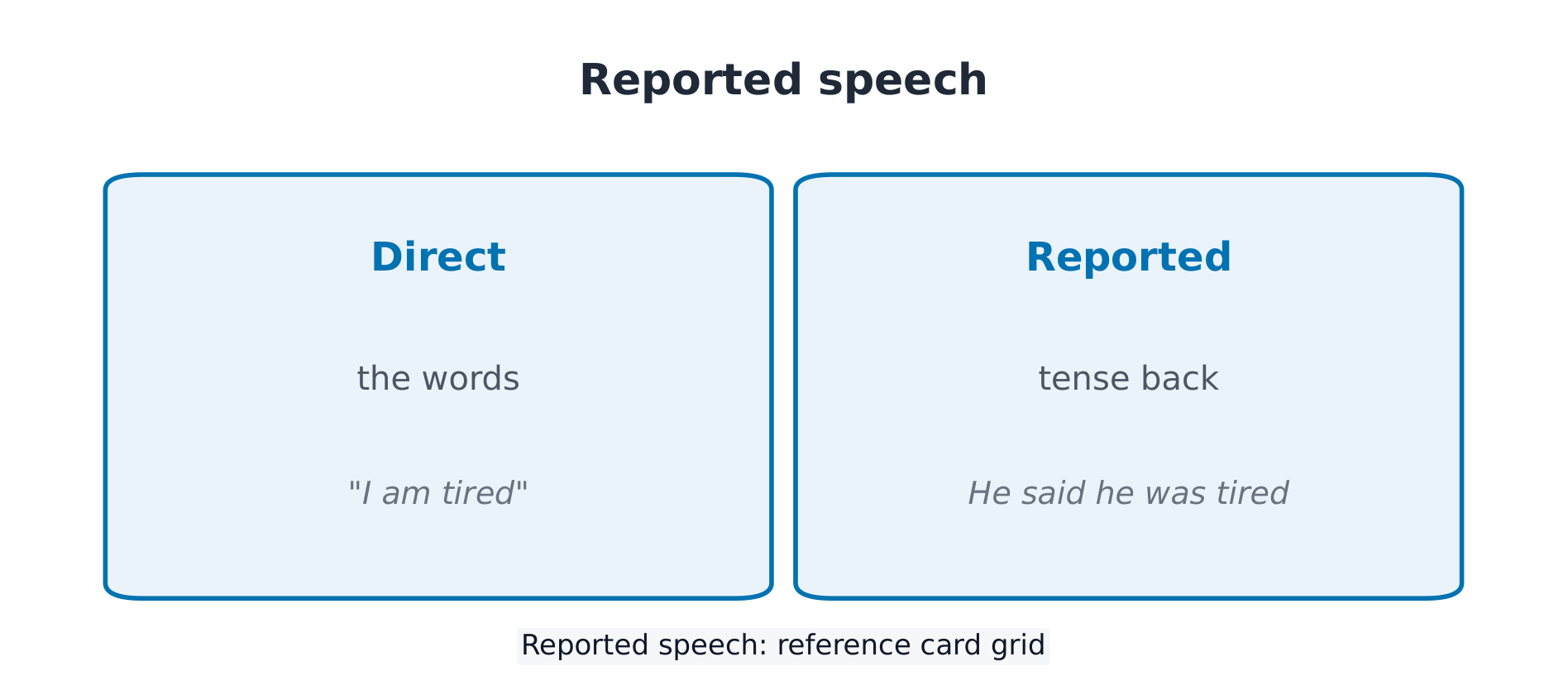
    He said he was tired. (Original quote: "I am tired.")

    Note that can be omitted: He said he was tired. The meaning remains the same.

    Português
    直接 → 间接引语

    Discurso indireto (reported speech) serve para relatar o que alguém disse, sem aspas. Usa-se frequentemente said ou told:

    • say não recebe o ouvinte:He said (that) …
    • tell precisa receber o ouvinte:He told me (that) …

    他He 说said (连词)that 他he (过去)was 累tired.

    Ele disse que estava cansado.(discurso original: "I am tired.")

    Atenção that pode ser omitido:He said he was tired. Significado idêntico.

    8.2

    时态后移

    English

    When reporting, if the reporting verb is in the past tense (said / told), the tense in the reported clause usually shifts back one step:

    • am / is → was; are → were; do / does → did.
    • will → would; can → could; present perfect / past simple → past perfect.

    Direct Speech: "I will help you," she said.

    Indirect Speech:

    她She 说said 她she 会would 帮help 我me.

    She said she would help me. (will → would, I → she, you → me)

    Pronouns and time expressions also change: I → he / she, now → then, today → that day, tomorrow → the next day.

    Note If reporting a general truth, tenses need not shift: He said the sun rises in the east.

    Common Errors

    • ❌ ~~He said me the truth.~~ / ~~He told that he was busy.~~ → ✓ He told me… / He said (that)… — say does not take a listener, tell must take a listener; this is the opposite of common mistakes.
    • ❌ ~~He asked me where did I live.~~ → ✓ He asked me where I lived. — Reported questions must change to statement word order, removing did.
    • ❌ ~~She asked me that I was hungry.~~ → ✓ She asked me if / whether I was hungry. — Report yes/no questions using if / whether, not that.
    • ❌ ~~He said he will come tomorrow.~~ → ✓ He said he would come the next day. — Tenses and time expressions must shift together.
    Português

    Ao relatar, se o verbo de citação estiver no passado(said / told), o tempo verbal da oração subordinada geralmente recua um passo:

    • am / is → was; are → were; do / does → did.
    • will → would; can → could; presente perfeito / passado simples → passado perfeito.

    Discurso direto:"I will help you," she said.(discurso original)

    间接引语:

    她She 说said 她she 会would 帮help 我me.

    Ela disse que me ajudaria.(will → would, I → she, you → me)

    Pessoas e palavras de tempo também mudam: I → he / she, now → then, today → that day, tomorrow → the next day.

    Atenção Se o que se relata for uma verdade universal, o tempo verbal pode não recuar:He said the sun rises in the east.

    常见错误

    • ❌ ~~He said me the truth.~~ / ~~He told that he was busy.~~ → ✓ He told me… / He said (that)… — say não recebe ouvinte, tell deve receber ouvinte, exatamente o oposto.
    • ❌ ~~He asked me where did I live.~~ → ✓ He asked me where I lived. — Perguntas relatadas devem voltar à ordem afirmativa, did desaparece.
    • ❌ ~~She asked me that I was hungry.~~ → ✓ She asked me if / whether I was hungry. — Perguntas sim/não relatadas usam if / whether, não that.
    • ❌ ~~He said he will come tomorrow.~~ → ✓ He said he would come the next day. — Tempo verbal e palavras de tempo devem recuar juntos.
  • 9 Relative clauses · ⁨Orações relativas⁩
    9.1

    who vs which / that

    English

    Relative clauses provide additional information about a preceding noun. They are introduced by relative pronouns:

    • who: refers to people.
    • which: refers to things.
    • that: refers to either people or things (common in informal speech).

    (冠词)The 女人woman (关系代词)who 住lives 隔壁next door 是is 一名a 医生doctor.

    The woman living next door is a doctor.

    这This 是is (冠词)the 书book (关系代词)which 获得won (冠词)the 奖prize.

    That is the award-winning book.

    Note Relative pronouns go immediately after the noun they refer to, introducing supplementary information.

    Português
    Conjunções relativas:who/which/where/whose

    Orações relativas (relative clauses) servem para complementar o substantivo anterior. Usam-se conjunções relativas para introduzi-las:

    • who: refere-se a pessoas.
    • which: refere-se a coisas.
    • that: pessoas ou coisas (comum na fala).

    (冠词)The 女人woman (关系代词)who 住lives 隔壁next door 是is 一名a 医生doctor.

    住在隔壁的那位女士是医生。

    这This 是is (冠词)the 书book (关系代词)which 获得won (冠词)the 奖prize.

    这就是那本获奖的书。

    注意 关系代词放在它所指的名词后面,引出补充信息。

    9.2

    where, when, whose

    English
    • where: refers to place. when: refers to time. whose: indicates possession ("'s").

    那是That's (冠词)the 镇town (在那里)where 我I 长大grew up.

    That is the town where I grew up.

    她是She's (冠词)the 作家writer (谁的)whose 书books 我I 喜爱love.

    She is the writer whose works I like.

    Note whose is followed directly by a noun (whose books), indicating "that person's books".

    Português
    • where: refere-se a lugar. when: refere-se a tempo. whose: indica posse("de alguém").

    那是That's (冠词)the 镇town (在那里)where 我I 长大grew up.

    那就是我长大的小镇。

    她是She's (冠词)the 作家writer (谁的)whose 书books 我I 喜爱love.

    她就是那位我喜欢其作品的作家。

    Atenção whose vem diretamente antes do substantivo(whose books), indicando "os livros daquela pessoa".

    9.3

    省略关系代词

    English

    When the relative pronoun acts as the object in the clause, it can be omitted (common in both speech and writing):

    (冠词)The 电影film 我们(that) we 看saw (是)was 很棒great.

    The movie (that) we watched was great.

    How to decide:

    • If the relative pronoun is the subject (followed immediately by a verb) → cannot omit.
    • If the relative pronoun is the object (followed by "subject + verb") → can omit.

    Note Must be retained when acting as subject: the man who called (cannot omit who).

    Common Errors

    • ❌ ~~The man which lives next door…~~ → ✓ The man who / that… — Do not use which for people.
    • ❌ ~~The book what I read…~~ → ✓ The book that / which I read… — English has no usage of what as a relative pronoun.
    • ❌ ~~This is the house which I live.~~ → ✓ …the house where I live / …the house which I live in. — When the clause lacks a preposition, either use where or supply the missing preposition.
    • ❌ ~~The friend who I met him yesterday…~~ → ✓ The friend who I met yesterday… — Since the relative pronoun already replaces the object, him / it cannot appear again in the clause.
    Português

    当关系代词在从句里作宾语时,可以省略(口语和写作都常见):

    (冠词)The 电影film 我们(that) we 看saw (是)was 很棒great.

    O filme que vimos era ótimo.(that pode ser omitido)

    判断方法:

    • 关系代词作主语(后面紧跟动词)→ 不能省略。
    • 关系代词作宾语(后面跟"主语 + 动词")→ 可以省略。

    Atenção Quando funciona como sujeito, deve ser mantido:the man who called(não se pode omitir who).*

    常见错误

    • ❌ ~~The man which lives next door…~~ → ✓ The man who / that… — Para pessoas, não se usa which.
    • ❌ ~~The book what I read…~~ → ✓ The book that / which I read… — Em inglês, what não funciona como conjunção relativa.
    • ❌ ~~This is the house which I live.~~ → ✓ …the house where I live / …the house which I live in. — Quando falta preposição na oração, ou usa-se where, ou restaura-se o in.
    • ❌ ~~The friend who I met him yesterday…~~ → ✓ The friend who I met yesterday… — A conjunção relativa já substitui o objeto; não se pode repetir him / it na oração.
  • 10 Modals of deduction
    10.1

    must vs can't(dedução certa)

    English

    Modal verbs can also express deduction. When you are very certain:

    • must: must be (definite positive deduction).
    • can't: can't be (definite negative deduction).

    她She 一定must 是be 累tired.

    She must be very tired. (Very certain)

    他He 不可能can't 是be 饿hungry 他; he 刚just 吃ate.

    He can't be hungry; he just ate.

    Note Use can't for negative deduction (impossible), not mustn't (which means "prohibited").

    Português
    推测情态动词:确定程度

    情态动词也能表示推测。当你很确定时:

    • must: deve ser (dedução afirmativa certa).
    • can't: não pode ser (dedução negativa certa).

    她She 一定must 是be 累tired.

    她一定很累。(很确定)

    他He 不可能can't 是be 饿hungry 他; he 刚just 吃ate.

    他不可能饿,他刚吃过。

    Atenção Para dedução negativa usa-se can't(impossível), não mustn't(que significa "proibido").

    10.2

    might, may, could(possibilidade)

    English

    When you are not entirely sure, but only feel that something is possible:

    • might / may / could: possible, perhaps.

    (天气it)It 可能might 下雨rain 稍后later.

    It might rain later.

    他们They 可能may 在be (在)at 家home.

    They might be at home.

    Degree of Certainty Comparison:

    • Very certain: must (is) / can't (is not).
    • Uncertain: might / may / could (possible).

    Note All these modal verbs are followed by the base form of the verb: might be, must be (not might is).

    Common Errors

    • ❌ ~~It can be John at the door.~~ → ✓ It could / might be John. — Use could / might for speculation about a specific instance; can only indicates "general possibility."
    • ❌ ~~He might not can come.~~ → ✓ He might not be able to come. — Two modal verbs cannot be used together; replace the second with be able to / have to.
    • ❌ ~~Maybe he be late. / It may be rain.~~ → ✓ Maybe he is late. / It may rain. — maybe is an adverb and follows normal sentence structure; may is a modal verb and is followed by the base form. Do not mix them up.
    • ❌ ~~She must is tired.~~ → ✓ She must be tired. — A modal verb is always followed by the base form of the verb.
    Português

    当你不太确定、只是觉得有可能时:

    • might / may / could: pode, talvez.

    (天气it)It 可能might 下雨rain 稍后later.

    待会儿可能会下雨。

    他们They 可能may 在be (在)at 家home.

    他们可能在家。

    确定程度对照:

    • Alta certeza:must(é)/ can't(não é).
    • Baixa certeza:might / may / could(pode ser).

    Atenção Todos esses verbos modais são seguidos pelo infinitivo:might be, must be(não might is).

    常见错误

    • ❌ ~~It can be John at the door.~~ → ✓ It could / might be John. — Para deduções sobre uma situação específica, usa-se could / might; can indica apenas "possibilidade geral".
    • ❌ ~~He might not can come.~~ → ✓ He might not be able to come. — Dois verbos modais não podem vir juntos; substitua o segundo por be able to / have to.
    • ❌ ~~Maybe he be late. / It may be rain.~~ → ✓ Maybe he is late. / It may rain. — maybe 是副词,句子照常;may 是情态动词,后接原形。两个别搅在一起。
    • ❌ ~~She must is tired.~~ → ✓ She must be tired. — 情态动词后面永远是动词原形。
  • 11 Gerunds and infinitives · ⁨Gerundivos e infinitivos⁩
    11.1

    动词 + -ing

    English

    Some verbs are followed by a gerund (verb-ing). Common examples include: enjoy, like, love, hate, finish, stop, mind, suggest, avoid.

    我I 喜欢enjoy 阅读reading.

    I enjoy reading.

    她She 完成finished 做doing 她的her 作业homework.

    She finished her homework.

    Note A gerund functions as a noun; its form is verb-ing.

    Português
    动词后:-ing 还是 to

    有些动词后面要跟动名词(动词-ing)。常见的有:enjoy、like、love、hate、finish、stop、mind、suggest、avoid。

    我I 喜欢enjoy 阅读reading.

    我喜欢阅读。

    她She 完成finished 做doing 她的her 作业homework.

    她做完了作业。

    注意 动名词 (gerund) 是动词当名词用,形式是动词-ing。

    11.2

    动词 + 不定式

    English

    Other verbs are followed by an infinitive (to + base form). Common examples include: want, need, decide, hope, promise, learn, would like, plan.

    我I 想want (不定式)to 学learn 英语English.

    I want to learn English.

    他们They 决定decided (不定式)to 留下stay.

    They decided to stay.

    Note Some verbs accept both forms with similar meanings: like, love, start, begin. I like swimming. = I like to swim.

    Português

    另一些动词后面要跟不定式(to + 动词原形)。常见的有:want、need、decide、hope、promise、learn、would like、plan。

    我I 想want (不定式)to 学learn 英语English.

    我想学英语。

    他们They 决定decided (不定式)to 留下stay.

    他们决定留下来。

    注意 有些动词两者都行,意思相近:like、love、start、begin。I like swimming. = I like to swim.

    11.3

    介词后用 -ing

    English

    After a preposition (in, on, at, of, about, for, good at, interested in…), the verb must take the -ing form:

    她She's 擅长good at 画画drawing.

    She is good at painting.

    谢谢Thank you 因为for 帮助helping 我me.

    Thank you for helping me.

    Note The base form of a verb never follows a preposition: ~~good at draw~~ ✗ → good at drawing ✓.

    Common Errors

    • ❌ ~~I enjoy to read.~~ / ~~I want reading.~~ → ✓ I enjoy reading. / I want to read. — Which verb takes which form is fixed; memorize the collocations, do not swap them.
    • Distinguish the two meanings of stop: He stopped smoking. (Quit smoking) vs. He stopped to smoke. (Stopped what he was doing to go smoke)— The meanings are completely different.
    • ❌ ~~I look forward to see you.~~ → ✓ I look forward to seeing you. — Here, to is a preposition and is followed by -ing.
    • ❌ ~~Swim is good exercise.~~ → ✓ Swimming is good exercise. — When a verb acts as the subject, use the -ing form.
    Português

    在介词(in、on、at、of、about、for、good at、interested in…)后面,动词要用 -ing 形式:

    她She's 擅长good at 画画drawing.

    她擅长画画。

    谢谢Thank you 因为for 帮助helping 我me.

    谢谢你帮我。

    注意 介词后绝不跟动词原形:~~good at draw~~ ✗ → good at drawing ✓。

    常见错误

    • ❌ ~~I enjoy to read.~~ / ~~I want reading.~~ → ✓ I enjoy reading. / I want to read. — 哪个动词接哪种形式是固定的,背搭配,别互换。
    • 区分 stop 的两种意思:He stopped smoking.(戒烟了)vs He stopped to smoke.(停下手头的事去抽烟)— 意思完全不同。
    • ❌ ~~I look forward to see you.~~ → ✓ I look forward to seeing you. — 这里的 to 是介词,后面接 -ing。
    • ❌ ~~Swim is good exercise.~~ → ✓ Swimming is good exercise. — 动词作主语要用 -ing 形式。
  • 12 too, enough, so, such
    12.1

    too 与 enough

    English

    too and enough indicate degree, but their position and meaning differ:

    • too + adjective = "too..." (negative excess), placed before the adjective.
    • enough = "sufficient," placed after the adjective and before the noun.

    这This 咖啡coffee 是is 太too 烫hot.

    This coffee is too hot.

    他He 不够isn't 大old 足够enough (不定式)to 开车drive.

    He isn't old enough to drive.

    Note enough comes after the adjective (old enough) but before the noun (enough money).

    Português
    too 与 enough

    too 和 enough 表示程度,但位置和含义不同:

    • too + 形容词 = "太……了"(否定的过度),放在形容词前。
    • enough = "足够",放在形容词后、名词前。

    这This 咖啡coffee 是is 太too 烫hot.

    这咖啡太烫了。

    他He 不够isn't 大old 足够enough (不定式)to 开车drive.

    他还不够大,不能开车。

    注意 enough 放在形容词后(old enough),但放在名词前(enough money)。

    12.2

    so 与 such

    English

    so and such both mean "so / such," used to intensify the tone:

    • so + adjective / adverb: so hot, so quickly.
    • such + (a/an) + (adjective) + noun: such a hot day.

    (冠词)The 电影film (是)was 如此so 无聊boring.

    That movie was so boring.

    (这)It 是was 如此such 一个a 好good 主意idea.

    That was really such a good idea.

    Note Follow so with an adjective (so good); follow such with a noun phrase (such a good idea).

    Common Errors

    • ❌ To praise "very happy" but say ~~I'm too happy!~~ → ✓ I'm so happy! — too carries a negative connotation ("excessively, to the point of being bad"); use so for praise and exclamation.
    • ❌ ~~The box is too much heavy.~~ → ✓ The box is much too heavy. — To intensify too, use much too; the word order is much first.
    • ❌ ~~The tea is too hot to drink it.~~ → ✓ The tea is too hot to drink. — In the too…to structure, the sentence subject serves as the object of drink, so do not write it.
    • ❌ ~~It was so a good idea.~~ → ✓ It was such a good idea. / The idea was so good. — If there is a noun, switch to such.
    Português

    so 和 such 都表示"如此 / 那么",用来加强语气:

    • so + 形容词 / 副词:so hot,so quickly。
    • such + (a/an) + (形容词) + 名词:such a hot day。

    (冠词)The 电影film (是)was 如此so 无聊boring.

    那部电影太无聊了。

    (这)It 是was 如此such 一个a 好good 主意idea.

    那真是个好主意。

    注意 so 后面跟形容词(so good),such 后面跟名词词组(such a good idea)。

    常见错误

    • ❌ 想夸"太开心了"却说 ~~I'm too happy!~~ → ✓ I'm so happy! — too 自带否定含义("过头了,以至于不行"),夸奖和感叹用 so。
    • ❌ ~~The box is too much heavy.~~ → ✓ The box is much too heavy. — 加强 too 用 much too,语序是 much 在前。
    • ❌ ~~The tea is too hot to drink it.~~ → ✓ The tea is too hot to drink. — too…to 结构里,句子主语就是 drink 的宾语,不再写 it。
    • ❌ ~~It was so a good idea.~~ → ✓ It was such a good idea. / The idea was so good. — 带名词就换 such。

Log in or create account · ⁨Entrar ou criar conta⁩

IGCSE, A-Level & AP