| Central | Suplementar |
|---|---|
| 1 Informar as funções do xilema e do floema: (a) xilema – transporte de água e íons minerais, e suporte (b) floema – transporte de sacarose e aminoácidos | 3 Relacionar a estrutura dos vasos do xilema com sua função, limitados a: (a) paredes espessas com lignina (detalhes da lignificação não são necessários) (b) ausência de conteúdo celular (c) células unidas ponta a ponta sem paredes transversais para formar um tubo longo e contínuo |
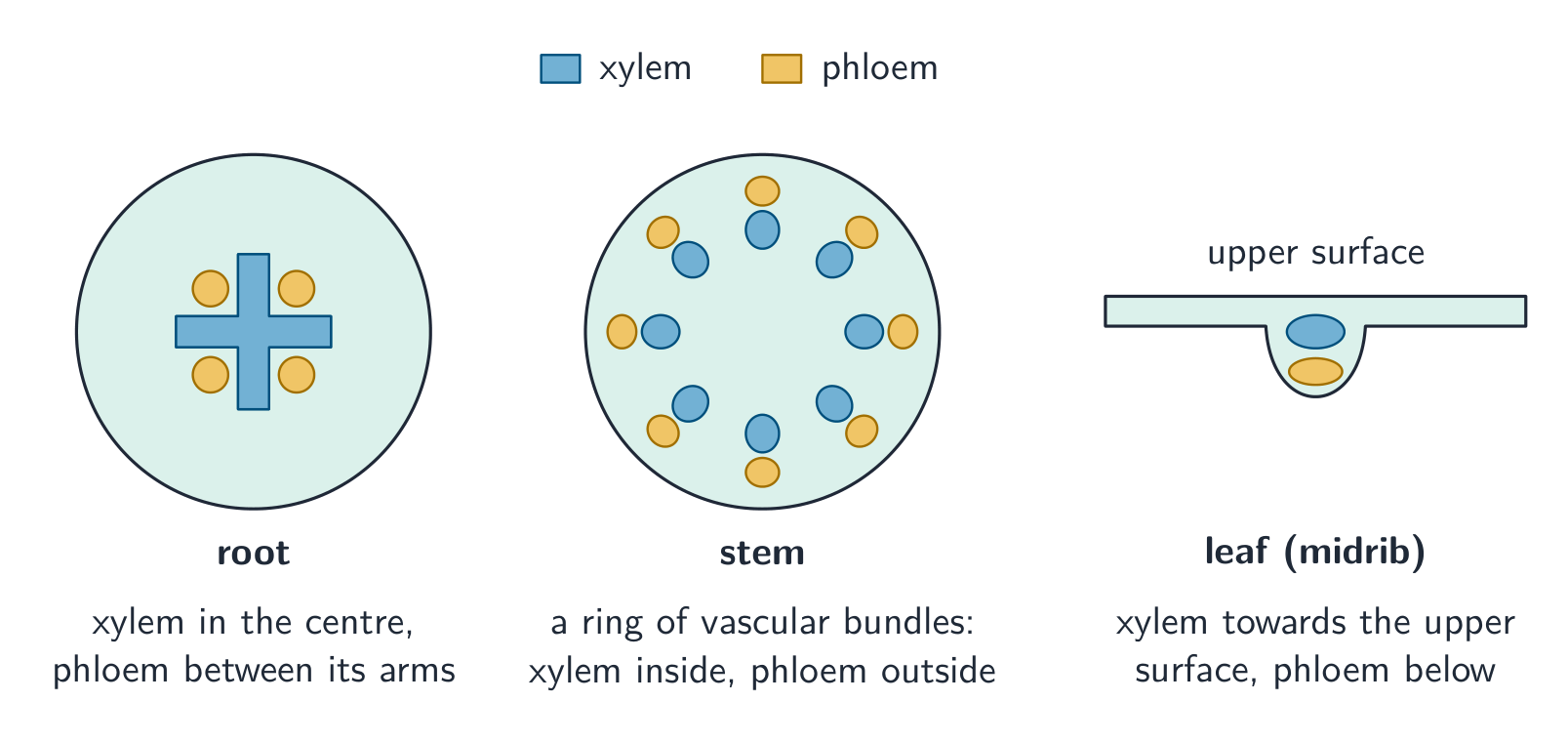
| 2 Identificar em diagramas e imagens a posição do xilema e do floema vistos em secções de raízes, caules e folhas de plantas dicotiledôneas lenhosas não-woody |
Transporte em plantas
Biologia IGCSE · Tópico 8
 5:54
Transporte em Plantas
Uma árvore alta levanta água cem metros para o ar, todos os dias, sem bomba e sem peças móveis. Ela faz isso usando apenas evaporação de suas folhas…
Narração em inglês · legendas em inglês e 中文 que você pode alternar
8.1
Xilema e floema
Programa
Fonte: Programa Cambridge International
English
Plants have two transport tissues that run through the roots, stems and leaves:
- xylem 木质部 — carries water and mineral ions 矿物质离子 up from the roots, and gives the plant support 支撑.
- phloem 韧皮部 — carries sucrose 蔗糖 and amino acids 氨基酸 to wherever they are needed.
In a root, stem or leaf, the xylem and phloem lie side by side in vascular bundles 维管束.
Exams show a section through a root, stem or leaf and ask you to identify the xylem and the phloem. Learn where each one lies:
- root: the xylem is in the centre, often in an X or star shape; the phloem lies in the gaps between its arms. A central core resists the pulling force as the root anchors the plant.
- stem: the vascular bundles form a ring near the outside; in each bundle the xylem is on the inside (towards the centre) and the phloem on the outside. This ring helps the stem resist bending.
- leaf: in the midrib and veins, the xylem is towards the upper surface and the phloem towards the lower surface.
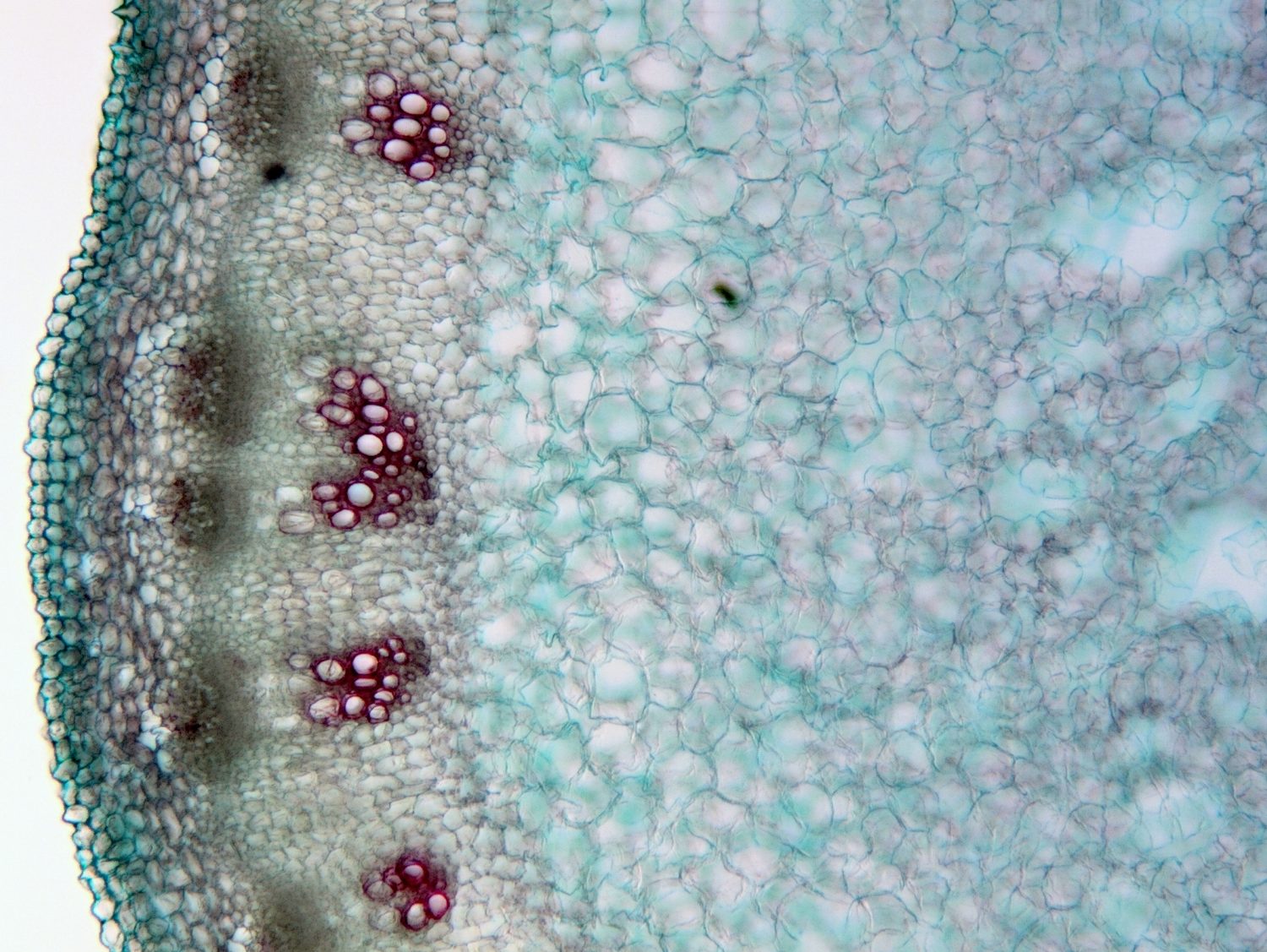
In a photograph, the xylem vessels are the cells with the widest openings and the thickest walls; stains such as the red in the stem section below colour the lignin in their walls.
Xylem structure (Supplement)
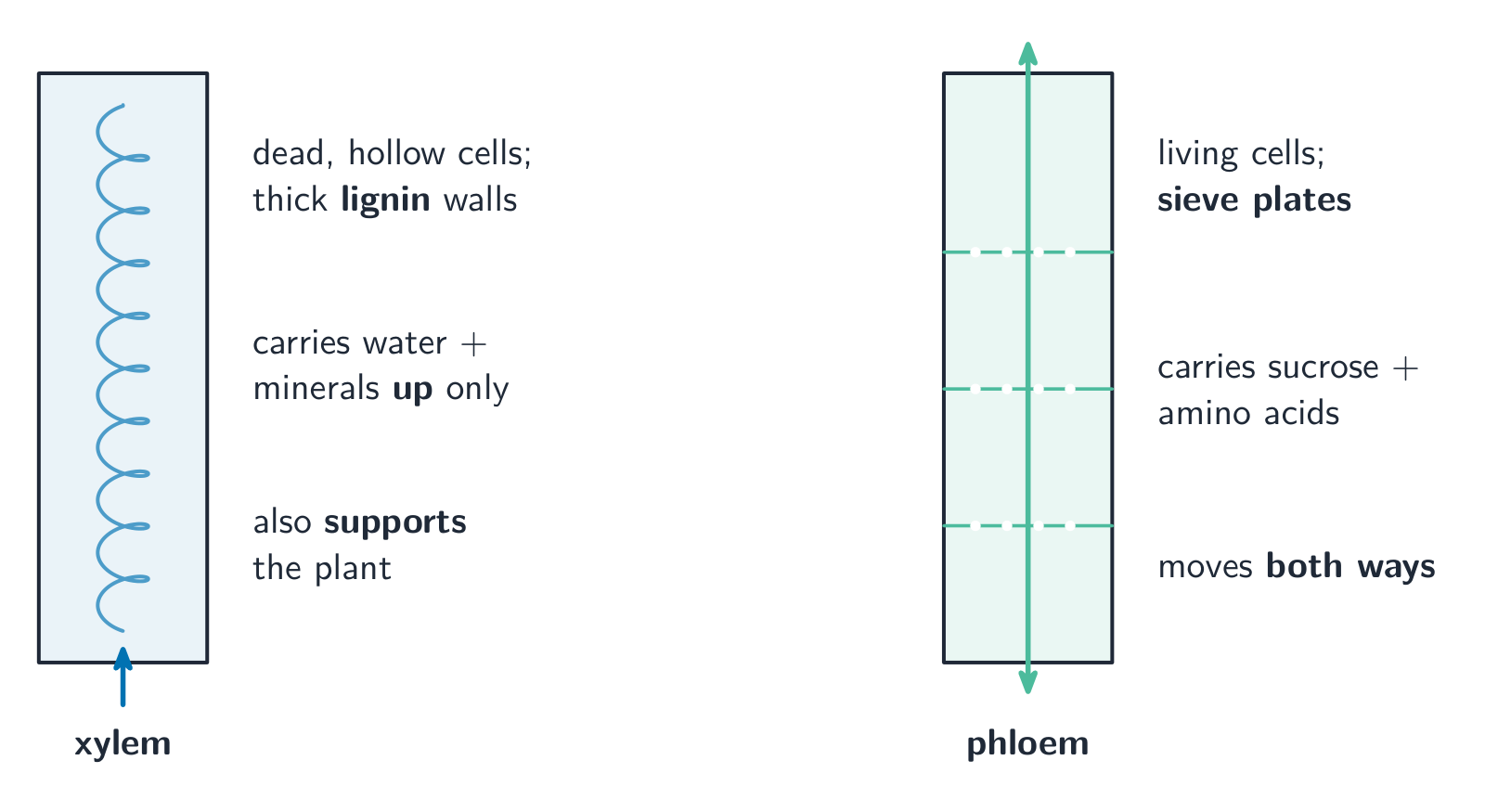
Xylem is made of long tubes called vessels 导管, well suited to carrying water:
- their walls are thick and strengthened with lignin 木质素, which also helps support the plant.
- the cells are dead and empty (they have no cell contents), so water flows through freely.
- the cells are joined end to end with no walls across the tube, making one long, continuous pipe.
Explorar
Rota de xilema e floema
Assista a água e açúcar se moverem através de diferentes tecidos de transporte vegetal.
Vocabulário
Treinar
| English | Português |
|---|---|
| xylem/ˈzaɪləm/ | xilema |
| mineral ions/ˈmɪnərəl ˈaɪɒnz/ | íons minerais |
| support/səˈpɔːt/ | suporte |
| phloem/ˈfləʊɪm/ | floema |
| sucrose/ˈsuːkrəʊs/ | sacarose |
| amino acids/əˈmiːnəʊ ˈæsɪdz/ | aminoácidos |
| vascular bundles/ˈvæskjʊlə ˈbʌndlz/ | feixes vasculares |
| vessels/ˈveslz/ | vasos |
| lignin/ˈlɪɡnɪn/ | lignina |
8.2
Absorção de água
Programa
| Central | Suplementar |
|---|---|
| 1 Identificar em diagramas e imagens células pilosas radiculares e informar suas funções | |
| 2 Informar que a grande área de superfície das pilosidades radiculares aumenta a captação de água e íons minerais | |
| 3 Esboçar o trajeto percorrido pela água através da raiz, caule e folha como: células pilosas radiculares, células do córtex radicular, xilema, células do mesofilo | |
| 4 Investigar, usando um corante adequado, o trajeto da água através das partes aéreas de uma planta |
Fonte: Programa Cambridge International
English
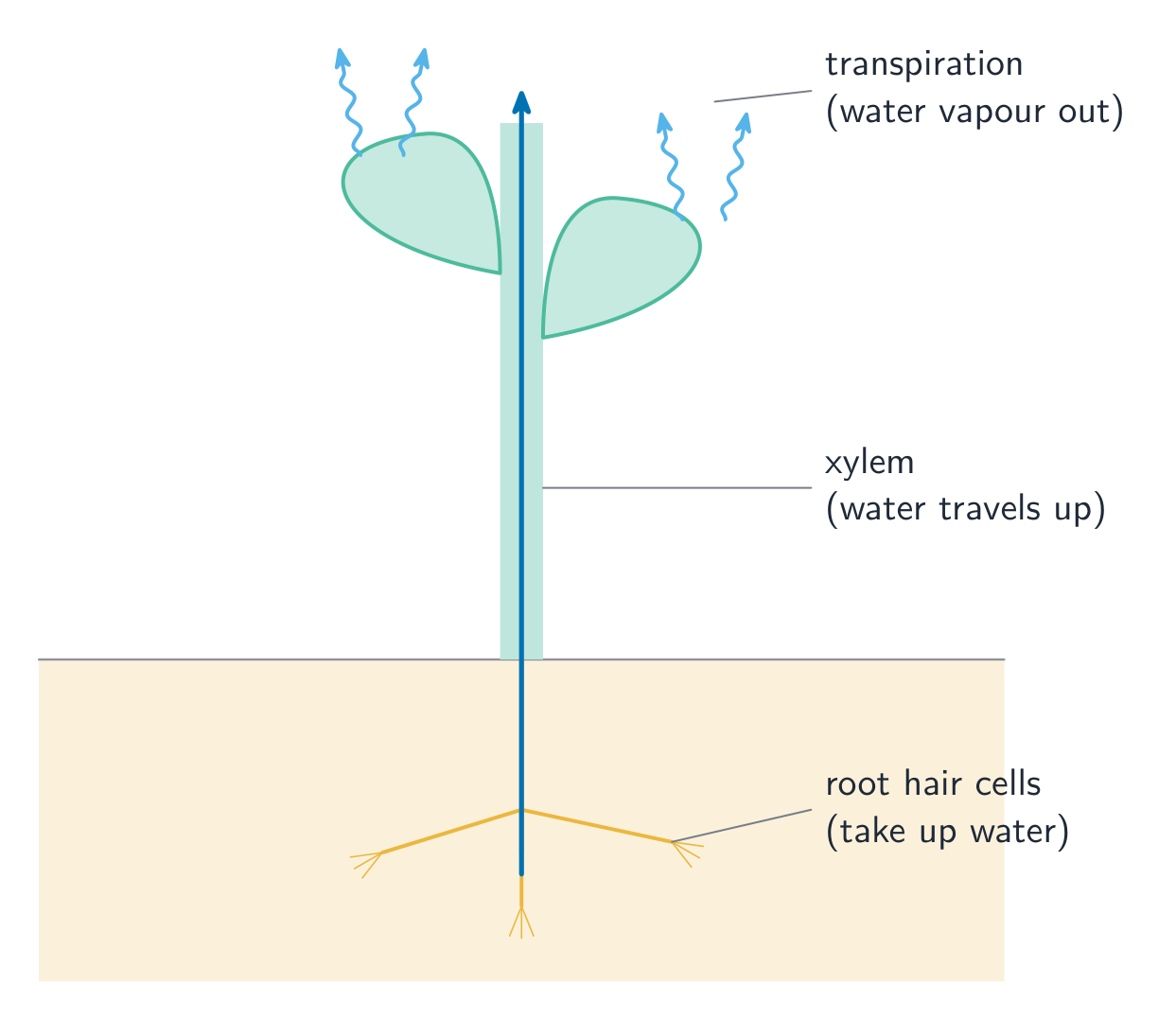
Water and mineral ions enter the plant through root hair cells 根毛细胞. The huge number of root hairs 根毛 gives a very large surface area 表面积, which speeds up the uptake of water and mineral ions.
The water then follows this pathway:
root hair cells → root cortex 皮层 cells → xylem → mesophyll 叶肉 cells in the leaf.
You can show this pathway by standing a plant or a white flower in water that contains a coloured stain 染色剂. The stain is carried up the xylem and colours the veins.
Investigating the pathway. Stand a celery stalk with leaves in water containing a dye (such as food colouring or eosin) for a few hours, in a warm, bright place so that transpiration is fast. Cut thin slices across the stalk and look at them with a hand lens: only small dots near the edge, the xylem in the vascular bundles, are coloured. The leaf veins also become coloured. This shows that water travels up the stem in the xylem and out into the leaves.
Explorar
Absorção de água pelos pelos radiculares
As células dos pelos radiculares absorvem água por osmose — a água move-se do solo diluído para a célula mais concentrada.
Vocabulário
Treinar
| English | Português |
|---|---|
| root hair cells/ruːt heə selz/ | células pilosas radiculares |
| root hairs/ruːt heəz/ | pelos radiculares |
| surface area/ˈsɜːfɪs ˈeərɪə/ | área de superfície |
| cortex/ˈkɔːteks/ | córtex |
| mesophyll/ˈmesəfɪl/ | parênquima |
| stain/steɪn/ | corante |
8.3
Transpiração
Programa
| Central | Suplementar |
|---|---|
| 1 Descrever a transpiração como a perda de vapor d'água das folhas | |
| 2 Informar que a água evapora das superfícies das células do mesofilo para os espaços aéreos e, em seguida, difunde-se para fora das folhas através dos estômatos como vapor d'água | |
| 4 Explique como a perda de vapor de água está relacionada: à grande área de superfície interna fornecida pelos espaços aéreos interconectados entre as células do mesófilo e ao tamanho e número dos estômatos | |
| 5 Explique o mecanismo pelo qual a água se move para cima no xilema em termos de uma sucção transpiratória que puxa uma coluna de moléculas de água, mantidas juntas por forças de atração entre as moléculas de água | |
| 3 Investigar e descrever os efeitos da variação de temperatura e velocidade do vento na taxa de transpiração | 6 Explicar os efeitos sobre a taxa de transpiração da variação dos seguintes fatores: temperatura, velocidade do vento e umidade |
| 7 Explicar como e por que ocorre o murchamento |
Fonte: Programa Cambridge International
English
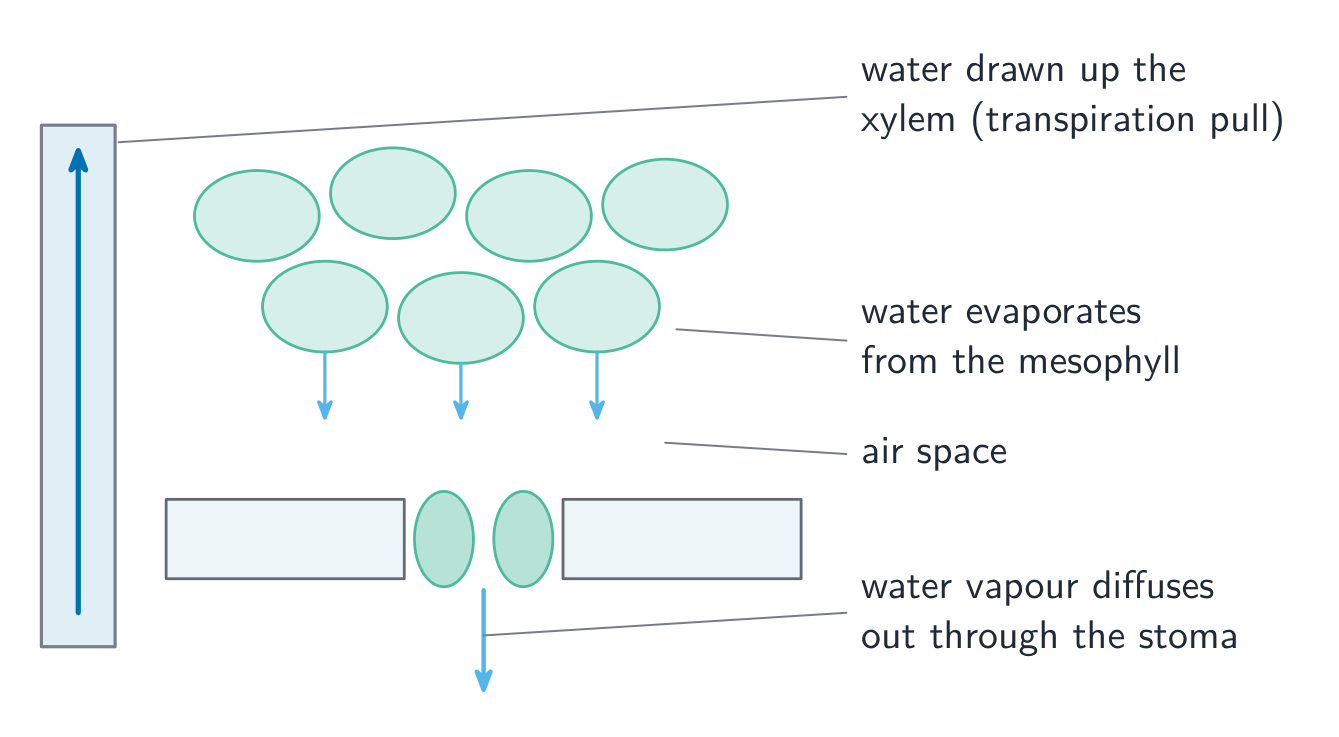
Transpiration 蒸腾作用 is the loss of water vapour 水蒸气 from the leaves.
- Water evaporates 蒸发 from the wet surfaces of the mesophyll cells into the air spaces 气腔 inside the leaf.
- The water vapour then diffuses 扩散 out of the leaf through the stomata 气孔.
(Supplement) The structure of the leaf makes this loss large. The mesophyll cells are surrounded by interconnecting air spaces, which give a very large internal surface area for water to evaporate from. The more stomata there are, and the wider they are open, the faster water vapour diffuses out. Most stomata are on the lower surface, which is cooler and shaded, and the stomata close at night or when the plant is short of water, which cuts water loss.
What changes the rate of transpiration
| Factor | Transpiration is faster when… | Why |
|---|---|---|
| temperature 温度 | it is hotter | water evaporates faster |
| wind speed 风速 | it is windier | wind carries the water vapour away |
| humidity 湿度 (Supplement) | the air is drier | a bigger difference makes water diffuse out faster |
(Supplement) Explaining the factors. Give the full reason:
- temperature: water molecules have more kinetic energy, so more water evaporates from the mesophyll cells and the vapour diffuses out faster.
- wind speed: the wind carries away the water vapour just outside the stomata, so the concentration gradient 浓度梯度 of water vapour between the air spaces and the outside air stays steep.
- humidity: humid air already holds a lot of water vapour, so the concentration gradient between the inside and the outside of the leaf is smaller and diffusion is slower.
Investigating temperature and wind speed. Use a potometer (below). Measure how far the bubble moves in a fixed time, for example 5 minutes, then change one factor: place the shoot at different distances from a fan (or use the fan at different speeds) for wind speed, or put it in rooms or by a heater at different temperatures, checked with a thermometer. Keep the other factors constant: the same shoot, light intensity and humidity. Repeat each reading and find a mean. Reset the bubble each time using the reservoir.
A potometer 蒸腾计 measures how fast a leafy shoot takes up water. The shoot is sealed into a tube full of water; as the leaves lose water by transpiration, the shoot draws water along a thin capillary tube, and an air bubble in the tube moves towards the shoot. The distance the bubble moves in a measured time gives the rate.
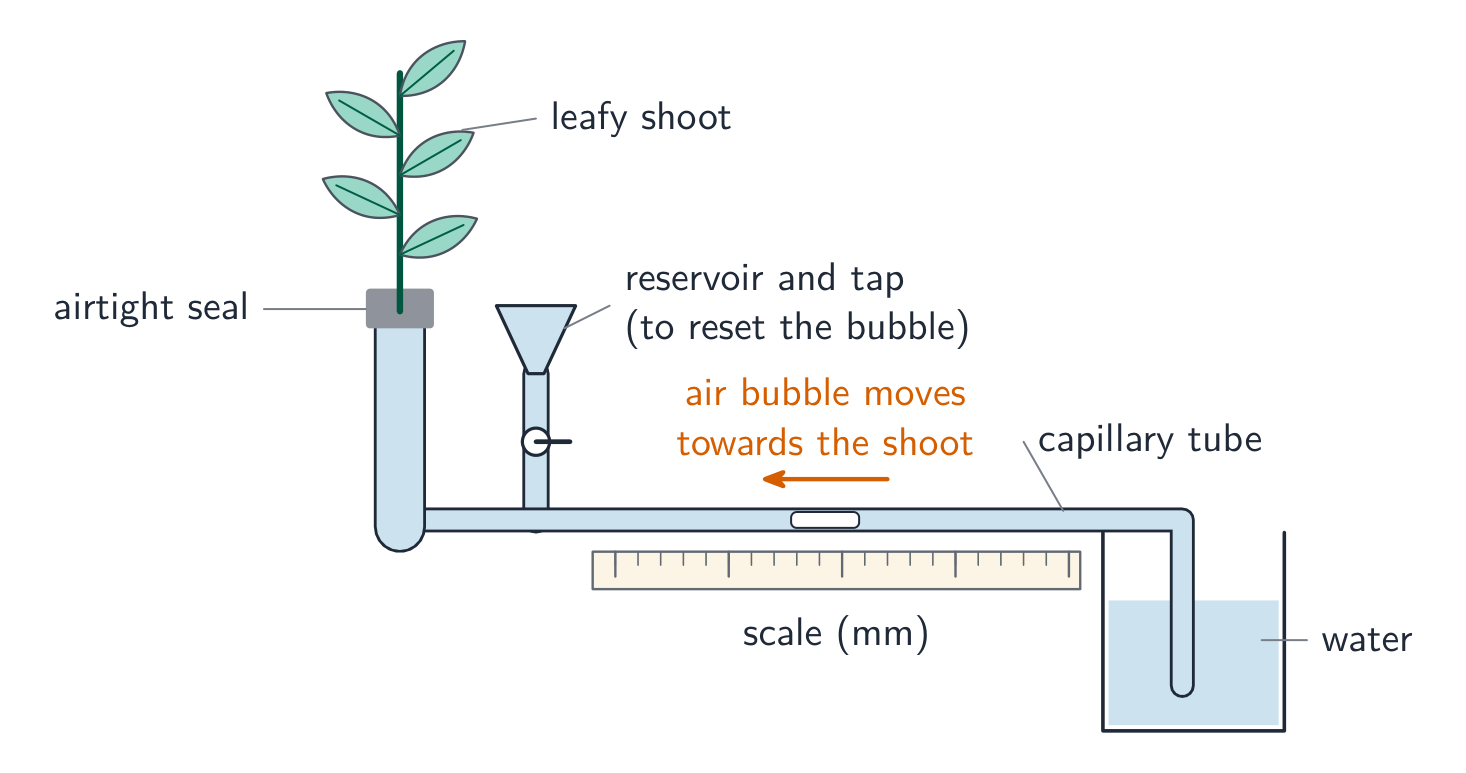
Worked example. In a potometer the air bubble moves 60 mm in 5 minutes. Find the rate of water uptake, and say what happens when a fan is switched on. Rate = distance ÷ time = 60 ÷ 5 = 12 mm per minute. Always give a rate its full unit, "mm per minute", not just "12". A fan raises the wind speed, which carries water vapour away from the leaf, so transpiration speeds up and the bubble moves further in the same 5 minutes.
How water rises up the xylem (Supplement)
As water vapour leaves the leaf, it pulls more water up behind it. This pull is called the transpiration pull 蒸腾拉力. The water molecules stick to one another by forces of attraction 吸引力, so they are drawn up the xylem together as one long column 水柱 of water.
Wilting (Supplement)
If a plant loses water faster than it can take it up, its cells become soft and the plant wilts 萎蔫 — the leaves and stem droop. This often happens on a hot, dry, windy day.
The reason is turgor 膨压. Normally the vacuoles are full of water, which pushes the cytoplasm and cell membrane outwards against the cell wall; the cells are turgid 膨胀 (firm), and they press against each other and hold the plant upright. When more water is lost by transpiration than enters the roots, water leaves the cells by osmosis. The vacuoles shrink, the cells become flaccid 松软 (soft) and no longer support the leaves and stem, so the plant wilts. Wilting also helps the plant: the drooping leaves expose less surface to the sun, and the stomata close, so less water is lost. Watering the plant, or a cool night, lets the cells take up water again and become turgid.
Explorar
A corrente transpiratória
A água é puxada para cima na planta em um fluxo contínuo, das raízes até as folhas, onde evapora.
Vocabulário
Treinar
| English | Português |
|---|---|
| transpiration/trænspəˈreɪʃn/ | transpiração |
| water vapour/ˈwɔːtə ˈveɪpə/ | vapor de água |
| evaporates/ɪˈvæpəreɪts/ | evapora |
| air spaces/eə ˈspeɪsɪz/ | espaços aéreos |
| diffuses/dɪˈfjuːzɪz/ | difunde |
| stomata/ˈstəʊmətə/ | estômatos |
| temperature/ˈtemprɪtʃə/ | temperatura |
| wind speed/wɪnd spiːd/ | velocidade do vento |
| humidity/hjuːˈmɪdɪti/ | umidade |
| concentration gradient/ˌkɒnsənˈtreɪʃn ˈɡreɪdɪənt/ | A change in a substance's concentration across a distance or between regions. |
| potometer/pəˈtɒmɪtə/ | potômetro |
| transpiration pull/trænspəˈreɪʃn pʊl/ | tração da transpiração |
| forces of attraction/ˈfɔːsɪz ɒv əˈtrækʃn/ | forças de atração |
| column/ˈkɒlʌm/ | coluna |
| wilts/wɪlts/ | murcha |
| turgor/ˈtɜːɡə/ | Pressure exerted by a cell's contents against its cell wall after water enters the cell. |
| turgid/ˈtɜːdʒɪd/ | Describing a plant cell swollen and firm because water entering by osmosis produces pressure against its cell wall. |
| flaccid/ˈflæsɪd/ | Describes a plant cell or plant that has lost water and gone soft. |
8.4
Translocation (Supplement)
Programa
| Central | Suplementar |
|---|---|
| 1 Descrever a translocação como o movimento de sacarose e aminoácidos no floema de fontes para sumidouros | |
| 2 Descrever: (a) fontes como as partes das plantas que liberam sacarose ou aminoácidos (b) sumidouros como as partes das plantas que usam ou armazenam sacarose ou aminoácidos | |
| 3 Explicar por que algumas partes de uma planta podem atuar como fonte e sumidouro em momentos diferentes |
Fonte: Programa Cambridge International
English
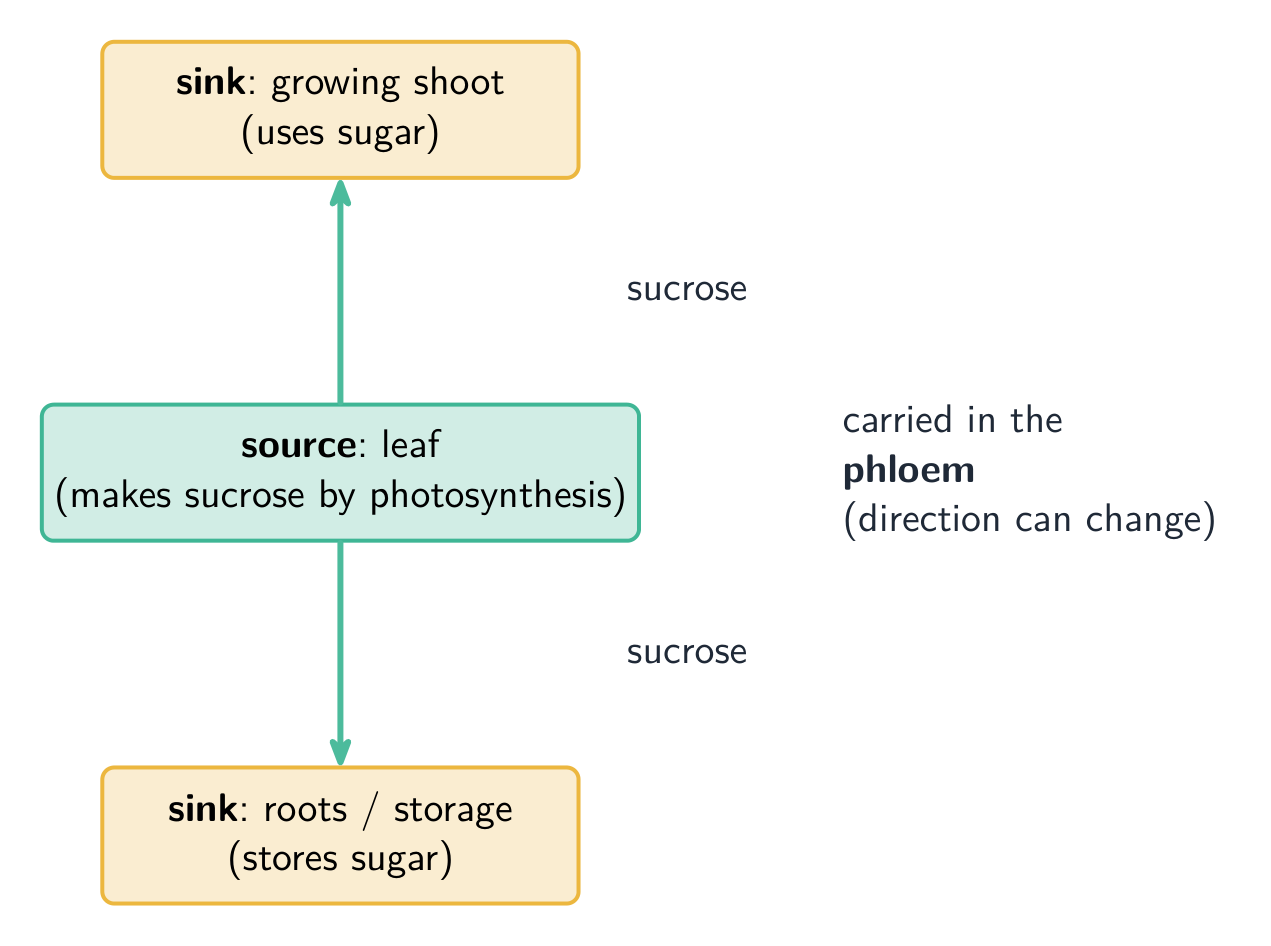
Translocation 转运 is the movement of sucrose and amino acids in the phloem, from sources 源 to sinks 库.
- sources are the parts that release sucrose or amino acids — for example the leaves, which make sugar by photosynthesis.
- sinks are the parts that use or store them — for example growing roots, or a storage organ.
The same part of a plant can be a sink at one time and a source at another. A potato tuber is a sink in summer, when sucrose arrives from the leaves and is stored as starch. In spring, before the new shoots have leaves, the starch is broken down to sucrose and sent to the growing shoots: now the tuber is a source. In the same way, a young leaf is a sink while it grows, and becomes a source once it is photosynthesising more than it needs. This is why phloem can carry sucrose upwards or downwards, unlike xylem.
Common mistakes.
- Saying transpiration is the loss of water through the stomata. Be exact: water evaporates from the mesophyll cell surfaces into the air spaces, and then water vapour diffuses out through the stomata.
- Saying root hairs take up water by active transport 主动运输. Water enters by osmosis 渗透; only mineral ions can need active transport.
- Saying humid air speeds up transpiration. More humid air means a smaller difference in water vapour between the leaf and the air, so transpiration is slower.
- Saying a potometer measures transpiration directly. It measures water uptake; a little of the water taken up is used in the plant (for example in photosynthesis), so uptake is only close to the transpiration rate.
- Saying xylem carries sugar, or that phloem carries water up from the roots. Xylem: water and mineral ions, upward. Phloem: sucrose and amino acids, from source to sink, up or down.
- Giving a rate as a bare number. A bubble that moves 60 mm in 5 minutes gives 12 mm per minute, not "12".
Explorar
Translocação no floema
O floema transporta açúcares dissolvidos de onde são produzidos (a fonte) até onde são usados ou armazenados (o sumidouro).
Vocabulário
Treinar
| English | Português |
|---|---|
| translocation/trænsləʊˈkeɪʃn/ | translocação |
| sources/ˈsɔːsɪz/ | fontes |
| sinks/sɪŋks/ | sumidouros |
| active transport/ˈæktɪv ˈtrænspɔːt/ | transporte ativo |
| osmosis/ɒzˈməʊsɪs/ | osmose |
8.4
Dicas para a prova
English
- Xylem: water and mineral ions, upward only, plus support — its cells are dead, with thick lignin walls. Phloem: sucrose and amino acids, in living cells.
- Learn the water pathway: root hair cell → cortex → xylem → mesophyll.
- Transpiration = evaporation from the mesophyll, then diffusion out of the stomata. It is faster when hotter, windier or drier.
- Water rises by the transpiration pull; the water molecules hold together as a column.
- Translocation goes from a source (where sugar is made or stored) to a sink (where it is used). The direction can change with the season.
- To identify the tissues in a section: root — xylem in the centre; stem — bundles in a ring, xylem inside and phloem outside; leaf — xylem above, phloem below.
- (Supplement) Explain wilting with osmosis and turgor: water leaves the cells, they become flaccid, and they stop supporting the plant.
Aulas interativas sobre este tópico
Passe por ele passo a passo, com exercícios de verificação instantânea.