Xylem and phloem
Introduzido| English | Significado |
|---|---|
| xylem/ˈzaɪləm/ | xilema |
| phloem/ˈfləʊɪm/ | floema |
| lignin/ˈlɪɡnɪn/ | lignina |
| translocation/trænsləʊˈkeɪʃn/ | translocação |
A plant's plumbing
- A tall tree must move water up from its roots and sugars down from its leaves — without a heart.
- It uses two transport tissues: xylem 木质部 and phloem 韧皮部.
Xylem and phloem route
Watch water and sugar move through different plant transport tissues.
Xylem transports:
Dificuldade 1/5 · Moedas 100 + pequeno bônus na primeira conclusão hoje
Xylem carries water and minerals upward.
Xylem vessels are strengthened with:
Dificuldade 1/5 · Moedas 100 + pequeno bônus na primeira conclusão hoje
Lignin strengthens xylem and helps support the plant.
Xylem
- Xylem carries water and minerals from the roots up to the leaves.
- It is made of dead, hollow tubes strengthened with lignin 木质素 — which also support the plant.
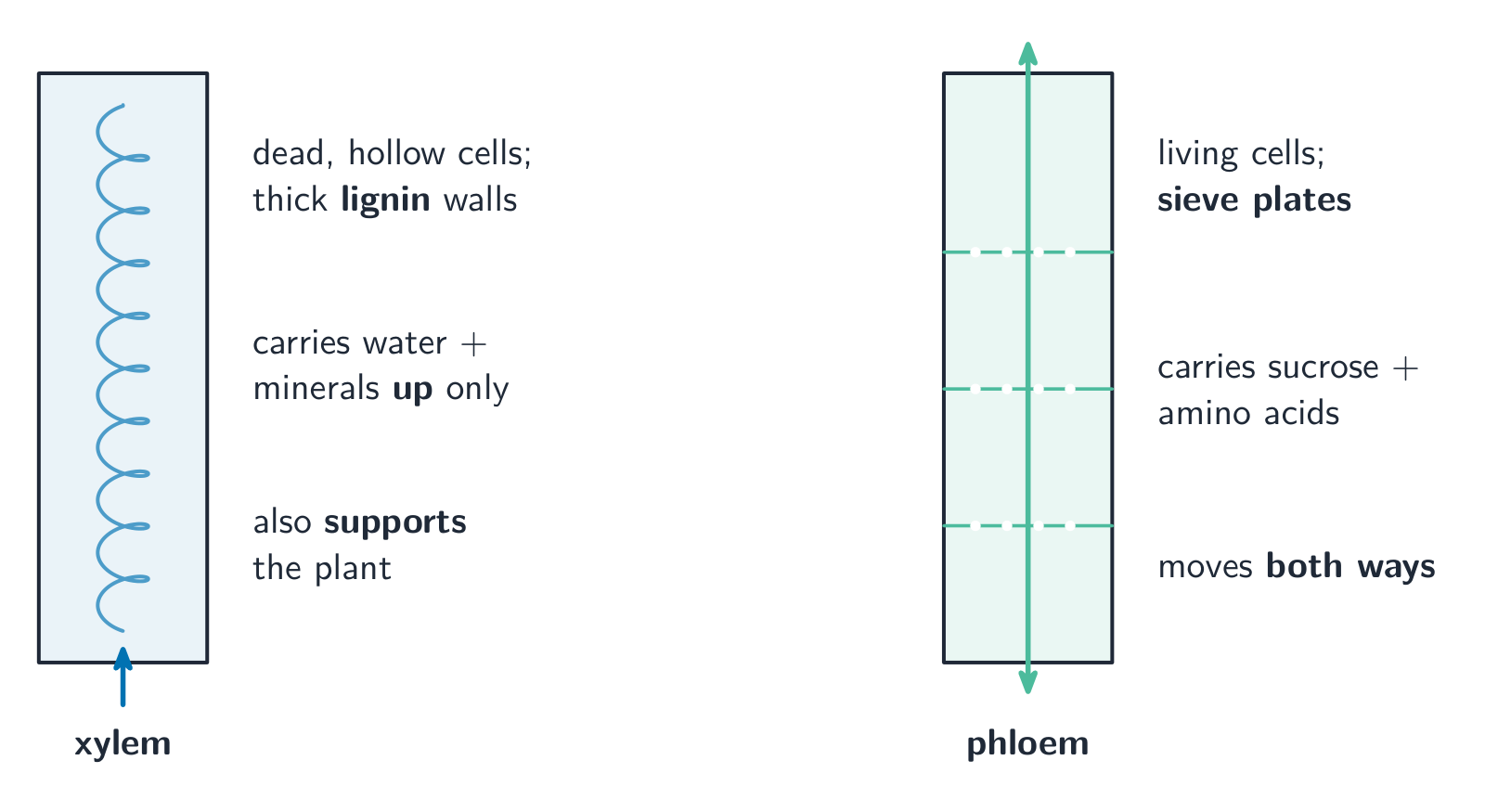
Xylem carries water up in dead lignified tubes; phloem carries sucrose in living cells
Phloem transports:
Dificuldade 1/5 · Moedas 100 + pequeno bônus na primeira conclusão hoje
Phloem carries sugars (translocation).
The transport of sugars in the phloem is called ______.
Dificuldade 1/5 · Moedas 100 + pequeno bônus na primeira conclusão hoje
Translocation moves food around the plant.
Phloem
- Phloem carries sugars (food) made in the leaves to the rest of the plant.
- It moves substances both up and down — this is translocation 转运.
Phloem transports substances only upwards, from roots to leaves.
Dificuldade 1/5 · Moedas 100 + pequeno bônus na primeira conclusão hoje
False. Phloem moves sugars both up and down the plant, from sources to wherever they are needed. Xylem carries water only upwards.
Xylem vs phloem
- Xylem: dead cells, one way (up), carries water + minerals.
- Phloem: living cells, both ways, carries sugars.
Xylem goes one way; phloem goes both ways. Water only travels up the xylem (root to leaf). Sugars in the phloem travel to wherever they're needed — up to growing shoots or down to the roots.
Worked example: celery in red dye
A celery stalk stands in red dye solution for 2 hours. The leaves turn pink at the edges, and a cut across the stalk shows red dots near the outside. Explain both observations.
- The dye travels in the xylem, carried up with water by the transpiration pull. The red dots in the cross-section are the xylem vessels inside the vascular bundles, which sit near the edge of a stem.
- Water evaporates from the leaves but the dye cannot, so it is left behind and colours the leaf. Phloem is not stained, because it carries sugars, not the water from the roots.
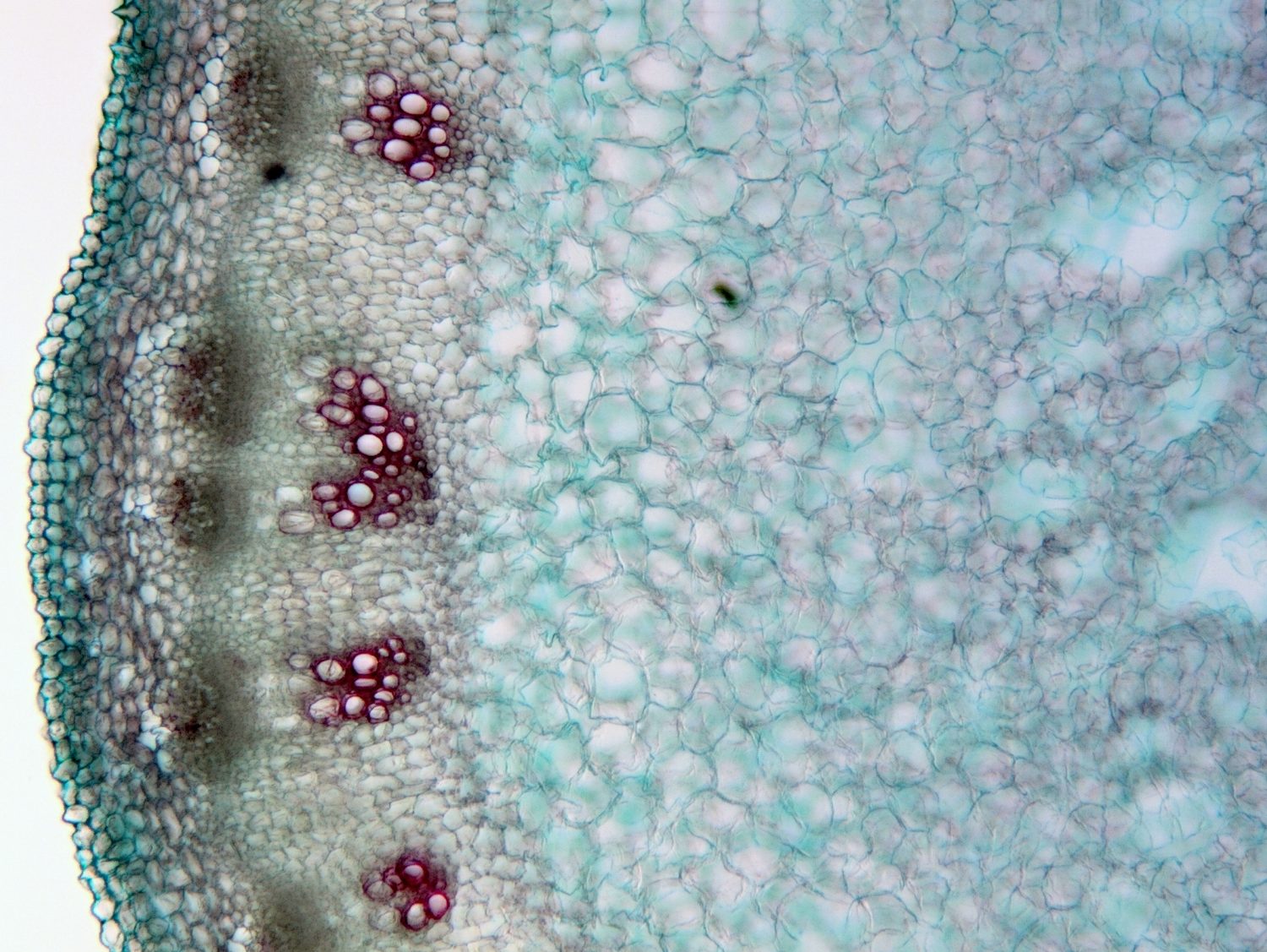
A stem in cross-section: the red-stained xylem sits in vascular bundles near the edge
The experiment is repeated next to a fan. What happens to the time for the leaves to turn pink?
Dificuldade 1/5 · Moedas 100 + pequeno bônus na primeira conclusão hoje
Faster evaporation from the leaves pulls water, and the dye, up the xylem faster.
Phloem can carry sucrose both up and down the plant, but xylem carries water only upwards.
Dificuldade 1/5 · Moedas 100 + pequeno bônus na primeira conclusão hoje
Phloem moves sugars from sources to sinks in either direction; xylem flows from roots to leaves.
You've got it
- xylem carries water + minerals up (dead, lignified tubes that also support)
- phloem carries sugars both ways — translocation
- xylem = one-way, dead; phloem = two-way, living
Write from dead xylem
- One tissue is made of dead lignified tubes.
- Another tissue carries dissolved sugars up or down.
Which tissue is xylem, and how is phloem different?
Dead lignified tubes are the xylem clue.
Which tissue carries water up the plant?
Dificuldade 1/5 · Moedas 100 + pequeno bônus na primeira conclusão hoje
Xylem is the one-way water route.