물 한 잔과 이 방의 공기를 바라보십시오. 둘 다 깨끗하고 심플해 보입니다. 하지만 자연수의 물에는 용해된 산소, 미네랄, 때로는 하수 및…이 포함되어 있습니다.
English narration · English + 中文 subtitles burned in · 영어 내레이션 · 영어 + 중국어 자막 burned-in
10.1
Water · 물
Syllabus
English
Core
Supplement
1 Describe chemical tests for the presence of water using anhydrous cobalt(II) chloride and anhydrous copper(II) sulfate
2 Describe how to test for the purity of water using melting point and boiling point
3 Explain that distilled water is used in practical chemistry rather than tap water because it contains fewer chemical impurities
4 State that water from natural sources may contain substances, including: (a) dissolved oxygen (b) metal compounds (c) plastics (d) sewage (e) harmful microbes (f) nitrates from fertilisers (g) phosphates from fertilisers and detergents
5 State that some of these substances are beneficial, including: (a) dissolved oxygen for aquatic life (b) some metal compounds provide essential minerals for life
6 State that some of these substances are potentially harmful, including: (a) some metal compounds are toxic (b) some plastics harm aquatic life (c) sewage contains harmful microbes which cause disease (d) nitrates and phosphates lead to deoxygenation of water and damage to aquatic life Details of the eutrophication process are not required
7 Describe the treatment of the domestic water supply in terms of: (a) sedimentation and filtration to remove solids (b) use of carbon to remove tastes and odours (c) chlorination to kill microbes
한국어
핵심
보충
1 무수 염화 코발트(II) 및 무수 황산 구리(II)를 사용하여 물 존재 여부를 확인하는 화학적 시료를 서술하라
2 융점 및 끓음점을 사용하여 물의 순도를 확인하는 방법을 서술하라
3 정제수는 불순물이 적어 실험 화학에서 사용되며, 상용 수와는 다른 이유를 설명하라
4 자연수에는 다음 물질들이 포함되어 있을 수 있음을 서술하라: (a) 용존 산소 (b) 금속 화합물 (c) 플라스틱 (d) 하수 (e) 유해 미생물 (f) 비료로 인한 질산염 (g) 비료 및 세제에인 인산염
5 이러한 물질 중 일부는 유익하며, 다음을 포함함을 서술하라: (a) 수생 생명을 위한 용존 산소 (b) 일부 금속 화합물은 생명에 필수적인 광물을 공급함
6 이러한 물질 중 일부는 유해할 수 있으며, 다음을 포함함을 서술하라: (a) 일부 금속 화합물은 독성이 있다 (b) 일부 플라스틱은 수생 생명에 해를 끼친다 (c) 하수는 질병을 유발하는 유해 미생물을 포함한다 (d) 질산염과 인산염은 물의 탈산소화를 일으키고 수생 생명을 손상시킨다. 부영양화 과정에 대한 상세한 내용은 불필요하다
7 가정용 급수의 처리 과정을 다음으로 서술하라: (a) 침전 및 여과를 통해 고형물 제거 (b) 맛과 냄새 제거를 위한 탄소 사용 (c) 소독을 위한 염소 살균
Source: Cambridge International syllabus · 출처: Cambridge International syllabus
English
Testing for water
Two chemical tests show that water is present:
Anhydrous 无水 cobalt(II) chloride turns from blue to pink when water is added.
Anhydrous copper(II) sulfate turns from white to blue when water is added.
These tests only show that water is there. To show that water is pure, you test its melting point 熔点 and boiling point 沸点: pure water melts at exactly $0\,{}^{\circ}\text{C}$ and boils at exactly $100\,{}^{\circ}\text{C}$. Any dissolved substance changes these values.
This is why distilled water 蒸馏水 is used in chemistry instead of tap water — it has far fewer chemical impurities 杂质.
What is in natural water
Water from rivers, lakes and the sea is not pure. It may contain dissolved oxygen 氧气, metal compounds, plastics, sewage 污水, harmful microbes 微生物, and nitrates 硝酸盐 and phosphates 磷酸盐 (which come from fertilisers and detergents).
Some of these are helpful:
dissolved oxygen lets aquatic life 水生生物 (fish and plants) breathe;
some metal compounds give essential minerals 矿物质.
Others are harmful:
some metal compounds are toxic 有毒 (poisonous);
some plastics harm aquatic life;
sewage carries microbes that cause disease;
nitrates and phosphates cause deoxygenation 缺氧 (loss of oxygen) in the water, which harms aquatic life.
Treating drinking water
To make water safe to drink, the water supply is treated in steps:
sedimentation 沉降 and filtration 过滤 remove solid bits;
passing it through carbon 碳 removes bad tastes and smells;
무수 코발트(II) 염화물(코발트 클로라이드)에 물을 추가하면 파란색에서 분홍색으로 변합니다.
무수 구리(II) 황산염(구리 황산염)에 물을 추가하면 하얀색에서 파란색으로 변합니다.
이 테스트들은 오직 물이 존재함을 보여주는 데 그칩니다. 물이 순수함을 증명하려면 융점과 끓는점을 테스트해야 합니다: 순수한 물은 정확히 $0\,{}^{\circ}\text{C}$에서 녹고 정확히 $100\,{}^{\circ}\text{C}$에서 끓습니다. 용해된 물질은 이 값들을 변경합니다.
색 변화 실험은 물 존재를, 고정된 융점과 끓는점은 순수함을 보여줍니다
따라서 화학 실험에서는 정수(自来水) 대신 화학적 불순물이 훨씬 적은 증류수를 사용합니다.
자연수에 포함된 것들
강, 호수, 바다의 물은 순수하지 않습니다. 용해된 산소, 금속 화합물, 플라스틱, 하수, 유해 미생물, 그리고 질산염과 인산염(비료와 세제에서 유래)을 포함할 수 있습니다.
이 중 일부는 유익합니다:
용해된 산소는 수중 생물(어류 및 식물)에게 호흡을 가능하게 합니다;
일부 금속 화합물은 필수적인 미네랄을 제공합니다.
다른 일부는 해롭습니다:
일부 금속 화합물은 독성(유독성)입니다;
일부 플라스틱은 수중 생물에 해를 끼칩니다;
하수는 질병을 유발하는 미생물을 운반합니다;
질산염과 인산염은 물에서 산소 결핍(산소 손실)을 유발하여 수중 생물에 해를 끼칩니다.
음용수 처리
물을 안전하게 마시게 하기 위해供水系统는 단계별로 처리됩니다:
침전 및 여과로 고형분을 제거합니다;
탄소를 통과시켜 나쁜 맛과 냄새를 제거합니다;
염소 소독(염소 첨가)으로 유해 미생물을 사멸시킵니다.
물은 단계별로 안전하게 만듭니다: 큰 입자 침전, 여과, 탄소를 통한 맛 제거, 염소 소독
Explore · 탐색하기
Water treatment lab · 정수 처리 실험실
Classify water processes by what they remove or change. · 정수 과정을 제거하거나 변경하는 것에 따라 분류하십시오.
10.2
Fertilisers · 비료
Syllabus
English
Core
Supplement
1 State that ammonium salts and nitrates are used as fertilisers
2 Describe the use of NPK fertilisers to provide the elements nitrogen, phosphorus and potassium for improved plant growth
한국어
핵심
보충
1 암모늄 염과 질산염이 비료로 사용됨을 서술하라
2 질소, 인, 칼륨 요소를 제공하여 식물 성장을 개선하기 위해 NPK 비료를 사용하는 방법을 서술하라
Source: Cambridge International syllabus · 출처: Cambridge International syllabus
English
Fertilisers 肥料 are added to soil to help plants grow. Ammonium salts and nitrates are common fertilisers.
NPK fertilisers contain the three elements plants need most: nitrogen 氮气, phosphorus 磷 and potassium 钾.
한국어
비료는 식물이 자라도록 돕기 위해 토양에 추가됩니다. 암모늄 염과 질산염이 일반적인 비료입니다.
NPK 비료는 식물이 가장 많이 필요로 하는 세 가지 요소인 질소, 인, 칼륨을 포함합니다.
NPK 비료는 식물이 가장 많이 필요로 하는 세 가지 요소를 공급합니다: 질소, 인, 칼륨
Explore · 탐색하기
Fertiliser route lab · 비료 경로 실험실
Follow nitrogen from raw materials to crop growth. · 원료에서 작물 성장까지 질소 경로를 추적하십시오.
1 State the composition of clean, dry air as approximately 78% nitrogen, $\text{N}_2$, 21% oxygen, $\text{O}_2$ and the remainder as a mixture of noble gases and carbon dioxide, $\text{CO}_2$
2 State the source of each of these air pollutants, limited to: (a) carbon dioxide from the complete combustion of carbon-containing fuels (b) carbon monoxide and particulates from the incomplete combustion of carbon-containing fuels (c) methane from the decomposition of vegetation and waste gases from digestion in animals (d) oxides of nitrogen from car engines (e) sulfur dioxide from the combustion of fossil fuels which contain sulfur compounds
3 State the adverse effect of these air pollutants, limited to: (a) carbon dioxide: higher levels of carbon dioxide leading to increased global warming, which leads to climate change (b) carbon monoxide: toxic gas (c) particulates: increased risk of respiratory problems and cancer (d) methane: higher levels of methane leading to increased global warming, which leads to climate change (e) oxides of nitrogen: acid rain, photochemical smog and respiratory problems (f) sulfur dioxide: acid rain
7 Describe how the greenhouse gases carbon dioxide and methane cause global warming, limited to: (a) the absorption, reflection and emission of thermal energy (b) reducing thermal energy loss to space
4 State and explain strategies to reduce the effects of these environmental issues, limited to: (a) climate change: planting trees, reduction in livestock farming, decreasing use of fossil fuels, increasing use of hydrogen and renewable energy, e.g. wind, solar (b) acid rain: use of catalytic converters in vehicles, reducing emissions of sulfur dioxide by using low-sulfur fuels and flue gas desulfurisation with calcium oxide
8 Explain how oxides of nitrogen form in car engines and describe their removal by catalytic converters, e.g. $2\text{CO} + 2\text{NO} \rightarrow 2\text{CO}_2 + \text{N}_2$
5 Describe photosynthesis as the reaction between carbon dioxide and water to produce glucose and oxygen in the presence of chlorophyll and using energy from light
6 State the word equation for photosynthesis, carbon dioxide + water $\rightarrow$ glucose + oxygen
9 State the symbol equation for photosynthesis, $6\text{CO}_2 + 6\text{H}_2\text{O} \rightarrow \text{C}_6\text{H}_{12}\text{O}_6 + 6\text{O}_2$
한국어
핵심
보충
1 청정 건조 공기의 조성을 약 78% 질소, $\text{N}_2$, 21% 산소, $\text{O}_2$ 그리고 나머지部分是稀有气体和二氧化碳的混合物, $\text{CO}_2$로 서술하시오
2 다음 대기 오염물질의 각 출원을 서술하라(다음으로 한정): (a) 탄소-containing 연료의 완전 연소로 인한 이산화탄소 (b) 탄소-containing 연료의 불완전 연소로 인한 일산화탄소 및 입자 물질 (c) 식물 및 폐기물의 분해 및 동물의 소화 과정에서 발생하는 메탄 (d) 자동차 엔진에서 나오는 질소 산化物 (e) 황 화합물을 포함한 화석연료 연소로 인한 이산화황
3 다음 대기 오염물질의 부정적인 영향을 서술하라(다음으로 한정): (a) 이산화탄소: 높은 수준의 이산화탄소가 지구 온난화를 증가시켜 기후 변화로 이어짐 (b) 일산화탄소: 독성 가스 (c) 입자 물질: 호흡기 질환 및 암 위험 증가 (d) 메탄: 높은 수준의 메탄이 지구 온난화를 증가시켜 기후 변화로 이어짐 (e) 질소 산化物: 산성 강수, photochemical smog 및 호흡기 질환 (f) 이산화황: 산성 강수
7 이산화탄소와 메탄이라는 온실 가스가 지구 온난화를 일으키는 방식을 서술하라(다음으로 한정): (a) 열 에너지의 흡수, 반사 및 방출 (b) 우주로의 열 에너지 손실 감소
4 다음 환경 문제의 영향을 줄이기 위한 전략을 서술하고 설명하시되, 다음에 한정한다: (a) 기후 변화: 나무 심기, 가축 사육 감소, 화석 연료 사용 감소, 수소 및 재생 에너지(예: 풍력, 태양광 등) 사용 증가 (b) 산성비: 차량용 촉매 변환기 사용, 저황 연료 사용 및 산화칼슘을 이용한 배기가스 탈황을 통한 이산화황 배출량 감소
8 자동차 엔진에서 질소 산화가 형성되는 원리와 촉매 변환기에 의한 제거 과정을 설명하시오. 예시: $2\text{CO} + 2\text{NO} \rightarrow 2\text{CO}_2 + \text{N}_2$
5 엽록소의 존재 하에서 빛의 에너지를 사용하여 이산화탄소와 물이 반응해 포도당과 산소를 생성하는 광합성을 서술하시오
6 광합성의 단언식(문자 방정식)을 서술하시오. 이산화탄소 + 물 $\rightarrow$ 포도당 + 산소
9 광합성의 기호 방정식을 서술하시오. $6\text{CO}_2 + 6\text{H}_2\text{O} \rightarrow \text{C}_6\text{H}_{12}\text{O}_6 + 6\text{O}_2$
Source: Cambridge International syllabus · 출처: Cambridge International syllabus
English
Clean, dry air is approximately:
78% nitrogen ($\text{N}_2$)
21% oxygen ($\text{O}_2$)
the rest is a mixture of noble gases 稀有气体 and carbon dioxide ($\text{CO}_2$).
Air pollutants and their sources
Pollutant
Main source
carbon dioxide ($\text{CO}_2$)
complete combustion 完全燃烧 of carbon-containing fuels
carbon monoxide 一氧化碳 and particulates 颗粒物
incomplete combustion 不完全燃烧 of carbon-containing fuels
methane 甲烷
rotting plants and waste gases from animal digestion
oxides of nitrogen 氮氧化物
car engines
sulfur dioxide
burning fossil fuels 化石燃料 that contain sulfur 硫
Effects of these pollutants
Carbon dioxide 二氧化碳 and methane are greenhouse gases 温室气体: more of them causes global warming 全球变暖, which leads to climate change 气候变化.
Carbon monoxide is a toxic gas.
Particulates increase the risk of respiratory 呼吸 (breathing) problems and cancer 癌症.
Oxides of nitrogen cause acid rain 酸雨, photochemical smog 光化学烟雾 and breathing problems.
Sulfur dioxide causes acid rain.
Worked example. A power station burns coal containing sulfur, and a lake downwind slowly turns acidic. Name the pollutant, explain the link, and give one way to stop it. Burning a fossil fuel that contains sulfur releases sulfur dioxide, which causes acid rain, so the rain falling on the lake is acidic. To stop it at the source, use flue gas desulfurisation, where calcium oxide removes the sulfur dioxide from the waste gases before they leave the chimney, or switch to a low-sulfur fuel. Match the fix to the pollutant: a catalytic converter treats a car's oxides of nitrogen and would do nothing about a coal-fired power station's sulfur dioxide.
Reducing these problems
To slow climate change: plant trees, farm fewer animals, burn fewer fossil fuels, and use more hydrogen and renewable energy 可再生能源 such as wind and solar power.
To reduce acid rain: fit catalytic converters 催化转化器 in cars, use low-sulfur fuels, and use flue gas desulfurisation 烟气脱硫 with calcium oxide 氧化钙 to remove sulfur dioxide from waste gases.
How greenhouse gases warm the Earth
Greenhouse gases such as carbon dioxide and methane let sunlight through, but they absorb the thermal energy 热能 given off by the warm Earth, and send some of it back down. This reduces the thermal energy lost to space, so the Earth gets warmer.
In a car engine, the high temperature makes nitrogen and oxygen from the air react to form oxides of nitrogen. A catalytic converter removes them, for example:
Photosynthesis 光合作用 is the opposite of combustion — it removes carbon dioxide from the air. Plants use light energy and chlorophyll 叶绿素 to turn carbon dioxide and water into glucose 葡萄糖 and oxygen:
깨끗하고 건조한 공기는 약 78% 질소, 21% 산소, 1% 기타 기체(비활성 기체 및 이산화탄소)
대기 오염물질 및 그 출처
오염물질
주요 출처
이산화탄소 ($\text{CO}_2$)
탄소-containing 연료의 완전 연소
일산화탄소 및 입자 물질
탄소-containing 연료의 불완전 연소
메탄
썩어가는 식물 및 동물 소화 과정에서 나오는 배기 가스
질소 산化物
자동차 엔진
이산화황
황을 포함한 화석 연료의 연소
이러한 오염물질의 영향
이산화탄소와 메탄은 온실 가스: 이들이 증가하면 지구 온난화가 발생하고 이는 기후 변화로 이어집니다.
일산화탄소는 독성 가스입니다.
입자 물질은 호흡기(호흡 관련) 문제 및 암의 위험성을 높입니다.
질소 산化物는 산성 강수, 광화학 스모그 및 호흡기 문제를 유발합니다.
이산화황은 산성 강수를 유발합니다.
해설 예시. 황을 포함한 석탄을 연소하는 발전소가 있으며, 그 하풍측에 있는 호수가 서서히 산성화되고 있습니다. 오염 물질을 명명하고, 이 연결 고리를 설명하며, 이를 방지하는 방법을 하나 제시하십시오. 황이 포함된 화석연료를 연소하면 황산 dioxide가 방출되어 산성비를 유발하므로, 호수에 내리는 비는 산성이 됩니다. 이를 발생원에서 차단하려면 배가스 탈황을 사용하거나, 저황 연료로 전환할 수 있습니다. 배가스 탈황은 유독가스가 굴뚝을 빠져나가기 전에 산성 산화물인 황산 dioxide를 제거하기 위해 산화칼을 사용하는 방법입니다. 해결책을 오염 물질에 매칭하십시오: 촉매 변환기는 자동차의 질소 산化物를 처리하지만, 석탄 연소 발전소의 황산 dioxide에는 아무런 효과가 없습니다.
이러한 문제점 감소
기후 변화를 늦추기 위해서는: 나무를 심고, 가축 사육을 줄이며, 화석연료 연소를 감소시키고, 풍력 및 태양광과 같은 수원 에너지와 수소 등 더 많은 청정 에너지를 활용하십시오.
산성비를 줄이기 위해서는: 자동차에 촉매 변환기를 장착하고, 저황 연료를 사용하며, 배가스 중의 황산 dioxide를 제거하기 위해 산화칼슘을 이용한 배가스 탈황을 적용하십시오.
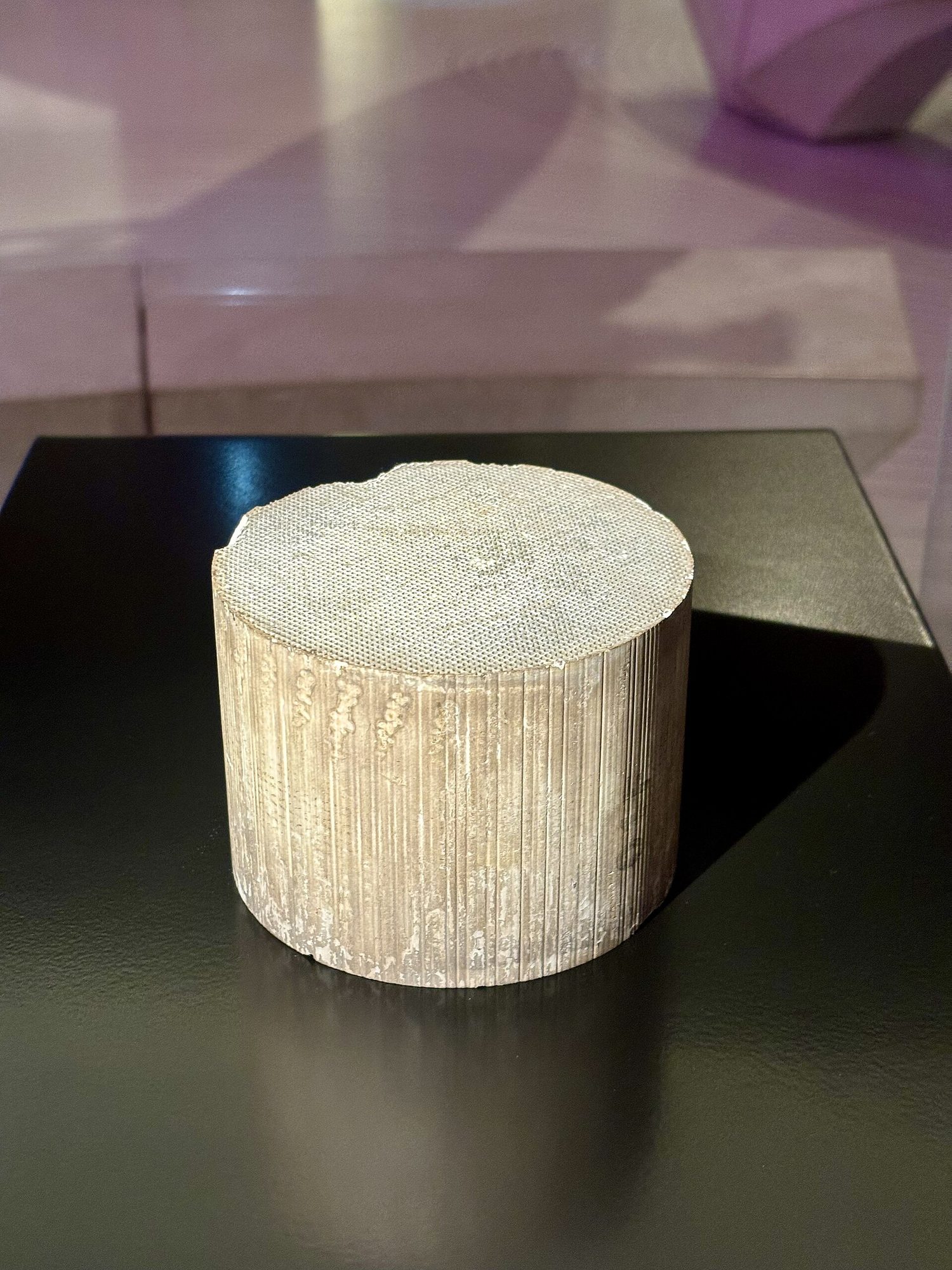
촉매 변환기 내부에는 촉매 금속으로 코팅된 벌집 구조가 있으며, 수많은 미세한 통로가 막대한 표면적을 제공합니다
온실 가스가 지구를 따뜻하게 하는 원리
탄산 dioxide와 메테인과 같은 온실 가스는 햇빛은 통과시키지만, 따뜻한 지구에서 방출되는 열에너지를 흡수하여 일부는 다시 아래로 보내보냅니다. 이는 우주로 손실되는 열에너지를 줄이므로, 지구는 더 따뜻해집니다.
온실 가스는 햇빛은 통과시키지만, 지구가 방출하는 열의 일부는 가두어 두므로 지구가 따뜻해집니다
자동차 엔진 내에서 높은 온도로 인해 공기 중의 질소와 산소가 반응하여 질소 산化物를 생성합니다. 촉매 변환기는 이를 제거하는데, 예를 들어 다음과 같습니다:
Two tests show water is present (cobalt(II) chloride blue → pink; copper(II) sulfate white → blue), but only fixed melting and boiling points (0 °C and 100 °C) show it is pure.
Clean, dry air is about 78% nitrogen, 21% oxygen and 1% other gases (mostly noble gases and carbon dioxide).
Match each pollutant to its source and effect: carbon monoxide (incomplete combustion; toxic); sulfur dioxide and oxides of nitrogen (acid rain); carbon dioxide and methane (greenhouse gases → global warming).
Greenhouse gases let sunlight through but absorb the heat the warm Earth gives off and send some back down, so the Earth warms up.
한국어
물이 존재함을 보여주는 두 가지 시험(코발트(II) 염화물 파랑 → 분홍색; 구리(II) 황산염 흰색 → 파랑)이 있지만, 오직 고정된 융점과 끓는점(0 °C 및 100 °C)만이 그것이 순수함을 증명합니다.
깨끗하고 마른 공기는 약 질소 78%, 산소 21% 와 기타 가스 1%(주로 비활성 기체와 탄산 dioxide)로 구성됩니다.
각 오염 물질을 발생원과 효과에 매칭하십시오: 일산화탄소(불완전 연소; 독성); 황산 dioxide 및 질소 산化物(산성비); 탄산 dioxide 및 메테인(온실 가스 → 글로벌 워밍).
온실 가스는 햇빛은 통과시키지만, 따뜻한 지구가 방출하는 열을 흡수하여 일부는 다시 아래로 보내보내므로 지구가 따뜻해집니다.
Interactive lessons on this topic · 이 주제에 대한 인터랙티브 수업
Work through it step by step, with instant-check exercises. · 즉시 체크 기능 exercises를 통해 단계별로 진행하세요.