Skip to content · ⁨본문 바로가기⁩

Land-Based Empires

AP World History: Modern · ⁨AP 세계사: 근현대⁩ · Topic 3 · ⁨주제 3⁩

Video lesson for this topic · ⁨이 주제용 영상 수업⁩ Open the video page · ⁨영상 페이지 열기⁩
5:35

단원 3: 대륙 기반 제국

이 단원의 모든 통치자는 동일한 실용적 문제를 직면합니다. 수도에서 수 주에 걸린 여행 거리의 영토를 정복했으며, 실제로…하는 사람들은…

English narration · English + 中文 subtitles burned in · ⁨영어 내레이션 · 영어 + 중국어 자막 burned-in⁩

3.1

How the Land Empires Expanded · ⁨대륙 제국의 확장 방식⁩

Syllabus
English

3.1 Empires Expand

Thematic Focus (GOV): Governance — A variety of internal and external factors contribute to state formation, expansion, and decline. Governments maintain order through a variety of administrative institutions, policies, and procedures, and governments obtain, retain, and exercise power in different ways and for different purposes.

Learning Objective Unit 3.A: Explain how and why various land-based empires developed and expanded from 1450 to 1750.

  • KC-4.3.II Imperial expansion relied on the increased use of gunpowder, cannons, and armed trade to establish large empires in both hemispheres.
  • KC-4.3.II.B Land empires included the Manchu in Central and East Asia; the Mughal in South and Central Asia; the Ottoman in Southern Europe, the Middle East, and North Africa; and the Safavids in the Middle East.
  • KC-4.3.III.i Political and religious disputes led to rivalries and conflict between states.

Illustrative examples:

  • State rivalries:
    • Safavid–Mughal conflict
    • Songhai Empire’s conflict with Morocco
한국어

3.1 제국 확장

주제 집중 (GOV): 통치 — 다양한 내부 및 외부 요인이 국가 형성, 확장 및 쇠퇴에 기여한다. 정부는 다양한 행정 기관, 정책 및 절차를 통해 질서를 유지하며, 정부는 서로 다른 방식과 목적으로 권력을 획득, 보유 및 행사한다.

학습 목표 Unit 3.A: 1450년부터 1750년까지 다양한 육지 제국이 어떻게 그리고 왜 발달하고 확장되었는지 설명하라.

  • KC-4.3.II 제국 확장은 총화약, 대포, 무장 교역을 더 많이 활용하여 양반구 모두에서 대규모 제국을 세우는 데 의존했다.
  • KC-4.3.II.B 육지 제국에는 중앙 및 동아시아의 만주족, 남부 및 중앙아시아의 무굴 제국, 남부 유럽·중동·북아프리카의 오스만 제국, 중동의 사피비드 제국이 포함된다.
  • KC-4.3.III.i 정치적 및 종교적 분쟁은 국가 간의 경쟁과 갈등을 초래했다.

예시 사례:

  • 국가 경쟁:
    • 사피비드-무굴 전쟁
    • 송하이 제국의 모로코와의 분쟁

Source: College Board AP Course and Exam Description · ⁨출처: College Board AP Course and Exam Description⁩

English

Unit 3 covers the great land-based empires 陆基帝国 of roughly 1450 to 1750. Four questions organise it: how they expanded, how they governed, how they paid for themselves, and how they used religion.

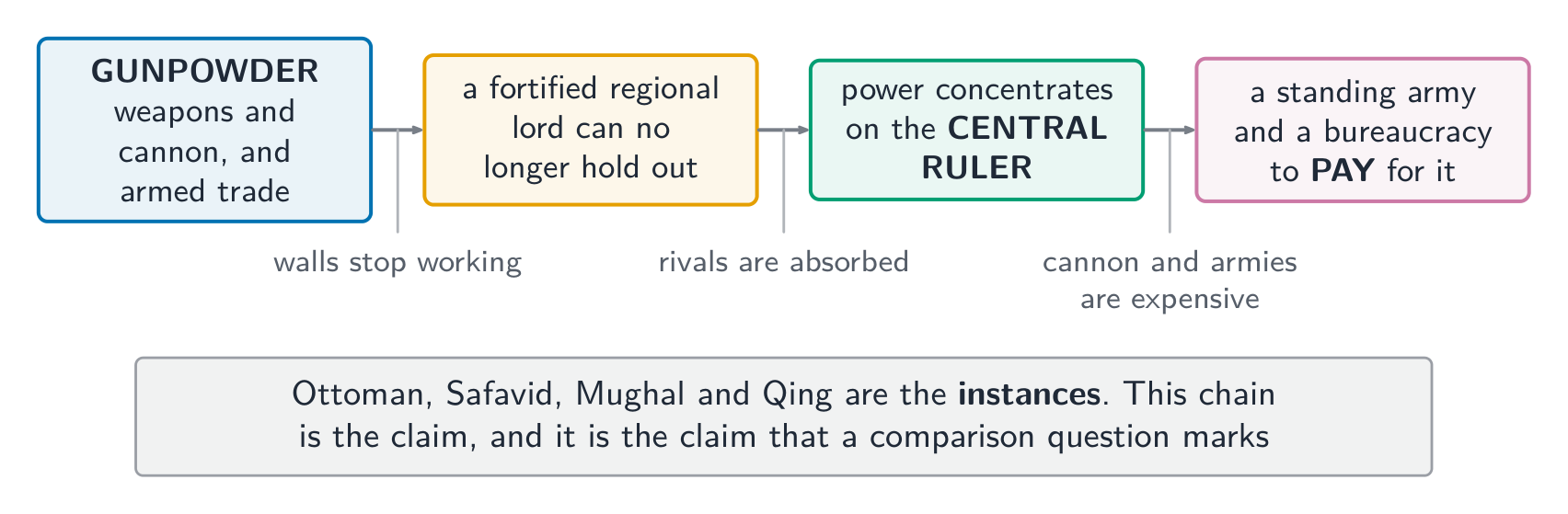
Expansion relied on the increased use of gunpowder, cannons, and armed trade - which is why these are often called the gunpowder empires 火药帝国. Access to gunpowder weapons let a central ruler overpower regional rivals and fortified nobles, so military technology and political centralisation grew together.

The empires to know:

  • The Manchu (Qing) 满清 in Central and East Asia.
  • The Mughal 莫卧儿 in South Asia.
  • The Ottoman 奥斯曼 in the eastern Mediterranean and beyond.
  • The Safavid 萨法维 in Persia.
한국어

단원 3는 약 1450년부터 1750년 사이의 거대 대륙 제국을 다룬다. 네 가지 질문으로 구성된다: 어떻게 확장되었는가, 어떻게 통치했는가, 재정을 어떻게 조달했는가, 그리고 종교를 어떻게 활용했는가.

확장은 화약, 포탄, 무장 무역의 증가한 활용에 의존했다. 이를 위해 이들은 종종 화약 제국이라 불린다. 화약 무기 접근권은 중앙 통치자가 지역 경쟁자와 성벽으로 방어된 귀족들을 압도하게 해 주었으므로, 군사 기술과 정치적 중앙집권이 함께 발전했다.

알아야 할 제국:

  • 중동방아시아의 만주(청)
  • 남아시아의 무갈
  • 동지중해 및 그 너머의 오스만
  • 페르시아의 사파위
화약 제국이라 불리는 이유: 군사 기술과 중앙집권이 함께 성장했다
Explore · ⁨탐색하기⁩

Assemble the gunpowder-empire claim · ⁨총포제국 주장을 구성하시오⁩

Military technology and political centralisation grew together — and the mechanism is that a cannon ends a fortified lord's advantage. · ⁨군사 기술과 정치적 중앙集权은 함께 성장함 — 메커니즘은 포탄이 요새를 지키던 영주의 우위를 끝낸다는 점임.⁩

Vocabulary · ⁨어휘⁩ Train · ⁨연습하기⁩
English 한국어
land-based empires/lænd beɪst ˈempaɪəz/ 대륙 기반 제국
gunpowder empires/ˈɡʌnpaʊdə ˈempaɪəz/ 화약 제국
Manchu (Qing)/ˈmæntʃuː/ 만주(청)
Mughal/ˈməʊɡl/ 무갈
Ottoman/ˈɒtəmən/ 오스만
Safavid/ˈsæfəvɪd/ 사파비드
Recruitment of bureaucratic elites/rɪˈkruːtmənt ɒv ˌbjʊərəʊˈkrætɪk ɪˈliːts/ 관료 엘리트 모집
military professionals/ˈmɪlɪtəri prəˈfeʃənlz/ 군사 전문가
devshirme/ˈdevʃɜːm/ 데브시르메
janissaries/ˈdʒænɪsəriz/ 야니제리
ghulams/ˈɡjʊlæmz/ 갈람
tribute collection/ˈtrɪbjuːt kəˈlekʃn/ 조공 수집
tax farming/tæks ˈfɑːmɪŋ/ 세금 수취권 매각(세금 경매)
zamindar/ˈzæmaɪndɑː/ 잠인다르
hard currency/hɑːd ˈkʌrənsi/ 경화(硬貨)
Protestant Reformation/ˈprɒtɪstənt rɪfɔːˈmeɪʃn/ 프로테스탄트 종교 개혁
Sunni-Shia split/ˈsʌni ʃɪə splɪt/ 선비-시아 분열
Sikhism/ˈsiːkɪzəm/ 시크교
3.2

Administration · ⁨행정⁩

Syllabus
English

3.2 Empires: Administration

Thematic Focus (GOV): Governance — A variety of internal and external factors contribute to state formation, expansion, and decline. Governments maintain order through a variety of administrative institutions, policies, and procedures, and governments obtain, retain, and exercise power in different ways and for different purposes.

Learning Objective Unit 3.B: Explain how rulers used a variety of methods to legitimize and consolidate their power in land-based empires from 1450 to 1750.

  • KC-4.3.I.C Recruitment and use of bureaucratic elites, as well as the development of military professionals, became more common among rulers who wanted to maintain centralized control over their populations and resources.
  • KC-4.3.I.A Rulers continued to use religious ideas, art, and monumental architecture to legitimize their rule.
  • KC-4.3.I.D Rulers used tribute collection, tax farming, and innovative tax-collection systems to generate revenue in order to forward state power and expansion.

Illustrative examples:

  • Bureaucratic elites or military professionals:
    • Ottoman devshirme
    • Salaried samurai
  • Religious ideas:
    • Mexica practice of human sacrifice
    • European notions of divine right
    • Songhai promotion of Islam
  • Art and monumental architecture:
    • Qing imperial portraits
    • Incan sun temple of Cuzco
    • Mughal mausolea and mosques
    • European palaces, such as Versailles
  • Tax-collection systems:
    • Mughal zamindar tax collection
    • Ottoman tax farming
    • Mexica tribute lists
    • Ming practice of collecting taxes in hard currency
한국어

3.2 제국: 행정

주제 집중 (GOV): 통치 — 다양한 내부 및 외부 요인이 국가 형성, 확장 및 쇠퇴에 기여한다. 정부는 다양한 행정 기관, 정책 및 절차를 통해 질서를 유지하며, 정부는 서로 다른 방식과 목적으로 권력을 획득, 보유 및 행사한다.

학습 목표 Unit 3.B: 1450년부터 1750년까지 통치자들이 육지 제국에서 권력을 정당화하고_AUDIT consolidate하는 데 다양한 방법을如何使用했는지 설명하라.

  • KC-4.3.I.C 관료 엘리트의 채용과 활용, 그리고 군사 전문가의 개발은 자국민과 자원을 집중통제하려 하는 통치자들에게서 더 흔하게 나타났다.
  • KC-4.3.I.A 통치자들은 자신의 통치를 정당화하기 위해 여전히 종교적 개념, 예술, 거대 건축물을 사용했다.
  • KC-4.3.I.D 통치자는 조공 징수, 세금 경매, 혁신적인 세금 수집 시스템을 사용하여 국가 권력과 확장을 추진할 재원을 마련했다.

예시 사례:

  • 관료 엘리트 또는 군사 전문가:
    • 오스만의 데브시르메
    • 연봉제 사무라이
  • 종교적 개념:
    • 메시카의 인간 sacrifices 관습
    • 유럽의 신권사상
    • 송하이의 이슬람 진흥
  • 예술 및 거대 건축:
    • 청나라 황실 초상화
    • 인카의 쿠스코 태양신전
    • 무굴의 묘소와 모스크
    • 베르사유궁전 등 유럽 궁정 건축물
  • 세금 수집 시스템:
    • 무굴의 잔디다르 세금 징수
    • 오스만의 세금 경매
    • 메시카의 조공 목록
    • 명나라의 현금 세금 징수 관습

Source: College Board AP Course and Exam Description · ⁨출처: College Board AP Course and Exam Description⁩

English

Rulers faced the same problem: how to control territory far from the capital. The CED names the tools they used.

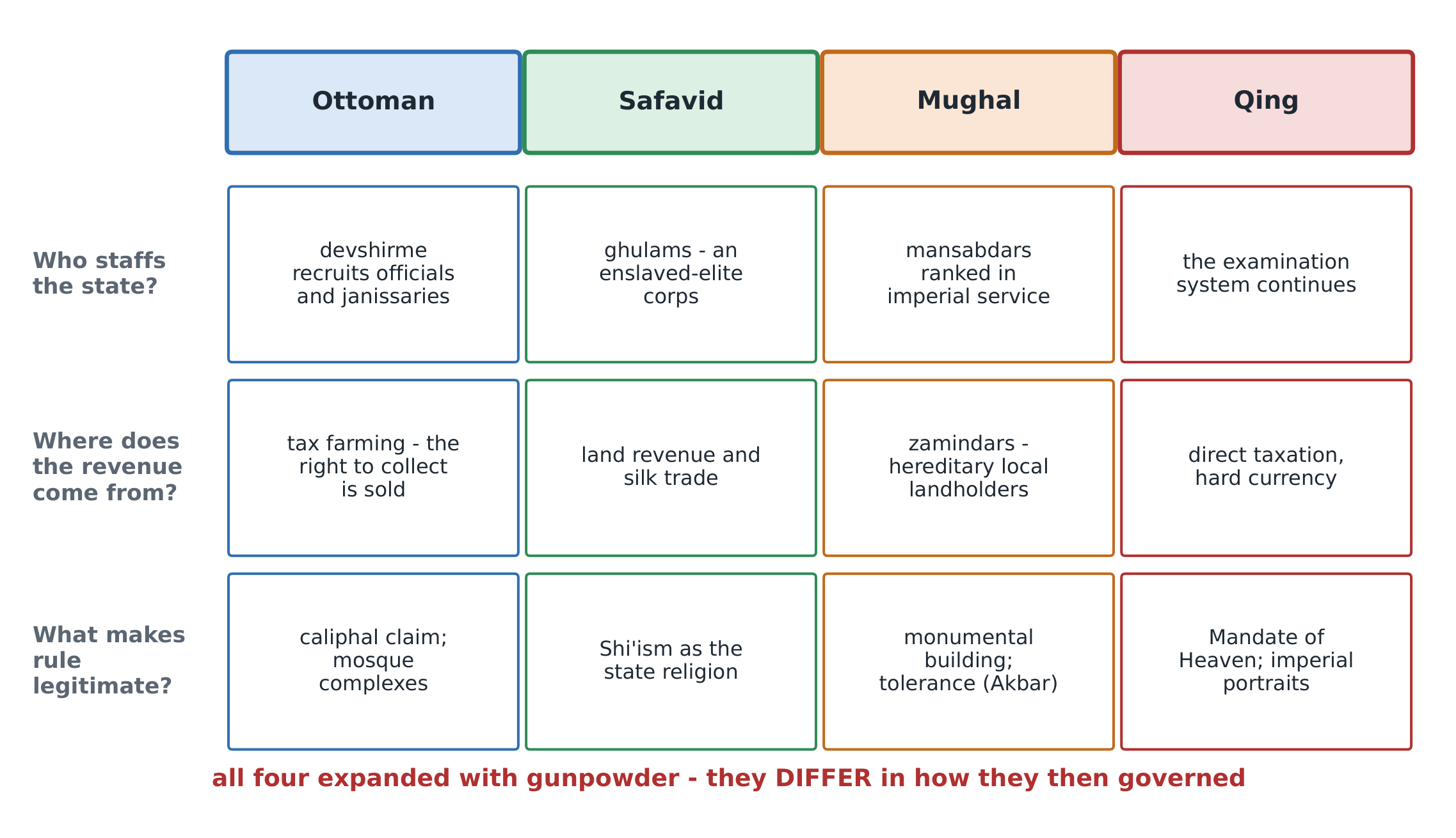
Recruitment of bureaucratic elites 官僚精英的选任 and the development of military professionals 职业军人 gave rulers officials who owed their position to the state rather than to birth. The clearest case is the Ottoman devshirme 德夫希尔梅 system, which recruited and trained administrators and soldiers, including the janissaries 耶尼切里; the Manchu continued China's examination system; the Safavids used ghulams 古拉姆.

Revenue came through tribute collection 纳贡, tax farming 包税制, and innovative tax-collection systems. The Mughal zamindar 柴明达尔 system and Ottoman tax farming are the standard examples, and the Ming practice of collecting taxes in hard currency 硬通货 is another.

한국어
네 개의 제국, 하나의 도구 세트: 각 제국이 관리 임용, 세수 확보, 정당성 주장에如何使用
同样的三个问题——人员、收入、合法性——各帝国以不同方式解决

통치자는 동일한 문제를 마주했다: 수도로부터 먼 영토를 어떻게 통제할 것인가. CED는 그들이 사용했던 도구들을 명시한다.

관료 엘리트 임용 및 군인 전문직 development는 통치자에게 출생이 아닌 국가에 대한 충성을 바치는 관료를 제공했다. 가장 명확한 사례는 오스만의 데브시르메 체계로, 행정관과 군인—including 야니체리—를 임용하고 훈련시켰다. 만주는 중국의 과거 제도를 계승했고, 사파위는 굴람을 사용했다.

세수는 조공 수집, 세금 경매, 혁신적인 세금 징수 시스템을 통해 확보되었다. 무갈의 잠디다르 체계와 오스만의 세금 경매가 표준 예시이며, 명나라의 현금(강화) 세수 관행도其中之一이다.

3.3

Legitimacy and Belief · ⁨정당성과 신념⁩

Syllabus
English

3.3 Empires: Belief Systems

Thematic Focus (CDI): Cultural Developments and Interactions — The development of ideas, beliefs, and religions illustrates how groups in society view themselves, and the interactions of societies and their beliefs often have political, social, and cultural implications.

Learning Objective Unit 3.C: Explain continuity and change within the various belief systems during the period from 1450 to 1750.

  • KC-4.1.VI.i The Protestant Reformation marked a break with existing Christian traditions and both the Protestant and Catholic reformations contributed to the growth of Christianity.
  • KC-4.1.VI.ii Political rivalries between the Ottoman and Safavid empires intensified the split within Islam between Sunni and Shi’a.
  • KC-4.1.VI.iii Sikhism developed in South Asia in a context of interactions between Hinduism and Islam.
한국어

3.3 제국: 신앙 체계

주제 집중 (CDI): 문화적 발전 및 상호작용 — 사상의 development, 신념 및 종교의 발전은 사회 내 집단이 자신을 어떻게 인식하는지를 보여주며, 사회와 그들의 신념 간의 상호작용은 종종 정치적, 사회적, 문화적 영향을 미친다.

학습 목표 Unit 3.C: 1450년부터 1750년까지의 다양한 신앙 체계 내의 지속성과 변화를 설명하라.

  • KC-4.1.VI.i 개신교 개혁은 기존 기독교 전통과의 단절을 의미했으며, 개신교와 가톨릭 개혁 모두 기독교의 확산에 기여했다.
  • KC-4.1.VI.ii 오스만과 사피비드 제국 간의 정치적 경쟁은 이슬람 내 선풍파와 시아파 간의 분열을 격화시켰다.
  • KC-4.1.VI.iii 시크교는 힌두교와 이슬람교의 상호작용이라는 맥락 속에서 남아시아에서 발달했다.

Source: College Board AP Course and Exam Description · ⁨출처: College Board AP Course and Exam Description⁩

English

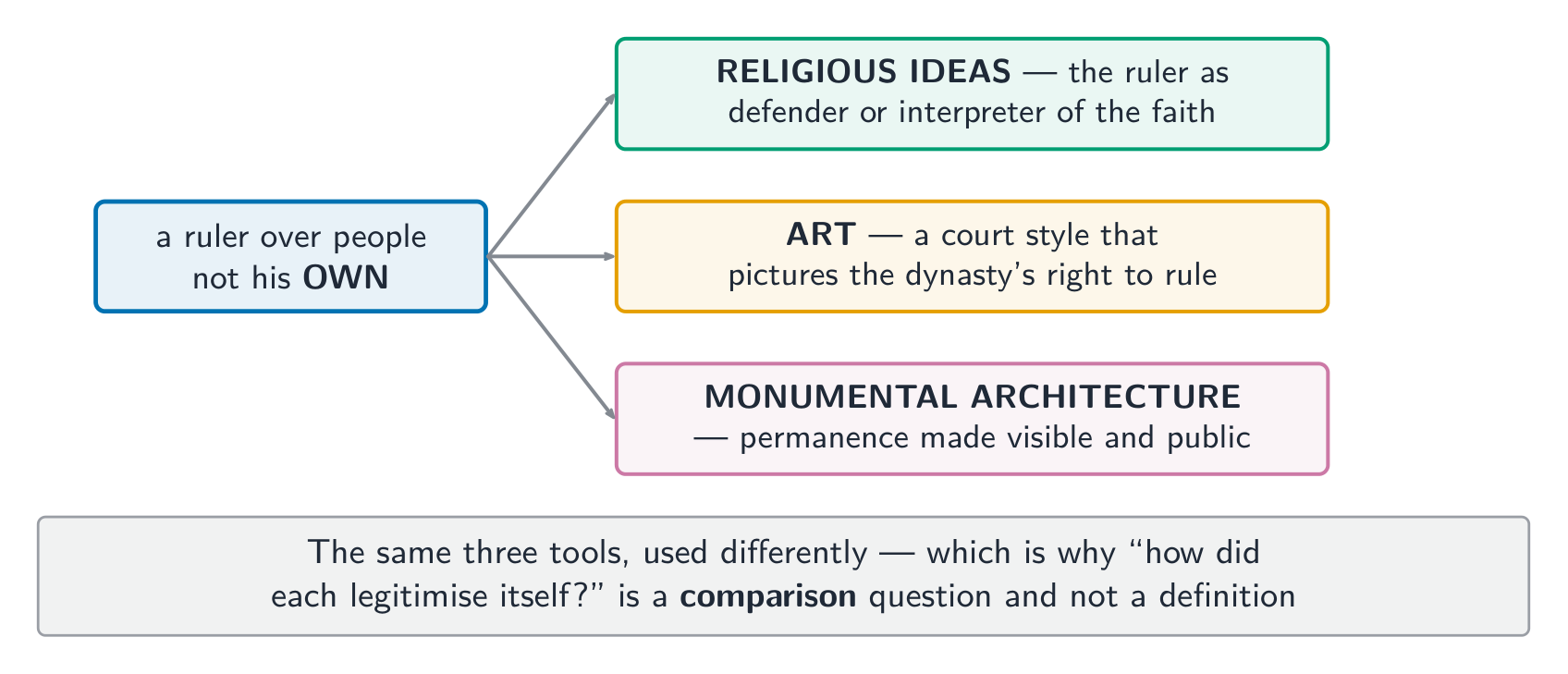
Rulers continued to use religious ideas, art, and monumental architecture to legitimise their rule - Mughal mosques and mausolea, Ottoman mosque complexes, Qing imperial portraits, and European palaces such as Versailles all do the same work.

Religious change also produced conflict:

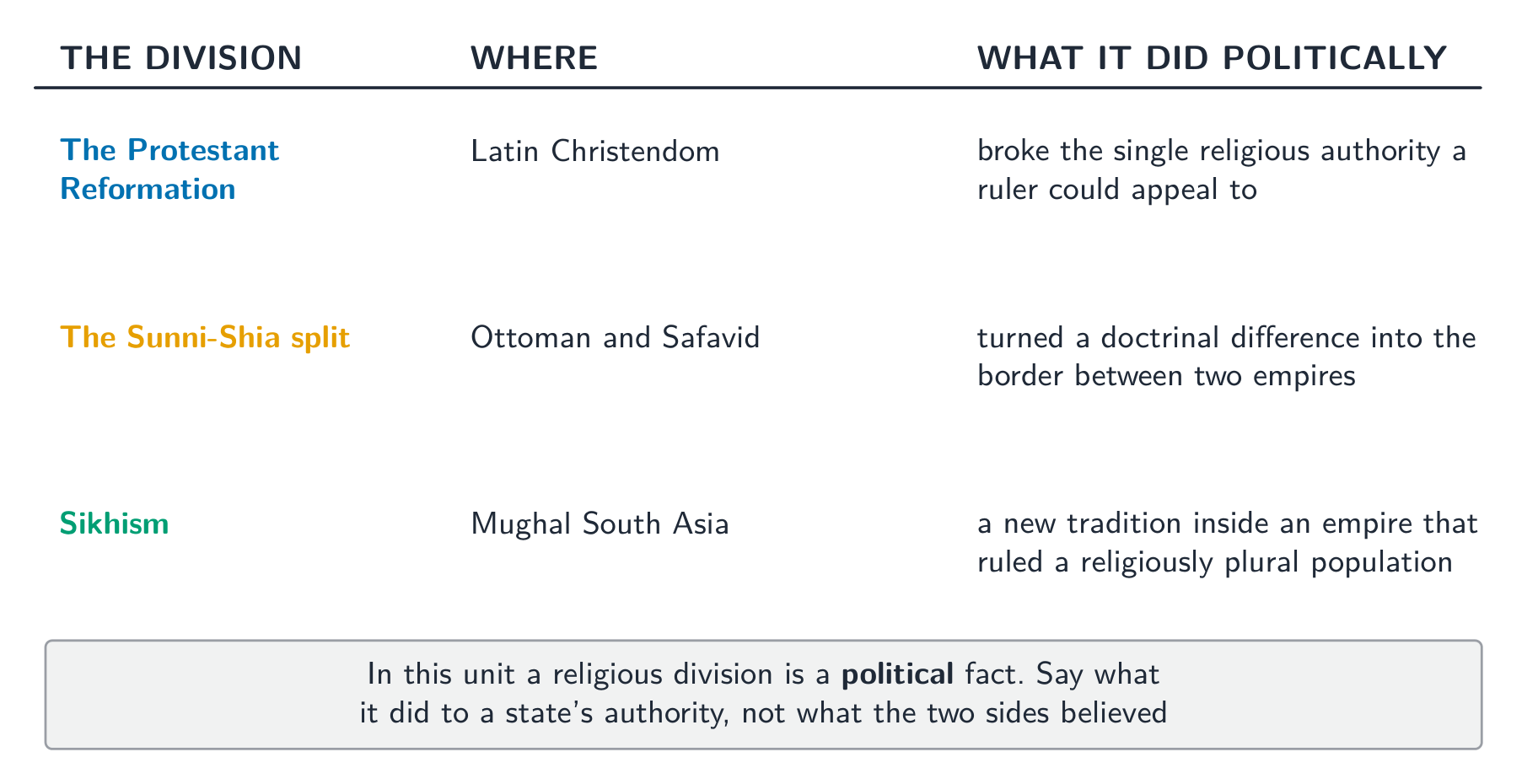
  • The Protestant Reformation 新教改革 marked a break with existing Christian traditions and led to sustained religious and political conflict in Europe.
  • Political rivalry between the Ottoman and Safavid empires intensified the Sunni-Shia split 逊尼派与什叶派分裂, showing how state rivalry can deepen a religious division.
  • Sikhism 锡克教 developed in South Asia in a context of interaction between Hinduism and Islam.

Political and religious disputes together produced rivalries and conflict between states across Eurasia.

한국어

통치자는 자신의 통치를 정당화하기 위해 계속 종교적 사상, 예술, 기념 건축물을 활용했다. 무갈의 모스크와 마울레아, 오스만의 모스크 복합체, 청의 황실 초상화, 베르사유 궁전 같은 유럽 궁전은 모두 동일한 기능을 수행했다.

종교적 변화 또한 갈등을 야기했다:

  • 신教 개혁은 기존 기독교 전통과의 단절을 알렸으며, 유럽에서 지속적인 종교 및 정치적 갈등을 초래했다.
  • 오스만과 사파위 제국 간의 정치적 대립은 선니-시아 분열을 심화시켰으며, state rivalries가 종교적 분열을 깊게 만들 수 있음을 보여준다.
  • 시크교는 힌두교와 이슬람교 간의 상호작용 맥락에서 남아시아에서 발전했다.

정치적·종교적 분쟁은 유라시아 전역에서 국가 간 대립과 갈등을 발생시켰다.

자신이 아닌 백성을 통치하기 위한 세 가지 수단 - 각 제국이 다르게 사용함
세 가지 종교적 분파가 국가 권위에 어떤 영향을 미쳤는지 읽으세요
슈레이마니예 모스크 - 정당성의 도구로서의 거대 건축물
타지 마할 - 종교적 다원주의 사회를 통치한 무갈 왕조 군주에 의해 사용된 동일한 수단
Explore · ⁨탐색하기⁩

Sort each instrument of legitimacy · ⁨각 정당성의 도구를 분류하라⁩

These rulers governed people who shared neither their language nor their faith, so legitimacy had to be manufactured. · ⁨이 통치자들은 언어도 신앙도 공유하지 않는 백성을 다스렸으므로, 정당성은 제조되어야 했다.⁩

3.4

Comparison in Land-Based Empires · ⁨대륙 기반 제국의 비교⁩

Syllabus
English

3.4 Comparison in Land-Based Empires

Learning Objective Unit 3.D: Compare the methods by which various empires increased their influence from 1450 to 1750.

  • KC-4.1 The interconnection of the Eastern and Western Hemispheres made possible by transoceanic voyaging, transformed trade and had a significant social impact on the world.
    • KC-4.1.VI In some cases, the increase and intensification of interactions between newly connected hemispheres expanded the reach and furthered development of existing religions, and contributed to religious conflicts and the development of syncretic belief systems and practices.
  • KC-4.3 Empires achieved increased scope and influence around the world, shaping and being shaped by the diverse populations they incorporated.
    • KC-4.3.II Imperial expansion relied on the increased use of gunpowder, cannons, and armed trade to establish large empires in both hemispheres.
    • KC-4.3.II.B Land empires included the Manchu in Central and East Asia; Mughal in South and Central Asia; Ottoman in Southern Europe, the Middle East, and North Africa; and the Safavids in the Middle East.
    • KC-4.3.III.i Political and religious disputes led to rivalries and conflict between states.
한국어

3.4 육지 제국 간의 비교

학습 목표 Unit 3.D: 1450년부터 1750년까지 다양한 제국이 영향력을 확대하기 위해 사용한 방법들을 비교하라.

  • KC-4.1 대양 항해에 의해 가능해진 동서 반구의 연결은 교역을 변형시키고 세계에 중대한 사회적 영향을 미쳤다.
    • KC-4.1.VI 어떤 경우에는 newly connected 반구 간의 상호작용 증가 및 심화가 기존 종교의 reach를 넓히고 발전을 촉진하였으며, 종교적 갈등과 융합 신앙 체계 및 관습의 발달에 기여했다.
  • KC-4.3 제국은 incorporating한 다양한 인구에 의해 형성되고 형성되는 과정에서 전 세계적으로 scope와 influence를 확대했다.
    • KC-4.3.II 제국 확장에는 총포, 대포, 무장 무역의 사용 확대를 통해 양반구 모두에서 거대 제국을 수립하는 것이 포함되었다.
    • KC-4.3.II.B 토지 제국에는 중앙아시아 및 동아시아의 만주족(Manchu), 남아시아 및 중앙아시아의 무갈 제국(Mughal), 남유럽, 중동, 북아프리카의 오스만 제국(Ottoman), 중동의 사파비드(Safavids)가 포함된다.
    • KC-4.3.III.i 정치적 및 종교적 분쟁은 국가 간 적대 관계와 갈등으로 이어졌다.

Source: College Board AP Course and Exam Description · ⁨출처: College Board AP Course and Exam Description⁩

English

The unit's reasoning skill is comparison, and the productive comparisons are about method, not size:

  • Recruiting officials by examination (Qing) against by enslaved-elite systems (Ottoman devshirme, Safavid ghulams).
  • Tax farming (Ottoman) against land-revenue intermediaries (Mughal zamindars) against direct taxation (Ming hard currency).
  • Legitimacy through religious identity (Safavid Shi'ism as state religion) against through tolerance of diversity (Mughal policy under Akbar).

Worked example (a real AP exam question). AP World short-answer questions in this unit typically ask students to "Explain one similarity" or "Explain one difference in how land-based empires maintained power." A full-mark answer names the method for both and explains the effect: "Both the Ottoman and Mughal empires used intermediaries to collect revenue rather than salaried tax officials, but the Ottomans used tax farming, which sold the right to collect for a fixed payment, while the Mughals relied on zamindars, hereditary landholders whose local standing gave them a permanent interest in the countryside." Notice the shape: the comparison is one function (raising revenue), performed two ways, with the consequence stated.

한국어

이 단원의 추론 능력은 비교이며, 생산적인 비교는 크기가 아닌 수단에 관한 것입니다:

  • 고시를 통한 관료 모집(칭)과 노예 귀족 체제(오스만 데브시르메, 사파비드 글람)와의 비교.
  • 세금 수취권 매각(오스만)과 토지 세수 중개자(무갈 자민다르)와 직접 과세(명 황금 화폐)의 비교.
  • 종교적 정체성을 통한 정당성 확보(사파비드 시아파를 국교로 함)와 다양성에 대한 용인을 통한 정당성 확보(아크바르 치하의 무갈 정책)의 비교.

작문 예제 (실제 AP 시험 문제). 이 단원의 AP 세계사 서술형 문제는 보통 학생들에게 "대륙 기반 제국이 권력을 유지하는 방식에서 유사점 하나를 설명"하거나 "상이점 하나를 설명"하도록 요구합니다. 만점 답안은 두 제국의 수단을 모두 제시하고 그 효과를 설명합니다: "오스만 제국과 무갈 제국은 모두 연봉을 받는 세금 관리자가 아닌 중개자를 사용하여 세금을 수취했으나, 오스만은 고정 금액에 대해 수취권을 판매하는 세금 수취권 매각 방식을 사용했고, 무갈은 지방에서의 지위가 농촌에 대한 영구적 이익을 부여한 세습 토지 소유자인 자민다르에 의존했다." 이 구조를 보면注意到, 비교는 하나의 기능(재정 조달)을 두 가지 방식으로 수행하며, 그 결과를 명시하는 형태입니다.

3.4

Exam tips · ⁨시험 팁⁩

English
  • Say why gunpowder mattered: it let central rulers overpower regional rivals, so military change and centralisation go together.
  • Learn the four empires by their administrative method, not their territory - devshirme, examinations, zamindars, ghulams.
  • Tax farming sells the right to collect; a zamindar is a hereditary landholder. Questions turn on that difference.
  • Monumental architecture is evidence of legitimation, not decoration. Say what it was doing.
  • The Ottoman-Safavid rivalry is the example of political conflict deepening a religious divide.
  • Comparisons should be one function performed two ways, with the consequence stated.
한국어
  • 총화약이 중요한 이유를 말하세요: 중앙 통치자가 지역 적대를 압도하게 했으므로, 군사적 변화와 중앙집권화가 함께 이루어졌습니다.
  • 네 개의 제국을 영토가 아닌 행정 수단으로 학습하십시오: 데브시르메, 고시, 자민다르, 글람.
  • 세금 수취권 매각은 수취권을 판매하는 것이며, 자민다르는 세습 토지 소유자입니다.问题是 이 차이점에 있습니다.
  • 거대 건축물은 장식이 아니라 정당화의 증거입니다. 그것이 무엇을 하는지 말하세요.
  • 오스만-사파비드 경쟁은 정치적 갈등이 종교적 분열을 깊게 만든 사례입니다.
  • 비교는 하나의 기능을 두 가지 방식으로 수행하며, 그 결과가 명시되어야 합니다.

Interactive lessons on this topic · ⁨이 주제에 대한 인터랙티브 수업⁩

Work through it step by step, with instant-check exercises. · ⁨즉시 체크 기능 exercises를 통해 단계별로 진행하세요.⁩

Past Papers · ⁨과거 시험지⁩

More topics in AP World History: Modern · ⁨AP 세계사: 근현대⁩ · ⁨AP World History: Modern · ⁨AP 세계사: 근현대⁩ 내 추가 주제⁩

Log in or create account · ⁨로그인 또는 계정 만들기⁩

IGCSE, A-Level & AP