Skip to content · ⁨본문 바로가기⁩

Networks of Exchange

AP World History: Modern · ⁨AP 세계사: 근현대⁩ · Topic 2 · ⁨주제 2⁩

Video lesson for this topic · ⁨이 주제용 영상 수업⁩ Open the video page · ⁨영상 페이지 열기⁩
6:50

단원 2: 교환의 네트워크

비단, 도자기, 향신료, 금, 염소. 학생들은 누가 무엇을 거래했는지 배우기 위해 수 시간을 보냅니다. 그런데 어떤 질문이 '왜 무역이 증가했는가'를 묻고, 나열된 목록은 전혀 도움이 되지 않습니다.…

English narration · English + 中文 subtitles burned in · ⁨영어 내레이션 · 영어 + 중국어 자막 burned-in⁩

2.1

What Made the Networks Grow · ⁨네트워크가 성장한 이유⁩

Syllabus
English

2.1 The Silk Roads

Thematic Focus (ECN): Economics Systems — As societies develop, they affect and are affected by the ways that they produce, exchange, and consume goods and services.

Learning Objective Unit 2.A: Explain the causes and effects of growth of networks of exchange after 1200.

  • KC-3.1.I.A.i Improved commercial practices led to an increased volume of trade and expanded the geographical range of existing trade routes— including the Silk Roads—promoting the growth of powerful new trading cities.
  • KC-3.1.I.C.i The growth of interregional trade in luxury goods was encouraged by innovations in previously existing transportation and commercial technologies, including the caravanserai, forms of credit, and the development of money economies.
  • KC-3.3.I.B Demand for luxury goods increased in Afro-Eurasia. Chinese, Persian, and Indian artisans and merchants expanded their production of textiles and porcelains for export; manufacture of iron and steel expanded in China.

Illustrative examples:

  • Trading cities:
    • Kashgar
    • Samarkand
  • New forms of credit and money economies:
    • Bills of exchange
    • Banking houses
    • Use of paper money
한국어

2.1 실크로드

주제 집중 (ECN): 경제 체계 — 사회가 발전함에 따라 생산, 교환, 소비 방식을 변화시키고 이에 영향을 받는다.

학습 목표 Unit 2.A: 1200년 이후 교역망 확장의 원인과 결과를 설명하시오.

  • KC-3.1.I.A.i 상업 관행의 개선은 교역량을 증가시키고 기존 교역로(실크로드 포함)의 지리적 범위를 확장하여 강력한 신규 교역 도시의 성장을 촉진하였다.
  • KC-3.1.I.C.i 사원, 신용 형태, 화폐 경제의 발달 등 기존 운송 및 상업 기술의 혁신은 고가품의 지역 간 교역 확대를 장려했다.
  • KC-3.3.I.B 아프리카·유라시아에서 고가품에 대한 수요가 증가했다. 중국, 페르시아, 인도 공작상인들은 직물과 도자기 수출용 생산을 확대했고, 중국의 철강 제조업도 성장했다.

예시 사례:

  • 교역 도시:
    • 카슈가르
    • 사마르칸드
  • 신규 신용 형태 및 화폐 경제:
    • 환어음
    • 은행가
    • 지폐 사용

Source: College Board AP Course and Exam Description · ⁨출처: College Board AP Course and Exam Description⁩

English

Unit 2 covers the three great exchange networks of 1200 to 1450 - the Silk Roads, the Indian Ocean, and the trans-Saharan routes - and asks the same question of each: what made trade grow, and what did that growth change?

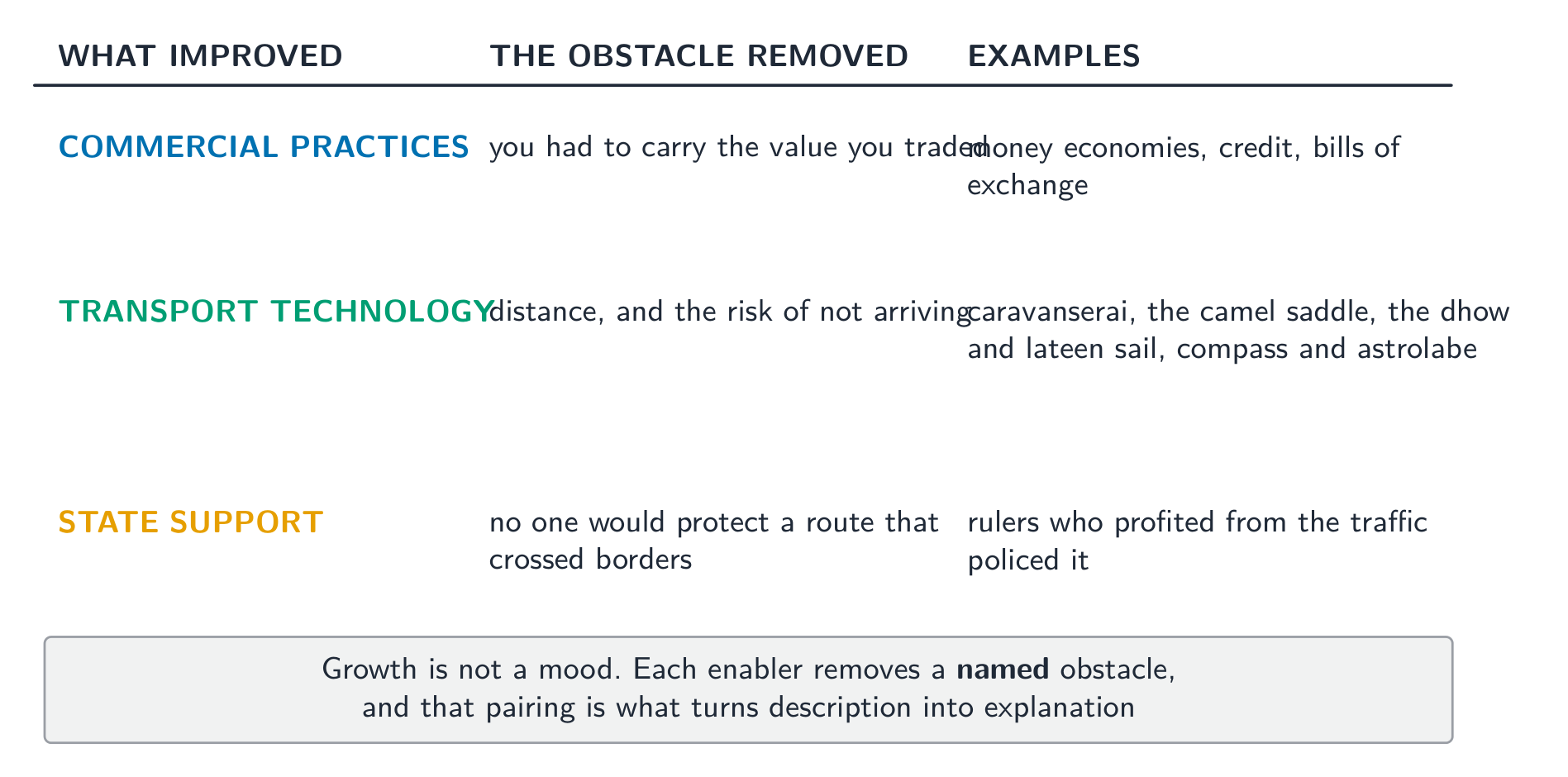
Growth had three common causes, and naming them is worth more than listing goods:

  • Improved commercial practices 商业惯例的改进 - money economies 货币经济, credit 信贷, and forms of partnership that spread risk.
  • Improved transportation technologies 交通技术的改进 - better ships, saddles, and navigation.
  • State support 国家支持 - empires that secured routes and taxed the trade benefited from protecting it.

Demand mattered too: luxury goods 奢侈品 from Chinese, Persian, and Indian artisans found expanding markets across Afro-Eurasia, and producers increased output to meet that demand.

한국어

단원 2는 1200년에서 1450년 사이의 세 대교환 네트워크 - 실크로드, 인도양, 트랜스사하라 경로 -를 다루며 각 네트워크에 대해 동일한 질문을 던집니다: 무엇을 통해 무역이 성장했으며, 그 성장이 무엇을 변화시켰는가?

성장은 세 가지 공통 원인이 있었으며, 이를 열거하는 것보다 명명하는 것이 더 높은 점수 가치가 있습니다:

  • 상업적 관행 개선 - 통화 경제, 신용, 위험을 분산시키는 파트너십 형태.
  • 운송 기술 개선 - 더 나은 선박, 안장, 항해 기술.
  • 국가 지원 - 경로를 확보하고 무역에 세금을 부과한 제국은 이를 보호함으로써 이익을 보았습니다.

수요도 중요합니다: 중국, 페르시아, 인도 장인의 고급품들이 아프로유라시아 전역에서 확장된 시장을 발견했고, 생산자들은 수요를 충족시키기 위해 생산량을 늘렸습니다.

각 촉진자는 명명된 장애물을 제거했습니다 - 이 짝 매핑이 서술을 설명으로 전환합니다
Explore · ⁨탐색하기⁩

Pair each enabler with the obstacle it removed

Growth is not a mood: each enabler removes a named obstacle, and that pairing turns description into explanation.

2.1

The Silk Roads · ⁨실크로드⁩

Syllabus
English

2.1 The Silk Roads

Thematic Focus (ECN): Economics Systems — As societies develop, they affect and are affected by the ways that they produce, exchange, and consume goods and services.

Learning Objective Unit 2.A: Explain the causes and effects of growth of networks of exchange after 1200.

  • KC-3.1.I.A.i Improved commercial practices led to an increased volume of trade and expanded the geographical range of existing trade routes— including the Silk Roads—promoting the growth of powerful new trading cities.
  • KC-3.1.I.C.i The growth of interregional trade in luxury goods was encouraged by innovations in previously existing transportation and commercial technologies, including the caravanserai, forms of credit, and the development of money economies.
  • KC-3.3.I.B Demand for luxury goods increased in Afro-Eurasia. Chinese, Persian, and Indian artisans and merchants expanded their production of textiles and porcelains for export; manufacture of iron and steel expanded in China.

Illustrative examples:

  • Trading cities:
    • Kashgar
    • Samarkand
  • New forms of credit and money economies:
    • Bills of exchange
    • Banking houses
    • Use of paper money
한국어

2.1 실크로드

주제 집중 (ECN): 경제 체계 — 사회가 발전함에 따라 생산, 교환, 소비 방식을 변화시키고 이에 영향을 받는다.

학습 목표 Unit 2.A: 1200년 이후 교역망 확장의 원인과 결과를 설명하시오.

  • KC-3.1.I.A.i 상업 관행의 개선은 교역량을 증가시키고 기존 교역로(실크로드 포함)의 지리적 범위를 확장하여 강력한 신규 교역 도시의 성장을 촉진하였다.
  • KC-3.1.I.C.i 사원, 신용 형태, 화폐 경제의 발달 등 기존 운송 및 상업 기술의 혁신은 고가품의 지역 간 교역 확대를 장려했다.
  • KC-3.3.I.B 아프리카·유라시아에서 고가품에 대한 수요가 증가했다. 중국, 페르시아, 인도 공작상인들은 직물과 도자기 수출용 생산을 확대했고, 중국의 철강 제조업도 성장했다.

예시 사례:

  • 교역 도시:
    • 카슈가르
    • 사마르칸드
  • 신규 신용 형태 및 화폐 경제:
    • 환어음
    • 은행가
    • 지폐 사용

Source: College Board AP Course and Exam Description · ⁨출처: College Board AP Course and Exam Description⁩

English

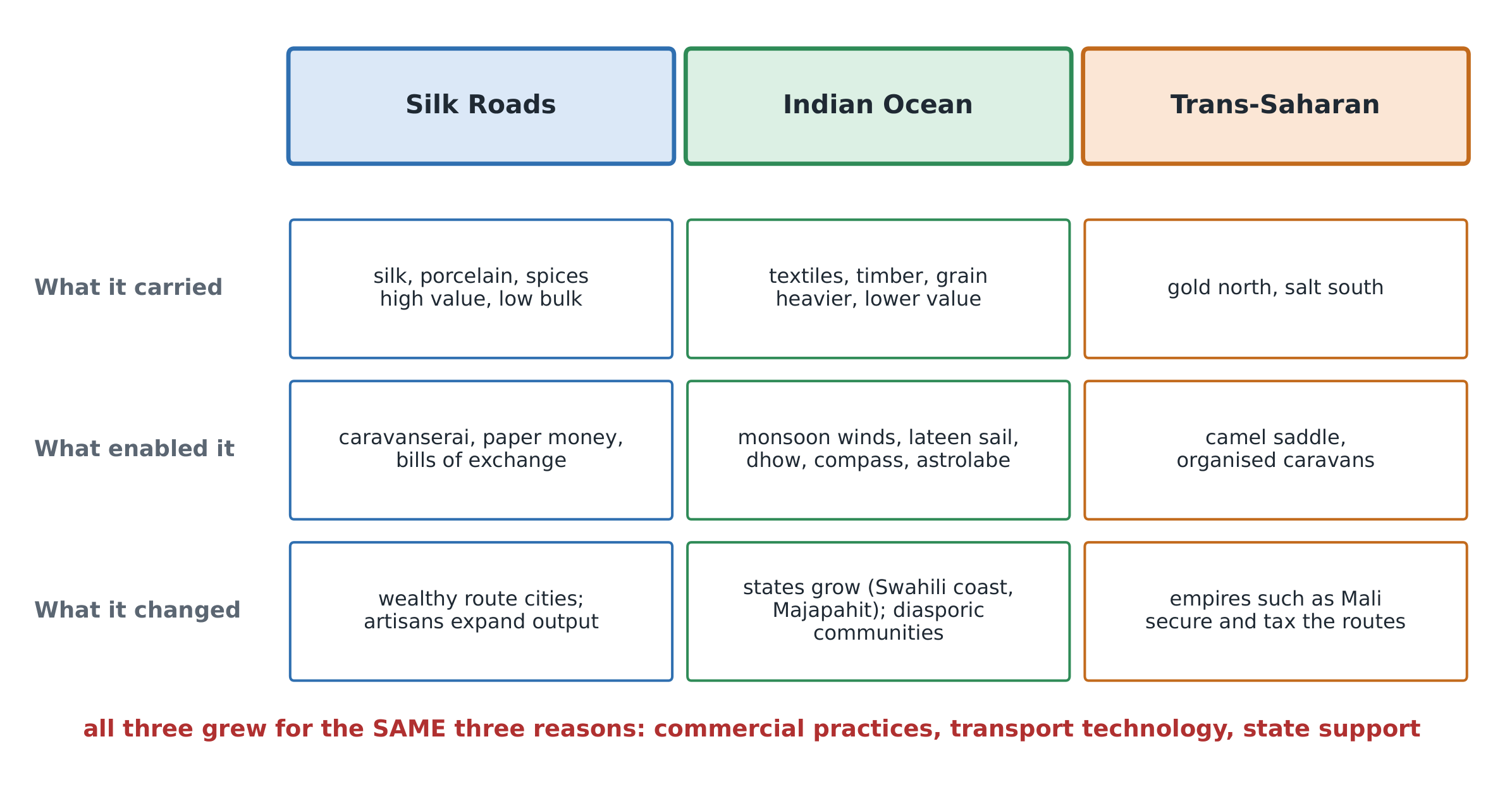
The Silk Roads 丝绸之路 carried high-value, low-bulk goods overland across Eurasia: silk, porcelain, spices, and precious metals.

Its enabling innovations were commercial as much as technical - caravanserai 商队旅馆 along the routes, the use of paper money 纸币 and bills of exchange 汇票 in China, and forms of credit that let merchants trade without carrying bullion.

The consequence for producers: Chinese artisans expanded output, and cities along the routes grew wealthy on the traffic passing through.

한국어

실크로드는 고가·저부피 상품을 유라시아 대륙을 가로질러 육로로 운반했습니다: 비단, 도자기, 향신료, 귀금속.

그것을 가능케 한 혁신들은 기술적이라기보다 상업적이었습니다: 경로상의 카라반세라이, 중국의 지폐와 환어음 사용, 금화나 은화를 휴대하지 않고도 상인들이 거래할 수 있게 해주는 신용 형태.

생산자에 대한 결과: 중국 장인들은 생산량을 확대했고, 경로상의 도시들은 통과하는 상류로 부를 얻었습니다.

2.2

The Mongol Empire · ⁨몽골 제국⁩

Syllabus
English

2.2 The Mongol Empire and the Making of the Modern World

Thematic Focus (GOV): Governance — A variety of internal and external factors contribute to state formation, expansion, and decline. Governments maintain order through a variety of administrative institutions, policies, and procedures, and governments obtain, retain, and exercise power in different ways and for different purposes.

Thematic Focus (CDI): Cultural Developments and Interactions — The development of ideas, beliefs, and religions illustrates how groups in society view themselves, and the interactions of societies and their beliefs often have political, social, and cultural implications.

Learning Objective Unit 2.B: Explain the process of state building and decline in Eurasia over time. THEMATIC FOCUS Economics Systems ECN As societies develop, they affect and are affected by the ways that they produce, exchange, and consume goods and services. LEARNING OBJECTIVE

  • KC-3.2.I.B.iii Empires collapsed in different regions of the world and in some areas were replaced by new imperial states, including the Mongol khanates. HISTORICAL DEVELOPMENTS

Learning Objective Unit 2.C: Explain how the expansion of empires influenced trade and communication over time.

  • KC-3.1.I.E.i The expansion of empires—including the Mongols—facilitated Afro-Eurasian trade and communication as new people were drawn into their conquerors’ economies and trade networks.

Learning Objective Unit 2.D: Explain the significance of the Mongol Empire in larger patterns of continuity and change.

  • KC-3.2.II.A.ii Interregional contacts and conflicts between states and empires, including the Mongols, encouraged significant technological and cultural transfers.

Illustrative examples:

  • Technological and cultural transfers:
    • Transfer of Greco– Islamic medical knowledge to western Europe
    • Transfer of numbering systems to Europe
    • Adoption of Uyghur script
한국어

2.2 몽골 제국과 근대 세계의 형성

주제 집중 (GOV): 통치 — 다양한 내부 및 외부 요인이 국가 형성, 확장 및 쇠퇴에 기여한다. 정부는 다양한 행정 기관, 정책 및 절차를 통해 질서를 유지하며, 정부는 서로 다른 방식과 목적으로 권력을 획득, 보유 및 행사한다.

주제 집중 (CDI): 문화적 발전 및 상호작용 — 사상의 development, 신념 및 종교의 발전은 사회 내 집단이 자신을 어떻게 인식하는지를 보여주며, 사회와 그들의 신념 간의 상호작용은 종종 정치적, 사회적, 문화적 영향을 미친다.

학습 목표 단원 2.B: 유라시아에서의 국가 형성과 쇠퇴 과정에 대해 설명하시오. 주제별 중점: 경제 체계 ECN 사회가 발전함에 따라 생산, 교환 및 소비 방식에 영향을 미치고, 동시에 그 방식의 변화에 영향을 받는다. 학습 목표

  • KC-3.2.I.B.iii 제국들은 세계 각지에서 붕괴되었으며, 일부 지역에서는 몽골 칸국과 같은 새로운 제국 국가로 대체되었다. 역사적 발전

학습 목표 단원 2.C: 제국의 확장이 시간이 지남에 따라 교역 및 소통에 미친 영향을 설명하시오.

  • KC-3.1.I.E.i 제국의 확장(몽골 포함)은 새로운 사람들이 정복자의 경제 및 교역망에 편입됨에 따라 아프리칸-유라시아 교역 및 소통을 촉진하였다.

학습 목표 단원 2.D: 몽골 제국이 지속과 변화의 더 큰 양상에서 가지는 의의를 설명하시오.

  • KC-3.2.II.A.ii 국가와 제국(몽골 포함) 간의 국제간 접촉 및 갈등은 중요한 기술 및 문화 전이를 장려하였다.

예시 사례:

  • 기술 및 문화 전이:
    • 서유럽으로의 그리스-이슬람 의학 지식 전이
    • 유럽으로의 숫자 체계 전이
    • 위구르 문자 채택

Source: College Board AP Course and Exam Description · ⁨출처: College Board AP Course and Exam Description⁩

English

Empires collapsed and were reconstituted in this period, and the largest transformation came from the Mongol Empire 蒙古帝国.

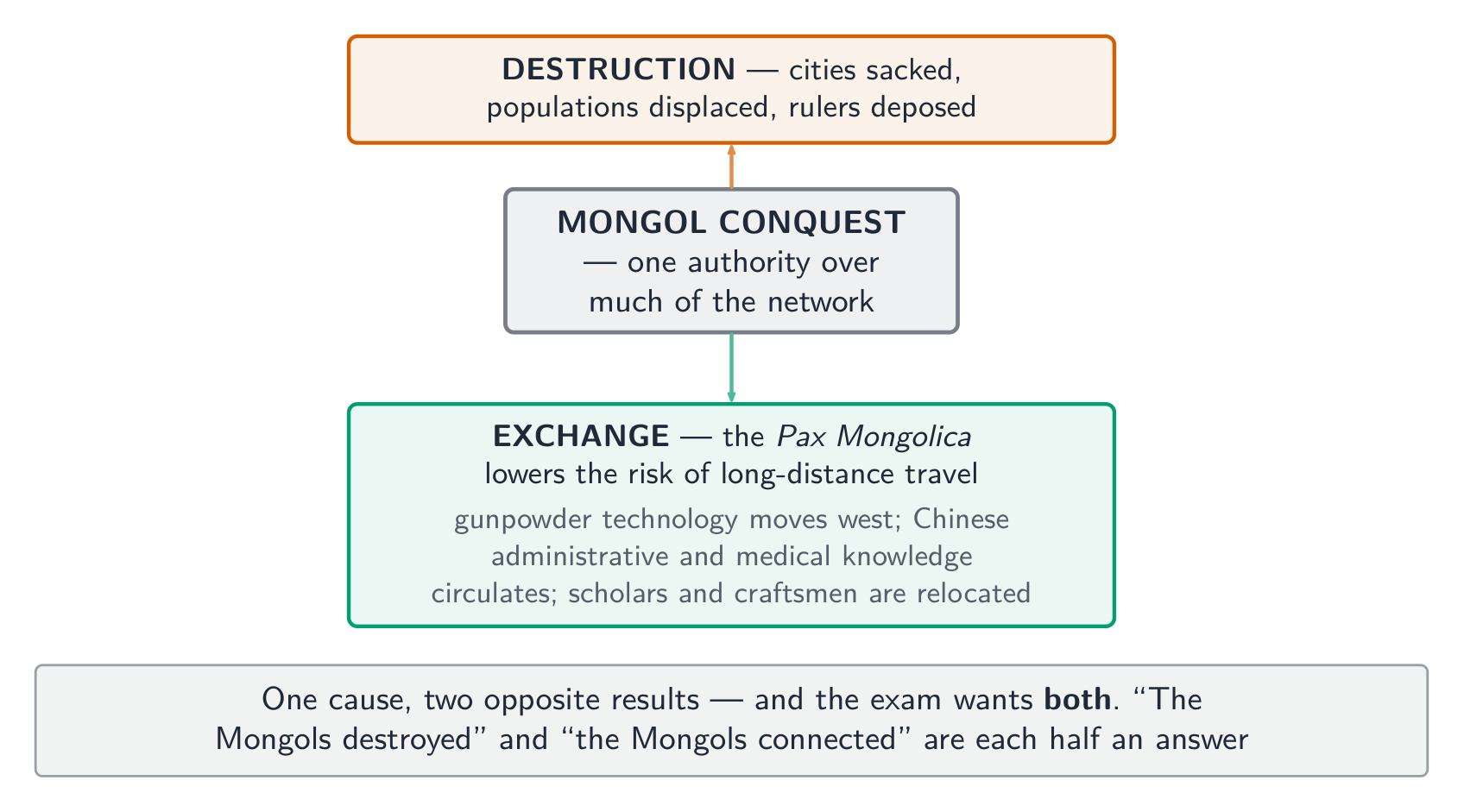
Mongol expansion facilitated Afro-Eurasian trade and communication by bringing much of the network under a single authority, which lowered the risk of long-distance travel - a period often called the Pax Mongolica 蒙古和平.

Interregional contacts and conflicts also encouraged technological and cultural transfers: gunpowder technology moved west, Chinese administrative and medical knowledge circulated, and scholars and craftsmen were relocated across the empire.

The Mongols illustrate the unit's central irony: conquest and destruction produced the conditions for exchange.

한국어

제국들이 붕괴하고 재편되는 시기였으며, 가장 큰 변화는 몽골 제국에서 비롯되었습니다.

몽골의 확장은 네트워크의 대부분을 단일 권위 아래에 놓아 장거리 여행의 위험을 낮췄는데, 이는 종종 몽골 평안(Pax Mongolica) 시기로 불립니다. 이로 인해 아프로유라시아 무역 및 소통이 촉진되었습니다.

간접적 접촉과 갈등 또한 기술 및 문화 이전을 촉진했습니다: 화약 기술이 서쪽으로 이동했고, 중국의 행정 및 의학 지식이 유통되었으며, 학자와 장인들이 제국 전역으로 이주했습니다.

몽골인은 이 단원의 핵심 아이러니를 보여줍니다: 정복과 파괴가 교환을 위한 조건을 창출했습니다.

단원의 핵심 아이러니: 하나의 원인, 두 가지 반대 결과, 그리고 시험에서는 둘 다 요구함
Vocabulary · ⁨어휘⁩ Train · ⁨연습하기⁩
English 한국어
Improved commercial practices/ɪmˈpruːvd kəˈmɜːʃl ˈpræktɪsɪz/ 개선된 상업적 관행
money economies/ˈmʌni ɪˈkɒnəmiz/ 통화 경제
credit/ˈkredɪt/ 신용
Improved transportation technologies/ɪmˈpruːvd trænspɔːˈteɪʃn tekˈnɒlədʒiz/ 개량된 교통 기술
State support/steɪt səˈpɔːt/ 국가 지원
luxury goods/ˈlʌkʃəri ɡʊdz/ 호화로운 물품
Silk Roads/sɪlk rəʊdz/ 실크로드
caravanserai/ˈkærəvænsəraɪ/ 카라반세라이
paper money/ˈpeɪpə ˈmʌni/ 종이 화폐
bills of exchange/bɪlz ɒv eksˈtʃeɪndʒ/ 수표
Mongol Empire/ˈmɒŋɡɒl ˈempaɪə/ 몽골 제국
Pax Mongolica/pæks mɒnˈɡɒlɪkə/ 몽골의 평정(Pax Mongolica)
monsoon winds/mɒnˈsuːn wɪndz/ 몬순 바람
lateen sail/ˈlætiːn seɪl/ 라테인 sails
2.3

The Indian Ocean · ⁨인도양⁩

Syllabus
English

2.3 Exchange in the Indian Ocean

Thematic Focus (ECN): Economics Systems — As societies develop, they affect and are affected by the ways that they produce, exchange, and consume goods and services.

Thematic Focus (CDI): Cultural Developments and Interactions — The development of ideas, beliefs, and religions illustrates how groups in society view themselves, and the interactions of societies and their beliefs often have political, social, and cultural implications.

Learning Objective Unit 2.E: Explain the causes of the growth of networks of exchange after 1200.

  • KC-3.1.I.A.ii Improved transportation technologies and commercial practices led to an increased volume of trade and expanded the geographical range of existing trade routes, including the Indian Ocean, promoting the growth of powerful new trading cities.
  • KC-3.1.I.C.ii The growth of interregional trade in luxury goods was encouraged by significant innovations in previously existing transportation and commercial technologies, including the use of the compass, the astrolabe, and larger ship designs.
  • KC-3.1.I.A.iii The Indian Ocean trading network fostered the growth of states.

Learning Objective Unit 2.F: Explain the effects of the growth of networks of exchange after 1200. THEMATIC FOCUS Humans and the Environments ENV The environment shapes human societies, and as populations grow and change, these populations in turn shape their environments. LEARNING OBJECTIVE

  • KC-3.1.III.B In key places along important trade routes, merchants set up diasporic communities where they introduced their own cultural traditions into the indigenous cultures and, in turn, indigenous cultures influenced merchant cultures.
  • KC-3.2.II.A.iii Interregional contacts and conflicts between states and empires encouraged significant technological and cultural transfers, including during Chinese maritime activity led by Ming Admiral Zheng He. HISTORICAL DEVELOPMENTS

Learning Objective Unit 2.G: Explain the role of environmental factors in the development of networks of exchange in the period from c. 1200 to c. 1450.

  • KC-3.1.II.A.i The expansion and intensification of long-distance trade routes often depended on environmental knowledge, including advanced knowledge of the monsoon winds.

Illustrative examples:

  • Growth of states:
    • City-states of the Swahili Coast
    • Gujarat
    • Sultanate of Malacca
  • (CONT’D) Diasporic communities:
    • Arab and Persian communities in East Africa
    • Chinese merchant communities in Southeast Asia
    • Malay communities in the Indian Ocean basin
한국어

2.3 인도양에서의 교환

주제 집중 (ECN): 경제 체계 — 사회가 발전함에 따라 생산, 교환, 소비 방식을 변화시키고 이에 영향을 받는다.

주제 집중 (CDI): 문화적 발전 및 상호작용 — 사상의 development, 신념 및 종교의 발전은 사회 내 집단이 자신을 어떻게 인식하는지를 보여주며, 사회와 그들의 신념 간의 상호작용은 종종 정치적, 사회적, 문화적 영향을 미친다.

학습 목표 단원 2.E: 1200년 이후 교환망 성장의 원인을 설명하시오. 주제별 중점: 인간과 환경 ENV 환경은 인간 사회를 형성하며, 인구가 증가하고 변화함에 따라 이러한 인구들이 다시 환경을 형성한다. 학습 목표

  • KC-3.1.I.A.ii 교통 기술의 개선과 상업 관행은 교역 물량의 증가를 가져왔고 인도양을 포함한 기존 교역로의 지리적 범위를 확대하여 강력한 신생 교역 도시의 성장을 촉진하였다.
  • KC-3.1.I.C.ii 비품에 대한 국제간 교역의 증가는 나침반, 아스트롤abe 및 대형 선박 설계 등 기존 교통 및 상업 기술의 중요한 혁신에 의해 장려되었다.
  • KC-3.1.I.A.iii 인도양 교역망은 국가의 성장을 도모하였다.

학습 목표 단원 2.F: 1200년 이후交換망 성장의 영향을 설명하시오. 주제별 중점: 인간과 환경 ENV 환경은 인간 사회를 형성하며, 인구가 증가하고 변화함에 따라 이러한 인구들이 다시 환경을 형성한다. 학습 목표

  • KC-3.1.III.B 중요한 교역로상의 주요 장소에서 상인들은 자국의 문화 전통을 토착 문화에 도입하고, 반대로 토착 문화가 상인의 문화에 영향을 미치는 디아스포라 공동체를 형성하였다.
  • KC-3.2.II.A.iii 국가와 제국 간의 국제간 접촉 및 갈등은 중요한 기술 및 문화 전이를 장려하였으며, 명(明) 제국의 정하(鄭和) 대령이 이끄는 중국 해상 활동时期에도 이를 포함하였다. 역사적 발전

학습 목표 단원 2.G: c. 1200~c. 1450 시기에交换망 발전에 있어 환경 요인이果た한 역할을 설명하시오.

  • KC-3.1.II.A.i 장거리 교역로의 확장과 강화는 종종 모순바람에 대한 고등 지식을 포함한 환경 지식에 의존하였다.

예시 사례:

  • 국가의 성장:
    • 스와힐리 해안의 도시국가
    • 구자라트
    • 말라카 술탄국
  • (계속) 디아스포라 공동체:
    • 동아프리카의 아랍 및 페르시아 공동체
    • 동남아시아의 중국 상인 공동체
    • 인도양 연안 지역의 말레이 공동체

Source: College Board AP Course and Exam Description · ⁨출처: College Board AP Course and Exam Description⁩

English

The Indian Ocean network moved bulkier goods than the Silk Roads - textiles, timber, grain, and spices - because ships carry more than camels.

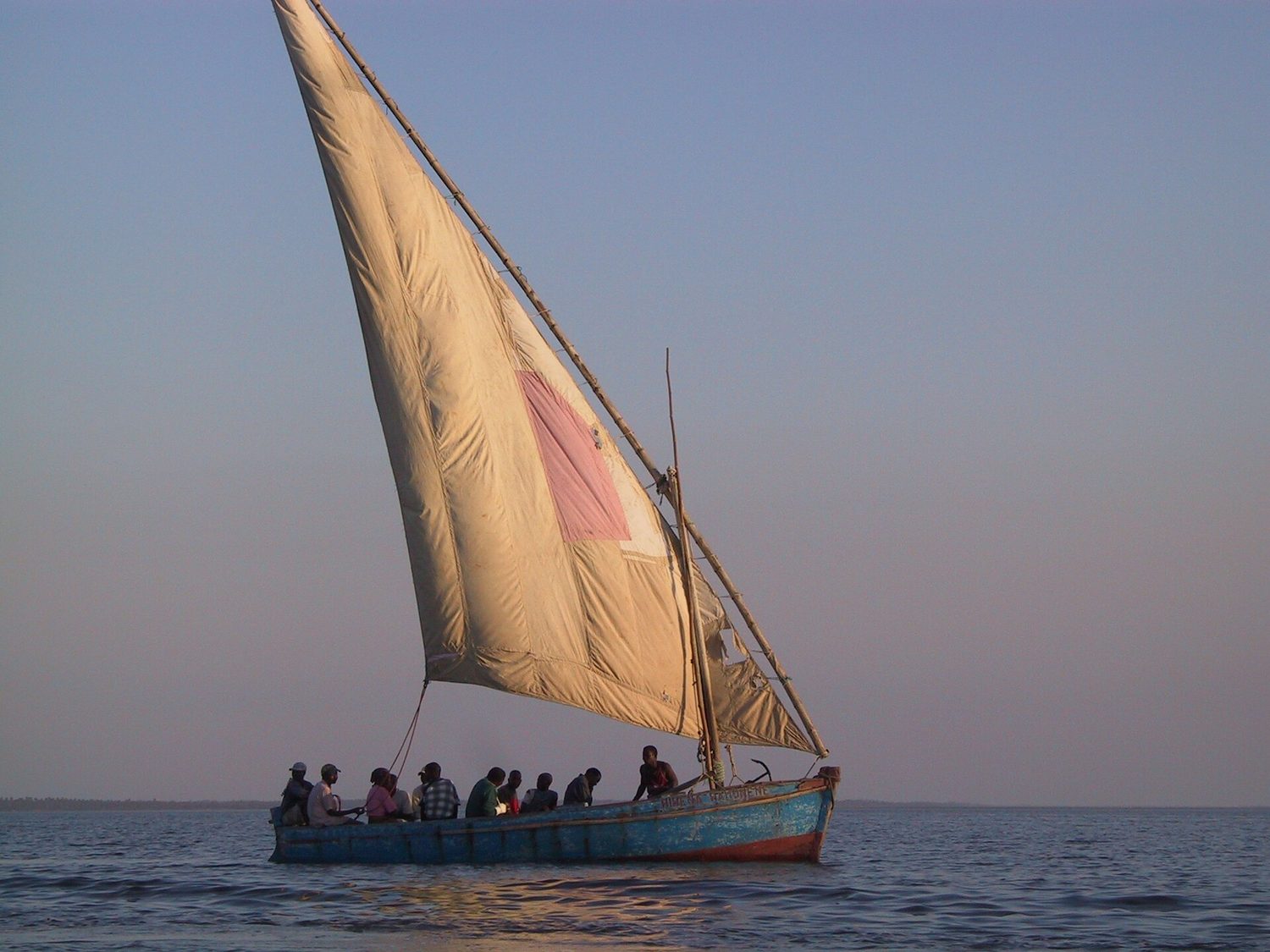
Its enabling technologies were maritime: knowledge of the monsoon winds 季风, the lateen sail 三角帆, the dhow 单桅帆船, and navigational tools including the compass 罗盘 and astrolabe 星盘.

Its consequences are the most examinable in the unit:

  • The network fostered the growth of states, such as the Swahili city-states on the East African coast and Srivijaya and Majapahit in Southeast Asia.
  • Merchants established diasporic communities 侨居社群 in key ports, introducing their own culture while adopting local ways.
  • Long-distance trade depended on and expanded coerced labour and on the movement of people as well as goods.
한국어
세 네트워크를 운반한 물품, 이를 가능케 한 것, 그리고它们이 변화시킨 것에 따라 비교
세 네트워크, 하나의 프레임워크: 물품, 촉진 기술, 결과 - 이것이 비교 문제에서 묻는 내용

인도양 네트워크는骆驼보다 더 많은 것을 운반할 수 있는 선박 덕분에 실크로드보다 더 무거운 물품을 운반했습니다: 직물, 목재, 곡물, 향신료.

그것을 가능케 한 기술들은 해양적이었습니다: 계절풍에 대한 지식, 래틴 sail, 도우, 그리고 나침반과 알트로لاب을 포함한 항해 도구.

그 결과들은 이 단원에서 가장 출제 가능성이 높습니다:

  • 네트워크는 국가의 성장을촉진했는데, 동아프리카 연안의 스와힐리 도시 국가들과 동남아시아의 스리비자야 및 마자파히트 등이 그 예입니다.
  • 상인들은 주요 항구에 ** Diasporic 공동체**를 형성하여 자신의 문화를 도입하면서도 현지 방식을 채택했습니다.
  • 장거리 무역은 강제 노동의 의존과 확장에, 그리고 사람과 물품의 이동에 의존했습니다.
래틴 sail을 단 도우 - 선박이 계절풍 시스템을横断할 수 있게 한 rigs
Vocabulary · ⁨어휘⁩ Train · ⁨연습하기⁩
English 한국어
dhow/ˈdiːhaʊ/ 도(船) 선
compass/ˈkʌmpəs/ 나침반
astrolabe/ˈæstrəleɪb/ 천문반
diasporic communities/ˌdaɪəˈspɒrɪk kəˈmjuːnɪtiz/ 디아스포라 공동체
camel saddle/ˈkæml ˈsædl/ 낙타 안장
caravans/ˈkærəvænz/ 카바반
salt/sɒlt/ 염
Mali/ˈmɑːli/ Mali
diffusion/dɪˈfjuːʒn/ 확산
travellers/ˈtræveləz/ 여행자들
2.4

Trans-Saharan Trade · ⁨트랜스사하라 무역⁩

Syllabus
English

2.4 Trans-Saharan Trade Routes

Thematic Focus (TEC): Technology and Innovation — Human adaptation and innovation have resulted in increased efficiency, comfort, and security, and technological advances have shaped human development and interactions with both intended and unintended consequences.

Thematic Focus (GOV): Governance — A variety of internal and external factors contribute to state formation, expansion, and decline. Governments maintain order through a variety of administrative institutions, policies, and procedures, and governments obtain, retain, and exercise power in different ways and for different purposes.

Learning Objective Unit 2.H: Explain the causes and effects of the growth of trans-Saharan trade.

  • KC-3.1.II.A.ii The growth of interregional trade was encouraged by innovations in existing transportation technologies.
  • KC-3.1.I.A.iv Improved transportation technologies and commercial practices led to an increased volume of trade and expanded the geographical range of existing trade routes, including the trans-Saharan trade network.

Learning Objective Unit 2.I: Explain how the expansion of empires influenced trade and communication over time.

  • KC-3.1.I.E.ii The expansion of empires—including Mali in West Africa–facilitated Afro-Eurasian trade and communication as new people were drawn into the economies and trade networks.

Illustrative examples:

  • Technologies encouraging interregional trade:
    • Camel saddle
    • Caravans
한국어

2.4 사하라 이남 교역로

주제별 중점 (TEC): 기술과 혁신 — 인간의 적응과 혁신은 효율성, 편안함, 안전성의 향상을 가져왔으며, 기술 발전은 의도된 결과뿐만 아니라 비의도적인 결과까지도 포함하여 인간의 발전 및 상호작용에 영향을 미쳤다.

주제 집중 (GOV): 통치 — 다양한 내부 및 외부 요인이 국가 형성, 확장 및 쇠퇴에 기여한다. 정부는 다양한 행정 기관, 정책 및 절차를 통해 질서를 유지하며, 정부는 서로 다른 방식과 목적으로 권력을 획득, 보유 및 행사한다.

학습 목표 단원 2.H: 사하라 이남 교역의 성장 원인 및 영향을 설명하시오.

  • KC-3.1.II.A.ii 기존 교통 기술의 혁신은 국제간 교역의 성장을 장려하였다.
  • KC-3.1.I.A.iv 교통 기술의 개선과 상업 관행은 교역 물량의 증가를 가져왔고 사하라 이남 교역망을 포함한 기존 교역로의 지리적 범위를 확대하였다.

학습 목표 단원 2.I: 제국의 확장이 시간이 지남에 따라 교역 및 소통에 미친 영향을 설명하시오.

  • KC-3.1.I.E.ii 마를리 왕국을 포함한 제국의 확장은 새로운 사람들이 경제 및 교역망에 편입됨에 따라 아프리칸-유라시아 교역 및 소통을 촉진하였다.

예시 사례:

  • 국제간 교역을 장려하는 기술:
    • 낙타 안장
    • 카라반(상단)

Source: College Board AP Course and Exam Description · ⁨출처: College Board AP Course and Exam Description⁩

English

The trans-Saharan routes crossed the desert on innovations in existing technology - above all the camel saddle 骆驼鞍 and organised caravans 商队.

Gold from West Africa moved north and salt 盐 moved south. The expansion of empires, including Mali 马里帝国, facilitated Afro-Eurasian trade by securing the routes and taxing them - and Mali's wealth and its ruler's famous pilgrimage advertised the region across the Islamic world.

한국어

트랜스사하라 경로는 기존 기술의 혁신을 통해 사막을 횡단했습니다: 특히 Camel 안장과 조직화된 카라반.

서아프리카의 금은 북쪽으로, 소금은 남쪽으로 이동했습니다. 말리를 포함한 제국의 확장은 통로 확보 및 과세를 통해 아프리카-유라시아 무역을 촉진했으며, 말리의 부와 통치자의 유명한 성지 순례는 이 지역이 이슬람 세계 전체에 널리 알려졌다.

2.5 2.6

Cultural and Environmental Consequences · ⁨문화적·환경적 결과⁩

Syllabus
English

2.5 Cultural Consequences of Connectivity

Thematic Focus (CDI): Cultural Developments and Interactions — The development of ideas, beliefs, and religions illustrates how groups in society view themselves, and the interactions of societies and their beliefs often have political, social, and cultural implications.

Learning Objective Unit 2.J: Explain the intellectual and cultural effects of the various networks of exchange in Afro-Eurasia from c. 1200 to c. 1450.

  • KC-3.1.III.D Increased cross-cultural interactions resulted in the diffusion of literary, artistic, and cultural traditions, as well as scientific and technological innovations.
  • KC-3.3.II The fate of cities varied greatly, with periods of significant decline and periods of increased urbanization, buoyed by rising productivity and expanding trade networks.
  • KC-3.1.III.C As exchange networks intensified, an increasing number of travelers within Afro-Eurasia wrote about their travels.

Illustrative examples:

  • Diffusion of cultural traditions:
    • The influence of Buddhism in East Asia
    • The spread of Hinduism and Buddhism into Southeast Asia
    • The spread of Islam in sub-Saharan Africa and Asia
  • Diffusion of scientific or technological innovations:
    • Gunpowder from China
    • Paper from China
  • Travelers:
    • Ibn Battuta
    • Margery Kempe
    • Marco Polo
한국어

2.5 연결성의 문화적 결과

주제 집중 (CDI): 문화적 발전 및 상호작용 — 사상의 development, 신념 및 종교의 발전은 사회 내 집단이 자신을 어떻게 인식하는지를 보여주며, 사회와 그들의 신념 간의 상호작용은 종종 정치적, 사회적, 문화적 영향을 미친다.

학습 목표 단원 2.J: c. 1200~c. 1450 시기에 아프리칸-유라시아에서 다양한交換망이 가져온 지적 및 문화적 영향을 설명하시오.

  • KC-3.1.III.D 문화 간 상호작용의 증가는 문학적, 예술적, 문화적 전통뿐만 아니라 과학 및 기술 혁신의 확산으로 이어졌다.
  • KC-3.3.II 도시의 운명은 크게 달라졌는데, 중요한 쇠퇴기나 생산력 상승 및 교역망 확장에 힘입어 도시화가 증가한 시기 등이 있었다.
  • KC-3.1.III.C交換망이 강화됨에 따라 아프리칸-유라시아 내에서 여행한 사람들의 수가 늘어나며 그들의 여정을 기록하게 되었다.

예시 사례:

  • 문화적 전통의 확산:
    • 동아시아의 불교 영향
    • 힌두교 및 불교의 동남아시아 진출
    • 사하라 이남 아프리카 및 아시아에서의 이슬람 확산
  • 과학 또는 기술 혁신의 확산:
    • 중국의 화약
    • 중국의 종이
  • 여행자:
    • 이븐 바투타
    • 마르지 케임프
    • 마르코 폴로
English

2.6 Environmental Consequences of Connectivity

Thematic Focus (ENV): Humans and the Environments — The environment shapes human societies, and as populations grow and change, these populations in turn shape their environments.

Learning Objective Unit 2.K: Explain the environmental effects of the various networks of exchange in Afro-Eurasia from c. 1200 to c. 1450.

  • KC-3.1.IV There was continued diffusion of crops and pathogens, with epidemic diseases, including the bubonic plague, along trade routes.

Illustrative examples:

  • Diffusion of crops:
    • Bananas in Africa
    • New rice varieties in East Asia
    • Spread of citrus in the Mediterranean
한국어

2.6 연결성의 환경적 결과

주제 초점 (ENV): 인간과 환경 — 환경은 인간 사회를 형성하며, 인구가 성장하고 변화함에 따라 이러한 인구들이 다시 환경을 형성한다.

학습 목표 Unit 2.K: c. 1200년부터 c. 1450년까지 아프리카-유라시아의 다양한 교환 네트워크의 환경적 영향을 설명하라.

  • KC-3.1.IV 교역로를 따라 전염병, 특히 매독을 포함한 병원체가 계속 확산되었다.

예시 사례:

  • 작물의 확산:
    • 아프리카의 바나나
    • 동아시아의 새로운 벼 품종
    • 지중해 지역의 시트러스類 확산

Source: College Board AP Course and Exam Description · ⁨출처: College Board AP Course and Exam Description⁩

English

Increased cross-cultural interaction produced diffusion 传播 of literary, artistic, scientific, and religious traditions - the spread of Islam along trade routes, Buddhist and Neo-Confucian influence in East Asia, and the movement of scientific and mathematical knowledge.

An increasing number of travellers 旅行者 moved within and between regions, and their accounts are the period's key evidence.

The fate of cities varied: some declined as routes shifted or invasions came, while others grew into major commercial centres.

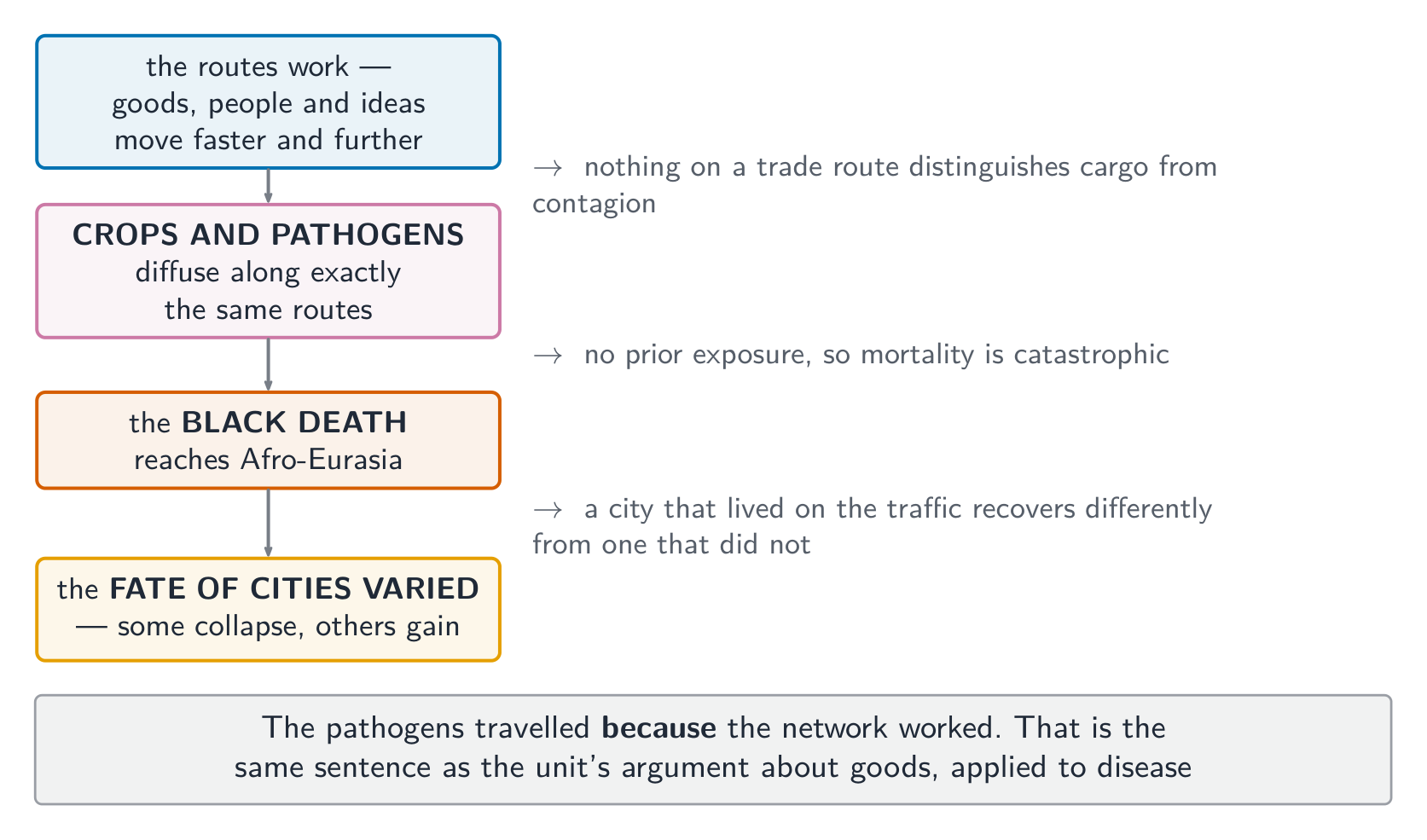
The environmental consequences were as large as the cultural ones. There was continued diffusion of crops and pathogens, and epidemic disease travelled with trade - most catastrophically the Black Death 黑死病, which moved along the same routes that carried goods and killed a large share of the population of Afro-Eurasia.

한국어

문화 간 상호작용 증가는 문학적, 예술적, 과학적, 종교적 전통의 확산을 초래했다. 이는 무역로를 따라 이슬람교가 확산되고, 동아시아에서 불교 및 신유교의 영향력이 커졌으며, 과학 및 수학 지식이 이동한 것을 의미한다.

더 많은 여행자들이 지역 내외를 왕래했으며, 그들의 기록은 해당 시기의 핵심 증거 자료이다.

도시의 운명은 다양했다: 일부는 통로 변경이나 침입으로 인해 쇠퇴했으나, 다른 도시는 주요 상업 중심지로 성장했다.

환경적 결과도 문화적 결과만큼 컸다. 작물과 병원체의 지속된 확산이 있었으며, 전염병은 무역과 함께 이동했다. 그중 가장 참혹했던 것은 흑사병으로, 물자가 운반되던 동일한 경로를 따라扩散되어 아프리카-유라시아 인구의 상당수를 사망시켰다.

병원체가 이동한 이유는 네트워크가 기능했기 때문이며 - 이 논리는 질병에도 적용된다
Explore · ⁨탐색하기⁩

Follow the network's most consequential cargo

The pathogens travelled because the network worked — the same argument the unit makes about goods, applied to disease.

Vocabulary · ⁨어휘⁩ Train · ⁨연습하기⁩
English 한국어
Black Death/blæk deθ/ 블랙 데스(흑사병)
2.7

Comparison of Economic Exchange · ⁨경제적 교환의 비교⁩

Syllabus
English

2.7 Comparison of Economic Exchange

Learning Objective Unit 2.L: Explain the similarities and differences among the various networks of exchange in the period from c. 1200 to c. 1450.

  • KC-3.1 A deepening and widening of networks of human interaction within and across regions contributed to cultural, technological, and biological diffusion within and between various societies.
    • KC-3.1.I.A.i Improved commercial practices led to an increased volume of trade and expanded the geographical range of existing trade routes—including the Silk Roads—promoting the growth of powerful new trading cities.
    • KC-3.1.I.C.i The growth of interregional trade in luxury goods was encouraged by innovations in previously existing transportation and commercial technologies, including the caravanserai, forms of credit, and the development of money economies.
  • KC-3.3 Changes in trade networks resulted from and stimulated increasing productive capacity, with important implications for social and gender structures and environmental processes.
    • KC-3.3.I.B Demand for luxury goods increased in Afro-Eurasia. Chinese, Persian, and Indian artisans and merchants expanded their production of textiles and porcelains for export; manufacture of iron and steel expanded in China.
한국어

2.7 경제적交換 비교

학습 목표 Unit 2.L: c. 1200년부터 c. 1450년까지의 다양한 교환 네트워크 간의 유사점과 차이점을 설명하라.

  • KC-3.1 지역 내외에서의 인간 상호작용 네트워크가 심화되고 확장됨에 따라 다양한 사회 내외에서 문화적, 기술적, 생물학적扩散이 일어났다.
    • KC-3.1.I.A.i 상업 관행의 개선은 교역량의 증가와 기존 교역로(실크로드 포함)의 지리적 범위 확장을 가져왔으며, 강력한 신규 교역 도시의 성장을 촉진했다.
    • KC-3.1.I.C.i 카라반세라이, 신용의 형태, 화폐 경제의 발전 등 기존 운송 및 상업 기술의 혁신은 고급품 간지역 교역의 성장을 장려했다.
  • KC-3.3 교역 네트워크의 변화는 생산 능력의 증대에 의해 유발되고 자극받았으며, 이는 사회 및 성 구조와 환경 과정에 중요한 영향을 미쳤다.
    • KC-3.3.I.B 아프리카-유라시아에서 고급품에 대한 수요가 증가했다. 중국, 페르시아, 인도 장인 및 상인은 직물과 도자기 수출을 위한 생산을 확대했으며, 중국에서는 철강 제조가 확장되었다.

Source: College Board AP Course and Exam Description · ⁨출처: College Board AP Course and Exam Description⁩

English

The unit's reasoning skill is comparison. Compare the networks on what they carried, what made them possible, and what they changed - not on which was "most important".

Worked example (a real AP exam question). AP World short-answer questions frequently ask students to "Explain one similarity" or "Explain one difference" between two trade networks in this period. A full-mark answer names the feature and applies it to both, then explains: "Both the Silk Roads and the Indian Ocean network expanded because of improved commercial practices, but the Indian Ocean carried heavier, lower-value goods such as timber and grain because ships could transport far greater bulk than overland caravans." Notice the shape: the because clause is what turns a difference into an explanation, and without it the answer only describes.

한국어

단원의 추론 능력은 비교이다.哪一个가 '가장 중요했는가'를 따지기보다, 각 네트워크가 운반한 것, 가능하게 한 조건, 변화시킨 점 등을 비교하라.

해설 예제 (실제 AP 시험 문제). AP 세계사 서술형 문제는 thường히 이 시기의 두 무역망 사이에서 "하나의 유사점 설명" 또는 *"하나의 차이점 설명"*을 요구한다. 만점 답안은 특징을 명시하고 양쪽에 적용한 뒤 설명한다: "실크로드와 인도양 네트워크 모두 상업 관행 개선으로 확장되었으나, 인도양 네트워크는 선박이 육상 카바란보다 훨씬 더 많은 양을 운반할 수 있어 목재나 곡물과 같이 무게가 무겁고 가치가 낮은 상품을 운반했다." 이 구조를 주의하라: because(왜) 구절이 차이를 설명으로 전환시키는 핵심이며, 이것이 없으면 답안은 단순히 묘사하는 수준에 머문다.

2.7

Exam tips · ⁨시험 팁⁩

English
  • Explain growth with the three causes - commercial practices, transport technology, state support - rather than listing trade goods.
  • Match cargo to carrier: overland routes move high-value, low-bulk goods; maritime routes move bulk.
  • Learn the enabling technologies by network: caravanserai and credit; monsoons, lateen sail and dhow; the camel saddle.
  • The Mongols' examinable role is facilitating exchange, not conquest for its own sake.
  • The Black Death is the environmental consequence to name, and it travelled on the trade network itself.
  • On difference questions, always add the because. A stated difference without a cause is only half an answer.
한국어
  • 무역품을 나열하기보다 상업 관행, 운송 기술, 국가 지원이라는 세 가지 원인을 활용해 성장을 설명하라.
  • 화물을 운수 수단에 맞춰 매칭하라: 육상 경로는 고부가가치·저부피 상품을, 해상 경로는 대량 상품을 운반한다.
  • 네트워크별 가능 기술을 익혀라: 카라반세라이와 신용, 몬순·라틴 선과 도우, 염소 안장 등.
  • 몽골인의 고사 대상 역할은 그 자체의 정복이 아니라 교환 촉진이다.
  • 언급해야 할 환경적 결과는 흑사병이며, 이는 무역망 자체를 타고 이동했다.
  • 차이점 질문에서는 항상 **because(왜)**를 추가하라. 원인 없이 제시된 차이점은 답안的一半에 불과하다.

Interactive lessons on this topic · ⁨이 주제에 대한 인터랙티브 수업⁩

Work through it step by step, with instant-check exercises. · ⁨즉시 체크 기능 exercises를 통해 단계별로 진행하세요.⁩

Past Papers · ⁨과거 시험지⁩

More topics in AP World History: Modern · ⁨AP 세계사: 근현대⁩ · ⁨AP World History: Modern · ⁨AP 세계사: 근현대⁩ 내 추가 주제⁩

Log in or create account · ⁨로그인 또는 계정 만들기⁩

IGCSE, A-Level & AP