Skip to content · ⁨본문 바로가기⁩

Basic Economic Concepts · ⁨기본 경제 개념⁩

AP Macroeconomics · ⁨AP 경제학 (거시)⁩ · Topic 1 · ⁨주제 1⁩

Video lesson for this topic · ⁨이 주제용 영상 수업⁩ Open the video page · ⁨영상 페이지 열기⁩
7:30

기본 경제 개념

처음 접했을 때 틀린 결과처럼 느껴지는 것이 있다. 가령 코딩을 작성하거나 문서화를 만드는 데 있어 친구보다 빠르다고 가정하자. 당신은 …

English narration · English + 中文 subtitles burned in · ⁨영어 내레이션 · 영어 + 중국어 자막 burned-in⁩

1.1

Scarcity · ⁨희소성⁩

Syllabus
English

Enduring Understanding (MOD-1): The production possibilities curve (PPC) model is used to demonstrate the full employment level of output and to illustrate changes in full employment.

Learning Objective MOD-1.A: Define scarcity and economic resources.

  • MOD-1.A.1 Individuals and societies are forced to make choices because most resources are scarce.
한국어

지속적 이해 (MOD-1): 생산 가능 곡선(PPC) 모델은 완전 고용 수준의 산출을 보여주기 위해 사용되며, 완전 고용의 변화를 설명하는 데 활용됩니다.

학습 목표 MOD-1.A: 희소성과 경제 자원을 정의하십시오.

  • MOD-1.A.1 대부분의 자원이 희소하기 때문에 개인과 사회는 선택을 강요받게 됩니다.
Source: College Board AP Course and Exam Description · ⁨출처: College Board AP Course and Exam Description⁩

English

Economics 经济学 begins with scarcity 稀缺性: people's wants are unlimited, but the resources 资源 to satisfy them are limited. The resources – the factors of production 生产要素 – are land, labor 劳动, capital 资本, and entrepreneurship 企业家才能. Scarcity forces every society to choose what, how, and for whom to produce, and it makes trade-offs 权衡 unavoidable.

한국어
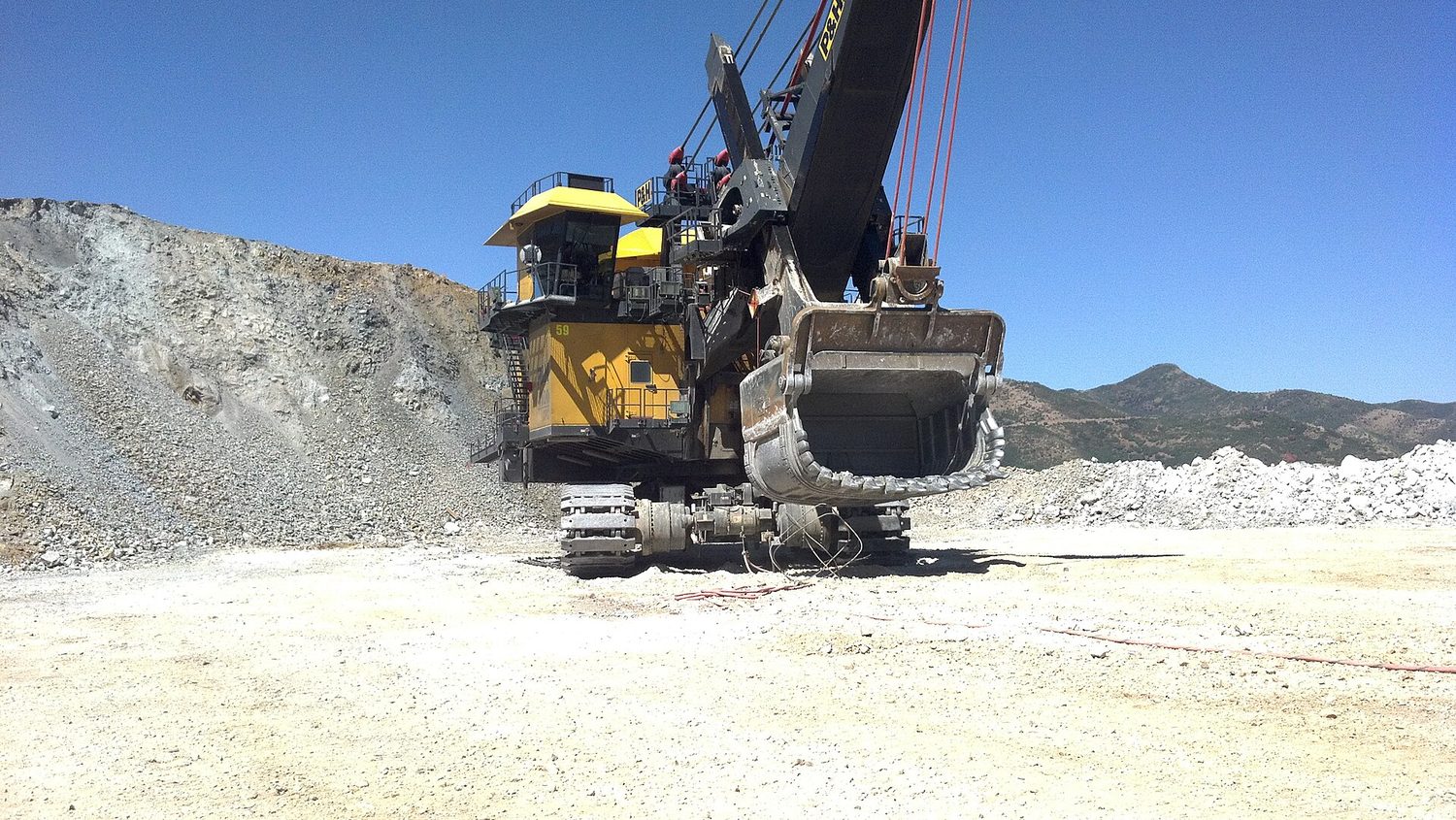
개방식 광산: 토지와 광물은 기회비용을 가진 희소 자원이다

경제학은 희소성으로부터 시작됩니다. 인간의 욕구는 무한하지만 이를 충족시키는 자원은 제한적입니다.的资源 — 생산요소 — 은 토지, 노동, 자본, 그리고 기업가정신입니다. 희소성은 모든 사회가 무엇을, 어떻게, 누구를 위해 생산할지를 선택하도록 강요하며, 타협(trade-offs) 을 불가피하게 만듭니다.

Vocabulary · ⁨어휘⁩ Train · ⁨연습하기⁩
English 한국어
Economics/ˌiːkəˈnɒmɪks/ 경제학
scarcity/ˈskeəsɪti/ 희소성
resources/rɪˈzɔːsɪz/ 자원
factors of production/ˈfæktəz ɒv prəˈdʌkʃn/ 생산 요인
labor/ˈleɪbə/ 노동
capital/ˈkæpɪtl/ 자본
entrepreneurship/ˌɒntrɪprəˈnjʊəʃɪp/ Entrepreneurship
trade-offs/treɪd ɒfs/ 타협(trade-offs)
1.2

Opportunity Cost and the Production Possibilities Curve (PPC) · ⁨기회비용과 생산가능곡선(PPC)⁩

Syllabus
English

Enduring Understanding (MOD-1): The production possibilities curve (PPC) model is used to demonstrate the full employment level of output and to illustrate changes in full employment.

Learning Objective MOD-1.B: a. Define (using graphs as appropriate) the PPC and related terms. b. Explain (using graphs as appropriate) how the PPC illustrates opportunity costs, tradeoffs, inefficiency, efficiency, and economic growth or contraction under various conditions. c. Calculate (using data from PPCs or tables as appropriate) opportunity cost.

  • MOD-1.B.1 The PPC is a model used to show the tradeoffs associated with allocating resources.
  • MOD-1.B.2 The PPC can be used to illustrate the concepts of scarcity, opportunity cost, efficiency, underutilized resources, and economic growth or contraction.
  • MOD-1.B.3 The shape of the PPC depends on whether opportunity costs are constant, increasing, or decreasing.
  • MOD-1.B.4 The PPC can shift because of changes in factors of production as well as changes in productivity/technology.
  • MOD-1.B.5 Economic growth results in an outward shift of the PPC.
한국어

지속적 이해 (MOD-1): 생산 가능 곡선(PPC) 모델은 완전 고용 수준의 산출을 보여주기 위해 사용되며, 완전 고용의 변화를 설명하는 데 활용됩니다.

학습 목표 MOD-1.B: a. PPC와 관련 용어를 정의하십시오(적절한 경우 그래프 사용). b. PPC가 다양한 조건 하에서 기회 비용, 상충 관계, 비효율성, 효율성, 그리고 경제 성장 또는 침체를 어떻게 나타내는지를 설명하십시오(적절한 경우 그래프 사용). c.的机会 비용을 계산하십시오(적절한 경우 PPC 또는 표의 데이터 사용).

  • MOD-1.B.1 PPC는 자원을 배분함에 따른 상충 관계를 보여주는 모델입니다.
  • MOD-1.B.2 PPC는 희소성, 기회 비용, 효율성, 비활용된 자원, 그리고 경제 성장 또는 침체 개념을 설명하는 데 사용할 수 있습니다.
  • MOD-1.B.3机会 비용이 일정, 증가, 또는 감소 여부에 따라 PPC의 형태가 결정됩니다.
  • MOD-1.B.4 생산 요인의 변화 및 생산성/기술의 변화로 인해 PPC가 이동할 수 있습니다.
  • MOD-1.B.5 경제 성장은 PPC의 외부 이동으로 이어집니다.

Source: College Board AP Course and Exam Description · ⁨출처: College Board AP Course and Exam Description⁩

English
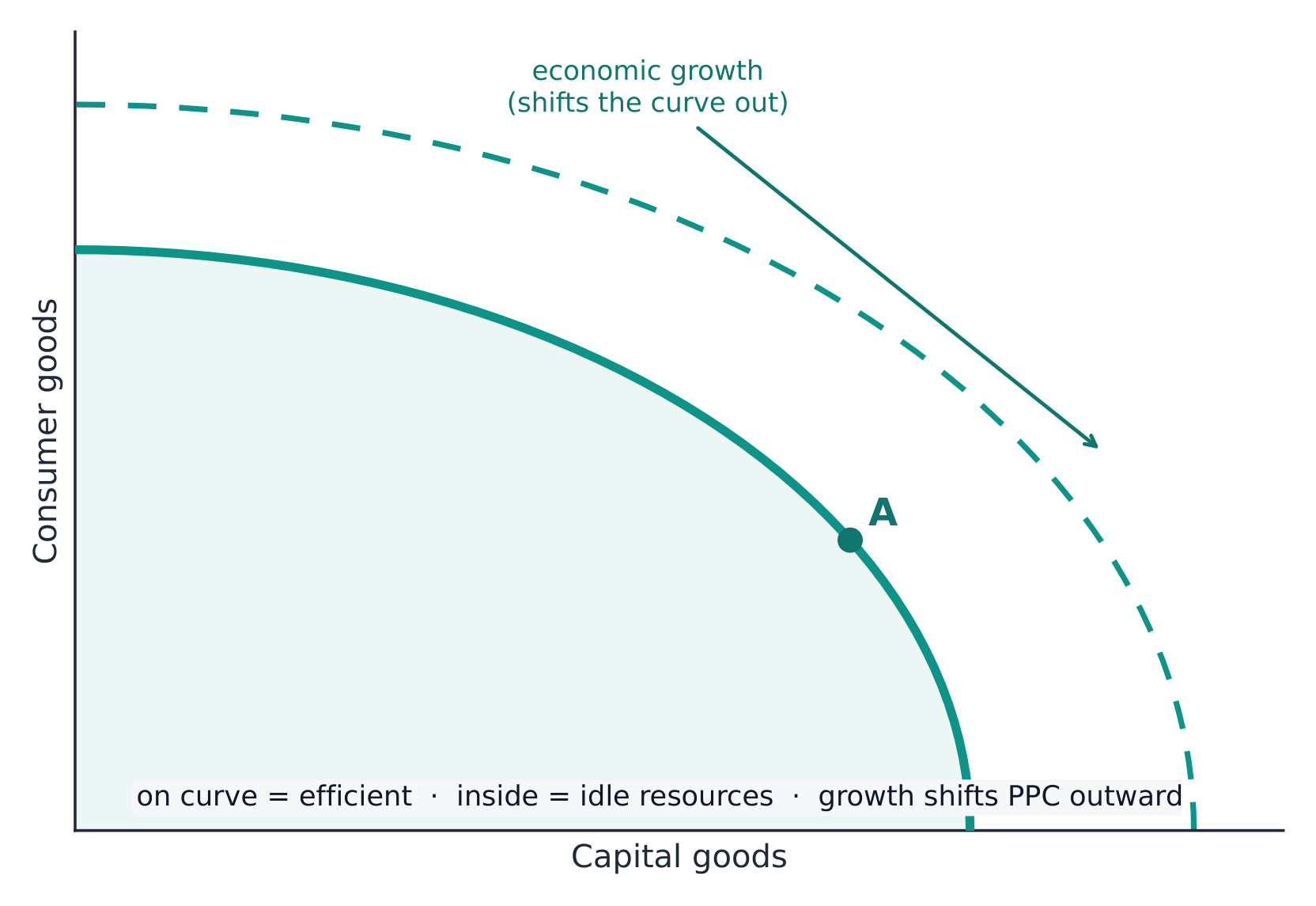
The production possibility frontier

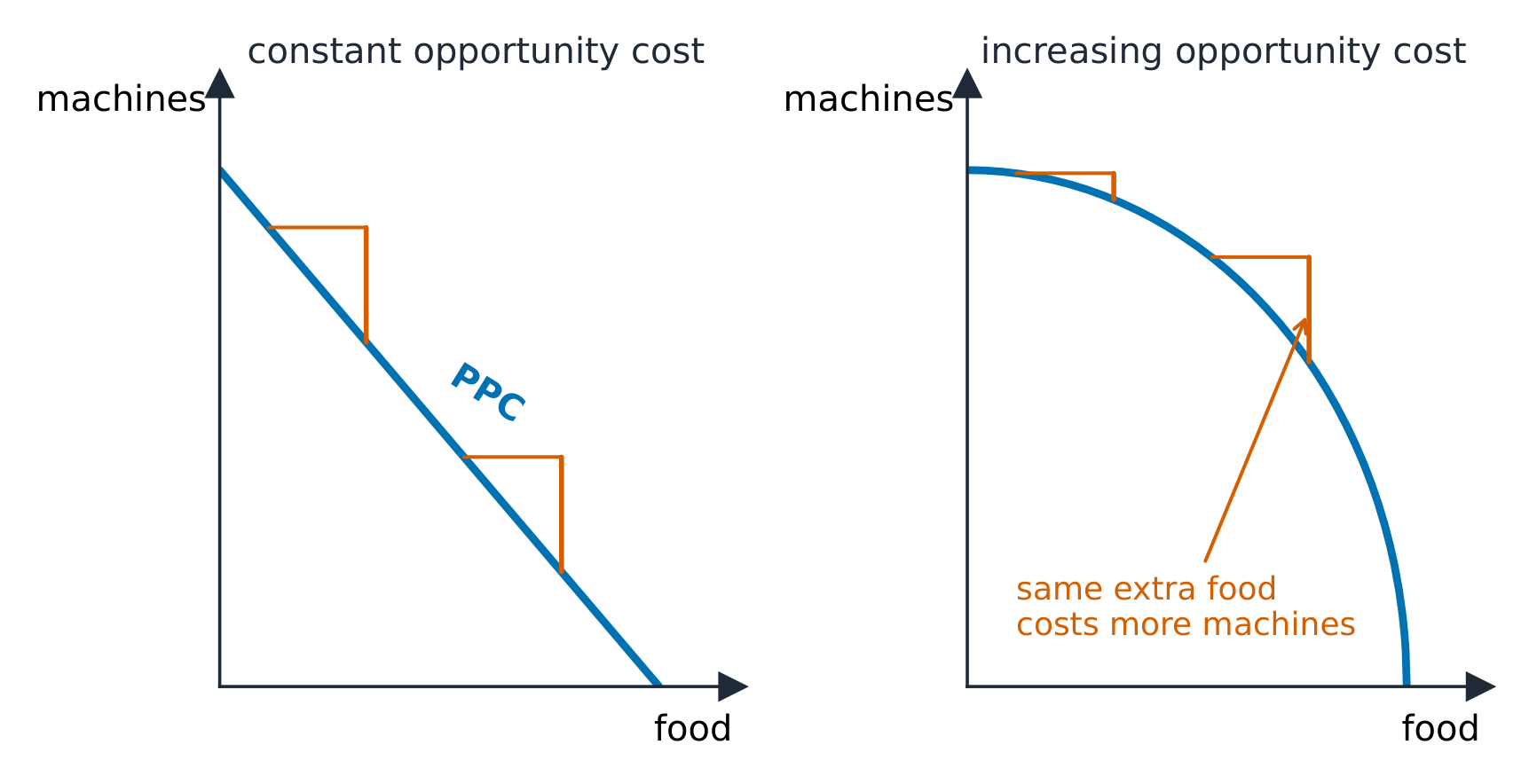
Every choice has an opportunity cost 机会成本 – the value of the next-best alternative given up. The production possibilities curve (PPC) 生产可能性曲线 shows the maximum combinations of two goods an economy can make when resources are fully and efficiently used.

  • Points on the curve are efficient; inside, inefficient (unemployed resources); outside, unattainable.
  • The downward slope shows opportunity cost; a bowed-out curve shows increasing opportunity cost.
  • More resources or better technology cause economic growth 经济增长, shifting the PPC outward.
한국어
생산가능 Frontier

모든 선택에는 기회비용이 존재합니다 — 포기된 차선책 alternative의 가치입니다. 생산가능 곡선(PPC) 은 자원이 완전히且(netly) 효율적으로 사용될 때 한 경제체가 생산할 수 있는 두 상품의 최대 조합을 보여줍니다.

직선형 PPC는 일정한 기회비용을 의미하며, 오목(bowed-out) 형태는 증가하는 비용을 의미한다
  • 곡선 위의 점은 효율적이며, 안쪽은 비효율적(실업 자원), 바깥은 달성 불가능합니다.
  • 하향 경사선은 기회비용을 나타내며, 오목(bowed-out) 곡선은 증가하는 기회비용을 의미합니다.
  • 더 많은 자원이나 더 나은 기술은 경제 성장을 유발하여 PPC를 바깥으로 이동시킵니다.
생산가능 곡선; 자본재에 대한 투자는 이를 바깥으로 이동시킨다
생산 가능 곡선; 자본재에 투자하면 외측으로 이동
Explore · ⁨탐색하기⁩

Explore the production possibilities curve · ⁨생산 가능 곡선을 탐색해 보십시오⁩

Move along the curve — making more capital goods means giving up consumer goods. That lost output is the opportunity cost, and the bowed shape shows it rising with each extra unit. · ⁨곡선을 따라 이동하라 — 더 많은 자본재를 생산한다는 것은 소비재를 포기한다는 뜻이다. 그 잃어버린 산출물은 기회비용이며, 볼록한 모양은 추가 단위가 늘어날수록 비용이 오름을 나타낸다.⁩

Vocabulary · ⁨어휘⁩ Train · ⁨연습하기⁩
English 한국어
opportunity cost/ɒpəˈtjuːnɪti kɒst/ 기회비용
production possibilities curve (PPC)/prəˈdʌkʃn ˌpɒsəˈbɪlɪtiz kɜːv/ 생산 가능성 곡선 (PPC)
economic growth/ˌiːkəˈnɒmɪk ɡrəʊθ/ 경제성장을 나타냄
absolute advantage/ˈæbsəluːt ədˈvæntɪdʒ/ 절대 우위
1.3

Comparative Advantage and Gains from Trade · ⁨비교 우위 및 무역의 이점⁩

Syllabus
English

Enduring Understanding (MKT-1): Production and consumption increase by engaging in trade.

Learning Objective MKT-1.A: a. Define absolute advantage and comparative advantage. b. Determine (using data from PPCs or tables as appropriate) absolute and comparative advantage.

  • MKT-1.A.1 Absolute advantage describes a situation in which an individual, business, or country can produce more of a good or service than any other producer with the same quantity of resources.
  • MKT-1.A.2 Comparative advantage describes a situation in which an individual, business, or country can produce a good or service at a lower opportunity cost than another producer.

Learning Objective MKT-1.B: a. Explain (using data from PPCs or tables as appropriate) how specialization according to comparative advantage with appropriate terms of trade can lead to gains from trade. b. Calculate (using data from PPCs or tables as appropriate) mutually beneficial terms of trade.

  • MKT-1.B.1 Production specialization according to comparative advantage results in exchange opportunities that lead to consumption opportunities beyond the PPC.
  • MKT-1.B.2 Comparative advantage and opportunity costs determine the terms of trade for exchange under which mutually beneficial trade can occur.
한국어

지속적 이해 (MKT-1): 거래에 참여함으로써 생산과 소비가 증가합니다.

학습 목표 MKT-1.A: a. 절대 우위와 비교 우위를 정의하십시오. b. 절대 우위와 비교 우위를 결정하십시오(적절한 경우 PPC 또는 표의 데이터 사용).

  • MKT-1.A.1 절대 우위는 동일한 양의 자원으로 다른 어떤 생산자보다 더 많은 재화나 서비스를 생산할 수 있는个人或 기업 또는 국가의 상황을 의미합니다.
  • MKT-1.A.2 비교 우위는 다른 생산자보다 낮은 기회 비용으로 재화나 서비스를 생산할 수 있는个人或 기업 또는 국가의 상황을 의미합니다.

학습 목표 MKT-1.B: a. 비교 우위에 따른 전문화와 적절한 거래 조건이 거래 이득으로 이어지는 방법을 설명하십시오(적절한 경우 PPC 또는 표의 데이터 사용). b. 상호 유익한 거래 조건을 계산하십시오(적절한 경우 PPC 또는 표의 데이터 사용).

  • MKT-1.B.1 비교 우위에 따른 생산 전문화는 PPC를 초과하는 소비 기회를 제공하는 교환 가능성을 창출합니다.
  • MKT-1.B.2 비교 우위와 기회 비용은 상호 유익한 거래가可能发生하는交换条件을 결정합니다.

Source: College Board AP Course and Exam Description · ⁨출처: College Board AP Course and Exam Description⁩

English

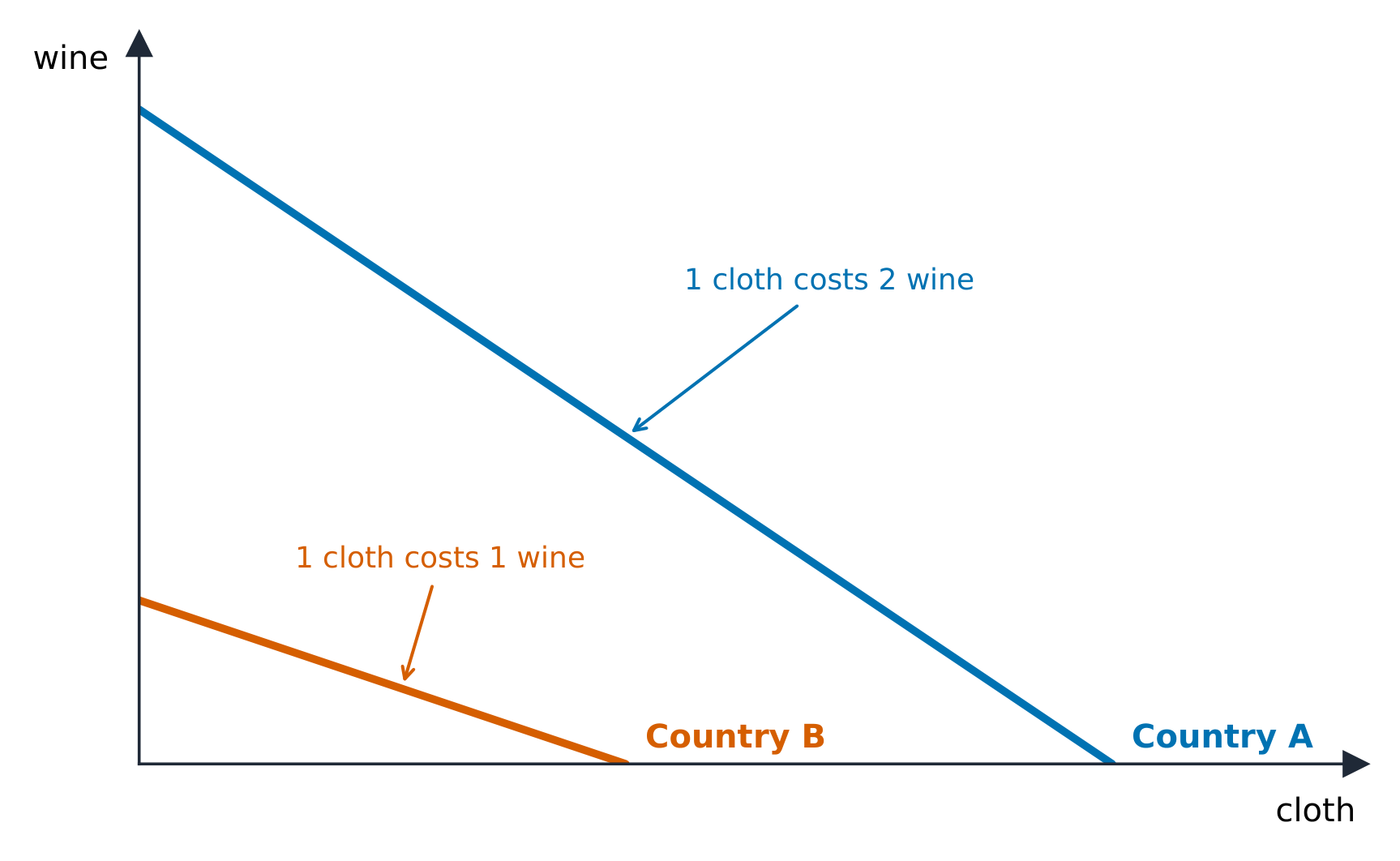
A producer has an absolute advantage 绝对优势 in a good if it can make more of it. It has a comparative advantage 比较优势 if it has the lower opportunity cost. Nations should specialize in their comparative-advantage goods and trade – both gain if the terms of trade 贸易条件 lie between the two opportunity costs. Trade lets a country consume beyond its own PPC.

Worked example. Country A can make $10$ wheat or $5$ cloth per day; Country B can make $8$ wheat or $8$ cloth. For A, one cloth costs $\tfrac{10}{5}=2$ wheat; for B it costs $\tfrac{8}{8}=1$ wheat. B's opportunity cost of cloth is lower, so B specializes in cloth. Checking wheat: A gives up $0.5$ cloth per wheat and B gives up $1$, so A specializes in wheat. Trading at any rate between the two costs, both consume beyond their own PPC.

한국어

한 생산자가 특정 재화를 더 많이 생산할 수 있을 때 그 재화에서 절대 우위를 가집니다. 기회 비용이 낮을 때 비교 우위를 가집니다. 각국은 비교 우위가 있는 재화에 전문화하고 무역해야 합니다. 두 국가의 기회 비용 사이에 무역 조건이 형성되면 양국 모두 이득을 얻습니다. 무역은 한 국가가 자체 PPC(생산 가능 곡선) 이상을 소비하게 해줍니다.

해설 예시. 국가 A는 하루에 $10$ 밀 또는 $5$ 천을 생산할 수 있습니다. 국가 B는 하루에 $8$ 밀 또는 $8$ 천을 생산할 수 있습니다. A에게 천 하나당 비용은 $\tfrac{10}{5}=2$ 밀이며, B에게도 천 하나당 비용은 $\tfrac{8}{8}=1$ 밀입니다. 천의的机会 비용이 낮은 B는 천 전문화를 선택합니다. 밀을 확인해 보면, 밀 하나당 A가 포기하는 천은 $0.5$이고 B는 $1$이므로 A는 밀 전문화를 선택합니다. 두 비용 사이 어떤 가격으로 거래하더라도, 양국은 자국의 PPC보다 많은 것을 소비할 수 있습니다.

비교 우위는 기울기가 다른 생산 가능 곡선에서 비롯됩니다
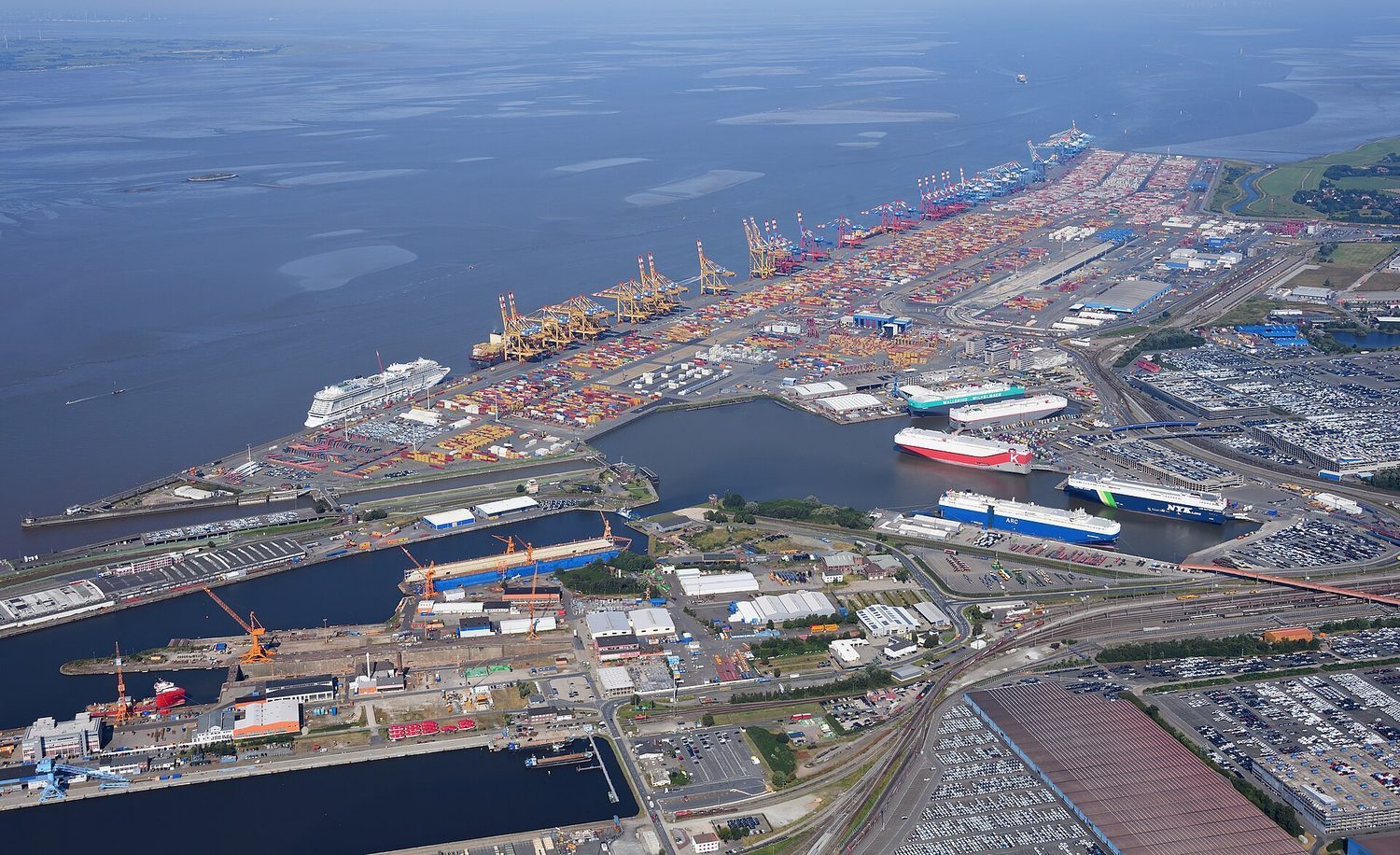
컨테이너 운송: 비교 우위와 무역은 국가의 전문화와 이득을 가능하게 합니다
Explore · ⁨탐색하기⁩

See the gains from specialization and trade · ⁨전문화와 무역의 이득을 확인하라⁩

A country should specialize where its opportunity cost is lowest, then trade for the rest. Because the terms of trade sit between the two countries' costs, each can consume beyond its own production frontier. · ⁨一个国家应在其 机会成本最低的领域进行专业化,然后贸易其余部分。由于贸易条件位于两国成本之间,每个国家都能在其生产可能性边界之外消费。⁩

Vocabulary · ⁨어휘⁩ Train · ⁨연습하기⁩
English 한국어
comparative advantage/kəmˈpærətɪv ədˈvæntɪdʒ/ 상대적 우위
terms of trade/tɜːmz ɒv treɪd/ Terms of Trade
1.4

Demand · ⁨수요⁩

Syllabus
English

Enduring Understanding (MKT-2): In a competitive market, demand for and supply of a good or service determine the equilibrium price.

Learning Objective MKT-2.A: a. Define (using graphs as appropriate) the law of demand. b. Explain (using graphs as appropriate) the relationship between the price of a good or service and the quantity demanded.

  • MKT-2.A.1 The law of demand states there is an inverse relationship between price and quantity demanded, leading to a downward-sloping demand curve.

Learning Objective MKT-2.B: Explain (using graphs as appropriate) the determinants of demand.

  • MKT-2.B.1 Factors that influence consumer demand, such as changes in consumer income, cause the market demand curve to shift.
한국어

지속적 이해 (MKT-2): 경쟁 시장에서는 재화나 서비스에 대한 수요와 공급이 균형 가격을 결정합니다.

학습 목표 MKT-2.A: a. 수요의 법칙을 정의하십시오(적절한 경우 그래프 사용). b. 재화나 서비스의 가격과 수량 사이의 관계를 설명하십시오(적절한 경우 그래프 사용).

  • MKT-2.A.1 수요의 법칙은 가격과 수량 수요 사이에 역관계가 있어 내리막형 수요 곡선을 형성함을 명시합니다.

학습 목표 MKT-2.B: 수요의 determinants를 설명하십시오(적절한 경우 그래프 사용).

  • MKT-2.B.1 소비자 소득 변화와 같은 소비자 수요에 영향을 미치는 요인은 시장 수요 곡선을 이동시킵니다.

Source: College Board AP Course and Exam Description · ⁨출처: College Board AP Course and Exam Description⁩

English

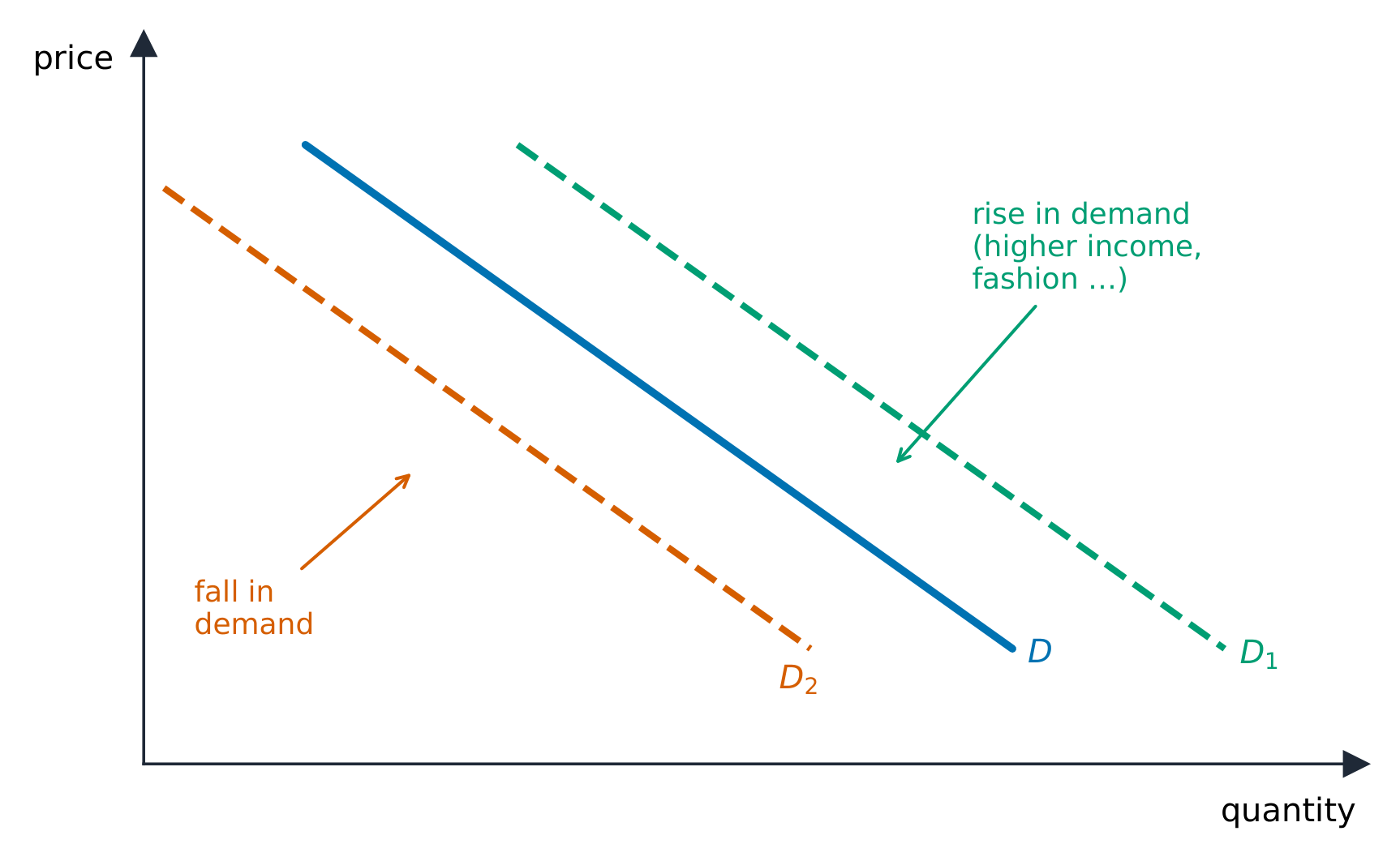
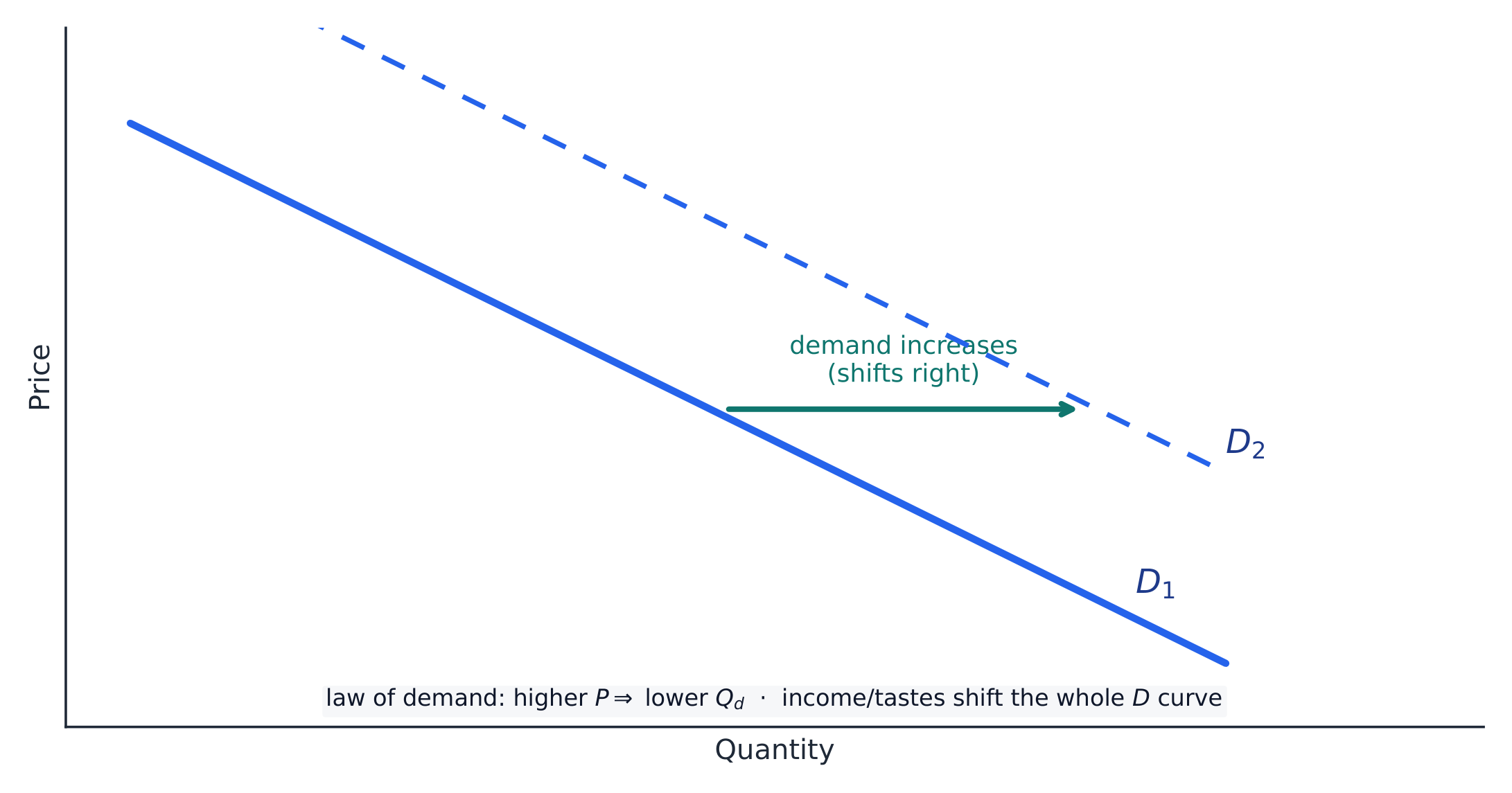
Demand 需求 relates price to the quantity buyers will buy. The law of demand 需求定律 makes the curve slope downward. A change in the good's own price is a movement along the curve; the determinants (income, tastes, prices of substitutes 替代品 and complements 互补品, number of buyers, expectations) shift the whole curve.

한국어

수요는 가격과 구매자가 사려는 수량 간의 관계를 나타냅니다. 수요의 법칙은 곡선을 아래로 경사되게 만듭니다. 해당 재화의 자신 가격 변화는 곡선 위에서의 이동을 의미하며, 요인(소득, 취향, 대체재 및 보완재 가격, 구매자 수, 기대감 등)은 곡선 전체를 이동시킵니다.

수요 곡선은 아래로 경사되며, 소득, 취향, 관련 가격이 이를 이동시킵니다
수요의 법칙이 곡선을 아래로 경사시키고, 요인이 곡선 전체를 이동시킵니다
Explore · ⁨탐색하기⁩

Explore demand — move along vs shift the curve · ⁨수요를 탐구하라 — 곡선 상의 이동 vs 곡선 전체의 이동⁩

A change in the own price moves you along a fixed curve (a change in quantity demanded); a determinant like income or tastes shifts the whole curve ($D_1 \to D_2$) — a change in demand. · ⁨자기 가격의 변화는 고정된 곡선 위에서 이동을 일으킨다 (수요량의 변화); 소득이나 취향과 같은 결정 변수는 곡선 전체를 ($D_1 \to D_2$) 이동시켜 수요의 변화를 야기한다.⁩

Vocabulary · ⁨어휘⁩ Train · ⁨연습하기⁩
English 한국어
Demand/dɪˈmænd/ 수요
law of demand/lɔː ɒv dɪˈmænd/ 수요의 법칙
substitutes/ˈsʌbstɪtjuːts/ 替代品
complements/ˈkɒmplɪmənts/ 互补品
1.5

Supply · ⁨공급⁩

Syllabus
English

Enduring Understanding (MKT-2): In a competitive market, demand for and supply of a good or service determine the equilibrium price.

Learning Objective MKT-2.C: a. Define (using graphs as appropriate) the law of supply. b. Explain (using graphs as appropriate) the relationship between the price of a good or service and the quantity supplied.

  • MKT-2.C.1 The law of supply states there is a positive relationship between price and quantity supplied, leading to an upward-sloping supply curve.

Learning Objective MKT-2.D: Explain (using graphs as appropriate) the determinants of supply.

  • MKT-2.D.1 Factors that influence producer supply, such as changes in input prices, cause the market supply curve to shift.
한국어

지속적 이해 (MKT-2): 경쟁 시장에서는 재화나 서비스에 대한 수요와 공급이 균형 가격을 결정합니다.

학습 목표 MKT-2.C: a. 공급의 법칙을 정의하십시오(적절한 경우 그래프 사용). b. 재화나 서비스의 가격과 수량 공급 사이의 관계를 설명하십시오(적절한 경우 그래프 사용).

  • MKT-2.C.1 공급의 법칙은 가격과 수량 공급 사이에 정관계가 있어 오름차형 공급 곡선을 형성함을 명시합니다.

학습 목표 MKT-2.D: 공급의 determinants를 설명하십시오(적절한 경우 그래프 사용).

  • MKT-2.D.1 투입 가격 변화와 같은 생산자의 공급에 영향을 미치는 요인은 시장 공급 곡선을 이동시킵니다.

Source: College Board AP Course and Exam Description · ⁨출처: College Board AP Course and Exam Description⁩

English

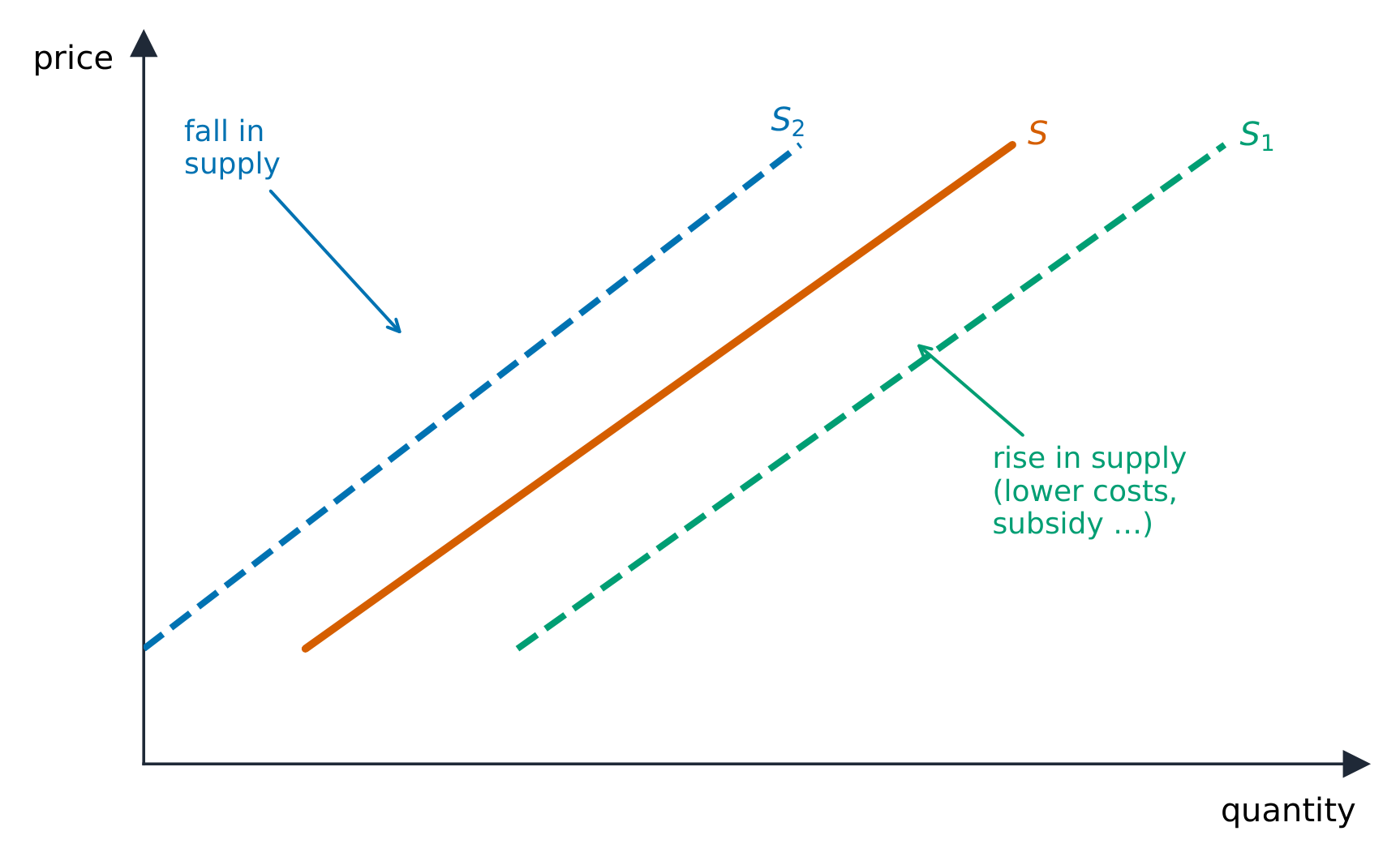
Supply 供给 relates price to the quantity sellers will offer; the law of supply 供给定律 makes it slope upward. Its determinants – input prices, technology, taxes and subsidies 补贴, number of sellers, expectations – shift the curve, while the good's own price moves along it.

한국어

공급은 가격과 판매자가 제공하려는 수량 간의 관계를 나타내며, 공급의 법칙은 이를 위로 경사되게 만듭니다. 공급의 요인—원자재 가격, 기술, 세금 및 보조금, 판매자 수, 기대감—are 곡선을 이동시키며, 해당 재화의 자신 가격은 곡선 위에서의 이동을 유발합니다.

공급 곡선은 위로 경사되며, 비용, 기술, 세금, 보조금이 이를 이동시킵니다
Explore · ⁨탐색하기⁩

Explore what moves the supply curve · ⁨供给曲线移动的因素来探究⁩

Supply slopes up: a higher price makes selling more worthwhile. A change in costs, technology or the number of sellers shifts the whole curve — not a move along it. Drag the supply line and watch price and quantity respond. · ⁨供给向上倾斜:更高的价格使销售更多变得有利可图。成本、技术或卖家数量的变化会移动整个供给曲线——而不是沿其移动。拖动供给线并观察价格和数量的反应。⁩

Vocabulary · ⁨어휘⁩ Train · ⁨연습하기⁩
English 한국어
Supply/səˈplaɪ/ 공급
law of supply/lɔː ɒv səˈplaɪ/ 공급의 법칙(law of supply)
subsidies/ˈsʌbsɪdiz/ 보조금
1.6

Market Equilibrium, Disequilibrium, and Changes in Equilibrium · ⁨시장 균형, 비균형 및 균형의 변화⁩

Syllabus
English

Enduring Understanding (MKT-2): In a competitive market, demand for and supply of a good or service determine the equilibrium price.

Learning Objective MKT-2.E: Define (using graphs as appropriate) market equilibrium.

  • MKT-2.E.1 Equilibrium is achieved at the price at which quantities demanded and supplied are equal.

Learning Objective MKT-2.F: a. Define a surplus and shortage. b. Explain (using graphs as appropriate) how prices adjust to restore equilibrium in markets that are experiencing imbalances. c. Calculate (using graphs as appropriate) the surplus or shortage in the market experience an imbalance.

  • MKT-2.F.1 Whenever markets experience imbalances—creating disequilibrium prices, surpluses, and shortages—market forces drive prices toward equilibrium.

Learning Objective MKT-2.G: Explain (using graphs as appropriate) how changes in demand and supply affect equilibrium price and equilibrium quantity.

  • MKT-2.G.1 Changes in the determinants of supply and/or demand result in a new equilibrium price and quantity.
한국어

지속적 이해 (MKT-2): 경쟁 시장에서는 재화나 서비스에 대한 수요와 공급이 균형 가격을 결정합니다.

학습 목표 MKT-2.E: 시장 균형을 정의하십시오(적절한 경우 그래프 사용).

  • MKT-2.E.1 균형은 수량 수요와 수량 공급이 일치하는 가격에서 달성됩니다.

학습 목표 MKT-2.F: a. 과잉과 부족을 정의하십시오. b. 불균형을 겪고 있는 시장에서 가격이 균형을 회복시키는 과정을 설명하십시오(적절한 경우 그래프 사용). c. 불균형을 겪고 있는 시장의 과잉 또는 부족을 계산하십시오(적절한 경우 그래프 사용).

  • MKT-2.F.1 시장이 불균형을 겪어 불균형 가격, 과잉, 부족을 유발할 때마다 시장 힘은 가격을 균형 방향으로驱使합니다.

학습 목표 MKT-2.G: 수요와 공급의 변화가 균형 가격과 균형 수량에 미치는 영향을 설명하십시오(적절한 경우 그래프 사용).

  • MKT-2.G.1 공급과/또는 수요의 determinants의 변화는 새로운 균형 가격과 수량을 초래합니다.

Source: College Board AP Course and Exam Description · ⁨출처: College Board AP Course and Exam Description⁩

English
Supply & demand: a shift raises P and Q

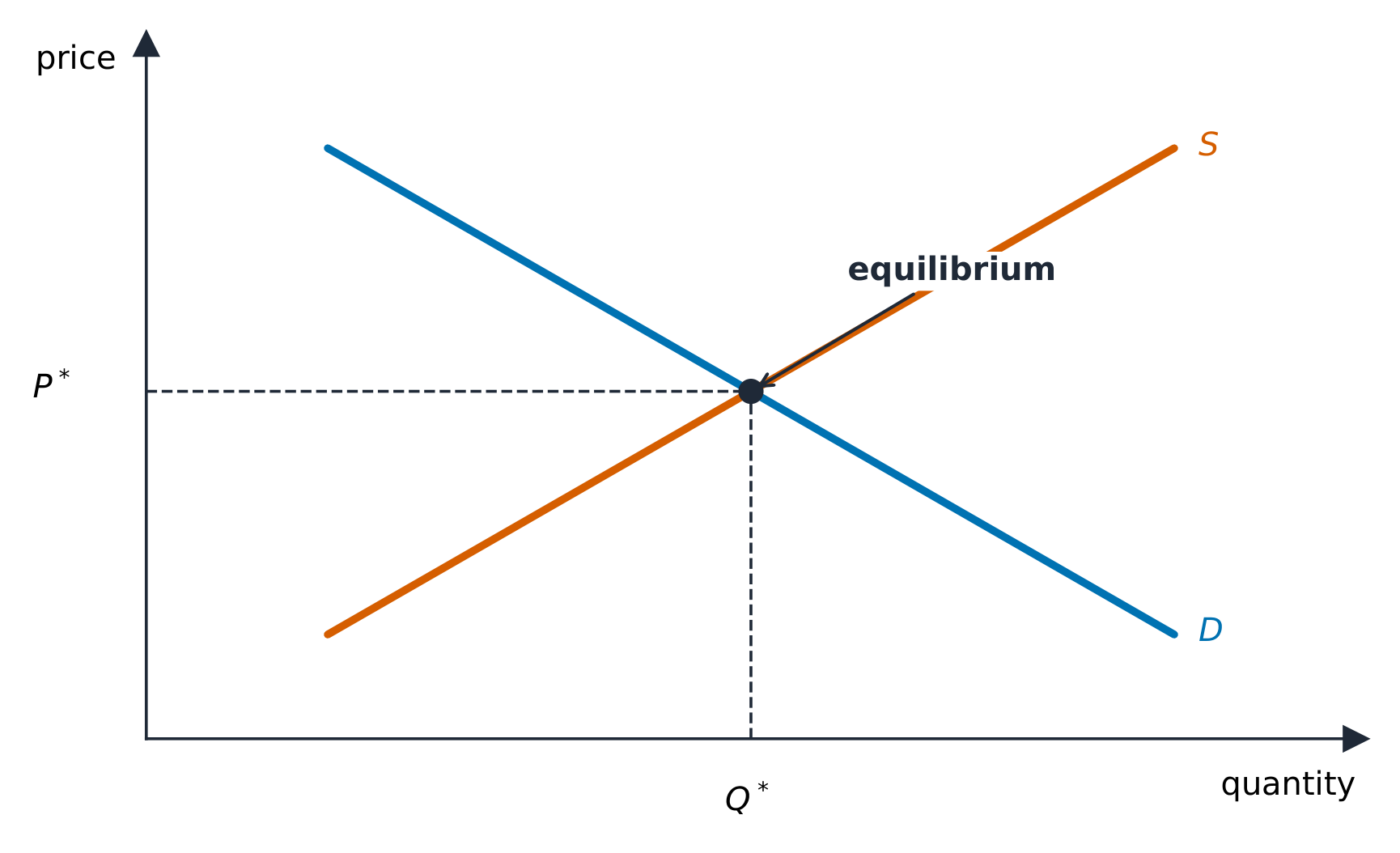
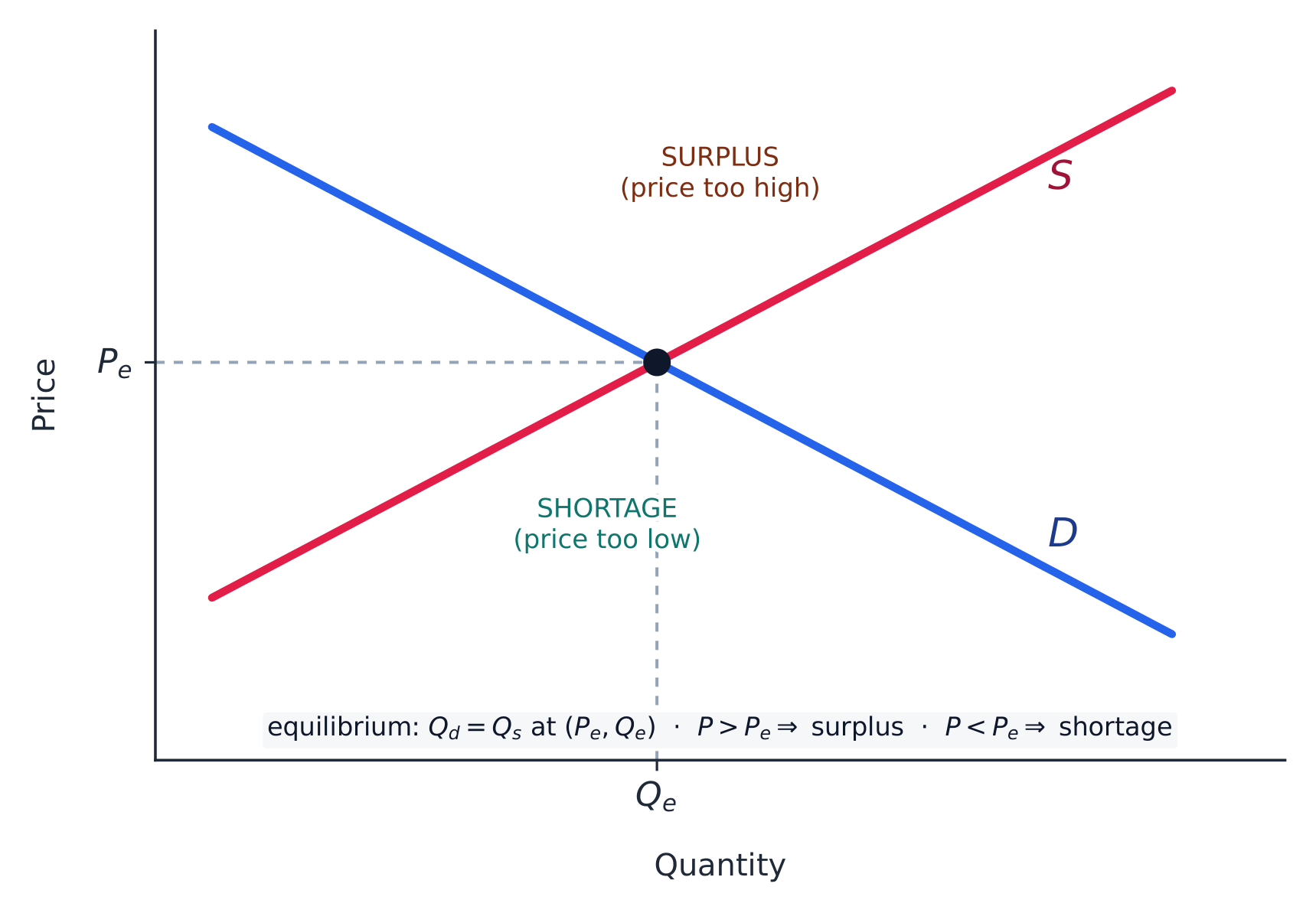
Equilibrium 均衡 is where supply meets demand, clearing the market. Above the equilibrium price a surplus 过剩 pushes price down; below it a shortage 短缺 pushes price up. When a determinant shifts one curve, price and quantity move predictably; when both shift, one of them is indeterminate.

Worked example. A new technology lowers producers' costs, shifting supply right. Along the unchanged demand curve, the equilibrium price falls and the equilibrium quantity rises. If instead a rise in incomes shifts demand right at the same time, quantity clearly rises but the effect on price depends on which shift is larger – the "both shift" indeterminate case.

Exam skill: macro builds on these micro tools – you must draw and shift supply-and-demand and PPC graphs correctly, because the same shift logic drives the aggregate (whole-economy) models later in the course.

한국어
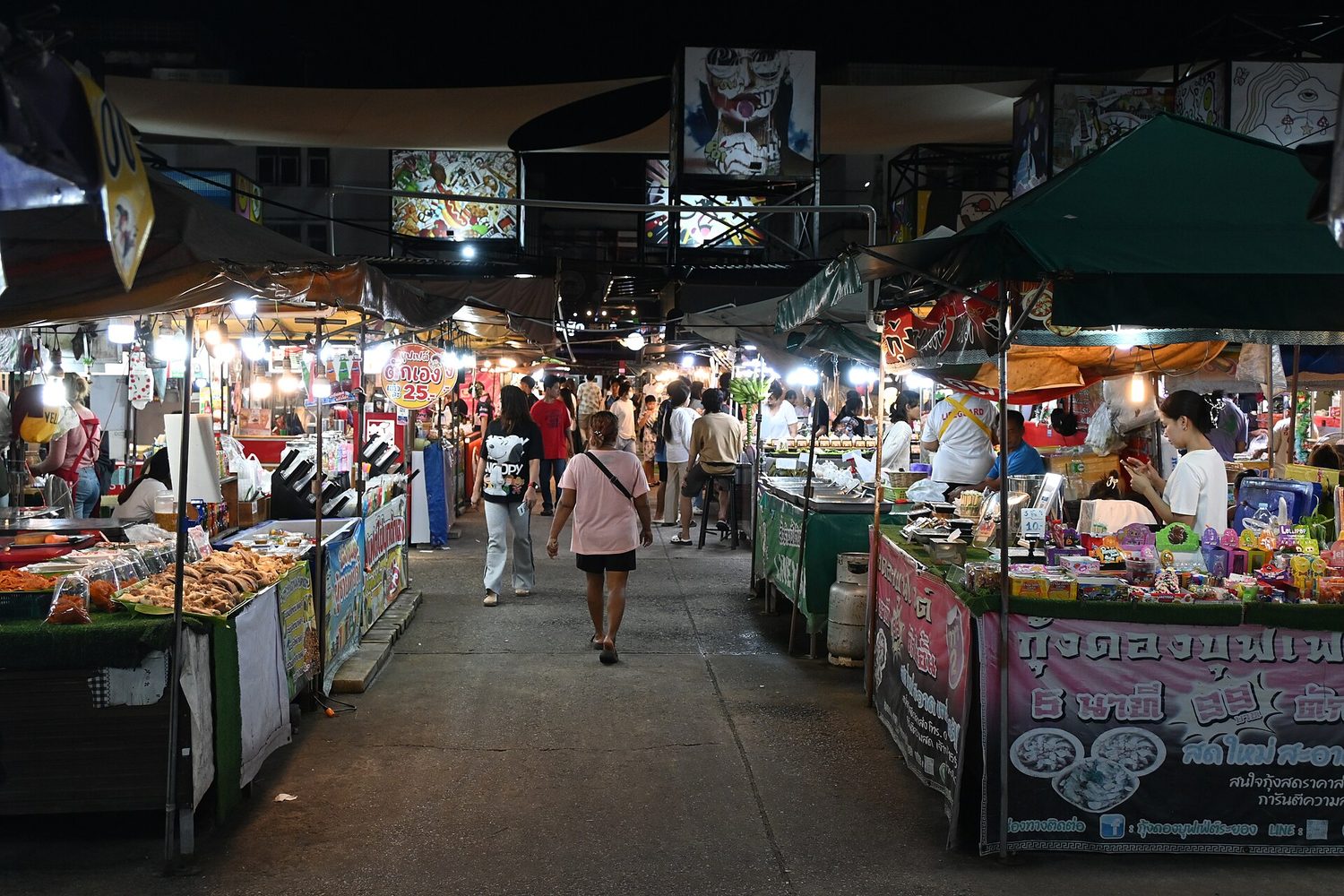
바쁜 시장: 수요와 공급이 구매자와 판매자가 가격에 합의하는 지점에서 만납니다
바쁜 시장: 수요와 공급이 구매자와 판매자가 가격에 합의하는 지점에서 만듭니다
공급 및 수요: 이동은 P와 Q를 높입니다

균형은 공급과 수요가 만나 시장을 청산하는 지점입니다. 균형 가격보다 높은 곳에서는 초과 공급이 가격을 내리고, 낮은 곳에서는 부족이 가격을 올립니다. 요인이 한 곡선을 이동시킬 때 가격과 수량은 예측 가능한 방향으로 움직이며, 두 곡선 모두 이동할 때는其中一个가 불확정이 됩니다.

해설 예시. 새로운 기술이 생산자의 비용을 낮추어 공급 곡선을 오른쪽으로 이동시킵니다. 변하지 않은 수요 곡선 위에서 균형 가격은 하락하고 균형 수량은 상승합니다. 만약 동시에 소득 증가로 수요 곡선이 오른쪽으로 이동한다면, 수량은 명확히 상승하지만 가격에 미치는 영향은 어느 이동이 큰지에 따라 달라집니다—이를 '양쪽 이동' 불확정 사례라고 합니다.

수요와 공급이 만나는 균형 가격과 수량

시험 실력: 거시경제학은 이러한 미시경제학 도구 위에 구축됩니다.的课程 후반의 총체적(전체 경제) 모델은 동일한 이동 논리를 따르므로, 공급·수요 및 PPC 그래프를 정확히 그리거나 이동시키는 능력을 갖추어야 합니다.

시장 균형은 공급과 수요가 만나는 곳에 위치하며, 그 외에는 초과 공급과 부족이 존재합니다
Explore · ⁨탐색하기⁩

Explore market equilibrium, surplus and shortage · ⁨시장 균형, 과잉 공급 및 부족을 탐구하라⁩

The market clears where supply meets demand. Shift a curve and watch the crossing move — a rightward demand shift raises both price and quantity; away from equilibrium a surplus or shortage pushes the price back. · ⁨수급이 만나는 지점에서 시장이 청산된다. 곡선을 이동시키면 교차가 움직임을 보라 — 수요 곡선이 오른쪽으로 이동하면 가격과 수량이 모두 상승하며, 균형에서 벗어난 상태에서는 과잉 공급 또는 부족이 가격을 다시 균형점으로 돌린다.⁩

Vocabulary · ⁨어휘⁩ Train · ⁨연습하기⁩
English 한국어
Equilibrium/ˌiːkwɪˈlɪbrɪəm/ 평형
surplus/ˈsɜːpləs/ 초과를 초래한다
shortage/ˈʃɔːtɪdʒ/ 부족을 초래한다
1.6

Exam tips · ⁨시험 팁⁩

English
  • Opportunity cost is what you give up — read it off a PPC as the slope; a bowed-out PPC shows increasing opportunity cost.
  • Comparative advantage (lower opportunity cost), not absolute advantage, decides who should specialise and trade.
  • Points inside the PPC are inefficient, outside unattainable; more resources/technology shift it out (growth).
  • Distinguish a movement along a demand/supply curve (own price) from a shift (a determinant).
  • These micro tools drive the aggregate models later — draw and shift the correct curve in the correct direction.
한국어
  • 기회 비용은 당신이 포기하는 것입니다—PPC의 기울기에서 읽으세요. 바깥쪽으로 볼록한 PPC는 증가하는 기회 비용을 나타냅니다.
  • 비교 우위(낮은 기회 비용)가 절대 우위보다 전문화와 무역의 주체를 결정합니다.
  • PPC 내부의 점은 비효율적이고, 외부의 점은 달성 불가능합니다. 더 많은 자원이나 기술은 PPC를 외측으로 이동시켜 성장을 의미합니다.
  • 수요/공급 곡선 위의 이동(자신 가격)과 이동(요인)을 구별하세요.
  • 이러한 미시경제학 도구는 추후 총체적 모델을 주도하므로, 올바른 방향에 correct curve를 그리는的能力이 필요합니다.

Interactive lessons on this topic · ⁨이 주제에 대한 인터랙티브 수업⁩

Work through it step by step, with instant-check exercises. · ⁨즉시 체크 기능 exercises를 통해 단계별로 진행하세요.⁩

Past Papers · ⁨과거 시험지⁩

More topics in AP Macroeconomics · ⁨AP 경제학 (거시)⁩ · ⁨AP Macroeconomics · ⁨AP 경제학 (거시)⁩ 내 추가 주제⁩

Log in or create account · ⁨로그인 또는 계정 만들기⁩

IGCSE, A-Level & AP