Market Equilibrium, Disequilibrium, and Changes
Introduced| English |
|---|
| equilibrium/ˌiːkwɪˈlɪbrɪəm/ |
| surplus/ˈsɜːpləs/ |
| shortage/ˈʃɔːtɪdʒ/ |
| disequilibrium/ˌdɪˌsiːkwɪˈlɪbrɪəm/ |
Where buyers and sellers agree
- Demand pulls the price down; supply pushes it up.
- Somewhere between, the two forces meet and settle.
- At that one price, buyers' and sellers' plans match exactly.
- This is equilibrium 均衡 — the heart of the supply-and-demand model.
Equilibrium, surplus, and shortage
- Equilibrium is where demand and supply cross — the equilibrium price and quantity.
- Away from it the market is in disequilibrium 非均衡, and prices are pushed back.
- Above equilibrium: quantity supplied exceeds quantity demanded — a surplus 过剩, so sellers cut the price.
- Below equilibrium: quantity demanded exceeds quantity supplied — a shortage 短缺, so buyers bid the price up.
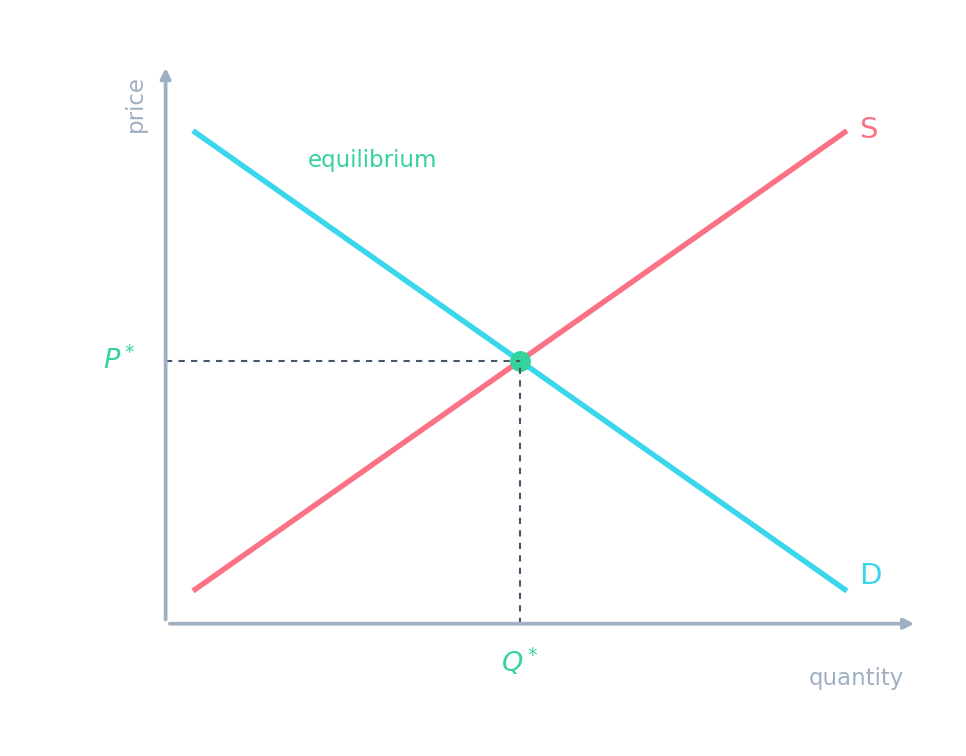
Find the equilibrium
Equilibrium sits where supply crosses demand. Above it there is a surplus; below it a shortage — the price is pushed back to where the curves meet.
At market equilibrium:
Equilibrium is where the two quantities match and the curves cross.
If the price is set above equilibrium, the market has a:
Above equilibrium, unsold stock piles up — a surplus, so sellers cut the price.
When the price is below equilibrium, excess demand creates a ______.
A shortage makes buyers bid the price up toward equilibrium.
The four shift cases
- Demand rises → price up, quantity up. Demand falls → price down, quantity down.
- Supply rises → price down, quantity up. Supply falls → price up, quantity down.
- When a determinant shifts a curve, the equilibrium simply moves to the new crossing point.
Demand shifts right (supply unchanged). Price and quantity:
A rightward demand shift raises both the equilibrium price and quantity.
Put the steps to find the new equilibrium after a change in order.
Name the shifter, move the right curve the right way, then read the new crossing point.
A supply curve shifts left (demand unchanged). The equilibrium price and quantity:
Less supply at every price pushes the price up and the quantity down.
A worked case
- A hot summer raises demand for ice cream (demand shifts right).
- At the old price a shortage appears, so the price rises to a new, higher equilibrium — with a higher quantity too.
- If at the same time a dairy shortage raises input costs (supply shifts left), the price rises even more.
- But the change in quantity is now ambiguous — it depends on which shift is larger.
A market settles at equilibrium (demand meets supply). In disequilibrium, a surplus (above) pushes the price down and a shortage (below) pushes it up. A single shift moves price and quantity predictably; when both curves shift, one result is clear and the other is ambiguous.