The Circular Flow and GDP
Introduced| English |
|---|
| gross domestic product/ɡrəʊs dəˈmestɪk ˈprɒdʌkt/ |
| market value/ˈmɑːkɪt ˈvæljuː/ |
| final goods/ˈfaɪnl ɡʊdz/ |
| circular flow model/ˈsɜːkjʊlə fləʊ ˈmɒdl/ |
| households/ˈhaʊshəʊldz/ |
| firms/fɜːmz/ |
| government/ˈɡʌvənmənt/ |
| intermediate goods/ˌɪntəˈmiːdɪət ɡʊdz/ |
| double-count/ˈdʌbl kaʊnt/ |
| used goods/juːzd ɡʊdz/ |
| purely financial transactions/ˈpjʊəli faɪˈnænʃl trænˈsækʃnz/ |
One number for a whole economy
- How do you measure something as vast as a country's output?
- You add up the value of everything it produces in a year.
- That single figure is gross domestic product 国内生产总值 (GDP).
- A simple model shows why a nation's output and its income are the same thing.
The circular flow
- GDP is the market value 市场价值 of all final goods 最终产品 and services made in a country in a year.
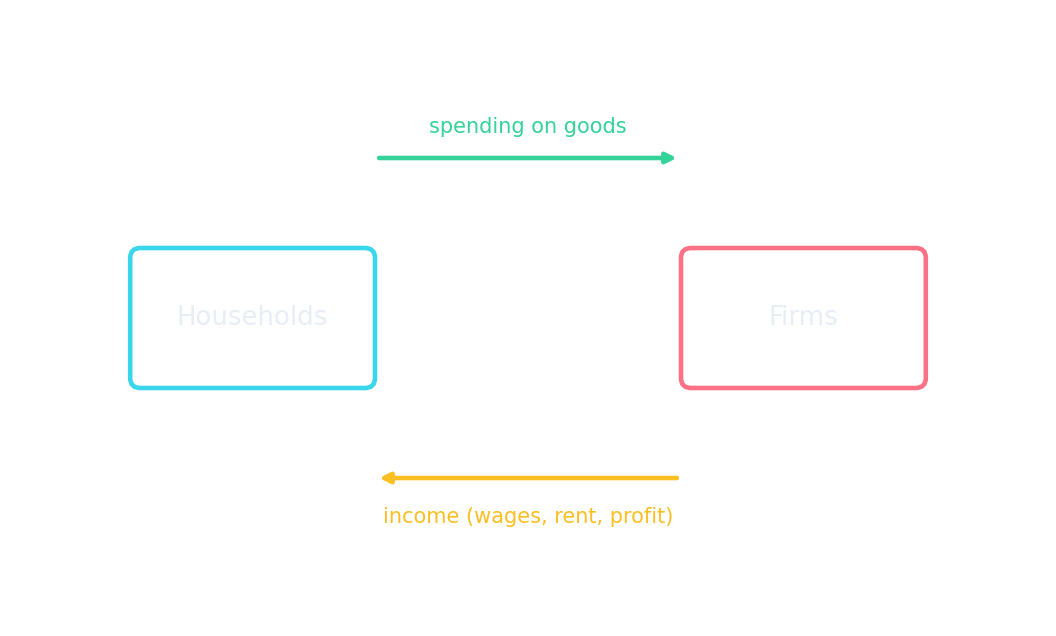
- The circular flow model 循环流动模型 tracks money among households 家庭, firms 企业, and government 政府.
- Households sell resources to firms and earn income; firms make goods and sell them back.
- Every dollar spent is a dollar earned — so total spending equals total income.
GDP is the market value of all ______ goods and services produced in a country in a year.
Only final goods count, so we don't double-count the intermediate parts.
In the circular flow, total spending equals total income.
Every dollar a household spends becomes a dollar of income for a firm's workers or owners.
Match each way of measuring GDP to what it adds up.
All three give the same GDP, because spending = income = value created.
What GDP leaves out
- Intermediate goods 中间产品 — used up to make something else (flour for a bakery); only the final bread counts, or we double-count 重复计算.
- Used goods 二手商品 — a resale was already counted when the item was new.
- Purely financial transactions 纯金融交易 — buying a stock just moves money; it produces nothing new.
Does it count in GDP?
GDP counts only final goods and services made this year. Intermediate goods, used goods, and financial trades are excluded.
Select all that are excluded from GDP.
Intermediate, used, and financial transactions are excluded; a new final good counts.
The expenditure approach
- Add up all spending on final goods: $GDP = C + I + G + (X - M)$.
- $C$ is consumption, $I$ investment, $G$ government spending, $X$ exports, $M$ imports.
- We subtract imports because they are made abroad, not here.
- Worked idea. With $C = 700$, $I = 200$, $G = 300$, $X = 150$, $M = 100$: $GDP = 700 + 200 + 300 + 50 = 1250$ billion.
With C = 700, I = 200, G = 300, exports X = 150, and imports M = 100, what is GDP?
GDP = C + I + G + (X − M) = 700 + 200 + 300 + (150 − 100) = 1250.
In GDP = C + I + G + (X − M), why do we subtract imports (M)?
Spending on imports is included in C, I, or G, but the output was made abroad — so we subtract it.
GDP is the market value of all final goods made in a country in a year. The circular flow shows why total spending equals total income. Measure it with the expenditure approach: $GDP = C + I + G + (X - M)$, excluding intermediate goods, used goods, and financial transactions.