Demand
Introduced| English |
|---|
| demand/dɪˈmænd/ |
| law of demand/lɔː ɒv dɪˈmænd/ |
| quantity demanded/ˈkwɒntɪti dɪˈmændɪd/ |
| substitutes/ˈsʌbstɪtjuːts/ |
| complements/ˈkɒmplɪmənts/ |
| normal good/ˈnɔːml ɡʊd/ |
| inferior good/ɪnˈfɪərɪə ɡʊd/ |
The buyers' side of every market
- Before we build the whole economy, we need its most basic tool.
- Start with buyers: how much do they want at each price?
- Get this right and you can predict how markets move.
- It begins with demand 需求 and the law behind it.
The law of demand
- Demand is the quantity buyers are willing and able to buy at each price.
- The law of demand 需求定律: a higher price means a lower quantity demanded 需求量 — so the curve slopes down.
- Two reasons: buyers substitute toward cheaper goods, and higher prices cut their real purchasing power.
Demand and supply
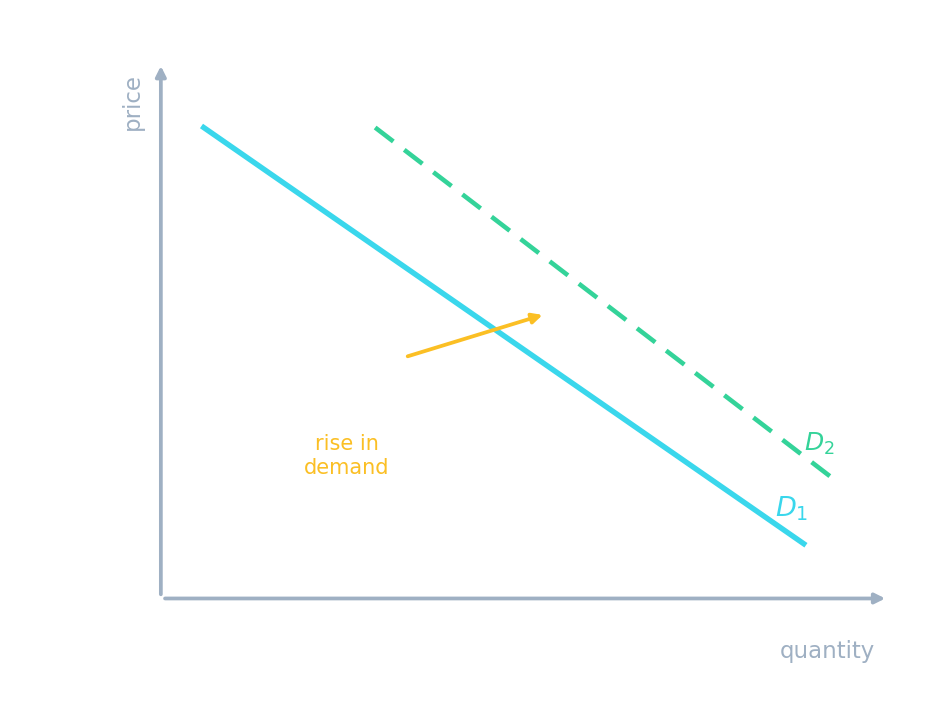
The demand curve slopes down — a lower price, more is wanted. A change in income or tastes shifts the whole curve.
The law of demand says a higher price leads to a:
Price and quantity demanded move in opposite directions — the curve slopes down.
Movement vs shift
- A change in the good's own price moves you along the curve — a change in quantity demanded.
- A change in something else shifts the whole curve — a change in demand.
This distinction is heavily tested. Only the good's own price moves you along the curve. Everything else shifts it. Label your diagram before you answer.
A change in the good's own price causes a movement along the demand curve, not a shift.
Own price → movement along; TRIBE determinants → shift.
What shifts demand — TRIBE
- Tastes; number of Related goods' prices; Income; Buyers; Expectations.
- Substitutes 替代品 (tea and coffee): a dearer coffee raises demand for tea.
- Complements 互补品 (cars and petrol): a dearer petrol lowers demand for cars.
- Income matters too: higher income raises demand for a normal good 正常品 but lowers it for an inferior good 低档品.
Tea and coffee are substitutes. If the price of coffee rises, demand for tea:
Buyers switch from dearer coffee to tea, so demand for tea rises.
Cars and petrol are used together, so they are ______.
A rise in the price of one lowers demand for the other.
Select all that shift the demand curve (TRIBE determinants).
TRIBE factors shift the curve; the good's own price only moves you along it.
As income rises, demand for an inferior good (like instant noodles):
Richer buyers switch to better options, so demand for the inferior good falls.
Demand slopes down (the law of demand). The good's own price = a movement along; any TRIBE determinant = a shift. Substitutes and higher income (normal goods) raise demand; complements and income (inferior goods) can lower it.