Scarcity
Introduced| English |
|---|
| macroeconomics/ˌmækrəˌriːkəˈnɒmɪks/ |
| scarcity/ˈskeəsɪti/ |
| resources/rɪˈzɔːsɪz/ |
| factors of production/ˈfæktəz ɒv prəˈdʌkʃn/ |
| land/lænd/ |
| labour/ˈleɪbə/ |
| capital/ˈkæpɪtl/ |
| entrepreneurship/ˌɒntrɪprəˈnjʊəʃɪp/ |
The whole economy in one idea
- Macroeconomics 宏观经济学 zooms out — it studies total output, total jobs, and the average level of prices.
- Yet it rests on the same bedrock as every branch of economics.
- No country, however rich, can produce everything at once.
- That single fact — scarcity 稀缺 — is where the whole subject begins.
Macroeconomics studies:
Macro zooms out to the whole economy; micro focuses on individual markets.
Scarcity forces choice
- Scarcity means our wants are unlimited while our resources 资源 are limited.
- So every society must choose: what to produce, how, and for whom.
- Because resources are scarce, every choice gives something up.
- Even a wealthy nation faces scarcity — it cannot do everything at once.
Scarcity exists because:
Scarcity is the gap between unlimited wants and limited resources.
A wealthy country does not face scarcity.
Scarcity is universal — even a rich country cannot produce everything at once.
The four factors of production
- Land 土地 — natural resources like soil, water, and minerals.
- Labour 劳动 — human physical and mental effort.
- Capital 资本 — machines, tools, and factories made to produce other goods.
- Entrepreneurship 企业家才能 — the initiative to combine the others and bear risk.
Which factor of production?
Every resource is a factor of production — land, labour, capital, or entrepreneurship. Sorting them is the first step in thinking about scarcity.
Select all four factors of production.
Land, labour, capital and entrepreneurship are the four factors.
Machines, tools, and factories used to make other goods are the factor called ______.
Capital is human-made goods used to produce other goods.
Match each resource to its factor of production.
Nature is land, human effort is labour, made tools are capital, risk-taking is entrepreneurship.
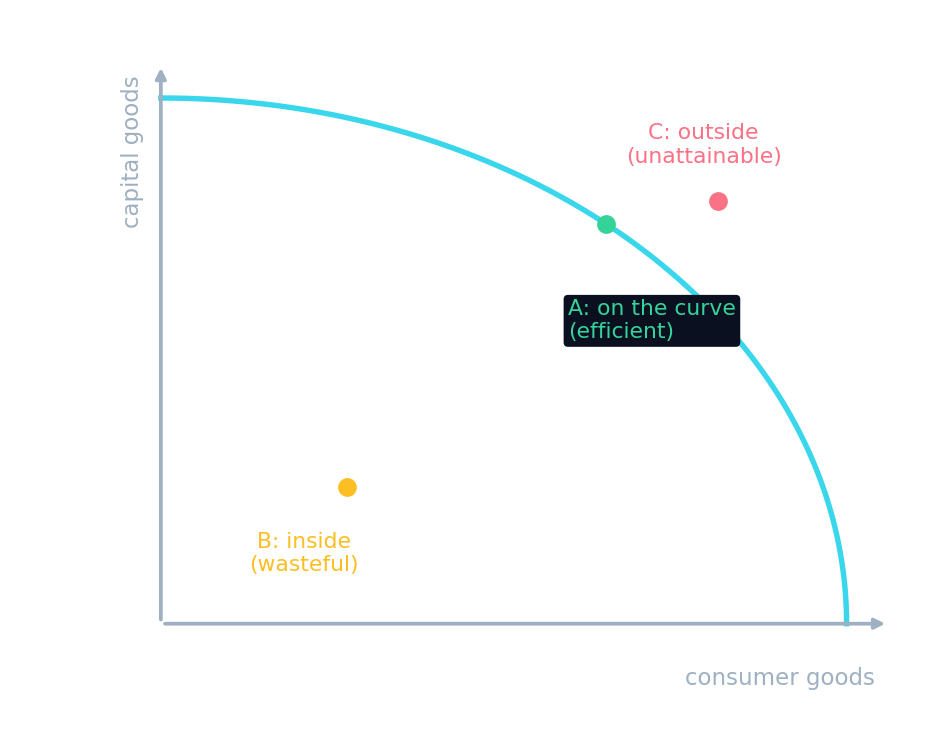
A country has only so many workers, machines, and hectares of land.
- Use them to build hospitals, and fewer are left for roads.
- Use them for consumer goods now, and fewer capital goods are made for the future.
- Every use of a scarce resource closes off another use — that is scarcity at work.
Macroeconomics studies the economy as a whole, but starts from scarcity: unlimited wants, limited resources. Scarcity forces every society to choose what, how, and for whom. Economists group resources into four factors of production — land, labour, capital, and entrepreneurship.