English
Learning Objective 9.1.A: Identify the sign and relative magnitude of the entropy change associated with chemical or physical processes.
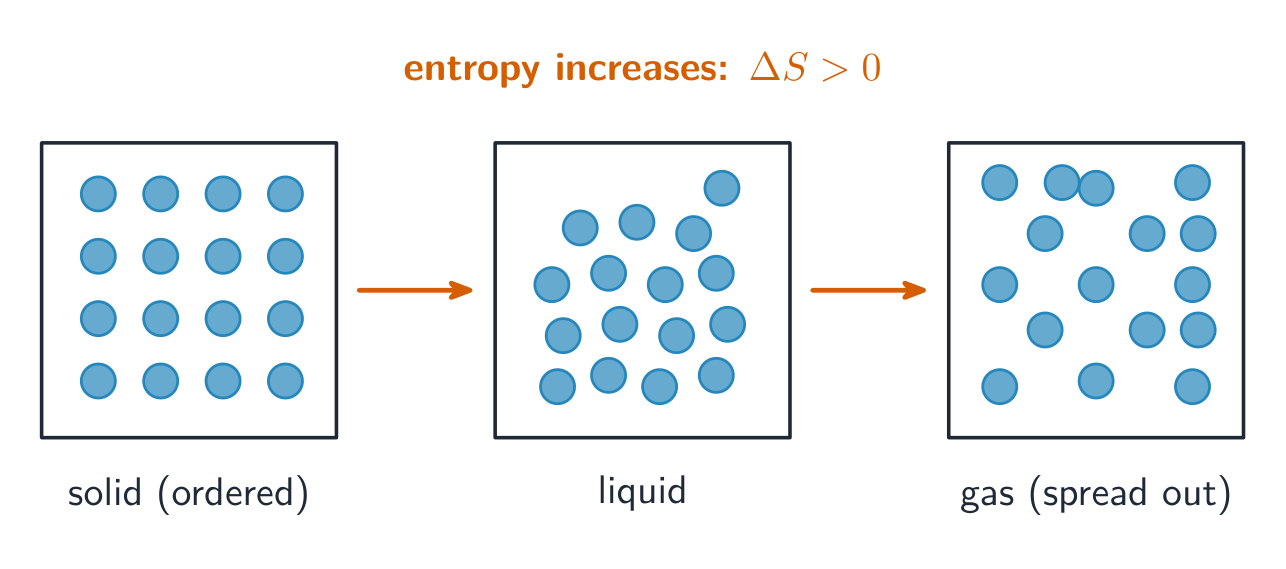
- 9.1.A.1 Entropy increases when matter becomes more dispersed. For example, the phase change from solid to liquid or from liquid to gas results in a dispersal of matter as the individual particles become freer to move and generally occupy a larger volume. Similarly, for a gas, the entropy increases when there is an increase in volume (at constant temperature), and the gas molecules are able to move within a larger space. For reactions involving gas-phase reactants or products, the entropy generally increases when the total number of moles of gas-phase products is greater than the total number of moles of gas-phase reactants.
- 9.1.A.2 Entropy increases when energy is dispersed. According to kinetic molecular theory (KMT), the distribution of kinetic energy among the particles of a gas broadens as the temperature increases. As a result, the entropy of the system increases with an increase in temperature.
한국어
학습목표 9.1.A: 화학적 또는 물리적 과정에 관련된 엔트로피 변화의 부호와 상대적 크기를 식별하시오.
- 9.1.A.1 물질이 더 넓게 퍼질 때 엔트로피는 증가한다. 예를 들어 고체에서 액체로, 혹은 액체에서 기체로 상변화가 일어날 때 개별 입자의 이동이 자유로워지고 일반적으로 더 큰 부위를 차지하게 되면서 물질이 퍼지게 되어 엔트로피가 증가한다. 마찬가지로 기체의 경우, 온도가 일정할 때 부위가 증가하면 기체 분자가 더 넓은 공간에서 움직일 수 있어 엔트로피가 증가한다. 기체상 반응물이나 생성물이 관여하는 반응에서 기체상 생성물의 총 몰수가 기체상 반응물의 총 몰수보다 클 때 엔트로피는 일반적으로 증가한다.
- 9.1.A.2 에너지가 퍼질 때 엔트로피는 증가한다. 운동론적 분자설(KMT)에 따르면, 온도가 상승함에 따라 기체 입자 간 운동에너지의 분포가 넓어진다. 그 결과 시스템의 엔트로피는 온도 증가에 따라 증가한다.