English
Learning Objective 1.1.A: Calculate quantities of a substance or its relative number of particles using dimensional analysis and the mole concept.
- 1.1.A.1 One cannot count particles directly while performing laboratory work. Thus, there must be a connection between the masses of substances reacting and the actual number of particles undergoing chemical changes.
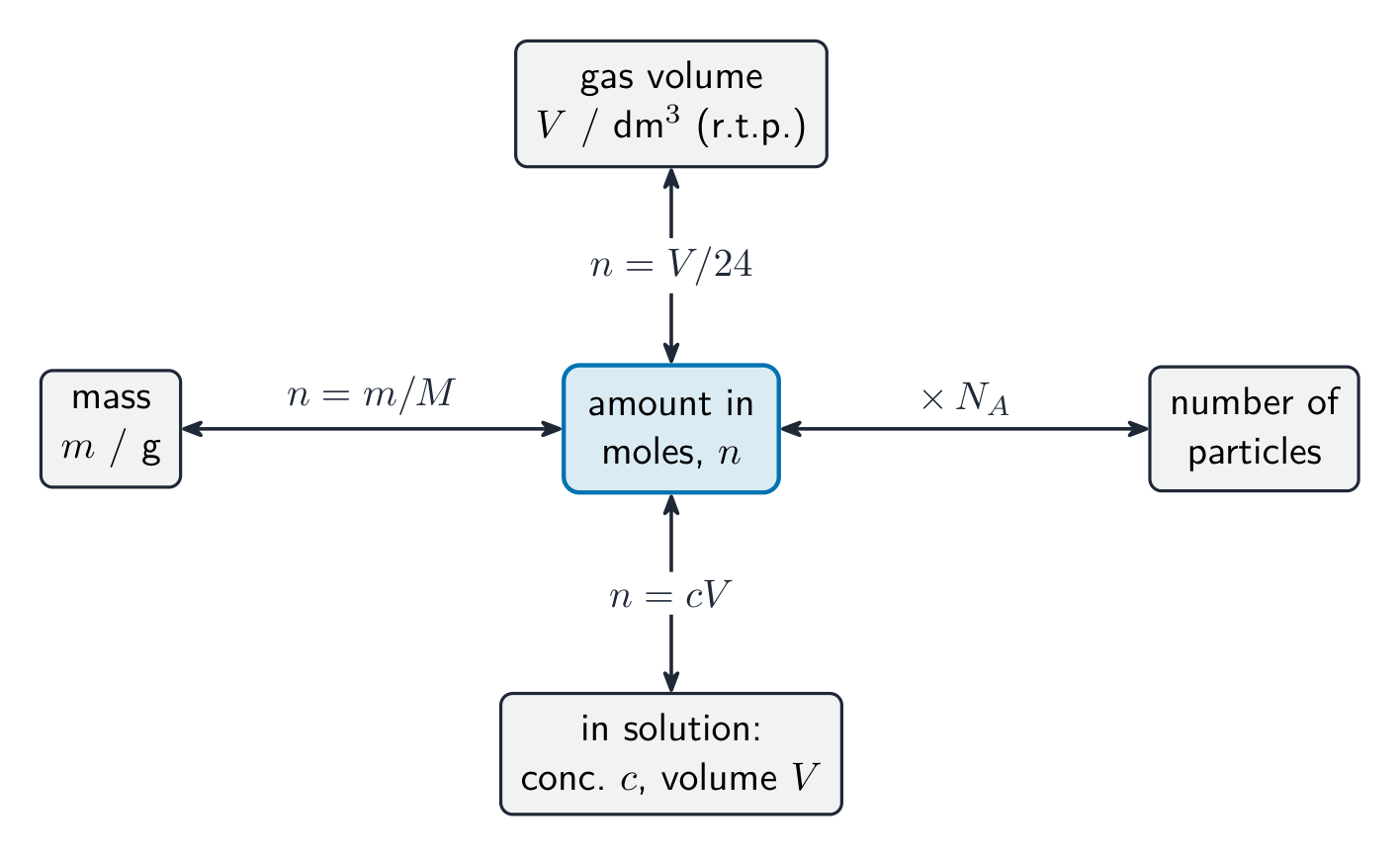
- 1.1.A.2 Avogadro's number ($N_{\mathrm{A}} = 6.022 \times 10^{23}\ \mathrm{mol}^{-1}$) provides the connection between the number of moles in a pure sample of a substance and the number of constituent particles (or formula units) of that substance.
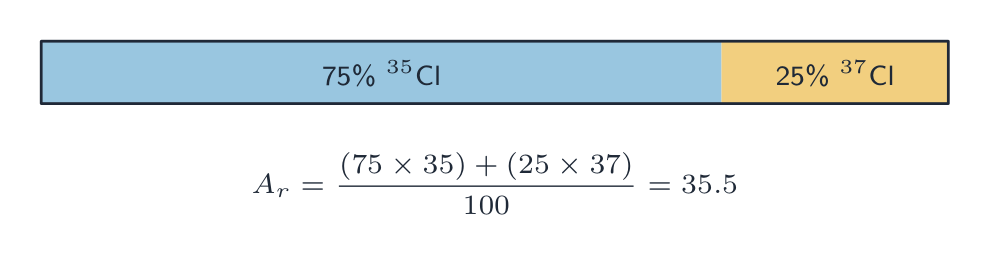
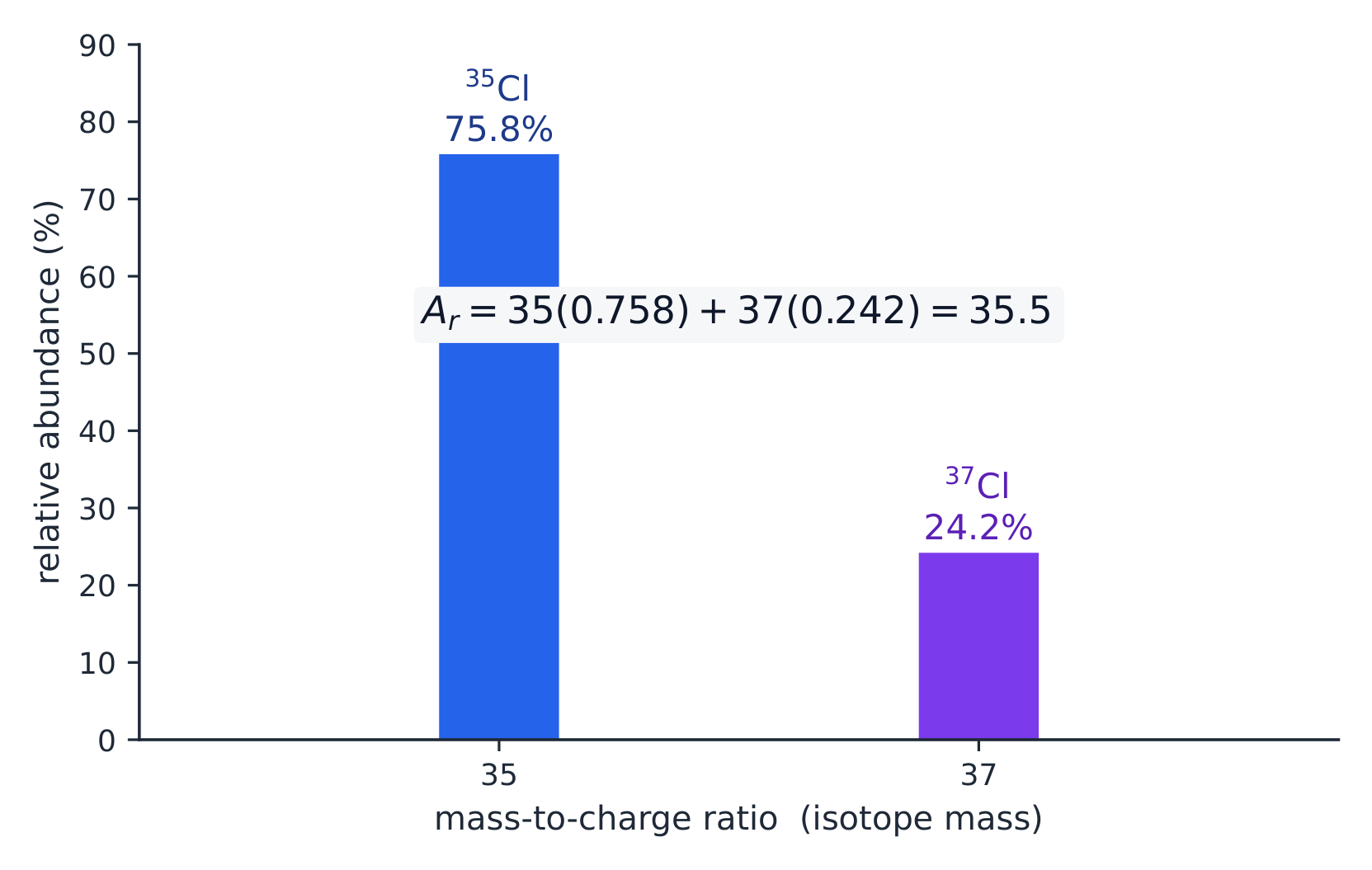
- 1.1.A.3 Expressing the mass of an individual atom or molecule in atomic mass units (amu) is useful because the average mass in amu of one particle (atom or molecule) or formula unit of a substance will always be numerically equal to the molar mass of that substance in grams. Thus, there is a quantitative connection between the mass of a substance and the number of particles that the substance contains.
- Equation: $n = m/M$
한국어
학습 목표 1.1.A: 차원 분석 및 몰 개념을 사용하여 물질의 양이나 입자의 상대적 개수를 계산합니다.
- 1.1.A.1 실험실 작업 중에는 입자를 직접 세는 것이 불가능하므로, 반응하는 물질의 질량과 화학 변화에 관여하는 실제 입자 수 사이에 연결 고리가 있어야 합니다.
- 1.1.A.2 아보가드로 상수($N_{\mathrm{A}} = 6.022 \times 10^{23}\ \mathrm{mol}^{-1}$)는 순수 시료 내 몰 수와 해당 물질의 구성 입자(또는 식 단위) 수 사이의 연결 고리를 제공합니다.
- 1.1.A.3 개별 원자나 분자의 질량을 원자 질량 단위(amu)로 표현하면 유용한데, 이는 한 입자(원자 또는 분자) 또는 식 단위의 amu 평균 질량이 해당 물질의 몰 질량(g)과 수치상 항상 같기 때문입니다. 따라서 물질의 질량과 그物质이 포함하는 입자 수 사이에는 정량적 연결고리가 존재합니다.
- 식: $n = m/M$