원하는 모든 것을 생각해 보세요. 더 나은 휴대폰, 더 많은 여가 시간. 이제 세상에서 실제로 있는 것을 생각해 보세요: 제한된 양의 토지, 제한된 수의 노동력, 그리고…
English narration · English + 中文 subtitles burned in · 영어 내레이션 · 영어 + 중국어 자막 burned-in
1.1
The fundamental economic problem · 근본적인 경제 문제
Syllabus
English
explain the fundamental economic problem of scarcity arising from finite resources and unlimited wants
explain choice and opportunity cost for consumers, producers and governments
distinguish positive and normative statements in the context of choice
한국어
유한한 자원과 무제한적인 욕구로 인해 발생하는 희소성의 근본적인 경제 문제에 대해 설명
소비자, 생산자, 정부에 대한 선택 및 기회 비용 설명
선택의 맥락에서 긍정적 및 규범적 진술 구분
Source: Cambridge International syllabus · 출처: Cambridge International syllabus
English
Economics starts with one big idea: scarcity 稀缺性. We never have enough to give everyone everything they want.
resources 资源 are the things we use to make goods and services. They are finite 有限的 — there is only a limited amount, so they are scarce 稀缺.
goods 物品 (things you can touch, like food) and services 服务 (work done for you, like a haircut) are what we make from resources.
human wants 欲望 are unlimited. People always want more.
Because wants are bigger than resources, this is called the economic problem 经济问题. Every society must answer three questions:
What to produce?
How to produce it?
For whom to produce it?
Choice and opportunity cost
Because resources are scarce, you must choose. Every choice means you give up something else.
opportunity cost 机会成本 — the next best alternative 替代选择 you give up when you make a decision.
Opportunity cost is faced by everyone:
consumers 消费者 (people who buy and use goods): buy a phone, and you give up the holiday that money could have paid for.
producers 生产者 and firms 企业 (the businesses that make goods): use a factory to make cars, and you give up the trucks it could have made.
governments 政府: spend tax money on hospitals, and you give up the schools that money could have built.
한국어
경제학은 하나의 큰 아이디어에서 시작한다: 희소성. 우리는 모두에게 원하는 모든 것을 제공할 만큼 충분히 많은 것을 결코 갖지 못한다.
자원은 재화와 서비스를 만드는 데 사용하는 것들이다. 그들은 한계적이며 — 존재하는 양이 제한적이므로 희소한 상태이다.
재화(음식처럼 만질 수 있는 것)와 서비스(이발처럼为你提供的工作)는 우리가 자원으로 만드는 것이다.
인간의 욕구는 무한하다. 사람들은 항상 더 원한다.
욕구가 자원보다 크기 때문에 이를 경제적 문제라고 부른다. 모든 사회는 세 가지 질문에 답해야 한다:
무엇을 생산할 것인가?
어떻게 생산할 것인가?
누구를 위해 생산할 것인가?
선택과 기회 비용
자원이 희소하므로 선택해야 한다. 모든 선택은 다른 어떤 것을 포기함을 의미한다.
기회 비용 — 결정을 내릴 때 포기하게 되는 가장 나은 대안.
기회 비용은 모든 사람에게 faced된다:
소비자(재화를 구매하고 사용하는 사람): 휴대폰을 구매하면 돈이 대체로Vacation을 대용할 수 있었던 휴가를 포기하게 된다.
생산자와 기업(재화를 만드는 비즈니스): 공장을 사용하여 자동차를 만들면该车 could have made trucks를 포기하게 된다.
정부: 세금으로 병원에 지출하면 그 돈이 대신 build할 수 있었던 학교를 포기하게 된다.
1.2
Thinking like an economist · 경제학자의 사고방식
Syllabus
English
explain economics as a social science and the use of the ceteris paribus assumption
distinguish positive and normative statements and the role of value judgements
distinguish microeconomics and macroeconomics
한국어
사회과학으로서의 경제학을 설명하고 동일 조건 assumption(ceteris paribus) 의 활용을 설명함
긍정적 진술과 규범적 진술을 구분하고 가치 판단(value judgements) 의 역할을 설명함
미시경제학과 거시경제학을 구분함
Source: Cambridge International syllabus · 출처: Cambridge International syllabus
English
Economics as a social science
Economics is a social science 社会科学. It studies how people behave when they make choices. Like other sciences, it builds models 模型 (simple pictures of the real world) and tests them with data.
The real world is complex, so economists change one thing at a time and keep everything else fixed. This is the idea of ceteris paribus 其他条件不变 — a Latin phrase meaning "all other things stay the same". For example: "if the price of coffee rises, people buy less coffee, ceteris paribus".
Positive and normative statements
a positive statement 实证表述 is about fact. It can be tested as true or false. Example: "a higher price of petrol reduces the amount people buy."
a normative statement 规范表述 is about opinion. It says what should happen, and it cannot be tested as true or false. Example: "the government should make petrol cheaper."
Normative statements rest on a value judgement 价值判断 — a personal view about what is good or fair. Two people can agree on the facts and still disagree about what should be done.
Microeconomics and macroeconomics
microeconomics 微观经济学 studies single parts of the economy: one market, one firm, one consumer.
macroeconomics 宏观经济学 studies the whole economy together: total output 产出, jobs, and rising prices.
한국어
경제학은 사회과학이다
경제학은 사회과학이다. 사람들이 선을 할 때 어떻게 행동하는지를 연구한다. 다른 과학과 마찬가지로 모델(현실 세계의 단순한 그림)을 구축하고 데이터로 테스트한다.
현실 세계는 복잡하므로 경제학자는 한 가지 요인을 동시에 변화시키고 나머지는 고정시킨다. 이는 ceteris paribus라는 라틴어 구절(모든 다른 것은 동일함을 유지함)의 개념이다. 예를 들어:
긍정적 및 규범적 진술
긍정적 진술은 사실에 관한 것입니다. 참이나 거짓으로 검증 가능합니다. 예: "석유 가격이 오르면 소비량이 감소한다."
규범적 진술은 의견에 관한 것입니다. 어떻게 되어야 할지를 말하며, 참거짓으로 검증할 수 없습니다. 예: "정부는 석유 가격을 낮추어야 한다."
규범적 진술은 가치 판단에 기반합니다 — 선하거나 공정한 것이 무엇인지에 대한 개인적인 견해입니다. 두 사람이 사실에 동의하더라도 어떻게 해야 하는지에 대해서는 disagree할 수 있습니다.
긍정적 진술은 검증 가능하고, 규범적 진술은 가치 판단이다
미시경제학 및 거시경제학
미시경제학은 경제의 개별 요소를 연구합니다: 하나의 시장, 하나의 기업, 하나의 소비자를 대상으로 합니다.
거시경제학은 전체 경제를一体的으로 연구합니다: 총 생산량, 고용, 물가 상승 등입니다.
Explore · 탐색하기
Economic method lab · 경제학 실험실
Classify statements by the role they play in economic reasoning. · 명제들을 경제 추론에서 담당하는 역할에 따라 분류하십시오.
define land, labour, capital and enterprise and their rewards (rent, wages, interest, profit)
explain division of labour and specialisation and their advantages and disadvantages
explain the mobility of factors of production
한국어
토지, 노동, 자본, 기업가정신을 정의하고 그 보수 (임대료, 임금, 이자, 이익)를 설명함
노동 분업과 전문화를 설명하고, 각각의 장점과 단점을 서술함
생산 요인의 이동성을 설명함
Source: Cambridge International syllabus · 출처: Cambridge International syllabus
English
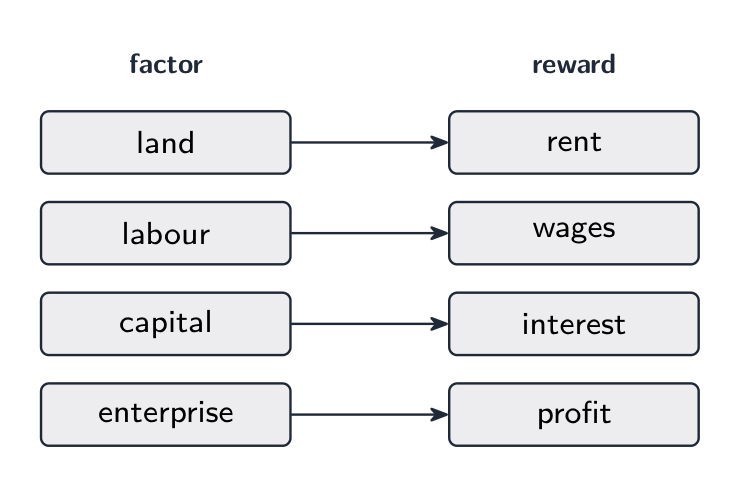
The factors of production 生产要素 are the four kinds of resource used to make goods and services. Each one earns a reward 报酬.
Factor
What it is
Its reward
land 土地
natural resources (fields, water, oil, minerals)
rent 地租
labour 劳动
human work, both physical and mental
wages 工资
capital 资本
man-made things used to produce, like machines, tools and factories
interest 利息
enterprise 企业家才能
the skill of bringing the other three together and taking the risk
profit 利润
Land includes some non-renewable resources 不可再生资源 (like oil and coal) that can run out. Enterprise is supplied by the entrepreneur 企业家, the person who has the business idea and risks their own money.
Specialisation and division of labour
specialisation 专业化 is when a worker, firm or country makes only the things it is best at, then trades for the rest.
Inside a workplace, specialisation leads to the division of labour 劳动分工: a big job is split into small tasks, and each worker 工人 does one task again and again.
Advantages
Disadvantages
workers get faster and better at one task
doing one task is boring, so workers may quit
less time wasted moving between jobs
if one worker is absent, the whole line can stop
output per worker rises, so costs fall
workers learn only one narrow skill
Mobility of factors
mobility 流动性 means how easily a factor can move to a new use.
occupational mobility 职业流动性 — how easily a factor moves from one job or use to another. A teacher who retrains as a nurse is occupationally mobile.
geographical mobility 地理流动性 — how easily a factor moves from one place to another. Land cannot move at all, so it has no geographical mobility.
Labour is often not very mobile. Family ties, the cost of housing, and missing skills all make it hard for workers to move.
한국어
생산 요소는 재화 및 서비스를 생산하는 데 사용되는 네 가지 자원의 종류입니다. 각 요소마다 보상이 발생합니다.
네 가지 생산 요인과 각 요인이 받는 보상
요소
내용
보상
토지
자연 자원(농경지, 수자원, 석유, 광물)
임대료
노동
신체적·정신적 인간 노동
임금
자본
기계, 공구, 공장 등 생산에 사용되는 인공적的物品
이자
기업
나머지 세 요소를 결합하고 위험을 감당하는 능력
이익
토지에는 석유와 석탄처럼 고갈될 수 있는 비재생 자원이 포함됩니다. 기업은 비즈니스 아이디어를 가지고 자신의 돈을 투자하여 위험을 감당하는 사업가에 의해 공급됩니다.
개방식 구리 광산: 기업이 추출하는 자연 자원(광물, 석유, 수자원)이 토지에 해당합니다.
전문성과 노업 분업
전문화란 노동자, 기업 또는 국가가 자신이 가장擅长的한 제품만 생산하고 나머지는 교역으로 조달하는 것입니다.
직장 내부에서 전문성은 노업 분업으로 이어집니다: 큰 업무를 작은 작업으로 나누고, 각 노동자가 특정 작업을 반복적으로 수행합니다.
장점
단점
한 작업에 대해 더 빠르고 잘하게 됩니다
한 작업만 반복하면 지루하므로 노동자가 퇴사할 수 있습니다
업무 간 이동으로 인한 시간 낭비가 줄어듭니다
한 노동자가 결석하면 전체 생산 라인이 멈출 수 있습니다
노동자당 생산량이 증가하여 비용이 감소합니다
노동자는 좁은 영역의 기술만 습득합니다
자동차 조립 라인: 자본(기계 및 로봇)과 노업 분업, 각 노동자가 한 작업만 반복합니다.
생산 요소의 유동성
유동성이란 한 요소가 새로운 용도로 이동하기 쉬운 정도를 의미합니다.
직업 유동성 — 한 요소가 다른 직무나 용도로 이동하기 쉬운 정도입니다. 교사가 간호사로 재교육받는 것은 직업 유동성이 높습니다.
지리적 유동성 — 한 요소가 다른 장소로 이동하기 쉬운 정도입니다. 토지는 이동할 수 없으므로 지리적 유동성이 없습니다.
노동은 일반적으로 유동성이 낮습니다. 가족 관계, 주거 비용, 미숙련 등이 노동자의 이동을 어렵게 만듭니다.
Explore · 탐색하기
Factors of production lab · 생산 요소 실험실
Sort real resources by the factor of production they represent. · 실물 자원을 그 생산 요소 유형에 따라 분류하십시오.
explain how resources are allocated in market, planned and mixed economic systems
explain the role of the price mechanism (signalling, incentive, rationing) in allocating resources
evaluate the advantages and disadvantages of each system
한국어
시장 경제, 계획 경제, 혼합 경제 체계에서 자원이 어떻게 배분되는지 설명함
**가격 메커니즘(signalling, incentive, rationing)**이 자원을 배분하는 역할을 설명함
각 경제 체계의 장점과 단점을 평가함
Source: Cambridge International syllabus · 출처: Cambridge International syllabus
English
An economic system is the way a country decides how to allocate 配置 (share out) its scarce resources. There are three types.
a market economy 市场经济 — firms and people own resources, and prices decide what is made. The government does little.
a planned economy 计划经济 (also called a command economy 指令经济) — the government owns resources and decides what is made, how, and for whom.
a mixed economy 混合经济 — a blend of the two. The private sector 私营部门 (firms and households) and the public sector 公共部门 (the government) both make decisions. Almost every real country is mixed.
The price mechanism
In a market economy, resources are guided by the price mechanism 价格机制. Prices do three jobs:
signalling 信号传递 — a price tells buyers and sellers where resources are wanted. A rising price says "this is wanted — make more".
incentive 激励 — a higher price rewards producers, so they want to supply more of that good.
rationing 配给 — when a good is scarce, a higher price shares it out to those who are willing and able to pay.
Comparing the systems
System
Strengths
Weaknesses
market
choice, low prices, strong incentive to work and invent
large gap between rich and poor; some goods not supplied
planned
smaller gap between rich and poor; key goods provided for all
weak incentive; shortages and surpluses; slow to change
mixed
tries to keep the good points of both
the right balance is hard to find
In practice no country sits at a pure extreme. China's economy, for instance, is officially a socialist market economy, where markets set most prices while the government guides key sectors and owns major enterprises. Every real system mixes the two and sits somewhere on the spectrum below.
한국어
경제 체제는 한 국가가 희귀 자원을 배분(나눠 주는) 방법을 결정하는 방식입니다. 세 가지 유형이 있습니다.
시장 경제 — 기업과 개인이 자산을 소유하며, 가격이 무엇을 만들지 결정합니다. 정부의 역할은 적습니다.
계획 경제(또는 명령 경제) — 정부가 자산을 소유하고 무엇을, 어떻게, 누구를 위해 만들지 결정합니다.
복합 경제 — 두 가지의 혼합입니다. 민간 부문(기업 및 가계)과 공공 부문(정부)이 모두 의사결정을 내립니다. 거의 모든 실제 국가가 복합 경제입니다.
가격 메커니즘
시장 경제에서 자원은 가격 메커니즘에 의해 유도됩니다. 가격은 세 가지 역할을 수행합니다:
신호 전달 — 가격이 구매자와 판매자에게 자원이 필요한 곳을 알려줍니다. 가격 상승은 "이것이 필요하다 — 더 많이 만들어라"라고 말합니다.
유인 — 높은 가격은 생산자에게 보상을 제공하므로, 그들이 해당 재화의 공급량을 늘리고 싶어 합니다.
할당 — 재화가 희귀할 때, 높은 가격은 지불 의사와 능력이 있는 사람에게 이를 배분합니다.
시장에서 가격은 세 가지 역할을 동시에 수행합니다 — 신호를 보내고, 유인을 제공하며, 희귀 재화를 할당합니다.
체제 비교
체제
강점
약점
시장
선택권, 저가, 노동 및 발명에 대한 강력한 유인
부 richness와 빈곤의 격차 큼; 일부 재화 비공급
계획
부 richness와 빈곤의 격차 작음; 필수 재화가 모두에게 제공됨
유인 약함; 부족과 과잉 발생; 변화가 느림
복합
두 체제의 장점을 유지하려 함
적절한 균형 찾기 어려움
실제 어느 한 국가도 순수한 극단에 위치하지 않습니다. 예를 들어 중국의 경제는 공식적으로 사회주의 시장 경제이며, 대부분 가격은 시장이 결정하지만 정부는 핵심 산업은 지도하고 주요 기업을 소유합니다. 모든 실제 체제는 두 가지를 혼합하여 아래 스펙트럼 상의 어디인가에 위치합니다.
경제 체제는 스펙트럼을 형성합니다: 한쪽 끝이 순수 시장, 다른 쪽 끝이 완전 정부 계획, 중간에 복합 경제가 있습니다.
draw and interpret PPCs to show opportunity cost, scarcity, choice and efficiency
explain movements along and shifts of the PPC and constant versus increasing opportunity cost
relate the PPC to economic growth and the allocation between capital and consumer goods
한국어
기회 비용, 희소성, 선택, 효율성을 나타내기 위해 PPC(생산 가능 곡선) 를 그려 해석함
PPC 상의 이동과 이동을 설명하고, 일정 기회 비용과 증가하는 기회 비용을 비교함
PPC와 경제 성장 및 자본재와 소비재 간의 배분 관계를 연결하여 설명함
Source: Cambridge International syllabus · 출처: Cambridge International syllabus
English
The PPF and opportunity cost
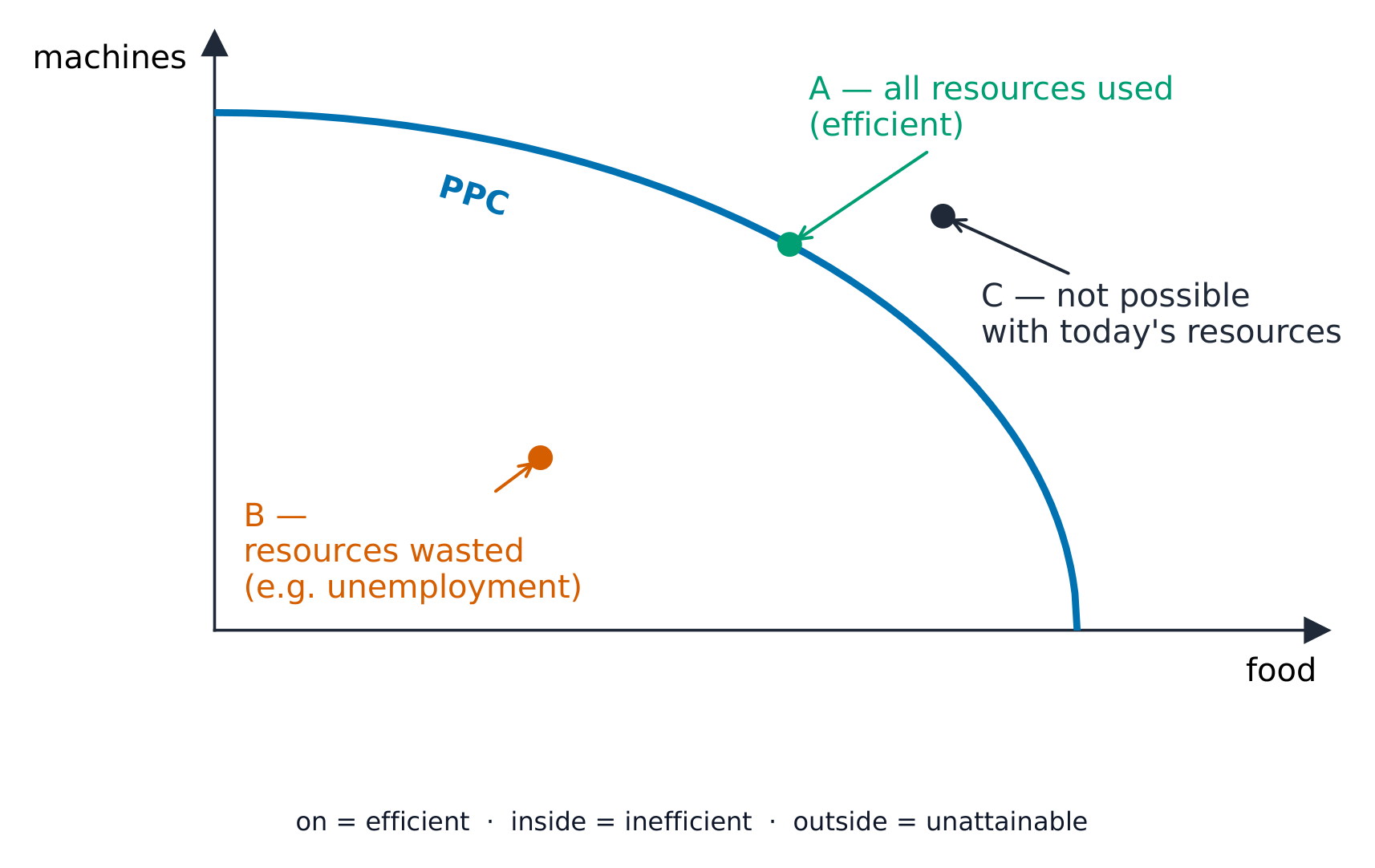
A production possibility curve 生产可能性曲线 (PPC) is a line showing the largest combinations of two goods an economy can make when all its resources are fully and well used.
Imagine an economy that makes only food and machines. The PPC is drawn with food on one axis and machines on the other.
a point on the curve: all resources are used with full efficiency 效率.
a point inside the curve: resources are wasted (for example, unemployment 失业 of workers). The economy could do better.
a point outside the curve: impossible today, because there are not enough resources. This shows scarcity.
Moving along the curve shows opportunity cost: to make more food, you must move resources away from machines, so you make fewer machines. This is the trade-off 取舍 between the two goods.
The shape of the curve shows how opportunity cost behaves:
a straight-line PPC means constant opportunity cost — each extra unit of food costs the same number of machines.
a curve that bows outwards means increasing opportunity cost — each extra unit of food costs more and more machines, because resources are not equally good at making both goods.
Shifts and growth
When the PPC moves outward (to the right), the economy can make more of both goods. This is economic growth 经济增长. It happens when there are more resources, or better ones (new technology 技术, a bigger or more skilled workforce). War or disaster can move the PPC inward — this is economic decline 经济衰退.
A country must also choose between two kinds of good now:
capital goods 资本品 — goods used to make other goods (machines, factories).
consumer goods 消费品 — goods people use directly (food, clothes).
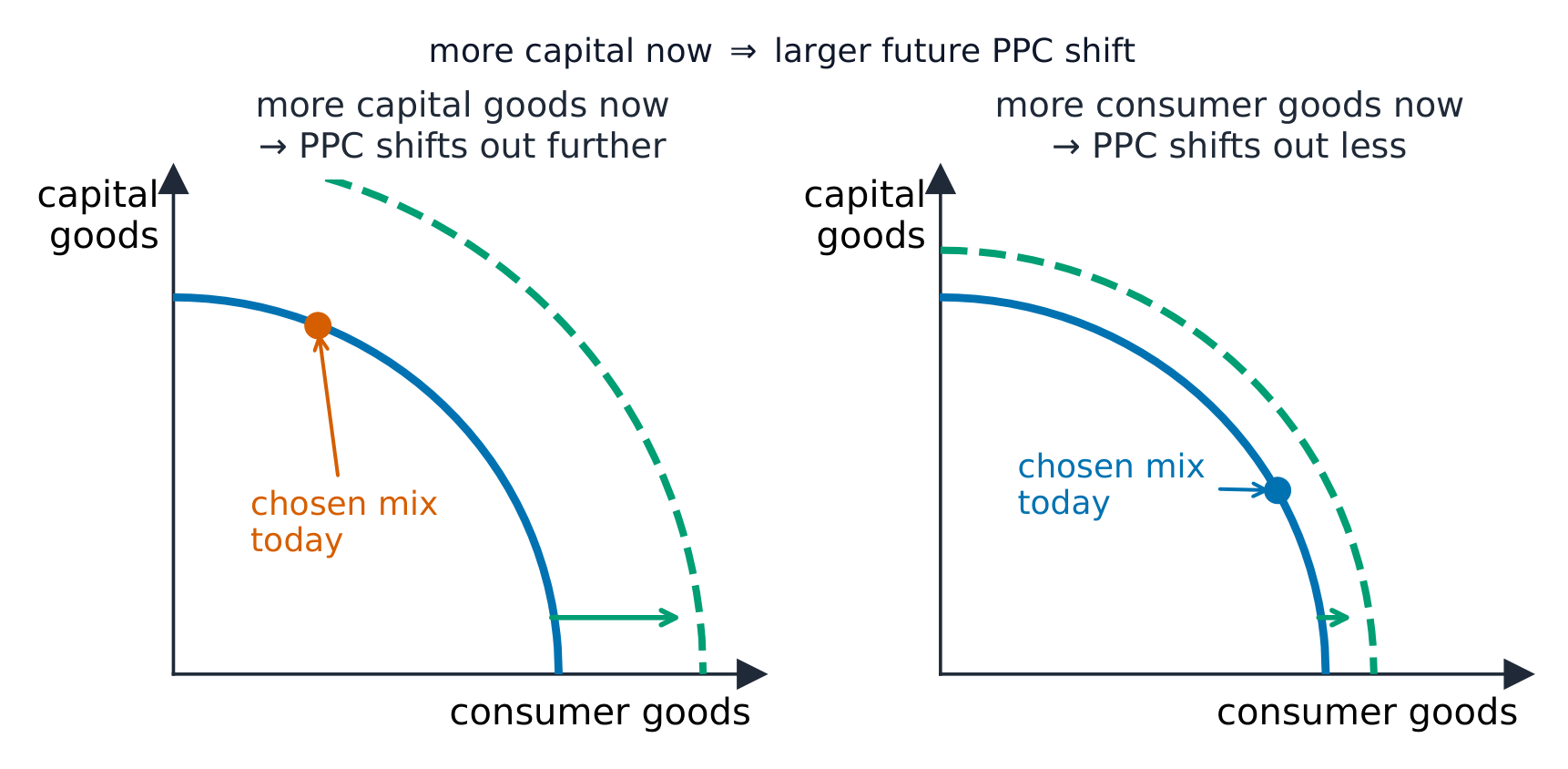
Making more capital goods today means fewer consumer goods today. But more capital goods help the economy grow faster, so the PPC shifts out by more in the future.
Worked example. Why is a production possibility curve usually drawn concave (bowed outwards) rather than as a straight line? A straight line would mean the opportunity cost of each extra unit stays constant. The curve bows out because factors of production are not perfectly substitutable - they are specialised. Starting from all-food production, the first factors moved into making cars are the ones least suited to farming, so very little food is given up for a lot of cars. Keep going and you must move factors that are increasingly good at farming and increasingly bad at making cars, so each extra car costs more and more food. That rising cost is increasing opportunity cost, and the bowed shape is simply its picture. A straight-line PPC is not wrong - it just assumes factors are perfectly substitutable, and naming that assumption is what earns the mark.
한국어
PPF와 기회 비용
생산 가능 곡선(PPC)은 모든 자원이 완전히 그리고 효율적으로 사용될 때, 한 경제가 생산할 수 있는 두 재화의 최대 조합을 보여주는 선입니다.
식품과 기계만 만드는 경제를 상상해 봅시다. PPF는 한 축에 식품, 다른 축에 기계를 두고 그립니다.
곡선 위의 점: 모든 자원이 완전 효율성으로 사용됩니다.
곡선 안의 점: 자원이 낭비됩니다(예: 노동자의 실업). 경제는 더 나은 성과를 낼 수 있습니다.
곡선 외부의 점: 불가능함. 현재는 자원이 충분하지 않기 때문이다. 이는 희소성을 보여준다.
곡선 위의 점은 모든 자원을 사용함(효율적); 곡선 내부는 낭비, 예시: 실업; 외부는 아직 불가능함.
곡선을 따라 이동하는 것은 기회비용을 나타낸다: 더 많은 식품을 생산하려면 자원을 기계에서 떼어내야 하므로, 기계 생산량이 줄어든다. 이는 두 재화 사이의 상충(trade-off) 관계이다.
곡선의 모양은 기회비용의 특성을 보여준다:
직선 PPC는 일정한 기회비용을 의미한다 — 식품 한 단위를 추가할 때마다 동일한 수의 기계를 포기해야 한다.
바깥쪽으로 볼록한 곡선은 증가하는 기회비용을 의미한다 — 자원이 두 재화를 모두 동등하게 생산할 수 없기 때문에, 식품 한 단위를 추가할 때마다 더 많은 기계를 포기해야 한다.
직선형 PPC는 식품 한 단위당 비용이 일정함을 의미하고, 볼록한 PPC는 식품 한 단위당 비용이 점점 더 많은 기계를 요구함을 의미한다.
이동 및 성장
PPC가 바깥쪽(오른쪽)으로 이동하면 경제는 두 재화 모두를 더 많이 생산할 수 있다. 이는 경제 성장이다. 자원의 양이 늘어나거나 자원의 질이 향상될 때(새로운 기술, 규모가 크거나 숙련도가 높은 노동력) 발생한다. 전쟁이나 재해는 PPC를 안쪽으로 이동시켜 경제 침체를 초래할 수 있다.
자원의 양이 늘어나거나 질이 좋아지면 전체 PPC가 바깥쪽으로 이동(성장); 전쟁이나 재해는 안쪽으로 이동(침체)시킨다.
또一个国家 must also choose between two kinds of good now:
자본재 — 다른 재화를 만드는 데 사용되는 재화 (기계, 공장).
소비재 — 사람들이 직접 사용하는 재화 (식품, 의류).
오늘 자본재를 더 많이 생산하면 오늘 소비재는 적어진다. 그러나 자본재가 많아지면 경제 성장이 빨라져 미래에 PPC가 더 크게 바깥쪽으로 이동하게 된다.
오늘 자본재를 더 많이 선택하면 지금 소비재는 적지만, 미래의 PPC는 더 크게 바깥쪽으로 이동한다.
해설 예제. 왜 생산 가능 경계 곡선은 보통 직선이 아닌 오목한(concave, 바깥쪽으로 볼록한) 형태로 그려지는가? 직선이라면 각 추가 단위의 기회비용이 일정해야 한다. 곡선이 바깥쪽으로 볼록한 이유는 생산 요인이 완전히 대체 가능하지 않기 때문이다 — 즉, 전문화되어 있기 때문이다. 모든 생산을 식품에서 시작할 때, 자동차 생산으로 전환되는 첫 번째 요인들은 농업에 가장 적합하지 않은 것들이므로, 많은 자동차를 생산하기 위해的食品을 거의 포기하지 않아도 된다. 계속 진행하면 농업에는 increasingly 좋고 자동차에는 increasingly 나쁜 요인을 전환해야 하므로, 각 추가 자동차가 점점 더 많은 식품을 필요로 하게 된다. 이 rising cost는 증가하는 기회비용이며, 볼록한 모양은 단순히 이를 시각적으로 표현한 것이다. 직선형 PPC가 틀린 것은 아니다 — 그것은 생산 요인이 완전히 대체 가능하다는 것을 가정할 뿐이며, 그 가정을 명시적으로 언급하는 것이 채점 포인트가 된다.
Explore · 탐색하기
The production possibility frontier · 생산 가능 곡선
Producing more of one good means giving up some of the other — that trade-off is the opportunity cost, shown by the slope of the frontier. · 하나의 재화를 더 생산하려면 다른 재화의 일부를 포기해야 합니다 — 이 trade-off가 기회비용이며, 곡선의 기울기로 나타납니다.
Explore · 탐색하기
Allocating scarce resources · 희귀 자원의 배분
An economy can't have more of everything: making more of one good means giving up some of another — the frontier's slope is that opportunity cost. · 모든 것을 더 많이 가질 수는 없습니다: 하나의 재화를 더 생산한다는 것은 다른 재화의 일부를 포기하는 것이며, 한계선(slope)이 바로 그 기회비용입니다.
Explore · 탐색하기
The production possibility curve · 생산 가능 곡선(PPC)
Move along the curve. Producing more of one good means producing less of the other — the curve shows opportunity cost and scarcity. · 곡선을 따라 이동하세요. 하나의 재화를 더 생산한다는 것은 다른 하나의 재화 생산량을 줄이는 것을 의미합니다 — 이 곡선은 기회 비용과 희소성을 나타냅니다.
distinguish free goods and economic (private) goods
explain the characteristics of public goods (non-rivalry, non-excludability) and the free-rider problem
explain merit and demerit goods and the role of information and value judgements
한국어
무상재(free goods) 와 경제재(민간재, economic/private goods) 를 구분함
공공재의 특징(비경쟁성(non-rivalry), 배제 불가능성(non-excludability) )과 타면 문제(free-rider problem) 을 설명함
선량재(merit goods) 와 악재(demerit goods) 를 설명하고, 정보와 가치 판단의 역할을 서술함
Source: Cambridge International syllabus · 출처: Cambridge International syllabus
English
Free goods and economic goods
a free good 免费物品 has no opportunity cost. Its supply is unlimited, so it has no price (for example, air or sunlight).
an economic good 经济物品 (also called a private good 私人物品) is scarce. Making it has an opportunity cost, so it has a price.
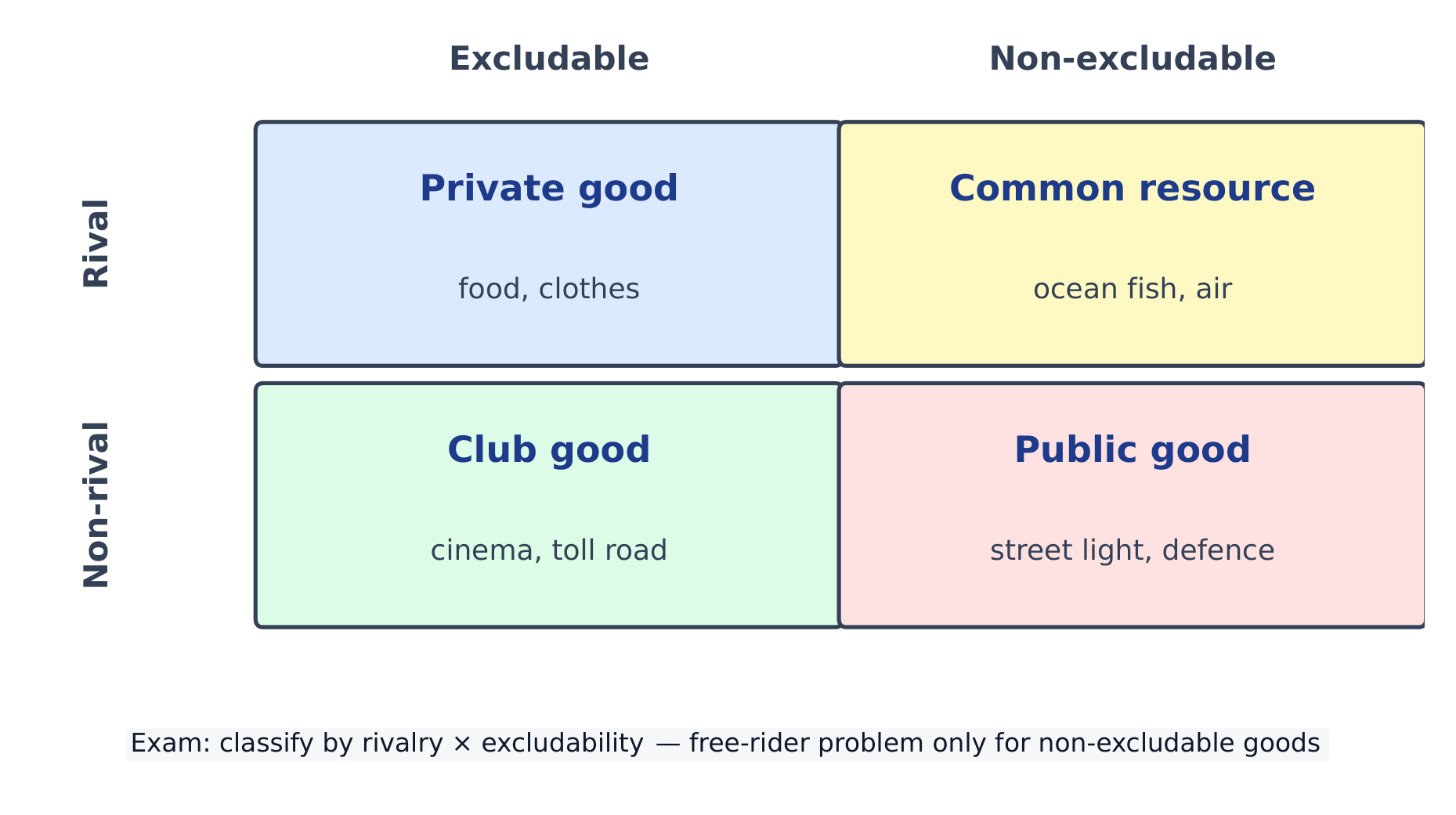
A private good has two features. It has rivalry 竞争性 (if I eat the apple, you cannot) and excludability 排他性 (the seller can stop you using it unless you pay).
Public goods
A public good 公共物品 is the opposite of a private good. It has two features:
non-rivalry 非竞争性 — one person using it does not reduce the amount left for others.
non-excludability 非排他性 — you cannot stop people who do not pay from using it.
Because of non-excludability, public goods suffer from the free-rider problem 搭便车问题: people enjoy the good without paying for it. So private firms cannot make a profit and will not supply it. The government must provide public goods instead — for example, street lighting and national defence 国防.
Merit and demerit goods
a merit good 优值品 is better for you (and for society) than you realise, so people buy too little of it. Examples: education and health care.
a demerit good 劣值品 is worse for you than you realise, so people buy too much of it. Examples: cigarettes and alcohol.
People misjudge these goods because of information failure 信息失灵 — they do not have, or do not use, the full facts about the benefit or harm.
Deciding what counts as a merit or demerit good is partly a value judgement, so people may disagree about which goods belong on each list.
한국어
무상재와 경제적 재화
무상재(free good) 는 기회비용이 없다. 공급이 무제한이므로 가격이 없다 (예: 공기나 햇빛).
경제적 재화(economic good) (또는 사적 재화/private good)는 희소하다. 이를 생산하는 데 기회비용이 있으므로 가격이 있다.
사적 재화는 두 가지 특징을 가진다. 경쟁성(rivalry) 이 있어 (내가 사과를 먹으면 당신은 먹을 수 없음) 배제 가능성(excludability) 이 있어 (판매자가 당신이 지불하지 않는 이상 사용을 막을 수 있음).
무상재는 기회비용과 가격이 없으며, 경제적 재화는 희소하고 경쟁적이며 배제 가능함
공공재
공공재(public good) 는 사적 재화의 반대이다. 두 가지 특징을 가진다:
비경쟁성(non-rivalry) — 한 사람이 사용하는 것이 다른 사람에게 남은 양을 줄이지 않는다.
비배제성(non-excludability) — 지불하지 않은 people에게도 사용을 막을 수 없다.
비배제성으로 인해 공공재는 무료 탑승자 문제(free-rider problem) 에 시달린다: 사람들은 비용을 지불하지 않고 혜택을 누린다. 따라서 사적 기업은 이익을 내지 못하여 공급하지 않을 것이다. 정부는 대신 공공재를 제공해야 한다 — 예: 가로등 조명과 국방.
경쟁성과 배제 가능성에 따라 네 가지 유형의 재화가 존재한다: 사적 재화, 클럽 재화, 공동 자원, 공공재.
긍정재와 부정재
긍정재(merit good) 은 본인이 인식하는 것보다 개인과 사회에 더 유익하므로, 사람들은 이를 너무 적게 소비한다. 예: 교육 및 의료 서비스.
부정재(demerit good) 은 본인이 인식하는 것보다 개인에 해롭고 불리하므로, 사람들은 이를 너무 많이 소비한다. 예: 담배 및 알코올.
교육은 고전적인 긍정재이다. 좋은 일자리와 숙련된 사회라는 완전한 가치(가치)는 과소평가하기 쉬우므로, 시장에만 맡겨두면 개인이나 국가에 이로운 수준보다 적게 소비하게 된다. 이것이 정부가 제공하고 보조금을 지급하는 이유이다
사람들은 정보 실패(information failure) 로 인해 이러한 재화를 잘못 판단한다 — 혜택이나 해에 대한 완전한 사실을 가지고 있지 않거나, 이용하지 않기 때문이다.
무엇이 긍정재 또는 부정재에 속하는지를 결정하는 것은 일부 가치 판단(value judgement)에 기반하므로, 어떤 재화가 각 목록에 포함되어야 하는지에 대해人们在 disagree 할 수 있다.
Explore · 탐색하기
Goods and services lab · 재화와 서비스 실험실
Classify examples by rivalry, excludability or whether they are services. · 경쟁성, 배제 가능성 또는 서비스가 여부를 기준으로 예시를 분류하십시오.