Skip to content · ⁨본문 바로가기⁩

Group 2

A-Level Chemistry · ⁨A-Level 화학⁩ · Topic 10 · ⁨주제 10⁩

Video lesson for this topic · ⁨이 주제용 영상 수업⁩ Open the video page · ⁨영상 페이지 열기⁩
8:01

2족

위 X선 촬영 전, 환자는 진한 흰색 액체를 마시도록 요청받습니다. 바륨이 가득 들어있으며, 바륨 이온은 독성입니다. 가용성 바륨 염을 삼키면…

English narration · English + 中文 subtitles burned in · ⁨영어 내레이션 · 영어 + 중국어 자막 burned-in⁩

10.1

The Group 2 metals · ⁨2족 금속⁩

Syllabus
English
  1. describe, and write equations for, the reactions of the elements with oxygen, water and dilute hydrochloric and sulfuric acids
  2. describe, and write equations for, the reactions of the oxides, hydroxides and carbonates with water and dilute hydrochloric and sulfuric acids
  3. describe, and write equations for, the thermal decomposition of the nitrates and carbonates, to include the trend in thermal stabilities
  4. describe, and make predictions from, the trends in physical and chemical properties of the elements involved in the reactions in 10.1.1 and the compounds involved in 10.1.2, 10.1.3 and 10.1.5
  5. state the variation in the solubilities of the hydroxides and sulfates
한국어
  1. 산소, 물, 희석 염산 및 황산과의 원소 반응 서술 및 화학 방정식 작성
  2. 산化物, 수산화물 및 탄산염이 물, 희석 염산 및 황산과 반응하는 것 서술 및 화학 방정식 작성
  3. 질산염 및 탄산염의 열분해 서술 및 화학 방정식 작성. 열적 안정성의 경향 포함
  4. 10.1.1의 반응에 관여한 원소 및 10.1.2, 10.1.3, 10.1.5의 화합물에 대한 물리적·화학적 성질 경향 서술 및 예측
  5. 수산화물 및 황산염의 용해도 변화를 서술

Source: Cambridge International syllabus · ⁨출처: Cambridge International syllabus⁩

English

Group 族 2 holds the metals magnesium, calcium, strontium and barium. They all have two outer electrons, which they lose to form $2+$ ions. Going down the group, the atoms get larger and the outer electrons are easier to lose, so the metals get more reactive — their reactivity 反应活性 increases down the group.

Reactions of the elements

With oxygen, they burn to form an oxide:

$$2\text{Mg} + \text{O}_2 \rightarrow 2\text{MgO}$$

With water, they form a hydroxide and hydrogen. The reaction gets faster down the group:

$$\text{Ca} + 2\text{H}_2\text{O} \rightarrow \text{Ca(OH)}_2 + \text{H}_2$$

Magnesium is slow with cold water but reacts fast with steam, giving $\text{MgO}$ and $\text{H}_2$.

With dilute hydrochloric or sulfuric acid, they form a salt and hydrogen:

$$\text{Mg} + 2\text{HCl} \rightarrow \text{MgCl}_2 + \text{H}_2 \qquad \text{Mg} + \text{H}_2\text{SO}_4 \rightarrow \text{MgSO}_4 + \text{H}_2$$

With sulfuric acid the reaction slows down the group, because the sulfates 硫酸盐 formed (such as $\text{BaSO}_4$) are insoluble and coat the metal.

Reactions of the compounds

The oxides 氧化物 and hydroxides 氢氧化物 are basic. They react with water and with dilute acids:

$$\text{MgO} + \text{H}_2\text{O} \rightarrow \text{Mg(OH)}_2 \qquad \text{Mg(OH)}_2 + 2\text{HCl} \rightarrow \text{MgCl}_2 + 2\text{H}_2\text{O}$$

The carbonates 碳酸盐 react with dilute acids to give a salt, water and carbon dioxide:

$$\text{CaCO}_3 + 2\text{HCl} \rightarrow \text{CaCl}_2 + \text{H}_2\text{O} + \text{CO}_2$$

Thermal decomposition

Thermal decomposition 热分解 means breaking a compound apart by heating it.

  • the carbonates break into the oxide and carbon dioxide:
$$\text{CaCO}_3 \rightarrow \text{CaO} + \text{CO}_2$$
  • the nitrates 硝酸盐 break into the oxide, brown nitrogen dioxide gas and oxygen:
$$2\text{Ca(NO}_3)_2 \rightarrow 2\text{CaO} + 4\text{NO}_2 + \text{O}_2$$

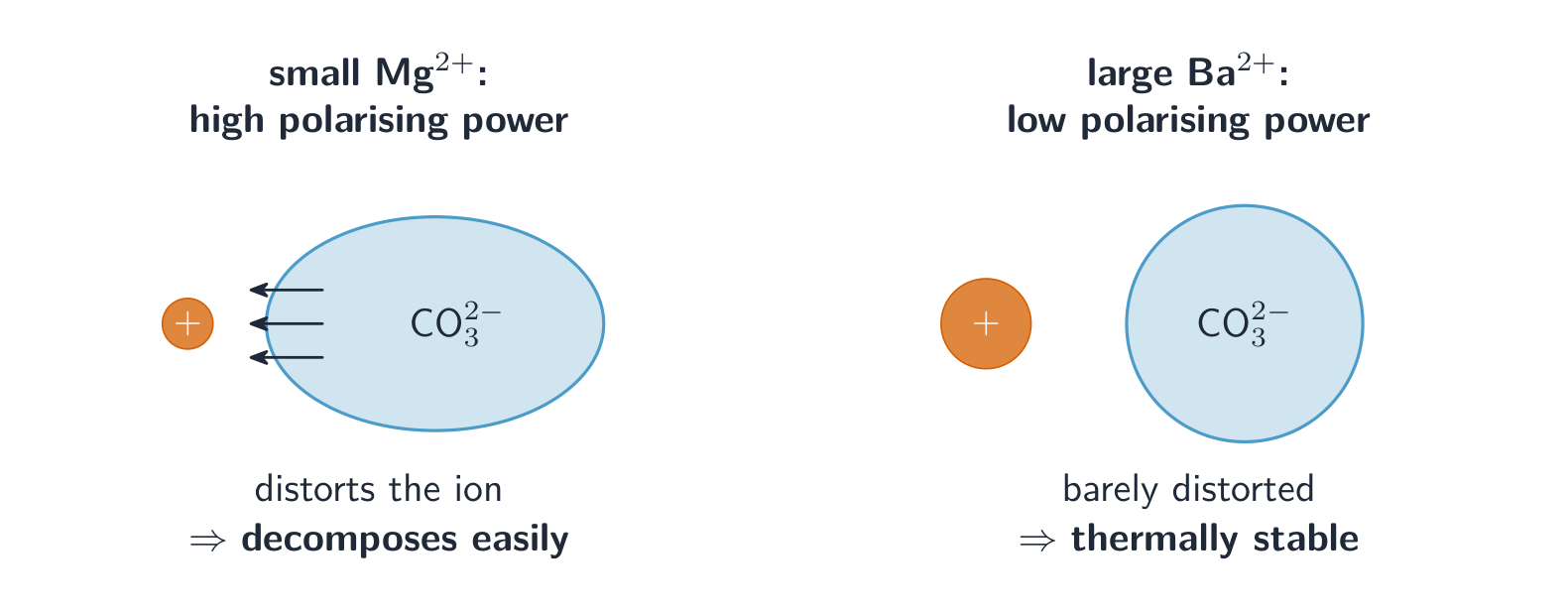
The thermal stability 热稳定性 of both the carbonates and the nitrates increases down the group. A larger metal ion pulls less on the carbonate or nitrate ion, so the compound is harder to break apart — it needs a higher temperature. So magnesium carbonate decomposes most easily, and barium carbonate is the hardest.

Trends in solubility

Compound Trend in solubility 溶解度 down the group
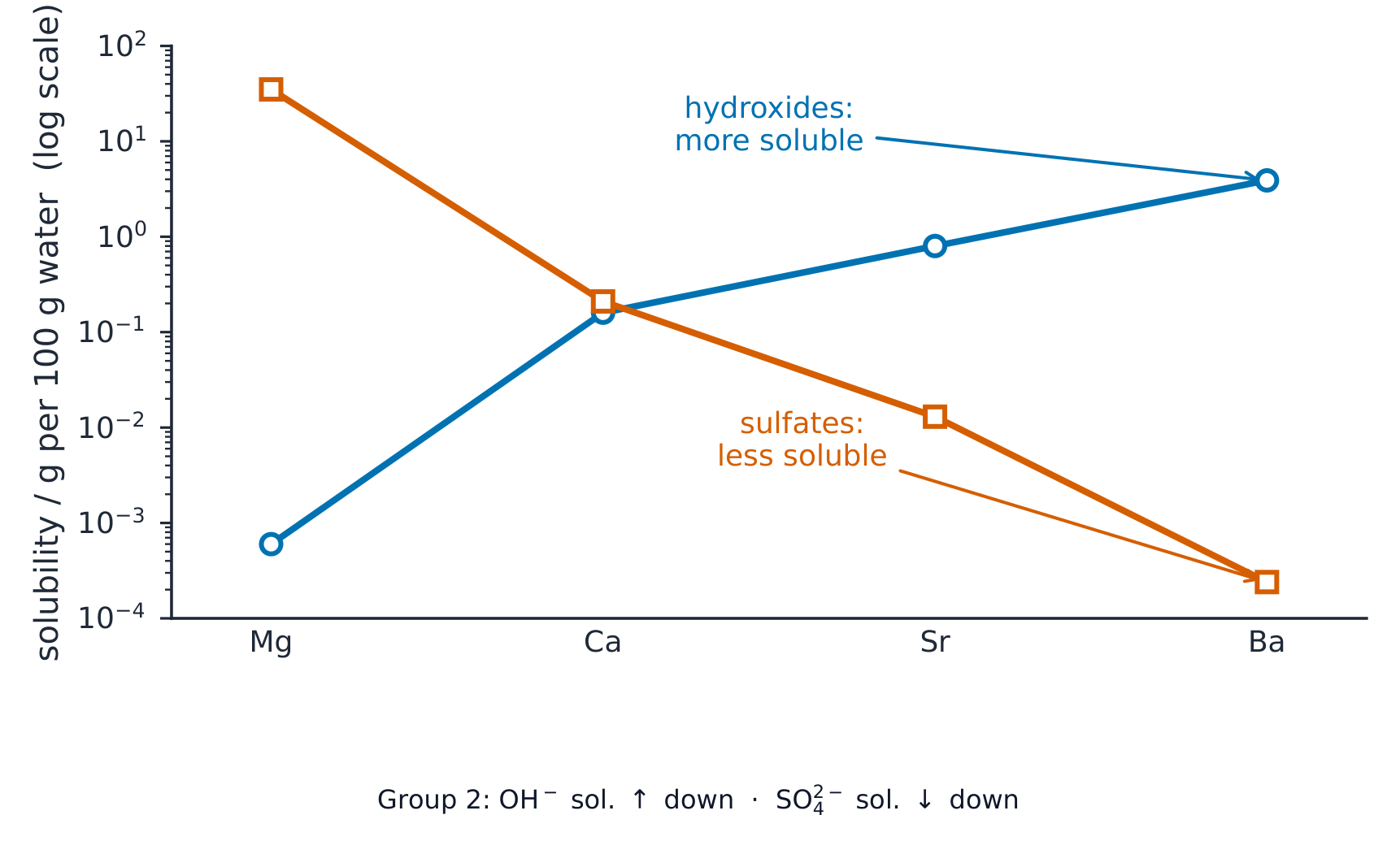
hydroxides increase (Mg(OH)$_2$ almost insoluble; Ba(OH)$_2$ soluble)
sulfates decrease (MgSO$_4$ soluble; BaSO$_4$ insoluble)

From these trends you can predict the properties of the next element down, radium, and of its compounds.

Worked example. $\text{MgCO}_3$ decomposes at about $540\ °\text{C}$ and $\text{BaCO}_3$ at about $1360\ °\text{C}$. Explain the trend and predict where $\text{CaCO}_3$ sits. Going down Group 2 the cation gets larger, so its charge is spread over a bigger surface and its polarising power falls. A less polarising cation distorts the carbonate ion less, so the $\text{C-O}$ bond is weakened less and more heat is needed to break it. Thermal stability therefore increases down the group, and $\text{CaCO}_3$, lying between Mg and Ba, decomposes at an intermediate temperature of about $900\ °\text{C}$. Argue the whole chain - cation size, then polarising power, then distortion of the anion; "it is more reactive" explains nothing here.

한국어
탄산칼슘의 해안 석회암 절벽
석회암은 탄산칼슘이다 - 2족 금속 칼슘의 화합물.

그룹 2에는 마그네슘, 칼슘, 스트론티움 및 바륨의 금속들이 포함됩니다. 이들은 모두 바깥 껍질 전자 2개를 가지고 있으며, 이를 잃어 $2+$ 이온을 형성합니다. 아래로 내려갈수록 원자는 커지고 바깥 껍질 전자를 잃기 쉬워지므로 금속들은 더 반응성이 높아집니다—즉, 그룹 아래로 갈수록 반응성이 증가합니다.

마그네슘부터 바륨까지 크기가 커지는 2족 원子和一个标有反应性增加的向下箭头
2족을 내려갈수록 반응성이 증가한다: 더 큰 원자는 두 개의 최외전자를 덜 강하게 묶어 놓으므로 더 쉽게 잃어진다

원소들의 반응

산소와 반응하면 산소를 만들어 연소한다:

$$2\text{Mg} + \text{O}_2 \rightarrow 2\text{MgO}$$
플라이어에 잡힌 마그네슘 줄기가 눈부신 흰빛과 함께 타오르며 산화마그네슘의 흰 연기를 내보냅니다
마그네슘은 공기 중에서 밝은 흰색 불꽃으로 타오르며 흰색 산화마그네슘을 형성함

물과 반응하면 수산화물과 수소 가스를 만든다. 반응은 족을 내려갈수록 빨라진다:

$$\text{Ca} + 2\text{H}_2\text{O} \rightarrow \text{Ca(OH)}_2 + \text{H}_2$$

마그네슘은 찬물에서는 느리지만 증기에서는 빠르게 반응하여 $\text{MgO}$과 $\text{H}_2$을 생성한다.

희석 염산 또는 황산과 반응하면 염과 수소를 만든다:

$$\text{Mg} + 2\text{HCl} \rightarrow \text{MgCl}_2 + \text{H}_2 \qquad \text{Mg} + \text{H}_2\text{SO}_4 \rightarrow \text{MgSO}_4 + \text{H}_2$$

황산과의 반응은 족을 내려갈수록 느려지는데,-formed sulfates (such as $\text{BaSO}_4$) are insoluble and coat the metal.

화합물들의 반응

산화물과 수산화물은 염기성이다. 그들은 물과 희석 산과 반응한다:

$$\text{MgO} + \text{H}_2\text{O} \rightarrow \text{Mg(OH)}_2 \qquad \text{Mg(OH)}_2 + 2\text{HCl} \rightarrow \text{MgCl}_2 + 2\text{H}_2\text{O}$$

탄산염은 희석 산과 반응하여 염, 물 및 이산화탄소를 생성한다:

$$\text{CaCO}_3 + 2\text{HCl} \rightarrow \text{CaCl}_2 + \text{H}_2\text{O} + \text{CO}_2$$

열분해

열분해는 화합물을 가열하여 분리시키는 것을 의미한다.

  • 탄산염은 산화와 이산화탄소로 쪼개진다:
$$\text{CaCO}_3 \rightarrow \text{CaO} + \text{CO}_2$$
  • 질산염은 산화물, 갈색 질소 산화물 가스 및 산소로 쪼개진다:
$$2\text{Ca(NO}_3)_2 \rightarrow 2\text{CaO} + 4\text{NO}_2 + \text{O}_2$$

탄산염과 질산염의 열 안정성은 모두 을 내려갈수록 증가한다. 더 큰 금속 이온은 탄산염이나 질산염 이온을 덜 끌어당하므로 화합물이 쪼개지기 어렵다 - 더 높은 온도가 필요하다. 따라서 탄산마그네슘이 가장 쉽게 분해되고, 탄산바륨이 가장难分解。

작은 마그네슘 이온이 탄산염 이온을 심하게 왜곡하고 큰 바륨 이온은 거의 왜곡하지 않음
열 안정성은 족을 내려갈수록 상승한다: 작은 양이온은 탄산염 이온을 더 극화(왜곡)시켜 약화시키므로 더 쉽게 분해됨

용해도의 경향

화합물 족을 내려가는 용해도의 경향
수산화물 증가 (Mg(OH)$_2$ 거의 불용; Ba(OH)$_2$ 용용)
황산염 감소 (MgSO$_4$ 용용; BaSO$_4$ 불용)
두 로그 스케일 선이 교차: 수산화물 용해도는 Mg에서 Ba로 상승하고 황산염 용해도는 하락함
2족을 내려갈수록 수산화물은 더 잘 녹고 황산염은 더 잘 녹지 않는다(로그 스케일 참고)

이러한 경향으로부터 다음 원소인 라듐과 그 화합물의 성질을 예측할 수 있다.

작은 예제. $\text{MgCO}_3$는 약 $540\ °\text{C}$에서 분해되고, $\text{BaCO}_3$는 약 $1360\ °\text{C}$에서 분해됩니다. 이 경향을 설명하고, $\text{CaCO}_3$가 어디에 위치하는지 예측하십시오. 2족 원소를 아래로 내려갈수록 양이온의 크기는 커지고, 전하가 더 넓은 면적에 퍼지므로 극화력은 감소합니다. 극화력이 작은 양이온은 탄산 이온을 덜 왜곡시키므로, $\text{C-O}$ 결합은 덜 약화되며 이를 끊기 위해 더 많은 열이 필요합니다. 따라서 열 안정성은 족을 따라 아래로 갈수록 증가하며, Mg와 Ba 사이에 위치한 $\text{CaCO}_3$는 중간 온도인 약 $900\ °\text{C}$에서 분해됩니다. 전체 인과사슬을 논증하십시오: 양이온 크기 → 극화력 → 음이온의 왜곡; "더 반응성이 크다"는 설명은 여기서 아무런 의미가 없습니다.

Explore · ⁨탐색하기⁩

Group 2 reactivity ladder · ⁨2족 반응성 계단⁩

Move down Group 2 and see why reactions become more vigorous. · ⁨2족을 내려가면 왜 반응이 격렬해지는지 확인하세요.⁩

Explore · ⁨탐색하기⁩

Group 2 trend lab · ⁨2족 경향 실험실⁩

Compare thermal stability and solubility trends down Group 2. · ⁨2족을 내려가는 열안정성과 용해도 경향을 비교하세요.⁩

Vocabulary · ⁨어휘⁩ Train · ⁨연습하기⁩
English 한국어
group/ɡruːp/ 그룹
reactivity/rɪəkˈtɪvɪti/ 활성도
sulfate/ˈsʌlfeɪt/ 황산염
oxide/ˈɒksaɪd/ 산化物
hydroxide/haɪˈdrɒksaɪd/ 수산화
carbonate/ˈkɑːbəneɪt/ 탄산염
thermal decomposition/ˈθɜːml ˌdiːkɒmpəˈzɪʃn/ 열분해 반응
nitrate/ˈnaɪtreɪt/ 질산
thermal stability/ˈθɜːml stəˈbɪlɪti/ 열안정성
solubility/ˌsɒljuːˈbɪlɪti/ 용해도
10.1

Exam tips · ⁨시험 팁⁩

English
  • Reactivity increases down Group 2: ionisation energy falls as atoms get larger, so electrons are lost more easily.
  • Reactions with water become more vigorous down the group; Mg reacts slowly with cold water but fast with steam (→ MgO).
  • Hydroxides get more soluble down the group; sulfates get less soluble ($\text{BaSO}_4$ insoluble — the basis of the sulfate test).
  • Write equations with the correct $+2$ ion and state the observations (fizzing, dissolving).
한국어
  • 2족 원소의 반응성은 족을 따라 아래로 갈수록 증가합니다. 원자가 커짐에 따라 이온화 에너지가 낮아져 전자를 잃기 쉬워집니다.
  • 물과의 반응은 족을 따라 아래로 갈수록 더 격렬해집니다. Mg는 찬물에서는 느리게 반응하지만 증기와는 빠르게 반응합니다 (→ MgO).
  • 수산화물은 족을 따라 아래로 갈수록 용해도가 높아지고, 황산염은 용해도가 낮아집니다 ($\text{BaSO}_4$는 불용성 — 황산염 검출법의 기초).
  • 올바른 $+2$ 이온을 사용하여 방정식을 쓰고, 관찰 사항(거품 발생, 용해)을 서술하십시오.

Interactive lessons on this topic · ⁨이 주제에 대한 인터랙티브 수업⁩

Work through it step by step, with instant-check exercises. · ⁨즉시 체크 기능 exercises를 통해 단계별로 진행하세요.⁩

Past Papers · ⁨과거 시험지⁩

More topics in A-Level Chemistry · ⁨A-Level 화학⁩ · ⁨A-Level Chemistry · ⁨A-Level 화학⁩ 내 추가 주제⁩

Log in or create account · ⁨로그인 또는 계정 만들기⁩

IGCSE, A-Level & AP