Thermal decomposition and solubility
Introduced| English | Meaning |
|---|---|
| thermal decomposition/ˈθɜːml ˌdiːkɒmpəˈzɪʃn/ | The breakdown of a compound into simpler substances when heated. |
| nitrate/ˈnaɪtreɪt/ | A compound containing the nitrate ion, NO3 with a single negative charge. |
| polarise/ˈpəʊləraɪz/ | polarise |
| thermal stability/ˈθɜːml stəˈbɪlɪti/ | The resistance of a substance or system to decomposition or other unwanted change when heated. |
| solubility/ˌsɒljuːˈbɪlɪti/ | The maximum amount of a solute that can dissolve in a specified amount of solvent at a given temperature and pressure. |
Heating the carbonates
- Thermal decomposition 热分解 breaks a compound apart by heating.
- Its ease changes in a clear trend down Group 2.
- So do the solubilities of the hydroxides and sulfates.
Group 2 trend lab
Compare thermal stability and solubility trends down Group 2.
Group 2 carbonates become less thermally stable down the group.
Difficulty 1/5 · 100 coins + a small bonus on first completion today
False. They become more stable down the group: larger cations have a lower charge density and polarise the carbonate ion less, so it needs a higher temperature to decompose.
Decomposing carbonates and nitrates 硝酸盐
- carbonates → oxide + carbon dioxide: $\text{CaCO}_3 \rightarrow \text{CaO} + \text{CO}_2$.
- nitrates → oxide + brown $\text{NO}_2$ + oxygen: $2\text{Ca(NO}_3)_2 \rightarrow 2\text{CaO} + 4\text{NO}_2 + \text{O}_2$.
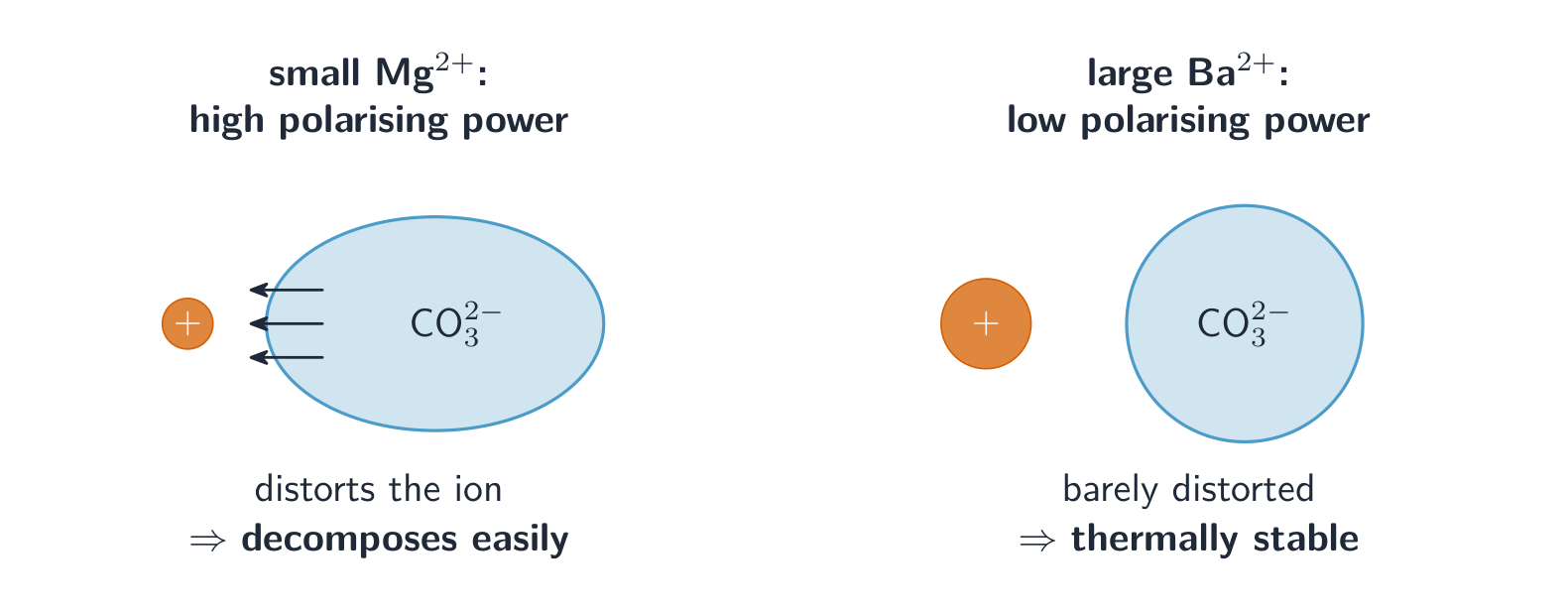
A small cation polarises 极化 the carbonate ion more, so it decomposes more easily
Heating a Group 2 carbonate produces:
Difficulty 1/5 · 100 coins + a small bonus on first completion today
Thermal decomposition: CaCO₃ → CaO + CO₂.
Heating a Group 2 nitrate produces:
Difficulty 1/5 · 100 coins + a small bonus on first completion today
e.g. 2Ca(NO₃)₂ → 2CaO + 4NO₂ + O₂ (brown NO₂ gas is given off).
Match each trend down Group 2.
Difficulty 2/5 · 140 coins + a small bonus on first completion today
Each item links the term to its correct meaning.
Thermal stability 热稳定性 rises down the group
- Both carbonates and nitrates get harder to decompose down the group.
- A larger metal ion pulls less on (polarises less) the carbonate/nitrate ion, so it is harder to break apart.
- So MgCO₃ decomposes most easily; BaCO₃ is the hardest.
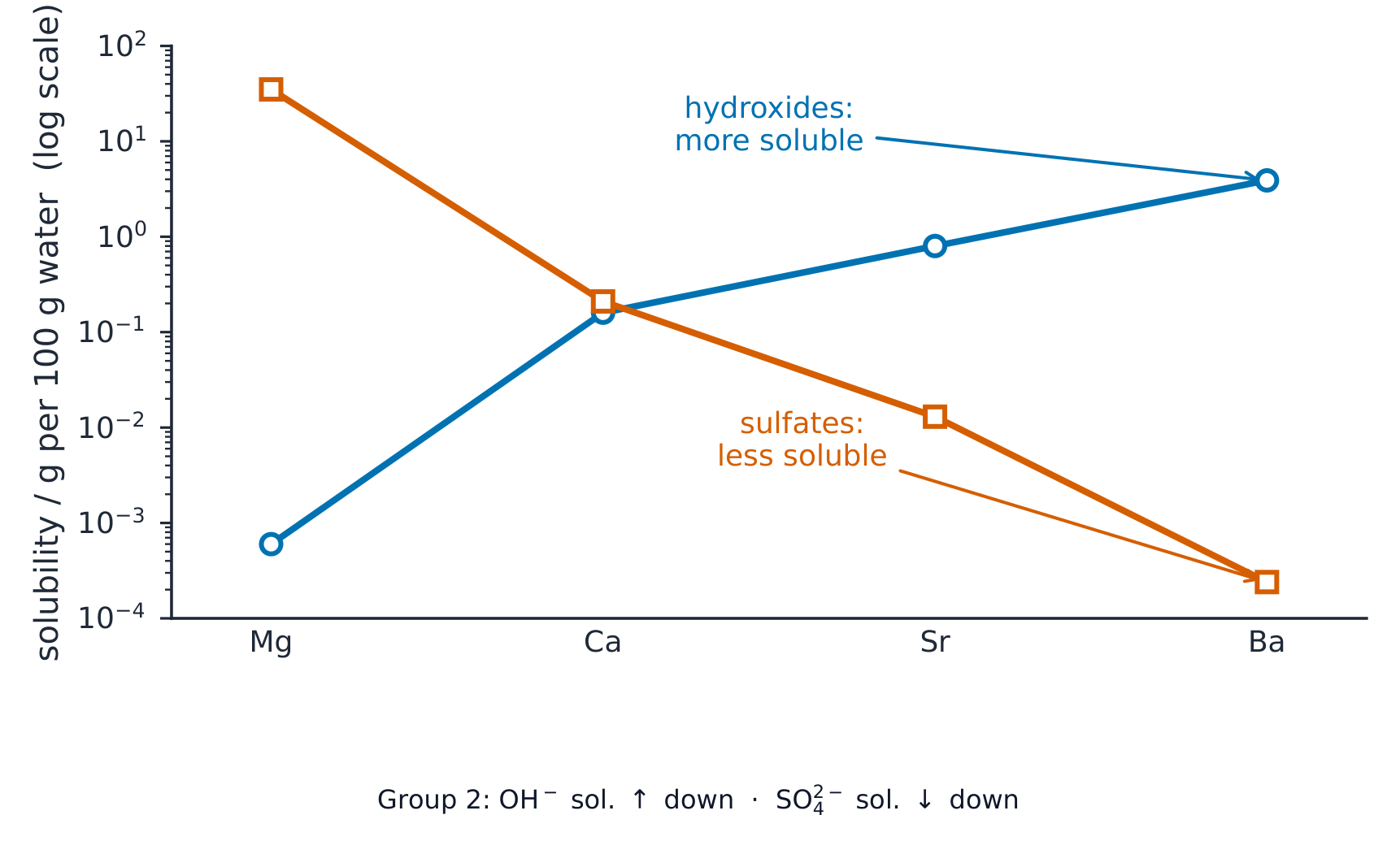
Down Group 2, hydroxide solubility 溶解度 increases while sulfate solubility decreases
Thermal stability of the carbonates increases down Group 2 because:
Difficulty 1/5 · 100 coins + a small bonus on first completion today
A big cation distorts the carbonate ion less, so more energy (a higher temperature) is needed to decompose it.
Solubility trends
| Compound | Down the group |
|---|---|
| hydroxides | solubility increases (Mg(OH)₂ almost insoluble; Ba(OH)₂ soluble) |
| sulfates | solubility decreases (MgSO₄ soluble; BaSO₄ insoluble) |
Down Group 2:
Difficulty 1/5 · 100 coins + a small bonus on first completion today
Hydroxides become more soluble (Ba(OH)₂ soluble); sulfates become less soluble (BaSO₄ insoluble).
You've got it
- carbonates → oxide + CO₂; nitrates → oxide + NO₂ + O₂ (on heating)
- thermal stability increases down the group (larger ion polarises the anion less)
- down the group: hydroxides more soluble, sulfates less soluble (BaSO₄ insoluble)