Skip to content · ⁨본문 바로가기⁩

Control and coordination · ⁨통제 및 조정⁩

A-Level Biology · ⁨A-Level 생물학⁩ · Topic 15 · ⁨주제 15⁩

Video lesson for this topic · ⁨이 주제용 영상 수업⁩ Open the video page · ⁨영상 페이지 열기⁩
9:38

신경 및 근육

뜨거운 것을 만지면 통증을 느끼기 전에 이미 손이 움직이고 있다. 신호가 허락을 구하기 위해 뇌로 가지 않았다. 그것은 척수 안으로…

English narration · English + 中文 subtitles burned in · ⁨영어 내레이션 · 영어 + 중국어 자막 burned-in⁩

15.1

Two systems for control · ⁨두 가지 조절 시스템⁩

Syllabus
English
  1. describe the features of the endocrine system with reference to the hormones ADH, glucagon and insulin (see 14.1.8, 14.1.9 and 14.1.10)
  2. compare the features of the nervous system and the endocrine system
  3. describe the structure and function of a sensory neurone and a motor neurone and state that intermediate neurones connect sensory neurones and motor neurones
  4. outline the role of sensory receptor cells in detecting stimuli and stimulating the transmission of impulses in sensory neurones
  5. describe the sequence of events that results in an action potential in a sensory neurone, using a chemoreceptor cell in a human taste bud as an example
  6. describe and explain changes to the membrane potential of neurones, including: • how the resting potential is maintained • the events that occur during an action potential • how the resting potential is restored during the refractory period
  7. describe and explain the rapid transmission of an impulse in a myelinated neurone with reference to saltatory conduction
  8. explain the importance of the refractory period in determining the frequency of impulses
  9. describe the structure of a cholinergic synapse and explain how it functions, including the role of calcium ions
  10. describe the roles of neuromuscular junctions, the T-tubule system and sarcoplasmic reticulum in stimulating contraction in striated muscle
  11. describe the ultrastructure of striated muscle with reference to sarcomere structure using electron micrographs and diagrams
  12. explain the sliding filament model of muscular contraction including the roles of troponin, tropomyosin, calcium ions and ATP
한국어
  1. ADH, 글루카곤 및 인슐린 호르몬에 대한 참고를 들어 내분비계의 특징을 서술하십시오(14.1.8, 14.1.9 및 14.1.10 참조).
  2. 신경계와 내분비계의 특징을 비교하십시오.
  3. 감각 신경원 및 운동 신경원의 구조와 기능을 서술하고, 중간 신경원이 감각 신경원과 운동 신경원을 연결한다는 점을 명시하십시오.
  4. 감각 수용체 세포가 자극을 감지하고 감각 신경원 내 임펄스 전달을 자극하는 역할을 요약하십시오.
  5. 감각 신경세포에서 액션 포텐셜이 발생하는 일련의 사건을 인체 미뢰에 있는 화학 수용체 세포를 예로 들어 설명하시오
  6. 막 전위의 변화를 서술하고 설명하시오. 다음을 포함: • 정지 전위가 어떻게 유지되는가 • 액션 포텐셜 중 일어나는 사건들 • 재분극 기간 동안 정지 전위가 어떻게 회복되는가
  7. ** Saltatory conduction(도약 전도)** 을 참고하여 유질막 신경에서의 신호 급속 전달을 서술하고 설명하시오
  8. 재분극 기간이 신호의 주파수를 결정하는 데 중요한 이유를 설명하시오
  9. 아세틸콜린성 시냅스의 구조를 서술하고 그 작동 원리를 설명하시오. 칼슘 이온의 역할도 포함할 것
  10. 근육 수축을 자극하는 데 있어 신경근 접합, T-관계 시스템 및 사르코플라직 망의 역할을 서술하시오
  11. 전자 현미경 사진과 도표를 사용하여 근섬유 단위의 구조를 사르코메어 구조와 함께 서술하시오
  12. muscular contraction의 sliding filament model을 설명하고, troponin, tropomyosin, calcium ions 및 ATP의 역할을 포함하시오.

Source: Cambridge International syllabus · ⁨출처: Cambridge International syllabus⁩

English

The body has two coordination systems. The endocrine system 内分泌系统 sends chemical hormones 激素 (such as ADH, glucagon and insulin) in the blood. The nervous system 神经系统 sends fast electrical signals along nerve cells.

Feature Nervous system Endocrine system
signal electrical impulse 冲动 chemical hormone
transport along nerve cells in the blood
speed very fast slower
how long it lasts short longer
한국어

身体는 두 가지 조율 시스템을 가집니다. 내분비계는 혈류 중 chemical 호르몬(예: ADH, 글루카곤, 인슐린)을 보냅니다. 신경계는 신경세포를 따라 빠른 electrical 신호를 보냅니다.

신경계는 빠른 electrical 전극을 사용합니다; 내분비계는 느린 chemical 호르몬을 사용합니다
신경 조절은 빠르고 전기적이며; 호르몬 조절은 느리고 화학적이다
인간 뇌의 스캔 절편
인간 뇌의 스캔, 신경계의 조절 중심
특징 신경계 내분비계
신호 electrical 전극 chemical 호르몬
운반 신경 세포를 따라 혈액 내에서
속도 매우 빠름 느림
지속 시간 짧음 더 길음
15.1

Neurones · ⁨뉴론⁩

English

A neurone 神经元 is a nerve cell. There are three kinds:

  • a sensory neurone 感觉神经元 carries impulses from a receptor towards the brain or spinal cord.
  • a motor neurone 运动神经元 carries impulses out to an effector, such as a muscle 肌肉.
  • intermediate neurones 中间神经元 connect sensory neurones to motor neurones.

A neurone has a long fibre (the axon) along which the impulse travels.

This is what real neurones look like in a stained slice of brain tissue:

한국어

뉴론은 신경세포입니다. 세 가지 종류가 있습니다:

  • 감각 뉴론은 수용체로부터 뇌 또는 척수로 전극을 전달합니다.
  • 운동 뉴론은 근육과 같은 효과기로 전극을 내보냅니다.
  • 중간 뉴론은 감각 뉴론과 운동 뉴론을 연결합니다.

뉴론은 전극이 이동하는 긴 섬유(축삭)를 가지고 있습니다.

핵을 포함하는 세포체,/csv dendrites, 미엘린 피막에 감싸진 긴 축삭, 그 사이마디에 랑비에 결절이 있으며, 근육 끝의 말단으로 이어지는 운동 뉴론
운동 뉴론: 전극은 축삭을 따라 이동하며, 미엘린 피막의 간격(랑비에 결절) 사이를 점프합니다

실제 뉴론의 모습은 염색된 뇌 조직 절편에서 다음과 같습니다:

스케일 바가 있는 뇌 조직의 광학 현미경 사진: 연한 배경에 어두운 갈색으로 염색된 여러 뉴론 세포체, 각각 대략적인 삼각형 형태이며 얇은 돌기가 뻗어 나옴
갈색으로 염색된 실제 뉴론: 세포체와 각 세포 간 신호를 운반하는 얇은 돌기를 볼 수 있습니다
Explore · ⁨탐색하기⁩

Explore a motor neurone · ⁨운동성 신경세포 탐색하기⁩

Tap each part. The impulse travels from the cell body down the long axon to the terminals, jumping between the myelin gaps. · ⁨각 부분을 클릭하십시오. 신호가 세포체에서 긴 축삭을 따라 말단까지 이동하며, 미엘린 간극 사이를 점프합니다.⁩

Vocabulary · ⁨어휘⁩ Train · ⁨연습하기⁩
English 한국어
endocrine system/ˈendəʊkraɪn ˈsɪstəm/ 내분비계
hormone/ˈhɔːməʊn/ 호르몬
nervous system/ˈnɜːvəs ˈsɪstəm/ 신경계
impulse/ˈɪmpʌls/ 신호
neurone/ˈnjuːrəʊn/ 신경세포(뉴런)
sensory neurone/ˈsensəri ˈnjuːrəʊn/ 감각성 신경세포
motor neurone/ˈməʊtə ˈnjuːrəʊn/ 운동성 신경세포
15.1

Detecting a stimulus · ⁨자극 탐지⁩

English

A sensory receptor 感受器 cell detects a stimulus 刺激 and starts an impulse in a sensory neurone. For example, a chemoreceptor 化学感受器 cell in a taste bud 味蕾 detects chemicals in food, and this triggers an action potential 动作电位 in the sensory neurone.

한국어

감각 수용체 세포가 자극을 감지하여 감각 뉴론에서 전극을 시작합니다. 예를 들어, 맛受体의 ** tasted bud**에 있는 화학 수용체 세포가 음식 속 화학 물질을 감지하고, 이는 감각 뉴론에서 작용 전위를 유발합니다.

반사 아크: 수용체가 자극을 감지하여 감각 뉴론을 따라 척수의 중계 뉴론으로 전달되고, 이후 운동 뉴론 및 효과근으로 전달되어 반응이 발생함
반사 아크: 자극 → 수용체 → 감각 뉴론 → 중계 → 운동 뉴론 → 효과기 → 반응
15.1

The nerve impulse · ⁨신경 전극⁩

English

The impulse is a change in the voltage across the neurone's membrane.

  • resting potential 静息电位 — when no impulse passes, the inside is negative compared to the outside. This is maintained by a pump that moves sodium ions out and potassium ions in, and by the membrane being more permeable to potassium.
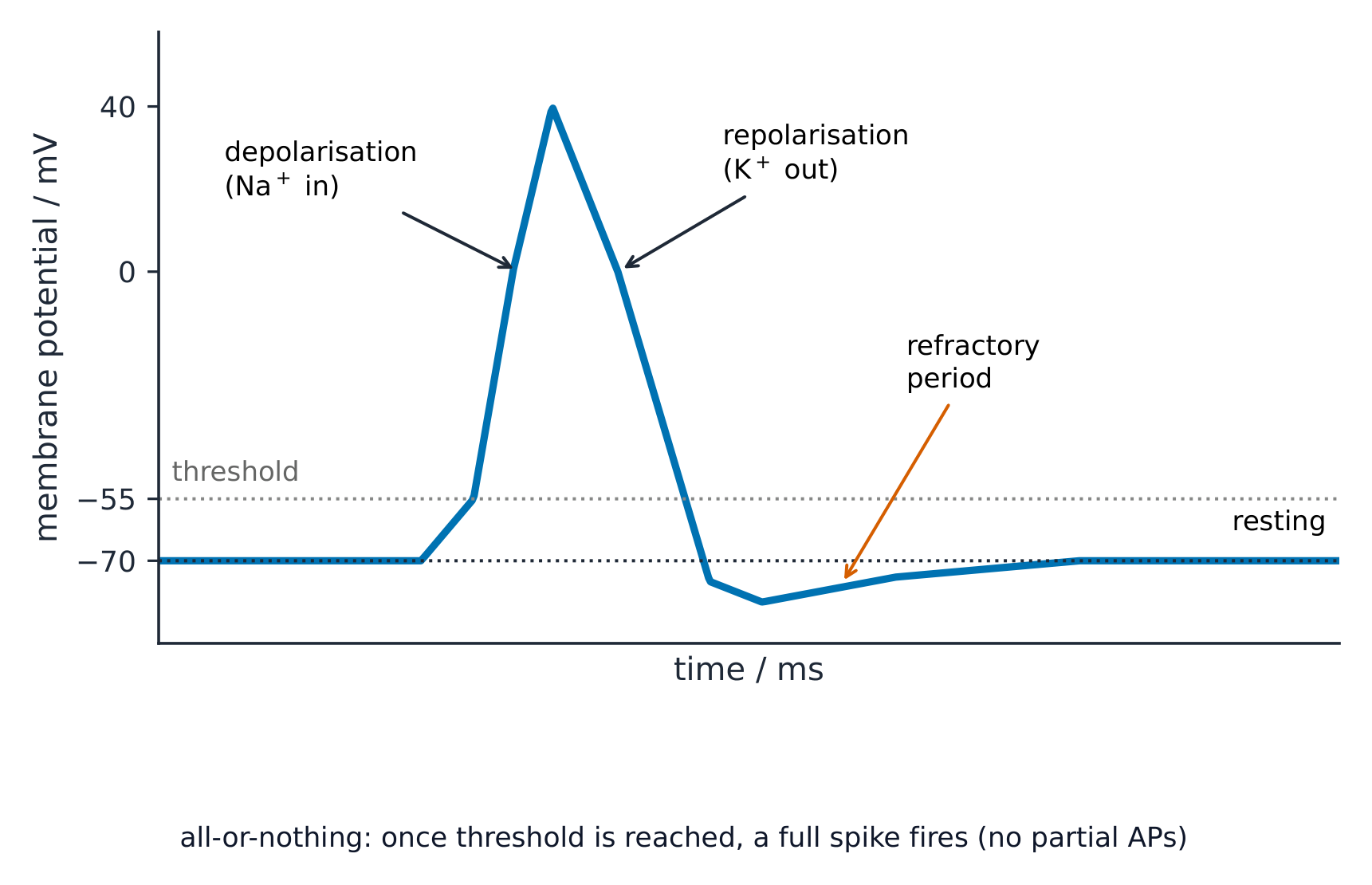
  • action potential — a stimulus makes sodium channels open, so sodium ions rush in and the inside briefly becomes positive (depolarisation). Then potassium channels open, potassium ions leave, and the membrane potential 膜电位 returns to negative (repolarisation).
  • refractory period 不应期 — just after an action potential, the sodium channels cannot open again for a short time. This restores the resting potential and sets a limit on how often impulses can be sent (their frequency).

Faster impulses: myelin

Some neurones are wrapped in a fatty myelin sheath 髓鞘. The impulse cannot cross the sheath, so it jumps from one gap to the next. This jumping, called saltatory conduction 跳跃式传导, makes the impulse travel much faster.

한국어

전극은 뉴론 막 전체의 전압 변화입니다.

  • 정지 전위 — 전극이 통과하지 않을 때, 내부가 외부에 비해 음전하입니다. 이는 나트륨 이온을 밖으로, 칼륨 이온을 안으로運搬하는 펌프 및 막이 칼륨에 대해 더 투과성이라는 사실에 의해 유지됩니다.
  • 작용 전위 — 자극이 나트륨 채널을 열면 나트륨 이온이 급격히 유입되어 내부가 잠시 양전하가 됩니다(분극화). 이후 칼륨 채널이 열려 칼륨 이온이 빠져나가고 막 전위가 다시 음전하로 돌아갑니다(재분극화).
  • 재현기(refractory period) — 활동전위 직후 나트륨 채널이 잠시 동안 다시 열리지 못합니다. 이로 인해 정지 전위가 회복되고 신호 전달 빈도(주파수)에 제한이 설정됩니다.

시간에 따른 막 전위의 그래프: -70 mV에서 정지 상태, 나트륨 유입으로 +40 mV까지 상승(분극화), 칼륨 유출로 감소(재분극화), 그리고 복귀 전 재현기 저하 *활동전위: 나트륨 유입은 분극화를, 칼륨 유출은 재분극화를 일으킵니다. 이후 재현기가 존재함

빠른 신호 전달: 미엘린

일부 신경세포는 지방성 **미엘린 피복(myelin sheath)으로 감싸여 있습니다. 신호가 이 피복을 건널 수 없으므로 한 간격에서 다음 간격으로 점프합니다. 이 점프 현상은 ** Saltatory conduction이라 불리며, 신호가 훨씬 빠르게 이동하게 합니다.

미엘린 피복이 있는 축삭: 신호가 랑비에 결절에서 다음 결절로 곡선형 점프를 하며 미엘린 피복 구간은 건너뜀 *신호는 결절에서 결절로 점프하며 — Saltatory conduction — 따라서 미yelinated 신경세포의 전달 속도가 훨씬 빠름

Explore · ⁨탐색하기⁩

The action potential · ⁨액션 포텐셜⁩

Step through one nerve impulse: a rapid depolarisation as Na⁺ enters, then repolarisation as K⁺ leaves, then recovery. · ⁨신경 신호 하나를 단계별로 진행합니다: Na⁺가 유입되면서 일어나는 빠른 탈분극, K⁺가 이탈하면서 이루어지는 재분극, 그리고 회복 단계를 거칩니다.⁩

Vocabulary · ⁨어휘⁩ Train · ⁨연습하기⁩
English 한국어
action potential/ˈækʃn pəˈtenʃl/ 작동 전위(액션 포텐셜)
refractory period/rɪˈfræktəri ˈpɪərɪəd/ 불응기
myelin sheath/ˈmaɪɪlɪn ʃiːθ/ 미yel인 피막
saltatory conduction/ˈsɒltətəri kənˈdʌkʃn/ 도약성 전도( Saltatory conduction)
15.1

The synapse · ⁨시냅스(synapse)⁩

English

A synapse 突触 is a tiny gap between two neurones. A cholinergic synapse 胆碱能突触 passes the signal like this:

  1. the impulse arrives and makes calcium ions 钙离子 enter the first neurone.
  2. this makes vesicles release a neurotransmitter 神经递质 called acetylcholine 乙酰胆碱.
  3. the acetylcholine diffuses across the gap and binds to receptors on the next neurone.
  4. this starts a new impulse in the next neurone.
한국어

시냅스는 두 신경세포 사이의 미세한 틈입니다. **아세틸콜린성 시냅스(cholinergic synapse)**는 다음과 같이 신호를 전달합니다:

  1. 임펄스가 도착하면 칼슘 이온이 첫 번째 신경세포로 진입하도록 유도함.
  2. 이는 **아세틸콜인(acetylcholine)**이라는 **신경전달물질(neurotransmitter)**을 방출하는 소포(vesicles)를 만듭니다.
  3. 아세틸콜인은 틈을 따라 확산하여 다음 신경세포의 수용체에 결합합니다.
  4. 이로 인해 다음 신경세포에서 새로운 신호가 시작됩니다.

시냅스: 도달한 신호가 칼슘 이온을 유입시키고, 소포가 시냅스 간극으로 아세틸콜인을 방출하며, 이는 다음 신경세포의 수용체에 결합하여 새로운 신호를 시작함 *시냅스에서 아세틸콜인은 간극을 따라 확산하여 수용체에 결합하고, 다음 신경세포에서 새로운 신호를 시작함

Explore · ⁨탐색하기⁩

Across a synapse · ⁨시냅스 너머로⁩

Step through it. The electrical impulse becomes a chemical one — neurotransmitter carries the signal across the gap. · ⁨단계별로 확인하십시오. 전기 신호가 화학 신호로 변합니다 — 신경전달 물질이 간극을 가로질러 신호를 전달합니다.⁩

Vocabulary · ⁨어휘⁩ Train · ⁨연습하기⁩
English 한국어
synapse/ˈsɪnæps/ 시냅스
cholinergic synapse/ˌkɒlɪˈnɜːdʒɪk ˈsɪnæps/ 콜린성 시냅스(cholinergic synapse)
calcium ion/ˈkælsɪəm ˈaɪɒn/ 칼슘 이온(calcium ion)
neurotransmitter/ˈnjuːrətrænsmɪtə/ 신경전달물질
acetylcholine/ˈæsɪtɪlkəliːn/ 아세틸콜린
15.1

Muscles and how they contract · ⁨근육과 수축 방식⁩

English

A neuromuscular junction 神经肌肉接头 is like a synapse, but between a motor neurone and a muscle.

Striated muscle 横纹肌 is made of long fibres. Each fibre is divided into repeating units called sarcomeres 肌节. Inside are two kinds of filament 肌丝: thick ones (myosin) and thin ones (actin). The T-tubule T小管 system carries the impulse deep into the fibre, and the sarcoplasmic reticulum 肌质网 stores and releases calcium ions.

The sliding filament model 肌丝滑动模型 explains contraction:

  1. an impulse causes the sarcoplasmic reticulum to release calcium ions.
  2. the calcium ions bind to troponin 肌钙蛋白, which makes tropomyosin 原肌球蛋白 move and uncover the binding sites on the actin.
  3. the myosin heads attach to the actin and pull it inwards, using energy from ATP.
  4. the thin filaments slide over the thick ones, so each sarcomere gets shorter and the muscle contracts.
한국어

**신근접합부(neuromuscular junction)**은 운동 신경세포와 근육 사이라는 점에서 시냅스와 유사합니다.

섬유성 근 striated muscle은 긴 섬유로 이루어져 있습니다. 각 섬유는 반복되는 단위인 **사르코메어(sarcomeres)**로 나뉩니다. 내부에는 두 종류의 **필라멘트(filament)**가 있으며, 굵은 ones(미오신 myosin)과 얇은 ones(액틴 actin)입니다. T-관 T-tubule 시스템은 신호를 섬유 깊숙이 전달하고, 삼키플라스마reticulum은 칼슘 이온을 저장하고 방출합니다.

근육의 전자 현미경 사진: 여러 평행 섬유 사이에 짙고 밝은 줄무늬가 규칙적으로 교차함 *'섬유성(striated)'라는 이름의 유래입니다. 각 반복되는 짙고 밝은 블록은 하나의 사르코메어이며, 띠들은 서로 다른 양으로 겹치는 굵고 얇은 필라멘트입니다. 근육이 수축할 때 필라멘트가 서로 밀려 지나가고 각 사르코메어는 짧아집니다

**슬라이딩 필라멘트 모델(sliding filament model)**은 수축을 설명합니다:

  1. 신호가 삼키플라스마reticulum에 칼슘 이온을 방출하게 합니다.
  2. 칼슘 이온이 **트로포닌(troponin)**에 결합하여 **트로포미오신(tropomyosin)**을 움직이고 액틴의 결합 부위를 드러냅니다.
  3. 미오신 헤드가 액틴에 부착되어 ATP의 에너지를 사용하여 안쪽으로 당깁니다.
  4. 얇은 필라멘트가 굵은 필라멘트 위를 밀려 지나가므로 각 사르코메어가 짧아지고 근육이 수축합니다.

이완된 사르코메어 위에 수축된 사르코메어: 수축된 쪽에서는 얇은 액틴과 굵은 미오신 필라멘트가 더 많이 겹치므로 Z-라인이 서로 더 가까움 *슬라이딩 필라멘트 모델: 얇은 액틴이 굵은 미오신 위를 밀려 지나가므로 사르코메어가 짧아짐

Explore · ⁨탐색하기⁩

How a muscle contracts · ⁨근육이 수축하는 방법⁩

Step through the sliding filament model — calcium uncovers the binding sites, then myosin pulls the actin inwards. · ⁨슬라이딩 필라멘트 모델을 단계별로 설명합니다 — 칼슘이 결합 부위를 드러내면, 미오신이 액틴을 안쪽으로 당깁니다.⁩

Vocabulary · ⁨어휘⁩ Train · ⁨연습하기⁩
English 한국어
muscle/ˈmʌsl/ 근육
intermediate neurone/ˌɪntəˈmiːdɪət ˈnjuːrəʊn/ 중간 신경원(intermediate neurone)
sensory receptor/ˈsensəri rɪˈseptə/ 감각 수용체(sensory receptor)
stimulus/ˈstɪmjʊləs/ 자극
chemoreceptor/ˌkiːməʊˈreseptə/ 화학 수용체(chemoreceptor)
taste bud/teɪst bʌd/ 미뢰(taste bud)
neuromuscular junction/ˌnjuːrəˈmʌskjʊlə ˈdʒʌŋkʃn/ 근육 신경 접합부(신경근접합부)
striated muscle/ˈstraɪeɪtɪd ˈmʌsl/ 줄무늬 근(골격근)
sarcomere/ˈsɑːkəmɪə/ 사르코메어
filament/ˈfɪləmənt/ 필라멘트
T-tubule/tiː ˈtjuːbjuːl/ T-관(T-tubule)
sarcoplasmic reticulum/ˌsɑːkəˈplæzmɪk reˈtɪkjʊləm/ 근질망(사르코플라즈마 망)
sliding filament model/ˈslaɪdɪŋ ˈfɪləmənt ˈmɒdl/ 슬라이딩 필라멘트 모델
troponin/ˈtrɒpənɪn/ 트로포닌
tropomyosin/ˈtrɒpəmɪɒsɪn/ 트로포미오신
15.2

Control and coordination in plants · ⁨식물에서의 조절 및 조율⁩

Syllabus
English
  1. describe the rapid response of the Venus fly trap to stimulation of hairs on the lobes of modified leaves and explain how the closure of the trap is achieved
  2. explain the role of auxin in elongation growth by stimulating proton pumping to acidify cell walls
  3. describe the role of gibberellin in the germination of barley (see 16.3.4)
한국어
  1. 변형된 잎의 엽연에 있는 모발이 자극받을 때 날벌레의 빠른 반응을 서술하고, 함Trap이 닫히는 메커니즘을 설명하시오
  2. 옥신이 프로톤 펌핑을 자극하여 세포벽을 산성화함으로써 신장 성장에 미치는 역할을 설명하시오
  3. 보리의 발아 과정에서 지베렐린의 역할을 서술하시오 (16.3.4 참조)

Source: Cambridge International syllabus · ⁨출처: Cambridge International syllabus⁩

English

The Venus fly trap

The Venus fly trap 捕蝇草 has tiny hairs on its trap-like leaves. When an insect touches the hairs, a fast electrical signal spreads, the cells quickly lose water and change shape, and the trap snaps shut to catch the insect.

Auxin and growth

Auxin 生长素 is a plant hormone that makes cells grow longer (elongation 伸长 growth). It does this by making the cell pump protons 质子 (hydrogen ions) into the cell wall 细胞壁. This acidifies 酸化 the wall, which loosens it, so the cell can stretch as water enters.

Gibberellin and germination

Gibberellin 赤霉素 controls the germination 萌发 of barley 大麦 seeds. It switches on the genes that make amylase, which then breaks down stored starch into sugars to feed the growing seedling.

Worked example. Explain why a nerve impulse crosses a synapse in one direction only, and why myelination speeds it up along an axon. At a synapse the vesicles of neurotransmitter are found only in the presynaptic neurone, and the receptors only on the postsynaptic membrane - so transmitter can only ever cross one way, which makes the synapse a one-way valve. Along a myelinated axon the myelin sheath insulates the membrane, so ions can only cross at the nodes of Ranvier; the impulse therefore jumps from node to node (saltatory conduction) instead of depolarising every part of the membrane in turn, which is far faster and uses less ATP. Locate the structure responsible for each effect: vesicles and receptors give the direction, insulation and nodes give the speed.

한국어

베너스 플라이트랩(Venus fly trap)

베너스 플라이트랩은 함정 모양 잎에 미세한 털이 있습니다. 곤충이 이 털에 닿으면 빠른 전기 신호가 퍼지고, 세포들이 빠르게 물을 잃으며 형태를 바꾸고, 함정이 곤충을 잡으려면 단단히 닫힙니다.

열린 베너스 플라이트랩: 긴 가시가 달린 가장자리와 함께 두 개의 붉은 엽이 있으며, 붉은 표면에서 여러 개의 작은 단단한 털이 서 있음 *열린 함정. 가장자리 주변의 긴 가시는 곤충을 가두기 위한 것일 뿐입니다. 붉은 표면에 서 있는 몇 개의 짧은 단단한 자극 털(trigger hairs)이触碰되어야만 신호가 발동됨

옥신(Auxin)과 성장

옥신은 세포를 길게 자라게 하는(신장 growth) 식물 호르몬입니다. 이는 세포가 **양성자(protons, 수소 이온)**를 **세포벽(cell wall)**으로 펌핑하게 하여 이를 산성화 acidifies함으로써 작용합니다. 이로 인해 벽이 느슨해져 물이 들어오면서 세포가 늘어날 수 있습니다.

짧은 식물 세포가 수소 이온을 벽으로 펌핑하고, 느슨해진 벽이 물 유입 시 신장을 허용하여 더 긴 세포가 된 후의 모습 *옥신의 '산성 성장': H⁺가 벽으로 펌핑되어 벽이 느슨해지고, 물이 유입되면서 세포가 더 길게 늘어나임

지베렐린(Gibberellin)과 발아

지베렐린은 보리 barley 종자의 발아 germination을 조절합니다. 아밀라아제(amylase)를 만드는 유전자를 켜고, 이 효소가 저장된 전분을 당으로 분해하여 자라고 있는 싹에 영양을 공급합니다.

작은 문제 풀이 예시. 신경 신호가 시냅스를 단방향 only으로 건넬 수 있는 이유와, 미yelination이 축삭을 따라 신호를 빠르게 하는 이유를 설명하시오. 시냅스에서神经전달물질의 **소포(vesicles)**는 전시냅스 presynaptic 신경세포에만 있고, **수용체(receptors)**는 후시냅스 postsynaptic 막에만 있으므로, 신경전달물질은 항상 한 방향으로만 건널 수 있어 시냅스는 일방통로와 같습니다. 미yelinated 축삭에서 미yel린 피복은 막을 절연 insulates하므로, 이온은 **랑비에 결절(nodes of Ranvier)**에서만 막을 건널 수 있습니다. 따라서 신호는 막의 모든 부분을 순차적으로 분극시키는 대신 결절에서 결절로 점프하며(saltatory conduction), 이는 훨씬 빠르고 ATP 사용량을 줄입니다. 각 효과에 관여하는 **구조(structure)**를 식별하시오: 소포와 수용체는 방향을, 절연과 결절은 속도를 담당함.

Explore · ⁨탐색하기⁩

Phototropism: bending to the light · ⁨광유성: 빛 쪽으로 구부러짐⁩

Step through it. Auxin gathers on the shaded side, makes those cells grow longer, and the shoot bends towards the light. · ⁨단계별로 설명합니다. 옥신이 음영 쪽에 모여, 해당 세포들이 더 길게 자라게 하고, 줄기가 빛 방향으로 구부러집니다.⁩

Vocabulary · ⁨어휘⁩ Train · ⁨연습하기⁩
English 한국어
Venus fly trap/ˈviːnəs flaɪ træp/ 바늘박쥐
auxin/ˈɔːksɪn/ 옥신
elongation/iːˌlɒnˈɡeɪʃn/ 연장(엘롱게이션)
proton/ˈprəʊtɒn/ proton
cell wall/sel wɔːl/ 세포벽
acidify/əˈsɪdɪfaɪ/ 산성화하다(acidify)
gibberellin/ˌdʒɪbəˈrelɪn/ gibberellin
germination/ˌdʒɜːmɪˈneɪʃn/ 발아(발아)
barley/ˈbɑːli/ 보리(barley)
15.2

Exam tips · ⁨시험 팁⁩

English
  • Explain the resting potential (Na+/K+ pump; more negative inside) then the action potential (depolarisation → repolarisation) as all-or-nothing.
  • Saltatory conduction (myelin, nodes of Ranvier) speeds the impulse; the refractory period makes it one-way and discrete.
  • Describe the synapse in order: Ca2+ enters → vesicles fuse → neurotransmitter → receptors → new impulse.
  • Muscle contraction follows the sliding-filament model (actin, myosin, ATP, Ca2+).
한국어
  • 정지 전위(resting potential) (Na+/K+ 펌프; 내부가 더 음전하)와 활동전위(action potential) (분극화 → 재분극화)가 모두-무-all-or-nothing임을 설명하시오
  • ** Saltatory 전도** (미엘린, 랑비에 결절)은 신호 전달 속도를 높이며, 불응기는 이를 단방향으로 만들고 이산적으로 만든다.
  • ** 시냅스**를 다음 순서로 설명한다: Ca2+ 유입 → 소포 융합 → 신경전달물질 → 수용체 → 새로운 신호 발생.
  • 근수축은 슬라이딩 필라멘트 모델(アク틴, 마이오신, ATP, Ca2+)을 따른다.
Vocabulary · ⁨어휘⁩ Train · ⁨연습하기⁩
English 한국어
resting potential/ˈrestɪŋ pəˈtenʃl/ 정전 전위
membrane potential/ˈmembreɪn pəˈtenʃl/ 막 전위(membrane potential)

Interactive lessons on this topic · ⁨이 주제에 대한 인터랙티브 수업⁩

Work through it step by step, with instant-check exercises. · ⁨즉시 체크 기능 exercises를 통해 단계별로 진행하세요.⁩

Past Papers · ⁨과거 시험지⁩

More topics in A-Level Biology · ⁨A-Level 생물학⁩ · ⁨A-Level Biology · ⁨A-Level 생물학⁩ 내 추가 주제⁩

Log in or create account · ⁨로그인 또는 계정 만들기⁩

IGCSE, A-Level & AP