The nerve impulse
Introduced| English | Meaning |
|---|---|
| resting potential/ˈrestɪŋ pəˈtenʃl/ | The steady negative voltage, about -70 mV, across the membrane of a resting neurone. |
| action potential/ˈækʃn pəˈtenʃl/ | The rapid rise and fall of membrane voltage that carries a signal along a neurone. |
| depolarisation/diːˌpəʊləraɪˈzeɪʃn/ | depolarisation |
| repolarisation/rɪˌpəʊləraɪˈzeɪʃn/ | repolarisation |
| refractory period/rɪˈfræktəri ˈpɪərɪəd/ | The brief interval after an action potential during which the neurone cannot fire again. |
| myelin sheath/ˈmaɪɪlɪn ʃiːθ/ | An insulating layer around many axons that increases the speed of nerve impulse transmission. |
| saltatory conduction/ˈsɒltətəri kənˈdʌkʃn/ | Propagation of an impulse along a myelinated axon by regenerating action potentials at successive nodes of Ranvier. |
A wave of electricity
- An impulse is a change in the voltage across the neurone's membrane.
- At rest the inside is negative; an impulse flips it briefly positive.
- A fatty sheath can make it travel far faster.
The brief reversal of charge across a neurone membrane is an action ______.
Difficulty 1/5 · 100 coins + a small bonus on first completion today
It travels along the axon as the nerve impulse.
The resting potential 静息电位
- When no impulse passes, the inside is negative compared with the outside — the resting potential.
- It is kept this way by a pump that moves sodium out and potassium in, and by the membrane being more permeable to potassium.
The nerve impulse
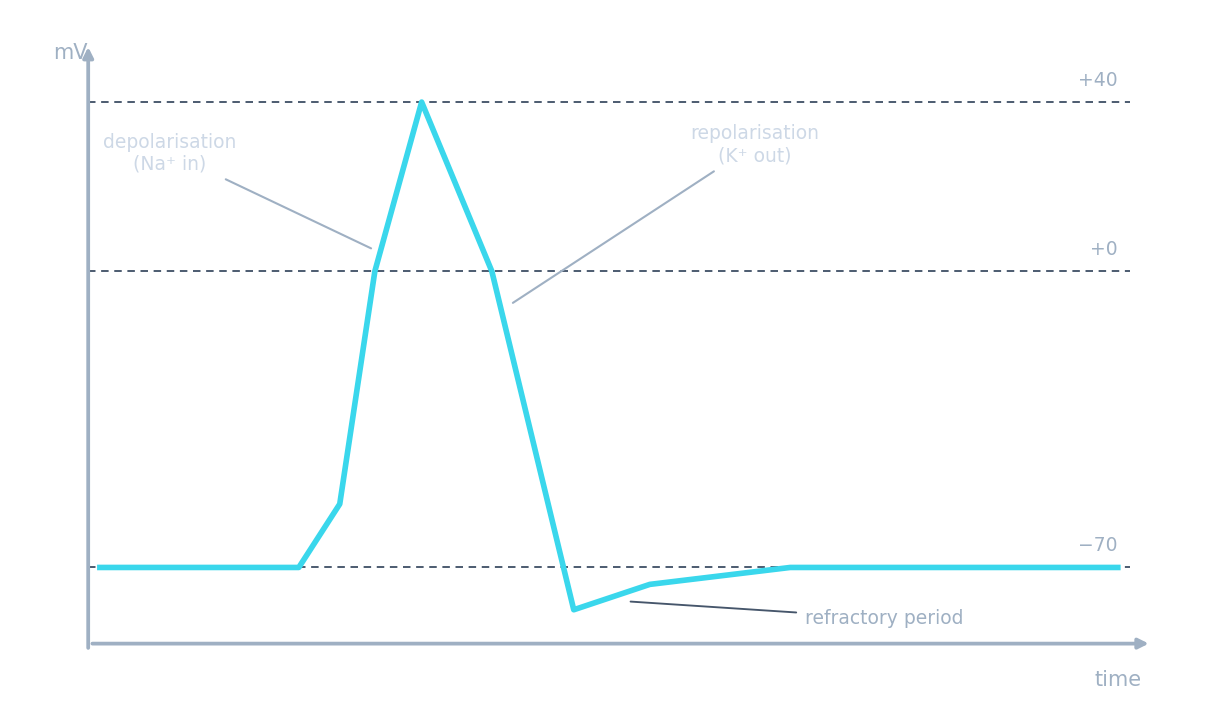
resting −70 → spike +40 mV
Scrub the spike: Na⁺ floods in to depolarise, then K⁺ leaves to repolarise.
At the resting potential, the inside of the neurone is:
Difficulty 1/5 · 100 coins + a small bonus on first completion today
The resting potential keeps the inside negative, maintained by the Na⁺/K⁺ pump and K⁺ permeability.
The action potential 动作电位
- A stimulus opens sodium channels → Na⁺ rushes in → inside briefly positive (depolarisation 去极化).
- Then potassium channels open → K⁺ leaves → the membrane returns to negative (repolarisation 复极化).
- A short refractory period 不应期 follows: sodium channels can't reopen, restoring rest and limiting how often impulses fire.
Depolarisation during an action potential is caused by:
Difficulty 1/5 · 100 coins + a small bonus on first completion today
Sodium channels open and Na⁺ floods in, reversing the charge (depolarisation); then K⁺ leaves to repolarise.
Put the action potential in order.
Difficulty 3/5 · 200 coins + a small bonus on first completion today
Rest → Na⁺ in (depolarise) → K⁺ out (repolarise) → reset. The spike is brief and all-or-nothing.
Match each phase to what is happening.
Difficulty 2/5 · 140 coins + a small bonus on first completion today
Na⁺ in flips the charge; K⁺ out restores it; the refractory period stops a backward impulse.
The refractory period resets the neurone and limits how often impulses can fire.
Difficulty 1/5 · 100 coins + a small bonus on first completion today
Sodium channels cannot reopen for a moment, so the neurone resets and impulses stay separate and one-way.
Faster: myelin
- Some axons are wrapped in a fatty myelin sheath 髓鞘 that the impulse cannot cross.
- So the impulse jumps from one gap (node) to the next — saltatory conduction 跳跃式传导 — travelling much faster.

Saltatory conduction: the impulse jumps between the gaps in the myelin
Saltatory conduction makes impulses faster because the impulse:
Difficulty 1/5 · 100 coins + a small bonus on first completion today
The impulse cannot cross the myelin, so it jumps node to node — much faster than along a bare axon.
You've got it
- resting potential: inside negative (Na⁺ pumped out, K⁺ in; membrane leaks K⁺)
- action potential: Na⁺ in → depolarisation (+); K⁺ out → repolarisation (−)
- refractory period: Na⁺ channels can't reopen → limits impulse frequency
- myelin → saltatory conduction (jumps node to node) → much faster