Skip to content · ⁨コンテンツへスキップ⁩

Enzymes · ⁨酵素⁩

IGCSE Biology · ⁨IGCSE 生物⁩ · Topic 5 · ⁨トピック 5⁩

View Slides · ⁨查看幻灯片⁩ Train · ⁨練習する⁩
Video lesson for this topic · ⁨このトピックのビデオレッスン⁩ Open the video page · ⁨動画ページを開く⁩
5:54

酵素

一秒間に千以上の化学反応が体内で進行しています。放任すれば、ほとんどは生存を維持するにはあまりにも遅すぎます。しかし…

English narration · English + 中文 subtitles burned in · ⁨英語ナレーション・英語+中文字幕 burning-in⁩

5.1

What enzymes are · ⁨エンザイムとは何か⁩

Syllabus · ⁨シラバス⁩
English
Core Supplement
1 Describe a catalyst as a substance that increases the rate of a chemical reaction and is not changed by the reaction
2 Describe enzymes as proteins that are involved in all metabolic reactions, where they function as biological catalysts
3 Describe why enzymes are important in all living organisms in terms of a reaction rate necessary to sustain life
4 Describe enzyme action with reference to the shape of the active site of an enzyme being complementary to its substrate and the formation of products 6 Explain enzyme action with reference to: active site, enzyme-substrate complex, substrate and product
7 Explain the specificity of enzymes in terms of the complementary shape and fit of the active site with the substrate
5 Investigate and describe the effect of changes in temperature and pH on enzyme activity with reference to optimum temperature and denaturation 8 Explain the effect of changes in temperature on enzyme activity in terms of kinetic energy, shape and fit, frequency of effective collisions and denaturation
9 Explain the effect of changes in pH on enzyme activity in terms of shape and fit and denaturation
日本語
コア サプリメント
1 触媒が化学反応の速度を増加させ、反応自体では変化しない物質であることを記述する
2 酵素を、すべての代謝反応に関与し、生物学的触媒として機能するタンパク質として記述する
3 生命を維持するために必要な反応速度という観点から、なぜ酵素がすべての生物にとって重要かを説明する
4 エンザムの活性部位の形状が基質と相補的であること、および生成物の形成に言及して酵素作用を説明する 6 活性部位、酵素-基質複合体、基質、生成物に言及して酵素作用を説明する
7 活性部位と基質との相補的な形状と適合性について、酵素の特異性を説明する
5 最適温度および変性について言及し、温度およびpHの変化が酵素活性に与える影響を検証・記述する 8 運動エネルギー、形状と適合性、有効衝突の頻度、および変性に言及して、温度の変化が酵素活性に与える影響を説明する
9 形状と適合性、および変性に言及して、pHの変化が酵素活性に与える影響を説明する

Source: Cambridge International syllabus · ⁨出典: Cambridge International シラバス⁩

English
Enzyme action: lock and key

A catalyst 催化剂 is a substance that speeds up the rate 速率 of a chemical reaction 化学反应 but is not used up or changed by the reaction. The same catalyst can be used again and again.

Enzymes 酶 are biological catalysts — catalysts made by living cells. They are proteins 蛋白质. Enzymes take part in all the reactions of metabolism 新陈代谢, so they control almost every chemical reaction in a living thing.

Enzymes are vital. Without them, the reactions that keep you alive would be far too slow. Enzymes raise the reaction rate enough to keep the organism alive.

日本語
エンザイムの作用:ロック・アンド・キー
生物学的洗剤の箱
生物学的洗剤には、汚れを分解する酵素が含まれている。

触媒とは、化学反応の速度を速める物質であり、反応によって消費されたり変化したりすることはない。同じ触媒を繰り返し使用できる。

酵素は生物学的触媒であり、生体細胞によって作られた触媒である。酵素はタンパク質である。酵素は代謝におけるあらゆる反応に関与するため、生体内のほぼすべての化学反応を制御している。

酵素は不可欠である。酵素がなければ、生命を維持するための反応は非常に遅くなりすぎる。酵素は反応速度を十分高めて、生物体を生存させることができる。

Explore · ⁨探索⁩

What enzymes do · ⁨酵素の働き⁩

rate rises then plateaus · ⁨反応速度は上昇してからは一定となる⁩

More substrate means a faster reaction — until the enzymes can't keep up. · ⁨基質が増えると反応速度が速くなるが、酵素が追いつかなくなるまでである。⁩

5.1

How an enzyme works · ⁨酵素の働き方⁩

English

Each enzyme has a special pocket called its active site 活性位点. The molecule 分子 it works on is called the substrate 底物.

  • The shape of the active site is complementary 互补 to the shape of the substrate — they fit together like a key in a lock.
  • The substrate slots into the active site. (Supplement) This makes an enzyme-substrate complex 酶底物复合物.
  • The reaction takes place, and the substrate is changed into one or more products 产物.
  • The products leave the active site, which is then free to be used again.

Why enzymes are specific (Supplement)

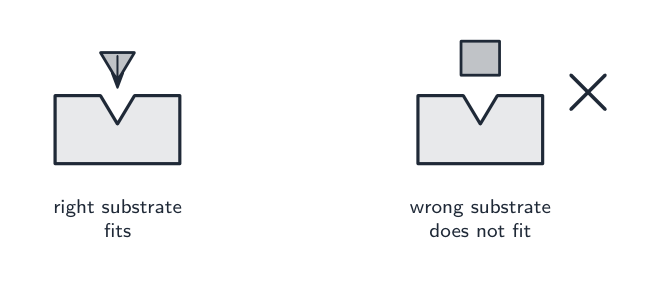
Each enzyme is specific 专一 — it works on only one kind of substrate. This is because only that substrate has the right shape to fit the active site. A substrate of a different shape will not fit, just as the wrong key will not open a lock.

日本語
キウイフルーツの断面画像
キウイフルーツにはタンパク質を分解するプロテアーゼ酵素が含まれている。

各酵素には、活性部位と呼ばれる特別なポケットがある。酵素が作用する対象となる分子は基質と呼ばれる。

  • 活性部位の形状は基質の形状と相補的であり、鍵と錠前のようにぴったりと嵌まる。
  • 基質が活性部位に嵌まる。(追加事項)これにより酵素-基質複合体が形成される。
  • 反応が起こり、基質は1つ以上の生成物に変換される。
  • 生成物が活性部位から離れると、酵素は再び利用可能な状態になる。
 notch形状の活性部位を持つ酵素:対応する基質が嵌まって酵素-基質複合体を形成し、その後2つの生成物の破片として離脱することで酵素が解放される様子
基質が鍵のように活性部位に嵌まり、生成物として離れます

酵素の特異性(追加事項)

各酵素は特異的であり、特定の1種類の基質のみを作用させる。これは、その基質だけが活性部位に合う適切な形状を持っているからである。異なる形状の基質は嵌まらず、鍵が合っていないように錠前を開けない的一样である。

1つの酵素:正しい形状の基質は活性部位に合うが、誤った形状の基質は合わない様子の図
一致する基質のみ活性部位に適合します
Vocabulary · ⁨語彙⁩ Train · ⁨練習する⁩
English 日本語
catalyst/ˈkætəlɪst/ 触媒
rate/reɪt/ 速度
chemical reaction/ˈkemɪkl rɪˈækʃn/ 化学反応
enzymes/ˈenzaɪmz/ 酵素
proteins/ˈprəʊtiːnz/ タンパク質
metabolism/məˈtæbəlɪzəm/ 代謝
active site/ˈæktɪv saɪt/ active site(活性部位)
molecule/ˈmɒlɪkjuːl/ 分子
substrate/ˈsʌbstreɪt/ substrate(基質)
complementary/ˌkɒmplɪˈmentəri/ 補色
enzyme-substrate complex/ˈenzaɪm ˈsʌbstreɪt ˈkɒmpleks/ 酵素-基質複合体
products/ˈprɒdʌkts/ 生成物
specific/spəˈsɪfɪk/ 特定の
5.1

The effect of temperature and pH · ⁨温度およびpHの影響⁩

English

The activity of an enzyme depends on temperature 温度 and pH. You can investigate this by measuring how fast the reaction goes at different temperatures or pH values.

Temperature

  • As the temperature rises from cold, enzyme activity speeds up. The enzyme and substrate molecules have more kinetic energy 动能, so they move faster and meet more often. (Supplement) There are more useful collisions 碰撞 each second.
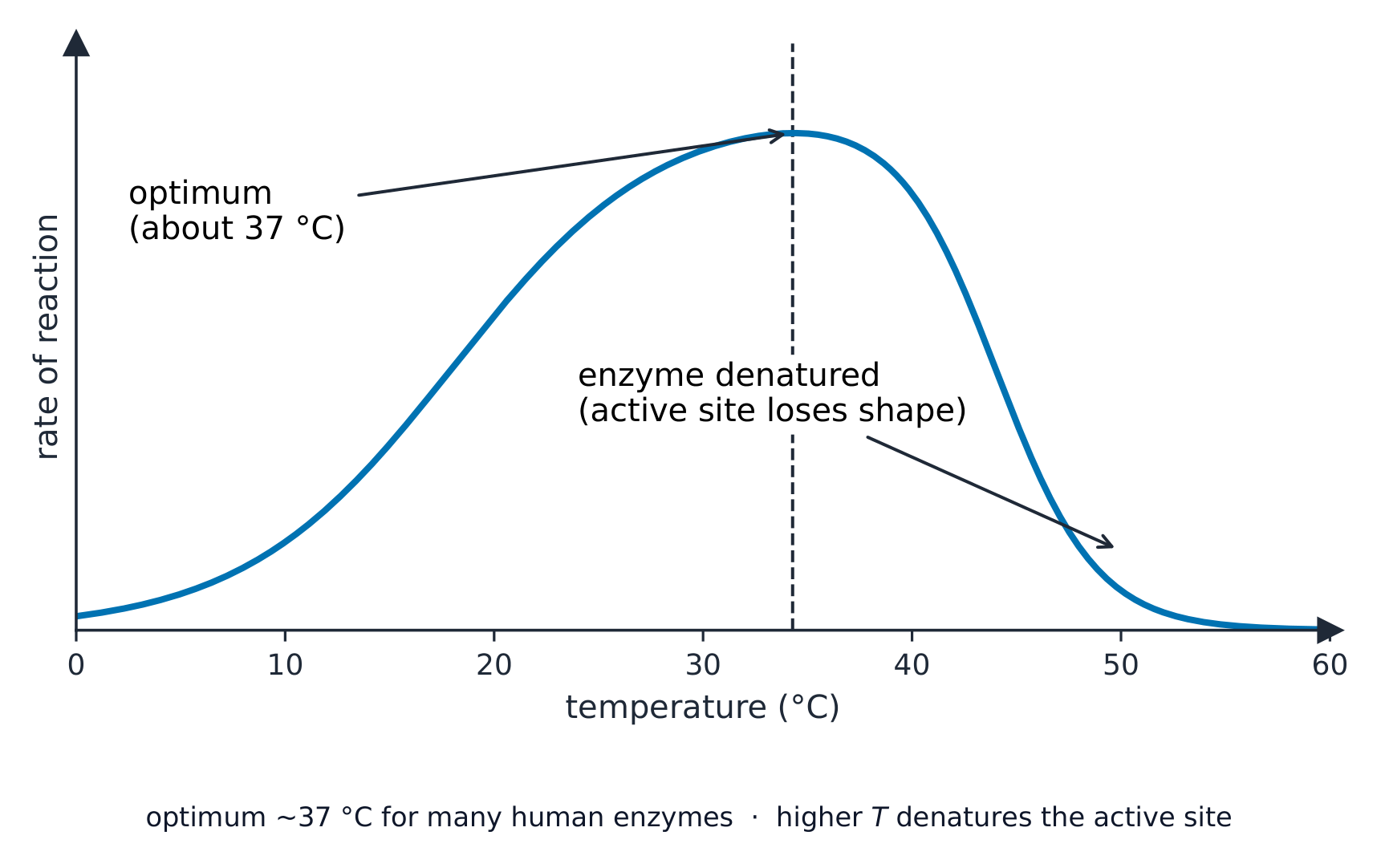
  • Activity is highest at the optimum temperature 最适温度 (about 37 °C in the human body).
  • Above the optimum, activity falls fast. The heat changes the shape of the active site, so the substrate no longer fits. The enzyme is denatured 变性. Denaturation is permanent — the enzyme cannot recover.

Worked example. A reaction finishes in 50 s at 20 °C, and in 20 s at 37 °C. Which temperature is faster, and by how much? A shorter time means a faster rate, so work out a rate with rate = 1000 ÷ time. At 20 °C the rate is 1000 ÷ 50 = 20 units; at 37 °C it is 1000 ÷ 20 = 50 units. So 37 °C is 50 ÷ 20 = 2.5 times faster. Do not say the rate "went up by 30 s" - a time is not a rate. Turn the time into a rate first, and remember the bigger rate always goes with the smaller time.

pH

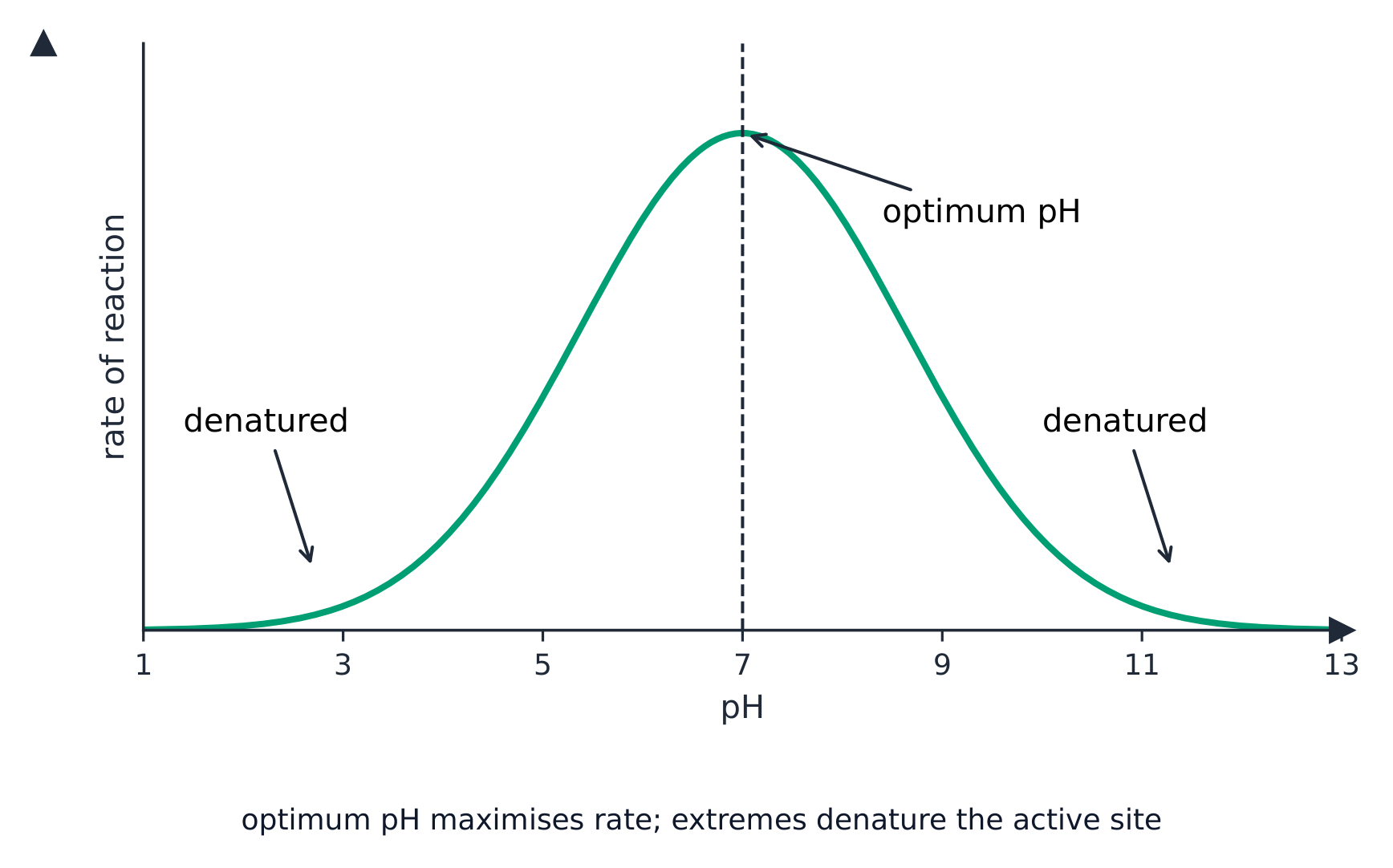
  • Each enzyme works best at one particular pH.
  • If the pH is too high or too low, the shape of the active site changes, the substrate stops fitting, and the enzyme is denatured.
日本語

酵素の活性は温度とpHに依存します。異なる温度やpH値における反応速度を測定することで、これを調べることができます。

温度

  • 温度が寒さから上昇すると、酵素活性が速くなる。酵素分子と基質分子はより多くの運動エネルギーを持つため、素早く動き、より頻繁に出会う。(補足)毎秒、より有用な衝突が生じる。
  • 最適温度(人体では約37°C)において活性が最大になります。
  • 最適温度を超えると、活性は急速に低下します。熱によって活性部位の形状が変わり、基質が fit しなくなります。酵素は変性します。変性は不可逆であり、酵素は回復できません。
反応速度対温度のプロット:速度は約37度でピークに達し、その後酵素の変性により急激に低下する
活性は最適温度でピークに達し、その後酵素の変性に伴い急激に低下する

** worked example.** 反応が50 sで20 °C、20 sで37 °Cで完了する場合、どちらの温度の方が速いか、そしてどれだけ速いかを答えよ。短い時間ほど速い速度であるため、速度 = 1000 ÷時間で計算する。20 °Cでは速度は1000 ÷ 50 = 20 単位、37 °Cでは1000 ÷ 20 = 50 単位となる。したがって、37 °Cは50 ÷ 20 = 2.5 倍速い。速度が「30 sだけ上がった」と言うのは誤りであり、時間は速度ではない。まずは時間を速度に変換し、より大きい速度は常により短い時間に対応することを remembering せよ。

pH

  • 各酵素は特定のpH値で最も良く機能します。
  • pHが過度に高いか低いと、活性部位の形状が変わり、基質が fit しなくなり、酵素は変性します。
反応速度対pHのプロット:最適pHでピークを迎え、酵素の変性により両側で低下する鐘型曲線
各酵素には唯一の最適pHがあり、そこから大きく外れると酵素は変性します
Explore · ⁨探索⁩

Temperature and enzyme activity · ⁨温度と酵素活性⁩

Drag the temperature. Activity rises to an optimum, then falls as the enzyme denatures. · ⁨温度をドラッグせよ。活性は最適温度まで上昇し、酵素が変性すると低下する。⁩

Vocabulary · ⁨語彙⁩ Train · ⁨練習する⁩
English 日本語
temperature/ˈtemprɪtʃə/ 温度
kinetic energy/kɪˈnetɪk ˈenədʒi/ 運動エネルギー
collisions/kəˈlɪʒnz/ 衝突
optimum temperature/ˈɒptɪməm ˈtemprɪtʃə/ 最適温度
denatured/ˈdenətʃəd/ 変性した
5.1

Exam tips · ⁨試験対策⁩

English
  • An enzyme is both a protein and a biological catalyst: it speeds up a reaction and is not used up.
  • Describe the shape: the active site is complementary to the substrate (the lock-and-key idea). Each enzyme is specific to one substrate.
  • Low temperature → slow (too little kinetic energy). Optimum → fastest. Too hot → denatured (the active site loses its shape, permanently).
  • The wrong pH also denatures the enzyme by changing the shape of the active site.
  • "Denatured" does not mean "killed" — enzymes are not alive. Say that the shape of the active site has changed so the substrate no longer fits.
日本語
  • 酵素はタンパク質であり、かつ生体触媒です。反応を加速しますが、消費されません。
  • 形状を説明する:活性部位は基質に対して相補的です(鍵と錠前モデル)。各酵素は1つの基質に対して特異的です。
  • 低温 → 遅い(運動エネルギーが不足している)。最適温度 → 最速。高温すぎ → 変性(活性部位の形状を失い、永久的になる)。
  • 不適切なpHも活性部位の形状を変化させることで酵素を変性させます。
  • 「変性」は「死んだ」ことを意味しません。酵素は生き物ではありません。活性部位の形状が変わって基質がfitしなくなったと述べてください。

Interactive lessons on this topic · ⁨このトピックのインタラクティブ授業⁩

Work through it step by step, with instant-check exercises. · ⁨一歩ずつ進め、即時チェック付きの問題で学習します。⁩

Past Papers · ⁨過去問⁩

More topics in IGCSE Biology · ⁨IGCSE 生物⁩ · ⁨IGCSE Biology · ⁨IGCSE 生物⁩ の他のトピック⁩

Log in or create account · ⁨ログインまたはアカウント作成⁩

IGCSE, A-Level & AP