What enzymes are
Introduced| English | Meaning |
|---|---|
| enzymes/ˈenzaɪmz/ | Biological catalysts that increase reaction rates without being used up overall. |
| catalysts/ˈkætəlɪsts/ | A substance that increases a reaction rate without being used up overall. |
| substrate/ˈsʌbstreɪt/ | A substance on which an enzyme acts. |
| active site/ˈæktɪv saɪt/ | The region of an enzyme where a substrate binds and the reaction is catalysed. |
| specific/spəˈsɪfɪk/ | Acting on or binding to a particular target or type, rather than a wide range of alternatives. |
| products/ˈprɒdʌkts/ | The substances formed by a chemical reaction. |
The body's tiny machines
- Your body runs thousands of chemical reactions every second — far faster than they'd happen on their own.
- The secret is enzymes 酶: biological catalysts 催化剂 that speed reactions up.
An enzyme is a biological catalyst, which means it:
Difficulty 1/5 · 100 coins + a small bonus on first completion today
Catalysts speed up reactions and are reusable.
Enzymes are made of:
Difficulty 1/5 · 100 coins + a small bonus on first completion today
Enzymes are proteins.
What enzymes are
- An enzyme is a protein that speeds up a reaction without being used up.
- It is a biological catalyst — it can be used again and again.
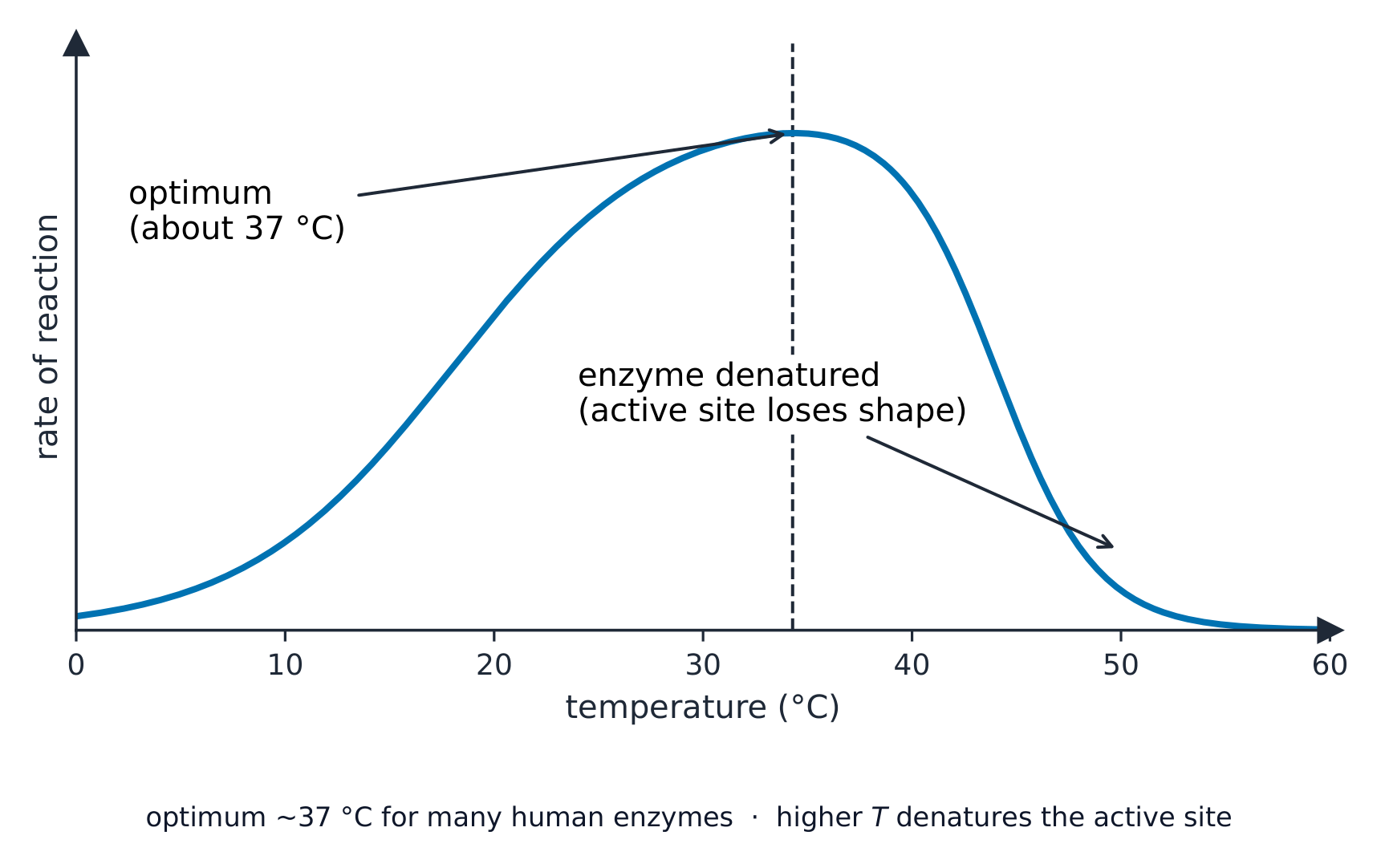
Enzyme activity peaks at the optimum temperature, then falls as the enzyme denatures
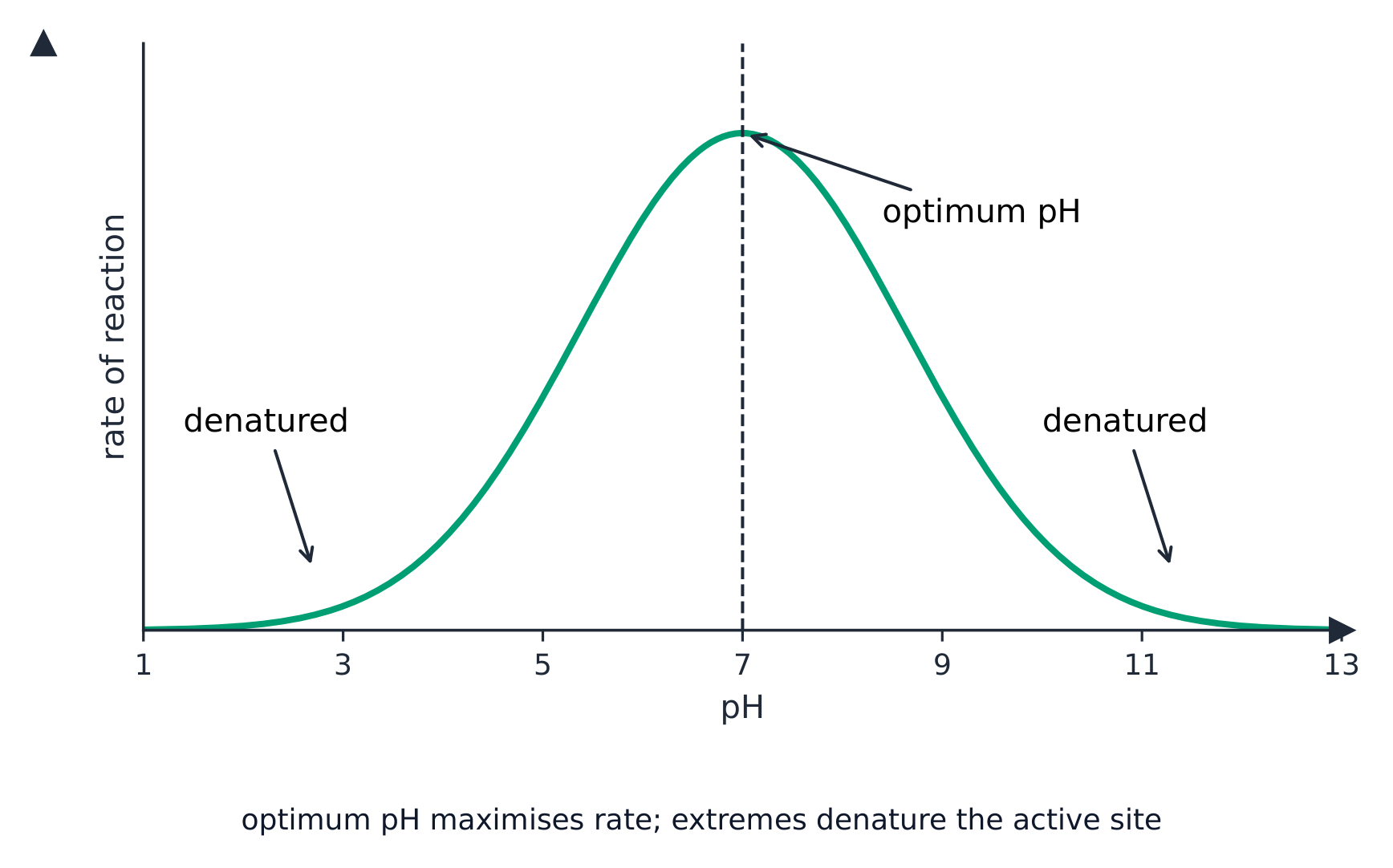
Each enzyme has one optimum pH; far from it the enzyme is denatured
What enzymes do
rate rises then plateaus
More substrate means a faster reaction — until the enzymes can't keep up.
The part of an enzyme where the substrate binds is the:
Difficulty 1/5 · 100 coins + a small bonus on first completion today
The substrate fits into the active site.
The model where only a matching substrate fits an enzyme is the ______-and-key model.
Difficulty 1/5 · 100 coins + a small bonus on first completion today
Lock-and-key explains enzyme specificity.
The lock and key
- Each enzyme has a specific 专一 shape with an active site 活性位点.
- Only a matching substrate 底物 fits the active site — like a key in a lock. This makes enzymes specific.

Biological washing powders contain enzymes that break down stains
Each enzyme is specific to one type of substrate.
Difficulty 1/5 · 100 coins + a small bonus on first completion today
Only a matching substrate fits the active site.
How they work
- The substrate binds to the active site, the reaction happens, and the products 产物 are released.
- The enzyme is unchanged and ready for the next substrate.
Enzymes are specific. One enzyme works on one type of substrate, because only that substrate fits its active site. The wrong substrate simply won't fit.

Kiwi fruit contains a protease enzyme that breaks down protein
You've got it
- an enzyme is a protein that acts as a biological catalyst (not used up)
- each has an active site that fits one substrate — the lock-and-key model
- this makes enzymes specific to their substrate