Skip to content · ⁨コンテンツへスキップ⁩

Collecting Data · ⁨データ収集⁩

AP Statistics · Topic 3 · ⁨トピック 3⁩

View Slides · ⁨查看幻灯片⁩ Train · ⁨練習する⁩
Video lesson for this topic · ⁨このトピックのビデオレッスン⁩ Open the video page · ⁨動画ページを開く⁩
7:31

データ収集

オンライン調査で三万人の回答を集めます。慎重なアンケートでは千人だけを尋ねます。どちらが真実に近いでしょうか。小さい方、ほぼ every…

English narration · English + 中文 subtitles burned in · ⁨英語ナレーション・英語+中文字幕 burning-in⁩

3.1

Can We Trust the Data We Collected? · ⁨収集したデータを信頼できるか?⁩

Syllabus · ⁨シラバス⁩
English

Enduring Understanding (VAR-1): Given that variation may be random or not, conclusions are uncertain.

Learning Objective VAR-1.E: Identify questions to be answered about data collection methods. [Skill 1.A]

  • VAR-1.E.1 Methods for data collection that do not rely on chance result in untrustworthy conclusions.
日本語

長期的理解(VAR-1): ばらつきがランダムである場合でもそうでない場合でも、結論には不確実性が伴う。

学習目標 VAR-1.E: データ収集方法に関する解答すべき質問を同定する。[スキル 1.A]

  • VAR-1.E.1 偶然性に依存しないデータ収集方法では、信頼できない結論が導かれる。
Source: College Board AP Course and Exam Description · ⁨出典: College Board AP コースおよび試験説明書⁩

English

A conclusion is only as good as the data behind it. How data are collected decides what you may conclude – whether you can generalize to a population 总体, and whether you can claim cause and effect. Poorly collected data can be worse than none.

日本語

結論は、それを裏付けるデータの品質と同じくらいです。データ収集方法が何 conclusiónを導き出せるかを決定します——母集団への一般化が可能かどうか、そして因果関係を主張できるかどうかです。不善なデータ収集は、データなしであることよりも悪い結果をもたらすことがあります。

3.2

Observational Studies and Experiments · ⁨観察研究と実験⁩

Syllabus · ⁨シラバス⁩
English

Enduring Understanding (DAT-2): The way we collect data influences what we can and cannot say about a population.

Learning Objective DAT-2.A: Identify the type of a study. [Skill 1.C]

  • DAT-2.A.1 A population consists of all items or subjects of interest.
  • DAT-2.A.2 A sample selected for study is a subset of the population.
  • DAT-2.A.3 In an observational study, treatments are not imposed. Investigators examine data for a sample of individuals (retrospective) or follow a sample of individuals into the future collecting data (prospective) in order to investigate a topic of interest about the population. A sample survey is a type of observational study that collects data from a sample in an attempt to learn about the population from which the sample was taken.
  • DAT-2.A.4 In an experiment, different conditions (treatments) are assigned to experimental units (participants or subjects).

Learning Objective DAT-2.B: Identify appropriate generalizations and determinations based on observational studies. [Skill 4.A]

  • DAT-2.B.1 It is only appropriate to make generalizations about a population based on samples that are randomly selected or otherwise representative of that population.
  • DAT-2.B.2 A sample is only generalizable to the population from which the sample was selected.
  • DAT-2.B.3 It is not possible to determine causal relationships between variables using data collected in an observational study.
日本語

持続的理解 (DAT-2): データの収集方法は、集団について何が言え、何が言えないかに影響を与える。

学習目標 DAT-2.A: 研究のタイプを同定する。[スキル 1.C]

  • DAT-2.A.1 集団は、関心のあるすべての項目や対象者で構成される。
  • DAT-2.A.2 研究のために選択されたサンプルは、集団の部分集合である。
  • DAT-2.A.3 観察研究では、処置が加えられない。研究者は、集団に関する関心事を調査するために、個人サンプルのデータを retrospectively に検討するか、prospective に個人サンプルを追跡してデータを収集する。サンプル調査とは、サンプルから得られた集団について学ぶことを目的として、サンプルからデータを収集する観察研究の一種である。
  • DAT-2.A.4 実験では、異なる条件(処置)が実験単体(参加者や被験者)に割り当てられる。

学習目標 DAT-2.B: 観察研究に基づいた適切な一般化と判定を同定する。[スキル 4.A]

  • DAT-2.B.1 集団に対する一般化を行うのは、無作為に選択されたサンプル、またはその集団を代表する他のサンプルの場合のみ適切である。
  • DAT-2.B.2 サンプルは、サンプルが選択された集団にのみ一般化可能である。
  • DAT-2.B.3 観察研究で収集されたデータを用いて、変数間の因果関係を判定することは不可能である。

Source: College Board AP Course and Exam Description · ⁨出典: College Board AP コースおよび試験説明書⁩

English
  • In an observational study 观察性研究 you measure individuals without trying to influence them. It can show association, but not causation, because lurking variables may explain the link.
  • In an experiment 实验 you deliberately impose a treatment 处理 and compare responses. A well-designed experiment can establish cause and effect.
日本語
  • 観察研究では、対象に影響を与えずに測定します。関連性を示すことはできますが、隠れた変数が関係を説明する可能性があるため、因果関係までは示せません。
  • 実験では、意図的に処置を加え、応答を比較します。設計の優れた実験は因果関係を確立できる可能性があります。
Explore · ⁨探索⁩

Observational study or experiment? · ⁨観察研究と実験の違い⁩

In an experiment the researcher imposes a treatment (and can show cause); an observational study only records what already happens (and can show association, not cause). · ⁨実験では研究者が処置を与え(因果関係を示せる)、観察研究では既に起こっている事象を記録するのみであり(関連性は示せるが因果関係は示せない)です。⁩

3.3

Random Sampling · ⁨無作為抽出⁩

Syllabus · ⁨シラバス⁩
English

Enduring Understanding (DAT-2): The way we collect data influences what we can and cannot say about a population.

Learning Objective DAT-2.C: Identify a sampling method, given a description of a study. [Skill 1.C]

  • DAT-2.C.1 When an item from a population can be selected only once, this is called sampling without replacement. When an item from the population can be selected more than once, this is called sampling with replacement.
  • DAT-2.C.2 A simple random sample (SRS) is a sample in which every group of a given size has an equal chance of being chosen. This method is the basis for many types of sampling mechanisms. A few examples of mechanisms used to obtain SRSs include numbering individuals and using a random number generator to select which ones to include in the sample, ignoring repeats, using a table of random numbers, or drawing a card from a deck without replacement.
  • DAT-2.C.3 A stratified random sample involves the division of a population into separate groups, called strata, based on shared attributes or characteristics (homogeneous grouping). Within each stratum a simple random sample is selected, and the selected units are combined to form the sample.
  • DAT-2.C.4 A cluster sample involves the division of a population into smaller groups, called clusters. Ideally, there is heterogeneity within each cluster, and clusters are similar to one another in their composition. A simple random sample of clusters is selected from the population to form the sample of clusters. Data are collected from all observations in the selected clusters.
  • DAT-2.C.5 A systematic random sample is a method in which sample members from a population are selected according to a random starting point and a fixed, periodic interval.
  • DAT-2.C.6 A census selects all items/subjects in a population.

Learning Objective DAT-2.D: Explain why a particular sampling method is or is not appropriate for a given situation. [Skill 1.C]

  • DAT-2.D.1 There are advantages and disadvantages for each sampling method depending upon the question that is to be answered and the population from which the sample will be drawn.
日本語

持続的理解 (DAT-2): データの収集方法は、集団について何が言え、何が言えないかに影響を与える。

学習目標 DAT-2.C: 研究の説明に基づいてサンプリング方法を同定する。[スキル 1.C]

  • DAT-2.C.1 母集団からの要素が一度しか選択できない場合、これを復元なし抽出という。母集団からの要素が複数回選択できる場合、これを復元あり抽出という。
  • DAT-2.C.2 単純無作為サンプル(SRS)とは、特定のサイズを持つグループすべてが選ばれる確率が等しいサンプルである。この手法は多くのサンプリングメカニズムの基礎となっている。SRSを取得するためのメカニズムの例には、個人に番号を振って無作為数生成器を使用してサンプルに含めるものを選び、重複を無視する、無作為数表を使用する、あるいは無放回でデッキからカードを引き出すなどが挙げられる。
  • DAT-2.C.3 層化無作為抽出は、共通する属性や特徴(均質なグループ分け)に基づいて母集団を別々のグループである「層」に分割する方法です。各層内では単純無作為抽出が行われ、選ばれた単位が組み合わさってサンプルとなります。
  • DAT-2.C.4 クラスター抽出は、母集団をより小さなグループである「クラスター」に分割する方法です。理想的には、各クラスター内に多様性があり、クラスター同士の構成が類似している必要があります。母集団からクラスターの単純無作為サンプルが選抜され、これがクラスターのサンプルとなります。選ばれたクラスター内のすべての観察値からデータ収集が行われます。
  • DAT-2.C.5 系統抽出とは、母集団からのサンプル成员を、ランダムな開始点と一定の周期間隔に従って選抜する方法です。
  • DAT-2.C.6 全数調査は、母集団内のすべての項目・対象者を選抜します。

学習目標 DAT-2.D: 特定の状況に対してどのサンプリング方法が適切か、または不適切かを説明する。[スキル 1.C]

  • DAT-2.D.1 各サンプリング方法には長所と短所があり、それらは解答すべき質問やサンプルの出所となる母集団によって異なります。

Source: College Board AP Course and Exam Description · ⁨出典: College Board AP コースおよび試験説明書⁩

English

To learn about a population you take a sample 样本. Random sampling 随机抽样 protects against selection bias 偏差 and lets you generalize (it cannot fix undercoverage, nonresponse, or response bias — see below). Common designs:

  • Simple random sample (SRS) 简单随机样本: every group of the chosen size is equally likely.
  • Stratified 分层: split the population into similar strata, then sample within each.
  • Cluster 整群: split into clusters, randomly choose whole clusters.
  • Systematic 系统: pick every $k$th individual from a random start.

A convenience sample 方便样本 or voluntary response sample is not random and is biased.

Worked example. To survey a school, an administrator lists all students by grade and randomly selects $20$ from each grade. This is a stratified sample – the grades are the strata – which guarantees every grade is represented, unlike an SRS that might by chance draw few from one grade.

日本語

母集団について学ぶためにはサンプルを採取します。無作為抽出は選択バイアスを防ぎ、一般化を可能にしますが(過小カバー、非回答、回答バイアスは修正できません——後述)、一般的なデザインとして以下のものが用いられます:

  • 単純無作為サンプリング (SRS):指定されたサイズのすべてのグループが等しい確率で選ばれます。
  • 層別: 母集団を類似した層に分け、各層内でサンプリングします。
  • クラスター: クラスターに分け、無作為に全体クラスターを選びます。
  • 系統: 無作為な開始点后に、$k$番目の個人を順に選びます。
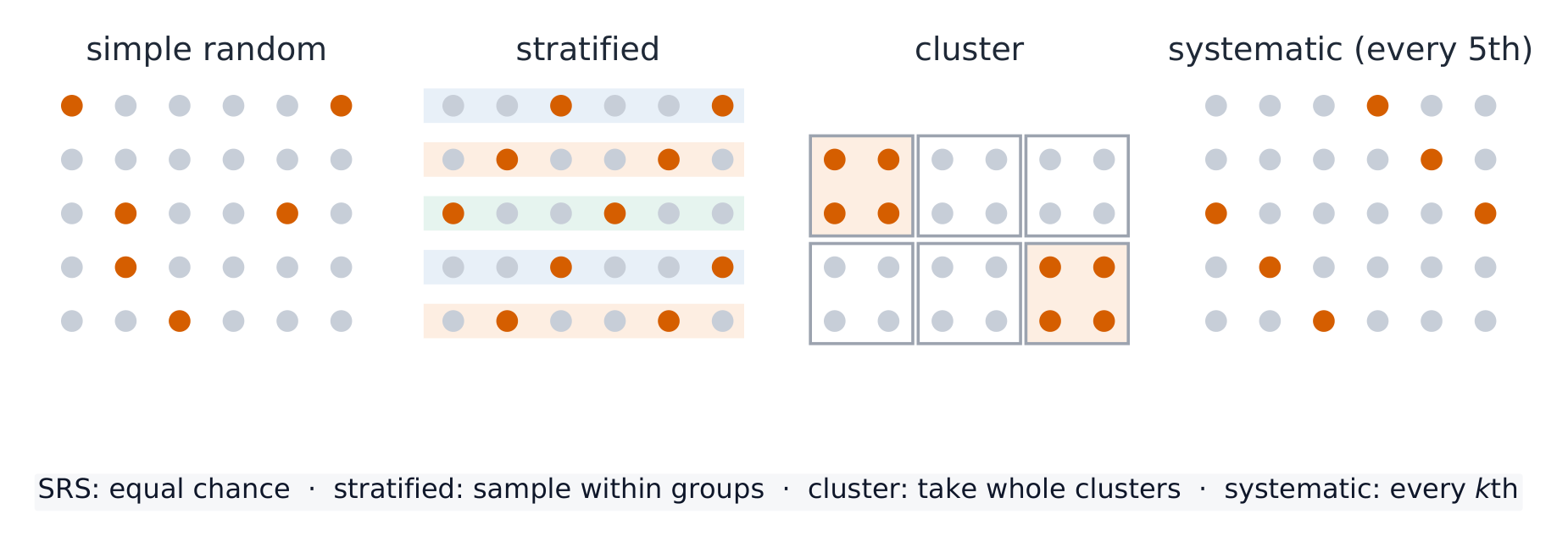
4つの無作為抽出デザイン:誰が選ばれ、どのように選ばれるか

利便標本または自発的応答標本は無作為ではなく、バイアスを含みます。

** worked example.** 学校を調査するために、管理者は学年ごとに全生徒をリストアップし、各学年から $20$ を無作為に抽出します。これは 層化標本 です——学年は層であり、SRS(単純無作為抽出)のように偶然ある学年からの抽出数が少なくなることを防ぎます。

無作為な結果:公平な条件下ではサイコロの各面が出る確率が等しい
3.4

When Sampling Goes Wrong · ⁨抽出が失敗するケース⁩

Syllabus · ⁨シラバス⁩
English

Enduring Understanding (DAT-2): The way we collect data influences what we can and cannot say about a population.

Learning Objective DAT-2.E: Identify potential sources of bias in sampling methods. [Skill 1.C]

  • DAT-2.E.1 Bias occurs when certain responses are systematically favored over others.
  • DAT-2.E.2 When a sample is comprised entirely of volunteers or people who choose to participate, the sample will typically not be representative of the population (voluntary response bias).
  • DAT-2.E.3 When part of the population has a reduced chance of being included in the sample, the sample will typically not be representative of the population (undercoverage bias).
  • DAT-2.E.4 Individuals chosen for the sample for whom data cannot be obtained (or who refuse to respond) may differ from those for whom data can be obtained (nonresponse bias).
  • DAT-2.E.5 Problems in the data gathering instrument or process result in response bias. Examples include questions that are confusing or leading (question wording bias) and self-reported responses.
  • DAT-2.E.6 Non-random sampling methods (for example, samples chosen by convenience or voluntary response) introduce potential for bias because they do not use chance to select the individuals.
日本語

持続的理解 (DAT-2): データの収集方法は、集団について何が言え、何が言えないかに影響を与える。

学習目標 DAT-2.E: サンプリング方法におけるバイアスの潜在的要因を特定する。[スキル 1.C]

  • DAT-2.E.1 バイアスとは、特定の回答が他よりも体系的に好まれる場合に発生します。
  • DAT-2.E.2 サンプルがボランティアや参加を自発的に選ぶ人々だけで構成されている場合、それは通常、母集団を代表していません(自己選択バイアス)。
  • DAT-2.E.3 母集団の一部がサンプルに含まれる機会が減少している場合、それは通常、母集団を代表していません(未被覆バイアス)。
  • DAT-2.E.4 データ取得できない(または回答を拒否する)サンプルとして選ばれた個人は、データ取得可能な個人と異なる可能性があります(非応答バイアス)。
  • DAT-2.E.5 データ収集器具やプロセス上の問題は、応答バイアスを引き起こします。例として、混乱させたり誘導したりする質問(質問の wording バイアス)や自己報告式回答があります。
  • DAT-2.E.6 非無作為サンプリング方法(例えば、利便性による選抜や自己選択による選抜など)は、個人を選抜するために偶然を用いないため、バイアスの可能性を生じます。

Source: College Board AP Course and Exam Description · ⁨出典: College Board AP コースおよび試験説明書⁩

English

Bias makes estimates systematically miss the truth:

  • Undercoverage 覆盖不足: some groups are left out of the sampling frame.
  • Nonresponse 无回应: selected people do not answer.
  • Response bias 回应偏差: people answer inaccurately (bad wording, sensitive topics).

Bias is about a consistent error in one direction – increasing the sample size does not fix it.

日本語

バイアスは推定値を真実から系統的にずらします:

  • 未被覆: 一部の集団が抽出フレームに含まれていない。
  • 非応答: 選ばれた人が回答しない。
  • 応答バイアス: 人々が不正確に回答する(悪い質問文、敏感なトピックなど)。

バイアスは一方向への一貫した誤差です——サンプルサイズを増やしても修正されません。

利便標本は母集団を逃す:選択が無Randomではないとバイアスが入り込む
Vocabulary · ⁨語彙⁩ Train · ⁨練習する⁩
English 日本語
bias/ˈbaɪəs/ バイアス
Simple random sample (SRS)/ˈsɪmpl ˈrændəm ˈsæmpl/ 単純無作為標本(SRS)
Stratified/ˈstrætɪfaɪd/ 階層化された
Cluster/ˈklʌstə/ クラスター
Systematic/ˌsɪstəˈmætɪk/ 系統的
convenience sample/kənˈviːnɪəns ˈsæmpl/ 利便性サンプリング
Undercoverage/ˌʌndəˈkʌvərɪdʒ/ 未網羅
Nonresponse/ˌnɒnrɪˈspɒns/ 非応答
Response bias/rɪˈspɒns ˈbaɪəs/ 回答バイアス
control group/kənˈtrəʊl ɡruːp/ 対照群
placebo/pləˈsiːbəʊ/ プラセボ
Random assignment/ˈrændəm əˈsaɪnmənt/ 無作為割り当て
Replication/ˌreplɪˈkeɪʃn/ 反復
Confounding/kənˈfaʊndɪŋ/ 混在変数
Blinding/ˈblaɪndɪŋ/ 盲検法
single-blind/ˈsɪŋɡl blaɪnd/ シングルブラインド
double-blind/ˈdʌbl blaɪnd/ ダブルブラインド
Blocking/ˈblɒkɪŋ/ ブロック化
3.5

Designing an Experiment · ⁨実験の設計⁩

Syllabus · ⁨シラバス⁩
English

Enduring Understanding (VAR-3): Well-designed experiments can establish evidence of causal relationships.

Learning Objective VAR-3.A: Identify the components of an experiment. [Skill 1.C]

  • VAR-3.A.1 The experimental units are the individuals (which may be people or other objects of study) that are assigned treatments. When experimental units consist of people, they are sometimes referred to as participants or subjects.
  • VAR-3.A.2 An explanatory variable (or factor) in an experiment is a variable whose levels are manipulated intentionally. The levels or combination of levels of the explanatory variable(s) are called treatments.
  • VAR-3.A.3 A response variable in an experiment is an outcome from the experimental units that is measured after the treatments have been administered.
  • VAR-3.A.4 A confounding variable in an experiment is a variable that is related to the explanatory variable and influences the response variable and may create a false perception of association between the two.

Learning Objective VAR-3.B: Describe elements of a well-designed experiment. [Skill 1.B]

  • VAR-3.B.1 A well-designed experiment should include the following:
    • a. Comparisons of at least two treatment groups, one of which could be a control group.
    • b. Random assignment/allocation of treatments to experimental units.
    • c. Replication (more than one experimental unit in each treatment group).
    • d. Control of potential confounding variables where appropriate.

Learning Objective VAR-3.C: Compare experimental designs and methods. [Skill 1.C]

  • VAR-3.C.1 In a completely randomized design, treatments are assigned to experimental units completely at random. Random assignment tends to balance the effects of uncontrolled (confounding) variables so that differences in responses can be attributed to the treatments.
  • VAR-3.C.2 Methods for randomly assigning treatments to experimental units in a completely randomized design include using a random number generator, a table of random values, drawing chips without replacement, etc.
  • VAR-3.C.3 In a single-blind experiment, subjects do not know which treatment they are receiving, but members of the research team do, or vice versa.
  • VAR-3.C.4 In a double-blind experiment neither the subjects nor the members of the research team who interact with them know which treatment a subject is receiving.
  • VAR-3.C.5 A control group is a collection of experimental units either not given a treatment of interest or given a treatment with an inactive substance (placebo) in order to determine if the treatment of interest has an effect.
  • VAR-3.C.6 The placebo effect occurs when experimental units have a response to a placebo.
  • VAR-3.C.7 For randomized complete block designs, treatments are assigned completely at random within each block.
  • VAR-3.C.8 Blocking ensures that at the beginning of the experiment the units within each block are similar to each other with respect to at least one blocking variable. A randomized block design helps to separate natural variability from differences due to the blocking variable.
  • VAR-3.C.9 A matched pairs design is a special case of a randomized block design. Using a blocking variable, subjects (whether they are people or not) are arranged in pairs matched on relevant factors. Matched pairs may be formed naturally or by the experimenter. Every pair receives both treatments by randomly assigning one treatment to one member of the pair and subsequently assigning the remaining treatment to the second member of the pair. Alternately, each subject may get both treatments.
日本語

持続的理解 (VAR-3): 適切に設計された実験は、因果関係の証拠を確立できます。

学習目標 VAR-3.A: 実験の構成要素を特定する。[スキル 1.C]

  • VAR-3.A.1 実験単位とは、処理が割り当てられる個人(人間或其他研究对象)のことです。実験単位が人間である場合、これらを「参加者」または「被験者」と呼ぶこともあります。
  • VAR-3.A.2 実験における説明変数(要因)とは、そのレベルが意図的に操作される変数のことです。説明変数のレベルやレベルの組み合わせは「処理」と呼ばれます。
  • VAR-3.A.3 実験における応答変数とは、処理施行後に実験単位から測定される結果のことです。
  • VAR-3.A.4 実験における混在変数とは、説明変数に関連し、応答変数に影響を与え、両者の間に誤った関連性を生じさせる可能性がある変数のことです。

学習目標 VAR-3.B: 適切に設計された実験の要素を記述する。[スキル 1.B]

  • VAR-3.B.1 適切に設計された実験には以下の要素を含めるべきです:
    • a. 最低2つの処理群の比較(その一つは対照群也可以是)。
    • b. 実験単位への処理の無作為割り当て/配分。
    • c. 反復(各処理群に1つ以上の実験単位)。
    • d. 適切な场合での潜在的な混在変数の管理。

学習目標 VAR-3.C: 実験計画と方法を比較する。[スキル 1.C]

  • VAR-3.C.1 完全無作為設計では、処理が実験単位に完全に無作為に割り当てられます。無作為割り当ては、制御されていない(混在)変数の影響を均衡させる傾向があり、応答の違いが処理によるものと帰属できるようにします。
  • VAR-3.C.2 完全無作為設計において処理を無作為に割り当てる方法には、乱数生成器の使用、乱数表、くじを交換なしで引くなどが含まれます。
  • VAR-3.C.3 単盲検実験では、被験者は自分がどの処理を受けているかわかりませんが、研究チームメンバーは知っています、またはその逆の場合もあります。
  • VAR-3.C.4 二重盲検実験では、被験者も彼らと対話する研究チームメンバーも、被験者がどの処理を受けているかわかりません。
  • VAR-3.C.5 対照群とは、興味のある処理を与えない、または有効成分を含まない物質(プラセボ)を与えることで、興味のある処理に効果があるかどうかを判定するための実験単位の集合体的ことです。
  • VAR-3.C.6 プラセボ効果とは、実験単位がプラセボに対して反応を示す場合に発生します。
  • VAR-3.C.7 無作為完全区画設計では、各区画内で処理が完全に無作為に割り当てられます。
  • VAR-3.C.8 区画化により、実験開始時に各区画内の単位が少なくとも1つの区画変数に関して互いに類似することが保証されます。無作為区画設計は、自然な変動と区画変数による違いを分離するのに役立ちます。
  • VAR-3.C.9 一致対照設計(マッチドペアデザイン)は、ランダム化ブロック設計の特殊なケースである。ブロック変数を用いて、被験者(人間に限らない)を関連する要因に基づいてペアに割り当てる。一致対照は自然に形成されるか、実験者が意図的に形成する。各ペアには両方の処置が適用され、ペア内の1人の被験者にランダムで1つの処置を割り当て、残りの被験者に残りの処置を割り当てる。あるいは、各被験者が両方の処置を受けることもある。

Source: College Board AP Course and Exam Description · ⁨出典: College Board AP コースおよび試験説明書⁩

English

Good experiments follow three principles:

  • Comparison with a control group 对照组 (often a placebo 安慰剂).
  • Random assignment 随机分配 of subjects to treatments, to balance out other variables.
  • Replication 重复: enough subjects per treatment to see a real effect.

Confounding 混杂 occurs when another variable is tied to the treatment so their effects cannot be separated; random assignment guards against it. Blinding 盲法 hides who is getting which treatment to prevent expectation effects: in a single-blind 单盲 study only one side is kept unaware (usually the subjects, or only the people assessing the result), while in a double-blind 双盲 study neither the subjects nor the researchers who interact with them know, blocking both the placebo effect and biased assessment. Blocking 区组 groups similar subjects and randomizes within each block to reduce variability.

日本語

良好な実験は3つの原則に従います:

  • 比較対象となる 対照群(しばしば 偽薬)との比較。
  • 被験者を treatment に無作為割り付けし、他の変数を均等に平衡させる。
  • 反復: 各 treatment で十分な数の被験者を用い、実際の効果を確認する。
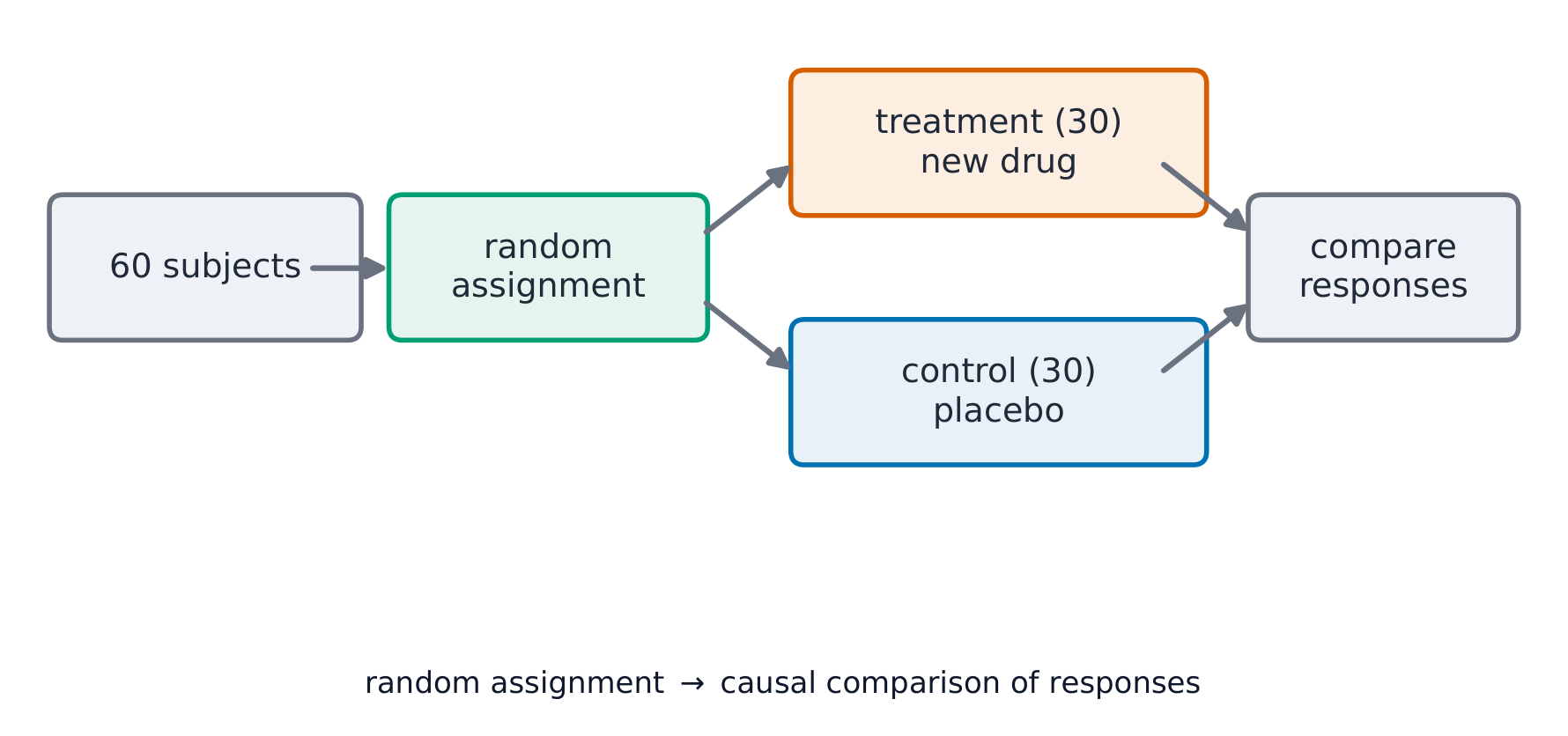
完全に無作為化された実験は treatment 群と対照群を比較する

混在とは、別の変数が treatment に関連しており、その影響を分離できない状態を指します;無作為割り付けでこれを防げます。ブラインド法は、どの treatment が与えられているかを隠して期待効果を防ぐものです:単盲検では片方のみが不知情(通常は被験者、あるいは結果を評価する人のみ)ですが、二重盲検では両方、つまり被験者と彼らに関わる研究者のどちらも不知情であり、偽薬効果とバイアスのある評価の両方をブロックします。ブロッキングは類似した被験者をグループ分けし、各ブロック内で無作為化してばらつきを減らす手法です。

臨床試験:無作為割り付けが treatment と対照を分離する
Vocabulary · ⁨語彙⁩ Train · ⁨練習する⁩
English 日本語
population/ˌpɒpjʊˈleɪʃn/ 人口
observational study/ɒbzəˈveɪʃənl ˈstʌdi/ 観察研究
experiment/ekˈsperɪmənt/ 実験
treatment/ˈtriːtmənt/ 処置
sample/ˈsæmpl/ サンプル
Random sampling/ˈrændəm ˈsæmplɪŋ/ 無作為抽出
3.6

Choosing the Right Design · ⁨適切なデザインの選択⁩

Syllabus · ⁨シラバス⁩
English

Enduring Understanding (VAR-3): Well-designed experiments can establish evidence of causal relationships.

Learning Objective VAR-3.D: Explain why a particular experimental design is appropriate. [Skill 1.C]

  • VAR-3.D.1 There are advantages and disadvantages for each experimental design depending on the question of interest, the resources available, and the nature of the experimental units.
日本語

持続的理解 (VAR-3): 適切に設計された実験は、因果関係の証拠を確立できます。

学習目標 VAR-3.D: 特定の experimental design が適切な理由を説明する。[スキル 1.C]

  • VAR-3.D.1 各実験設計には利点と欠点があり、それらは関心のある質問、利用可能なリソース、および実験単位の性質によって異なる。

Source: College Board AP Course and Exam Description · ⁨出典: College Board AP コースおよび試験説明書⁩

English

Match the design to the goal: use a completely randomized design for uniform subjects; a randomized block design when a known variable (sex, age) affects the response; a matched-pairs design when each subject can serve as its own control. State how you would carry out the randomization.

日本語

目的に合わせてデザインを選択します:均質な被験者には完全に無作為化デザインを使用し、既知の変数(性別、年齢など)が応答に影響する場合やランダムブロッキングデザインを使用し、各被験者が自身の対照となりうる場合はペアマッチングデザインを使用します。無作為化の実施方法を明記してください。

3.7

What an Experiment Lets You Conclude · ⁨実験から導き出せる結論⁩

Syllabus · ⁨シラバス⁩
English

Enduring Understanding (VAR-3): Well-designed experiments can establish evidence of causal relationships.

Learning Objective VAR-3.E: Interpret the results of a well-designed experiment. [Skill 4.B]

  • VAR-3.E.1 Statistical inference attributes conclusions based on data to the distribution from which the data were collected.
  • VAR-3.E.2 Random assignment of treatments to experimental units allows researchers to conclude that some observed changes are so large as to be unlikely to have occurred by chance. Such changes are said to be statistically significant.
  • VAR-3.E.3 Statistically significant differences between or among experimental treatment groups are evidence that the treatments caused the effect.
  • VAR-3.E.4 If the experimental units used in an experiment are representative of some larger group of units, the results of an experiment can be generalized to the larger group. Random selection of experimental units gives a better chance that the units will be representative.
日本語

持続的理解 (VAR-3): 適切に設計された実験は、因果関係の証拠を確立できます。

学習目標 VAR-3.E: 適切に設計された実験の結果を解釈する。[スキル 4.B]

  • VAR-3.E.1 統計的推論では、データから得られた結論が、そのデータが収集された分布に基づいていると見なす。
  • VAR-3.E.2 処置を実験単位にランダムに割り当てることで、研究者は観測された変化が偶然によって生じる可能性が極めて低いほど大きいと結論づけられる。このような変化は「統計的に有意」と呼ばれる。
  • VAR-3.E.3 実験処理群間で統計的に有意な差が見られることは、処置がその効果を引き起こした証拠となる。
  • VAR-3.E.4 実験で使用された単位がより大きな集団を代表している場合、実験の結果はその larger group への一般化が可能である。実験単位の無作為抽出は、単位が代表性を持つ可能性を高める。

Source: College Board AP Course and Exam Description · ⁨出典: College Board AP コースおよび試験説明書⁩

English

Two questions decide the scope of a conclusion:

  • Random assignment used? Then a significant difference can be attributed to the treatment (causation) – for these subjects.
  • Random sampling from a population? Then results generalize to that population.

Only an experiment with random assignment supports a cause-and-effect claim; only random sampling supports generalization. Say exactly which you have.

Worked example. Researchers randomly assign $100$ volunteers to a new drug or a placebo, and the drug group improves significantly more. Because of the random assignment, the improvement can be attributed to the drug (causation) – but because the subjects were not randomly sampled, the conclusion applies only to these volunteers and does not automatically generalize to everyone.

日本語

結論の範囲を決定する2つの質問があります:

  • 無作為割り付けを行ったか? そうであれば、有意な差は treatment によるもの(因果関係)として説明できる——この被験者について。
  • 母集団から無作為抽出を行ったか? そうであれば、結果はその母集団に一般化できる。

因果関係を支持するのは無作為割り付けを行った実験のみであり、一般化を支持するのは無作為抽出のみである。具体的にどちらを行っているかを述べる。

** worked example.** 研究者は $100$ のボランティアを新しい薬または偽薬に無作為割り付けし、薬群の方が有意に改善した。 無作為割り付けにより、改善は薬によるもの(因果関係)として説明できる——しかし、被験者が無作為抽出されていないため、結論はこのボランティアに限定され、すべての人に自動的に一般化されるわけではない。

3.7

Exam tips · ⁨試験対策⁩

English
  • Distinguish an observational study (finds association) from an experiment (can show causation).
  • Good sampling is random (SRS, stratified, cluster) — beware bias (voluntary response, undercoverage, nonresponse).
  • Good experiments use control, randomization, and replication; blocking handles a known nuisance variable.
  • Only a randomized experiment supports a cause-and-effect conclusion.
  • Name the population, sample, and any confounding clearly.
日本語
  • 観察研究(相関を見つける)と実験(因果関係を示せる)を区別する。
  • 良好な抽出は無Random(SRS、層化、クラスター抽出)である——バイアス(自発的応答、未被覆、非応答)に注意する。
  • 良好な実験は対照、無作為化、反復を用い、ブロッキングは既知の邪魔変数を扱う。
  • 因果関係を支持するのは無作為化された実験のみである。
  • 母集団、標本、および混在を明確に名称する。

Interactive lessons on this topic · ⁨このトピックのインタラクティブ授業⁩

Work through it step by step, with instant-check exercises. · ⁨一歩ずつ進め、即時チェック付きの問題で学習します。⁩

Past Papers · ⁨過去問⁩

More topics in AP Statistics · ⁨AP Statistics の他のトピック⁩

Log in or create account · ⁨ログインまたはアカウント作成⁩

IGCSE, A-Level & AP