Skip to content · ⁨コンテンツへスキップ⁩

Energy and Momentum of Rotating Systems · ⁨回転系エネルギーと運動量⁩

AP Physics 1 · ⁨AP物理学 1⁩ · Topic 6 · ⁨トピック 6⁩

View Slides · ⁨查看幻灯片⁩ Train · ⁨練習する⁩
Video lesson for this topic · ⁨このトピックのビデオレッスン⁩ Open the video page · ⁨動画ページを開く⁩
7:54

回転系エネルギーと運動量

スケート選手が腕を広げて回転している様子を見てください。腕を体側に引き寄せると、急激に高速で回転し始めます。誰かが押したわけでもなく、モーターが始まったわけでもありません。では、その…

English narration · English + 中文 subtitles burned in · ⁨英語ナレーション・英語+中文字幕 burning-in⁩

6.1

Rotational Kinetic Energy · ⁨回転運動エネルギー⁩

Syllabus · ⁨シラバス⁩
English

Learning Objective 6.1.A: Describe the rotational kinetic energy of a rigid system in terms of the rotational inertia and angular velocity of that rigid system.

  • 6.1.A.1 The rotational kinetic energy of an object or rigid system is related to the rotational inertia and angular velocity of the rigid system and is given by the equation $K = \frac{1}{2} I \omega^2$.
    • 6.1.A.1.i The rotational inertia of an object about a fixed axis can be used to show that the rotational kinetic energy of that object is equivalent to its translational kinetic energy, which is its total kinetic energy.
    • 6.1.A.1.ii The total kinetic energy of a rigid system is the sum of its rotational kinetic energy due to its rotation about its center of mass and the translational kinetic energy due to the linear motion of its center of mass.
  • 6.1.A.2 A rigid system can have rotational kinetic energy while its center of mass is at rest due to the individual points within the rigid system having linear speed and, therefore, kinetic energy.
  • 6.1.A.3 Rotational kinetic energy is a scalar quantity.
日本語

学習目標 6.1.A: 回転慣性と角速度を用いて、剛体系の回転運動エネルギーを説明する。

  • 6.1.A.1 物体または剛体系の回転運動エネルギーは、剛体系の回転慣性と角速度に関連しており、以下の式で与えられる $K = \frac{1}{2} I \omega^2$。
    • 6.1.A.1.i 固定軸に関する物体の回転慣性を用いることで、その物体の回転運動エネルギーが並進運動エネルギー(=全運動エネルギー)に等しいことを示せる。
    • 6.1.A.1.ii 剛体系の全運動エネルギーは、重心周りの回転による回転運動エネルギーと、重心の直線運動による並進運動エネルギーの和である。
  • 6.1.A.2 剛体系は重心が静止していても、内部の各点が線速度を持ち、したがって運動エネルギーを持つため、回転運動エネルギーを持つことができる。
  • 6.1.A.3 回転運動エネルギーはスカラー量である。

Source: College Board AP Course and Exam Description · ⁨出典: College Board AP コースおよび試験説明書⁩

English

A spinning object has rotational kinetic energy 转动动能, the rotational twin of $\tfrac12 mv^2$:

$$K_{\text{rot}}=\tfrac{1}{2}I\omega^2.$$
An object that both moves and spins (like a rolling ball) has both translational and rotational kinetic energy, and its total is $K=\tfrac12 mv^2+\tfrac12 I\omega^2$.

日本語

回転している物体には回転運動エネルギーがあり、これは$\tfrac12 mv^2$の回転版です:

$$K_{\text{rot}}=\tfrac{1}{2}I\omega^2.$$
移動しながら回転する物体(転がる球など)は、並進運動エネルギーと回転運動エネルギーの両方を持ちます。その合計は$K=\tfrac12 mv^2+\tfrac12 I\omega^2$です。

6.2

Torque and Work · ⁨トルクと仕事⁩

Syllabus · ⁨シラバス⁩
English

Learning Objective 6.2.A: Describe the work done on a rigid system by a given torque or collection of torques.

  • 6.2.A.1 A torque can transfer energy into or out of an object or rigid system if the torque is exerted over an angular displacement.
  • 6.2.A.2 The amount of work done on a rigid system by a torque is related to the magnitude of that torque and the angular displacement through which the rigid system rotates during the interval in which that torque is exerted.
    • Equation: $W = \tau \Delta\theta$
  • 6.2.A.3 Work done on a rigid system by a given torque can be found from the area under the curve of a graph of torque as a function of angular position.
日本語

学習目標 6.2.A: 与えられたトルクまたはトルクの集合が剛体系に対して行う仕事について説明する。

  • 6.2.A.1 トルクが角変位にわたって加わる場合、そのトルクは物体や剛体系へエネルギーを伝達したり取り出したりすることができる。
  • 6.2.A.2 剛体系に対するトルクによる仕事量は、そのトルクの大きさおよび、そのトルクが加わる期間中に剛体系が回転する角変位と関連している。
    • 式: $W = \tau \Delta\theta$
  • 6.2.A.3 与えられたトルクによる剛体系の仕事は、角位置を横軸とするトルクのグラフの曲線下面積から求めることができる。

Source: College Board AP Course and Exam Description · ⁨出典: College Board AP コースおよび試験説明書⁩

English

A torque acting through an angular displacement does work, changing rotational kinetic energy:

$$W=\tau\,\Delta\theta,\qquad P=\tau\omega.$$
This is the rotational form of $W=Fd$ and $P=Fv$, and it extends the work–energy theorem to rotation.

Worked example. A motor applies a steady torque of $8.0\ \text{N m}$ to a flywheel while it turns through $10\ \text{rad}$. The work done is $W=\tau\,\Delta\theta=8.0\times10=80\ \text{J}$, and if the flywheel started from rest this all becomes rotational kinetic energy.

日本語

角変位に対して作用するトルクは仕事を行ない、回転運動エネルギーを変化させます:

$$W=\tau\,\Delta\theta,\qquad P=\tau\omega.$$
これは$W=Fd$および$P=Fv$の回転形であり、仕事-エネルギーの定理を回転運動に拡張したものです。

計算例。 モーターがフライホイールに$8.0\ \text{N m}$の一定のトルクを加えながら$10\ \text{rad}$だけ回転させます。行なわれた仕事は$W=\tau\,\Delta\theta=8.0\times10=80\ \text{J}$であり、フライホイールが静止状態から始まった場合、この全エネルギーが回転運動エネルギーになります。

Explore · ⁨探索⁩

Balance torques on a seesaw · ⁨こけびの上でのモーメントを釣り合わせる⁩

Torque is force times perpendicular distance, $\tau = Fd$. The beam balances when the torques on each side are equal — move the forces and distances to find the balance point. · ⁨モーメント は力に垂直距離を掛けたもの、$\tau = Fd$。両側のモーメントが等しくなればビームは釣り合い、力を動かして釣り合い点を見つけろ。⁩

6.3

Angular Momentum and Angular Impulse · ⁨角運動量と角インパルス⁩

Syllabus · ⁨シラバス⁩
English

Learning Objective 6.3.A: Describe the angular momentum of an object or rigid system.

  • 6.3.A.1 The magnitude of the angular momentum of a rigid system about a specific axis can be described with the equation $L = I\omega$.
  • 6.3.A.2 The magnitude of the angular momentum of an object about a given point is $L = rmv \sin\theta$.
    • 6.3.A.2.i The selection of the axis about which an object is considered to rotate influences the determination of the angular momentum of that object.
    • 6.3.A.2.ii The measured angular momentum of an object traveling in a straight line depends on the distance between the reference point and the object, the mass of the object, the speed of the object, and the angle between the radial distance and the velocity of the object.

Learning Objective 6.3.B: Describe the angular impulse delivered to an object or rigid system by a torque.

  • 6.3.B.1 Angular impulse is defined as the product of the torque exerted on an object or rigid system and the time interval during which the torque is exerted.
    • Equation: $\text{angular impulse} = \tau \Delta t$
  • 6.3.B.2 Angular impulse has the same direction as the torque exerted on the object or system.
  • 6.3.B.3 The angular impulse delivered to an object or rigid system by a torque can be found from the area under the curve of a graph of the torque as a function of time.

Learning Objective 6.3.C: Relate the change in angular momentum of an object or rigid system to the angular impulse given to that object or rigid system.

  • 6.3.C.1 The magnitude of the change in angular momentum can be described by comparing the magnitudes of the final and initial angular momenta of the object or rigid system: $\Delta L = L - L_0$
  • 6.3.C.2 A rotational form of the impulse–momentum theorem relates the angular impulse delivered to an object or rigid system and the change in angular momentum of that object or rigid system.
    • 6.3.C.2.i The angular impulse exerted on an object or rigid system is equal to the change in angular momentum of that object or rigid system.
      • Equation: $\Delta L = \tau \Delta t$
    • 6.3.C.2.ii The rotational form of the impulse–momentum theorem is a direct result of the rotational form of Newton's second law of motion for cases in which rotational inertia is constant: $\tau_{\text{net}} = \dfrac{\Delta L}{\Delta t} = I \dfrac{\Delta\omega}{\Delta t} = I\alpha$
  • 6.3.C.3 The net torque exerted on an object is equal to the slope of the graph of the angular momentum of an object as a function of time.
  • 6.3.C.4 The angular impulse delivered to an object is equal to the area under the curve of a graph of the net external torque exerted on an object as a function of time.

Boundary statement: While AP Physics 1 expects that students can mathematically manipulate the magnitude of angular momentum using one-dimensional vector conventions, the direction of angular momentum and angular impulse is beyond the scope of the course.

日本語

学習目標 6.3.A: 物体や剛体系の角運動量について説明する。

  • 6.3.A.1 特定の軸に関する剛体系の角運動量の大きさは、式 $L = I\omega$ で記述できる。
  • 6.3.A.2 特定の点に関するある物体の角運動量の大きさは$L = rmv \sin\theta$である。
    • 6.3.A.2.i 物体が回転すると見なす軸の選択は、その物体の角運動量の決定に影響を与える。
    • 6.3.A.2.ii 直進運動をする物体の測定された角運動量は、参照点と物体との距離、物体の質量、物体の速さ、および半径ベクトルと物体の速度とのなす角に依存する。

学習目標 6.3.B: トルクによって物体や剛体系に与えられる角インパルスについて説明する。

  • 6.3.B.1 角インパルスとは、物体や剛体系に加わるトルクと、そのトルクが加わる時間区間の積として定義される。
    • 式: $\text{angular impulse} = \tau \Delta t$
  • 6.3.B.2 角インパルスの方向は、物体や系上加わるトルクの方向と同じである。
  • 6.3.B.3 トルクによって物体や剛体系に与えられる角インパルスは、時間を横軸とするトルクのグラフの曲線下面積から求めることができる。

学習目標 6.3.C: 物体や剛体系の角運動量の変化と、それらの物体や剛体系に与えられた角インパルスの関係を説明する。

  • 6.3.C.1 角運動量の変化の大きさは、物体や剛体系の最終角運動量と初期角運動量の大きさを比較して記述できる:$\Delta L = L - L_0$
  • 6.3.C.2 インパルス・モーメント定理の回転形は、物体や剛体系に与えられた角インパルスと、それらの物体や剛体系の角運動量の変化を関連づける。
    • 6.3.C.2.i 物体や剛体系に加えられた角インパルスは、それらの物体や剛体系の角運動量の変化に等しい。
      • 数式: $\Delta L = \tau \Delta t$
    • 6.3.C.2.ii 回転慣性が一定の場合におけるニュートンの第二法則の回転形の直接的な結果として、インパルス・モーメント定理の回転形が成立する:$\tau_{\text{net}} = \dfrac{\Delta L}{\Delta t} = I \dfrac{\Delta\omega}{\Delta t} = I\alpha$
  • 6.3.C.3 物体に加えられた正味トルクは、時間を横軸とする物体の角運動量のグラフの傾きに等しい。
  • 6.3.C.4 物体に与えられた角インパルスは、時間を横軸とする物体に加えられた正味外トルクのグラフの曲線下面積に等しい。

境界声明: AP Physics 1では、学生が一次元ベクトルの慣例を用いて角運動量の大きさを数学的に操作できると期待されるが、角運動量および角インパルスの方向については、本課程の範囲を超えている。

Source: College Board AP Course and Exam Description · ⁨出典: College Board AP コースおよび試験説明書⁩

English

Angular momentum 角动量 is the rotational version of linear momentum:

$$L=I\omega.$$
A net torque acting over time delivers an angular impulse 角冲量 that changes it: $\tau\,\Delta t=\Delta L$ – the rotational impulse–momentum theorem.

日本語

角運動量は、線運動量の回転版です:

$$L=I\omega.$$
時間を通じて作用する正味トルクは角インパルスを与え、角運動量を変化させます:$\tau\,\Delta t=\Delta L$ — これは角インパルス-角運動量の定理です。

6.4

Conservation of Angular Momentum · ⁨角運動量の保存⁩

Syllabus · ⁨シラバス⁩
English

Learning Objective 6.4.A: Describe the behavior of a system using conservation of angular momentum.

  • 6.4.A.1 The total angular momentum of a system about a rotational axis is the sum of the angular momenta of the system's constituent parts about that axis.
  • 6.4.A.2 Any change to a system's angular momentum must be due to an interaction between the system and its surroundings.
    • 6.4.A.2.i The angular impulse exerted by one object or system on a second object or system is equal and opposite to the angular impulse exerted by the second object or system on the first. This is a direct result of Newton's third law.
    • 6.4.A.2.ii A system may be selected so that the total angular momentum of that system is constant.
    • 6.4.A.2.iii The angular speed of a nonrigid system may change without the angular momentum of the system changing if the system changes shape by moving mass closer to or further from the rotational axis.
    • 6.4.A.2.iv If the total angular momentum of a system changes, that change will be equivalent to the angular impulse exerted on the system.

Learning Objective 6.4.B: Describe how the selection of a system determines whether the angular momentum of that system changes.

  • 6.4.B.1 Angular momentum is conserved in all interactions.
  • 6.4.B.2 If the net external torque exerted on a selected object or rigid system is zero, the total angular momentum of that system is constant.
  • 6.4.B.3 If the net external torque exerted on a selected object or rigid system is nonzero, angular momentum is transferred between the system and the environment.
日本語

学習目標 6.4.A: 角運動量の保存則を用いて系の挙動について説明する。

  • 6.4.A.1 回転軸に関する系の全角運動量は、その軸に関する系を構成する各部分の角運動量の和である。
  • 6.4.A.2 系の角運動量の変化は、必ず系と環境との相互作用に起因する。
    • 6.4.A.2.i 第一の物体または系が第二の物体または系に加えたり受けたりした角インパルスは、第二の物体または系が第一の物体または系に加えたり受けたりした角インパルスと等しく逆向きである。これはニュートンの第三法則の直接的な結果である。
    • 6.4.A.2.ii 系の全角運動量が一定となるように系を選択することが可能である。
    • 6.4.A.2.iii 非剛体系の角速度は、質量を回転軸に近い位置から遠い位置へ、あるいはその逆へ動かして形状を変えることで変化しうるが、このとき系の角運動量は変化しない。
    • 6.4.A.2.iv 系の全角運動量に変化が生じた場合、その変化は系に加えられた角インパルスに等しい。

学習目標 6.4.B: 系の選択が、その系の角運動量の変化の有無をどう決定するかについて説明する。

  • 6.4.B.1 角運動量はすべての相互作用において保存される。
  • 6.4.B.2 選択された物体や剛体系に加えられた正味外トルクがゼロであれば、その系の全角運動量は一定である。
  • 6.4.B.3 選択された物体や剛体系に加えられた正味外トルクがゼロでない場合、角運動量は系と環境の間で移動する。

Source: College Board AP Course and Exam Description · ⁨出典: College Board AP コースおよび試験説明書⁩

English

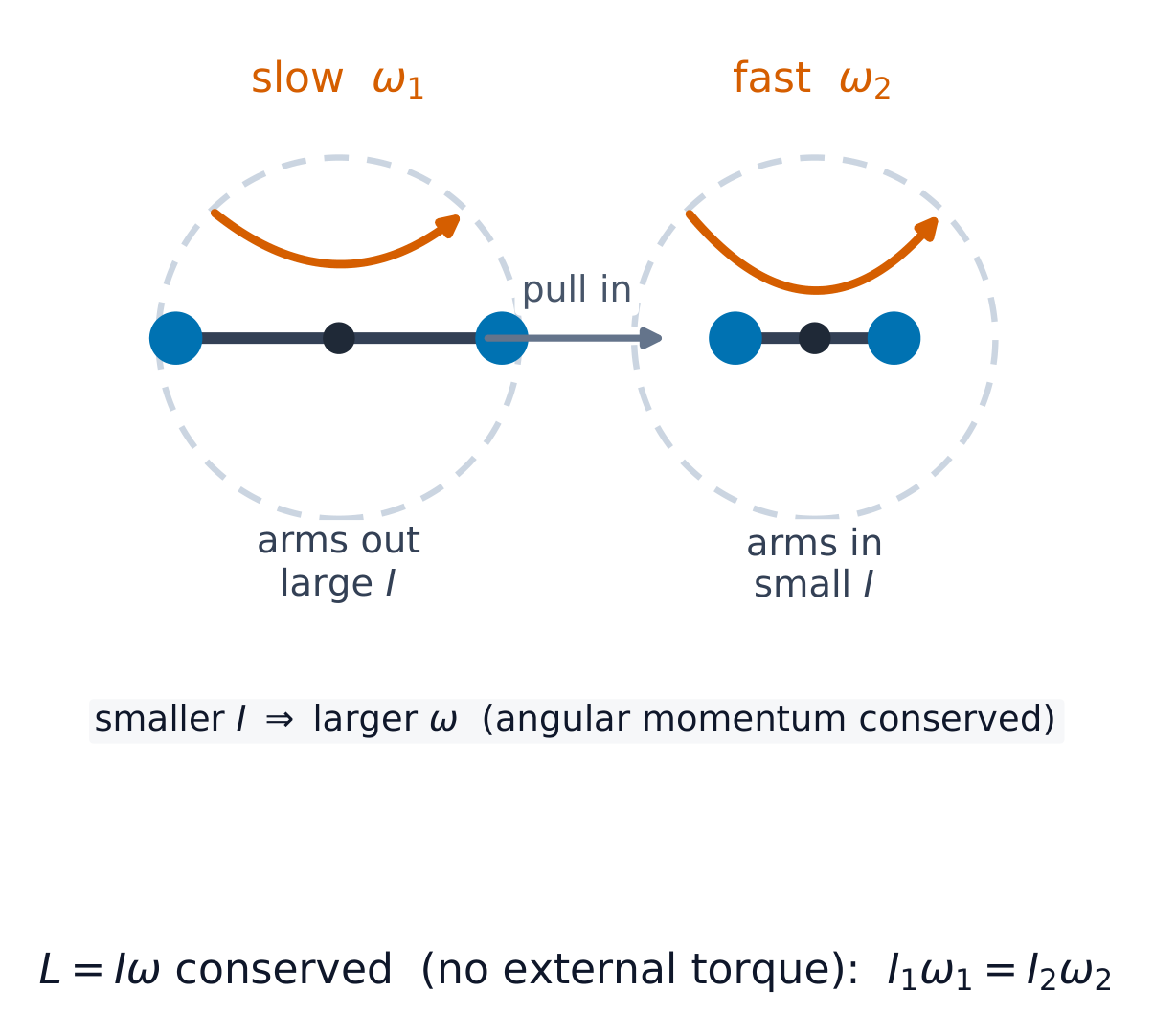
If the net external torque on a system is zero, its total angular momentum is conserved 守恒:

$$I_1\omega_1=I_2\omega_2.$$
So if $I$ decreases, $\omega$ increases to keep $L$ constant – this is why a spinning skater speeds up when pulling their arms in. It applies to collisions and explosions of rotating systems too.

Worked example. A skater spins at $2.0\ \text{rev/s}$ with rotational inertia $I_1=4.0\ \text{kg m}^2$. She pulls her arms in, dropping her rotational inertia to $I_2=1.6\ \text{kg m}^2$. With no external torque, angular momentum is conserved:

$$\omega_2=\frac{I_1}{I_2}\,\omega_1=\frac{4.0}{1.6}\times2.0=5.0\ \text{rev/s}.$$
Her kinetic energy actually rises – the extra energy comes from the work her muscles do pulling her arms in against the outward pull.

日本語

システムに働く正味の外部トルクがゼロの場合、その全角運動量は保存されます:

$$I_1\omega_1=I_2\omega_2.$$
したがって、$I$ が減少すると、$\omega$ は増加して $L$ を一定に保ちます。これが、スケート選手が腕を引き寄せて回転を速める理由です。回転系の衝突や爆発にも適用されます。

計算例。 スケーターが$2.0\ \text{rev/s}$で回転しており、回転慣性は$I_1=4.0\ \text{kg m}^2$です。彼女が腕を引き寄せると、回転慣性は$I_2=1.6\ \text{kg m}^2$まで低下します。外部トルクがないため、角運動量は保存されます:

$$\omega_2=\frac{I_1}{I_2}\,\omega_1=\frac{4.0}{1.6}\times2.0=5.0\ \text{rev/s}.$$
彼女の運動エネルギーは実際には増加します。追加されたエネルギーは、腕を引き寄せる際に筋肉が行なった仕事(外向きの張りに対して)から来ています。

内側への質量引き寄せによりIが低下し、L = Iωを保存するためにωが上昇
Vocabulary · ⁨語彙⁩ Train · ⁨練習する⁩
English 日本語
rotational kinetic energy/rəʊˈteɪʃənl kɪˈnetɪk ˈenədʒi/ 回転運動エネルギー
Angular momentum/ˈæŋɡjʊlə məʊˈmentəm/ 角運動量
angular impulse/ˈæŋɡjʊlə ˈɪmpʌls/ 角冲動
conserved/kənˈsɜːvd/ 保存されている
6.5

Rolling · ⁨転がり⁩

Syllabus · ⁨シラバス⁩
English

Learning Objective 6.5.A: Describe the kinetic energy of a system that has translational and rotational motion.

  • 6.5.A.1 The total kinetic energy of a system is the sum of the system's translational and rotational kinetic energies.
    • Equation: $K_{\text{tot}} = K_{\text{trans}} + K_{\text{rot}}$

Learning Objective 6.5.B: Describe the motion of a system that is rolling without slipping.

  • 6.5.B.1 While rolling without slipping, the translational motion of a system's center of mass is related to the rotational motion of the system itself with the equations:
    • Equation: $\Delta x_{\text{cm}} = r\Delta\theta$
    • Equation: $v_{\text{cm}} = r\omega$
    • Equation: $a_{\text{cm}} = r\alpha$
  • 6.5.B.2 For ideal cases, rolling without slipping implies that the frictional force does not dissipate any energy from the rolling system.

Learning Objective 6.5.C: Describe the motion of a system that is rolling while slipping.

  • 6.5.C.1 When slipping, the motion of a system's center of mass and the system's rotational motion cannot be directly related.
  • 6.5.C.2 When a rotating system is slipping relative to another surface, the point of application of the force of kinetic friction exerted on the system moves with respect to the surface, so the force of kinetic friction will dissipate energy from the system.

Boundary statement: Rolling friction is beyond the scope of AP Physics 1.

Boundary statement: The precise mathematical relationships between linear and angular quantities while a rigid body is rolling while slipping are beyond the scope of AP Physics 1 and 2, and students will not be expected to model those relationships quantitatively. However, students are expected to qualitatively explain the changes to linear and angular quantities while a rigid body is rolling while slipping.

日本語

学習目標 6.5.A: 並進運動と回転運動の両方を持つ系の運動エネルギーについて説明する。

  • 6.5.A.1 系の全運動エネルギーは、系の並進運動エネルギーと回転運動エネルギーの和である。
    • 式: $K_{\text{tot}} = K_{\text{trans}} + K_{\text{rot}}$

学習目標 6.5.B: 滑りなく転がる系の運動について説明する。

  • 6.5.B.1 滑りなく転動する際、系の重心の並進運動は、系自体の回転運動と以下の式によって関係付けられる:
    • 式: $\Delta x_{\text{cm}} = r\Delta\theta$
    • 式: $v_{\text{cm}} = r\omega$
    • 式: $a_{\text{cm}} = r\alpha$
  • 6.5.B.2 理想caseでは、滑りなく転動することは、摩擦力が転動系からエネルギーを散逸させないことを意味する。

学習目標 6.5.C: 滑りながら転動する系の運動を説明せよ。

  • 6.5.C.1 滑りが生じている場合、系の重心の運動と系の回転運動は直接関連づけられない。
  • 6.5.C.2 回転している系が別の表面に対して滑り发生时、系に作用する動摩擦の力の作用点は表面に対して移動するため、動摩擦力は系からエネルギーを散逸させる。

境界声明: 転動摩擦はAP Physics 1のカリキュラム範囲外である。

境界声明: 剛体が滑りながら転動する際の線量と角量の間の正確な数学的関係はAP Physics 1および2のカリキュラム範囲外であり、学生はこれらの関係を定量的にモデル化することが期待されない。しかし、剛体が滑りながら転動する際の線量および角量の変化について、定性的に説明することが期待される。

Source: College Board AP Course and Exam Description · ⁨出典: College Board AP コースおよび試験説明書⁩

English

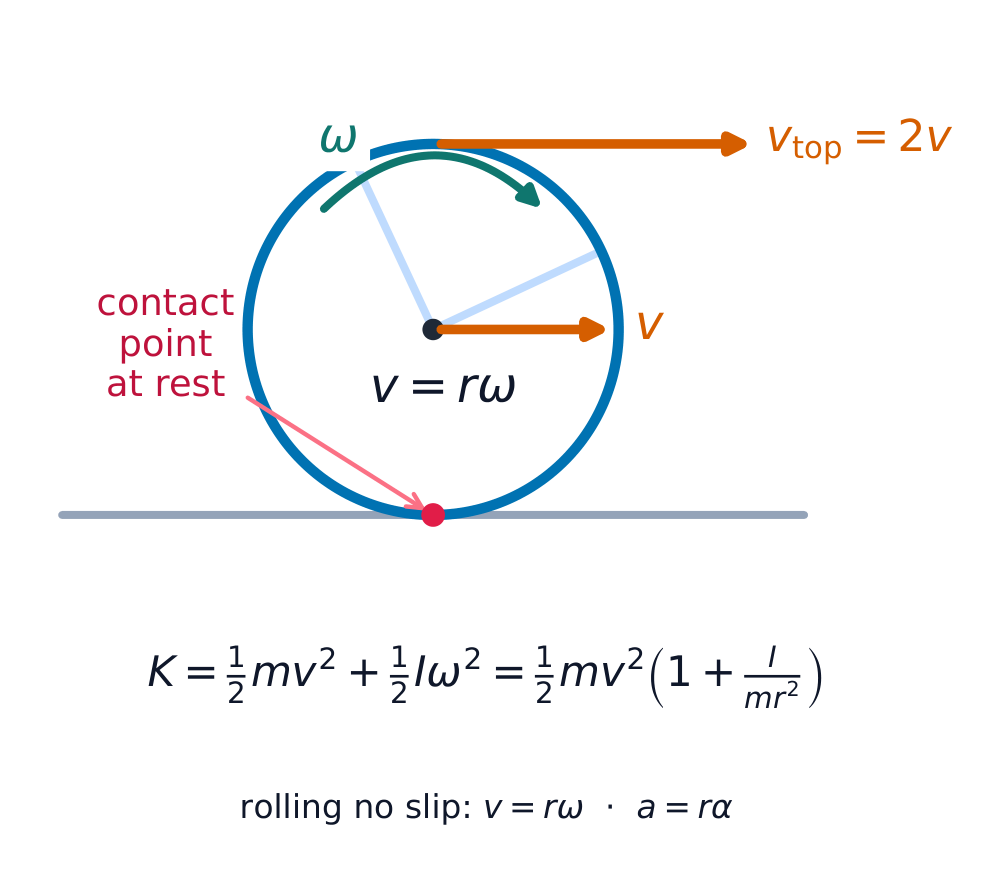
Rolling without slipping 纯滚动 links the translational and rotational motions: the contact point is momentarily at rest, so

$$v=r\omega \qquad\text{and}\qquad a=r\alpha.$$
A rolling object's energy splits between translation and rotation, so on an incline it accelerates more slowly than a frictionless sliding object – some energy goes into spin.

Worked example. For a solid disk ($I=\tfrac12 mR^2$) that rolls without slipping, what fraction of its kinetic energy is rotational? Using $v=R\omega$, the rotational part is $\tfrac12 I\omega^2=\tfrac12(\tfrac12 mR^2)\omega^2=\tfrac14 mv^2$, while the translational part is $\tfrac12 mv^2$. So the total is $\tfrac34 mv^2$ and the rotational share is $\tfrac{1/4}{3/4}=\tfrac13$. A hoop, with its mass farther out, stores half its energy in spin and rolls down a ramp even more slowly.

日本語

すべりなく転がることは、並進運動と回転運動を結びつけます。接触点は瞬間的に静止しているため、

$$v=r\omega \qquad\text{and}\qquad a=r\alpha.$$
転がる物体のエネルギーは並進と回転に分配されるため、摩擦のない滑り落ちる物体よりも傾斜面上での加速度が遅くなります。一部のエネルギーが回転に使われるからです。

計算例。 すべりなく転がる実心円板($I=\tfrac12 mR^2$)について、運動エネルギーの何分の一が回転部分か? $v=R\omega$を用いると、回転部分は$\tfrac12 I\omega^2=\tfrac12(\tfrac12 mR^2)\omega^2=\tfrac14 mv^2$、並進部分は$\tfrac12 mv^2$となる。したがって全エネルギーは$\tfrac34 mv^2$であり、回転の割合は$\tfrac{1/4}{3/4}=\tfrac13$である。質量が外側に分布する輪(ホープ)は、エネルギーの半分を回転に蓄えるため、斜面を下る際さらに遅くなる。

すべりなく転がる際は接触点が静止しているため、v = rω
Vocabulary · ⁨語彙⁩ Train · ⁨練習する⁩
English 日本語
Rolling without slipping/ˈrəʊlɪŋ wɪˈðaʊt ˈslɪpɪŋ/ 滑りなしの転がり
satellite/ˈsætəlaɪt/ 衛星
6.6

Motion of Orbiting Satellites · ⁨軌道にある衛星の運動⁩

Syllabus · ⁨シラバス⁩
English

Learning Objective 6.6.A: Describe the motions of a system consisting of two objects interacting only via gravitational forces.

  • 6.6.A.1 In a system consisting only of a massive central object and an orbiting satellite with mass that is negligible in comparison to the central object's mass, the motion of the central object itself is negligible.
  • 6.6.A.2 The motion of satellites in orbits is constrained by conservation laws.
    • 6.6.A.2.i In circular orbits, the system's total mechanical energy, the system's gravitational potential energy, and the satellite's angular momentum and kinetic energy are constant.
    • 6.6.A.2.ii In elliptical orbits, the system's total mechanical energy and the satellite's angular momentum are constant, but the system's gravitational potential energy and the satellite's kinetic energy can each change.
    • 6.6.A.2.iii The gravitational potential energy of a system consisting of a satellite and a massive central object is defined to be zero when the satellite is an infinite distance from the central object.
      • Equation: $U_g = -G\dfrac{m_1 m_2}{r}$
  • 6.6.A.3 The escape velocity of a satellite is the satellite's velocity such that the mechanical energy of the satellite–central-object system is equal to zero.
    • 6.6.A.3.i When the only force exerted on a satellite is gravity from a central object, a satellite that reaches escape velocity will move away from the central body until its speed reaches zero at an infinite distance from the central body.
    • 6.6.A.3.ii The escape velocity of a satellite from a central body of mass $M$ can be derived using conservation of energy laws.
      • Equation (derived): $v_{\text{esc}} = \sqrt{\dfrac{2GM}{r}}$
日本語

学習目標 6.6.A: 重力のみによって相互作用する2つの物体からなる系の運動を説明せよ。

  • 6.6.A.1 質量が中心物体に対して無視できるほど小さい卫星のみの系において、中心物体自身の運動は無視できる程度である。
  • 6.6.A.2 軌道における衛星の運動は保存則によって制約される。
    • 6.6.A.2.i 円軌道では、系の全機械的エネルギー、系の重力ポテンシャルエネルギー、衛星の角運動量および運動エネルギーは一定である。
    • 6.6.A.2.ii 楕円軌道では、系の全機械的エネルギーと衛星の角運動量は一定であるが、系の重力ポテンシャルエネルギーと衛星の運動エネルギーはそれぞれ変化しうる。
    • 6.6.A.2.iii 衛星と大質量中心物体からなる系の重力ポテンシャルエネルギーは、衛星が中心物体から無限遠にあるときゼロと定義される。
      • 数式: $U_g = -G\dfrac{m_1 m_2}{r}$
  • 6.6.A.3 衛星の脱出速度とは、衛星-中心物体系の機械的エネルギーがゼロとなる衛星の速度のことである。
    • 6.6.A.3.i 衛星に働く力が中心物体からの重力のみである場合、脱出速度に達した衛星は中心天体から離れ、中心天体から無限遠で速度がゼロになるまで移動する。
    • 6.6.A.3.ii 質量$M$の中心天体からの衛星の脱出速度は、エネルギー保存則を用いて導出できる。
      • 式(導出): $v_{\text{esc}} = \sqrt{\dfrac{2GM}{r}}$

Source: College Board AP Course and Exam Description · ⁨出典: College Board AP コースおよび試験説明書⁩

English
Orbital motion (Kepler's 2nd law)

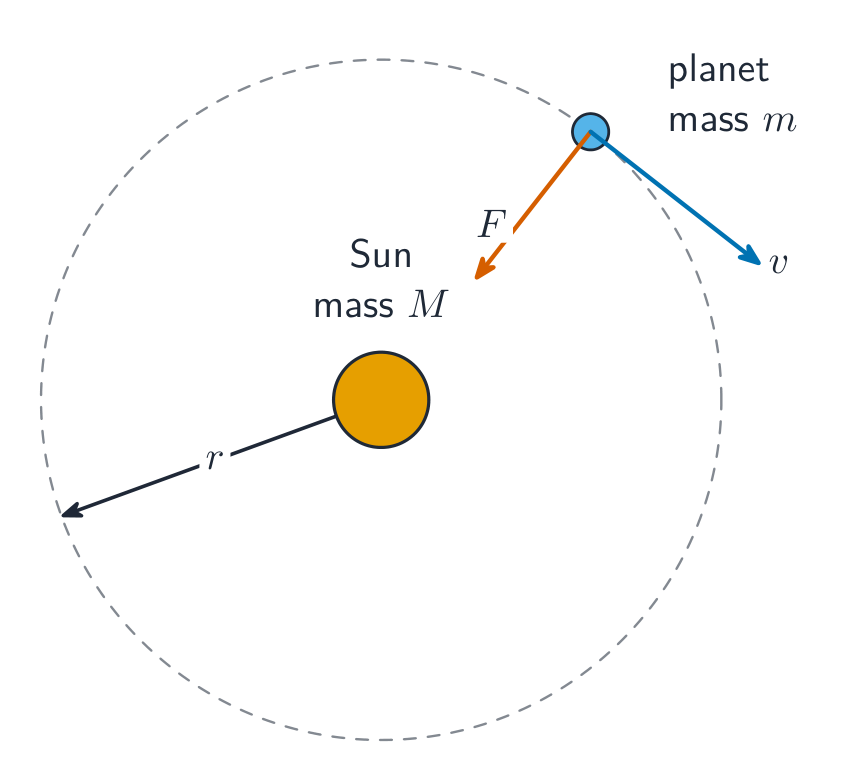
A satellite 卫星 in orbit is in free fall: gravity provides the exact centripetal force needed to curve its path into an orbit. Setting gravity equal to the centripetal requirement,

$$\frac{GMm}{r^2}=\frac{mv^2}{r}\ \Rightarrow\ v=\sqrt{\frac{GM}{r}}.$$
So a larger orbit means a slower speed. For a circular orbit, angular momentum and mechanical energy are both constant; for an elliptical orbit, angular momentum is conserved (no torque about the planet) while speed varies – fastest when closest.

Worked example. Find the speed of a satellite in a low orbit just above the Earth, radius $r=6.4\times10^{6}\ \text{m}$, with $GM=4.0\times10^{14}\ \text{m}^3/\text{s}^2$:

$$v=\sqrt{\frac{GM}{r}}=\sqrt{\frac{4.0\times10^{14}}{6.4\times10^{6}}}=\sqrt{6.25\times10^{7}}\approx 7.9\times10^{3}\ \text{m/s},$$
about $7.9\ \text{km/s}$ – and notice that the satellite's mass cancels, so all low orbits share this speed.

Escape velocity 逃逸速度 is the launch speed that just lets an object leave for good: its total mechanical energy is exactly zero, so it slows to zero speed only at infinite distance. Setting $\tfrac12 mv^2 - \dfrac{GMm}{r}=0$ (using the general gravitational PE $U_g=-GMm/r$) and solving for $v$,

$$v_{\text{esc}}=\sqrt{\frac{2GM}{r}}.$$
It is $\sqrt2$ times the circular-orbit speed at the same radius, and (like orbital speed) does not depend on the escaping object's mass.

日本語
軌道運動(ケプラーの第2法則)

軌道にある卫星は自由落下状态にあります:重力が軌道に曲げるために必要な正確な向心力を提供しています。重力を向心力の必要量と等しく置くことで、

$$\frac{GMm}{r^2}=\frac{mv^2}{r}\ \Rightarrow\ v=\sqrt{\frac{GM}{r}}.$$
したがって、より大きな軌道ほど速度は遅くなります。円軌道の場合は、角運動量と機械的エネルギーの両方が一定です。楕円軌道の場合は、惑星に対するトルクがないため角運動量は保存されますが、速度は変化し、最も近接点では最速となります。

重力が卫星を轨道に留める向心力を提供
重力が卫星を轨道に留める向心力を提供

計算例。 地球直上の低軌道にある卫星の速度を求めよ。半径は$r=6.4\times10^{6}\ \text{m}$、$GM=4.0\times10^{14}\ \text{m}^3/\text{s}^2$とする:

$$v=\sqrt{\frac{GM}{r}}=\sqrt{\frac{4.0\times10^{14}}{6.4\times10^{6}}}=\sqrt{6.25\times10^{7}}\approx 7.9\times10^{3}\ \text{m/s},$$
約$7.9\ \text{km/s}$ — 注意到卫星の質量が相殺され、すべての低軌道がこの速度を持つことに留意せよ。

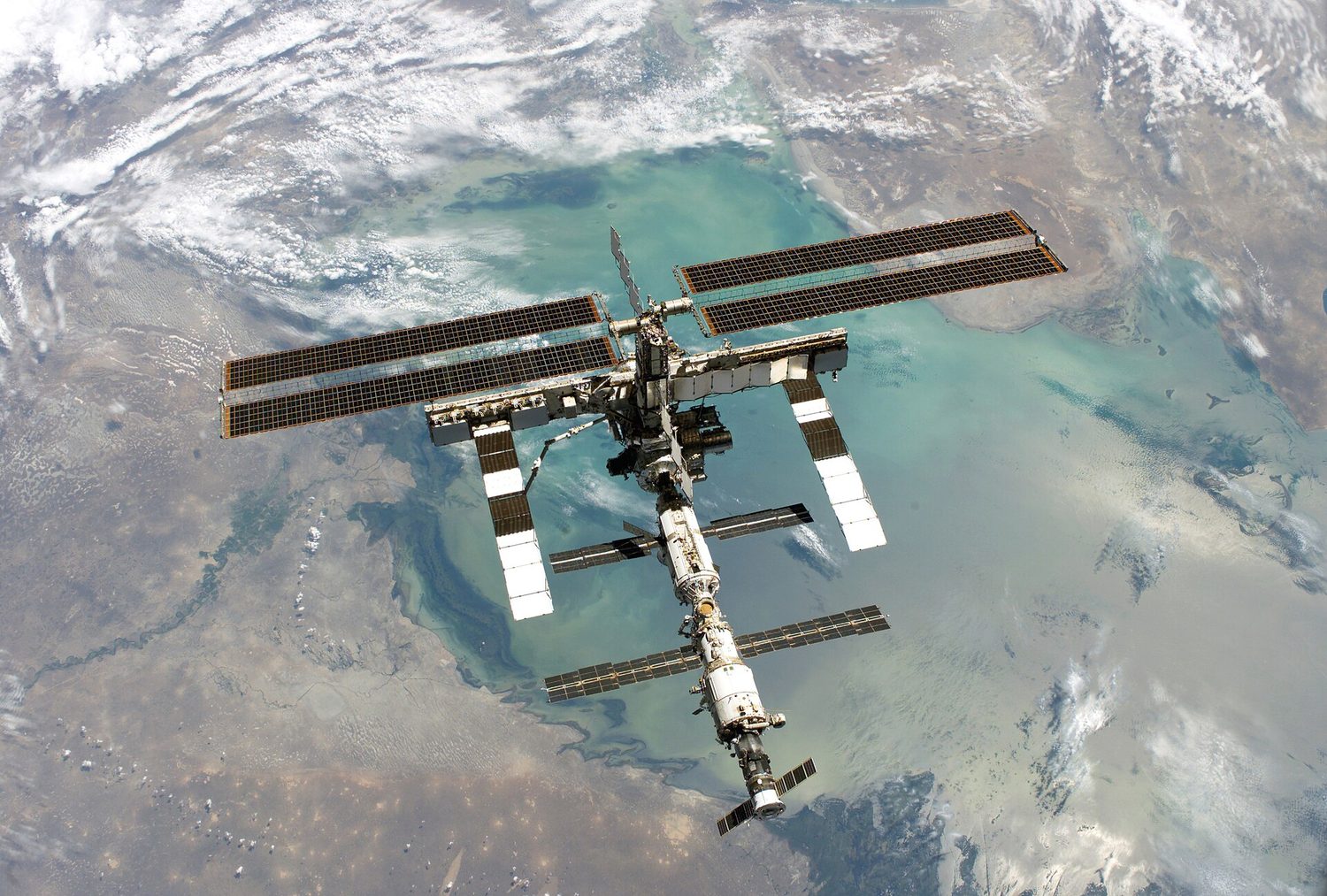
国际空间站绕地球运行的照片
国际空间站:重力のみによって轨道に留められた真实的卫星

** escape velocity** は、物体が完全に脱出できるための最小の射出速度である。全機械的エネルギーがちょうどゼロであるため、無限遠で速度がゼロになるまで減速する。$\tfrac12 mv^2 - \dfrac{GMm}{r}=0$を置く(一般重力ポテンシャルエネルギー$U_g=-GMm/r$を使用)ことで$v$を求める。

$$v_{\text{esc}}=\sqrt{\frac{2GM}{r}}.$$
これは同じ半径での円軌道速度の$\sqrt2$倍であり、(軌道速度と同様に)脱出する物体の質量には依存しない。

Explore · ⁨探索⁩

Compare orbits at different radii · ⁨異なる半径での軌道を比較する⁩

A satellite is in free fall, its gravity supplying the centripetal force. A larger orbit means a slower speed and a longer period — Kepler's third law. · ⁨衛星は 自由落下 にあり、重力が向心力を供給している。大きな軌道ほど速度は遅く、周期も長い — ケプラーの第三法則。⁩

Vocabulary · ⁨語彙⁩ Train · ⁨練習する⁩
English 日本語
Escape velocity/eˈskeɪp vəˈlɒsɪti/ 脱出速度
6.6

Exam tips · ⁨試験対策⁩

English
  • Conserve angular momentum $L=I\omega$ when no external torque acts: a smaller $I$ (arms pulled in) gives a larger $\omega$.
  • A rolling object splits its energy between $\tfrac12 mv^2$ and $\tfrac12 I\omega^2$, linked by $v=r\omega$ — so it accelerates down a ramp more slowly than a sliding one.
  • For a circular orbit set gravity equal to the centripetal requirement: $v=\sqrt{GM/r}$, so a larger orbit is slower and the satellite's mass cancels.
  • Pulling in raises the spin and the kinetic energy — the extra energy comes from the work done pulling inward; $L$ is unchanged.
  • Watch which rotational quantity is conserved: $L$ (no torque) versus energy (no friction) are different conditions.
日本語
  • 外部トルクが働かないとき角運動量$L=I\omega$を保存する:腕を引き寄せた結果$I$が小さくなると、$\omega$が大きくなる。
  • 転がる物体は$\tfrac12 mv^2$と$\tfrac12 I\omega^2$の間でエネルギーを分配し、$v=r\omega$で結ばれている—したがって滑り落ちる物体よりも斜面を下る際の加速度が遅い。
  • 円軌道では重力を向心力の必要量と等しくする:$v=\sqrt{GM/r}$、したがって大きな軌道ほど遅く、卫星の質量は相殺される。
  • 引き寄せると回転が加速し運動エネルギーも増加する—追加されたエネルギーは内側へ引く際に行なわれた仕事から来ており、$L$は不変である。
  • どの回転量が保存されるかに注意する:$L$(トルクなし)とエネルギー(摩擦なし)は異なる条件である。

Interactive lessons on this topic · ⁨このトピックのインタラクティブ授業⁩

Work through it step by step, with instant-check exercises. · ⁨一歩ずつ進め、即時チェック付きの問題で学習します。⁩

Past Papers · ⁨過去問⁩

More topics in AP Physics 1 · ⁨AP物理学 1⁩ · ⁨AP Physics 1 · ⁨AP物理学 1⁩ の他のトピック⁩

Log in or create account · ⁨ログインまたはアカウント作成⁩

IGCSE, A-Level & AP