English
Learning Objective 1.1.A: Calculate quantities of a substance or its relative number of particles using dimensional analysis and the mole concept.
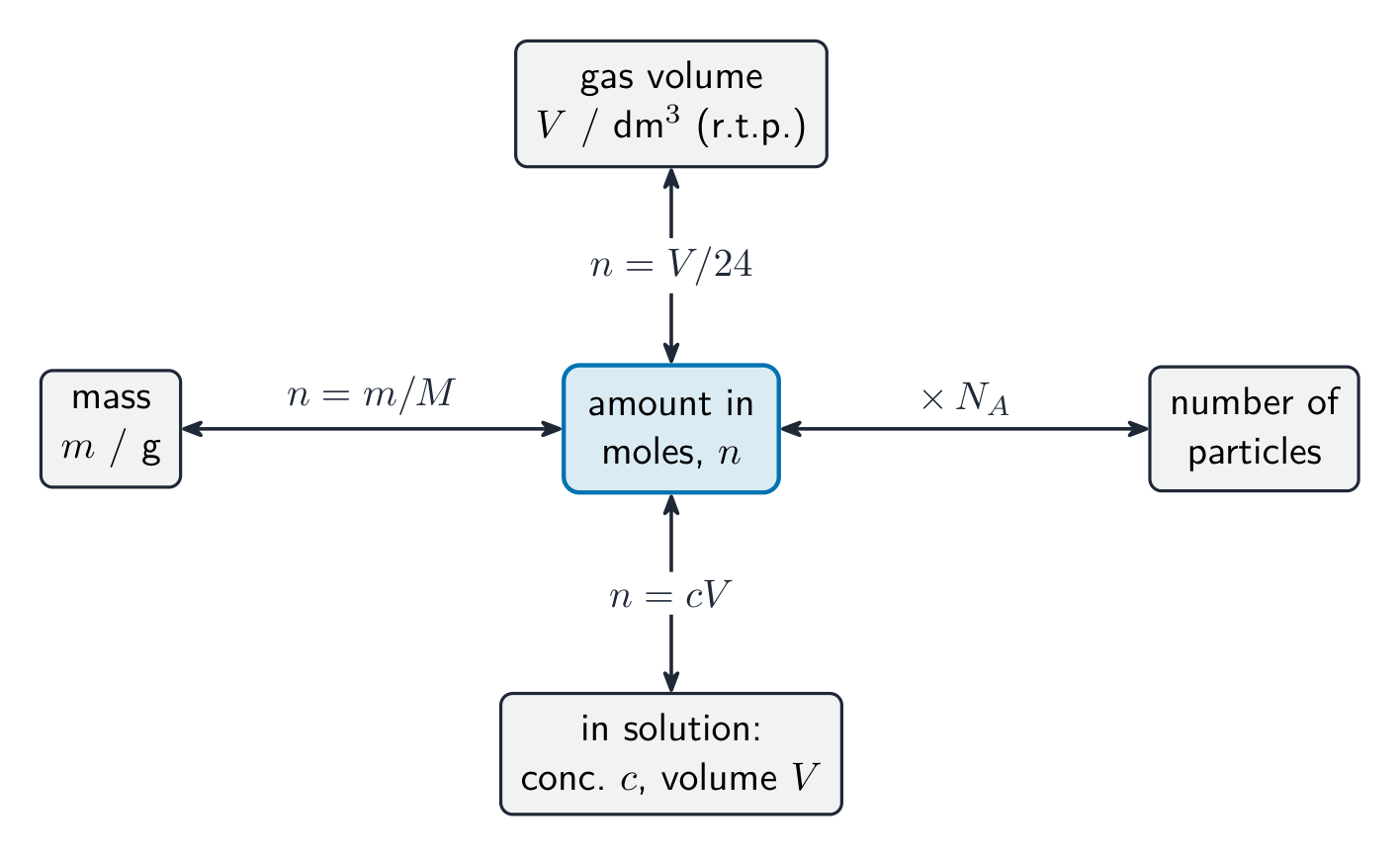
- 1.1.A.1 One cannot count particles directly while performing laboratory work. Thus, there must be a connection between the masses of substances reacting and the actual number of particles undergoing chemical changes.
- 1.1.A.2 Avogadro's number ($N_{\mathrm{A}} = 6.022 \times 10^{23}\ \mathrm{mol}^{-1}$) provides the connection between the number of moles in a pure sample of a substance and the number of constituent particles (or formula units) of that substance.
- 1.1.A.3 Expressing the mass of an individual atom or molecule in atomic mass units (amu) is useful because the average mass in amu of one particle (atom or molecule) or formula unit of a substance will always be numerically equal to the molar mass of that substance in grams. Thus, there is a quantitative connection between the mass of a substance and the number of particles that the substance contains.
- Equation: $n = m/M$
日本語
学習目標 1.1.A: 次元解析およびモルの概念を用いて、物質の量やその相対的な粒子数を計算する。
- 1.1.A.1 実験作業中に粒子を直接数えることはできない。したがって、反応する物質の質量と化学変化を起こす実際の粒子数の間には、何らかの関連性が必要である。
- 1.1.A.2 アボガドロの数($N_{\mathrm{A}} = 6.022 \times 10^{23}\ \mathrm{mol}^{-1}$)は、純粋な試料中のモル数と、その物質の構成粒子(または式単位)の数との間に関連性を示している。
- 1.1.A.3 個々の原子や分子の質量を原子質量単位(amu)で表すことは有用である。なぜなら、1つの粒子(原子または分子)または式単位の平均質量(amu)は、数値的に常にその物質のモル質量(g/mol)に等しいからである。したがって、物質の質量とそれが含む粒子数の間には量的な関係がある。
- 式: $n = m/M$
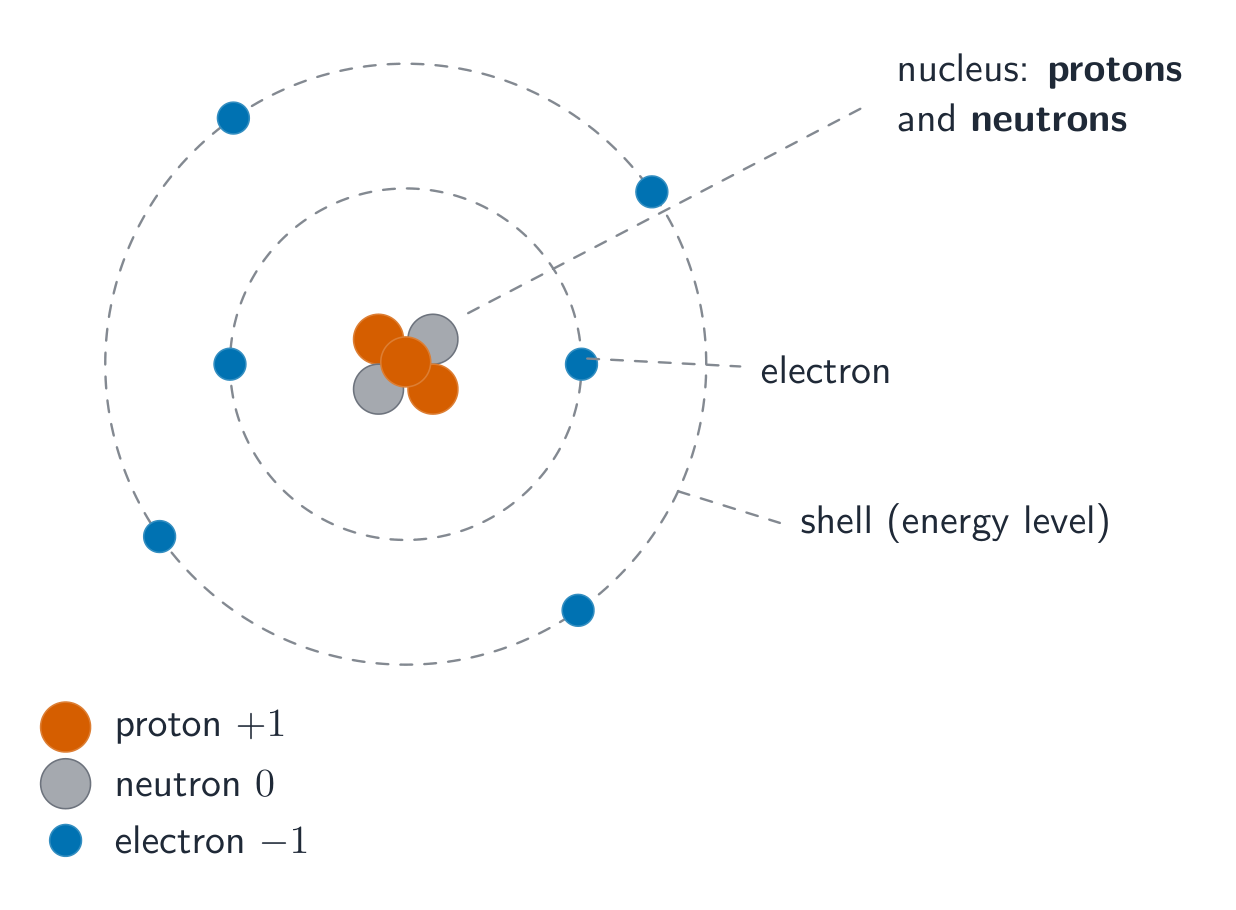
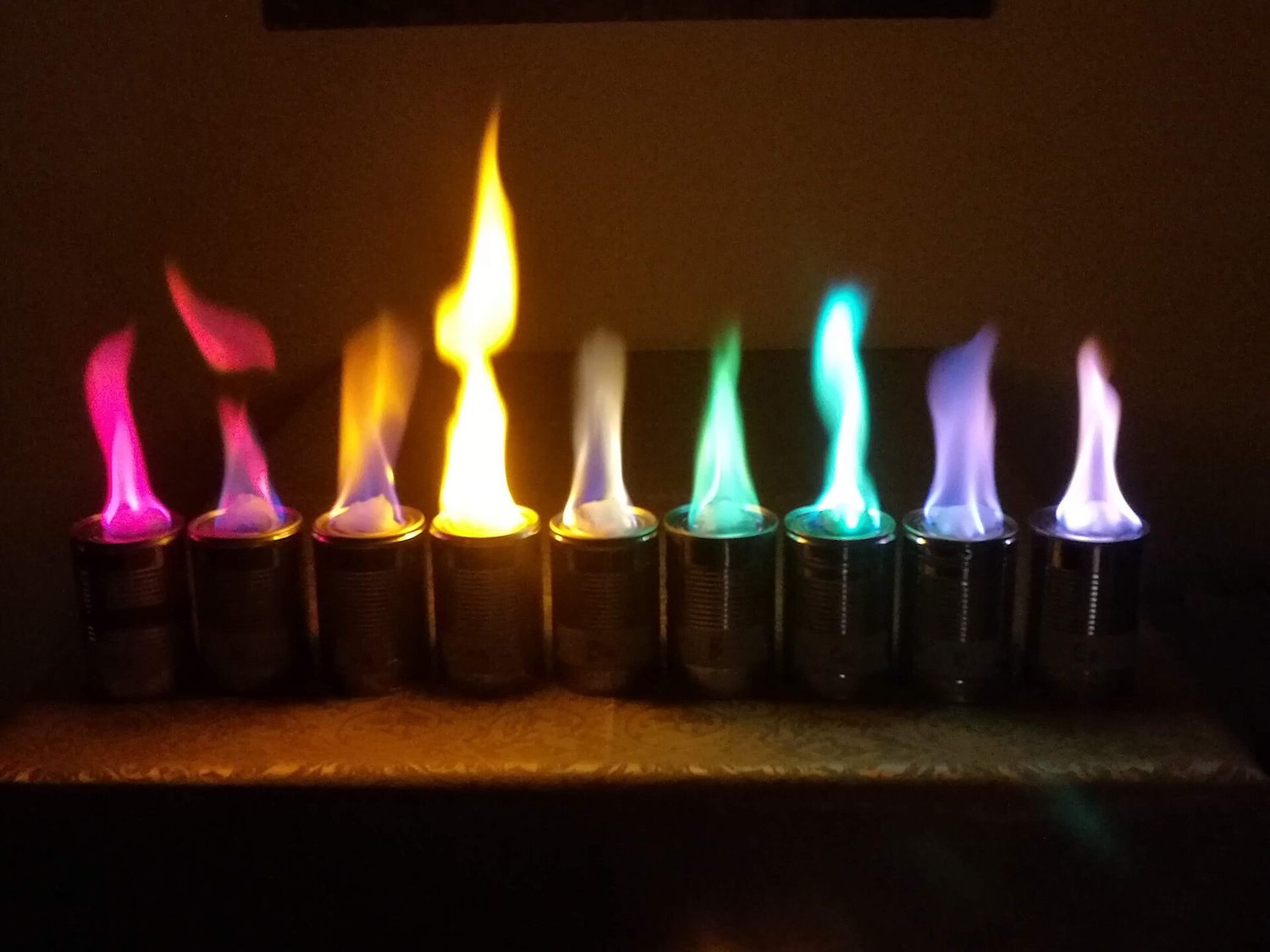 *炎色反応: 各金属イオンは独自の色を示す。熱によって電子が励起され、基底状態に戻る際に特定の波長の光を放出するためである。