Skip to content · ⁨コンテンツへスキップ⁩

Organic synthesis · ⁨有機合成⁩

A-Level Chemistry · ⁨A-Level 化学⁩ · Topic 21 · ⁨トピック 21⁩

View Slides · ⁨查看幻灯片⁩ Train · ⁨練習する⁩
Video lesson for this topic · ⁨このトピックのビデオレッスン⁩ Open the video page · ⁨動画ページを開く⁩
8:01

有機合成

ほとんどの薬を見てみてください。複雑な分子ですが、元々は単純なものでした—通常は原油から得られる小さな分子です。一つの反応で全てが変わるわけではありません…

English narration · English + 中文 subtitles burned in · ⁨英語ナレーション・英語+中文字幕 burning-in⁩

21.1

Organic synthesis · ⁨有機合成⁩

Syllabus · ⁨シラバス⁩
English
  1. for an organic molecule containing several functional groups: (a) identify organic functional groups using the reactions in the syllabus (b) predict properties and reactions
  2. devise multi-step synthetic routes for preparing organic molecules using the reactions in the syllabus
  3. analyse a given synthetic route in terms of type of reaction and reagents used for each step of it, and possible by-products
日本語
  1. 複数の官能基を含む有機分子について: (a) 履修内容の反応を用いて有機官能基を特定 (b) 性質および反応を予測する
  2. 履修内容の反応を用いて有機分子を調製するための多段階合成ルートを考案する
  3. 与えられた合成ルートを反応の種類、各工程で使用される試薬、および副生成物について分析する

Source: Cambridge International syllabus · ⁨出典: Cambridge International シラバス⁩

English

This topic does not add new reactions. Instead it asks you to join up the reactions you already know, so you can build a target molecule in several steps.

Identifying functional groups

A molecule may have more than one functional group 官能团. Use the test reactions from the syllabus to identify each one, and then predict how the molecule will behave. For example:

  • decolourises bromine water → a C=C double bond (an alkene 烯烃).
  • gives a precipitate with silver nitrate → a halogenoalkane 卤代烷.
  • orange $\text{K}_2\text{Cr}_2\text{O}_7$ turns green → a primary or secondary alcohol 醇.
  • orange precipitate with 2,4-DNPH → an aldehyde 醛 or ketone 酮.
  • fizzes with a carbonate → a carboxylic acid 羧酸.

A map of the AS reactions

Each row turns one functional group into another. Learn it as a map you can travel around:

Start Reagent and conditions Product
alkene $\text{H}_2$, Ni alkane
alkene $\text{HX}$, or $\text{X}_2$ halogenoalkane
alkene steam, $\text{H}_3\text{PO}_4$ alcohol
halogenoalkane $\text{NaOH(aq)}$, heat alcohol
halogenoalkane $\text{KCN}$ in ethanol, heat a nitrile 腈 (adds one carbon)
halogenoalkane $\text{NH}_3$ in ethanol, pressure an amine 胺
alcohol $\text{K}_2\text{Cr}_2\text{O}_7$, distil / reflux aldehyde / carboxylic acid
alcohol concentrated acid, heat alkene
aldehyde or ketone $\text{NaBH}_4$ alcohol
aldehyde or ketone $\text{HCN}$, $\text{KCN}$ hydroxynitrile
nitrile dilute acid, heat carboxylic acid
carboxylic acid + alcohol concentrated $\text{H}_2\text{SO}_4$ an ester 酯

Planning a multi-step route

To devise a synthetic route 合成路线:

  1. compare the target with the starting material — what has changed (the functional group, the number of carbons)?
  2. work backwards from the target: which single reaction could make it, and from what?
  3. repeat until you reach the starting material.
  4. write each step with its reagent 试剂 and conditions.

If you need to add a carbon, the $\text{KCN}$ step is the key — it is the only AS reaction that lengthens the chain.

Analysing a route

When you are given a route, for each step state the type of reaction (such as oxidation 氧化, reduction 还原, substitution, addition or elimination) and the reagent used. Also think about possible by-products 副产物 — for example, making an amine from a halogenoalkane also gives a mixture of further-substituted amines, so the yield of the simple amine is low.

Worked example. Devise a route from propene to propanone, $\text{CH}_3\text{COCH}_3$. Work backwards from the target. A ketone comes from oxidising a secondary alcohol, so the step before propanone is propan-2-ol with acidified $\text{K}_2\text{Cr}_2\text{O}_7$ under reflux. Propan-2-ol comes from propene by adding steam over an $\text{H}_3\text{PO}_4$ catalyst - and Markovnikov's rule conveniently puts the $\text{OH}$ on the middle carbon, which is exactly the secondary alcohol needed. So the route is: propene, then steam with $\text{H}_3\text{PO}_4$, giving propan-2-ol; then acidified $\text{K}_2\text{Cr}_2\text{O}_7$ under reflux, giving propanone. Give a reagent and its conditions on every arrow: a route with the right intermediates but no reagents scores very little.

日本語

このトピックは新しい反応を追加するものではありません。代わりに、既知の反応をつなぐことで、複数の工程を経てターゲット分子を構築することを求めます。

アルミ箔ブリスター包装された白色錠剤
医薬品は、多段階の有機合成によって単純な出発物質から製造される

官能基の特定

1つの分子に複数の官能基がある場合があります。シラバスにある検出反応を用いてそれぞれを特定し、その分子の挙動を予測してください。例:

  • ブロム水を脱色させる → C=C二重結合(アルケン)。
  • 硝酸銀と沈殿を生じる → ハロゲンアルカン。
  • オレンジ $\text{K}_2\text{Cr}_2\text{O}_7$ がグリーンに変色する → 一次または二次 アルコール。
  • 2,4-DNPHと橙色の沈殿 → アルデヒドまたはケトン。
  • カルボネートと泡を立てる → カルボン酸。
各検出試薬、その観察結果、および特定される官能基をリストする3列の表
標準的な検出試験:各試薬は特定の官能基を示唆する特徴的な観察結果を与える

ASの反応マップ

各行は1つの官能基を別のものに変換します。旅する地図のように memorize してください:

出発 試薬と条件 生成物
アルケン $\text{H}_2$, Ni アルカン
アルケン $\text{HX}$, または $\text{X}_2$ ハロゲンアルカン
alkene steam, $\text{H}_3\text{PO}_4$ alcohol
ハロゲンアルカン $\text{NaOH(aq)}$, 加熱 アルコール
ハロゲンアルカン エタノール中の $\text{KCN}$, 加熱 ニトリル(炭素が1つ増える)
ハロゲンアルカン エタノール中の $\text{NH}_3$, 加圧 アミン
アルコール $\text{K}_2\text{Cr}_2\text{O}_7$, 蒸留 / 還流 アルデヒド / カルボン酸
アルコール 濃酸, 加熱 アルケン
アルデヒドまたはケトン $\text{NaBH}_4$ アルコール
アルデヒドまたはケトン $\text{HCN}$, $\text{KCN}$ ヒドロキシニトリル
ニトリル 希酸, 加熱 カルボン酸
カルボン酸 + アルコール 濃 $\text{H}_2\text{SO}_4$ エステル
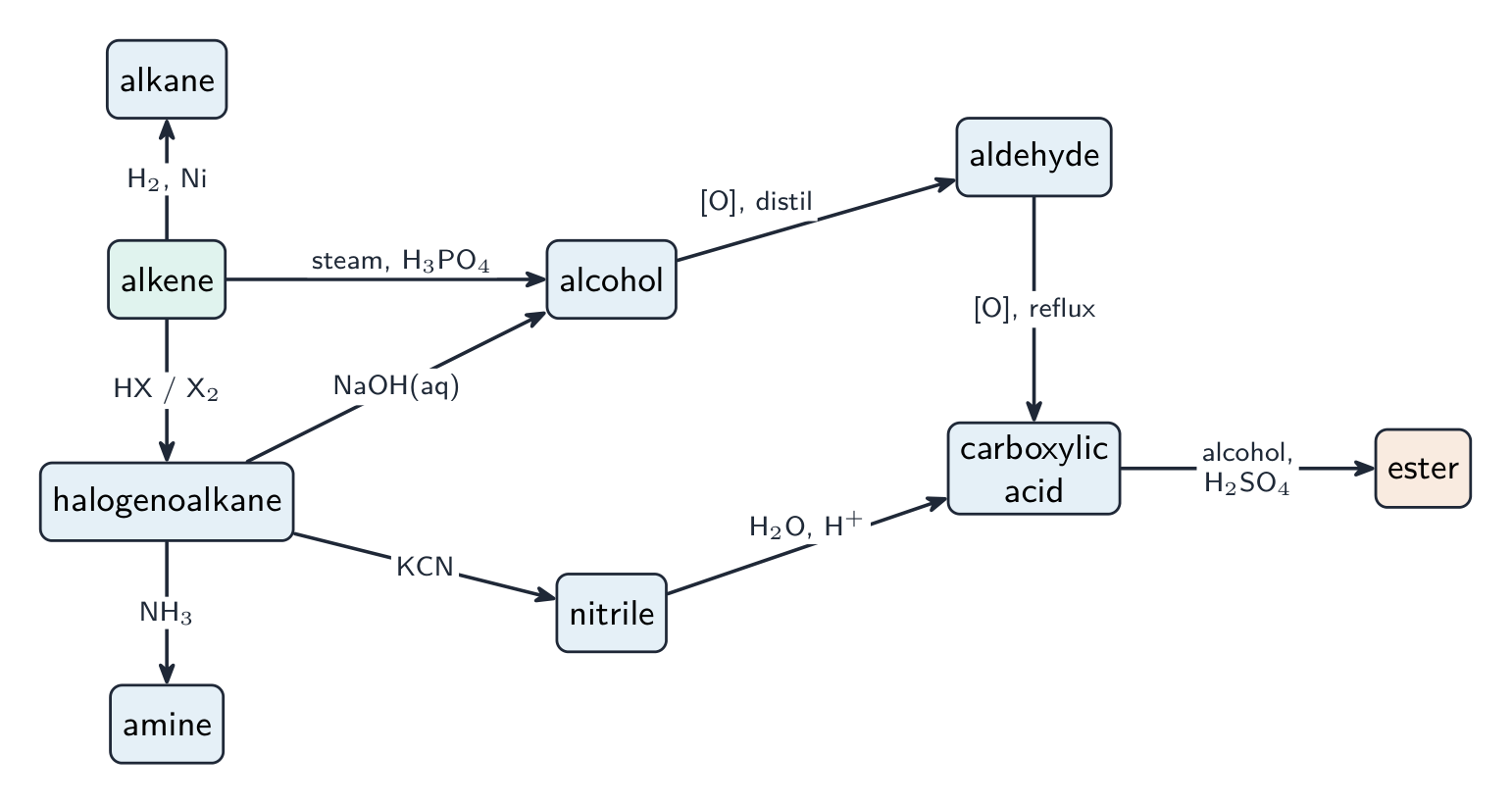
アルケン、アルカン、ハロゲンアルカン、アルコール、アルデヒド、ニトリル、アミン、カルボン酸、エステルをラベル付きの試薬矢印で結んだネットワーク図
ASの反応マップ:各矢印は1つの官能基を別のものに変換します。ターゲットから逆算してルートを計画してください

多段階ルートの計画

合成ルートを考案するには:

  1. ターゲットを出発物質と比較する — 何が変わったか(官能基、炭素数)?
  2. ターゲットから逆算する:どのような単一反応でこれを作れ、その原料は何か?
  3. 出発物質に到達するまで繰り返す。
  4. 各ステップを試薬と条件と共に書き出す。

炭素を増やす必要がある場合、$\text{KCN}$ ステップが鍵となります — これはAS反応の中で唯一鎖を長くするものです。

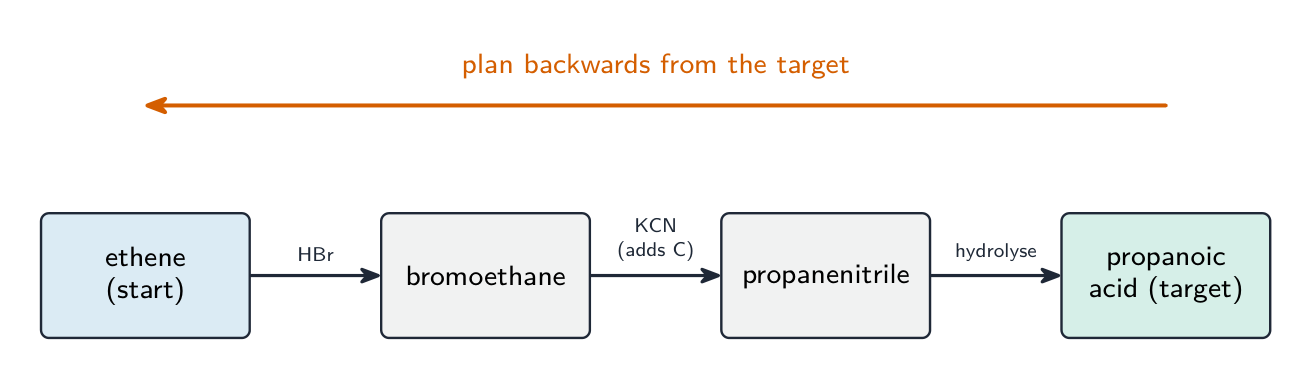
エチレンからプロパノ酸への合成連鎖:各進行方向のステップに試薬が示され、大きな逆矢印でプランニングがターゲットから出発点へ向かうことを示している
ターゲットから逆算して、1つずつ反応を遡り、出発物質に到達するまでルートを計画する

ルートの分析

与えられたルートに対して、各ステップで反応の種類(酸化、還元、置換、付加、脱離など)と使用された試薬を述べてください。また、可能性のある副産物についても考えましょう。例えば、ハロゲンアルカンからアミンを作る場合、さらに置換されたアミンの混合物も生成するため、単純なアミンの収率は低くなります。

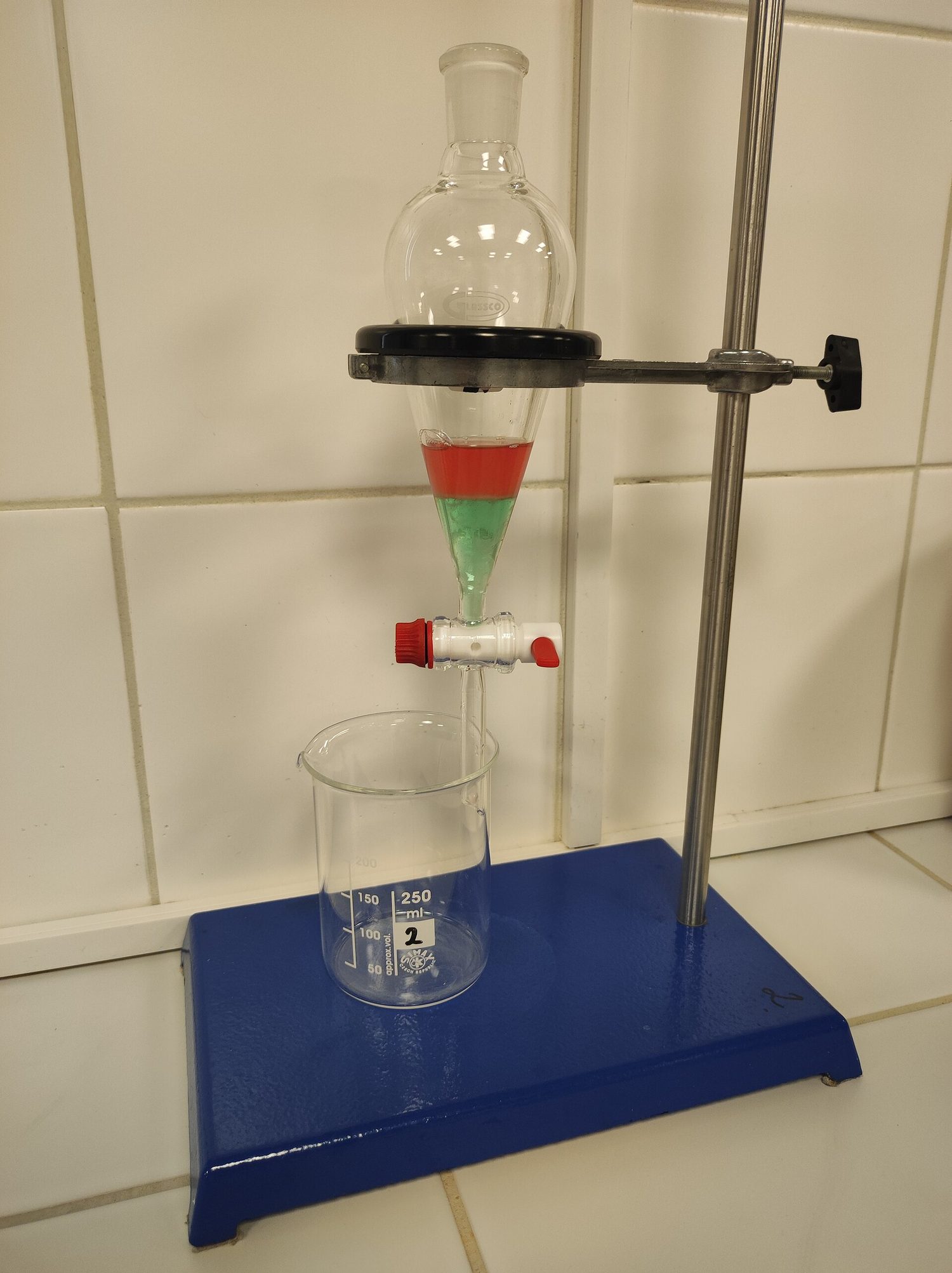
ビーカーの上に固定された分液漏斗:混ざり合わない2層の有色液体を含んでいる
分液漏斗は互いに溶け合わない2層を分離する — 反応混合物からの有機生成物の回収方法
与えられたルートの各ステップに対して3つの質問をする:反応の種類、試薬と条件、副産物が収率を下げるかどうか
与えられたルートのすべてのステップに対して、反応の種類、試薬、副産物を問う
5つの反応種類とそれぞれの作用:酸化、還元、置換、付加、脱離
各ステップの反応種類を名指す:酸化、還元、置換、付加、または脱離

** worked example.** プロペンからプロパノンへ合成する経路を立案せよ、$\text{CH}_3\text{COCH}_3$。標的物質から逆算する。ケトンは二次アルコールの酸化によって生成されるため、プロパノンの直前の中間体はプロパン-2-オールであり、還流条件下で酸性化された $\text{K}_2\text{Cr}_2\text{O}_7$ で酸化される。プロパン-2-オールはプロペンを $\text{H}_3\text{PO}_4$ 触媒上にある蒸気(スチーム)と付加することにより得られる。マルコフニコフ則により、$\text{OH}$ は中央の炭素原子に導入され、これがちょうど必要な二次アルコールとなる。したがって、合成経路は以下の通りである:プロペンを $\text{H}_3\text{PO}_4$ と蒸気で処理してプロパン-2-オールを得る;次に、還流条件下で酸性化された $\text{K}_2\text{Cr}_2\text{O}_7$ で酸化してプロパノンを得る。各矢印に対しては試薬とその反応条件を必ず記載せよ。適切な中間体は示しているものの試薬が記載されていない経路では、得点は極めて低い。

Explore · ⁨探索⁩

Reaction map lab · ⁨反応マップ実験室⁩

Classify clues that identify functional groups and reaction pathways. · ⁨官能基や反応経路を同定する手がかりを分類せよ。⁩

Explore · ⁨探索⁩

Synthetic route planning lab · ⁨合成経路設計実験室⁩

Follow how a target molecule is planned backwards then made forwards. · ⁨目標分子の逆合成計画と、それに続く正合成の流れを追う。⁩

Vocabulary · ⁨語彙⁩ Train · ⁨練習する⁩
English 日本語
functional group/ˈfʌŋkʃənl ɡruːp/ 官能基
alkene/ˈælkiːn/ アルケン
halogenoalkane/ˈheɪləʊdʒnəʊlkeɪn/ ハロゲン化アルキル
alcohol/ˈælkəhɒl/ アルコール
aldehyde/ˈældɪhaɪd/ アルデヒドが得られる
ketone/ˈketəʊn/ ケトン
carboxylic acid/ˌkɑːbəkˈsɪlɪk ˈæsɪd/ カルボン酸
nitrile/ˈnaɪtraɪl/ ニトリル
amine/ˈæmaɪn/ アミン
ester/ˈestə/ エステル
synthetic route/sɪnˈθetɪk ruːt/ 合成経路
reagent/rɪˈeɪdʒənt/ 試薬
oxidation/ˌɒksɪˈdeɪʃn/ 酸化反応
reduction/rɪˈdʌkʃn/ 還元
by-product/baɪ ˈprɒdʌkt/ 副生成物
21.1

Exam tips · ⁨試験対策⁩

English
  • Learn the reagents and conditions for each conversion — that is exactly what synthesis questions test.
  • Plan multi-step routes by functional group and watch the carbon count (KCN adds one carbon).
  • Choose the shortest valid route and state every reagent and condition.
日本語
  • 各変換における試薬と反応条件を暗記すること——これが合成問題の核心的な出題ポイントである。
  • 官能基ごとの多段階合成経路を計画し、炭素数の変化に注意すること(KCN は炭素を1つ追加する)。
  • 最短かつ有効な合成経路を選び、すべての試薬と反応条件を明記すること。

Interactive lessons on this topic · ⁨このトピックのインタラクティブ授業⁩

Work through it step by step, with instant-check exercises. · ⁨一歩ずつ進め、即時チェック付きの問題で学習します。⁩

Past Papers · ⁨過去問⁩

More topics in A-Level Chemistry · ⁨A-Level 化学⁩ · ⁨A-Level Chemistry · ⁨A-Level 化学⁩ の他のトピック⁩

Log in or create account · ⁨ログインまたはアカウント作成⁩

IGCSE, A-Level & AP