Skip to content · ⁨コンテンツへスキップ⁩

Group 2 · ⁨第2族⁩

A-Level Chemistry · ⁨A-Level 化学⁩ · Topic 10 · ⁨トピック 10⁩

View Slides · ⁨查看幻灯片⁩ Train · ⁨練習する⁩
Video lesson for this topic · ⁨このトピックのビデオレッスン⁩ Open the video page · ⁨動画ページを開く⁩
8:01

第2族

胃のX線検査の前、患者には白く厚い液体を飲ませられます。この液体にはバリウムが豊富に含まれており、バリウムイオンは毒物です。可溶性のバリウム塩を服用すると…

English narration · English + 中文 subtitles burned in · ⁨英語ナレーション・英語+中文字幕 burning-in⁩

10.1

The Group 2 metals · ⁨第2族金属⁩

Syllabus · ⁨シラバス⁩
English
  1. describe, and write equations for, the reactions of the elements with oxygen, water and dilute hydrochloric and sulfuric acids
  2. describe, and write equations for, the reactions of the oxides, hydroxides and carbonates with water and dilute hydrochloric and sulfuric acids
  3. describe, and write equations for, the thermal decomposition of the nitrates and carbonates, to include the trend in thermal stabilities
  4. describe, and make predictions from, the trends in physical and chemical properties of the elements involved in the reactions in 10.1.1 and the compounds involved in 10.1.2, 10.1.3 and 10.1.5
  5. state the variation in the solubilities of the hydroxides and sulfates
日本語
  1. 元素の酸素、水、希塩酸および希硫酸との反応を記述し、化学方程式を立てる
  2. 酸化物、水酸化物および炭酸塩の水、希塩酸および希硫酸との反応を記述し、化学方程式を立てる
  3. 熱分解について、窒素酸塩および炭酸塩の熱分解を記述し、熱安定性の傾向を含む
  4. 10.1.1の反応に関わる元素および10.1.2、10.1.3、10.1.5の反応に関わる化合物の物理的および化学的性質の傾向を記述し、予測を行う
  5. 水酸化物および硫酸塩の溶解度の変異を述べる

Source: Cambridge International syllabus · ⁨出典: Cambridge International シラバス⁩

English

Group 族 2 holds the metals magnesium, calcium, strontium and barium. They all have two outer electrons, which they lose to form $2+$ ions. Going down the group, the atoms get larger and the outer electrons are easier to lose, so the metals get more reactive — their reactivity 反应活性 increases down the group.

Reactions of the elements

With oxygen, they burn to form an oxide:

$$2\text{Mg} + \text{O}_2 \rightarrow 2\text{MgO}$$

With water, they form a hydroxide and hydrogen. The reaction gets faster down the group:

$$\text{Ca} + 2\text{H}_2\text{O} \rightarrow \text{Ca(OH)}_2 + \text{H}_2$$

Magnesium is slow with cold water but reacts fast with steam, giving $\text{MgO}$ and $\text{H}_2$.

With dilute hydrochloric or sulfuric acid, they form a salt and hydrogen:

$$\text{Mg} + 2\text{HCl} \rightarrow \text{MgCl}_2 + \text{H}_2 \qquad \text{Mg} + \text{H}_2\text{SO}_4 \rightarrow \text{MgSO}_4 + \text{H}_2$$

With sulfuric acid the reaction slows down the group, because the sulfates 硫酸盐 formed (such as $\text{BaSO}_4$) are insoluble and coat the metal.

Reactions of the compounds

The oxides 氧化物 and hydroxides 氢氧化物 are basic. They react with water and with dilute acids:

$$\text{MgO} + \text{H}_2\text{O} \rightarrow \text{Mg(OH)}_2 \qquad \text{Mg(OH)}_2 + 2\text{HCl} \rightarrow \text{MgCl}_2 + 2\text{H}_2\text{O}$$

The carbonates 碳酸盐 react with dilute acids to give a salt, water and carbon dioxide:

$$\text{CaCO}_3 + 2\text{HCl} \rightarrow \text{CaCl}_2 + \text{H}_2\text{O} + \text{CO}_2$$

Thermal decomposition

Thermal decomposition 热分解 means breaking a compound apart by heating it.

  • the carbonates break into the oxide and carbon dioxide:
$$\text{CaCO}_3 \rightarrow \text{CaO} + \text{CO}_2$$
  • the nitrates 硝酸盐 break into the oxide, brown nitrogen dioxide gas and oxygen:
$$2\text{Ca(NO}_3)_2 \rightarrow 2\text{CaO} + 4\text{NO}_2 + \text{O}_2$$

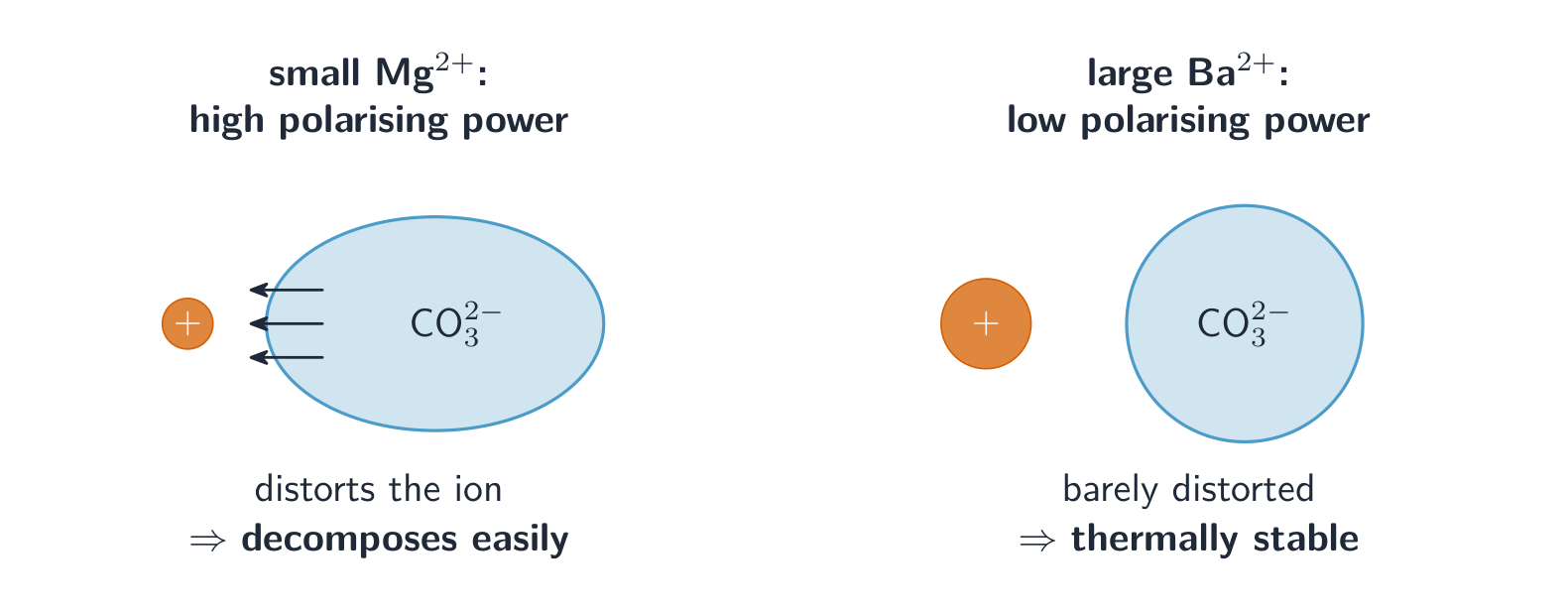
The thermal stability 热稳定性 of both the carbonates and the nitrates increases down the group. A larger metal ion pulls less on the carbonate or nitrate ion, so the compound is harder to break apart — it needs a higher temperature. So magnesium carbonate decomposes most easily, and barium carbonate is the hardest.

Trends in solubility

Compound Trend in solubility 溶解度 down the group
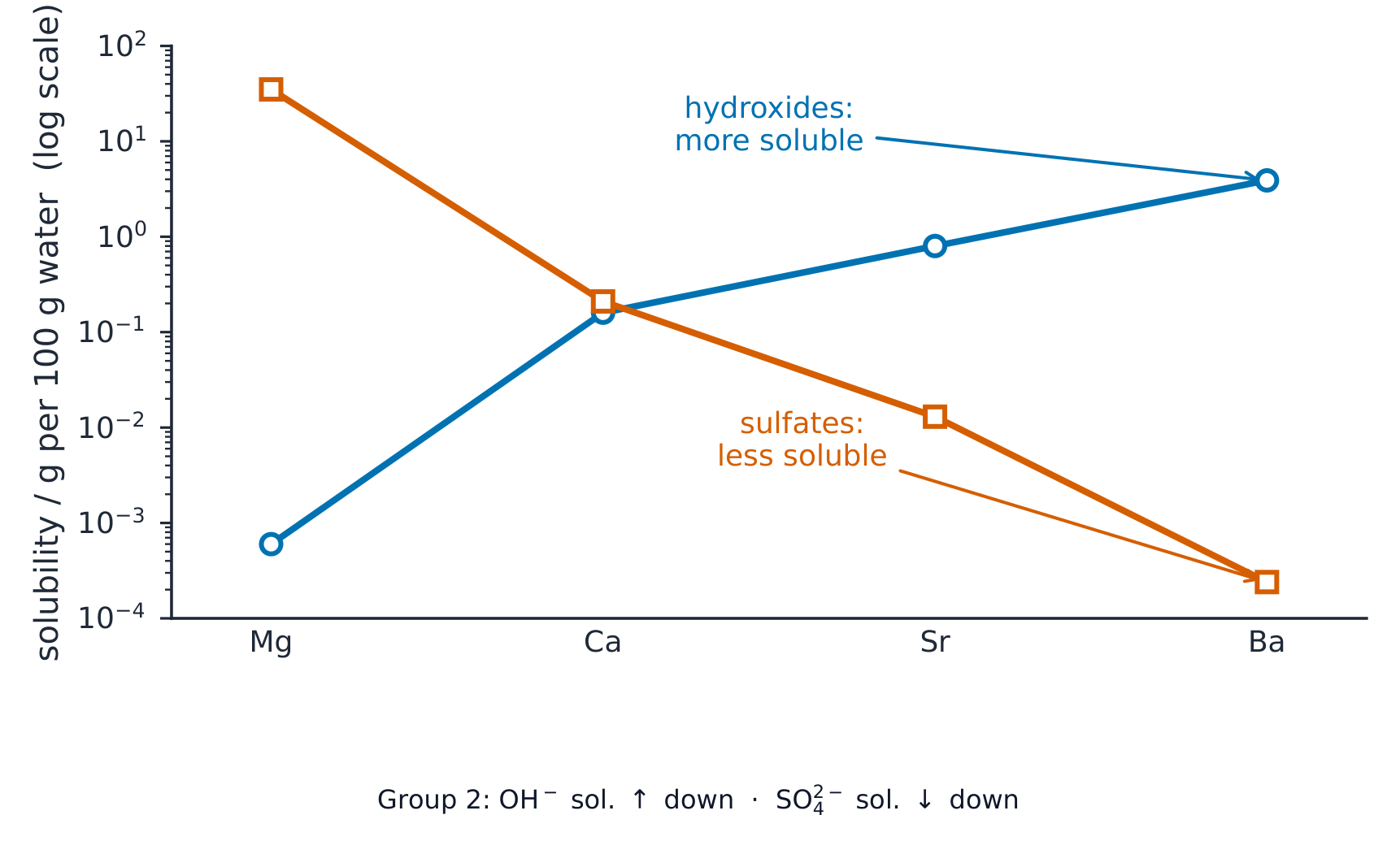
hydroxides increase (Mg(OH)$_2$ almost insoluble; Ba(OH)$_2$ soluble)
sulfates decrease (MgSO$_4$ soluble; BaSO$_4$ insoluble)

From these trends you can predict the properties of the next element down, radium, and of its compounds.

Worked example. $\text{MgCO}_3$ decomposes at about $540\ °\text{C}$ and $\text{BaCO}_3$ at about $1360\ °\text{C}$. Explain the trend and predict where $\text{CaCO}_3$ sits. Going down Group 2 the cation gets larger, so its charge is spread over a bigger surface and its polarising power falls. A less polarising cation distorts the carbonate ion less, so the $\text{C-O}$ bond is weakened less and more heat is needed to break it. Thermal stability therefore increases down the group, and $\text{CaCO}_3$, lying between Mg and Ba, decomposes at an intermediate temperature of about $900\ °\text{C}$. Argue the whole chain - cation size, then polarising power, then distortion of the anion; "it is more reactive" explains nothing here.

日本語
カルシウム炭酸塩の海岸石灰岩崖
石灰岩はカルシウム炭酸塩である——第2族金属カルシウムの化合物。

第2族には、マグネシウム、カルシウム、ストロンチウム、バリウムという金属が含まれる。これらすべては2つの最外殻電子を持ち、失って $2+$ イオンを形成する。族を下 going するにつれて、原子は大きくなり、最外殻電子は失われやすくなるため、金属はより活性になる——その反応性は族を下 going して増加する。

第2族原子がマグネシウムからバリウムまで大きくなる様子と、反応性が増すことを示す下向きの矢印
第2族で反応性が増加する:大きな原子は2つの最外殻電子をより緩やかに保持するため、失われやすい

元素の反応

酸素に対して、燃焼して酸化物を形成する:

$$2\text{Mg} + \text{O}_2 \rightarrow 2\text{MgO}$$
ペンチで持ったマグネシウムリボンが眩しい白光を放ちながら燃え、酸化マグネシウムの白色煙を出す
マグネシウムは空気中で鮮やかな白色の炎を放ちながら燃え、白色の酸化マグネシウムを形成する

水に対して、水酸化物と水素ガスを形成する。反応は族を下 going して速くなる:

$$\text{Ca} + 2\text{H}_2\text{O} \rightarrow \text{Ca(OH)}_2 + \text{H}_2$$

マグネシウムは冷水に対して遅いが、蒸気に対して速く反応して $\text{MgO}$ と $\text{H}_2$ を生じる。

希薄塩酸または希薄硫酸に対して、塩と水素ガスを形成する:

$$\text{Mg} + 2\text{HCl} \rightarrow \text{MgCl}_2 + \text{H}_2 \qquad \text{Mg} + \text{H}_2\text{SO}_4 \rightarrow \text{MgSO}_4 + \text{H}_2$$

硫酸との反応は族を下 going して遅くなる。なぜなら、生成される硫酸塩(例えば $\text{BaSO}_4$ など)は難溶であり、金属を覆うからである。

化合物の反応

酸化物と水酸化物は塩基性である。水および希薄酸と反応する:

$$\text{MgO} + \text{H}_2\text{O} \rightarrow \text{Mg(OH)}_2 \qquad \text{Mg(OH)}_2 + 2\text{HCl} \rightarrow \text{MgCl}_2 + 2\text{H}_2\text{O}$$

炭酸塩は希薄酸と反応して塩、水、二酸化炭素を生じる:

$$\text{CaCO}_3 + 2\text{HCl} \rightarrow \text{CaCl}_2 + \text{H}_2\text{O} + \text{CO}_2$$

熱分解

熱分解とは、加熱によって化合物を崩壊させることである。

  • 炭酸塩は酸化物と二酸化炭素に分解する:
$$\text{CaCO}_3 \rightarrow \text{CaO} + \text{CO}_2$$
  • 硝酸塩は酸化物、茶色の窒素酸化物ガス、酸素に分解する:
$$2\text{Ca(NO}_3)_2 \rightarrow 2\text{CaO} + 4\text{NO}_2 + \text{O}_2$$

炭酸塩と硝酸塩の熱安定性は族を下 going して増加する。大きな金属イオンは炭酸塩イオンや硝酸塩イオンをより弱く引き寄せるため、化合物は崩壊しにくく、高い温度が必要となる。したがって、炭酸マグネシウムは最も容易に分解し、炭酸バリウムは最も分解されにくい。

小さなマグネシウムイオンが炭酸塩イオンを強く歪ませる様子、隣にはわずかにしか歪ませない大きなバリウムイオン
熱安定性は族を下 going して上昇する:小さなカチオンは炭酸塩イオンをより強く分極(歪ませ)して弱め、分解されやすくする

溶解度の傾向

化合物 族を下 going する溶解度の傾向
水酸化物 増加 (Mg(OH)$_2$ はほとんど難溶;Ba(OH)$_2$ は可溶)
硫酸塩 減少 (MgSO$_4$ は可溶;BaSO$_4$ は難溶)
対数スケールの2本の線が交差:水酸化物の溶解度はMgからBaへ上昇し、硫酸塩の溶解度は低下
第2族を下 going するにつれ、水酸化物はより可溶になり、硫酸塩はより難溶になる(対数スケールに注意)

これらの傾向から、族を下 going した次の元素であるラジウムおよびその化合物の性質を予測できる。

計算例. $\text{MgCO}_3$ は約 $540\ °\text{C}$ で分解し、$\text{BaCO}_3$ は約 $1360\ °\text{C}$ で分解する。この傾向を説明し、$\text{CaCO}_3$ がどの位置にあるかを予測せよ。第2族を下るにつれてカチオンは大きくなるため、電荷がより広い表面に分散され、分極力が低下する。分極力が小さいカチオンは炭酸イオンをより少しくずすため、$\text{C-O}$ 結合は弱くならず、分解するために必要な熱も増える。したがって、熱安定性は族を下るにつれて増加し、MgとBaの間に位置する$\text{CaCO}_3$ は中間温度である約 $900\ °\text{C}$ で分解する。一連の流れを論じよ:カチオンのサイズ → 分極力 → アニオンの歪み。単に「反応性が高いから」と説明してはならない。

Explore · ⁨探索⁩

Group 2 reactivity ladder · ⁨第2族の反応性階段⁩

Move down Group 2 and see why reactions become more vigorous. · ⁨第2族を下に進んで、なぜ反応が激しくなるかを確認せよ。⁩

Explore · ⁨探索⁩

Group 2 trend lab · ⁨第2族の傾向実験室⁩

Compare thermal stability and solubility trends down Group 2. · ⁨第2族を下に進む際の熱的安定性と溶解度の傾向を比較せよ。⁩

Vocabulary · ⁨語彙⁩ Train · ⁨練習する⁩
English 日本語
group/ɡruːp/ グループ
reactivity/rɪəkˈtɪvɪti/ 反応性
sulfate/ˈsʌlfeɪt/ 硫酸塩
oxide/ˈɒksaɪd/ 酸化物
hydroxide/haɪˈdrɒksaɪd/ 水酸化物
carbonate/ˈkɑːbəneɪt/ 炭酸塩
thermal decomposition/ˈθɜːml ˌdiːkɒmpəˈzɪʃn/ 熱分解
nitrate/ˈnaɪtreɪt/ 窒素酸
thermal stability/ˈθɜːml stəˈbɪlɪti/ 熱安定性
solubility/ˌsɒljuːˈbɪlɪti/ 溶解度
10.1

Exam tips · ⁨試験対策⁩

English
  • Reactivity increases down Group 2: ionisation energy falls as atoms get larger, so electrons are lost more easily.
  • Reactions with water become more vigorous down the group; Mg reacts slowly with cold water but fast with steam (→ MgO).
  • Hydroxides get more soluble down the group; sulfates get less soluble ($\text{BaSO}_4$ insoluble — the basis of the sulfate test).
  • Write equations with the correct $+2$ ion and state the observations (fizzing, dissolving).
日本語
  • 第2族を下るにつれて反応性は増加する:原子が大きくなるにつれて第一イオン化エネルギーが低下するため、電子が失われやすくなる。
  • 水との反応は族を下るにつれて激しくなる;Mgは冷水とはゆっくり反応するが、蒸気とは速く反応する(→ MgO)。
  • 水酸化物は族を下るにつれて溶解度が増加し、硫酸塩は溶解度が減少する($\text{BaSO}_4$ は不溶 — 硫酸塩の検出法に基づく)。
  • 正しい$+2$ イオンを用いて化学方程式を書き、観察現象(泡立ち、溶解)を記述せよ。

Interactive lessons on this topic · ⁨このトピックのインタラクティブ授業⁩

Work through it step by step, with instant-check exercises. · ⁨一歩ずつ進め、即時チェック付きの問題で学習します。⁩

Past Papers · ⁨過去問⁩

More topics in A-Level Chemistry · ⁨A-Level 化学⁩ · ⁨A-Level Chemistry · ⁨A-Level 化学⁩ の他のトピック⁩

Log in or create account · ⁨ログインまたはアカウント作成⁩

IGCSE, A-Level & AP