Skip to content · ⁨コンテンツへスキップ⁩

Immunity · ⁨免疫⁩

A-Level Biology · ⁨A-Level 生物⁩ · Topic 11 · ⁨トピック 11⁩

View Slides · ⁨查看幻灯片⁩ Train · ⁨練習する⁩
Video lesson for this topic · ⁨このトピックのビデオレッスン⁩ Open the video page · ⁨動画ページを開く⁩
8:37

免疫

麻疹に一度かかったら、ほぼ二度とはかかりません。体が強くなったわけではなく、ウイルスも弱まったわけではありません。何が変化しましたか?…

English narration · English + 中文 subtitles burned in · ⁨英語ナレーション・英語+中文字幕 burning-in⁩

11.1

Phagocytes — the first defence · ⁨食胞体 ― 最初の防御⁩

Syllabus · ⁨シラバス⁩
English
  1. describe the mode of action of phagocytes (macrophages and neutrophils)
  2. explain what is meant by an antigen (see 4.1.3) and state the difference between self antigens and non-self antigens
  3. describe the sequence of events that occurs during a primary immune response with reference to the roles of: • macrophages • B-lymphocytes, including plasma cells • T-lymphocytes, limited to T-helper cells and T-killer cells
  4. explain the role of memory cells in the secondary immune response and in long-term immunity
日本語
  1. 食胞性細胞(マクロファージおよび好中球)の作用様式を記述せよ
  2. 抗原(4.1.3を参照)の意味を説明し、自己抗原と非自己抗原の違いを述べよ
  3. 以下の役割に関する一次免疫応答中に起こる一連の出来事を記述せよ: • マクロファージ • Bリンパ球、形質細胞を含む • Tリンパ球、Tヘルパー細胞およびTキラー細胞に限定する
  4. 二次免疫応答および長期免疫における記憶細胞の役割を説明せよ

Source: Cambridge International syllabus · ⁨出典: Cambridge International シラバス⁩

English

Your immune system 免疫系统 is the set of cells that defends the body against pathogens 病原体. The first cells to act are phagocytes 吞噬细胞, a group of white blood cells that includes macrophages 巨噬细胞 and neutrophils 中性粒细胞.

A phagocyte destroys a pathogen by phagocytosis 吞噬作用: it surrounds the pathogen, takes it inside in a vesicle, and digests it with enzymes. After this, a macrophage displays parts of the pathogen on its own surface, ready to alert other immune cells.

This false-coloured electron micrograph captures the moment in real life: a phagocyte reaching out to grab and engulf rod-shaped bacteria.

日本語

あなたの免疫系とは、病原体から体を守る細胞群のことである。最初に活動するのは食胞体であり、マクロファージや好中球を含む白血球の一種である。

赤血球と複数の大きな紫色の白血球を含む染色血液塗抹片
血液塗抹片:大きな染色された細胞は白血球であり、多数の赤血球の間に散在している

食胞体は食作用によって病原体を破壊する。すなわち、病原体を取り囲んで小胞に取り込み、酵素によって消化する。その後、マクロファージは病原体の一部を自身の表面に提示し、他の免疫細胞への警告準備を整える。

3つの工程:食胞体が病原体を吞み込み、小胞内で酵素で消化した後、その抗原を表面に提示する様子
食作用:食胞体が病原体を吞み込み、消化して、その抗原を提示する

この偽彩色電子顕微鏡写真は、現実の瞬間を捉えたものである:棒状のバクテリアを掴んで吞み込もうとする食胞体の姿。

暗い青色の背景に対する偽彩色走査型電子顕微鏡写真:波打つ表面を持つ黄色の好中球が、指のような突起を伸ばして、複数の長いオレンジ色の棒状の炭疽バクテリアを掴んでいる様子
実際の好中球(黄色)― 食胞体の一種が、食作用によって棒状のバクテリア(オレンジ色)を吞み込もうとしている
Explore · ⁨探索⁩

Phagocytosis · ⁨食胞作用⁩

Step through how a phagocyte deals with a pathogen — engulf it, digest it, then display its antigen to call in the rest of the immune system. · ⁨食胞体が病原体を処理する手順を確認する——包み込み、消化し、その後免疫系を呼び出すためにその抗原を示す。⁩

Vocabulary · ⁨語彙⁩ Train · ⁨練習する⁩
English 日本語
immune system/ɪˈmjuːn ˈsɪstəm/ 免疫系
pathogen/ˈpæθədʒn/ 病原体
phagocyte/ˈfæɡəsaɪt/ 食胞作用細胞
macrophage/ˈmækrəfɪdʒ/ マクロファージ
neutrophil/ˈnjuːtrəfɪl/ 好中球
phagocytosis/ˌfæɡəsɪˈtəʊsɪs/ 食胞作用
11.1

Antigens: self and non-self · ⁨抗原:自己と非自己⁩

English

An antigen 抗原 is a molecule (usually a protein) on a cell surface that the immune system can recognise.

  • self antigens 自身抗原 are the body's own markers. The immune system learns to ignore them.
  • non-self antigens 非自身抗原 are foreign, for example the antigens on a pathogen. These trigger an immune response.
日本語

抗原とは、細胞表面にある分子(通常はタンパク質)であり、免疫系が認識できるものである。

  • 自己抗原は体内の固有マーカーである。免疫系はこれらを無視することを学ぶ。
  • 非自己抗原は外来のものであり、例えば病原体上の抗原などがこれに該当する。これらは免疫反応を引き起こす。
培地盤上の透明領域:免疫系が非自己抗原を認識し、外来細胞を攻撃する
Vocabulary · ⁨語彙⁩ Train · ⁨練習する⁩
English 日本語
antigen/ˈæntɪdʒen/ 抗原
self antigen/self ˈæntɪdʒen/ 自己抗原
non-self antigen/nɒn self ˈæntɪdʒen/ 非自己抗原
11.1

The primary immune response · ⁨一次免疫応答⁩

English

The first time a new pathogen enters, the body makes a slow immune response 免疫反应. The main steps are:

  1. a macrophage engulfs the pathogen and displays its antigen.
  2. T-helper cells 辅助性T细胞 recognise that antigen and become active. They release chemicals that switch on other cells.
  3. B-lymphocytes 淋巴细胞 with a matching shape are selected. They divide to form plasma cells 浆细胞, which pour out antibodies 抗体, and memory cells 记忆细胞.
  4. T-killer cells 杀伤性T细胞 destroy the body's own cells that have been infected.
日本語

新しい病原体が初めて侵入した場合、体はゆっくりとした免疫応答を起こす。主な手順は以下の通りである:

  1. マクロファージが病原体を吞み込み、その抗原を提示する。
  2. Tヘルパー細胞Tがその抗原を認識して活性化する。そして他の細胞をオンにする化学物質を放出する。
  3. 対応する形状を持つBリンパ球が選択される。これらの細胞は分裂して形質細胞となり、そこから抗体が大量に分泌される。同時に記憶細胞も形成される。
  4. Tキラー細胞Tは、体内で感染した自分の細胞を破壊する。
マクロファージが抗原を提示し、活性化されたTヘルパー細胞へ、さらに選択されたBリンパ球へと続く流れ。Bリンパ球は形質細胞(抗体産生)と記憶細胞に分裂する
抗原の形状に一致するBリンパ球のみが選択・増幅され―抗体産生用の形質細胞や長寿命の記憶細胞へと克隆される
Explore · ⁨探索⁩

The primary immune response · ⁨一次免疫応答⁩

Step through the first time the body meets a pathogen — slow at first, but it leaves memory cells behind. · ⁨病原体との初接触をステップバイステップで確認 — 最初は遅いですが、記憶細胞を残します。⁩

11.1

Memory cells and long-term immunity · ⁨記憶細胞と長期免疫⁩

English

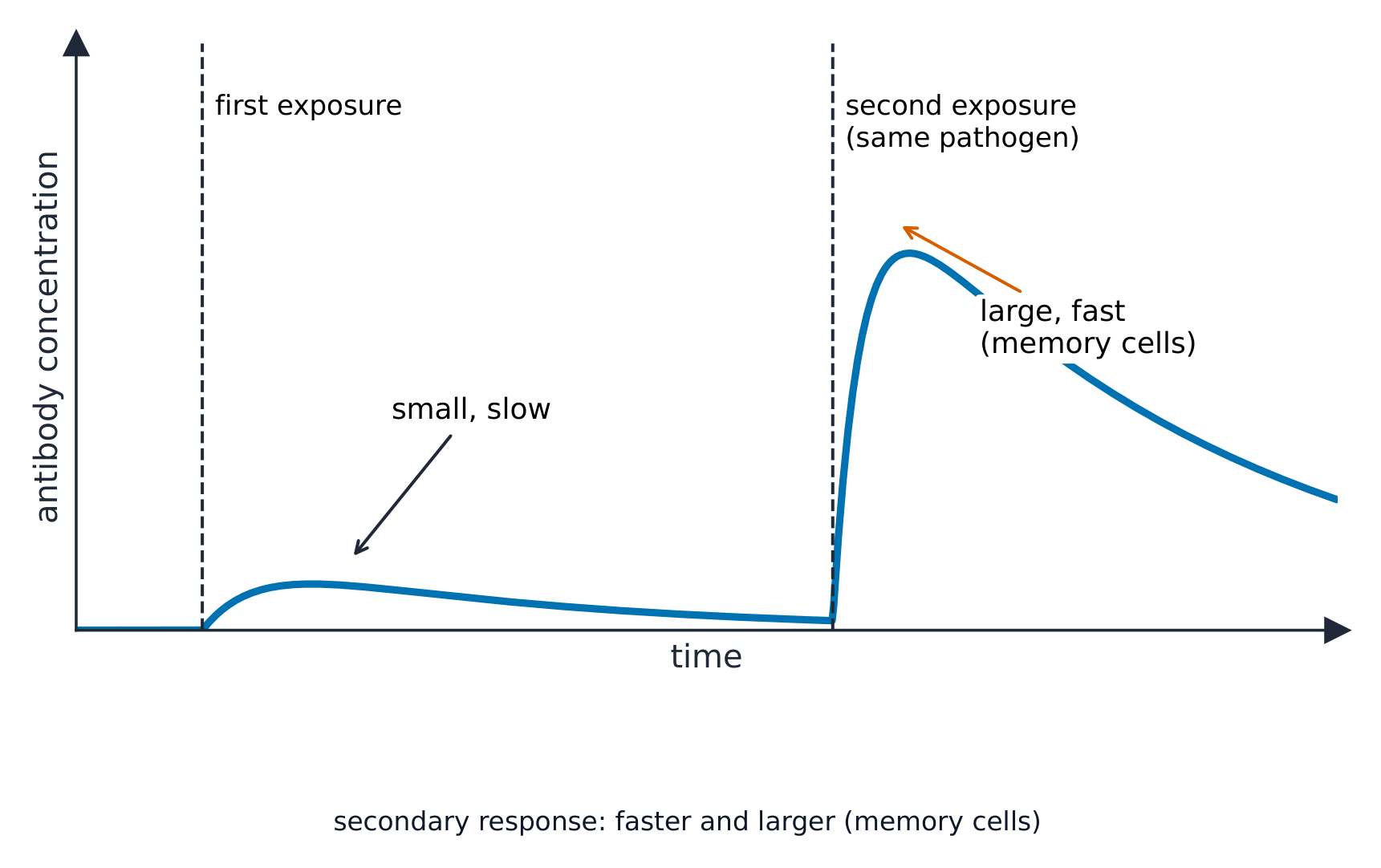
Memory cells stay in the body for years after the infection is over. If the same pathogen enters again, the memory cells start a secondary immune response that is much faster and larger than the first. The pathogen is destroyed before it can make you ill. This is what we mean by long-term immunity.

日本語

記憶細胞は感染終息後も体内に数年間残留する。もし同じ病原体が再侵入すれば、記憶細胞は二次的な免疫応答を開始する。これは第一次応答よりもはるかに速く、強力である。病原体は病気を発症させる前に破壊される。これが私たちが意味する「長期免疫」である。

時間経過に伴う抗体濃度の変化グラフ:初回曝露後に小さくゆっくり上昇し、同じ病原体への再曝露後にははるかに大きく速く上昇する
二次応答は速く强大である。記憶細胞が既に備えているためである
Vocabulary · ⁨語彙⁩ Train · ⁨練習する⁩
English 日本語
immune response/ɪˈmjuːn rɪˈspɒns/ 免疫反応
T-helper cell/tiː ˈhelpə sel/ Tヘルパー細胞
lymphocyte/ˈlɪmfəsaɪt/ リンパ球
plasma cell/ˈplæzmə sel/ 形質細胞
11.2

Antibodies · ⁨抗体⁩

Syllabus · ⁨シラバス⁩
English
  1. relate the molecular structure of antibodies to their functions
  2. outline the hybridoma method for the production of monoclonal antibodies
  3. outline the principles of using monoclonal antibodies in the diagnosis of disease and in the treatment of disease
  4. describe the differences between active immunity and passive immunity and between natural immunity and artificial immunity
  5. explain that vaccines contain antigens that stimulate immune responses to provide long-term immunity
  6. explain how vaccination programmes can help to control the spread of infectious diseases
日本語
  1. 抗体の分子構造と機能の関係を述べよ
  2. クローン抗体の製造のためのハイブリドーマ法を概説せよ
  3. 疾病の診断および治療におけるクローン抗体の使用の原則を概説せよ
  4. 能動的免疫と受動的免疫の違い、および自然免疫と人工免疫の違いを記述せよ
  5. ワクチンには抗原が含まれており、免疫応答を刺激して長期免疫を提供することを説明せよ
  6. ワクチン接種プログラムが感染症の拡大を抑制するのにどう役立つかを説明せよ

Source: Cambridge International syllabus · ⁨出典: Cambridge International シラバス⁩

English

An antibody is a Y-shaped protein made by plasma cells. The two tips of the Y are antigen-binding sites 抗原结合位点. Each site has a special shape, called the variable region 可变区, that fits one antigen only, like a lock and key.

Antibodies help in several ways: they stick to antigens, clump pathogens together so they are easier to deal with, mark pathogens so phagocytes find them, and block harmful toxins.

日本語

抗体とは、形質細胞によって作られるY字型のタンパク質である。Y字の2つの先端部は抗原結合部位である。各部位には可変領域と呼ばれる特別な形状があり、鍵と鍵穴のように、特定の抗原1種類にのみ適合する。

Y字型の抗体:抗原が2つの先端(可変領域であり、抗原結合部位を形成する部分)それぞれに結合している様子
抗体はY字型である。2つの先端は可変領域であり、特定の抗原1種類に結合する

抗体は多様な方法で機能を発揮する:抗原に付着したり、病原体同士を凝集させて処理しやすくしたり、病原体に目印をつけて食胞体が見つけやすくしたり、有害な毒素をブロックしたりする。

Explore · ⁨探索⁩

Inside an antibody · ⁨抗体の内部構造⁩

Tap each part. The variable tips bind one specific antigen; the constant stem is the same in every antibody. · ⁨各部分をクリックせよ。可変端部は特定の抗原1つに結合し、一定領域はすべての抗体で同じである。⁩

Vocabulary · ⁨語彙⁩ Train · ⁨練習する⁩
English 日本語
antibody/ˈæntɪbɒdi/ 抗体
memory cell/ˈmeməri sel/ 記憶細胞
T-killer cell/tiː ˈkɪlə sel/ Tキラー細胞
antigen-binding site/ˈæntɪdʒen ˈbaɪndɪŋ saɪt/ 抗原結合部位
variable region/ˈveərɪəbl ˈriːdʒn/ 可変領域
monoclonal antibody/ˈmɒnəʊklɒnl ˈæntɪbɒdi/ 単一克隆抗体(モノクローナル抗体)
11.2

Monoclonal antibodies · ⁨モノクローナル抗体⁩

English

A monoclonal antibody 单克隆抗体 is a single type of antibody, all identical. They are made by the hybridoma 杂交瘤 method:

  1. an animal is given an antigen, so it makes B-lymphocytes that produce the wanted antibody.
  2. these B-lymphocytes are fused with tumour cells, which divide endlessly.
  3. the fused cell (the hybridoma) both makes the antibody and divides without stopping, producing large amounts of one identical antibody.

Monoclonal antibodies are used in the diagnosis 诊断 of disease (to detect a specific molecule, as in a pregnancy test) and in treatment (to carry drugs to specific target cells, such as cancer cells).

日本語

モノクローナル抗体とは、同一種類の抗体で、すべてが同一構造である。これらはハイブリドーマ法によって製造される:

  1. 動物に抗原を与え、目的の抗体を産生するBリンパ球を作らせる。
  2. これらのBリンパ球は、無限に分裂する腫瘍細胞と融合する。
  3. 融合した細胞(ハイブリドマ)は、抗体を作るとともに、停止することなく分裂し、同一の抗体を大量に産生する。
Bリンパ球が腫瘍細胞と融合してハイブリドマとなり、目的の抗体を作るとともに無限に分裂して多くの同一抗体を生産する様子
Bリンパ球と腫瘍細胞を融合させると、同一(単クローン)の抗体を多量に分泌するハイブリドマが得られる

単クローン抗体は、疾患の診断(妊娠検査のような特定の分子を検出するため)や治療(がん細胞などの特定の標的細胞へ薬物を運ぶため)に用いられる。

hCGとラベル付けされた妊娠検査カセットで、文字CとTの隣に赤い線が2本表示されている様子
妊娠検査は単クローン抗体の働きである。抗体はTラインに固定され、妊娠ホルモンhCGという1種類の分子のみを結合する。尿中にhCGが存在する場合に限りTラインが赤くなり、Cラインは常に現れ、検査が正常に行われたことを示す
Vocabulary · ⁨語彙⁩ Train · ⁨練習する⁩
English 日本語
hybridoma/ˌhaɪbrɪˈdəʊmə/ ハイブリドーマ
diagnosis/ˌdaɪəɡˈnəʊsɪs/ 診断
active immunity/ˈæktɪv ɪˈmjuːnɪti/ 能動免疫
passive immunity/ˈpæsɪv ɪˈmjuːnɪti/ 受動免疫
natural immunity/ˈnætʃərəl ɪˈmjuːnɪti/ 自然免疫
artificial immunity/ˌɑːtɪˈfɪʃl ɪˈmjuːnɪti/ 人工免疫
vaccine/vækˈsiːn/ ワクチン
vaccination/ˌvæksɪˈneɪʃn/ ワクチン接種
11.2

Types of immunity · ⁨免疫の種類⁩

English

Immunity can be active or passive, and natural or artificial.

  • active immunity 主动免疫 — your own body meets an antigen and makes its own antibodies and memory cells. It is slow to start but long-lasting.
  • passive immunity 被动免疫 — ready-made antibodies are given to you from outside. It works at once but does not last, because there are no memory cells.
  • natural immunity 天然免疫 — gained in a natural way (active: after an infection; passive: antibodies passed from mother to baby).
  • artificial immunity 人工免疫 — gained on purpose (active: your body is made to respond to a safe dose of antigen; passive: you are injected with ready-made antibodies).
日本語

免疫には、能動的または受動的、自然または人工のものがある。

  • 能動性免疫 — 自身の体が抗原に出会い、自身の抗体と記憶細胞を作る。発現は遅いが、持続する。
  • 受動性免疫 — 外部から既成の抗体を授与される。即効性はあるが、記憶細胞がないため持続しない。
  • 自然性免疫 — 自然な方法で獲得される(能動性:感染後;受動性:母親から胎児への抗体の移行)。
  • 人工性免疫 — 意図的に獲得される(能動性:安全量の抗原に対する応答を誘導する;受動性:既成の抗体を注射する)。
免疫の2×2分類表:感染後の能動性自然免疫、ワクチンによる能動性人工免疫、母親からの受動性自然免疫、注射による受動性人工免疫
能動性免疫(体の反応)は持続するが、受動性免疫(既成抗体)は速いものの短い
11.2

Vaccination · ⁨予防接種⁩

English

A vaccine 疫苗 contains antigens — often a dead or weakened pathogen, or part of one. The antigens trigger a primary immune response and make memory cells, so you gain long-term immunity without becoming ill.

Vaccination 疫苗接种 programmes can control the spread of a disease across a population. If enough people are vaccinated, the pathogen cannot pass easily from person to person. This protects even the people who are not vaccinated, an effect called herd immunity 群体免疫.

Worked example. Classify each as active or passive, natural or artificial: (a) a baby receives antibodies in breast milk; (b) a child is vaccinated against measles; (c) someone recovers from chickenpox; (d) a patient bitten by a snake is given antivenom. Ask two questions each time. Did the person make the antibodies themselves? If yes it is active; if they were handed ready-made ones, it is passive. Did it happen by chance or deliberately? Naturally, or artificially. So (a) is natural passive - ready-made antibodies by a natural route; (b) is artificial active - the vaccine's antigens make the child produce their own; (c) is natural active - the infection made them produce their own; (d) is artificial passive - ready-made antibodies given deliberately. Only active immunity makes memory cells, which is exactly why passive immunity acts immediately but is short-lived.

日本語

ワクチンには抗原が含まれる。一般的には死菌または弱毒化された病原体、あるいはその一部である。抗原は一次免疫応答を引き起こし、記憶細胞を形成するため、病気になることなく長期的な免疫を得られる。

予防接種プログラムにより、集団内での疾病の拡大を抑制できる。十分な人が接種されれば、病原体は人から人へと簡単に伝播できなくなる。これにより、未接種者も保護されるが、これを群衆免疫という効果と呼ぶ。

接種者が病原体の伝播を遮断し、周囲の未接種者を保護している様子
群衆免疫:十分な人が接種されれば、病原体は少数の未接種者に到達できない

** worked example.** 次を能動/受動、自然/人工のいずれかに分類せよ:(a) 乳児が母乳から抗体を受ける;(b) 子供が麻疹ワクチンを受ける;(c) 某人が水疱瘡から回復する;(d) 蛇に噛まれた患者に抗血清を受ける。毎回2つの質問を行う。その人は自身で抗体を作ったか? はいなら能動性、既成のものを渡されたら受動性である。偶然か意図的か? 自然か人工か。したがって(a)は自然受動性—自然な経路での既成抗体;(b)は人工能動性—ワクチンの抗原が子供自身に抗体を作らせる;(c)は自然能動性—感染が自身での抗体生産を促した;(d)は人工受動性—意図的に渡された既成抗体。能動性免疫のみが記憶細胞を作り、これが受動性免疫が即効性はあるものの短命である理由そのものである。

Explore · ⁨探索⁩

How a vaccine works · ⁨ワクチンの仕組み⁩

Step through it. A vaccine triggers a primary response and memory cells, so the real pathogen meets a fast, strong defence. · ⁨順を追って確認しよう。ワクチンは一次応答と記憶細胞を誘導するため、実際の病原体は迅速かつ強力な防衛に遭遇する。⁩

Vocabulary · ⁨語彙⁩ Train · ⁨練習する⁩
English 日本語
herd immunity/hɜːd ɪˈmjuːnɪti/ 集団免疫
11.2

Exam tips · ⁨試験対策⁩

English
  • Distinguish phagocytes (engulf, non-specific) from lymphocytes: B cells → antibodies (humoral), T cells (helper/killer, cell-mediated).
  • Label an antibody (variable region, antigen-binding site) and explain agglutination and neutralisation.
  • Compare the primary and secondary response on a graph — memory cells make the secondary faster and larger.
  • Distinguish active vs passive and natural vs artificial immunity with an example of each; explain vaccination and herd immunity.
日本語
  • 食胞性細胞(取り込み、非特異的)とリンパ球を区別する:B細胞→抗体(体液性)、T細胞(ヘルパー/キラー、細胞性)。
  • 抗体(可変領域、抗原結合部位)にラベルをつけ、凝集および中和を説明する。
  • グラフ上で一次応答と二次応答を比較する。記憶細胞により二次応答は速く大きくなる。
  • 各々の例を用いて能動性と受動性、自然性と人工性の免疫を区別し、ワクチンと群衆免疫を説明する。

Interactive lessons on this topic · ⁨このトピックのインタラクティブ授業⁩

Work through it step by step, with instant-check exercises. · ⁨一歩ずつ進め、即時チェック付きの問題で学習します。⁩

Past Papers · ⁨過去問⁩

More topics in A-Level Biology · ⁨A-Level 生物⁩ · ⁨A-Level Biology · ⁨A-Level 生物⁩ の他のトピック⁩

Log in or create account · ⁨ログインまたはアカウント作成⁩

IGCSE, A-Level & AP