Listrik dapat melakukan sesuatu yang menakjubkan: dapat memecah senyawa. Alirkan arus melalui senyawa lelehan atau terlarut, dan ia terurai menjadi unsurnya.…
English narration · English + 中文 subtitles burned in · Narasi bahasa Inggris · Subtitle bahasa Inggris + 中文 disematkan langsung
4.1
Electrolysis · Elektrolisis
Syllabus · Silabus
English
Core
Supplement
1 Define electrolysis as the decomposition of an ionic compound, when molten or in aqueous solution, by the passage of an electric current
8 Describe the transfer of charge during electrolysis to include: (a) the movement of electrons in the external circuit (b) the loss or gain of electrons at the electrodes (c) the movement of ions in the electrolyte
2 Identify in simple electrolytic cells: (a) the anode as the positive electrode (b) the cathode as the negative electrode (c) the electrolyte as the molten or aqueous substance that undergoes electrolysis
3 Identify the products formed at the electrodes and describe the observations made during the electrolysis of: (a) molten lead(II) bromide (b) concentrated aqueous sodium chloride (c) dilute sulfuric acid using inert electrodes made of platinum or carbon/graphite
9 Identify the products formed at the electrodes and describe the observations made during the electrolysis of aqueous copper(II) sulfate using inert carbon/graphite electrodes and when using copper electrodes
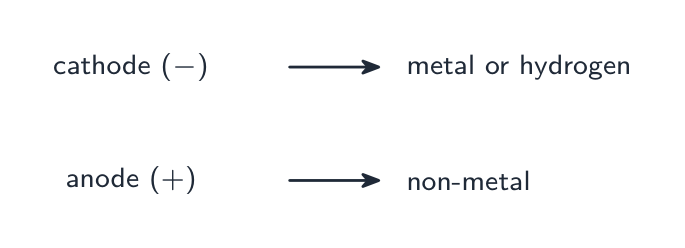
4 State that metals or hydrogen are formed at the cathode and that non-metals (other than hydrogen) are formed at the anode
5 Predict the identity of the products at each electrode for the electrolysis of a binary compound in the molten state
10 Predict the identity of the products at each electrode for the electrolysis of a halide compound in dilute or concentrated aqueous solution
11 Construct ionic half-equations for reactions at the anode (to show oxidation) and at the cathode (to show reduction)
6 State that metal objects are electroplated to improve their appearance and resistance to corrosion
7 Describe how metals are electroplated
Bahasa Indonesia
Inti
Tambahan
1 Definisikan elektrolisis sebagai penguraian senyawa ionik, ketika lebur atau dalam larutan akuatik, oleh aliran arus listrik
8 Deskripsikan perpindahan muatan selama elektrolisis yang mencakup: (a) pergerakan elektron dalam rangkaian eksternal (b) hilangnya atau perolehan elektron pada elektroda (c) pergerakan ion dalam elektrolit
2 Identifikasi dalam sel elektrolisis sederhana: (a) anoda sebagai elektroda positif (b) katoda sebagai elektroda negatif (c) elektrolit sebagai zat lebur atau akuatik yang mengalami elektrolisis
3 Identifikasi produk yang terbentuk pada elektroda dan deskripsikan pengamatan selama elektrolisis: (a) timbal(II) bromida lebur (b) natrium klorida akuatik pekat (c) asam sulfat encer menggunakan elektroda inert dari platinum atau karbon/grafit
9 Identifikasi produk yang terbentuk pada elektroda dan deskripsikan pengamatan selama elektrolisis tembaga(II) sulfat akuatik menggunakan elektroda karbon/grafit inert dan ketika menggunakan elektroda tembaga
4 Nyatakan bahwa logam atau hidrogen terbentuk pada katoda dan bahwa non-logam (selain hidrogen) terbentuk pada anoda
5 Prediksi identitas produk pada setiap elektroda untuk elektrolisis senyawa biner dalam keadaan lebur
10 Prediksi identitas produk pada setiap elektroda untuk elektrolisis senyawa halogenida dalam larutan akuatik encer atau pekat
11 Susun setengah persamaan ion untuk reaksi pada anoda (untuk menunjukkan oksidasi) dan pada katoda (untuk menunjukkan reduksi)
6 Nyatakan bahwa benda logam dilapisi secara elektroplating untuk meningkatkan penampilan dan ketahanannya terhadap korosi
7 Deskripsikan bagaimana logam dilapisi secara elektroplating
Source: Cambridge International syllabus · Sumber: Silabus Cambridge International
English
Electrolysis: ions discharge at the electrodes
Electrolysis 电解 is the breaking down (decomposition 分解) of an ionic compound 离子化合物 — when it is molten 熔融 or in aqueous 水溶液 solution — by passing an electric current 电流 through it.
It only works when the substance is molten or dissolved, because then the ions 离子 are free to move and carry the charge. A solid ionic compound cannot be electrolysed because its ions are locked in place.
The electrolytic cell
The set-up is called an electrolytic cell 电解池. Two electrodes 电极 (solid conductors) dip into the electrolyte 电解质 — the molten or aqueous substance being broken down.
The anode 阳极 is the positive ($+$) electrode.
The cathode 阴极 is the negative ($-$) electrode.
The electrodes are often inert 惰性 (they do not react), such as platinum 铂 or carbon/graphite 石墨.
What is formed at each electrode
There is a simple rule:
Metals 金属 or hydrogen 氢气 are formed at the cathode.
Non-metals 非金属 (other than hydrogen) are formed at the anode.
For aqueous solutions, the product can depend on whether the solution is dilute 稀 or concentrated 浓. Here are the three Core examples:
Electrolyte
At the cathode ($-$)
At the anode ($+$)
molten lead(II) bromide, $\text{PbBr}_2$
lead 铅 (silvery liquid)
bromine 溴 (red-brown vapour)
concentrated aqueous sodium chloride
hydrogen (bubbles of gas)
chlorine 氯气 (pale green gas)
dilute sulfuric acid 硫酸
hydrogen (bubbles of gas)
oxygen 氧气 (bubbles of gas)
Worked example. Predict the products of electrolysing molten zinc chloride, $\text{ZnCl}_2$. Because it is molten, only zinc ions and chloride ions are present - there is no water to complicate things. Zinc is a metal, so it forms at the cathode: $\text{Zn}^{2+}$ ions gain electrons and silvery zinc appears. Chlorine is a non-metal, so it forms at the anode: pale green chlorine gas bubbles off. Always check the state first. A molten compound simply gives you its own two elements, while an aqueous one brings water into the competition - which is why concentrated sodium chloride solution gives hydrogen at the cathode rather than sodium.
How the charge moves
During electrolysis:
Electrons 电子 move through the wires (the external circuit 外电路) from the power supply.
At the cathode, positive ions gain electrons. Gaining electrons is reduction 还原.
At the anode, negative ions lose electrons. Losing electrons is oxidation 氧化.
Inside the electrolyte, the ions move: positive ions go to the cathode and negative ions go to the anode.
You can write a half-equation 半反应式 for each electrode. For molten lead(II) bromide:
The product at the anode depends on the electrode:
With inert carbon electrodes: copper 铜 forms at the cathode and oxygen forms at the anode. The blue colour of the solution slowly fades as copper is removed.
With copper electrodes: copper forms at the cathode, while the anode itself dissolves into the solution. The blue colour stays the same. This is used to purify copper.
Electroplating
Electroplating 电镀 means covering a metal object with a thin layer of another metal. This improves its appearance and its resistance to corrosion 腐蚀 (rusting and wearing away).
To electroplate an object:
the object to be coated is made the cathode;
the plating metal is made the anode;
the electrolyte is a solution containing ions of the plating metal.
Bahasa Indonesia
Elektrolisis: ion terdischarge di elektroda
Elektrolisis adalah penguraian (dekomposisi) dari senyawa ionik — ketika ia meleleh atau dalam larutan akuatik — dengan mengalirkan arus listrik melewatinya.
Sel elektrolisis memecah senyawa menggunakan arus listrik.
Ini hanya bekerja ketika zat tersebut meleleh atau dilarutkan, karena saat itu ion-nya bebas bergerak dan membawa muatan. Senyawa ionik padat tidak dapat dielektrolisis karena ion-ionnya terkunci di tempat.
Elektrolisis air: gelembung gas terbentuk di setiap elektroda dan terkumpul di tabung di atasnya, dengan jumlah hidrogen kira-kira dua kali lipat dari oksigen
Sel elektrolitik
Rangkaian ini disebut sel elektrolitik. Dua elektroda (konduktor padat) dicelupkan ke dalam elektrolit — zat cair lebur atau larutan yang sedang diuraikan.
Anoda adalah elektroda positif ($+$).
Katoda adalah elektroda negatif ($-$).
Elektroda sering bersifat inert (tidak bereaksi), seperti platinum atau karbon/grafit.
Apa yang terbentuk di setiap elektroda
Ada aturan sederhana:
Logam dan hidrogen terbentuk di katoda; non-logam di anoda
Logam atau hidrogen terbentuk di katoda.
Non-logam (selain hidrogen) terbentuk di anoda.
Untuk larutan akuatik, produknya dapat bergantung pada apakah larutannya encer atau pekat. Berikut tiga contoh Inti:
Elektrolit
Pada katode ($-$)
Pada anode ($+$)
timbal(II) bromida cair lebur, $\text{PbBr}_2$
timbal (cairan berwarna perak)
bromin (uap merah-coklat)
natrium klorida akuatik pekat
hidrogen (gelembung gas)
klorin (gas hijau pucat)
asam sulfat encer
hidrogen (gelembung gas)
oksigen (gelembung gas)
Contoh terpecah. Ramalkan produk dari elektrolisis zink klorida cair lebur, $\text{ZnCl}_2$. Karena bersifat cair lebur, hanya ion zink dan ion klorida yang ada - tidak ada air yang memperumit situasi. Zink adalah logam, sehingga ia terbentuk di katoda: $\text{Zn}^{2+}$ ion mendapatkan elektron dan zink berwarna perak muncul. Klorin adalah non-logam, sehingga ia terbentuk di anoda: gas klorin hijau pucat keluar sebagai gelembung. Selalu periksa wujud zat terlebih dahulu. Senyawa cair lebur sekadar memberikan dua elemen aslinya, sementara senyawa akuatik引入 air ke dalam kompetisi - itulah sebabnya larutan natrium klorida pekat menghasilkan hidrogen di katoda alih-alih natrium.
Bagaimana muatan bergerak
Selama elektrolisis:
Elektron bergerak melalui kabel (sirkuit eksternal) dari sumber daya.
Di katoda, ion positif mendapatkan elektron. Mendapatkan elektron adalah reduksi.
Di anoda, ion negatif melepaskan elektron. Melepaskan elektron adalah oksidasi.
Di dalam elektrolit, ion-ion bergerak: ion positif menuju katoda dan ion negatif menuju anoda.
Anda dapat menuliskan persamaan separuh untuk setiap elektroda. Untuk timbal(II) bromida cair lebur:
Di dalam timbal(II) bromida cair lebur, $\text{Pb}^{2+}$ bergerak ke katoda dan $\text{Br}^-$ ke anoda, di mana masing-masing mengalami pembuangan
Elektrolisis tembaga(II) sulfat
Produk di anoda bergantung pada jenis elektroda:
Dengan elektroda karbon inert: tembaga terbentuk di katoda dan oksigen terbentuk di anoda. Warna biru larutan perlahan memudar saat tembaga terhapus.
Dengan elektroda tembaga: tembaga terbentuk di katoda, sementara anoda itu sendiri melarut ke dalam larutan. Warna biru tetap sama. Ini digunakan untuk memurnikan tembaga.
Pelapisan listrik
Pelapisan listrik berarti menutupi benda logam dengan lapisan tipis logam lain. Hal ini meningkatkan penampilannya dan ketahanannya terhadap korosi (berkarat dan aus).
Untuk melakukan pelapisan listrik pada suatu benda:
benda yang akan dilapisi dijadikan katoda;
logam pelapis dijadikan anoda;
elektrolit adalah larutan yang mengandung ion dari logam pelapis.
Untuk melakukan pelapisan elektrokimia, buatlah benda sebagai katoda dan logam pelapis sebagai anoda, dalam larutan ion logam pelapis
Explore · Jelajahi
Inside an electrolysis cell · Di dalam sel elektrolisis
Pick an electrolyte and watch ions move: positive ions to the cathode, negative ions to the anode. · Pilih elektrolit dan perhatikan ion bergerak: ion positif ke katode, ion negatif ke anode.
Hydrogen–oxygen fuel cells · Sel bahan bakar hidrogen–oksigen
Syllabus · Silabus
English
Core
Supplement
1 State that a hydrogen–oxygen fuel cell uses hydrogen and oxygen to produce electricity with water as the only chemical product
2 Describe the advantages and disadvantages of using hydrogen–oxygen fuel cells in comparison with gasoline/petrol engines in vehicles
Bahasa Indonesia
Inti
Tambahan
1 Nyatakan bahwa sel bahan bakar hidrogen–oksigen menggunakan hidrogen dan oksigen untuk menghasilkan listrik dengan air sebagai satu-satunya produk kimia
2 Deskripsikan keunggulan dan kelemahan penggunaan sel bahan bakar hidrogen–oksigen dibandingkan dengan mesin bensin pada kendaraan
Source: Cambridge International syllabus · Sumber: Silabus Cambridge International
English
A fuel cell 燃料电池 uses hydrogen and oxygen to make electricity directly. The only chemical product is water.
It is useful to compare a fuel cell with a normal petrol (gasoline) engine in a vehicle.
Hydrogen–oxygen fuel cell
Petrol engine
Main product
water only
carbon dioxide and pollutants 污染物
Effect on air
clean
adds to air pollution
Fuel storage
hydrogen is hard and dangerous to store (flammable, needs high pressure)
petrol is easy to store
Source
hydrogen may be made using fossil fuels
made from crude oil
Advantages of the fuel cell: the only product is water, so it does not pollute the air, and it changes chemical energy into electricity efficiently. Disadvantages: hydrogen is hard to store and transport safely, and producing the hydrogen can still use energy from fossil fuels.
Bahasa Indonesia
Sebuah sel bahan bakar menggunakan hidrogen dan oksigen untuk menghasilkan listrik secara langsung. Satu-satunya produk kimia adalah air.
*Sel bahan bakar hidrogen-oksigen mengubah energi kimia langsung menjadi listrik, dengan air sebagai satu-satunya produk
Berguna untuk membandingkan sel bahan bakar dengan mesin bensin (petrol) biasa pada kendaraan.
Sel bahan bakar hidrogen-oksigen
Mesin bensin
Produk utama
hanya air
karbon dioksida dan polutan
Dampak pada udara
bersih
menambah polusi udara
Penyimpanan bahan bakar
hidrogen sulit dan berbahaya disimpan (mudah terbakar, butuh tekanan tinggi)
bensin mudah disimpan
Sumber
hidrogen mungkin dibuat menggunakan bahan bakar fosil
dibuat dari minyak mentah
Keuntungan sel bahan bakar: satu-satunya produk adalah air, sehingga tidak mencemari udara, dan mengubah energi kimia menjadi listrik secara efisien. Kerugian: hidrogen sulit disimpan dan ditransportasikan dengan aman, serta produksi hidrogen masih bisa menggunakan energi dari bahan bakar fosil.
Explore · Jelajahi
Inside a hydrogen–oxygen fuel cell · Di dalam sel bahan bakar hidrogen–oksigen
Step through a fuel cell. Hydrogen and oxygen combine to make water, and the energy of that reaction is released as electricity — with no carbon dioxide. · Langkah-langkah kerja sel bahan bakar. Hidrogen dan oksigen bergabung membentuk air, dan energi reaksi tersebut dilepaskan sebagai listrik — tanpa karbon dioksida.
At the cathode (negative) you get a metal or hydrogen; at the anode (positive) you get a non-metal. Positive ions move to the cathode, negative ions to the anode.
A molten compound just gives its two elements. An aqueous solution can give something different (concentrated sodium chloride gives hydrogen and chlorine, not sodium).
Reduction is gain of electrons (at the cathode); oxidation is loss of electrons (at the anode). Remember OIL RIG.
In a half-equation the atoms and the charges must balance, with the electrons on the correct side: $\text{Pb}^{2+} + 2e^- \rightarrow \text{Pb}$ (cathode).
To electroplate an object, make it the cathode, make the plating metal the anode, and use a solution containing ions of the plating metal.
Bahasa Indonesia
Di katoda (negatif) Anda mendapat logam atau hidrogen; di anoda (positif) Anda mendapat non-logam. Ion positif bergerak ke katoda, ion negatif ke anoda.
Senyawa cairan hanya menghasilkan dua unsurnya. Larutan berair dapat menghasilkan sesuatu yang berbeda (natrium klorida pekat menghasilkan hidrogen dan klorin, bukan natrium).
Reduksi adalah penerimaan elektron (di katode); oksidasi adalah pelepasan elektron (di anode). Ingat OIL RIG.
Dalam persamaan setengah, atom dan muatan harus seimbang, dengan elektron di sisi yang benar: $\text{Pb}^{2+} + 2e^- \rightarrow \text{Pb}$ (katode).
Untuk melapis elektro, buat objek sebagai katode, buat logam pelapis sebagai anode, dan gunakan larutan yang mengandung ion dari logam pelapis tersebut.
Interactive lessons on this topic · Pelajaran interaktif untuk topik ini
Work through it step by step, with instant-check exercises. · Kerjakan langkah demi langkah, dengan latihan pengecekan instan.
Pick one and the site follows you — notes, papers, videos and practice all open on it. · Pilih satu dan situs mengikuti Anda — catatan, kertas, video, dan latihan semua terbuka di sana.
Type to search notes, lessons, code, vocabulary and past-paper questions across every subject. · Ketik untuk mencari catatan, pelajaran, kode, kosakata, dan pertanyaan soal lama di setiap mata pelajaran.