Skip to content · ⁨Lompat ke konten⁩
Subjects · ⁨Materi⁩

AP Physics 1 · ⁨AP Fisika 1⁩

Tips

AP Fisika 1 adalah mekanika berbasis aljabar: kinematika, gaya, usaha, energi dan daya, momentum, torsi dan rotasi, osilasi, dan fluida. Tidak perlu kalkulus — yang membuatnya secara konseptual lebih sulit, bukan lebih mudah. Anda bernalar tentang situasi alih-alih memutar tombol.

Bagian respons bebas memisahkan skor. Bagian ini meminta Anda untuk memberi justifikasi, membandingkan dua situasi, dan menjelaskan hasil dengan kata-kata. Angka yang benar tanpa penalaran hanya mendapat sedikit poin.

Sebutkan prinsipnya terlebih dahulu. "Karena momentum dikonservasikan dan tidak ada gaya horizontal eksternal yang bekerja…" adalah kalimat yang diinginkan rubrik. Gambarlah diagram benda bebas untuk setiap soal, bahkan ketika terlihat tidak perlu — itu adalah kebiasaan bernilai tertinggi dalam kursus ini.

Catatan di bawah ini membahas unit demi unit sesuai CED, dari kinematika hingga gerak harmonik sederhana, masing-masing disertai contoh terpecahkan. Soal-soal respons bebas yang dirilis beserta pedoman penilaiannya tersedia di perpustakaan, dan soal desain eksperimen layak dilatih sendiri — soal ini muncul setiap tahun dan menghargai prosedur yang jelas alih-alih rumus.

  • 1

    Kinematics · ⁨Kinematika⁩

    Watch lesson · ⁨Tonton pelajaran⁩
    1.1

    Scalars and Vectors in One Dimension

    Syllabus · ⁨Silabus⁩
    English

    Learning Objective 1.1.A: Describe a scalar or vector quantity using magnitude and direction, as appropriate.

    • 1.1.A.1 Scalars are quantities described by magnitude only; vectors are quantities described by both magnitude and direction.
    • 1.1.A.2 Vectors can be visually modeled as arrows with appropriate direction and lengths proportional to their magnitude.
    • 1.1.A.3 Distance and speed are examples of scalar quantities, while position, displacement, velocity, and acceleration are examples of vector quantities.
      • 1.1.A.3.i Vectors are notated with an arrow above the symbol for that quantity.
        • Equation: $\vec{v} = \vec{v}_0 + \vec{a}t$
      • 1.1.A.3.ii Vector notation is not required for vector components along an axis. In one dimension, the sign of the component completely describes the direction of that component.
        • Derived equation: $v_x = v_{x0} + a_x t$

    Learning Objective 1.1.B: Describe a vector sum in one dimension.

    • 1.1.B.1 When determining a vector sum in a given one-dimensional coordinate system, opposite directions are denoted by opposite signs.
    Bahasa Indonesia

    Tujuan Pembelajaran 1.1.A: Deskripsikan besaran skalar atau vektor menggunakan magnitudo dan arah, sesuai dengan kebutuhan.

    • 1.1.A.1 Skalar adalah besaran yang dijelaskan hanya oleh magnitudo; vektor adalah besaran yang dijelaskan oleh magnitudo dan arah.
    • 1.1.A.2 Vektor dapat dimodelkan secara visual sebagai panah dengan arah yang sesuai dan panjang yang proporsional terhadap magnitudonya.
    • 1.1.A.3 Jarak dan kecepatan adalah contoh besaran skalar, sedangkan posisi, perpindahan, kecepatan, dan percepatan adalah contoh besaran vektor.
      • 1.1.A.3.i Vektor dinotasikan dengan tanda panah di atas simbol untuk besaran tersebut.
        • Persamaan: $\vec{v} = \vec{v}_0 + \vec{a}t$
      • 1.1.A.3.ii Notasi vektor tidak diperlukan untuk komponen vektor sepanjang sumbu. Dalam satu dimensi, tanda dari komponen sepenuhnya menggambarkan arah komponen tersebut.
        • Persamaan turunan: $v_x = v_{x0} + a_x t$

    Tujuan Pembelajaran 1.1.B: Deskripsikan penjumlahan vektor dalam satu dimensi.

    • 1.1.B.1 Saat menentukan penjumlahan vektor dalam sistem koordinat satu dimensi yang diberikan, arah berlawanan ditandai dengan tanda yang berlawanan.
    Source: College Board AP Course and Exam Description · ⁨Sumber: Deskripsi Kursus dan Ujian College Board AP⁩

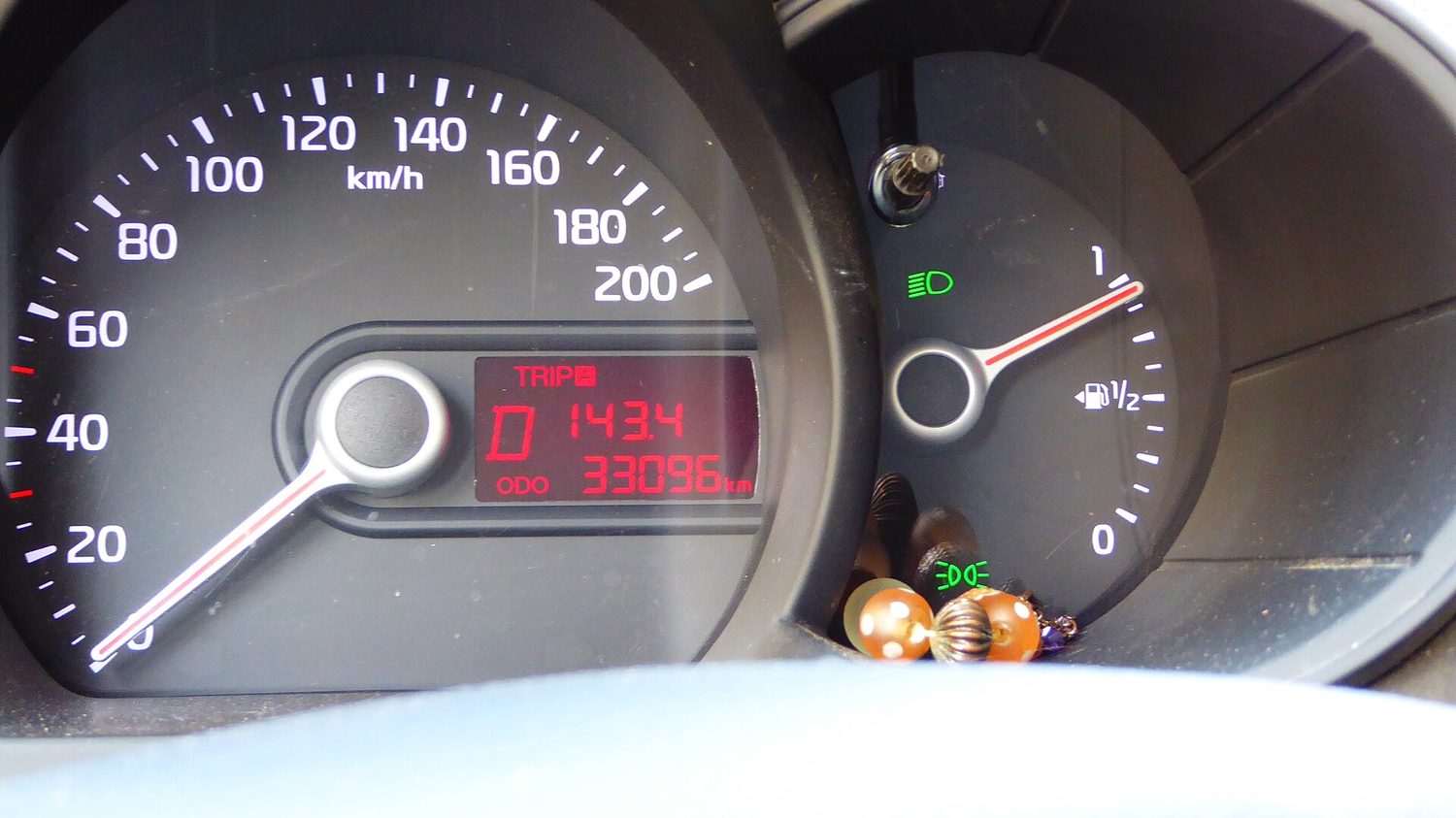
    A car speedometer: speed is the magnitude of velocity — a scalar rate of motion
    A car speedometer: speed is the magnitude of velocity — a scalar rate of motion

    Kinematics 运动学 describes how objects move, without asking why. First, two kinds of quantity:

    • A scalar 标量 has only size (magnitude 大小): distance 距离, speed, time, mass.
    • A vector 矢量 has magnitude and direction: displacement, velocity, acceleration, force.

    The difference matters. Distance is the total path length travelled – a scalar that only grows. Displacement is the straight-line change in position, with a direction. Walk $3\ \text{m}$ east then $1\ \text{m}$ back west: the distance is $4\ \text{m}$, but the displacement is only $2\ \text{m}$ east.

    In one dimension, direction is just a sign (+ or −) along a chosen axis. Choosing the positive direction first is essential – every vector's sign depends on it. A velocity of $-5\ \text{m/s}$ does not mean "slow"; it means $5\ \text{m/s}$ in the negative direction.

    Vocabulary · ⁨Kosa kata⁩ Train · ⁨Latih⁩
    English Bahasa Indonesia
    Kinematics/ˌkɪnɪˈmætɪks/ Kinematika
    scalar/ˈskeɪlə/ skalar
    magnitude/ˈmæɡnɪtjuːd/ besarnya
    vector/ˈvektə/ vektor
    distance/ˈdɪstəns/ jarak tempuh
    1.2

    Displacement, Velocity, and Acceleration

    Syllabus · ⁨Silabus⁩
    English

    Learning Objective 1.2.A: Describe a change in an object's position.

    • 1.2.A.1 When using the object model, the size, shape, and internal configuration are ignored. The object may be treated as a single point with extensive properties such as mass and charge.
    • 1.2.A.2 Displacement is the change in an object's position.
      • Equation: $\Delta x = x - x_0$

    Learning Objective 1.2.B: Describe the average velocity and acceleration of an object.

    • 1.2.B.1 Averages of velocity and acceleration are calculated considering the initial and final states of an object over an interval of time.
    • 1.2.B.2 Average velocity is the displacement of an object divided by the interval of time in which that displacement occurs.
      • Equation: $\vec{v}_{avg} = \dfrac{\Delta \vec{x}}{\Delta t}$
    • 1.2.B.3 Average acceleration is the change in velocity divided by the interval of time in which that change in velocity occurs.
      • Equation: $\vec{a}_{avg} = \dfrac{\Delta \vec{v}}{\Delta t}$

    Learning Objective 1.2.B: Describe the velocity and acceleration of an object.

    • 1.2.B.4 An object is accelerating if the magnitude and/or direction of the object's velocity are changing.
    • 1.2.B.5 Calculating average velocity or average acceleration over a very small time interval yields a value that is very close to the instantaneous velocity or instantaneous acceleration.
    Bahasa Indonesia

    Tujuan Pembelajaran 1.2.A: Deskripsikan perubahan posisi suatu benda.

    • 1.2.A.1 Saat menggunakan model benda, ukuran, bentuk, dan konfigurasi internal diabaikan. Benda dapat diperlakukan sebagai titik tunggal dengan sifat ekstensif seperti massa dan muatan.
    • 1.2.A.2 Perpindahan adalah perubahan posisi suatu benda.
      • Persamaan: $\Delta x = x - x_0$

    Tujuan Pembelajaran 1.2.B: Deskripsikan kecepatan rata-rata dan percepatan rata-rata suatu benda.

    • 1.2.B.1 Rata-rata kecepatan dan percepatan dihitung dengan mempertimbangkan keadaan awal dan akhir suatu benda selama interval waktu tertentu.
    • 1.2.B.2 Kecepatan rata-rata adalah perpindahan suatu benda dibagi dengan interval waktu di mana perpindahan itu terjadi.
      • Persamaan: $\vec{v}_{avg} = \dfrac{\Delta \vec{x}}{\Delta t}$
    • 1.2.B.3 Percepatan rata-rata adalah perubahan kecepatan dibagi dengan interval waktu di mana perubahan kecepatan itu terjadi.
      • Persamaan: $\vec{a}_{avg} = \dfrac{\Delta \vec{v}}{\Delta t}$

    Tujuan Pembelajaran 1.2.B: Deskripsikan kecepatan dan percepatan suatu benda.

    • 1.2.B.4 Suatu benda sedang mengalami percepatan jika magnitudo dan/atau arah kecepatan benda tersebut berubah.
    • 1.2.B.5 Menghitung kecepatan rata-rata atau percepatan rata-rata selama interval waktu yang sangat kecil menghasilkan nilai yang sangat dekat dengan kecepatan sesaat atau percepatan sesaat.

    Source: College Board AP Course and Exam Description · ⁨Sumber: Deskripsi Kursus dan Ujian College Board AP⁩

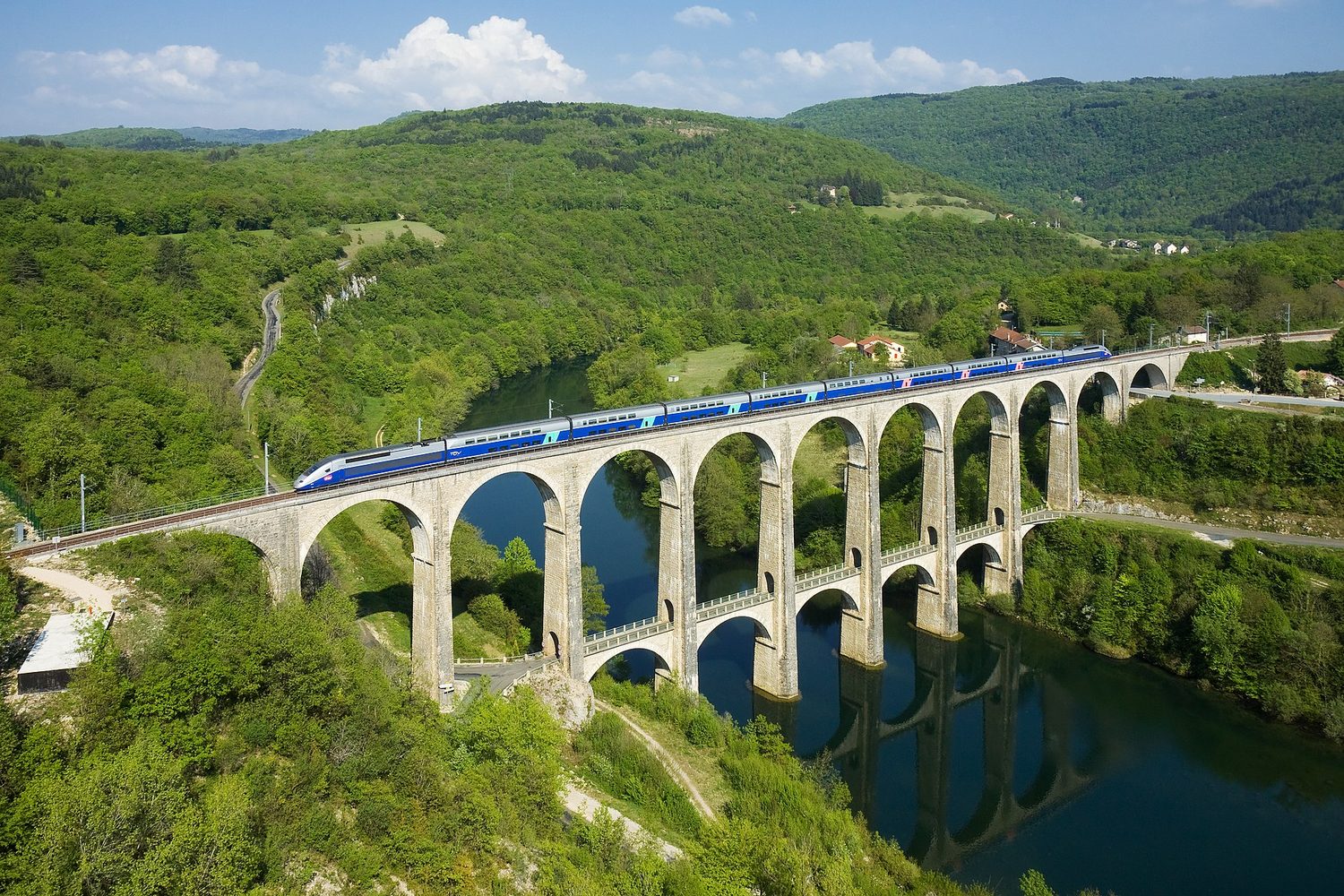
    A high-speed train: kinematics describes displacement, velocity and acceleration over time
    A high-speed train: kinematics describes displacement, velocity and acceleration over time
    Projectile motion is two independent motions

    Three linked vectors describe motion along a line:

    • Displacement 位移 $\Delta x$ is the change in position – a vector from start to end (not the total path length, which is distance).
    • Velocity 速度 is the rate of change of position, $v=\dfrac{\Delta x}{\Delta t}$. Its sign gives direction; its magnitude is speed 速率.
    • Acceleration 加速度 is the rate of change of velocity, $a=\dfrac{\Delta v}{\Delta t}$.

    Be careful to separate average velocity 平均速度 (total displacement over total time) from instantaneous velocity 瞬时速度 (the velocity at one instant, the slope of the position–time graph at that point). They are equal only when the velocity is constant.

    An object speeds up when $v$ and $a$ have the same sign, and slows down (deceleration 减速) when they have opposite signs. Note that a negative acceleration does not always mean slowing down – a ball falling faster and faster has negative velocity and negative acceleration.

    For constant acceleration, the four kinematic equations (often called SUVAT) apply:

    $$v=v_0+at,\qquad \Delta x=v_0 t+\tfrac{1}{2}at^2,\qquad v^2=v_0^2+2a\,\Delta x,\qquad \Delta x=\tfrac{1}{2}(v_0+v)\,t.$$
    Pick the equation that contains the three quantities you know plus the one you want, so only one unknown is left. They apply only while $a$ is constant.

    Worked example. A car starts from rest and accelerates uniformly at $2.0\ \text{m/s}^2$ for $6.0\ \text{s}$. Find its final velocity and the distance it travels.

    List what you know: $v_0=0$, $a=2.0\ \text{m/s}^2$, $t=6.0\ \text{s}$.

    $$v=v_0+at=0+2.0\times 6.0=12\ \text{m/s},$$
    $$\Delta x=v_0 t+\tfrac12 at^2=0+\tfrac12\times 2.0\times 6.0^2=36\ \text{m}.$$

    Worked example (free fall). A ball is thrown straight up at $15\ \text{m/s}$. Taking $g=9.8\ \text{m/s}^2$ and up as positive, how high does it rise, and how long is it in the air before returning to the thrower's hand?

    At the highest point the velocity is momentarily zero, and $a=-g=-9.8\ \text{m/s}^2$ throughout (this is free fall 自由落体, ignoring air resistance 空气阻力):

    $$v^2=v_0^2+2a\,\Delta x \;\Rightarrow\; 0=15^2+2(-9.8)\Delta x \;\Rightarrow\; \Delta x=\frac{225}{19.6}=11.5\ \text{m}.$$
    Time to the top: $0=15-9.8\,t \Rightarrow t=1.53\ \text{s}$. By symmetry the fall takes the same time, so the total is $3.1\ \text{s}$.

    Vocabulary · ⁨Kosa kata⁩ Train · ⁨Latih⁩
    English Bahasa Indonesia
    Displacement/dɪˈspleɪsmənt/ Penggantian
    Velocity/vəˈlɒsɪti/ Kecepatan
    speed/spiːd/ kecepatan (besaran skalar)
    Acceleration/əkˌseləˈreɪʃn/ Percepatan
    average velocity/ˈævrɪdʒ vəˈlɒsɪti/ kecepatan rata-rata
    instantaneous velocity/ˌɪnstənˈteɪnɪəs vəˈlɒsɪti/ kecepatan sesaat
    deceleration/dɪˌseləˈreɪʃn/ perlambatan
    free fall/friː fɔːl/ jatuh bebas
    air resistance/eə rɪˈzɪstəns/ hambatan udara
    1.3

    Representing Motion

    Syllabus · ⁨Silabus⁩
    English

    Learning Objective 1.3.A: Describe the position, velocity, and acceleration of an object using representations of that object's motion.

    • 1.3.A.1 Motion can be represented by motion diagrams, figures, graphs, equations, and narrative descriptions.
    • 1.3.A.2 For constant acceleration, three kinematic equations can be used to describe instantaneous linear motion in one dimension:
      • Equation: $v_x = v_{x0} + a_x t$
      • Equation: $x = x_0 + v_{x0}t + \dfrac{1}{2}a_x t^2$
      • Equation: $v_x^2 = v_{x0}^2 + 2a_x(x - x_0)$
      • Note: The equations above are written to indicate motion in the x-direction, but these equations can be used in any single dimension as appropriate.
    • 1.3.A.3 Near the surface of Earth, the vertical acceleration caused by the force of gravity is downward, constant, and has a measured value approximately equal to $a_g = g \approx 10 \ m/s^2$.
    • 1.3.A.4 Graphs of position, velocity, and acceleration as functions of time can be used to find the relationships between those quantities.
      • 1.3.A.4.i An object's instantaneous velocity is the rate of change of the object's position, which is equal to the slope of a line tangent to a point on a graph of the object's position as a function of time.
      • 1.3.A.4.ii An object's instantaneous acceleration is the rate of change of the object's velocity, which is equal to the slope of a line tangent to a point on a graph of the object's velocity as a function of time.
      • 1.3.A.4.iii The displacement of an object during a time interval is equal to the area under the curve of a graph of the object's velocity as a function of time (i.e., the area bounded by the function and the horizontal axis for the appropriate interval).
      • 1.3.A.4.iv The change in velocity of an object during a time interval is equal to the area under the curve of a graph of the acceleration of the object as a function of time.

    Boundary statement: AP Physics 1 does not expect students to quantitatively analyze nonuniform acceleration. However, students will be expected to be able to qualitatively analyze, sketch appropriate graphs of, and discuss situations in which acceleration is nonuniform.

    Boundary statement: For all situations in which a numerical quantity is required for $g$, the value $g \approx 10 \ m/s^2$ will be used. However, students will not be penalized for correctly using the more precise commonly accepted values of $g = 9.81 \ \text{m/s}^2$ or $g = 9.8 \ \text{m/s}^2$.

    Bahasa Indonesia

    Tujuan Pembelajaran 1.3.A: Deskripsikan posisi, kecepatan, dan percepatan suatu benda menggunakan representasi gerak benda tersebut.

    • 1.3.A.1 Gerak dapat direpresentasikan melalui diagram gerak, gambar, grafik, persamaan, dan deskripsi naratif.
    • 1.3.A.2 Untuk percepatan konstan, tiga persamaan kinematika dapat digunakan untuk menggambarkan gerak linear sesaat dalam satu dimensi:
      • Persamaan: $v_x = v_{x0} + a_x t$
      • Persamaan: $x = x_0 + v_{x0}t + \dfrac{1}{2}a_x t^2$
      • Persamaan: $v_x^2 = v_{x0}^2 + 2a_x(x - x_0)$
      • Catatan: Persamaan-persamaan di atas ditulis untuk menunjukkan gerak dalam arah x, tetapi persamaan-persamaan ini dapat digunakan dalam sembarang satu dimensi sesuai kebutuhan.
    • 1.3.A.3 Di dekat permukaan Bumi, percepatan vertikal yang disebabkan oleh gaya gravitasi mengarah ke bawah, konstan, dan memiliki nilai terukur kira-kira sama dengan $a_g = g \approx 10 \ m/s^2$.
    • 1.3.A.4 Grafik posisi, kecepatan, dan percepatan sebagai fungsi waktu dapat digunakan untuk menemukan hubungan antar besaran-besaran tersebut.
      • 1.3.A.4.i Kecepatan sesuat benda adalah laju perubahan posisi benda tersebut, yang sama dengan kemiringan garis tangen pada sebuah titik di grafik posisi benda sebagai fungsi waktu.
      • 1.3.A.4.ii Percepatan sesuat benda adalah laju perubahan kecepatan benda tersebut, yang sama dengan kemiringan garis tangen pada sebuah titik di grafik kecepatan benda sebagai fungsi waktu.
      • 1.3.A.4.iii Perpindahan suatu benda selama interval waktu sama dengan luas di bawah kurva grafik kecepatan benda sebagai fungsi waktu (yaitu, area yang dibatasi oleh fungsi dan sumbu horizontal untuk interval yang sesuai).
      • 1.3.A.4.iv Perubahan kecepatan suatu benda selama interval waktu sama dengan luas di bawah kurva grafik percepatan benda sebagai fungsi waktu.

    Pernyataan Batasan: AP Fisika 1 tidak mengharapkan siswa melakukan analisis kuantitatif terhadap percepatan tak seragam. Namun, siswa diharapkan mampu menganalisis secara kualitatif, membuat sketsa grafik yang sesuai, dan mendiskusikan situasi di mana percepatan tak seragam terjadi.

    Pernyataan Batasan: Untuk semua situasi yang memerlukan besaran numerik untuk $g$, nilai $g \approx 10 \ m/s^2$ akan digunakan. Namun, siswa tidak akan didiskualifikasi karena secara benar menggunakan nilai yang lebih presisi yang umum diterima dari $g = 9.81 \ \text{m/s}^2$ atau $g = 9.8 \ \text{m/s}^2$.

    Source: College Board AP Course and Exam Description · ⁨Sumber: Deskripsi Kursus dan Ujian College Board AP⁩

    The same motion appears as a description, a graph, a table, or an equation, and you should move between them:

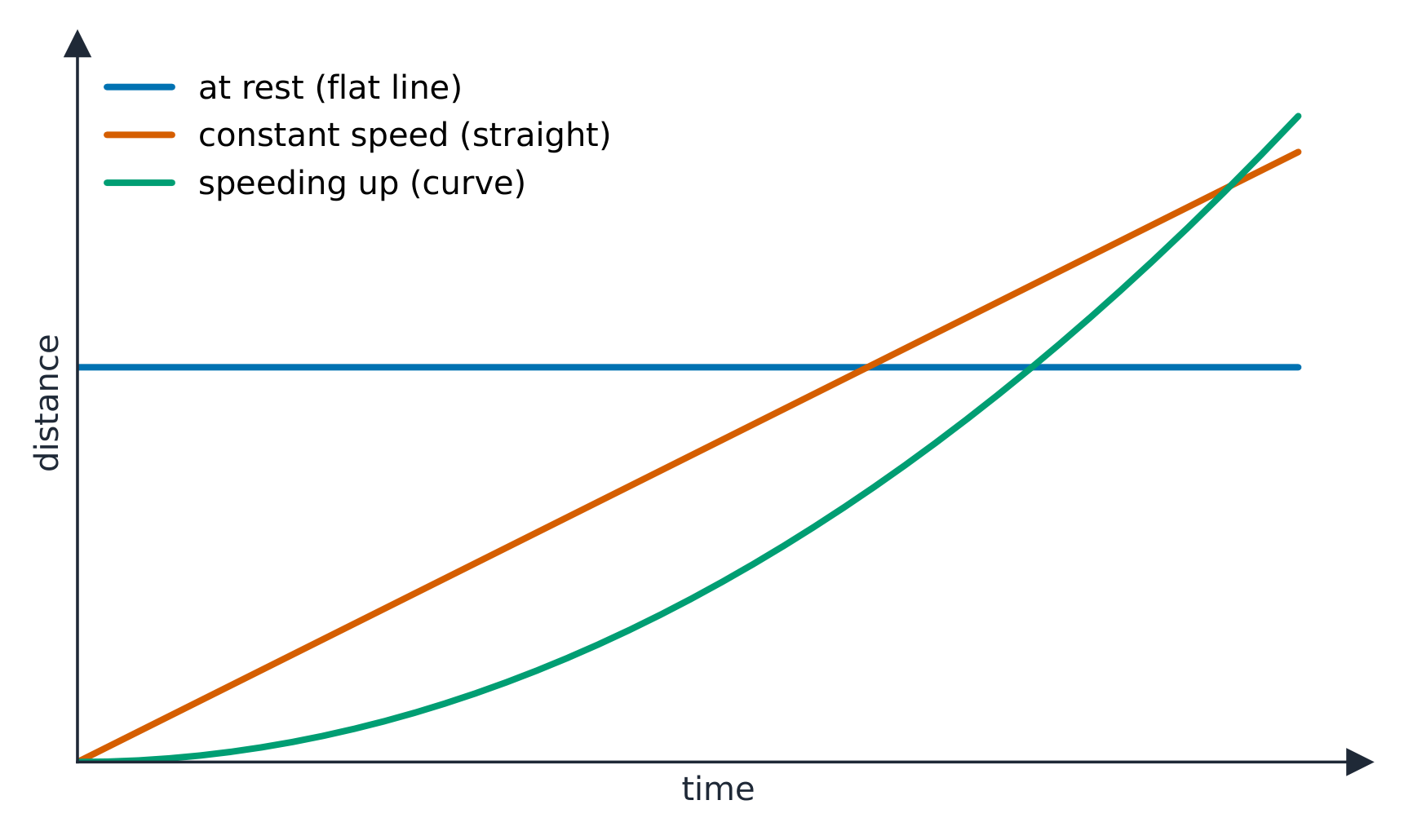
    Reading a distance-time graph: flat means at rest, a straight slope means constant speed
    Reading a distance-time graph: flat means at rest, a straight slope means constant speed
    • On a position–time graph, the slope is velocity (steeper = faster; a curve = changing velocity).
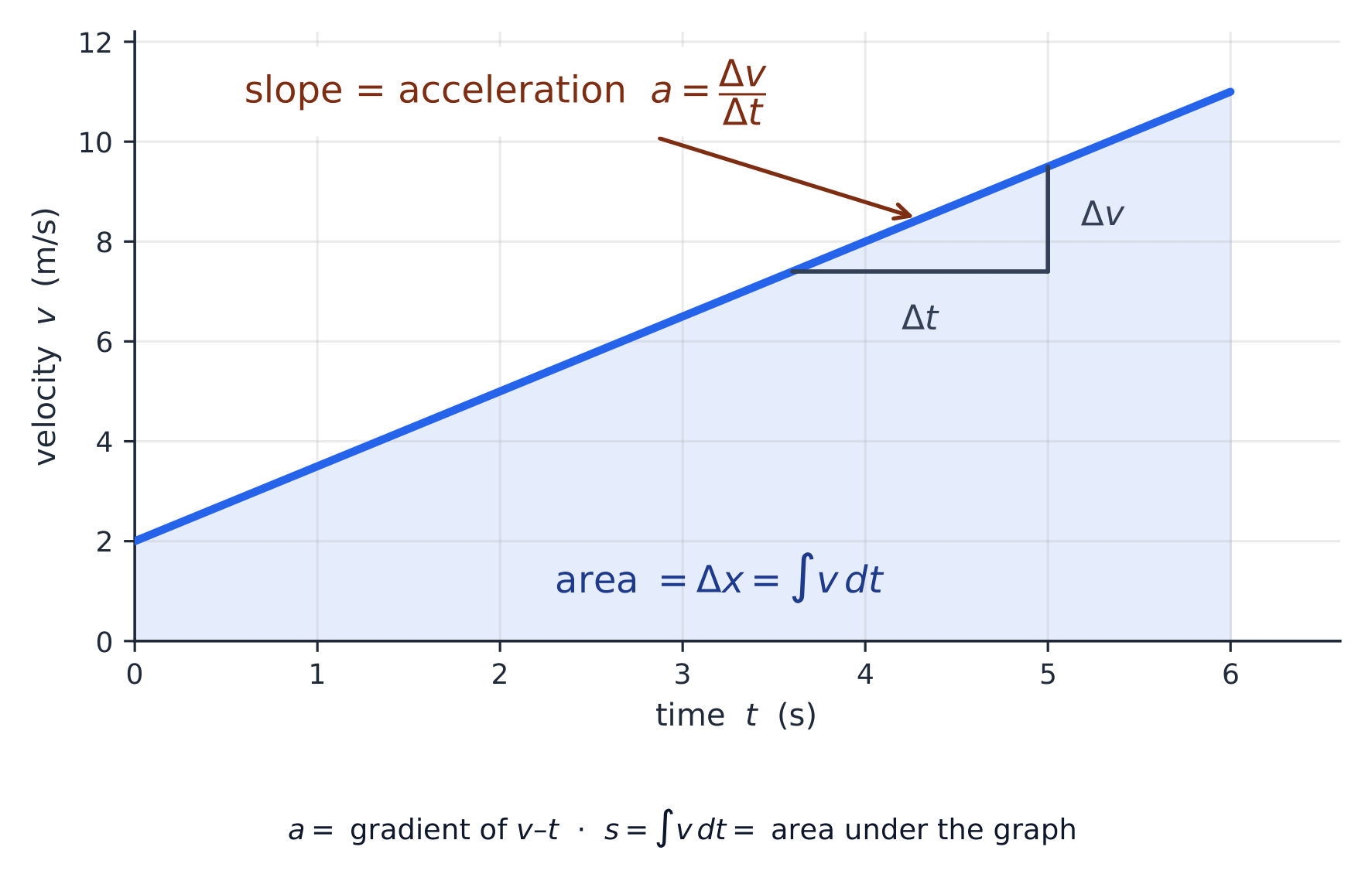
    • On a velocity–time graph, the slope is acceleration, and the area under the line is displacement.

    Reading slopes and areas off graphs is a core exam skill. To get displacement from a velocity–time graph, split the area into triangles and rectangles and add them up; area below the time axis counts as negative displacement (motion the other way).

    On a velocity-time graph the slope is the acceleration and the shaded area is the displacement
    On a velocity-time graph the slope is the acceleration and the shaded area is the displacement

    Worked example. A cyclist speeds up uniformly from rest to $8.0\ \text{m/s}$ in $4.0\ \text{s}$, then holds $8.0\ \text{m/s}$ for $6.0\ \text{s}$. Find the total distance from the velocity–time graph.

    The area is a triangle followed by a rectangle:

    $$\Delta x=\underbrace{\tfrac12\times 4.0\times 8.0}_{\text{triangle}}+\underbrace{6.0\times 8.0}_{\text{rectangle}}=16+48=64\ \text{m}.$$

    Explore · ⁨Jelajahi⁩

    Explore the velocity–time graph · ⁨Jelajahi grafik kecepatan-waktu⁩

    Change the start velocity $u$ and the acceleration $a$. The gradient (slope) of the line is the acceleration; the area between the line and the time axis is the displacement. · ⁨Ubah kecepatan awal $u$ dan percepatan $a$. Gradien (kemiringan) garis adalah percepatan; luas antara garis dan sumbu waktu adalah ** perpindahan**.⁩

    1.4

    Reference Frames and Relative Motion

    Syllabus · ⁨Silabus⁩
    English

    Learning Objective 1.4.A: Describe the reference frame of a given observer.

    • 1.4.A.1 The choice of reference frame will determine the direction and magnitude of quantities measured by an observer in that reference frame.

    Learning Objective 1.4.B: Describe the motion of objects as measured by observers in different inertial reference frames.

    • 1.4.B.1 Measurements from a given reference frame may be converted to measurements from another reference frame.
    • 1.4.B.2 The observed velocity of an object results from the combination of the object's velocity and the velocity of the observer's reference frame.
      • 1.4.B.2.i Combining the motion of an object and the motion of an observer in a given reference frame involves the addition or subtraction of vectors.
      • 1.4.B.2.ii The acceleration of any object is the same as measured from all inertial reference frames.

    Boundary statement: Unless otherwise stated, the frame of reference of any problem may be assumed to be inertial.

    Boundary statement: Adding or subtracting vectors to find relative velocities is restricted to motion along one dimension for AP Physics 1.

    Bahasa Indonesia

    Tujuan Pembelajaran 1.4.A: Deskripsikan kerangka acuan pengamat tertentu.

    • 1.4.A.1 Pemilihan kerangka acuan akan menentukan arah dan besaran kuantitas yang diukur oleh pengamat dalam kerangka acuan tersebut.

    Tujuan Pembelajaran 1.4.B: Deskripsikan gerak benda seperti yang diukur oleh pengamat dalam kerangka acuan inersia yang berbeda.

    • 1.4.B.1 Pengukuran dari suatu kerangka acuan tertentu dapat dikonversi menjadi pengukuran dari kerangka acuan lain.
    • 1.4.B.2 Kecepatan yang diamati dari sebuah benda merupakan hasil kombinasi dari kecepatan benda tersebut dan kecepatan kerangka acuan pengamatnya.
      • 1.4.B.2.i Menggabungkan gerak benda dan gerak pengamat dalam suatu kerangka acuan melibatkan penjumlahan atau pengurangan vektor.
      • 1.4.B.2.ii Percepatan setiap benda adalah sama jika diukur dari semua kerangka acuan inersia.

    Pernyataan Batas: Kecuali dinyatakan lain, kerangka acuan dari setiap masalah dapat diasumsikan sebagai inersia.

    Pernyataan Batas: Menambahkan atau mengurangkan vektor untuk menemukan kecepatan relatif dibatasi pada gerak sepanjang satu dimensi untuk AP Physics 1.

    Source: College Board AP Course and Exam Description · ⁨Sumber: Deskripsi Kursus dan Ujian College Board AP⁩

    All motion is measured against a reference frame 参考系. Velocities measured in different frames differ, and you combine them by vector addition. The velocity of A relative to C is

    $$\vec{v}_{A/C}=\vec{v}_{A/B}+\vec{v}_{B/C}.$$
    A person walking on a moving train has one velocity relative to the train and another relative to the ground – this is relative motion 相对运动. A useful shortcut: the velocity of A relative to B is $\vec{v}_{A/B}=\vec{v}_A-\vec{v}_B$ (subtract B's velocity).

    A frame that is not accelerating is an inertial reference frame 惯性参考系: one in which a free object (no net force) obeys Newton's first law, staying at rest or moving at constant velocity. A frame that accelerates – a braking car – is non-inertial, where objects seem to speed up with no force acting on them.

    Worked example. A boat points straight across a river and moves at $3.0\ \text{m/s}$ relative to the water. The current flows at $4.0\ \text{m/s}$ along the river. Find the boat's speed and direction relative to the bank.

    The two velocities are perpendicular, so add them as a right triangle:

    $$v=\sqrt{3.0^2+4.0^2}=5.0\ \text{m/s},\qquad \theta=\tan^{-1}\!\frac{4.0}{3.0}=53^{\circ}\ \text{downstream from straight across.}$$

    Vocabulary · ⁨Kosa kata⁩ Train · ⁨Latih⁩
    English Bahasa Indonesia
    reference frame/ˈrefrəns freɪm/ kerangka acuan
    relative motion/ˈrelətɪv ˈməʊʃn/ Gerak relatif
    inertial reference frame/ɪˈnɜːʃl ˈrefrəns freɪm/ kerangka acuan inersia
    1.5

    Vectors and Motion in Two Dimensions

    Syllabus · ⁨Silabus⁩
    English

    Learning Objective 1.5.A: Describe the perpendicular components of a vector.

    • 1.5.A.1 Vectors can be mathematically modeled as the resultant of two perpendicular components.
    • 1.5.A.2 Vectors can be resolved into components using a chosen coordinate system.
    • 1.5.A.3 Vectors can be resolved into perpendicular components using trigonometric functions and relationships.
      • Equation: $\sin \theta = \dfrac{a}{c}$
      • Equation: $\cos \theta = \dfrac{b}{c}$
      • Equation: $\tan \theta = \dfrac{a}{b}$
      • Equation: $a^2 + b^2 = c^2$

    Learning Objective 1.5.B: Describe the motion of an object moving in two dimensions.

    • 1.5.B.1 Motion in two dimensions can be analyzed using one-dimensional kinematic relationships if the motion is separated into components.
    • 1.5.B.2 Projectile motion is a special case of two-dimensional motion that has zero acceleration in one dimension and constant, nonzero acceleration in the second dimension.
    Bahasa Indonesia

    Tujuan Pembelajaran 1.5.A: Deskripsikan komponen-komponen tegak lurus dari sebuah vektor.

    • 1.5.A.1 Vektor dapat dimodelkan secara matematis sebagai resultan dari dua komponen yang saling tegak lurus.
    • 1.5.A.2 Vektor dapat diuraikan menjadi komponen-komponennya menggunakan sistem koordinat yang dipilih.
    • 1.5.A.3 Vektor dapat diuraikan menjadi komponen-komponen tegak lurus menggunakan fungsi trigonometri dan hubungannya.
      • Persamaan: $\sin \theta = \dfrac{a}{c}$
      • Persamaan: $\cos \theta = \dfrac{b}{c}$
      • Persamaan: $\tan \theta = \dfrac{a}{b}$
      • Persamaan: $a^2 + b^2 = c^2$

    Tujuan Pembelajaran 1.5.B: Deskripsikan gerak sebuah benda yang bergerak dalam dua dimensi.

    • 1.5.B.1 Gerak dalam dua dimensi dapat dianalisis menggunakan hubungan kinematika satu dimensi jika gerak tersebut dipisahkan menjadi komponen-komponennya.
    • 1.5.B.2 Gerak peluru adalah kasus khusus dari gerak dua dimensi yang memiliki percepatan nol pada satu dimensi dan percepatan konstan, tak nol pada dimensi kedua.

    Source: College Board AP Course and Exam Description · ⁨Sumber: Deskripsi Kursus dan Ujian College Board AP⁩

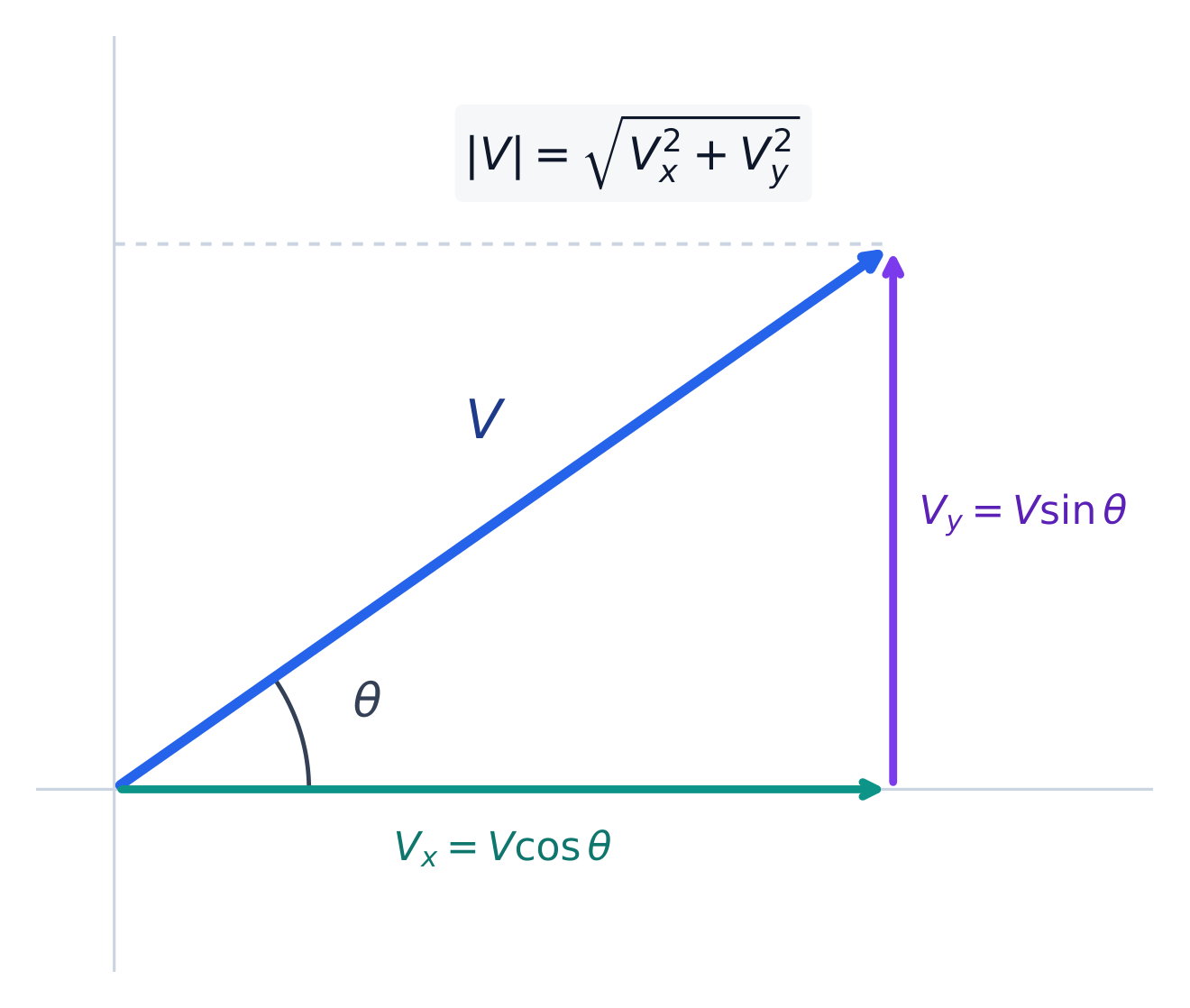
    In two dimensions, resolve each vector into components 分量 along perpendicular axes ($x$ and $y$), handle each axis separately, then recombine. A velocity $v$ at angle $\theta$ to the horizontal has components $v_x=v\cos\theta$ and $v_y=v\sin\theta$.

    A velocity vector resolved into its horizontal and vertical components
    A velocity vector resolved into its horizontal and vertical components

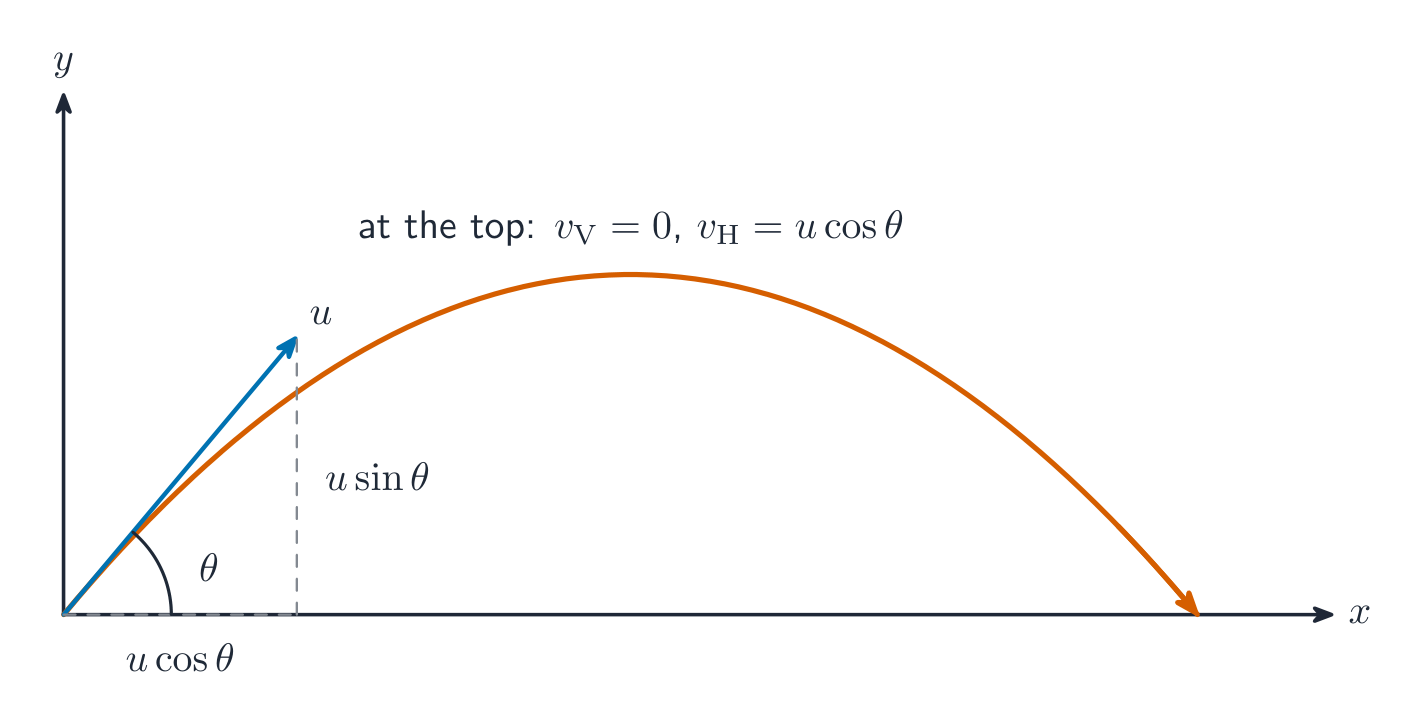
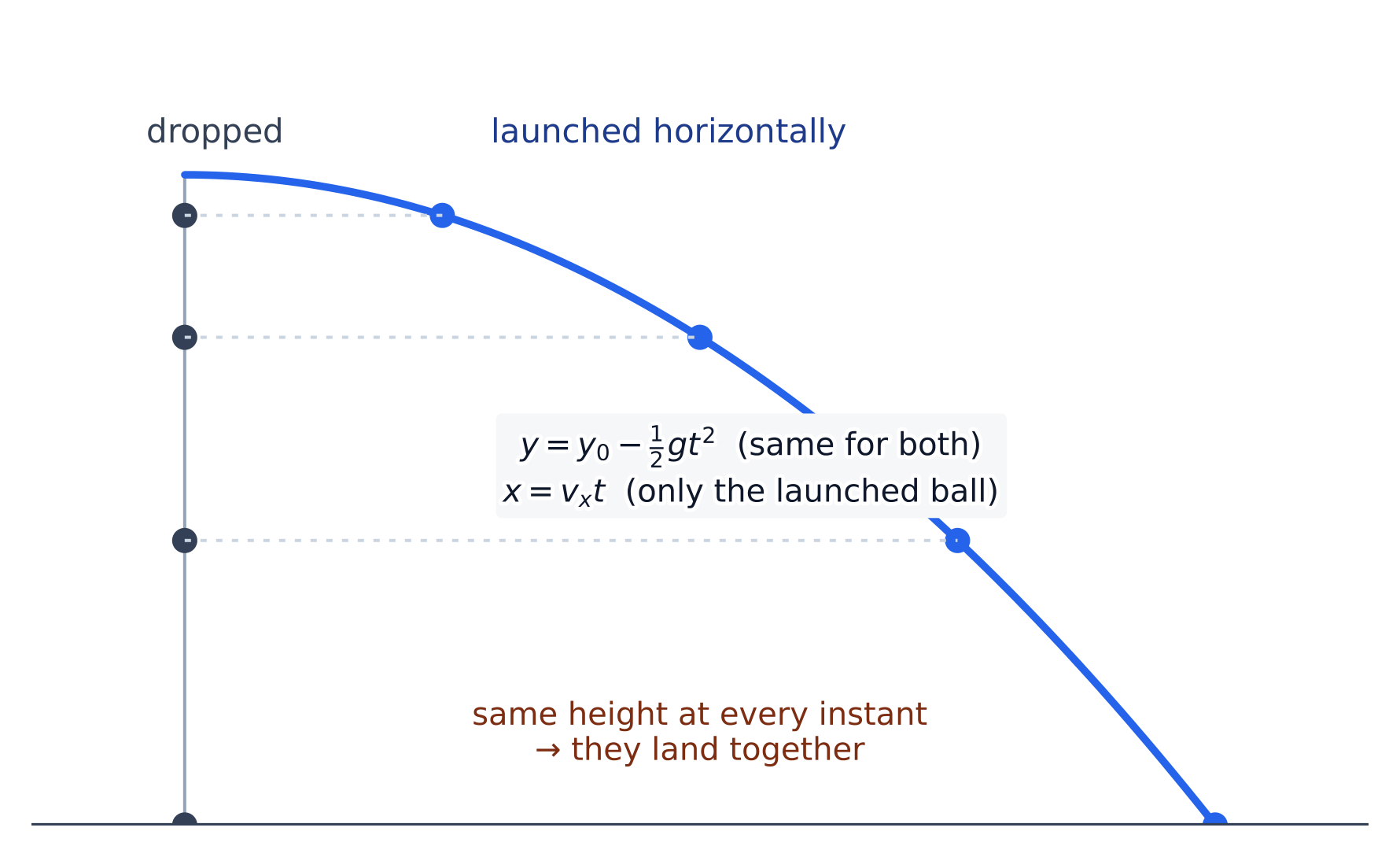
    For projectile motion 抛体运动 (an object moving under gravity alone): the horizontal and vertical motions are independent. Horizontally, velocity is constant ($a_x=0$); vertically, acceleration is $-g$ (down). The two motions share only the time. So a projectile's path (its trajectory 轨迹) is a parabola, and you solve it as two one-dimensional problems joined by $t$.

    A projectile launched at an angle: the horizontal and vertical motions are independent
    A projectile launched at an angle: the horizontal and vertical motions are independent
    A dropped ball and a horizontally launched ball fall together – the vertical motions are identical
    A dropped ball and a horizontally launched ball fall together – the vertical motions are identical

    Worked example. A ball is kicked at $20\ \text{m/s}$, $30^{\circ}$ above the horizontal. Taking $g=9.8\ \text{m/s}^2$, find the time of flight, the maximum height, and the horizontal range 射程 (assume it lands at launch height).

    Split the launch velocity into components:

    $$v_{0x}=20\cos 30^{\circ}=17.3\ \text{m/s},\qquad v_{0y}=20\sin 30^{\circ}=10\ \text{m/s}.$$
    Vertical motion sets the time. At the top $v_y=0$, so $0=10-9.8\,t \Rightarrow t_{\text{up}}=1.02\ \text{s}$, and the total flight is $2t_{\text{up}}=2.0\ \text{s}$. The maximum height is
    $$\Delta y=\frac{v_{0y}^2}{2g}=\frac{10^2}{19.6}=5.1\ \text{m}.$$
    Horizontal motion runs at constant $v_{0x}$ for the whole flight, so the range is
    $$R=v_{0x}\times t_{\text{flight}}=17.3\times 2.0=35\ \text{m}.$$

    A common trap: at the top of the flight the vertical velocity is zero, but the ball is not at rest – its horizontal velocity $v_{0x}$ never changes. The speed at the top equals $v_{0x}=17.3\ \text{m/s}$.

    Explore · ⁨Jelajahi⁩

    Explore projectile motion · ⁨Jelajahi gerak peluru⁩

    Fire the ball, then change the angle and speed. The horizontal motion stays steady while gravity pulls it down — together they trace a parabola. Find the launch angle that gives the longest range, and try the Moon. · ⁨Tembakkan bola, lalu ubah sudut dan kecepatan. Gerakan horizontal tetap stabil sementara gravitasi menariknya ke bawah — bersama-sama mereka membentuk parabola. Temukan sudut peluncuran yang memberikan jangkauan terpanjang, dan coba di Bulan.⁩

    Explore · ⁨Jelajahi⁩

    Explore vectors and their components · ⁨Jelajahi vektor dan komponennya⁩

    Drag the vectors to change their $x$- and $y$-components. See how a single vector is built from independent horizontal and vertical parts, and how two vectors add tip-to-tail into a resultant. · ⁨Seret vektor untuk mengubah komponen $x$- dan $y$-nya. Lihat bagaimana satu vektor tunggal dibangun dari bagian horizontal dan vertikal yang independen, dan bagaimana dua vektor dijumlahkan ujung-ke-ujung menjadi vektor resultan.⁩

    Vocabulary · ⁨Kosa kata⁩ Train · ⁨Latih⁩
    English Bahasa Indonesia
    components/kəmˈpəʊnənts/ komponen
    projectile motion/prəˈdʒektaɪl ˈməʊʃn/ gerak peluru
    trajectory/trəˈdʒektəri/ lintasan
    range/reɪndʒ/ jangkauannya
    1.5

    Exam tips

    • Choose the right kinematic equation by listing the three quantities you know plus the one you want, so only one unknown remains; the SUVAT equations apply only while acceleration is constant.
    • Fix a positive direction first — every displacement, velocity, and acceleration then carries a sign; a negative velocity means "moving the other way", not "slow".
    • Treat a projectile as two independent 1-D problems sharing only the time $t$: constant velocity horizontally, $a=-g$ vertically. At the top $v_y=0$ but $v_x$ is unchanged.
    • On a velocity–time graph the gradient is the acceleration and the area is the displacement (area below the axis is negative).
    • Distinguish distance (scalar, total path) from displacement (vector, start-to-end), and speed from velocity.
  • 2

    Force and Translational Dynamics · ⁨Gaya dan Dinamika Translasi⁩

    Watch lesson · ⁨Tonton pelajaran⁩
    2.1

    Systems and Center of Mass

    Syllabus · ⁨Silabus⁩
    English

    Learning Objective 2.1.A: Describe the properties and interactions of a system.

    • 2.1.A.1 System properties are determined by the interactions between objects within the system.
    • 2.1.A.2 If the properties or interactions of the constituent objects within a system are not important in modeling the behavior of the macroscopic system, the system can itself be treated as a single object.
    • 2.1.A.3 Systems may allow interactions between constituent parts of the system and the environment, which may result in the transfer of energy or mass.
    • 2.1.A.4 Individual objects within a chosen system may behave differently from each other as well as from the system as a whole.
    • 2.1.A.5 The internal structure of a system affects the analysis of that system.
    • 2.1.A.6 As variables external to a system are changed, the system's substructure may change.

    Learning Objective 2.1.B: Describe the location of a system's center of mass with respect to the system's constituent parts.

    • 2.1.B.1 For systems with symmetrical mass distributions, the center of mass is located on lines of symmetry.
    • 2.1.B.2 The location of a system's center of mass along a given axis can be calculated using the equation
      • Equation: $\vec{x}_{cm} = \dfrac{\sum m_i \vec{x}_i}{\sum m_i}$
    • 2.1.B.3 A system can be modeled as a singular object that is located at the system's center of mass.

    Boundary statement: AP Physics 1 only expects students to calculate the center of mass for systems of five or fewer particles arranged in a two-dimensional configuration or for systems that are highly symmetrical.

    Bahasa Indonesia

    Tujuan Pembelajaran 2.1.A: Deskripsikan sifat-sifat dan interaksi suatu sistem.

    • 2.1.A.1 Sifat-sifat sistem ditentukan oleh interaksi antara objek-objek di dalam sistem.
    • 2.1.A.2 Jika sifat-sifat atau interaksi objek-objek penyusun di dalam sistem tidak penting dalam memodelkan perilaku sistem makroskopis, sistem itu sendiri dapat diperlakukan sebagai satu objek tunggal.
    • 2.1.A.3 Sistem mungkin memungkinkan interaksi antara bagian-bagian penyusun sistem dengan lingkungan, yang dapat menghasilkan transfer energi atau massa.
    • 2.1.A.4 Objek-objek individu di dalam sistem yang dipilih dapat berperilaku berbeda satu sama lain serta berbeda dari sistem secara keseluruhan.
    • 2.1.A.5 Struktur internal sistem mempengaruhi analisis terhadap sistem tersebut.
    • 2.1.A.6 Saat variabel eksternal dari sistem diubah, substruktur sistem mungkin berubah.

    Tujuan Pembelajaran 2.1.B: Deskripsikan lokasi titik massa pusat sistem terkait dengan bagian-bagian penyusun sistem.

    • 2.1.B.1 Untuk sistem dengan distribusi massa yang simetris, titik massa pusat terletak pada garis-garis simetri.
    • 2.1.B.2 Lokasi titik massa pusat sistem sepanjang sumbu tertentu dapat dihitung menggunakan persamaan ⟦number⟧
      • Persamaan: $\vec{x}_{cm} = \dfrac{\sum m_i \vec{x}_i}{\sum m_i}$
    • 2.1.B.3 Sistem dapat dimodelkan sebagai objek tunggal yang berlokasi di titik massa pusat sistem.

    Pernyataan Batas: AP Physics 1 hanya mengharapkan siswa untuk menghitung titik massa pusat untuk sistem lima partikel atau kurang yang tersusun dalam konfigurasi dua dimensi atau untuk sistem yang sangat simetris.

    Source: College Board AP Course and Exam Description · ⁨Sumber: Deskripsi Kursus dan Ujian College Board AP⁩

    A system 系统 is the object or group of objects you choose to analyze. A system can be treated as a single point at its center of mass 质心 – the average position of its mass. External forces change the motion of the center of mass; internal forces (between parts of the system) do not.

    This is why a wrench spinning across a table still has its center of mass move in a straight line: the spinning is internal, and only the (near-zero) external force matters for the center of mass. For two masses $m_1,m_2$ on a line at positions $x_1,x_2$, the center of mass sits at $x_{\text{cm}}=\dfrac{m_1x_1+m_2x_2}{m_1+m_2}$ – always closer to the heavier mass.

    Vocabulary · ⁨Kosa kata⁩ Train · ⁨Latih⁩
    English Bahasa Indonesia
    system/ˈsɪstəm/ sistem
    center of mass/ˈsentə ɒv mæs/ pusat massa
    2.2

    Forces and Free-Body Diagrams

    Syllabus · ⁨Silabus⁩
    English

    Learning Objective 2.2.A: Describe a force as an interaction between two objects or systems.

    • 2.2.A.1 Forces are vector quantities that describe the interactions between objects or systems.
      • 2.2.A.1.i A force exerted on an object or system is always due to the interaction of that object with another object or system.
      • 2.2.A.1.ii An object or system cannot exert a net force on itself.
    • 2.2.A.2 Contact forces describe the interaction of an object or system touching another object or system and are macroscopic effects of interatomic electric forces.

    Learning Objective 2.2.B: Describe the forces exerted on an object or system using a free-body diagram.

    • 2.2.B.1 Free-body diagrams are useful tools for visualizing forces being exerted on a single object or system and for determining the equations that represent a physical situation.
    • 2.2.B.2 The free-body diagram of an object or system shows each of the forces exerted on the object by the environment.
    • 2.2.B.3 Forces exerted on an object or system are represented as vectors originating from the representation of the center of mass, such as a dot. A system is treated as though all of its mass is located at the center of mass.
    • 2.2.B.4 A coordinate system with one axis parallel to the direction of acceleration of the object or system simplifies the translation from free-body diagram to algebraic representation. For example, in a free-body diagram of an object on an inclined plane, it is useful to set one axis parallel to the surface of the incline.

    Boundary statement: AP Physics 1 only expects students to depict the forces exerted on objects, not the force components on free-body diagrams. On the AP Physics exams, individual forces represented on a free-body diagram must be drawn as individual straight arrows, originating on the dot and pointing in the direction of the force. Individual forces that are in the same direction must be drawn side by side, not overlapping.

    Bahasa Indonesia

    Tujuan Pembelajaran 2.2.A: Deskripsikan gaya sebagai interaksi antara dua objek atau sistem.

    • 2.2.A.1 Gaya adalah besaran vektor yang menggambarkan interaksi antara objek atau sistem.
      • 2.2.A.1.i Gaya yang diberikan pada suatu objek atau sistem selalu disebabkan oleh interaksi objek tersebut dengan objek atau sistem lain.
      • 2.2.A.1.ii Suatu objek atau sistem tidak dapat memberikan gaya bersih pada dirinya sendiri.
    • 2.2.A.2 Gaya kontak menggambarkan interaksi objek atau sistem yang menyentuh objek atau sistem lain dan merupakan efek makroskopis dari gaya listrik antaratom.

    Tujuan Pembelajaran 2.2.B: Deskripsikan gaya-gaya yang bekerja pada suatu objek atau sistem menggunakan diagram benda bebas.

    • 2.2.B.1 Diagram benda bebas adalah alat yang berguna untuk memvisualisasikan gaya-gaya yang bekerja pada satu objek atau sistem dan untuk menentukan persamaan yang mewakili situasi fisik.
    • 2.2.B.2 Diagram benda bebas dari suatu objek atau sistem menunjukkan setiap gaya yang diberikan pada objek tersebut oleh lingkungannya.
    • 2.2.B.3 Gaya-gaya yang bekerja pada objek atau sistem direpresentasikan sebagai vektor yang bermula dari representasi titik massa pusat, seperti sebuah titik. Sebuah sistem diperlakukan seolah-olah seluruh massanya berlokasi di titik massa pusat.
    • 2.2.B.4 Sistem koordinat dengan satu sumbu sejajar dengan arah percepatan objek atau sistem menyederhanakan translasi dari diagram benda bebas ke representasi aljabar. Sebagai contoh, dalam diagram benda bebas objek pada bidang miring, berguna untuk menetapkan satu sumbu sejajar dengan permukaan bidang miring.

    Pernyataan Batas: AP Physics 1 hanya mengharapkan siswa untuk menggambarkan gaya-gaya yang bekerja pada objek, bukan komponen-komponen gayanya pada diagram benda bebas. Pada ujian AP Physics, gaya-gaya individu yang direpresentasikan pada diagram benda bebas harus digambar sebagai panah lurus individual, bermula dari titik dan menunjuk ke arah gaya. Gaya-gaya individu yang berada dalam arah yang sama harus digambar berdampingan, tidak tumpang tindih.

    Source: College Board AP Course and Exam Description · ⁨Sumber: Deskripsi Kursus dan Ujian College Board AP⁩

    A skydiver: free-body diagrams balance gravity and air resistance at terminal speed
    A skydiver: free-body diagrams balance gravity and air resistance at terminal speed
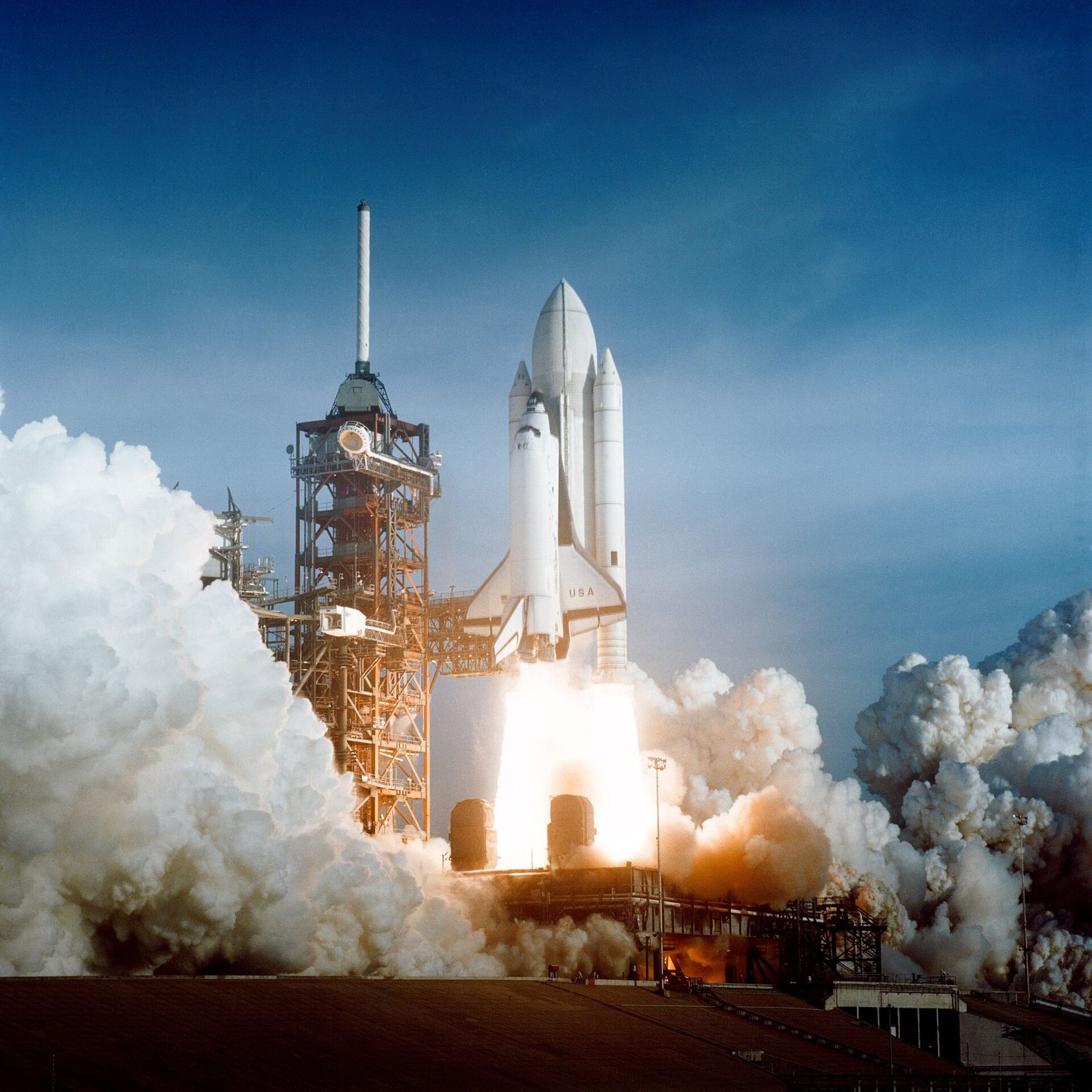
    A rocket launch: net force changes momentum — F_net = ma for translational dynamics
    A rocket launch: net force changes momentum — F_net = ma for translational dynamics

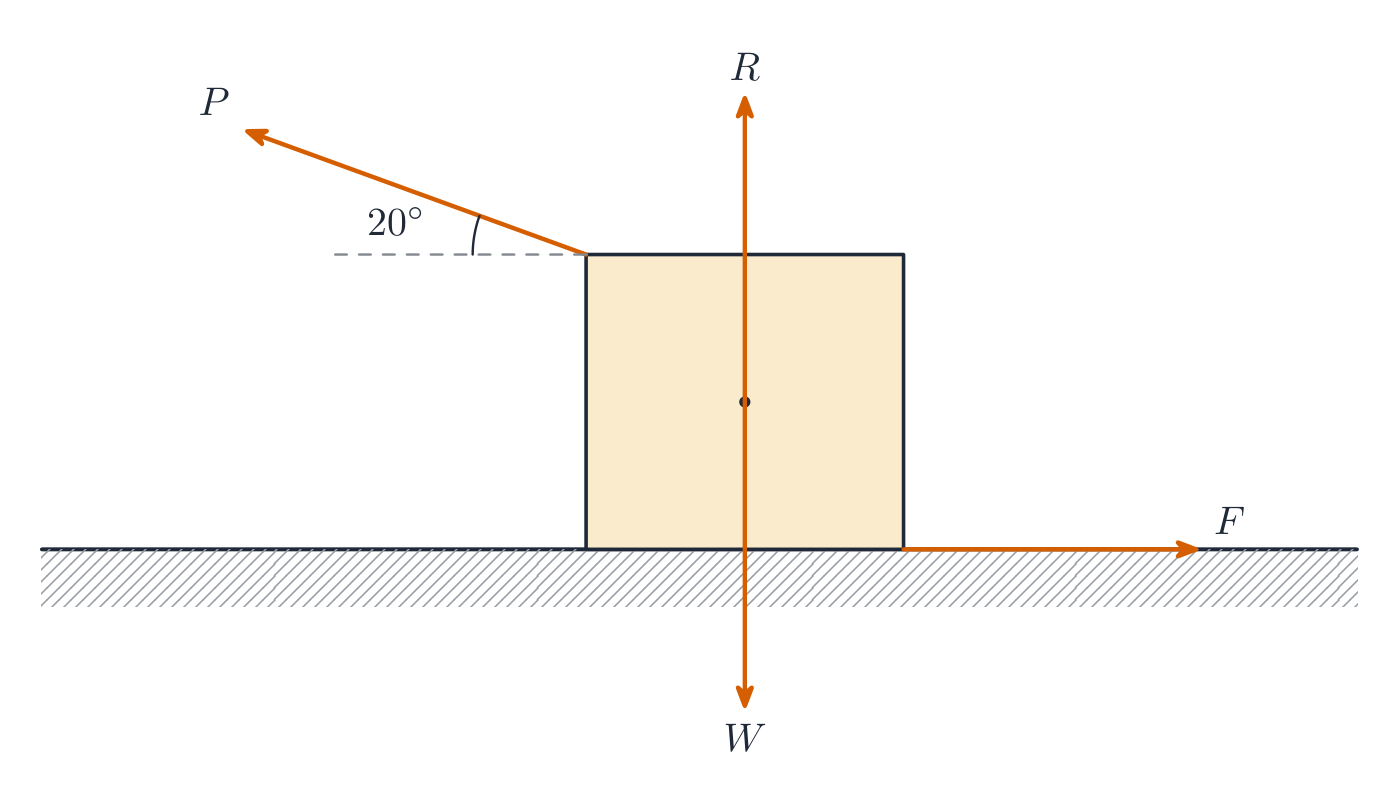
    A force 力 is a push or pull – a vector, measured in newtons (N). A free-body diagram 受力图 shows one object as a dot with arrows for every force acting on it (weight 重力, normal, tension 张力, friction, applied), each labelled and pointing the right way. Draw it before any dynamics problem; it is where most marks are won or lost.

    A free-body diagram shows every force acting on one object
    A free-body diagram shows every force acting on one object

    Two rules keep free-body diagrams honest: draw only forces acting on the chosen object (not forces it exerts on other things), and draw only real, physical forces (a rope, a surface, gravity, a hand) – never an "$ma$" arrow, which is the result of the forces, not a force itself.

    Explore · ⁨Jelajahi⁩

    Balance the forces on a free-body diagram · ⁨Seimbangkan gaya-gaya pada diagram benda bebas⁩

    A free-body diagram shows every force on one object as an arrow. The object accelerates only if the forces don't cancel — the net force sets $a=F/m$. · ⁨Diagram benda bebas menunjukkan setiap gaya yang bekerja pada satu objek sebagai anak panah. Objek hanya berakselerasi jika gaya-gaya tidak saling meniadakan — gaya bersih menentukan $a=F/m$.⁩

    Vocabulary · ⁨Kosa kata⁩ Train · ⁨Latih⁩
    English Bahasa Indonesia
    force/fɔːs/ gaya
    free-body diagram/friː ˈbɒdi ˈdaɪəɡræm/ diagram benda bebas
    weight/weɪt/ berat
    tension/ˈtenʃn/ tegangan
    2.3

    Newton's Third Law

    Syllabus · ⁨Silabus⁩
    English

    Learning Objective 2.3.A: Describe the interaction of two objects using Newton's third law and a representation of paired forces exerted on each object.

    • 2.3.A.1 Newton's third law describes the interaction of two objects in terms of the paired forces that each exerts on the other.
      • Equation: $\vec{F}_{\text{A on B}} = -\vec{F}_{\text{B on A}}$
    • 2.3.A.2 Interactions between objects within a system (internal forces) do not influence the motion of a system's center of mass.
    • 2.3.A.3 Tension is the macroscopic net result of forces that segments of a string, cable, chain, or similar system exert on each other in response to an external force.
      • 2.3.A.3.i An ideal string has negligible mass and does not stretch when under tension.
      • 2.3.A.3.ii The tension in an ideal string is the same at all points within the string.
      • 2.3.A.3.iii In a string with nonnegligible mass, tension may not be the same at all points within the string.
      • 2.3.A.3.iv An ideal pulley is a pulley that has negligible mass and rotates about an axle through its center of mass with negligible friction.

    Boundary statement: AP Physics 1 only expects students to describe tension qualitatively in a string, cable, chain, or similar system with mass. For example, students might note that the tension in a hanging chain is greater toward the top of the chain.

    Boundary statement: The interaction between objects or systems at a distance is limited to gravitational forces in AP Physics 1. In AP Physics 2, gravitational, electric, and magnetic forces may be considered.

    Bahasa Indonesia

    Tujuan Pembelajaran 2.3.A: Jelaskan interaksi dua benda menggunakan hukum ketiga Newton dan representasi pasangan gaya yang bekerja pada masing-masing benda.

    • 2.3.A.1 Hukum ketiga Newton menggambarkan interaksi dua benda dalam hal pasangan gaya yang masing-masing exertkan pada yang lain.
      • Persamaan: $\vec{F}_{\text{A on B}} = -\vec{F}_{\text{B on A}}$
    • 2.3.A.2 Interaksi antara benda-benda dalam suatu sistem (gaya internal) tidak memengaruhi gerak pusat massa sistem tersebut.
    • 2.3.A.3 Tegangan adalah hasil makroskopis bersih dari gaya-gaya yang diberikan oleh segmen-segmen tali, kabel, rantai, atau sistem serupa kepada satu sama lain sebagai respons terhadap gaya eksternal.
      • 2.3.A.3.i Tali ideal memiliki massa yang dapat diabaikan dan tidak meregang ketika mengalami tegangan.
      • 2.3.A.3.ii Tegangan pada tali ideal adalah sama di semua titik di dalam tali tersebut.
      • 2.3.A.3.iii Pada tali dengan massa yang tidak dapat diabaikan, tegangan mungkin tidak sama di semua titik di dalam tali tersebut.
      • 2.3.A.3.iv Katrol ideal adalah katrol yang memiliki massa yang dapat diabaikan dan berputar pada sumbu melalui pusat massanya dengan gesekan yang dapat diabaikan.

    Pernyataan Batasan: AP Physics 1 hanya mengharapkan siswa untuk menjelaskan tegangan secara kualitatif dalam tali, kabel, rantai, atau sistem serupa yang bermassa. Sebagai contoh, siswa mungkin mencatat bahwa tegangan pada rantai yang digantung lebih besar menuju bagian atas rantai.

    Pernyataan Batasan: Interaksi antara benda atau sistem pada jarak terbatas pada gaya gravitasi dalam AP Physics 1. Dalam AP Physics 2, gaya gravitasi, listrik, dan magnet dapat dipertimbangkan.

    Source: College Board AP Course and Exam Description · ⁨Sumber: Deskripsi Kursus dan Ujian College Board AP⁩

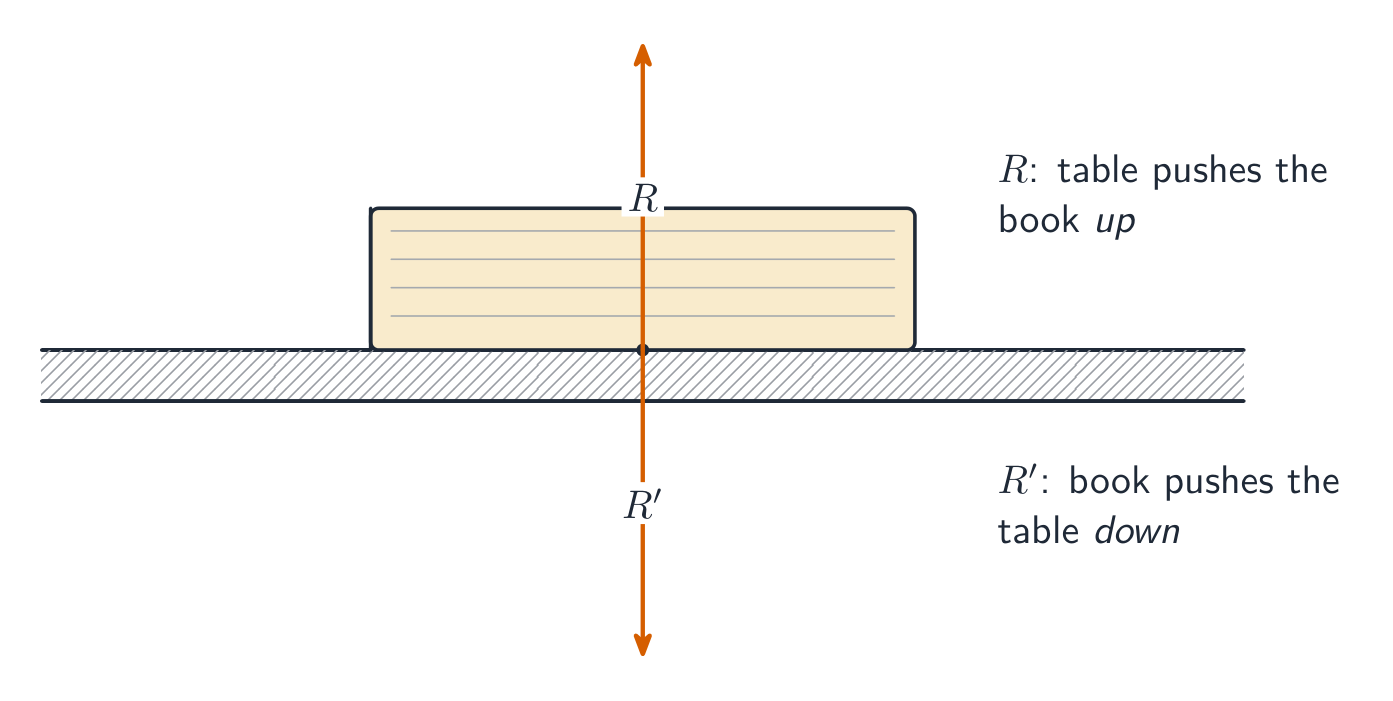
    Newton's third law 牛顿第三定律: if object A pushes on object B, then B pushes back on A with a force equal in size and opposite in direction. These two forces act on different objects, so they never cancel each other. Identify third-law pairs by the "A on B / B on A" wording.

    A Newton's third-law pair: equal and opposite forces on two different objects
    A Newton's third-law pair: equal and opposite forces on two different objects

    A classic trap: the weight of a book and the normal force from the table are not a third-law pair – they act on the same object (the book). The partner of the book's weight is the pull the book exerts on the Earth; the partner of the table's push is the push the book makes on the table.

    Vocabulary · ⁨Kosa kata⁩ Train · ⁨Latih⁩
    English Bahasa Indonesia
    Newton's third law/ˈnjuːtnz θɜːd lɔː/ hukum ketiga Newton
    2.4

    Newton's First Law

    Syllabus · ⁨Silabus⁩
    English

    Learning Objective 2.4.A: Describe the conditions under which a system's velocity remains constant.

    • 2.4.A.1 The net force on a system is the vector sum of all forces exerted on the system.
    • 2.4.A.2 Translational equilibrium is a configuration of forces such that the net force exerted on a system is zero.
      • Derived equation: $\sum_i \vec{F}_i = 0$
    • 2.4.A.3 Newton's first law states that if the net force exerted on a system is zero, the velocity of that system will remain constant.
    • 2.4.A.4 Forces may be balanced in one dimension but unbalanced in another. The system's velocity will change only in the direction of the unbalanced force.
    • 2.4.A.5 An inertial reference frame is one from which an observer would verify Newton's first law of motion.
    Bahasa Indonesia

    Tujuan Pembelajaran 2.4.A: Jelaskan kondisi di mana kecepatan suatu sistem tetap konstan.

    • 2.4.A.1 Resultan gaya pada suatu sistem adalah jumlah vektor dari semua gaya yang bekerja pada sistem tersebut.
    • 2.4.A.2 Kesetimbangan translasi adalah konfigurasi gaya sedemikian rupa sehingga resultan gaya yang bekerja pada sistem adalah nol.
      • Persamaan Turunan: $\sum_i \vec{F}_i = 0$
    • 2.4.A.3 Hukum pertama Newton menyatakan bahwa jika resultan gaya yang bekerja pada suatu sistem adalah nol, maka kecepatan sistem tersebut akan tetap konstan.
    • 2.4.A.4 Gaya-gaya dapat seimbang dalam satu dimensi tetapi tidak seimbang dalam dimensi lain. Kecepatan sistem hanya akan berubah dalam arah gaya yang tidak seimbang.
    • 2.4.A.5 Kerangka acuan inersial adalah kerangka dari mana pengamat akan memverifikasi hukum pertama gerak Newton.

    Source: College Board AP Course and Exam Description · ⁨Sumber: Deskripsi Kursus dan Ujian College Board AP⁩

    Newton's first law 牛顿第一定律 (the law of inertia 惯性): an object's velocity stays constant unless a net force 合力 acts on it. So zero net force means constant velocity (including rest) – the object is in translational equilibrium 平衡. Inertia is the tendency to resist changes in motion, measured by mass.

    Worked example. A $1200\ \text{kg}$ car cruises at a steady $25\ \text{m/s}$ on a level road. What is the net force on it? Because the velocity is constant, the acceleration is zero, so by the first law the net force is zero – the forward drive force exactly balances drag and friction. "Steady speed" always means balanced forces.

    Vocabulary · ⁨Kosa kata⁩ Train · ⁨Latih⁩
    English Bahasa Indonesia
    Newton's first law/ˈnjuːtnz fɜːst lɔː/ Hukum pertama Newton
    inertia/ɪˈnɜːʃə/ inersia
    net force/net fɔːs/ gaya bersih
    translational equilibrium/trænˈsleɪʃənl ˌiːkwɪˈlɪbrɪəm/ kesetimbangan translasi
    2.5

    Newton's Second Law

    Syllabus · ⁨Silabus⁩
    English

    Learning Objective 2.5.A: Describe the conditions under which a system's velocity changes.

    • 2.5.A.1 Unbalanced forces are a configuration of forces such that the net force exerted on a system is not equal to zero.
    • 2.5.A.2 Newton's second law of motion states that the acceleration of a system's center of mass has a magnitude proportional to the magnitude of the net force exerted on the system and is in the same direction as that net force.
      • Equation: $\vec{a}_{\text{sys}} = \dfrac{\sum \vec{F}}{m_{\text{sys}}} = \dfrac{\vec{F}_{\text{net}}}{m_{\text{sys}}}$
    • 2.5.A.3 The velocity of a system's center of mass will only change if a nonzero net external force is exerted on that system.
    Bahasa Indonesia

    Tujuan Pembelajaran 2.5.A: Jelaskan kondisi di mana kecepatan suatu sistem berubah.

    • 2.5.A.1 Gaya-gaya yang tidak seimbang adalah konfigurasi gaya sedemikian rupa sehingga resultan gaya yang bekerja pada sistem tidak sama dengan nol.
    • 2.5.A.2 Hukum kedua gerak Newton menyatakan bahwa percepatan pusat massa sistem memiliki besaran yang berbanding lurus dengan besaran resultan gaya yang bekerja pada sistem dan berada dalam arah yang sama dengan resultan gaya tersebut.
      • Persamaan: $\vec{a}_{\text{sys}} = \dfrac{\sum \vec{F}}{m_{\text{sys}}} = \dfrac{\vec{F}_{\text{net}}}{m_{\text{sys}}}$
    • 2.5.A.3 Kecepatan pusat massa suatu sistem hanya akan berubah jika ada resultan gaya eksternal tak nol yang bekerja pada sistem tersebut.

    Source: College Board AP Course and Exam Description · ⁨Sumber: Deskripsi Kursus dan Ujian College Board AP⁩

    Newton's second law 牛顿第二定律 relates net force to acceleration:

    $$\vec{a}=\frac{\sum \vec{F}}{m},\qquad\text{i.e.}\qquad \sum\vec{F}=m\vec{a}.$$
    Apply it one axis at a time: add the force components along each axis and set the sum equal to $ma$ for that axis. Acceleration points the same way as the net force.

    Worked example. A $4.0\ \text{kg}$ box is pulled along the floor by a horizontal force of $18\ \text{N}$. Friction on the box is $6.0\ \text{N}$. Find its acceleration. Along the direction of motion the net force is $18-6.0=12\ \text{N}$, so

    $$a=\frac{\sum F}{m}=\frac{12}{4.0}=3.0\ \text{m/s}^2.$$

    Worked example (incline 斜面). A block of mass $m$ slides down a frictionless ramp tilted at angle $\theta$. Find its acceleration. Resolve gravity into components along and perpendicular to the ramp; only the along-ramp part, $mg\sin\theta$, drives the motion, so

    $$a=\frac{mg\sin\theta}{m}=g\sin\theta.$$
    The steeper the ramp, the larger $\sin\theta$ and the faster it accelerates; at $\theta=90^{\circ}$ it is free fall.

    Vocabulary · ⁨Kosa kata⁩ Train · ⁨Latih⁩
    English Bahasa Indonesia
    Newton's second law/ˈnjuːtnz ˈsekənd lɔː/ Hukum kedua Newton
    incline/ɪnˈklaɪn/ Kemiringan
    2.6

    Gravitational Force

    Syllabus · ⁨Silabus⁩
    English

    Learning Objective 2.6.A: Describe the gravitational interaction between two objects or systems with mass.

    • 2.6.A.1 Newton's law of universal gravitation describes the gravitational force between two objects or systems as directly proportional to each of their masses and inversely proportional to the square of the distance between the systems' centers of mass.
      • Equation: $\left|\vec{F}_g\right| = G\dfrac{m_1 m_2}{r^2}$
      • 2.6.A.1.i The gravitational force is attractive.
      • 2.6.A.1.ii The gravitational force is always exerted along the line connecting the centers of mass of the two interacting systems.
      • 2.6.A.1.iii The gravitational force on a system can be considered to be exerted on the system's center of mass.
    • 2.6.A.2 A field models the effects of a noncontact force exerted on an object at various positions in space.
      • 2.6.A.2.i The magnitude of the gravitational field created by a system of mass $M$ at a point in space is equal to the ratio of the gravitational force exerted by the system on a test object of mass $m$ to the mass of the test object.
        • Equation: $\left|\vec{g}\right| = \dfrac{\left|\vec{F}_g\right|}{m} = G\dfrac{M}{r^2}$
      • 2.6.A.2.ii If the gravitational force is the only force exerted on an object, the observed acceleration of the object (in m/s$^2$) is numerically equal to the magnitude of the gravitational field strength (in N/kg) at that location.
    • 2.6.A.3 The gravitational force exerted by an astronomical body on a relatively small nearby object is called weight.
      • Equation: $\text{Weight} = F_g = mg$

    Learning Objective 2.6.B: Describe situations in which the gravitational force can be considered constant.

    • 2.6.B.1 If the gravitational force between two systems' centers of mass has a negligible change as the relative position of the two systems changes, the gravitational force can be considered constant at all points between the initial and final positions of the systems.
    • 2.6.B.2 Near the surface of Earth, the strength of the gravitational field is $g \approx 10 \text{ N/kg}$

    Learning Objective 2.6.C: Describe the conditions under which the magnitude of a system's apparent weight is different from the magnitude of the gravitational force exerted on that system.

    • 2.6.C.1 The magnitude of the apparent weight of a system is the magnitude of the normal force exerted on the system.
    • 2.6.C.2 If the system is accelerating, the apparent weight of the system is not equal to the magnitude of the gravitational force exerted on the system.
    • 2.6.C.3 A system appears weightless when there are no forces exerted on the system or when the force of gravity is the only force exerted on the system.
    • 2.6.C.4 The equivalence principle states that an observer in a noninertial reference frame is unable to distinguish between an object's apparent weight and the gravitational force exerted on the object by a gravitational field.

    Learning Objective 2.6.D: Describe inertial and gravitational mass.

    • 2.6.D.1 Objects have inertial mass, or inertia, a property that determines how much an object's motion resists changes when interacting with another object.
    • 2.6.D.2 Gravitational mass is related to the force of attraction between two systems with mass.
    • 2.6.D.3 Inertial mass and gravitational mass have been experimentally verified to be equivalent.
    Bahasa Indonesia

    Tujuan Pembelajaran 2.6.A: Jelaskan interaksi gravitasi antara dua benda atau sistem yang bermassa.

    • 2.6.A.1 Hukum gravitasi universal Newton menggambarkan gaya gravitasi antara dua benda atau sistem sebagai berbanding lurus dengan masing-masing massanya dan berbanding terbalik dengan kuadrat jarak antara pusat massa sistem tersebut.
      • Persamaan: $\left|\vec{F}_g\right| = G\dfrac{m_1 m_2}{r^2}$
      • 2.6.A.1.i Gaya gravitasi bersifat menarik.
      • 2.6.A.1.ii Gaya gravitasi selalu bekerja sepanjang garis yang menghubungkan pusat massa kedua sistem yang berinteraksi.
      • 2.6.A.1.iii Gaya gravitasi pada suatu sistem dapat dianggap bekerja pada pusat massa sistem tersebut.
    • 2.6.A.2 Medan memodelkan efek gaya non-kontak yang bekerja pada objek di berbagai posisi di ruang.
      • 2.6.A.2.i Besaran medan gravitasi yang dihasilkan oleh sistem bermassa $M$ pada suatu titik di ruang sama dengan rasio gaya gravitasi yang diberikan sistem terhadap objek uji bermassa $m$ dibagi dengan massa objek uji tersebut.
        • Persamaan: $\left|\vec{g}\right| = \dfrac{\left|\vec{F}_g\right|}{m} = G\dfrac{M}{r^2}$
      • 2.6.A.2.ii Jika gaya gravitasi adalah satu-satunya gaya yang bekerja pada sebuah objek, percepatan objek yang diamati (dalam m/s$^2$) secara numerik sama dengan besaran kekuatan medan gravitasi (dalam N/kg) di lokasi tersebut.
    • 2.6.A.3 Gaya gravitasi yang diberikan oleh tubuh astronomi terhadap objek kecil di dekatnya disebut berat.
      • Persamaan: $\text{Weight} = F_g = mg$

    Tujuan Pembelajaran 2.6.B: Jelaskan situasi di mana gaya gravitasi dapat dianggap konstan.

    • 2.6.B.1 Jika perubahan gaya gravitasi antara pusat massa dua sistem sangat kecil seiring dengan perubahan posisi relatif kedua sistem, maka gaya gravitasi dapat dianggap konstan di semua titik antara posisi awal dan akhir sistem.
    • 2.6.B.2 Di dekat permukaan Bumi, kekuatan medan gravitasi adalah $g \approx 10 \text{ N/kg}$

    Tujuan Pembelajaran 2.6.C: Jelaskan kondisi di mana besaran berat semu suatu sistem berbeda dari besaran gaya gravitasi yang bekerja pada sistem tersebut.

    • 2.6.C.1 Besaran berat semu suatu sistem adalah besaran gaya normal yang bekerja pada sistem tersebut.
    • 2.6.C.2 Jika sistem sedang dipercepat, berat semu sistem tidak sama dengan besaran gaya gravitasi yang bekerja pada sistem.
    • 2.6.C.3 Suatu sistem tampak tanpa berat ketika tidak ada gaya yang bekerja pada sistem atau ketika gaya gravitasi adalah satu-satunya gaya yang bekerja pada sistem.
    • 2.6.C.4 Prinsip ekuivalensi menyatakan bahwa pengamat dalam kerangka acuan non-inersia tidak dapat membedakan antara berat semu suatu benda dan gaya gravitasi yang bekerja pada benda tersebut oleh medan gravitasi.

    Tujuan Pembelajaran 2.6.D: Jelaskan massa inersia dan massa gravitasi.

    • 2.6.D.1 Benda memiliki massa inersia, atau inersia, sebuah sifat yang menentukan seberapa besar gerak benda menahan perubahan ketika berinteraksi dengan benda lain.
    • 2.6.D.2 Massa gravitasi berkaitan dengan gaya tarik-menarik antara dua sistem bermassa.
    • 2.6.D.3 Massa inersia dan massa gravitasi telah diverifikasi secara eksperimental sebagai ekuivalen.

    Source: College Board AP Course and Exam Description · ⁨Sumber: Deskripsi Kursus dan Ujian College Board AP⁩

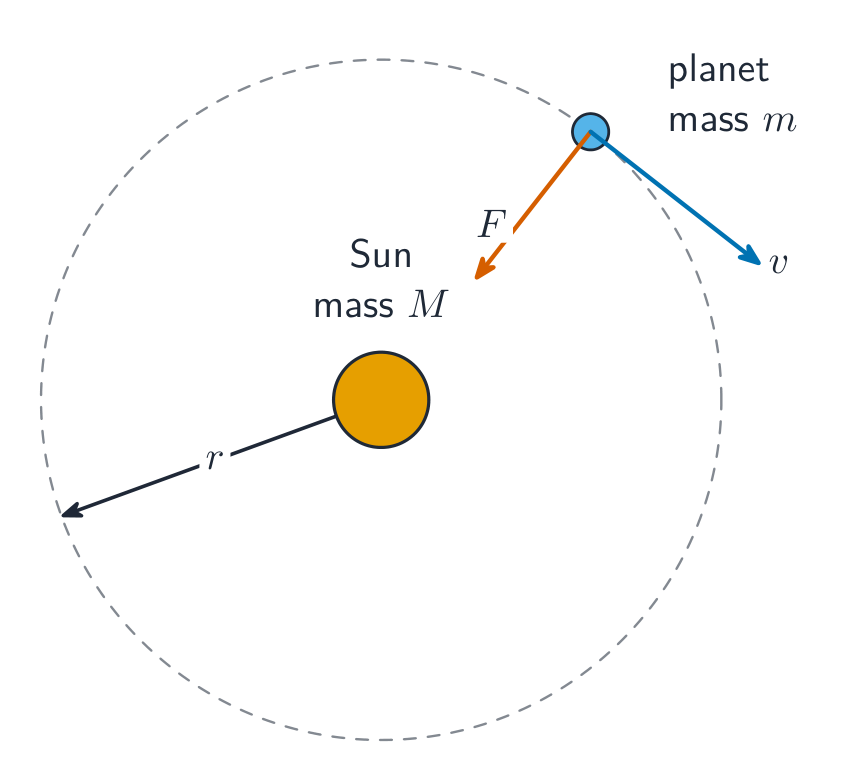
    Orbital motion (Kepler's 2nd law)

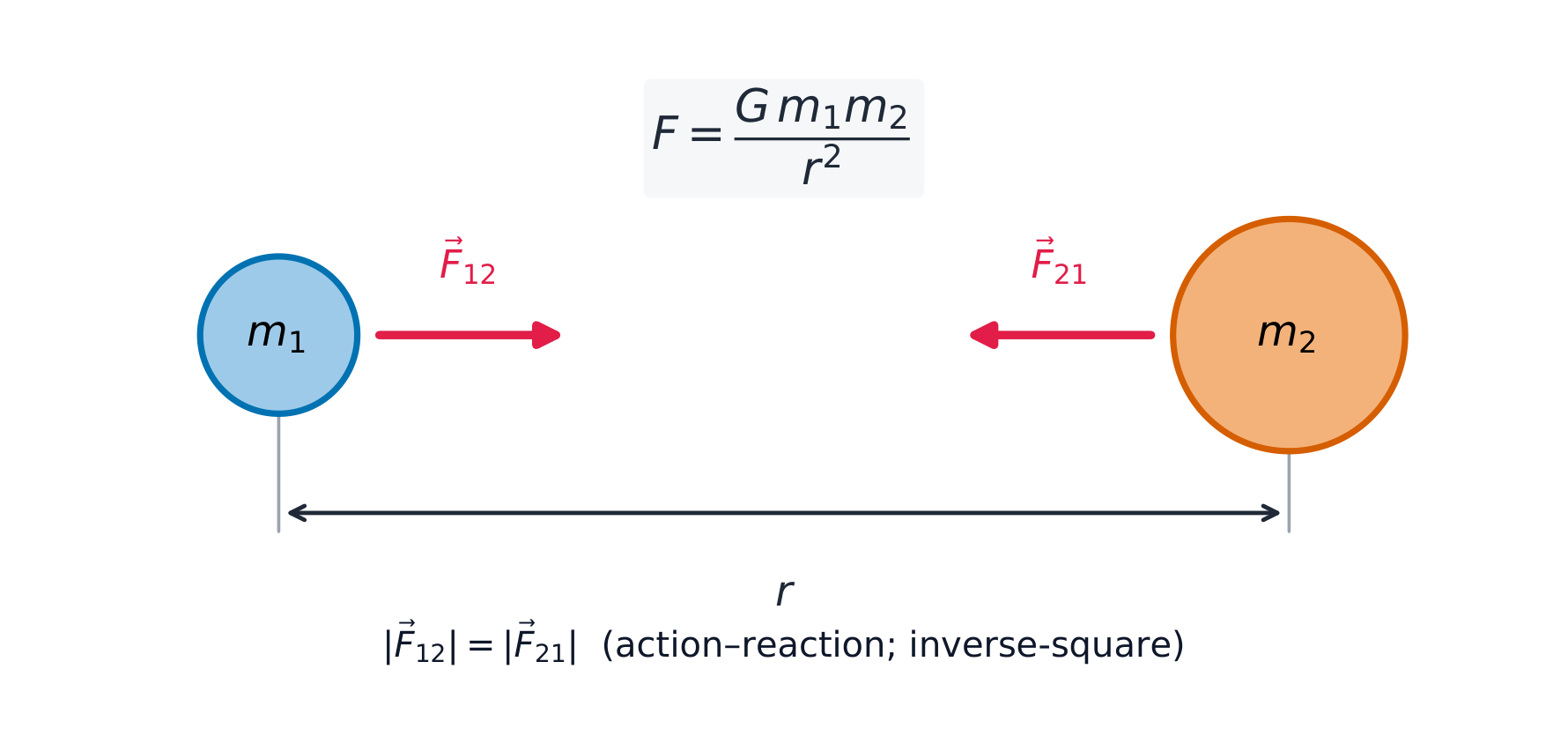
    Near a planet's surface, the gravitational force (weight) is $F_g=mg$, directed down, where $g$ is the gravitational field strength 重力场强度. More generally, Newton's law of gravitation 万有引力定律 gives the attraction between any two masses:

    $$F_g=\frac{G m_1 m_2}{r^2},$$
    directed along the line joining them, weaker as the distance $r$ grows (an inverse-square law). Doubling the separation quarters the force.

    Two masses attract each other with equal, opposite, inverse-square forces along the line joining them
    Two masses attract each other with equal, opposite, inverse-square forces along the line joining them

    Worked example. A $2.0\ \text{kg}$ object weighs $19.6\ \text{N}$ on Earth ($g=9.8\ \text{m/s}^2$). On the Moon $g_{\text{Moon}}=1.6\ \text{m/s}^2$. Its mass is unchanged ($2.0\ \text{kg}$), but its weight becomes $F_g=mg=2.0\times1.6=3.2\ \text{N}$. Mass measures inertia; weight is a force that depends on where you are.

    Mass actually plays two distinct roles. Inertial mass 惯性质量 sets how strongly an object resists acceleration ($F=ma$); gravitational mass 引力质量 sets how strongly it attracts other masses ($F=Gm_1m_2/r^2$). Experiments confirm the two are equal – which is exactly why every object, heavy or light, falls with the same $g$.

    Vocabulary · ⁨Kosa kata⁩ Train · ⁨Latih⁩
    English Bahasa Indonesia
    gravitational field strength/ˌɡrævɪˈteɪʃənl fiːld streŋθ/ kekuatan medan gravitasi
    Newton's law of gravitation/ˈnjuːtnz lɔː ɒv ˌɡrævɪˈteɪʃn/ Hukum gravitasi Newton
    Inertial mass/ɪˈnɜːʃl mæs/ Massa inersia
    gravitational mass/ˌɡrævɪˈteɪʃənl mæs/ Massa gravitasi
    2.7

    Kinetic and Static Friction

    Syllabus · ⁨Silabus⁩
    English

    Learning Objective 2.7.A: Describe kinetic friction between two surfaces

    • 2.7.A.1 Kinetic friction occurs when two surfaces in contact move relative to each other.
      • 2.7.A.1.i The kinetic friction force is exerted in a direction opposite to the motion of each surface relative to the other surface.
      • 2.7.A.1.ii The force of friction between two surfaces does not depend on the size of the surface area of contact.
    • 2.7.A.2 The magnitude of the kinetic friction force exerted on an object is the product of the normal force the surface exerts on the object and the coefficient of kinetic friction.
      • Equation: $\left|\vec{F}_{f,k}\right| = \left|\mu_k \vec{F}_n\right|$
      • 2.7.A.2.i The coefficient of kinetic friction depends on the material properties of the surfaces that are in contact.
      • 2.7.A.2.ii Normal force is the perpendicular component of the force exerted on an object by the surface with which it is in contact; it is directed away from the surface.

    Learning Objective 2.7.B: Describe static friction between two surfaces.

    • 2.7.B.1 Static friction may occur between the contacting surfaces of two objects that are not moving relative to each other.
    • 2.7.B.2 Static friction adopts the value and direction required to prevent an object from slipping or sliding on a surface.
      • Equation: $\left|\vec{F}_{f,s}\right| \leq \left|\mu_s \vec{F}_n\right|$
      • 2.7.B.2.i Slipping and sliding refer to situations in which two surfaces are moving relative to each other.
      • 2.7.B.2.ii There exists a maximum value for which static friction will prevent an object from slipping on a given surface.
        • Equation: $F_{f,s,\max} = \mu_s F_n$
    • 2.7.B.3 The coefficient of static friction is typically greater than the coefficient of kinetic friction for a given pair of surfaces.
    Bahasa Indonesia

    Tujuan Pembelajaran 2.7.A: Jelaskan gesekan kinetik antara dua permukaan

    • 2.7.A.1 Gesekan kinetik terjadi ketika dua permukaan yang bersentuhan bergerak relatif satu sama lain.
      • 2.7.A.1.i Gaya gesekan kinetik diberikan dalam arah berlawanan dengan gerak setiap permukaan relatif terhadap permukaan lainnya.
      • 2.7.A.1.ii Besar gaya gesekan antara dua permukaan tidak bergantung pada luas area kontak permukaan.
    • 2.7.A.2 Besar gaya gesekan kinetik yang bekerja pada suatu benda adalah hasil kali gaya normal yang diberikan permukaan pada benda dan koefisien gesekan kinetik.
      • Persamaan: $\left|\vec{F}_{f,k}\right| = \left|\mu_k \vec{F}_n\right|$
      • 2.7.A.2.i Koefisien gesekan kinetik bergantung pada sifat material permukaan yang bersentuhan.
      • 2.7.A.2.ii Gaya normal adalah komponen tegak lurus dari gaya yang diberikan pada suatu benda oleh permukaan tempat benda itu bersentuhan; arahnya menjauhi permukaan.

    Tujuan Pembelajaran 2.7.B: Jelaskan gesekan statis antara dua permukaan.

    • 2.7.B.1 Gesekan statis dapat terjadi antara permukaan yang bersentuhan dari dua benda yang tidak bergerak relatif satu sama lain.
    • 2.7.B.2 Gesekan statis mengambil nilai dan arah yang diperlukan untuk mencegah benda tergelincir atau tergelinding di atas permukaan.
      • Persamaan: $\left|\vec{F}_{f,s}\right| \leq \left|\mu_s \vec{F}_n\right|$
      • 2.7.B.2.i Tergelincir dan tergelinding merujuk pada situasi di mana dua permukaan bergerak relatif satu sama lain.
      • 2.7.B.2.ii Terdapat nilai maksimum di mana gesekan statis akan mencegah benda tergelincir di atas suatu permukaan tertentu.
        • Persamaan: $F_{f,s,\max} = \mu_s F_n$
    • 2.7.B.3 Koefisien gesekan statis biasanya lebih besar daripada koefisien gesekan kinetik untuk sepasang permukaan tertentu.

    Source: College Board AP Course and Exam Description · ⁨Sumber: Deskripsi Kursus dan Ujian College Board AP⁩

    Friction 摩擦力 acts along a surface, opposing relative sliding (or the tendency to slide):

    • Kinetic friction 动摩擦 (while sliding): $f_k=\mu_k N$.
    • Static friction 静摩擦 (while not yet sliding): $f_s\le \mu_s N$ – it adjusts up to a maximum to prevent motion.

    Here $N$ is the normal force 法向力 (surface push, perpendicular to the surface) and $\mu$ is the coefficient of friction 摩擦系数.

    Worked example. A $5.0\ \text{kg}$ crate sits on a level floor with $\mu_s=0.40$. Will a horizontal push of $15\ \text{N}$ move it? On a level floor $N=mg=5.0\times9.8=49\ \text{N}$, so the largest static friction is $f_{s,\max}=\mu_s N=0.40\times49=19.6\ \text{N}$. The $15\ \text{N}$ push is smaller than $19.6\ \text{N}$, so friction rises to match it and the crate stays still.

    Explore · ⁨Jelajahi⁩

    Slide a block down a slope with friction · ⁨Geser balok menuruni lereng dengan gesekan⁩

    Friction opposes motion up to a maximum $\mu N$. Tilt the slope until gravity's pull along it beats static friction and the block starts to slide. · ⁨Gesekan melawan gerakan hingga maksimum tertentu $\mu N$. Condongkan lereng hingga tarikan gravitasi di sepanjangnya mengalahkan gesekan statis dan balok mulai tergelincir.⁩

    Vocabulary · ⁨Kosa kata⁩ Train · ⁨Latih⁩
    English Bahasa Indonesia
    Friction/ˈfrɪkʃn/ Gesekan
    Kinetic friction/kɪˈnetɪk ˈfrɪkʃn/ Gesekan kinetik
    Static friction/ˈstætɪk ˈfrɪkʃn/ Gesekan statis
    normal force/ˈnɔːml fɔːs/ gaya normal
    coefficient of friction/ˌkəʊɪˈfɪʃənt ɒv ˈfrɪkʃn/ koefisien gesekan
    2.8

    Spring Forces

    Syllabus · ⁨Silabus⁩
    English

    Learning Objective 2.8.A: Describe the force exerted on an object by an ideal spring

    • 2.8.A.1 An ideal spring has negligible mass and exerts a force that is proportional to the change in its length as measured from its relaxed length.
    • 2.8.A.2 The magnitude of the force exerted by an ideal spring on an object is given by Hooke's law:
      • Equation: $\vec{F}_s = -k\Delta\vec{x}$
    • 2.8.A.3 The force exerted on an object by a spring is always directed toward the equilibrium position of the object–spring system.
    Bahasa Indonesia

    Tujuan Pembelajaran 2.8.A: Jelaskan gaya yang diberikan pada suatu benda oleh pegas ideal

    • 2.8.A.1 Pegas ideal memiliki massa yang dapat diabaikan dan memberikan gaya yang sebanding dengan perubahan panjangnya相对于 panjang relaksasinya.
    • 2.8.A.2 Besar gaya yang diberikan oleh pegas ideal pada suatu benda dinyatakan oleh hukum Hooke:
      • Persamaan: $\vec{F}_s = -k\Delta\vec{x}$
    • 2.8.A.3 Gaya yang diberikan pada suatu benda oleh pegas selalu diarahkan menuju posisi kesetimbangan sistem benda-pegas.

    Source: College Board AP Course and Exam Description · ⁨Sumber: Deskripsi Kursus dan Ujian College Board AP⁩

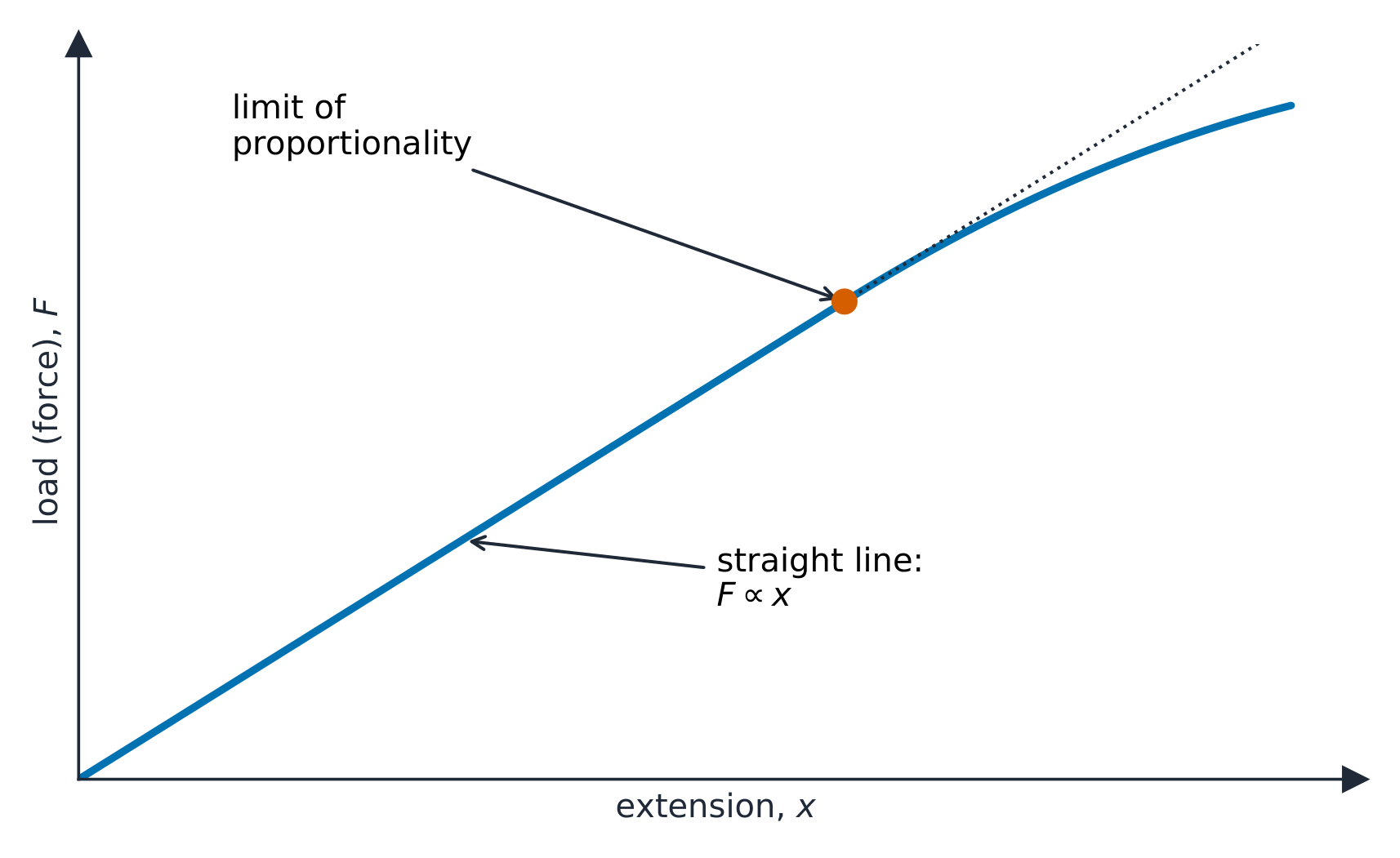
    Hooke's law & the elastic limit

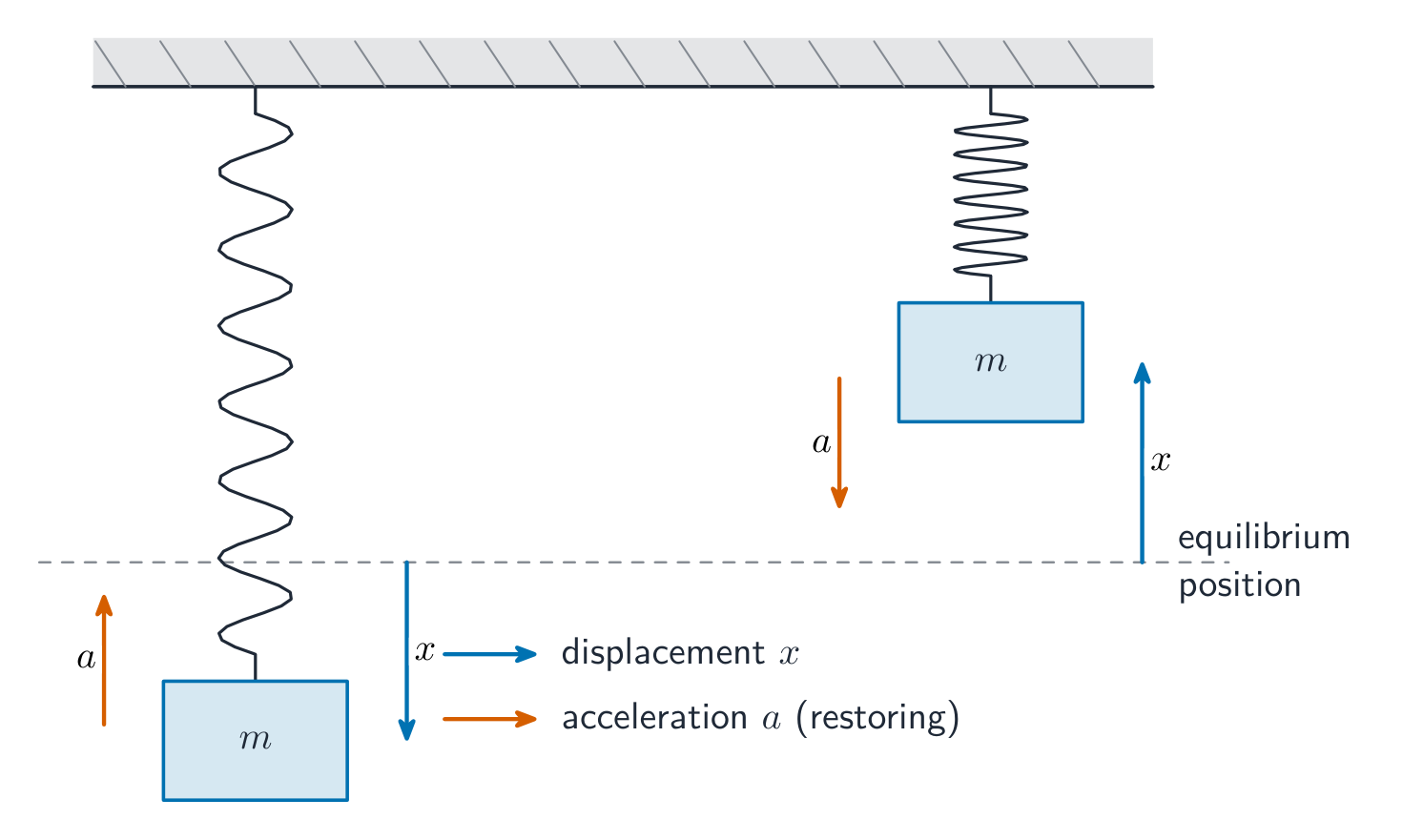
    An ideal spring exerts a restoring force 回复力 proportional to its stretch or compression – Hooke's law 胡克定律:

    $$F_s=-kx,$$
    where $k$ is the spring constant 弹簧常数 (stiffness) and $x$ is the displacement from the spring's natural length. The minus sign means the force points back toward equilibrium.

    Hooke's law: extension is proportional to load up to the limit of proportionality
    Hooke's law: extension is proportional to load up to the limit of proportionality

    Worked example. A spring with $k=200\ \text{N/m}$ hangs vertically and a $0.50\ \text{kg}$ mass is hung on it. How far does it stretch at rest? At rest the spring force balances the weight, $kx=mg$, so

    $$x=\frac{mg}{k}=\frac{0.50\times9.8}{200}=0.025\ \text{m}=2.5\ \text{cm}.$$

    Explore · ⁨Jelajahi⁩

    Stretch a spring (Hooke's law) · ⁨Regangkan pegas (Hukum Hooke)⁩

    A spring's force is proportional to its extension, $F=kx$ (Hooke's law). Pull harder and the extension grows in step — until the spring's limit. · ⁨Gaya pegas berbanding lurus dengan perpanjangan-nya, $F=kx$ (Hukum Hooke). Tarik lebih keras dan perpanjangan bertambah secara proporsional — hingga batas elastis pegas.⁩

    Vocabulary · ⁨Kosa kata⁩ Train · ⁨Latih⁩
    English Bahasa Indonesia
    restoring force/rɪˈstɔːrɪŋ fɔːs/ gaya pemulih
    Hooke's law/hʊks lɔː/ Hukum Hooke
    spring constant/sprɪŋ ˈkɒnstənt/ konstanta pegas
    2.9

    Circular Motion

    Syllabus · ⁨Silabus⁩
    English

    Learning Objective 2.9.A: Describe the motion of an object traveling in a circular path.

    • 2.9.A.1 Centripetal acceleration is the component of an object's acceleration directed toward the center of the object's circular path.
      • 2.9.A.1.i The magnitude of centripetal acceleration for an object moving in a circular path is the ratio of the object's tangential speed squared to the radius of the circular path.
        • Equation: $a_c = \dfrac{v^2}{r}$
      • 2.9.A.1.ii Centripetal acceleration is directed toward the center of an object's circular path.
    • 2.9.A.2 Centripetal acceleration can result from a single force, more than one force, or components of forces exerted on an object in circular motion.
      • 2.9.A.2.i At the top of a vertical, circular loop, an object requires a minimum speed to maintain circular motion. At this point, and with this minimum speed, the gravitational force is the only force that causes the centripetal acceleration.
        • Equation: $v = \sqrt{gr}$
      • 2.9.A.2.ii Components of the static friction force and the normal force can contribute to the net force producing centripetal acceleration of an object traveling in a circle on a banked surface.
      • 2.9.A.2.iii A component of tension contributes to the net force producing centripetal acceleration experienced by a conical pendulum.
    • 2.9.A.3 Tangential acceleration is the rate at which an object's speed changes and is directed tangent to the object's circular path.
    • 2.9.A.4 The net acceleration of an object moving in a circle is the vector sum of the centripetal acceleration and tangential acceleration.
    • 2.9.A.5 The revolution of an object traveling in a circular path at a constant speed (uniform circular motion) can be described using period and frequency.
      • 2.9.A.5.i The time to complete one full circular path, one full rotation, or a full cycle of oscillatory motion is defined as period, $T$.
      • 2.9.A.5.ii The rate at which an object is completing revolutions is defined as frequency, $f$.
        • Equation: $T = \dfrac{1}{f}$
      • 2.9.A.5.iii For an object traveling at a constant speed in a circular path, the period is given by the derived equation
        • Equation: $T = \dfrac{2\pi r}{v}$

    Learning Objective 2.9.B: Describe circular orbits using Kepler's third law.

    • 2.9.B.1 For a satellite in circular orbit around a central body, the satellite's centripetal acceleration is caused only by gravitational attraction. The period and radius of the circular orbit are related to the mass of the central body.
      • Equation: $T^2 = \dfrac{4\pi^2}{GM} R^3$

    Boundary statement: AP Physics 1 only expects students to quantitatively analyze banked curves in which no friction is required to maintain uniform circular motion. Analysis of situations in which friction is required on a banked curve is limited to qualitative descriptions.

    Boundary statement: AP Physics 1 does not expect students to know Kepler's first or second laws of planetary motion.

    Bahasa Indonesia

    Tujuan Pembelajaran 2.9.A: Jelaskan gerak benda yang menempuh lintasan melingkar.

    • 2.9.A.1 Percepatan sentripetal adalah komponen percepatan benda yang diarahkan ke pusat lintasan melingkarnya.
      • 2.9.A.1.i Besar percepatan sentripetal untuk benda yang bergerak dalam lintasan melingkar adalah rasio kuadrat kecepatan tangensial benda terhadap jari-jari lintasan melingkar.
        • Persamaan: $a_c = \dfrac{v^2}{r}$
      • 2.9.A.1.ii Percepatan sentripetal diarahkan menuju pusat lintasan melingkar benda.
    • 2.9.A.2 Percepatan sentripetal dapat disebabkan oleh satu gaya, lebih dari satu gaya, atau komponen-komponen gaya yang bekerja pada benda dalam gerak melingkar.
      • 2.9.A.2.i Di bagian atas lintasan lingkaran vertikal, benda memerlukan kecepatan minimum untuk mempertahankan gerak melingkar. Pada titik ini, dan dengan kecepatan minimum ini, gaya gravitasi merupakan satu-satunya gaya yang menyebabkan percepatan sentripetal.
        • Persamaan: $v = \sqrt{gr}$
      • 2.9.A.2.ii Komponen gaya gesekan statis dan gaya normal dapat berkontribusi pada resultan gaya yang menghasilkan percepatan sentripetal bagi benda yang bergerak dalam lingkaran di atas bidang miring.
      • 2.9.A.2.iii Komponen tegangan tali berkontribusi pada resultan gaya yang menghasilkan percepatan sentripetal yang dialami oleh pendulum konus.
    • 2.9.A.3 Percepatan tangensial adalah laju perubahan kecepatan benda dan diarahkan menyinggung lintasan melingkar benda.
    • 2.9.A.4 Resultan percepatan benda yang bergerak dalam lingkaran adalah jumlah vektor dari percepatan sentripetal dan percepatan tangensial.
    • 2.9.A.5 Rotasi (revolusi) benda yang menempuh lintasan melingkar dengan kecepatan konstan (gerak melingkar beraturan) dapat dijelaskan menggunakan periode dan frekuensi.
      • 2.9.A.5.i Waktu untuk menyelesaikan satu lintasan melingkar penuh, satu putaran penuh, atau satu siklus penuh gerakan osilatif didefinisikan sebagai periode, $T$.
      • 2.9.A.5.ii Laju penyelesaian rotasi oleh benda didefinisikan sebagai frekuensi, $f$.
        • Persamaan: $T = \dfrac{1}{f}$
      • 2.9.A.5.iii Untuk benda yang bergerak dengan kecepatan konstan dalam lintasan melingkar, periode diberikan oleh persamaan turunan
        • Persamaan: $T = \dfrac{2\pi r}{v}$

    Tujuan Pembelajaran 2.9.B: Jelaskan orbit melingkar menggunakan hukum ketiga Kepler.

    • 2.9.B.1 Untuk satelit dalam orbit melingkar di sekitar benda pusat, percepatan sentripetal satelit hanya disebabkan oleh tarikan gravitasi. Periode dan jari-jari orbit melingkar berkaitan dengan massa benda pusat.
      • Persamaan: $T^2 = \dfrac{4\pi^2}{GM} R^3$

    Pernyataan Batasan: AP Physics 1 hanya mengharapkan siswa menganalisis secara kuantitatif tikungan miring yang tidak memerlukan gesekan untuk mempertahankan gerak melingkar beraturan. Analisis situasi di mana gesekan diperlukan pada tikungan miring terbatas pada deskripsi kualitatif.

    Pernyataan Batas: AP Physics 1 tidak mengharapkan siswa mengetahui hukum pertama atau kedua Kepler tentang gerak planet.

    Source: College Board AP Course and Exam Description · ⁨Sumber: Deskripsi Kursus dan Ujian College Board AP⁩

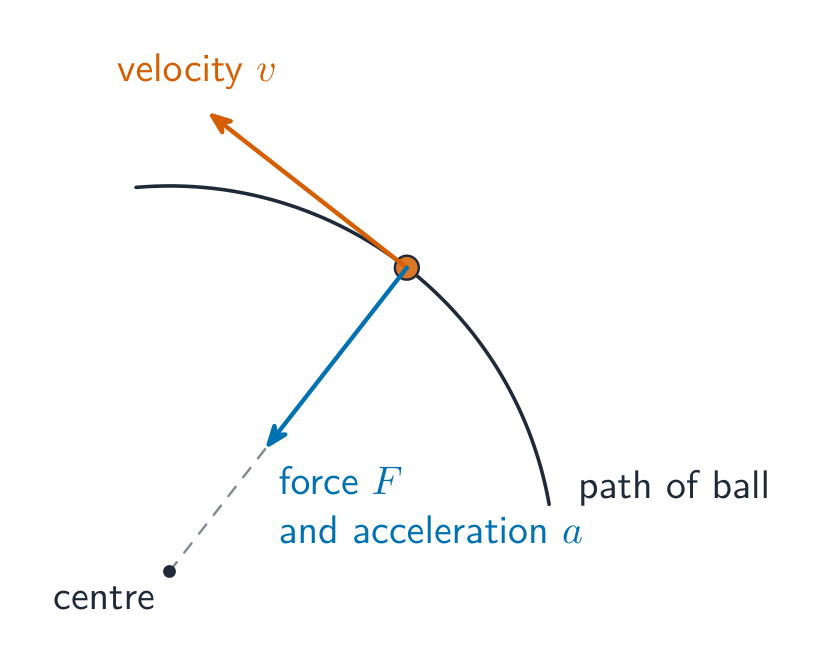
    Uniform circular motion

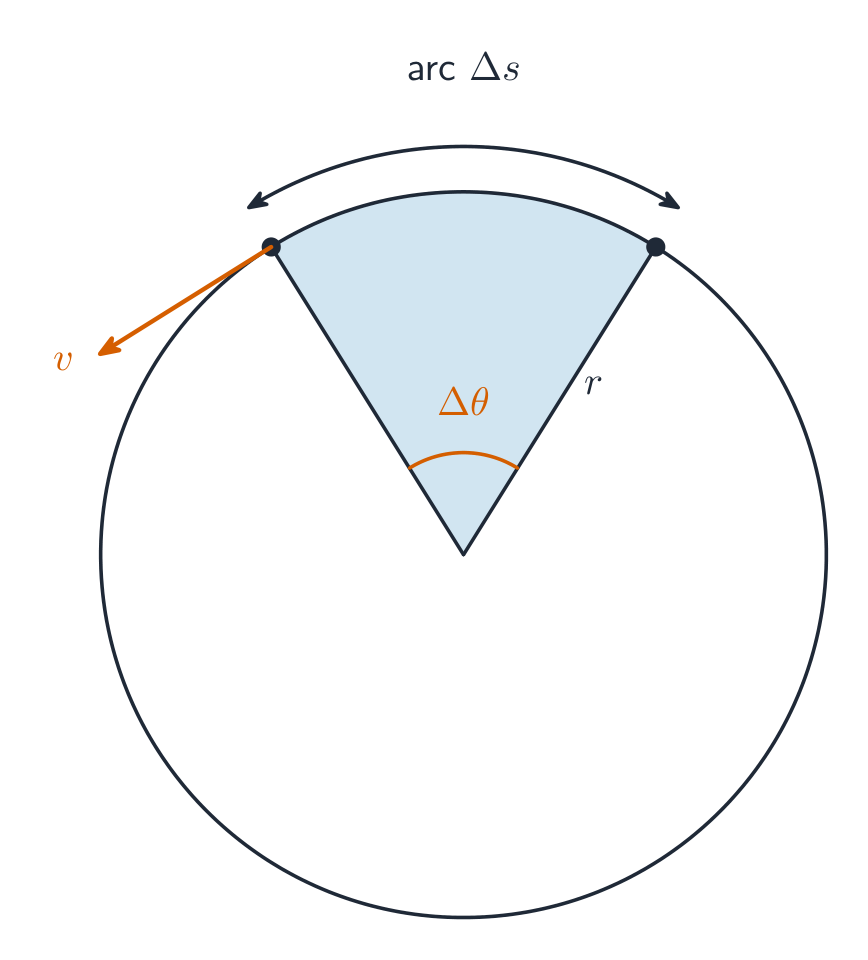
    An object moving in a circle at constant speed still accelerates, because its velocity direction keeps changing. This centripetal acceleration 向心加速度 points toward the center:

    $$a_c=\frac{v^2}{r}.$$
    It is produced by a net inward (centripetal) force 向心力 $F_c=\dfrac{mv^2}{r}$ – supplied by whatever real force points inward (tension, gravity, friction, normal). The time for one full revolution is the period 周期 $T$, and the number of revolutions per second is the frequency 频率 $f$; they are reciprocals, $f = 1/T$, and the same definitions describe any rotation or oscillation.There is no separate outward force; "centrifugal" is only an apparent effect.

    The velocity points along the tangent; the centripetal force and acceleration point to the centre
    The velocity points along the tangent; the centripetal force and acceleration point to the centre

    Worked example. A $0.30\ \text{kg}$ ball on a string is whirled in a horizontal circle of radius $0.80\ \text{m}$ at $4.0\ \text{m/s}$. Find the tension in the string. The tension supplies the whole centripetal force:

    $$T=\frac{mv^2}{r}=\frac{0.30\times4.0^2}{0.80}=6.0\ \text{N}.$$
    If the string can take at most $6.0\ \text{N}$, this is the fastest the ball can go at that radius – spin any faster and the string breaks.

    Vocabulary · ⁨Kosa kata⁩ Train · ⁨Latih⁩
    English Bahasa Indonesia
    centripetal acceleration/senˈtrɪpɪtl əkˌseləˈreɪʃn/ percepatan sentripetal
    net inward (centripetal) force/net ˈɪnwəd fɔːs/ Gaya bersih ke dalam (sentripetal)
    period/ˈpɪərɪəd/ tempoh
    frequency/ˈfriːkwənsi/ frekuensi
    2.9

    Exam tips

    • Always draw a free-body diagram first: only real forces on the chosen object (weight, normal, tension, friction, applied) — never an "$ma$" arrow.
    • Apply $\sum F = ma$ one axis at a time; on an incline resolve gravity into $mg\sin\theta$ (along) and $mg\cos\theta$ (perpendicular).
    • A Newton's third-law pair acts on two different objects — a book's weight and the table's normal force are not a pair (both act on the book).
    • Static friction adjusts up to $\mu_s N$ (use it to test whether motion starts); once sliding, use kinetic friction $f_k=\mu_k N$.
    • Circular motion needs a net inward (centripetal) force $mv^2/r$ supplied by a real force — there is no outward "centrifugal" force.
  • 3

    Work, Energy, and Power · ⁨Usaha, Energi, dan Daya⁩

    Watch lesson · ⁨Tonton pelajaran⁩
    3.1

    Translational Kinetic Energy · ⁨Energi Kinetik Translasi⁩

    Syllabus · ⁨Silabus⁩
    English

    Learning Objective 3.1.A: Describe the translational kinetic energy of an object in terms of the object's mass and velocity.

    • 3.1.A.1 An object's translational kinetic energy is given by the equation
      • Equation: $K = \dfrac{1}{2}mv^2$
    • 3.1.A.2 Translational kinetic energy is a scalar quantity.
    • 3.1.A.3 Different observers may measure different values of the translational kinetic energy of an object, depending on the observer's frame of reference.
    Bahasa Indonesia

    Tujuan Pembelajaran 3.1.A: Jelaskan energi kinetik translasi suatu benda dalam hubungannya dengan massa dan kecepatan benda tersebut.

    • 3.1.A.1 Energi kinetik translasi suatu benda diberikan oleh persamaan
      • Persamaan: $K = \dfrac{1}{2}mv^2$
    • 3.1.A.2 Energi kinetik translasi adalah besaran skalar.
    • 3.1.A.3 Pengamat yang berbeda mungkin mengukur nilai energi kinetik translasi yang berbeda, tergantung pada kerangka acuan pengamat tersebut.

    Source: College Board AP Course and Exam Description · ⁨Sumber: Deskripsi Kursus dan Ujian College Board AP⁩

    English

    Energy 能量 is the capacity to do work, measured in joules 焦耳 (J). A moving object has kinetic energy 动能:

    $$K=\tfrac{1}{2}mv^2.$$
    It depends on the square of the speed, so doubling the speed quadruples the kinetic energy. Kinetic energy is a scalar and is never negative.

    Worked example. A $1500\ \text{kg}$ car travels at $20\ \text{m/s}$. Its kinetic energy is $K=\tfrac12\times1500\times20^2=3.0\times10^{5}\ \text{J}=300\ \text{kJ}$. If it speeds up to $40\ \text{m/s}$ (double), the kinetic energy becomes $4\times$ larger, $1200\ \text{kJ}$ – which is why stopping distance grows so fast with speed.

    Bahasa Indonesia

    Energi adalah kemampuan untuk melakukan usaha, diukur dalam joule (J). Benda yang bergerak memiliki energi kinetik:

    $$K=\tfrac{1}{2}mv^2.$$
    Energi ini bergantung pada kuadrat kecepatan, sehingga menggandakan kecepatan akan menggandakan empat kali energi kinetik. Energi kinetik adalah besaran skalar dan tidak pernah negatif.

    Contoh terarah. Sebuah mobil $1500\ \text{kg}$ melaju dengan kecepatan $20\ \text{m/s}$. Energi kinetiknya adalah $K=\tfrac12\times1500\times20^2=3.0\times10^{5}\ \text{J}=300\ \text{kJ}$. Jika mobil mempercepat menjadi $40\ \text{m/s}$ (dua kali lipat), energi kinetiknya menjadi $4\times$ lebih besar, $1200\ \text{kJ}$ – inilah mengapa jarak pengereman meningkat sangat cepat seiring kecepatan.

    3.2

    Work · ⁨Usaha⁩

    Syllabus · ⁨Silabus⁩
    English

    Learning Objective 3.2.A: Describe the work done on an object or system by a given force or collection of forces.

    • 3.2.A.1 Work is the amount of energy transferred into or out of a system by a force exerted on that system over a distance.
      • 3.2.A.1.i The work done by a conservative force exerted on a system is path-independent and only depends on the initial and final configurations of that system.
      • 3.2.A.1.ii The work done by a conservative force on a system—or the change in the potential energy of the system—will be zero if the system returns to its initial configuration.
      • 3.2.A.1.iii Potential energies are associated only with conservative forces.
      • 3.2.A.1.iv The work done by a nonconservative force is path-dependent.
      • 3.2.A.1.v Examples of nonconservative forces are friction and air resistance.
    • 3.2.A.2 Work is a scalar quantity that may be positive, negative, or zero.
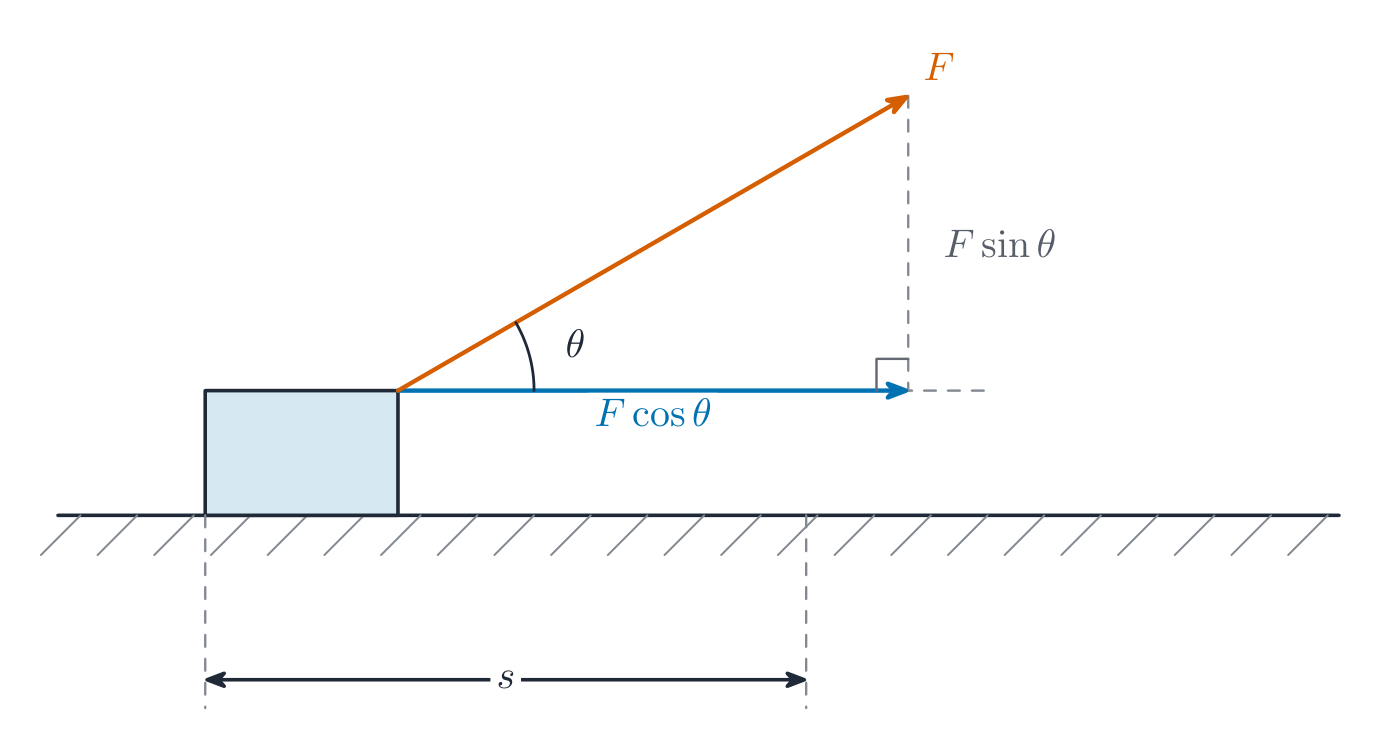
    • 3.2.A.3 The amount of work done on a system by a constant force is related to the components of that force and the displacement of the point at which that force is exerted.
      • 3.2.A.3.i Only the component of the force exerted on a system that is parallel to the displacement of the point of application of the force will change the system's total energy.
        • Equation: $W = F_{\parallel}d = Fd\cos\theta$
      • 3.2.A.3.ii The component of the force exerted on a system perpendicular to the direction of the displacement of the system's center of mass can change the direction of the system's motion without changing the system's kinetic energy.
    • 3.2.A.4 The work-energy theorem states that the change in an object's kinetic energy is equal to the sum of the work (net work) being done by all forces exerted on the object.
      • Equation: $\Delta K = \sum_{i} W_i = \sum_{i} F_{\parallel,i}\,d$
      • 3.2.A.4.i An external force may change the configuration of a system. The component of the external force parallel to the displacement times the displacement of the point of application of the force gives the change in kinetic energy of the system.
      • 3.2.A.4.ii If the system's center of mass and the point of application of the force move the same distance when a force is exerted on a system, then the system may be modeled as an object, and only the system's kinetic energy can change.
      • 3.2.A.4.iii The energy dissipated by friction is typically equated to the force of friction times the length of the path over which the force is exerted
        • Equation: $\Delta E_{\text{mech}} = F_f\,d\cos\theta$
    • 3.2.A.5 Work is equal to the area under the curve of a graph of $F_{\parallel}$ as a function of displacement.

    Boundary statement: AP Physics 1 only expects students to analyze the transfer of mechanical energy (as defined in Unit 3, Topic 4: Conservation of Energy), although students should be aware that mechanical energy may be dissipated in the form of thermal energy or sound. In AP Physics 2, students will also study how thermal energy can be transferred between systems through heating or cooling.

    Bahasa Indonesia

    Tujuan Pembelajaran 3.2.A: Jelaskan usaha yang dilakukan pada suatu benda atau sistem oleh gaya tertentu atau kumpulan gaya.

    • 3.2.A.1 Usaha adalah jumlah energi yang ditransfer masuk atau keluar dari sebuah sistem melalui gaya yang bekerja pada sistem tersebut sepanjang jarak tempuh.
      • 3.2.A.1.i Usaha yang dilakukan oleh gaya konservatif pada suatu sistem bersifat independen terhadap lintasan dan hanya bergantung pada konfigurasi awal dan akhir sistem tersebut.
      • 3.2.A.1.ii Usaha yang dilakukan oleh gaya konservatif pada suatu sistem—atau perubahan energi potensial sistem—akan bernilai nol jika sistem kembali ke konfigurasi awalnya.
      • 3.2.A.1.iii Energi potensial hanya terkait dengan gaya-gaya konservatif.
      • 3.2.A.1.iv Usaha yang dilakukan oleh gaya nonkonservatif bergantung pada lintasan.
      • 3.2.A.1.v Contoh gaya nonkonservatif meliputi gesekan dan hambatan udara.
    • 3.2.A.2 Usaha adalah besaran skalar yang dapat bernilai positif, negatif, atau nol.
    • 3.2.A.3 Besar usaha yang dilakukan pada suatu sistem oleh gaya konstan berkaitan dengan komponen gaya tersebut dan perpindahan titik tempat gaya tersebut bekerja.
      • 3.2.A.3.i Hanya komponen gaya yang bekerja pada sistem yang sejajar dengan perpindahan titik aplikasi gaya yang akan mengubah total energi sistem.
        • Persamaan: $W = F_{\parallel}d = Fd\cos\theta$
      • 3.2.A.3.ii Komponen gaya yang bekerja pada sistem tegak lurus terhadap arah perpindahan pusat massa sistem dapat mengubah arah gerak sistem tanpa mengubah energi kinetik sistem.
    • 3.2.A.4 Teorema usaha-energi menyatakan bahwa perubahan energi kinetik suatu benda sama dengan jumlah usaha (usaha bersih) yang dilakukan oleh semua gaya yang bekerja pada benda tersebut.
      • Persamaan: $\Delta K = \sum_{i} W_i = \sum_{i} F_{\parallel,i}\,d$
      • 3.2.A.4.i Gaya eksternal dapat mengubah konfigurasi suatu sistem. Komponen gaya eksternal yang sejajar dengan perpindahan dikali perpindahan titik aplikasi gaya memberikan perubahan energi kinetik sistem.
      • 3.2.A.4.ii Jika pusat massa sistem dan titik aplikasi gaya bergerak sejauh yang sama ketika gaya bekerja pada sistem, maka sistem dapat dimodelkan sebagai benda tunggal, dan hanya energi kinetik sistem yang dapat berubah.
      • 3.2.A.4.iii Energi yang terdisipasi oleh gesekan biasanya setara dengan gaya gesek dikali panjang lintasan di mana gaya tersebut bekerja.
        • Persamaan: $\Delta E_{\text{mech}} = F_f\,d\cos\theta$
    • 3.2.A.5 Usaha sama dengan luas di bawah kurva grafik $F_{\parallel}$ sebagai fungsi perpindahan.

    Pernyataan Batas: AP Physics 1 hanya mengharapkan siswa menganalisis transfer energi mekanik (seperti yang didefinisikan dalam Unit 3, Topik 4: Kekekalan Energi), meskipun siswa harus menyadari bahwa energi mekanik dapat terdisipasi dalam bentuk energi termal atau bunyi. Dalam AP Physics 2, siswa juga akan mempelajari bagaimana energi termal dapat ditransfer antar sistem melalui pemanasan atau pendinginan.
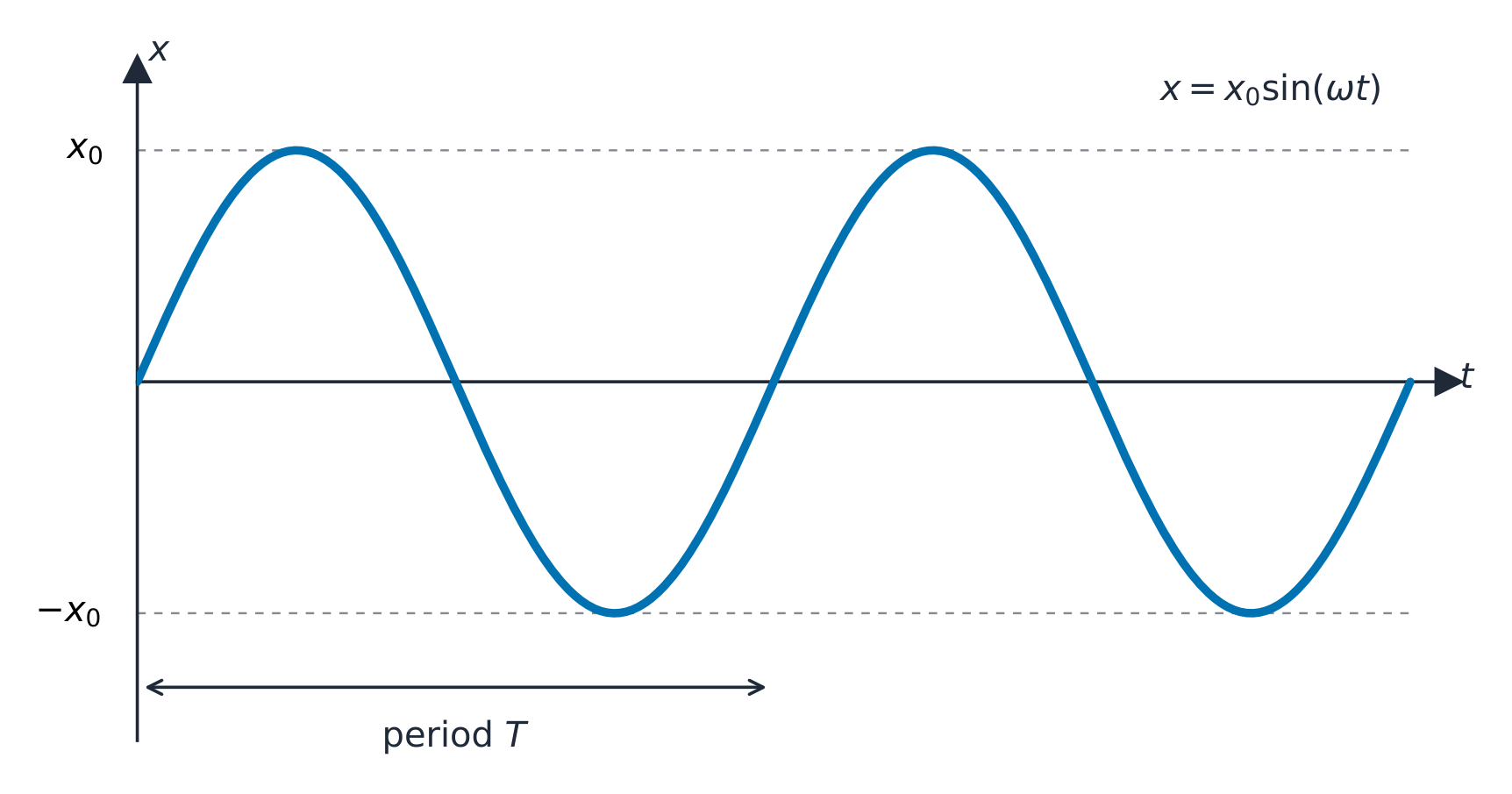
    Source: College Board AP Course and Exam Description · ⁨Sumber: Deskripsi Kursus dan Ujian College Board AP⁩

    English

    Work 功 is energy transferred by a force acting over a displacement:

    $$W=F\,d\cos\theta,$$
    where $\theta$ is the angle between the force and the displacement. Work is positive when the force has a component along the motion (adds energy), negative when it opposes the motion (removes energy), and zero when the force is perpendicular. On a force–position graph, work is the area under the curve. The work–energy theorem 动能定理 states that the net work equals the change in kinetic energy: $W_{\text{net}}=\Delta K$.

    Worked example. A $2.0\ \text{kg}$ block moving at $3.0\ \text{m/s}$ on a frictionless floor is pushed by a $5.0\ \text{N}$ force over $4.0\ \text{m}$ in the direction of motion. Find its final speed. The net work is $W=Fd=5.0\times4.0=20\ \text{J}$, and by the work–energy theorem $W=\tfrac12 m(v^2-v_0^2)$:

    $$20=\tfrac12\times2.0\times(v^2-3.0^2)\;\Rightarrow\;v^2=29\;\Rightarrow\;v=5.4\ \text{m/s}.$$

    Bahasa Indonesia

    Usaha adalah energi yang ditransfer oleh gaya yang bekerja sepanjang perpindahan:

    $$W=F\,d\cos\theta,$$
    di mana $\theta$ adalah sudut antara gaya dan perpindahan. Usaha bernilai positif ketika gaya memiliki komponen sepanjang gerak (menambah energi), negatif ketika melawan gerak (mengurangi energi), dan nol ketika gaya tegak lurus. Pada grafik gaya–posisi, usaha adalah luas di bawah kurva. Teorema usaha-energi menyatakan bahwa usaha total sama dengan perubahan energi kinetik: $W_{\text{net}}=\Delta K$.
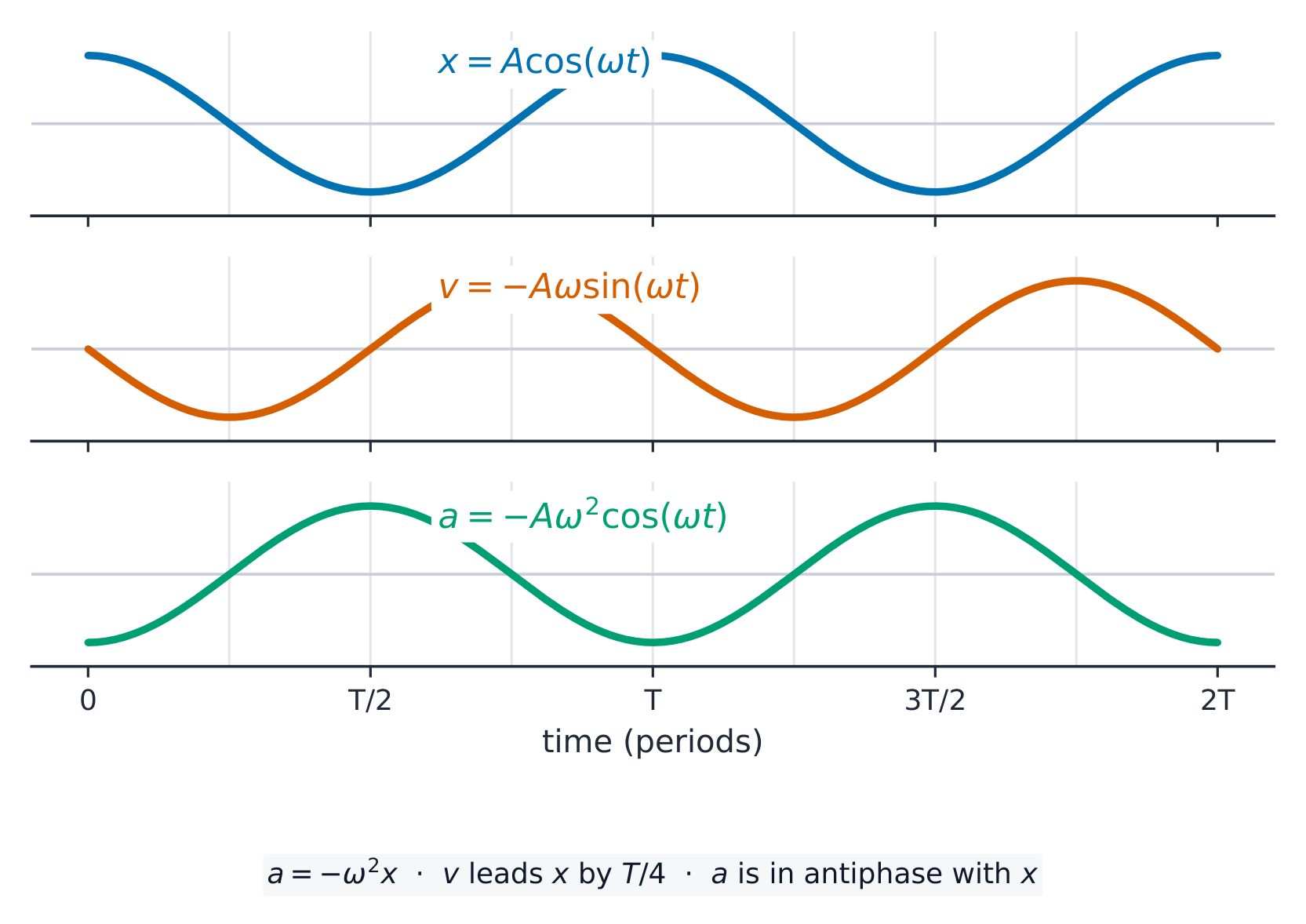
    Hanya komponen gaya sepanjang perpindahan yang melakukan usaha
    Hanya komponen gaya sepanjang perpindahan yang melakukan usaha

    Contoh terarah. Sebuah balok $2.0\ \text{kg}$ bergerak dengan kecepatan $3.0\ \text{m/s}$ di lantai tanpa gesekan didorong oleh gaya $5.0\ \text{N}$ sejauh $4.0\ \text{m}$ searah gerak. Tentukan kecepatan akhirnya. Usaha total adalah $W=Fd=5.0\times4.0=20\ \text{J}$, dan berdasarkan teorema usaha-energi $W=\tfrac12 m(v^2-v_0^2)$:

    $$20=\tfrac12\times2.0\times(v^2-3.0^2)\;\Rightarrow\;v^2=29\;\Rightarrow\;v=5.4\ \text{m/s}.$$

    Vocabulary · ⁨Kosa kata⁩ Train · ⁨Latih⁩
    English Bahasa Indonesia
    Work/wɜːk/ Usaha
    work–energy theorem/wɜːk ˈenədʒi ˈθɪərəm/ Teorema usaha-energi
    Potential energy/pəˈtenʃl ˈenədʒi/ Energi potensial
    Gravitational potential energy/ˌɡrævɪˈteɪʃənl pəˈtenʃl ˈenədʒi/ Energi potensial gravitasi
    Elastic potential energy/ɪˈlæstɪk pəˈtenʃl ˈenədʒi/ Energi potensial elastis
    conservative forces/kənˈsɜːvətɪv ˈfɔːsɪz/ Gaya konservatif
    total mechanical energy/ˈtəʊtl mɪˈkænɪkl ˈenədʒi/ Energi mekanik total
    conserved/kənˈsɜːvd/ terjaga
    thermal energy/ˈθɜːml ˈenədʒi/ energi termal
    3.3

    Potential Energy · ⁨Energi Potensial⁩

    Syllabus · ⁨Silabus⁩
    English

    Learning Objective 3.3.A: Describe the potential energy of a system.

    • 3.3.A.1 A system composed of two or more objects has potential energy if the objects within that system only interact with each other through conservative forces.
    • 3.3.A.2 Potential energy is a scalar quantity associated with the position of objects within a system.
    • 3.3.A.3 The definition of zero potential energy for a given system is a decision made by the observer considering the situation to simplify or otherwise assist in analysis.
    • 3.3.A.4 The potential energy of common physical systems can be described using the physical properties of that system.
      • 3.3.A.4.i The elastic potential energy of an ideal spring is given by the following equation, where $\Delta x$ is the distance the spring has been stretched or compressed from its equilibrium length.
        • Equation: $U_s = \dfrac{1}{2}k(\Delta x)^2$
      • 3.3.A.4.ii The general form for the gravitational potential energy of a system consisting of two approximately spherical distributions of mass (e.g., moons, planets or stars) is given by the equation
        • Equation: $U_g = -G\dfrac{m_1 m_2}{r}$
      • 3.3.A.4.iii Because the gravitational field near the surface of a planet is nearly constant, the change in gravitational potential energy in a system consisting of an object with mass $m$ and a planet with gravitational field of magnitude $g$ when the object is near the surface of the planet may be approximated by the equation
        • Equation: $\Delta U_g = mg\Delta y$
    • 3.3.A.5 The total potential energy of a system containing more than two objects is the sum of the potential energy of each pair of objects within the system.
    Bahasa Indonesia

    Tujuan Pembelajaran 3.3.A: Jelaskan energi potensial suatu sistem.

    • 3.3.A.1 Sistem yang terdiri dari dua atau lebih benda memiliki energi potensial jika benda-benda di dalamnya hanya berinteraksi satu sama lain melalui gaya-gaya konservatif.
    • 3.3.A.2 Energi potensial adalah besaran skalar yang terkait dengan posisi benda-benda di dalam suatu sistem.
    • 3.3.A.3 Definisi nol energi potensial untuk suatu sistem tertentu merupakan keputusan yang diambil oleh pengamat berdasarkan situasi untuk menyederhanakan atau membantu analisis.
    • 3.3.A.4 Energi potensial dari sistem fisik umum dapat dijelaskan menggunakan sifat-sifat fisik dari sistem tersebut.
      • 3.3.A.4.i Energi potensial elastis pegas ideal diberikan oleh persamaan berikut, di mana $\Delta x$ adalah jarak pegas telah diregangkan atau ditekan dari panjang kesetimbangannya.
        • Persamaan: $U_s = \dfrac{1}{2}k(\Delta x)^2$
      • 3.3.A.4.ii Bentuk umum untuk energi potensial gravitasi sistem yang terdiri dari dua distribusi massa yang hampir berbentuk bola (misalnya, bulan, planet, atau bintang) diberikan oleh persamaan
        • Persamaan: $U_g = -G\dfrac{m_1 m_2}{r}$
      • 3.3.A.4.iii Karena medan gravitasi dekat permukaan planet hampir konstan, perubahan energi potensial gravitasi pada sistem yang terdiri dari benda bermassa $m$ dan planet dengan besar medan gravitasi $g$ saat benda berada dekat permukaan planet dapat diaproksimasi dengan persamaan
        • Persamaan: $\Delta U_g = mg\Delta y$
    • 3.3.A.5 Total energi potensial sistem yang berisi lebih dari dua benda adalah jumlah energi potensial dari setiap pasangan benda di dalam sistem tersebut.

    Source: College Board AP Course and Exam Description · ⁨Sumber: Deskripsi Kursus dan Ujian College Board AP⁩

    English

    Potential energy 势能 is stored energy that depends on position or configuration:

    • Gravitational potential energy 重力势能 near the surface: $U_g=mgh$ (height $h$ above a reference level).
    • Elastic potential energy 弹性势能 in a spring: $U_s=\tfrac{1}{2}kx^2$.

    Potential energy is defined only for conservative forces 保守力 (gravity, springs), for which the stored energy depends on position, not path. Only changes in potential energy matter, so you may put the zero level wherever is convenient.

    The $U_g=mgh$ form only holds near a surface where $g$ is roughly constant. The general form, for two spherical masses a distance $r$ apart, is

    $$U_g=-\frac{G m_1 m_2}{r}.$$
    It is negative and defined to be zero at infinite separation, so gravitational PE rises toward zero as the masses move apart. $mgh$ is simply its near-surface approximation. (This is the form you need for satellites and escape speed.)
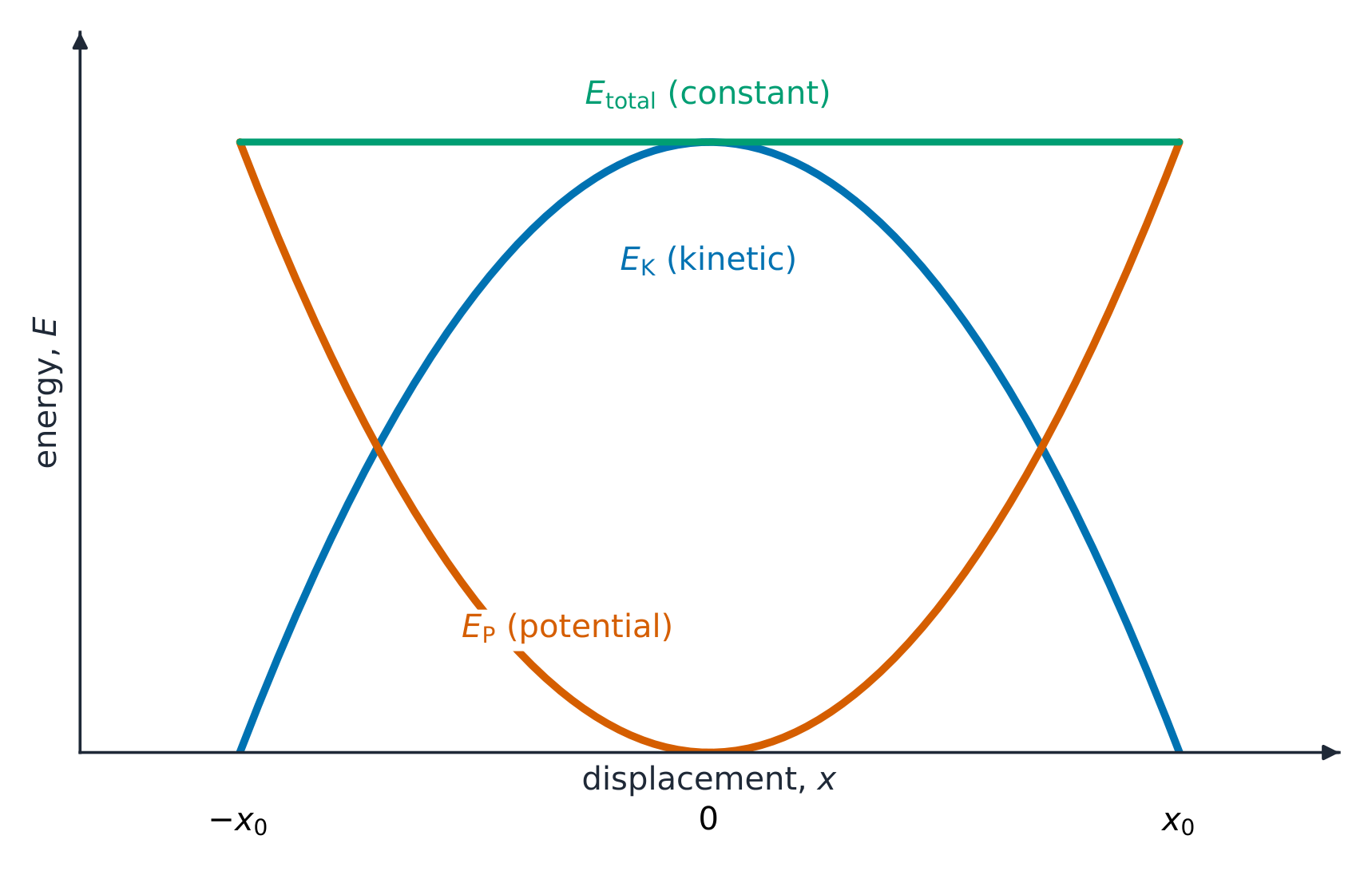
    Bahasa Indonesia

    Energi potensial adalah energi tersimpan yang bergantung pada posisi atau konfigurasi:

    • Energi potensial gravitasi dekat permukaan: $U_g=mgh$ (ketinggian $h$ di atas tingkat referensi).
    • Energi potensial elastis dalam pegas: $U_s=\tfrac{1}{2}kx^2$.

    Energi potensial hanya didefinisikan untuk gaya konservatif (gravitasi, pegas), di mana energi tersimpan bergantung pada posisi, bukan lintasan. Hanya perubahan energi potensial yang penting, sehingga Anda dapat menempatkan level nol di mana saja yang nyaman.

    Bentuk $U_g=mgh$ hanya berlaku dekat permukaan tempat $g$ hampir konstan. Bentuk umum, untuk dua massa bulat berjarak $r$, adalah

    $$U_g=-\frac{G m_1 m_2}{r}.$$
    Nilainya negatif dan didefinisikan nol pada jarak tak terhingga, sehingga energi potensial gravitasi naik menuju nol saat massa menjauh. $mgh$ hanyalah pendekatan dekat permukaannya. (Ini adalah bentuk yang diperlukan untuk satelit dan kecepatan lepas.)

    Explore · ⁨Jelajahi⁩

    Store elastic potential energy in a spring · ⁨Simpan energi potensial elastis dalam pegas⁩

    Stretching a spring stores elastic potential energy $\tfrac12 kx^2$ — the area under the force-extension line. Release it and that energy becomes kinetic. · ⁨Meregangkan pegas menyimpan energi potensial elastis $\tfrac12 kx^2$ — yaitu area di bawah garis gaya-perpanjangan. Lepaskan dan energi tersebut berubah menjadi energi kinetik.⁩

    3.4

    Conservation of Energy · ⁨Kekekalan Energi⁩

    Syllabus · ⁨Silabus⁩
    English

    Learning Objective 3.4.A: Describe the energies present in a system.

    • 3.4.A.1 A system composed of only a single object can only have kinetic energy.
    • 3.4.A.2 A system that contains objects that interact via conservative forces or that can change its shape reversibly may have both kinetic and potential energies.

    Learning Objective 3.4.B: Describe the behavior of a system using conservation of mechanical energy principles.

    • 3.4.B.1 Mechanical energy is the sum of a system's kinetic and potential energies.
    • 3.4.B.2 Any change to a type of energy within a system must be balanced by an equivalent change of other types of energies within the system or by a transfer of energy between the system and its surroundings.
    • 3.4.B.3 A system may be selected so that the total energy of that system is constant.
    • 3.4.B.4 If the total energy of a system changes, that change will be equivalent to the energy transferred into or out of the system.

    Learning Objective 3.4.C: Describe how the selection of a system determines whether the energy of that system changes.

    • 3.4.C.1 Energy is conserved in all interactions.
    • 3.4.C.2 If the work done on a selected system is zero and there are no nonconservative interactions within the system, the total mechanical energy of the system is constant.
    • 3.4.C.3 If the work done on a selected system is nonzero, energy is transferred between the system and the environment.

    Boundary statement: AP Physics 1 expects students to know that mechanical energy can be dissipated as thermal energy or sound by nonconservative forces.

    Bahasa Indonesia

    Tujuan Pembelajaran 3.4.A: Jelaskan energi-energi yang ada dalam suatu sistem.

    • 3.4.A.1 Sistem yang terdiri hanya dari satu benda hanya dapat memiliki energi kinetik.
    • 3.4.A.2 Sistem yang berisi benda-benda yang berinteraksi melalui gaya konservatif atau yang dapat mengubah bentuknya secara reversibel dapat memiliki energi kinetik maupun potensial.

    Tujuan Pembelajaran 3.4.B: Jelaskan perilaku sistem menggunakan prinsip-prinsip kekekalan energi mekanik.

    • 3.4.B.1 Energi mekanik adalah jumlah energi kinetik dan potensial suatu sistem.
    • 3.4.B.2 Perubahan apa pun pada jenis energi dalam suatu sistem harus seimbang dengan perubahan ekuivalen dari jenis energi lainnya dalam sistem atau melalui perpindahan energi antara sistem dan lingkungannya.
    • 3.4.B.3 Suatu sistem dapat dipilih sedemikian rupa sehingga total energi sistem tersebut konstan.
    • 3.4.B.4 Jika total energi sistem berubah, perubahan tersebut akan setara dengan energi yang ditransfer masuk atau keluar dari sistem.

    Tujuan Pembelajaran 3.4.C: Jelaskan bagaimana pemilihan sistem menentukan apakah energi sistem tersebut berubah.

    • 3.4.C.1 Energi kekal dalam semua interaksi.
    • 3.4.C.2 Jika usaha yang dilakukan pada sistem yang dipilih adalah nol dan tidak ada interaksi nonkonservatif di dalam sistem, maka total energi mekanik sistem adalah konstan.
    • 3.4.C.3 Jika usaha yang dilakukan pada sistem yang dipilih tidak nol, energi ditransfer antara sistem dan lingkungan.

    Pernyataan Batas: AP Physics 1 mengharapkan siswa mengetahui bahwa energi mekanik dapat terdispersi menjadi energi termal atau suara oleh gaya-gaya nonkonservatif.

    Source: College Board AP Course and Exam Description · ⁨Sumber: Deskripsi Kursus dan Ujian College Board AP⁩

    English
    Energy conservation: KE ⇄ PE

    The total mechanical energy 机械能 is $E=K+U$. When only conservative forces do work, mechanical energy is conserved 守恒:

    $$K_1+U_1=K_2+U_2.$$
    When friction or other non-conservative forces act, they transfer mechanical energy to thermal energy 热能; then the general statement is that total energy (including thermal) is conserved. Energy bar charts are a good way to track where the energy goes.

    Worked example. A ball is released from rest at the top of a frictionless ramp $5.0\ \text{m}$ high. Find its speed at the bottom. All the gravitational potential energy becomes kinetic energy:

    $$mgh=\tfrac12 mv^2\;\Rightarrow\;v=\sqrt{2gh}=\sqrt{2\times9.8\times5.0}=9.9\ \text{m/s}.$$
    The mass cancels, so every object reaches the same speed – exactly the free-fall result, now got from energy. If instead $30\ \text{J}$ were lost to friction, you would subtract it: $mgh-30=\tfrac12 mv^2$.

    Bahasa Indonesia
    Kekekalan energi: KE ⇄ PE
    Luncuran roller coaster dengan lintasan hijau dan merah tinggi di langit
    Luncuran roller coaster menukar energi bolak-balik: berada di titik tertinggi (paling banyak energi potensial) di puncak dan tercepat (paling banyak energi kinetik) di dasar

    Energi mekanik total adalah $E=K+U$. Ketika hanya gaya konservatif yang melakukan usaha, energi mekanik **terjaga

    $$K_1+U_1=K_2+U_2.$$
    Ketika gesekan atau gaya non-konservatif lainnya bekerja, mereka mentransfer energi mekanik ke energi termal; maka pernyataan umumnya adalah total energi (termasuk termal) kekal. Diagram batang energi adalah cara yang baik untuk melacak ke mana energi tersebut pergi.

    Pendulum berayun menukar energi potensial gravitasi untuk energi kinetik dan sebaliknya
    Pendulum berayun menukar energi potensial gravitasi untuk energi kinetik dan sebaliknya

    Contoh terpecahkan. Sebuah bola dilepaskan dari keadaan diam di bagian atas landasan tanpa gesekan $5.0\ \text{m}$ tinggi. Temukan kecepatannya di bagian bawah. Seluruh energi potensial gravitasi berubah menjadi energi kinetik:

    $$mgh=\tfrac12 mv^2\;\Rightarrow\;v=\sqrt{2gh}=\sqrt{2\times9.8\times5.0}=9.9\ \text{m/s}.$$
    Massa saling menghilangkan, sehingga setiap benda mencapai kecepatan yang sama – tepat seperti hasil jatuh bebas, kini diperoleh dari energi. Jika sebaliknya $30\ \text{J}$ hilang karena gesekan, Anda harus mengurangkannya: $mgh-30=\tfrac12 mv^2$.

    Explore · ⁨Jelajahi⁩

    Watch energy convert as an object falls · ⁨Amati konversi energi saat benda jatuh⁩

    With no friction, mechanical energy is conserved: as an object falls, gravitational potential energy turns into kinetic energy while the total stays fixed. · ⁨Tanpa gesekan, energi mekanik kekal: saat benda jatuh, energi potensial gravitasi berubah menjadi energi kinetik sementara totalnya tetap.⁩

    Vocabulary · ⁨Kosa kata⁩ Train · ⁨Latih⁩
    English Bahasa Indonesia
    Energy/ˈenədʒi/ Energi
    joules/dʒuːlz/ joule
    kinetic energy/kɪˈnetɪk ˈenədʒi/ energi kinetik
    3.5

    Power · ⁨Daya⁩

    Syllabus · ⁨Silabus⁩
    English

    Learning Objective 3.5.A: Describe the transfer of energy into, out of, or within a system in terms of power.

    • 3.5.A.1 Power is the rate at which energy changes with respect to time, either by transfer into or out of a system or by conversion from one type to another within a system.
    • 3.5.A.2 Average power is the amount of energy being transferred or converted, divided by the time it took for that transfer or conversion to occur.
      • Equation: $P_{\text{avg}} = \dfrac{\Delta E}{\Delta t}$
    • 3.5.A.3 Because work is the change in energy of an object or system due to a force, average power is the total work done, divided by the time during which that work was done.
      • Equation: $P_{\text{avg}} = \dfrac{W}{\Delta t}$
    • 3.5.A.4 The instantaneous power delivered to an object by the component of a constant force parallel to the object's velocity can be described with the derived equation.
      • Equation: $P_{\text{inst}} = F_{\parallel}v = Fv\cos\theta$
    Bahasa Indonesia

    Tujuan Pembelajaran 3.5.A: Jelaskan perpindahan energi masuk, keluar, atau di dalam suatu sistem dalam istilah daya.

    • 3.5.A.1 Daya adalah laju perubahan energi terhadap waktu, baik melalui transfer masuk atau keluar dari sistem maupun melalui konversi dari satu jenis ke jenis lain di dalam sistem.
    • 3.5.A.2 Daya rata-rata adalah jumlah energi yang ditransfer atau dikonversi, dibagi dengan waktu yang dibutuhkan untuk transfer atau konversi tersebut terjadi.
      • Persamaan: $P_{\text{avg}} = \dfrac{\Delta E}{\Delta t}$
    • 3.5.A.3 Karena usaha adalah perubahan energi suatu objek atau sistem akibat gaya, daya rata-rata adalah total usaha yang dilakukan, dibagi dengan waktu selama usaha itu dilakukan.
      • Persamaan: $P_{\text{avg}} = \dfrac{W}{\Delta t}$
    • 3.5.A.4 Daya sesaat yang disalurkan ke suatu objek oleh komponen gaya konstan sejajar dengan kecepatan objek dapat dijelaskan dengan persamaan turunan.
      • Persamaan: $P_{\text{inst}} = F_{\parallel}v = Fv\cos\theta$

    Source: College Board AP Course and Exam Description · ⁨Sumber: Deskripsi Kursus dan Ujian College Board AP⁩

    English

    Power 功率 is the rate of doing work or transferring energy, measured in watts 瓦特 (W):

    $$P=\frac{W}{\Delta t}=\frac{\Delta E}{\Delta t},\qquad\text{and instantaneously}\qquad P=Fv.$$
    So the same job done faster requires more power. On an energy–time graph, power is the slope.

    Worked example. A motor lifts a $50\ \text{kg}$ load at a steady $2.0\ \text{m/s}$. Because it moves at constant speed, the lifting force equals the weight, so

    $$P=Fv=mgv=50\times9.8\times2.0=980\ \text{W}.$$

    Real machines waste some energy, so we quote efficiency 效率 – useful output power divided by total input power. If this motor draws $1400\ \text{W}$ of electrical power to deliver $980\ \text{W}$ of useful lifting, its efficiency is $980/1400=0.70$, or $70\%$; the other $30\%$ becomes heat and sound.

    Bahasa Indonesia

    Daya adalah laju melakukan usaha atau mentransfer energi, diukur dalam watt (W):

    $$P=\frac{W}{\Delta t}=\frac{\Delta E}{\Delta t},\qquad\text{and instantaneously}\qquad P=Fv.$$
    Jadi pekerjaan yang sama dilakukan lebih cepat memerlukan daya lebih besar. Pada grafik energi–waktu, daya adalah kemiringan.

    Daya adalah kemiringan grafik usaha-waktu: usaha yang sama dalam waktu lebih sedikit berarti daya lebih besar
    Daya adalah kemiringan grafik usaha-waktu: usaha yang sama dalam waktu lebih sedikit berarti daya lebih besar

    Contoh terpecahkan. Sebuah motor mengangkat beban $50\ \text{kg}$ dengan laju konstan $2.0\ \text{m/s}$. Karena bergerak dengan kecepatan konstan, gaya angkat sama dengan beratnya, sehingga

    $$P=Fv=mgv=50\times9.8\times2.0=980\ \text{W}.$$

    Mesin nyata membuang sebagian energi, jadi kita menyatakan efisiensi – daya output yang berguna dibagi dengan daya input total. Jika motor ini menarik $1400\ \text{W}$ daya listrik untuk menghasilkan $980\ \text{W}$ daya angkat yang berguna, efisiensinya adalah $980/1400=0.70$, atau $70\%$; sisanya $30\%$ berubah menjadi panas dan suara.

    Air terjun: daya adalah seberapa cepat energi ditransfer – penurunan yang sama dalam waktu lebih sedikit berarti daya lebih besar
    Air terjun: daya adalah seberapa cepat energi ditransfer – penurunan yang sama dalam waktu lebih sedikit berarti daya lebih besar
    Vocabulary · ⁨Kosa kata⁩ Train · ⁨Latih⁩
    English Bahasa Indonesia
    Power/ˈpaʊə/ Daya
    watts/wɒts/ watt
    efficiency/ɪˈfɪʃənsi/ efisiensi
    3.5

    Exam tips · ⁨Tips ujian⁩

    English
    • Use $W=Fd\cos\theta$: work is zero when the force is perpendicular to the motion, and negative when it opposes it.
    • Reach for the work–energy theorem ($W_{\text{net}}=\Delta K$) or energy conservation ($K_1+U_1=K_2+U_2$) instead of forces whenever the path is complicated.
    • When friction acts, mechanical energy is not conserved — subtract the energy lost to heat.
    • Remember $K\propto v^2$: doubling the speed quadruples the kinetic energy (and the stopping distance).
    • Use $P=Fv$ for power at a steady speed; at constant velocity the net force is zero but the power is not.
    Bahasa Indonesia
    • Gunakan $W=Fd\cos\theta$: usaha bernilai nol ketika gaya tegak lurus terhadap gerakan, dan negatif ketika berlawanan arah.
    • Rujuk pada teorema usaha-energi ($W_{\text{net}}=\Delta K$) atau kekekalan energi ($K_1+U_1=K_2+U_2$) alih-alih gaya whenever lintasannya rumit.
    • Ketika gesekan bekerja, energi mekanik tidak kekal – kurangi energi yang hilang menjadi panas.
    • Ingat $K\propto v^2$: menggandakan kecepatan mengkuadratkan energi kinetik (dan jarak pengereman).
    • Gunakan $P=Fv$ untuk daya pada kecepatan konstan; pada kecepatan konstan resultan gaya adalah nol tetapi dayanya bukan.
  • 4

    Linear Momentum · ⁨Momentum Linear⁩

    Watch lesson · ⁨Tonton pelajaran⁩
    4.1

    Linear Momentum · ⁨Momentum Linear⁩

    Syllabus · ⁨Silabus⁩
    English

    Learning Objective 4.1.A: Describe the linear momentum of an object or system.

    • 4.1.A.1 Linear momentum is defined by the equation $\vec{p} = m\vec{v}$.
      • Equation: $\vec{p} = m\vec{v}$
    • 4.1.A.2 Momentum is a vector quantity and has the same direction as the velocity.
    • 4.1.A.3 Momentum can be used to analyze collisions and explosions.
      • 4.1.A.3.i A collision is a model for an interaction where the forces exerted between the involved objects in the system are much larger than the net external force exerted on those objects during the interaction.
      • 4.1.A.3.ii As only the initial and final states of a collision are analyzed, the object model may be used to analyze collisions.
      • 4.1.A.3.iii An explosion is a model for an interaction in which forces internal to the system move objects within that system apart.

    Boundary statement: Unless otherwise stated, the general term "momentum" will refer specifically to linear momentum.

    Bahasa Indonesia

    Tujuan Pembelajaran 4.1.A: Jelaskan momentum linear suatu objek atau sistem.

    • 4.1.A.1 Momentum linear didefinisikan oleh persamaan $\vec{p} = m\vec{v}$.
      • Persamaan: $\vec{p} = m\vec{v}$
    • 4.1.A.2 Momentum adalah besaran vektor dan memiliki arah yang sama dengan kecepatan.
    • 4.1.A.3 Momentum dapat digunakan untuk menganalisis tumbukan dan ledakan.
      • 4.1.A.3.i Tumbukan adalah model interaksi di mana gaya yang dikeluarkan antar objek yang terlibat dalam sistem jauh lebih besar daripada resultan gaya eksternal yang bekerja pada objek-objek tersebut selama interaksi.
      • 4.1.A.3.ii Karena hanya keadaan awal dan akhir tumbukan yang dianalisis, model objek dapat digunakan untuk menganalisis tumbukan.
      • 4.1.A.3.iii Ledakan adalah model interaksi di mana gaya internal sistem memisahkan objek-objek di dalamnya.

    Pernyataan Batas: Kecuali dinyatakan lain, istilah umum "momentum" akan merujuk secara khusus pada momentum linear.

    Source: College Board AP Course and Exam Description · ⁨Sumber: Deskripsi Kursus dan Ujian College Board AP⁩

    English

    Linear momentum 动量 is mass times velocity – a vector pointing the same way as the velocity:

    $$\vec{p}=m\vec{v}.$$
    It measures "how hard it is to stop" a moving object. A heavy slow truck and a light fast ball can have the same momentum. Its unit is $\text{kg m/s}$, the same as $\text{N s}$.

    Bahasa Indonesia

    Momentum linear adalah massa dikali kecepatan – sebuah vektor yang mengarah sama dengan kecepatan:

    $$\vec{p}=m\vec{v}.$$
    Ini mengukur "seberapa sulit menghentikan" benda yang bergerak. Truk berat yang lambat dan bola ringan yang cepat dapat memiliki momentum yang sama. Satuannya adalah $\text{kg m/s}$, sama dengan $\text{N s}$.

    4.2

    Change in Momentum and Impulse · ⁨Perubahan Momentum dan Impuls⁩

    Syllabus · ⁨Silabus⁩
    English

    Learning Objective 4.2.A: Describe the impulse delivered to an object or system.

    • 4.2.A.1 The rate of change of momentum is equal to the net external force exerted on an object or system.
      • Equation: $\vec{F}_{\text{net}} = \dfrac{\Delta \vec{p}}{\Delta t}$
    • 4.2.A.2 Impulse is defined as the product of the average force exerted on a system and the time interval during which that force is exerted on the system.
      • Equation: $\vec{J} = \vec{F}_{\text{avg}} \Delta t$
    • 4.2.A.3 Impulse is a vector quantity and has the same direction as the net force exerted on the system.
    • 4.2.A.4 The impulse delivered to a system by a net external force is equal to the area under the curve of a graph of the net external force exerted on the system as a function of time.
    • 4.2.A.5 The net external force exerted on a system is equal to the slope of a graph of the momentum of the system as a function of time.

    Learning Objective 4.2.B: Describe the relationship between the impulse exerted on an object or a system and the change in momentum of the object or system.

    • 4.2.B.1 Change in momentum is the difference between a system's final momentum and its initial momentum.
      • Equation: $\Delta \vec{p} = \vec{p} - \vec{p}_0$
    • 4.2.B.2 The impulse–momentum theorem relates the impulse exerted on a system and the system's change in momentum.
      • Equation: $\vec{J} = \vec{F}_{\text{avg}} \Delta t = \Delta \vec{p}$
    • 4.2.B.3 Newton's second law of motion is a direct result of the impulse–momentum theorem applied to systems with constant mass.
      • Equation: $\vec{F}_{\text{net}} = \dfrac{\Delta \vec{p}}{\Delta t} = m\dfrac{\Delta \vec{v}}{\Delta t} = m\vec{a}$

    Boundary statement: AP Physics 1 does not require students to quantitatively analyze systems in which the mass of the system changes with respect to time.

    Bahasa Indonesia

    Tujuan Pembelajaran 4.2.A: Jelaskan impuls yang diberikan kepada objek atau sistem.

    • 4.2.A.1 Laju perubahan momentum sama dengan resultan gaya eksternal yang bekerja pada objek atau sistem.
      • Persamaan: $\vec{F}_{\text{net}} = \dfrac{\Delta \vec{p}}{\Delta t}$
    • 4.2.A.2 Impuls didefinisikan sebagai hasil kali gaya rata-rata yang diberikan pada sistem dan selang waktu selama gaya tersebut diberikan pada sistem.
      • Persamaan: $\vec{J} = \vec{F}_{\text{avg}} \Delta t$
    • 4.2.A.3 Impuls adalah besaran vektor dan memiliki arah yang sama dengan resultan gaya yang diberikan pada sistem.
    • 4.2.A.4 Impuls yang diberikan kepada sistem oleh resultan gaya eksternal sama dengan luas di bawah kurva grafik resultan gaya eksternal yang diberikan pada sistem sebagai fungsi waktu.
    • 4.2.A.5 Resultan gaya eksternal yang diberikan pada sistem sama dengan kemiringan grafik momentum sistem sebagai fungsi waktu.

    Tujuan Pembelajaran 4.2.B: Jelaskan hubungan antara impuls yang diberikan kepada objek atau sistem dan perubahan momentum objek atau sistem tersebut.

    • 4.2.B.1 Perubahan momentum adalah perbedaan antara momentum akhir sistem dan momentum awalnya.
      • Persamaan: $\Delta \vec{p} = \vec{p} - \vec{p}_0$
    • 4.2.B.2 Teorema impuls-momentum menghubungkan impuls yang diberikan pada sistem dan perubahan momentum sistem tersebut.
      • Persamaan: $\vec{J} = \vec{F}_{\text{avg}} \Delta t = \Delta \vec{p}$
    • 4.2.B.3 Hukum kedua Newton tentang gerak merupakan hasil langsung dari teorema impuls-momentum yang diterapkan pada sistem dengan massa konstan.
      • Persamaan: $\vec{F}_{\text{net}} = \dfrac{\Delta \vec{p}}{\Delta t} = m\dfrac{\Delta \vec{v}}{\Delta t} = m\vec{a}$

    Pernyataan Batas: AP Physics 1 tidak mensyaratkan siswa untuk melakukan analisis kuantitatif pada sistem di mana massa sistem berubah seiring waktu.

    Source: College Board AP Course and Exam Description · ⁨Sumber: Deskripsi Kursus dan Ujian College Board AP⁩

    English

    A net force acting over time changes momentum. The impulse 冲量 delivered is

    $$\vec{J}=\vec{F}\,\Delta t=\Delta\vec{p}.$$
    This is the impulse–momentum theorem: impulse equals the change in momentum. On a force–time graph, impulse is the area under the curve. It explains why airbags and follow-through help – spreading the same momentum change over a longer time reduces the force.

    Worked example. A $0.15\ \text{kg}$ ball hits a wall at $20\ \text{m/s}$ and bounces straight back at $15\ \text{m/s}$. The contact lasts $0.020\ \text{s}$. Find the average force on the ball. Take the rebound direction as positive, so $u=-20\ \text{m/s}$ and $v=+15\ \text{m/s}$:

    $$\Delta p=m(v-u)=0.15\big(15-(-20)\big)=5.25\ \text{kg m/s},\qquad F=\frac{\Delta p}{\Delta t}=\frac{5.25}{0.020}=260\ \text{N}.$$
    The sign work matters: forgetting that the velocity reverses is the most common mistake here.

    Bahasa Indonesia

    Gaya resultan yang bekerja selama waktu mengubah momentum. Impuls yang diberikan adalah

    $$\vec{J}=\vec{F}\,\Delta t=\Delta\vec{p}.$$
    Ini adalah teorema impuls-momentum: impuls sama dengan perubahan momentum. Pada grafik gaya–waktu, impuls adalah luas di bawah kurva. Ini menjelaskan mengapa airbag dan gerakan lanjutan membantu – menyebarkan perubahan momentum yang sama selama waktu yang lebih lama mengurangi gaya.

    Impuls adalah luas di bawah kurva gaya-waktu, sama dengan gaya rata-rata dikali waktu kontak
    Impuls adalah luas di bawah kurva gaya-waktu, sama dengan gaya rata-rata dikali waktu kontak

    Contoh terpecahkan. Sebuah bola $0.15\ \text{kg}$ menabrak dinding pada $20\ \text{m/s}$ dan memantul lurus kembali pada $15\ \text{m/s}$. Kontak berlangsung selama $0.020\ \text{s}$. Temukan gaya rata-rata pada bola. Ambil arah pantulan sebagai positif, sehingga $u=-20\ \text{m/s}$ dan $v=+15\ \text{m/s}$:

    $$\Delta p=m(v-u)=0.15\big(15-(-20)\big)=5.25\ \text{kg m/s},\qquad F=\frac{\Delta p}{\Delta t}=\frac{5.25}{0.020}=260\ \text{N}.$$
    Tanda penting: lupa bahwa kecepatan berbalik adalah kesalahan paling umum di sini.

    Vocabulary · ⁨Kosa kata⁩ Train · ⁨Latih⁩
    English Bahasa Indonesia
    Linear momentum/ˈlɪnɪə məʊˈmentəm/ Momentum linear
    impulse/ˈɪmpʌls/ impuls
    conserved/kənˈsɜːvd/ terjaga
    collisions/kəˈlɪʒnz/ Tumbukan
    center-of-mass velocity/ˈsentə ɒv mæs vəˈlɒsɪti/ Kecepatan pusat massa
    4.3

    Conservation of Linear Momentum · ⁨Kekekalan Momentum Linear⁩

    Syllabus · ⁨Silabus⁩
    English

    Learning Objective 4.3.A: Describe the behavior of a system using conservation of linear momentum.

    • 4.3.A.1 A collection of objects with individual momenta can be described as one system with one center-of-mass velocity.
      • 4.3.A.1.i For a collection of objects, the velocity of a system's center of mass can be calculated using the equation $\vec{v}_{\text{cm}} = \dfrac{\sum \vec{p}_i}{\sum m_i} = \dfrac{\sum m_i \vec{v}_i}{\sum m_i}$.
      • 4.3.A.1.ii The velocity of a system's center of mass is constant in the absence of a net external force.
    • 4.3.A.2 The total momentum of a system is the sum of the momenta of the system's constituent parts.
    • 4.3.A.3 In the absence of net external forces, any change to the momentum of an object within a system must be balanced by an equivalent and opposite change of momentum elsewhere within the system. Any change to the momentum of a system is due to a transfer of momentum between the system and its surroundings.
      • 4.3.A.3.i The impulse exerted by one object on a second object is equal and opposite to the impulse exerted by the second object on the first. This is a direct result of Newton's third law.
      • 4.3.A.3.ii A system may be selected so that the total momentum of that system is constant.
      • 4.3.A.3.iii If the total momentum of a system changes, that change will be equivalent to the impulse exerted on the system.
        • Equation: $\vec{J} = \Delta \vec{p}$
    • 4.3.A.4 Correct application of conservation of momentum can be used to determine the velocity of a system immediately before and immediately after collisions or explosions.

    Boundary statement: AP Physics 1 includes a quantitative and qualitative treatment of conservation of momentum in one dimension and a semiquantitative treatment of conservation of momentum in two dimensions. Exam questions involving solution of simultaneous equations are not included in AP Physics 1, but the AP Physics 1 Exam may include questions that assess whether students can set up the equations properly and reason about how changing a given mass, speed, or angle would affect other quantities. AP Physics 2 includes a full treatment of conservation of momentum in two dimensions for problems that include one unknown final velocity.

    Learning Objective 4.3.B: Describe how the selection of a system determines whether the momentum of that system changes.

    • 4.3.B.1 Momentum is conserved in all interactions.
    • 4.3.B.2 If the net external force on the selected system is zero, the total momentum of the system is constant.
    • 4.3.B.3 If the net external force on the selected system is nonzero, momentum is transferred between the system and the environment.
    Bahasa Indonesia

    Tujuan Pembelajaran 4.3.A: Jelaskan perilaku sistem menggunakan kekekalan momentum linear.

    • 4.3.A.1 Kumpulan objek dengan momentum individu dapat digambarkan sebagai satu sistem dengan satu kecepatan pusat massa.
      • 4.3.A.1.i Untuk kumpulan objek, kecepatan pusat massa sistem dapat dihitung menggunakan persamaan $\vec{v}_{\text{cm}} = \dfrac{\sum \vec{p}_i}{\sum m_i} = \dfrac{\sum m_i \vec{v}_i}{\sum m_i}$.
      • 4.3.A.1.ii Kecepatan pusat massa sistem adalah konstan jika tidak ada resultan gaya eksternal.
    • 4.3.A.2 Total momentum sistem adalah jumlah momentum bagian-bagian penyusun sistem.
    • 4.3.A.3 Dalam ketiadaan resultan gaya eksternal, perubahan apa pun pada momentum objek di dalam sistem harus seimbang dengan perubahan momentum yang setara dan berlawanan di tempat lain dalam sistem. Perubahan apa pun pada momentum sistem disebabkan oleh transfer momentum antara sistem dan lingkungannya.
      • 4.3.A.3.i Impuls yang diberikan satu objek kepada objek kedua sama besar dan berlawanan arah dengan impuls yang diberikan objek kedua kepada objek pertama. Ini merupakan hasil langsung dari hukum ketiga Newton.
      • 4.3.A.3.ii Sistem dapat dipilih sedemikian rupa sehingga total momentum sistem tersebut konstan.
      • 4.3.A.3.iii Jika total momentum sistem berubah, perubahan tersebut setara dengan impuls yang diberikan pada sistem.
        • Persamaan: $\vec{J} = \Delta \vec{p}$
    • 4.3.A.4 Penerapan konservasi momentum yang benar dapat digunakan untuk menentukan kecepatan sistem segera sebelum dan segera setelah tabrakan atau ledakan.

    Pernyataan Batas: AP Physics 1 mencakup penanganan kuantitatif dan kualitatif tentang konservasi momentum dalam satu dimensi serta penanganan semi-kuantitatif tentang konservasi momentum dalam dua dimensi. Soal ujian yang melibatkan penyelesaian persamaan simultan tidak termasuk dalam AP Physics 1, namun Ujian AP Physics 1 mungkin memuat soal yang menilai apakah siswa dapat menyusun persamaan dengan benar dan beralasan mengenai bagaimana perubahan massa, kecepatan, atau sudut tertentu akan mempengaruhi besaran lainnya. AP Physics 2 mencakup penanganan penuh tentang konservasi momentum dalam dua dimensi untuk masalah yang mencakup satu variabel kecepatan akhir yang belum diketahui.

    Tujuan Pembelajaran 4.3.B: Jelaskan bagaimana pemilihan suatu sistem menentukan apakah momentum sistem tersebut berubah.

    • 4.3.B.1 Momentum kekal dalam semua interaksi.
    • 4.3.B.2 Jika resultan gaya eksternal pada sistem yang dipilih adalah nol, total momentum sistem tersebut konstan.
    • 4.3.B.3 Jika resultan gaya eksternal pada sistem yang dipilih bukan nol, momentum ditransfer antara sistem dan lingkungan.

    Source: College Board AP Course and Exam Description · ⁨Sumber: Deskripsi Kursus dan Ujian College Board AP⁩

    English

    If the net external force on a system is zero, its total momentum is conserved 守恒:

    $$\sum \vec{p}_{\text{before}}=\sum \vec{p}_{\text{after}}.$$
    Internal forces (like the push between two colliding carts) come in third-law pairs and cancel, so they cannot change the total momentum. This is the key tool for collisions 碰撞 and explosions – apply it separately in the $x$ and $y$ directions.

    Worked example (recoil 反冲). A $60\ \text{kg}$ skater, initially at rest on frictionless ice, throws a $2.0\ \text{kg}$ ball at $8.0\ \text{m/s}$. Find her recoil speed. The total momentum starts at zero and stays zero:

    $$0=(60)v+(2.0)(8.0)\;\Rightarrow\;v=-\frac{16}{60}=-0.27\ \text{m/s},$$
    so she moves at $0.27\ \text{m/s}$ in the opposite direction to the ball – the principle behind rockets and guns.

    A whole collection of objects can be described by a single center-of-mass velocity 质心速度:

    $$\vec{v}_{\text{cm}}=\frac{\sum m_i\vec{v}_i}{\sum m_i}=\frac{\vec{p}_{\text{total}}}{M_{\text{total}}}.$$
    Since total momentum is conserved when no net external force acts, $\vec{v}_{\text{cm}}$ then stays constant – a $v_{\text{cm}}$-versus-time graph is flat unless an outside force acts. An internal collision or explosion never changes it, however violently the parts fly apart.

    Bahasa Indonesia

    Jika gaya eksternal resultan pada sistem adalah nol, total momennya kekal:

    $$\sum \vec{p}_{\text{before}}=\sum \vec{p}_{\text{after}}.$$
    Gaya internal (seperti dorongan antara dua troli bertabrakan) muncul dalam pasangan hukum ketiga dan saling menghilangkan, sehingga tidak dapat mengubah total momentum. Ini adalah alat kunci untuk tabrakan dan ledakan – terapkan secara terpisah dalam arah $x$ dan $y$.

    Tabrakan searah: total momentum sebelum sama dengan total momentum setelah
    Tabrakan searah: total momentum sebelum sama dengan total momentum setelah

    Contoh terpecahkan (recoil). Seorang pembeku $60\ \text{kg}$, awalnya diam di atas es tanpa gesekan, melempar bola $2.0\ \text{kg}$ pada $8.0\ \text{m/s}$. Temukan kecepatan recoil-nya. Total momentum dimulai dari nol dan tetap nol:

    $$0=(60)v+(2.0)(8.0)\;\Rightarrow\;v=-\frac{16}{60}=-0.27\ \text{m/s},$$
    sehingga dia bergerak pada $0.27\ \text{m/s}$ ke arah berlawanan dengan bola – prinsip di balik roket dan senjata api.

    Kumpulan seluruh benda dapat dijelaskan oleh satu kecepatan pusat massa:

    $$\vec{v}_{\text{cm}}=\frac{\sum m_i\vec{v}_i}{\sum m_i}=\frac{\vec{p}_{\text{total}}}{M_{\text{total}}}.$$
    Karena total momentum kekal ketika tidak ada gaya eksternal resultan, $\vec{v}_{\text{cm}}$ kemudian tetap konstan – grafik $v_{\text{cm}}$-vs-waktu datar kecuali ada gaya luar yang bekerja. Tabrakan internal atau ledakan tidak pernah mengubahnya, bagaimanapun kerasnya bagian-bagian itu terbang menjauh.

    Explore · ⁨Jelajahi⁩

    Collide two carts and conserve momentum · ⁨Tabrakan dua gerbong dan守恒 momentum⁩

    In any collision the total momentum $\sum mv$ before equals the total after. Set the masses and speeds and check the momentum bookkeeping. · ⁨Dalam tabrakan apa pun, total momentum $\sum mv$ sebelum sama dengan total setelahnya. Tetapkan massa dan kecepatan lalu periksa pencatatan momentum.⁩

    Vocabulary · ⁨Kosa kata⁩ Train · ⁨Latih⁩
    English Bahasa Indonesia
    recoil/rɪˈkɔɪl/ recoil
    4.4

    Elastic and Inelastic Collisions · ⁨Tabrakan Elastis dan Inelastis⁩

    Syllabus · ⁨Silabus⁩
    English

    Learning Objective 4.4.A: Describe whether an interaction between objects is elastic or inelastic.

    • 4.4.A.1 An elastic collision between objects is one in which the initial kinetic energy of the system is equal to the final kinetic energy of the system.
    • 4.4.A.2 In an elastic collision, the final kinetic energies of each of the objects within the system may be different from their initial kinetic energies.
    • 4.4.A.3 An inelastic collision between objects is one in which the total kinetic energy of the system decreases.
    • 4.4.A.4 In an inelastic collision, some of the initial kinetic energy is not restored to kinetic energy but is transformed by nonconservative forces into other forms of energy.
    • 4.4.A.5 In a perfectly inelastic collision, the objects stick together and move with the same velocity after the collision.
    Bahasa Indonesia

    Tujuan Pembelajaran 4.4.A: Jelaskan apakah interaksi antar benda bersifat elastis atau inelastis.

    • 4.4.A.1 Tabrakan elastis antara benda-benda adalah tabrakan di mana energi kinetik awal sistem sama dengan energi kinetik akhir sistem.
    • 4.4.A.2 Dalam tabrakan elastis, energi kinetik akhir dari setiap benda dalam sistem mungkin berbeda dari energi kinetik awalnya.
    • 4.4.A.3 Tabrakan inelastis antara benda-benda adalah tabrakan di mana total energi kinetik sistem berkurang.
    • 4.4.A.4 Dalam tabrakan inelastis, sebagian energi kinetik awal tidak dikembalikan menjadi energi kinetik melainkan diubah oleh gaya non-konservatif menjadi bentuk energi lain.
    • 4.4.A.5 Dalam tabrakan inelastis sempurna, benda-benda saling menempel dan bergerak dengan kecepatan yang sama setelah tabrakan.

    Source: College Board AP Course and Exam Description · ⁨Sumber: Deskripsi Kursus dan Ujian College Board AP⁩

    English
    Conservation of momentum in a collision

    Momentum is conserved in every collision (with no external force). Kinetic energy is not:

    • In an elastic collision 弹性碰撞, kinetic energy is also conserved (objects bounce apart cleanly).
    • In an inelastic collision 非弹性碰撞, some kinetic energy becomes heat or deformation. In a perfectly inelastic collision the objects stick together and move with one common velocity afterward.

    Strategy: always write momentum conservation; add energy conservation only if the collision is stated to be elastic. One elastic fact worth memorising: in a 1D elastic collision between equal masses, the two objects simply swap velocities (a moving ball striking an identical stationary one stops dead, and the target flies off at the incoming speed).

    Worked example. A $1000\ \text{kg}$ car moving at $20\ \text{m/s}$ runs into a stationary $1500\ \text{kg}$ car and they lock together. Find their common speed, and the kinetic energy lost. Momentum conservation gives

    $$1000\times20=(1000+1500)\,v\;\Rightarrow\;v=\frac{20000}{2500}=8.0\ \text{m/s}.$$
    Kinetic energy before is $\tfrac12(1000)(20^2)=2.0\times10^{5}\ \text{J}$; after is $\tfrac12(2500)(8.0^2)=8.0\times10^{4}\ \text{J}$. So $1.2\times10^{5}\ \text{J}$ (about $60\%$) is lost to crumpling and heat – momentum is still conserved, but kinetic energy is not.

    Bahasa Indonesia
    Kekekalan momentum dalam tabrakan

    Momentum kekal dalam setiap tabrakan (tanpa gaya eksternal). Energi kinetik tidak:

    Tabrakan menyamping, diuraikan sepanjang dua sumbu tegak lurus
    Tabrakan menyamping, diuraikan sepanjang dua sumbu tegak lurus
    • Dalam tabrakan elastis, energi kinetik juga kekal (benda memantul bersih).
    • Dalam tabrakan inelastis, sebagian energi kinetik berubah menjadi panas atau deformasi. Dalam tabrakan inelastis sempurna benda-benda menempel bersama dan bergerak dengan satu kecepatan bersama setelahnya.

    Strategi: selalu tulis kekekalan momentum; tambahkan kekekalan energi hanya jika tabrakan dinyatakan elastis. Satu fakta elastis yang layak diingat: dalam tabrakan elastis 1D antara massa yang sama, kedua benda sekadar menukar kecepatan (bola yang bergerak menabrak bola identik yang diam berhenti total, dan target terbang keluar pada kecepatan datang).

    Contoh terpecahkan. Mobil $1000\ \text{kg}$ yang bergerak dengan kecepatan $20\ \text{m/s}$ menabrak mobil $1500\ \text{kg}$ yang diam, dan keduanya terkunci bersama. Temukan kecepatan bersama mereka, serta energi kinetik yang hilang. Kekekalan momentum memberikan

    $$1000\times20=(1000+1500)\,v\;\Rightarrow\;v=\frac{20000}{2500}=8.0\ \text{m/s}.$$
    Energi kinetik sebelum adalah $\tfrac12(1000)(20^2)=2.0\times10^{5}\ \text{J}$; setelahnya adalah $\tfrac12(2500)(8.0^2)=8.0\times10^{4}\ \text{J}$. Jadi $1.2\times10^{5}\ \text{J}$ (sekitar $60\%$) hilang karena penumpukan dan panas – momentum tetap kekal, tetapi energi kinetik tidak.

    A Newton's cradle: five steel balls hanging in a row
    A Newton's cradle shows momentum and kinetic energy passing through a line of balls in a near-elastic collision
    Explore · ⁨Jelajahi⁩

    Compare elastic and inelastic collisions · ⁨Bandingkan tabrakan elastis dan inelastis⁩

    Momentum is always conserved, but kinetic energy is only conserved in an elastic collision. In an inelastic one the carts stick and some energy becomes heat. · ⁨Momentum selalu守恒, tetapi energi kinetik hanya守恒 dalam tabrakan elastis. Dalam tabrakan inelastis, gerbong saling menempel dan sebagian energi berubah menjadi panas.⁩

    Vocabulary · ⁨Kosa kata⁩ Train · ⁨Latih⁩
    English Bahasa Indonesia
    elastic collision/ɪˈlæstɪk kəˈlɪʒn/ tabrakan elastis
    inelastic collision/ɪnɪˈlæstɪk kəˈlɪʒn/ tabrakan inelastis
    4.4

    Exam tips · ⁨Tips ujian⁩

    English
    • Momentum is a vector — assign $+$/$-$ signs before adding; a ball that rebounds reverses its velocity, giving a large $\Delta p$.
    • Momentum is conserved in every collision (no external force); kinetic energy is conserved only if the collision is stated to be elastic.
    • In a perfectly inelastic collision the objects stick and move with one common velocity.
    • Impulse $=F\,\Delta t=\Delta p$ = the area under a force–time graph; spreading a collision over a longer time reduces the force (airbags, bending knees).
    • For recoil/explosions, set the total momentum equal before and after (often zero before).
    Bahasa Indonesia
    • Momentum adalah vektor — tentukan tanda $+$/$-$ sebelum menjumlahkan; bola yang memantul membalik kecepatannya, menghasilkan $\Delta p$ besar.
    • Momentum kekal dalam setiap tabrakan (tanpa gaya eksternal); energi kinetik kekal hanya jika tabrakan dinyatakan sebagai elastis.
    • Dalam tabrakan inelastis sempurna, benda-benda itu melekat dan bergerak dengan satu kecepatan bersama.
    • Impuls $=F\,\Delta t=\Delta p$ = luas di bawah grafik gaya–waktu; memperpanjang durasi tabrakan selama waktu lebih lama mengurangi gaya (airbag, membungkuk lutut).
    • Untuk rekoil/ledakan, samakan total momentum sebelum dan sesudah (sering nol sebelum).
  • 5

    Torque and Rotational Dynamics · ⁨Torsi dan Dinamika Rotasi⁩

    Watch lesson · ⁨Tonton pelajaran⁩
    5.1

    Rotational Kinematics · ⁨Kinematika Rotasi⁩

    Syllabus · ⁨Silabus⁩
    English

    Learning Objective 5.1.A: Describe the rotation of a system with respect to time using angular displacement, angular velocity, and angular acceleration.

    • 5.1.A.1 Angular displacement is the measurement of the angle, in radians, through which a point on a rigid system rotates about a specified axis.
      • Equation: $\Delta\theta = \theta - \theta_0$
      • 5.1.A.1.i A rigid system is one that holds its shape but in which different points on the system move in different directions during rotation. A rigid system cannot be modeled as an object.
      • 5.1.A.1.ii One direction of angular displacement about an axis of rotation—clockwise or counterclockwise—is typically indicated as mathematically positive, with the other direction becoming mathematically negative.
      • 5.1.A.1.iii If the rotation of a system about an axis may be well described using the motion of the system's center of mass, the system may be treated as a single object. For example, the rotation of Earth about its axis may be considered negligible when considering the revolution of Earth about the center of mass of the Earth–Sun system.
    • 5.1.A.2 Average angular velocity is the average rate at which angular position changes with respect to time.
      • Equation: $\omega_{\text{avg}} = \dfrac{\Delta\theta}{\Delta t}$
    • 5.1.A.3 Average angular acceleration is the average rate at which the angular velocity changes with respect to time.
      • Equation: $\alpha_{\text{avg}} = \dfrac{\Delta\omega}{\Delta t}$
    • 5.1.A.4 Angular displacement, angular velocity, and angular acceleration around one axis are analogous to linear displacement, velocity, and acceleration in one dimension and demonstrate the same mathematical relationships.
      • 5.1.A.4.i For constant angular acceleration, the mathematical relationships between angular displacement, angular velocity, and angular acceleration can be described with the following equations:
        • Equation: $\omega = \omega_0 + \alpha t$
        • Equation: $\theta = \theta_0 + \omega_0 t + \dfrac{1}{2}\alpha t^2$
        • Equation: $\omega^2 = \omega_0^2 + 2\alpha(\theta - \theta_0)$
      • 5.1.A.4.ii Graphs of angular displacement, angular velocity, and angular acceleration as functions of time can be used to find the relationships between those quantities.

    Boundary statement: Descriptions of the directions of rotation for a point or object are limited to clockwise and counterclockwise with respect to a given axis of rotation.

    Bahasa Indonesia

    Tujuan Pembelajaran 5.1.A: Deskripsikan rotasi suatu sistem terhadap waktu menggunakan simpangan sudut, kecepatan sudut, dan percepatan sudut.

    • 5.1.A.1 Simpangan sudut adalah pengukuran sudut, dalam radian, melalui mana sebuah titik pada sistem kaku berotasi sekitar sumbu yang ditentukan.
      • Persamaan: $\Delta\theta = \theta - \theta_0$
      • 5.1.A.1.i Sistem kaku adalah sistem yang mempertahankan bentuknya tetapi di mana titik-titik berbeda pada sistem bergerak ke arah yang berbeda selama rotasi. Sistem kaku tidak dapat dimodelkan sebagai satu objek.
      • 5.1.A.1.ii Salah satu arah simpangan sudut terhadap sumbu rotasi—searah jarum jam atau berlawanan arah jarum jam—biasanya ditunjukkan secara matematis sebagai positif, dengan arah lainnya menjadi negatif secara matematis.
      • 5.1.A.1.iii Jika rotasi sistem terhadap sumbu dapat dijelaskan dengan baik menggunakan gerakan pusat massa sistem, sistem tersebut dapat diperlakukan sebagai satu objek tunggal. Sebagai contoh, rotasi Bumi terhadap porosnya dapat dianggap dapat diabaikan ketika mempertimbangkan revolusi Bumi terhadap pusat massa sistem Bumi-Matahari.
    • 5.1.A.2 Kecepatan sudut rata-rata adalah laju rata-rata perubahan posisi sudut terhadap waktu.
      • Persamaan: $\omega_{\text{avg}} = \dfrac{\Delta\theta}{\Delta t}$
    • 5.1.A.3 Percepatan sudut rata-rata adalah laju rata-rata perubahan kecepatan sudut terhadap waktu.
      • Persamaan: $\alpha_{\text{avg}} = \dfrac{\Delta\omega}{\Delta t}$
    • 5.1.A.4 Simpangan sudut, kecepatan sudut, dan percepatan sudut di sekitar satu sumbu analog dengan perpindahan linear, kecepatan, dan percepatan dalam satu dimensi dan menunjukkan hubungan matematis yang sama.
      • 5.1.A.4.i Untuk percepatan sudut konstan, hubungan matematis antara simpangan sudut, kecepatan sudut, dan percepatan sudut dapat dijelaskan dengan persamaan berikut:
        • Persamaan: $\omega = \omega_0 + \alpha t$
        • Persamaan: $\theta = \theta_0 + \omega_0 t + \dfrac{1}{2}\alpha t^2$
        • Persamaan: $\omega^2 = \omega_0^2 + 2\alpha(\theta - \theta_0)$
      • 5.1.A.4.ii Grafik simpangan sudut, kecepatan sudut, dan percepatan sudut sebagai fungsi waktu dapat digunakan untuk menemukan hubungan antar besaran tersebut.

    Pernyataan Batas: Deskripsi tentang arah rotasi untuk sebuah titik atau benda dibatasi hanya pada searah jarum jam dan berlawanan arah jarum jam relatif terhadap sumbu rotasi yang diberikan.

    Source: College Board AP Course and Exam Description · ⁨Sumber: Deskripsi Kursus dan Ujian College Board AP⁩

    English

    Rotation is described by angular quantities that mirror the linear ones:

    • angular displacement 角位移 $\theta$ (in radians 弧度),
    • angular velocity 角速度 $\omega=\dfrac{\Delta\theta}{\Delta t}$,
    • angular acceleration 角加速度 $\alpha=\dfrac{\Delta\omega}{\Delta t}$.

    For constant $\alpha$, the rotational kinematic equations have the same form as the linear ones, with $\theta,\omega,\alpha$ replacing $x,v,a$: $\omega=\omega_0+\alpha t$, $\theta=\omega_0 t+\tfrac12\alpha t^2$, and $\omega^2=\omega_0^2+2\alpha\theta$.

    Worked example. A wheel starts from rest and speeds up uniformly to $30\ \text{rad/s}$ in $6.0\ \text{s}$. Find its angular acceleration and the total angle turned:

    $$\alpha=\frac{\Delta\omega}{\Delta t}=\frac{30}{6.0}=5.0\ \text{rad/s}^2,\qquad \theta=\tfrac12\alpha t^2=\tfrac12\times5.0\times6.0^2=90\ \text{rad}.$$

    Bahasa Indonesia
    A crash-test collision: large forces and torques produce rapid changes in linear and angular motion
    A crash-test collision: large forces and torques produce rapid changes in linear and angular motion
    A spring under load: Hooke's law links force and extension — useful context for energy in rotating systems
    A spring under load: Hooke's law links force and extension — useful context for energy in rotating systems

    Rotasi dijelaskan oleh besaran sudut yang mencerminkan besaran linear:

    Satu radian adalah sudut yang panjang busurnya sama dengan jari-jari
    Satu radian adalah sudut yang panjang busurnya sama dengan jari-jari
    • pergeseran sudut $\theta$ (dalam radian),
    • kecepatan sudut $\omega=\dfrac{\Delta\theta}{\Delta t}$,
    • percepatan sudut $\alpha=\dfrac{\Delta\omega}{\Delta t}$.

    Untuk $\alpha$ konstan, persamaan kinematika rotasi memiliki bentuk yang sama dengan persamaan linear, dengan $\theta,\omega,\alpha$ menggantikan $x,v,a$: $\omega=\omega_0+\alpha t$, $\theta=\omega_0 t+\tfrac12\alpha t^2$, dan $\omega^2=\omega_0^2+2\alpha\theta$.

    Contoh terpecahkan. Roda mulai dari keadaan diam dan dipercepat secara seragam hingga mencapai $30\ \text{rad/s}$ dalam waktu $6.0\ \text{s}$. Temukan percepatan sudutnya dan total sudut yang berpusing:

    $$\alpha=\frac{\Delta\omega}{\Delta t}=\frac{30}{6.0}=5.0\ \text{rad/s}^2,\qquad \theta=\tfrac12\alpha t^2=\tfrac12\times5.0\times6.0^2=90\ \text{rad}.$$

    Vocabulary · ⁨Kosa kata⁩ Train · ⁨Latih⁩
    English Bahasa Indonesia
    angular displacement/ˈæŋɡjʊlə dɪˈspleɪsmənt/ pencucupan sudut
    radians/ˈreɪdɪənz/ radian
    angular velocity/ˈæŋɡjʊlə vəˈlɒsɪti/ halaju sudut
    angular acceleration/ˈæŋɡjʊlə əkˌseləˈreɪʃn/ pecutan sudut
    Torque/tɔːk/ Torsi
    moment arm/ˈməʊmənt ɑːm/ Lengan momen
    Rotational inertia/rəʊˈteɪʃənl ɪˈnɜːʃə/ Inersia rotasi
    rotational equilibrium/rəʊˈteɪʃənl ˌiːkwɪˈlɪbrɪəm/ keseimbangan rotasi
    5.2

    Connecting Linear and Rotational Motion · ⁨Menghubungkan Gerak Linear dan Rotasi⁩

    Syllabus · ⁨Silabus⁩
    English

    Learning Objective 5.2.A: Describe the linear motion of a point on a rotating rigid system that corresponds to the rotational motion of that point, and vice versa.

    • 5.2.A.1 For a point at a distance $r$ from a fixed axis of rotation, the linear distance $s$ traveled by the point as the system rotates through an angle $\Delta\theta$ is given by the equation $\Delta s = r\Delta\theta$.
    • 5.2.A.2 Derived relationships of linear velocity and of the tangential component of acceleration to their respective angular quantities are given by the following equations:
      • Equation: $s = r\theta$
      • Equation: $v = r\omega$
      • Equation: $a_T = r\alpha$
    • 5.2.A.3 For a rigid system, all points within that system have the same angular velocity and angular acceleration.

    Boundary statement: Descriptions of the directions of rotation for a point or object are limited to clockwise and counterclockwise with respect to a given axis of rotation.

    Bahasa Indonesia

    Tujuan Pembelajaran 5.2.A: Deskripsikan gerakan linear sebuah titik pada sistem kaku berotasi yang sesuai dengan gerakan rotasi titik tersebut, dan sebaliknya.

    • 5.2.A.1 Untuk sebuah titik pada jarak $r$ dari sumbu rotasi tetap, jarak linear $s$ yang ditempuh oleh titik tersebut saat sistem berotasi sejauh sudut $\Delta\theta$ diberikan oleh persamaan $\Delta s = r\Delta\theta$.
    • 5.2.A.2 Hubungan turunan dari kecepatan linear dan komponen tangensial percepatan terhadap besaran sudut masing-masing diberikan oleh persamaan berikut:
      • Persamaan: $s = r\theta$
      • Persamaan: $v = r\omega$
      • Persamaan: $a_T = r\alpha$
    • 5.2.A.3 Untuk sistem kaku, semua titik di dalamnya memiliki kecepatan sudut dan percepatan sudut yang sama.

    Pernyataan Batas: Deskripsi tentang arah rotasi untuk sebuah titik atau benda dibatasi hanya pada searah jarum jam dan berlawanan arah jarum jam relatif terhadap sumbu rotasi yang diberikan.

    Source: College Board AP Course and Exam Description · ⁨Sumber: Deskripsi Kursus dan Ujian College Board AP⁩

    English

    A point at radius $r$ from the axis has linear quantities tied to the angular ones:

    $$s=r\theta,\qquad v=r\omega,\qquad a_t=r\alpha.$$
    Points farther from the axis move faster. This link lets you switch between "how fast the wheel spins" and "how fast a point on its rim moves."

    Worked example. A bicycle wheel of radius $0.35\ \text{m}$ spins at $12\ \text{rad/s}$. A point on the rim (and so the bike) moves at $v=r\omega=0.35\times12=4.2\ \text{m/s}$. A point halfway to the axis moves at half that speed.

    Bahasa Indonesia

    Sebuah titik pada jari-jari $r$ dari sumbu memiliki besaran linear yang terkait dengan besaran sudutnya:

    $$s=r\theta,\qquad v=r\omega,\qquad a_t=r\alpha.$$
    Titik-titik yang lebih jauh dari sumbu bergerak lebih cepat. Hubungan ini memungkinkan Anda beralih antara "seberapa cepat roda berputar" dan "seberapa cepat sebuah titik di tepinya bergerak."

    As the radius turns through an angle, a point moves along an arc at speed v
    As the radius turns through an angle, a point moves along an arc at speed v

    Contoh terpecahkan. Roda sepeda dengan jari-jari $0.35\ \text{m}$ berputar pada kecepatan $12\ \text{rad/s}$. Sebuah titik di tepi (dan sehingga sepeda) bergerak dengan kecepatan $v=r\omega=0.35\times12=4.2\ \text{m/s}$. Titik di tengah menuju sumbu bergerak dengan setengah kecepatan tersebut.

    5.3

    Torque · ⁨Torsi⁩

    Syllabus · ⁨Silabus⁩
    English

    Learning Objective 5.3.A: Identify the torques exerted on a rigid system.

    • 5.3.A.1 Torque results only from the force component perpendicular to the position vector from the axis of rotation to the point of application of the force.
    • 5.3.A.2 The lever arm is the perpendicular distance from the axis of rotation to the line of action of the exerted force.

    Learning Objective 5.3.B: Describe the torques exerted on a rigid system.

    • 5.3.B.1 Torques can be described using force diagrams.
      • 5.3.B.1.i Force diagrams are similar to free-body diagrams and are used to analyze the torques exerted on a rigid system.
      • 5.3.B.1.ii Similar to free-body diagrams, force diagrams represent the relative magnitude and direction of the forces exerted on a rigid system. Force diagrams also depict the location at which those forces are exerted relative to the axis of rotation.
    • 5.3.B.2 The magnitude of the torque exerted on a rigid system by a force is described by the following equation, where $\theta$ is the angle between the force vector and the position vector from the axis of rotation to the point of application of the force.
      • Equation: $\tau = rF_{\perp} = rF\sin\theta$

    Boundary statement: While AP Physics 1 expects students to mathematically manipulate the magnitude of torque using vector conventions, the direction of torque is beyond the scope of the course.

    Bahasa Indonesia

    Tujuan Pembelajaran 5.3.A: Identifikasi torsi yang diberikan pada sistem kaku.

    • 5.3.A.1 Torsi hanya dihasilkan dari komponen gaya yang tegak lurus terhadap vektor posisi dari sumbu rotasi ke titik aplikasi gaya.
    • 5.3.A.2 Lengan tuas adalah jarak tegak lurus dari sumbu rotasi ke garis kerja gaya yang diberikan.

    Tujuan Pembelajaran 5.3.B: Jelaskan torsi yang diberikan pada sistem kaku.

    • 5.3.B.1 Torsi dapat dijelaskan menggunakan diagram gaya.
      • 5.3.B.1.i Diagram gaya mirip dengan diagram benda bebas dan digunakan untuk menganalisis torsi yang diberikan pada sistem kaku.
      • 5.3.B.1.ii Mirip dengan diagram benda bebas, diagram gaya merepresentasikan besaran relatif dan arah gaya-gaya yang diberikan pada sistem kaku. Diagram gaya juga menggambarkan lokasi di mana gaya-gaya tersebut diberikan relatif terhadap sumbu rotasi.
    • 5.3.B.2 Besar torsi yang diberikan pada sistem kaku oleh sebuah gaya dijelaskan oleh persamaan berikut, di mana $\theta$ adalah sudut antara vektor gaya dan vektor posisi dari sumbu rotasi ke titik aplikasi gaya.
      • Persamaan: $\tau = rF_{\perp} = rF\sin\theta$

    Pernyataan Batasan: Meskipun AP Physics 1 mengharapkan siswa memanipulasi secara matematis besar torsi menggunakan konvensi vektor, arah torsi berada di luar cakupan kursus ini.

    Source: College Board AP Course and Exam Description · ⁨Sumber: Deskripsi Kursus dan Ujian College Board AP⁩

    English
    The principle of moments (torque)

    Torque 力矩 is the rotational effect of a force – how effectively it turns an object about an axis:

    $$\tau=r F\sin\theta = F\cdot r_\perp,$$
    where $r_\perp$ is the moment arm 力臂 (the perpendicular distance from the axis to the force's line of action). A force applied farther out, or more perpendicular, produces more torque. Torque has a sign (clockwise vs counterclockwise).

    Worked example. You push with $20\ \text{N}$ at the end of a $0.30\ \text{m}$ wrench. Perpendicular to the wrench the torque is $\tau=rF=0.30\times20=6.0\ \text{N m}$. If you push at $60^{\circ}$ to the wrench instead, only the perpendicular part counts: $\tau=rF\sin 60^{\circ}=0.30\times20\times0.87=5.2\ \text{N m}$ – which is why you push at a right angle for the most turning effect.

    Bahasa Indonesia
    The principle of moments (torque)

    Torsi adalah efek rotasi dari gaya – seberapa efektifnya gaya itu memutar suatu objek tentang sumbu:

    $$\tau=r F\sin\theta = F\cdot r_\perp,$$
    di mana $r_\perp$ adalah lengan momen (jarak tegak lurus dari sumbu ke garis kerja gaya). Gaya yang diterapkan lebih jauh atau lebih tegak lurus menghasilkan torsi lebih besar. Torsi memiliki tanda (searah jarum jam vs berlawanan arah jarum jam).

    The moment of a force depends on the perpendicular distance from the pivot
    The moment of a force depends on the perpendicular distance from the pivot

    Contoh terpecahkan. Anda mendorong dengan gaya $20\ \text{N}$ di ujung kunci pas sepanjang $0.30\ \text{m}$. Tegak lurus terhadap kunci pas, torsinya adalah $\tau=rF=0.30\times20=6.0\ \text{N m}$. Jika Anda mendorong pada sudut $60^{\circ}$ terhadap kunci pas, hanya komponen tegak lurusnya yang dihitung: $\tau=rF\sin 60^{\circ}=0.30\times20\times0.87=5.2\ \text{N m}$ – inilah sebabnya Anda mendorong pada sudut siku-siku untuk efek putaran maksimal.

    Explore · ⁨Jelajahi⁩

    Balance torques on a beam · ⁨Seimbangkan torsi pada balok⁩

    Torque is force times perpendicular distance, $\tau=Fd$. The beam is in rotational equilibrium when the torques on each side are equal. · ⁨Torsi adalah gaya dikali jarak tegak lurus, $\tau=Fd$. Balok berada dalam keseimbangan rotasi ketika torsi di kedua sisi sama.⁩

    5.4

    Rotational Inertia · ⁨Inersia Rotasi⁩

    Syllabus · ⁨Silabus⁩
    English

    Learning Objective 5.4.A: Describe the rotational inertia of a rigid system relative to a given axis of rotation.

    • 5.4.A.1 Rotational inertia measures a rigid system's resistance to changes in rotation and is related to the mass of the system and the distribution of that mass relative to the axis of rotation.
    • 5.4.A.2 The rotational inertia of an object rotating a perpendicular distance $r$ from an axis is described by the equation
      • Equation: $I = mr^2$
    • 5.4.A.3 The total rotational inertia of a collection of objects about an axis is the sum of the rotational inertias of each object about that axis:
      • Equation: $I_{\text{tot}} = \sum I_i = \sum m_i r_i^2$

    Learning Objective 5.4.B: Describe the rotational inertia of a rigid system rotating about an axis that does not pass through the system's center of mass.

    • 5.4.B.1 A rigid system's rotational inertia in a given plane is at a minimum when the rotational axis passes through the system's center of mass.
    • 5.4.B.2 The parallel axis theorem uses the following equation to relate the rotational inertia of a rigid system about any axis that is parallel to an axis through its center of mass:
      • Equation: $I' = I_{\text{cm}} + Md^2$

    Boundary statement: AP Physics 1 only expects students to calculate the rotational inertia for systems of five or fewer objects arranged in a two-dimensional configuration.

    Boundary statement: Students do not need to know the rotational inertia of extended rigid systems, as these will be provided within the exam. Students should have a qualitative understanding of the factors that affect rotational inertia; for example, how rotational inertia is greater when mass is farther from the axis of rotation, which is why a hoop has more rotational inertia than a solid disk of the same mass and radius.

    Bahasa Indonesia

    Tujuan Pembelajaran 5.4.A: Jelaskan inersia rotasi sistem kaku relatif terhadap sumbu rotasi tertentu.

    • 5.4.A.1 Inersia rotasi mengukur resistensi sistem kaku terhadap perubahan rotasi dan berkaitan dengan massa sistem serta distribusi massa tersebut relatif terhadap sumbu rotasi.
    • 5.4.A.2 Inersia rotasi dari suatu objek yang berotasi pada jarak tegak lurus $r$ dari sebuah sumbu dijelaskan oleh persamaan
      • Persamaan: $I = mr^2$
    • 5.4.A.3 Total inersia rotasi dari sekumpulan objek terhadap sebuah sumbu adalah jumlah dari inersia rotasi setiap objek terhadap sumbu tersebut:
      • Persamaan: $I_{\text{tot}} = \sum I_i = \sum m_i r_i^2$

    Tujuan Pembelajaran 5.4.B: Jelaskan inersia rotasi sistem kaku yang berotasi tentang sumbu yang tidak melewati pusat massa sistem.

    • 5.4.B.1 Inersia rotasi sistem kaku dalam bidang tertentu mencapai nilai minimum ketika sumbu rotasi melewati pusat massa sistem.
    • 5.4.B.2 Teorem sumbu sejajar menggunakan persamaan berikut untuk menghubungkan inersia rotasi sistem kaku tentang sembarang sumbu yang sejajar dengan sumbu yang melalui pusat massanya:
      • Persamaan: $I' = I_{\text{cm}} + Md^2$

    Pernyataan Batasan: AP Physics 1 hanya mengharapkan siswa menghitung inersia rotasi untuk sistem lima objek atau kurang yang tersusun dalam konfigurasi dua dimensi.

    Pernyataan Batasan: Siswa tidak perlu mengetahui inersia rotasi dari sistem kaku yang meluas, karena hal ini akan disediakan dalam ujian. Siswa harus memiliki pemahaman kualitatif mengenai faktor-faktor yang mempengaruhi inersia rotasi; misalnya, bagaimana inersia rotasi lebih besar ketika massa berada jauh dari sumbu rotasi, yang menjelaskan mengapa lingkaran (hoop) memiliki inersia rotasi lebih besar daripada cakram solid dengan massa dan jari-jari yang sama.

    Source: College Board AP Course and Exam Description · ⁨Sumber: Deskripsi Kursus dan Ujian College Board AP⁩

    English

    Rotational inertia 转动惯量 (moment of inertia) $I$ measures how hard it is to change an object's rotation – the rotational version of mass. It depends on both the mass and how far that mass sits from the axis: mass spread farther out gives a larger $I$. For a point mass, $I=mr^2$; for extended bodies, standard formulas are provided (a hoop is $mR^2$, a solid disk $\tfrac12 mR^2$). This is why a figure skater spins faster when she pulls her arms in – she reduces $I$.

    Bahasa Indonesia

    Inersia rotasi (momen inersia) $I$ mengukur seberapa sulit mengubah rotasi suatu objek – versi rotasi dari massa. Ini bergantung pada massa dan seberapa jauh massa tersebut berada dari sumbu: massa yang tersebar lebih jauh menghasilkan $I$ yang lebih besar. Untuk massa titik, $I=mr^2$; untuk benda berekstensi, rumus standar disediakan (lingkaran adalah $mR^2$, cakram pekat $\tfrac12 mR^2$). Inilah sebabnya seorang penari es berputar lebih cepat saat menarik lengannya – ia mengurangi $I$.

    5.5

    Rotational Equilibrium · ⁨Kesetimbangan Rotasi⁩

    Syllabus · ⁨Silabus⁩
    English

    Learning Objective 5.5.A: Describe the conditions under which a system's angular velocity remains constant.

    • 5.5.A.1 A system may exhibit rotational equilibrium (constant angular velocity) without being in translational equilibrium, and vice versa.
      • 5.5.A.1.i Free-body and force diagrams describe the nature of the forces and torques exerted on an object or rigid system.
      • 5.5.A.1.ii Rotational equilibrium is a configuration of torques such that the net torque exerted on the system is zero.
        • Equation: $\sum \tau_i = 0$
      • 5.5.A.1.iii The rotational analog of Newton's first law is that a system will have a constant angular velocity only if the net torque exerted on the system is zero.
    • 5.5.A.2 A rotational corollary to Newton's second law states that if the torques exerted on a rigid system are not balanced, the system's angular velocity must be changing.

    Boundary statement: AP Physics 1 does not expect students to simultaneously analyze rotation in multiple planes.

    Bahasa Indonesia

    Tujuan Pembelajaran 5.5.A: Jelaskan kondisi di mana kecepatan sudut sistem tetap konstan.

    • 5.5.A.1 Suatu sistem dapat menunjukkan kesetimbangan rotasi (kecepatan sudut konstan) tanpa berada dalam kesetimbangan translasi, dan sebaliknya.
      • 5.5.A.1.i Diagram benda bebas dan diagram gaya mendeskripsikan sifat gaya-gaya dan torsi-torsi yang diberikan pada suatu objek atau sistem kaku.
      • 5.5.A.1.ii Kesetimbangan rotasi adalah konfigurasi torsi sedemikian rupa sehingga resultan torsi yang diberikan pada sistem adalah nol.
        • Persamaan: $\sum \tau_i = 0$
      • 5.5.A.1.iii Analog rotasi dari hukum pertama Newton menyatakan bahwa sistem akan memiliki kecepatan sudut konstan hanya jika resultan torsi yang diberikan pada sistem adalah nol.
    • 5.5.A.2 Koreolarium rotasi dari hukum kedua Newton menyatakan bahwa jika torsi-torsi yang diberikan pada sistem kaku tidak seimbang, maka kecepatan sudut sistem harus berubah.

    Pernyataan Batasan: AP Physics 1 tidak mengharapkan siswa menganalisis rotasi secara bersamaan di beberapa bidang.

    Source: College Board AP Course and Exam Description · ⁨Sumber: Deskripsi Kursus dan Ujian College Board AP⁩

    English

    An object is in rotational equilibrium 转动平衡 when the net torque is zero, so its angular velocity stays constant. For a balanced (static) object, both the net force and the net torque are zero. Choosing the axis at an unknown force's location removes it from the torque equation – a useful trick for beam and ladder problems.

    Worked example. A $30\ \text{kg}$ child sits $2.0\ \text{m}$ from the pivot of a seesaw. Where must a $40\ \text{kg}$ child sit on the other side to balance it? Set the clockwise torque equal to the anticlockwise torque (the $g$'s cancel):

    $$30\times2.0=40\times d\;\Rightarrow\;d=\frac{60}{40}=1.5\ \text{m}.$$
    The heavier child sits closer to the pivot – less distance, same torque.

    Bahasa Indonesia

    Suatu objek berada dalam kesetimbangan rotasi ketika torsi bersih adalah nol, sehingga kecepatannya sudut tetap konstan. Untuk objek seimbang (statis), baik gaya bersih dan torsi bersih adalah nol. Memilih sumbu di lokasi gaya yang tidak diketahui akan menghilangkan gaya tersebut dari persamaan torsi – trik berguna untuk masalah balok dan tangga.

    At balance the clockwise and anticlockwise moments about the pivot are equal
    At balance the clockwise and anticlockwise moments about the pivot are equal

    Contoh terpecahkan. Seorang anak berat $30\ \text{kg}$ duduk pada jarak $2.0\ \text{m}$ dari engsel ayunan. Di mana seorang anak berat $40\ \text{kg}$ harus duduk di sisi lain untuk menyeimbangkannya? Samakan torsi searah jarum jam dengan torsi berlawanan arah jarum jam ($g$ saling menghilangkan):

    $$30\times2.0=40\times d\;\Rightarrow\;d=\frac{60}{40}=1.5\ \text{m}.$$
    Anak yang lebih berat duduk lebih dekat ke engsel – jarak lebih pendek, torsi yang sama.

    Explore · ⁨Jelajahi⁩

    Find the balance point · ⁨Temukan titik keseimbangan⁩

    For rotational equilibrium the total clockwise torque equals the total anticlockwise torque. Move the forces and distances until the beam balances. · ⁨Untuk keseimbangan rotasi, total torsi searah jarum jam sama dengan total torsi berlawanan arah jarum jam. Gerakkan gaya dan jarak hingga balok seimbang.⁩

    5.6

    Newton's Second Law in Rotational Form · ⁨Hukum Kedua Newton dalam Bentuk Rotasi⁩

    Syllabus · ⁨Silabus⁩
    English

    Learning Objective 5.6.A: Describe the conditions under which a system's angular velocity changes.

    • 5.6.A.1 Angular velocity changes when the net torque exerted on the object or system is not equal to zero.
    • 5.6.A.2 The rate at which the angular velocity of a rigid system changes is directly proportional to the net torque exerted on the rigid system and is in the same direction. The angular acceleration of the rigid system is inversely proportional to the rotational inertia of the rigid system.
      • Equation: $\alpha_{\text{sys}} = \dfrac{\sum \tau}{I_{\text{sys}}} = \dfrac{\tau_{\text{net}}}{I_{\text{sys}}}$
    • 5.6.A.3 To fully describe a rotating rigid system, linear and rotational analyses may need to be performed independently.
    Bahasa Indonesia

    Tujuan Pembelajaran 5.6.A: Jelaskan kondisi di mana kecepatan sudut sistem berubah.

    • 5.6.A.1 Kecepatan sudut berubah ketika resultan torsi yang diberikan pada objek atau sistem tidak sama dengan nol.
    • 5.6.A.2 Laju perubahan kecepatan sudut sistem kaku berbanding lurus dengan resultan torsi yang diberikan pada sistem kaku dan berarah sama. Percepatan sudut sistem kaku berbanding terbalik dengan inersia rotasi sistem kaku.
      • Persamaan: $\alpha_{\text{sys}} = \dfrac{\sum \tau}{I_{\text{sys}}} = \dfrac{\tau_{\text{net}}}{I_{\text{sys}}}$
    • 5.6.A.3 Untuk mendeskripsikan sepenuhnya sistem kaku yang berotasi, analisis linear dan rotasi mungkin perlu dilakukan secara independen.

    Source: College Board AP Course and Exam Description · ⁨Sumber: Deskripsi Kursus dan Ujian College Board AP⁩

    English

    Net torque produces angular acceleration, in direct analogy with $F=ma$:

    $$\sum\tau = I\alpha.$$
    So a larger net torque, or a smaller rotational inertia, gives a larger angular acceleration. Solve rotation problems just like translation problems, with $\tau\leftrightarrow F$, $I\leftrightarrow m$, and $\alpha\leftrightarrow a$.

    Worked example. A net torque of $12\ \text{N m}$ acts on a wheel with rotational inertia $I=3.0\ \text{kg m}^2$. Its angular acceleration is $\alpha=\tau/I=12/3.0=4.0\ \text{rad/s}^2$ – the exact rotational twin of $a=F/m$.

    Bahasa Indonesia

    Torsi bersih menghasilkan percepatan sudut, sebagai analogi langsung dengan $F=ma$:

    $$\sum\tau = I\alpha.$$
    Jadi torsi bersih yang lebih besar, atau inersia rotasi yang lebih kecil, menghasilkan percepatan sudut yang lebih besar. Selesaikan masalah rotasi persis seperti masalah translasi, dengan $\tau\leftrightarrow F$, $I\leftrightarrow m$, dan $\alpha\leftrightarrow a$.

    Contoh terpecahkan. Torsi bersih sebesar $12\ \text{N m}$ bekerja pada roda dengan inersia rotasi $I=3.0\ \text{kg m}^2$. Percepatan sudutnya adalah $\alpha=\tau/I=12/3.0=4.0\ \text{rad/s}^2$ – kembar rotasi yang tepat dari $a=F/m$.

    5.6

    Exam tips · ⁨Tips ujian⁩

    English
    • Torque $\tau=Fr_\perp$ uses the perpendicular distance from the pivot; a force through the pivot gives zero torque.
    • For balance, set clockwise torque = anticlockwise torque; choosing the pivot at an unknown force removes it from the equation.
    • Use the rotational analogues: $\tau\leftrightarrow F$, $I\leftrightarrow m$, $\alpha\leftrightarrow a$, so $\sum\tau=I\alpha$ mirrors $\sum F=ma$.
    • Rotational inertia depends on how far the mass sits from the axis, not just its amount — a hoop resists spinning more than a disc of equal mass.
    • Convert angles to radians and link linear to angular with $v=r\omega$, $a_t=r\alpha$.
    Bahasa Indonesia
    • Torsi $\tau=Fr_\perp$ menggunakan jarak tegak lurus dari engsel; gaya yang melalui engsel menghasilkan torsi nol.
    • Untuk kesetimbangan, tetapkan torsi searah jarum jam = torsi berlawanan arah jarum jam; memilih titik tumpu pada gaya yang tidak diketahui akan menghilangkan gaya tersebut dari persamaan.
    • Gunakan analogi rotasi: $\tau\leftrightarrow F$, $I\leftrightarrow m$, $\alpha\leftrightarrow a$, sehingga $\sum\tau=I\alpha$ merupakan cerminan dari $\sum F=ma$.
    • Inersia rotasi bergantung pada sejauh mana massa berada dari sumbu, bukan hanya pada jumlahnya — sebuah cincin lebih resisten terhadap putaran dibandingkan cakram dengan massa yang sama.
    • Ubah sudut menjadi radian dan hubungkan gerak linear dengan sudut menggunakan $v=r\omega$, $a_t=r\alpha$.
  • 6

    Energy and Momentum of Rotating Systems · ⁨Energi dan Momentum Sistem Berputar⁩

    Watch lesson · ⁨Tonton pelajaran⁩
    6.1

    Rotational Kinetic Energy · ⁨Energi Kinetik Rotasi⁩

    Syllabus · ⁨Silabus⁩
    English

    Learning Objective 6.1.A: Describe the rotational kinetic energy of a rigid system in terms of the rotational inertia and angular velocity of that rigid system.

    • 6.1.A.1 The rotational kinetic energy of an object or rigid system is related to the rotational inertia and angular velocity of the rigid system and is given by the equation $K = \frac{1}{2} I \omega^2$.
      • 6.1.A.1.i The rotational inertia of an object about a fixed axis can be used to show that the rotational kinetic energy of that object is equivalent to its translational kinetic energy, which is its total kinetic energy.
      • 6.1.A.1.ii The total kinetic energy of a rigid system is the sum of its rotational kinetic energy due to its rotation about its center of mass and the translational kinetic energy due to the linear motion of its center of mass.
    • 6.1.A.2 A rigid system can have rotational kinetic energy while its center of mass is at rest due to the individual points within the rigid system having linear speed and, therefore, kinetic energy.
    • 6.1.A.3 Rotational kinetic energy is a scalar quantity.
    Bahasa Indonesia

    Tujuan Pembelajaran 6.1.A: Jelaskan energi kinetik rotasi sistem kaku dalam istilah inersia rotasi dan kecepatan sudut sistem kaku tersebut.

    • 6.1.A.1 Energi kinetik rotasi dari suatu objek atau sistem kaku berkaitan dengan inersia rotasi dan kecepatan sudut sistem kaku tersebut dan diberikan oleh persamaan $K = \frac{1}{2} I \omega^2$.
      • 6.1.A.1.i Inersia rotasi dari suatu objek tentang sumbu tetap dapat digunakan untuk menunjukkan bahwa energi kinetik rotasi dari objek tersebut setara dengan energi kinetik translasinya, yaitu total energi kinetiknya.
      • 6.1.A.1.ii Total energi kinetik sistem kaku adalah jumlah dari energi kinetik rotasinya akibat rotasi tentang pusat massanya dan energi kinetik translasinya akibat gerak linear pusat massanya.
    • 6.1.A.2 Sistem kaku dapat memiliki energi kinetik rotasi meskipun pusat massanya diam karena titik-titik individu di dalam sistem kaku memiliki kecepatan linear dan, karenanya, energi kinetik.
    • 6.1.A.3 Energi kinetik rotasi adalah besaran skalar.

    Source: College Board AP Course and Exam Description · ⁨Sumber: Deskripsi Kursus dan Ujian College Board AP⁩

    English

    A spinning object has rotational kinetic energy 转动动能, the rotational twin of $\tfrac12 mv^2$:

    $$K_{\text{rot}}=\tfrac{1}{2}I\omega^2.$$
    An object that both moves and spins (like a rolling ball) has both translational and rotational kinetic energy, and its total is $K=\tfrac12 mv^2+\tfrac12 I\omega^2$.

    Bahasa Indonesia

    Benda yang berputar memiliki energi kinetik rotasi, pasangan rotasi dari $\tfrac12 mv^2$:

    $$K_{\text{rot}}=\tfrac{1}{2}I\omega^2.$$
    Benda yang bergerak sekaligus berputar (seperti bola bergulir) memiliki keduanya, yaitu energi kinetik translasi dan rotasi, dan totalnya adalah $K=\tfrac12 mv^2+\tfrac12 I\omega^2$.

    6.2

    Torque and Work · ⁨Torsi dan Usaha⁩

    Syllabus · ⁨Silabus⁩
    English

    Learning Objective 6.2.A: Describe the work done on a rigid system by a given torque or collection of torques.

    • 6.2.A.1 A torque can transfer energy into or out of an object or rigid system if the torque is exerted over an angular displacement.
    • 6.2.A.2 The amount of work done on a rigid system by a torque is related to the magnitude of that torque and the angular displacement through which the rigid system rotates during the interval in which that torque is exerted.
      • Equation: $W = \tau \Delta\theta$
    • 6.2.A.3 Work done on a rigid system by a given torque can be found from the area under the curve of a graph of torque as a function of angular position.
    Bahasa Indonesia

    Tujuan Pembelajaran 6.2.A: Jelaskan usaha yang dilakukan pada sistem kaku oleh torsi tertentu atau kumpulan torsi.

    • 6.2.A.1 Torsi dapat mentransfer energi masuk ke dalam atau keluar dari suatu objek atau sistem kaku jika torsi tersebut diberikan selama perpindahan sudut.
    • 6.2.A.2 Besarnya usaha yang dilakukan pada sistem kaku oleh sebuah torsi berkaitan dengan besaran torsi tersebut dan perpindahan sudut yang dilalui sistem kaku saat berotasi selama selang waktu torsi diberikan.
      • Persamaan: $W = \tau \Delta\theta$
    • 6.2.A.3 Usaha yang dilakukan pada sistem kaku oleh torsi tertentu dapat ditemukan dari luas di bawah kurva grafik torsi sebagai fungsi posisi sudut.

    Source: College Board AP Course and Exam Description · ⁨Sumber: Deskripsi Kursus dan Ujian College Board AP⁩

    English

    A torque acting through an angular displacement does work, changing rotational kinetic energy:

    $$W=\tau\,\Delta\theta,\qquad P=\tau\omega.$$
    This is the rotational form of $W=Fd$ and $P=Fv$, and it extends the work–energy theorem to rotation.

    Worked example. A motor applies a steady torque of $8.0\ \text{N m}$ to a flywheel while it turns through $10\ \text{rad}$. The work done is $W=\tau\,\Delta\theta=8.0\times10=80\ \text{J}$, and if the flywheel started from rest this all becomes rotational kinetic energy.

    Bahasa Indonesia

    Torsi yang bekerja melalui perpindahan sudut melakukan usaha, mengubah energi kinetik rotasi:

    $$W=\tau\,\Delta\theta,\qquad P=\tau\omega.$$
    Ini adalah bentuk rotasi dari $W=Fd$ dan $P=Fv$, serta memperluas teorema usaha-energi ke dalam rotasi.

    Contoh terkerjakan. Sebuah motor menerapkan torsi konstan sebesar $8.0\ \text{N m}$ pada roda gila saat ia berputar sejauh $10\ \text{rad}$. Usaha yang dilakukan adalah $W=\tau\,\Delta\theta=8.0\times10=80\ \text{J}$, dan jika roda gila dimulai dari keadaan diam, seluruhnya berubah menjadi energi kinetik rotasi.

    Explore · ⁨Jelajahi⁩

    Balance torques on a seesaw · ⁨Seimbangkan torsi pada ayunan⁩

    Torque is force times perpendicular distance, $\tau = Fd$. The beam balances when the torques on each side are equal — move the forces and distances to find the balance point. · ⁨Torsi adalah gaya dikali jarak tegak lurus, $\tau = Fd$. Balok seimbang ketika torsi di kedua sisi sama — gerakkan gaya dan jarak untuk menemukan titik keseimbangan.⁩

    6.3

    Angular Momentum and Angular Impulse · ⁨Momentum Sudut dan Impuls Sudut⁩

    Syllabus · ⁨Silabus⁩
    English

    Learning Objective 6.3.A: Describe the angular momentum of an object or rigid system.

    • 6.3.A.1 The magnitude of the angular momentum of a rigid system about a specific axis can be described with the equation $L = I\omega$.
    • 6.3.A.2 The magnitude of the angular momentum of an object about a given point is $L = rmv \sin\theta$.
      • 6.3.A.2.i The selection of the axis about which an object is considered to rotate influences the determination of the angular momentum of that object.
      • 6.3.A.2.ii The measured angular momentum of an object traveling in a straight line depends on the distance between the reference point and the object, the mass of the object, the speed of the object, and the angle between the radial distance and the velocity of the object.

    Learning Objective 6.3.B: Describe the angular impulse delivered to an object or rigid system by a torque.

    • 6.3.B.1 Angular impulse is defined as the product of the torque exerted on an object or rigid system and the time interval during which the torque is exerted.
      • Equation: $\text{angular impulse} = \tau \Delta t$
    • 6.3.B.2 Angular impulse has the same direction as the torque exerted on the object or system.
    • 6.3.B.3 The angular impulse delivered to an object or rigid system by a torque can be found from the area under the curve of a graph of the torque as a function of time.

    Learning Objective 6.3.C: Relate the change in angular momentum of an object or rigid system to the angular impulse given to that object or rigid system.

    • 6.3.C.1 The magnitude of the change in angular momentum can be described by comparing the magnitudes of the final and initial angular momenta of the object or rigid system: $\Delta L = L - L_0$
    • 6.3.C.2 A rotational form of the impulse–momentum theorem relates the angular impulse delivered to an object or rigid system and the change in angular momentum of that object or rigid system.
      • 6.3.C.2.i The angular impulse exerted on an object or rigid system is equal to the change in angular momentum of that object or rigid system.
        • Equation: $\Delta L = \tau \Delta t$
      • 6.3.C.2.ii The rotational form of the impulse–momentum theorem is a direct result of the rotational form of Newton's second law of motion for cases in which rotational inertia is constant: $\tau_{\text{net}} = \dfrac{\Delta L}{\Delta t} = I \dfrac{\Delta\omega}{\Delta t} = I\alpha$
    • 6.3.C.3 The net torque exerted on an object is equal to the slope of the graph of the angular momentum of an object as a function of time.
    • 6.3.C.4 The angular impulse delivered to an object is equal to the area under the curve of a graph of the net external torque exerted on an object as a function of time.

    Boundary statement: While AP Physics 1 expects that students can mathematically manipulate the magnitude of angular momentum using one-dimensional vector conventions, the direction of angular momentum and angular impulse is beyond the scope of the course.

    Bahasa Indonesia

    Tujuan Pembelajaran 6.3.A: Jelaskan momentum sudut dari sebuah objek atau sistem kaku.

    • 6.3.A.1 Besar momentum sudut dari sistem kaku terhadap sumbu tertentu dapat dijelaskan dengan persamaan $L = I\omega$.
    • 6.3.A.2 Besar momentum sudut dari sebuah objek terhadap titik tertentu adalah $L = rmv \sin\theta$.
      • 6.3.A.2.i Pemilihan sumbu tentang mana objek dianggap berotasi mempengaruhi penentuan momentum sudut objek tersebut.
      • 6.3.A.2.ii Momentum sudut terukur dari objek yang bergerak lurus bergantung pada jarak antara titik referensi dan objek, massa objek, kecepatan objek, serta sudut antara jarak radial dan kecepatan objek.

    Tujuan Pembelajaran 6.3.B: Jelaskan impuls sudut yang diberikan kepada objek atau sistem kaku oleh torsi.

    • 6.3.B.1 Impuls sudut didefinisikan sebagai hasil kali torsi yang diberikan pada objek atau sistem kaku dengan selang waktu torsi tersebut diberikan.
      • Persamaan: $\text{angular impulse} = \tau \Delta t$
    • 6.3.B.2 Impuls sudut memiliki arah yang sama dengan torsi yang diberikan pada objek atau sistem.
    • 6.3.B.3 Impuls sudut yang diberikan kepada objek atau sistem kaku oleh torsi dapat ditemukan dari luas di bawah kurva grafik torsi sebagai fungsi waktu.

    Tujuan Pembelajaran 6.3.C: Hubungkan perubahan momentum sudut dari objek atau sistem kaku dengan impuls sudut yang diberikan kepada objek atau sistem kaku tersebut.

    • 6.3.C.1 Besar perubahan momentum sudut dapat dijelaskan dengan membandingkan besar momentum sudut akhir dan awal objek atau sistem kaku: $\Delta L = L - L_0$
    • 6.3.C.2 Bentuk rotasi dari teorem impuls-momentum menghubungkan impuls sudut yang diberikan kepada objek atau sistem kaku dengan perubahan momentum sudut dari objek atau sistem kaku tersebut.
      • 6.3.C.2.i Impuls sudut yang diberikan pada objek atau sistem kaku sama dengan perubahan momentum sudut dari objek atau sistem kaku tersebut.
        • Persamaan: $\Delta L = \tau \Delta t$
      • 6.3.C.2.ii Bentuk rotasi dari teorem impuls-momentum merupakan akibat langsung dari bentuk rotasi hukum kedua Newton untuk gerak pada kasus di mana inersia rotasi konstan: $\tau_{\text{net}} = \dfrac{\Delta L}{\Delta t} = I \dfrac{\Delta\omega}{\Delta t} = I\alpha$
    • 6.3.C.3 Torsi bersih yang diberikan pada objek sama dengan kemiringan grafik momentum sudut objek sebagai fungsi waktu.
    • 6.3.C.4 Impuls sudut yang diberikan kepada objek sama dengan luas di bawah kurva grafik torsi eksternal bersih yang diberikan pada objek sebagai fungsi waktu.

    Pernyataan Batasan: Meskipun AP Physics 1 mengharapkan siswa dapat memanipulasi secara matematis besar momentum sudut menggunakan konvensi vektor satu dimensi, arah momentum sudut dan impuls sudut berada di luar cakupan kursus ini.

    Source: College Board AP Course and Exam Description · ⁨Sumber: Deskripsi Kursus dan Ujian College Board AP⁩

    English

    Angular momentum 角动量 is the rotational version of linear momentum:

    $$L=I\omega.$$
    A net torque acting over time delivers an angular impulse 角冲量 that changes it: $\tau\,\Delta t=\Delta L$ – the rotational impulse–momentum theorem.

    Bahasa Indonesia

    Momentum sudut adalah versi rotasi dari momentum linear:

    $$L=I\omega.$$
    Torsi bersih yang bekerja selama waktu memberikan impuls sudut yang mengubahnya: $\tau\,\Delta t=\Delta L$ – teorema impuls-momentum rotasi.

    6.4

    Conservation of Angular Momentum · ⁨Kekekalan Momentum Sudut⁩

    Syllabus · ⁨Silabus⁩
    English

    Learning Objective 6.4.A: Describe the behavior of a system using conservation of angular momentum.

    • 6.4.A.1 The total angular momentum of a system about a rotational axis is the sum of the angular momenta of the system's constituent parts about that axis.
    • 6.4.A.2 Any change to a system's angular momentum must be due to an interaction between the system and its surroundings.
      • 6.4.A.2.i The angular impulse exerted by one object or system on a second object or system is equal and opposite to the angular impulse exerted by the second object or system on the first. This is a direct result of Newton's third law.
      • 6.4.A.2.ii A system may be selected so that the total angular momentum of that system is constant.
      • 6.4.A.2.iii The angular speed of a nonrigid system may change without the angular momentum of the system changing if the system changes shape by moving mass closer to or further from the rotational axis.
      • 6.4.A.2.iv If the total angular momentum of a system changes, that change will be equivalent to the angular impulse exerted on the system.

    Learning Objective 6.4.B: Describe how the selection of a system determines whether the angular momentum of that system changes.

    • 6.4.B.1 Angular momentum is conserved in all interactions.
    • 6.4.B.2 If the net external torque exerted on a selected object or rigid system is zero, the total angular momentum of that system is constant.
    • 6.4.B.3 If the net external torque exerted on a selected object or rigid system is nonzero, angular momentum is transferred between the system and the environment.
    Bahasa Indonesia

    Tujuan Pembelajaran 6.4.A: Jelaskan perilaku sistem menggunakan kekekalan momentum sudut.

    • 6.4.A.1 Total momentum sudut dari sistem terhadap sumbu rotasi adalah jumlah dari momentum sudut bagian-bagian penyusun sistem terhadap sumbu tersebut.
    • 6.4.A.2 Setiap perubahan pada momentum sudut sistem harus disebabkan oleh interaksi antara sistem dan lingkungannya.
      • 6.4.A.2.i Impuls sudut yang diberikan oleh satu objek atau sistem kepada objek atau sistem kedua sama besar dan berlawanan arah dengan impuls sudut yang diberikan oleh objek atau sistem kedua kepada yang pertama. Ini merupakan akibat langsung dari hukum ketiga Newton.
      • 6.4.A.2.ii Sistem dapat dipilih sedemikian rupa sehingga total momentum sudut sistem tersebut konstan.
      • 6.4.A.2.iii Kecepatan sudut dari sistem nonkaku dapat berubah tanpa mengubah momentum sudut sistem jika sistem mengubah bentuknya dengan memindahkan massa lebih dekat atau lebih jauh dari sumbu rotasi.
      • 6.4.A.2.iv Jika total momentum sudut sistem berubah, perubahan tersebut akan setara dengan impuls sudut yang diberikan kepada sistem.

    Tujuan Pembelajaran 6.4.B: Jelaskan bagaimana pemilihan sistem menentukan apakah momentum sudut dari sistem tersebut berubah.

    • 6.4.B.1 Momentum sudut kekal dalam semua interaksi.
    • 6.4.B.2 Jika torsi eksternal bersih yang diberikan pada objek atau sistem kaku yang dipilih adalah nol, total momentum sudut sistem tersebut konstan.
    • 6.4.B.3 Jika torsi eksternal bersih yang diberikan pada objek atau sistem kaku yang dipilih tidak nol, momentum sudut ditransfer antara sistem dan lingkungan.

    Source: College Board AP Course and Exam Description · ⁨Sumber: Deskripsi Kursus dan Ujian College Board AP⁩

    English

    If the net external torque on a system is zero, its total angular momentum is conserved 守恒:

    $$I_1\omega_1=I_2\omega_2.$$
    So if $I$ decreases, $\omega$ increases to keep $L$ constant – this is why a spinning skater speeds up when pulling their arms in. It applies to collisions and explosions of rotating systems too.

    Worked example. A skater spins at $2.0\ \text{rev/s}$ with rotational inertia $I_1=4.0\ \text{kg m}^2$. She pulls her arms in, dropping her rotational inertia to $I_2=1.6\ \text{kg m}^2$. With no external torque, angular momentum is conserved:

    $$\omega_2=\frac{I_1}{I_2}\,\omega_1=\frac{4.0}{1.6}\times2.0=5.0\ \text{rev/s}.$$
    Her kinetic energy actually rises – the extra energy comes from the work her muscles do pulling her arms in against the outward pull.

    Bahasa Indonesia

    Jika torsi eksternal bersih pada suatu sistem adalah nol, total momentum sudutnya terkonservasi:

    $$I_1\omega_1=I_2\omega_2.$$
    Jadi jika $I$ menurun, $\omega$ meningkat untuk mempertahankan $L$ tetap konstan – inilah sebabnya peluncur es berputar semakin cepat saat menarik lengannya ke dalam. Hal ini juga berlaku pada tumbukan dan ledakan sistem berputar.

    Contoh terkerjakan. Seorang penari es berputar dengan kecepatan sudut $2.0\ \text{rev/s}$ dan inersia rotasi $I_1=4.0\ \text{kg m}^2$. Ia menarik lengannya, menurunkan inersia rotasinya menjadi $I_2=1.6\ \text{kg m}^2$. Tanpa torsi eksternal, momentum sudut terkonservasi:

    $$\omega_2=\frac{I_1}{I_2}\,\omega_1=\frac{4.0}{1.6}\times2.0=5.0\ \text{rev/s}.$$
    Energi kinetiknya sebenarnya meningkat – energi tambahan berasal dari usaha yang dilakukan otot-ototnya saat menarik lengannya melawan gaya tarik ke luar.

    Menarik massa ke dalam menurunkan I, sehingga ω naik untuk mengkonservasi L = Iω
    Menarik massa ke dalam menurunkan I, sehingga ω naik untuk mengkonservasi L = Iω
    Vocabulary · ⁨Kosa kata⁩ Train · ⁨Latih⁩
    English Bahasa Indonesia
    rotational kinetic energy/rəʊˈteɪʃənl kɪˈnetɪk ˈenədʒi/ energi kinetik rotasi
    Angular momentum/ˈæŋɡjʊlə məʊˈmentəm/ Momentum sudut
    angular impulse/ˈæŋɡjʊlə ˈɪmpʌls/ impuls sudut
    conserved/kənˈsɜːvd/ terjaga
    6.5

    Rolling · ⁨Pengguliran⁩

    Syllabus · ⁨Silabus⁩
    English

    Learning Objective 6.5.A: Describe the kinetic energy of a system that has translational and rotational motion.

    • 6.5.A.1 The total kinetic energy of a system is the sum of the system's translational and rotational kinetic energies.
      • Equation: $K_{\text{tot}} = K_{\text{trans}} + K_{\text{rot}}$

    Learning Objective 6.5.B: Describe the motion of a system that is rolling without slipping.

    • 6.5.B.1 While rolling without slipping, the translational motion of a system's center of mass is related to the rotational motion of the system itself with the equations:
      • Equation: $\Delta x_{\text{cm}} = r\Delta\theta$
      • Equation: $v_{\text{cm}} = r\omega$
      • Equation: $a_{\text{cm}} = r\alpha$
    • 6.5.B.2 For ideal cases, rolling without slipping implies that the frictional force does not dissipate any energy from the rolling system.

    Learning Objective 6.5.C: Describe the motion of a system that is rolling while slipping.

    • 6.5.C.1 When slipping, the motion of a system's center of mass and the system's rotational motion cannot be directly related.
    • 6.5.C.2 When a rotating system is slipping relative to another surface, the point of application of the force of kinetic friction exerted on the system moves with respect to the surface, so the force of kinetic friction will dissipate energy from the system.

    Boundary statement: Rolling friction is beyond the scope of AP Physics 1.

    Boundary statement: The precise mathematical relationships between linear and angular quantities while a rigid body is rolling while slipping are beyond the scope of AP Physics 1 and 2, and students will not be expected to model those relationships quantitatively. However, students are expected to qualitatively explain the changes to linear and angular quantities while a rigid body is rolling while slipping.

    Bahasa Indonesia

    Tujuan Pembelajaran 6.5.A: Jelaskan energi kinetik dari sistem yang memiliki gerak translasi dan rotasi.

    • 6.5.A.1 Total energi kinetik dari sistem adalah jumlah dari energi kinetik translasi dan rotasi sistem.
      • Persamaan: $K_{\text{tot}} = K_{\text{trans}} + K_{\text{rot}}$

    Tujuan Pembelajaran 6.5.B: Jelaskan gerak sistem yang menggulung tanpa tergelincir.

    • 6.5.B.1 Saat menggulir tanpa tergelincir, gerak translasi pusat massa sistem terkait dengan gerak rotasi sistem itu sendiri melalui persamaan-persamaan berikut:
      • Persamaan: $\Delta x_{\text{cm}} = r\Delta\theta$
      • Persamaan: $v_{\text{cm}} = r\omega$
      • Persamaan: $a_{\text{cm}} = r\alpha$
    • 6.5.B.2 Untuk kasus ideal, menggulir tanpa tergelincir berarti gaya gesek tidak meng dissipasi energi dari sistem yang menggulir.

    Tujuan Pembelajaran 6.5.C: Jelaskan gerak sistem yang menggulir sambil tergelincir.

    • 6.5.C.1 Saat tergelincir, gerak pusat massa sistem dan gerak rotasi sistem tidak dapat dihubungkan secara langsung.
    • 6.5.C.2 Ketika sistem berputar tergelincir relatif terhadap permukaan lain, titik aplikasi gaya gesek kinetik yang bekerja pada sistem bergerak relatif terhadap permukaan, sehingga gaya gesek kinetik akan meng dissipasi energi dari sistem.

    Pernyataan Batas: Gesekan gulir berada di luar jangkauan AP Physics 1.

    Pernyataan Batas: Hubungan matematis yang presisi antara besaran linear dan sudut saat benda kaku menggulir sambil tergelincir berada di luar jangkauan AP Physics 1 dan 2, dan siswa tidak diharapkan memodelkan hubungan tersebut secara kuantitatif. Namun, siswa diharapkan menjelaskan secara kualitatif perubahan pada besaran linear dan sudut saat benda kaku menggulir sambil tergelincir.

    Source: College Board AP Course and Exam Description · ⁨Sumber: Deskripsi Kursus dan Ujian College Board AP⁩

    English

    Rolling without slipping 纯滚动 links the translational and rotational motions: the contact point is momentarily at rest, so

    $$v=r\omega \qquad\text{and}\qquad a=r\alpha.$$
    A rolling object's energy splits between translation and rotation, so on an incline it accelerates more slowly than a frictionless sliding object – some energy goes into spin.

    Worked example. For a solid disk ($I=\tfrac12 mR^2$) that rolls without slipping, what fraction of its kinetic energy is rotational? Using $v=R\omega$, the rotational part is $\tfrac12 I\omega^2=\tfrac12(\tfrac12 mR^2)\omega^2=\tfrac14 mv^2$, while the translational part is $\tfrac12 mv^2$. So the total is $\tfrac34 mv^2$ and the rotational share is $\tfrac{1/4}{3/4}=\tfrac13$. A hoop, with its mass farther out, stores half its energy in spin and rolls down a ramp even more slowly.

    Bahasa Indonesia

    Pengguliran tanpa selip menghubungkan gerak translasi dan rotasi: titik kontak sesaat berada dalam keadaan diam, sehingga

    $$v=r\omega \qquad\text{and}\qquad a=r\alpha.$$
    Energi benda yang menggulir terbagi antara translasi dan rotasi, sehingga pada bidang miring percepatannya lebih lambat daripada benda yang meluncur tanpa gesekan – sebagian energi masuk ke dalam putaran.

    Contoh terkerjakan. Untuk cakram pejal ($I=\tfrac12 mR^2$) yang menggelinding tanpa selip, berapa fraksi energi kinetiknya yang bersifat rotasi? Menggunakan $v=R\omega$, bagian rotasinya adalah $\tfrac12 I\omega^2=\tfrac12(\tfrac12 mR^2)\omega^2=\tfrac14 mv^2$, sementara bagian translasinya adalah $\tfrac12 mv^2$. Jadi totalnya adalah $\tfrac34 mv^2$ dan porsi rotasinya adalah $\tfrac{1/4}{3/4}=\tfrac13$. Cincin, dengan massanya yang lebih jauh di tepi, menyimpan separuh energinya dalam putaran dan menggelinding turun ramp bahkan lebih lambat.

    Dalam pengguliran tanpa selip, titik kontak berada dalam keadaan diam, sehingga v = rω
    Dalam pengguliran tanpa selip, titik kontak berada dalam keadaan diam, sehingga v = rω
    Vocabulary · ⁨Kosa kata⁩ Train · ⁨Latih⁩
    English Bahasa Indonesia
    Rolling without slipping/ˈrəʊlɪŋ wɪˈðaʊt ˈslɪpɪŋ/ Bergulir tanpa selip
    satellite/ˈsætəlaɪt/ satelit
    Escape velocity/eˈskeɪp vəˈlɒsɪti/ Kecepatan lepas
    6.6

    Motion of Orbiting Satellites · ⁨Gerak Satelit Berorbit⁩

    Syllabus · ⁨Silabus⁩
    English

    Learning Objective 6.6.A: Describe the motions of a system consisting of two objects interacting only via gravitational forces.

    • 6.6.A.1 In a system consisting only of a massive central object and an orbiting satellite with mass that is negligible in comparison to the central object's mass, the motion of the central object itself is negligible.
    • 6.6.A.2 The motion of satellites in orbits is constrained by conservation laws.
      • 6.6.A.2.i In circular orbits, the system's total mechanical energy, the system's gravitational potential energy, and the satellite's angular momentum and kinetic energy are constant.
      • 6.6.A.2.ii In elliptical orbits, the system's total mechanical energy and the satellite's angular momentum are constant, but the system's gravitational potential energy and the satellite's kinetic energy can each change.
      • 6.6.A.2.iii The gravitational potential energy of a system consisting of a satellite and a massive central object is defined to be zero when the satellite is an infinite distance from the central object.
        • Equation: $U_g = -G\dfrac{m_1 m_2}{r}$
    • 6.6.A.3 The escape velocity of a satellite is the satellite's velocity such that the mechanical energy of the satellite–central-object system is equal to zero.
      • 6.6.A.3.i When the only force exerted on a satellite is gravity from a central object, a satellite that reaches escape velocity will move away from the central body until its speed reaches zero at an infinite distance from the central body.
      • 6.6.A.3.ii The escape velocity of a satellite from a central body of mass $M$ can be derived using conservation of energy laws.
        • Equation (derived): $v_{\text{esc}} = \sqrt{\dfrac{2GM}{r}}$
    Bahasa Indonesia

    Tujuan Pembelajaran 6.6.A: Jelaskan gerak sistem yang terdiri dari dua objek yang berinteraksi hanya melalui gaya gravitasi.

    • 6.6.A.1 Dalam sistem yang hanya terdiri dari objek pusat bermassa besar dan satelit pengelilingi yang massanya dapat diabaikan dibandingkan massa objek pusat, gerak objek pusat itu sendiri dapat diabaikan.
    • 6.6.A.2 Gerak satelit dalam orbit dibatasi oleh hukum-hukum kekekalan.
      • 6.6.A.2.i Dalam orbit lingkaran, energi mekanik total sistem, energi potensial gravitasi sistem, serta momentum sudut dan energi kinetik satelit adalah konstan.
      • 6.6.A.2.ii Dalam orbit elips, energi mekanik total sistem dan momentum sudut satelit adalah konstan, tetapi energi potensial gravitasi sistem dan energi kinetik satelit masing-masing dapat berubah.
      • 6.6.A.2.iii Energi potensial gravitasi sistem yang terdiri dari satelit dan objek pusat bermassa besar didefinisikan bernilai nol ketika satelit berada pada jarak tak hingga dari objek pusat.
        • Persamaan: $U_g = -G\dfrac{m_1 m_2}{r}$
    • 6.6.A.3 Kecepatan lepas sebuah satelit adalah kecepatan satelit sedemikian rupa sehingga energi mekanik sistem satelit-objek pusat sama dengan nol.
      • 6.6.A.3.i Ketika satu-satunya gaya yang bekerja pada satelit adalah gravitasi dari objek pusat, satelit yang mencapai kecepatan lepas akan menjauh dari benda pusat hingga kecepatannya mencapai nol pada jarak tak hingga dari benda pusat.
      • 6.6.A.3.ii Kecepatan lepas satelit dari benda pusat bermassa $M$ dapat diturunkan menggunakan hukum kekekalan energi.
        • Persamaan (turunan): $v_{\text{esc}} = \sqrt{\dfrac{2GM}{r}}$

    Source: College Board AP Course and Exam Description · ⁨Sumber: Deskripsi Kursus dan Ujian College Board AP⁩

    English
    Orbital motion (Kepler's 2nd law)

    A satellite 卫星 in orbit is in free fall: gravity provides the exact centripetal force needed to curve its path into an orbit. Setting gravity equal to the centripetal requirement,

    $$\frac{GMm}{r^2}=\frac{mv^2}{r}\ \Rightarrow\ v=\sqrt{\frac{GM}{r}}.$$
    So a larger orbit means a slower speed. For a circular orbit, angular momentum and mechanical energy are both constant; for an elliptical orbit, angular momentum is conserved (no torque about the planet) while speed varies – fastest when closest.

    Worked example. Find the speed of a satellite in a low orbit just above the Earth, radius $r=6.4\times10^{6}\ \text{m}$, with $GM=4.0\times10^{14}\ \text{m}^3/\text{s}^2$:

    $$v=\sqrt{\frac{GM}{r}}=\sqrt{\frac{4.0\times10^{14}}{6.4\times10^{6}}}=\sqrt{6.25\times10^{7}}\approx 7.9\times10^{3}\ \text{m/s},$$
    about $7.9\ \text{km/s}$ – and notice that the satellite's mass cancels, so all low orbits share this speed.

    Escape velocity 逃逸速度 is the launch speed that just lets an object leave for good: its total mechanical energy is exactly zero, so it slows to zero speed only at infinite distance. Setting $\tfrac12 mv^2 - \dfrac{GMm}{r}=0$ (using the general gravitational PE $U_g=-GMm/r$) and solving for $v$,

    $$v_{\text{esc}}=\sqrt{\frac{2GM}{r}}.$$
    It is $\sqrt2$ times the circular-orbit speed at the same radius, and (like orbital speed) does not depend on the escaping object's mass.

    Bahasa Indonesia
    Gerak orbital (Hukum Kepler ke-2)

    Sebuah satelit dalam orbit sedang dalam jatuh bebas: gravitasi menyediakan gaya sentripetal yang tepat diperlukan untuk membengkokkan lintasannya menjadi orbit. Menyamakan gravitasi dengan persyaratan sentripetal,

    $$\frac{GMm}{r^2}=\frac{mv^2}{r}\ \Rightarrow\ v=\sqrt{\frac{GM}{r}}.$$
    Jadi orbit yang lebih besar berarti kecepatan yang lebih lambat. Untuk orbit melingkar, momentum sudut dan energi mekanik keduanya konstan; untuk orbit elips, momentum sudut terkonservasi (tidak ada torsi terhadap planet) sementara kecepatannya bervariasi – tercepat saat terdekat.

    Gravitasi menyediakan gaya sentripetal yang menjaga satelit tetap dalam orbit
    Gravitasi menyediakan gaya sentripetal yang menjaga satelit tetap dalam orbit

    Contoh terkerjakan. Tentukan kecepatan satelit dalam orbit rendah tepat di atas Bumi, jari-jari $r=6.4\times10^{6}\ \text{m}$, dengan $GM=4.0\times10^{14}\ \text{m}^3/\text{s}^2$:

    $$v=\sqrt{\frac{GM}{r}}=\sqrt{\frac{4.0\times10^{14}}{6.4\times10^{6}}}=\sqrt{6.25\times10^{7}}\approx 7.9\times10^{3}\ \text{m/s},$$
    seputar $7.9\ \text{km/s}$ – dan perhatikan bahwa massa satelit saling menghilangkan, sehingga semua orbit rendah memiliki kecepatan ini.

    Foto Stasiun Luar Angkasa Internasional mengorbit Bumi
    Stasiun Luar Angkasa Internasional: satelit nyata yang dijaga dalam orbit oleh gravitasi semata

    Kecepatan lepas adalah kecepatan peluncuran yang cukup membiarkan objek pergi selamanya: total energi mekaniknya tepat nol, sehingga ia melambat hingga kecepatan nol hanya pada jarak tak terhingga. Menyamakan $\tfrac12 mv^2 - \dfrac{GMm}{r}=0$ (menggunakan PE gravitasi umum $U_g=-GMm/r$) dan menyelesaikan untuk $v$,

    $$v_{\text{esc}}=\sqrt{\frac{2GM}{r}}.$$
    Nilainya adalah $\sqrt2$ kali kecepatan orbit melingkar pada jari-jari yang sama, dan (seperti kecepatan orbit) tidak bergantung pada massa objek yang lepas.

    Explore · ⁨Jelajahi⁩

    Compare orbits at different radii · ⁨Bandingkan orbit pada jari-jari berbeda⁩

    A satellite is in free fall, its gravity supplying the centripetal force. A larger orbit means a slower speed and a longer period — Kepler's third law. · ⁨Satelit berada dalam jatuh bebas, gravitasinya menyediakan gaya sentripetal. Orbit yang lebih besar berarti kecepatan lebih lambat dan periode lebih panjang — hukum Kepler ketiga.⁩

    6.6

    Exam tips · ⁨Tips ujian⁩

    English
    • Conserve angular momentum $L=I\omega$ when no external torque acts: a smaller $I$ (arms pulled in) gives a larger $\omega$.
    • A rolling object splits its energy between $\tfrac12 mv^2$ and $\tfrac12 I\omega^2$, linked by $v=r\omega$ — so it accelerates down a ramp more slowly than a sliding one.
    • For a circular orbit set gravity equal to the centripetal requirement: $v=\sqrt{GM/r}$, so a larger orbit is slower and the satellite's mass cancels.
    • Pulling in raises the spin and the kinetic energy — the extra energy comes from the work done pulling inward; $L$ is unchanged.
    • Watch which rotational quantity is conserved: $L$ (no torque) versus energy (no friction) are different conditions.
    Bahasa Indonesia
    • Konservasikan momentum sudut $L=I\omega$ ketika tidak ada torsi eksternal: $I$ yang lebih kecil (lengan ditarik) menghasilkan $\omega$ yang lebih besar.
    • Benda yang menggelinding membagi energinya antara $\tfrac12 mv^2$ dan $\tfrac12 I\omega^2$, yang dihubungkan oleh $v=r\omega$ – sehingga ia berakselerasi turun ramp lebih lambat daripada benda yang meluncur.
    • Untuk orbit melingkar samakan gravitasi dengan persyaratan sentripetal: $v=\sqrt{GM/r}$, sehingga orbit yang lebih besar lebih lambat dan massa satelit saling menghilangkan.
    • Menarik ke dalam meningkatkan spin dan energi kinetik – energi tambahan berasal dari usaha yang dilakukan menarik ke dalam; $L$ tidak berubah.
    • Perhatikan besaran rotasi mana yang dikonservasikan: $L$ (tanpa torsi) versus energi (tanpa gesekan) adalah kondisi yang berbeda.
  • 7

    Oscillations · ⁨Osilasi⁩

    Watch lesson · ⁨Tonton pelajaran⁩
    7.1

    Defining Simple Harmonic Motion · ⁨Mendefinisikan Gerak Harmonik Sederhana⁩

    Syllabus · ⁨Silabus⁩
    English

    Learning Objective 7.1.A: Describe simple harmonic motion.

    • 7.1.A.1 Simple harmonic motion is a special case of periodic motion.
    • 7.1.A.2 SHM results when the magnitude of the restoring force exerted on an object is proportional to that object's displacement from its equilibrium position.
      • Equation: $ma_x = -k\Delta x$
      • 7.1.A.2.i A restoring force is a force that is exerted in a direction opposite to the object's displacement from an equilibrium position.
      • 7.1.A.2.ii An equilibrium position is a location at which the net force exerted on an object or system is zero.
      • 7.1.A.2.iii The motion of a pendulum with a small angular displacement can be modeled as simple harmonic motion because the restoring torque is proportional to the angular displacement.
    Bahasa Indonesia

    Tujuan Pembelajaran 7.1.A: Jelaskan gerak harmonik sederhana.

    • 7.1.A.1 Gerak harmonik sederhana adalah kasus khusus dari gerak periodik.
    • 7.1.A.2 GHS terjadi ketika besar gaya pemulih yang bekerja pada suatu benda sebanding dengan simpangan benda tersebut dari posisi kesetimbangannya.
      • Persamaan: $ma_x = -k\Delta x$
      • 7.1.A.2.i Gaya pemulih adalah gaya yang bekerja dalam arah berlawanan dengan simpangan benda dari posisi kesetimbangan.
      • 7.1.A.2.ii Posisi kesetimbangan adalah lokasi di mana resultan gaya yang bekerja pada benda atau sistem adalah nol.
      • 7.1.A.2.iii Gerak bandul dengan simpangan sudut kecil dapat dimodelkan sebagai gerak harmonik sederhana karena torsi pemulih sebanding dengan simpangan sudut.

    Source: College Board AP Course and Exam Description · ⁨Sumber: Deskripsi Kursus dan Ujian College Board AP⁩

    English
    Simple harmonic motion

    Simple harmonic motion 简谐运动 (SHM) is a back-and-forth oscillation 振动 caused by a restoring force 回复力 that is proportional to the displacement from equilibrium and always points back toward it: $F=-kx$. A mass on a spring and (for small angles) a pendulum are the standard examples. Because the force grows with displacement, the motion is smooth and repeating, tracing a sine curve in time.

    The test for SHM is exactly this: acceleration proportional to displacement and opposite in direction, $a=-\dfrac{k}{m}x$. A pendulum only obeys it for small swings, where $\sin\theta\approx\theta$; large swings are not quite SHM.

    Bahasa Indonesia
    Gerak harmonik sederhana

    Gerak harmonik sederhana (GHS) adalah osilasi bolak-balik yang disebabkan oleh gaya pemulih yang sebanding dengan simpangan dari kesetimbangan dan selalu mengarah kembali ke sana: $F=-kx$. Massa pada pegas dan (untuk sudut kecil) bandul adalah contoh standar. Karena gaya meningkat seiring dengan simpangan, gerakan ini halus dan berulang, melacak kurva sinus dalam waktu.

    Dalam GHS percepatan selalu mengarah kembali ke kesetimbangan, berlawanan dengan simpangan
    Dalam GHS percepatan selalu mengarah kembali ke kesetimbangan, berlawanan dengan simpangan

    Ujian untuk GHS adalah persis seperti ini: percepatan sebanding dengan simpangan dan berlawanan arah, $a=-\dfrac{k}{m}x$. Bandul hanya mematuhi hal ini untuk ayunan kecil, di mana $\sin\theta\approx\theta$; ayunan besar tidak sepenuhnya GHS.

    Pegas yang diberi beban: hukum Hooke F = −kx adalah gaya pemulih yang menghasilkan GHS
    Pegas yang diberi beban: hukum Hooke F = −kx adalah gaya pemulih yang menghasilkan GHS
    7.2

    Frequency and Period of SHM · ⁨Frekuensi dan Periode GHS⁩

    Syllabus · ⁨Silabus⁩
    English

    Learning Objective 7.2.A: Describe the frequency and period of an object exhibiting SHM.

    • 7.2.A.1 The period of SHM is related to the frequency $f$ of the object's motion by the following equation:
      • Equation: $T = \dfrac{1}{f}$
      • 7.2.A.1.i The period of an object–ideal-spring oscillator is given by the equation $T_s = 2\pi\sqrt{\dfrac{m}{k}}$.
      • 7.2.A.1.ii The period of a simple pendulum displaced by a small angle is given by the equation $T_p = 2\pi\sqrt{\dfrac{\ell}{g}}$.
    Bahasa Indonesia

    Tujuan Pembelajaran 7.2.A: Jelaskan frekuensi dan periode benda yang mengalami GHS.

    • 7.2.A.1 Periode GHS terkait dengan frekuensi $f$ gerak benda melalui persamaan berikut:
      • Persamaan: $T = \dfrac{1}{f}$
      • 7.2.A.1.i Periode osilator benda–pegas ideal diberikan oleh persamaan $T_s = 2\pi\sqrt{\dfrac{m}{k}}$.
      • 7.2.A.1.ii Periode bandul sederhana yang disimpangkan oleh sudut kecil diberikan oleh persamaan $T_p = 2\pi\sqrt{\dfrac{\ell}{g}}$.

    Source: College Board AP Course and Exam Description · ⁨Sumber: Deskripsi Kursus dan Ujian College Board AP⁩

    English
    • The period 周期 $T$ is the time for one full cycle.
    • The frequency 频率 $f=\dfrac{1}{T}$ is cycles per second (hertz).

    For SHM these depend only on the system, not on the amplitude:

    $$T_{\text{spring}}=2\pi\sqrt{\frac{m}{k}},\qquad T_{\text{pendulum}}=2\pi\sqrt{\frac{L}{g}}.$$
    So a stiffer spring or smaller mass oscillates faster; a longer pendulum swings slower.

    Worked example. A $0.25\ \text{kg}$ mass hangs on a spring of stiffness $k=100\ \text{N/m}$. Its period is

    $$T=2\pi\sqrt{\frac{m}{k}}=2\pi\sqrt{\frac{0.25}{100}}=0.31\ \text{s},\qquad f=\frac{1}{T}=3.2\ \text{Hz}.$$

    Worked example. A pendulum clock ticks with a period of exactly $2.0\ \text{s}$. How long is it? Rearranging $T=2\pi\sqrt{L/g}$,

    $$L=g\left(\frac{T}{2\pi}\right)^2=9.8\times\left(\frac{2.0}{2\pi}\right)^2=0.99\ \text{m}.$$
    Notice the amplitude never entered – a wide or narrow swing keeps the same time, which is what makes pendulums good clocks.

    Bahasa Indonesia
    • Periode $T$ adalah waktu untuk satu siklus penuh.
    • Frekuensi $f=\dfrac{1}{T}$ adalah siklus per detik (hertz).

    Untuk GHS, hal ini hanya bergantung pada sistem, bukan pada amplitudo:

    $$T_{\text{spring}}=2\pi\sqrt{\frac{m}{k}},\qquad T_{\text{pendulum}}=2\pi\sqrt{\frac{L}{g}}.$$
    Jadi pegas yang lebih kaku atau massa yang lebih kecil bergetar lebih cepat; bandul yang lebih panjang berayun lebih lambat.

    Contoh terpecahkan. Sebuah massa $0.25\ \text{kg}$ tergantung pada pegas dengan kekakuan $k=100\ \text{N/m}$. Periodenya adalah

    $$T=2\pi\sqrt{\frac{m}{k}}=2\pi\sqrt{\frac{0.25}{100}}=0.31\ \text{s},\qquad f=\frac{1}{T}=3.2\ \text{Hz}.$$

    Contoh terpecahkan. Sebuah jam bandul berdetak dengan periode tepat $2.0\ \text{s}$. Berapa panjangnya? Mengatur ulang $T=2\pi\sqrt{L/g}$,

    $$L=g\left(\frac{T}{2\pi}\right)^2=9.8\times\left(\frac{2.0}{2\pi}\right)^2=0.99\ \text{m}.$$
    Perhatikan bahwa amplitudo tidak pernah masuk—ayunan lebar atau sempit tetap memiliki waktu yang sama, yang membuat bandul menjadi jam yang baik.

    Serangkaian garpu nada dengan ukuran berbeda
    Garpu nada: garpu yang lebih panjang dan berat bergetar lebih lambat, memberikan frekuensi yang lebih rendah
    Explore · ⁨Jelajahi⁩

    Time a pendulum's swing · ⁨Ukur waktu ayunan bandul⁩

    A pendulum's period depends on its length and gravity, not its mass or (small) amplitude: $T=2\pi\sqrt{L/g}$. Lengthen it and each swing takes longer. · ⁨Periode bandul bergantung pada panjang dan gravitasi, bukan massa atau amplitudonya (kecil): $T=2\pi\sqrt{L/g}$. Perpanjang bandul dan setiap ayunan akan memakan waktu lebih lama.⁩

    Vocabulary · ⁨Kosa kata⁩ Train · ⁨Latih⁩
    English Bahasa Indonesia
    Simple harmonic motion/ˈsɪmpl hɑːˈmɒnɪk ˈməʊʃn/ Gerak Harmonik Sederhana
    oscillation/ˌɒsɪˈleɪʃn/ osilasi
    restoring force/rɪˈstɔːrɪŋ fɔːs/ gaya pemulih
    period/ˈpɪərɪəd/ tempoh
    frequency/ˈfriːkwənsi/ frekuensi
    amplitude/ˈæmplɪtjuːd/ amplitudo
    angular frequency/ˈæŋɡjʊlə ˈfriːkwənsi/ frekuensi sudut
    7.3

    Representing and Analyzing SHM · ⁨Representasi dan Analisis GHS⁩

    Syllabus · ⁨Silabus⁩
    English

    Learning Objective 7.3.A: Describe the displacement, velocity, and acceleration of an object exhibiting SHM.

    • 7.3.A.1 For an object exhibiting SHM, the displacement of that object measured from its equilibrium position can be represented by the equations $x = A\cos(2\pi ft)$ or $x = A\sin(2\pi ft)$.
      • 7.3.A.1.i Minima, maxima, and zeros of displacement, velocity, and acceleration are features of harmonic motion.
      • 7.3.A.1.ii Recognizing the positions or times at which the displacement, velocity, and acceleration for SHM have extrema or zeros can help in qualitatively describing the behavior of the motion.
    • 7.3.A.2 Changing the amplitude of a system exhibiting SHM will not change the period of that system.
    • 7.3.A.3 Properties of SHM can be determined and analyzed using graphical representations.
    Bahasa Indonesia

    Tujuan Pembelajaran 7.3.A: Jelaskan simpangan, kecepatan, dan percepatan benda yang mengalami GHS.

    • 7.3.A.1 Untuk benda yang mengalami GHS, simpangan benda tersebut diukur dari posisi kesetimbangannya dapat direpresentasikan oleh persamaan $x = A\cos(2\pi ft)$ atau $x = A\sin(2\pi ft)$.
      • 7.3.A.1.i Minimum, maksimum, dan nol dari simpangan, kecepatan, dan percepatan merupakan fitur dari gerak harmonik.
      • 7.3.A.1.ii Mengenali posisi atau waktu di mana simpangan, kecepatan, dan percepatan untuk GHS memiliki nilai ekstrem atau nol dapat membantu dalam mendeskripsikan perilaku gerak secara kualitatif.
    • 7.3.A.2 Mengubah amplitudo sistem yang mengalami GHS tidak akan mengubah periode sistem tersebut.
    • 7.3.A.3 Properti GHS dapat ditentukan dan dianalisis menggunakan representasi grafik.

    Source: College Board AP Course and Exam Description · ⁨Sumber: Deskripsi Kursus dan Ujian College Board AP⁩

    English

    The displacement varies sinusoidally: $x(t)=A\cos(\omega t)$ (or sine), where $A$ is the amplitude 振幅 (maximum displacement) and $\omega=2\pi f$ is the angular frequency 角频率. Reading the motion:

    • At the extremes ($x=\pm A$): displacement and restoring force are maximum, so acceleration is maximum, but velocity is zero.
    • At equilibrium 平衡 ($x=0$): force and acceleration are zero, but speed is maximum.

    Velocity and acceleration are also sinusoidal, shifted in phase 相位 from the displacement – velocity leads displacement by a quarter cycle, and acceleration is exactly opposite to displacement.

    Read the figure as a story: where $x$ is largest (the turning point), $v$ has just fallen to zero and $a$ is at its most negative, hauling the mass back; a quarter-cycle later the mass races through the middle at top speed with zero acceleration.

    Bahasa Indonesia

    Simpangan berubah secara sinusoidal: $x(t)=A\cos(\omega t)$ (atau sinus), di mana $A$ adalah amplitudo (simpangan maksimum) dan $\omega=2\pi f$ adalah frekuensi sudut. Membaca gerakan:

    Simpangan bervariasi secara sinusoidal terhadap waktu dalam gerak harmonik sederhana *Sesar berubah secara sinusoidal terhadap masa dalam gerakan harmonik mudah

    • Di titik ekstrem ($x=\pm A$): simpangan dan gaya pemulih maksimum, sehingga percepatan maksimum, tetapi kecepatan nol.
    • Di kesetimbangan ($x=0$): gaya dan percepatan nol, tetapi kecepatan maksimum.

    Kecepatan dan percepatan juga sinusoidal, bergeser dalam fase dari simpangan—kecepatan mendahului simpangan sebesar seperempat siklus, dan percepatan persis berlawanan dengan simpangan.

    Simpangan, kecepatan, dan percepatan dalam GHS, masing-masing terpisah satu perempat siklus
    Simpangan, kecepatan, dan percepatan dalam GHS, masing-masing terpisah satu perempat siklus

    Baca gambar sebagai cerita: di mana $x$ terbesar (titik balik), $v$ baru saja turun ke nol dan $a$ berada di nilai negatifnya paling ekstrem, menarik massa kembali; seperempat siklus kemudian, massa melaju melewati tengah dengan kecepatan puncak dan percepatan nol.

    Vocabulary · ⁨Kosa kata⁩ Train · ⁨Latih⁩
    English Bahasa Indonesia
    phase/feɪz/ fase
    equilibrium/ˌiːkwɪˈlɪbrɪəm/ kesetimbangan
    7.4

    Energy of Simple Harmonic Oscillators · ⁨Energi Osilator Harmonik Sederhana⁩

    Syllabus · ⁨Silabus⁩
    English

    Learning Objective 7.4.A: Describe the mechanical energy of a system exhibiting SHM.

    • 7.4.A.1 The total energy of a system exhibiting SHM is the sum of the system's kinetic and potential energies.
      • Equation: $E_{\text{total}} = U + K$
    • 7.4.A.2 Conservation of energy indicates that the total energy of a system exhibiting SHM is constant.
    • 7.4.A.3 The kinetic energy of a system exhibiting SHM is at a maximum when the system's potential energy is at a minimum.
    • 7.4.A.4 The potential energy of a system exhibiting SHM is at a maximum when the system's kinetic energy is at a minimum.
      • 7.4.A.4.i The minimum kinetic energy of a system exhibiting SHM is zero.
      • 7.4.A.4.ii Changing the amplitude of a system exhibiting SHM will change the maximum potential energy of the system and, therefore, the total energy of the system.
      • Relevant equation for a spring–object system: $E_{\text{total}} = \dfrac{1}{2}kA^2$
    Bahasa Indonesia

    Tujuan Pembelajaran 7.4.A: Jelaskan energi mekanik sistem yang mengalami GHS.

    • 7.4.A.1 Energi total sistem yang mengalami GHS adalah jumlah dari energi kinetik dan potensial sistem.
      • Persamaan: $E_{\text{total}} = U + K$
    • 7.4.A.2 Hukum kekekalan energi menunjukkan bahwa energi total sistem yang mengalami GHS adalah konstan.
    • 7.4.A.3 Energi kinetik sistem yang mengalami GHS mencapai maksimum ketika energi potensial sistem berada pada minimum.
    • 7.4.A.4 Energi potensial sistem yang menunjukkan Gerak Harmonik Sederhana (GHS) berada pada maksimum ketika energi kinetik sistem berada pada minimum.
      • 7.4.A.4.i Energi kinetik minimum dari sistem yang menunjukkan GHS adalah nol.
      • 7.4.A.4.ii Mengubah amplitudo sistem yang menunjukkan GHS akan mengubah energi potensial maksimum sistem dan, oleh karena itu, juga mengubah energi total sistem.
      • Persamaan relevan untuk sistem pegas–benda: $E_{\text{total}} = \dfrac{1}{2}kA^2$

    Source: College Board AP Course and Exam Description · ⁨Sumber: Deskripsi Kursus dan Ujian College Board AP⁩

    English
    Energy conservation: KE ⇄ PE

    Energy sloshes between kinetic and potential while the total stays constant (no friction):

    $$E=\tfrac{1}{2}kA^2 = \tfrac{1}{2}kx^2+\tfrac{1}{2}mv^2.$$
    At the extremes it is all potential; at equilibrium it is all kinetic (maximum speed). Because $E\propto A^2$, doubling the amplitude quadruples the energy.

    Worked example. A $0.50\ \text{kg}$ mass on a spring of stiffness $k=200\ \text{N/m}$ oscillates with amplitude $A=0.10\ \text{m}$. Find its maximum speed. All the energy is kinetic at the equilibrium point, so $\tfrac12 kA^2=\tfrac12 mv_{\max}^2$:

    $$v_{\max}=A\sqrt{\frac{k}{m}}=0.10\times\sqrt{\frac{200}{0.50}}=0.10\times20=2.0\ \text{m/s}.$$
    The energy method is faster than tracking the sine functions when you only need the greatest speed.

    Bahasa Indonesia
    Kekekalan energi: KE ⇄ PE

    Energi beralih antara kinetik dan potensial sementara total tetap konstan (tanpa gesekan):

    $$E=\tfrac{1}{2}kA^2 = \tfrac{1}{2}kx^2+\tfrac{1}{2}mv^2.$$
    Di titik ekstrem semuanya berupa potensial; di kesetimbangannya semua berupa kinetik (kecepatan maksimum). Karena $E\propto A^2$, menggandakan amplitudo akan kuadruplikasi energi.

    Pertukaran energi kinetik dan potensial sepanjang siklus sementara energi total tetap konstan
    Energi kinetik dan potensial bertukar selama satu siklus sementara energi total tetap konstan

    Contoh terpecahkan. Sebuah massa $0.50\ \text{kg}$ pada pegas dengan kekakuan $k=200\ \text{N/m}$ bergetar dengan amplitudo $A=0.10\ \text{m}$. Temukan kecepatannya maksimum. Semua energi adalah kinetik di titik kesetimbangan, jadi $\tfrac12 kA^2=\tfrac12 mv_{\max}^2$:

    $$v_{\max}=A\sqrt{\frac{k}{m}}=0.10\times\sqrt{\frac{200}{0.50}}=0.10\times20=2.0\ \text{m/s}.$$
    Metode energi lebih cepat daripada melacak fungsi sinus ketika Anda hanya membutuhkan kecepatan terbesar.

    Explore · ⁨Jelajahi⁩

    Trade kinetic and potential energy in SHM · ⁨Tukar energi kinetik dan potensial dalam Osilasi Harmonik Sederhana⁩

    In simple harmonic motion, energy sloshes between kinetic (fastest at the centre) and potential (greatest at the extremes) while the total stays constant. · ⁨Dalam osilasi harmonik sederhana, energi bolak-balik antara energi kinetik (paling cepat di tengah) dan potensial (terbesar di ujung), sementara totalnya tetap konstan.⁩

    7.4

    Exam tips · ⁨Tips ujian⁩

    English
    • Test for SHM: the acceleration must be proportional to the displacement and directed back toward the middle ($a=-\tfrac{k}{m}x$).
    • The period does not depend on amplitude — use $T=2\pi\sqrt{m/k}$ (spring) or $T=2\pi\sqrt{L/g}$ (pendulum, small angles).
    • Speed is maximum at the middle (all kinetic) and zero at the extremes (all potential); acceleration is largest at the extremes.
    • Use energy ($\tfrac12 kA^2 = \tfrac12 kx^2 + \tfrac12 mv^2$) to find the maximum speed quickly: $v_{\max}=A\sqrt{k/m}$.
    • Total energy $\propto A^2$, so doubling the amplitude quadruples the energy.
    Bahasa Indonesia
    • Uji untuk GHS: percepatan harus sebanding dengan simpangan dan diarahkan kembali ke tengah ($a=-\tfrac{k}{m}x$).
    • Periode tidak bergantung pada amplitudo—gunakan $T=2\pi\sqrt{m/k}$ (pegas) atau $T=2\pi\sqrt{L/g}$ (bandul, sudut kecil).
    • Kecepatan maksimum di tengah (semua kinetik) dan nol di titik ekstrem (semua potensial); percepatan terbesar di titik ekstrem.
    • Gunakan energi ($\tfrac12 kA^2 = \tfrac12 kx^2 + \tfrac12 mv^2$) untuk menemukan kecepatan maksimum dengan cepat: $v_{\max}=A\sqrt{k/m}$.
    • Energi total $\propto A^2$, sehingga menggandakan amplitudo akan kuadruplikasi energi.
  • 8

    Fluids · ⁨Fluida⁩

    Watch lesson · ⁨Tonton pelajaran⁩
    8.1

    Internal Structure and Density · ⁨Struktur Internal dan Kepadatan⁩

    Syllabus · ⁨Silabus⁩
    English

    Learning Objective 8.1.A: Describe the properties of a fluid.

    • 8.1.A.1 Distinguishing properties of solids, liquids, and gases stem from the varying interactions between atoms and molecules.
    • 8.1.A.2 A fluid is a substance that has no fixed shape.
    • 8.1.A.3 Fluids can be characterized by their density. Density is defined as a ratio of mass to volume.
      • Equation: $\rho = \dfrac{m}{V}$
    • 8.1.A.4 An ideal fluid is incompressible and has no viscosity.
    Bahasa Indonesia

    Tujuan Pembelajaran 8.1.A: Jelaskan sifat-sifat fluida.

    • 8.1.A.1 Sifat pembeda antara padat, cair, dan gas berasal dari interaksi yang berbeda antara atom dan molekul.
    • 8.1.A.2 Fluida adalah zat yang tidak memiliki bentuk tetap.
    • 8.1.A.3 Fluida dapat dikarakterisasi berdasarkan kepadatannya. Kepadatan didefinisikan sebagai rasio massa terhadap volume.
      • Persamaan: $\rho = \dfrac{m}{V}$
    • 8.1.A.4 Fluida ideal bersifat tak terkompresi dan tidak memiliki viskositas.

    Source: College Board AP Course and Exam Description · ⁨Sumber: Deskripsi Kursus dan Ujian College Board AP⁩

    English

    The differences between solids, liquids, and gases come from how strongly their particles interact. A fluid 流体 (liquid or gas) has no fixed shape – it flows because its particles move past one another. Density 密度 is mass per unit volume:

    $$\rho=\frac{m}{V}.$$
    It depends on the substance and its state. An object sinks or floats depending on how its density compares with the surrounding fluid's – less dense floats, more dense sinks. An ideal fluid 理想流体 is incompressible 不可压缩 (constant density, whatever the pressure) and has no viscosity 黏度 (internal friction) – the model AP uses throughout.

    Bahasa Indonesia

    Perbedaan antara padat, cair, dan gas berasal dari seberapa kuat partikel-partikel mereka berinteraksi. Fluida (cair atau gas) tidak memiliki bentuk tetap—mengalir karena partikelnya bergerak melewati satu sama lain. Kepadatan adalah massa per satuan volume:

    $$\rho=\frac{m}{V}.$$
    Ini bergantung pada zat dan keadaannya. Benda tenggelam atau mengapung tergantung pada bagaimana kepadatannya dibandingkan dengan fluida sekitarnya—yang kurang padat mengapung, yang lebih padat tenggelam. Fluida ideal adalah tak termampatkan (kepadatan konstan, apa pun tekanannya) dan tidak memiliki viskositas (gesekan internal)—model AP yang digunakan sepanjang waktu.

    Explore · ⁨Jelajahi⁩

    Float or sink by density · ⁨Mengapung atau tenggelam berdasarkan densitas⁩

    An object floats if it is less dense than the fluid. Change the density and watch it ride higher or sink, displacing its own weight of fluid. · ⁨Suatu benda mengapung jika densitasnya lebih rendah daripada fluida. Ubah densitas dan saksikan benda itu naik lebih tinggi atau tenggelam, menggantikan berat sendiri fluida.⁩

    Vocabulary · ⁨Kosa kata⁩ Train · ⁨Latih⁩
    English Bahasa Indonesia
    fluid/ˈfluːɪd/ fluida
    Density/ˈdensɪti/ Kepadatan
    ideal fluid/aɪˈdɪəl ˈfluːɪd/ Fluida ideal
    incompressible/ˌɪnkəmˈpresəbl/ tak termampatkan
    viscosity/vɪˈskɒsɪti/ viskositas
    8.2

    Pressure · ⁨Tekanan⁩

    Syllabus · ⁨Silabus⁩
    Learning ObjectiveEssential Knowledge

    8.2.A
    Describe the pressure exerted on a surface by a given force.

    • 8.2.A.1 Pressure is defined as the magnitude of the perpendicular force component exerted per unit area over a given surface area, as described by the equation
      • Equation: $P = \dfrac{F_\perp}{A}$
    • 8.2.A.2 Pressure is a scalar quantity.
    • 8.2.A.3 The volume and density of a given amount of an incompressible fluid is constant regardless of the pressure exerted on that fluid.

    8.2.B
    Describe the pressure exerted by a fluid.

    • 8.2.B.1 The pressure exerted by a fluid is the result of the entirety of the interactions between the fluid's constituent particles and the surface with which those particles interact.
    • 8.2.B.2 The absolute pressure of a fluid at a given point is equal to the sum of a reference pressure $P_0$, such as the atmospheric pressure $P_{\text{atm}}$, and the gauge pressure $P_{\text{gauge}}$.
      • Equation: $P = P_0 + \rho g h$
    • 8.2.B.3 The gauge pressure of a vertical column of fluid is described by the equation
      • Equation: $P_{\text{gauge}} = \rho g h$

    Source: College Board AP Course and Exam Description · ⁨Sumber: Deskripsi Kursus dan Ujian College Board AP⁩

    English

    Pressure 压强 is the perpendicular force per unit area, a scalar 标量 measured in pascals (Pa):

    $$P=\frac{F_\perp}{A}.$$
    In a fluid at rest, pressure increases with depth 深度 because of the weight of fluid above:
    $$P=P_0+\rho g h,$$
    where $P_0$ is the pressure at the surface and $h$ is the depth. Pressure acts equally in all directions at a point and pushes perpendicular to any surface.

    Distinguish the two pressures AP asks about: the gauge pressure 表压 is the extra pressure the fluid column adds, $P_{\text{gauge}}=\rho g h$, while the absolute pressure 绝对压强 is the total, $P=P_0+P_{\text{gauge}}$ (with $P_0$ usually atmospheric). A tyre gauge reading "$200\ \text{kPa}$" is gauge pressure; the air inside is really at about $300\ \text{kPa}$ absolute.

    Worked example. Find the total pressure on a diver $10\ \text{m}$ below the surface of water ($\rho=1000\ \text{kg/m}^3$, surface pressure $P_0=1.0\times10^{5}\ \text{Pa}$):

    $$P=P_0+\rho g h=1.0\times10^{5}+1000\times9.8\times10=1.98\times10^{5}\ \text{Pa}.$$
    Every $10\ \text{m}$ of water adds roughly one extra atmosphere of pressure. Notice the pressure does not depend on the shape or width of the container, only on the depth.

    Bahasa Indonesia

    Tekanan adalah gaya tegak lurus per satuan area, sebuah skalar yang diukur dalam pascal (Pa):

    $$P=\frac{F_\perp}{A}.$$
    Dalam fluida yang diam, tekanan meningkat dengan kedalaman karena berat fluida di atasnya:
    $$P=P_0+\rho g h,$$
    di mana $P_0$ adalah tekanan di permukaan dan $h$ adalah kedalaman. Tekanan bekerja merata ke segala arah pada suatu titik dan mendorong tegak lurus terhadap permukaan apa pun.

    Dua jack hidraulik berdiri berdampingan, masing-masing dengan tuas pompa sempit dan ram pengangkat lebar
    Jack hidraulik: tekanan yang diterapkan pada piston kecil ditransmisikan tanpa berkurang melalui fluida ke piston besar, sehingga gaya kecil dapat mengangkat mobil

    Bedakan dua tekanan yang diminta AP: tekanan manometer adalah tekanan tambahan yang ditambahkan oleh kolom fluida, $P_{\text{gauge}}=\rho g h$, sedangkan tekanan absolut adalah total, $P=P_0+P_{\text{gauge}}$ (dengan $P_0$ biasanya atmosferik). Pembacaan alat ukur ban "$200\ \text{kPa}$" adalah tekanan manometer; udara di dalamnya sebenarnya berada pada sekitar $300\ \text{kPa}$ absolut.

    Berat kolom cairan menetapkan tekanan tambahan pada kedalaman
    Berat kolom cairan menetapkan tekanan tambahan pada kedalaman

    Contoh terpecahkan. Tentukan total tekanan pada seorang penyelam $10\ \text{m}$ di bawah permukaan air ($\rho=1000\ \text{kg/m}^3$, tekanan permukaan $P_0=1.0\times10^{5}\ \text{Pa}$):

    $$P=P_0+\rho g h=1.0\times10^{5}+1000\times9.8\times10=1.98\times10^{5}\ \text{Pa}.$$
    Setiap $10\ \text{m}$ air menambahkan sekitar satu atmosfer tekanan tambahan. Perhatikan bahwa tekanan tidak bergantung pada bentuk atau lebar wadah, hanya pada kedalaman.

    Barometer aneroid dengan dial bundar
    Barometer aneroid mengukur tekanan udara dengan kotak logam yang tertutup yang lentur ketika tekanan di luar berubah
    Vocabulary · ⁨Kosa kata⁩ Train · ⁨Latih⁩
    English Bahasa Indonesia
    Pressure/ˈpreʃə/ Tekanan
    scalar/ˈskeɪlə/ skalar
    depth/depθ/ kedalaman
    gauge pressure/ɡeɪdʒ ˈpreʃə/ Tekanan ukur
    absolute pressure/ˈæbsəluːt ˈpreʃə/ Tekanan mutlak
    buoyant force/ˈbɔɪənt fɔːs/ gaya apung
    Archimedes' principle/ˌɑːkɪˈmiːdiːz ˈprɪnsɪpl/ Prinsip Archimedes
    Continuity/kɒntɪˈnjuːɪti/ Kelanjutan
    Bernoulli's equation/ˈbɜːnaʊliz ɪˈkweɪʒn/ Persamaan Bernoulli
    8.3

    Fluids and Newton's Laws · ⁨Fluida dan Hukum Newton⁩

    Syllabus · ⁨Silabus⁩
    English

    Learning Objective 8.3.A: Describe the conditions under which a fluid's velocity changes.

    • 8.3.A.1 Newton's laws can be used to describe the motion of particles within a fluid.
    • 8.3.A.2 The macroscopic behavior of a fluid is a result of the internal interactions between the fluid's constituent particles and external forces exerted on the fluid.

    Learning Objective 8.3.B: Describe the buoyant force exerted on an object interacting with a fluid.

    • 8.3.B.1 The buoyant force is a net upward force exerted on an object by a fluid.
    • 8.3.B.2 The buoyant force exerted on an object by a fluid is a result of the collective forces exerted on the object by the particles making up the fluid.
    • 8.3.B.3 The magnitude of the buoyant force exerted on an object by a fluid is equivalent to the weight of the fluid displaced by the object.
      • Equation: $F_b = \rho V g$
    Bahasa Indonesia

    Tujuan Pembelajaran 8.3.A: Jelaskan kondisi di mana kecepatan fluida berubah.

    • 8.3.A.1 Hukum Newton dapat digunakan untuk menjelaskan gerakan partikel di dalam fluida.
    • 8.3.A.2 Perilaku makroskopis fluida merupakan hasil dari interaksi internal antara partikel penyusun fluida dan gaya eksternal yang diberikan pada fluida.

    Tujuan Pembelajaran 8.3.B: Jelaskan gaya apung yang diberikan pada objek yang berinteraksi dengan fluida.

    • 8.3.B.1 Gaya apung adalah resultan gaya ke atas yang diberikan pada sebuah objek oleh fluida.
    • 8.3.B.2 Gaya apung yang diberikan pada sebuah objek oleh fluida merupakan hasil dari gabungan gaya-gaya yang diberikan pada objek tersebut oleh partikel-partikel penyusun fluida.
    • 8.3.B.3 Besarnya gaya apung yang diberikan pada sebuah objek oleh fluida setara dengan berat fluida yang dipindahkan oleh objek tersebut.
      • Persamaan: $F_b = \rho V g$

    Source: College Board AP Course and Exam Description · ⁨Sumber: Deskripsi Kursus dan Ujian College Board AP⁩

    English
    Buoyancy: float or sink

    An object in a fluid feels an upward buoyant force 浮力 equal to the weight of the fluid it displaces – Archimedes' principle 阿基米德原理:

    $$F_b=\rho_{\text{fluid}}\,g\,V_{\text{displaced}}.$$
    Combine this with Newton's laws: the object floats when buoyancy balances weight, sinks when weight wins, and rises when buoyancy wins. A floating object displaces exactly its own weight of fluid.

    Worked example. A block of density $600\ \text{kg/m}^3$ floats in water ($1000\ \text{kg/m}^3$). What fraction is under the surface? For floating, the buoyant force equals the weight, so $\rho_{\text{fluid}}\,g\,V_{\text{sub}}=\rho_{\text{object}}\,g\,V$:

    $$\frac{V_{\text{sub}}}{V}=\frac{\rho_{\text{object}}}{\rho_{\text{fluid}}}=\frac{600}{1000}=0.60.$$
    So $60\%$ sits below the water – the same reason most of an iceberg (density $\approx 900$) hides underwater.

    Bahasa Indonesia
    Gaya Apung: terapung atau tenggelam

    Benda dalam fluida mengalami gaya apung ke atas yang besarnya sama dengan berat fluida yang dipindahnya – Prinsip Archimedes:

    $$F_b=\rho_{\text{fluid}}\,g\,V_{\text{displaced}}.$$
    Gabungkan ini dengan hukum Newton: benda akan terapung jika gaya apung menyeimbangkan beratnya, tenggelam jika beratnya lebih besar, dan naik jika gaya apungnya lebih besar. Benda yang terapung memindahkan tepat beratnya sendiri dalam volume fluida.

    Contoh terpecahkan. Sebuah balok dengan densitas $600\ \text{kg/m}^3$ terapung di dalam air ($1000\ \text{kg/m}^3$). Berapakah pecahan yang berada di bawah permukaan? Untuk kondisi terapung, gaya apung sama dengan berat, sehingga $\rho_{\text{fluid}}\,g\,V_{\text{sub}}=\rho_{\text{object}}\,g\,V$:

    $$\frac{V_{\text{sub}}}{V}=\frac{\rho_{\text{object}}}{\rho_{\text{fluid}}}=\frac{600}{1000}=0.60.$$
    Jadi $60\%$ berada di bawah air – alasan yang sama mengapa sebagian besar es batu (densitas $\approx 900$) tersembunyi di bawah air.

    8.4

    Fluids and Conservation Laws · ⁨Fluida dan Hukum Kekekalan⁩

    Syllabus · ⁨Silabus⁩
    English

    Learning Objective 8.4.A: Describe the flow of an incompressible fluid through a cross-sectional area by using mass conservation.

    • 8.4.A.1 A difference in pressure between two locations causes a fluid to flow.
      • 8.4.A.1.i The rate at which matter enters a fluid-filled tube open at both ends must equal the rate at which matter exits the tube.
      • 8.4.A.1.ii The rate at which matter flows into a location is proportional to the cross-sectional area of the flow and the speed at which the fluid flows.
        • Derived equation: $\dfrac{V}{t} = A v$
    • 8.4.A.2 The continuity equation for fluid flow describes conservation of mass flow rate in incompressible fluids.
      • Equation: $A_1 v_1 = A_2 v_2$
    Bahasa Indonesia

    Tujuan Pembelajaran 8.4.A: Jelaskan aliran fluida tak terkompresi melalui area penampang menggunakan kekekalan massa.

    • 8.4.A.1 Perbedaan tekanan antara dua lokasi menyebabkan fluida mengalir.
      • 8.4.A.1.i Laju masuknya materi ke dalam tabung berisi fluida yang terbuka di kedua ujungnya harus sama dengan laju keluarnya materi dari tabung tersebut.
      • 8.4.A.1.ii Laju materi yang mengalir ke suatu lokasi berbanding lurus dengan luas penampang aliran dan kecepatan fluida.
        • Persamaan turunan: $\dfrac{V}{t} = A v$
    • 8.4.A.2 Persamaan kontinuitas untuk aliran fluida menggambarkan kekekalan laju aliran massa pada fluida tak terkompresi.
      • Persamaan: $A_1 v_1 = A_2 v_2$

    Source: College Board AP Course and Exam Description · ⁨Sumber: Deskripsi Kursus dan Ujian College Board AP⁩

    English

    For an ideal fluid flowing steadily, two conservation ideas apply:

    • Continuity 连续性 (conservation of mass): the volume flow rate is constant, so $A_1 v_1 = A_2 v_2$. A narrower pipe forces faster flow.
    • Bernoulli's equation 伯努利方程 (conservation of energy per volume): along a streamline,
      $$P+\tfrac{1}{2}\rho v^2+\rho g y = \text{constant}.$$

    Together they explain why fluid speeds up and its pressure drops where a pipe narrows or where flow is fastest.

    Worked example. Water flows at $2.0\ \text{m/s}$ through a pipe of cross-section $0.010\ \text{m}^2$, then enters a narrower section of $0.0040\ \text{m}^2$. By continuity the speed there is

    $$v_2=\frac{A_1 v_1}{A_2}=\frac{0.010\times2.0}{0.0040}=5.0\ \text{m/s}.$$
    By Bernoulli's equation this faster stream is at lower pressure – the effect that lifts an aeroplane wing and pulls two passing ships together.

    Exam skill. Choose the right law by what changes. If the pipe changes width, start with continuity ($A_1v_1=A_2v_2$) to get the speeds; if you then need a pressure, feed those speeds into Bernoulli. Watch the height term $\rho g y$ only when the pipe also changes level.

    Bahasa Indonesia

    Untuk fluida ideal yang mengalir secara stabil, berlaku dua konsep kekekalan:

    Gaya apung muncul karena tekanan di bagian bawah benda melebihi tekanan di bagian atas
    Gaya apung timbul karena tekanan di bagian bawah benda melebihi tekanan di bagian atas
    • Kontinuitas (kekekalan massa): laju aliran volume adalah konstan, sehingga $A_1 v_1 = A_2 v_2$. Pipa yang lebih sempit memaksa aliran menjadi lebih cepat.
    • Persamaan Bernoulli (kekekalan energi per volume): sepanjang garis aliran,
      $$P+\tfrac{1}{2}\rho v^2+\rho g y = \text{constant}.$$

    Keduanya menjelaskan mengapa kecepatan fluida meningkat dan tekanannya turun di tempat pipa menyempit atau di mana aliran paling cepat.

    Di mana pipa menyempit, kecepatan fluida meningkat (kontinuitas) dan tekanannya turun (Bernoulli)
    Di mana pipa menyempit, fluida bergerak lebih cepat (kontinuitas) dan tekanannya turun (Bernoulli)

    Contoh terpecahkan. Air mengalir dengan kecepatan $2.0\ \text{m/s}$ melalui pipa dengan luas penampang $0.010\ \text{m}^2$, kemudian masuk ke bagian yang lebih sempit dengan luas $0.0040\ \text{m}^2$. Berdasarkan kontinuitas, kecepatannya di sana adalah

    $$v_2=\frac{A_1 v_1}{A_2}=\frac{0.010\times2.0}{0.0040}=5.0\ \text{m/s}.$$
    Berdasarkan persamaan Bernoulli, aliran yang lebih cepat ini memiliki tekanan yang lebih rendah – efek yang mengangkat sayap pesawat dan menarik dua kapal yang lewat berdekatan.

    Keterampilan ujian. Pilih hukum yang tepat berdasarkan apa yang berubah. Jika pipa berubah lebar, mulailah dengan kontinuitas ($A_1v_1=A_2v_2$) untuk mendapatkan kecepatan; jika Anda kemudian membutuhkan tekanan, masukkan kecepatan tersebut ke dalam Bernoulli. Perhatikan suku ketinggian $\rho g y$ hanya jika pipa juga mengubah level.

    8.4

    Exam tips · ⁨Tips ujian⁩

    English
    • Pressure with depth is $P=P_0+\rho g h$ — it depends on depth only, not the container's shape or width.
    • Buoyant force = weight of fluid displaced ($\rho_{\text{fluid}}\,gV_{\text{disp}}$); a floating object displaces its own weight, so the fraction submerged is $\rho_{\text{object}}/\rho_{\text{fluid}}$.
    • Compare densities to predict floating vs sinking; a floating object is in equilibrium (buoyancy = weight), not weightless.
    • Use continuity $A_1v_1=A_2v_2$: a narrower pipe means faster flow.
    • Bernoulli: where a fluid flows faster its pressure is lower (wing lift, spray).
    Bahasa Indonesia
    • Tekanan terhadap kedalaman adalah $P=P_0+\rho g h$ — itu bergantung pada kedalaman saja, bukan bentuk atau lebar wadah.
    • Gaya apung = berat fluida yang dipindahkan ($\rho_{\text{fluid}}\,gV_{\text{disp}}$); benda terapung memindahkan beratnya sendiri, sehingga pecahan yang tercelup adalah $\rho_{\text{object}}/\rho_{\text{fluid}}$.
    • Bandingkan densitas untuk memprediksi terapung vs tenggelam; benda terapung berada dalam kesetimbangan (gaya apung = berat), bukan tanpa bobot.
    • Gunakan kontinuitas $A_1v_1=A_2v_2$: pipa yang lebih sempit berarti aliran lebih cepat.
    • Bernoulli: di mana fluida mengalir lebih cepat, tekanannya lebih rendah (angkat sayap, semprotan).

Log in or create account · ⁨Masuk atau buat akun⁩

IGCSE, A-Level & AP