Skip to content · ⁨Lompat ke konten⁩

Atomic Structure and Properties · ⁨Struktur dan Sifat Atom⁩

AP Chemistry · ⁨AP Kimia⁩ · Topic 1 · ⁨Topik 1⁩

Video lesson for this topic · ⁨Pelajaran video untuk topik ini⁩ Open the video page · ⁨Buka halaman video⁩
9:19

Struktur dan Sifat Atom

Persamaan kimia menghitung partikel. Dua dari ini bereaksi dengan satu dari itu. Namun atom terlalu kecil untuk dihitung, dan tidak ada instrumen yang akan memberikan Anda…

English narration · English + 中文 subtitles burned in · ⁨Narasi bahasa Inggris · Subtitle bahasa Inggris + 中文 disematkan langsung⁩

1.1

Moles and Molar Mass · ⁨Mol dan Massa Molar⁩

Syllabus · ⁨Silabus⁩
English

Learning Objective 1.1.A: Calculate quantities of a substance or its relative number of particles using dimensional analysis and the mole concept.

  • 1.1.A.1 One cannot count particles directly while performing laboratory work. Thus, there must be a connection between the masses of substances reacting and the actual number of particles undergoing chemical changes.
  • 1.1.A.2 Avogadro's number ($N_{\mathrm{A}} = 6.022 \times 10^{23}\ \mathrm{mol}^{-1}$) provides the connection between the number of moles in a pure sample of a substance and the number of constituent particles (or formula units) of that substance.
  • 1.1.A.3 Expressing the mass of an individual atom or molecule in atomic mass units (amu) is useful because the average mass in amu of one particle (atom or molecule) or formula unit of a substance will always be numerically equal to the molar mass of that substance in grams. Thus, there is a quantitative connection between the mass of a substance and the number of particles that the substance contains.
    • Equation: $n = m/M$
Bahasa Indonesia

Tujuan Pembelajaran 1.1.A: Menghitung jumlah zat atau jumlah relatif partikelnya menggunakan analisis dimensi dan konsep mol.

  • 1.1.A.1 Partikel tidak dapat dihitung secara langsung selama praktikum. Oleh karena itu, harus ada hubungan antara massa zat yang bereaksi dengan jumlah aktual partikel yang mengalami perubahan kimia.
  • 1.1.A.2 Bilangan Avogadro ($N_{\mathrm{A}} = 6.022 \times 10^{23}\ \mathrm{mol}^{-1}$) menyediakan hubungan antara jumlah mol dalam sampel murni suatu zat dan jumlah partikel penyusun (atau satuan rumus) dari zat tersebut.
  • 1.1.A.3 Menyatakan massa satu atom atau molekul tunggal dalam satuan massa atom (amu) berguna karena rata-rata massa dalam amu dari satu partikel (atom atau molekul) atau satuan rumus suatu zat akan selalu sama secara numerik dengan massa molar zat tersebut dalam gram. Dengan demikian, terdapat hubungan kuantitatif antara massa suatu zat dan jumlah partikel yang terkandung di dalamnya.
    • Persamaan: $n = m/M$

Source: College Board AP Course and Exam Description · ⁨Sumber: Deskripsi Kursus dan Ujian College Board AP⁩

English

Because atoms are far too small to count, chemists count in moles 摩尔. One mole is Avogadro's number 阿伏伽德罗常数 of particles, $N_A=6.022\times10^{23}$. The molar mass 摩尔质量 (grams per mole, read off the periodic table) converts between mass and moles:

$$n=\frac{m}{M}.$$
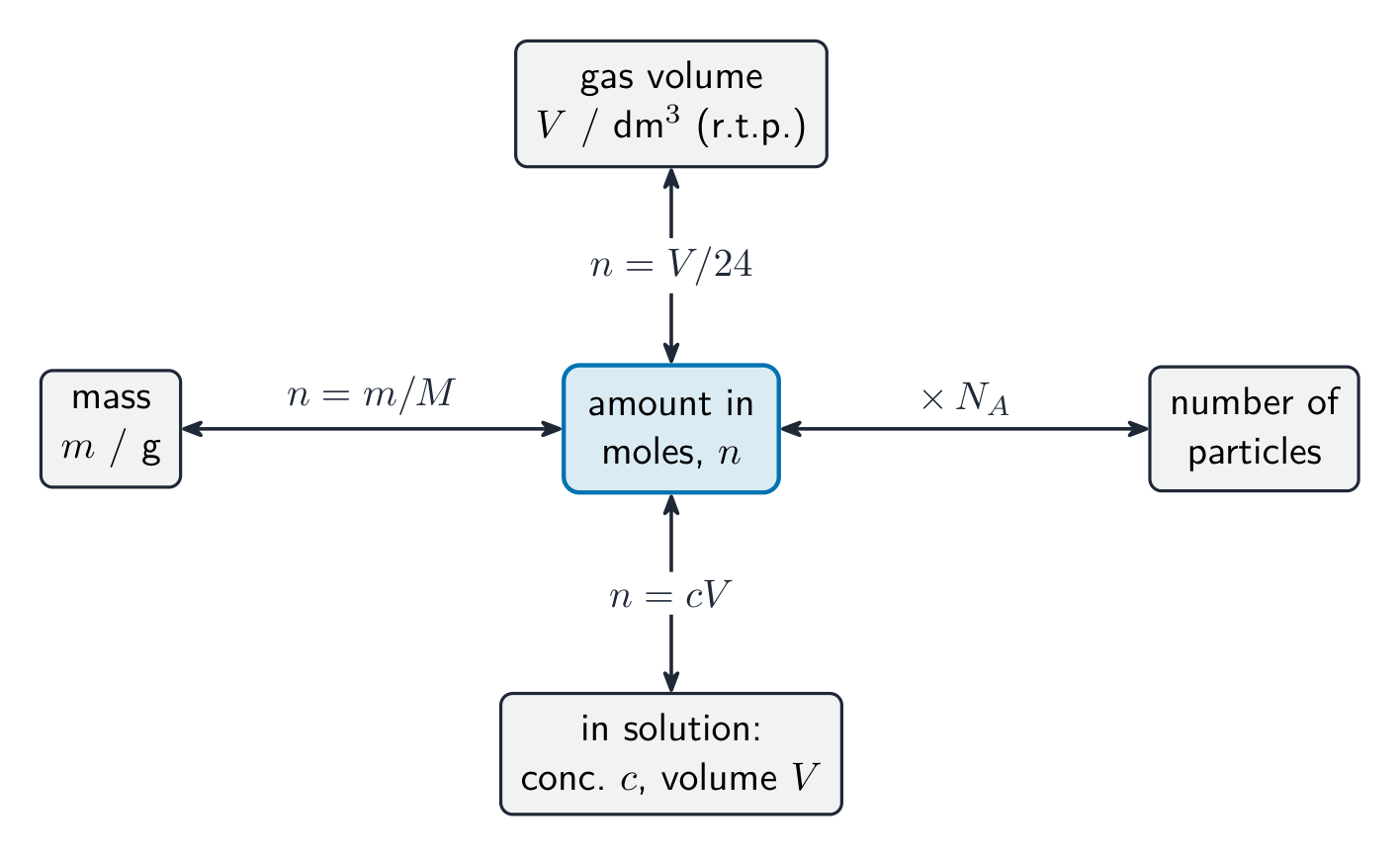
Moles are the bridge between the lab (grams you weigh) and the equation (particles that react).

Worked example. How many moles, and how many molecules, are in $36.0\ \text{g}$ of water ($M=18.0\ \text{g/mol}$)?

$$n=\frac{m}{M}=\frac{36.0}{18.0}=2.0\ \text{mol},\qquad N=n\,N_A=2.0\times6.022\times10^{23}=1.2\times10^{24}\ \text{molecules}.$$

Bahasa Indonesia

Karena atom terlalu kecil untuk dihitung satu per satu, para ahli kimia menghitung dalam satuan mol. Satu mol adalah bilangan Avogadro partikel, yaitu $N_A=6.022\times10^{23}$. Massa molar (gram per mol, diambil dari tabel periodik) digunakan untuk mengonversi antara massa dan mol:

$$n=\frac{m}{M}.$$
Mol berfungsi sebagai jembatan antara laboratorium (gram yang ditimbang) dan persamaan reaksi (partikel yang bereaksi).

Mol adalah hub: konversi antara massa, partikel, volume gas, dan konsentrasi

Contoh terpecahkan. Berapa banyak mol, dan berapa banyak molekul, yang terdapat dalam $36.0\ \text{g}$ air ($M=18.0\ \text{g/mol}$)?

$$n=\frac{m}{M}=\frac{36.0}{18.0}=2.0\ \text{mol},\qquad N=n\,N_A=2.0\times6.022\times10^{23}=1.2\times10^{24}\ \text{molecules}.$$

Explore · ⁨Jelajahi⁩

Link mass, moles and molar mass · ⁨Hubungkan massa, mol, dan massa molar⁩

Molar mass $M$ is the bridge between the mass you weigh and the number of moles: $m = M \times n$. Because $M$ is fixed for a substance, mass is proportional to moles — double the moles, double the mass. · ⁨Massa molar $M$ adalah jembatan antara massa yang Anda timbang dengan jumlah mol: $m = M \times n$. Karena $M$ tetap untuk suatu zat, massa berbanding lurus dengan mol — gandakan mol, gandakan pula massanya.⁩

1.2

Mass Spectra of Elements · ⁨Spektrum Massa Unsur⁩

Syllabus · ⁨Silabus⁩
English

Learning Objective 1.2.A: Explain the quantitative relationship between the mass spectrum of an element and the masses of the element's isotopes.

  • 1.2.A.1 The mass spectrum of a sample containing a single element can be used to determine the identity of the isotopes of that element and the relative abundance of each isotope in nature.
  • 1.2.A.2 The average atomic mass of an element can be estimated from the weighted average of the isotopic masses using the mass of each isotope and its relative abundance.
    • Exclusion Statement: Interpreting mass spectra of samples containing multiple elements or peaks arising from species other than singly charged monatomic ions will not be assessed on the AP Exam.
Bahasa Indonesia

Tujuan Pembelajaran 1.2.A: Menjelaskan hubungan kuantitatif antara spektrum massa suatu elemen dengan massa isotop-isotop elemen tersebut.

  • 1.2.A.1 Spektrum massa dari sampel yang mengandung satu elemen tunggal dapat digunakan untuk mengidentifikasi identitas isotop-isotop elemen tersebut serta kelimpahan relatif masing-masing isotop di alam.
  • 1.2.A.2 Massa atom rata-rata suatu elemen dapat diestimasi dari rata-rata tertimbang massa isotop menggunakan massa setiap isotop dan kelimpahannya.
    • Pengecualian: Interpretasi spektrum massa sampel yang mengandung lebih dari satu elemen atau puncak yang berasal dari spesies selain ion monatom bermuatan tunggal tidak akan diujikan pada Ujian AP.

Source: College Board AP Course and Exam Description · ⁨Sumber: Deskripsi Kursus dan Ujian College Board AP⁩

English
Mass spectrometry

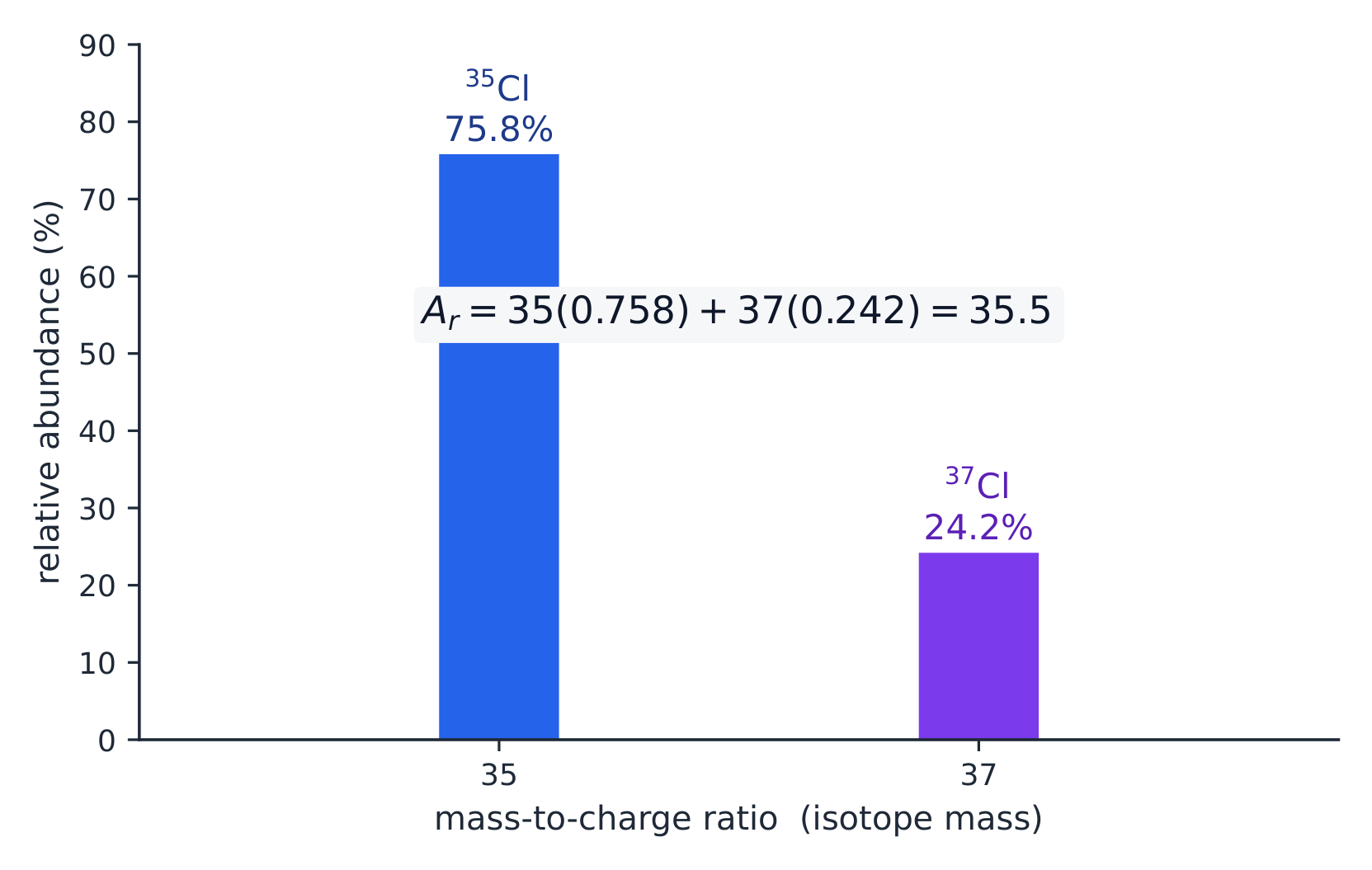
A mass spectrometer 质谱仪 separates atoms by mass, giving a mass spectrum 质谱: peaks at each isotope 同位素 (same element, different neutron count) with heights showing their relative abundance 相对丰度. The element's average atomic mass is the abundance-weighted average of its isotope masses.

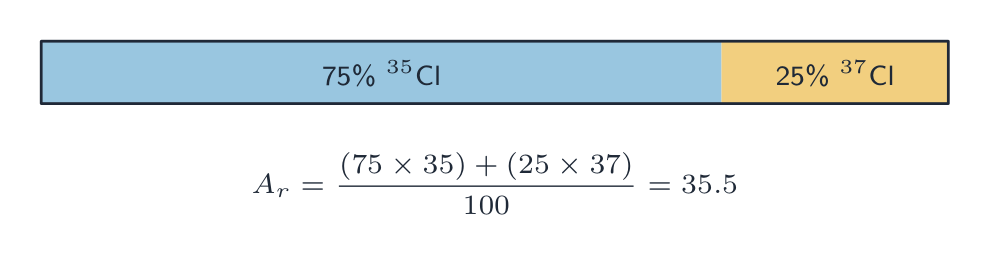
Worked example. Chlorine is $75.8\%$ chlorine-35 and $24.2\%$ chlorine-37. Its average atomic mass is

$$A_r=(35)(0.758)+(37)(0.242)=26.5+8.95=35.5.$$
The average lies closer to $35$ because that isotope is more abundant – which is why the periodic-table value is $35.5$, not a whole number.

Bahasa Indonesia
Spektrometri massa

Spektrometer massa memisahkan atom berdasarkan massanya, menghasilkan spektrum massa: puncak pada setiap isotop (unsur yang sama, jumlah neutron berbeda) dengan tinggi yang menunjukkan kelimpahan relatif-nya. Massa atom rata-rata unsur tersebut adalah rata-rata terbobot kelimpahan dari massa isotop-isotopnya.

Massa atom relatif adalah rata-rata tertimbang kelimpahan isotop-isotop tersebut
Massa atom relatif adalah rata-rata terbobot kelimpahan dari isotop-isotopnya
Spektrum massa klorin: dua isotop dengan kelimpahan berbeda

Contoh terpecahkan. Klorin terdiri dari $75.8\%$ klorin-35 dan $24.2\%$ klorin-37. Massa atom rata-ratanya adalah

$$A_r=(35)(0.758)+(37)(0.242)=26.5+8.95=35.5.$$
Nilai rata-rata berada lebih dekat ke $35$ karena isotop tersebut lebih melimpah – inilah sebabnya nilai di tabel periodik adalah $35.5$, bukan bilangan bulat.

Explore · ⁨Jelajahi⁩

Explore isotopes — same element, different mass · ⁨Eksplorasi isotop — unsur yang sama, massa berbeda⁩

Keep the protons fixed but change the neutrons to build the two chlorine isotopes ($^{35}$Cl and $^{37}$Cl). Same element, different mass — exactly the peaks a mass spectrum shows. · ⁨Tetapkan proton tetap tetapi ubah neutron untuk membangun dua isotop klorin ($^{35}$Cl dan $^{37}$Cl). Unsur yang sama, massa berbeda — persis seperti puncak yang ditunjukkan spektrum massa.⁩

Vocabulary · ⁨Kosa kata⁩ Train · ⁨Latih⁩
English Bahasa Indonesia
moles/məʊlz/ mol
Avogadro's number/ˌævəˈɡædrəʊz ˈnʌmbə/ bilangan Avogadro
molar mass/ˈməʊlə mæs/ massa molar
mass spectrometer/mæs spekˈtrɒmɪtə/ spektrometer massa
mass spectrum/mæs ˈspektrəm/ spektrum massa
isotope/ˈaɪsətəʊp/ isotop
relative abundance/ˈrelətɪv əˈbʌndəns/ kelimpahan relatif
percent composition/pəˈsent ˌkɒmpəˈzɪʃn/ komposisi persen
1.3

Elemental Composition of Pure Substances · ⁨Komposisi Elemen Senyawa Murni⁩

Syllabus · ⁨Silabus⁩
English

Learning Objective 1.3.A: Explain the quantitative relationship between the elemental composition by mass and the empirical formula of a pure substance.

  • 1.3.A.1 Some pure substances are composed of individual molecules, while others consist of atoms or ions held together in fixed proportions as described by a formula unit.
  • 1.3.A.2 According to the law of definite proportions, the ratio of the masses of the constituent elements in any pure sample of that compound is always the same.
  • 1.3.A.3 The chemical formula that lists the lowest whole number ratio of atoms of the elements in a compound is the empirical formula.
Bahasa Indonesia

Tujuan Pembelajaran 1.3.A: Menjelaskan hubungan kuantitatif antara komposisi unsur berdasarkan massa dan rumus empiris suatu zat murni.

  • 1.3.A.1 Beberapa zat murni terdiri dari molekul individu, sementara yang lain terdiri dari atom atau ion yang terikat dalam proporsi tetap seperti yang dijelaskan oleh satuan rumus.
  • 1.3.A.2 Berdasarkan hukum perbandingan tetap, rasio massa unsur-unsur penyusun dalam setiap sampel murni senyawa tersebut selalu sama.
  • 1.3.A.3 Rumus kimia yang mencantumkan rasio bilangan bulat terendah dari atom-atom unsur dalam suatu senyawa adalah rumus empiris.

Source: College Board AP Course and Exam Description · ⁨Sumber: Deskripsi Kursus dan Ujian College Board AP⁩

English

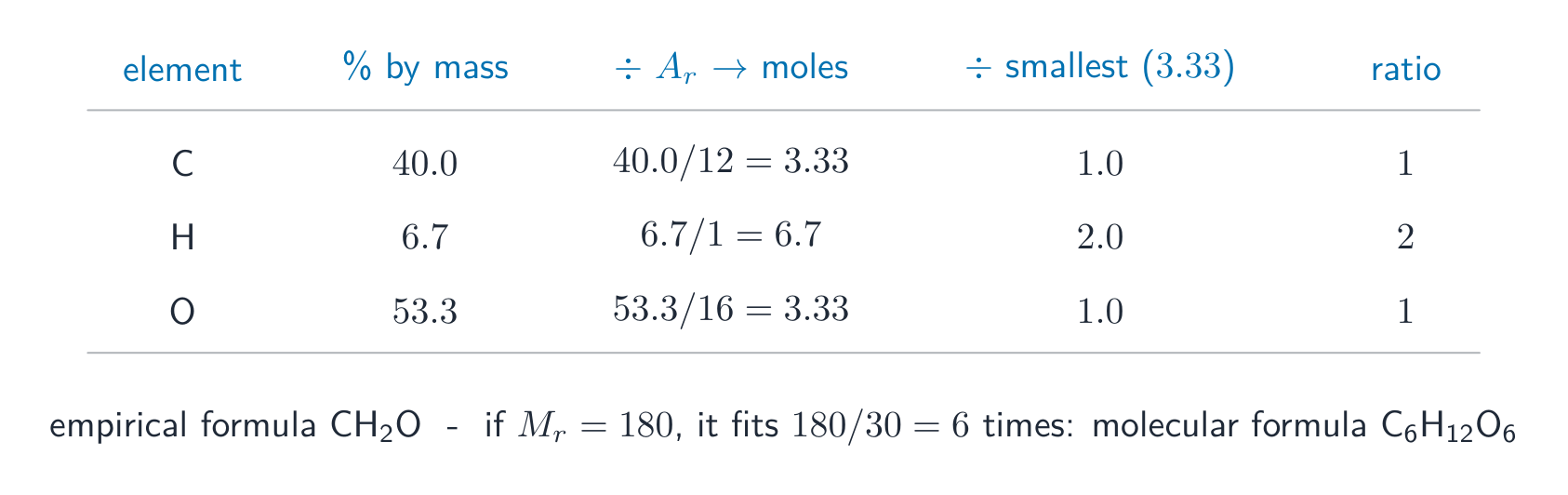
The percent composition 百分组成 of a compound is each element's mass fraction. From it you find the empirical formula 实验式 (simplest whole-number ratio of atoms) by converting each element's mass to moles and dividing by the smallest. The molecular formula 分子式 is a whole-number multiple of the empirical formula, found from the molar mass.

Worked example. A compound is $40.0\%$ C, $6.7\%$ H, and $53.3\%$ O by mass. Assuming $100\ \text{g}$, convert each mass to moles and divide by the smallest:

$$\text{C}:\frac{40.0}{12}=3.33,\quad \text{H}:\frac{6.7}{1}=6.7,\quad \text{O}:\frac{53.3}{16}=3.33 \;\xrightarrow{\div 3.33}\; 1:2:1,$$
so the empirical formula is $\text{CH}_2\text{O}$. If the molar mass were $180\ \text{g/mol}$ ($=6\times30$), the molecular formula would be $\text{C}_6\text{H}_{12}\text{O}_6$ – glucose.

Bahasa Indonesia

Komposisi persentase suatu senyawa adalah fraksi massa dari masing-masing elemen. Dari sana Anda dapat menemukan rumus empiris (rasio bilangan bulat terkecil dari atom) dengan mengonversi massa setiap elemen menjadi mol dan membaginya dengan nilai terkecil. Rumus molekuler adalah kelipatan bilangan bulat dari rumus empiris, yang ditemukan melalui massa molar.

Menentukan rumus empiris: massa ke mol, bagi dengan nilai terkecil, baca rasionya
Menemukan rumus empiris: massa ke mol, bagi dengan yang terkecil, baca rasionya

Contoh terpecahkan. Suatu senyawa memiliki komposisi $40.0\%$ C, $6.7\%$ H, dan $53.3\%$ O berdasarkan massa. Asumsikan massa totalnya $100\ \text{g}$, konversikan setiap massa menjadi mol dan bagi dengan nilai terkecil:

$$\text{C}:\frac{40.0}{12}=3.33,\quad \text{H}:\frac{6.7}{1}=6.7,\quad \text{O}:\frac{53.3}{16}=3.33 \;\xrightarrow{\div 3.33}\; 1:2:1,$$
sehingga rumus empirisnya adalah $\text{CH}_2\text{O}$. Jika massa molar adalah $180\ \text{g/mol}$ ($=6\times30$), maka rumus molekuler akan menjadi $\text{C}_6\text{H}_{12}\text{O}_6$ – glukosa.

Vocabulary · ⁨Kosa kata⁩ Train · ⁨Latih⁩
English Bahasa Indonesia
empirical formula/emˈpɪrɪkl ˈfɔːmjʊlə/ rumus empirik
molecular formula/məˈlekjʊlə ˈfɔːmjʊlə/ rumus molekul
mixture/ˈmɪkstʃə/ campuran
nucleus/ˈnjuːklɪəs/ inti sel
electron configuration/ɪˈlektrɒn kənˌfɪɡjəˈreɪʃn/ konfigurasi elektron
valence electrons/ˈveɪləns ɪˈlektrɒnz/ elektron valensi
Photoelectron spectroscopy/ˌfəʊtəʊɪˈlektrɒn spekˈtrɒskəpi/ Spektroskopi fotoelektron
Atomic radius/əˈtɒmɪk ˈreɪdɪəs/ Jari-jari atom
Ionization energy/ˌaɪənaɪˈzeɪʃn ˈenədʒi/ Energi ionisasi
1.4

Composition of Mixtures · ⁨Komposisi Campuran⁩

Syllabus · ⁨Silabus⁩
English

Learning Objective 1.4.A: Explain the quantitative relationship between the elemental composition by mass and the composition of substances in a mixture.

  • 1.4.A.1 Pure substances contain atoms, molecules, or formula units of a single type. Mixtures contain atoms, molecules, or formula units of two or more types, whose relative proportions can vary.
  • 1.4.A.2 Elemental analysis can be used to determine the relative numbers of atoms in a substance and to determine its purity.
Bahasa Indonesia

Tujuan Pembelajaran 1.4.A: Menjelaskan hubungan kuantitatif antara komposisi unsur berdasarkan massa dan komposisi zat dalam campuran.

  • 1.4.A.1 Zat murni mengandung atom, molekul, atau satuan rumus dari satu jenis saja. Campuran mengandung atom, molekul, atau satuan rumus dari dua jenis atau lebih, yang proporsi relatifnya dapat bervariasi.
  • 1.4.A.2 Analisis unsur dapat digunakan untuk menentukan jumlah relatif atom dalam suatu zat dan untuk menentukan kemurniannya.

Source: College Board AP Course and Exam Description · ⁨Sumber: Deskripsi Kursus dan Ujian College Board AP⁩

English

Unlike a pure compound, a mixture 混合物 has variable composition – its parts keep their own identities. Describe a mixture by the mass or mole fraction of each component; these do not follow a fixed formula. Spectroscopy (like PES or absorption) can measure how much of each component is present.

Bahasa Indonesia

Berbeda dengan senyawa murni, sebuah campuran memiliki komposisi yang bervariasi – bagian-bagiannya tetap mempertahankan identitasnya sendiri. Deskripsikan campuran menggunakan fraksi massa atau fraksi mol dari setiap komponen; ini tidak mengikuti rumus tetap. Spektroskopi (seperti PES atau absorpsi) dapat mengukur seberapa besar setiap komponen yang ada.

1.5

Atomic Structure and Electron Configuration · ⁨Struktur Atom dan Konfigurasi Elektron⁩

Syllabus · ⁨Silabus⁩
English

Learning Objective 1.5.A: Represent the ground-state electron configuration of an atom of an element or its ions using the Aufbau principle.

  • 1.5.A.1 The atom is composed of negatively charged electrons and a positively charged nucleus that is made of protons and neutrons.
  • 1.5.A.2 Coulomb's law is used to calculate the force between two charged particles.
    • Equation: $F_{coulombic} \propto \dfrac{q_1 q_2}{r^2}$
  • 1.5.A.3 In atoms and ions, the electrons can be thought of as being in "shells (energy levels)" and "subshells (sublevels)," as described by the ground-state electron configuration. Inner electrons are called core electrons, and outer electrons are called valence electrons. The electron configuration is explained by quantum mechanics, as delineated in the Aufbau principle and exemplified in the periodic table of the elements.
    • Exclusion Statement: The assignment of quantum numbers to electrons in subshells of an atom will not be assessed on the AP Exam.
  • 1.5.A.4 The relative energy required to remove an electron from different subshells of an atom or ion or from the same subshell in different atoms or ions (ionization energy) can be estimated through a qualitative application of Coulomb's law. This energy is related to the distance from the nucleus and the effective (shield) charge of the nucleus.
Bahasa Indonesia

Tujuan Pembelajaran 1.5.A: Merepresentasikan konfigurasi elektron keadaan dasar atom suatu elemen atau ionnya menggunakan prinsip Aufbau.

  • 1.5.A.1 Atom terdiri dari elektron bermuatan negatif dan inti bermuatan positif yang tersusun atas proton dan neutron.
  • 1.5.A.2 Hukum Coulomb digunakan untuk menghitung gaya antara dua partikel bermuatan.
    • Persamaan: $F_{coulombic} \propto \dfrac{q_1 q_2}{r^2}$
  • 1.5.A.3 Dalam atom dan ion, elektron dapat dipandang berada di "kulit (tingkat energi)" dan "subkulit (sublevel)", sebagaimana dijelaskan oleh konfigurasi elektron keadaan dasar. Elektron dalam disebut elektron inti, dan elektron luar disebut elektron valensi. Konfigurasi elektron dijelaskan oleh mekanika kuantum, sebagaimana digariskan dalam prinsip Aufbau dan diilustrasikan dalam tabel periodik unsur.
    • Pengecualian: Penetapan bilangan kuantum ke elektron dalam subkulit atom tidak akan diujikan pada Ujian AP.
  • 1.5.A.4 Energi relatif yang diperlukan untuk melepaskan elektron dari subkulit berbeda dalam atom atau ion, atau dari subkulit yang sama dalam atom atau ion berbeda (energi ionisasi), dapat diestimasi melalui penerapan kualitatif hukum Coulomb. Energi ini berkaitan dengan jarak dari inti dan muatan efektif (pelindung) inti.

Source: College Board AP Course and Exam Description · ⁨Sumber: Deskripsi Kursus dan Ujian College Board AP⁩

English

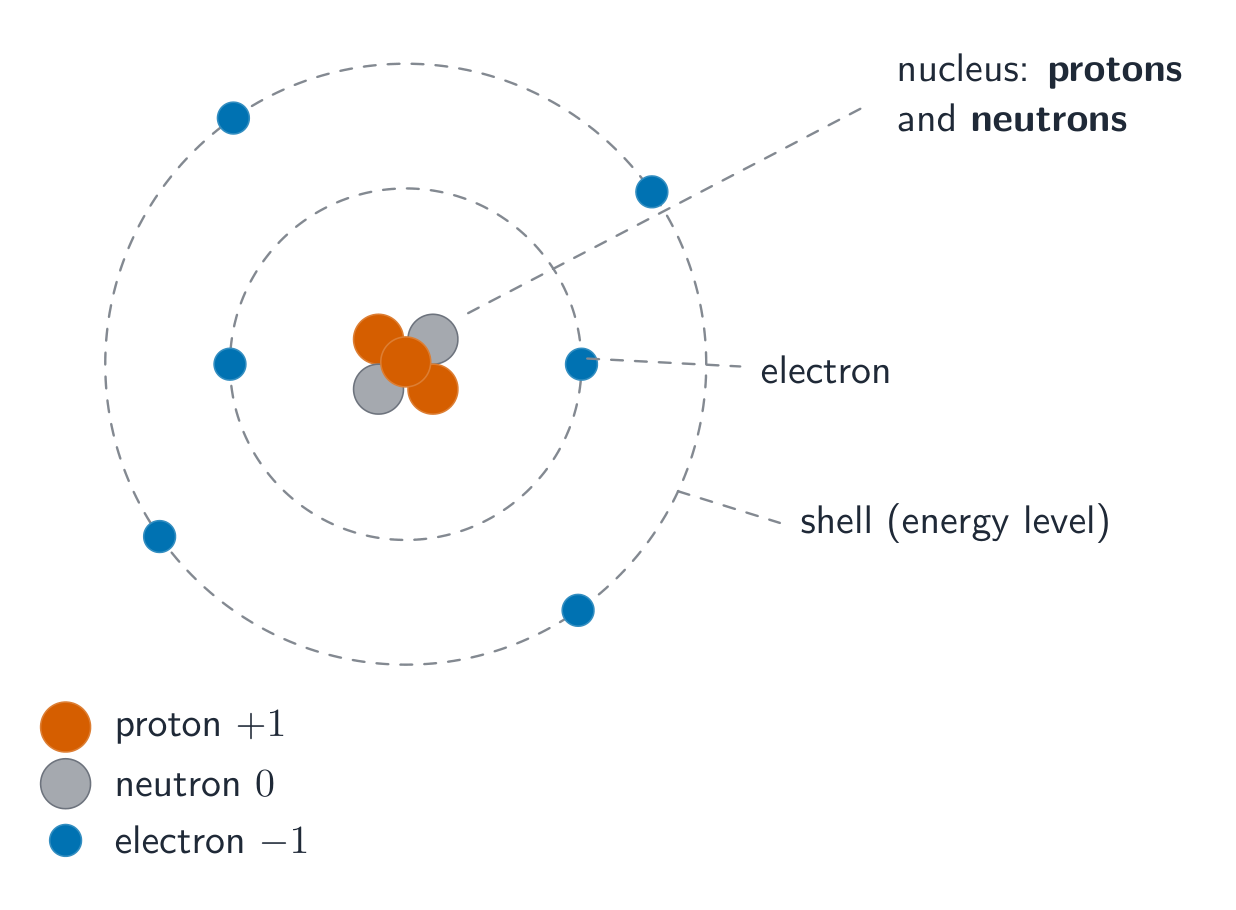
An atom is a tiny nucleus 原子核 (protons and neutrons) surrounded by electrons in shells and subshells (s, p, d, f). The electron configuration 电子排布 lists how electrons fill these, lowest energy first (e.g. $1s^2\,2s^2\,2p^6$). The outermost, highest-energy electrons – the valence electrons 价电子 – control chemistry. Coulomb's law explains their energies: electrons closer to, and less shielded from, the nucleus are held more tightly.

Worked example. Write the electron configuration of sulfur ($Z=16$). Fill subshells in order until $16$ electrons are placed: $1s^2\,2s^2\,2p^6\,3s^2\,3p^4$. The $3s$ and $3p$ electrons (six in total) are the valence electrons, so sulfur tends to gain two electrons to complete its octet.

Bahasa Indonesia

Sebuah atom memiliki inti kecil (nukleus berisi proton dan neutron) yang dikelilingi oleh elektron dalam kulit dan subkulit (s, p, d, f). Konfigurasi elektron merinci bagaimana elektron mengisi kulit-kulit tersebut, dimulai dari energi terendah (misalnya $1s^2\,2s^2\,2p^6$). Elektron valensi – elektron terluar berenergi tertinggi – menentukan sifat kimia. Hukum Coulomb menjelaskan energi mereka: elektron yang lebih dekat ke nukleus dan kurang terlindung dari muatan inti diikat lebih kuat.

Atom: inti kecil berisi proton dan neutron, dengan elektron dalam kulit elektron
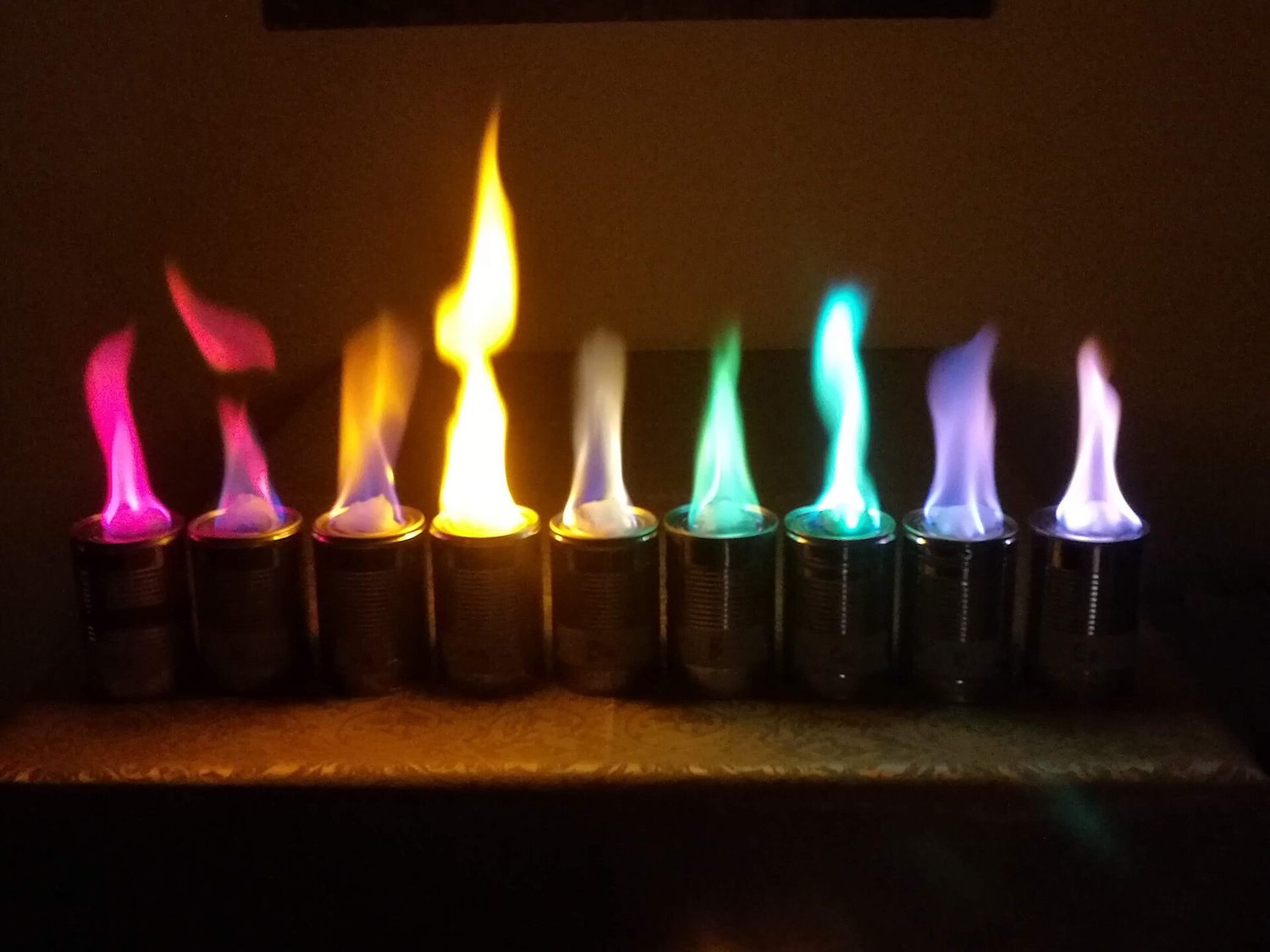
Barisan sembilan cawan terbakar, masing-masing api berwarna cerah berbeda — merah tua, oranye, kuning, hijau, biru, ungu
Uji nyala: setiap ion logam memberikan warnanya sendiri karena panas mengexcite elektronnya, dan saat kembali turun, mereka memancarkan cahaya dengan panjang gelombang spesifik

Contoh terpecahkan. Tuliskan konfigurasi elektron sulfur ($Z=16$). Isi subkulit secara berurutan hingga $16$ elektron ditempatkan: $1s^2\,2s^2\,2p^6\,3s^2\,3p^4$. Elektron $3s$ dan $3p$ (total enam) adalah elektron valensi, sehingga sulfur cenderung menerima dua elektron untuk melengkapi oktetnya.

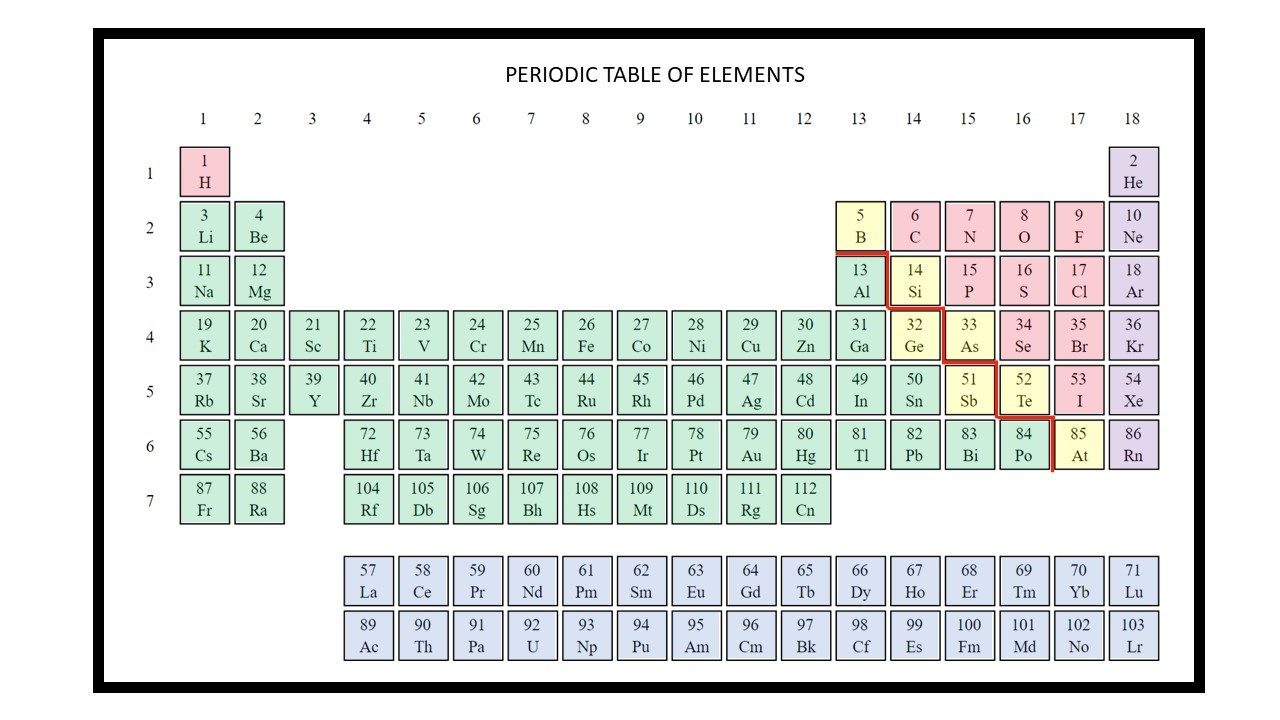
Tabel periododik mengorganisasi unsur berdasarkan struktur atom — konfigurasi elektron menjelaskan pola-pola tersebut
Tabel periodik mengelompokkan unsur berdasarkan struktur atom — konfigurasi elektron menjelaskan polanya
Explore · ⁨Jelajahi⁩

Explore how electrons fill the shells · ⁨Eksplorasi bagaimana elektron mengisi kulit atom⁩

Change the atomic number $Z$ and watch the electrons fill the shells lowest-energy-first (the Aufbau principle 构造原理). The outermost electrons are the valence electrons that drive bonding. · ⁨Ubah nomor atom $Z$ dan lihat elektron mengisi kulit terluar-terlebih dulu (prinsip Aufbau). Elektron terluar adalah elektron valensi yang mendorong pembentukan ikatan.⁩

1.6

Photoelectron Spectroscopy · ⁨Spektroskopi Fotoelektron⁩

Syllabus · ⁨Silabus⁩
English

Learning Objective 1.6.A: Explain the relationship between the photoelectron spectrum of an atom or ion and: i. The ground-state electron configuration of the species. ii. The interactions between the electrons and the nucleus.

  • 1.6.A.1 The energies of the electrons in a given shell can be measured experimentally with photoelectron spectroscopy (PES). The position of each peak in the PES spectrum is related to the energy required to remove an electron from the corresponding subshell, and the relative height of each peak is (ideally) proportional to the number of electrons in that subshell.
Bahasa Indonesia

Tujuan Pembelajaran 1.6.A: Menjelaskan hubungan antara spektrum fotoelektron dari atom atau ion dengan: i. Konfigurasi elektron keadaan dasar spesies tersebut. ii. Interaksi antara elektron dan inti.

  • 1.6.A.1 Energi elektron dalam kulit tertentu dapat diukur secara eksperimental dengan spektroskopi fotoelektron (PES). Posisi setiap puncak dalam spektrum PES terkait dengan energi yang diperlukan untuk melepaskan elektron dari subkulit yang bersangkutan, dan tinggi relatif setiap puncak sebanding (idealnya) dengan jumlah elektron dalam subkulit tersebut.

Source: College Board AP Course and Exam Description · ⁨Sumber: Deskripsi Kursus dan Ujian College Board AP⁩

English

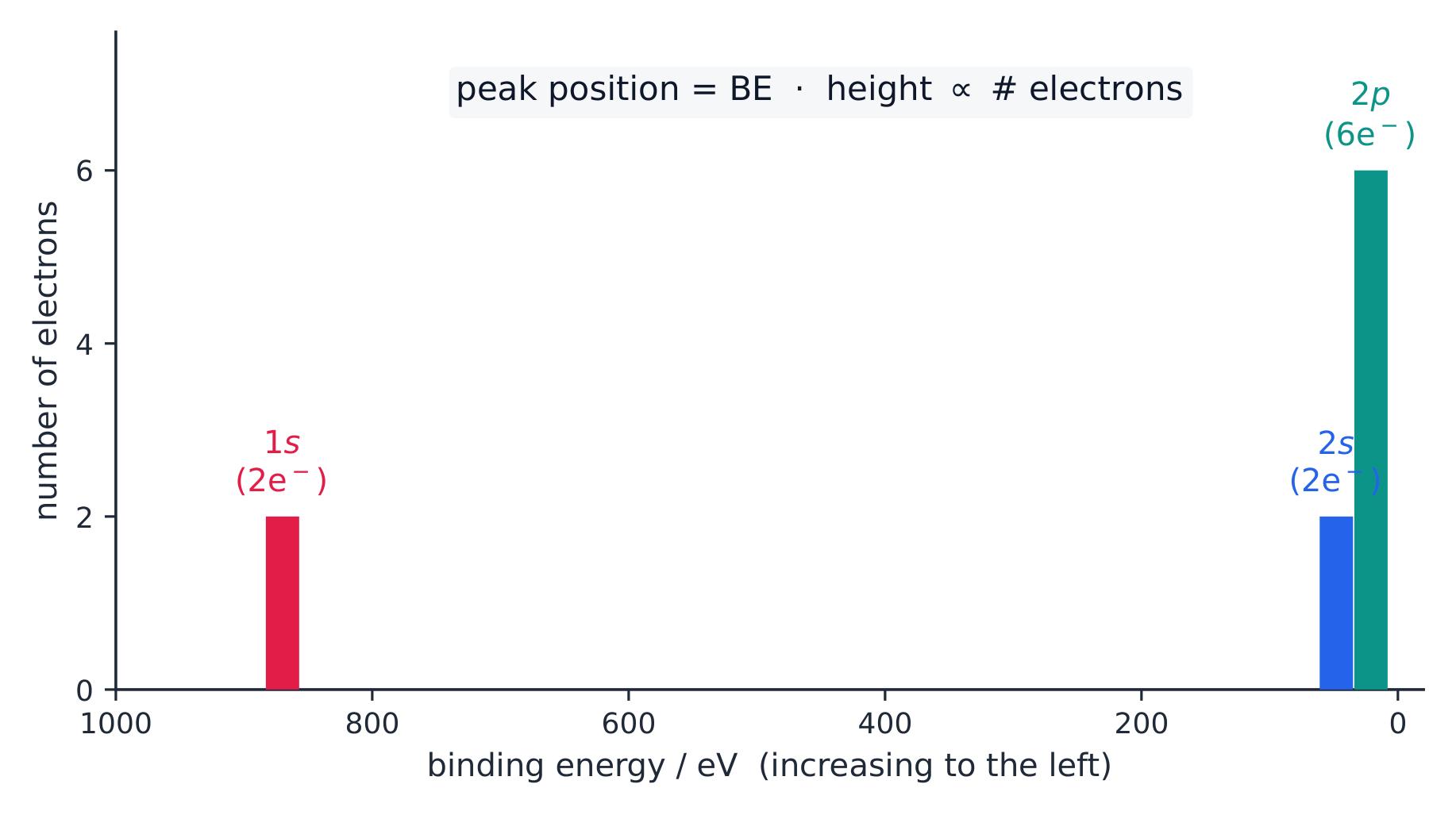
Photoelectron spectroscopy 光电子能谱 (PES) measures the energy needed to remove electrons from each subshell. Each peak is a subshell: its position gives the binding energy (how tightly held) and its height gives the number of electrons in it. PES data let you read an element's electron configuration and confirm shell structure directly.

Bahasa Indonesia

Spektroskopi fotoelektron (PES) mengukur energi yang dibutuhkan untuk melepaskan elektron dari setiap subkulit. Setiap puncak merepresentasikan sebuah subkulit: posisinya menunjukkan energi ikat (seberapa kuat terikat) dan tingginya menunjukkan jumlah elektron di dalamnya. Data PES memungkinkan Anda membaca konfigurasi elektron suatu unsur dan memverifikasi struktur kulit secara langsung.

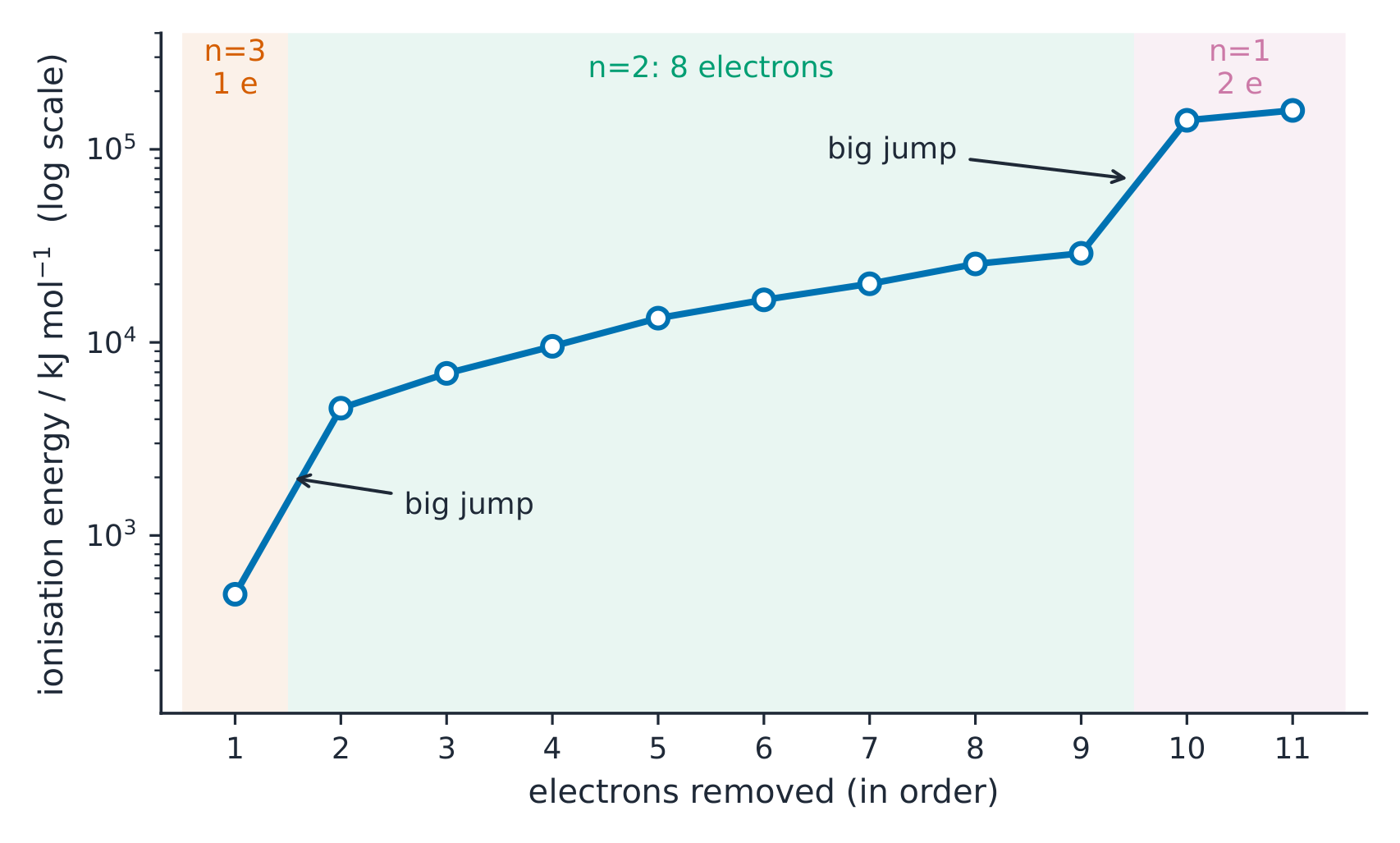
Energi ionisasi berturut-turut mengungkapkan struktur kulit melalui lonjakan besar
Energi ionisasi berturut-turut mengungkapkan struktur kulit melalui loncatan besar
Spektrum fotoelektron neon: satu puncak per subkulit, tinggi ditentukan oleh jumlah elektron
1.7

Periodic Trends · ⁨Tren Periodik⁩

Syllabus · ⁨Silabus⁩
English

Learning Objective 1.7.A: Explain the relationship between trends in atomic properties of elements and electronic structure and periodicity.

  • 1.7.A.1 The organization of the periodic table is based on patterns of recurring properties of the elements, which are explained by patterns of ground-state electron configurations and the presence of completely or partially filled shells (and subshells) of electrons in atoms.
    • Exclusion Statement: Writing the electron configuration of elements that are exceptions to the aufbau principle will not be assessed on the AP Exam.
  • 1.7.A.2 Trends in atomic properties within the periodic table (periodicity) can be predicted by the position of the element on the periodic table and qualitatively understood using Coulomb's law, the shell model, and the concepts of shielding and effective nuclear charge. These properties include:
    • i. Ionization energy
    • ii. Atomic and ionic radii
    • iii. Electron affinity
    • iv. Electronegativity.
  • 1.7.A.3 The periodicity (in 1.7.A.2) is useful to predict/estimate values of properties in the absence of data.
Bahasa Indonesia

Tujuan Pembelajaran 1.7.A: Menjelaskan hubungan antara tren sifat atom unsur dan struktur elektron serta periodisitas.

  • 1.7.A.1 Pengelompokan tabel periodik didasarkan pada pola sifat berulang unsur, yang dijelaskan oleh pola konfigurasi elektron keadaan dasar dan adanya kulit (dan subkulit) elektron yang terisi penuh atau sebagian dalam atom.
    • Pengecualian: Penulisan konfigurasi elektron unsur-unsur yang merupakan pengecualian terhadap prinsip Aufbau tidak akan diujikan pada Ujian AP.
  • 1.7.A.2 Tren sifat-sifat atomik dalam tabel periodik (periodisitas) dapat diprediksi berdasarkan posisi unsur dalam tabel periodik dan dipahami secara kualitatif menggunakan hukum Coulomb, model kulit, serta konsep pelindung dan muatan inti efektif. Sifat-sifat ini meliputi:
    • i. Energi ionisasi
    • ii. Jari-jari atom dan ion
    • iii. Afinitas elektron
    • iv. Elektronegativitas.
  • 1.7.A.3 Periodisitas (dalam 1.7.A.2) berguna untuk memprediksi/memperkirakan nilai-nilai sifat-sifat tersebut ketika data tidak tersedia.

Source: College Board AP Course and Exam Description · ⁨Sumber: Deskripsi Kursus dan Ujian College Board AP⁩

English

Trends across the periodic table follow from nuclear charge and shielding:

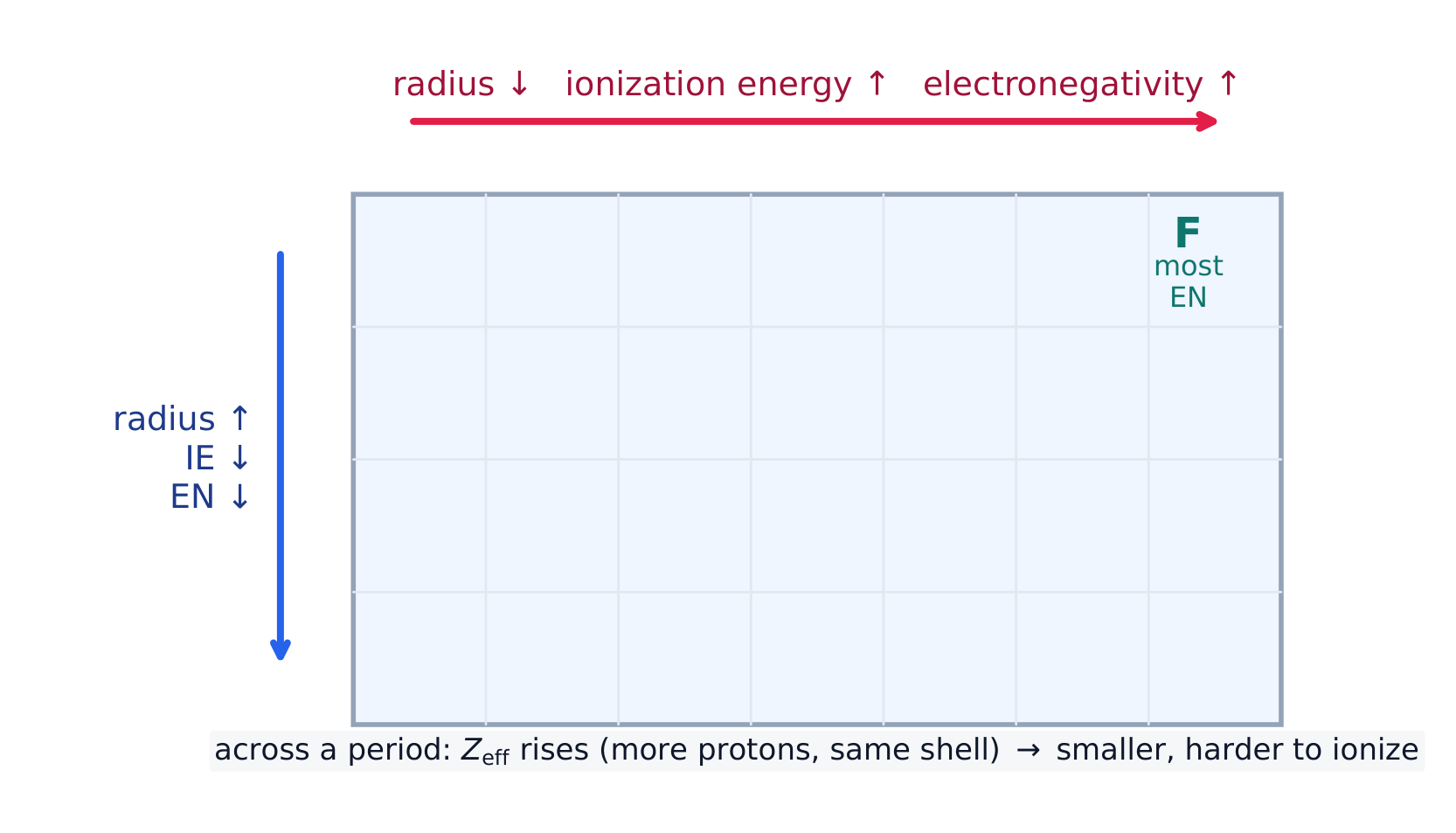
  • Atomic radius 原子半径 decreases across a period (stronger pull) and increases down a group (more shells).
  • Ionization energy 电离能 (energy to remove an electron) increases across, decreases down – opposite to radius.
  • Electronegativity 电负性 (pull on shared electrons) increases across and up, toward fluorine.
Bahasa Indonesia

Tren melintasi tabel periodik bersumber dari muatan nuklir dan pelindung (shielding):

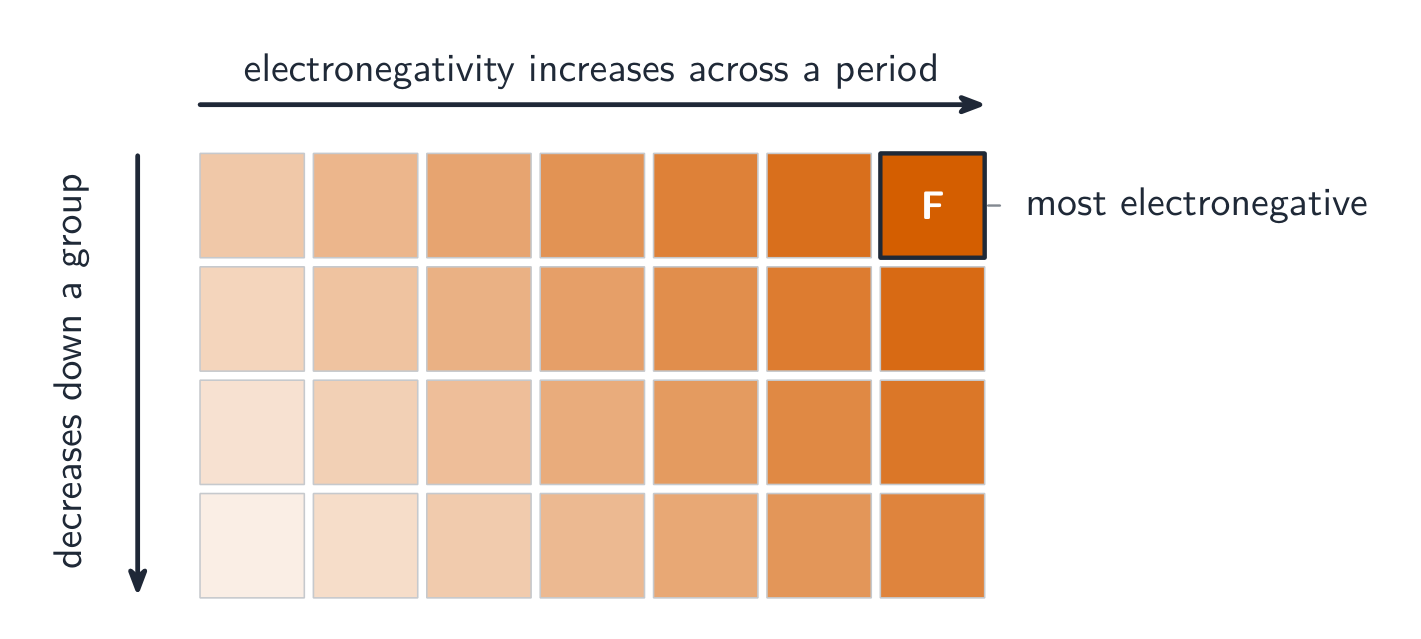
Elektonegatifivitas meningkat melintasi periode dan menurun sepanjang golongan
Elektronegativitas naik melintasi periode dan turun sepanjang golongan
  • Jari-jari atom menurun melintasi satu periode (tarikan lebih kuat) dan meningkat ke bawah dalam satu kumpulan (lebih banyak kulit).
  • Energi ionisasi (energi untuk melepaskan elektron) meningkat melintasi, menurun ke bawah – berlawanan dengan jari-jari.
  • Kelektronegatifan (tarikan pada elektron yang dibagikan) meningkat melintasi dan ke atas, menuju fluor.
Tren periodik: bagaimana jari-jari, energi ionisasi, dan kelektronegatifan berubah melintasi dan ke bawah
Explore · ⁨Jelajahi⁩

Explore atomic radius across a period · ⁨Jelajahi jari-jari atom sepanjang satu periode⁩

Step across Period 3 and watch the atomic radius shrink — each added proton raises the effective nuclear charge and pulls the same shell in tighter. · ⁨Melintasi Periode 3 dan lihat jari-jari atom menyusut — setiap proton yang ditambahkan meningkatkan muatan inti efektif dan menarik kulit yang sama lebih rapat.⁩

Vocabulary · ⁨Kosa kata⁩ Train · ⁨Latih⁩
English Bahasa Indonesia
Electronegativity/ɪˌlektrəʊŋɡəˈtɪvɪti/ Kelektronegatifan
cations/ˈkætaɪənz/ kation
anions/ˈænaɪənz/ anion
ionic compound/aɪˈɒnɪk ˈkɒmpaʊnd/ sebatian ionik
1.8

Valence Electrons and Ionic Compounds · ⁨Elektron Valensi dan Senyawa Ionik⁩

Syllabus · ⁨Silabus⁩
English

Learning Objective 1.8.A: Explain the relationship between trends in the reactivity of elements and periodicity.

  • 1.8.A.1 The likelihood that two elements will form a chemical bond is determined by the interactions between the valence electrons and nuclei of elements.
  • 1.8.A.2 Elements in the same column of the periodic table tend to form analogous compounds.
  • 1.8.A.3 Typical charges of atoms in ionic compounds are governed by the number of valence electrons and predicted by their location on the periodic table.
Bahasa Indonesia

Tujuan Pembelajaran 1.8.A: Jelaskan hubungan antara tren reaktivitas unsur dengan periodisitas.

  • 1.8.A.1 Kemungkinan dua unsur membentuk ikatan kimia ditentukan oleh interaksi antara elektron valensi dan inti atom unsur-unsur tersebut.
  • 1.8.A.2 Unsur-unsur dalam kolom yang sama pada tabel periodik cenderung membentuk senyawa yang analog.
  • 1.8.A.3 Muatan típikal atom dalam senyawa ionik ditentukan oleh jumlah elektron valensi dan diprediksi berdasarkan lokasinya pada tabel periodik.

Source: College Board AP Course and Exam Description · ⁨Sumber: Deskripsi Kursus dan Ujian College Board AP⁩

English

Atoms gain, lose, or share valence electrons to reach stable configurations. Metals (low ionization energy) lose electrons to form cations 阳离子; nonmetals gain electrons to form anions 阴离子. Oppositely charged ions attract into an ionic compound 离子化合物, whose formula balances the charges to make the whole neutral. For example, aluminium ($3+$) and oxide ($2-$) combine as $\text{Al}_2\text{O}_3$ so the $+6$ and $-6$ cancel.

Bahasa Indonesia

Atom memperoleh, kehilangan, atau berbagi elektron valensi untuk mencapai konfigurasi stabil. Logam (energi ionisasi rendah) kehilangan elektron untuk membentuk kation; nonlogam memperoleh elektron untuk membentuk anion. Ion bermuatan berlawanan tertarik menjadi senyawa ionik, di mana rumusnya menyeimbangkan muatan agar keseluruhan netral. Sebagai contoh, aluminium ($3+$) dan oksida ($2-$) bergabung sebagai $\text{Al}_2\text{O}_3$ sehingga $+6$ dan $-6$ saling meniadakan.

Explore · ⁨Jelajahi⁩

Watch an ionic bond form by electron transfer · ⁨Lihat ikatan ion terbentuk melalui transfer elektron⁩

A metal gives up its valence electron(s) and a non-metal takes them, so both reach a full shell. The atoms become oppositely charged ions that attract — that electrostatic pull is the ionic bond. · ⁨Logam melepaskan elektron valensinya dan non-logam mengambilnya, sehingga keduanya mencapai kulit penuh. Atom menjadi ion bermuatan berlawanan yang saling tarik-menarik; tarikan elektrostatik inilah ikatan ion.⁩

1.8

Exam tips · ⁨Tips ujian⁩

English
  • Use the mole as the hub: convert grams↔moles with $n=m/M$ and moles↔particles with Avogadro's number.
  • Relative atomic mass is the abundance-weighted average of the isotopes — it lies closer to the more abundant one, not halfway.
  • For an empirical formula, turn each element's mass into moles and divide by the smallest; scale up to whole numbers.
  • Read periodic trends from nuclear charge and shielding: atomic radius decreases across a period, ionisation energy and electronegativity increase across (and up).
  • Fill electron configurations in energy order; the outer valence electrons control the chemistry.
Bahasa Indonesia
  • Gunakan mol sebagai pusat: konversi gram↔mol dengan $n=m/M$ dan mol↔partikel dengan bilangan Avogadro.
  • Massa atom relatif adalah rata-rata berbobot kelimpahan dari isotop-isotop tersebut — nilainya lebih dekat ke isotop yang lebih melimpah, bukan tepat di tengah.
  • Untuk rumus empiris, ubah massa setiap unsur menjadi mol dan bagi dengan nilai terkecil; kalikan hingga menjadi bilangan bulat.
  • Bacalah tren periodik dari muatan inti dan pelindung: jari-jari atom menurun melintasi satu periode, energi ionisasi dan kelektronegatifan meningkat melintasi (dan ke atas).
  • Isi konfigurasi elektron secara berurutan berdasarkan tingkat energi; elektron valensi terluar mengontrol kimia unsur tersebut.

Interactive lessons on this topic · ⁨Pelajaran interaktif untuk topik ini⁩

Work through it step by step, with instant-check exercises. · ⁨Kerjakan langkah demi langkah, dengan latihan pengecekan instan.⁩

Past Papers · ⁨Soal-Soil Masa Lalu⁩

More topics in AP Chemistry · ⁨AP Kimia⁩ · ⁨Topik lain dalam AP Chemistry · ⁨AP Kimia⁩⁩

Log in or create account · ⁨Masuk atau buat akun⁩

IGCSE, A-Level & AP