Skip to content · ⁨Lompat ke konten⁩

Heredity · ⁨Hereditas⁩

AP Biology · ⁨AP Biologi⁩ · Topic 5 · ⁨Topik 5⁩

Video lesson for this topic · ⁨Pelajaran video untuk topik ini⁩ Open the video page · ⁨Buka halaman video⁩
7:53

Hereditas

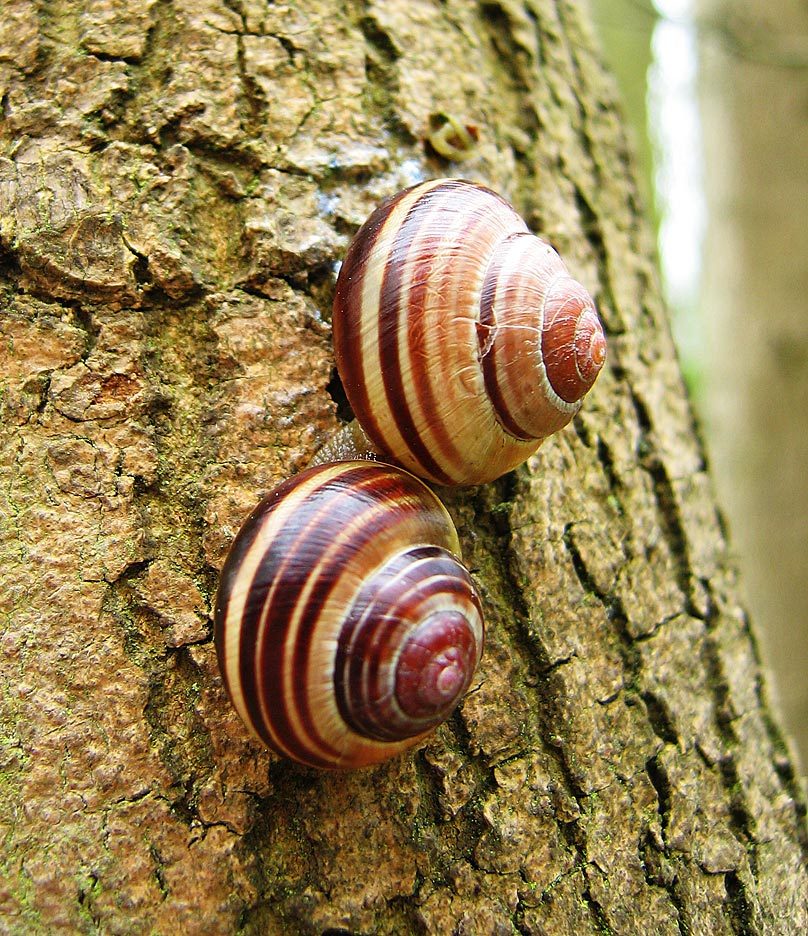
Dua siput di pohon yang sama. Spesies yang sama, kulit pohon yang sama, cuaca yang sama. Tetapi perhatikan cangkangnya. Satu pucat dengan pita gelap tipis, yang lain gelap dengan pita lebar.…

English narration · English + 中文 subtitles burned in · ⁨Narasi bahasa Inggris · Subtitle bahasa Inggris + 中文 disematkan langsung⁩

5.1

Meiosis

Syllabus · ⁨Silabus⁩
English

Enduring Understanding (BIG IDEA 3 — Information Storage and Transmission): Living systems store, retrieve, transmit, and respond to information essential to life processes.

Learning Objective 5.1.A: Explain how meiosis results in the transmission of chromosomes from one generation to the next.

  • 5.1.A.1 Meiosis is a process that ensures the formation of haploid gamete cells, sometimes referred to as daughter cells, in sexually reproducing diploid organisms.
  • 5.1.A.2 Meiosis I involves the following steps:
    • i. Prophase I: Homologous chromosomes pair up and condense, synapsis occurs and then chiasmata may form, meiotic spindle begins to form, centrosomes move to opposite poles of the cell, and the nuclear envelope breaks down.
    • ii. Metaphase I: Meiotic spindle fibers align homologous pairs of chromosomes along the equator of the cell at the metaphase plate.
    • iii. Anaphase I: Homologous chromosomes separate, while sister chromatids remain attached, as meiotic spindle fibers pull chromosomes toward poles.
    • iv. Telophase I: Meiotic spindle breaks down, a new nuclear envelope develops, a cleavage furrow (animal cell) or cell plate (plant cell) forms, and cytokinesis occurs. Two haploid daughter cells are formed (at the end of meiosis I).
  • 5.1.A.3 Meiosis II involves the following steps:
    • i. Prophase II: Meiotic spindle forms; sister chromatids connected at the centromere attach to meiotic spindle.
    • ii. Metaphase II: Chromosomes align along the metaphase plate; the kinetochore of each chromatid is attached to a microtubule extending from the poles.
    • iii. Anaphase II: Proteins at the centromeres break down, and sister chromatids are pulled apart and toward opposite poles in the cell.
    • iv. Telophase II: Meiotic spindle breaks down, a new nuclear envelope develops, a cleavage furrow (animal cell) or a cell plate (plant cell) forms, chromatids begin to decondense, and cytokinesis occurs. Four haploid daughter cells are formed, each with an unduplicated chromatid.

Learning Objective 5.1.B: Describe similarities and differences between the phases and outcomes of mitosis and meiosis.

  • 5.1.B.1 Mitosis and meiosis are similar in the use of a spindle apparatus to move chromosomes but differ in the number of cells produced and the genetic content of the daughter cells.
Bahasa Indonesia

Pemahaman Abadi (GAGASAN BESAR 3 — Penyimpanan dan Transmisi Informasi): Sistem hidup menyimpan, mengambil, mentransmisikan, dan merespons informasi yang penting bagi proses kehidupan.

Tujuan Pembelajaran 5.1.A: Jelaskan bagaimana meiosis menghasilkan transmisi kromosom dari satu generasi ke generasi berikutnya.

  • 5.1.A.1 Meiosis adalah proses yang memastikan pembentukan sel gamet haploid, kadang-kadang disebut sel anak, pada organisme diploid yang bereproduksi secara seksual.
  • 5.1.A.2 Meiosis I melibatkan langkah-langkah berikut:
    • i. Profase I: Kromosom homolog berpasangan dan memadat, sinapsis terjadi, dan kemudian kiasmata dapat terbentuk, gelendong meiosis mulai terbentuk, sentrosom bergerak ke kutub berlawanan sel, dan selubung inti runtuh.
    • ii. Metafase I: Serat gelendong meosis sejajarkan pasangan kromosom homolog di sepanjang ekuator sel pada pelat metafase.
    • iii. Anafase I: Kromosom homolog terpisah, sementara kromatid saudara tetap terhubung, saat serat gelendong meosis menarik kromosom menuju kutub.
    • iv. Telofase I: Gelendong meosis runtuh, selubung inti baru berkembang, furva pembelahan (sel hewan) atau pelat sel (sel tumbuhan) terbentuk, dan sitokinesis terjadi. Dua sel anak haploid terbentuk (pada akhir meiosis I).
  • 5.1.A.3 Meiosis II melibatkan langkah-langkah berikut:
    • i. Profase II: Gelendong meosis terbentuk; kromatid saudara yang terhubung di sentromer menempel pada gelendong meosis.
    • ii. Metafase II: Kromosom berbaris sepanjang pelat metafase; kinetokor setiap kromatid melekat pada mikrotubulus yang membentang dari kutub.
    • iii. Anafase II: Protein di sentromer terurai, dan kromatid saudara ditarik terpisah serta bergerak menuju kutub yang berlawanan dalam sel.
    • iv. Telofase II: Spindel meiotik terurai, selaput inti baru terbentuk, celah pembelahan (sel hewan) atau pelat sel (sel tumbuhan) terbentuk, kromatid mulai mengalami dekondensasi, dan sitokinesis terjadi. Empat sel anak haploid terbentuk, masing-masing dengan satu kromatid tidak duplikat.

Tujuan Pembelajaran 5.1.B: Jelaskan kemiripan dan perbedaan antara fase-fase dan hasil mitosis dan meiosis.

  • 5.1.B.1 Mitosis dan meiosis memiliki kesamaan dalam penggunaan alat spindel untuk memindahkan kromosom, tetapi berbeda dalam jumlah sel yang dihasilkan dan konten genetik dari sel anak.
Source: College Board AP Course and Exam Description · ⁨Sumber: Deskripsi Kursus dan Ujian College Board AP⁩

English

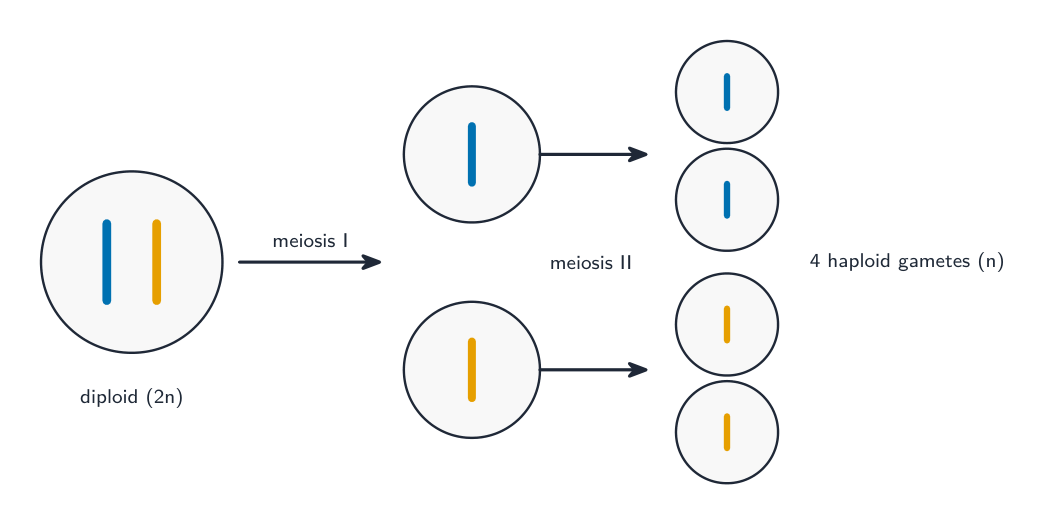
Meiosis 减数分裂 makes gametes 配子 (eggs and sperm) with half the chromosome number, so fertilization restores the full set. One diploid cell divides twice to give four haploid cells. Meiosis I separates homologous chromosomes 同源染色体 (reducing the number); meiosis II separates sister chromatids (like mitosis).

Bahasa Indonesia
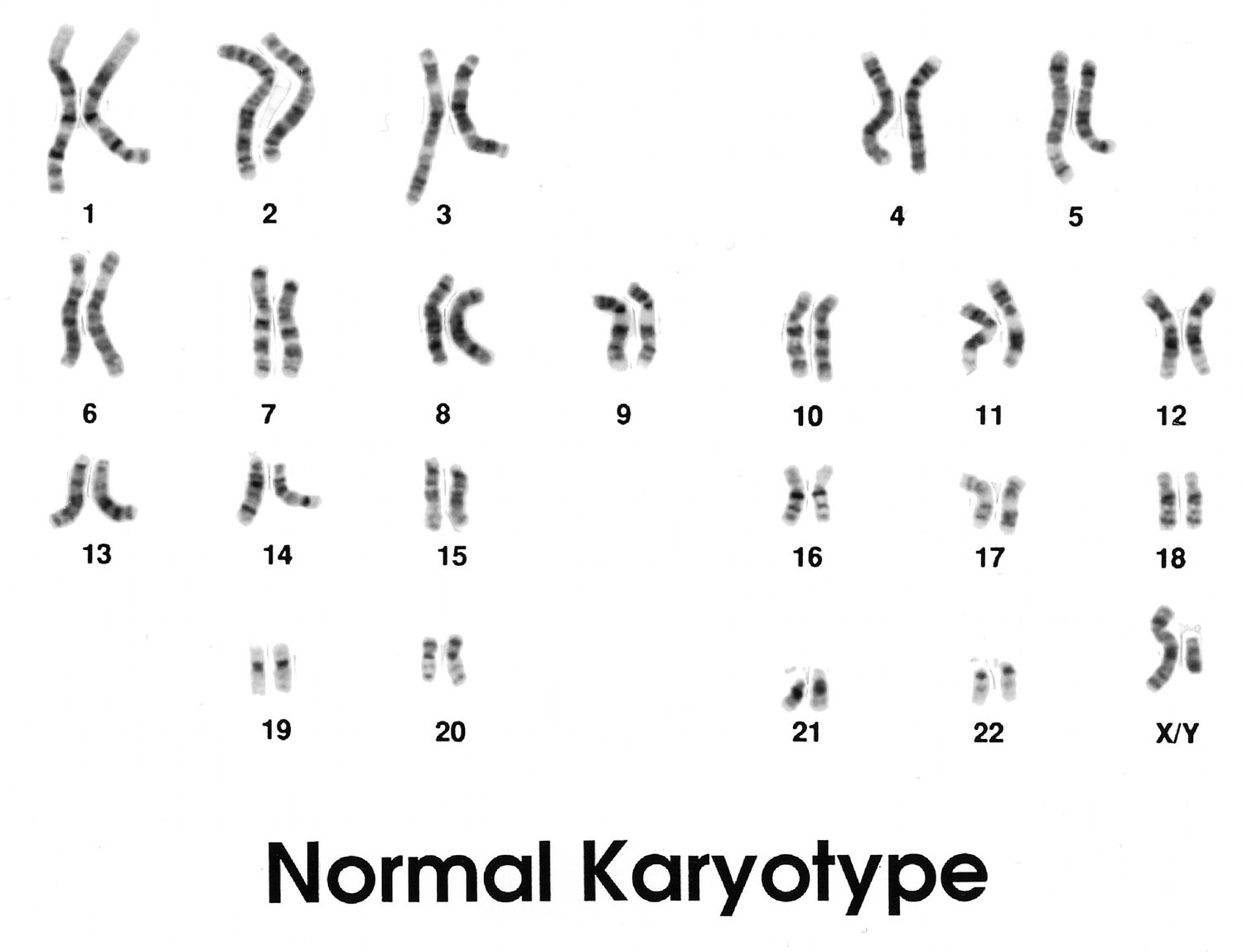
Kariotipe manusia: 22 pasang autosom plus kromosom seks

Meiosis menghasilkan gamet (sel telur dan sperma) dengan setengah jumlah kromosom, sehingga pembuahan mengembalikan set lengkap. Satu sel diploid membelah dua kali untuk menghasilkan empat sel haploid. Meiosis I memisahkan kromosom homolog (mengurangi jumlah); meiosis II memisahkan kromatid saudara (seperti mitosis).

Meiosis mengurangi setengah jumlah kromosom dalam dua pembelahan
Explore · ⁨Jelajahi⁩

Divide a cell's chromosomes · ⁨Bagikan kromosom sel⁩

Meiosis halves the chromosome number and shuffles genes, making four genetically varied gametes. Step through to see the divisions. · ⁨Meiosis menggandakan setengah jumlah kromosom dan mengacak gen, menghasilkan empat gamet yang bervariasi secara genetik. Langkahkan untuk melihat pembelahan-pembelahannya.⁩

Vocabulary · ⁨Kosa kata⁩ Train · ⁨Latih⁩
English Bahasa Indonesia
Meiosis/meɪˈəʊsɪs/ Meiosis
gametes/ˈɡæmiːts/ gamet
homologous chromosomes/həˈmɒləɡəs ˈkrəʊməsəʊmz/ kromosom homolog
5.2

Meiosis and Genetic Diversity · ⁨Meiosis dan Keragaman Genetik⁩

Syllabus · ⁨Silabus⁩
English

Enduring Understanding (BIG IDEA 3 — Information Storage and Transmission): Living systems store, retrieve, transmit, and respond to information essential to life processes.

Learning Objective 5.2.A: Explain how the process of meiosis generates genetic diversity.

  • 5.2.A.1 Correct separation of the homologous chromosomes in meiosis I and sister chromatids in meiosis II ensures that each gamete receives a haploid (1n) set of chromosomes that comprises an assortment of both maternal and paternal chromosomes. When incorrect separation occurs (nondisjunction), gametes are no longer haploid.
  • 5.2.A.2 During prophase I of meiosis, non-sister chromatids exchange genetic material via a process called crossing over (recombination), which increases genetic diversity among the resultant gametes.
  • 5.2.A.3 Sexual reproduction in eukaryotes increases genetic variation, including crossing over, random assortment of chromosomes during meiosis, and subsequent fertilization of gametes.
    • Exclusion statement: Knowledge of the details of sexual reproduction cycles in various plants and animals is beyond the scope of the AP Exam.
Bahasa Indonesia

Pemahaman Abadi (GAGASAN BESAR 3 — Penyimpanan dan Transmisi Informasi): Sistem hidup menyimpan, mengambil, mentransmisikan, dan merespons informasi yang penting bagi proses kehidupan.

Tujuan Pembelajaran 5.2.A: Jelaskan bagaimana proses meiosis menghasilkan keragaman genetik.

  • 5.2.A.1 Pemisahan yang benar dari kromosom homolog pada meiosis I dan kromatid saudara pada meiosis II memastikan bahwa setiap gamet menerima set kromosom haploid (1n) yang terdiri dari kombinasi kromosom maternal dan paternal. Ketika pemisahan terjadi secara salah (nondisjunction), gamet不再 lagi bersifat haploid.
  • 5.2.A.2 Selama profase I meiosis, kromatid non-saudara bertukar materi genetik melalui proses yang disebut crossing over (rekombinasi), yang meningkatkan keragaman genetik di antara gamet yang dihasilkan.
  • 5.2.A.3 Reproduksi seksual pada eukariota meningkatkan variasi genetik, termasuk crossing over, pengelompokan kromosom secara acak selama meiosis, dan fertilisasi berikutnya dari gamet.
    • Pernyataan Pengecualian: Pengetahuan tentang detail siklus reproduksi seksual pada berbagai tanaman dan hewan berada di luar cakupan Ujian AP.

Source: College Board AP Course and Exam Description · ⁨Sumber: Deskripsi Kursus dan Ujian College Board AP⁩

English

Meiosis shuffles genes three ways, so offspring differ from parents and each other:

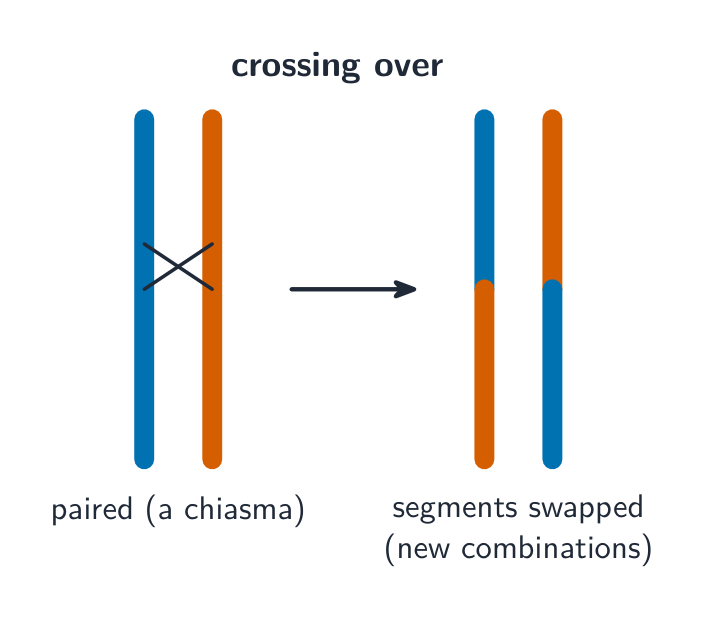
  • Crossing over 交叉互换: homologous chromosomes swap segments in meiosis I.
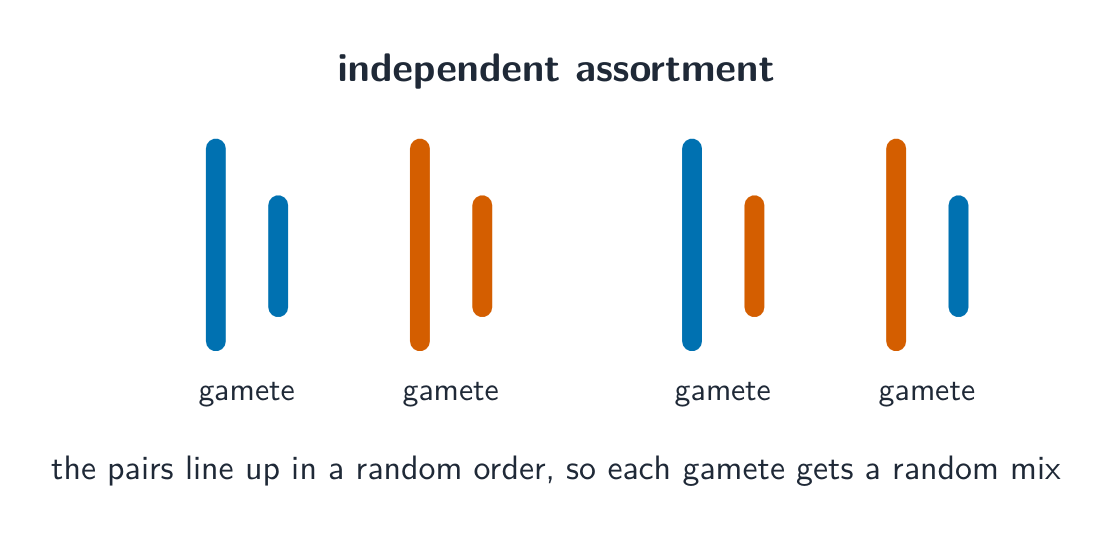
  • Independent assortment 自由组合: each homologous pair lines up and separates randomly.
  • Random fertilization: any sperm can meet any egg.

Together these create enormous variation – the raw material for evolution.

Bahasa Indonesia

Meiosis mengacak gen dengan tiga cara, sehingga keturunan berbeda dari orang tua dan sesama mereka:

Asumsi bebas menghasilkan banyak kombinasi gamet
Persilangan menyilangkan segmen antara kromosom homolog
Crossing over menukar segmen antar kromosom homolog
  • Crossing over: kromosom homolog menukar segmen pada meiosis I.
  • Asumsi bebas: setiap pasangan homolog berbaris dan terpisah secara acak.
  • Pembuahan acak: sperm manapun dapat bertemu dengan telur manapun.

Bersama-sama hal ini menciptakan variasi yang sangat besar – bahan baku untuk evolusi.

Vocabulary · ⁨Kosa kata⁩ Train · ⁨Latih⁩
English Bahasa Indonesia
Crossing over/ˈkrɒsɪŋ ˈəʊvə/ Percilangan silang
Independent assortment/ˌɪndɪˈpendənt əˈsɔːtmənt/ Penataan bebas
alleles/əˈliːlz/ alel
genotype/ˈdʒenətaɪp/ genotipe
phenotype/ˈfenətaɪp/ fenotipe
dominant/ˈdɒmɪnənt/ dominan
recessive/rɪˈsesɪv/ resesif
5.3

Mendelian Genetics · ⁨Genetika Mendel⁩

Syllabus · ⁨Silabus⁩
English

Enduring Understanding (BIG IDEA 1 — Evolution): The process of evolution drives the diversity and unity of life.

Enduring Understanding (BIG IDEA 3 — Information Storage and Transmission): Living systems store, retrieve, transmit, and respond to information essential to life processes.

Learning Objective 5.3.A: Explain the inheritance of genes and traits as described by Mendel's laws.

  • 5.3.A.1 Mendel's laws of segregation and independent assortment can be applied to genes that are on different chromosomes.
  • 5.3.A.2 In most cases, fertilization involves the fusion of two haploid gametes, restoring the diploid number of chromosomes and increasing genetic variation in populations by creating new combinations of alleles in the zygote.
    • i. Rules of probability can be applied to analyze the passing of single-gene traits from parent to offspring.
    • ii. Monohybrid, dihybrid, and test crosses can be used to determine whether alleles are dominant or recessive.
    • iii. An organism's genotype is the set of alleles inherited for one or more genes by an individual organism. An organism's genotype can be homozygous or heterozygous for each gene.
    • iv. An organism's phenotype is the observable expression of the inherited traits.
    • v. Patterns of inheritance (autosomal, genetically linked, sex-linked) and whether an allele is dominant or recessive can often be predicted from data, including pedigrees. Punnett squares can be used to predict the genotypes and phenotypes of parents and offspring.
    • Equation (Laws of Probability): If $A$ and $B$ are mutually exclusive, then: $P(A \text{ or } B) = P(A) + P(B)$
    • Equation (Laws of Probability): If $A$ and $B$ are independent, then: $P(A \text{ and } B) = P(A) \times P(B)$
Bahasa Indonesia

Pemahaman Abadi (GAGASAN BESAR 1 — Evolusi): Proses evolusi mendorong keanekaragaman dan kesatuan kehidupan.

Pemahaman Abadi (GAGASAN BESAR 3 — Penyimpanan dan Transmisi Informasi): Sistem hidup menyimpan, mengambil, mentransmisikan, dan merespons informasi yang penting bagi proses kehidupan.

Tujuan Pembelajaran 5.3.A: Jelaskan pewarisan gen dan sifat seperti yang dijelaskan oleh hukum-hukum Mendel.

  • 5.3.A.1 Hukum segregasi dan assortmen independen Mendel dapat diterapkan pada gen-gen yang terletak pada kromosom yang berbeda.
  • 5.3.A.2 Dalam kebanyakan kasus, pembuahan melibatkan peleburan dua gamet haploid, mengembalikan jumlah kromosom diploid dan meningkatkan keragaman genetik dalam populasi dengan menciptakan kombinasi alel baru dalam zigot.
    • i. Aturan probabilitas dapat diterapkan untuk menganalisis pewarisan sifat gen tunggal dari orang tua ke keturunan.
    • ii. Persilangan monohibrid, dihibrid, dan uji dapat digunakan untuk menentukan apakah alel bersifat dominan atau resesif.
    • iii. Genotipe organisme adalah kumpulan alel yang diwariskan untuk satu atau lebih gen oleh individu tertentu. Genotipe organisme dapat homozigot atau heterozigot untuk setiap gen.
    • iv. Fenotipe organisme adalah ekspresi yang terlihat dari sifat yang diwariskan.
    • v. Pola pewarisan (autosomal, terkait genetik, terkait jenis kelamin) dan apakah suatu alel bersifat dominan atau resesif sering dapat diprediksi dari data, termasuk silsilah. Kotak Punnett dapat digunakan untuk memprediksi genotipe dan fenotipe orang tua dan keturunan.
    • Persamaan (Hukum Probabilitas): Jika $A$ dan $B$ saling lepas, maka: $P(A \text{ or } B) = P(A) + P(B)$
    • Persamaan (Hukum Probabilitas): Jika $A$ dan $B$ saling bebas, maka: $P(A \text{ and } B) = P(A) \times P(B)$

Source: College Board AP Course and Exam Description · ⁨Sumber: Deskripsi Kursus dan Ujian College Board AP⁩

English

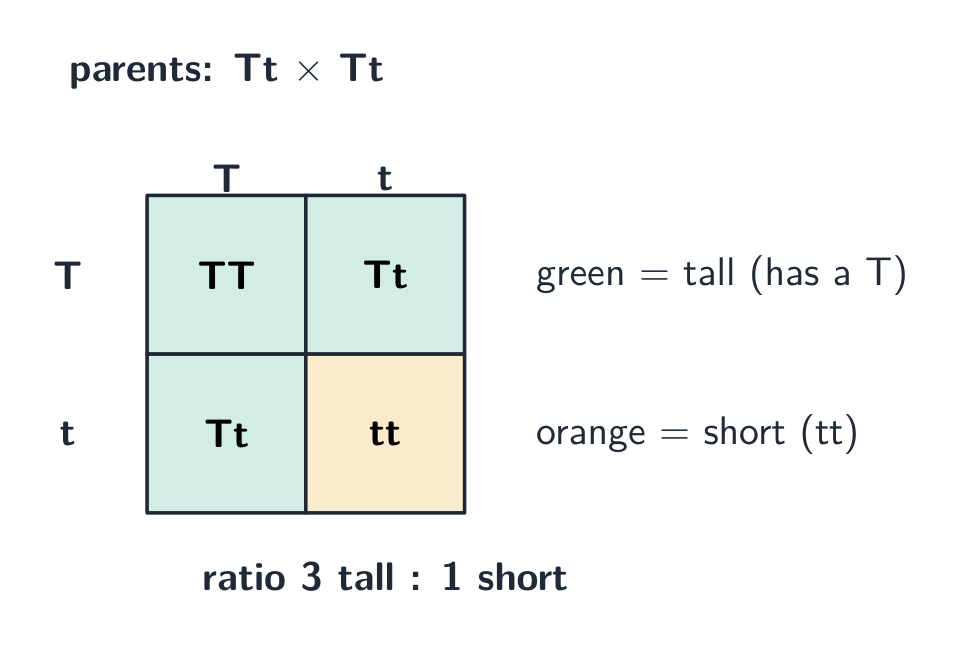
A gene's alternative versions are alleles 等位基因. An organism's genotype 基因型 (its alleles) produces its phenotype 表型 (its traits). Mendel's rules: a dominant 显性 allele masks a recessive 隐性 one; the two alleles segregate into different gametes (law of segregation); genes for different traits assort independently. A Punnett square 庞纳特方格 predicts offspring ratios (a heterozygous cross gives 3:1). Homozygous 纯合 means two identical alleles; heterozygous 杂合 means two different.

Worked example. For a dihybrid cross of two independent genes, $AaBb\times AaBb$, use the multiplication rule instead of a $16$-box square. Each gene alone gives $\tfrac34$ dominant, so the chance an offspring shows both dominant traits is $\tfrac34\times\tfrac34=\tfrac{9}{16}$, and the chance of the fully recessive $aabb$ is $\tfrac14\times\tfrac14=\tfrac{1}{16}$. Multiplying two independent $3{:}1$ ratios is what produces the classic $9{:}3{:}3{:}1$ pattern.

Bahasa Indonesia
Variasi alami dalam pola pita cangkang siput – perbedaan yang dapat diwariskan yang dapat ditindaklanjuti seleksi

Versi alternatif suatu gen adalah alel. Genotipe organisme (alel-nya) menghasilkan fenotipe-nya (sifat-sifatnya). Aturan Mendel: alel dominan menutupi alel resesif; dua alel bersegregasi ke gamet yang berbeda (hukum segregasi); gen untuk sifat yang berbeda berasortir secara independen. Kotak Punnett memprediksi rasio keturunan (persilangan heterozigot menghasilkan 3:1). Homozygous berarti dua alel identik; heterozygous berarti dua alel berbeda.

Kotak Punnett monohybrid yang menghasilkan rasio 3:1

Contoh terarah. Untuk persilangan dihybrid dari dua gen independen, $AaBb\times AaBb$, gunakan aturan perkalian alih-alih kotak $16$. Setiap gen sendiri menghasilkan $\tfrac34$ dominan, sehingga peluang keturunan menunjukkan kedua sifat dominan adalah $\tfrac34\times\tfrac34=\tfrac{9}{16}$, dan peluang resesif penuh $aabb$ adalah $\tfrac14\times\tfrac14=\tfrac{1}{16}$. Mengalikan dua rasio independen $3{:}1$ adalah apa yang menghasilkan pola klasik $9{:}3{:}3{:}1$.

Explore · ⁨Jelajahi⁩

Cross two parents · ⁨Silangkan dua orang tua⁩

A Punnett square combines each parent's alleles to predict the offspring ratios. Set the parent genotypes and read off the expected proportions. · ⁨Kotak Punnett menggabungkan alel masing-masing orang tua untuk memprediksi rasio keturunan. Atur genotipe orang tua dan baca proporsi yang diharapkan.⁩

Vocabulary · ⁨Kosa kata⁩ Train · ⁨Latih⁩
English Bahasa Indonesia
Punnett square/ˈpʌnɪt skweə/ Kotak Punnett
Homozygous/ˌhɒməˈzɪɡəs/ Homozygot
heterozygous/ˌhetrəˈzɪɡəs/ heterozigot
Incomplete dominance/ɪŋkəmˈpliːt ˈdɒmɪnəns/ Dominasi tidak lengkap
Codominance/ˈkəʊdəmɪnəns/ Kodominansi
polygenic/ˌpɒlɪˈdʒenɪk/ poligenik
sex-linked/seks lɪŋkt/ terikat jenis kelamin
5.4

Non-Mendelian Genetics · ⁨Genetika Non-Mendel⁩

Syllabus · ⁨Silabus⁩
English

Enduring Understanding (BIG IDEA 3 — Information Storage and Transmission): Living systems store, retrieve, transmit, and respond to information essential to life processes.

Learning Objective 5.4.A: Explain deviations from Mendel's model of the inheritance of traits.

  • 5.4.A.1 Patterns of inheritance of many traits do not follow the ratios predicted by Mendel's laws and can be identified by quantitative analysis, when the observed phenotypic ratios statistically differ from the predicted ratios.
    • i. Genes located on the same chromosome are referred to as being genetically linked. The probability that these linked genes segregate together during meiosis can be used to calculate the map distance (or map units) between them on a chromosome. This calculation is called gene or genetic mapping.
    • ii. Codominance occurs when the phenotype from both alleles is expressed such that the heterozygote would have a different phenotype than either homozygote.
    • iii. Incomplete dominance occurs when neither allele of a gene can mask the other, so the phenotype of the heterozygote is a blended version of the dominant and recessive phenotypes.
  • 5.4.A.2 Some traits, known as sex-linked traits (X- or Y-linked), are determined by genes on sex chromosomes. The pattern of inheritance of sex-linked traits can often be predicted from data, including pedigrees, indicating the genotypes and phenotypes of both parents and offspring.
    • Illustrative examples for EK 5.4.A.2:
      • Sex-linked traits (X- or Y-linked) reside on sex chromosomes.
      • Sex-linked traits (X- or Y-linked) are inherited at higher rates in XY individuals than they are in XX individuals.
      • In certain species, the chromosomal basis of sex determination is not based on X and Y chromosomes (e.g., ZW in birds, haplodiploidy in bees).
  • 5.4.A.3 Pleiotropy is a phenomenon in which the expression of a single gene results in multiple traits or effects; these traits therefore do not segregate independently.
  • 5.4.A.4 Some traits result from non-nuclear inheritance.
    • i. Chloroplasts and mitochondria are randomly assorted to gametes and daughter cells; thus, traits determined by chloroplast and mitochondrial DNA do not follow simple Mendelian rules.
    • ii. In animals, mitochondria are usually transmitted by the egg and not by sperm; thus, traits determined by the mitochondrial DNA are typically maternally inherited.
    • iii. In plants, mitochondria and chloroplasts are transmitted in the ovule and not in the pollen; as such, mitochondria-determined and chloroplast-determined traits are typically maternally inherited.
Bahasa Indonesia

Pemahaman Abadi (GAGASAN BESAR 3 — Penyimpanan dan Transmisi Informasi): Sistem hidup menyimpan, mengambil, mentransmisikan, dan merespons informasi yang penting bagi proses kehidupan.

Tujuan Pembelajaran 5.4.A: Jelaskan penyimpangan dari model Mendel mengenai pewarisan sifat.

  • 5.4.A.1 Pola pewarisan banyak sifat tidak mengikuti rasio yang diprediksi oleh hukum Mendel dan dapat diidentifikasi melalui analisis kuantitatif, ketika rasio fenotipe yang diamati secara statistik berbeda dari rasio yang diprediksi.
    • i. Gen yang terletak pada kromosom yang sama disebut memiliki keterkaitan genetik. Probabilitas bahwa gen-gen terkait ini terpisahkan bersama selama meiosis dapat digunakan untuk menghitung jarak peta (atau unit peta) di antara mereka pada sebuah kromosom. Perhitungan ini disebut pemetaan gen atau pemetaan genetik.
    • ii. Kodominansi terjadi ketika fenotipe dari kedua alel diekspresikan sedemikian rupa sehingga heterozigot akan memiliki fenotipe yang berbeda dari keduanya homozigot.
    • iii. Dominansi tidak lengkap terjadi ketika neither alel dari suatu gen dapat menyingkirkan yang lain, sehingga fenotipe heterozigot adalah versi campuran dari fenotipe dominan dan resesif.
  • 5.4.A.2 Beberapa sifat, yang dikenal sebagai sifat terkait jenis kelamin (terikat-X atau terikat-Y), ditentukan oleh gen pada kromosom jenis kelamin. Pola pewarisan sifat terkait jenis kelamin sering dapat diprediksi dari data, termasuk silsilah, yang menunjukkan genotipe dan fenotipe baik orang tua maupun keturunan.
    • *Contoh Ilustratif untuk EK 5.4.A2:
      • Sifat terkait jenis kelamin (terikat-X atau terikat-Y) terletak pada kromosom jenis kelamin.
      • Sifat terkait jenis kelamin (terikat-X atau terikat-Y) diwariskan pada tingkat yang lebih tinggi pada individu XY dibandingkan dengan individu XX.
      • Pada beberapa spesies, dasar kromosom penentuan jenis kelamin tidak didasarkan pada kromosom X dan Y (misalnya, ZW pada burung, haplodiploidi pada lebah).
  • 5.4.A.3 Pleiotropi adalah fenomena di mana ekspresi satu gen menghasilkan beberapa sifat atau efek; oleh karena itu sifat-sifat ini tidak tersegregasi secara independen.
  • 5.4.A.4 Beberapa sifat berasal dari pewarisan non-nuklear.
    • i. Kloroplas dan mitokondria dialokasikan secara acak ke gamet dan sel anak; dengan demikian, sifat yang ditentukan oleh DNA kloroplas dan mitokondria tidak mengikuti aturan Mendel sederhana.
    • ii. Pada hewan, mitokondria biasanya ditransmisikan melalui telur dan bukan melalui sperma; sehingga, sifat yang ditentukan oleh DNA mitokondria umumnya diwariskan secara maternal.
    • iii. Pada tumbuhan, mitokondria dan kloroplas ditransmisikan dalam bakal biji (ovule) dan bukan dalam serbuk sari; oleh karena itu, sifat yang ditentukan oleh mitokondria dan kloroplas umumnya diwariskan secara maternal.

Source: College Board AP Course and Exam Description · ⁨Sumber: Deskripsi Kursus dan Ujian College Board AP⁩

English

Many traits do not follow simple dominance:

  • Incomplete dominance 不完全显性: heterozygotes are a blend (red × white → pink).
  • Codominance 共显性: both alleles show fully (AB blood type).
  • Multiple alleles, polygenic 多基因 traits (many genes, like height), pleiotropy (one gene, many effects), and sex-linked 伴性 genes (on the X chromosome) all give more complex ratios.

Worked example (chi-square test). To check whether real data fit a predicted ratio, use $\chi^2=\sum\dfrac{(o-e)^2}{e}$. A monohybrid cross predicts $3{:}1$, so of $80$ offspring you expect $60$ dominant and $20$ recessive, but you observe $55$ and $25$. Then $\chi^2=\dfrac{(55-60)^2}{60}+\dfrac{(25-20)^2}{20}=\dfrac{25}{60}+\dfrac{25}{20}=0.42+1.25=1.67$. With $1$ degree of freedom the critical value at $p=0.05$ is $3.84$; since $1.67<3.84$, we fail to reject the null hypothesis – the deviation is within chance.

Bahasa Indonesia

Banyak sifat tidak mengikuti dominasi sederhana:

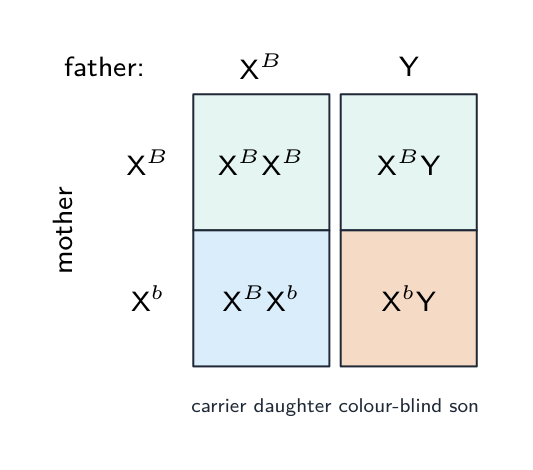
Pengikatan jenis kelamin memberikan hasil berbeda untuk putra dan putri
  • Dominansi tidak lengkap: heterozigot adalah campuran (merah × putih → merah muda).
  • Kodominansi: kedua alel muncul sepenuhnya (golongan darah AB).
  • Alel majemuk, sifat poligenik (banyak gen, seperti tinggi badan), pleiotropi (satu gen, banyak efek), dan gen terikat jenis kelamin (pada kromosom X) semuanya menghasilkan rasio yang lebih kompleks.

Contoh terpecahkan (uji chi-square). Untuk memeriksa apakah data riil sesuai dengan rasio yang diprediksi, gunakan $\chi^2=\sum\dfrac{(o-e)^2}{e}$. Persilangan monohibrid memprediksi $3{:}1$, sehingga dari $80$ keturunan Anda mengharapkan $60$ dominan dan $20$ resesif, tetapi Anda mengamati $55$ dan $25$. Maka $\chi^2=\dfrac{(55-60)^2}{60}+\dfrac{(25-20)^2}{20}=\dfrac{25}{60}+\dfrac{25}{20}=0.42+1.25=1.67$. Dengan $1$ derajat kebebasan, nilai kritis pada $p=0.05$ adalah $3.84$; karena $1.67<3.84$, kita gagal menolak hipotesis nol – penyimpangan berada dalam batas kebetulan.

5.5

Environmental Effects on Phenotype · ⁨Pengaruh Lingkungan terhadap Fenotipe⁩

Syllabus · ⁨Silabus⁩
English

Enduring Understanding (BIG IDEA 4 — Systems Interactions): Biological systems interact, and these systems and their interactions exhibit complex properties.

Learning Objective 5.5.A: Explain how the same genotype can result in multiple phenotypes under different environmental conditions.

  • 5.5.A.1 Environmental conditions influence gene expression and can lead to phenotypic plasticity (e.g., the ability of individual genotypes to produce different phenotypes).
    • Illustrative examples for EK 5.5.A.1:
      • Height and weight in humans
      • Flower color based on soil pH
      • Seasonal fur color in arctic animals
      • Sex determination in reptiles
      • Effect of increased UV on melanin production in animals
      • Presence of the opposite mating type on pheromone production in yeast and other fungi
Bahasa Indonesia

Pemahaman Abadi (GAGASAN BESAR 4 — Interaksi Sistem): Sistem biologis saling berinteraksi, dan sistem serta interaksinya menunjukkan sifat-sifat yang kompleks.

Tujuan Pembelajaran 5.5.A: Jelaskan bagaimana genotipe yang sama dapat menghasilkan beberapa fenotipe di bawah kondisi lingkungan yang berbeda.

  • 5.5.A.1 Kondisi lingkungan memengaruhi ekspresi gen dan dapat menyebabkan plastisitas fenotipik (misalnya, kemampuan genotipe individu untuk menghasilkan fenotipe yang berbeda).
    • Contoh ilustratif untuk EK 5.5.A.1:
      • Tinggi badan dan berat badan pada manusia
      • Warna bunga berdasarkan pH tanah
      • Warna bulu musiman pada hewan kutub
      • Penentuan jenis kelamin pada reptil
      • Efek peningkatan radiasi UV terhadap produksi melanin pada hewan
      • Keberadaan tipe kawin yang berlawanan pada produksi feromon pada ragi dan jamur lainnya

Source: College Board AP Course and Exam Description · ⁨Sumber: Deskripsi Kursus dan Ujian College Board AP⁩

English

Phenotype is not set by genes alone – the environment also matters. Temperature, nutrition, and other factors can change how genes are expressed (a Himalayan rabbit's dark fur where it is cold, a plant's height with more sunlight). So identical genotypes can give different phenotypes in different conditions.

Bahasa Indonesia

Fenotipe tidak ditentukan oleh gen saja – lingkungan juga berperan. Suhu, nutrisi, dan faktor lain dapat mengubah bagaimana gen diekspresikan (bulu gelap kelinci Himalaya di daerah dingin, tinggi tanaman dengan lebih banyak cahaya matahari). Jadi, genotipe identik dapat menghasilkan fenotipe berbeda dalam kondisi yang berbeda.

5.5

Exam tips · ⁨Tips ujian⁩

English
  • Contrast mitosis (2 identical, full chromosome number) with meiosis (4 non-identical gametes, half the number).
  • Explain variation from crossing over, independent assortment, and random fertilisation.
  • Use the multiplication rule for dihybrid crosses (each gene's $3{:}1$ multiplied), and a chi-square test ($\chi^2=\sum\frac{(o-e)^2}{e}$) to judge observed vs expected ratios.
  • Keep genotype (the alleles) separate from phenotype (what you see) — $AA$ and $Aa$ can look the same.
  • Recognise non-Mendelian patterns: incomplete dominance, codominance, and sex linkage.
Bahasa Indonesia
  • Bandingkan mitosis (2 identik, jumlah kromosom penuh) dengan meiosis (4 gamet non-identik, setengah jumlahnya).
  • Jelaskan variasi akibat pindah silang, pengelompokan bebas, dan pembuahan acak.
  • Gunakan aturan perkalian untuk persilangan dihibrid (probabilitas setiap gene $3{:}1$ dikalikan), dan uji chi-square ($\chi^2=\sum\frac{(o-e)^2}{e}$) untuk menilai rasio yang diamati vs yang diharapkan.
  • Pisahkan genotipe (alel) dari fenotipe (apa yang terlihat) — $AA$ dan $Aa$ bisa tampak sama.
  • Kenali pola non-Mendelian: dominasi tidak lengkap, kodominansi, dan keterkaitan seks.

Interactive lessons on this topic · ⁨Pelajaran interaktif untuk topik ini⁩

Work through it step by step, with instant-check exercises. · ⁨Kerjakan langkah demi langkah, dengan latihan pengecekan instan.⁩

Past Papers · ⁨Soal-Soil Masa Lalu⁩

More topics in AP Biology · ⁨AP Biologi⁩ · ⁨Topik lain dalam AP Biology · ⁨AP Biologi⁩⁩

Log in or create account · ⁨Masuk atau buat akun⁩

IGCSE, A-Level & AP