Skip to content · ⁨Lompat ke konten⁩

Cell Communication and Cell Cycle · ⁨Komunikasi Sel dan Siklus Sel⁩

AP Biology · ⁨AP Biologi⁩ · Topic 4 · ⁨Topik 4⁩

Video lesson for this topic · ⁨Pelajaran video untuk topik ini⁩ Open the video page · ⁨Buka halaman video⁩
7:34

Komunikasi Sel dan Siklus Sel

Perhatikan dengan saksama. Ini adalah sel-sel nyata, difoto di tengah pembelahan. Di dalam tubuh Anda, jutaan sel baru dibuat setiap detik — kulit, darah, usus…

English narration · English + 中文 subtitles burned in · ⁨Narasi bahasa Inggris · Subtitle bahasa Inggris + 中文 disematkan langsung⁩

4.1

Cell Communication · ⁨Komunikasi Sel⁩

Syllabus · ⁨Silabus⁩
English

Big Idea 3 — Information Storage and Transmission: Living systems store, retrieve, transmit, and respond to information essential to life processes.

Learning Objective 4.1.A: Describe the ways that cells can communicate with one another.

  • 4.1.A.1 Cells communicate with one another through direct contact with other cells or from a distance via chemical signaling.
    • Illustrative examples for 4.1.A.1:
      • Immune cells interact through cell-to-cell contact, antigen-presenting cells (APCs), helper T-cells, and killer T-cells.

Learning Objective 4.1.B: Explain how cells communicate with one another over short and long distances.

  • 4.1.B.1 Cells communicate over short distances by using local regulators that target cells in the vicinity of the signal-emitting cell.
    • Illustrative examples for 4.1.B.1:
      • Neurotransmitters
      • Plant immune response
      • Quorum sensing in bacteria
      • Morphogens in embryonic development
  • 4.1.B.2 Signals released by one cell type can travel long distances to target cells of another type.
    • Illustrative examples for 4.1.B.2:
      • Insulin
      • Human growth hormone
      • Thyroid hormones
      • Testosterone
      • Estrogen
Bahasa Indonesia

Ide Besar 3 — Penyimpanan dan Transmisi Informasi: Sistem hidup menyimpan, mengambil, mentransmisikan, dan merespons informasi yang penting bagi proses kehidupan.

Tujuan Pembelajaran 4.1.A: Jelaskan cara sel dapat berkomunikasi satu sama lain.

  • 4.1.A.1 Sel berkomunikasi satu sama lain melalui kontak langsung dengan sel lain atau dari jarak jauh melalui sinyal kimia.
    • *Contoh ilustratif untuk 4.1.A.1:
      • Sel imun berinteraksi melalui kontak sel-ke-sel, sel penyaji antigen (APCs), sel T helper, dan sel T pembunuh.

Tujuan Pembelajaran 4.1.B: Jelaskan bagaimana sel berkomunikasi satu sama lain dalam jarak pendek dan panjang.

  • 4.1.B.1 Sel berkomunikasi dalam jarak pendek dengan menggunakan regulator lokal yang menargetkan sel di sekitar sel pengirim sinyal.
    • *Contoh ilustratif untuk 4.1.B.1:
      • Neurotransmiter
      • Respons imun tumbuhan
      • Sinyal kuantum pada bakteri
      • Morfogen dalam perkembangan embrio
  • 4.1.B.2 Sinyal yang dilepaskan oleh satu jenis sel dapat menempuh jarak jauh menuju sel target dari jenis lain.
    • *Contoh ilustratif untuk 4.1.B.2:
      • Insulin
      • Hormon pertumbuhan manusia
      • Hormon tiroid
      • Testosteron
      • Estrogen

Source: College Board AP Course and Exam Description · ⁨Sumber: Deskripsi Kursus dan Ujian College Board AP⁩

English

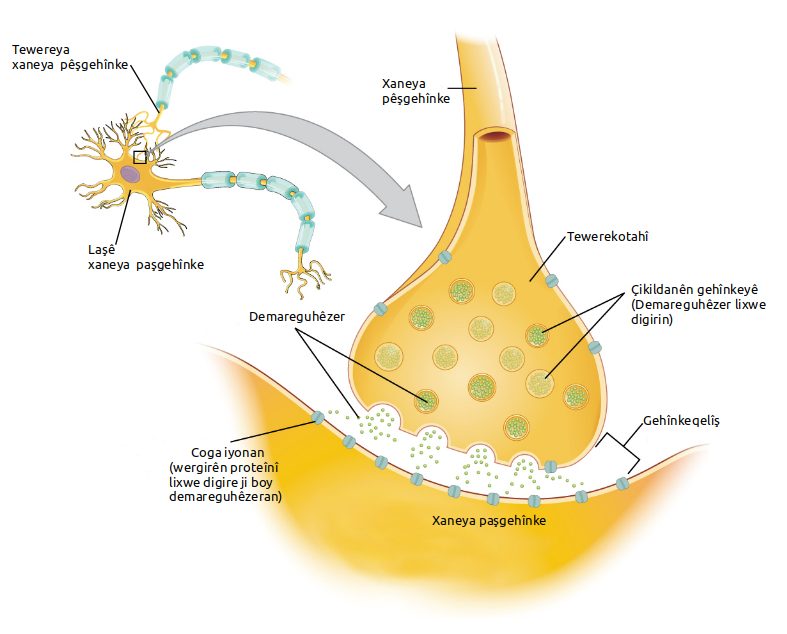
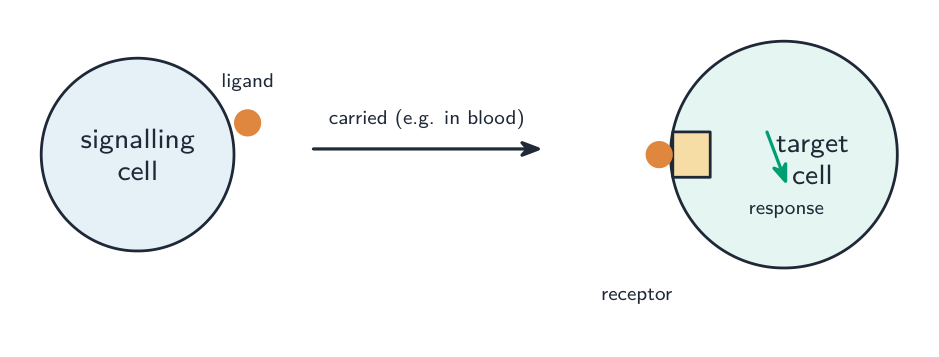
Cells coordinate by sending and receiving chemical signals 信号. A signaling cell releases a ligand 配体 that binds a receptor 受体 on a target cell. Signals travel over different ranges: direct contact (cell junctions), local signaling (nearby cells, like neurotransmitters), and long-distance signaling (hormones 激素 through the blood).

Bahasa Indonesia

Sel berkoordinasi dengan mengirimkan dan menerima sinyal kimiawi. Sel pemberi sinyal melepaskan ligan yang mengikat reseptor pada sel target. Sinyal menempuh jarak berbeda: kontak langsung (sambungan sel), sinyal lokal (sel tetangga, seperti neurotransmiter), dan sinyal jarak jauh (hormon melalui darah).

Molekul sinyal (ligan) berikatan dengan reseptor yang sesuai pada sel target
Molekul sinyal (ligan) mengikat reseptor yang sesuai pada sel target
4.2

Introduction to Signal Transduction · ⁨Pengantar Transduksi Sinyal⁩

Syllabus · ⁨Silabus⁩
English

Big Idea 3 — Information Storage and Transmission: Living systems store, retrieve, transmit, and respond to information essential to life processes.

Learning Objective 4.2.A: Describe the components of a signal transduction pathway.

  • 4.2.A.1 Signal transduction pathways link signal receptions with cellular responses.
  • 4.2.A.2 Many signal transduction pathways include protein modifications and involve phosphorylation cascades.

Learning Objective 4.2.B: Describe the role of components of a signal transduction pathway in producing a cellular response.

  • 4.2.B.1 Signaling begins with the recognition of a chemical messenger—a ligand—by a receptor protein in a target cell.
    • i. The ligand-binding domain of a receptor recognizes a specific chemical messenger, which can be a peptide (protein) or a small molecule.
    • ii. G protein-coupled receptors are an example of a receptor protein in eukaryotes.
    • iii. Receptors may be located on the surface of a target cell or in the cytoplasm or nucleus of the target cell.
  • 4.2.B.2 Signaling cascades relay signals from receptors to cell targets, often amplifying the incoming signals, resulting in the appropriate responses by the cell. Responses could include cell growth, secretion of molecules, or gene expression.
    • i. After the ligand binds, the intracellular domain of a receptor protein changes shape, initiating transduction of the signal.
    • ii. Enzymes and second messengers such as cyclic AMP (cAMP) relay and amplify the intracellular signal.
    • iii. Hormones are an example of a signaling messenger that can travel long distances in the bloodstream.
    • iv. The binding of ligands to ligand-gated channels can cause the channel to open or close.
Bahasa Indonesia

Ide Besar 3 — Penyimpanan dan Transmisi Informasi: Sistem hidup menyimpan, mengambil, mentransmisikan, dan merespons informasi yang penting bagi proses kehidupan.

Tujuan Pembelajaran 4.2.A: Jelaskan komponen jalur transduksi sinyal.

  • 4.2.A.1 Jalur transduksi sinyal menghubungkan penerimaan sinyal dengan respons seluler.
  • 4.2.A.2 Banyak jalur transduksi sinyal mencakup modifikasi protein dan melibatkan kaskade fosforilasi.

Tujuan Pembelajaran 4.2.B: Jelaskan peran komponen jalur transduksi sinyal dalam menghasilkan respons seluler.

  • 4.2.B.1 Sinyal dimulai dengan pengenalan pesan kimia—ligan—oleh protein reseptor di sel target.
    • i. Domain pengikat ligan pada reseptor mengenali pesan kimia spesifik, yang bisa berupa peptida (protein) atau molekul kecil.
    • ii. Reseptor terikat protein G adalah contoh protein reseptor pada eukariota.
    • iii. Reseptor dapat terletak di permukaan sel target atau di sitoplasma atau inti sel target.
  • 4.2.B.2 Kaskade sinyal meneruskan sinyal dari reseptor ke target sel, sering kali memperbesar sinyal masuk, menghasilkan respons yang sesuai oleh sel. Respons bisa meliputi pertumbuhan sel, sekresi molekul, atau ekspresi gen.
    • i. Setelah ligan berikatan, domain intraseluler protein reseptor berubah bentuk, memulai transduksi sinyal.
    • ii. Enzim dan pesan kedua seperti siklik AMP (cAMP) meneruskan dan memperbesar sinyal intraseluler.
    • iii. Hormon adalah contoh pesan sinyal yang dapat menempuh jarak jauh dalam aliran darah.
    • iv. Pengikatan ligan ke saluran yang dikendalikan ligan dapat menyebabkan saluran terbuka atau tertutup.

Source: College Board AP Course and Exam Description · ⁨Sumber: Deskripsi Kursus dan Ujian College Board AP⁩

English

Signal transduction 信号转导 converts an outside signal into a cellular response in three stages: reception (ligand binds receptor), transduction (a relay of molecules inside the cell), and response (a change in the cell's activity, such as switching on a gene). Receptors are specific, so a cell only responds to signals it can receive.

Bahasa Indonesia

Transduksi sinyal mengubah sinyal eksternal menjadi respons seluler dalam tiga tahap: penerimaan (ligan mengikat reseptor), transduksi (relai molekul di dalam sel), dan respons (perubahan aktivitas sel, seperti menyalakan gen). Reseptor bersifat spesifik, sehingga sel hanya merespons sinyal yang dapat diterimanya.

Sinaps kimiawi: transduksi sinyal meneruskan pesan melalui celah dengan ligan dan reseptor
Sinaps kimiawi: transduksi sinyal menyampaikan pesan melintasi celah dengan ligan dan reseptor
4.3

Signal Transduction Pathways · ⁨Jalur Transduksi Sinyal⁩

Syllabus · ⁨Silabus⁩
English

Big Idea 3 — Information Storage and Transmission: Living systems store, retrieve, transmit, and respond to information essential to life processes.

Learning Objective 4.3.A: Describe the different types of cellular responses elicited by a signal transduction pathway.

  • 4.3.A.1 Signal transduction may result in changes in gene expressions and cell function, which may alter phenotype or result in programmed cell death (apoptosis).
    • Illustrative examples for 4.3.A.1:
      • Use of chemical messengers by microbes to communicate with other nearby cells and to regulate specific pathways in response to population density (quorum sensing)
      • Epinephrine stimulation of glycogen breakdown in mammals

Learning Objective 4.3.B: Explain how a change in the structure of any signaling molecule affects the activity of the signaling pathway.

  • 4.3.B.1 Changes in signal transduction pathways can alter cellular responses. Mutations in any domain of the receptor protein or in any component of the signaling pathway may affect the downstream components by altering the subsequent transduction of the signal.
    • Illustrative examples for 4.3.B.1:
      • Cytokines regulate gene expression to allow for cell replication and division.
      • Mating pheromones in yeast trigger mating gene expression.
      • Ethylene levels cause changes in the production of different enzymes allowing fruits to ripen.
      • HOX genes regulate animal body plans during embryonic development.
  • 4.3.B.2 Chemicals that interact with any component of the signaling pathway may activate or inhibit the pathway.
Bahasa Indonesia

Ide Besar 3 — Penyimpanan dan Transmisi Informasi: Sistem hidup menyimpan, mengambil, mentransmisikan, dan merespons informasi yang penting bagi proses kehidupan.

Tujuan Pembelajaran 4.3.A: Jelaskan berbagai jenis respons seluler yang dipicu oleh jalur transduksi sinyal.

  • 4.3.A.1 Transduksi sinyal dapat mengakibatkan perubahan ekspresi gen dan fungsi sel, yang dapat mengubah fenotipe atau menyebabkan kematian sel terprogram (apoptosis).
    • *Contoh ilustratif untuk 4.3.A.1:
      • Penggunaan pesan kimia oleh mikroba untuk berkomunikasi dengan sel tetangga lainnya dan mengatur jalur spesifik sebagai respons terhadap kepadatan populasi (sinyal kuantum)
      • Stimulasi epinefrin terhadap pemecahan glikogen pada mamalia

Tujuan Pembelajaran 4.3.B: Jelaskan bagaimana perubahan struktur pada molekul sinyal apa pun memengaruhi aktivitas jalur sinyal.

  • 4.3.B.1 Perubahan dalam jalur transduksi sinyal dapat mengubah respons seluler. Mutasi pada domain apa pun dari protein reseptor atau pada komponen apa pun dari jalur sinyal dapat memengaruhi komponen hilir dengan mengubah transduksi sinyal selanjutnya.
    • *Contoh ilustratif untuk 4.3.B.1:
      • Sitokin mengatur ekspresi gen untuk memungkinkan replikasi dan pembelahan sel.
      • Pheromone perkawinan pada ragi memicu ekspresi gen perkawinan.
      • Kadar etilen menyebabkan perubahan produksi enzim berbeda yang memungkinkan buah matang.
      • Gen HOX mengatur pola tubuh hewan selama perkembangan embrio.
  • 4.3.B.2 Zat kimia yang berinteraksi dengan komponen apa pun dari jalur sinyal dapat mengaktifkan atau menghambat jalur tersebut.

Source: College Board AP Course and Exam Description · ⁨Sumber: Deskripsi Kursus dan Ujian College Board AP⁩

English

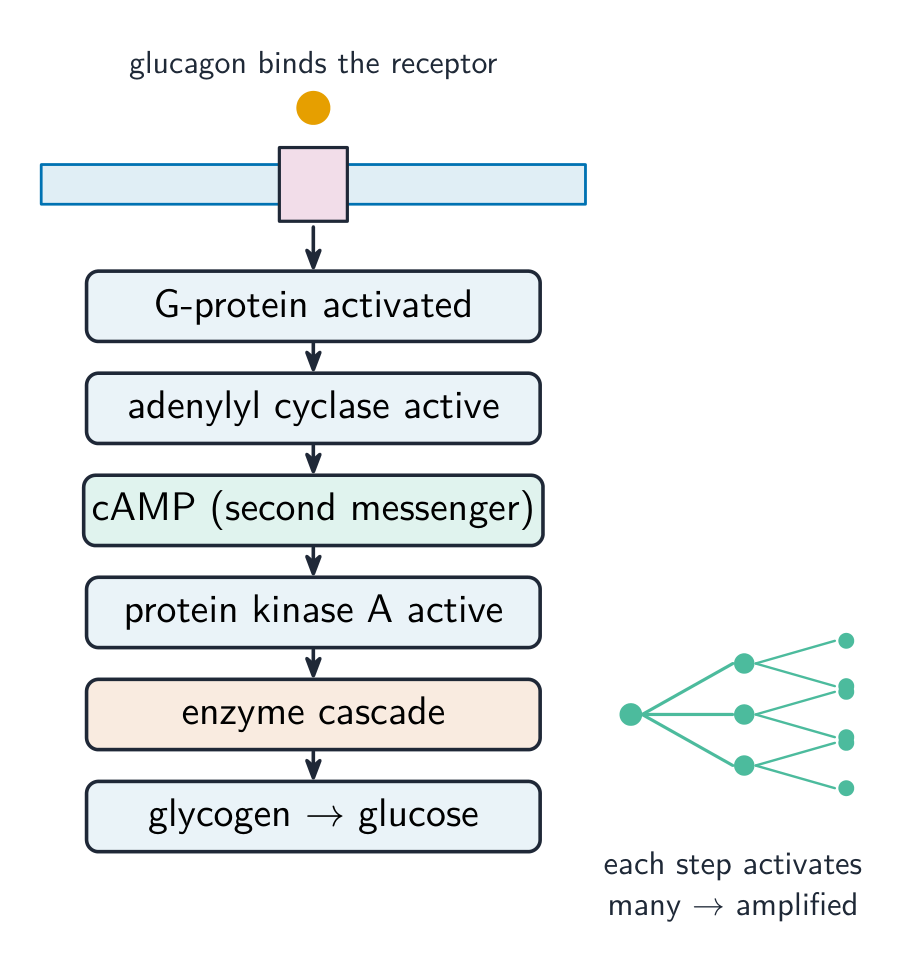
In the transduction stage, the signal passes through a pathway – often a cascade of proteins that activate one another, frequently amplifying the signal so a few ligands trigger a large response. Second messengers (like cyclic AMP or calcium ions) spread the signal quickly through the cell. A change in one step can alter the whole outcome.

Bahasa Indonesia

Pada tahap transduksi, sinyal melewati jalur — seringkali berupa kaskade protein yang saling mengaktifkan, sering kali mengamplifikasi sinyal sehingga beberapa ligan memicu respons besar. Pesan kedua (seperti AMP siklik atau ion kalsium) menyebarkan sinyal dengan cepat di seluruh sel. Perubahan pada satu tahap dapat mengubah seluruh hasil akhir.

Kaskade pensinyalan memperkuat pesan di dalam sel
Kaskade sinyal mengamplifikasi pesan di dalam sel
4.4

Feedback · ⁨Umpan Balik⁩

Syllabus · ⁨Silabus⁩
English

Big Idea 2 — Energetics: Biological systems use energy and molecular building blocks to grow, reproduce, and maintain dynamic homeostasis.

Learning Objective 4.4.A: Explain how positive and negative feedback helps maintain homeostasis.

  • 4.4.A.1 Organisms use feedback mechanisms to maintain their internal environments in response to internal and external changes.
    • i. Negative feedback mechanisms maintain homeostasis by reducing the initial stimulus to regulate physiological processes. If a system is perturbed or disrupted, negative feedback mechanisms return the system back to its target set point. These processes operate at the molecular, cellular, and organismal levels.
      • Illustrative examples for 4.4.A.1.i:
        • Blood sugar regulation by insulin/glucagon
    • ii. Positive feedback mechanisms amplify responses and processes in biological organisms. The variable initiating the response is moved further away from the initial set point. Amplification occurs when the stimulus is further intensified, which, in turn, initiates an additional response that produces system change.
      • Illustrative examples for 4.4.A.1.ii:
        • Lactation in mammals
        • Onset of labor in childbirth
        • Ripening of fruit
Bahasa Indonesia

Ide Besar 2 — Energetika: Sistem biologis menggunakan energi dan blok bangunan molekuler untuk tumbuh, bereproduksi, dan mempertahankan homeostasis dinamis.

Tujuan Pembelajaran 4.4.A: Jelaskan bagaimana umpan balik positif dan negatif membantu mempertahankan homeostasis.

  • 4.4.A.1 Organisme menggunakan mekanisme umpan balik untuk menjaga lingkungan internal mereka sebagai respons terhadap perubahan internal dan eksternal.
    • i. Mekanisme umpan balik negatif mempertahankan homeostasis dengan mengurangi stimulus awal untuk mengatur proses fisiologis. Jika suatu sistem terganggu atau tidak seimbang, mekanisme umpan balik negatif akan mengembalikan sistem ke titik setel targetnya. Proses ini beroperasi pada tingkat molekuler, seluler, dan organisme.
      • Contoh ilustratif untuk 4.4.A.1.i:
        • Pengaturan gula darah oleh insulin/glukagon
    • ii. Mekanisme umpan balik positif memperkuat respons dan proses dalam organisme biologis. Variabel yang memulai respons dipindahkan semakin jauh dari titik setel awal. Penguatan terjadi ketika stimulus diperintensifikasi lebih lanjut, yang pada gilirannya memicu respons tambahan yang menghasilkan perubahan sistem.
      • Contoh ilustratif untuk 4.4.A.1.ii:
        • Laktasi pada mamalia
        • Awal persalinan dalam melahirkan
        • Pematangan buah

Source: College Board AP Course and Exam Description · ⁨Sumber: Deskripsi Kursus dan Ujian College Board AP⁩

English

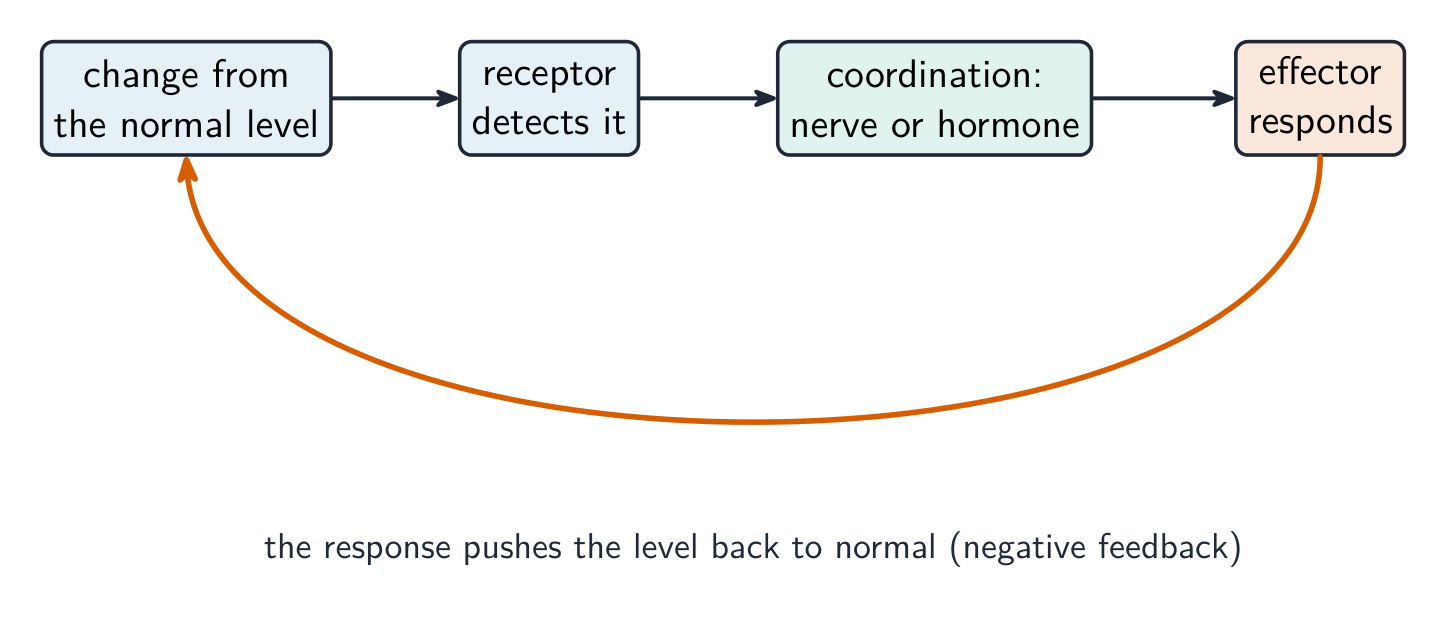
Feedback 反馈 keeps systems balanced:

  • Negative feedback 负反馈 counteracts a change to restore a set point (like a thermostat) – it maintains homeostasis 稳态.
  • Positive feedback 正反馈 amplifies a change to push a process to completion (like childbirth contractions or blood clotting).
Bahasa Indonesia

Umpan balik menjaga keseimbangan sistem:

Umpan balik negatif mendeteksi dan memperbaiki perubahan
  • Umpan balik negatif melawan perubahan untuk mengembalikan titik setel (seperti termostat) — hal ini mempertahankan homeostasis.
  • Umpan balik positif memperbesar perubahan untuk mendorong proses hingga selesai (seperti kontraksi persalinan atau pembekuan darah).
Explore · ⁨Jelajahi⁩

Negative feedback keeps things steady · ⁨Umpan balik negatif menjaga kestabilan⁩

Negative feedback senses a change and reverses it, holding a variable (like blood glucose) near a set point. Push it away and watch the system correct. · ⁨Umpan balik negatif mendeteksi perubahan dan membalikkannya, menjaga variabel (seperti glukosa darah) dekat dengan titik setel. Dorong menjauh dan saksikan sistem melakukan koreksi.⁩

Vocabulary · ⁨Kosa kata⁩ Train · ⁨Latih⁩
English Bahasa Indonesia
signals/ˈsɪɡnlz/ sinyal
ligand/ˈlɪɡænd/ ligan
receptor/rɪˈseptə/ reseptor
hormones/ˈhɔːməʊnz/ hormon
Signal transduction/ˈsɪɡnl trænsˈdʌkʃn/ Transduksi sinyal
Feedback/ˈfiːdbæk/ Umpan balik
Negative feedback/ˈneɡətɪv ˈfiːdbæk/ Umpan balik negatif
homeostasis/ˌhəʊmiːəˈstɑːsiz/ homeostasis
Positive feedback/ˈpɒzɪtɪv ˈfiːdbæk/ Umpan balik positif
4.5

Cell Cycle · ⁨Siklus Sel⁩

Syllabus · ⁨Silabus⁩
English

Big Idea 3 — Information Storage and Transmission: Living systems store, retrieve, transmit, and respond to information essential to life processes.

Learning Objective 4.5.A: Describe the events that occur in the cell cycle.

  • 4.5.A.1 The cell cycle is a highly regulated series of events that controls the growth and reproduction of eukaryotic cells.
    • i. The cell cycle consists of sequential stages of interphase (G1, S, G2), mitosis, and cytokinesis.
    • ii. G1 phase: The cell is metabolically active, duplicating organelles and cytosolic components.
    • iii. S phase: DNA is in the form of chromatin and replicates to form two sister chromatids connected at a centromere.
    • iv. G2 phase: Protein synthesis occurs, ATP is produced in large quantities, and centrosomes replicate.
    • v. A cell can enter a stage (G0) in which it no longer divides, but it can reenter the cell cycle in response to appropriate cues.
    • vi. Nondividing cells may exit the cell cycle or be held at a particular stage in the cell cycle.

Learning Objective 4.5.B: Explain how mitosis results in the transmission of chromosomes from one generation of cells to the next.

  • 4.5.B.1 Mitosis is a process that ensures the transfer of a complete genome from a parent cell to two genetically identical daughter cells in eukaryotes.
    • i. Mitosis plays a role in growth, tissue repair, and asexual reproduction.
    • ii. Mitosis occurs in sequential steps (prophase, metaphase, anaphase, telophase) and alternates with interphase in the cell cycle.
    • iii. Prophase: Sister chromatids condense, mitotic spindle begins to form, and centrosomes move to opposite poles of the cell.
    • iv. Metaphase: Spindle fibers align chromosomes along the equator of the cell.
    • v. Anaphase: Paired sister chromatids separate as spindle fibers pull chromatids toward poles.
    • vi. Telophase: Mitotic spindle breaks down, a new nuclear envelope develops, and then the cytoplasm divides.
    • vii. Cytokinesis: A cleavage furrow forms in animal cells or a cell plate forms in plant cells, resulting in two new daughter cells.
Bahasa Indonesia

Ide Besar 3 — Penyimpanan dan Transmisi Informasi: Sistem hidup menyimpan, mengambil, mentransmisikan, dan merespons informasi yang penting bagi proses kehidupan.

Tujuan Pembelajaran 4.5.A: Deskripsikan peristiwa-peristiwa yang terjadi dalam siklus sel.

  • 4.5.A.1 Siklus sel adalah serangkaian peristiwa yang sangat teratur yang mengontrol pertumbuhan dan reproduksi sel eukariotik.
    • i. Siklus sel terdiri dari tahap-tahap berurutan interphase (G1, S, G2), mitosis, dan sitokinesis.
    • ii. Fase G1: Sel aktif secara metabolik, menduplikasi organel dan komponen sitosolik.
    • iii. Fase S: DNA berada dalam bentuk kromatin dan bereplikasi untuk membentuk dua kromatid saudara yang terhubung di sentromer.
    • iv. Fase G2: Sintesis protein terjadi, ATP diproduksi dalam jumlah besar, dan sentrosom bereplikasi.
    • v. Sel dapat memasuki tahap (G0) di mana ia tidak lagi membelah, tetapi dapat masuk kembali ke siklus sel sebagai respons terhadap isyarat yang sesuai.
    • vi. Sel yang tidak membelah dapat keluar dari siklus sel atau ditahan pada tahap tertentu dalam siklus sel.

Tujuan Pembelajaran 4.5.B: Jelaskan bagaimana mitosis menghasilkan transmisi kromosom dari satu generasi sel ke generasi berikutnya.

  • 4.5.B.1 Mitosis adalah proses yang memastikan transfer genom lengkap dari sel induk ke dua sel anak yang ident secara genetik pada eukariota.
    • i. Mitosis berperan dalam pertumbuhan, perbaikan jaringan, dan reproduksi aseksual.
    • ii. Mitosis terjadi melalui langkah-langkah berurutan (profase, metafase, anafase, telofase) dan bergantian dengan interphase dalam siklus sel.
    • iii. Profase: Kromatid saudara memadat, gelendong mitosis mulai terbentuk, dan sentrosom bergerak ke kutub berlawanan sel.
    • iv. Metafase: Serat gelendong sejajarkan kromosom di sepanjang ekuator sel.
    • v. Anafase: Kromatid saudara yang berpasangan terpisah saat serat gelendong menarik kromatid menuju kutub.
    • vi. Telofase: Gelendong mitosis runtuh, selubung inti baru berkembang, kemudian sitoplasma terbagi.
    • vii. Sitokinesis: Furva pembelahan terbentuk pada sel hewan atau pelat sel terbentuk pada sel tumbuhan, menghasilkan dua sel anak baru.

Source: College Board AP Course and Exam Description · ⁨Sumber: Deskripsi Kursus dan Ujian College Board AP⁩

English

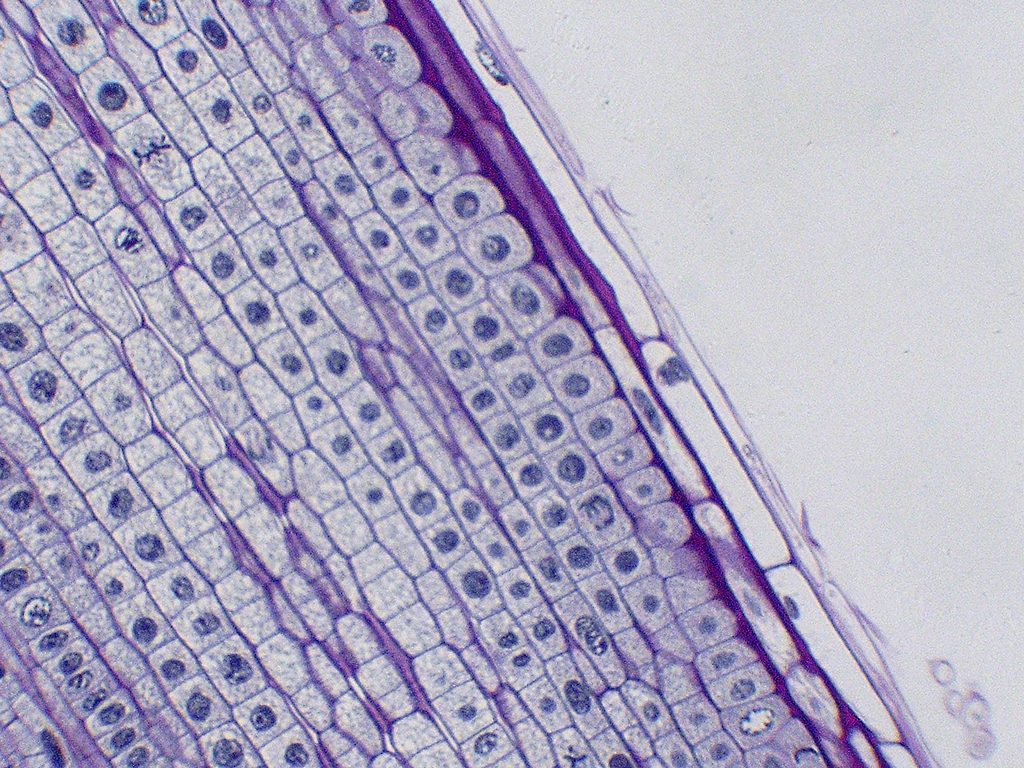
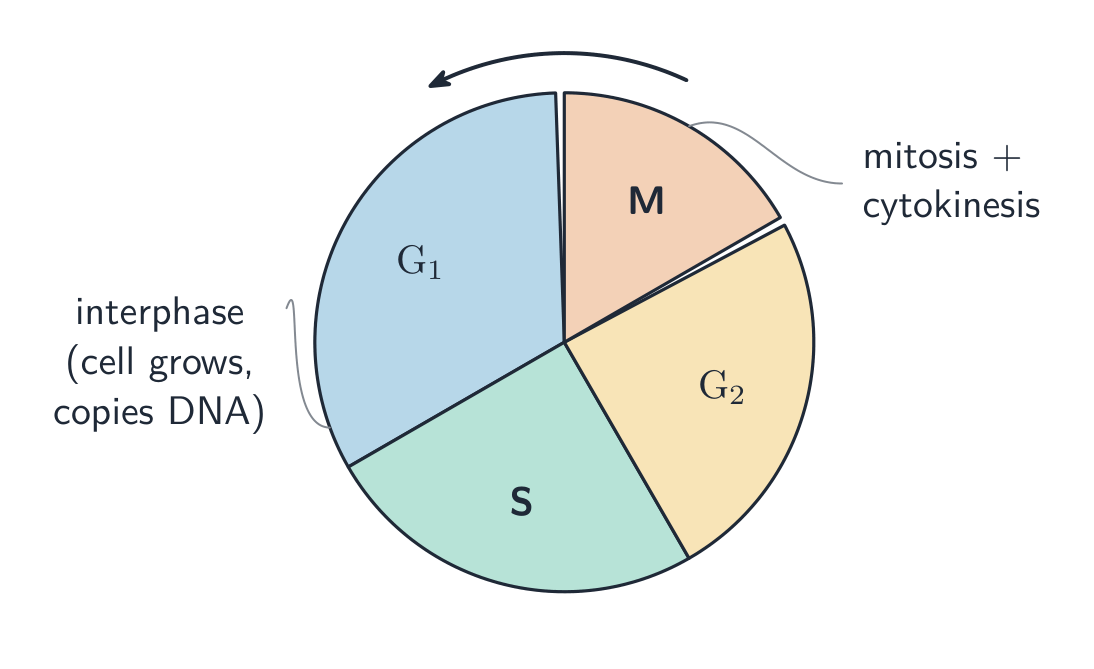
The cell cycle 细胞周期 is the life of a cell from one division to the next: interphase 间期 (G1 growth, S DNA replication, G2 preparation) followed by mitosis 有丝分裂 (M) and cytokinesis, which produce two identical daughter cells. Interphase takes most of the time; DNA is copied only in S phase.

Bahasa Indonesia
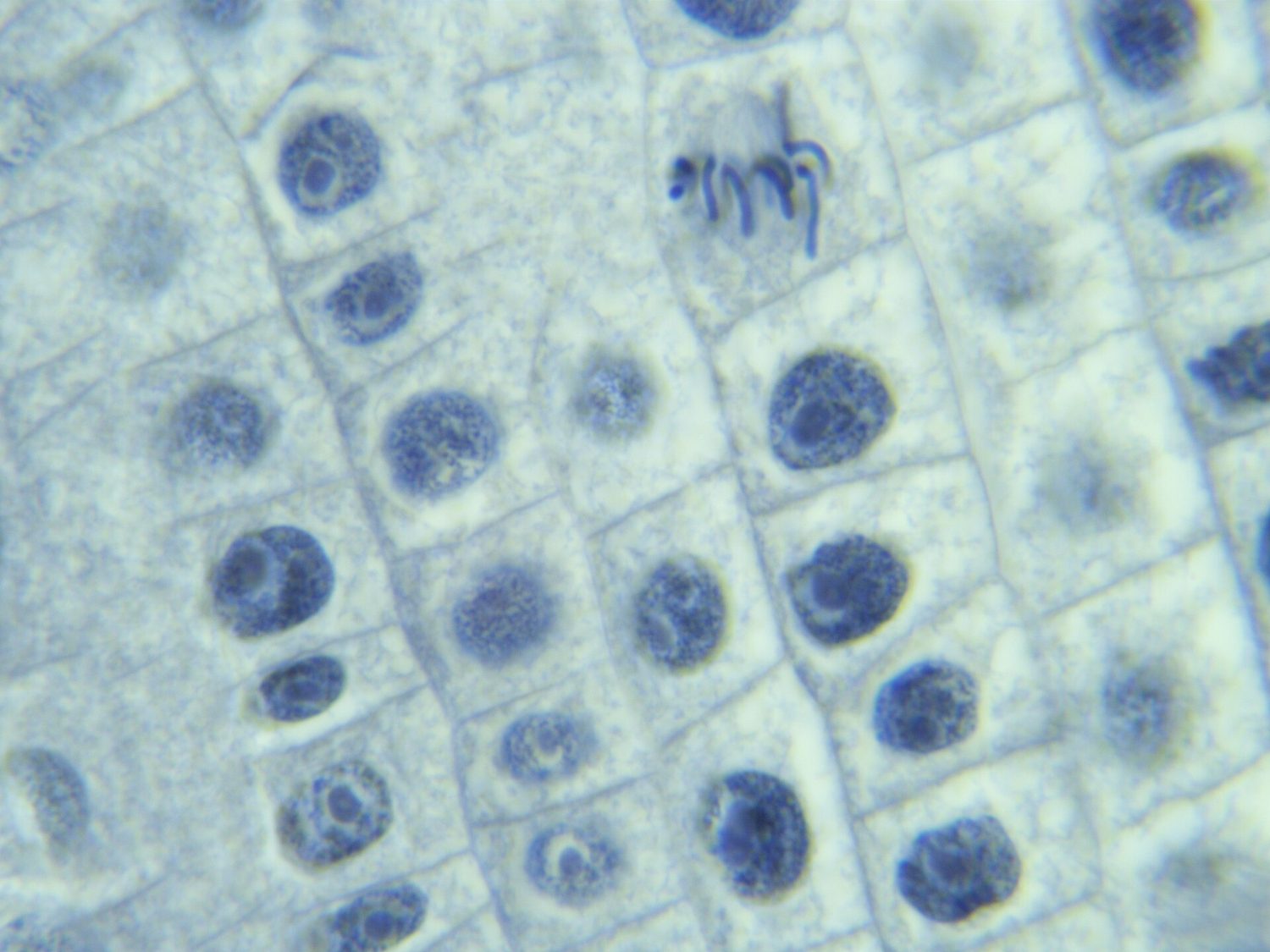
Sel ujung akar bawang pada berbagai tahap mitosis (mikroskop cahaya)

Siklus sel adalah kehidupan sel dari satu pembelahan ke pembelahan berikutnya: interfase (pertumbuhan G1, replikasi DNA S, persiapan G2) diikuti oleh mitosis (M) dan sitokinesis, yang menghasilkan dua sel anak identik. Interfase memakan waktu paling lama; DNA hanya disalin pada fase S.

Siklus sel: interfase, kemudian mitosis dan sitokinesis
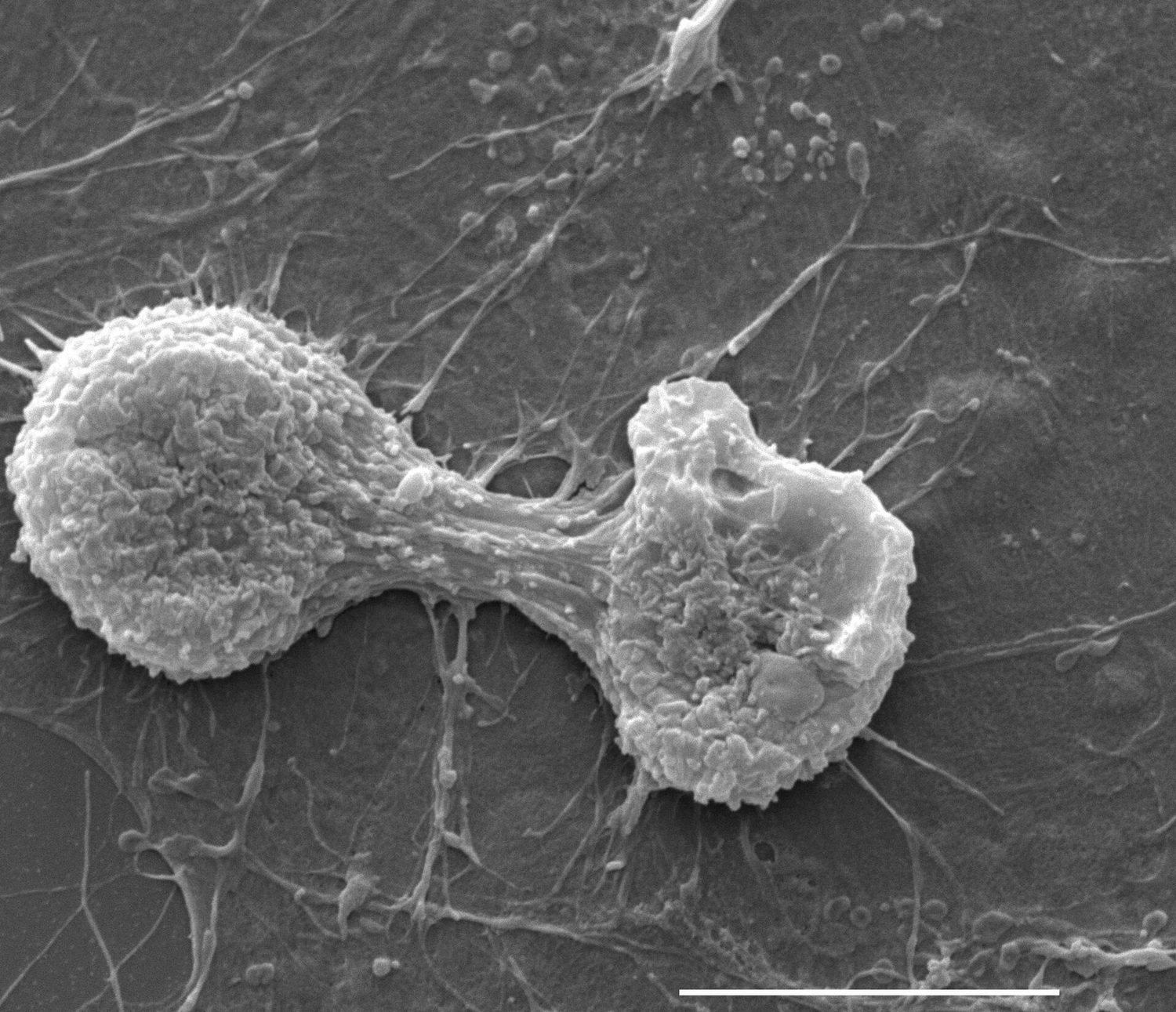
Fibroblast sedang membelah: sitokinesis membagi satu sel menjadi dua setelah mitosis selesai
Ujung akar bawang pada metafase: kromosom berbaris sebelum kromatid saudara terpisah
Explore · ⁨Jelajahi⁩

Step through the cell cycle · ⁨Langkahkan siklus sel⁩

The cell cycle copies the DNA (S phase) then splits it evenly in mitosis, producing two identical cells. Step through the stages. · ⁨Siklus sel menyalin DNA (fase S) lalu membaginya secara merata dalam mitosis, menghasilkan dua sel identik. Langkahkan tahap-tahapnya.⁩

Vocabulary · ⁨Kosa kata⁩ Train · ⁨Latih⁩
English Bahasa Indonesia
cell cycle/sel ˈsaɪkl/ siklus sel
interphase/ˌɪntəˈfeɪz/ interfase
mitosis/maɪˈtəʊsɪs/ mitosis
checkpoints/ˈtʃekpɔɪnts/ checkpoint
cancer/ˈkænsə/ kanker
4.6

Regulation of Cell Cycle · ⁨Regulasi Siklus Sel⁩

Syllabus · ⁨Silabus⁩
English

Big Idea 3 — Information Storage and Transmission: Living systems store, retrieve, transmit, and respond to information essential to life processes.

Learning Objective 4.6.A: Describe the role of checkpoints in regulating the cell cycle.

  • 4.6.A.1 A number of internal controls or checkpoints regulate progression through the cell cycle.
  • 4.6.A.2 Interactions between cyclins and cyclin-dependent kinases control the cell cycle.
    • Exclusion statement: Knowledge of specific cyclin-CdK pairs or growth factors is beyond the scope of the AP Exam.

Learning Objective 4.6.B: Describe the effects of disruptions to the cell cycle on the cell or organism.

  • 4.6.B.1 Disruptions to the cell cycle may result in cancer or apoptosis (programmed cell death).
Bahasa Indonesia

Ide Besar 3 — Penyimpanan dan Transmisi Informasi: Sistem hidup menyimpan, mengambil, mentransmisikan, dan merespons informasi yang penting bagi proses kehidupan.

Tujuan Pembelajaran 4.6.A: Deskripsikan peran pemeriksaan (checkpoints) dalam mengatur siklus sel.

  • 4.6.A.1 Sejumlah kontrol internal atau pemeriksaan mengatur progresi melalui siklus sel.
  • 4.6.A.2 Interaksi antara siklin dan kinase bergantung-siklin mengontrol siklus sel.
    • Pernyataan pengecualian: Pengetahuan tentang pasangan siklin-CdK spesifik atau faktor pertumbuhan berada di luar cakupan Ujian AP.

Tujuan Pembelajaran 4.6.B: Deskripsikan efek gangguan pada siklus sel terhadap sel atau organisme.

  • 4.6.B.1 Gangguan pada siklus sel dapat menyebabkan kanker atau apoptosis (kematian sel terprogram).

Source: College Board AP Course and Exam Description · ⁨Sumber: Deskripsi Kursus dan Ujian College Board AP⁩

English

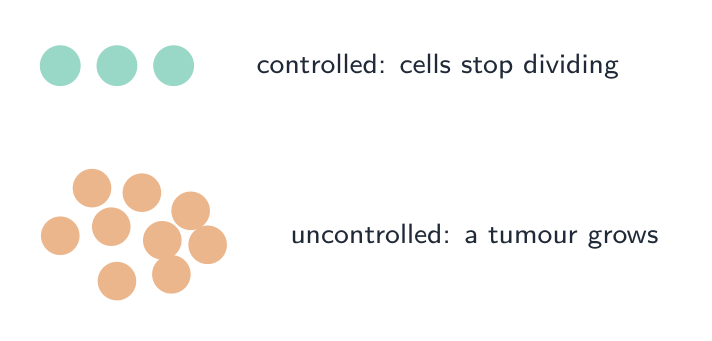
The cycle is controlled at checkpoints 检查点 that verify conditions before proceeding (Is the DNA intact? Are chromosomes attached?). Internal signals (cyclins and their kinases) and external signals drive the cycle forward. When this control fails – for example, a mutation that ignores a checkpoint – cells divide uncontrollably, which underlies cancer 癌症.

Worked example. Signal amplification in a cascade: one hormone activates one receptor, which switches on about 100 relay proteins, and each of those makes about 1,000 second-messenger molecules — so a single signal produces roughly $100 \times 1000 = 10^{5}$ product molecules. This is why a hormone concentration as low as $10^{-9}\,\text{M}$ can trigger a large cellular response.

Bahasa Indonesia

Siklus dikendalikan pada titik periksa yang memverifikasi kondisi sebelum melanjutkan (Apakah DNA utuh? Apakah kromosom terpasang?). Sinyal internal (silin dan kinases-nya) dan sinyal eksternal mendorong siklus berjalan. Ketika kontrol ini gagal – misalnya, mutasi yang mengabaikan titik periksa – sel membelah secara tak terkendali, yang merupakan dasar dari kanker.

Pembelahan tak terkendali dari titik periksa yang gagal membentuk tumor

Contoh pengerjaan. Amplifikasi sinyal dalam kaskade: satu hormon mengaktifkan satu reseptor, yang mengaktifkan sekitar 100 protein relay, dan masing-masing dari mereka menghasilkan sekitar 1,000 molekul penyampai kedua — sehingga satu sinyal tunggal menghasilkan sekitar $100 \times 1000 = 10^{5}$ molekul produk. Inilah sebabnya konsentrasi hormon serendah $10^{-9}\,\text{M}$ dapat memicu respons seluler yang besar.

4.6

Exam tips · ⁨Tips ujian⁩

English
  • In signal transduction name the three stages: reception → transduction → response.
  • Negative feedback reverses a change to keep conditions steady (homeostasis); positive feedback amplifies a change to completion (childbirth, clotting).
  • Order the cell cycle: interphase (grow, copy DNA in S phase) then mitosis → two identical daughter cells.
  • The DNA is copied once, in S phase, so each daughter gets a full copy.
  • Failed checkpoints allow uncontrolled division → cancer.
Bahasa Indonesia
  • Dalam transduksi sinyal sebutkan tiga tahap: penerimaan → transduksi → respons.
  • Umpan balik negatif membalikkan perubahan agar kondisi tetap stabil (homeostasis); umpan balik positif memperbesar perubahan hingga selesai (persalinan, pembekuan darah).
  • Urutkan siklus sel: interfase (tumbuh, salin DNA di fase S) kemudian mitosis → dua sel anak identik.
  • DNA disalin sekali, di fase S, sehingga setiap sel anak mendapatkan salinan penuh.
  • Titik periksa yang gagal memungkinkan pembelahan tak terkendali → kanker.

Interactive lessons on this topic · ⁨Pelajaran interaktif untuk topik ini⁩

Work through it step by step, with instant-check exercises. · ⁨Kerjakan langkah demi langkah, dengan latihan pengecekan instan.⁩

Past Papers · ⁨Soal-Soil Masa Lalu⁩

More topics in AP Biology · ⁨AP Biologi⁩ · ⁨Topik lain dalam AP Biology · ⁨AP Biologi⁩⁩

Log in or create account · ⁨Masuk atau buat akun⁩

IGCSE, A-Level & AP