Lompat ke konten

Struktur dan Fungsi Sel

AP Biologi · Topik 2

Pelajaran video untuk topik ini Buka halaman video
9:47

Struktur dan Fungsi Sel

Perhatikan sehelai daun di bawah mikroskop. Anda melihat baris kotak-kotak hijau, dan setiap kotak penuh dengan cakram hijau kecil. Sekarang lihat irisan bawang yang tipis. Bata yang rapi…

Narasi bahasa Inggris · takarir bahasa Inggris dan 中文 yang dapat dipilih

2.1

Organelles and the Endomembrane System

Silabus

Ide Besar 4 — Interaksi Sistem (SYI): Sistem biologis berinteraksi, dan sistem serta interaksinya menunjukkan sifat yang kompleks.

Tujuan Pembelajaran 2.1.A: Jelaskan bagaimana struktur dan fungsi komponen subseluler dan organel berkontribusi terhadap fungsi sel.

  • 2.1.A.1 Ribosom terdiri dari RNA ribosom (rRNA) dan protein. Struktur subseluler tanpa membran ini terdapat pada sel di semua bentuk kehidupan dan mencerminkan nenek moyang bersama dalam semua kehidupan yang diketahui. Ribosom mensintesis protein sesuai dengan urutan messenger RNA (mRNA).
  • 2.1.A.2 Sistem endomembran terdiri dari sekelompok organel dan komponen subseluler yang terbungkus membran (retikulum endoplasma (RE), kompleks Golgi, lisosom, vakuola dan vesikel transport, selubung nukleus, dan membran plasma) yang bekerja sama untuk memodifikasi, mengemas, dan mentransportasikan polisakarida, lipid, dan protein secara inter-seluler.
  • 2.1.A.3 Retikulum endoplasma menyediakan dukungan mekanis dengan membantu sel mempertahankan bentuk dan berperan dalam transportasi intraseluler.
    • i. RE kasar terkait dengan ribosom yang terbungkus membran, memungkinkan kompartementalisasi sel, dan membantu melakukan sintesis protein.
    • ii. Fungsi retikulum endoplasma halus meliputi detoksifikasi sel dan sintesis lipid.
    • Pernyataan pengecualian: Pengetahuan tentang fungsi spesifik retikulum endoplasma halus pada sel khusus berada di luar cakupan Ujian AP.
  • 2.1.A.4 Kompleks Golgi adalah struktur terbungkus membran yang terdiri dari serangkaian kantung membran pipih. Fungsi kompleks Golgi meliputi:
    • i. Melipat dengan benar dan memodifikasi secara kimiawi produk seluler yang baru disintesis
    • ii. Mengemas protein untuk trafficking
    • Pernyataan pengecualian: Pengetahuan tentang peran Golgi dalam sintesis fosfolipid tertentu dan pengemasan enzim tertentu untuk lisosom, peroksisom, dan vesikel sekretori berada di luar cakupan Ujian AP.
    • Contoh ilustratif untuk 2.1.A.4:
      • Glikosilasi dan modifikasi kimia lainnya pada protein yang terjadi di dalam Golgi dan menentukan fungsi atau penargetan protein
  • 2.1.A.5 Mitokondria memiliki membran ganda yang menyediakan kompartemen untuk berbagai reaksi metabolik yang terlibat dalam respirasi seluler aerob. Membran luar licin, sedangkan membran dalam sangat berlipat, membentuk lipatan yang memungkinkan ATP disintesis lebih efisien.
  • 2.1.A.6 Lisosom adalah kantung yang dibungkus membran yang mengandung enzim hidrolitik untuk mendigesti materi. Lisosom juga berperan dalam kematian sel terprogram (apoptosis).
  • 2.1.A.7 Vakuola adalah kantung yang terbungkus membran yang memainkan banyak peran yang berbeda.
    • i. Pada sel tumbuhan, vakuola besar yang terspesialisasi menjaga tekanan turgor melalui penyimpanan nutrisi dan air.
    • ii. Pada sel hewan, vakuola ukurannya lebih kecil, lebih banyak daripada pada sel tumbuhan, dan menyimpan material seluler.
  • 2.1.A.8 Kloroplas adalah organel khusus yang ditemukan pada tumbuhan dan alga fotosintetik. Kloroplas mengandung membran ganda dan berfungsi sebagai lokasi fotosintesis.
Sumber: Deskripsi Kursus dan Ujian College Board AP

English

In cystic fibrosis, one amino acid is missing from a membrane protein called CFTR, which should carry chloride ions out of lung cells. In the most common mutation, the protein is synthesised but folds incorrectly, and the cell's quality checks reject it inside the endoplasmic reticulum, so it never reaches the cell surface. Without it, the mucus in the lungs becomes thick and sticky. To understand the disease, and many exam questions built on it, you need to know where proteins are made, how they travel through the cell, and how the membrane controls what crosses it.

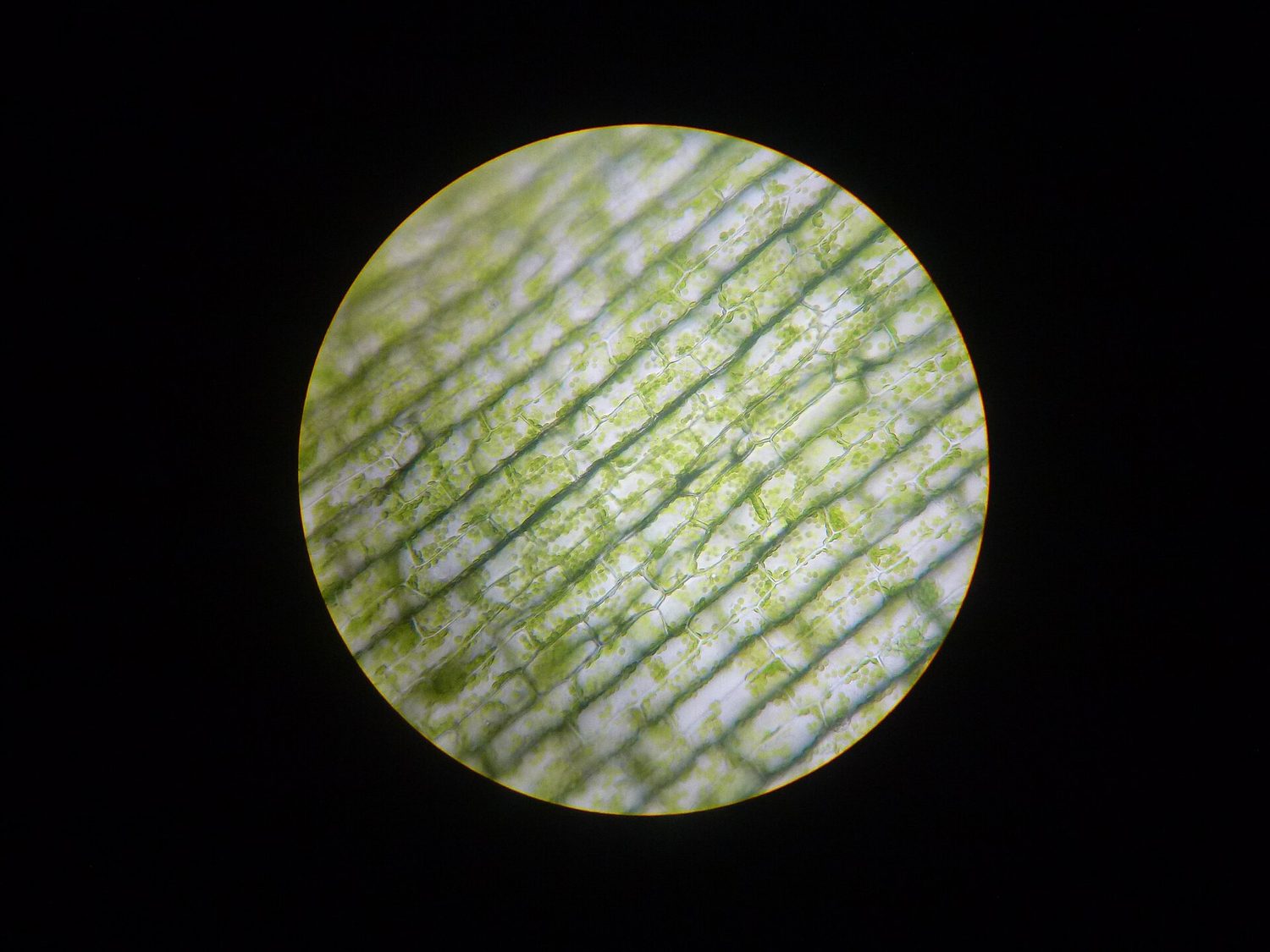
Elodea leaf cells packed with green chloroplasts (light micrograph)
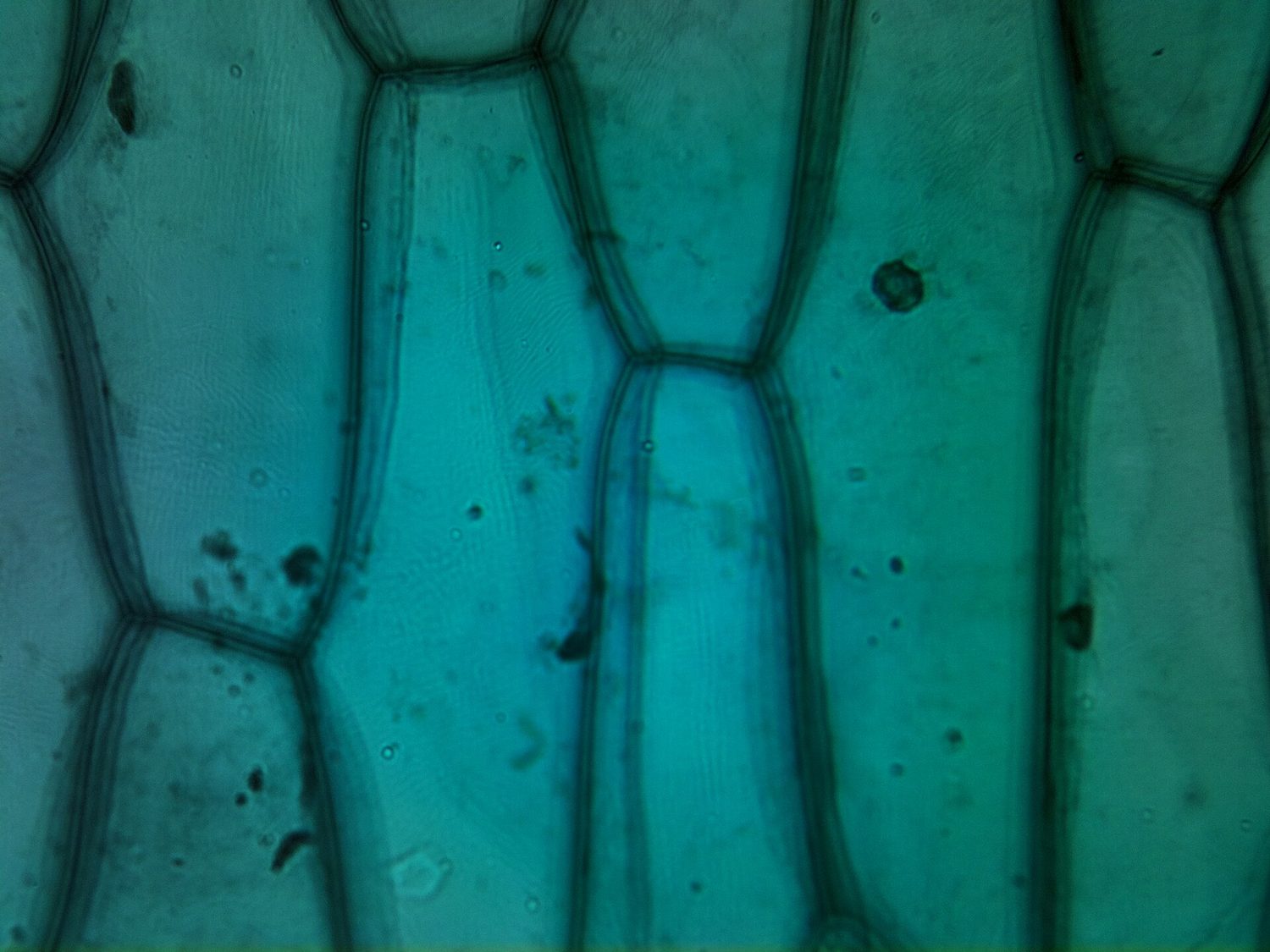
Onion epidermis cells under a light microscope — cell walls and nuclei clearly visible

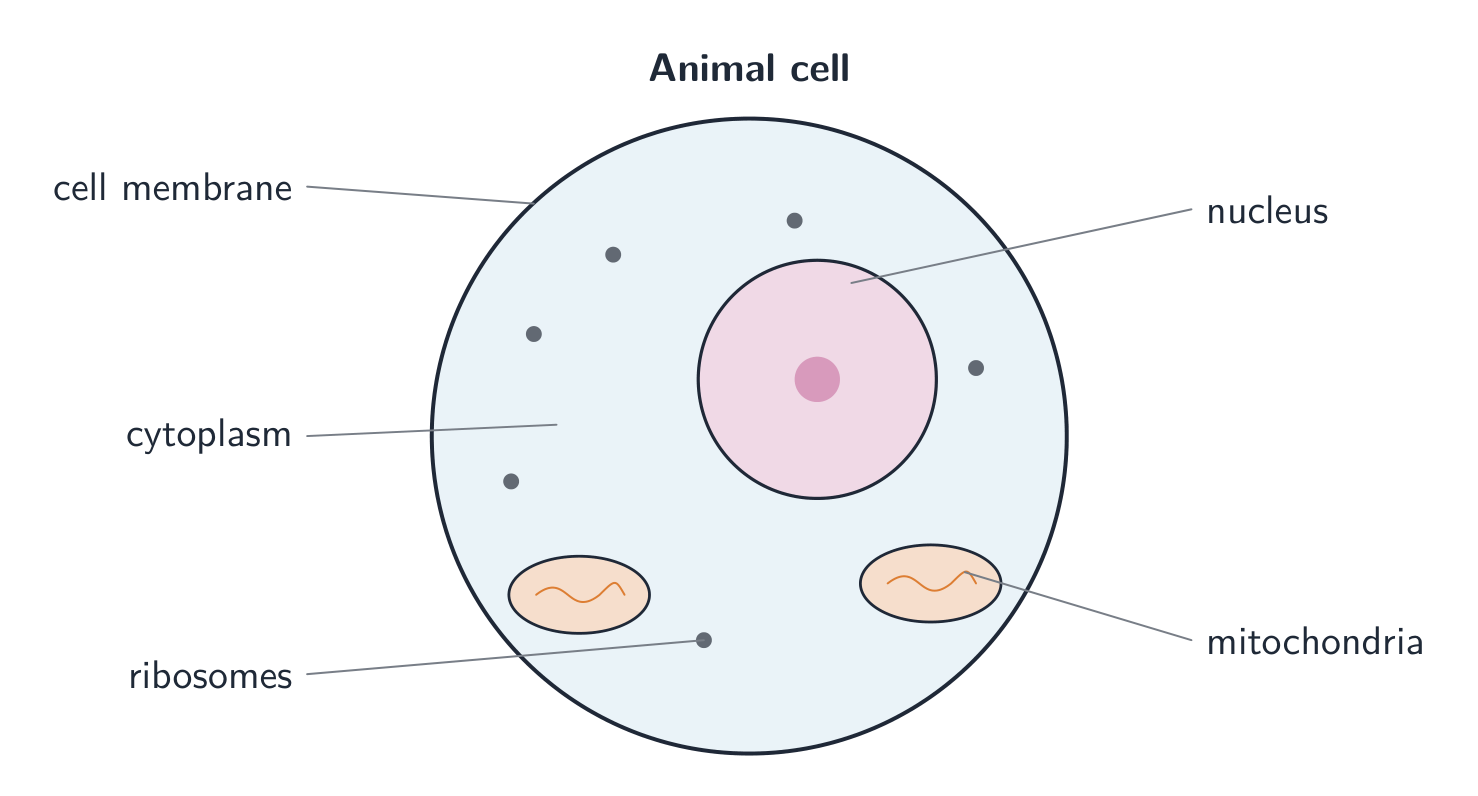
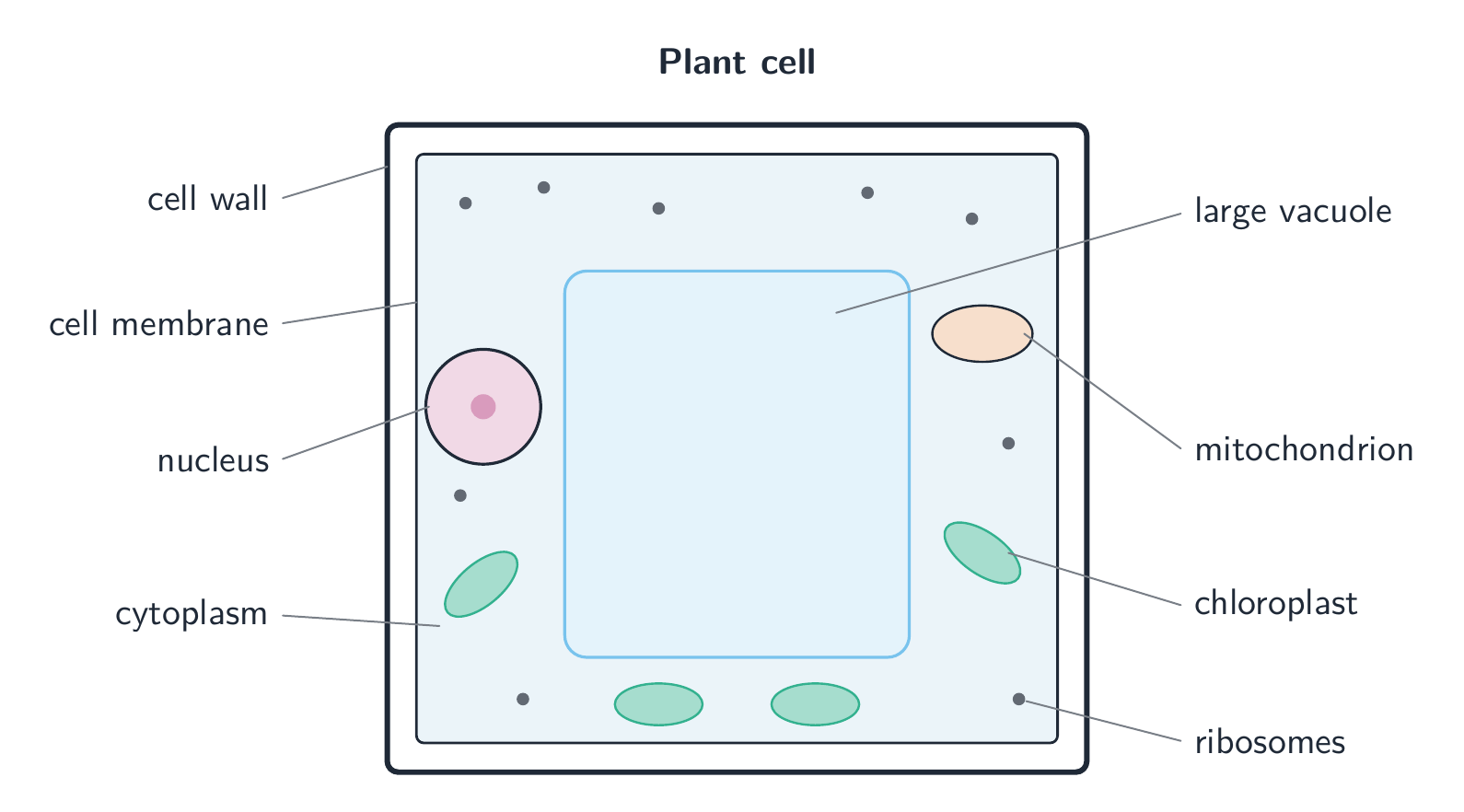
A eukaryotic cell divides its work among organelles 细胞器. The endomembrane system 内膜系统 is a connected set that makes, modifies, and ships molecules: the nucleus 细胞核 (holds DNA), rough and smooth endoplasmic reticulum 内质网 (protein and lipid synthesis), the Golgi 高尔基体 (modifies and packages), lysosomes 溶酶体 (digestion), and vesicles that carry material between them. Mitochondria 线粒体 (respiration) and chloroplasts 叶绿体 (photosynthesis) have their own membranes.

A plant cell also has a cell wall, a large vacuole, and chloroplasts
A generalised animal cell and its organelles

What each organelle actually does

The exam asks you to name a structure and say what it does, so learn them as pairs.

Ribosomes 核糖体 are made of ribosomal RNA 核糖体核糖核酸 (rRNA) and protein. They have no membrane, and they are found in every form of life — bacteria, archaea and eukaryotes alike. That shared presence is evidence of common ancestry: a structure this central was already present in the last common ancestor of all living things. A ribosome reads messenger RNA 信使核糖核酸 (mRNA) and builds the protein it codes for. Free ribosomes make proteins for use inside the cell; ribosomes bound to the rough endoplasmic reticulum make proteins for export or for the membrane.

The endoplasmic reticulum (ER) is a network of membranes that runs through the cytoplasm, helps the cell keep its shape and carries materials around inside it. Rough ER 粗面内质网 is covered with ribosomes: the proteins they make are threaded into the ER, the first step for proteins that will go to the membrane, to a lysosome, or out of the cell. Smooth ER 滑面内质网 has no ribosomes; it makes lipids and breaks down (detoxifies) harmful substances.

The Golgi complex 高尔基复合体 is a series of flattened, membrane-bound sacs. A protein arriving from the endoplasmic reticulum is passed through them, and three things happen to it:

  • it arrives folded from the ER and is chemically modified — most often by glycosylation 糖基化, the attachment of short sugar chains;
  • it is sorted and targeted, so the modified sugar or phosphate tag decides which compartment the protein is sent to;
  • it is packaged into a vesicle for transport.

So the Golgi is not storage: it is the cell's finishing and dispatch department, and its modifications determine what a protein does and where it ends up.

Lysosomes are membrane-enclosed sacs of hydrolytic enzymes 水解酶 that digest material — worn-out organelles, engulfed bacteria, and food particles taken in by the cell. Their enzymes work best at a low pH, which the lysosome maintains inside itself; keeping them enclosed protects the rest of the cell. (A lysosome is a good example of compartmentalization: an enzyme that would damage the cytoplasm is safe inside its own membrane.) Lysosomes also take part in apoptosis 细胞凋亡, programmed cell death, in which a cell is dismantled deliberately, for example to sculpt fingers from a webbed embryonic hand.

Vacuoles 液泡 are membrane-bound sacs with many different roles: storing water, ions, nutrients or waste, and in a plant cell the large central vacuole also presses outwards on the cell wall to keep the cell firm. Animal cells have many small vacuoles instead of one large one.

A cell wall 细胞壁 surrounds the membrane of plant and fungal cells and most bacterial and archaeal cells, but not animal cells. It gives the cell shape and strength, stops it bursting when it takes in water, and acts as a barrier to some substances.

Mitochondria and chloroplasts each have a double membrane and their own circular DNA and ribosomes — the evidence behind endosymbiotic theory below. The outer membrane of a mitochondrion is smooth; the inner membrane is folded into cristae 嵴, which give it a much larger surface area for the reactions of aerobic respiration. The two membranes also make separate compartments for different stages of respiration. Chloroplasts, found in plants and algae, are where photosynthesis happens.

Following a protein through the cell

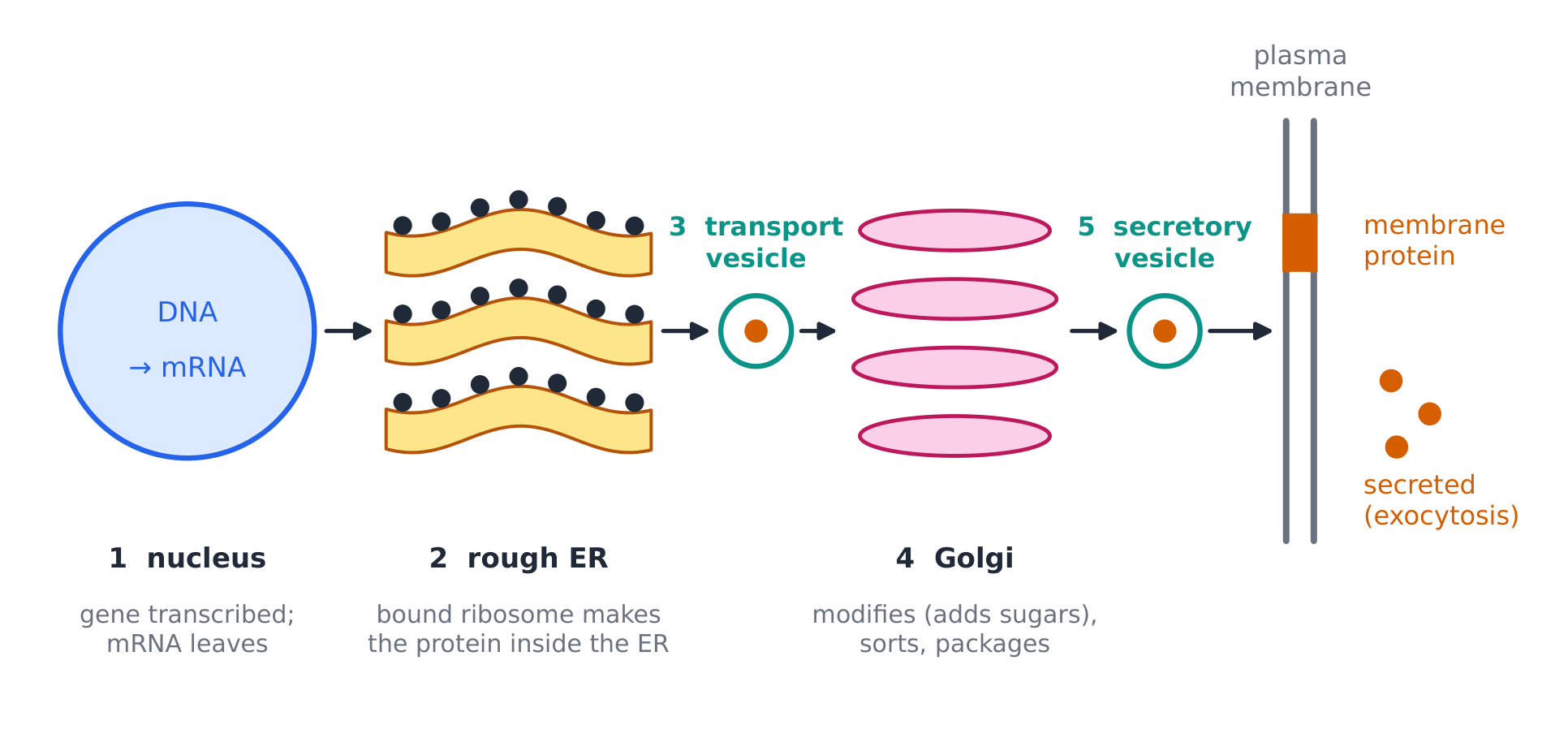
A protein that ends up in the plasma membrane, or is secreted, follows one route. Free-response questions often ask you to draw or describe it.

mRNA leaves the nucleus; a membrane or secreted protein is then made at the rough ER and travels through the Golgi to the plasma membrane

Worked example (where is the faulty protein?). CFTR is a membrane protein, so it is made by ribosomes on the rough ER, not by free ribosomes. From the ER it goes in a vesicle to the Golgi, then in another vesicle to the plasma membrane. In the most common cystic fibrosis mutation the protein folds wrongly, and the ER keeps misfolded proteins back, so the mutant protein is found in the ER, not in the membrane. If instead a mutation changed only the protein's ATP-binding site, the protein could still fold and reach the membrane, but it would not work there.

Kosa kata Latih
English Bahasa Indonesia
organelles/ˌɔːɡəˈnelz/ organel
endomembrane system/ˈendəʊmembreɪn ˈsɪstəm/ sistem endomembran
nucleus/ˈnjuːklɪəs/ Inti sel
endoplasmic reticulum/ˌendəʊˈplæzmɪk reˈtɪkjʊləm/ retikulum endoplasma
Golgi/ˈɡɒlɡɪ/ badan Golgi
lysosomes/ˈlaɪsəsəʊmz/ lisosom
Mitochondria/ˌmaɪtəˈkɒndrɪə/ mitokondria
chloroplasts/ˈklɔːrəʊplæsts/ kloroplas
Ribosomes/ˈrɪbəsəʊmz/ ribosom
ribosomal RNA/ˈrɪbəsɒml ˌɑː en ˈeɪ/ RNA ribosom
messenger RNA/ˈmesɪndʒə ˌɑː en ˈeɪ/ RNA messenger
Rough ER/rʌf ˌiː ˈɑː/ retikulum endoplasma kasar
smooth ER/smuːð ˌiː ˈɑː/ retikulum endoplasma halus
The Golgi complex/ðə ˈɡɒlɡɪ ˈkɒmpleks/ kompleks Golgi
glycosylation/ˌɡlaɪkəsɪˈleɪʃn/ glikosilasi
hydrolytic enzymes/ˌhaɪdrəˈlɪtɪk ˈenzaɪmz/ enzim hidrolitik
apoptosis/əpəpˈtəʊsɪs/ apoptosis
Vacuoles/ˈvækjuːəʊlz/ vakuola
cell wall/sel wɔːl/ dinding sel
cristae/ˈkrɪstiː/ krista
2.2

Why Cells Stay Small

Silabus

Ide Besar 2 — Energetika (ENE): Sistem biologis menggunakan energi dan blok bangunan molekuler untuk tumbuh, bereproduksi, dan mempertahankan homeostasis dinamis.

Tujuan Pembelajaran 2.2.A: Jelaskan efek rasio luas permukaan-terhadap-volume terhadap pertukaran materi antara sel atau organisme dengan lingkungan.

  • 2.2.A.1 Rasio luas permukaan-terhadap-volume mempengaruhi kemampuan sistem biologis untuk mendapatkan nutrisi yang diperlukan, menghilangkan produk limbah, memperoleh atau melepaskan energi termal, dan bertukar bahan kimia serta energi dengan lingkungan.
    • Persamaan relevan:
      • Volume Bola: $V = \dfrac{4}{3}\pi r^3$
      • Volume Kubus: $V = s^3$
      • Volume Balok: $V = lwh$
      • Volume Silinder: $V = \pi r^2 h$
      • Luas Permukaan Bola: $SA = 4\pi r^2$
      • Luas Permukaan Kubus: $SA = 6s^2$
      • Luas Permukaan Balok: $SA = 2lh + 2lw + 2wh$
      • Luas Permukaan Silinder: $SA = 2\pi rh + 2\pi r^2$
      • $r$ = jari-jari
      • $l$ = panjang
      • $h$ = tinggi
      • $w$ = lebar
      • $s$ = panjang salah satu sisi kubus
    • Contoh ilustratif untuk 2.2.A.1:
      • Rasio LA/V dan Pertukaran
        • Rambut akar
        • Sel penjaga
        • Sel epitel usus
      • Sitilia
      • Stoma
  • 2.2.A.2 Luas permukaan membran plasma harus cukup besar untuk bertukar materi secara memadai.
    • i. Rasio luas permukaan-terhadap-volume dapat membatasi ukuran dan bentuk sel. Sel yang lebih kecil biasanya memiliki rasio luas permukaan-terhadap-volume yang lebih tinggi serta pertukaran materi yang lebih efisien dengan lingkungan dibandingkan sel yang lebih besar.
    • ii. Seiring bertambahnya volume sel, rasio luas permukaan-terhadap-volume menurun dan kebutuhan akan sumber daya internal meningkat.
    • iii. Struktur seluler yang lebih kompleks (misalnya, lipatan membran) diperlukan untuk bertukar materi dengan lingkungan secara memadai.
    • iv. Saat organisme membesar, rasio luas permukaan terhadap volumenya menurun, yang memengaruhi sifat seperti laju pertukaran panas dengan lingkungan. Massa yang lebih kecil bertukar panas secara proporsional lebih banyak dengan lingkungan sekitar dibandingkan massa yang lebih besar. Seiring bertambahnya massa, baik rasio luas permukaan terhadap volume maupun laju pertukaran panas menurun.
    • v. Terdapat hubungan antara laju metabolik per satuan massa tubuh dan ukuran organisme multiseluler; umumnya, semakin kecil organisme, semakin tinggi laju metabolik per satuan massa tubuhnya.

Sumber: Deskripsi Kursus dan Ujian College Board AP

English
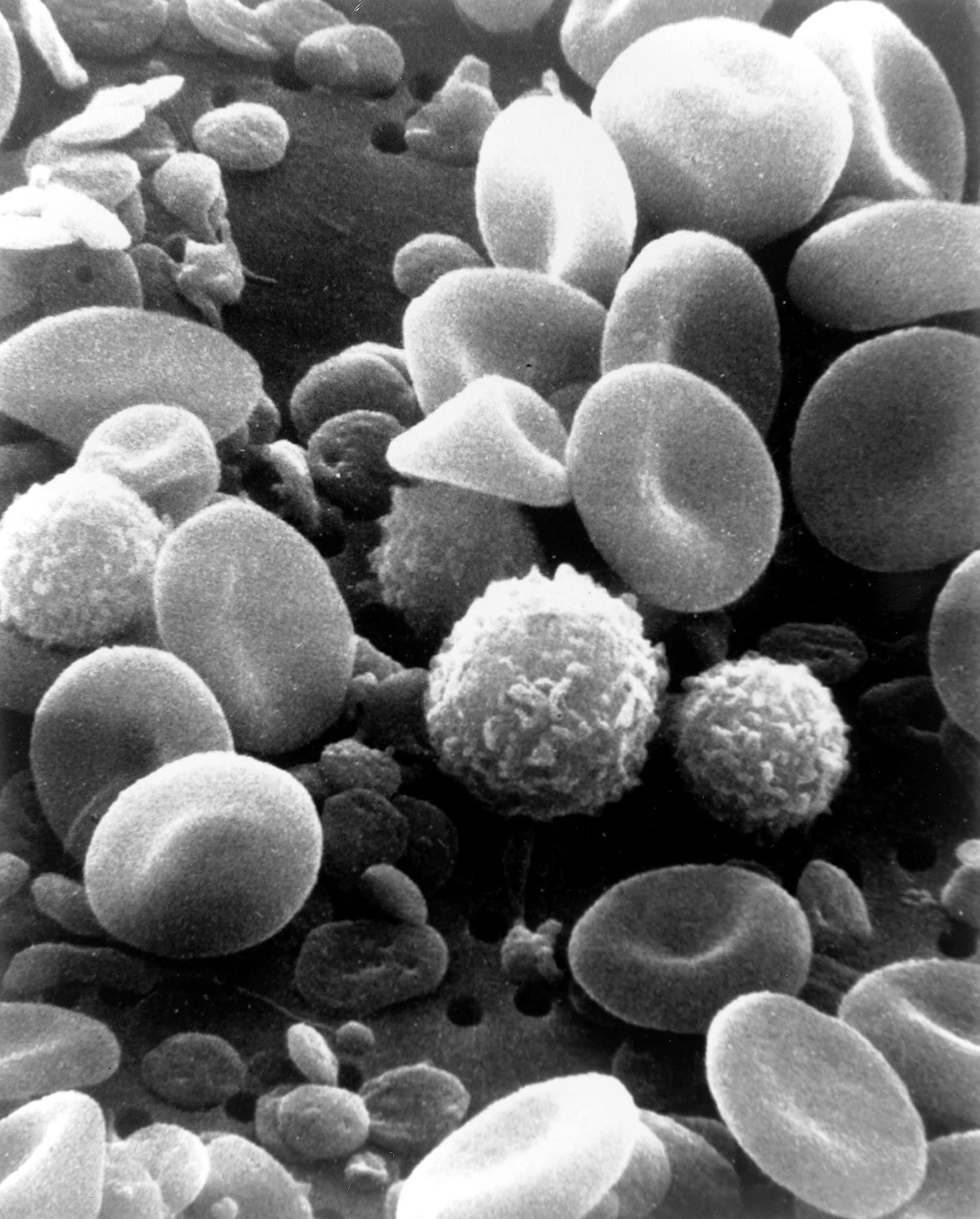
Scanning electron micrograph of red blood cells — no nucleus, high surface area for gas exchange

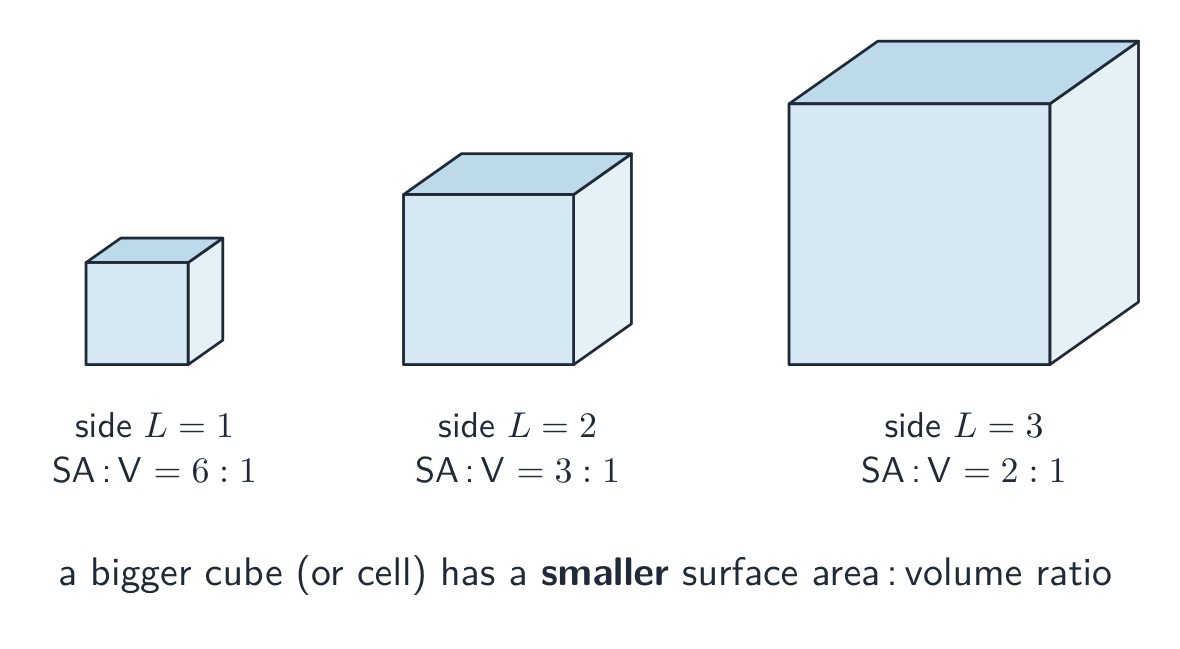
Cells stay small because of the surface-area-to-volume ratio 表面积与体积比. As a cell grows, its volume rises faster than its surface area, so its membrane cannot exchange materials fast enough for the interior. Staying small (or being flat or folded) keeps enough surface to serve the volume.

The surface-area-to-volume ratio falls as a cell gets bigger

Worked example. A cube-shaped cell $2\ \mu\text{m}$ on a side has surface area $6\times2^2=24\ \mu\text{m}^2$ and volume $2^3=8\ \mu\text{m}^3$, so its surface-area-to-volume ratio is $\tfrac{24}{8}=3\ \mu\text{m}^{-1}$. Double the side to $4\ \mu\text{m}$: surface area $=6\times4^2=96$, volume $=4^3=64$, ratio $=\tfrac{96}{64}=1.5\ \mu\text{m}^{-1}$. Doubling the size halved the ratio – the larger cell has far less membrane per unit of interior, which is why cells stay small.

Worked example (a sphere). A spherical cell of radius $3\ \mu\text{m}$ has $SA=4\pi r^2=113\ \mu\text{m}^2$ and $V=\tfrac43\pi r^3=113\ \mu\text{m}^3$, a ratio of $1.0\ \mu\text{m}^{-1}$. For any sphere the ratio is $3/r$, so it falls as the radius grows. Cells that need a lot of exchange increase their surface without growing: microvilli 微绒毛 on gut cells, root hairs on plant roots, and the cristae inside mitochondria are all folds or projections that add membrane.

The same rule works for whole organisms. A mouse has far more surface per kilogram than an elephant, so it loses heat much faster and must burn food faster to stay warm. In general, the smaller the animal, the higher its metabolic rate per unit of body mass.

Jelajahi

Lihat luas permukaan terhadap volume saat kubus membesar

Saat sel membesar, volume meningkat lebih cepat daripada luas permukaan, sehingga rasio luas permukaan terhadap volume menurun. Sel kecil mempertahankan membran yang cukup untuk menukar materi dengan cukup cepat.

Kosa kata Latih
English Bahasa Indonesia
surface-area-to-volume ratio/ˈsɜːfɪs ˈeərɪə tə ˈvɒljuːm ˈreɪʃɪəʊ/ surface-area-to-volume ratio
microvilli/ˈmaɪkrəʊvɪlaɪ/ mikrovili
2.3

The Fluid Mosaic Model of the Membrane

Silabus

Ide Besar 2 — Energetika (ENE): Sistem biologis menggunakan energi dan blok bangunan molekuler untuk tumbuh, bereproduksi, dan mempertahankan homeostasis dinamis.

Tujuan Pembelajaran 2.3.A: Jelaskan peran setiap komponen membran sel dalam mempertahankan lingkungan internal sel.

  • 2.3.A.1 Fosfolipid memiliki wilayah hidrofilik dan hidrofobik. Wilayah fosfat polar yang hidrofilik dari fosfolipid diorientasikan menuju lingkungan luar atau dalam yang berair, sedangkan wilayah asam lemak nonpolar yang hidrofobik saling menghadap di bagian dalam membran.
  • 2.3.A.2 Protein tertanam dapat bersifat hidrofilik (dengan gugus samping bermuatan dan polar), hidrofobik (dengan gugus samping nonpolar), atau keduanya.
    • i. Wilayah hidrofilik dari protein berada di dalam interior protein atau terekspos ke sitosol (sitoplasma).
    • ii. Wilayah hidrofobik dari protein membentuk permukaan protein yang berinteraksi dengan asam lemak di bagian dalam membran.

Tujuan Pembelajaran 2.3.B: Jelaskan model mosaik cair pada membran sel.

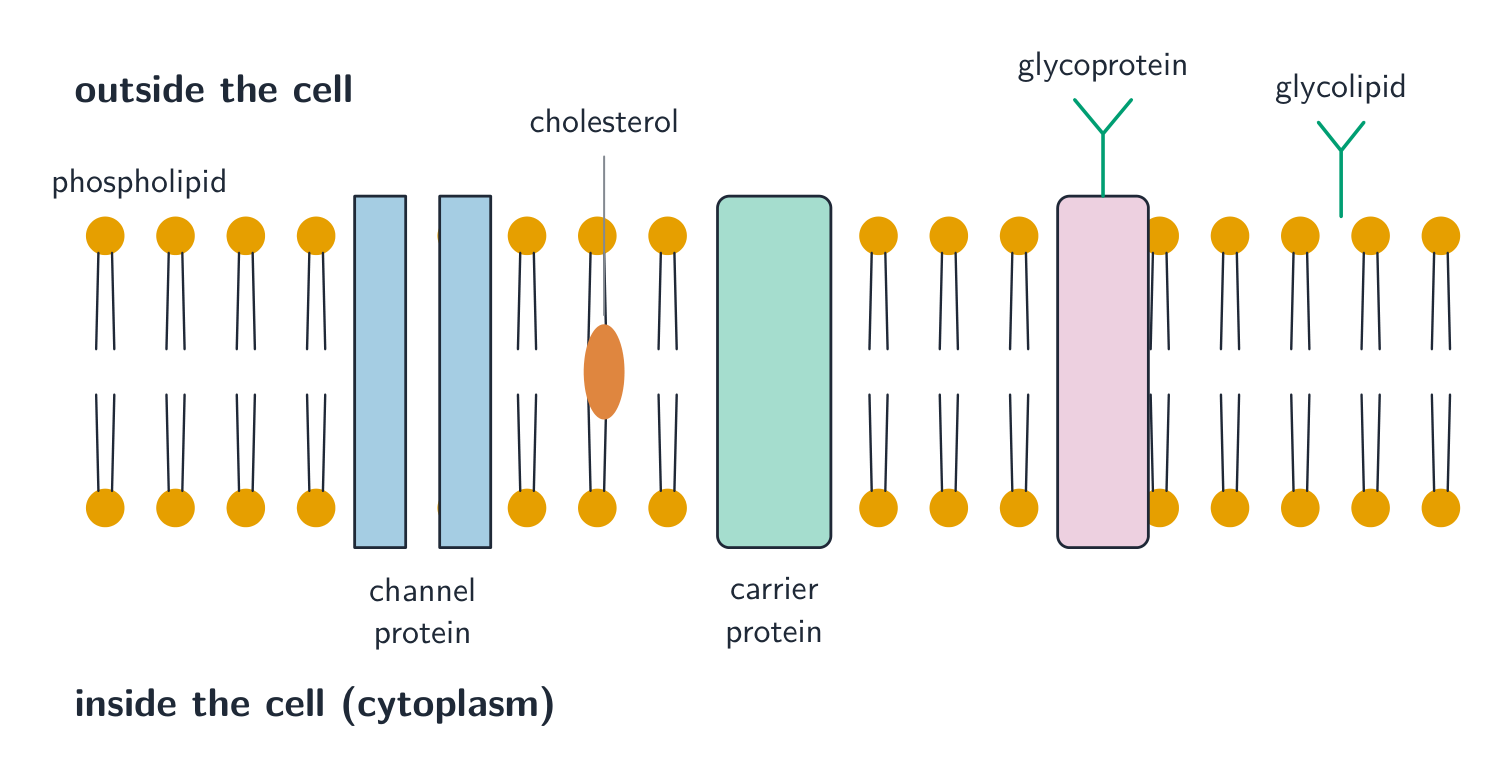
  • 2.3.B.1 Membran plasma terdiri dari kerangka struktural molekul fosfolipid yang tertanam dengan protein, steroid (seperti kolesterol pada hewan vertebrata), glikoprotein, dan glikolipid. Semua ini dapat bergerak di sekitar permukaan sel di dalam membran, sebagaimana diilustrasikan oleh model mosaik cair.

Sumber: Deskripsi Kursus dan Ujian College Board AP

English

The cell membrane is a phospholipid bilayer 磷脂双分子层 – polar heads facing the water, nonpolar tails inside – studded with proteins. The fluid mosaic model 流动镶嵌模型 pictures it as a fluid sheet in which lipids and proteins drift. Cholesterol and the degree of unsaturation tune its fluidity.

Membrane proteins follow the same rule as phospholipids. The part of a protein that crosses the bilayer has mainly nonpolar (hydrophobic) R groups, which touch the fatty-acid tails. The parts that stick out into the cytoplasm or the outside fluid have polar and charged R groups, which touch water. Short sugar chains attached to some proteins (glycoproteins) and lipids (glycolipids) face the outside and let cells recognise each other.

The fluid mosaic model of the cell membrane
Kosa kata Latih
English Bahasa Indonesia
phospholipid bilayer/ˈfɒsfəlɪpɪd ˈbɪleɪə/ phospholipid bilayer
fluid mosaic model/ˈfluːɪd məˈseɪɪk ˈmɒdl/ model mosaik cair
2.4

What Can Cross the Membrane

Silabus

Ide Besar 2 — Energetika (ENE): Sistem biologis menggunakan energi dan blok bangunan molekuler untuk tumbuh, bereproduksi, dan mempertahankan homeostasis dinamis.

Tujuan Pembelajaran 2.4.A: Jelaskan bagaimana struktur membran biologis memengaruhi permeabilitas selektif.

  • 2.4.A.1 Membran plasma memisahkan lingkungan internal sel dari lingkungan eksternal. Permeabilitas selektif merupakan hasil dari membran plasma yang memiliki interior hidrofobik.
  • 2.4.A.2 Molekul nonpolar kecil, termasuk $\mathrm{N_2}$, $\mathrm{O_2}$, dan $\mathrm{CO_2}$, dapat melewati membran dengan bebas. Zat hidrofilik, seperti molekul polar besar dan ion, melintasi membran melalui saluran tertanam dan protein pengangkut.
  • 2.4.A.3 Ekor hidrokarbon nonpolar dari fosfolipid mencegah pergerakan ion dan molekul polar melintasi membran. Molekul polar kecil yang tidak bermuatan, seperti $\mathrm{H_2O}$ atau $\mathrm{NH_3}$ (amonia), dapat melewati membran dalam jumlah kecil.

Tujuan Pembelajaran 2.4.B: Jelaskan peran dinding sel dalam mempertahankan struktur dan fungsi sel.

  • 2.4.B.1 Dinding sel Bakteri, Arkea, Fungi, dan tumbuhan menyediakan batas struktural serta penghalang permeabilitas untuk beberapa zat terhadap lingkungan seluler internal atau eksternal, dan perlindungan dari lisis osmotik.

Sumber: Deskripsi Kursus dan Ujian College Board AP

English

The membrane is selectively permeable 选择透过性. Small nonpolar molecules ($\text{O}_2$, $\text{CO}_2$) cross freely. Water, small but polar, crosses the bilayer only in small amounts and moves mostly through channel proteins called aquaporins 水通道蛋白. Large or charged/polar particles (ions, glucose) cannot pass the nonpolar core without help. This selectivity lets the cell control its internal environment.

The nonpolar core is the reason. Steroid hormones such as oestrogen are nonpolar, so they dissolve in the core and cross the membrane by simple diffusion, then bind receptors inside the cell. Ions such as $\text{Na}^+$, $\text{K}^+$ and $\text{Cl}^-$ are charged, so the hydrophobic tails stop them; they need channel proteins 通道蛋白 or carriers even to move down their electrochemical gradients (which depend on both concentration and charge). Because ions carry charge, moving them across a membrane makes one side more positive than the other: the membrane becomes polarized.

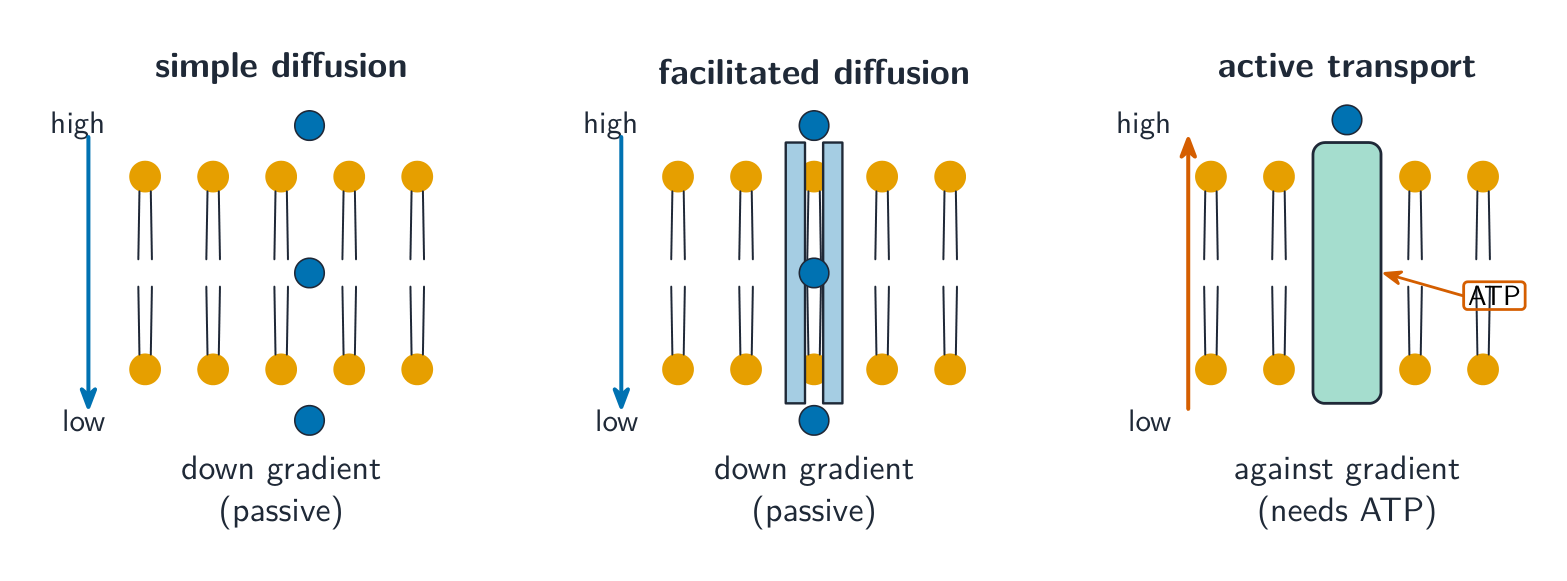
Three ways substances cross the membrane
Kosa kata Latih
English Bahasa Indonesia
selectively permeable/sɪˈlektɪvli ˈpɜːməbl/ selektif permeabel
aquaporins/ˈækwəpɔːrɪnz/ aquaporin
Channel proteins/ˈtʃænl ˈprəʊtiːnz/ protein saluran
2.5

Passive and Active Transport

Silabus

Ide Besar 2 — Energetika (ENE): Sistem biologis menggunakan energi dan blok bangunan molekuler untuk tumbuh, bereproduksi, dan mempertahankan homeostasis dinamis.

Tujuan Pembelajaran 2.5.A: Jelaskan mekanisme yang digunakan organisme untuk menjaga keseimbangan zat terlarut dan air.

  • 2.5.A.1 Permeabilitas selektif membran memungkinkan terbentuknya gradien konsentrasi zat terlarut melintasi membran.
  • 2.5.A.2 Transportasi pasif adalah pergerakan bersih molekul dari daerah berkonsentrasi tinggi ke daerah berkonsentrasi rendah tanpa input energi metabolik langsung.
  • 2.5.A.3 Transportasi aktif memerlukan input energi langsung untuk menggerakkan molekul. Dalam beberapa kasus, transportasi aktif digunakan untuk memindahkan molekul dari daerah berkonsentrasi rendah ke daerah berkonsentrasi tinggi.

Tujuan Pembelajaran 2.5.B: Jelaskan mekanisme yang digunakan organisme untuk mengangkut molekul besar melintasi membran plasma.

  • 2.5.B.1 Proses endositosis dan eksositosis memerlukan energi untuk memindahkan zat besar atau jumlah zat besar masuk dan keluar dari sel.
    • i. Pada endositosis, sel menyerap molekul besar dan materi partikulat dengan melipat membran plasma ke dalam dan membentuk vesikel baru (kecil) yang membungkus materi dari lingkungan eksternal.
    • ii. Pada eksositosis, vesikel internal melepaskan materi dari sel dengan cara berfusi dengan membran plasma dan mensekresi molekul besar keluar dari sel.

Sumber: Deskripsi Kursus dan Ujian College Board AP

English
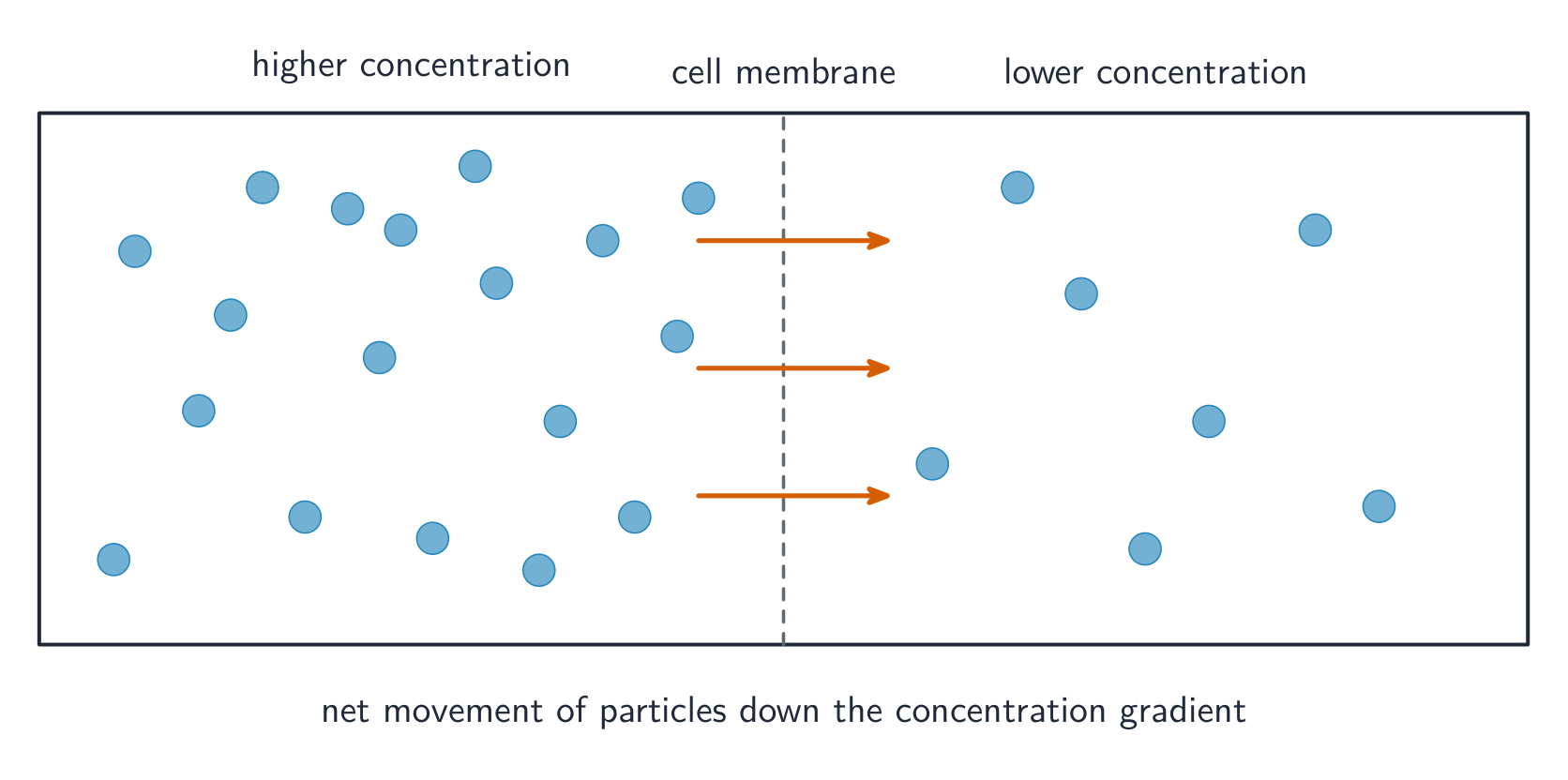
  • Passive transport 被动运输 moves substances down their concentration gradient (high → low) without cellular energy input – diffusion 扩散.
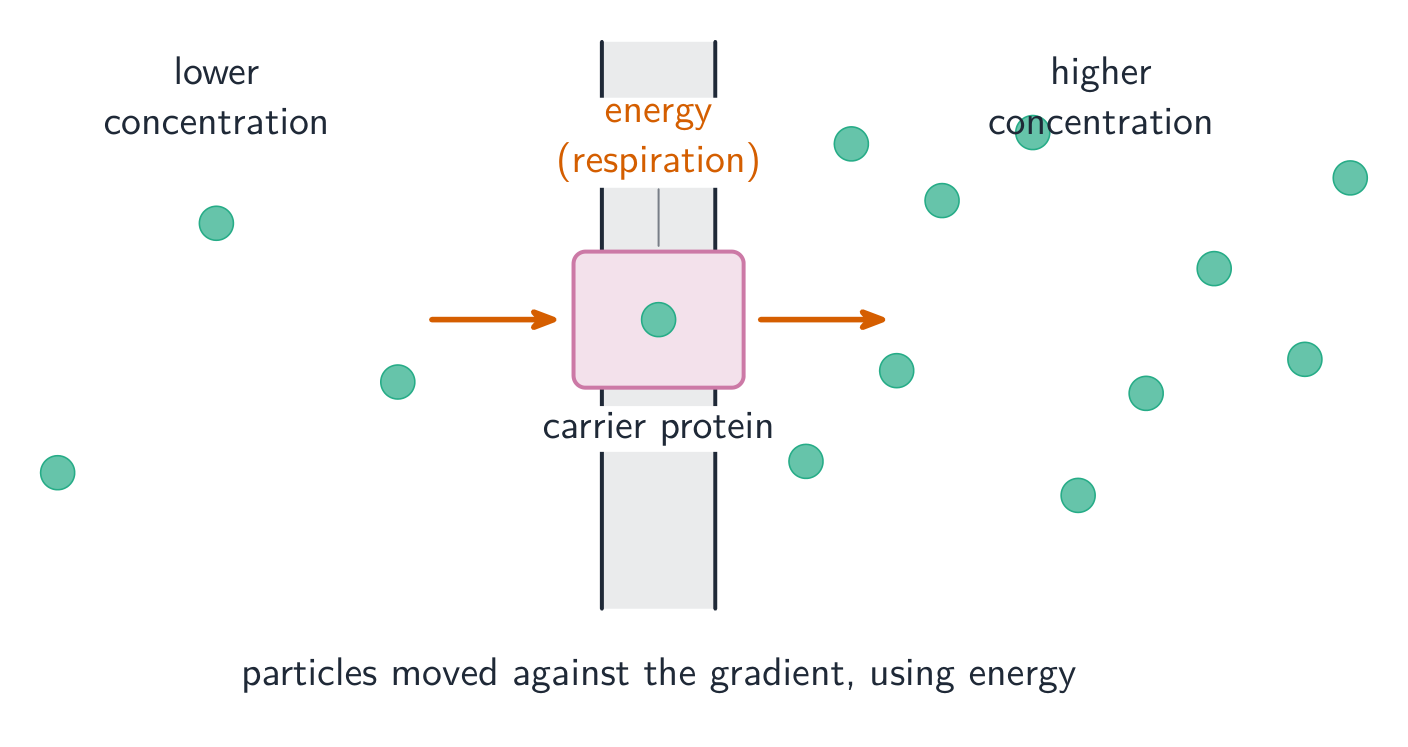
  • Active transport 主动运输 moves substances against the gradient (low → high), requiring energy, directly from ATP or indirectly from another gradient. Protein pumps like the sodium–potassium pump use ATP directly.

The sodium-potassium pump 钠钾泵 uses one ATP to move 3 $\text{Na}^+$ out of the cell and 2 $\text{K}^+$ in, both against their gradients. Because more positive charge leaves than enters, it helps keep the inside of the cell negative: the membrane potential that nerve and muscle cells depend on. Active transport always needs a membrane protein and a source of energy; when a cell runs out of ATP, the gradients slowly run down.

Active transport moves particles against the gradient, using ATP and a carrier protein
Jelajahi

Pompa zat terlarut melawan gradiennya

Transpor pasif menggerakkan zat terlarut turun searah gradien secara gratis; transpor aktif menggunakan ATP untuk memompanya ke arah sebaliknya, dari konsentrasi rendah ke tinggi.

Kosa kata Latih
English Bahasa Indonesia
Passive transport/ˈpæsɪv ˈtrænspɔːt/ transportasi pasif
diffusion/dɪˈfjuːʒn/ diffusion
Active transport/ˈæktɪv ˈtrænspɔːt/ transportasi aktif
sodium-potassium pump/ˈsəʊdɪəm pəˈtæsɪəm pʌmp/ pompa natrium-kalium
2.6

Difusi Terfasilitasi

Silabus

Ide Besar 2 — Energetika (ENE): Sistem biologis menggunakan energi dan blok bangunan molekuler untuk tumbuh, bereproduksi, dan mempertahankan homeostasis dinamis.

Tujuan Pembelajaran 2.6.A: Jelaskan bagaimana struktur molekul memengaruhi kemampuannya untuk menembus membran plasma.

  • 2.6.A.1 Difusi terfasilitasi memerlukan protein transpor atau protein saluran untuk memungkinkan pergerakan ion bermuatan melintasi membran.
    • i. Membran dapat menjadi terpolarisasi oleh pergerakan ion melintasi membran.
    • ii. Ion bermuatan, termasuk $\mathrm{Na^+}$ (natrium) dan $\mathrm{K^+}$ (kalium), memerlukan protein saluran untuk bergerak melalui membran.
  • 2.6.A.2 Difusi terfasilitasi memungkinkan pergerakan molekul polar besar melalui membran tanpa input energi. Dalam jenis difusi ini, zat-zat bergerak searah dengan gradien konsentrasi.
  • 2.6.A.3 Akuaporin mengangkut sejumlah besar air melintasi membran.

Sumber: Deskripsi Kursus dan Ujian College Board AP

English

Facilitated diffusion 易化扩散 is passive transport through a membrane protein – a channel or carrier 载体 – for particles that cannot cross the lipid alone. It still goes down the gradient and needs no energy, but its rate can saturate when all the proteins are busy.

Reading a rate graph. Free-response questions often plot the rate of uptake against the concentration outside the cell. For simple diffusion through the bilayer, the rate keeps rising in proportion to the concentration. For facilitated diffusion, the rate rises at first and then levels off: every channel or carrier is already in use, so more solute cannot make it faster. A level section is therefore evidence that a membrane protein is involved, and a cell with more of those proteins levels off at a higher rate.

Diffusion: particles spread from higher to lower concentration, down the gradient
Jelajahi

Difusi melalui protein

Partikel tetap bergerak menuruni gradiennya — tetapi di sini protein membran memberikan jalan bagi molekul bermuatan atau besar untuk lewat.

Kosa kata Latih
English Bahasa Indonesia
Facilitated diffusion/fəˈsɪlɪteɪtɪd dɪˈfjuːʒn/ difusi difasilitasi
carrier/ˈkærɪə/ pembawa
2.7

Tonicity, Water Potential, and Osmoregulation

Silabus

Ide Besar 2 — Energetika (ENE): Sistem biologis menggunakan energi dan blok bangunan molekuler untuk tumbuh, bereproduksi, dan mempertahankan homeostasis dinamis.

Tujuan Pembelajaran 2.7.A: Jelaskan bagaimana gradien konsentrasi memengaruhi pergerakan molekul melintasi membran.

  • 2.7.A.1 Lingkungan eksternal dapat bersifat hipotonik, hipertonik, atau isotonic terhadap lingkungan internal sel. Pergerakan air juga dapat dijelaskan sebagai bergerak dari daerah hipotonik ke daerah hipertonik. Air bergerak melalui osmosis dari daerah potensial air tinggi ke daerah potensial air rendah.
    • Persamaan (Potensial Air): $\psi = \psi_p + \psi_s$
      • di mana:
      • $\psi_p$ = potensial tekanan
      • $\psi_s$ = potensial zat terlarut
    • Contoh ilustratif untuk 2.7.A.1:
      • Vakuola kontraktil pada protista
      • Vakuola sentral pada sel tumbuhan

Tujuan Pembelajaran 2.7.B: Jelaskan bagaimana mekanisme osmoregulasi berkontribusi terhadap kesehatan dan kelangsungan hidup organisme.

  • 2.7.B.1 Pertumbuhan dan homeostasis dipertahankan oleh perpindahan molekul yang terus-menerus melintasi membran.
  • 2.7.B.2 Osmoregulasi menjaga keseimbangan air dan memungkinkan organisme mengontrol komposisi zat terlarut serta potensial air internalnya. Air bergerak dari daerah dengan osmolaritas rendah atau konsentrasi zat terlarut rendah ke daerah dengan osmolaritas tinggi atau konsentrasi zat terlarut tinggi.
    • Persamaan (Potensial Zat Terlarut Larutan): $\psi_s = -iCRT$
      • di mana:
      • $i$ = konstanta ionisasi
      • $C$ = konsentrasi molar
      • $R$ = konstanta tekanan $\left(R = 0.0831 \dfrac{L \cdot bars}{mol \cdot K}\right)$
      • $T$ = suhu dalam Kelvin (°C + 273)

Sumber: Deskripsi Kursus dan Ujian College Board AP

English
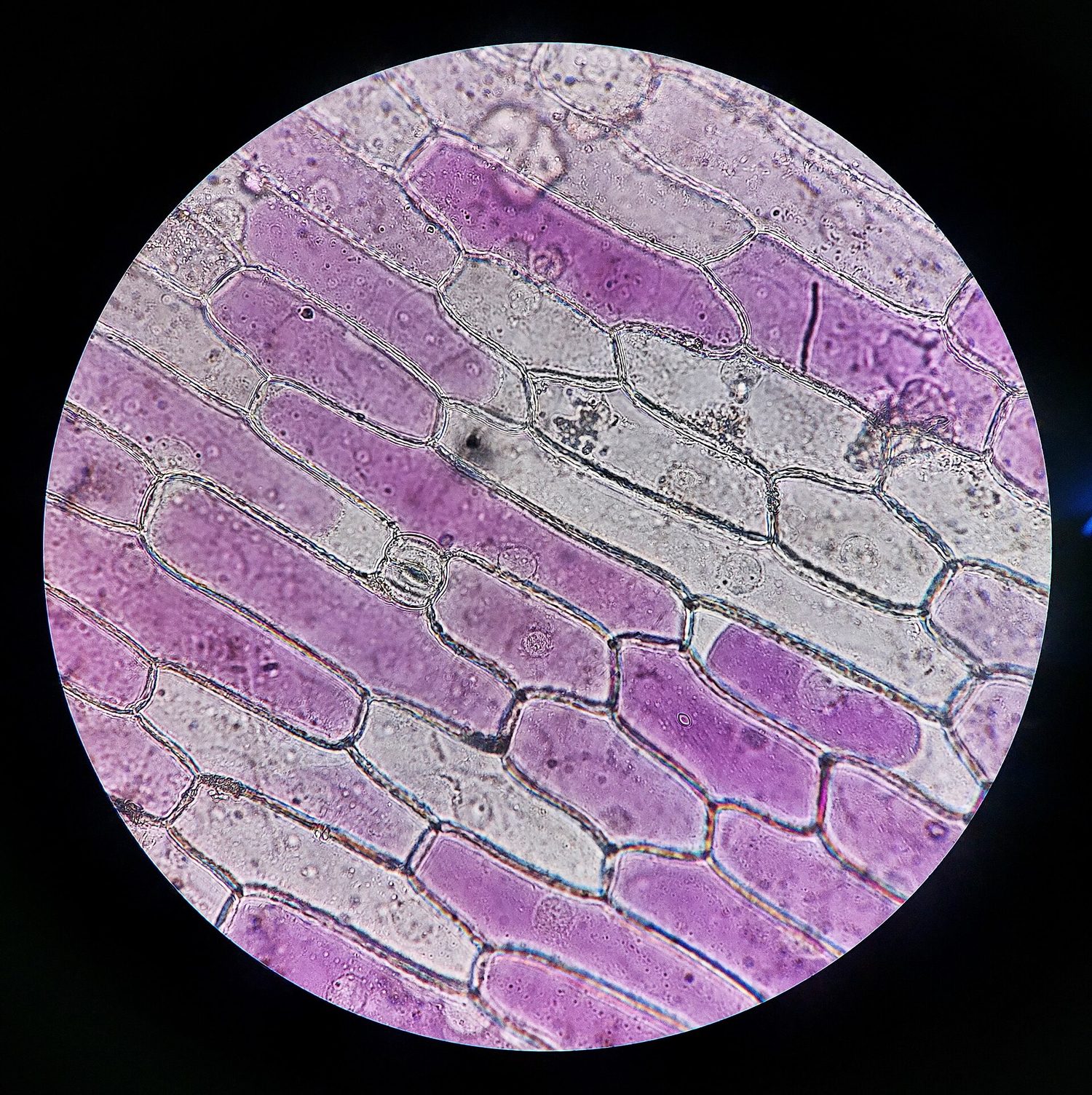
Red onion cells in hypertonic solution: the membrane pulls away from the wall (plasmolysis)

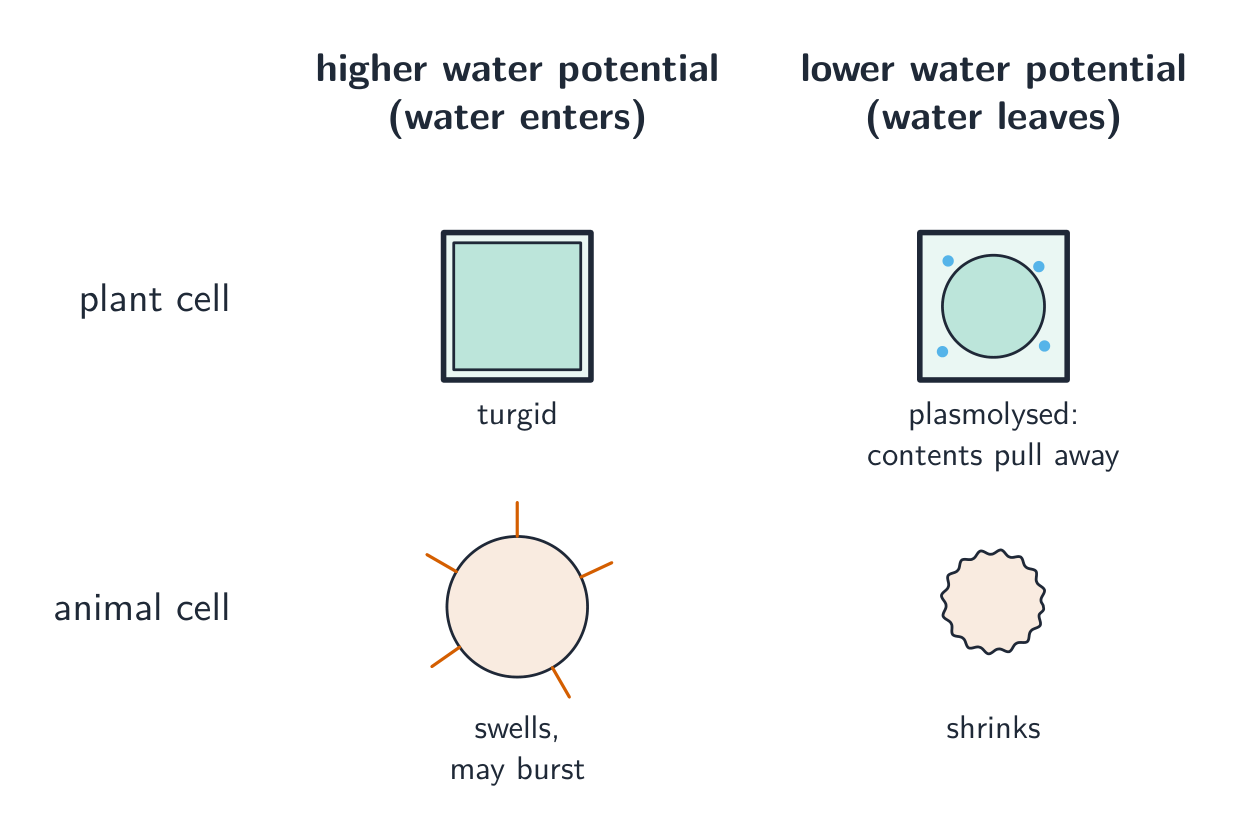
Osmosis 渗透 is the diffusion of water across a membrane. Tonicity 张力 compares concentrations of solutes that cannot cross the membrane: in a hypotonic 低渗 solution a cell gains water (may burst); in a hypertonic 高渗 one it loses water (shrinks); in an isotonic 等渗 one there is no net change. Water potential 水势 predicts the direction of water movement (water moves to lower water potential), and is the sum of a pressure term and a solute term: $\Psi=\Psi_p+\Psi_s$, where the solute potential $\Psi_s=-iCRT$. Osmoregulation 渗透调节 is how organisms control this balance.

Freshwater protists live in water that is hypotonic to their cytoplasm, so water flows in all the time. A contractile vacuole 收缩泡 collects it and pumps it out, using energy. Put the protist in a medium with even less solute and water enters faster, so the vacuole must fill and empty more often. In a plant cell, water entering the large central vacuole pushes the membrane against the cell wall, giving turgor pressure; the wall stops the cell from bursting.

How plant and animal cells respond to solutions of different water potential

Worked example. For a $0.1\,\text{M}$ sucrose solution ($i=1$) in an open beaker (so pressure potential $\Psi_p=0$) at $25\,°\text{C}$ ($T=298\,\text{K}$, $R=0.0831\ \text{L}\cdot\text{bar/mol}\cdot\text{K}$): $\Psi_s=-iCRT=-(1)(0.1)(0.0831)(298)\approx-2.48\ \text{bar}$, so $\Psi\approx-2.48\ \text{bar}$. A plant cell whose interior is $\Psi=-1.0\ \text{bar}$ sits in this solution: since the solution is more negative, water moves out of the cell into the solution, and the cell loses turgor.

Jelajahi

Saksikan pergerakan air melalui osmosis

Air bergerak melintasi membran dari potensial air tinggi ke rendah, menuju sisi yang lebih pekat (hipertonik). Atur konsentrasinya dan saksikan apakah sel membengkak atau menyusut.

Kosa kata Latih
English Bahasa Indonesia
Osmosis/ɒzˈməʊsɪs/ osmosis
Tonicity/təˈnɪsɪti/ tonisitas
hypotonic/ˌhaɪpəʊˈtɒnɪk/ hipotonik
hypertonic/ˌhaɪpəˈtɒnɪk/ hipertonik
isotonic/ˌaɪsəˈtɒnɪk/ isotonik
Water potential/ˈwɔːtə pəˈtenʃl/ potensial air
Osmoregulation/ˌɒzmɔːɡjʊˈleɪʃn/ osmoregulasi
contractile vacuole/kənˈtræktaɪl ˈvækjuːəʊl/ vakuola kontraktil
2.8

Mechanisms of Membrane Transport

Silabus

Ide Besar 2 — Energetika (ENE): Sistem biologis menggunakan energi dan blok bangunan molekuler untuk tumbuh, bereproduksi, dan mempertahankan homeostasis dinamis.

Tujuan Pembelajaran 2.8.A: Jelaskan proses-proses yang memungkinkan ion dan molekul lain bergerak melintasi membran.

  • 2.8.A.1 Energi metabolik (seperti dari ATP) diperlukan untuk transportasi aktif molekul melintasi membran serta untuk membentuk dan mempertahankan gradien elektrokimia.
    • i. Protein membran diperlukan untuk transportasi aktif.
    • ii. Pompa $\mathrm{Na^+}/\mathrm{K^+}$ dan ATPase berkontribusi pada pemeliharaan potensial membran.

Sumber: Deskripsi Kursus dan Ujian College Board AP

English

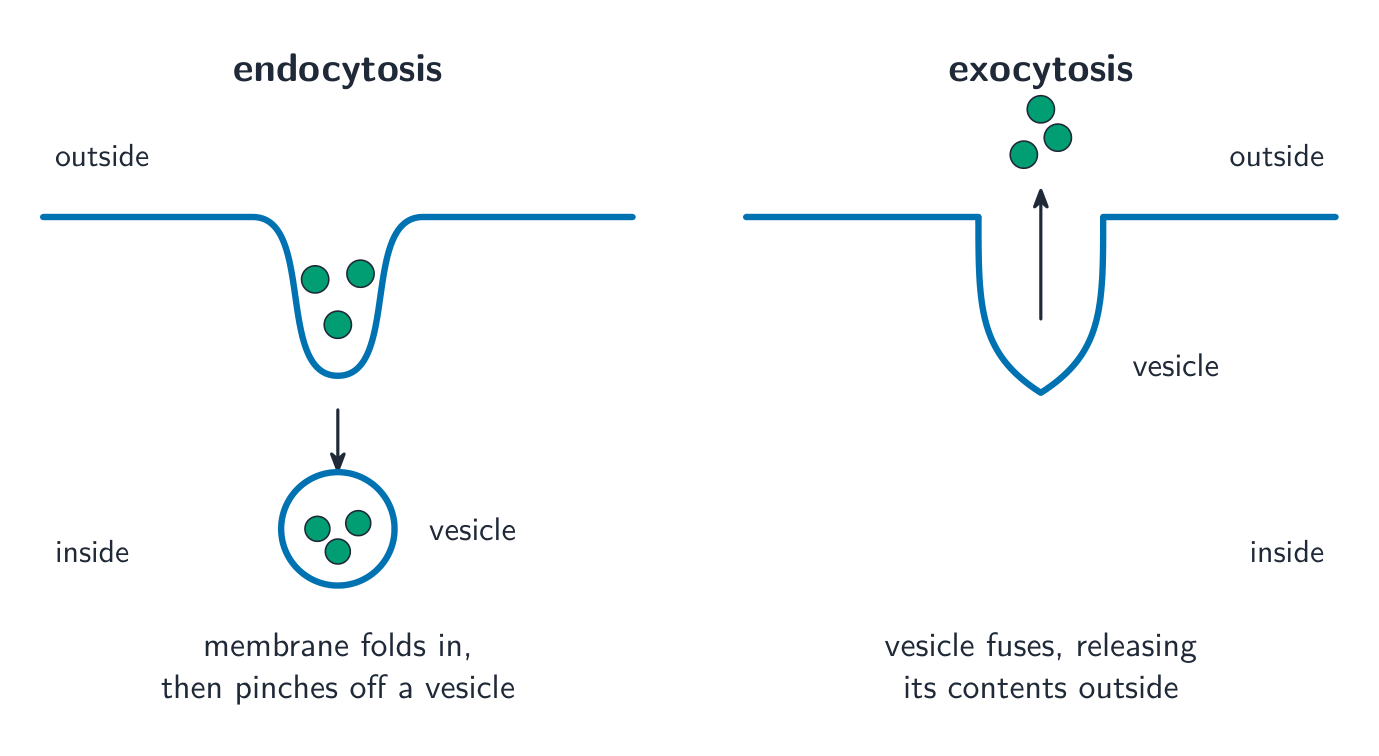
Large materials move in bulk by vesicles: endocytosis 内吞 brings material in (the membrane engulfs it), and exocytosis 外排 sends material out (a vesicle fuses with the membrane). Both require energy and let cells import and secrete large molecules.

Endocytosis brings material in; exocytosis releases it out
Kosa kata Latih
English Bahasa Indonesia
endocytosis/ˌendəʊsɪˈtəʊsɪs/ endositosis
exocytosis/eɡˌzɒsɪˈtəʊsɪs/ ekositosis
2.9

Compartmentalization Inside the Cell

Silabus

Ide Besar 2 — Energetika (ENE): Sistem biologis menggunakan energi dan blok bangunan molekuler untuk tumbuh, bereproduksi, dan mempertahankan homeostasis dinamis.

Tujuan Pembelajaran 2.9.A: Jelaskan struktur bermembran pada sel eukariotik.

  • 2.9.A.1 Membran dan organel bermembran pada sel eukariotik mengkompartementalkan proses metabolik intraseluler dan reaksi enzimatis spesifik.

Tujuan Pembelajaran 2.9.B: Jelaskan bagaimana membran internal dan organel bermembran berkontribusi terhadap kompartementalisasi fungsi sel eukariotik.

  • 2.9.B.1 Membran internal memfasilitasi proses seluler dengan meminimalkan interaksi yang saling bersaing dan meningkatkan luas permukaan tempat reaksi dapat terjadi.

Sumber: Deskripsi Kursus dan Ujian College Board AP

English

Membranes create separate compartments 区室 so incompatible reactions can run at once and conditions (pH, ion levels) can be tuned locally. This organization boosts efficiency – the internal membranes also add surface area for reactions.

Examples to use as evidence:

  • A lysosome keeps its digestive enzymes at about pH 5, while the cytosol is about pH 7.2. The enzymes work best at the lower pH, so they are less active in the cytosol; substantial leakage can still damage or kill the cell.
  • The inner membrane of a mitochondrion is folded into cristae, which gives a much larger area for the proteins of the electron transport chain. It also separates two compartments, so a proton gradient can build up between them.
  • In a chloroplast, the thylakoid membranes hold the light-reaction proteins, and protons build up inside each thylakoid.
Kosa kata Latih
English Bahasa Indonesia
compartments/kəmˈpɑːtmənts/ kompartemen
2.10

The Origins of Cell Compartmentalization

Silabus

Ide Besar 1 — Evolusi (EVO): Proses evolusi mendorong keanekaragaman dan kesatuan kehidupan.

Tujuan Pembelajaran 2.10.A: Deskripsikan kemiripan dan/atau perbedaan dalam kompartementalisasi antara sel prokariotik dan eukariotik.

  • 2.10.A.1 Organel terbungkus membran seperti mitokondria dan kloroplas berevolusi dari sel prokariotik yang sebelumnya hidup bebas melalui endosimbiosis.
  • 2.10.A.2 Prokariot biasanya tidak memiliki organel terbungkus membran internal tetapi memiliki wilayah internal dengan struktur dan fungsi khusus.
  • 2.10.A.3 Sel eukariotik mempertahankan membran internal yang mempartisi sel menjadi wilayah-wilayah yang terspesialisasi.

Sumber: Deskripsi Kursus dan Ujian College Board AP

English

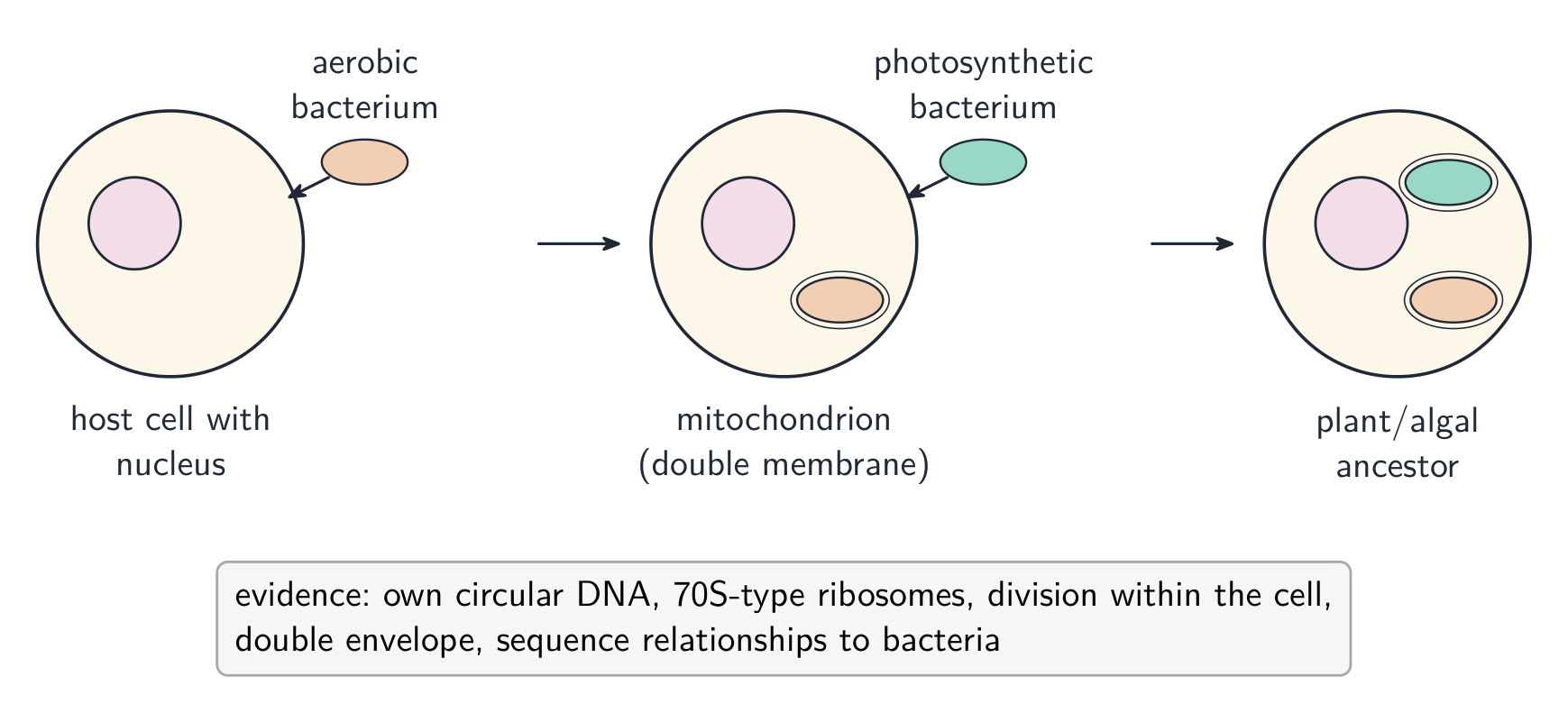
The endosymbiotic theory 内共生学说 explains mitochondria and chloroplasts: they arose when a larger cell engulfed free-living prokaryotes that then lived inside it. The evidence – their own circular DNA, their own ribosomes, and double membranes – supports this shared evolutionary origin.

A host cell engulfs an aerobic bacterium that becomes a mitochondrion with a double membrane, then a photosynthetic bacterium that becomes a chloroplast; evidence listed: own circular DNA, own ribosomes, division within the cell, double envelope
Engulfed prokaryotes became mitochondria and chloroplasts.

Prokaryotes 原核生物 (bacteria and archaea) usually have no membrane-bound organelles, but their cells still have specialised regions: the DNA sits in an area called the nucleoid, and ribosomes are spread through the cytoplasm. In bacteria, the enzymes of the Krebs cycle work in the cytosol; in eukaryotes they work inside mitochondria. Eukaryotic cells keep many internal membranes that divide them into specialised regions.

Exam skill (experiments). Many unit 2 free-response questions describe a real experiment. The independent variable is what the researchers changed (for example, the ouabain concentration); the dependent variable is what they measured (the pump's activity). A control is a group treated the same way except for the factor being tested, such as normal kidney cells beside diseased ones, or cells with no inhibitor. When asked to "justify a control", say what it rules out: it shows that any difference is caused by the factor tested, not by something else in the method.

Common mistakes.

  • Using "hypertonic" without saying compared with what. Tonicity always compares two solutions: the solution outside is hypertonic to the cell when it has a higher concentration of solutes that cannot cross the membrane than the cell's cytoplasm.
  • Moving water the wrong way. With equal pressure potential, water moves towards the hypertonic side, which has the lower water potential. When pressures differ, compare total water potentials.
  • Dropping the minus sign in $\Psi_s = -iCRT$. Adding solute always makes the solute potential more negative.
  • Forgetting $i$ for an ionic solute. NaCl gives two particles, so $i = 2$ and $\Psi_s$ is about twice that of sucrose at the same molarity.
  • Saying water crosses the membrane only through aquaporins. A little crosses the bilayer directly; aquaporins make it much faster.
  • Calling facilitated diffusion active because it uses a protein. Any movement down the gradient is passive, with or without a channel or carrier.
  • Saying membrane proteins are made by free ribosomes. Proteins for the membrane or for export are made by ribosomes on the rough ER.
  • Saying the Golgi makes proteins. Ribosomes make them; the Golgi modifies, sorts and packages them.
  • Saying ions cross the membrane because they are small. They are blocked by the nonpolar core because they are charged, however small.
  • Saying the sodium-potassium pump moves equal numbers of ions. It moves 3 Na⁺ out and 2 K⁺ in per ATP.
Kosa kata Latih
English Bahasa Indonesia
endosymbiotic theory/ˌendəʊˌsɪmbaɪˈɒtɪk ˈθɪəri/ Teori endosimbiosis
prokaryotes/ˈprɒkərɪəʊts/ Prokariot
2.10

Latihan

English

Answer each before reading the answers below.

  1. Calculate the surface-area-to-volume ratio of a cube-shaped cell of side $1$ µm and of side $3$ µm. Which exchanges materials more efficiently, and why?
  2. Calculate the solute potential of a $0.10\ M$ sucrose solution at $295$ K ($\Psi_s = -iCRT$, $R = 0.0831$ L·bar/(mol·K)). A potato cell with $\Psi = -3.0$ bars is placed in it. Which way does water move?
  3. Predict what happens to a red blood cell placed in a hypertonic solution, and explain.
  4. Which of these cross the phospholipid bilayer without a protein: $\text{O}_2$, glucose, $\text{Na}^+$, a steroid hormone? Explain.
  5. The sodium-potassium pump moves $3\ \text{Na}^+$ out and $2\ \text{K}^+$ in per ATP. Explain why this is active transport.
  6. In an experiment, dialysis bags containing $0$, $0.2$, $0.4$ and $0.6\ M$ sucrose are placed in distilled water and weighed after $30$ minutes. Identify the independent variable, the dependent variable and an appropriate control.
  7. Give two pieces of evidence that mitochondria were once free-living prokaryotes.
2.10

Jawaban

English
  1. $1$ µm: $6 \div 1 = 6\ \mu\text{m}^{-1}$; $3$ µm: $54 \div 27 = 2\ \mu\text{m}^{-1}$. The smaller cell has more membrane per unit volume, so it exchanges materials faster relative to its needs.
  2. $\Psi_s = -(1)(0.10)(0.0831)(295) = -2.45$ bars. Water moves from higher water potential ($-2.45$) to lower ($-3.0$), so into the potato, which gains mass.
  3. It shrinks (crenates): water potential is lower outside, so water leaves the cell by osmosis.
  4. $\text{O}_2$ and the steroid hormone, because they are small or nonpolar and dissolve in the hydrophobic core. Glucose (large, polar) and $\text{Na}^+$ (charged) need channels or carriers.
  5. It moves both ions against their concentration gradients and uses energy from ATP hydrolysis.
  6. Independent: sucrose concentration in the bag. Dependent: percent change in mass. Control: a bag containing distilled water ($0\ M$).
  7. Any two: they have their own circular DNA; they have a double membrane; their ribosomes resemble bacterial ribosomes; they divide by a process like binary fission.
2.10

Tips ujian

English
  • Use the two AP-formula skills: surface-area-to-volume ratio (why cells stay small) and water potential $\Psi=\Psi_p+\Psi_s$ ($\Psi_s=-iCRT$).
  • Water moves toward the lower (more negative) water potential; predict swelling or shrinking from tonicity (hypo/hyper/isotonic).
  • Passive transport and osmosis need no energy (down the gradient); active transport needs energy, directly from ATP or indirectly from another gradient (against the gradient).
  • Distinguish diffusion, facilitated diffusion (a channel/carrier protein), and active transport.
  • Explain membrane selectivity from the phospholipid bilayer — small non-polar molecules cross, large/charged ones need help.

Pelajaran interaktif untuk topik ini

Kerjakan langkah demi langkah, dengan latihan pengecekan instan.

Soal-Soil Masa Lalu

Topik lain dalam AP Biologi

Masuk atau buat akun

IGCSE, A-Level & AP