Tataplah Matahari. Setiap detik, ia mengubah empat juta ton dirinya sendiri — hilang, lenyap — menjadi energi murni. Tidak terbakar. Dikonversi. Massa yang hilang…
English narration · English + 中文 subtitles burned in · Narasi bahasa Inggris · Subtitle bahasa Inggris + 中文 disematkan langsung
understand the equivalence between energy and mass as represented by $E = mc^2$ and recall and use this equation
represent simple nuclear reactions by nuclear equations of the form $^{14}_{7}\text{N} + ^{4}_{2}\text{He} \rightarrow ^{17}_{8}\text{O} + ^{1}_{1}\text{H}$
define and use the terms mass defect and binding energy
sketch the variation of binding energy per nucleon with nucleon number
explain what is meant by nuclear fusion and nuclear fission
explain the relevance of binding energy per nucleon to nuclear reactions, including nuclear fusion and nuclear fission
calculate the energy released in nuclear reactions using $E = c^2 \Delta m$
Bahasa Indonesia
memahami ekuivalensi antara energi dan massa yang direpresentasikan oleh $E = mc^2$ dan mengingat serta menggunakan persamaan ini
merepresentasikan reaksi nuklir sederhana melalui persamaan nuklir berbentuk $^{14}_{7}\text{N} + ^{4}_{2}\text{He} \rightarrow ^{17}_{8}\text{O} + ^{1}_{1}\text{H}$
mendefinisikan dan menggunakan istilah defek massa dan energi ikat
membuat sketsa variasi energi ikat per nukleon terhadap nomor nukleon
menjelaskan makna fusi nuklir dan fisi nuklir
menjelaskan relevansi energi ikat per nukleon terhadap reaksi nuklir, termasuk fusi nuklir dan fisi nuklir
menghitung energi yang dilepaskan dalam reaksi nuklir menggunakan $E = c^2 \Delta m$
Source: Cambridge International syllabus · Sumber: Silabus Cambridge International
English
Einstein's special relativity gives the famous link (mass-energy equivalence 质能等价):
$$E = m c^{2},$$
where $c = 3.00 \times 10^{8}\ \text{m s}^{-1}$. A mass $m$ matches an energy 能量$E$ — the two can change into each other. For a mass change $\Delta m$:
Worked example. The star Sirius loses mass through nuclear fusion at $1.09 \times 10^{11}\ \text{kg s}^{-1}$. Find the power it radiates.
Every kilogram that disappears leaves as energy: $P = c^{2} \times (\text{mass lost per second}) = (3.00 \times 10^{8})^{2}(1.09 \times 10^{11}) = 9.8 \times 10^{27}\ \text{W}$. This is the star's luminosity 光度 (Topic 25); the Sun's is $3.8 \times 10^{26}\ \text{W}$, so it loses about $4$ million tonnes a second. The same idea in reverse: a power station producing $1\ \text{GW}$ for a year converts $E/c^{2} = 3.2 \times 10^{16}/9.0 \times 10^{16} = 0.35\ \text{kg}$ of mass, which is why the fuel weighs almost the same afterwards.
$$\Delta E = c^{2} \Delta m.$$
In nuclear physics the masses are tiny but $c^{2}$ is huge, so a small mass change means a large energy. A mass change of $1\ \text{u}$ ($1.661 \times 10^{-27}\ \text{kg}$) matches $\Delta E \approx 1.49 \times 10^{-10}\ \text{J}$. This gives a conversion you will use again and again:
Relativitas khusus Einstein memberikan hubungan terkenal (kesetaraan massa-energi):
Massa dan energi ekuivalen dan dapat berubah satu sama lain
$$E = m c^{2},$$
di mana $c = 3.00 \times 10^{8}\ \text{m s}^{-1}$. Satu massa $m$ setara dengan energi$E$ — keduanya dapat berubah menjadi yang lain. Untuk perubahan massa $\Delta m$:
Contoh terpecahkan. Bintang Sirius kehilangan massa melalui fusi nuklir pada $1.09 \times 10^{11}\ \text{kg s}^{-1}$. Temukan daya yang dipancarkannya.
Setiap kilogram yang hilang meninggalkan sebagai energi: $P = c^{2} \times (\text{mass lost per second}) = (3.00 \times 10^{8})^{2}(1.09 \times 10^{11}) = 9.8 \times 10^{27}\ \text{W}$. Ini adalah luminositas bintang (Topik 25); luminositas Matahari adalah $3.8 \times 10^{26}\ \text{W}$, sehingga ia kehilangan sekitar $4$ juta ton per detik. Ide yang sama secara terbalik: pembangkit listrik yang menghasilkan $1\ \text{GW}$ selama satu tahun mengonversi $E/c^{2} = 3.2 \times 10^{16}/9.0 \times 10^{16} = 0.35\ \text{kg}$ massa, itulah sebabnya bahan bakar beratnya hampir sama setelah itu.
$$\Delta E = c^{2} \Delta m.$$
Dalam fisika nuklir, massanya sangat kecil tetapi $c^{2}$ sangat besar, sehingga perubahan massa kecil berarti energi besar. Perubahan massa $1\ \text{u}$ ($1.661 \times 10^{-27}\ \text{kg}$) setara dengan $\Delta E \approx 1.49 \times 10^{-10}\ \text{J}$. Ini memberikan konversi yang akan Anda gunakan lagi dan lagi:
with nucleon number 核子数 conserved (top numbers: $14 + 4 = 17 + 1$) and charge conserved (bottom numbers: $7 + 2 = 8 + 1$) — this is conservation of charge 电荷守恒. Use these to fill in an unknown: identify the species, then balance the top and bottom numbers.
The decay equations. Alpha decay removes $^{4}_{2}\text{He}$, so $A$ falls by 4 and $Z$ by 2: $^{211}_{84}\text{Po} \to {}^{207}_{82}\text{Pb} + {}^{4}_{2}\text{He}$. Beta-minus decay turns a neutron into a proton, emitting an electron and an antineutrino: $^{15}_{6}\text{C} \to {}^{15}_{7}\text{N} + {}^{0}_{-1}\text{e} + \bar{\nu}$ ($A$ unchanged, $Z$ up by 1). Beta-plus decay turns a proton into a neutron, emitting a positron 正电子 and a neutrino 中微子: $^{18}_{9}\text{F} \to {}^{18}_{8}\text{O} + {}^{0}_{+1}\text{e} + \nu$ ($Z$ down by 1). Gamma emission changes neither number. In a chain of decays just keep the books: a nucleus W that emits $\beta^{-}$, then $\alpha$, then $\beta^{-}$ ends with $A - 4$ and $Z + 1 - 2 + 1 = Z$, an isotope of W. Check both lines of every equation you complete, and remember the neutrino: the mark scheme includes it.
dengan nomor nukleon terjaga (angka atas: $14 + 4 = 17 + 1$) dan muatan terjaga (angka bawah: $7 + 2 = 8 + 1$) — ini adalah kekekalan muatan. Gunakan ini untuk mengisi yang tidak diketahui: identifikasi spesiesnya, lalu seimbangkan angka atas dan bawah.
Persamaan peluruhan. Peluruhan alpha melepaskan $^{4}_{2}\text{He}$, sehingga $A$ turun sebesar 4 dan $Z$ turun sebesar 2: $^{211}_{84}\text{Po} \to {}^{207}_{82}\text{Pb} + {}^{4}_{2}\text{He}$. Peluruhan beta-minus mengubah neutron menjadi proton, memancarkan elektron dan antineutrino: $^{15}_{6}\text{C} \to {}^{15}_{7}\text{N} + {}^{0}_{-1}\text{e} + \bar{\nu}$ ($A$ tidak berubah, $Z$ naik 1). Peluruhan beta-plus mengubah proton menjadi neutron, memancarkan positron dan neutrino: $^{18}_{9}\text{F} \to {}^{18}_{8}\text{O} + {}^{0}_{+1}\text{e} + \nu$ ($Z$ turun 1). Emisi gamma tidak mengubah kedua angka tersebut. Dalam rantai peluruhan, cukup catat: inti W yang memancarkan $\beta^{-}$, kemudian $\alpha$, lalu $\beta^{-}$ berakhir dengan $A - 4$ dan $Z + 1 - 2 + 1 = Z$, sebuah isotop dari W. Periksa kedua baris setiap persamaan yang Anda lengkapkan, dan ingat neutrino: kunci jawaban menyertakannya.
Mass defect and binding energy · Defek massa dan energi ikat
English
The mass of a nucleus 原子核 is less than the total mass of its separate protons 质子 and neutrons 中子. The difference is the mass defect 质量亏损$\Delta m$:
$$\Delta m = (Z m_{\text{p}} + N m_{\text{n}}) - m_{\text{nucleus}}.$$
By $E = mc^{2}$, this "missing" mass was released as energy when the nucleus formed. To pull the nucleus fully apart you must put that energy back — the binding energy 结合能$B$:
$$B = \Delta m \cdot c^{2}.$$
Worked example. A helium-4 nucleus has a mass defect of $\Delta m = 0.0304\ \text{u}$. Find its binding energy. ($1\ \text{u}$ corresponds to $931\ \text{MeV}$.)
A more tightly bound nucleus has a larger mass defect and larger binding energy. The binding energy per nucleon 比结合能 is $B/A$ (usually in MeV per nucleon) — a measure of how tightly each nucleon is held, useful for comparing nuclides.
The two-mark definitions.The mass defect of a nucleus is the difference between the total mass of its separate nucleons and the mass of the nucleus.The binding energy is the minimum energy required to separate the nucleus into its individual nucleons (equivalently, the energy released when the nucleus is formed from separate nucleons). Say "separate nucleons" or "individual protons and neutrons"; "the energy holding the nucleus together" scores nothing. Binding energy is released, not stored: the nucleus has less energy than its parts.
Worked example. The masses are: proton $1.007\,276\ \text{u}$, neutron $1.008\,665\ \text{u}$, polonium-212 nucleus $211.945\,4\ \text{u}$. Find the mass defect and the binding energy per nucleon of $^{212}_{84}\text{Po}$.
$Z = 84$ protons and $N = 212 - 84 = 128$ neutrons: total $84 \times 1.007\,276 + 128 \times 1.008\,665 = 84.611\,2 + 129.109\,1 = 213.720\,3\ \text{u}$. Mass defect $\Delta m = 213.720\,3 - 211.945\,4 = 1.774\,9\ \text{u}$. Binding energy $= 1.774\,9 \times 931.5 = 1653\ \text{MeV}$, so per nucleon $1653/212 = 7.80\ \text{MeV}$, on the falling part of the curve. Keep every decimal place until the subtraction: the defect is a small difference of two large numbers.
Binding energy per nucleon vs nucleon number
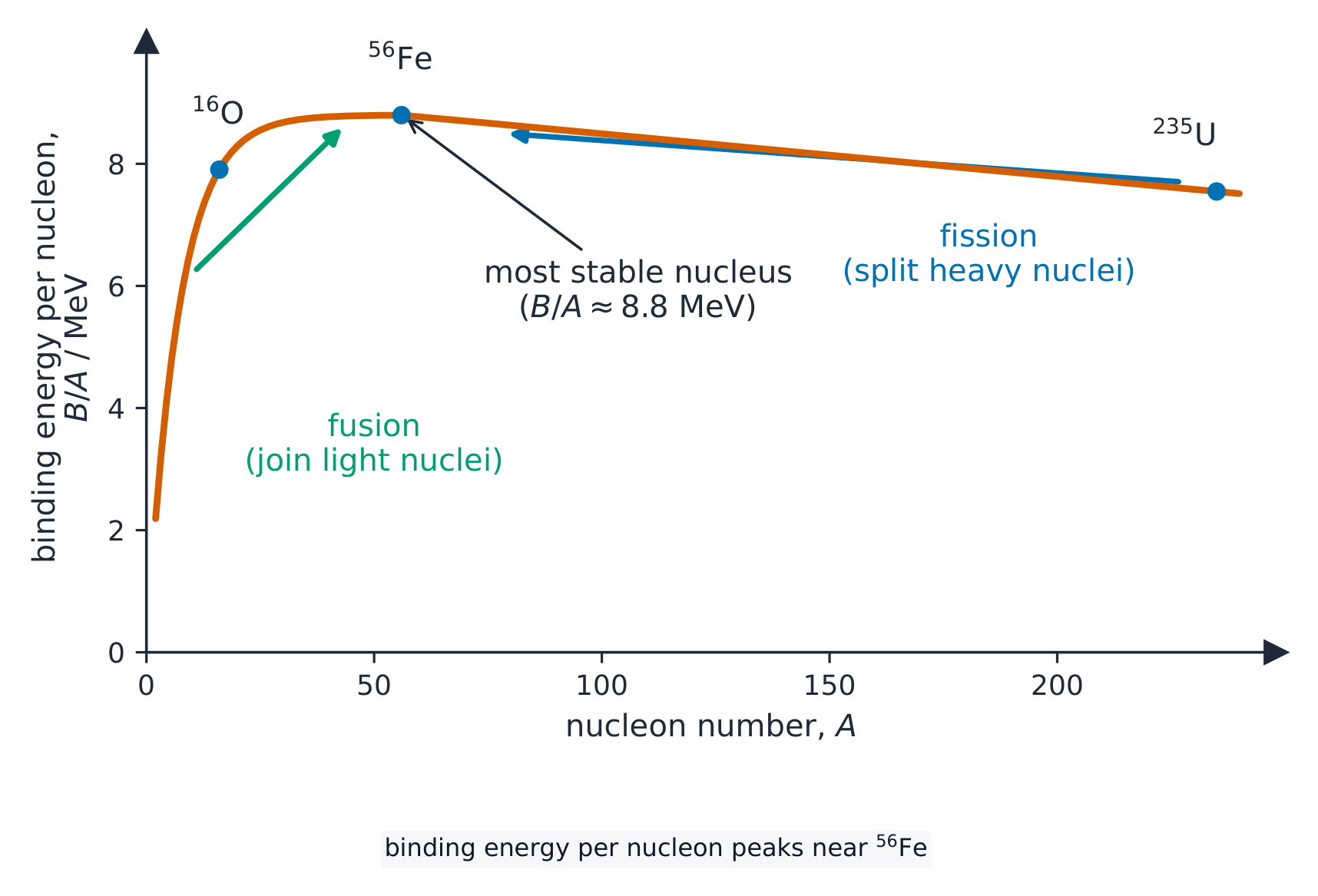
A graph of $B/A$ against $A$ has a typical shape:
for light nuclei ($A < 20$), $B/A$ rises quickly (with a spike at the very stable $^{4}_{2}\text{He}$).
around $A \sim 56$ (iron), $B/A$ reaches its maximum of about $8.8\ \text{MeV}$. Iron-56 is the most stable nucleus.
for heavy nuclei ($A > 100$), $B/A$ falls slowly, to about $7.5\ \text{MeV}$ for uranium.
So the curve is dome-shaped, rising to iron then falling.
Sketching the curve. The exam gives blank axes ($A$ from 1 to 250, $B/A$ up to about $9\ \text{MeV}$) and marks: a steep rise from near zero at $A = 1$, a maximum near $A = 56$ at about $8.8\ \text{MeV}$, then a slow, gentle fall to about $7.5\ \text{MeV}$ at $A = 238$. Do not start the curve at the origin exactly (hydrogen-1 has no binding energy but is a single point), do not make the fall as steep as the rise, and do not let the curve reach zero on the right. Asked to mark a nucleus that undergoes alpha decay, put X on the far right, $A > 200$; a nucleus that undergoes fusion goes at the far left, $A < 10$; both are at low $B/A$, moving up the curve when they react.
Bahasa Indonesia
Massa intilebih kecil daripada total massa proton dan neutron terpisahnya. Selisihnya adalah defek massa$\Delta m$:
$$\Delta m = (Z m_{\text{p}} + N m_{\text{n}}) - m_{\text{nucleus}}.$$
Berdasarkan $E = mc^{2}$, massa "hilang" ini dilepaskan sebagai energi saat inti terbentuk. Untuk memisahkan inti sepenuhnya, Anda harus memasukkan kembali energi itu — energi ikat$B$:
$$B = \Delta m \cdot c^{2}.$$
*Inti yang berkumpul memiliki massa lebih kecil daripada nukleon-nukleon terpisahnya; massa yang hilang dilepaskan sebagai energi ikat
Contoh terpecahkan. Inti helium-4 memiliki defek massa $\Delta m = 0.0304\ \text{u}$. Temukan energi ikatnya. ($1\ \text{u}$ setara dengan $931\ \text{MeV}$.)
Inti yang terikat lebih kuat memiliki defek massa dan energi ikat yang lebih besar. Energi ikat per nukleon adalah $B/A$ (biasanya dalam MeV per nukleon) — ukuran seberapa kuat setiap nukleon diikat, berguna untuk membandingkan nuklida.
Definisi dua nilai.Defek massa suatu inti adalah selisih antara total massa nukleon-nukleon terpisahnya dan massa intinya.Energi ikat adalah energi minimum yang diperlukan untuk memisahkan inti menjadi nukleon-nukleon individualnya (setara dengan energi yang dilepaskan ketika inti terbentuk dari nukleon-nukleon terpisah). Katakan "nukleon-nukleon terpisah" atau "proton dan neutron individual"; "energi yang mengikat inti bersama" tidak mendapat nilai. Energi ikat dilepaskan, bukan disimpan: inti memiliki energi lebih sedikit daripada bagian-bagiannya.
Contoh terpecahkan. Massanya adalah: proton $1.007\,276\ \text{u}$, neutron $1.008\,665\ \text{u}$, inti polonium-212 $211.945\,4\ \text{u}$. Temukan defek massa dan energi ikat per nukleon dari $^{212}_{84}\text{Po}$.
$Z = 84$ proton dan $N = 212 - 84 = 128$ neutron: total $84 \times 1.007\,276 + 128 \times 1.008\,665 = 84.611\,2 + 129.109\,1 = 213.720\,3\ \text{u}$. Defek massa $\Delta m = 213.720\,3 - 211.945\,4 = 1.774\,9\ \text{u}$. Energi ikat $= 1.774\,9 \times 931.5 = 1653\ \text{MeV}$, sehingga per nukleon $1653/212 = 7.80\ \text{MeV}$, pada bagian menurun kurva. Pertahankan setiap desimal hingga pengurangan: defeknya adalah selisih kecil dari dua bilangan besar.
Energi ikat per nukleon vs nomor nukleon
Grafik $B/A$ terhadap $A$ memiliki bentuk khas:
untuk inti ringan ($A < 20$), $B/A$ naik cepat (dengan puncak pada $^{4}_{2}\text{He}$ yang sangat stabil).
di sekitar $A \sim 56$ (besi), $B/A$ mencapai maksimum sekitar $8.8\ \text{MeV}$. Besi-56 adalah inti paling stabil.
untuk inti berat ($A > 100$), $B/A$ turun perlahan, hingga sekitar $7.5\ \text{MeV}$ untuk uranium.
Jadi kurvanya berbentuk kubah, naik menuju besi lalu turun.
Menggambar sketsa kurva. Ujian menyediakan sumbu kosong ($A$ dari 1 hingga 250, $B/A$ hingga sekitar $9\ \text{MeV}$) dan menandai: kenaikan curam dari dekat nol pada $A = 1$, maksimum di sekitar $A = 56$ pada sekitar $8.8\ \text{MeV}$, kemudian penurunan lambat dan landai hingga sekitar $7.5\ \text{MeV}$ pada $A = 238$. Jangan mulai kurva tepat di titik asal (hidrogen-1 tidak memiliki energi ikat tetapi merupakan titik tunggal), jangan buat penurunan securam kenaikan, dan jangan biarkan kurva mencapai nol di sisi kanan. Diminta untuk menandai inti yang mengalami peluruhan alpha, letakkan X di ujung kanan, $A > 200$; inti yang mengalami fusi diletakkan di ujung kiri, $A < 10$; keduanya berada pada $B/A$ rendah, bergerak naik sepanjang kurva saat bereaksi.
Energi ikat per nukleon mencapai puncaknya di dekat besi ($A \approx 56$); inti yang lebih ringan dan lebih berat terikat kurang kuat
Explore · Jelajahi
Mass defect energy lab · Laboratorium energi kehilangan massa
E = delta m c^2
Change mass defect and see binding energy rise with E = mc^2. · Ubah kehilangan massa dan lihat energi ikat meningkat dengan E = mc^2.
The product has greater binding energy per nucleon than the reactants, so energy is released. Fusion powers stars. It needs very high temperatures (millions of kelvin) so the nuclei have enough kinetic energy 动能 to beat their electrostatic 静电 repulsion and get close enough for the strong nuclear force 强核力 to take over.
Nuclear fission
Nuclear fission 核裂变 splits a heavy nucleus into two lighter ones:
The products have higher binding energy per nucleon than $^{235}$U, so energy is released. The extra neutrons can cause more fissions — a chain reaction 链式反应 in a large enough mass of fuel (the critical mass 临界质量). This is the basis of nuclear power and weapons.
"Describe the differences between fission and fusion." Fission: a heavy nucleus (large $A$) splits into two lighter nuclei of roughly similar mass, usually after absorbing a neutron, releasing further neutrons. Fusion: two light nuclei (small $A$) join to form one heavier nucleus; it needs very high temperature and pressure to overcome the electrostatic repulsion between the nuclei. Both release energy, but per kilogram of fuel fusion releases more.
"Explain, with reference to the curve, why energy is released." In both processes the products lie higher on the binding-energy-per-nucleon curve than the reactants: each nucleon ends up more tightly bound, so the total binding energy increases. The extra binding energy is released (as the kinetic energy of the products and as photons), and the total mass of the products is less than that of the reactants by $\Delta E/c^{2}$. A nucleus near the peak (iron) can release energy by neither process, which is why the stars' fusion stops at iron.
Calculating the energy released
find the total mass of the reactants.
find the total mass of the products.
mass change $\Delta m = m_{\text{reactants}} - m_{\text{products}}$ (positive when energy is released).
energy released $\Delta E = c^{2} \Delta m$.
In kg this gives joules; in atomic mass units use $\Delta E\ (\text{MeV}) = \Delta m\ (\text{u}) \times 931$.
Worked example. In a nuclear reaction the total mass decreases by $0.020\ \text{u}$. Find the energy released.
Worked example (fusion). The mass defect of deuterium $^{2}_{1}\text{H}$ is $0.002\,388\ \text{u}$ and that of helium-4 is $0.030\,377\ \text{u}$. Find the energy released when two deuterium nuclei fuse to form one helium-4 nucleus.
Energy released $=$ (binding energy of the products) $-$ (binding energy of the reactants) $= [0.030\,377 - 2 \times 0.002\,388] \times 931.5 = 0.025\,601 \times 931.5 = 23.8\ \text{MeV}$ ($3.82 \times 10^{-12}\ \text{J}$). Mass defects can be used directly like this because the number of nucleons is the same on both sides; the difference in the defects is the mass converted. Per kilogram of deuterium this is $5.7 \times 10^{14}\ \text{J}$, about a million times a chemical fuel.
Worked example (fission).$^{235}_{92}\text{U} + {}^{1}_{0}\text{n} \to {}^{141}_{56}\text{Ba} + {}^{92}_{36}\text{Kr} + 3\,{}^{1}_{0}\text{n}$. Masses: U-235 $235.043\,9\ \text{u}$, n $1.008\,665\ \text{u}$, Ba-141 $140.914\,4\ \text{u}$, Kr-92 $91.926\,2\ \text{u}$. Find the energy released.
Reactants: $235.043\,9 + 1.008\,665 = 236.052\,6\ \text{u}$. Products: $140.914\,4 + 91.926\,2 + 3 \times 1.008\,665 = 235.866\,6\ \text{u}$. $\Delta m = 0.186\,0\ \text{u}$, so $\Delta E = 0.186\,0 \times 931.5 = 173\ \text{MeV} = 2.8 \times 10^{-11}\ \text{J}$ per fission. Count the three neutrons on the right and the one on the left: forgetting one changes the answer by a whole nucleon mass.
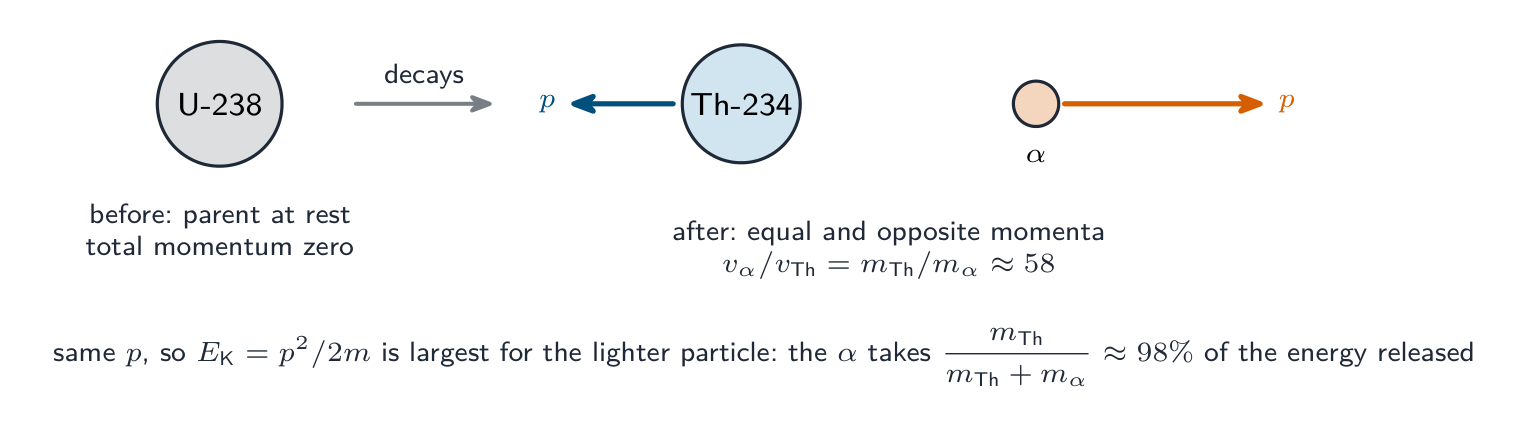
Worked example (alpha decay and momentum). A stationary $^{238}_{92}\text{U}$ nucleus decays to $^{234}_{90}\text{Th}$ by emitting an $\alpha$-particle; the total kinetic energy released is $4.27\ \text{MeV}$. Find the kinetic energy of the $\alpha$-particle.
Momentum is conserved and the parent was at rest, so the $\alpha$ and the thorium nucleus have equal and opposite momenta $p$. With $E_{\text{K}} = p^{2}/2m$, the energies are in the inverse ratio of the masses: $E_{\alpha}/E_{\text{Th}} = m_{\text{Th}}/m_{\alpha} = 234/4$. So $E_{\alpha} = 4.27 \times 234/238 = 4.20\ \text{MeV}$ and the thorium recoil 反冲 takes only $0.07\ \text{MeV}$. The $\alpha$-particles from a given decay are all emitted with this one energy, which is the sign that the energy is shared between just two bodies.
Worked example (a radioactive power source). A space probe is powered by $0.874\ \text{kg}$ of plutonium-238, half-life $87.7$ years, each decay releasing $5.59\ \text{MeV}$. Find the power available at launch.
Number of nuclei: $N = 0.874/(238 \times 1.661 \times 10^{-27}) = 2.21 \times 10^{24}$. Decay constant: $\lambda = 0.693/(87.7 \times 3.156 \times 10^{7}) = 2.50 \times 10^{-10}\ \text{s}^{-1}$. Activity: $A = \lambda N = 5.53 \times 10^{14}\ \text{Bq}$. Power $= A \times E = 5.53 \times 10^{14} \times 5.59 \times 1.60 \times 10^{-13} = 490\ \text{W}$, falling to half after $87.7$ years. A nuclide with a shorter half-life would give more power per kilogram but would not last the mission; polonium-210 ($138$ days) would be far more powerful at first and useless within two years.
Bahasa Indonesia
Pembangkit listrik tenaga nuklir membebaskan energi melalui fisi nuklir.
Energi dilepaskan ketika inti bergerak mendekati puncak besi — dengan menggabungkan inti ringan atau memecah inti berat.
Fusi menggabungkan inti ringan; fisi memecah inti berat — keduanya membebaskan energi dengan bergerak menuju puncak besi
Fusi nuklir
Fusi nuklir menggabungkan dua inti ringan menjadi satu inti lebih berat:
Produk memiliki energi ikat per nukleon lebih besar daripada reaktan, sehingga energi dilepaskan. Fusi menghidupkan bintang-bintang. Proses ini membutuhkan suhu sangat tinggi (jutaan kelvin) agar inti memiliki energi kinetik yang cukup untuk mengatasi elektrostatik tolakan dan mendekat cukup dekat sehingga gaya nuklir kuat mengambil alih.
Fisi nuklir
Fisi nuklir memecah inti berat menjadi dua yang lebih ringan:
Produk memiliki energi ikat per nukleon lebih tinggi daripada $^{235}$U, sehingga energi dilepaskan. Neutron tambahan dapat menyebabkan lebih banyak fisi — sebuah reaksi berantai dalam massa bahan bakar yang cukup besar (massa kritis). Ini adalah dasar dari tenaga nuklir dan senjata.
"Jelaskan perbedaan antara fisi dan fusi." Fisi: inti berat (massa $A$ besar) terpecah menjadi dua inti lebih ringan dengan massa kira-kira sama, biasanya setelah menyerap neutron, melepaskan neutron lebih lanjut. Fusi: dua inti ringan (massa $A$ kecil) bergabung membentuk satu inti lebih berat; proses ini memerlukan suhu dan tekanan sangat tinggi untuk mengatasi tolakan elektrostatik antar inti. Keduanya membebaskan energi, tetapi per kilogram bahan bakar fusi menghasilkan lebih banyak.
"Jelaskan, merujuk pada kurva, mengapa energi dilepaskan." Pada kedua proses, produk terletak lebih tinggi pada kurva energi ikat per nukleon daripada reaktan: setiap nukleon berakhir terikat lebih erat, sehingga total energi ikat meningkat. Energi ikat ekstra tersebut dilepaskan (sebagai energi kinetik produk dan sebagai foton), dan total massa produk lebih sedikit daripada massa reaktan sebesar $\Delta E/c^{2}$. Inti di dekat puncak (besi) tidak dapat membebaskan energi melalui salah satu proses, itulah sebabnya fusi bintang berhenti pada besi.
Dalam reaksi berantai tak terkendali, setiap fisi uranium-235 melepaskan neutron yang menyebabkan lebih banyak fisi
Menghitung energi yang dilepaskan
cari total massa reaktan.
cari total massa produk.
perubahan massa $\Delta m = m_{\text{reactants}} - m_{\text{products}}$ (positif ketika energi dilepaskan).
energi yang dilepaskan $\Delta E = c^{2} \Delta m$.
Dalam kg hasilnya joule; dalam satuan massa atom gunakan $\Delta E\ (\text{MeV}) = \Delta m\ (\text{u}) \times 931$.
Contoh terkerjakan. Dalam reaksi nuklir, total massa berkurang sebesar $0.020\ \text{u}$. Temukan energi yang dilepaskan.
Contoh terkerjakan (fusi). Cacat massa deuterium $^{2}_{1}\text{H}$ adalah $0.002\,388\ \text{u}$ dan cacat massa helium-4 adalah $0.030\,377\ \text{u}$. Temukan energi yang dilepaskan ketika dua inti deuterium menyatu membentuk satu inti helium-4.
Energi yang dilepaskan $=$ (energi ikat produk) $-$ (energi ikat reaktan) $= [0.030\,377 - 2 \times 0.002\,388] \times 931.5 = 0.025\,601 \times 931.5 = 23.8\ \text{MeV}$ ($3.82 \times 10^{-12}\ \text{J}$). Cacat massa dapat digunakan langsung seperti ini karena jumlah nukleon sama di kedua sisi; perbedaan cacatnya adalah massa yang terkonversi. Per kilogram deuterium ini adalah $5.7 \times 10^{14}\ \text{J}$, sekitar satu juta kali bahan bakar kimia.
Contoh terpecah (fisi).$^{235}_{92}\text{U} + {}^{1}_{0}\text{n} \to {}^{141}_{56}\text{Ba} + {}^{92}_{36}\text{Kr} + 3\,{}^{1}_{0}\text{n}$. Massa: U-235 $235.043\,9\ \text{u}$, n $1.008\,665\ \text{u}$, Ba-141 $140.914\,4\ \text{u}$, Kr-92 $91.926\,2\ \text{u}$. Hitung energi yang dilepaskan.
Reaktan: $235.043\,9 + 1.008\,665 = 236.052\,6\ \text{u}$. Produk: $140.914\,4 + 91.926\,2 + 3 \times 1.008\,665 = 235.866\,6\ \text{u}$. $\Delta m = 0.186\,0\ \text{u}$, sehingga $\Delta E = 0.186\,0 \times 931.5 = 173\ \text{MeV} = 2.8 \times 10^{-11}\ \text{J}$ per fisi. Hitung tiga neutron di kanan dan satu di kiri: melupakan satu akan mengubah jawaban sebesar massa satu nukleon utuh.
Peluruhan alfa dari keadaan diam: momentum sama besar dan berlawanan arah, sehingga partikel alfa ringan membawa sekitar 98% energi yang dilepaskan dan inti berat hanya sedikit terpental
Contoh terkerjakan (peluruhan alfa dan momentum). Inti $^{238}_{92}\text{U}$ yang diam meluruh menjadi $^{234}_{90}\text{Th}$ dengan memancarkan partikel $\alpha$; total energi kinetik yang dilepaskan adalah $4.27\ \text{MeV}$. Temukan energi kinetik dari partikel $\alpha$.
Momentum kekal dan induknya berada dalam keadaan diam, sehingga $\alpha$ dan inti thorium memiliki momentum sama besar dan berlawanan arah$p$. Dengan $E_{\text{K}} = p^{2}/2m$, energinya berbanding terbalik dengan massa: $E_{\alpha}/E_{\text{Th}} = m_{\text{Th}}/m_{\alpha} = 234/4$. Jadi $E_{\alpha} = 4.27 \times 234/238 = 4.20\ \text{MeV}$ dan recoil thorium hanya mengambil $0.07\ \text{MeV}$. Partikel-$\alpha$ dari peluruhan tertentu dipancarkan dengan satu energi ini, yang merupakan tanda bahwa energi dibagi antara hanya dua benda.
Contoh terkerjakan (sumber daya radioaktif). Probe luar angkasa digerakkan oleh $0.874\ \text{kg}$ plutonium-238, waktu paruh $87.7$ tahun, setiap peluruhan membebaskan $5.59\ \text{MeV}$. Temukan daya yang tersedia saat peluncuran.
Jumlah inti: $N = 0.874/(238 \times 1.661 \times 10^{-27}) = 2.21 \times 10^{24}$. Konstanta peluruhan: $\lambda = 0.693/(87.7 \times 3.156 \times 10^{7}) = 2.50 \times 10^{-10}\ \text{s}^{-1}$. Aktivitas: $A = \lambda N = 5.53 \times 10^{14}\ \text{Bq}$. Daya $= A \times E = 5.53 \times 10^{14} \times 5.59 \times 1.60 \times 10^{-13} = 490\ \text{W}$, turun menjadi setengah setelah $87.7$ tahun. Nuclida dengan waktu paruh lebih pendek akan menghasilkan daya lebih besar per kilogram tetapi tidak akan bertahan selama misi; polonium-210 ($138$ hari) akan jauh lebih kuat pada awalnya dan tidak berguna dalam dua tahun.
A neutron splits a heavy nucleus, releasing energy and more neutrons — which split more nuclei. · Sebuah neutron memecah inti berat, melepaskan energi dan neutron lebih lanjut — yang kemudian memecah inti lain.
understand that fluctuations in count rate provide evidence for the random nature of radioactive decay
understand that radioactive decay is both spontaneous and random
define activity and decay constant, and recall and use $A = \lambda N$
define half-life
use $\lambda = 0.693 / t_{\frac{1}{2}}$
understand the exponential nature of radioactive decay, and sketch and use the relationship $x = x_0 e^{-\lambda t}$, where $x$ could represent activity, number of undecayed nuclei or received count rate
Bahasa Indonesia
memahami bahwa fluktuasi pada laju hitungan memberikan bukti akan sifat acak dari peluruhan radioaktif
memahami bahwa peluruhan radioaktif bersifat spontan dan acak
mendefinisikan aktivitas dan konstanta peluruhan, serta mengingat dan menggunakan $A = \lambda N$
mendefinisikan waktu paruh
menggunakan $\lambda = 0.693 / t_{\frac{1}{2}}$
memahami sifat eksponensial peluruhan radioaktif, dan membuat sketsa serta menggunakan hubungan $x = x_0 e^{-\lambda t}$, di mana $x$ dapat mewakili aktivitas, jumlah inti yang belum meluruh, atau laju hitungan yang diterima
Source: Cambridge International syllabus · Sumber: Silabus Cambridge International
English
Radioactive decay & half-life
Random and spontaneous
Radioactive decay is:
spontaneous 自发 — it happens with no outside trigger, and the rate is not changed by temperature, pressure or chemical state; and
random 随机 — you cannot predict when a given nucleus will decay, only the probability that it decays in a time.
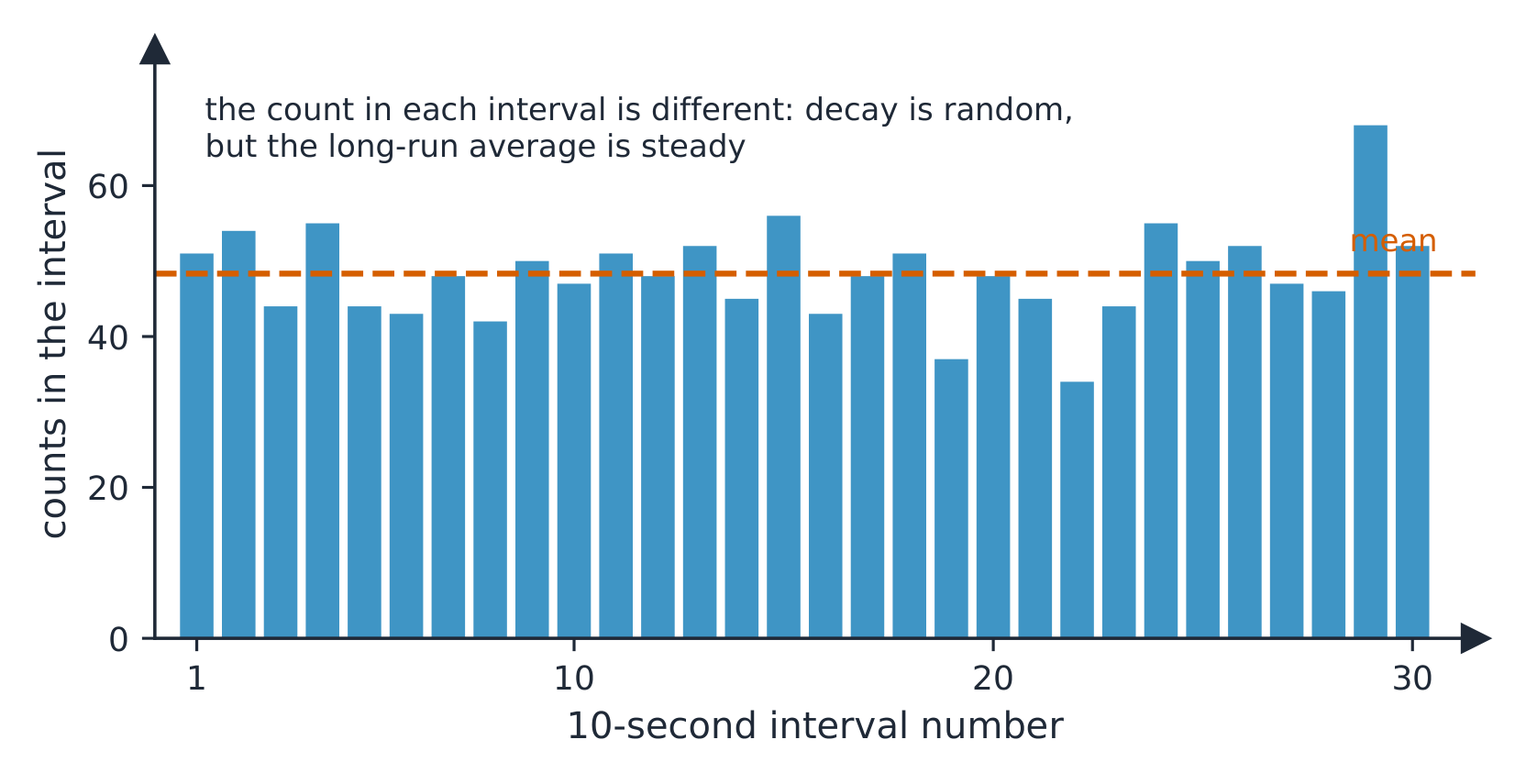
Evidence for randomness: the count rate fluctuates. A Geiger counter 盖革计数器 next to a source clicks at uneven intervals — never a steady stream — although the long-run mean rate is well-defined.
The two-mark definitions.Radioactive decay is the spontaneous and random emission of a particle ($\alpha$ or $\beta$) or a photon ($\gamma$) from an unstable nucleus.Spontaneous means the decay is not affected by external factors: temperature, pressure, chemical state, or the presence of other nuclei. Random means it is impossible to predict which nucleus will decay next, or when a given nucleus will decay; only a probability can be given. Evidence for randomness: the count rate fluctuates from one interval to the next, even for a source whose activity is not changing over the experiment.
Activity and decay constant
For $N$ undecayed nuclei of a radionuclide 放射性核素, the rate of decay is
$$A = \lambda N.$$
$A$ is the activity 活度 — decays per unit time. Unit: becquerel 贝克勒尔 (Bq) $= \text{s}^{-1}$.
$\lambda$ is the decay constant 衰变常数 — the probability per unit time that a nucleus decays. Unit: $\text{s}^{-1}$.
$\lambda$ is fixed for a nuclide; a larger sample (larger $N$) has proportionally larger activity.
The one-mark definitions.Activity is the number of decays (of nuclei) per unit time, or the rate of decay. The decay constant is the probability per unit time that a (given) nucleus will decay. Not "the rate of decay": that is the activity. Note the units are the same, $\text{s}^{-1}$, but $A$ counts events and $\lambda$ is a probability per second.
Worked example. Fluorine-18 has a half-life of $110$ minutes. Show that its decay constant is $1.05 \times 10^{-4}\ \text{s}^{-1}$, and find the activity of $2.1 \times 10^{-12}\ \text{kg}$ of fluorine-18.
$\lambda = 0.693/(110 \times 60) = 1.05 \times 10^{-4}\ \text{s}^{-1}$. The number of nuclei is the mass divided by the mass of one nucleus: $N = 2.1 \times 10^{-12}/(18 \times 1.661 \times 10^{-27}) = 7.0 \times 10^{13}$. So $A = \lambda N = 1.05 \times 10^{-4} \times 7.0 \times 10^{13} = 7.4 \times 10^{9}\ \text{Bq}$. A tiny mass gives a huge activity because the half-life is short; the same mass of uranium-238 (half-life $4.5 \times 10^{9}$ years) would give about $10^{-5}\ \text{Bq}$.
Exponential decay
Since $\lambda$ is the fractional decay rate, $\dfrac{dN}{dt} = -\lambda N$, whose solution is an exponential decay 指数衰减:
$$N = N_{0} e^{-\lambda t}.$$
Because $A = \lambda N$, the activity (and any count rate 计数率 proportional to it) decays the same way:
$$A = A_{0} e^{-\lambda t}.$$
Why exponential? For each nucleus, $\lambda$ is a fixed probability per unit time, independent of the others and of the nucleus's age. So the same fraction decays in each time interval, which gives exponential decay.
Writing the explanation (three marks). (1) The decay constant is the probability per unit time of decay and is the same for every nucleus of the nuclide, whatever its age. (2) So the rate of decay, the activity, is proportional to the number of undecayed nuclei present: $A = \lambda N$. (3) A rate of change proportional to the quantity itself gives an exponential change; equivalently, the same fraction of the remaining nuclei decays in every equal time interval, so the number never reaches zero but halves in every half-life.
Half-life
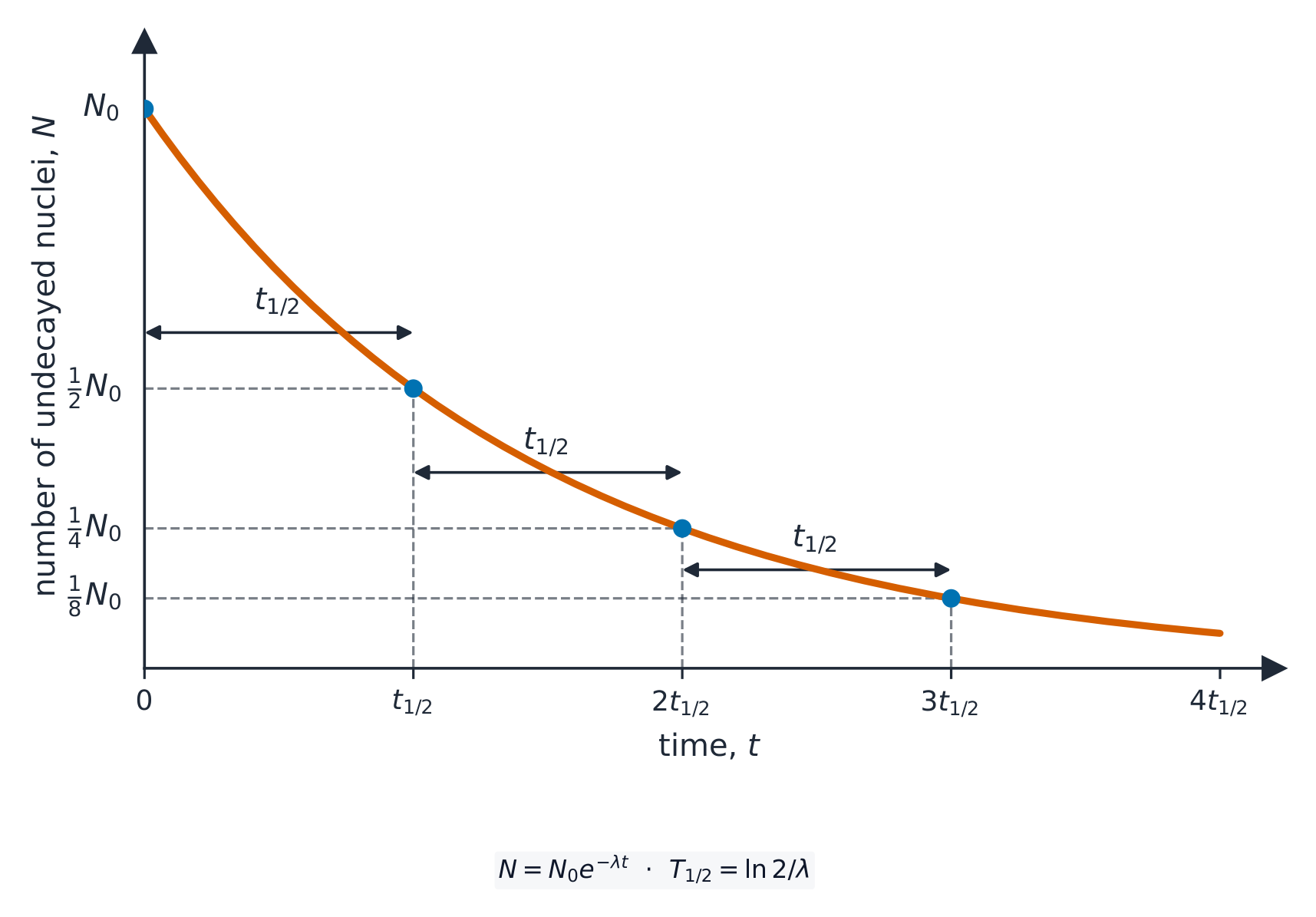
The half-life 半衰期$t_{1/2}$ is the time for the number of undecayed nuclei (or the activity, or the count rate) to fall to half. From $N = N_{0} e^{-\lambda t}$ with $N = N_{0}/2$:
A larger decay constant means a shorter half-life. After $n$ half-lives the surviving fraction is $(1/2)^{n}$; after 5 half-lives only about 3% remains.
The definition of half-life.The time taken for the number of undecayed nuclei (or the activity) of a sample to fall to half its initial value. "Half the atoms decay" is accepted; "half the sample disappears" is not, since the decayed nuclei are still there as the daughter product.
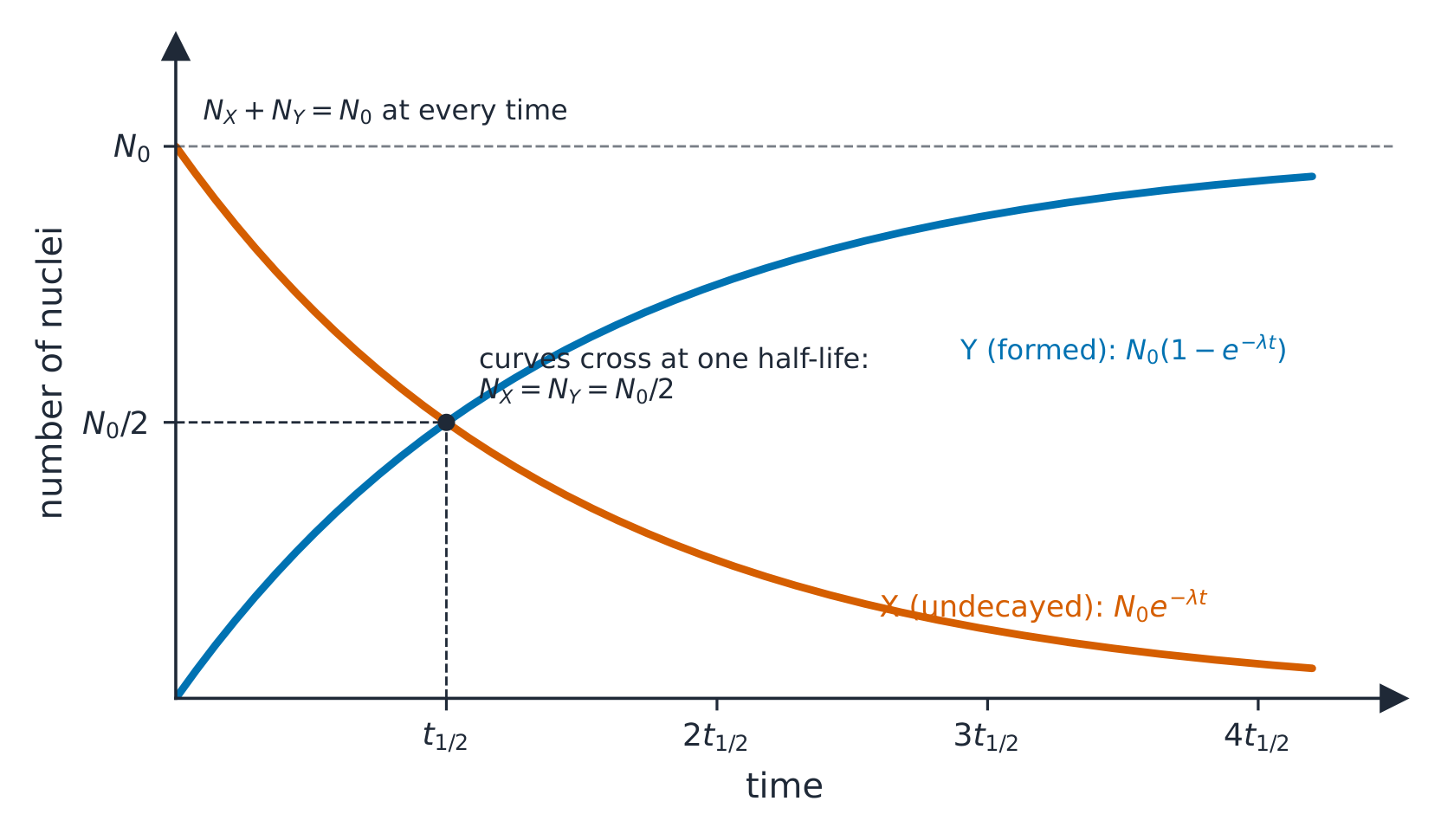
Reading a two-isotope graph. When X decays to a stable Y, $N_{\text{Y}} = N_{0} - N_{\text{X}} = N_{0}(1 - e^{-\lambda t})$. The half-life is the time at which the curves cross ($N_{\text{X}} = N_{\text{Y}} = N_{0}/2$), or the time for $N_{\text{X}}$ to halve. If the graph gives the initial number $N_{0}$ and the initial mass $m$, the nucleon number follows from $m = N_{0} A u$: for $m = 7.3 \times 10^{-4}\ \text{kg}$ and $N_{0} = 2.0 \times 10^{21}$, $A = m/(N_{0} u) = 7.3 \times 10^{-4}/(2.0 \times 10^{21} \times 1.661 \times 10^{-27}) = 220$.
Worked example. A sample of a single radioactive isotope has an activity of $180\ \text{Bq}$ at $t = 0$ and $45\ \text{Bq}$ at $t = 8.4$ minutes. Find the half-life and the decay constant, and the activity after a further $8.4$ minutes.
$45/180 = 1/4 = (1/2)^{2}$: two half-lives in $8.4$ minutes, so $t_{1/2} = 4.2\ \text{min} = 252\ \text{s}$ and $\lambda = 0.693/252 = 2.8 \times 10^{-3}\ \text{s}^{-1}$. After another two half-lives the activity is $45/4 = 11\ \text{Bq}$. When the ratio is not a neat power of two, use $t = \ln(A_{0}/A)/\lambda$: for the activity to fall from $180$ to $50\ \text{Bq}$ takes $\ln(3.6)/2.75 \times 10^{-3} = 466\ \text{s}$. Always convert the half-life to seconds before finding $\lambda$ if the activity is in becquerels.
Taking logs of $A = A_{0} e^{-\lambda t}$ gives $\ln A = \ln A_{0} - \lambda t$, so a plot of $\ln A$ against $t$ is a straight line with gradient $-\lambda$. Use this with several data points.
Count rate is not activity. A detector records only the radiation that reaches it and is absorbed in it: a fraction set by the solid angle it covers, by absorption in the air and in the source itself, and by its efficiency. So the measured count rate is smaller than the activity, but proportional to it, and the half-life obtained from a count-rate graph is correct. Subtract the background radiation 本底辐射 (measured with the source removed) from every reading before taking ratios or logarithms; an unsubtracted background makes the curve flatten and the half-life appear too long.
Tracers in medicine. Fluorine-18 and oxygen-15 are $\beta^{+}$ emitters used as tracers 示踪剂 in PET scanning (Topic 24): the positron annihilates with an electron, giving two gamma photons that leave in opposite directions and reveal where the tracer is. A short half-life ($110$ minutes, $2$ minutes) is chosen so that the activity falls quickly after the scan and the dose to the patient stays small, at the price of having to make the isotope close to the hospital and use it at once.
Bahasa Indonesia
Peluruhan radioaktif & waktu paruh
Acak dan spontan
Peluruhan radioaktif adalah:
spontan — hal ini terjadi tanpa pemicu luar, dan lajunya tidak berubah oleh suhu, tekanan, atau keadaan kimia; dan
acak — Anda tidak dapat memprediksi kapan suatu inti tertentu akan meluruh, hanya probabilitas bahwa inti tersebut meluruh dalam suatu rentang waktu.
Bukti kenacakan: tingkat hitung berfluktuasi. Sebuah pembilang Geiger di samping sumber berklik pada interval yang tidak teratur — tidak pernah sebagai aliran yang stabil — meskipun rata-rata jangka panjangnya terdefinisi dengan jelas.
Hitungan dalam interval waktu yang sama dari sumber yang sama tidak pernah sama dua kali: fluktuasi adalah bukti bahwa peluruhan itu acak, sementara rata-rata yang stabil menunjukkan bahwa probabilitasnya konstan
Definisi bernilai dua poin.Peluruhan radioaktif adalah emisi spontan dan acak dari sebuah partikel ($\alpha$ atau $\beta$) atau foton ($\gamma$) dari inti yang tidak stabil.Spontan berarti peluruhan tidak dipengaruhi oleh faktor eksternal: suhu, tekanan, keadaan kimia, atau keberadaan inti lainnya. Acak berarti mustahil untuk memprediksi inti mana yang akan meluruh selanjutnya, atau kapan inti tertentu akan meluruh; hanya probabilitas yang dapat diberikan. Bukti kenacakan: tingkat hitung berfluktuasi dari satu interval ke interval berikutnya, bahkan untuk sumber yang aktivitasnya tidak berubah selama percobaan.
Setiap partikel beta dari sumber meninggalkan jejak tipis di dalam bilik awan -- bukti langsung dari peluruhan terpisah dan acak
Aktivitas dan konstanta peluruhan
Untuk $N$ inti yang belum meluruh dari radionuklida, laju peluruhannya adalah
$$A = \lambda N.$$
$A$ adalah aktivitas — peluruhan per satuan waktu. Satuan: bekquerel (Bq) $= \text{s}^{-1}$.
$\lambda$ adalah konstanta peluruhan — probabilitas per satuan waktu bahwa suatu inti meluruh. Satuan: $\text{s}^{-1}$.
$\lambda$ tetap untuk suatu nuclida; sampel yang lebih besar ($N$ yang lebih besar) memiliki aktivitas yang sebanding lebih besar.
Definisi bernilai satu poin.Aktivitas adalah jumlah peluruhan (inti) per satuan waktu, atau laju peluruhan. Konstanta peluruhan adalah probabilitas per satuan waktu bahwa (suatu) inti akan meluruh. Bukan "laju peluruhan": itu adalah aktivitas. Perhatikan bahwa satuannya sama, $\text{s}^{-1}$, tetapi $A$ menghitung peristiwa dan $\lambda$ adalah probabilitas per detik.
Contoh terpecahkan. Fluorin-18 memiliki waktu paruh $110$ menit. Tunjukkan bahwa konstanta peluruhannya adalah $1.05 \times 10^{-4}\ \text{s}^{-1}$, dan temukan aktivitas dari $2.1 \times 10^{-12}\ \text{kg}$ fluorin-18.
$\lambda = 0.693/(110 \times 60) = 1.05 \times 10^{-4}\ \text{s}^{-1}$. Jumlah inti adalah massa dibagi dengan massa satu inti: $N = 2.1 \times 10^{-12}/(18 \times 1.661 \times 10^{-27}) = 7.0 \times 10^{13}$. Jadi $A = \lambda N = 1.05 \times 10^{-4} \times 7.0 \times 10^{13} = 7.4 \times 10^{9}\ \text{Bq}$. Massa yang sangat kecil menghasilkan aktivitas yang sangat besar karena waktu paruhnya pendek; massa yang sama dari uranium-238 (waktu paruh $4.5 \times 10^{9}$ tahun) akan menghasilkan sekitar $10^{-5}\ \text{Bq}$.
Peluruhan eksponensial
Karena $\lambda$ adalah tingkat peluruhan fraksional, $\dfrac{dN}{dt} = -\lambda N$, yang solusinya adalah peluruhan eksponensial:
$$N = N_{0} e^{-\lambda t}.$$
Karena $A = \lambda N$, aktivitas (dan setiap tingkat hitung yang sebanding dengannya) meluruh dengan cara yang sama:
$$A = A_{0} e^{-\lambda t}.$$
Mengapa eksponensial? Untuk setiap inti, $\lambda$ adalah probabilitas tetap per satuan waktu, independen dari yang lain dan dari usia inti. Jadi fraksi yang sama meluruh dalam setiap interval waktu, yang memberikan peluruhan eksponensial.
Menulis penjelasan (tiga poin). (1) Konstanta peluruhan adalah probabilitas per satuan waktu untuk peluruhan dan sama untuk setiap inti dari nuclida tersebut, terlepas dari usianya. (2) Jadi laju peluruhan, aktivitas, sebanding dengan jumlah inti yang belum meluruh yang ada: $A = \lambda N$. (3) Laju perubahan yang sebanding dengan kuantitas itu sendiri memberikan perubahan eksponensial; setara dengan, fraksi yang sama dari inti yang tersisa meluruh dalam setiap interval waktu yang sama, sehingga jumlahnya tidak pernah mencapai nol tetapi menjadi setengah dalam setiap waktu paruh.
Waktu paruh
Waktu paruh$t_{1/2}$ adalah waktu untuk jumlah inti yang belum meluruh (atau aktivitas, atau tingkat hitung) turun menjadi setengah. Dari $N = N_{0} e^{-\lambda t}$ dengan $N = N_{0}/2$:
Konstanta peluruhan yang lebih besar berarti waktu paruh yang lebih pendek. Setelah $n$ waktu paruh, fraksi yang tersisa adalah $(1/2)^{n}$; setelah 5 waktu paruh hanya sekitar 3% yang tersisa.
Definisi waktu paruh.Waktu yang dibutuhkan agar jumlah inti yang belum meluruh (atau aktivitas) dari suatu sampel turun menjadi setengah nilainya awal. "Setengah atom meluruh" diterima; "setengah sampel menghilang" tidak, karena inti yang telah meluruh masih ada sebagai produk anak.
Induk yang meluruh menjadi anak stabil: apa yang X hilangkan, Y peroleh, sehingga kurva berpotongan setelah satu waktu paruh dan waktu paruh dapat dibaca dari titik potong
Membaca grafik dua isotop. Ketika X meluruh menjadi stabil Y, $N_{\text{Y}} = N_{0} - N_{\text{X}} = N_{0}(1 - e^{-\lambda t})$. Waktu paruh adalah waktu saat kurva berpotongan ($N_{\text{X}} = N_{\text{Y}} = N_{0}/2$), atau waktu agar $N_{\text{X}}$ berkurang setengah. Jika grafik memberikan jumlah awal $N_{0}$ dan massa awal $m$, nomor nukleon mengikuti dari $m = N_{0} A u$: untuk $m = 7.3 \times 10^{-4}\ \text{kg}$ dan $N_{0} = 2.0 \times 10^{21}$, $A = m/(N_{0} u) = 7.3 \times 10^{-4}/(2.0 \times 10^{21} \times 1.661 \times 10^{-27}) = 220$.
Contoh terpecahkan. Sebuah sampel isotop radioaktif tunggal memiliki aktivitas $180\ \text{Bq}$ pada $t = 0$ dan $45\ \text{Bq}$ pada $t = 8.4$ menit. Temukan waktu paruh dan konstanta peluruhan, serta aktivitas setelah $8.4$ menit lagi.
$45/180 = 1/4 = (1/2)^{2}$: dua waktu paruh dalam $8.4$ menit, sehingga $t_{1/2} = 4.2\ \text{min} = 252\ \text{s}$ dan $\lambda = 0.693/252 = 2.8 \times 10^{-3}\ \text{s}^{-1}$. Setelah dua waktu paruh lagi, aktivitasnya menjadi $45/4 = 11\ \text{Bq}$. Ketika rasionya bukan pangkat dua yang bulat, gunakan $t = \ln(A_{0}/A)/\lambda$: untuk aktivitas turun dari $180$ ke $50\ \text{Bq}$ membutuhkan $\ln(3.6)/2.75 \times 10^{-3} = 466\ \text{s}$. Selalu konversi waktu paruh ke detik sebelum mencari $\lambda$ jika aktivitas dalam becquerel.
Jumlah inti tak meluruh berkurang setengah dalam setiap waktu paruh
Mengambil logaritma dari $A = A_{0} e^{-\lambda t}$ menghasilkan $\ln A = \ln A_{0} - \lambda t$, sehingga plot $\ln A$ terhadap $t$ adalah garis lurus dengan kemiringan $-\lambda$. Gunakan ini bersama beberapa titik data.
Tingkat hitung bukanlah aktivitas. Detektor hanya merekam radiasi yang mencapai dan diserap olehnya: sebagian ditentukan oleh sudut pejal yang diliputnya, penyerapan di udara dan sumber itu sendiri, serta efisiensinya. Jadi tingkat hitung yang terukur lebih kecil daripada aktivitas, tetapi sebanding dengannya, dan waktu paruh yang diperoleh dari grafik tingkat hitung adalah benar. Kurangi radiasi latar belakang (diukur tanpa sumber) dari setiap pembacaan sebelum mengambil rasio atau logaritma; latar belakang yang tidak dikurangkan membuat kurva mendatar dan waktu paruh tampak terlalu lama.
Penelusur dalam kedokteran. Fluorin-18 dan oksigen-15 adalah pemancar $\beta^{+}$ yang digunakan sebagai penelusur dalam pemindaian PET (Topik 24): positron annihilate dengan elektron, menghasilkan dua foton gamma yang keluar ke arah berlawanan dan mengungkap lokasi penelusur. Waktu paruh pendek ($110$ menit, $2$ menit) dipilih agar aktivitas cepat menurun setelah pemindaian dan dosis bagi pasien tetap kecil, dengan harga harus membuat isotop dekat rumah sakit dan menggunakannya segera.
Grafik $\ln A$ terhadap waktu adalah garis lurus dengan gradien $-\lambda$
Choose a decay type; the daughter nuclide is fixed so the nucleon number A and the proton number Z both balance. · Pilih jenis peluruhan; nuclid anak tetap sehingga nomor nukleon A dan nomor proton Z seimbang.
Each nucleus has a fixed chance of decaying, at random. Move time forward: about half the remaining nuclei decay every half-life — so the count halves, then halves again. · Setiap inti memiliki peluang tetap untuk meluruh secara acak. Majukan waktu: sekitar setengah inti yang tersisa meluruh setiap waktu paruh — sehingga hitungannya berkurang setengah, lalu berkurang lagi.
Definitions the examiner accepts · Definisi yang diterima oleh penguji
English
A definition question is marked against fixed wording. Learn these exactly, and give one answer only.
Term
Definition
mass defect
the difference between the total mass of the separate nucleons and the mass of the nucleus
binding energy
the minimum energy needed to separate a nucleus into its individual nucleons (the energy released when it forms from them)
nuclear fusion
two light nuclei combine to form a single heavier nucleus
nuclear fission
a heavy nucleus splits into two lighter nuclei of similar mass (usually after absorbing a neutron)
radioactive decay
the spontaneous and random emission of α, β or γ radiation from an unstable nucleus
spontaneous
not affected by external factors such as temperature, pressure or chemical state
random
it cannot be predicted which nucleus will decay, or when a given nucleus will decay
activity
the number of nuclei decaying per unit time
decay constant
the probability per unit time that a nucleus decays
half-life
the time for the number of undecayed nuclei (or the activity) to fall to half its initial value
Bahasa Indonesia
Soal definisi dinilai berdasarkan frasa tetap. Hafalkan ini persis, dan berikan hanya satu jawaban.
Istilah
Definisi
cacah massa
selisih antara total massa nukleon terpisah dan massa inti
energi ikat
energi minimum yang diperlukan untuk memisahkan inti menjadi nukleon-nukleon individualnya (energi yang dilepaskan saat terbentuk darinya)
fusi nuklir
dua inti ringan bergabung membentuk satu inti lebih berat
fisi nuklir
inti berat terbelah menjadi dua inti lebih ringan dengan massa serupa (biasanya setelah menyerap neutron)
peluruhan radioaktif
emisi spontan dan acak radiasi α, β, atau γ dari inti yang tidak stabil
spontan
tidak dipengaruhi faktor eksternal seperti suhu, tekanan, atau keadaan kimia
acak
tidak dapat diprediksi inti mana yang akan meluruh, atau kapan inti tertentu akan meluruh
aktivitas
jumlah inti yang meluruh per satuan waktu
konstanta peluruhan
probabilitas per satuan waktu bahwa sebuah inti meluruh
waktu paruh
waktu agar jumlah inti tak meluruh (atau aktivitas) turun menjadi setengah nilai awalnya
23.2
Exam tips · Tips ujian
English
$E = mc^{2}$ with $1\ \text{u} = 931.5\ \text{MeV}$: work in u and MeV for reactions, then convert to joules only if asked ($1\ \text{MeV} = 1.60 \times 10^{-13}\ \text{J}$).
Energy released $=$ (total mass before $-$ total mass after) $\times c^{2}$, or (binding energy after $-$ binding energy before). Mass defects can be subtracted directly when the nucleon count is unchanged.
The curve: steep rise, peak $8.8\ \text{MeV}$ near $A = 56$, gentle fall. Products higher on the curve means energy released; fusion on the left, fission (and α-decay) on the right.
Balance every equation twice: nucleon numbers along the top, proton numbers along the bottom; β decays carry a neutrino or antineutrino.
$A = \lambda N$, $\lambda = 0.693/t_{1/2}$ with $t_{1/2}$ in seconds; $N$ from mass: $N = m/(A u)$. Ratios of $1/2$, $1/4$, $1/8$ mean whole half-lives; otherwise $t = \ln(x_{0}/x)/\lambda$.
Explanations are marked on the words: constant probability, rate proportional to number, same fraction per interval; fluctuating count rate for randomness; unaffected by external conditions for spontaneous.
Common mistakes
Defining binding energy as "the energy holding the nucleus together" or "the energy stored in the nucleus"; it is the energy to separate the nucleons.
Subtracting masses the wrong way round and reporting a negative energy release, or forgetting the neutron(s) on one side of a fission equation.
Drawing the binding-energy curve falling as steeply as it rises, or reaching zero at large $A$.
Using a half-life in minutes or years with an activity in becquerels; convert to seconds first.
Confusing the decay constant (a probability per second) with the activity (decays per second).
Saying "half the sample disappears" for a half-life, or that after two half-lives nothing is left.
Giving "random" as "it happens at any time" without "cannot predict which nucleus or when", or "spontaneous" without "unaffected by external factors".
Treating the count rate as the activity, or forgetting to subtract background.
Assuming the α-particle and the recoil nucleus share the energy equally; they share the momentum equally.
Bahasa Indonesia
$E = mc^{2}$ dengan $1\ \text{u} = 931.5\ \text{MeV}$: gunakan u dan MeV untuk reaksi, lalu konversi ke joule hanya jika diminta ($1\ \text{MeV} = 1.60 \times 10^{-13}\ \text{J}$).
Energi yang dilepaskan $=$ (total massa sebelum $-$ total massa setelah) $\times c^{2}$, atau (energi ikat setelah $-$ energi ikat sebelum). Cacah massa dapat dikurangkan langsung ketika jumlah nukleon tidak berubah.
Kurva: kenaikan curam, puncak $8.8\ \text{MeV}$ di sekitar $A = 56$, penurunan landai. Produk yang lebih tinggi pada kurva berarti energi dilepaskan; fusi di sebelah kiri, fissi (dan peluruhan α) di sebelah kanan.
Seimbangkan setiap persamaan dua kali: nomor nukleon di atas, nomor proton di bawah; peluruhan β membawa neutrino atau antineutrino.
$A = \lambda N$, $\lambda = 0.693/t_{1/2}$ dengan $t_{1/2}$ dalam detik; $N$ dari massa: $N = m/(A u)$. Rasio $1/2$, $1/4$, $1/8$ berarti waktu paruh utuh; jika tidak, gunakan $t = \ln(x_{0}/x)/\lambda$.
Penjelasan ditandai pada kata-kata: probabilitas konstan, laju sebanding dengan jumlah, fraksi sama per interval; fluktuasi tingkat hitung untuk ketidakteraturan; tidak terpengaruh kondisi eksternal untuk spontanitas.
Kesalahan umum
Mendefinisikan energi ikat sebagai "energi yang mengikat inti" atau "energi yang tersimpan dalam inti"; itu adalah energi untuk memisahkan nukleon-nukleon.
Mengurangkan massa secara terbalik dan melaporkan pelepasan energi negatif, atau melupakan neutron(ton) di salah satu sisi persamaan fissi.
Menggambar kurva energi ikat menurun secanggih naiknya, atau mencapai nol pada $A$ yang besar.
Menggunakan waktu paruh dalam menit atau tahun dengan aktivitas dalam becquerel; ubah ke detik terlebih dahulu.
Membingungkan konstanta peluruhan (probabilitas per detik) dengan aktivitas (peluruhan per detik).
Mengatakan "setengah sampel menghilang" untuk waktu paruh, atau bahwa setelah dua waktu paruh tidak ada yang tersisa.
Memberikan "acak" sebagai "terjadi kapan saja" tanpa "tidak dapat memprediksi inti mana atau kapan", atau "spontan" tanpa "tidak dipengaruhi oleh faktor eksternal".
Memperlakukan laju penghitungan sebagai aktivitas, atau lupa mengurangi latar belakang.
Menganggap partikel α dan inti pantulan membagi energi secara sama; mereka membagi momentum secara sama.
Interactive lessons on this topic · Pelajaran interaktif untuk topik ini
Work through it step by step, with instant-check exercises. · Kerjakan langkah demi langkah, dengan latihan pengecekan instan.
Pick one and the site follows you — notes, papers, videos and practice all open on it. · Pilih satu dan situs mengikuti Anda — catatan, kertas, video, dan latihan semua terbuka di sana.
Type to search notes, lessons, code, vocabulary and past-paper questions across every subject. · Ketik untuk mencari catatan, pelajaran, kode, kosakata, dan pertanyaan soal lama di setiap mata pelajaran.