Listrik di dinding rumah Anda tidak tenang. Lima puluh kali setiap detik — kadang enam puluh — arus ini membalikkan arah, mengalir ke satu sisi, lalu ke sisi lain. Ini adalah…
English narration · English + 中文 subtitles burned in · Narasi bahasa Inggris · Subtitle bahasa Inggris + 中文 disematkan langsung
21.1
Alternating current basics · Dasar arus bolak-balik
Syllabus · Silabus
English
understand and use the terms period, frequency and peak value as applied to an alternating current or voltage
use equations of the form $x = x_0 \sin \omega t$ representing a sinusoidally alternating current or voltage
recall and use the fact that the mean power in a resistive load is half the maximum power for a sinusoidal alternating current
distinguish between root-mean-square (r.m.s.) and peak values and recall and use $I_{\text{r.m.s.}} = I_0 / \sqrt{2}$ and $V_{\text{r.m.s.}} = V_0 / \sqrt{2}$ for a sinusoidal alternating current
Bahasa Indonesia
pahami dan gunakan istilah periode, frekuensi, dan nilai puncak yang diterapkan pada arus bolak-balik atau tegangan
gunakan persamaan berbentuk $x = x_0 \sin \omega t$ yang merepresentasikan arus bolak-balik sinusoidal atau tegangan
ingat dan gunakan fakta bahwa daya rata-rata dalam beban resistif adalah setengah dari daya maksimum untuk arus bolak-balik sinusoidal
bedakan antara nilai efektif (r.m.s.) dan nilai puncak, serta ingat dan gunakan $I_{\text{r.m.s.}} = I_0 / \sqrt{2}$ dan $V_{\text{r.m.s.}} = V_0 / \sqrt{2}$ untuk arus bolak-balik sinusoidal
Source: Cambridge International syllabus · Sumber: Silabus Cambridge International
English
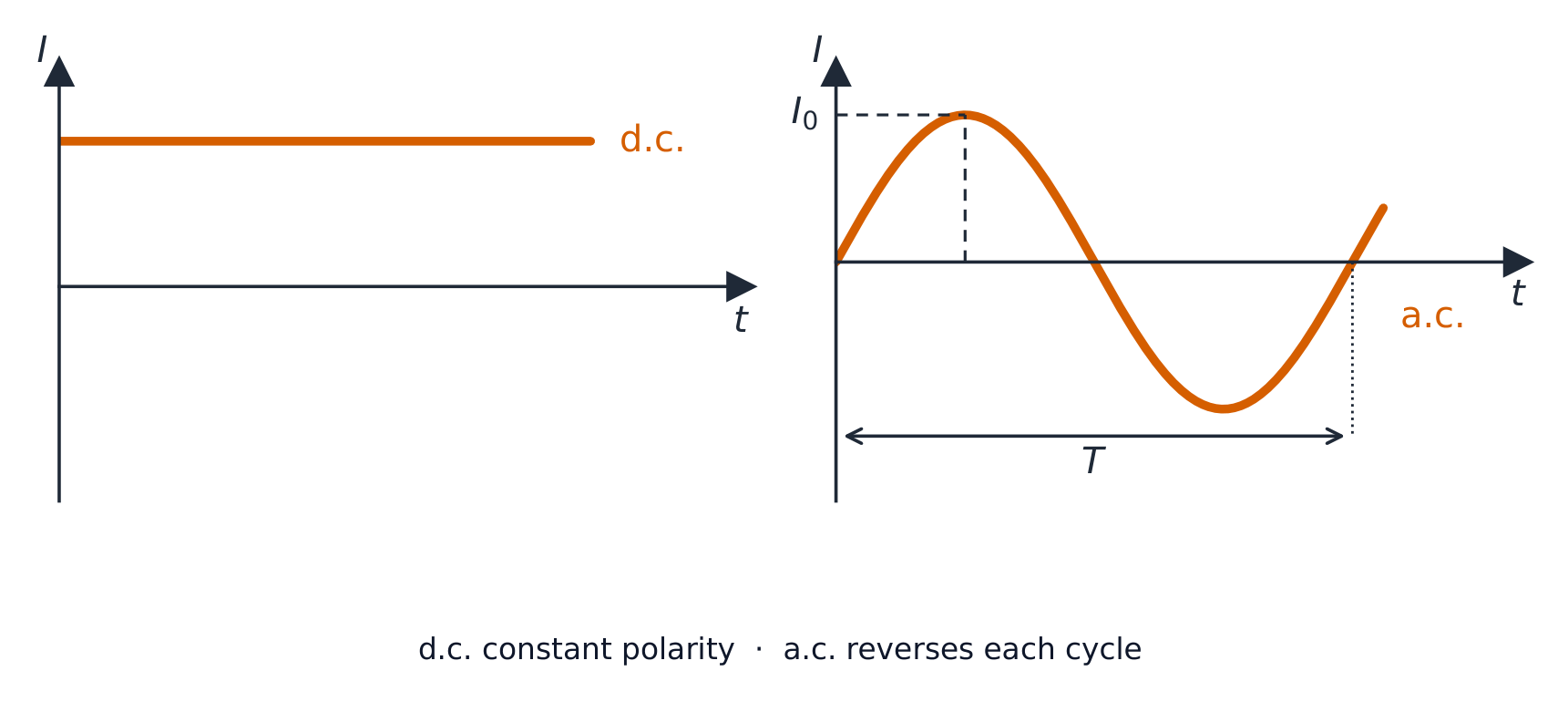
An alternating current 交流电 (a.c.) keeps reversing direction. Mains supply is sinusoidal a.c.: $I$ or $V$ follows a sine wave in time:
(For a purely resistive load the voltage 电压 and current 电流 are in phase, which is the case in this syllabus.)
Key terms
period 周期$T$ — the time for one full cycle. Unit: s.
frequency 频率$f$ — cycles per second; $f = 1/T$. Mains is often $50\ \text{Hz}$ or $60\ \text{Hz}$.
angular frequency 角频率$\omega = 2\pi f = 2\pi/T$.
peak value 峰值$I_{0}$ or $V_{0}$ — the largest value in a cycle (also called the amplitude).
peak-to-peak value 峰峰值$2 I_{0}$ — from $+I_{0}$ to $-I_{0}$. Useful when reading an oscilloscope.
The two-mark definitions.The frequency of an alternating current is the number of complete cycles per unit time (say "per second" or "per unit time", and "complete cycles" or "oscillations"). The period is the time for one complete cycle, and the peak value is the maximum value of the current or voltage during a cycle. Note that the mean value of a sinusoidal current over a cycle is zero, which is exactly why the r.m.s. value is needed to describe it.
Reading the equation. In $V = V_{0} \sin(\omega t)$ the number in front is the peak value and the number multiplying $t$ is $\omega = 2\pi f$; the angle $\omega t$ is in radians 弧度, so set the calculator to radians before evaluating. A supply written with $\cos$ instead of $\sin$ is the same wave starting at its peak rather than at zero.
Worked example. The output of a supply is $V = 320 \sin(100\pi t)$ (volts, seconds). Find the peak value, the frequency, the period and the r.m.s. value, and the first time after $t = 0$ at which $V = 160\ \text{V}$.
Peak $V_{0} = 320\ \text{V}$. $\omega = 100\pi\ \text{rad s}^{-1}$, so $f = \omega/2\pi = 50\ \text{Hz}$ and $T = 1/f = 0.020\ \text{s}$. $V_{\text{r.m.s.}} = 320/\sqrt{2} = 226\ \text{V}$. For $V = 160\ \text{V}$: $\sin(100\pi t) = 0.5$, so $100\pi t = \pi/6$ and $t = 1/600 = 1.7 \times 10^{-3}\ \text{s}$. (For $V = 18\cos(40\pi t)$ the same reading gives $V_{0} = 18\ \text{V}$, $f = 20\ \text{Hz}$, $T = 50\ \text{ms}$, and a sketch that starts at $+18\ \text{V}$.)
Reading a CRO trace
Same as for any wave (Topic 7), using a cathode-ray oscilloscope 示波器:
horizontal divisions × time-base 时基 → period $T$, so $f = 1/T$.
vertical divisions × $y$-gain → peak voltage $V_{0}$ (measure centre to peak, or peak-to-peak then halve).
Bahasa Indonesia
Transformator substasi menaikkan atau menurunkan tegangan bolak-balik.
Arus bolak-balik (a.c.) terus-menerus membalik arah. Suplai jaringan menggunakan a.c. sinusoidal: $I$ atau $V$ mengikuti gelombang sinus terhadap waktu:
(Untuk beban murni resistif, tegangan dan arus sefasa, yang merupakan kasus dalam silabus ini.)
Arus searah stabil dibandingkan dengan arus bolak-balik sinusoidal dengan puncak $I_0$ dan periode $T$
Istilah kunci
periode$T$ — waktu untuk satu siklus penuh. Satuan: s.
frekuensi$f$ — siklus per detik; $f = 1/T$. Suplai jaringan sering kali $50\ \text{Hz}$ atau $60\ \text{Hz}$.
frekuensi sudut$\omega = 2\pi f = 2\pi/T$.
nilai puncak$I_{0}$ atau $V_{0}$ — nilai terbesar dalam satu siklus (juga disebut amplitudo).
nilai puncak-ke-puncak$2 I_{0}$ — dari $+I_{0}$ ke $-I_{0}$. Berguna saat membaca osiloskop.
Definisi bernilai dua poin.Frekuensi arus bolak-balik adalah jumlah siklus lengkap per satuan waktu (katakan "per detik" atau "per satuan waktu", dan "siklus lengkap" atau "osilasi"). Periode adalah waktu untuk satu siklus lengkap, dan nilai puncak adalah nilai maksimum arus atau tegangan selama satu siklus. Perhatikan bahwa nilai rata-rata arus sinusoidal selama satu siklus adalah nol, yang tepat menjadi alasan mengapa nilai r.m.s. diperlukan untuk mendeskripsikannya.
Membaca persamaan. Dalam $V = V_{0} \sin(\omega t)$, angka di depan adalah nilai puncak dan angka yang mengalikan $t$ adalah $\omega = 2\pi f$; sudut $\omega t$ berada dalam radian, jadi atur kalkulator ke mode radian sebelum melakukan perhitungan. Suplai yang ditulis dengan $\cos$ alih-alih $\sin$ adalah gelombang yang sama yang dimulai dari puncaknya bukan dari nol.
Contoh terpecahkan. Output suplai adalah $V = 320 \sin(100\pi t)$ (volt, detik). Temukan nilai puncak, frekuensi, periode, dan nilai r.m.s., serta waktu pertama setelah $t = 0$ ketika $V = 160\ \text{V}$.
G.g.b. puncak $V_{0} = 320\ \text{V}$. $\omega = 100\pi\ \text{rad s}^{-1}$, sehingga $f = \omega/2\pi = 50\ \text{Hz}$ dan $T = 1/f = 0.020\ \text{s}$. $V_{\text{r.m.s.}} = 320/\sqrt{2} = 226\ \text{V}$. Untuk $V = 160\ \text{V}$: $\sin(100\pi t) = 0.5$, sehingga $100\pi t = \pi/6$ dan $t = 1/600 = 1.7 \times 10^{-3}\ \text{s}$. (Untuk $V = 18\cos(40\pi t)$ pembacaan yang sama menghasilkan $V_{0} = 18\ \text{V}$, $f = 20\ \text{Hz}$, $T = 50\ \text{ms}$, dan sketsa yang dimulai dari $+18\ \text{V}$.)
Membaca jejak CRO
Sama seperti untuk gelombang apa pun (Topik 7), menggunakan osiloskop sinar katode:
division horizontal × basis waktu → periode $T$, sehingga $f = 1/T$.
division vertikal × $y$-gain → tegangan puncak $V_{0}$ (ukur dari pusat ke puncak, atau dari puncak-ke-puncak lalu bagi dua).
Explore · Jelajahi
Alternating current · Arus bolak-balik
I = a sin(bt)
AC is a sine wave — amplitude is the peak, b sets the frequency. · AC adalah gelombang sinus — amplitudo adalah puncak, b menetapkan frekuensi.
Power delivered to a resistor · Daya yang disalurkan ke resistor
English
For a resistive load $R$, the instant power 功率 is $P(t) = I(t)^{2} R$. With $I = I_{0}\sin(\omega t)$:
$$P(t) = I_{0}^{2} R \sin^{2}(\omega t).$$
This is always positive, with peak $I_{0}^{2} R$ and minimum zero, oscillating at twice the frequency of $I$. The mean of $\sin^{2}(\omega t)$ over a cycle is $\tfrac{1}{2}$, so the average power is
$$\langle P \rangle = \tfrac{1}{2} I_{0}^{2} R = \tfrac{1}{2} P_{\text{peak}}.$$
Average a.c. power in a resistor is half the peak power.
"Show by calculation that the mean power is half the peak power." A supply of peak value $12\ \text{V}$ drives a $680\ \Omega$ resistor. Peak power: $P_{0} = V_{0}^{2}/R = 12^{2}/680 = 0.212\ \text{W}$, the instantaneous power at the moment the voltage is at its peak. Mean power: use the r.m.s. value, $V_{\text{r.m.s.}} = 12/\sqrt{2} = 8.49\ \text{V}$, so $\langle P \rangle = V_{\text{r.m.s.}}^{2}/R = 8.49^{2}/680 = 0.106\ \text{W}$, exactly half. The two calculations must be shown separately; writing "$\tfrac{1}{2}$ of $0.212$" scores nothing, because that is the thing being shown. The $\tfrac{1}{2}$ is $(1/\sqrt{2})^{2}$: squaring the r.m.s. factor.
Bahasa Indonesia
Untuk beban resistif $R$, daya sesaat adalah $P(t) = I(t)^{2} R$. Dengan $I = I_{0}\sin(\omega t)$:
Daya pada resistor berdenyut; rata-ratanya adalah setengah dari daya puncak
$$P(t) = I_{0}^{2} R \sin^{2}(\omega t).$$
Ini selalu positif, dengan puncak $I_{0}^{2} R$ dan minimum nol, bergetar pada dua kali frekuensi $I$. Rata-rata $\sin^{2}(\omega t)$ selama satu siklus adalah $\tfrac{1}{2}$, sehingga daya rata-rata adalah
$$\langle P \rangle = \tfrac{1}{2} I_{0}^{2} R = \tfrac{1}{2} P_{\text{peak}}.$$
Daya a.c. rata-rata pada resistor adalah setengah dari daya puncak.
"Tunjukkan dengan perhitungan bahwa daya rata-rata adalah setengah dari daya puncak." Suplai dengan nilai puncak $12\ \text{V}$ mendorong resistor $680\ \Omega$. Daya puncak: $P_{0} = V_{0}^{2}/R = 12^{2}/680 = 0.212\ \text{W}$, yaitu daya sesaat pada saat tegangan mencapai puncaknya. Daya rata-rata: gunakan nilai r.m.s., $V_{\text{r.m.s.}} = 12/\sqrt{2} = 8.49\ \text{V}$, sehingga $\langle P \rangle = V_{\text{r.m.s.}}^{2}/R = 8.49^{2}/680 = 0.106\ \text{W}$, tepat setengahnya. Kedua perhitungan harus ditunjukkan secara terpisah; menulis "$\tfrac{1}{2}$ dari $0.212$" tidak mendapat poin, karena itu adalah hal yang ingin dibuktikan. Faktor $\tfrac{1}{2}$ adalah $(1/\sqrt{2})^{2}$: kuadratkan faktor r.m.s.
The r.m.s. current $I_{\text{r.m.s.}}$ is the steady direct current that would give the same average power in the same resistance 电阻$R$. From $\langle P \rangle = I_{\text{r.m.s.}}^{2} R = \tfrac{1}{2} I_{0}^{2} R$:
The $\sqrt{2}$ comes from the name root-mean-square 均方根: $I_{\text{r.m.s.}} = \sqrt{\langle I^{2} \rangle}$ and $\langle \sin^{2}\rangle = \tfrac{1}{2}$. (Only the sinusoidal case is needed.)
The two-mark definition.The r.m.s. value of an alternating current is the value of the direct (steady) current that would dissipate the same (mean) power in the same resistor. "By reference to the heating effect" means exactly this sentence: same resistor, same power (or same heating), direct current. A definition that only says "$I_{0}/\sqrt{2}$" scores nothing, because that formula is true only for a sine wave.
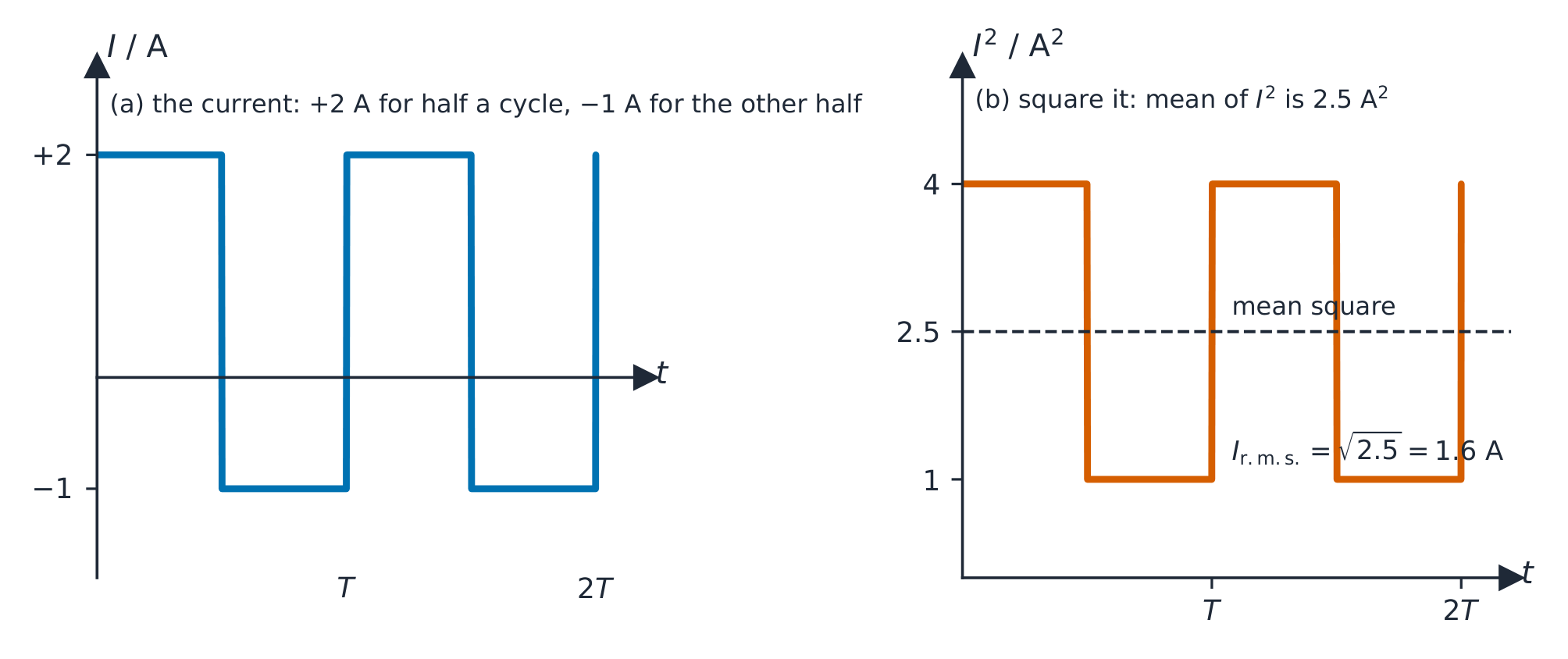
Worked example (non-sinusoidal). A current through a resistor is $+2.0\ \text{A}$ for the first half of each cycle and $-1.0\ \text{A}$ for the second half, a square wave 方波. Find its r.m.s. value and the mean power in a $10\ \Omega$ resistor.
Square the current: $4.0\ \text{A}^{2}$ for half the time and $1.0\ \text{A}^{2}$ for the other half, so the mean square is $(4.0 + 1.0)/2 = 2.5\ \text{A}^{2}$ and $I_{\text{r.m.s.}} = \sqrt{2.5} = 1.6\ \text{A}$. Mean power $= I_{\text{r.m.s.}}^{2} R = 2.5 \times 10 = 25\ \text{W}$. The sign of the current does not matter to the heating (it is squared away), and $I_{0}/\sqrt{2}$ would have given the wrong answer, $1.4\ \text{A}$: that shortcut is for sine waves only.
Why r.m.s. matters
Quoted a.c. values are r.m.s. values. "$230\ \text{V}$ mains" means $V_{\text{r.m.s.}} = 230\ \text{V}$, with peak $V_{0} = 230\sqrt{2} \approx 325\ \text{V}$. Components must be rated for the peak, not the r.m.s. Average power then takes the d.c. form:
$$\langle P \rangle = I_{\text{r.m.s.}}^{2} R = V_{\text{r.m.s.}}^{2} / R = V_{\text{r.m.s.}} I_{\text{r.m.s.}}.$$
Worked example. A heater of resistance $50\ \Omega$ is connected to the $230\ \text{V}$ r.m.s. mains. Find the r.m.s. current and the average power dissipated.
Worked example. A sinusoidal supply of r.m.s. value $4.2\ \text{V}$ and frequency $50\ \text{kHz}$ is connected across a $150\ \Omega$ resistor. Find the peak current, the mean power, and write down an equation for the current.
$V_{0} = 4.2\sqrt{2} = 5.9\ \text{V}$, so $I_{0} = V_{0}/R = 5.9/150 = 0.040\ \text{A}$ (or $I_{\text{r.m.s.}} = 4.2/150 = 0.028\ \text{A}$ and then $\times\sqrt{2}$). Mean power $= V_{\text{r.m.s.}}^{2}/R = 4.2^{2}/150 = 0.12\ \text{W}$. With $\omega = 2\pi f = 2\pi \times 5.0 \times 10^{4} = 3.1 \times 10^{5}\ \text{rad s}^{-1}$: $I = 0.040 \sin(3.1 \times 10^{5} t)$ (amps, seconds). Keep the two families apart: peak values go into the equation and into component ratings; r.m.s. values go into power.
Bahasa Indonesia
Arus r.m.s. $I_{\text{r.m.s.}}$ adalah arus searah stabil yang akan menghasilkan daya rata-rata yang sama pada resistansi yang sama $R$. Dari $\langle P \rangle = I_{\text{r.m.s.}}^{2} R = \tfrac{1}{2} I_{0}^{2} R$:
$\sqrt{2}$ berasal dari nama akar-kuadrat-rata: $I_{\text{r.m.s.}} = \sqrt{\langle I^{2} \rangle}$ dan $\langle \sin^{2}\rangle = \tfrac{1}{2}$. (Kasus sinusoidal saja yang dibutuhkan.)
Definisi bernilai dua.Nilai r.m.s. dari arus bolak-balik adalah nilai arus searah (stabil) yang akan menyebarkan daya yang sama (rata-rata) pada resistor yang sama. "Dengan merujuk pada efek pemanasan" berarti persis kalimat ini: resistor yang sama, daya yang sama (atau pemanasan yang sama), arus searah. Definisi yang hanya menyebutkan "$I_{0}/\sqrt{2}$" tidak mendapat nilai, karena rumus itu hanya benar untuk gelombang sinus.
Root-mean-square, secara harfiah: kuadratkan arus, rata-ratakan kuadrat-kuadratnya selama satu siklus, lalu ambil akarnya. Untuk arus non-sinusoidal, ini adalah satu-satunya cara; $I_0/\sqrt{2}$ berlaku hanya untuk gelombang sinus
Contoh terpecahkan (non-sinusoidal). Arus yang mengalir melalui sebuah resistor bernilai $+2.0\ \text{A}$ untuk setengah pertama setiap siklus dan $-1.0\ \text{A}$ untuk setengah keduanya, membentuk gelombang persegi. Temukan nilai r.m.s. dan daya rata-rata pada resistor $10\ \Omega$.
Kuadratkan arus: $4.0\ \text{A}^{2}$ selama separuh waktu dan $1.0\ \text{A}^{2}$ untuk separuh lainnya, sehingga rata-rata kuadrat adalah $(4.0 + 1.0)/2 = 2.5\ \text{A}^{2}$ dan $I_{\text{r.m.s.}} = \sqrt{2.5} = 1.6\ \text{A}$. Daya rata-rata $= I_{\text{r.m.s.}}^{2} R = 2.5 \times 10 = 25\ \text{W}$. Tanda arus tidak berpengaruh terhadap pemanasan (karena dikuadratkan), dan $I_{0}/\sqrt{2}$ akan menghasilkan jawaban yang salah, $1.4\ \text{A}$: jalan pintas itu hanya untuk gelombang sinus.
Mengapa r.m.s. penting
Nilai a.c. yang dikutip adalah nilai r.m.s. "Jaringan listrik $230\ \text{V}$" berarti $V_{\text{r.m.s.}} = 230\ \text{V}$, dengan puncak $V_{0} = 230\sqrt{2} \approx 325\ \text{V}$. Komponen harus dinilai untuk nilai puncak, bukan r.m.s. Daya rata-rata kemudian mengambil bentuk d.c.:
$$\langle P \rangle = I_{\text{r.m.s.}}^{2} R = V_{\text{r.m.s.}}^{2} / R = V_{\text{r.m.s.}} I_{\text{r.m.s.}}.$$
Contoh terpecahkan. Pemanas dengan hambatan $50\ \Omega$ terhubung ke mains r.m.s. $230\ \text{V}$. Temukan arus r.m.s. dan daya rata-rata yang dibuang.
Contoh terpecahkan. Suplai sinusoidal dengan nilai r.m.s. $4.2\ \text{V}$ dan frekuensi $50\ \text{kHz}$ dihubungkan melintasi resistor $150\ \Omega$. Temukan arus puncak, daya rata-rata, dan tuliskan persamaan untuk arus tersebut.
$V_{0} = 4.2\sqrt{2} = 5.9\ \text{V}$, sehingga $I_{0} = V_{0}/R = 5.9/150 = 0.040\ \text{A}$ (atau $I_{\text{r.m.s.}} = 4.2/150 = 0.028\ \text{A}$ dan kemudian $\times\sqrt{2}$). Daya rata-rata $= V_{\text{r.m.s.}}^{2}/R = 4.2^{2}/150 = 0.12\ \text{W}$. Dengan $\omega = 2\pi f = 2\pi \times 5.0 \times 10^{4} = 3.1 \times 10^{5}\ \text{rad s}^{-1}$: $I = 0.040 \sin(3.1 \times 10^{5} t)$ (ampere, detik). Pisahkan kedua keluarga ini: nilai puncak masuk ke dalam persamaan dan penilaian komponen; nilai r.m.s. masuk ke dalam perhitungan daya.
distinguish graphically between half-wave and full-wave rectification
explain the use of a single diode for the half-wave rectification of an alternating current
explain the use of four diodes (bridge rectifier) for the full-wave rectification of an alternating current
analyse the effect of a single capacitor in smoothing, including the effect of the values of capacitance and the load resistance
Bahasa Indonesia
bedakan secara grafis antara rectifikasi gelombang penuh dan setengah gelombang
jelaskan penggunaan satu dioda untuk rectifikasi setengah gelombang arus bolak-balik
jelaskan penggunaan empat dioda (penyearah jembatan) untuk rectifikasi gelombang penuh arus bolak-balik
analisis efek satu kapasitor dalam penghalusan, termasuk efek nilai kapasitansi dan hambatan beban
Source: Cambridge International syllabus · Sumber: Silabus Cambridge International
English
Rectification 整流 turns an alternating voltage into a one-direction (d.c.-like) voltage, using diodes 二极管 (which conduct in only one direction).
"State what is meant by rectification."The conversion of an alternating current (or voltage) into a direct current (or voltage): one that flows in one direction only, however much it varies. A diode conducts only when it is forward-biased 正向偏置, that is, when its anode (the flat end of the symbol's triangle) is more positive than its cathode (the bar); otherwise it is reverse-biased and behaves like an open switch. Treat it as ideal: zero resistance one way, infinite the other.
Half-wave rectification
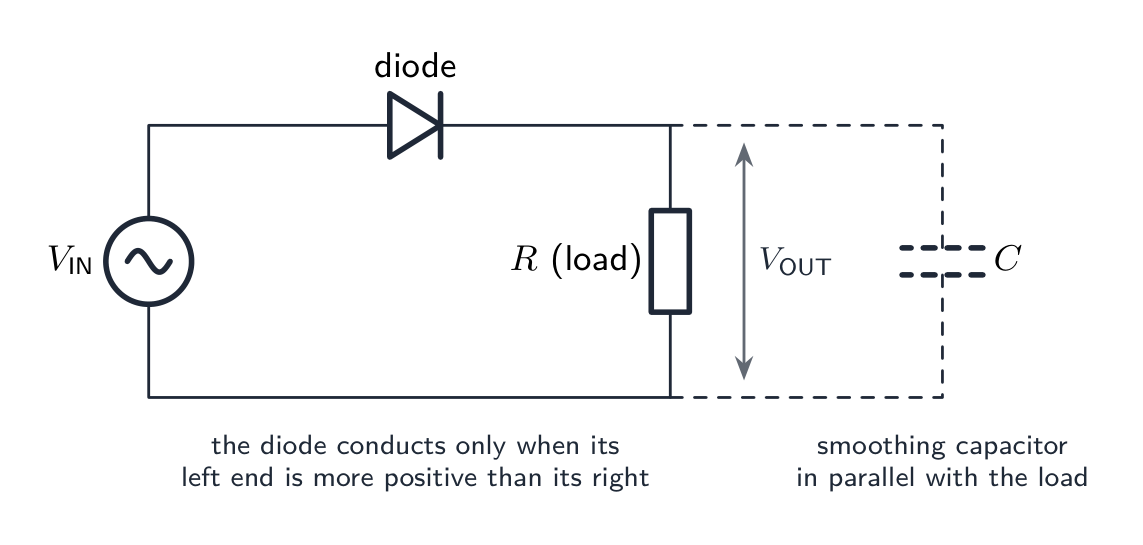
A single diode in series with the load passes only the positive half of each cycle; in the negative half the diode is reverse-biased 反向偏置 and no current flows. This is half-wave rectification 半波整流.
Output: positive half-waves with flat zero gaps. The mean output is $V_{0}/\pi \approx 0.32 V_{0}$. Drawback: half the input is wasted and the output is very uneven.
Completing the circuit. "Complete the diagram to produce half-wave rectification" needs one diode in series between the supply and the load, with the triangle pointing the way the output current must flow, and $V_{\text{OUT}}$ taken across the load. If a capacitor is to smooth the output it goes across the load (in parallel); a capacitor in series would block the d.c. altogether.
Full-wave rectification (bridge rectifier)
A bridge rectifier 桥式整流器 uses four diodes arranged so the current through the load always flows the same way, whichever a.c. terminal is positive — full-wave rectification 全波整流. On each half-cycle a different pair of diodes conducts, but the load always sees the same direction.
Explaining the bridge (the standard four-marker). When terminal P is positive, current leaves P, passes through the diode pointing away from P to the top of the load, flows down through the load and returns to Q through the diode pointing towards Q; the other two diodes are reverse-biased and carry nothing. When Q is positive the other pair conducts, but they are arranged so that the current still enters the load at the top: the load current is in the same direction in both half-cycles. Name the diodes in each half-cycle and say which end of the load is positive.
Completing a bridge. Given a bridge with diodes missing, remember the rule for every diode: conventional current flows through it in the direction of the triangle. Both diodes joined to the positive output terminal must point towards it; both joined to the negative output terminal must point away from it. A bridge with a diode the wrong way round either short-circuits the supply on one half-cycle or passes nothing.
Output: a continuous run of positive half-waves (no gaps), at twice the input frequency. The mean output is $2V_{0}/\pi \approx 0.64 V_{0}$ — double the half-wave value. It uses all the input and is smoother and easier to filter.
Drawing the diagrams
half-wave: a.c. source — single diode — load $R$, in series.
full-wave bridge: four diodes as the arms of a "diamond"; the a.c. input goes to one pair of opposite corners, the load $R$ across the other pair. The diode directions make the load terminals keep the same polarity for either input polarity.
"State the difference between half-wave and full-wave rectification." In half-wave rectification only one half of each input cycle appears at the output and the other half is blocked (the output is zero for half the time); in full-wave rectification both halves appear, one of them inverted, so there are no gaps and the output has twice the input frequency. A sketch should show, for half-wave, positive humps separated by flat zero sections of equal length; for full-wave, positive humps joined at the zero line.
Bahasa Indonesia
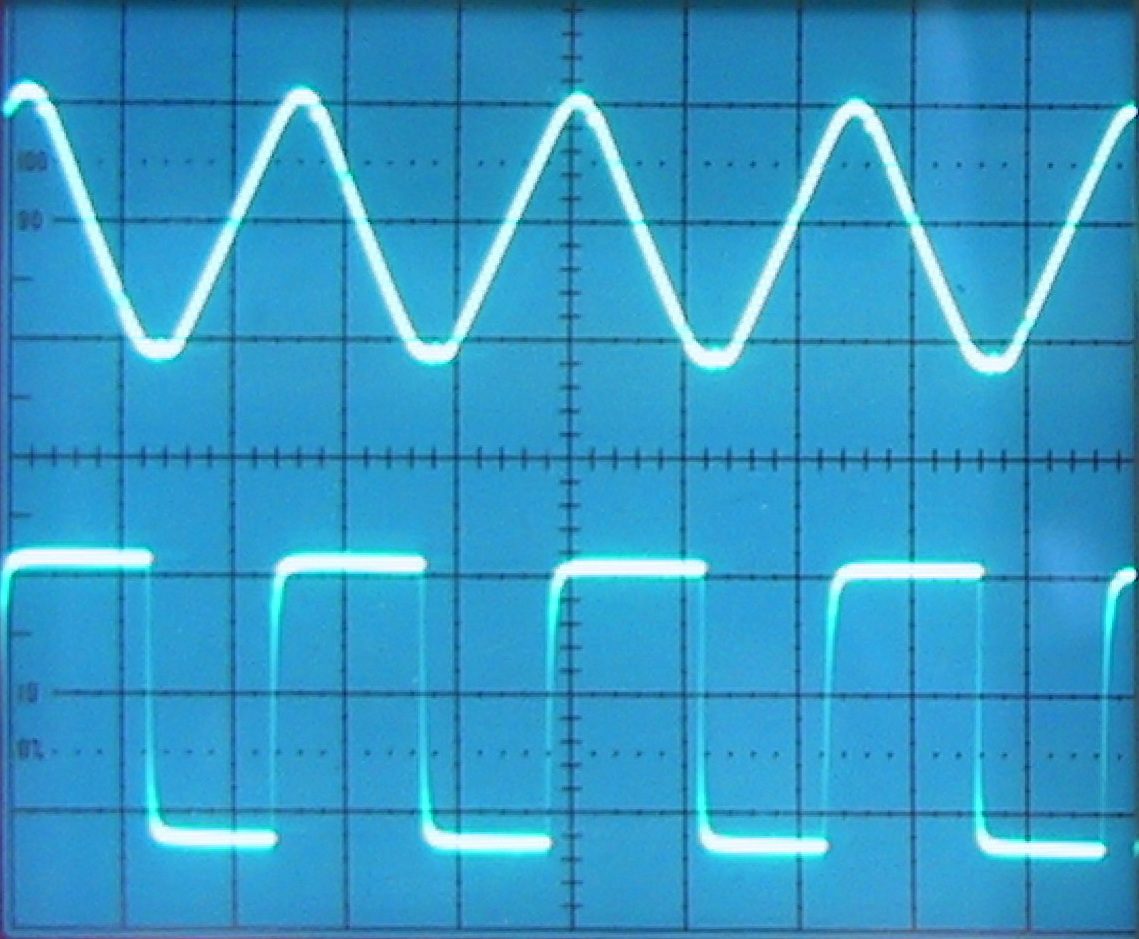
Osiloskop menunjukkan bagaimana tegangan berubah seiring waktu.
Penyearahan mengubah tegangan bolak-balik menjadi tegangan satu arah (mirip d.c.) menggunakan dioda (yang menghantarkan arus hanya dalam satu arah).
"Nyatakan apa yang dimaksud dengan penyearahan."Konversi arus bolak-balik (atau tegangan) menjadi arus searah (atau tegangan): yaitu arus yang mengalir hanya dalam satu arah, seberapa pun perubahannya. Dioda menghantarkan arus hanya ketika bias maju, yaitu ketika anodanya (ujung datar dari simbol segitiga) lebih positif daripada katodnya (garis); jika tidak, ia bias mundur dan berperilaku seperti saklar terbuka. Anggaplah sebagai ideal: hambatan nol satu arah, tak hingga di arah lain.
Penyearahan gelombang setengah
Satu dioda seri dengan beban hanya meneruskan setengah positif dari setiap siklus; pada setengah negatif, dioda tersebut bias mundur dan tidak ada arus yang mengalir. Ini disebut penyearahan gelombang setengah.
Output: gelombang setengah positif dengan celah nol yang datar. Output rata-rata adalah $V_{0}/\pi \approx 0.32 V_{0}$. Kekurangannya: separuh input terbuang dan output sangat tidak merata.
Dalam penyearahan gelombang setengah, satu dioda hanya meneruskan siklus positifPenyearah gelombang setengah yang diminta ujian untuk digambar: sumber, dioda, beban seri, output di atas beban; kapasitor penapis, jika diinginkan, dipasang paralel dengan beban, tidak pernah seri
Melengkapi sirkuit. "Lengkapi diagram untuk menghasilkan penyearahan gelombang setengah" membutuhkan satu dioda seri antara suplai dan beban, dengan segitiga menunjuk ke arah aliran arus output, dan $V_{\text{OUT}}$ diambil di atas beban. Jika kapasitor digunakan untuk menapis output, ia dipasang di atas beban (paralel); kapasitor seri akan memblokir d.c. sepenuhnya.
Penyearahan gelombang penuh (rectifier jembatan)
Rectifier jembatan menggunakan empat dioda yang diatur sedemikian rupa sehingga arus melalui beban selalu mengalir ke satu arah yang sama, terlepas dari terminal a.c. mana yang positif — penyearahan gelombang penuh. Pada setiap setengah siklus, pasangan dioda berbeda yang menghantarkan arus, tetapi beban selalu melihat arah yang sama.
Jembatan empat dioda mengirimkan arus beban ke arah yang sama terlepas dari terminal a.c. mana yang positif
Menjelaskan jembatan (marker standar empat). Ketika terminal P positif, arus keluar dari P, melewati dioda yang menjauh dari P menuju atas beban, mengalir turun melalui beban dan kembali ke Q melalui dioda yang mengarah ke Q; dua dioda lainnya bias mundur dan tidak mengalirkan arus. Ketika Q positif, pasangan lainnya menghantarkan, tetapi mereka diatur sedemikian rupa agar arus tetap memasuki beban dari bagian atas: arus beban berada dalam arah yang sama pada kedua setengah siklus. Sebutkan nama dioda pada setiap setengah siklus dan sebutkan ujung mana dari beban yang positif.
Menyempurnakan jembatan. Diberikan sebuah jembatan dengan dioda yang hilang, ingat aturan untuk setiap dioda: arus konvensional mengalir melaluinya searah dengan segitiga. Kedua dioda yang terhubung ke terminal output positif harus mengarah menuju terminal tersebut; kedua dioda yang terhubung ke terminal output negatif harus mengarah menjauhi terminal tersebut. Jembatan dengan satu dioda terbalik akan menyebabkan korsleting pada sumber pada setengah siklus atau tidak mengalirkan apa pun.
Output: rentetan gelombang positif penuh yang berkelanjutan (tanpa jeda), pada frekuensi input dua kali lipat. Rata-rata output adalah $2V_{0}/\pi \approx 0.64 V_{0}$ — dua kali nilai gelombang separuh. Ini menggunakan seluruh input dan lebih halus serta lebih mudah difilter.
Dalam penyearahan gelombang penuh, setiap setengah siklus digunakan, menghasilkan rentetan hump positif yang berkelanjutan
Menggambar diagram
gelombang separuh: sumber a.c. — dioda tunggal — beban $R$, secara seri.
jembatan gelombang penuh: empat dioda sebagai lengan "berlian"; input a.c. masuk ke sepasang sudut yang berhadapan, beban $R$ dipasangkan melintasi pasangan lainnya. Arah dioda membuat terminal beban mempertahankan polaritas yang sama baik untuk polaritas input mana pun.
"Sebutkan perbedaan antara penyearahan gelombang separuh dan gelombang penuh." Dalam penyearahan gelombang separuh hanya satu setengah dari setiap siklus input yang muncul di output dan setengah lainnya diblokir (output nol selama setengah waktu); dalam penyearahan gelombang penuh kedua setengahnya muncul, salah satunya terbalik, sehingga tidak ada jeda dan output memiliki frekuensi dua kali lipatnya input. Sketsa harus menunjukkan, untuk gelombang separuh, hump positif yang dipisahkan oleh bagian datar nol yang panjangnya sama; untuk gelombang penuh, hump positif yang menyambung di garis nol.
Explore · Jelajahi
Rectifier and smoothing route · Jalur rektifier dan penyingkat
Watch alternating input become a smoother direct output. · Perhatikan input bolak-balik berubah menjadi output searah yang lebih halus.
Smoothing with a capacitor · Penghalusan dengan kapasitor
English
A rectifier's output is still bumpy. To smooth it, put a capacitor 电容器$C$in parallel with the load$R$.
How it works
on the rising part of each pulse, the capacitor charges up to near the peak.
on the falling part (and any gap), the diodes are reverse-biased, so the capacitor discharges through the load, keeping current flowing. The voltage falls with time constant 时间常数$RC$ (Topic 19).
at the next peak, the capacitor charges again, and the cycle repeats.
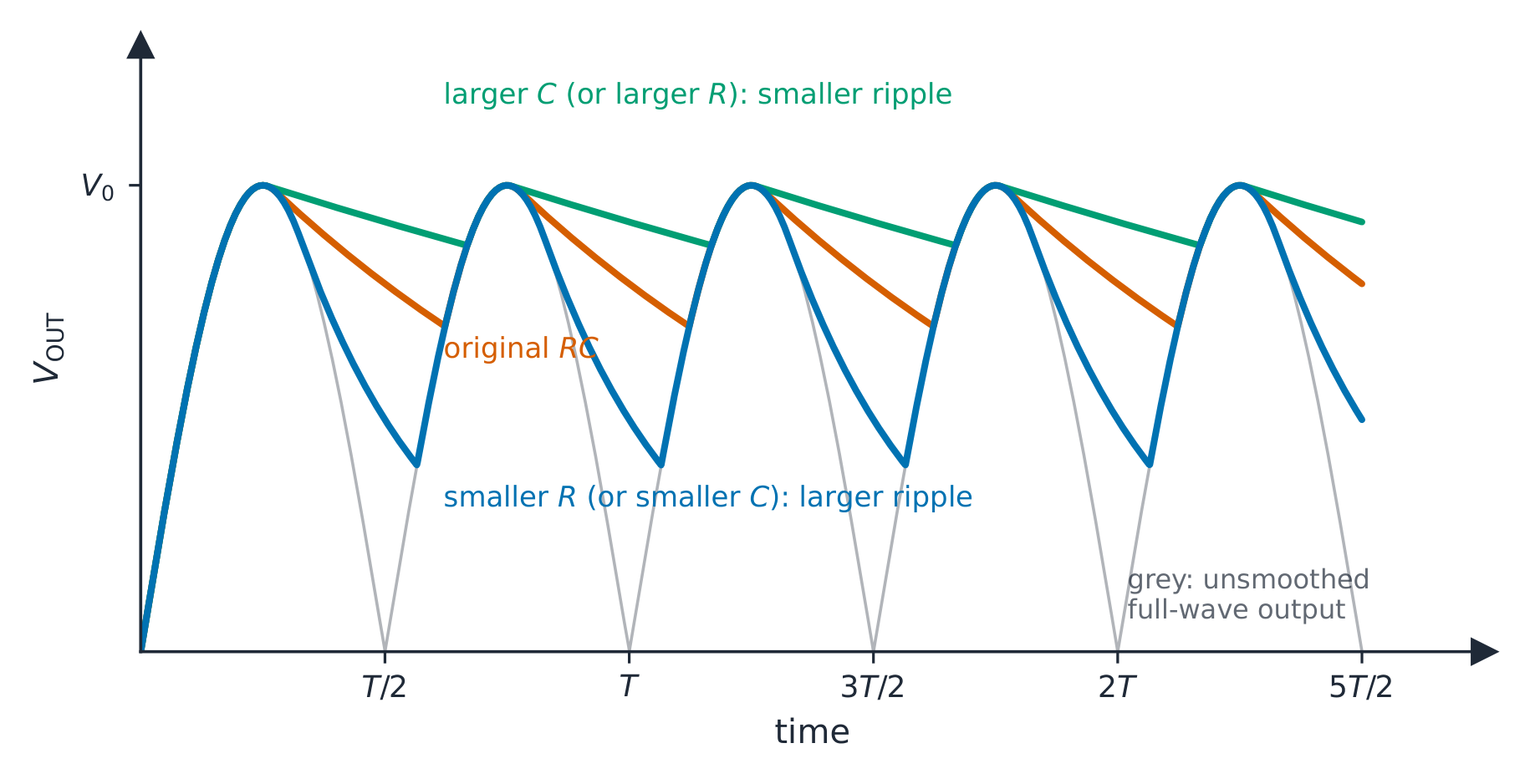
The output now sits near the peak with small dips. The size of the dips is the ripple 纹波 (this whole step is called smoothing 平滑).
Worked example. A half-wave rectifier fed from a $50\ \text{Hz}$ supply has a $470\ \mu\text{F}$ capacitor across its $1.2\ \text{k}\Omega$load 负载. Estimate the fractional fall in the output between peaks, and say how it changes with a bridge rectifier.
The peaks are $T = 1/50 = 20\ \text{ms}$ apart (half-wave: one peak per cycle). The time constant is $RC = (1.2 \times 10^{3})(470 \times 10^{-6}) = 0.56\ \text{s}$. Between peaks the capacitor discharges to $V_{0} e^{-t/RC} = V_{0} e^{-0.020/0.56} = 0.965\,V_{0}$, a fall of about $3.5\%$. With full-wave rectification the peaks are $10\ \text{ms}$ apart, so the fall is only $1.8\%$; doubling the capacitance would halve it again. Because $t \ll RC$ the fall is approximately $V_{0}\, t/(RC)$: the ripple is proportional to the time between peaks and inversely proportional to both $R$ and $C$. (A network of capacitors across the output combines by the rules of Topic 19 before it is used here.)
What reduces the ripple
larger $C$ → more stored charge → smaller dip between peaks → smaller ripple.
higher rectified frequency (full-wave is twice the input) → less time to discharge between peaks → smaller ripple.
In short, a large $RC$ compared with the time between peaks gives a smoother output.
Sketching the smoothed output. Draw the unsmoothed humps faintly first. The smoothed curve touches each peak, then falls along a gentle curve (steepest just after the peak) until the next hump rises to meet it, where it turns sharply upwards and follows the hump to the peak. It never falls to zero, and it never rises above the peak. For half-wave rectification the decay has to last through the missing half-cycle as well, so the ripple is about twice that of full-wave for the same $RC$. If the question changes $C$ or $R$, redraw on the same axes: a larger $RC$ hugs the peak line more closely; a smaller $RC$ sags further.
Purpose in summary
The smoothing capacitor reduces the ripple, giving a steadier d.c. voltage suitable for sensitive electronics.
Bahasa Indonesia
Output penyearah masih bergelombang. Untuk menghaluskannya, pasanglah kapasitor$C$secara paralel dengan beban$R$.
Cara kerjanya
pada bagian naik dari setiap pulsa, kapasitor mengisi muatan hingga mendekati puncak.
pada bagian turun (dan jeda apa pun), dioda bias negatif, sehingga kapasitor mengosongkan muatan melalui beban, menjaga arus tetap mengalir. Tegangan turun dengan konstanta waktu$RC$ (Topik 19).
pada puncak berikutnya, kapasitor mengisi kembali, dan siklus berulang.
Output sekarang berada di dekat puncak dengan lekukan kecil. Ukuran lekukan tersebut adalah ripar (seluruh langkah ini disebut penghalusan).
Kapasitor melintasi beban menghaluskan output penyearah, meninggalkan hanya ripar kecilSumber penyearahan yang sama yang dihaluskan dengan konstanta waktu berbeda: konstanta waktu $RC$ yang lebih besar (kapasitansi lebih banyak, atau resistansi beban lebih besar) menurun lebih sedikit di antara puncak, sehingga riparnya lebih kecil
Contoh soal terpecahkan. Penyearah gelombang separuh yang dialiri dari sumber $50\ \text{Hz}$ memiliki kapasitor $470\ \mu\text{F}$ yang dipasangkan melintasi beban$1.2\ \text{k}\Omega$. Perkirakan penurunan pecahan pada output antar-puncak, dan jelaskan bagaimana hal itu berubah dengan penyearah jembatan.
Puncak-puncaknya terpisah $T = 1/50 = 20\ \text{ms}$ (gelombang separuh: satu puncak per siklus). Konstanta waktunya adalah $RC = (1.2 \times 10^{3})(470 \times 10^{-6}) = 0.56\ \text{s}$. Antara puncak kapasitor kosong hingga $V_{0} e^{-t/RC} = V_{0} e^{-0.020/0.56} = 0.965\,V_{0}$, penurunan sekitar $3.5\%$. Dengan penyearahan gelombang penuh, puncak-puncaknya terpisah $10\ \text{ms}$, sehingga penurunannya hanya $1.8\%$; menggandakan kapasitansi akan memotongnya menjadi setengah lagi. Karena $t \ll RC$ penurunan tersebut kira-kira $V_{0}\, t/(RC)$: ripar sebanding dengan waktu antar-puncak dan berbanding terbalik dengan keduanya $R$ dan $C$. (Jaringan kapasitor melintasi output digabungkan sesuai aturan Topik 19 sebelum digunakan di sini.)
Apa yang mengurangi ripar
konstanta waktu $C$ yang lebih besar → muatan tersimpan lebih banyak → lekukan antar-puncak lebih kecil → ripar lebih kecil.
resistansi $R$ yang lebih besar → arus beban lebih kecil → pengosongan lebih lambat → ripar lebih kecil.
frekuensi penyearahan yang lebih tinggi (gelombang penuh adalah dua kali input) → lebih sedikit waktu untuk mengosongkan muatan antar-puncak → ripar lebih kecil.
Singkatnya, konstanta waktu $RC$ yang besar dibandingkan dengan waktu antar-puncak menghasilkan output yang lebih halus.
Menggambar sketsa output yang dihaluskan. Gambarlah hump yang belum dihaluskan samar-samar terlebih dahulu. Kurva yang dihaluskan sentuh setiap puncak, lalu turun sepanjang kurva landai (paling curam tepat setelah puncak) hingga hump berikutnya naik untuk menemuinya, di mana ia berbelok tajam ke atas dan mengikuti hump menuju puncak. Ia tidak pernah turun ke nol, dan tidak pernah naik melebihi puncak. Untuk penyearahan gelombang separuh, peluruhan harus berlangsung melalui setengah siklus yang hilang juga, sehingga riparnya sekitar dua kali lipat dari gelombang penuh untuk konstanta waktu $RC$ yang sama. Jika soal mengubah $C$ atau $R$, gambar ulang pada sumbu yang sama: konstanta waktu $RC$ yang lebih besar akan lebih dekat menempel pada garis puncak; konstanta waktu $RC$ yang lebih kecil akan melengkung lebih jauh ke bawah.
Tujuan secara ringkas
Kapasitor penghalus mengurangi ripar, memberikan tegangan d.c. yang lebih stabil yang cocok untuk elektronik sensitif.
Definitions the examiner accepts · Definisi yang diterima oleh penguji
English
A definition question is marked against fixed wording. Learn these exactly, and give one answer only.
Term
Definition
alternating current
a current that reverses its direction periodically (varies sinusoidally with time about zero)
period
the time for one complete cycle
frequency
the number of complete cycles per unit time
peak value
the maximum value of the current or voltage in a cycle
r.m.s. value
the value of the direct (steady) current that would dissipate the same power in the same resistor
rectification
the conversion of an alternating current into a direct (one-direction) current
half-wave rectification
only one half of each cycle is passed to the output; the other half is blocked
full-wave rectification
both halves of each cycle appear at the output in the same direction
smoothing
using a capacitor across the load to reduce the variation (ripple) of a rectified output
Bahasa Indonesia
Soal definisi dinilai berdasarkan frasa tetap. Hafalkan ini persis, dan berikan hanya satu jawaban.
Istilah
Definisi
arus bolak-balik
arus yang membalikkan arahnya secara berkala (bervariasi secara sinusoidal terhadap waktu di sekitar nol)
periode
waktu untuk satu siklus lengkap
frekuensi
jumlah siklus lengkap per satuan waktu
nilai puncak
nilai maksimum dari arus atau tegangan dalam satu siklus
nilai r.m.s.
nilai arus langsung (stabil) yang akan menghamburkan daya yang sama pada resistor yang sama
penyearahan
konversi arus bolak-balik menjadi arus langsung (satu arah)
penyearah gelombang setengah
hanya satu separuh dari setiap siklus yang dilewatkan ke output; separuh lainnya diblokir
penyearah gelombang penuh
kedua separuh dari setiap siklus muncul pada output dalam arah yang sama
penyaringan
menggunakan kapasitor di beban untuk mengurangi variasi (riak) dari output yang telah disearahkan
21.2
Exam tips · Tips ujian
English
$V = V_{0} \sin\omega t$ with $\omega = 2\pi f$ in radians per second: read $V_{0}$ and $\omega$ straight off the equation; radian mode for any time calculation.
$I_{\text{r.m.s.}} = I_{0}/\sqrt{2}$ and $V_{\text{r.m.s.}} = V_{0}/\sqrt{2}$ for a sine wave only; otherwise square, average, root. Quoted mains values are r.m.s.; components are rated for the peak.
Mean power in a resistor is $I_{\text{r.m.s.}}^{2}R = V_{\text{r.m.s.}}^{2}/R = \tfrac{1}{2} I_{0}^{2} R$, half the peak power; the mean current is zero, the mean power is not.
One diode in series gives half-wave rectification; a four-diode bridge gives full-wave, with the load current always in the same direction and the output at twice the input frequency.
Smoothing: capacitor across the load; ripple falls with a larger $C$, a larger $R$ (smaller load current) and a higher rectified frequency, because the decay between peaks is $V_{0}e^{-t/RC}$.
Sketches are marked on shape: humps that touch the peak line, a decay that never reaches zero, flat zero gaps for half-wave, none for full-wave.
Common mistakes
Using the peak value in a power calculation, or the r.m.s. value as the amplitude in $V = V_{0}\sin\omega t$.
Writing $\omega = f$ or $\omega = 2\pi/f$; it is $2\pi f = 2\pi/T$.
Defining the r.m.s. value as "the peak divided by $\sqrt{2}$", or leaving out "same power" and "same resistor".
Applying $I_{0}/\sqrt{2}$ to a square or triangular wave.
Drawing a diode backwards, or a bridge in which two diodes joined to the same output terminal point opposite ways.
Putting the smoothing capacitor in series with the load.
A smoothed output sketched falling to zero between peaks, or rising above the peak.
Saying a larger load resistance gives a larger ripple; a larger $R$ means a smaller current, a slower discharge and a smaller ripple.
Stating that full-wave rectification gives a steady d.c.; without a capacitor it is a series of humps with a large ripple.
Bahasa Indonesia
$V = V_{0} \sin\omega t$ dengan $\omega = 2\pi f$ dalam radian per detik: baca $V_{0}$ dan $\omega$ langsung dari persamaan; mode radian untuk perhitungan waktu apa pun.
$I_{\text{r.m.s.}} = I_{0}/\sqrt{2}$ dan $V_{\text{r.m.s.}} = V_{0}/\sqrt{2}$ hanya untuk gelombang sinus; jika tidak, kuadrat, rata-rata, akar. Nilai jaringan yang dikutip adalah r.m.s.; komponen dinilai untuk nilai puncak.
Daya rata-rata pada resistor adalah $I_{\text{r.m.s.}}^{2}R = V_{\text{r.m.s.}}^{2}/R = \tfrac{1}{2} I_{0}^{2} R$, setengah daya puncak; arus rata-rata adalah nol, tetapi daya rata-rata bukan nol.
Satu dioda seri memberikan penyearahan gelombang setengah; jembatan empat dioda memberikan penyearahan gelombang penuh, dengan arus beban selalu dalam arah yang sama dan output pada frekuensi dua kali frekuensi input.
Penyaringan: kapasitor di atas beban; riak menurun dengan $C$ yang lebih besar, $R$ yang lebih besar (arus beban lebih kecil) dan frekuensi penyearahan yang lebih tinggi, karena peluruhan antara puncak adalah $V_{0}e^{-t/RC}$.
Sketsa ditandai pada bentuk: tonjolan yang menyentuh garis puncak, peluruhan yang tidak pernah mencapai nol, celah nol datar untuk gelombang setengah, tidak ada untuk gelombang penuh.
Kesalahan umum
Menggunakan nilai puncak dalam perhitungan daya, atau nilai r.m.s. sebagai amplitudo dalam $V = V_{0}\sin\omega t$.
Menulis $\omega = f$ atau $\omega = 2\pi/f$; itu adalah $2\pi f = 2\pi/T$.
Mendefinisikan nilai r.m.s. sebagai "puncak dibagi dengan $\sqrt{2}$", atau mengabaikan "daya sama" dan "resistor sama".
Menerapkan $I_{0}/\sqrt{2}$ ke gelombang persegi atau segitiga.
Menggambar dioda terbalik, atau jembatan di mana dua dioda terhubung ke terminal output yang sama mengarah ke arah berlawanan.
Memasang kapasitor penyaring secara seri dengan beban.
Output yang disaring digambar turun ke nol di antara puncak, atau naik melebihi puncak.
Menyatakan bahwa resistansi beban yang lebih besar memberikan riak yang lebih besar; $R$ yang lebih besar berarti arus yang lebih kecil, pembuangan yang lebih lambat dan riak yang lebih kecil.
Menyatakan bahwa penyearahan gelombang penuh menghasilkan d.c. stabil; tanpa kapasitor, ini adalah deretan tonjolan dengan riak yang besar.
Interactive lessons on this topic · Pelajaran interaktif untuk topik ini
Work through it step by step, with instant-check exercises. · Kerjakan langkah demi langkah, dengan latihan pengecekan instan.
Pick one and the site follows you — notes, papers, videos and practice all open on it. · Pilih satu dan situs mengikuti Anda — catatan, kertas, video, dan latihan semua terbuka di sana.
Type to search notes, lessons, code, vocabulary and past-paper questions across every subject. · Ketik untuk mencari catatan, pelajaran, kode, kosakata, dan pertanyaan soal lama di setiap mata pelajaran.