Alternating currents
Introduced| English | Meaning |
|---|---|
| peak value/piːk ˈvæljuː/ | The maximum value of the current or voltage in a cycle. |
| root-mean-square/ruːt miːn skweə/ | The square root of the mean of the squares of a set of values or a varying quantity. |
| alternating current/ˈɔːltəneɪtɪŋ ˈkʌrənt/ | The value of the direct (steady) current that would dissipate the same mean power in the same resistor. |
| sinusoidal/ˌsaɪnəˈsɔɪdl/ | sinusoidal |
| angular frequency/ˈæŋɡjʊlə ˈfriːkwənsi/ | The rate of change of phase in radians per second, equal to two pi times frequency. |
| radians/ˈreɪdɪənz/ | Units of angle defined by arc length divided by radius; one full turn equals two pi of these units. |
| cathode-ray oscilloscope/ˈkæθəʊd reɪ ɒˈsɪləskəʊp/ | An instrument that uses an electron beam and a screen to display how an electrical signal changes, commonly with time. |
| time-base/taɪm beɪs/ | A circuit or setting that provides the controlled horizontal sweep used to represent time on an oscilloscope. |
The 230 volts that is never 230 volts
- A mains socket is labelled $230\ \text{V}$, yet an oscilloscope shows the voltage swinging up to about $325\ \text{V}$ and down to $-325\ \text{V}$, fifty times a second.
- Neither number is a mistake. The mains voltage really does reach $325\ \text{V}$, and it really does behave like a steady $230\ \text{V}$ battery when it heats a kettle.
- Reconciling those two facts is what this lesson is about.
- The tools are the peak value 峰值, the root-mean-square 均方根 value, and the fact that average a.c. power is half the peak power.
Period, frequency and peak value
- An alternating current 交流电 keeps reversing direction; the mains is sinusoidal 正弦, so $I$ and $V$ follow sine waves in time.
- The period $T$ is the time for one complete cycle. The frequency $f$ is the number of complete cycles per unit time, so $f = 1/T$.
- The peak value is the maximum value of the current or voltage in a cycle. Those three sentences are the marked wordings.
- The mean value over a whole cycle is zero, since the wave spends as long negative as positive. That is precisely why an r.m.s. value is needed at all.
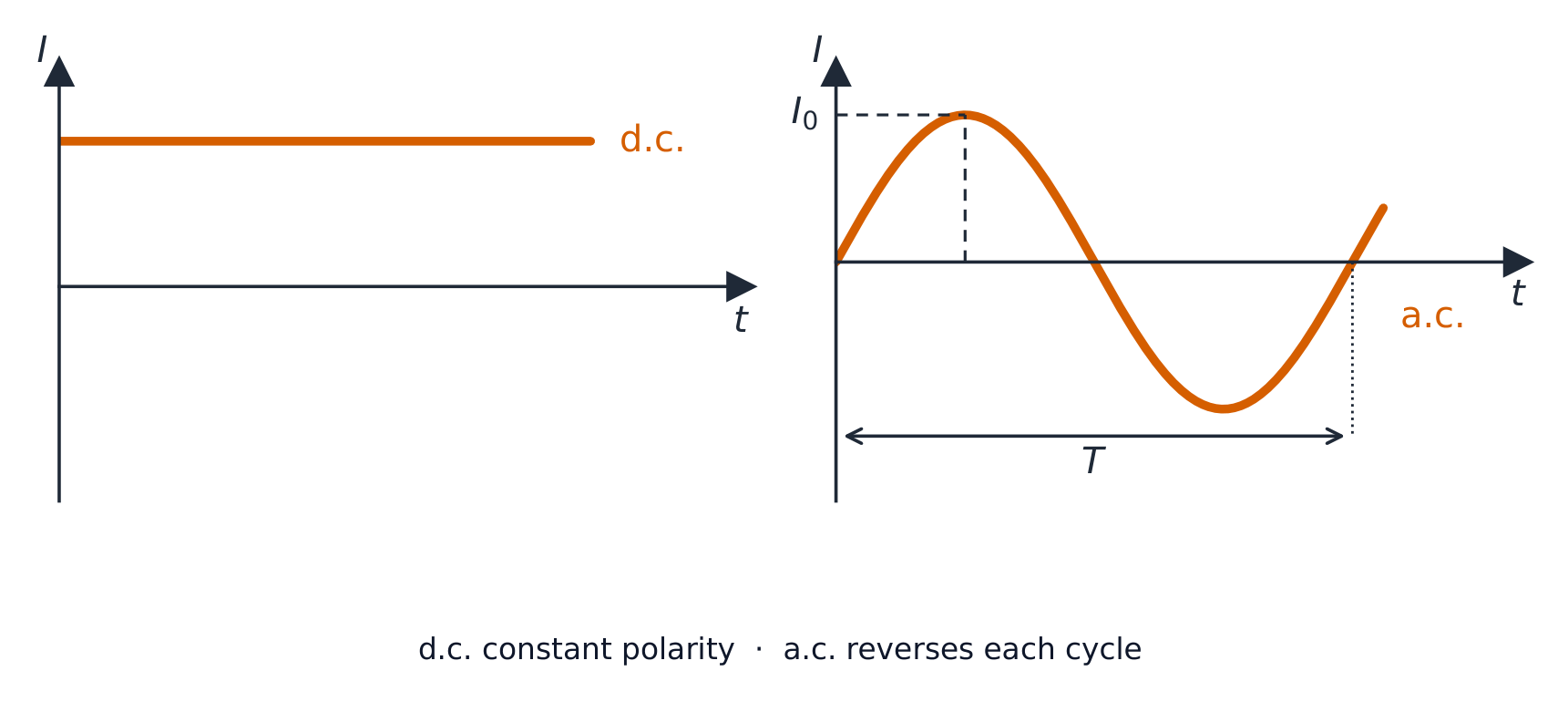
One line that never moves, one that never stops
Alternating current
I = a sin(bt)
AC is a sine wave — amplitude is the peak, b sets the frequency.
An alternating current:
Difficulty 1/5 · 100 coins + a small bonus on first completion today
a.c. keeps swapping direction — mains does so 50 (or 60) times a second.
Match each term to the definition the examiner marks.
Difficulty 2/5 · 140 coins + a small bonus on first completion today
Each is a fixed wording. The r.m.s. one is the only definition that mentions another current, because that is what it compares itself to.
Reading the equation
- A supply is written $V = V_0 \sin(\omega t)$. The number in front is the peak value; the number multiplying $t$ is the angular frequency 角频率 $\omega = 2\pi f$.
- So $f = \omega / 2\pi$ and $T = 1/f$. The angle $\omega t$ is in radians 弧度, so put the calculator in radians before evaluating anything.
- A supply written with $\cos$ is the same wave started at its peak rather than at zero.
In $V = V_0\sin(\omega t)$ the coefficient of $t$ is the ____ frequency, equal to $2\pi f$.
Difficulty 1/5 · 100 coins + a small bonus on first completion today
omega is 2pif, so a supply written sin(100pit) has f = 50 Hz, not 100*pi Hz. The angle is in radians, so a calculator left in degrees turns every such step into nonsense.
Worked example: unpacking a supply equation
- A supply has $V = 320\sin(100\pi t)$, with $V$ in volts and $t$ in seconds. Find the peak value, frequency, period and r.m.s. voltage, and the first time after $t = 0$ at which $V = 160\ \text{V}$.
- Peak: $V_0 = 320\ \text{V}$. Angular frequency: $\omega = 100\pi\ \text{rad/s}$, so $f = 100\pi / 2\pi = 50\ \text{Hz}$ and $T = 1/50 = 0.020\ \text{s}$.
- $V_{\text{r.m.s.}} = 320/\sqrt{2} = 226\ \text{V}$.
- For $V = 160\ \text{V}$: $\sin(100\pi t) = 0.5$, so $100\pi t = \pi/6$ and $t = 1/600 = 1.7 \times 10^{-3}\ \text{s}$. In degrees mode this last step gives nonsense.
Mains supply is $50\ \text{Hz}$. What is its period?
Difficulty 2/5 · 140 coins + a small bonus on first completion today
$T = \dfrac{1}{f} = \dfrac{1}{50} = 0.020\ \text{s}$.
Reading a CRO trace
- A cathode-ray oscilloscope 示波器 is read exactly as in Topic 7.
- Horizontal: count the divisions for one full cycle and multiply by the time-base 时基 setting. That gives $T$, and $f = 1/T$.
- Vertical: count the divisions from the centre line to a peak and multiply by the $y$-gain. That gives $V_0$. Measuring peak to peak and halving is usually more accurate, because the centre line is easy to misjudge.
On a CRO trace one complete cycle spans 4.0 divisions with the time-base at 5.0 ms per division. What is the frequency, in Hz?
Difficulty 2/5 · 140 coins + a small bonus on first completion today
T = 4.0 x 5.0 ms = 20 ms, so f = 1/0.020 = 50 Hz. Count divisions for a WHOLE cycle, not a half.
Power in a resistor
- For a resistive load the instantaneous power is $P = I^2 R$, and with $I = I_0\sin(\omega t)$:
- This is always positive, since the current is squared, so a reversing current still heats the resistor. It pulses between zero and $I_0^2 R$ at twice the frequency of the current.
- The mean of $\sin^2$ over a cycle is $\tfrac{1}{2}$, so the average power is half the peak power.

Twice the frequency, and never negative
The average power of a.c. in a resistor is ____ the peak power.
Difficulty 1/5 · 100 coins + a small bonus on first completion today
The mean of $\sin^{2}$ over a cycle is $\tfrac{1}{2}$, so $\langle P\rangle = \tfrac{1}{2}P_{\text{peak}}$.
Worked example: showing it is half
- A supply of peak voltage $12\ \text{V}$ drives a $680\ \Omega$ resistor. Show by calculation that the mean power is half the peak power.
- Peak power, at the instant the voltage is at its peak: $P_0 = V_0^2/R = 12^2/680 = 0.212\ \text{W}$.
- Mean power, through the r.m.s. value: $V_{\text{r.m.s.}} = 12/\sqrt{2} = 8.49\ \text{V}$, so $\langle P\rangle = V_{\text{r.m.s.}}^2/R = 8.49^2/680 = 0.106\ \text{W}$.
- The two are shown separately, and the second is half the first. Writing "half of $0.212$" scores nothing, because that is the very thing being shown.
- The factor $\tfrac{1}{2}$ is just $(1/\sqrt{2})^2$: the r.m.s. factor, squared.
What r.m.s. actually means
- The r.m.s. value of an alternating current is the value of the direct (steady) current that would dissipate the same mean power in the same resistor. That sentence is the two-mark definition, and "by reference to the heating effect" is asking for exactly it.
- From $\langle P\rangle = I_{\text{r.m.s.}}^2 R = \tfrac{1}{2}I_0^2 R$ it follows that, for a sine wave:
- A definition that says only "$I_0/\sqrt{2}$" scores nothing, because that formula holds for a sine wave alone.
- Quoted a.c. values are r.m.s. values, which settles the opening puzzle: $230\ \text{V}$ mains has $V_0 = 230\sqrt{2} \approx 325\ \text{V}$, and components must be rated for the peak.

One dashed line that does the same heating
An a.c. has a peak current of $2.0\ \text{A}$. What is the r.m.s. current?
Difficulty 2/5 · 140 coins + a small bonus on first completion today
$I_{\text{rms}} = \dfrac{I_0}{\sqrt{2}} = \dfrac{2.0}{\sqrt{2}} \approx 1.41\ \text{A}$.
A 230 V (r.m.s.) mains supply has a peak voltage of about 325 V.
Difficulty 1/5 · 100 coins + a small bonus on first completion today
$V_0 = V_{\text{rms}}\sqrt{2} = 230 \times \sqrt{2} \approx 325\ \text{V}$ — components must be rated for the peak.
Which statements belong in the definition of an r.m.s. current? Select all that apply.
Difficulty 2/5 · 140 coins + a small bonus on first completion today
The last one is a consequence for a sine wave, not the definition. A definition giving only I0/sqrt(2) scores nothing, because it is false for any other waveform.
Worked example: a wave that is not a sine
- A current is $+2.0\ \text{A}$ for the first half of each cycle and $-1.0\ \text{A}$ for the second half. Find its r.m.s. value and the mean power in a $10\ \Omega$ resistor.
- Take the name literally. Square: $4.0\ \text{A}^2$ for half the time, $1.0\ \text{A}^2$ for the other half. Mean: $(4.0 + 1.0)/2 = 2.5\ \text{A}^2$. Root: $I_{\text{r.m.s.}} = \sqrt{2.5} = 1.6\ \text{A}$.
- Mean power $= I_{\text{r.m.s.}}^2 R = 2.5 \times 10 = 25\ \text{W}$.
- The sign of the current never matters, because it is squared away. And $I_0/\sqrt{2}$ would have given $1.4\ \text{A}$, which is wrong: that shortcut is for sine waves only.
Put the steps for finding the r.m.s. value of a non-sinusoidal current in order.
Difficulty 3/5 · 200 coins + a small bonus on first completion today
Root-mean-square, read backwards. For a square wave of +2.0 A and -1.0 A the mean square is 2.5 A^2 and the r.m.s. is 1.6 A, not the 1.4 A that I0/sqrt(2) would give.
Marks that slip away
- The r.m.s. definition is about the same power in the same resistor, not about dividing by $\sqrt{2}$. Quote the sentence, not the formula.
- "Show that the mean power is half the peak" needs two separate calculations. Halving the first one is circular.
- Put the calculator in radians before evaluating $\sin(\omega t)$.
- $\omega$ is not the frequency. Divide by $2\pi$ first.
- The mean current over a cycle is zero; the mean power is not, because power depends on $I^2$.
You've got it
- period is the time for one complete cycle, frequency the number of complete cycles per unit time, peak value the maximum in a cycle
- in $V = V_0\sin(\omega t)$ the coefficient of $t$ is $\omega = 2\pi f$, and the angle is in radians
- the power in a resistor pulses at twice the frequency and is never negative, so the mean power is half the peak power
- the r.m.s. value is the steady direct current dissipating the same mean power in the same resistor; only for a sine wave is it $I_0/\sqrt{2}$