Perhatikan kilat kamera dengan teliti. Sebelum foto diambil, bagian kecil berdenyut dan bersuara mendesis selama sesaat — Anda bahkan mungkin mendengarnya. Hal itu sedang mengisi kapasitor, menyimpan…
English narration · English + 中文 subtitles burned in · Narasi bahasa Inggris · Subtitle bahasa Inggris + 中文 disematkan langsung
19.1
Capacitance · Kapasitansi
Syllabus · Silabus
English
define capacitance, as applied to both isolated spherical conductors and to parallel plate capacitors
recall and use $C = Q/V$
derive, using $C = Q/V$, formulae for the combined capacitance of capacitors in series and in parallel
use the capacitance formulae for capacitors in series and in parallel
Bahasa Indonesia
definisikan kapasitansi, baik untuk konduktor bola terisolasi maupun untuk kondensor pelat sejajar
ingat dan gunakan $C = Q/V$
turunkan, menggunakan $C = Q/V$, rumus untuk kapasitansi gabungan dari kondensor dalam rangkaian seri dan dalam rangkaian paralel
gunakan rumus-rumus kapasitansi untuk kondensor dalam rangkaian seri dan paralel
Source: Cambridge International syllabus · Sumber: Silabus Cambridge International
English
A capacitor 电容器 stores charge. The simplest one is two parallel conductor 导体 plates with an insulator 绝缘体 (a dielectric 电介质, or just vacuum 真空 / air) between them. Connected to a battery, charge $+Q$ builds up on one plate and $-Q$ on the other, with a potential difference 电势差$V$ across the gap.
How the plates become charged. Connect the plates to a battery and electrons flow, through the battery, from the plate joined to the positive terminal 接线端 to the plate joined to the negative terminal. One plate is left with charge $+Q$ and the other gains $-Q$: the charges are always equal and opposite, so the capacitor as a whole stays neutral. The flow stops when the p.d. between the plates equals the e.m.f. of the battery. Nothing crosses the gap; the insulator is what keeps the charge separated.
The capacitance 电容$C$ of any capacitor (or any isolated conductor) is
$$C = \frac{Q}{V}.$$
This applies to:
an isolated sphere holding charge $Q$ at potential $V$ (zero at infinity). For radius $r$, $V = Q/(4\pi\varepsilon_{0}r)$, so $C = 4\pi\varepsilon_{0} r$.
a parallel-plate capacitor: charges $\pm Q$ on the plates, p.d. $V$ between them.
Unit: farad 法拉 (F) $= \text{C V}^{-1}$. A farad is huge, so real capacitors run from $\text{pF}$ to $\text{mF}$.
Capacitance is constant for a given capacitor (set by its size and dielectric). Doubling the charge doubles the voltage, so $C = Q/V$ stays the same.
The two-mark definitions. For a parallel-plate capacitor: the charge on one plate per unit potential difference between the plates. For an isolated sphere (or any isolated conductor): the charge on the conductor per unit potential. The examiner looks for "charge per unit p.d." (or "per unit potential") and, for the plates, that the charge is the charge on one plate and the p.d. is that between the plates. "The charge stored" is accepted; "the total charge on both plates" is not, because that total is zero.
What sets the capacitance. For parallel plates the capacitance is proportional to the plate area and inversely proportional to the separation$x$ ($C \propto 1/x$: halve the gap and the capacitance doubles), and it rises when a dielectric replaces the air. A question that states "$C$ is inversely proportional to $x$" and then moves the plates apart at constant charge is asking for $V = Q/C \propto x$: the p.d. rises in proportion. At constant p.d. (still connected to the supply) it is the charge that falls instead.
Worked example. A $100\ \mu\text{F}$ capacitor is charged to $12\ \text{V}$. Find the charge stored.
Worked example. An isolated metal sphere of radius $15\ \text{cm}$ is charged to a potential of $9.0 \times 10^{3}\ \text{V}$. Find its capacitance and its charge. It is then discharged to earth through a $120\ \text{M}\Omega$ resistor: find the time constant of the discharge.
The time constant is $RC = (1.2 \times 10^{8})(1.67 \times 10^{-11}) = 2.0 \times 10^{-3}\ \text{s}$: even through an enormous resistance the sphere loses its charge in milliseconds, because its capacitance is so small. Notice that $4\pi\varepsilon_{0} = 1/(8.99 \times 10^{9})$, so $C = r/(8.99 \times 10^{9})$ with $r$ in metres.
Combining capacitors
Capacitors in parallel share the same p.d. $V$. The total charge is the sum:
$$Q_{\text{total}} = C_{1} V + C_{2} V + \ldots, \qquad\text{so}\qquad C_{\text{parallel}} = C_{1} + C_{2} + \ldots$$
A parallel combination has larger capacitance than any one capacitor.
Capacitors in series carry the same charge$Q$. The total p.d. is the sum:
A series combination has smaller capacitance than any one capacitor.
Note: these rules are the opposite of those for resistors (resistors sum in series; capacitors sum in parallel), because $C = Q/V$ has $V$ on the bottom while $R = V/I$ has $I$ on the bottom.
Deriving the two rules
"Derive an expression for the combined capacitance" is a show that question, and the mark scheme wants the physics stated, not just the algebra.
Series. The capacitors carry the same charge$Q$: the plate joined to the positive terminal loses electrons to the far plate of the next capacitor, so every plate in the chain holds $\pm Q$. The p.d.s add: $V = V_{1} + V_{2}$. With $V_{1} = Q/C_{1}$ and $V_{2} = Q/C_{2}$, and the combination defined by $V = Q/C$, dividing through by $Q$ gives $1/C = 1/C_{1} + 1/C_{2}$.
Parallel. The capacitors have the same p.d.$V$, because each is connected directly across the supply. The charges add: $Q = Q_{1} + Q_{2} = C_{1}V + C_{2}V$, and $Q = CV$ for the combination, so $C = C_{1} + C_{2}$.
Two capacitors in series always give less than the smaller one; two equal capacitors $C$ give $C/2$ in series and $2C$ in parallel.
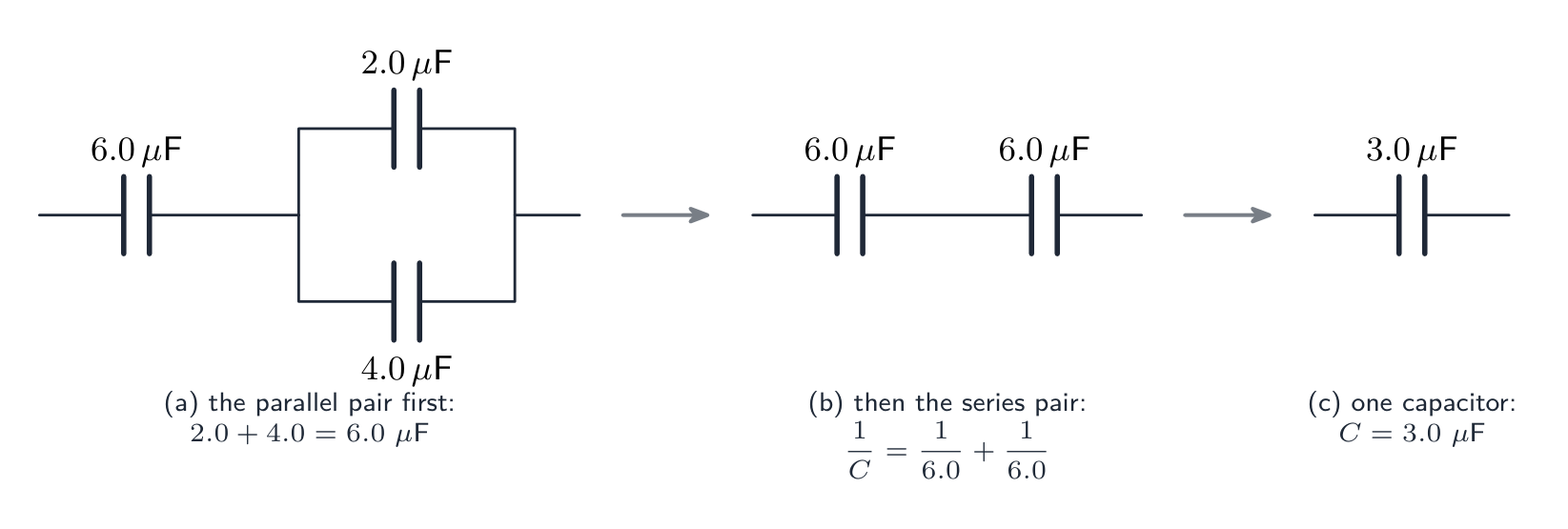
Worked example. A $6.0\ \mu\text{F}$ capacitor is in series with a parallel pair of $2.0\ \mu\text{F}$ and $4.0\ \mu\text{F}$. Find the total capacitance, and the charge on each capacitor when $12\ \text{V}$ is applied across the network.
Parallel pair: $2.0 + 4.0 = 6.0\ \mu\text{F}$. In series with $6.0\ \mu\text{F}$: $1/C = 1/6.0 + 1/6.0$, so $C = 3.0\ \mu\text{F}$. Total charge $Q = CV = (3.0 \times 10^{-6})(12) = 3.6 \times 10^{-5}\ \text{C}$: this is the charge on the $6.0\ \mu\text{F}$ capacitor (series, same charge), and it is shared by the parallel pair in the ratio of their capacitances (same p.d., $6.0\ \text{V}$ across each): the $2.0\ \mu\text{F}$ holds $1.2 \times 10^{-5}\ \text{C}$ and the $4.0\ \mu\text{F}$ holds $2.4 \times 10^{-5}\ \text{C}$. Check: they add to $3.6 \times 10^{-5}\ \text{C}$.
Worked example. Capacitors X and Y, each of capacitance $C$, are connected in series across a supply of voltage $V$; capacitors P and Q, each $C$, are connected in parallel across an identical supply. Compare the charge drawn from each supply and the energy stored in each arrangement.
Series: $C_{\text{s}} = C/2$, charge $Q_{\text{s}} = CV/2$, energy $\tfrac{1}{2} C_{\text{s}} V^{2} = CV^{2}/4$. Parallel: $C_{\text{p}} = 2C$, charge $2CV$, energy $CV^{2}$. The parallel arrangement draws four times the charge and stores four times the energy, because at the same supply voltage the energy is $\tfrac{1}{2} C V^{2}$ and the capacitance is four times larger. Asked which arrangement stores more energy from a given supply, the answer is always parallel.
Bahasa Indonesia
Kapasitor menyimpan muatan listrik dalam rangkaian.
Sebuah kapasitor menyimpan muatan. Yang paling sederhana adalah dua pelat konduktor sejajar dengan isolator (sebuah dielektrik, atau sekadar ruang hampa / udara) di antaranya. Terhubung ke baterai, muatan $+Q$ terkumpul pada satu pelat dan $-Q$ pada pelat lainnya, dengan beda potensial$V$ di celah.
Kapasitor pelat sejajar: muatan sama besar dan berlawanan tanda pada dua pelat dengan beda potensial $V$ di celah
Bagaimana pelat menjadi bermuatan. Hubungkan pelat ke baterai dan elektron mengalir, melalui baterai, dari pelat yang terhubung ke terminal positif ke pelat yang terhubung ke terminal negatif. Satu pelat tertinggal dengan muatan $+Q$ dan pelat lainnya memperoleh $-Q$: muatan-muatannya selalu sama besar dan berlawanan, sehingga kapasitor secara keseluruhan tetap netral. Aliran berhenti ketika beda potensial antara pelat sama dengan GGL baterai. Tidak ada yang melintasi celah; isolator lah yang menjaga muatan tetap terpisah.
Kapasitansi$C$ dari setiap kapasitor (atau konduktor terisolasi apa pun) adalah
$$C = \frac{Q}{V}.$$
Ini berlaku untuk:
bola terisolasi yang memegang muatan $Q$ pada potensial $V$ (nol di tak terhingga). Untuk jari-jari $r$, $V = Q/(4\pi\varepsilon_{0}r)$, sehingga $C = 4\pi\varepsilon_{0} r$.
kapasitor pelat sejajar: muatan $\pm Q$ pada pelat, beda potensial (p.d.) $V$ di antaranya.
Unit: farad (F) $= \text{C V}^{-1}$. Satu farad itu sangat besar, sehingga kapasitor nyata berkisar dari $\text{pF}$ hingga $\text{mF}$.
Kapasitansi adalah konstan untuk sebuah kapasitor tertentu (ditentukan oleh ukuran dan dielektriknya). Menggandakan muatan akan menggandakan tegangan, sehingga $C = Q/V$ tetap sama.
Definisi dua poin. Untuk kapasitor pelat sejajar: muatan pada satu pelat per satuan beda potensial antara pelat-pelat tersebut. Untuk bola terisolasi (atau konduktor terisolasi lainnya): muatan pada konduktor per satuan potensial. Penguji mencari "muatan per satuan p.d." (atau "per satuan potensial") dan, untuk pelat-pelat tersebut, bahwa muatan adalah muatan pada satu pelat dan p.d. adalah yang antara pelat-pelat tersebut. "Muatan yang tersimpan" diterima; "total muatan pada kedua pelat" tidak, karena totalnya adalah nol.
Apa yang menentukan kapasitansi. Untuk pelat sejajar, kapasitansinya berbanding lurus dengan luas pelat dan berbanding terbalik dengan jarak pemisahan$x$ ($C \propto 1/x$: setengahkan celah dan kapasitansinya menjadi dua kali), dan meningkat ketika dielektrik menggantikan udara. Soal yang menyatakan "$C$ berbanding terbalik dengan $x$" lalu memisahkan pelat pada muatan konstan meminta Anda untuk $V = Q/C \propto x$: p.d. naik sebanding. Pada p.d. konstan (masih terhubung ke sumber), justru muatan yang turun.
Contoh terpecahkan. Sebuah kapasitor $100\ \mu\text{F}$ diisi hingga $12\ \text{V}$. Temukan muatan yang tersimpan.
Contoh dikerjakan. Sebuah bola logam terisolasi berjari-jari $15\ \text{cm}$ diberi potensial $9.0 \times 10^{3}\ \text{V}$. Temukan kapasitansinya dan muatannya. Kemudian dibuang ke bumi melalui resistor $120\ \text{M}\Omega$: temukan konstanta waktu pembuangan.
Konstanta waktunya $RC = (1.2 \times 10^{8})(1.67 \times 10^{-11}) = 2.0 \times 10^{-3}\ \text{s}$: bahkan melalui resistansi yang sangat besar, bola kehilangan muatannya dalam milidetik, karena kapasitansinya sangat kecil. Perhatikan bahwa $4\pi\varepsilon_{0} = 1/(8.99 \times 10^{9})$, jadi $C = r/(8.99 \times 10^{9})$ dengan $r$ dalam meter.
Kapasitor nyata berkisar dari kaleng elektrolitik besar (kapasitansi tinggi) hingga jenis film dan keramik yang sangat kecil -- mulai dari pF hingga mF
Menggabungkan kapasitor
Kapasitor paralel memiliki p.d. yang sama $V$. Total muatan adalah jumlah:
$$Q_{\text{total}} = C_{1} V + C_{2} V + \ldots, \qquad\text{so}\qquad C_{\text{parallel}} = C_{1} + C_{2} + \ldots$$
Kombinasi paralel memiliki kapasitansi yang lebih besar daripada salah satu kapasitor pun.
Kapasitor paralel memiliki p.d. yang sama; muatan-muatannya menjumlahkan
Kapasitor seri membawa muatan yang sama$Q$. Total p.d. adalah jumlah:
Kombinasi seri memiliki kapasitansi yang lebih kecil daripada salah satu kapasitor pun.
Kapasitor seri membawa muatan yang sama; p.d.-nya menjumlahkan
Catatan: aturan ini adalah kebalikan dari aturan untuk resistor (resistor menjumlahkan dalam seri; kapasitor menjumlahkan dalam paralel), karena $C = Q/V$ memiliki $V$ di bagian bawah sementara $R = V/I$ memiliki $I$ di bagian bawah.
Menurunkan dua aturan tersebut
"Turunkan ekspresi untuk kapasitansi gabungan" adalah soal buktikan, dan kunci jawaban menginginkan fisika yang dijelaskan, bukan hanya aljabar.
Seri. Kapasitor membawa muatan yang sama$Q$: pelat yang terhubung ke terminal positif kehilangan elektron ke pelat jauh kapasitor berikutnya, sehingga setiap pelat dalam rantai memegang $\pm Q$. p.d.-nya menjumlahkan: $V = V_{1} + V_{2}$. Dengan $V_{1} = Q/C_{1}$ dan $V_{2} = Q/C_{2}$, dan kombinasi didefinisikan oleh $V = Q/C$, membagi seluruh persamaan dengan $Q$ menghasilkan $1/C = 1/C_{1} + 1/C_{2}$.
Paralel. Kapasitor memiliki p.d. yang sama$V$, karena masing-masing terhubung langsung melintasi sumber. Muatan-muatannya menjumlahkan: $Q = Q_{1} + Q_{2} = C_{1}V + C_{2}V$, dan $Q = CV$ untuk kombinasi, sehingga $C = C_{1} + C_{2}$.
Dua kapasitor seri selalu menghasilkan kurang daripada yang terkecil; dua kapasitor identik $C$ menghasilkan $C/2$ dalam seri dan $2C$ dalam paralel.
Jaringan disederhanakan satu langkah pada satu waktu: gabungkan pasangan paralel terlebih dahulu, lalu pasangan seri
Contoh dikerjakan. Sebuah kapasitor $6.0\ \mu\text{F}$ seri dengan pasangan paralel dari $2.0\ \mu\text{F}$ dan $4.0\ \mu\text{F}$. Temukan kapasitansi total, dan muatan pada setiap kapasitor ketika $12\ \text{V}$ diterapkan melintasi jaringan.
Pasangan paralel: $2.0 + 4.0 = 6.0\ \mu\text{F}$. Seri dengan $6.0\ \mu\text{F}$: $1/C = 1/6.0 + 1/6.0$, sehingga $C = 3.0\ \mu\text{F}$. Total muatan $Q = CV = (3.0 \times 10^{-6})(12) = 3.6 \times 10^{-5}\ \text{C}$: ini adalah muatan pada kapasitor $6.0\ \mu\text{F}$ (seri, muatan sama), dan dibagi oleh pasangan paralel sesuai rasio kapasitansinya (p.d. sama, $6.0\ \text{V}$ di setiap satu): kapasitor $2.0\ \mu\text{F}$ memegang $1.2 \times 10^{-5}\ \text{C}$ dan kapasitor $4.0\ \mu\text{F}$ memegang $2.4 \times 10^{-5}\ \text{C}$. Cek: mereka menjumlahkan ke $3.6 \times 10^{-5}\ \text{C}$.
Contoh dikerjakan. Kapasitor X dan Y, masing-masing berkapasitansi $C$, dihubungkan seri melintasi sumber tegangan $V$; kapasitor P dan Q, masing-masing $C$, dihubungkan paralel melintasi sumber yang identik. Bandingkan muatan yang diambil dari setiap sumber dan energi yang tersimpan dalam setiap susunan.
Seri: $C_{\text{s}} = C/2$, muatan $Q_{\text{s}} = CV/2$, energi $\tfrac{1}{2} C_{\text{s}} V^{2} = CV^{2}/4$. Paralel: $C_{\text{p}} = 2C$, muatan $2CV$, energi $CV^{2}$. Susunan paralel menarik empat kali lebih banyak muatan dan menyimpan empat kali lebih banyak energi, karena pada tegangan suplai yang sama energi adalah $\tfrac{1}{2} C V^{2}$ dan kapasitansinya empat kali lebih besar. Ditanya susunan mana yang menyimpan lebih banyak energi dari suplai tertentu, jawabannya selalu paralel.
Explore · Jelajahi
Capacitance · Kapasitansi
Q = C·V
Charge stored is proportional to voltage — the gradient is the capacitance C. · Muatan yang tersimpan berbanding lurus dengan tegangan — gradiennya adalah kapasitansi C.
Energy stored in a capacitor · Energi tersimpan dalam kapasitor
Syllabus · Silabus
English
determine the electric potential energy stored in a capacitor from the area under the potential–charge graph
recall and use $W = \frac{1}{2}QV = \frac{1}{2}CV^2$
Bahasa Indonesia
tentukan energi potensial listrik yang tersimpan dalam sebuah kondensor dari luas di bawah grafik potensial–muatan
ingat dan gunakan $W = \frac{1}{2}QV = \frac{1}{2}CV^2$
Source: Cambridge International syllabus · Sumber: Silabus Cambridge International
English
Charging a capacitor from $0$ to $Q$ needs work, because each extra bit of charge is pushed against the p.d. already there. When the charge is $q$, the p.d. is $V(q) = q/C$, so adding a small charge $dq$ needs work $V\,dq$. The total work is
Worked example. The graph of charge $Q$ against p.d. $V$ for a capacitor is a straight line through the origin passing through $(10\ \text{V},\ 1.2 \times 10^{-3}\ \text{C})$. Find the capacitance and the energy stored at $10\ \text{V}$, and then the extra energy stored when the p.d. is raised to $12\ \text{V}$.
The gradient of $Q$ against $V$ is $C = 1.2 \times 10^{-3}/10 = 1.2 \times 10^{-4}\ \text{F} = 120\ \mu\text{F}$. Energy is the area under the line: $\tfrac{1}{2}QV = \tfrac{1}{2}(1.2 \times 10^{-3})(10) = 6.0 \times 10^{-3}\ \text{J}$. At $12\ \text{V}$: $\tfrac{1}{2}CV^{2} = \tfrac{1}{2}(1.2 \times 10^{-4})(12)^{2} = 8.6 \times 10^{-3}\ \text{J}$, so the extra energy is $2.6 \times 10^{-3}\ \text{J}$. Do not find the extra energy from the extra charge as $\tfrac{1}{2}(\Delta Q)V$: energy is not proportional to charge, so subtract the two areas.
Reading the $Q$–$V$ graph
A plot of $V$ against $Q$ is a straight line through the origin with gradient $1/C$. The energy stored is the area under the line up to a given charge $Q$, which is the triangle $\tfrac{1}{2} Q V$. The factor $\tfrac{1}{2}$ is there because the average p.d. during charging is $V/2$ (it grows from zero to $V$), not $V$.
Why charging is "half efficient"
Connect a capacitor $C$ to an ideal battery of e.m.f. $V$ through a wire. The capacitor stores $\tfrac{1}{2} C V^{2}$, but the battery supplies charge $Q = CV$ at e.m.f. $V$, giving out $QV = CV^{2}$. The other half is lost as heat in the wire — whatever the wire's resistance.
Sharing charge between capacitors
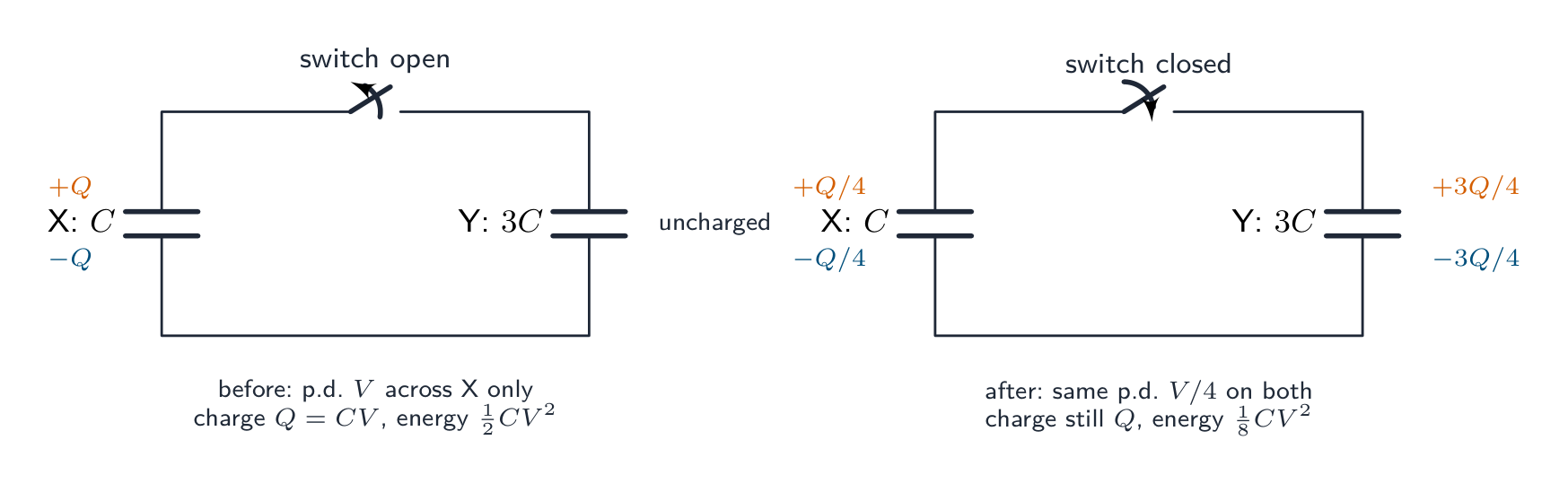
A fully charged capacitor X (capacitance $C$, p.d. $V$, charge $Q = CV$) is disconnected from its supply and connected across an uncharged capacitor Y of capacitance $3C$. Charge flows until the two p.d.s are equal. Two principles settle everything:
Charge is conserved. The total charge is still $Q$, now spread over a parallel pair of total capacitance $4C$, so the common p.d. is $V' = Q/(4C) = V/4$. X keeps $Q/4$ and Y takes $3Q/4$ (charge in the ratio of the capacitances, since the p.d. is the same).
Energy is not conserved. Before: $\tfrac{1}{2} C V^{2}$. After: $\tfrac{1}{2}(4C)(V/4)^{2} = \tfrac{1}{8} C V^{2}$. Three-quarters of the energy has gone: it is dissipated 耗散 as heat in the connecting wires (and as a spark or electromagnetic radiation) while the charge moves, however small the resistance.
Worked example. A $220\ \mu\text{F}$ capacitor charged to $9.0\ \text{V}$ is connected across an uncharged $440\ \mu\text{F}$ capacitor. Find the final p.d. and the energy lost.
$Q = CV = (220 \times 10^{-6})(9.0) = 1.98 \times 10^{-3}\ \text{C}$; total capacitance $660\ \mu\text{F}$, so $V' = 1.98 \times 10^{-3}/(660 \times 10^{-6}) = 3.0\ \text{V}$. Energy before: $\tfrac{1}{2}(220 \times 10^{-6})(9.0)^{2} = 8.9 \times 10^{-3}\ \text{J}$; after: $\tfrac{1}{2}(660 \times 10^{-6})(3.0)^{2} = 3.0 \times 10^{-3}\ \text{J}$; lost: $5.9 \times 10^{-3}\ \text{J}$, two-thirds of the original. A capacitor connected to another of capacitance $kC$ always loses the fraction $k/(k+1)$.
Bahasa Indonesia
Mengisi kapasitor dari $0$ ke $Q$ memerlukan usaha, karena setiap tambahan muatan didorong melawan beda potensial (p.d.) yang sudah ada. Ketika muatan adalah $q$, p.d. adalah $V(q) = q/C$, sehingga menambahkan muatan kecil $dq$ memerlukan usaha $V\,dq$. Total usahanya adalah
Contoh terpecahkan. Grafik muatan $Q$ terhadap p.d. $V$ untuk sebuah kapasitor adalah garis lurus melalui titik asal yang melewati $(10\ \text{V},\ 1.2 \times 10^{-3}\ \text{C})$. Temukan kapasitas dan energi yang tersimpan pada $10\ \text{V}$, lalu cari energi tambahan yang tersimpan ketika p.d. dinaikkan menjadi $12\ \text{V}$.
Gradien $Q$ terhadap $V$ adalah $C = 1.2 \times 10^{-3}/10 = 1.2 \times 10^{-4}\ \text{F} = 120\ \mu\text{F}$. Energi adalah area di bawah garis: $\tfrac{1}{2}QV = \tfrac{1}{2}(1.2 \times 10^{-3})(10) = 6.0 \times 10^{-3}\ \text{J}$. Pada $12\ \text{V}$: $\tfrac{1}{2}CV^{2} = \tfrac{1}{2}(1.2 \times 10^{-4})(12)^{2} = 8.6 \times 10^{-3}\ \text{J}$, sehingga energi tambahan adalah $2.6 \times 10^{-3}\ \text{J}$. Jangan mencari energi tambahan dari muatan tambahan seperti $\tfrac{1}{2}(\Delta Q)V$: energi tidak sebanding dengan muatan, jadi kurangkan kedua area tersebut.
Membaca grafik $Q$–$V$
Plot $V$ terhadap $Q$ adalah garis lurus melalui titik asal dengan gradien $1/C$. Energi yang tersimpan adalah luas di bawah garis hingga muatan tertentu $Q$, yaitu segitiga $\tfrac{1}{2} Q V$. Faktor $\tfrac{1}{2}$ ada karena rata-rata p.d. selama pengisian adalah $V/2$ (meningkat dari nol hingga $V$), bukan $V$.
Energi tersimpan adalah area di bawah garis potensial-muatan (segitiga $\tfrac{1}{2}QV$)
Mengapa pengisian "setengah efisien"
Hubungkan kapasitor $C$ ke baterai ideal dengan g.g.b. $V$ melalui kawat. Kapasitor menyimpan $\tfrac{1}{2} C V^{2}$, tetapi baterai menyediakan muatan $Q = CV$ pada g.g.b. $V$, menghasilkan $QV = CV^{2}$. Setengah lainnya hilang sebagai panas di kawat — berapapun resistansi kawatnya.
Berbagi muatan antar kapasitor
Menghubungkan kapasitor bermuatan ke kapasitor tak bermuatan: muatan terjaga, p.d. setara, dan energi hilang
Kapasitor X yang terisi penuh (kapasitansi $C$, p.d. $V$, muatan $Q = CV$) dilepas dari sumbernya dan dihubungkan melintasi kapasitor Y tak bermuatan dengan kapasitansi $3C$. Muatan mengalir hingga kedua p.d.-nya setara. Dua prinsip menentukan semuanya:
Muatan terjaga. Total muatan tetap $Q$, kini tersebar pada pasangan paralel dengan total kapasitansi $4C$, sehingga p.d. bersama adalah $V' = Q/(4C) = V/4$. X mempertahankan $Q/4$ dan Y mengambil $3Q/4$ (muatan dalam rasio kapasitansinya, karena p.d.-nya sama).
Energi tidak terjaga. Sebelum: $\tfrac{1}{2} C V^{2}$. Sesudah: $\tfrac{1}{2}(4C)(V/4)^{2} = \tfrac{1}{8} C V^{2}$. Tiga perempat energi telah hilang: energi tersebut terdispersipasi sebagai panas di kawat penghubung (dan sebagai percikan atau radiasi elektromagnetik) saat muatan bergerak, bagaimanapun kecilnya resistansinya.
Contoh terpecahkan. Kapasitor $220\ \mu\text{F}$ yang diisi hingga $9.0\ \text{V}$ dihubungkan melintasi kapasitor $440\ \mu\text{F}$ tak bermuatan. Temukan p.d. akhir dan energi yang hilang.
$Q = CV = (220 \times 10^{-6})(9.0) = 1.98 \times 10^{-3}\ \text{C}$; total kapasitansi $660\ \mu\text{F}$, sehingga $V' = 1.98 \times 10^{-3}/(660 \times 10^{-6}) = 3.0\ \text{V}$. Energi sebelum: $\tfrac{1}{2}(220 \times 10^{-6})(9.0)^{2} = 8.9 \times 10^{-3}\ \text{J}$; sesudah: $\tfrac{1}{2}(660 \times 10^{-6})(3.0)^{2} = 3.0 \times 10^{-3}\ \text{J}$; hilang: $5.9 \times 10^{-3}\ \text{J}$, dua pertiga dari awal. Kapasitor yang dihubungkan dengan kapasitor lain berkapasitansi $kC$ selalu kehilangan pecahan $k/(k+1)$.
Explore · Jelajahi
Energy in a capacitor · Energi dalam kapasitor
E = ½C·V²
Stored energy grows with the square of the voltage. · Energi tersimpan tumbuh sesuai dengan kuadrat tegangan.
Capacitor discharging through a resistor · Pengosongan kapasitor melalui resistor
Syllabus · Silabus
English
analyse graphs of the variation with time of potential difference, charge and current for a capacitor discharging through a resistor
recall and use $\tau = RC$ for the time constant for a capacitor discharging through a resistor
use equations of the form $x = x_0 e^{-(t/RC)}$ where $x$ could represent current, charge or potential difference for a capacitor discharging through a resistor
Bahasa Indonesia
analisis grafik perubahan terhadap waktu dari beda potensial, muatan, dan arus untuk kondensor yang melepaskan muatan melalui resistor
ingat dan gunakan $\tau = RC$ untuk konstanta waktu bagi kondensor yang melepaskan muatan melalui resistor
gunakan persamaan berbentuk $x = x_0 e^{-(t/RC)}$ di mana $x$ dapat mewakili arus, muatan, atau beda potensial untuk kondensor yang melepaskan muatan melalui resistor
Source: Cambridge International syllabus · Sumber: Silabus Cambridge International
English
A capacitor $C$ charged to $V_{0}$ is connected through a switch to a resistor 电阻器 of resistance 电阻$R$. When the switch closes at $t = 0$, the capacitor discharges.
Setting up the equation
By Kirchhoff's second law 基尔霍夫第二定律 around the loop, $V_{C} = V_{R}$. Using $V_{C} = Q/C$, $V_{R} = IR$ and $I = -dQ/dt$:
$$\frac{Q}{C} = -R \frac{dQ}{dt}.$$
This is solved by an exponential decay 指数衰减 with time constant $RC$.
Discharge equations
Charge $Q$, p.d. $V$ and current $I$ all decay exponentially with the same time constant:
$$Q = Q_{0} e^{-t / (RC)}, \qquad V = V_{0} e^{-t / (RC)}, \qquad I = I_{0} e^{-t / (RC)},$$
with $I_{0} = V_{0}/R$.
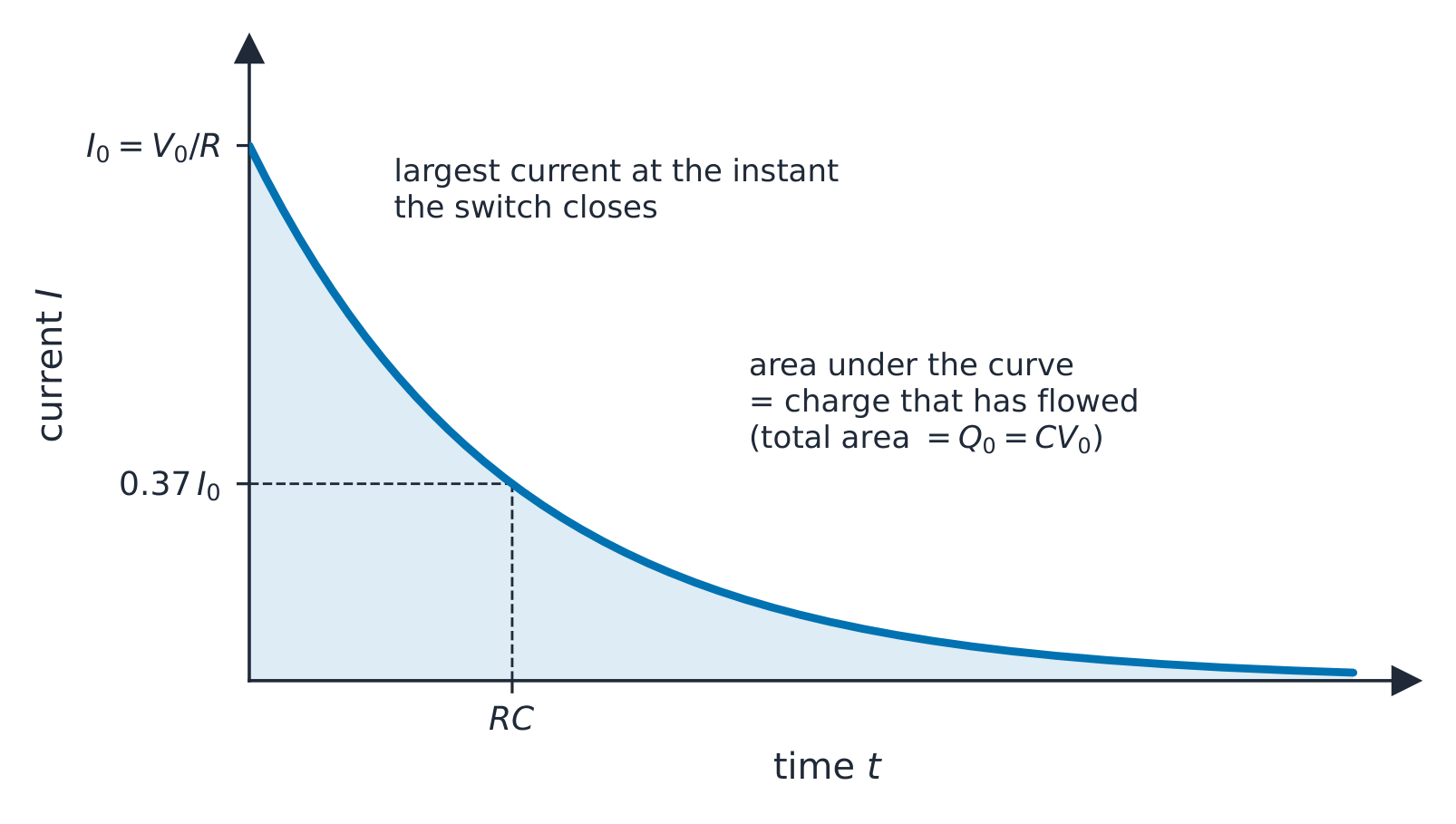
Reading the three graphs. All three curves have the same shape and the same time constant, so one measurement of $\tau$ from any of them gives $RC$. The current is largest the instant the switch closes, $I_{0} = V_{0}/R$, because the full p.d. $V_{0}$ is then across the resistor; it falls as the p.d. falls. The area under the $I$–$t$ graph is the charge that has flowed, so the total area is $Q_{0} = CV_{0}$, and the charge that flows in the first time constant is $Q_{0}(1 - e^{-1}) = 0.63\,Q_{0}$. The gradient of the $Q$–$t$ graph is $-I$: steepest at the start, flattening as the current dies away. (During charging through a resistor the current has the same decaying shape, while $V$ and $Q$ rise as $V_{0}(1 - e^{-t/RC})$, the mirror image of the discharge curve.)
Time constant
$$\tau = RC$$
is the time constant 时间常数 (in seconds: $\Omega \cdot \text{F} = \text{s}$). It is the time for a decaying quantity to fall to $1/e \approx 0.37$ (about 37%) of its starting value. After $2\tau$ it is at about 13.5%; after $5\tau$, below 1%.
Worked example. A $100\ \mu\text{F}$ capacitor charged to $12\ \text{V}$ is discharged through a $47\ \text{k}\Omega$ resistor. Find the time constant and the voltage after one time constant.
After one time constant the voltage falls to $1/e$ of its start: $V = 12 \times 0.37 \approx 4.4\ \text{V}$.
Worked example. A $470\ \mu\text{F}$ capacitor is charged to $24\ \text{V}$ and then discharged through a $5.6\ \text{k}\Omega$ resistor. Find (a) the initial charge and energy, (b) the time constant and the initial current, (c) the p.d. after $4.0\ \text{s}$, (d) the time for the p.d. to fall to $6.0\ \text{V}$.
Keep the time constant unrounded ($2.632\ \text{s}$) inside the calculation and round only the answers. The rearrangement in (d) is the one most often asked and most often botched: $\ln(V/V_{0})$ is negative, so $t$ comes out positive.
Worked example. From a discharge graph, the p.d. across a $2200\ \mu\text{F}$ capacitor falls from $6.0\ \text{V}$ to $2.2\ \text{V}$ in $4.5\ \text{s}$. Find the resistance of the resistor.
$2.2/6.0 = 0.367 \approx 1/e$, so $4.5\ \text{s}$ is one time constant: $R = \tau/C = 4.5/(2200 \times 10^{-6}) = 2.0 \times 10^{3}\ \Omega$. If the fall is not to $1/e$, use $RC = -t/\ln(V/V_{0})$; the answer is the same either way.
To find $\tau$ from a curve: read the time to fall to $1/e$ of the start. Or take logs: $\ln(V/V_{0}) = -t/(RC)$, so a plot of $\ln V$ against $t$ is a straight line with gradient $-1/(RC)$.
Using the logarithmic graph. In an experiment, plot $\ln V$ (or $\ln I$) on the $y$-axis against $t$. The points should lie on a straight line: its gradient is $-1/(RC)$, so $RC = -1/\text{gradient}$, and its intercept 截距 on the $\ln V$ axis is $\ln V_{0}$. A straight line is the test that the decay really is exponential; a curve means it is not. Take the gradient from two points far apart on the best-fit line, not from two data points, and quote $RC$ in seconds.
Reading graphs during discharge
$Q$ against $V_{C}$: since $Q = C V$ always, this is a straight line through the origin with gradient $C$. Discharge moves the point from $(V_{0}, Q_{0})$ down to $(0,0)$.
$I$ against $V_{C}$: since $I = V_{C}/R$, this is a straight line through the origin with gradient $1/R$, so you can find $R$.
Common exam questions
Given a discharge curve $V(t)$ or $Q(t)$:
read the start value $V_{0}$ or $Q_{0}$ at $t = 0$.
read the time to fall to $V_{0}/e$ → time constant $\tau = RC$.
given $R$, find $C = \tau / R$ (or the other way round).
predict a later value with the exponential formula.
A capacitor as a smoothing component
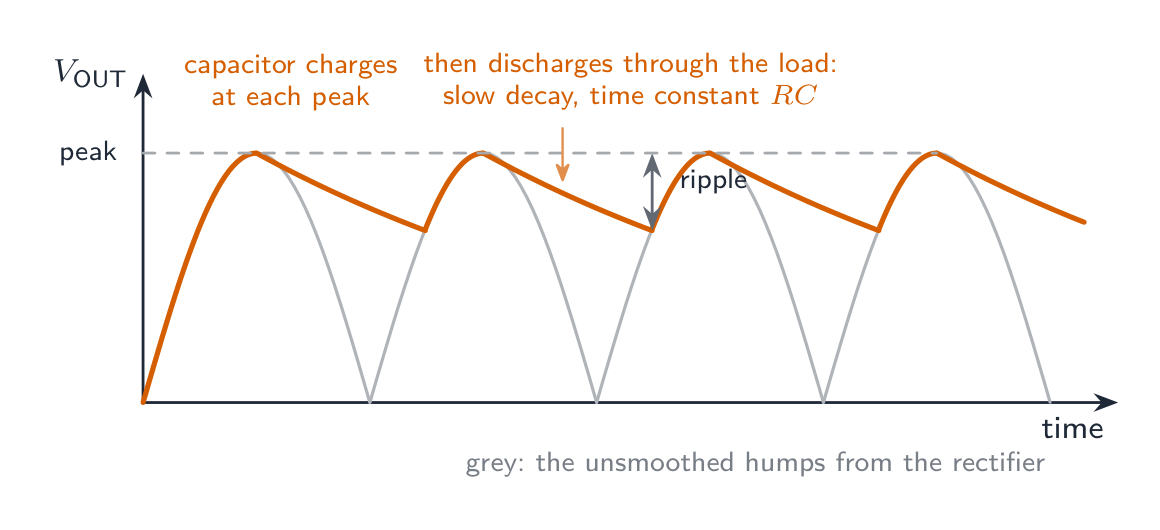
A rectifier 整流器 (Topic 21) turns an alternating voltage into a series of positive humps. A capacitor connected across the load smooths them. Near each peak 峰值 the diodes conduct and the capacitor charges to the peak voltage; as the supply voltage falls away the diodes stop conducting and the capacitor discharges through the load resistor, holding the output up until the next hump rises above it and recharges the capacitor. The output therefore falls only a little between peaks; the rise and fall that remains is the ripple 纹波.
How much it falls depends on the time constant of the discharge, $RC$, compared with the time between peaks. A larger capacitance, or a larger load resistance (a smaller load current), gives a larger $RC$, a slower decay and a smaller ripple; a heavily loaded supply (small $R$) has a larger ripple. Asked to sketch the smoothed output, draw it touching each peak, decaying slightly between them, and never falling to zero.
Bahasa Indonesia
Sebuah kapasitor $C$ yang diisi hingga $V_{0}$ dihubungkan melalui sakelar ke resistor dengan hambatan$R$. Ketika sakelar ditutup pada $t = 0$, kapasitor akan mengosongkan muatannya.
Kapasitor mengisi melalui sakelar A, kemudian mengosong melalui resistor lewat sakelar B
Menetapkan persamaan
Dengan Hukum Kedua Kirchhoff di sekitar loop, $V_{C} = V_{R}$. Menggunakan $V_{C} = Q/C$, $V_{R} = IR$ dan $I = -dQ/dt$:
$$\frac{Q}{C} = -R \frac{dQ}{dt}.$$
Ini diselesaikan oleh peluruhan eksponensial dengan konstanta waktu $RC$.
Persamaan pembuangan
Muatan $Q$, p.d. $V$ dan arus $I$ semuanya meluruh secara eksponensial dengan konstanta waktu yang sama:
$$Q = Q_{0} e^{-t / (RC)}, \qquad V = V_{0} e^{-t / (RC)}, \qquad I = I_{0} e^{-t / (RC)},$$
dengan $I_{0} = V_{0}/R$.
Arus pembuangan dimulai pada $V_0/R$ dan meluruh dengan konstanta waktu yang sama; area di bawah kurva adalah muatan yang telah mengalir
Membaca ketiga grafik. Ketiga kurva memiliki bentuk yang sama dan konstanta waktu yang sama, sehingga satu pengukuran $\tau$ dari salah satunya memberikan $RC$. Arus terbesar pada saat sakelar ditutup, $I_{0} = V_{0}/R$, karena seluruh beda potensial (b.p.) $V_{0}$ berada di atas resistor; arus menurun seiring b.p. menurun. Luas di bawah grafik $I$–$t$ adalah muatan yang telah mengalir, sehingga total luasnya adalah $Q_{0} = CV_{0}$, dan muatan yang mengalir dalam konstanta waktu pertama adalah $Q_{0}(1 - e^{-1}) = 0.63\,Q_{0}$. Gradien dari grafik $Q$–$t$ adalah $-I$: paling curam di awal, melandai saat arus mereda. (Selama pengisian melalui resistor, arus memiliki bentuk peluruhan yang sama, sementara $V$ dan $Q$ naik sebagai $V_{0}(1 - e^{-t/RC})$, cerminan dari kurva pembuangan.)
Muatan meluruh secara eksponensial selama pembuangan, turun ke $Q_0/e$ setelah satu konstanta waktu $RC$
Konstanta waktu
$$\tau = RC$$
adalah konstanta waktu (dalam detik: $\Omega \cdot \text{F} = \text{s}$). Ini adalah waktu untuk besaran yang meluruh turun ke $1/e \approx 0.37$ (sekitar 37%) dari nilainya awal. Setelah $2\tau$ nilainya sekitar 13,5%; setelah $5\tau$, di bawah 1%.
Contoh soal terpecahkan. Kapasitor $100\ \mu\text{F}$ yang diisi hingga $12\ \text{V}$ dibuang melalui resistor $47\ \text{k}\Omega$. Tentukan konstanta waktu dan tegangan setelah satu konstanta waktu.
Setelah satu konstanta waktu, tegangan turun ke $1/e$ dari nilai awalnya: $V = 12 \times 0.37 \approx 4.4\ \text{V}$.
Contoh soal terpecahkan. Kapasitor $470\ \mu\text{F}$ diisi hingga $24\ \text{V}$ lalu dibuang melalui resistor $5.6\ \text{k}\Omega$. Tentukan (a) muatan dan energi awal, (b) konstanta waktu dan arus awal, (c) p.d. setelah $4.0\ \text{s}$, (d) waktu agar p.d. turun ke $6.0\ \text{V}$.
Pertahankan konstanta waktu tanpa pembulatan ($2.632\ \text{s}$) di dalam perhitungan dan bulatkan hanya jawabannya. Penyusunan ulang pada (d) adalah yang paling sering ditanyakan dan paling sering keliru: $\ln(V/V_{0})$ bernilai negatif, sehingga $t$ akan keluar positif.
Contoh soal terpecahkan. Dari grafik pembuangan, p.d. pada kapasitor $2200\ \mu\text{F}$ turun dari $6.0\ \text{V}$ ke $2.2\ \text{V}$ dalam waktu $4.5\ \text{s}$. Tentukan hambatan resistor.
$2.2/6.0 = 0.367 \approx 1/e$, sehingga $4.5\ \text{s}$ adalah satu konstanta waktu: $R = \tau/C = 4.5/(2200 \times 10^{-6}) = 2.0 \times 10^{3}\ \Omega$. Jika penurunan tidak menuju $1/e$, gunakan $RC = -t/\ln(V/V_{0})$; jawabannya tetap sama baik menggunakan cara mana pun.
Untuk menemukan $\tau$ dari kurva: baca waktu untuk turun ke $1/e$ dari nilai awal. Atau ambil logaritma: $\ln(V/V_{0}) = -t/(RC)$, sehingga plot $\ln V$ terhadap $t$ adalah garis lurus dengan gradien $-1/(RC)$.
Grafik $\ln V$ terhadap waktu adalah garis lurus dengan gradien $-1/(RC)$
Menggunakan grafik logaritma. Dalam suatu percobaan, plot $\ln V$ (atau $\ln I$) pada sumbu $y$ terhadap $t$. Titik-titik harus terletak pada garis lurus: gradiennya adalah $-1/(RC)$, sehingga $RC = -1/\text{gradient}$, dan intersepnya pada sumbu $\ln V$ adalah $\ln V_{0}$. Garis lurus adalah uji bahwa peluruhan benar-benar eksponensial; kurva berarti tidak. Ambil gradien dari dua titik yang jauh pada garis fit terbaik, bukan dari dua titik data, dan nyatakan $RC$ dalam satuan detik.
Membaca grafik selama pembuangan
$Q$ terhadap $V_{C}$: karena $Q = C V$ selalu berlaku, ini adalah garis lurus melalui titik asal dengan gradien $C$. Pembuangan menggerakkan titik dari $(V_{0}, Q_{0})$ turun ke $(0,0)$.
$I$ terhadap $V_{C}$: karena $I = V_{C}/R$, ini adalah garis lurus melalui titik asal dengan gradien $1/R$, sehingga Anda dapat menentukan $R$.
Soal ujian umum
Diberikan kurva pembuangan $V(t)$ atau $Q(t)$:
baca nilai awal $V_{0}$ atau $Q_{0}$ pada $t = 0$.
baca waktu untuk turun ke $V_{0}/e$ → konstanta waktu $\tau = RC$.
diberikan $R$, temukan $C = \tau / R$ (atau sebaliknya).
prediksikan nilai selanjutnya dengan rumus eksponensial.
Kapasitor sebagai komponen penyaring
Kapasitor di atas beban penyearah mengisi muatan pada setiap puncak dan membongkar muatan melalui beban di antaranya, mengubah hump menjadi output hampir stabil dengan riak kecil
Sebuah penyearah (Topik 21) mengubah tegangan bolak-balik menjadi serangkaian hump positif. Kapasitor yang dihubungkan melintang di atas beban meratakannya. Dekat setiap puncak, dioda menghantarkan arus dan kapasitor mengisi muatan hingga tegangan puncak; saat tegangan suplai mereda, dioda berhenti menghantarkan dan kapasitor membongkar muatan melalui resistor beban, menjaga output tetap tinggi hingga hump berikutnya naik melebihi level tersebut dan mengisi kembali kapasitor. Oleh karena itu, output hanya turun sedikit di antara puncak-puncak; kenaikan dan penurunan yang tersisa adalah riak.
Berapa banyak penurunan tergantung pada konstanta waktu pembuangan, $RC$, dibandingkan dengan waktu antar puncak. Kapasitansi yang lebih besar, atau hambatan beban yang lebih besar (arus beban yang lebih kecil), menghasilkan $RC$ yang lebih besar, peluruhan yang lebih lambat, dan riak yang lebih kecil; suplai yang dibebani berat ($R$ kecil) memiliki riak yang lebih besar. Saat diminta menggambar output yang diratakan, gambarlah menyentuh setiap puncak, meluruh sedikit di antaranya, dan tidak pernah turun ke nol.
The voltage rises (or decays) exponentially with time constant τ = RC. · Tegangan naik (atau meluruh) secara eksponensial dengan konstanta waktu τ = RC.
Explore · Jelajahi
Discharging a capacitor · Pengosongan kapasitor
Q = Q₀·bᵗ
Charge decays exponentially through the resistor. · Muatan meluruh secara eksponensial melalui resistor.
Definitions the examiner accepts · Definisi yang diterima oleh penguji
English
A definition question is marked against fixed wording. Learn these exactly, and give one answer only.
Term
Definition
capacitance (parallel-plate capacitor)
the charge on one plate per unit potential difference between the plates
capacitance (isolated conductor)
the charge on the conductor per unit potential
farad
one coulomb per volt
capacitors in series
the same charge on each; the p.d.s add; $1/C = 1/C_{1} + 1/C_{2}$
capacitors in parallel
the same p.d. across each; the charges add; $C = C_{1} + C_{2}$
energy stored
the work done in charging the capacitor, equal to the area under the potential–charge graph; $W = \tfrac{1}{2}QV = \tfrac{1}{2}CV^{2}$
time constant
the product $RC$; the time for the charge (or p.d., or current) to fall to $1/e$ of its initial value
Bahasa Indonesia
Soal definisi dinilai berdasarkan frasa tetap. Hafalkan ini persis, dan berikan hanya satu jawaban.
Istilah
Definisi
kapasitansi (kapasitor pelat sejajar)
muatan pada salah satu pelat per beda potensial satuan antar pelat
kapasitansi (konduktor terisolasi)
muatan pada konduktor per potensial satuan
farad
satu coulomb per volt
kapasitor seri
muatan yang sama pada masing-masing; p.d.s menjumlah; $1/C = 1/C_{1} + 1/C_{2}$
kapasitor dalam paralel
tegangan yang sama di setiap kapasitor; muatan dijumlahkan; $C = C_{1} + C_{2}$
energi tersimpan
usaha yang dilakukan saat mengisi kapasitor, sama dengan luas di bawah grafik potensial–muatan; $W = \tfrac{1}{2}QV = \tfrac{1}{2}CV^{2}$
konstanta waktu
hasil kali $RC$; waktu yang dibutuhkan agar muatan (atau tegangan, atau arus) turun menjadi $1/e$ dari nilai awalnya
19.3
Exam tips · Tips ujian
English
$C = Q/V$ defines capacitance; for an isolated sphere $C = 4\pi\varepsilon_{0} r$. Energy stored $W = \tfrac{1}{2}QV = \tfrac{1}{2}CV^{2} = Q^{2}/2C$: pick the form that uses what you know, and remember that energy is not proportional to charge.
Combine capacitors the opposite way to resistors (parallel add, series reciprocal), and reduce a network one step at a time.
Charge sharing: charge is conserved, energy is not. Find the common p.d. from the total charge and the total capacitance first, then the energies.
Discharge: $x = x_{0} e^{-t/RC}$ for $Q$, $V$ and $I$ alike; $t = -RC \ln(x/x_{0})$; $\tau = RC$ is in seconds ($\Omega \cdot \text{F} = \text{s}$) and is the time to fall to $37\%$, not to zero.
Graphs: the initial current is $V_{0}/R$; the area under $I$–$t$ is charge; the gradient of $Q$–$t$ is $-I$; $\ln V$ against $t$ is a straight line of gradient $-1/(RC)$ and intercept $\ln V_{0}$.
Convert $\mu\text{F}$ and $\text{k}\Omega$ before multiplying: $\text{k}\Omega \times \mu\text{F}$ gives milliseconds, not seconds.
Common mistakes
Defining capacitance as "the charge stored" or "the charge on both plates". It is the charge on one plate per unit p.d. between the plates.
Adding capacitors in series as if they were resistors, or forgetting to invert the reciprocal sum at the end.
After charge sharing, using the supply voltage in $\tfrac{1}{2}CV^{2}$ instead of the new common p.d., or claiming the energy is conserved.
Drawing the discharge current starting from zero. It starts at its largest value, $V_{0}/R$.
Treating $\tau$ as the time to discharge completely; after $5\tau$ about $1\%$ remains.
Dropping the minus sign in $t = -RC \ln(V/V_{0})$ and reporting a negative time.
Finding the extra energy on raising the p.d. from the extra charge alone: subtract two areas (or two $\tfrac{1}{2}CV^{2}$ values).
Sketching a smoothed output that falls to zero between peaks, or saying a larger load resistance gives a larger ripple.
Bahasa Indonesia
$C = Q/V$ mendefinisikan kapasitansi; untuk bola terisolasi $C = 4\pi\varepsilon_{0} r$. Energi tersimpan $W = \tfrac{1}{2}QV = \tfrac{1}{2}CV^{2} = Q^{2}/2C$: pilih bentuk yang menggunakan apa yang Anda ketahui, dan ingat bahwa energi tidak berbanding lurus dengan muatan.
Gabungkan kapasitor dengan cara kebalik dari resistor (paralel dijumlahkan, seri resiprokal), dan sederhanakan jaringan satu langkah demi satu langkah.
Pembagian muatan: muatan kekal, energi tidak kekal. Temukan tegangan bersama dari total muatan dan total kapasitansi terlebih dahulu, kemudian hitung energinya.
Pembuangan: $x = x_{0} e^{-t/RC}$ untuk $Q$, $V$ dan $I$ sama; $t = -RC \ln(x/x_{0})$; $\tau = RC$ dalam satuan detik ($\Omega \cdot \text{F} = \text{s}$) dan merupakan waktu untuk turun ke $37\%$, bukan nol.
Grafik: arus awal adalah $V_{0}/R$; luas di bawah $I$–$t$ adalah muatan; gradien dari $Q$–$t$ adalah $-I$; $\ln V$ terhadap $t$ adalah garis lurus dengan gradien $-1/(RC)$ dan intersep $\ln V_{0}$.
Konversi $\mu\text{F}$ dan $\text{k}\Omega$ sebelum dikalikan: $\text{k}\Omega \times \mu\text{F}$ menghasilkan milidetik, bukan detik.
Kesalahan umum
Mendefinisikan kapasitansi sebagai "muatan yang tersimpan" atau "muatan pada kedua pelat". Ini adalah muatan pada satu pelat per satuan tegangan antara pelat.
Menambahkan kapasitor secara seri seolah-olah mereka adalah resistor, atau lupa membalikkan jumlah resiprokal di akhir.
Setelah pembagian muatan, menggunakan tegangan sumber dalam $\tfrac{1}{2}CV^{2}$ alih-alih tegangan bersama baru, atau mengklaim energi kekal.
Menggambar arus pelepasan mulai dari nol. Arus dimulai dari nilainya terbesar, $V_{0}/R$.
Memperlakukan $\tau$ sebagai waktu untuk pengosongan sepenuhnya; setelah $5\tau$ sekitar $1\%$ masih tersisa.
Melewatkan tanda minus dalam $t = -RC \ln(V/V_{0})$ dan melaporkan waktu negatif.
Menemukan energi tambahan saat menaikkan tegangan dari muatan tambahan saja: kurangkan dua area (atau dua nilai $\tfrac{1}{2}CV^{2}$).
Menggambar output yang halus yang turun ke nol di antara puncak, atau mengatakan bahwa resistansi beban yang lebih besar memberikan riak yang lebih besar.
Interactive lessons on this topic · Pelajaran interaktif untuk topik ini
Work through it step by step, with instant-check exercises. · Kerjakan langkah demi langkah, dengan latihan pengecekan instan.
Pick one and the site follows you — notes, papers, videos and practice all open on it. · Pilih satu dan situs mengikuti Anda — catatan, kertas, video, dan latihan semua terbuka di sana.
Type to search notes, lessons, code, vocabulary and past-paper questions across every subject. · Ketik untuk mencari catatan, pelajaran, kode, kosakata, dan pertanyaan soal lama di setiap mata pelajaran.