Capacitors and capacitance
Introduced| English | Meaning |
|---|---|
| capacitance/kəˈpæsɪtəns/ | Stored electric charge per unit potential difference between conductors. |
| parallel/ˈpærəlel/ | An electrical arrangement in which components are connected across the same two points and have the same potential difference. |
| farad/ˈfæræd/ | The SI unit of capacitance, equal to one coulomb of stored charge per volt of potential difference. |
| dielectric/ˌdaɪɪˈlektrɪk/ | An electrical insulator that can become polarised in an electric field. |
| series/ˈsɪəriːz/ | An arrangement in which components lie along a single electrical path. |
A store that fills up and then stops
- Connect a capacitor to a battery and charge flows for a moment, then stops completely, even though the battery is still connected.
- It stops because the two plates are not joined. Electrons leave one plate and arrive at the other through the battery, and the flow ceases when the p.d. across the gap has grown to match the battery's.
- So the capacitor is left holding $+Q$ on one plate and $-Q$ on the other, always equal and opposite, and the device as a whole is still neutral.
- This lesson is capacitance 电容, what sets it, and how capacitors combine.
Defining capacitance
- The capacitance of a capacitor, or of any isolated conductor, is the charge per unit potential difference:
- The two-mark definitions differ slightly. For a parallel-plate capacitor: the charge on one plate per unit potential difference between the plates. For an isolated sphere: the charge on the conductor per unit potential.
- The unit is the farad 法拉, $1\ \text{F} = 1\ \text{C/V}$. A farad is enormous, so real capacitors run from picofarads to millifarads.

Two plates, an insulator between, and charge that cannot cross
Capacitance
Q = C·V
Charge stored is proportional to voltage — the gradient is the capacitance C.
Capacitance is the charge stored per unit:
Difficulty 1/5 · 100 coins + a small bonus on first completion today
$C = \dfrac{Q}{V}$ — charge per volt, in farads.
A capacitor holds $0.012\ \text{C}$ at $4.0\ \text{V}$. What is its capacitance, in mF?
Difficulty 2/5 · 140 coins + a small bonus on first completion today
$C = \dfrac{Q}{V} = \dfrac{0.012}{4.0} = 0.0030\ \text{F} = 3.0\ \text{mF}$.
A charged capacitor holds +Q on one plate and -Q on the other, so the capacitor as a whole is neutral.
Difficulty 1/5 · 100 coins + a small bonus on first completion today
Electrons move from one plate to the other through the battery, so the charges are always equal and opposite. The stored charge Q means the charge on one plate.
What sets the capacitance
- $C$ is a constant for a given capacitor. Double the charge and the p.d. doubles too, so the ratio does not change. That is why $Q$ against $V$ is a straight line through the origin.
- For parallel plates, $C$ is proportional to the plate area and inversely proportional to the separation: halve the gap and the capacitance doubles. Replacing the air with a dielectric 电介质 raises it further.
- For an isolated sphere of radius $r$, $V = Q/(4\pi\varepsilon_0 r)$, so $C = 4\pi\varepsilon_0 r$: the capacitance depends only on its size.
Doubling the charge on a capacitor doubles the voltage, so its capacitance stays the same.
Difficulty 1/5 · 100 coins + a small bonus on first completion today
$C = \dfrac{Q}{V}$ is fixed by the capacitor's size and dielectric — $Q$ and $V$ rise together.
Worked example: the charged sphere
- An isolated metal sphere of radius $15\ \text{cm}$ is charged to $9.0 \times 10^3\ \text{V}$. Find its capacitance and its charge.
- $C = 4\pi\varepsilon_0 r = \dfrac{0.15}{8.99 \times 10^9} = 1.7 \times 10^{-11}\ \text{F}$, which is $17\ \text{pF}$.
- $Q = CV = (1.67 \times 10^{-11})(9.0 \times 10^3) = 1.5 \times 10^{-7}\ \text{C}$.
- Useful shortcut: since $4\pi\varepsilon_0 = 1/(8.99 \times 10^9)$, the capacitance of a sphere is simply $r/(8.99 \times 10^9)$ with $r$ in metres. Nine thousand volts stores only a seventh of a microcoulomb, because a sphere is a very poor capacitor.
Capacitors in parallel
- Capacitors in parallel all have the same p.d. across them, so each stores $C_nV$ and the charges add:
- The combination has a larger capacitance than any one of them, because the effect is like enlarging the plate area.
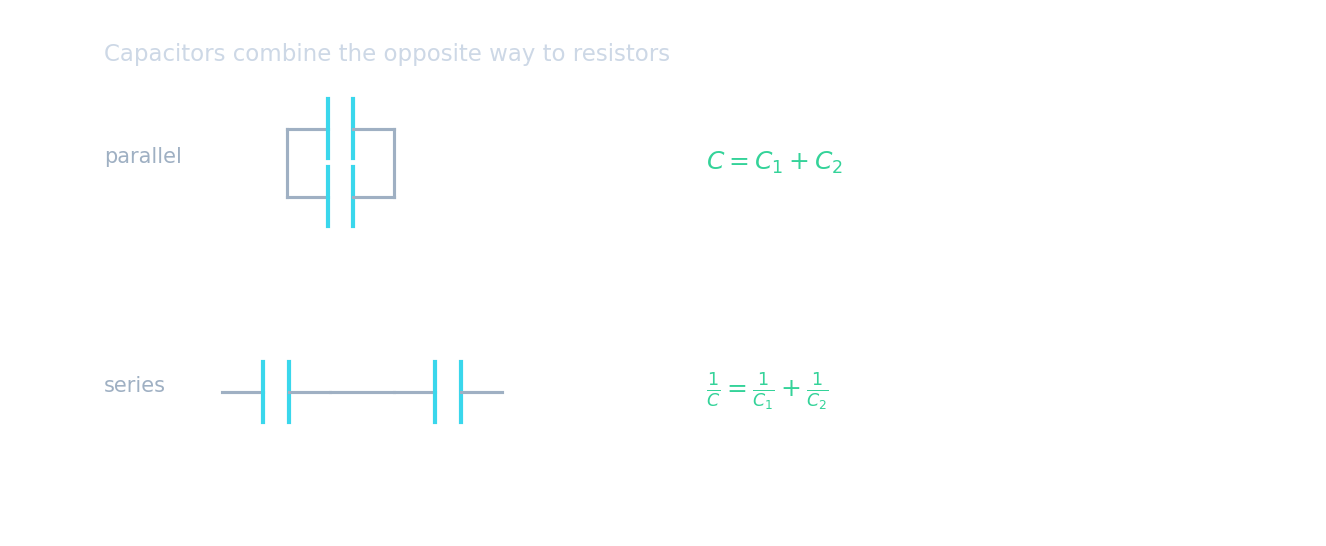
Parallel adds capacitance; series reduces it
A $2.0\ \mu\text{F}$ and a $3.0\ \mu\text{F}$ capacitor are in parallel. What is the total capacitance, in µF?
Difficulty 2/5 · 140 coins + a small bonus on first completion today
In parallel capacitances add: $2.0 + 3.0 = 5.0\ \mu\text{F}$.
Two capacitors in parallel give a combined capacitance that is:
Difficulty 1/5 · 100 coins + a small bonus on first completion today
Parallel capacitors add ($C_1 + C_2$) — the opposite of resistors, which add in series.
An isolated sphere of radius 0.15 m has capacitance C = 4 pi eps0 r. What is C in picofarads? (1/4 pi eps0 = 8.99e9)
Difficulty 2/5 · 140 coins + a small bonus on first completion today
C = r / 8.99e9 = 0.15 / 8.99e9 = 1.7e-11 F = 17 pF. A sphere is a very poor capacitor: 9000 V stores only about 0.15 microcoulombs.
Capacitors in series
- Capacitors in series all carry the same charge, since the charge pushed onto one plate must come off the plate joined to it. The p.d.s add, so $V = Q/C_1 + Q/C_2$ and:
- The combination has a smaller capacitance than any one of them, as though the plate separation had increased.
- This is the opposite way round to resistors, and stating the reason, same p.d. for parallel and same charge for series, is what a "derive" question is asking for.
Match each capacitor arrangement to the fact that gives its combination rule.
Difficulty 2/5 · 140 coins + a small bonus on first completion today
Those two facts are what a "derive the formula" question wants, and they are the reason the rules are the reverse of the ones for resistors.
Capacitors in parallel add, which is the ____ of the rule for resistors.
Difficulty 1/5 · 100 coins + a small bonus on first completion today
Resistors add in series and use reciprocals in parallel; capacitors do it the other way round. Mixing them up is the commonest error in this subtopic.
Worked example: combining three
- A $2.0\ \mu\text{F}$ and a $3.0\ \mu\text{F}$ capacitor are connected in parallel, and that combination is joined in series with a $5.0\ \mu\text{F}$ capacitor. Find the total capacitance.
- The parallel pair first: $C_{\text{p}} = 2.0 + 3.0 = 5.0\ \mu\text{F}$.
- Then in series with $5.0\ \mu\text{F}$: $\dfrac{1}{C} = \dfrac{1}{5.0} + \dfrac{1}{5.0} = \dfrac{2}{5.0}$, so $C = 2.5\ \mu\text{F}$.
- Work from the inside outwards, exactly as with resistors, but with the two rules swapped. The final answer must be smaller than either part of the series pair, which is the check.
A 2.0 uF and a 3.0 uF capacitor in parallel are connected in series with a 5.0 uF capacitor. What is the total capacitance in uF?
Difficulty 2/5 · 140 coins + a small bonus on first completion today
The parallel pair gives 5.0 uF, then in series with 5.0 uF: 1/C = 1/5 + 1/5, so C = 2.5 uF. The result must be smaller than either series element.
Marks that slip away
- Parallel capacitors add; series capacitors use the reciprocal rule. This is the reverse of resistors and is the single commonest error here.
- The definition is charge per unit potential difference, and for plates it is the charge on one plate.
- The charges on the two plates are equal and opposite, so the capacitor is neutral overall. Never write $2Q$.
- $C$ is fixed by the capacitor's geometry. Charging it more does not change $C$; it changes $Q$ and $V$ together.
You've got it
- capacitance is charge per unit p.d., $C = Q/V$, in farads; for plates it is the charge on one plate
- $C$ depends on geometry: plate area over separation for a capacitor, and $C = 4\pi\varepsilon_0 r$ for an isolated sphere
- parallel: same p.d., charges add, $C = C_1 + C_2$, a larger capacitance
- series: same charge, p.d.s add, $\dfrac{1}{C} = \dfrac{1}{C_1} + \dfrac{1}{C_2}$, a smaller capacitance, the opposite of resistors