Apel jatuh dari pohon. Bulan mengelilingi Bumi. Selama ribuan tahun, tidak ada yang melihat hubungan di antara keduanya. Lalu Isaac Newton memiliki salah satu ide…
English narration · English + 中文 subtitles burned in · Narasi bahasa Inggris · Subtitle bahasa Inggris + 中文 disematkan langsung
13.1
Gravitational fields · Medan gravitasi
Syllabus · Silabus
English
understand that a gravitational field is an example of a field of force and define gravitational field as force per unit mass
represent a gravitational field by means of field lines
Bahasa Indonesia
pahami bahwa medan gravitasi adalah contoh medan gaya dan definisikan medan gravitasi sebagai gaya per satuan massa
representasikan medan gravitasi menggunakan garis-garis medan
Source: Cambridge International syllabus · Sumber: Silabus Cambridge International
English
Definition
A gravitational field 重力场 is a region where a mass 质量 feels a force 力 from other masses. The gravitational field strength 重力场强度$g$ at a point is the gravitational force per unit mass on a small test mass 检验质量 placed there:
$$g = \frac{F}{m}.$$
Unit: $\text{N kg}^{-1}$ (the same as $\text{m s}^{-2}$ — the acceleration of free fall in the field). $g$ is a vector 矢量, pointing the way the force acts — towards the source mass.
The examiner's wording. A gravitational field is a region of space in which a mass experiences a force. Gravitational field strength at a point is the gravitational force per unit mass acting on a small test mass placed at the point. The direction of a field line at a point is the direction of the force on a (small test) mass placed there. All three are one-mark definitions; "force per unit mass" is the phrase that scores, "the force on 1 kg" is not.
Field lines
A gravitational field is drawn with field lines 场线 that point the way the force acts on a test mass:
around a point mass 质点 or a uniform sphere (treated as a point mass from outside), the field lines are radial 径向, pointing inwards.
near the Earth's surface over a small area, the field lines are nearly parallel and equally spaced, pointing straight down — a uniform field 匀强场.
Closer lines mean a stronger field.
Why $g$ is constant near the surface, in terms of field lines (a two-mark explanation): over a region whose size is small compared with the Earth's radius, the radial field lines are almost parallel and their spacing hardly changes with height, so the field strength — which the spacing represents — is almost the same at the top of the region as at the bottom. Over the whole planet the lines spread out with distance and the field falls.
Worked example. A point P represents a point mass. Draw lines to represent the gravitational field around P, and state what the direction of a line shows.
Straight radial lines, evenly spaced around P, with arrows pointing inwards towards P. The direction of a line is the direction of the force on a small test mass placed there — always towards the mass that produces the field, because gravity only attracts.
Bahasa Indonesia
Definisi
Medan gravitasi adalah daerah di mana massa merasakan gaya dari massa lainnya. Kekuatan medan gravitasi$g$ pada suatu titik adalah gaya gravitasi per satuan massa pada massa uji kecil yang ditempatkan di sana:
$$g = \frac{F}{m}.$$
Satuan: $\text{N kg}^{-1}$ (sama dengan $\text{m s}^{-2}$ — percepatan jatuh bebas di dalam medan tersebut). $g$ adalah vektor, menunjuk ke arah gaya bekerja — menuju massa sumber.
Istilah penguji. Sebuah medan gravitasi adalah daerah ruang di mana suatu massa mengalami gaya. Kekuatan medan gravitasi di suatu titik adalah gaya gravitasi per satuan massa yang bekerja pada massa uji kecil yang diletakkan di titik tersebut. Arah garis medan di suatu titik adalah arah gaya pada (massa uji) kecil yang diletakkan di sana. Ketiganya adalah definisi bernilai satu poin; "gaya per satuan massa" adalah frasa yang mendapat nilai, "gaya pada 1 kg" tidak mendapatkan nilai penuh.
Garis medan
Medan gravitasi digambar dengan garis medan yang menunjuk ke arah gaya bekerja pada massa uji:
di sekitar massa titik atau bola seragam (diperlakukan sebagai massa titik dari luar), garis medannya radial, menunjuk ke dalam.
dekat permukaan Bumi di atas area kecil, garis medannya hampir paralel dan berjarak sama, menunjuk lurus ke bawah — sebuah medan seragam.
Garis yang lebih rapat menunjukkan medan yang lebih kuat.
Jarak garis medan menunjukkan kekuatan medan — garis yang lebih rapat berarti medan yang lebih kuat
Mengapa $g$ konstan dekat permukaan, dalam istilah garis medan (penjelasan bernilai dua poin): di atas wilayah yang ukurannya kecil dibandingkan jari-jari Bumi, garis medan radial hampir paralel dan jaraknya hampir tidak berubah seiring ketinggian, sehingga kekuatan medan — yang diwakili oleh jarak antar garis — hampir sama di bagian atas wilayah tersebut dibandingkan dengan bagian bawahnya. Di seluruh planet, garis-garis tersebut menyebar menjauh seiring bertambahnya jarak dan medan melemah.
Contoh terpecahkan. Titik P mewakili massa titik. Gambar garis untuk merepresentasikan medan gravitasi di sekitar P, dan nyatakan apa arti arah garis tersebut.
Garis radial lurus, berjarak sama di sekitar P, dengan anak panah menunjuk ke dalam menuju P. Arah garis adalah arah gaya pada massa uji kecil yang diletakkan di sana — selalu menuju massa yang menghasilkan medan, karena gravitasi hanya menarik.
Explore · Jelajahi
A radial field · Medan radial
Change the mass. The field lines point inward and get denser close in, where the field is stronger — a radial field around a point mass. · Ubah massanya. Garis-garis medan mengarah ke dalam dan menjadi lebih rapat di dekat pusat, di mana medan lebih kuat — medan radial di sekitar massa titik.
Newton's law of gravitation · Hukum gravitasi Newton
Syllabus · Silabus
English
understand that, for a point outside a uniform sphere, the mass of the sphere may be considered to be a point mass at its centre
recall and use Newton's law of gravitation$F = Gm_1m_2 / r^2$ for the force between two point masses
analyse circular orbits in gravitational fields by relating the gravitational force to the centripetal acceleration it causes
understand that a satellite in a geostationary orbit remains at the same point above the Earth's surface, with an orbital period of 24 hours, orbiting from west to east, directly above the Equator
Bahasa Indonesia
pahami bahwa, untuk titik di luar bola seragam, massa bola tersebut dapat dianggap sebagai massa titik di pusatnya
ingat dan gunakan hukum gravitasi Newton$F = Gm_1m_2 / r^2$ untuk gaya antara dua massa titik
analisis orbit melingkar dalam medan gravitasi dengan menghubungkan gaya gravitasi ke percepatan sentripetal yang ditimbulkannya
pahami bahwa satelit dalam orbit geostasioner tetap berada pada posisi yang sama di atas permukaan Bumi, dengan periode orbit 24 jam, mengorbit dari barat ke timur, tepat di atas Khatulistiwa
English
derive, from Newton's law of gravitation and the definition of gravitational field, the equation $g = GM/r^2$ for the gravitational field strength due to a point mass
recall and use $g = GM/r^2$
understand why $g$ is approximately constant for small changes in height near the Earth's surface
Bahasa Indonesia
turunkan, dari hukum gravitasi Newton dan definisi medan gravitasi, persamaan $g = GM/r^2$ untuk kekuatan medan gravitasi akibat massa titik
ingat dan gunakan $g = GM/r^2$
pahami mengapa $g$ hampir konstan untuk perubahan ketinggian kecil di dekat permukaan Bumi
Source: Cambridge International syllabus · Sumber: Silabus Cambridge International
English
For two point masses $m_{1}, m_{2}$ a distance $r$ apart, the force on each is
$$F = \frac{G m_{1} m_{2}}{r^{2}},$$
pulling them together along the line joining them. This is Newton's law of gravitation 万有引力定律. The constant $G = 6.67 \times 10^{-11}\ \text{N m}^{2}\ \text{kg}^{-2}$ is the universal gravitational constant 万有引力常量.
In words, as the mark scheme wants it:the gravitational force between two point masses is proportional to the product of their masses and inversely proportional to the square of their separation — both proportionalities, and "point masses". Asked to "state the equation and the meaning of any other symbols", give $F = Gm_{1}m_{2}/r^{2}$ with $G$ the gravitational constant and $r$ the distance between the centres.
Worked example. Two isolated uniform spheres, each of mass $1.0 \times 10^{3}\ \text{kg}$, have their centres $2.0\ \text{m}$ apart. Find the gravitational force between them and comment on its size.
$F = \dfrac{6.67 \times 10^{-11} \times 1.0 \times 10^{3} \times 1.0 \times 10^{3}}{2.0^{2}} = 1.7 \times 10^{-5}\ \text{N}$. This is about $10^{-9}$ of each sphere's weight ($9.8 \times 10^{3}\ \text{N}$): gravity between everyday objects is negligible, and only a planet-sized mass produces a noticeable field. "Isolated" in a question means that no other masses need be considered.
Spheres treated as point masses
For a uniform sphere (such as a planet or star), the field at any point outside is the same as that of a point mass equal to the total mass at the centre. So from above the surface, you can treat the Earth as a point mass at its centre. (Points inside a sphere are different, and are not in the syllabus.)
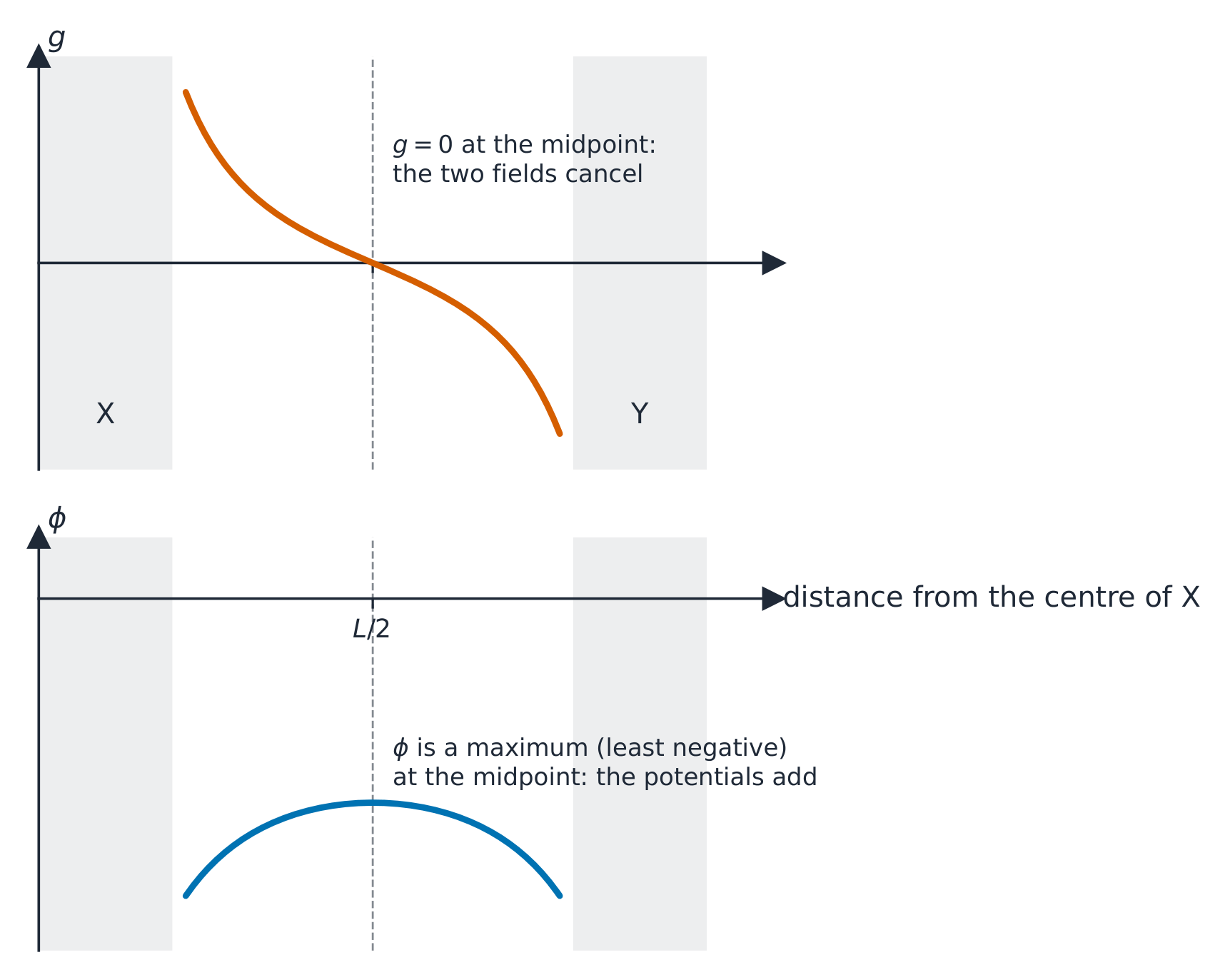
Between two masses the fields subtract and the potentials add. Field strength is a vector: on the line joining two spheres the two fields point in opposite directions, so there is a point where they cancel and the resultant field is zero. Potential is a scalar: the two potentials simply add, and both are negative, so the potential is least negative (a maximum) at the point where the field is zero.
Worked example. Two identical isolated uniform spheres X and Y, each of mass $M$ and radius $R$, have their centres a distance $L$ apart. Point P lies on the line joining the centres. State where on the line the resultant field strength is zero, and find the gravitational potential there.
By symmetry the fields of X and Y are equal and opposite at the midpoint, $L/2$ from each centre, so the resultant field is zero there. The potential at P is the sum $\phi = -\dfrac{GM}{L/2} - \dfrac{GM}{L/2} = -\dfrac{4GM}{L}$. A mass released at P would stay there; a mass released anywhere else on the line falls towards the nearer sphere.
Field strength from a point mass
Put the gravitational force on a test mass $m$ at distance $r$ from a point mass $M$ into $g = F/m$:
$$F = \frac{G M m}{r^{2}}, \qquad g = \frac{G M}{r^{2}}.$$
So $g$ falls off as $1/r^{2}$ as you move away from the source.
The two-mark derivation. The force on a test mass $m$ at distance $r$ from a point mass $M$ is $F = GMm/r^{2}$ (Newton's law). Field strength is force per unit mass, $g = F/m$, so $g = GM/r^{2}$. Write both lines: the law and the definition are the two marks. Because $g \propto 1/r^{2}$, halving the distance makes the field four times stronger: at distance $x/2$ the field is $4g$, in the same direction, towards $M$.
Worked example. Find the gravitational field strength at the Earth's surface. (Earth's mass $M = 6.0 \times 10^{24}\ \text{kg}$, radius $R = 6.4 \times 10^{6}\ \text{m}$, $G = 6.67 \times 10^{-11}\ \text{N m}^{2}\ \text{kg}^{-2}$.)
Why $g$ is nearly constant near the Earth's surface
The Earth's radius is $R \approx 6.4 \times 10^{6}\ \text{m}$. Rising to height $h$ changes the distance from the centre from $R$ to $R + h$. For $h \ll R$ (any building or mountain), $(R + h)/R \approx 1$, so $g$ barely changes — going from $5\ \text{m}$ to $10\ \text{m}$ high changes $r$ by about one part in a million. In the laboratory, $g$ is effectively constant.
Bahasa Indonesia
Untuk dua massa titik $m_{1}, m_{2}$ yang terpisah sejauh $r$, gaya pada masing-masing adalah
Dua massa saling tarik-menarik sepanjang garis penghubung mereka
$$F = \frac{G m_{1} m_{2}}{r^{2}},$$
menarik mereka bersama sepanjang garis penghubung. Ini adalah hukum gravitasi Newton. Konstanta $G = 6.67 \times 10^{-11}\ \text{N m}^{2}\ \text{kg}^{-2}$ adalah konstanta gravitasi universal.
Dalam kata-kata, sesuai dengan kunci jawaban:gaya gravitasi antara dua massa titik sebanding dengan hasil kali massa mereka dan berbanding terbalik dengan kuadrat jarak pemisahan — kedua proporsionalitas tersebut, serta "massa titik". Jika diminta untuk "nyatakan persamaan dan makna simbol lainnya", berikan $F = Gm_{1}m_{2}/r^{2}$ dengan $G$ sebagai konstanta gravitasi dan $r$ sebagai jarak antara pusat-pusatnya.
Contoh terpecahkan. Dua bola seragam terisolasi, masing-masing bermassa $1.0 \times 10^{3}\ \text{kg}$, memiliki jarak pusat $2.0\ \text{m}$. Hitunglah gaya gravitasi di antara keduanya dan komentari besarnya.
$F = \dfrac{6.67 \times 10^{-11} \times 1.0 \times 10^{3} \times 1.0 \times 10^{3}}{2.0^{2}} = 1.7 \times 10^{-5}\ \text{N}$. Ini sekitar $10^{-9}$ dari berat setiap bola ($9.8 \times 10^{3}\ \text{N}$): gravitasi antara benda sehari-hari dapat diabaikan, dan hanya massa sebesar planet yang menghasilkan medan yang terasa. "Terisolasi" dalam soal berarti tidak perlu mempertimbangkan massa lain.
Bola diperlakukan sebagai massa titik
Untuk bola seragam (seperti planet atau bintang), medan di setiap titik di luar sama dengan yang dari massa titik yang besarnya sama dengan massa total di pusat. Jadi dari atas permukaan, Anda dapat memperlakukan Bumi sebagai massa titik di pusatnya. (Titik di dalam bola berbeda, dan tidak termasuk dalam silabus.)
Di luar bola seragam medannya bersifat radial, persis seperti massa titik di pusat
Antara dua massa medan saling mengurangi dan potensial saling menjumlahkan. Kekuatan medan adalah vektor: pada garis yang menghubungkan dua bola, kedua medan mengarah berlawanan arah, sehingga ada titik di mana mereka saling meniadakan dan medan resultan menjadi nol. Potensial adalah skalar: kedua potensial hanya dijumlahkan, dan keduanya negatif, sehingga potensial paling kurang negatif (maksimum) terjadi di titik di mana medan nol.
Sepanjang garis antara dua massa yang sama, kekuatan medan melewati nol di titik tengah, di mana potensial memiliki nilai maksimum
Contoh terpecahkan. Dua bola seragam terisolasi identik X dan Y, masing-masing bermassa $M$ dan berjari-jari $R$, memiliki jarak antarpusel $L$. Titik P terletak pada garis yang menghubungkan pusat-pusat tersebut. Nyatakan di mana pada garis tersebut kekuatan medan resultan bernilai nol, dan temukan potensial gravitasi di sana.
Berdasarkan simetri, medan X dan Y sama besar dan berlawanan arah di titik tengah, $L/2$ dari setiap pusat, sehingga medan resultan nol di sana. Potensial di P adalah jumlah $\phi = -\dfrac{GM}{L/2} - \dfrac{GM}{L/2} = -\dfrac{4GM}{L}$. Massa yang dilepaskan di P akan tetap di sana; massa yang dilepaskan di tempat lain pada garis tersebut jatuh menuju bola yang lebih dekat.
Kekuatan medan dari massa titik
Masukkan gaya gravitasi pada massa uji $m$ pada jarak $r$ dari massa titik $M$ ke dalam $g = F/m$:
$$F = \frac{G M m}{r^{2}}, \qquad g = \frac{G M}{r^{2}}.$$
Sehingga $g$ menurun sebanding dengan $1/r^{2}$ saat Anda menjauh dari sumber.
Penurunan dua poin. Gaya pada massa uji $m$ pada jarak $r$ dari massa titik $M$ adalah $F = GMm/r^{2}$ (hukum Newton). Kekuatan medan adalah gaya per satuan massa, $g = F/m$, sehingga $g = GM/r^{2}$. Tulis kedua baris: hukum dan definisi adalah dua poin tersebut. Karena $g \propto 1/r^{2}$, menggandakan jarak membuat medan empat kali lebih kuat: pada jarak $x/2$ medan adalah $4g$, dalam arah yang sama, menuju $M$.
Kekuatan medan menurun sebanding dengan $1/r^2$ terhadap jarak dari massa titik
Contoh terpecahkan. Temukan kekuatan medan gravitasi di permukaan Bumi. (Massa Bumi $M = 6.0 \times 10^{24}\ \text{kg}$, jari-jari $R = 6.4 \times 10^{6}\ \text{m}$, $G = 6.67 \times 10^{-11}\ \text{N m}^{2}\ \text{kg}^{-2}$.)
Mengapa $g$ hampir konstan di dekat permukaan Bumi
Jari-jari Bumi adalah $R \approx 6.4 \times 10^{6}\ \text{m}$. Naik ke ketinggian $h$ mengubah jarak dari pusat dari $R$ menjadi $R + h$. Untuk $h \ll R$ (bangunan atau gunung apa pun), $(R + h)/R \approx 1$, sehingga $g$ hampir tidak berubah — naik dari $5\ \text{m}$ ke $10\ \text{m}$ tinggi mengubah $r$ sekitar satu bagian dalam satu juta. Di laboratorium, $g$ efektif konstan.
Explore · Jelajahi
Newton's law of gravitation · Hukum gravitasi Newton
F ∝ Mm / r²
Gravity pulls inward and weakens with the square of the distance. · Gravitasi menarik ke dalam dan melemah dengan kuadrat jarak.
13.2 13.3
Orbital motion in a gravitational field · Gerak orbit dalam medan gravitasi
English
For a satellite 卫星 of mass $m$ in a circular orbit 轨道 of radius $r$ around a body of mass $M$, gravity provides the centripetal force 向心力:
$$\frac{G M m}{r^{2}} = \frac{m v^{2}}{r}.$$
Cancel $m$ (the orbital speed does not depend on the satellite's mass):
$$v = \sqrt{\frac{G M}{r}}.$$
Worked example. A satellite orbits the Earth in a circular orbit of radius $r = 7.0 \times 10^{6}\ \text{m}$. Find its orbital speed. (For the Earth, $GM = 4.0 \times 10^{14}\ \text{m}^{3}\ \text{s}^{-2}$.)
This is Kepler's third law 开普勒第三定律 for circular orbits: $T^{2} \propto r^{3}$. A plot of $T^{2}$ against $r^{3}$ is a straight line through the origin with gradient $4\pi^{2}/(GM)$, so orbital data gives the central mass.
The two-mark derivation, as the exam sets it. For a satellite of mass $m$ in a circular orbit of radius $R$ and period $T$ around a planet of mass $M$: the gravitational force provides the centripetal force, $\dfrac{GMm}{R^{2}} = mR\omega^{2}$, and $\omega = 2\pi/T$; so $\dfrac{GM}{R^{2}} = \dfrac{4\pi^{2}R}{T^{2}}$, giving $T^{2} = \dfrac{4\pi^{2}R^{3}}{GM}$. For an orbit at height $h$ above a planet of radius $R_{\text{p}}$ the orbital radius is $R_{\text{p}} + h$, so $T^{2} = 4\pi^{2}(R_{\text{p}} + h)^{3}/GM$: a graph of $T^{2}$ against $(R_{\text{p}} + h)^{3}$ is a straight line through the origin whose gradient gives $M$.
Worked example. Satellite X, of mass $M_{\text{s}}$, orbits a planet at a distance $4R$ from its centre; satellite Y, of mass $2M_{\text{s}}$, orbits at $3R$. Compare their speeds, periods and kinetic energies.
From $v = \sqrt{GM/r}$, $\dfrac{v_{\text{Y}}}{v_{\text{X}}} = \sqrt{\dfrac{4R}{3R}} = 1.15$: Y moves faster, and the satellite masses do not enter. From $T \propto r^{3/2}$, $\dfrac{T_{\text{Y}}}{T_{\text{X}}} = \left(\dfrac{3}{4}\right)^{3/2} = 0.65$. Kinetic energy $= \tfrac{1}{2}mv^{2} = \dfrac{GMm}{2r}$, so $\dfrac{E_{\text{Y}}}{E_{\text{X}}} = \dfrac{2M_{\text{s}}/3R}{M_{\text{s}}/4R} = \dfrac{8}{3}$. In ratio questions cancel $G$, $M$ and the satellite mass first; only the radii and masses that differ survive.
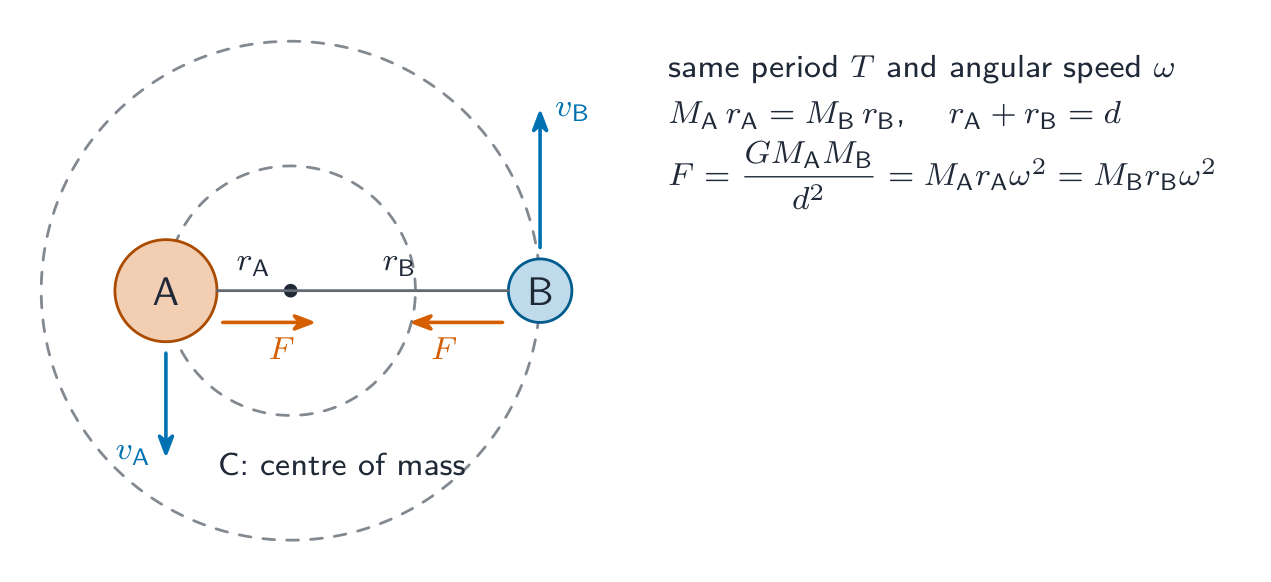
Binary stars. Two stars of masses $M_{\text{A}}$ and $M_{\text{B}}$ a distance $d$ apart orbit their common centre of mass 质心, always on opposite sides of it, with the same period. The centre of mass divides $d$ in the inverse ratio of the masses, $M_{\text{A}}r_{\text{A}} = M_{\text{B}}r_{\text{B}}$ with $r_{\text{A}} + r_{\text{B}} = d$, and the same gravitational force $GM_{\text{A}}M_{\text{B}}/d^{2}$ is the centripetal force on each star.
Worked example. A binary star consists of star A, mass $4.0 \times 10^{30}\ \text{kg}$, and star B, mass $2.0 \times 10^{30}\ \text{kg}$, with centres $3.3 \times 10^{11}\ \text{m}$ apart. Find the distance of A from the centre of mass and the period of the orbit.
$M_{\text{A}}r_{\text{A}} = M_{\text{B}}r_{\text{B}}$ with $r_{\text{A}} + r_{\text{B}} = 3.3 \times 10^{11}$ gives $r_{\text{A}} = \dfrac{2.0}{6.0} \times 3.3 \times 10^{11} = 1.1 \times 10^{11}\ \text{m}$ (and $r_{\text{B}} = 2.2 \times 10^{11}\ \text{m}$). For star A: $\dfrac{GM_{\text{A}}M_{\text{B}}}{d^{2}} = M_{\text{A}}r_{\text{A}}\omega^{2}$, so $\omega^{2} = \dfrac{GM_{\text{B}}}{d^{2}r_{\text{A}}} = \dfrac{6.67 \times 10^{-11} \times 2.0 \times 10^{30}}{(3.3 \times 10^{11})^{2} \times 1.1 \times 10^{11}} = 1.1 \times 10^{-14}\ \text{s}^{-2}$, $\omega = 1.06 \times 10^{-7}\ \text{rad s}^{-1}$ and $T = 2\pi/\omega = 6.0 \times 10^{7}\ \text{s}$, about $1.9$ years. Using $d$ in the force but $r_{\text{A}}$ in the centripetal term is the whole point of the question.
Geostationary orbit
A geostationary 地球同步 satellite:
stays directly above the same point on the Earth (so a fixed dish always points at it),
has a period of 24 hours (the same as the Earth's rotation),
orbits west to east (the same way the Earth turns),
must be directly above the equator 赤道.
It must have the same angular speed 角速度 as the Earth, in the same direction, in the equatorial plane (or it would drift north–south during the day). From $T = 24\ \text{h}$ and $T^{2} = 4\pi^{2} r^{3}/(GM)$, the radius is $r \approx 4.2 \times 10^{7}\ \text{m}$ (about $3.6 \times 10^{7}\ \text{m}$ above the surface).
Worked example. Calculate the radius of a geostationary orbit around the Earth ($M = 5.98 \times 10^{24}\ \text{kg}$), and explain why a satellite with the same orbital radius and period may still not be geostationary.
$T = 24 \times 3600 = 8.64 \times 10^{4}\ \text{s}$; $r^{3} = \dfrac{GMT^{2}}{4\pi^{2}} = \dfrac{6.67 \times 10^{-11} \times 5.98 \times 10^{24} \times (8.64 \times 10^{4})^{2}}{4\pi^{2}} = 7.5 \times 10^{22}\ \text{m}^{3}$, so $r = 4.2 \times 10^{7}\ \text{m}$ — a height of about $3.6 \times 10^{7}\ \text{m}$ above the surface. A satellite with this period is geostationary only if its orbit is in the plane of the equator and it travels from west to east; with the same period in a tilted orbit (over the poles, say) it returns to the same point each day but is not always above it. Mars turns once in about $25$ hours, so a satellite that stays above one point on Mars has a $25$-hour period and the same two other features.
Bahasa Indonesia
Stasiun Luar Angkasa Internasional mengorbit Bumi, tertahan jalurnya oleh gravitasi.Gravitasi menyediakan gaya sentripetal yang mempertahankan planet dalam orbit melingkarSaturnus, cincin-cincinya (potongan-potongan kecil tak terhitung yang mengorbit) dan bulannya semuanya tertahan dalam orbit oleh gravitasi
Untuk satelit bermassa $m$ dalam orbit melingkar berjari-jari $r$ mengelilingi benda bermassa $M$, gravitasi menyediakan gaya sentripetal:
$$\frac{G M m}{r^{2}} = \frac{m v^{2}}{r}.$$
Coret $m$ (kecepatan orbit tidak bergantung pada massa satelit):
$$v = \sqrt{\frac{G M}{r}}.$$
Contoh terpecahkan. Sebuah satelit mengorbit Bumi dalam orbit melingkar berjari-jari $r = 7.0 \times 10^{6}\ \text{m}$. Temukan kecepatan orbitnya. (Untuk Bumi, $GM = 4.0 \times 10^{14}\ \text{m}^{3}\ \text{s}^{-2}$.)
Ini adalah hukum Kepler ketiga untuk orbit melingkar: $T^{2} \propto r^{3}$. Plot $T^{2}$ terhadap $r^{3}$ adalah garis lurus melalui titik asal dengan gradien $4\pi^{2}/(GM)$, sehingga data orbit memberikan massa pusat.
Hukum Kepler ketiga: $T^2 \propto r^3$, garis lurus melalui titik asal
Penurunan nilai dua poin, sesuai format soal ujian. Untuk satelit bermassa $m$ dalam orbit melingkar berjari-jari $R$ dan periode $T$ mengelilingi planet bermassa $M$: gaya gravitasi menyediakan gaya sentripetal, $\dfrac{GMm}{R^{2}} = mR\omega^{2}$, dan $\omega = 2\pi/T$; sehingga $\dfrac{GM}{R^{2}} = \dfrac{4\pi^{2}R}{T^{2}}$, menghasilkan $T^{2} = \dfrac{4\pi^{2}R^{3}}{GM}$. Untuk orbit pada ketinggian $h$ di atas planet berjari-jari $R_{\text{p}}$, jari-jari orbit adalah $R_{\text{p}} + h$, sehingga $T^{2} = 4\pi^{2}(R_{\text{p}} + h)^{3}/GM$: grafik $T^{2}$ terhadap $(R_{\text{p}} + h)^{3}$ merupakan garis lurus melalui titik asal yang gradiennya memberikan $M$.
Contoh terpecahkan. Satelit X, bermassa $M_{\text{s}}$, mengorbit sebuah planet pada jarak $4R$ dari pusatnya; satelit Y, bermassa $2M_{\text{s}}$, mengorbit pada $3R$. Bandingkan kecepatan, periode, dan energi kinetik keduanya.
Dari $v = \sqrt{GM/r}$, $\dfrac{v_{\text{Y}}}{v_{\text{X}}} = \sqrt{\dfrac{4R}{3R}} = 1.15$: Y bergerak lebih cepat, dan massa satelit tidak masuk dalam persamaan. Dari $T \propto r^{3/2}$, $\dfrac{T_{\text{Y}}}{T_{\text{X}}} = \left(\dfrac{3}{4}\right)^{3/2} = 0.65$. Energi kinetik $= \tfrac{1}{2}mv^{2} = \dfrac{GMm}{2r}$, sehingga $\dfrac{E_{\text{Y}}}{E_{\text{X}}} = \dfrac{2M_{\text{s}}/3R}{M_{\text{s}}/4R} = \dfrac{8}{3}$. Pada soal perbandingan, coret $G$, $M$ dan massa satelit terlebih dahulu; hanya jari-jari dan massa yang berbeda yang tersisa.
Bintang ganda. Dua bintang dengan massa $M_{\text{A}}$ dan $M_{\text{B}}$ berjarak $d$ satu sama lain mengorbit pusat massa bersama mereka, selalu berada di sisi yang berlawanan dari pusat tersebut, dengan periode yang sama. Pusat massa membagi $d$ dalam rasio terbalik dari massa-massa tersebut, $M_{\text{A}}r_{\text{A}} = M_{\text{B}}r_{\text{B}}$ dengan $r_{\text{A}} + r_{\text{B}} = d$, dan gaya gravitasi yang sama $GM_{\text{A}}M_{\text{B}}/d^{2}$ adalah gaya sentripetal pada masing-masing bintang.
Bintang ganda: kedua bintang mengelilingi pusat massa dengan periode yang sama, bintang yang lebih berat berada pada lingkaran yang lebih kecil
Contoh terpecahkan. Sebuah bintang ganda terdiri dari bintang A, bermassa $4.0 \times 10^{30}\ \text{kg}$, dan bintang B, bermassa $2.0 \times 10^{30}\ \text{kg}$, dengan jarak antar pusat $3.3 \times 10^{11}\ \text{m}$. Tentukan jarak A dari pusat massa dan periode orbitnya.
$M_{\text{A}}r_{\text{A}} = M_{\text{B}}r_{\text{B}}$ dengan $r_{\text{A}} + r_{\text{B}} = 3.3 \times 10^{11}$ menghasilkan $r_{\text{A}} = \dfrac{2.0}{6.0} \times 3.3 \times 10^{11} = 1.1 \times 10^{11}\ \text{m}$ (dan $r_{\text{B}} = 2.2 \times 10^{11}\ \text{m}$). Untuk bintang A: $\dfrac{GM_{\text{A}}M_{\text{B}}}{d^{2}} = M_{\text{A}}r_{\text{A}}\omega^{2}$, sehingga $\omega^{2} = \dfrac{GM_{\text{B}}}{d^{2}r_{\text{A}}} = \dfrac{6.67 \times 10^{-11} \times 2.0 \times 10^{30}}{(3.3 \times 10^{11})^{2} \times 1.1 \times 10^{11}} = 1.1 \times 10^{-14}\ \text{s}^{-2}$, $\omega = 1.06 \times 10^{-7}\ \text{rad s}^{-1}$ dan $T = 2\pi/\omega = 6.0 \times 10^{7}\ \text{s}$, sekitar $1.9$ tahun. Menggunakan $d$ dalam suku gaya tetapi $r_{\text{A}}$ dalam suku sentripetal merupakan inti utama dari pertanyaan ini.
Orbit geostasioner
Sebuah satelit geostasioner:
tetap tepat di atas titik yang sama di permukaan Bumi (sehingga antena parabola yang tetap selalu mengarah ke arahnya),
memiliki periode 24 jam (sama dengan rotasi Bumi),
mengorbit dari barat ke timur (sama arah dengan putaran Bumi),
harus berada tepat di atas khatulistiwa.
Satelit tersebut harus memiliki kecepatan sudut yang sama dengan Bumi, dalam arah yang sama, di bidang khatulistiwa (jika tidak, ia akan bergeser ke utara-selatan selama hari). Dari $T = 24\ \text{h}$ dan $T^{2} = 4\pi^{2} r^{3}/(GM)$, jari-jarinya adalah $r \approx 4.2 \times 10^{7}\ \text{m}$ (sekitar $3.6 \times 10^{7}\ \text{m}$ di atas permukaan).
Contoh terpecahkan. Hitung jari-jari orbit geostasioner di sekitar Bumi ($M = 5.98 \times 10^{24}\ \text{kg}$), dan jelaskan mengapa satelit dengan jari-jari dan periode orbit yang sama mungkin saja belum tentu geostasioner.
$T = 24 \times 3600 = 8.64 \times 10^{4}\ \text{s}$; $r^{3} = \dfrac{GMT^{2}}{4\pi^{2}} = \dfrac{6.67 \times 10^{-11} \times 5.98 \times 10^{24} \times (8.64 \times 10^{4})^{2}}{4\pi^{2}} = 7.5 \times 10^{22}\ \text{m}^{3}$, sehingga $r = 4.2 \times 10^{7}\ \text{m}$ — ketinggian sekitar $3.6 \times 10^{7}\ \text{m}$ di atas permukaan. Satelit dengan periode ini bersifat geostasioner hanya jika orbitnya berada di bidang khatulistiwa dan bergerak dari barat ke timur; dengan periode yang sama pada orbit miring (misalnya melewati kutub), ia kembali ke titik yang sama setiap hari tetapi tidak selalu berada tepat di atasnya. Mars berputar sekali dalam waktu sekitar $25$ jam, sehingga satelit yang tetap di atas satu titik di Mars memiliki periode $25$ jam dan dua karakteristik lainnya yang sama.
define gravitational potential at a point as the work done per unit mass in bringing a small test mass from infinity to the point
use $\phi = -GM/r$ for the gravitational potential in the field due to a point mass
understand how the concept of gravitational potential leads to the gravitational potential energy of two point masses and use $E_P = -GMm/r$
Bahasa Indonesia
definisikan potensial gravitasi pada suatu titik sebagai usaha per satuan massa dalam membawa massa uji kecil dari tak hingga ke titik tersebut
gunakan $\phi = -GM/r$ untuk potensial gravitasi dalam medan akibat massa titik
pahami bagaimana konsep potensial gravitasi mengarah pada energi potensial gravitasi dua massa titik dan gunakan $E_P = -GMm/r$
Source: Cambridge International syllabus · Sumber: Silabus Cambridge International
English
Gravitational potential 引力势$\phi$ at a point is the work done per unit mass in bringing a small test mass from infinity 无穷远 to that point:
$$\phi = \frac{W}{m}.$$
Unit: $\text{J kg}^{-1}$.
The potential is taken as zero at infinity. As the test mass falls in towards the source, gravity does the work for you, so $\phi$ is negative everywhere except at infinity. For a point mass $M$ at distance $r$:
$$\phi = -\frac{G M}{r}.$$
$\phi$ is a scalar 标量. For several masses, add the potentials.
The two-mark definition, and why it is negative.Gravitational potential at a point is the work done per unit mass in bringing a small test mass from infinity to the point. Potential is defined as zero at infinity; gravity is attractive, so as the test mass comes in from infinity the field does work on it and the mass gives out energy — the work that an external agent must do is negative. Hence the potential at every finite distance is below zero. (Electric potential near a positive charge is positive for the opposite reason: that field repels, so work must be done to bring a positive test charge in.)
Similarities and differences with electric potential. Both are defined as work done per unit mass or per unit positive charge from infinity, both are scalars, both vary as $1/r$ from a point source and both are zero at infinity. The difference: gravitational potential is always negative, because gravity only attracts, whereas electric potential can be positive or negative depending on the sign of the charge.
Reading a potential graph. Two graphs appear in questions. On $\phi$ against $r$ the curve is $-GM/r$: the surface value $\phi_{\text{s}} = -GM/R$ gives the mass of the planet, and the gradient at any point gives the field strength there, since $g = -\dfrac{\Delta\phi}{\Delta r}$ — field strength is the negative of the potential gradient (this is the "relationship between potential and field strength" a question may ask for). On $\phi$ against $1/r$ the graph is a straight line through the origin with gradient $-GM$, which is the neater way to extract $M$.
Worked example. The Moon is an isolated uniform sphere of mass $7.3 \times 10^{22}\ \text{kg}$ and radius $1.7 \times 10^{6}\ \text{m}$. Calculate the gravitational potential at its surface, and the minimum speed with which a particle must leave the surface to escape.
$\phi = -\dfrac{GM}{R} = -\dfrac{6.67 \times 10^{-11} \times 7.3 \times 10^{22}}{1.7 \times 10^{6}} = -2.9 \times 10^{6}\ \text{J kg}^{-1}$. To escape, the particle's kinetic energy per unit mass must equal the depth of the potential well: $\tfrac{1}{2}v^{2} = 2.9 \times 10^{6}$, so $v = \sqrt{2 \times 2.9 \times 10^{6}} = 2.4 \times 10^{3}\ \text{m s}^{-1}$. The minus sign carries the meaning: energy of $2.9\ \text{MJ}$ per kilogram must be supplied to lift the particle out.
Gravitational potential energy of two point masses
If a test mass $m$ sits where the potential is $\phi$, the gravitational potential energy 重力势能 of the pair is
$$E_{\text{P}} = m \phi = -\frac{G M m}{r}.$$
Like the potential, $E_{\text{P}}$ is negative and reaches zero only at infinite separation. Closer masses have more negative potential energy (more tightly bound).
Link with $\Delta E_{\text{P}} = mg\Delta h$
For small height changes near the surface, $r$ barely changes, so $\Delta E_{\text{P}} \approx mg\Delta h$. For large changes (a satellite moving to a higher orbit) use $-GMm/r$ at each radius and take the difference:
which is positive (energy must be supplied to raise the satellite).
Worked example. A satellite of mass $1200\ \text{kg}$ is moved from a circular orbit of radius $7.0 \times 10^{6}\ \text{m}$ to one of radius $8.0 \times 10^{6}\ \text{m}$ around the Earth ($GM = 4.0 \times 10^{14}\ \text{m}^{3}\ \text{s}^{-2}$). Find the changes in its gravitational potential energy, its kinetic energy and its total energy.
$\Delta E_{\text{P}} = GMm\left(\dfrac{1}{r_{1}} - \dfrac{1}{r_{2}}\right) = 4.0 \times 10^{14} \times 1200 \times \left(\dfrac{1}{7.0 \times 10^{6}} - \dfrac{1}{8.0 \times 10^{6}}\right) = +8.6 \times 10^{9}\ \text{J}$. In a circular orbit $E_{\text{K}} = \tfrac{1}{2}mv^{2} = \dfrac{GMm}{2r}$, so $\Delta E_{\text{K}} = \dfrac{GMm}{2}\left(\dfrac{1}{r_{2}} - \dfrac{1}{r_{1}}\right) = -4.3 \times 10^{9}\ \text{J}$: the higher satellite moves more slowly. The total energy $E_{\text{K}} + E_{\text{P}} = -\dfrac{GMm}{2r}$ rises by $+4.3 \times 10^{9}\ \text{J}$, which is the energy the rocket motor must supply. A satellite's total energy is negative — it is bound — and it becomes less negative as the orbit widens.
Escape velocity (from conservation of energy)
To escape from radius $r$ to infinity, an object's kinetic energy 动能 must equal the size of its gravitational potential energy:
$$\tfrac{1}{2} m v_{\text{esc}}^{2} = \frac{G M m}{r}, \qquad v_{\text{esc}} = \sqrt{\frac{2 G M}{r}}.$$
At the Earth's surface, the escape velocity 逃逸速度 is $\approx 11\ \text{km s}^{-1}$. It does not depend on the object's mass.
Worked example. Find the escape velocity from the Earth's surface. (For the Earth, $GM = 4.0 \times 10^{14}\ \text{m}^{3}\ \text{s}^{-2}$, $R = 6.4 \times 10^{6}\ \text{m}$.)
Worked example. A particle is projected vertically upwards from the surface of an isolated planet of radius $R$, where the gravitational potential is $\phi_{\text{s}}$. Show that it just reaches a distance $r$ from the centre if its launch speed $v$ satisfies $\tfrac{1}{2}v^{2} = -\phi_{\text{s}}\left(1 - \dfrac{R}{r}\right)$, and deduce the escape speed.
Potential varies as $1/r$, so at distance $r$ it is $\phi_{\text{s}}R/r$. When the particle stops, its kinetic energy per unit mass has all become potential energy per unit mass: $\tfrac{1}{2}v^{2} = \phi(r) - \phi_{\text{s}} = \phi_{\text{s}}\dfrac{R}{r} - \phi_{\text{s}} = -\phi_{\text{s}}\left(1 - \dfrac{R}{r}\right)$, which is positive because $\phi_{\text{s}}$ is negative. Letting $r \to \infty$ gives $\tfrac{1}{2}v_{\text{esc}}^{2} = -\phi_{\text{s}} = GM/R$ — the escape-speed result again, now read straight off the potential.
Bahasa Indonesia
Potensial gravitasi$\phi$ di suatu titik adalah usaha per satuan massa untuk memindahkan massa uji kecil dari tak hingga ke titik tersebut:
$$\phi = \frac{W}{m}.$$
Satuan: $\text{J kg}^{-1}$.
Potensial dianggap nol di tak hingga. Saat massa uji jatuh mendekati sumber, gravitasi melakukan usaha untuk Anda, sehingga $\phi$ bernilai negatif di mana pun kecuali di tak hingga. Untuk massa titik $M$ pada jarak $r$:
$$\phi = -\frac{G M}{r}.$$
$\phi$ adalah skalar. Untuk beberapa massa, jumlahkan potensial-potensialnya.
Sumur potensial gravitasi: $\phi = -GM/r$ bernilai negatif, naik menuju nol di tak hingga
Definisi bernilai dua poin, dan mengapa nilainya negatif.Potensial gravitasi di suatu titik adalah usaha per satuan massa untuk memindahkan massa uji kecil dari tak hingga ke titik tersebut. Potensial didefinisikan nol di tak hingga; gravitasi bersifat tarik-menarik, sehingga saat massa uji datang dari tak hingga, medan melakukan usaha padanya dan massa melepaskan energi — usaha yang harus dilakukan oleh agen eksternal adalah negatif. Oleh karena itu, potensial pada setiap jarak berhingga berada di bawah nol. (Potensial listrik di dekat muatan positif bernilai positif karena alasan sebaliknya: medan tersebut menolak, sehingga usaha harus dilakukan untuk mendekatkan muatan uji positif.)
Kesamaan dan perbedaan dengan potensial listrik. Keduanya didefinisikan sebagai usaha per satuan massa atau per satuan muatan positif dari tak hingga, keduanya adalah skalar, keduanya berubah sebanding dengan $1/r$ dari sumber titik, dan keduanya bernilai nol di tak hingga. Perbedaannya: potensial gravitasi selalu negatif, karena gravitasi hanya menarik, sedangkan potensial listrik bisa positif atau negatif tergantung tanda muatannya.
Membaca grafik potensial. Dua grafik muncul dalam soal. Pada $\phi$ terhadap $r$, kurva berbentuk $-GM/r$: nilai permukaan $\phi_{\text{s}} = -GM/R$ memberikan massa planet, dan gradien pada titik manapun memberikan kekuatan medan di sana, karena $g = -\dfrac{\Delta\phi}{\Delta r}$ — kekuatan medan adalah negatif dari gradien potensial (ini adalah "hubungan antara potensial dan kekuatan medan" yang mungkin ditanyakan oleh soal). Pada $\phi$ terhadap $1/r$, grafiknya adalah garis lurus melalui titik asal dengan gradien $-GM$, yang merupakan cara lebih rapi untuk mengekstrak $M$.
Contoh terpecahkan. Bulan adalah bola seragam terisolasi bermassa $7.3 \times 10^{22}\ \text{kg}$ dan jari-jari $1.7 \times 10^{6}\ \text{m}$. Hitung potensial gravitasi di permukaannya, dan kecepatan minimum dengan mana partikel harus meninggalkan permukaan untuk lepas.
$\phi = -\dfrac{GM}{R} = -\dfrac{6.67 \times 10^{-11} \times 7.3 \times 10^{22}}{1.7 \times 10^{6}} = -2.9 \times 10^{6}\ \text{J kg}^{-1}$. Untuk keluar, energi kinetik partikel per satuan massa harus sama dengan kedalaman sumur potensial: $\tfrac{1}{2}v^{2} = 2.9 \times 10^{6}$, sehingga $v = \sqrt{2 \times 2.9 \times 10^{6}} = 2.4 \times 10^{3}\ \text{m s}^{-1}$. Tanda minus membawa makna: energi $2.9\ \text{MJ}$ per kilogram harus disuplai untuk mengangkat partikel keluar.
Energi potensial gravitasi dua massa titik
Jika sebuah massa uji $m$ berada di tempat yang memiliki potensial $\phi$, maka energi potensial gravitasi dari pasangan tersebut adalah
$$E_{\text{P}} = m \phi = -\frac{G M m}{r}.$$
Seperti potensialnya, $E_{\text{P}}$ bernilai negatif dan hanya mencapai nol pada pemisahan tak hingga. Massa yang lebih dekat memiliki energi potensial yang lebih negatif (terikat lebih kuat).
Hubungan dengan $\Delta E_{\text{P}} = mg\Delta h$
Untuk perubahan ketinggian kecil di dekat permukaan, $r$ hampir tidak berubah, sehingga $\Delta E_{\text{P}} \approx mg\Delta h$. Untuk perubahan besar (satelit berpindah ke orbit lebih tinggi) gunakan $-GMm/r$ pada setiap jari-jari dan ambil selisihnya:
yang merupakan nilai positif (energi harus disuplai untuk menaikkan satelit).
Contoh terpecahkan. Sebuah satelit bermassa $1200\ \text{kg}$ dipindahkan dari orbit melingkar berjari-jari $7.0 \times 10^{6}\ \text{m}$ ke orbit berjari-jari $8.0 \times 10^{6}\ \text{m}$ mengelilingi Bumi ($GM = 4.0 \times 10^{14}\ \text{m}^{3}\ \text{s}^{-2}$). Tentukan perubahan energi potensial gravitasinya, energi kinetiknya, dan energinya total.
$\Delta E_{\text{P}} = GMm\left(\dfrac{1}{r_{1}} - \dfrac{1}{r_{2}}\right) = 4.0 \times 10^{14} \times 1200 \times \left(\dfrac{1}{7.0 \times 10^{6}} - \dfrac{1}{8.0 \times 10^{6}}\right) = +8.6 \times 10^{9}\ \text{J}$. Dalam orbit melingkar $E_{\text{K}} = \tfrac{1}{2}mv^{2} = \dfrac{GMm}{2r}$, sehingga $\Delta E_{\text{K}} = \dfrac{GMm}{2}\left(\dfrac{1}{r_{2}} - \dfrac{1}{r_{1}}\right) = -4.3 \times 10^{9}\ \text{J}$: satelit yang lebih tinggi bergerak lebih lambat. Energi total $E_{\text{K}} + E_{\text{P}} = -\dfrac{GMm}{2r}$ meningkat sebesar $+4.3 \times 10^{9}\ \text{J}$, yang merupakan energi yang harus disuplai oleh mesin roket. Energi total satelit bernilai negatif — ia terikat — dan menjadi kurang negatif seiring orbit yang semakin melebar.
Kecepatan lepas (dari kekekalan energi)
Untuk lepas dari jari-jari $r$ menuju tak hingga, energi kinetik suatu benda harus sama dengan besaran energi potensial gravitasinya:
$$\tfrac{1}{2} m v_{\text{esc}}^{2} = \frac{G M m}{r}, \qquad v_{\text{esc}} = \sqrt{\frac{2 G M}{r}}.$$
Di permukaan Bumi, kecepatan lepas adalah $\approx 11\ \text{km s}^{-1}$. Nilai ini tidak bergantung pada massa benda.
Contoh terpecahkan. Tentukan kecepatan lepas dari permukaan Bumi. (Untuk Bumi, $GM = 4.0 \times 10^{14}\ \text{m}^{3}\ \text{s}^{-2}$, $R = 6.4 \times 10^{6}\ \text{m}$.)
Contoh terpecahkan. Sebuah partikel diluncurkan vertikal ke atas dari permukaan planet terisolasi berjari-jari $R$, di mana potensial gravitasinya adalah $\phi_{\text{s}}$. Tunjukkan bahwa partikel itu tepat sampai pada jarak $r$ dari pusat jika kecepatan peluncurannya $v$ memenuhi $\tfrac{1}{2}v^{2} = -\phi_{\text{s}}\left(1 - \dfrac{R}{r}\right)$, dan turunkan kecepatan lepasnya.
Potensial bervariasi sebanding dengan $1/r$, sehingga pada jarak $r$ nilainya adalah $\phi_{\text{s}}R/r$. Ketika partikel berhenti, energi kinetik per satuan massanya seluruhnya telah menjadi energi potensial per satuan massa: $\tfrac{1}{2}v^{2} = \phi(r) - \phi_{\text{s}} = \phi_{\text{s}}\dfrac{R}{r} - \phi_{\text{s}} = -\phi_{\text{s}}\left(1 - \dfrac{R}{r}\right)$, yang bernilai positif karena $\phi_{\text{s}}$ bernilai negatif. Memisalkan $r \to \infty$ menghasilkan $\tfrac{1}{2}v_{\text{esc}}^{2} = -\phi_{\text{s}} = GM/R$ — hasil kecepatan lepas lagi, kali ini langsung dibaca dari grafik potensial.
Explore · Jelajahi
Gravitational potential · Potensial gravitasi
V = −GM / r
Potential ∝ −1/r — deep near the mass, flattening with distance. · Potensial ∝ −1/r — mendalam dekat massa, mendatar seiring jarak.
13.4
Definitions the examiner accepts · Definisi yang diterima oleh penguji
English
A definition question is marked against fixed wording. Learn these exactly, and give one answer only.
Term
Definition
gravitational field
a region of space in which a mass experiences a force
gravitational field strength
the gravitational force per unit mass acting on a small test mass placed at the point
field line (direction)
the direction of the force on a small test mass placed at that point
Newton's law of gravitation
the gravitational force between two point masses is proportional to the product of their masses and inversely proportional to the square of their separation
gravitational potential
the work done per unit mass in bringing a small test mass from infinity to the point
gravitational potential energy (two point masses)
the work done in bringing the two masses from infinity to their separation, $E_{\text{P}} = -GMm/r$
geostationary orbit
an orbit with a period of 24 hours, from west to east, directly above the equator, so the satellite stays above the same point on the surface
escape speed
the minimum speed at which an object must leave the surface to reach infinity with zero kinetic energy
centre of mass (binary star)
the point about which both stars orbit, dividing their separation in the inverse ratio of their masses
Bahasa Indonesia
Soal definisi dinilai berdasarkan frasa tetap. Hafalkan ini persis, dan berikan hanya satu jawaban.
Istilah
Definisi
medan gravitasi
daerah ruang di mana massa mengalami gaya
kekuatan medan gravitasi
gaya gravitasi per satuan massa yang bekerja pada massa uji kecil yang ditempatkan di titik tersebut
garis medan (arah)
arah gaya pada massa uji kecil yang ditempatkan di titik tersebut
hukum gravitasi Newton
gaya gravitasi antara dua massa titik berbanding lurus dengan hasil kali massa mereka dan berbanding terbalik dengan kuadrat jarak pisahnya
potensial gravitasi
usaha per satuan massa dalam memindahkan massa uji kecil dari tak hingga ke titik tersebut
energi potensial gravitasi (dua massa titik)
usaha yang dilakukan untuk membawa kedua massa dari tak hingga ke jarak pisahnya, $E_{\text{P}} = -GMm/r$
orbit geostasioner
orbit dengan periode 24 jam, dari barat ke timur, tepat di atas ekuator, sehingga satelit tetap berada di atas titik yang sama di permukaan
kecepatan lepas
kecepatan minimum yang harus dimiliki benda untuk meninggalkan permukaan dan mencapai tak hingga dengan energi kinetik nol
pusat massa (bintang ganda)
titik di sekitar kedua bintang mengorbit, membagi jarak pisah mereka dalam perbandingan terbalik dari massa masing-masing
13.4
Exam tips · Tips ujian
English
Newton's law of gravitation $F = GMm/r^2$ (inverse-square); field strength $g = GM/r^2$ — and quote the derivation as two lines, the law and the definition of $g$.
Distinguish gravitational potential ($\phi = -GM/r$, always negative, zero at infinity) from field strength; $g$ is the negative gradient of the $\phi$–$r$ graph.
For an orbit set gravity $=$ centripetal force to get $T^2 \propto r^3$; a geostationary orbit has $T = 24\ \text{h}$ plus two more features: above the equator, west to east.
Use the orbital radius (centre to centre, $R_{\text{p}} + h$), never the height, and for a binary star the separation $d$ in the force but the orbit radius $r_{\text{A}}$ in the centripetal term.
Energy changes come from $-GMm/r$ at each radius; for a circular orbit $E_{\text{K}} = GMm/2r$ and the total energy is $-GMm/2r$.
Common mistakes
Defining potential as "force per unit mass" or field strength as "work done per unit mass". Swap them and both marks go.
Saying the potential is negative "because gravity attracts" and stopping there. The mark needs the work argument: zero at infinity, and the field does the work as the mass comes in.
Using the height above the surface as $r$ in $GM/r^{2}$ or $T^{2} \propto r^{3}$. Add the planet's radius first.
Writing Kepler's law as $T \propto r$ or $T^{2} \propto r^{2}$. It is $T^{2} \propto r^{3}$: a straight line only on $T^{2}$ against $r^{3}$.
Making "geostationary" mean only "24-hour period". Without the equatorial plane and the west-to-east direction it is not geostationary.
Forgetting that a satellite's kinetic energy falls when it is raised to a higher orbit, even though energy had to be supplied.
Bahasa Indonesia
Hukum gravitasi Newton $F = GMm/r^2$ (kuadrat terbalik); kekuatan medan $g = GM/r^2$ — dan kutip penurunan rumus sebagai dua baris, yaitu hukum dan definisi $g$.
Bedakan potensial gravitasi ($\phi = -GM/r$, selalu negatif, nol di tak hingga) dari kekuatan medan; $g$ adalah gradien negatif dari grafik $\phi$–$r$.
Untuk orbit, samakan gaya gravitasi $=$ dengan gaya sentripetal untuk mendapatkan $T^2 \propto r^3$; orbit geostasioner memiliki $T = 24\ \text{h}$ ditambah dua ciri lainnya: di atas ekuator, arah barat ke timur.
Gunakan jari-jari orbit (pusat ke pusat, $R_{\text{p}} + h$), jangan pernah ketinggian, dan untuk bintang ganda, jarak pisah $d$ digunakan dalam gaya tetapi jari-jari orbit $r_{\text{A}}$ digunakan dalam suku sentripetal.
Perubahan energi berasal dari $-GMm/r$ pada setiap jari-jari; untuk orbit melingkar $E_{\text{K}} = GMm/2r$ dan energi totalnya adalah $-GMm/2r$.
Kesalahan umum
Mendefinisikan potensial sebagai "gaya per satuan massa" atau kekuatan medan sebagai "usaha per satuan massa". Tukar keduanya dan kedua poin akan hilang.
Mengatakan potensial bernilai negatif "karena gravitasi menarik" dan berhenti di sana. Poin memerlukan argumen usaha: nol di tak hingga, dan medan melakukan usaha saat massa mendekat.
Menggunakan ketinggian di atas permukaan sebagai $r$ dalam $GM/r^{2}$ atau $T^{2} \propto r^{3}$. Tambahkan半径 planet terlebih dahulu.
Menulis hukum Kepler sebagai $T \propto r$ atau $T^{2} \propto r^{2}$. Ini adalah $T^{2} \propto r^{3}$: garis lurus hanya pada $T^{2}$ terhadap $r^{3}$.
Membuat "geostasioner" berarti hanya "periode 24 jam". Tanpa bidang ekuatorial dan arah barat ke timur, itu bukan geostasioner.
Melupakan fakta bahwa energi kinetik satelit turun ketika dinaikkan ke orbit yang lebih tinggi, meskipun energi harus disuplai.
Interactive lessons on this topic · Pelajaran interaktif untuk topik ini
Work through it step by step, with instant-check exercises. · Kerjakan langkah demi langkah, dengan latihan pengecekan instan.
Pick one and the site follows you — notes, papers, videos and practice all open on it. · Pilih satu dan situs mengikuti Anda — catatan, kertas, video, dan latihan semua terbuka di sana.
Type to search notes, lessons, code, vocabulary and past-paper questions across every subject. · Ketik untuk mencari catatan, pelajaran, kode, kosakata, dan pertanyaan soal lama di setiap mata pelajaran.