Gravitational fields
Introduced| English | Meaning |
|---|---|
| gravitational field/ˌɡrævɪˈteɪʃənl fiːld/ | A region in which a mass experiences gravitational force, described locally by force per unit mass. |
| gravitational field strength/ˌɡrævɪˈteɪʃənl fiːld streŋθ/ | The gravitational force per unit mass at a point. |
| field lines/fiːld laɪnz/ | Imaginary curves whose tangents show a field's direction and whose spacing can indicate its relative strength. |
| point mass/pɔɪnt mæs/ | An idealised object whose mass is treated as concentrated at a single point. |
| radial/ˈreɪdɪəl/ | Directed along a line towards or away from a specified centre. |
| uniform field/ˈjuːnɪfɔːm fiːld/ | A field with the same magnitude and direction at every point in the region considered. |
| test mass/test mæs/ | A small mass used to investigate a gravitational field without significantly altering it. |
The same pull, near and far
- An apple falls; the Moon circles the Earth. Both feel the same pull.
- A gravitational field 重力场 is any region where a mass feels a gravitational force.
- We measure its strength with one simple idea.
Field strength
- Gravitational field strength 重力场强度 is the force per unit mass: $g = \dfrac{F}{m}$.
- It is a vector, pointing toward the source mass. The exam definition is "the gravitational force per unit mass at that point".

Saturn, its rings and moons all held in orbit by gravity
Gravitational fields
g ∝ M / r²
Gravitational field strength obeys the inverse-square law — halve the distance and it quadruples.
Gravitational field strength is the force per unit:
Difficulty 1/5 · 100 coins + a small bonus on first completion today
$g = \dfrac{F}{m}$ — the gravitational force on each kilogram of a small test mass.
A familiar number
- The unit is $\dfrac{\text{N}}{\text{kg}}$ — exactly the same as $\dfrac{\text{m}}{\text{s}^2}$.
- So $g$ is just the acceleration of free fall in the field.
A $2.0\ \text{kg}$ mass feels a gravitational force of $20\ \text{N}$. What is $g$ there?
Difficulty 2/5 · 140 coins + a small bonus on first completion today
$g = \dfrac{F}{m} = \dfrac{20}{2.0} = 10\ \dfrac{\text{N}}{\text{kg}}$.
The unit N/kg is the same as m/s².
Difficulty 1/5 · 100 coins + a small bonus on first completion today
Yes — $g$ is also the acceleration of free fall, so its units are equivalent.
Match each term to the definition the examiner marks.
Difficulty 2/5 · 140 coins + a small bonus on first completion today
Field strength is force per unit mass; potential is WORK done per unit mass. Swapping those two phrases loses both marks at once.
Field lines 场线
- Around a point mass 质点 or sphere: lines are radial 径向, pointing inward.
- Near a surface (small region): lines are parallel — a uniform field 匀强场. Closer lines = stronger field.
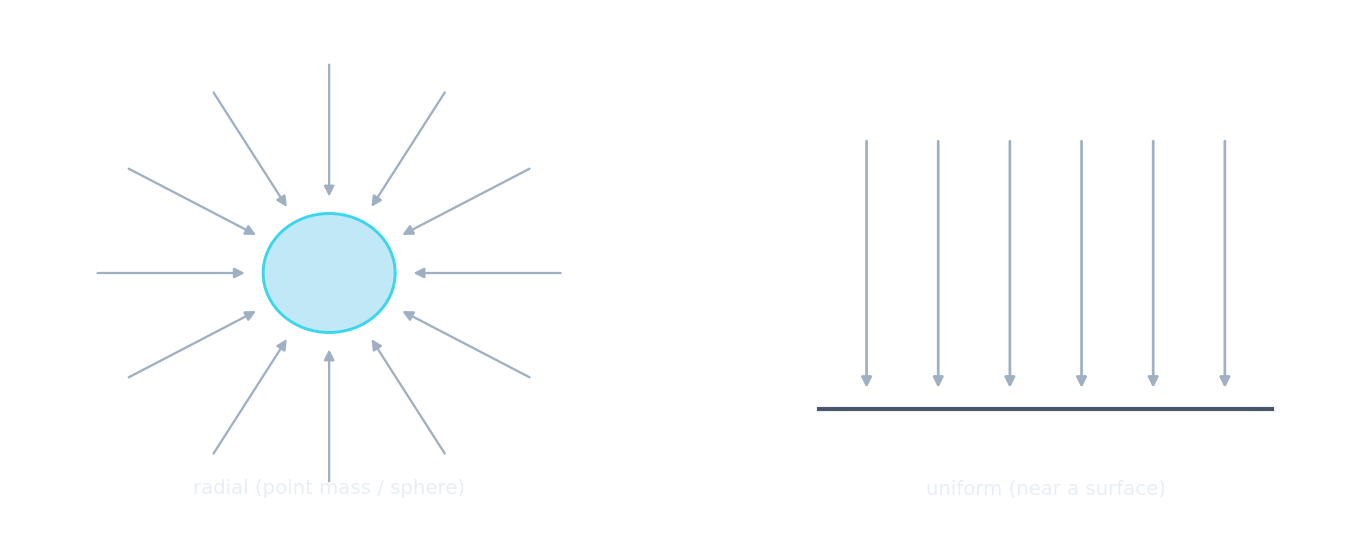
Around a sphere (seen from outside), the gravitational field lines are:
Difficulty 1/5 · 100 coins + a small bonus on first completion today
Gravity always attracts, so the lines point inward toward the centre, like a point mass.
Field lines drawn closer together represent a ____ field.
Difficulty 1/5 · 100 coins + a small bonus on first completion today
Line spacing shows strength — closer lines mean a stronger field.
Deriving $g$ for a point mass
- Put a test mass 检验质量 $m$ at distance $x$ from a mass $M$. The force on it is $F = \dfrac{GMm}{x^{2}}$.
- Field strength is force per unit mass: $g = \dfrac{F}{m} = \dfrac{GM}{x^{2}}$.
- The test mass cancels — the field belongs to $M$ alone — and $g$ points towards $M$. Name $G$ as the gravitational constant when the question asks you to identify symbols.
For a satellite 300 km above the Earth, the r in $GM/r^2$ is 300 km.
Difficulty 1/5 · 100 coins + a small bonus on first completion today
r is measured from the CENTRE, so add the Earth's radius: about 6670 km. Using the height alone is the standard error and gives a field strength hundreds of times too large.
Worked example: two points, two spheres
(a) P is at distance $x$ from a point mass; Q is at $\dfrac{x}{2}$ on the opposite side. Compare the fields. (b) Two identical uniform spheres of radius $R$ have their centres a distance $L$ apart. Sketch $g$ along the line between them.
- (a) Size: $g \propto \dfrac{1}{x^{2}}$, so halving the distance gives four times the field strength at Q.
- (a) Direction: both fields point towards the mass, and the points are on opposite sides, so the two fields are in opposite directions.
- (b) Ends: at the surface of each sphere the field is the surface value $g_{0}$, pointing into that sphere — so the graph runs from $-g_{0}$ at $x = R$ to $+g_{0}$ at $x = L - R$.
- (b) Middle: the two pulls are equal and opposite at $x = \dfrac{L}{2}$, so the curve passes through zero there.
- (b) Shape: each field falls as $\dfrac{1}{r^{2}}$, so the curve is steep near each surface and shallow in the middle.
- Check: field strength is a vector — between two masses you subtract, and a point of zero field always exists somewhere between them.
The gravitational field strength at distance $x$ from a point mass is $g$. What is the field strength, as a multiple of $g$, at distance $\dfrac{x}{2}$?
Difficulty 2/5 · 140 coins + a small bonus on first completion today
$g \propto \dfrac{1}{x^{2}}$: halving the distance multiplies the field strength by $2^{2} = 4$.
A planet has mass 6.0e24 kg and radius 6.4e6 m. What is the field strength at its surface, in N/kg? (G = 6.67e-11)
Difficulty 2/5 · 140 coins + a small bonus on first completion today
g = GM/r^2 = 6.67e-11 x 6.0e24 / (6.4e6)^2 = 9.8 N/kg, which is why that number is familiar. Square the radius, not just the mantissa.
Field strength is force per unit mass, in $\dfrac{\text{N}}{\text{kg}}$ — writing "the force on a mass" loses the definition mark. Its direction is towards the mass producing it. And a field is only "uniform" near a surface because the region considered is tiny compared with the planet's radius; over any real distance it weakens as $\dfrac{1}{r^{2}}$.
Adding two fields
- Fields are vectors, so at a point between two masses the resultant is the difference of the two pulls.
- The neutral point, where they cancel, lies closer to the smaller mass — its weaker pull needs a shorter distance to match.
- On the far side of either mass the two fields add.
Two identical spheres are a distance apart. Which statements about the gravitational field on the line between them are true? Select all that apply.
Difficulty 2/5 · 140 coins + a small bonus on first completion today
Each sphere pulls towards itself, so between them the fields oppose and cancel at the midpoint; each field grows as $\dfrac{1}{r^{2}}$ towards its own surface.
You've got it
- gravitational field strength $g = \dfrac{F}{m}$ (force per unit mass, a vector toward the mass)
- $\dfrac{\text{N}}{\text{kg}} = \dfrac{\text{m}}{\text{s}^2}$ — $g$ is the free-fall acceleration; for a point mass $g = \dfrac{GM}{x^{2}}$
- field lines: radial for a sphere, uniform near a surface; between two masses the fields subtract and cancel at a neutral point