Tidak seorang pun pernah melihat bagian dalam atom. Ukurannya terlalu kecil — satu atom sekitar satu juta kali lebih tipis dari rambut manusia. Dan yet kita tahu persis bagaimana…
English narration · English + 中文 subtitles burned in · Narasi bahasa Inggris · Subtitle bahasa Inggris + 中文 disematkan langsung
1.1
What an atom is made of · Apa yang membentuk sebuah atom
Syllabus · Silabus
English
understand that atoms are mostly empty space surrounding a very small, dense nucleus that contains protons and neutrons; electrons are found in shells in the empty space around the nucleus
identify and describe protons, neutrons and electrons in terms of their relative charges and relative masses
understand the terms atomic and proton number; mass and nucleon number
describe the distribution of mass and charge within an atom
describe the behaviour of beams of protons, neutrons and electrons moving at the same velocity in an electric field
determine the numbers of protons, neutrons and electrons present in both atoms and ions given atomic or proton number, mass or nucleon number and charge
state and explain qualitatively the variations in atomic radius and ionic radius across a period and down a group
Bahasa Indonesia
pahami bahwa atom sebagian besar merupakan ruang hampa di sekitar inti yang sangat kecil dan padat yang mengandung proton dan neutron; elektron ditemukan pada kulit di ruang hampa di sekitar inti
identifikasi dan deskripsikan proton, neutron, dan elektron berdasarkan muatan relatif dan massa relatifnya
pahami istilah nomor atom dan nomor proton; massa dan nomor nukleon
deskripsikan distribusi massa dan muatan di dalam atom
deskripsikan perilaku berkas proton, neutron, dan elektron yang bergerak dengan kecepatan sama dalam medan listrik
tentukan jumlah proton, neutron, dan elektron yang terdapat dalam atom dan ion berdasarkan nomor atom atau nomor proton, massa atau nomor nukleon, serta muatan
nyatakan dan jelaskan secara kualitatif variasi jari-jari atom dan jari-jari ion melintasi periode dan menurun sepanjang golongan
Source: Cambridge International syllabus · Sumber: Silabus Cambridge International
English
Everything is made of atoms 原子. An atom is mostly empty space. At its centre is a tiny, heavy nucleus 原子核. The nucleus holds two kinds of particle: protons 质子 and neutrons 中子. Around the nucleus, in the empty space, move the electrons 电子. The electrons stay in shells 壳层 — layers at set distances from the nucleus.
The nucleus is very small but holds almost all the mass. The electrons take up almost all the space but have almost no mass.
Relative charge and relative mass
We compare the three particles using relative charge 相对电荷 and relative mass 相对质量. These are simple numbers, not real units.
Particle
Relative charge
Relative mass
proton
$+1$
$1$
neutron
$0$
$1$
electron
$-1$
$\tfrac{1}{1836}$ (about $0$)
A proton and a neutron have almost the same mass. An electron is about 1836 times lighter. The proton is positive, the electron is negative, and the neutron has no charge — it is neutral 中性.
Proton number and nucleon number
Two numbers describe the nucleus:
the proton number 质子数 (also called the atomic number 原子序数), symbol $Z$ — the number of protons.
the nucleon number 核子数 (also called the mass number 质量数), symbol $A$ — the total number of protons and neutrons. Protons and neutrons are both nucleons 核子.
So the number of neutrons is $A - Z$.
Counting particles in an atom or ion
For a neutral atom, the number of electrons equals the number of protons, which equals $Z$.
An ion 离子 is an atom that has lost or gained electrons, so it has a charge:
a positive ion has fewer electrons than protons.
a negative ion has more electrons than protons.
Example: $^{27}_{13}\text{Al}^{3+}$ has $13$ protons, $27 - 13 = 14$ neutrons, and $13 - 3 = 10$ electrons (it lost 3 electrons to become $3+$).
How mass and charge are spread out
Almost all the mass sits in the nucleus, because protons and neutrons are heavy and electrons are very light. All the positive charge is in the nucleus (the protons). The negative charge is spread out in the shells (the electrons).
Beams of particles in an electric field
Imagine beams of protons, neutrons and electrons moving at the same speed into an electric field 电场 between two charged plates:
the proton beam bends towards the negative plate (protons are positive).
the electron beam bends the other way, towards the positive plate. It bends much more, because the electron is far lighter — the same force gives a bigger deflection 偏转 to a smaller mass.
the neutron beam goes straight through. It has no charge, so the field gives it no force.
Atomic radius and ionic radius
The atomic radius 原子半径 is the size of an atom. The ionic radius 离子半径 is the size of an ion.
Across a period 周期 (left to right), the atomic radius gets smaller. The nuclear charge 核电荷 (the pull from the protons) rises, but the electrons go into the same outer shell, so the shielding 屏蔽 by inner shells stays about the same. The stronger pull draws the outer shell inwards.
Down a group 族 (top to bottom), the atomic radius gets larger. Each step down adds a new shell, so the outer electrons are further out and feel more shielding from the nucleus.
For ions:
a positive ion (cation 阳离子) is smaller than its atom. It has lost its outer shell, and the electrons that remain feel a stronger pull each.
a negative ion (anion 阴离子) is larger than its atom. It has gained electrons, so there is more repulsion 排斥 between the electrons.
among ions that have the same number of electrons, the one with more protons is smaller.
Bahasa Indonesia
Mikroskop pemindai tunneling dapat menggambar atom individual.
Semuanya terbuat dari atom. Atom sebagian besar adalah ruang hampa. Di pusatnya terdapat inti yang kecil dan berat. Inti memegang dua jenis partikel: proton dan neutron. Di sekitar inti, di ruang hampa, bergeraklah elektron. Elektron berada dalam kulit elektron — lapisan pada jarak tertentu dari inti.
Inti sangat kecil namun menyimpan hampir seluruh massa. Elektron menempati hampir seluruh ruang namun memiliki hampir nol massa.
Atom sebagian besar adalah ruang hampa: proton dan neutron berada di inti kecil pusat, sementara elektron bergerak dalam kulit di sekitarnya
Muatan relatif dan massa relatif
Kita membandingkan ketiga partikel menggunakan muatan relatif dan massa relatif. Ini adalah angka sederhana, bukan satuan nyata.
Partikel
Muatan relatif
Massa relatif
proton
$+1$
$1$
neutron
$0$
$1$
elektron
$-1$
$\tfrac{1}{1836}$ (sekitar $0$)
Proton dan neutron memiliki massa yang hampir sama. Elektron sekitar 1836 kali lebih ringan. Proton bermuatan positif, elektron bermuatan negatif, dan neutron tidak bermuatan — ia netral.
Nomor proton dan nomor nukleon
Dua angka menggambarkan inti:
nomor proton (juga disebut nomor atom), simbol $Z$ — jumlah proton.
nomor nukleon (juga disebut nomor massa), simbol $A$ — total jumlah proton dan neutron. Proton dan neutron keduanya adalah nukleon.
Jadi jumlah neutron adalah $A - Z$.
Menghitung partikel dalam atom atau ion
Untuk atom netral, jumlah elektron sama dengan jumlah proton, yaitu $Z$.
Sebuah ion adalah atom yang telah kehilangan atau mendapatkan elektron, sehingga memiliki muatan:
ion positif memiliki lebih sedikit elektron daripada proton.
ion negatif memiliki lebih banyak elektron daripada proton.
Contoh: $^{27}_{13}\text{Al}^{3+}$ memiliki $13$ proton, $27 - 13 = 14$ neutron, dan $13 - 3 = 10$ elektron (ia kehilangan 3 elektron untuk menjadi $3+$).
Bagaimana massa dan muatan tersebar
Hampir seluruh massa berada di inti, karena proton dan neutron berat sedangkan elektron sangat ringan. Semua muatan positif berada di inti (proton). Muatan negatif tersebar di kulit (elektron).
Sinar partikel dalam medan listrik
Bayangkan sinar proton, neutron, dan elektron bergerak dengan kecepatan sama memasuki medan listrik antara dua pelat bermuatan:
sinar proton membengkok menuju pelat negatif (proton bermuatan positif).
sinar elektron membengkok ke arah sebaliknya, menuju pelat positif. Ia membengkok jauh lebih tajam, karena elektron jauh lebih ringan — gaya yang sama memberikan pembelokan yang lebih besar pada massa yang lebih kecil.
sinar neutron melaju lurus. Ia tidak bermuatan, sehingga medan tidak memberikan gaya apa pun padanya.
Dalam medan listrik proton membengkok menuju pelat $-$ dan elektron membengkok ke arah berlawanan dan jauh lebih tajam (karena jauh lebih ringan); neutron melaju lurus
Jari-jari atom dan jari-jari ion
Jari-jari atom adalah ukuran atom. Jari-jari ion adalah ukuran ion.
Sepanjang satu periode (kiri ke kanan), jari-jari atom menjadi lebih kecil. Muatan inti (tarikan dari proton) meningkat, namun elektron masuk ke kulit luar yang sama, sehingga perlindungan oleh kulit dalam tetap kira-kira sama. Tarikan yang lebih kuat menarik kulit luar ke dalam.
Turut golongan (atas ke bawah), jejari atom menjadi lebih besar. Setiap langkah turun menambah satu kulit baharu, jadi elektron terluar berada lebih jauh dan mengalami lebih banyak penyahjaran daripada nukleus.
Merentasi satu tempoh atom mengecil (tarikan nukleus yang lebih kuat pada kulit luar yang sama); turun sepanjang satu golongan mereka membesar (setiap langkah menambah satu kulit)
Bagi ion:
ion positif (kation) adalah lebih kecil daripada atomnya. Ia telah kehilangan kulit luarnya, dan elektron yang tinggal masing-masing merasakan tarikan yang lebih kuat.
ion negatif (anion) adalah lebih besar daripada atomnya. Ia telah mendapat elektron, jadi terdapat lebih banyak tolakan antara elektron-elektron tersebut.
di antara ion yang mempunyai bilangan elektron yang sama, ion yang mempunyai lebih banyak proton adalah lebih kecil.
Explore · Jelajahi
Explore the atom · Jelajahi atom
Tap each part. A tiny dense nucleus of protons and neutrons holds the mass; light electrons orbit it in shells. · Ketuk setiap bagian. Nukleus kecil yang padat berisi proton dan neutron memegang massa; elektron ringan mengelilinginya dalam kulit.
Explore · Jelajahi
Atomic and ionic radius trends · Tren jari-jari atom dan ion
Atomic radius falls across a period (rising nuclear charge pulls the same shell in) and rises down a group (an extra shell each time). Step across Period 3 to see it. · Jari-jari atom menurun sepanjang periode (karena muatan inti yang meningkat menarik kulit yang sama ke dalam) dan meningkat turun dalam golongan (menambah satu kulit setiap kali). Lompat ke Period 3 untuk melihatnya.
define the term isotope in terms of numbers of protons and neutrons
understand the notation $_y^x\text{A}$ for isotopes, where $x$ is the mass or nucleon number and $y$ is the atomic or proton number
state that and explain why isotopes of the same element have the same chemical properties
state that and explain why isotopes of the same element have different physical properties, limited to mass and density
Bahasa Indonesia
definisikan istilah isotop berdasarkan jumlah proton dan neutron
pahami notasi $_y^x\text{A}$ untuk isotop, di mana $x$ adalah massa atau nomor nukleon dan $y$ adalah nomor atom atau nomor proton
nyatakan dan jelaskan mengapa isotop dari unsur yang sama memiliki sifat kimia yang sama
nyatakan dan jelaskan mengapa isotop dari unsur yang sama memiliki sifat fisika yang berbeda, terbatas pada massa dan densitas
Source: Cambridge International syllabus · Sumber: Silabus Cambridge International
English
Isotopes 同位素 are atoms of the same element with the same number of protons but a different number of neutrons. So isotopes have the same proton number $Z$ but a different nucleon number $A$.
We write an isotope as $^{A}_{Z}\text{X}$: the nucleon number $A$ on top, the proton number $Z$ below. For example, chlorine has two main isotopes, $^{35}_{17}\text{Cl}$ and $^{37}_{17}\text{Cl}$.
Same chemical properties
Chemical properties 化学性质 depend on the electrons, especially the outer electrons. Isotopes of one element have the same number of electrons arranged in the same way. So they react in exactly the same way — they have the same chemical properties.
Different physical properties
Some physical properties 物理性质 depend on mass, so they differ between isotopes. A heavier isotope has more neutrons, so more mass, and therefore a higher density 密度. (The syllabus limits this difference to mass and density.)
Bahasa Indonesia
Isotop ialah atom bagi unsur yang sama dengan bilangan proton yang sama tetapi bilangan neutron yang berbeza. Jadi isotop mempunyai nombor proton yang sama $Z$ tetapi nombor nukleon yang berbeza $A$.
Dua isotop klorin: proton sama, neutron berbeda
Kita menulis isotop sebagai $^{A}_{Z}\text{X}$: nomor nukleon $A$ di atas, nomor proton $Z$ di bawah. Sebagai contoh, klorin memiliki dua isotop utama, yaitu $^{35}_{17}\text{Cl}$ dan $^{37}_{17}\text{Cl}$.
Sifat kimia yang sama
Sifat kimia bergantung kepada elektron, terutamanya elektron terluar. Isotop bagi satu unsur mempunyai bilangan elektron yang sama yang tersusun dengan cara yang sama. Oleh itu, mereka bereaksi dengan cara yang sama sekali — mereka mempunyai sifat kimia yang sama.
Sifat fizikal yang berbeza
Beberapa sifat fizikal bergantung kepada jisim, jadi ia berbeza antara isotop. Isotop yang lebih berat mempunyai lebih banyak neutron, jadi lebih banyak jisim, dan oleh itu ketumpatan yang lebih tinggi. (Syllabus membataskan perbezaan ini kepada jisim dan ketumpatan.)
Explore · Jelajahi
Isotope lab · Laboratorium isotop
Classify isotope facts by what changes and what stays the same. · Klasifikasikan fakta tentang isotop berdasarkan apa yang berubah dan apa yang tetap sama.
Electrons, energy levels and orbitals · Elektron, tahap tenaga dan orbital
Syllabus · Silabus
English
understand the terms: shells, sub-shells and orbitals; principal quantum number (n); ground state, limited to electronic configuration
describe the number of orbitals making up s, p and d sub-shells, and the number of electrons that can fill s, p and d sub-shells
describe the order of increasing energy of the sub-shells within the first three shells and the 4s and 4p sub-shells
describe the electronic configurations to include the number of electrons in each shell, sub-shell and orbital
explain the electronic configurations in terms of energy of the electrons and inter-electron repulsion
determine the electronic configuration of atoms and ions given the atomic or proton number and charge, using either of the following conventions: e.g. for Fe: $1\text{s}^2 2\text{s}^2 2\text{p}^6 3\text{s}^2 3\text{p}^6 3\text{d}^6 4\text{s}^2$ (full electronic configuration) or [Ar] $3\text{d}^6 4\text{s}^2$ (shorthand electronic configuration)
understand and use the electrons in boxes notation
describe and sketch the shapes of s and p orbitals
describe a free radical as a species with one or more unpaired electrons
Bahasa Indonesia
pahami istilah: kulit elektron, subkulit dan orbital; bilangan kuantum utama (n); keadaan dasar, dibatasi pada konfigurasi elektron
jelaskan jumlah orbital yang membentuk subkulit s, p dan d, serta jumlah elektron yang dapat mengisi subkulit s, p dan d
jelaskan urutan kenaikan energi subkulit dalam tiga kulit pertama dan subkulit 4s dan 4p
jelaskan konfigurasi elektron yang mencakup jumlah elektron di setiap kulit, subkulit, dan orbital
jelaskan konfigurasi elektron berdasarkan energi elektron dan tolakan antar-elektron
tentukan konfigurasi elektron atom dan ion dengan menggunakan nomor atom atau nomor proton dan muatan, melalui salah satu konvensi berikut: mis. untuk Fe: $1\text{s}^2 2\text{s}^2 2\text{p}^6 3\text{s}^2 3\text{p}^6 3\text{d}^6 4\text{s}^2$ (konfigurasi elektron lengkap) atau [Ar] $3\text{d}^6 4\text{s}^2$ (konfigurasi elektron ringkas)
pahami dan gunakan notasi elektron dalam kotak
deskripsikan dan gambarlah bentuk orbital s dan p
deskripsikan radikal bebas sebagai spesies dengan satu atau lebih elektron tak berpasangan
Source: Cambridge International syllabus · Sumber: Silabus Cambridge International
English
Electrons are arranged in shells, sub-shells and orbitals.
Shells and the principal quantum number
Each shell is labelled by the principal quantum number 主量子数$n = 1, 2, 3, \dots$ A larger $n$ means a shell that is further from the nucleus and higher in energy.
Sub-shells and orbitals
Each shell is split into sub-shells 亚层, named s, p and d. Each sub-shell is built from orbitals 轨道. An orbital is a small region that can hold up to two electrons.
Sub-shell
Number of orbitals
Maximum electrons
s
1
2
p
3
6
d
5
10
So an s sub-shell holds 2 electrons, a p sub-shell holds 6, and a d sub-shell holds 10.
Order of increasing energy
Electrons fill the lowest-energy sub-shell first. For the first three shells, plus 4s and 4p, the order of rising energy is:
You can write a shorthand using the nearest noble gas 稀有气体 in square brackets:
$$[\text{Ar}]\,3\text{d}^6\,4\text{s}^2$$
Here $[\text{Ar}]$ stands for the full configuration of argon.
For ions, you add or remove electrons. One key rule: when a transition metal forms a positive ion, it loses its 4s electrons before its 3d electrons. So $\text{Fe}^{3+}$ is $[\text{Ar}]\,3\text{d}^5$.
Electrons in boxes
The electrons in boxes notation draws each orbital as a box and each electron as an arrow. Two electrons in the same orbital must point opposite ways, because each electron has a property called spin 自旋, and a shared orbital needs opposite spins.
Within a sub-shell, electrons fill empty orbitals one at a time, with parallel arrows, before any orbital gets a second electron. Spreading out like this keeps the electrons apart and lowers the repulsion between them.
Why the configuration takes this shape
Electrons fill from low energy to high energy because that gives the most stable (lowest-energy) atom. Within a sub-shell they spread out singly first to reduce the repulsion between the negative electrons.
Shapes of s and p orbitals
an s orbital is a sphere 球形 centred on the nucleus.
a p orbital has two lobes, like a dumbbell, pointing along one axis. The three p orbitals point along three directions at right angles (the $x$, $y$ and $z$ axes).
Free radicals
A free radical 自由基 is a species with one or more unpaired electrons 未成对电子. Free radicals are very reactive.
Bahasa Indonesia
Hidrogen memancarkan cahaya hanya pada panjang gelombang diskrit yang berkarakteristik — spektrum pemancarannya.
Elektron tersusun dalam kulit, subkulit dan orbital.
Kulit dan nombor kuantum utama
Setiap kulit diberi label oleh nombor kuantum utama$n = 1, 2, 3, \dots$. Nombor $n$ yang lebih besar bermaksud kulit yang lebih jauh dari nukleus dan mempunyai tenaga yang lebih tinggi.
Subkulit dan orbital
Setiap kulit dibahagikan kepada subkulit, dinamakan s, p dan d. Setiap subkulit terdiri daripada orbital. Orbital ialah kawasan kecil yang boleh menampung sehingga dua elektron.
Subkulit
Bilangan orbital
Maksimum elektron
s
1
2
p
3
6
d
5
10
Jadi subkulit s menampung 2 elektron, subkulit p menampung 6, dan subkulit d menampung 10.
Urutan tenaga meningkat
Elektron mengisi subkulit berenergi rendah terlebih dahulu. Untuk tiga kulit pertama, ditambah 4s dan 4p, urutan kenaikan tenaga adalah:
Anda boleh menulis singkatan menggunakan gas mulia terdekat dalam kurungan:
$$[\text{Ar}]\,3\text{d}^6\,4\text{s}^2$$
Di sini $[\text{Ar}]$ mewakili konfigurasi penuh argon.
Bagi ion, anda menambah atau menolak elektron. Satu peraturan penting: apabila logam peralihan membentuk ion positif, ia kehilangan elektron 4snya sebelum elektron 3d-nya. Jadi $\text{Fe}^{3+}$ menjadi $[\text{Ar}]\,3\text{d}^5$.
Elektron dalam kotak
Notasi elektron dalam kotak menggambarkan setiap orbital sebagai kotak dan setiap elektron sebagai anak panah. Dua elektron dalam orbital yang sama mesti mengarah ke arah bertentangan, kerana setiap elektron mempunyai sifat yang dipanggil spin, dan orbital bersama memerlukan spin yang bertentangan.
Dalam satu subkulit, elektron mengisi orbital kosong satu demi satu, dengan anak panah selari, sebelum mana-mana orbital mendapat elektron kedua. Menyebarkan diri seperti ini menjauhkan elektron dan menurunkan tolakan di antara mereka.
Elektron dalam kotak untuk nitrogen ($1\text{s}^2\,2\text{s}^2\,2\text{p}^3$): elektron berpasangan mengarah ke arah bertentangan, dan orbital 2p diisi secara tunggal dengan spin selari
Mengapa konfigurasi mengambil bentuk ini
Elektron mengisi dari tenaga rendah ke tenaga tinggi kerana itu memberikan atom yang paling stabil (tenaga terendah). Dalam satu subkulit, mereka menyebar secara tunggal terlebih dahulu untuk mengurangkan tolakan antara elektron negatif.
Bentuk orbital s dan p
orbital s ialah sfera yang berpusat pada nukleus.
orbital p mempunyai dua lobus, seperti dumbel, menghala sepanjang satu paksi. Tiga orbital p menghala sepanjang tiga arah bersudut tegak (paksi $x$, $y$ dan $z$).
Orbital s ialah sfera; setiap orbital p adalah dumbel, dan tiga orbital p menghala sepanjang paksi $x$, $y$ dan $z$
Radikal bebas
Radikal bebas ialah spesies yang mempunyai satu atau lebih elektron tidak berpasangan. Radikal bebas sangat reaktif.
Explore · Jelajahi
Filling the electron shells · Mengisi kulit elektron
Change the atomic number Z and watch the electrons fill the shells (2, 8, 8, …) — the pattern that builds the Periodic Table. · Ubah nomor atom Z dan saksikan elektron mengisi kulit (2, 8, 8, …) — pola yang membangun Tabel Periodik.
define and use the term first ionisation energy, IE
construct equations to represent first, second and subsequent ionisation energies
identify and explain the trends in ionisation energies across a period and down a group of the Periodic Table
identify and explain the variation in successive ionisation energies of an element
understand that ionisation energies are due to the attraction between the nucleus and the outer electron
explain the factors influencing the ionisation energies of elements in terms of nuclear charge, atomic/ionic radius, shielding by inner shells and sub-shells and spin-pair repulsion
deduce the electronic configurations of elements using successive ionisation energy data
deduce the position of an element in the Periodic Table using successive ionisation energy data
Bahasa Indonesia
definisikan dan gunakan istilah energi ionisasi pertama, IE
susun persamaan untuk mewakili energi ionisasi pertama, kedua, dan berikutnya
identifikasi dan jelaskan tren dalam energi ionisasi melintasi satu periode dan ke bawah satu golongan dalam Tabel Periodik
identifikasi dan jelaskan variasi energi ionisasi berturut-turut dari suatu unsur
pahami bahwa energi ionisasi disebabkan oleh tarik-menarik antara inti dan elektron terluar
jelaskan faktor-faktor yang memengaruhi energi ionisasi unsur-unsur dalam hal muatan inti, jari-jari atom/ion, perisai oleh kulit dan subkulit dalam, serta tolakan pasangan spin
deduksikan konfigurasi elektron unsur menggunakan data energi ionisasi berturut-turut
deduksikan posisi unsur dalam Tabel Periodik menggunakan data energi ionisasi berturut-turut
Source: Cambridge International syllabus · Sumber: Silabus Cambridge International
English
First ionisation energy
The first ionisation energy 第一电离能 (IE) is the energy needed to remove one electron from each atom in one mole of gaseous atoms, forming one mole of gaseous $+1$ ions.
We use gaseous atoms so there are no forces between the particles. The unit is $\text{kJ mol}^{-1}$. As an equation, for an element X:
You can keep going. These are the successive ionisation energies 逐级电离能. Each is larger than the one before, because every electron is pulled away from a more positive ion.
What ionisation energy depends on
Ionisation energy comes from the attraction between the positive nucleus and the outer electron. Three main factors set how strong that attraction is:
nuclear charge: more protons pull the electrons more strongly, so the ionisation energy is higher.
atomic radius: the further the outer electron sits from the nucleus, the weaker the pull, so the ionisation energy is lower.
shielding: inner shells block some of the pull on the outer electron. More inner shells mean more shielding and a lower ionisation energy.
There is a smaller effect too — spin-pair repulsion 自旋成对排斥. When two electrons share one orbital, they push each other a little, so one is easier to remove.
Trends in first ionisation energy
Across a period, the first ionisation energy generally rises. The nuclear charge grows while shielding stays about the same, so the outer electrons are held more tightly.
Down a group, the first ionisation energy falls. Lower elements have more shells, so more shielding and a larger radius, and the outer electron is easier to remove.
The dips are evidence for sub-shells
The rise across a period is not smooth. Two small dips appear, and you should be able to explain both:
Group 2 to Group 13 (for example Mg to Al): the electron removed from Al comes from a 3p sub-shell, which is higher in energy than the full 3s sub-shell in Mg. A 3p electron is easier to remove, so the value dips.
Group 15 to Group 16 (for example P to S): in S, one 3p orbital now holds a pair of electrons. Spin-pair repulsion makes one of them easier to remove, so the value dips.
These dips are evidence that sub-shells exist.
Successive ionisation energies are evidence for shells
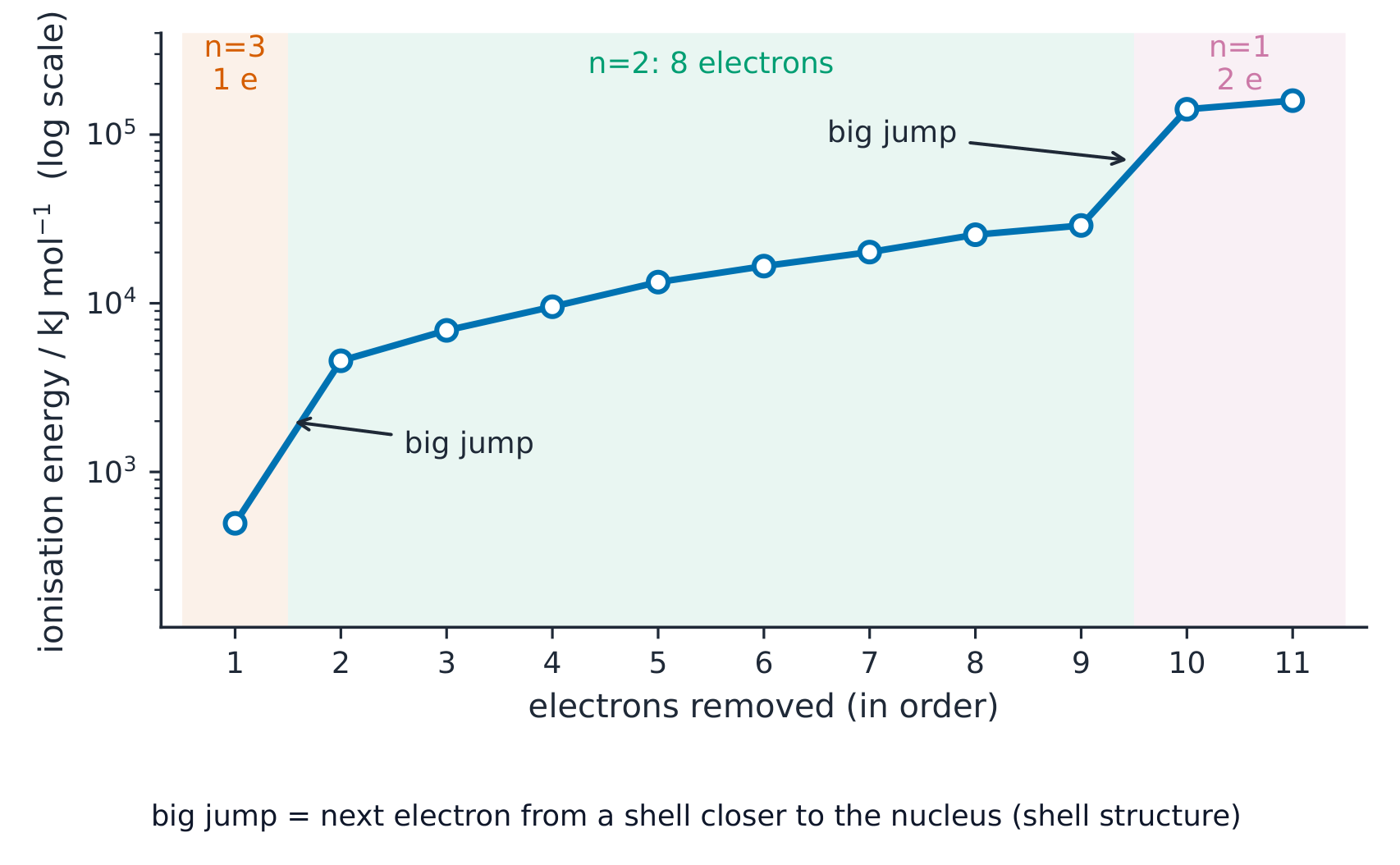
If you plot the successive ionisation energies of one element, the values rise, with big jumps at certain points. A big jump happens when the next electron must come from a shell closer to the nucleus.
Count how many electrons come off easily before the first big jump — that is the number of electrons in the outer shell, which tells you the group the element is in. You can also use the pattern to work out the electronic configuration and the position of the element in the Periodic Table.
Electrons removed before the first big jump
Group
1
Group 1
2
Group 2
3
Group 13
Worked example. The first five successive ionisation energies of an element are $590$, $1150$, $4940$, $6480$ and $8120\ \text{kJ}\,\text{mol}^{-1}$. Which group is it in? Look for the big jump, not the biggest number. From the 1st to the 2nd the value roughly doubles, which is a normal rise. From the 2nd ($1150$) to the 3rd ($4940$) it more than quadruples: that is the jump. So two electrons come off easily before it, the outer shell holds 2 electrons, and the element is in Group 2. Count the electrons removed before the jump, and explain the jump properly: the next electron is being pulled from a shell closer to the nucleus, not from a different element.
Bahasa Indonesia
Tenaga pengionan pertama
Tenaga pengionan pertama (IE) ialah tenaga yang diperlukan untuk menyingkirkan satu elektron daripada setiap atom dalam satu mol atom gas, membentuk satu mol ion gas $+1$.
Kami menggunakan atom gas sehingga tidak ada gaya antar partikel. Satuannya adalah $\text{kJ mol}^{-1}$. Sebagai persamaan, untuk unsur X:
Anda bisa terus melanjutkan. Ini disebut energi ionisasi berturut-turut. Masing-masing nilainya lebih besar dari sebelumnya, karena setiap elektron ditarik menjauh dari ion yang semakin positif.
Faktor-faktor yang mempengaruhi energi ionisasi
Energi ionisasi berasal dari tarikan antara inti positif dan elektron terluar. Tiga faktor utama menentukan seberapa kuat tarikan tersebut:
muatan inti: semakin banyak proton, tarikan terhadap elektron semakin kuat, sehingga energi ionisasi lebih tinggi.
jari-jari atom: semakin jauh posisi elektron terluar dari inti, tarikan semakin lemah, sehingga energi ionisasi lebih rendah.
pelindung (shielding): kulit dalam memblokir sebagian tarikan pada elektron terluar. Semakin banyak kulit dalam, semakin besar efek pelindung dan semakin rendah energi ionisasinya.
Terdapat juga efek yang lebih kecil—tolakan pasangan spin. Ketika dua elektron menempati satu orbital, mereka saling mendorong sedikit, sehingga salah satunya lebih mudah dilepaskan.
Tren energi ionisasi pertama
Menyusuri suatu periode, energi ionisasi pertama umumnya naik. Muatan inti bertambah sementara efek pelindung tetap hampir sama, sehingga elektron terluar terikat lebih kuat.
Menurun dalam suatu golongan, energi ionisasi pertama turun. Unsur yang lebih bawah memiliki lebih banyak kulit, sehingga efek pelindung lebih besar dan jari-jari lebih lebar, membuat elektron terluar lebih mudah dilepaskan.
Lengkungan turun sebagai bukti subkulit
Kenaikan menyusuri periode tidak mulus. Dua lengkungan kecil muncul, dan Anda harus mampu menjelaskan keduanya:
Golongan 2 ke Golongan 13 (contoh Mg ke Al): elektron yang dilepas dari Al berasal dari subkulit 3p, yang energinya lebih tinggi daripada subkulit 3s penuh di Mg. Elektron 3p lebih mudah dilepas, sehingga nilainya menurun.
Golongan 15 ke Golongan 16 (contoh P ke S): di S, sebuah orbital 3p kini berisi pasangan elektron. Tolakan pasangan spin membuat salah satu elektronnya lebih mudah dilepas, sehingga nilainya menurun.
Lengkungan turun ini merupakan bukti bahwa subkulit itu ada.
Energi ionisasi pertama meningkat sepanjang Periode 3 namun turun di Al dan S — bukti adanya subkulit
Energi ionisasi berturut-turut sebagai bukti kulit
Jika Anda memplot energi ionisasi berturut-turut dari satu unsur, nilainya akan naik dengan loncatan besar pada titik tertentu. Loncatan besar terjadi ketika elektron berikutnya harus diambil dari kulit yang lebih dekat dengan inti.
Hitung berapa banyak elektron yang terlepas dengan mudah sebelum loncatan besar pertama—itu adalah jumlah elektron di kulit terluar, yang memberi tahu Anda golongan unsur tersebut. Anda juga dapat menggunakan pola ini untuk menentukan konfigurasi elektron dan posisi unsur dalam Tabel Periodik.
Energi ionisasi berturut-turut natrium (skala log): loncatan besar mengungkap struktur $2,8,1$ kulit
Elektron dilepas sebelum loncatan besar
Golongan
1
Golongan 1
2
Golongan 2
3
Golongan 13
Contoh dikerjakan. Lima energi ionisasi berturut-turut dari suatu unsur adalah $590$, $1150$, $4940$, $6480$, dan $8120\ \text{kJ}\,\text{mol}^{-1}$. Unsur ini berada di golongan mana? Cari lonjakan besar, bukan angka terbesar. Dari ke-1 ke ke-2 nilainya kira-kira berlipat ganda, yang merupakan kenaikan normal. Dari yang ke-2 ($1150$) ke ke-3 ($4940$) nilainya lebih dari empat kali lipat: itulah lonjakannya. Jadi dua elektron keluar dengan mudah sebelumnya, kulit luar memegang 2 elektron, dan unsur tersebut berada di Golongan 2. Hitung elektron yang dilepas sebelum lonjakan, dan jelaskan lonjakan tersebut dengan benar: elektron berikutnya ditarik dari kulit yang lebih dekat ke inti, bukan dari unsur yang berbeda.
Explore · Jelajahi
The ionisation-energy trend — and its dips · Tren energi ionisasi — dan lembahnya
First ionisation energy generally rises across a period, but DIPS where a new p sub-shell starts and where a p-orbital pair first forms. Step across to find the two tell-tale dips. · Energi ionisasi pertama umumnya meningkat melintasi periode, tetapi LEMBAH terjadi ketika subkulit p baru dimulai dan ketika pasangan orbital p pertama kali terbentuk. Beralihlah untuk menemukan dua tanda khas tersebut.
Define isotopes in full: atoms of the same element with the same number of protons but a different number of neutrons — the mark scheme wants both halves.
4s fills before 3d, but electrons are removed from 4s first when forming ions, so $\text{Fe}^{3+}$ is $[\text{Ar}]3\text{d}^5$ (not $[\text{Ar}]3\text{d}^3 4\text{s}^2$).
In successive ionisation energies, a big jump marks the start of a new (inner) shell — use the jumps to place the element in its group.
Explain every ionisation-energy trend with the same three factors: nuclear charge, distance and shielding, plus sub-shell effects for the small dips.
Learn the exact reason first ionisation energy of oxygen is below nitrogen: oxygen's paired 2p electrons repel, so one is easier to remove.
Bahasa Indonesia
Definisikan isotop secara lengkap: atom dari unsur yang sama dengan jumlah proton yang sama tetapi jumlah neutron yang berbeda—kunci jawaban memerlukan kedua bagian tersebut.
4s terisi sebelum 3d, tetapi elektron dilepas dari 4s terlebih dahulu saat membentuk ion, sehingga $\text{Fe}^{3+}$ adalah $[\text{Ar}]3\text{d}^5$ (bukan $[\text{Ar}]3\text{d}^3 4\text{s}^2$).
Dalam energi ionisasi berturut-turut, loncatan besar menandai dimulunya kulit baru (dalam)—gunakan loncatan tersebut untuk menempatkan unsur dalam golongannya.
Jelaskan setiap tren energi ionisasi dengan tiga faktor yang sama: muatan inti, jarak, dan efek pelindung, ditambah efek subkulit untuk lengkungan kecil.
Hafalkan alasan pasti mengapa energi ionisasi pertama oksigen di bawah nitrogen: elektron 2p yang berpasangan pada oksigen saling tolak, sehingga salah satunya lebih mudah dilepas.
Interactive lessons on this topic · Pelajaran interaktif untuk topik ini
Work through it step by step, with instant-check exercises. · Kerjakan langkah demi langkah, dengan latihan pengecekan instan.
Pick one and the site follows you — notes, papers, videos and practice all open on it. · Pilih satu dan situs mengikuti Anda — catatan, kertas, video, dan latihan semua terbuka di sana.
Type to search notes, lessons, code, vocabulary and past-paper questions across every subject. · Ketik untuk mencari catatan, pelajaran, kode, kosakata, dan pertanyaan soal lama di setiap mata pelajaran.