חשמל מסוגל לבצע דבר מדהים: הוא יכול לפרק תרכובת. מעביר זרם דרך תרכובת ממיסה או מומסת, והיא מתפרקת למרכיביה…
English narration · English + 中文 subtitles burned in · קריאת קול באנגלית · תרגום אנגלי + סינית שרוף בתוך הסרטון
4.1
Electrolysis · אלקטרוליזה
Syllabus · סיילבוס
English
Core
Supplement
1 Define electrolysis as the decomposition of an ionic compound, when molten or in aqueous solution, by the passage of an electric current
8 Describe the transfer of charge during electrolysis to include: (a) the movement of electrons in the external circuit (b) the loss or gain of electrons at the electrodes (c) the movement of ions in the electrolyte
2 Identify in simple electrolytic cells: (a) the anode as the positive electrode (b) the cathode as the negative electrode (c) the electrolyte as the molten or aqueous substance that undergoes electrolysis
3 Identify the products formed at the electrodes and describe the observations made during the electrolysis of: (a) molten lead(II) bromide (b) concentrated aqueous sodium chloride (c) dilute sulfuric acid using inert electrodes made of platinum or carbon/graphite
9 Identify the products formed at the electrodes and describe the observations made during the electrolysis of aqueous copper(II) sulfate using inert carbon/graphite electrodes and when using copper electrodes
4 State that metals or hydrogen are formed at the cathode and that non-metals (other than hydrogen) are formed at the anode
5 Predict the identity of the products at each electrode for the electrolysis of a binary compound in the molten state
10 Predict the identity of the products at each electrode for the electrolysis of a halide compound in dilute or concentrated aqueous solution
11 Construct ionic half-equations for reactions at the anode (to show oxidation) and at the cathode (to show reduction)
6 State that metal objects are electroplated to improve their appearance and resistance to corrosion
7 Describe how metals are electroplated
עברית
ליבה
תוספת
1 הגדר אלקטרוליזה כפירוק של תרכובת יונית, כאשר היא במצב נוזלי או בתמיסה מימית, על ידי מעבר זרם חשמלי
8 תאר העברת מטען במהלך אלקטרוליזה כך שתכלול: (א) תנועת אלקטרונים במעגל החיצוני (ב) איבוד או רכישת אלקטרונים באלקטרודות (ג) תנועת יונים באלקטרוליט
3 זיהוי המוצרים שנוצרו באלקטרודות ותיאור התצפיות שנעשו במהלך אלקטרוליזה של: (א) ברומידית עופרת(II) ממיסה (ב) תמיסת נתרן כלוריד רכוזה (ג) חומצת גופרית דלולה באמצעות אלקטרודות אינרטיים העשויות פלטינה או פחמן/גרפיט
9 זיהוי המוצרים שנוצרו באלקטרודות ותיאור התצפיות שנעשו במהלך אלקטרוליזה של תמיסת נחושת(II) סולפט במים, כאשר משתמשים באלקטרודות פחמן/גרפיט אינרטיות וכאשר משתמשים באלקטרודות נחושת
4 לציין כי מתכות או מימן נוצרים בקתודה וכי אל-מתכות (מעבר למימן) נוצרים באנודה
5 לחזות את זהות המוצרים בכל אלקטרודה עבור אלקטרוליזה של תרכובת בינארית במצב מיסה
10 לחזות את זהות המוצרים בכל אלקטרודה עבור אלקטרוליזה של תרכובת הלוגנית בתמיסה מימית דלולה או רכוזה
11 בניית משוואות מחצית יוניות לתגובות באנודה (כדי להראות חמצון) ובקתודה (כדי להראה הפחתה)
6 לציין כי חפצי מתכת מצופים בחשמל כדי לשפר את מראהם ולהגדיל את עמידותם בפני קורוזיה
7 לחדש כיצד מתכות מצופות בחשמל
Source: Cambridge International syllabus · מקור: הסיילבוס הבינלאומי של קמבריד'ג'
English
Electrolysis: ions discharge at the electrodes
Electrolysis 电解 is the breaking down (decomposition 分解) of an ionic compound 离子化合物 — when it is molten 熔融 or in aqueous 水溶液 solution — by passing an electric current 电流 through it.
It only works when the substance is molten or dissolved, because then the ions 离子 are free to move and carry the charge. A solid ionic compound cannot be electrolysed because its ions are locked in place.
The electrolytic cell
The set-up is called an electrolytic cell 电解池. Two electrodes 电极 (solid conductors) dip into the electrolyte 电解质 — the molten or aqueous substance being broken down.
The anode 阳极 is the positive ($+$) electrode.
The cathode 阴极 is the negative ($-$) electrode.
The electrodes are often inert 惰性 (they do not react), such as platinum 铂 or carbon/graphite 石墨.
What is formed at each electrode
There is a simple rule:
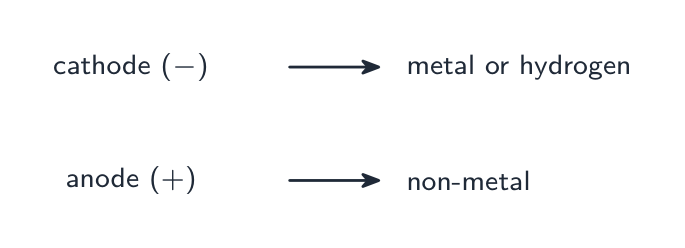
Metals 金属 or hydrogen 氢气 are formed at the cathode.
Non-metals 非金属 (other than hydrogen) are formed at the anode.
For aqueous solutions, the product can depend on whether the solution is dilute 稀 or concentrated 浓. Here are the three Core examples:
Electrolyte
At the cathode ($-$)
At the anode ($+$)
molten lead(II) bromide, $\text{PbBr}_2$
lead 铅 (silvery liquid)
bromine 溴 (red-brown vapour)
concentrated aqueous sodium chloride
hydrogen (bubbles of gas)
chlorine 氯气 (pale green gas)
dilute sulfuric acid 硫酸
hydrogen (bubbles of gas)
oxygen 氧气 (bubbles of gas)
Worked example. Predict the products of electrolysing molten zinc chloride, $\text{ZnCl}_2$. Because it is molten, only zinc ions and chloride ions are present - there is no water to complicate things. Zinc is a metal, so it forms at the cathode: $\text{Zn}^{2+}$ ions gain electrons and silvery zinc appears. Chlorine is a non-metal, so it forms at the anode: pale green chlorine gas bubbles off. Always check the state first. A molten compound simply gives you its own two elements, while an aqueous one brings water into the competition - which is why concentrated sodium chloride solution gives hydrogen at the cathode rather than sodium.
How the charge moves
During electrolysis:
Electrons 电子 move through the wires (the external circuit 外电路) from the power supply.
At the cathode, positive ions gain electrons. Gaining electrons is reduction 还原.
At the anode, negative ions lose electrons. Losing electrons is oxidation 氧化.
Inside the electrolyte, the ions move: positive ions go to the cathode and negative ions go to the anode.
You can write a half-equation 半反应式 for each electrode. For molten lead(II) bromide:
The product at the anode depends on the electrode:
With inert carbon electrodes: copper 铜 forms at the cathode and oxygen forms at the anode. The blue colour of the solution slowly fades as copper is removed.
With copper electrodes: copper forms at the cathode, while the anode itself dissolves into the solution. The blue colour stays the same. This is used to purify copper.
Electroplating
Electroplating 电镀 means covering a metal object with a thin layer of another metal. This improves its appearance and its resistance to corrosion 腐蚀 (rusting and wearing away).
To electroplate an object:
the object to be coated is made the cathode;
the plating metal is made the anode;
the electrolyte is a solution containing ions of the plating metal.
עברית
אלקטרוליזה: יונים משחררים בקטבים
אלקטרוליזה היא פירוק (פירוק כימי) של תרכובת יונית — כאשר היא ממוסחת או בתמיסה מימית — על ידי העברת זרם חשמלי דרכה.
תא אלקטרוליזה מפצל תרכובת באמצעות זרם חשמלי.
התהליך עובד רק כאשר החומר הוא ממוסח או מומס, משום שאז ה-יונים חופשים לנוע ולשאת את המטען. תרכובת יונית מוצקה לא ניתנת לאלקטרוליזה מכיוון שהיונים שלה נעולים במקום.
אלקטרוליזה של מים: בועות גז נוצרות בכל אלקטרודה ואוספות בצינורות למעלה, עם כמות הידרוגן כפולה בקירוב מאוקסיגן
התא האלקטרוליטי
המתקן נקרא תא אלקטרוליטי. שתי אלקטרודות (מוליכים מוצקים) צוללות בתוך האלקטרוליט — החומר הממוסח או המימי הנפרק.
האנוד היא האלקטרודה החיובית ($+$).
הקתודה היא האלקטרודה השלילית ($-$).
האלקטרודות לעיתים קרובות הן אינרטי (לא מגיבות), כמו פלטינה או פחמן/גרפיט.
מה נוצר בכל אלקטרודה
קיים כלל פשוט:
מתכות ומימן נוצרים בקתודה; לא-מתכות באנודה
מתכות או הידרוגן נוצרים בקתודה.
לא-מתכות (מעטפת ההידרוגן) נוצרות באנוד.
בתמיסות מימיות, התוצר יכול להשתנות בהתאם לכך שהתמיסה היא מדוללת או מרוכזת. להלן שלושת הדוגמאות הבסיסיות:
אלקטרוליט
בקתודה ($-$)
באנוד ($+$)
ברומיד עופרת(II) ממוסח, $\text{PbBr}_2$
עופרת (נוזל כסוף-לבן)
ברומין (בדוד אדום-חום)
נתרן כלורי מרוכז
מימן (בועות גז)
כלור (גז ירוק-בהיר)
חומצת גופרית דלולה
מימן (בועות גז)
חמצן (בועות גז)
דוגמה פותרת. נבוא את תוצרי האלקטרוליזה של כלוריד אבץ מהולך, $\text{ZnCl}_2$. מכיוון שהוא מהולך, נוכחים רק יוני אבץ ויוני כלור – אין מים שיסבכו את העניין. אבץ הוא מתכת, ולכן נוצר ב-קתודה: $\text{Zn}^{2+}$ יונים מקבלים אלקטרונים ומופיע אבץ כסוף. הכלור הוא לא-מתכת, ולכן נוצר ב-אנודה: בועות של גז כלור ירוק-בהיר. תמיד יש לבדוק תחילה את המצב. תרכובת מהולה פשוט נותנת לך את שני היסודות שלה, בעוד שתרכובת מימית מביאה את המים לתחרות – ולכן תמיסת נתרן כלורי מרוכז נותנת מימן בקתודה ולא נתרן.
כיצד הטעון זז
במהלך אלקטרוליזה:
אלקטרונים זזים דרך החוטים (המעגל החיצוני) ממקור המתח.
בקתודה, יונים חיוביים מקבלים אלקטרונים. קבלת אלקטרונים היא חילוץ.
באנודה, יונים שליליים מאבדים אלקטרונים. איבוד אלקטרונים הוא חמצון.
ברומיד עופרת(II) מהולך, $\text{Pb}^{2+}$ נע לקתודה ו$\text{Br}^-$ לאנודה, שם כל אחד מהם משוחרר
אלקטרוליזה של נחושת(II) סולפט
המוצר באנודה תלוי באלקטרודה:
עם אלקטרודות פחמן אינERT: נחושת נוצרת בקתודה וחמצן נוצר באנודה. הצבע הכחול של התמיסה דוהה לאט כאשר הנחושת נשלפת.
עם אלקטרודות נחושת: נחושת נוצרת בקתודה, בעוד שהאנודה עצמה נמסה לתמיסה. הצבע הכחול נשאר זהה. שימוש זה נעשה לטיהור נחושת.
ציפוי אלקטרוליטי
ציפוי אלקטרוליטי פירונו כיסוי חפץ מתכתי בשכבה דקה של מתכת אחרת. הדבר משפר את מראהו והעמידות שלו לקורוזיה (חלודה ושחיקה).
כדי לציפוי אלקטרוליטית חפץ:
החפץ המצופה משמש כקתודה;
מתכת הציפוי משמשת כאנודה;
האלקטרוליט הוא תמיסה המכילה יונים של מתכת הציפוי.
לבצע ציפוי חשמלי, יש להפוך את האובייקט לקתודה ולהפוך את המתכת המצופה לאנודה, בתמיסה של יוני המתכת המצופה
Explore · חקור
Inside an electrolysis cell · בתוך תא אלקטרוליזה
Pick an electrolyte and watch ions move: positive ions to the cathode, negative ions to the anode. · בחר אלקטרוליט והתבונן בתנועת יונים: יונים חיוביים אל הקתודה, יונים שליליים אל האנודה.
It is useful to compare a fuel cell with a normal petrol (gasoline) engine in a vehicle.
Hydrogen–oxygen fuel cell
Petrol engine
Main product
water only
carbon dioxide and pollutants 污染物
Effect on air
clean
adds to air pollution
Fuel storage
hydrogen is hard and dangerous to store (flammable, needs high pressure)
petrol is easy to store
Source
hydrogen may be made using fossil fuels
made from crude oil
Advantages of the fuel cell: the only product is water, so it does not pollute the air, and it changes chemical energy into electricity efficiently. Disadvantages: hydrogen is hard to store and transport safely, and producing the hydrogen can still use energy from fossil fuels.
עברית
תא דלק משתמש במימן ובחמצן ליצירת חשמל ישירות. המוצר הכימי היחיד הוא מים.
תא דלק מימן-חמצן ממיר אנרגיה כימית ישירות לחשמל, כאשר המוצר היחיד הם מים
יש ערך להשוות בין תא דלק לבין מנוע בנזין רגיל ברכב.
תא דלק מימן-חמצן
מנוע בנזין
מוצר ראשי
רק מים
פחמן די-אוקסיד ו-זיהומים
השפעה על האוויר
נקי
מוסיף לזיהום אוויר
אחסון דלק
קשה וחסר ביטחון לאחסן מימן (דליק, דורש לחץ גבוה)
קל לאחסן בנזין
מקור
ניתן לייצר מימן באמצעות דלקים מאובנים
מיוצר משמן גס
יתרונות תא הדלק: המוצר היחיד הוא מים, ולכן הוא אינו מזדהם את האוויר, והוא ממיר אנרגיה כימית לחשמל בצורה יעילה. חסרונות: קשה לאחסן ולהוביל מימן בבטחה, וייצור המימן עדיין יכול להשתמש באנרגיה מדלקים מאובנים.
Explore · חקור
Inside a hydrogen–oxygen fuel cell · בתוך תא דלק מימן-חמצן
Step through a fuel cell. Hydrogen and oxygen combine to make water, and the energy of that reaction is released as electricity — with no carbon dioxide. · סקירה של תא דלק: מימן וחמצן מגיבים ליצירת מים, ואנרגיה מהתגובה משוחררת בחשמל — ללא פליטת דו-חמצן פחמן.
At the cathode (negative) you get a metal or hydrogen; at the anode (positive) you get a non-metal. Positive ions move to the cathode, negative ions to the anode.
A molten compound just gives its two elements. An aqueous solution can give something different (concentrated sodium chloride gives hydrogen and chlorine, not sodium).
Reduction is gain of electrons (at the cathode); oxidation is loss of electrons (at the anode). Remember OIL RIG.
In a half-equation the atoms and the charges must balance, with the electrons on the correct side: $\text{Pb}^{2+} + 2e^- \rightarrow \text{Pb}$ (cathode).
To electroplate an object, make it the cathode, make the plating metal the anode, and use a solution containing ions of the plating metal.
עברית
בקתודה (שלילי) מתקבל מתכת או מימן; באנודה (חיובי) מתקבל אל-מתכת. יונים חיוביים זזים לעבר הקתודה, ויונים שליליים לעבר האנודה.
תרכובת ממוסה נותנת רק את שני היסודות שלה. תמיסה מימית עשויה לתת מוצרים אחרים (תמיסת נתרן כלוריד מרוכזת נותנת מימן וכלור, ולא נתרן).
רידוקציה היא קיבלת אלקטרונים (בקתודה); חמצון היא אובדת אלקטרונים (באנודה). תזכרו: OIL RIG.
במשוואת חצי, האטומים והמטענים חייבים להיות מאוזנים, כאשר האלקטרונים נמצאים בצד הנכון: $\text{Pb}^{2+} + 2e^- \rightarrow \text{Pb}$ (קתודה).
כדי להכסות גוף מתכת, יש להפוך אותו לקתודה, את המתכת המכסה לאנודה, ולהשתמש בתמיסה המכילה יוני המתכת המכסה.
Interactive lessons on this topic · שיעורים אינטראקטיביים בנושא זה
Work through it step by step, with instant-check exercises. · לעבור על הדברים צעד אחר צעד, עם תרגילים לבדיקה מיידית.
Pick one and the site follows you — notes, papers, videos and practice all open on it. · בחרו נושא אחד והאתר יעקוב אחריו — הערות, מסמכים, וידאו ותרגולים פתוחים בו.
Type to search notes, lessons, code, vocabulary and past-paper questions across every subject. · הקלד כדי לחפש הערות, שיעורים, קוד, אוצר מילים ושאלות מבחנים בכל הנושאים.