Skip to content · ⁨דלג לתוכן⁩

Waves, Sound, and Physical Optics · ⁨גלים, קול ואופטיקה פיזיקלית⁩

AP Physics 2 · ⁨פיזיקה AP 2⁩ · Topic 14 · ⁨נושא 14⁩

Video lesson for this topic · ⁨שיעור וידאו לנושא זה⁩ Open the video page · ⁨פתח את עמוד הוידאו⁩
7:50

גלים, קול ואופטיקה פיזיקלית

תנו בועת סבון ותבטלו מקרוב. הסרט דק יותר משיער ואינו בעל צבע משלו, והאור הנופל עליו הוא אור לבן רגיל. עם זאת, ה…

English narration · English + 中文 subtitles burned in · ⁨קריאת קול באנגלית · תרגום אנגלי + סינית שרוף בתוך הסרטון⁩

14.1

Properties of Wave Pulses and Waves · ⁨תכונות של פולסי גלים וגלים⁩

Syllabus · ⁨סיילבוס⁩
English

Learning Objective 14.1.A: Describe the physical properties of waves and wave pulses.

  • 14.1.A.1 Waves transfer energy between two locations without transferring matter between those locations.
    • 14.1.A.1.i A wave pulse is a single disturbance that transfers energy without transferring matter between two locations.
    • 14.1.A.1.ii A wave is modeled as a continuous, periodic disturbance with well-defined wavelength and frequency.
  • 14.1.A.2 Mechanical waves or wave pulses require a medium in which to propagate. Electromagnetic waves or wave pulses do not require a medium in which to propagate.
  • 14.1.A.3 The speed at which a wave or wave pulse propagates through a medium depends on the type of wave and the properties of the medium.
    • 14.1.A.3.i The speed of all electromagnetic waves in a vacuum is a universal physical constant, $c = 3.00 \times 10^{8}$ m/s.
    • 14.1.A.3.ii The speed at which a wave pulse or wave propagates along a string is dependent upon the tension in the string, $F_T$, and the mass per length of the string.
      • Equation: $v_{\text{string}} = \sqrt{\dfrac{F_T}{m/\ell}}$
    • 14.1.A.3.iii In a given medium, the speed of sound waves increases with the temperature of the medium.
  • 14.1.A.4 In a transverse wave, the direction of the disturbance is perpendicular to the direction of propagation of the wave.
  • 14.1.A.5 In a longitudinal wave, the direction of the disturbance is parallel to the direction of propagation of the wave.
    • 14.1.A.5.i Sound waves are modeled as mechanical longitudinal waves.
    • 14.1.A.5.ii The regions of high and low pressure in a sound wave are called compressions and rarefactions, respectively.
  • 14.1.A.6 Amplitude is the maximum displacement of a wave from its equilibrium position.
    • 14.1.A.6.i The amplitude of a longitudinal pressure wave may be determined by the maximum increase or decrease in pressure from equilibrium pressure.
    • 14.1.A.6.ii The loudness of a sound increases with increasing amplitude.
    • 14.1.A.6.iii The energy carried by a wave increases with increasing amplitude.
עברית

מטרות למידה 14.1.A: תאר את המאפיינים הפיזיקליים של גלים ופולסי גלים.

  • 14.1.A.1 גלים מעבירים אנרגיה בין שני מיקומים מבלי להעביר חומר בין מיקומים אלו.
    • 14.1.A.1.i פולס גל הוא הפרעה יחידה המעבירה אנרגיה מבלי להעביר חומר בין שני מיקומים.
    • 14.1.A.1.ii גל מדגם כהפרעה רציפה, מחזורית עם אורך גל ותדר מוגדרים היטב.
  • 14.1.A.2 גלי מכניים או דופקות גל דורשים תווך כדי להתפשט. גלים אלקטרומגנטיים או דופקות גל אינן דורשות תווך להתפשטות.
  • 14.1.A.3 מהירות ההתפשטות של גל או דופקת גל בתווך תלויה בסוג הגל ובמאפייני התווך.
    • 14.1.A.3.i מהירותם של כל הגלים האלקטרומגנטיים בוואקום היא קבוע פיזיקלי אוניברסלי, $c = 3.00 \times 10^{8}$ מ"ש.
    • 14.1.A.3.ii מהירות ההתפשטות של דופקת גל או גלאורך חוט תלויה במתיחה בחוט, $F_T$, ובמסה ליחידת אורך של החוט.
      • משוואה: $v_{\text{string}} = \sqrt{\dfrac{F_T}{m/\ell}}$
    • 14.1.A.3.iii בתווך נתון, מהירותם של גלי הקול עולה עם עליית טמפרטורת התווך.
  • 14.1.A.4 בגל רוחבי, כיוון ההפרעה הוא מאונך לכיוון ההתפשטות של הגל.
  • 14.1.A.5 בגל אורכי, כיוון ההפרעה הוא מקביל לכיוון ההתפשטות של הגל.
    • 14.1.A.5.i גלי קול מדומים כגלים אורכיים מכניים.
    • 14.1.A.5.ii אזורים בעלי לחץ גבוה ונמוך בגל קול נקראים, בהתאמה, דחיסות ודילול.
  • 14.1.A.6 המשרעת היא סטייתו המקסימלית של גל ממיקום האיזון שלו.
    • 14.1.A.6.i משרעתו של גל לחץ אוריכונית יכולה להיחשב על בסיס העלייה או הירידה המקסימליות בלחץ ביחס ללחץ האיזון.
    • 14.1.A.6.ii עוצמת הקול עולה עם עליית המשרעת.
    • 14.1.A.6.iii האנרגיה הנעית על ידי גל עולה עם עליית המשרעת.
Source: College Board AP Course and Exam Description · ⁨מקור: תיאור הקורס והמבחן של College Board AP⁩

English

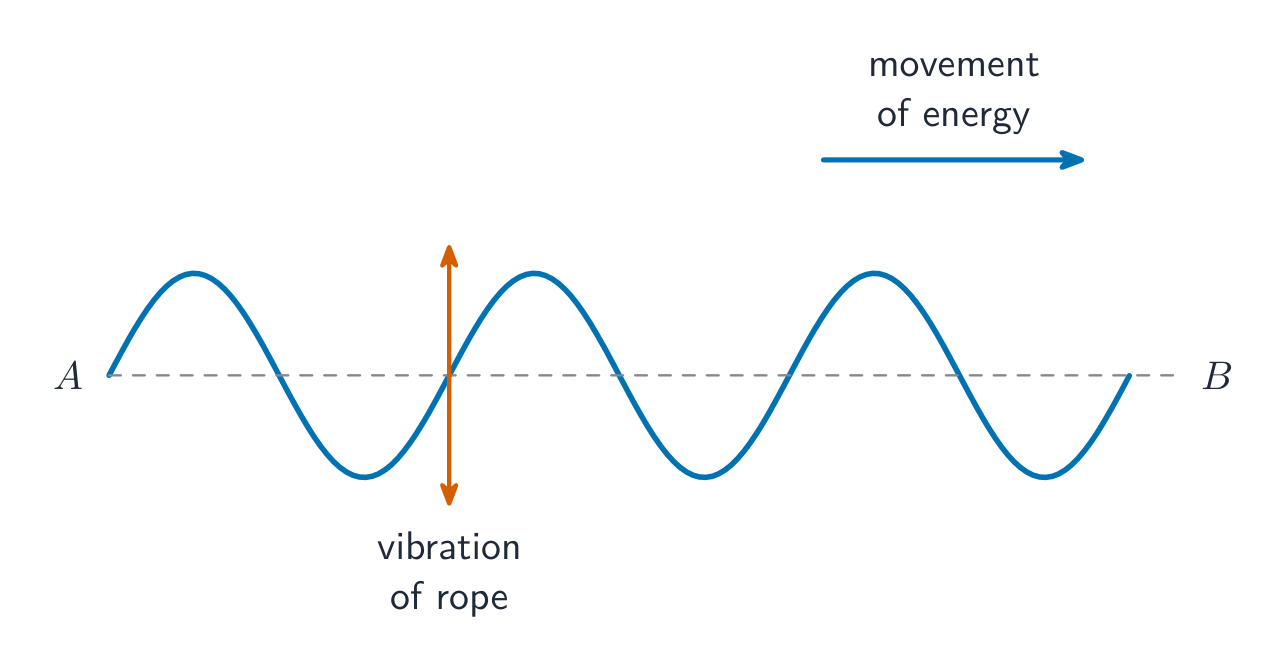
A wave 波 carries energy through a medium (or space) without carrying the matter along. A single disturbance is a pulse; a repeating one is a wave. Two types:

  • Transverse 横波: the medium moves perpendicular to the wave's travel (a wave on a rope, light).
  • Longitudinal 纵波: the medium moves along the direction of travel (sound).
עברית

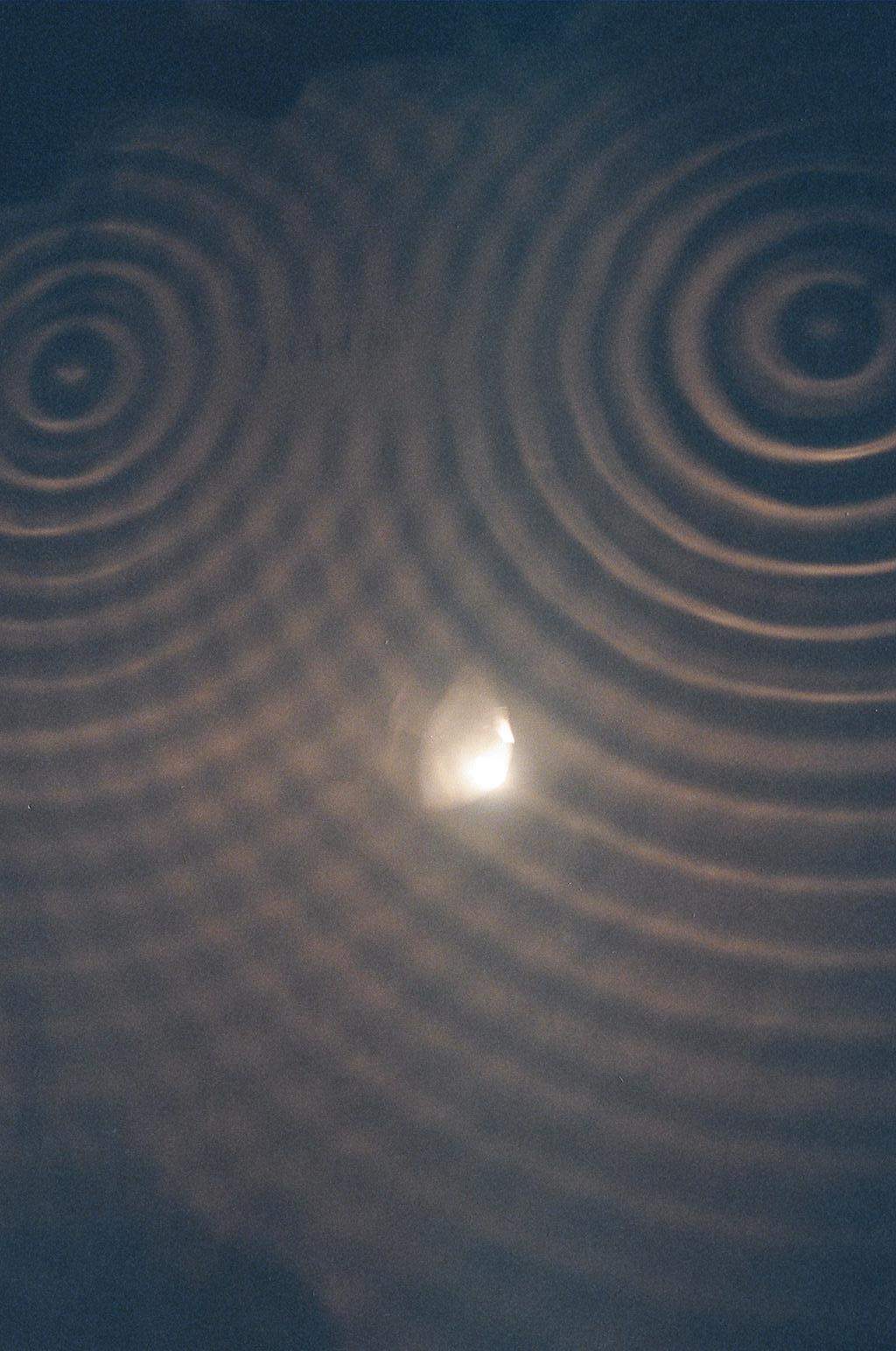
התערבות באגן גלים: מסלולי הגלים נוספים בצורה בניינית והרסנית *התערבות באגן גלים: מסלולי הגלים נוספים בצורה בניינית והרסנית

גל נושא אנרגיה דרך תווך (או חלל) מבלי להעביר את החומר עמם. הפרעה יחידה היא פולס; פרעה חוזרת היא גל. שני סוגים:

גל רוחבי: התווך נע באופן מאונך לכיוון התנועה של הגל *גל רוחבי: התווך נע באופן מאונך לכיוון התנועה של הגל
  • רוחבי: התווך נע מאונך לכיוון התנועה של הגל (גל על חבל, אור).
  • אורך: התווך נע לאורך כיוון התנועה (קול).
Vocabulary · ⁨מילון מונחים⁩ Train · ⁨אימון⁩
English עברית
wave/weɪv/ גל
Transverse/trænsˈvɜːs/ רוחבי
14.2

Periodic Waves · ⁨גלים מחזוריים⁩

Syllabus · ⁨סיילבוס⁩
English

Learning Objective 14.2.A: Describe the physical properties of a periodic wave.

  • 14.2.A.1 Periodic waves have regular repetitions that can be described using period and frequency.
    • 14.2.A.1.i The period is the time for one complete oscillation of the wave.
    • 14.2.A.1.ii The frequency is the rate at which the wave repeats.
      • Equation: $T = \dfrac{1}{f}$
    • 14.2.A.1.iii The amplitude of a wave is independent of the period and the frequency of that wave.
    • 14.2.A.1.iv The energy of a wave increases with increasing frequency.
    • 14.2.A.1.v The frequency of a sound wave is related to its pitch.
    • 14.2.A.1.vi Wavelength is the distance between successive corresponding positions (such as peaks or troughs) on a wave.
  • 14.2.A.2 A sinusoidal wave can be described by equations for the displacement from equilibrium at a specific location as a function of time. A wave can also be described by an equation for the displacement from equilibrium at a specific time as a function of position.
    • Equation: $x(t) = A\cos(\omega t) = A\cos(2\pi f t)$
    • Equation: $y(x) = A\cos\left(2\pi \dfrac{x}{\lambda}\right)$
  • 14.2.A.3 For a periodic wave, the wavelength is proportional to the wave's speed and inversely proportional to the wave's frequency.
    • Equation: $\lambda = \dfrac{v}{f}$
עברית

מטרת למידה 14.2.A: תאר את המאפיינים הפיזיקליים של גל מחזורי.

  • 14.2.A.1 לגלים מחזוריים ישן חזרות קבועות שיכולות להיות מתוארות באמצעות מחזור ותדר.
    • 14.2.A.1.i המחזור הוא הזמן הנדרש לתנודת גל מלאה אחת.
    • 14.2.A.1.ii התדר הוא קצב חזרתו של הגל.
      • משוואה: $T = \dfrac{1}{f}$
    • 14.2.A.1.iii המשרעת של גל אינה תלויה במחזור ובתדר של אותו גל.
    • 14.2.A.1.iv אנרגייתו של גל עולה עם עליית התדר.
    • 14.2.A.1.v התדר של גל קולי קשור לגובה הצליל שלו.
    • 14.2.A.1.vi אורך גל הוא המרחק בין עמדות תואמות ברצף (כגון פסגות או שפל) על גל.
  • 14.2.A.2 גל סינוסואידלי ניתן לתיאור באמצעות משוואות למיקום ביחס לאיזון במיקום ספציפי כפונקציה של זמן. גל ניתן גם לתיאור באמצעות משוואה למיקום ביחס לאיזון בזמן ספציפי כפונקציה של מיקום.
    • משוואה: $x(t) = A\cos(\omega t) = A\cos(2\pi f t)$
    • משוואה: $y(x) = A\cos\left(2\pi \dfrac{x}{\lambda}\right)$
  • 14.2.A.3 עבור גל מחזורי, אורך הגל פרופורציונלי למהירות הגל והופך לפרופורציוני הפוך לתדירות הגל.
    • משוואה: $\lambda = \dfrac{v}{f}$

Source: College Board AP Course and Exam Description · ⁨מקור: תיאור הקורס והמבחן של College Board AP⁩

English
Transverse vs longitudinal waves

A repeating wave is described by:

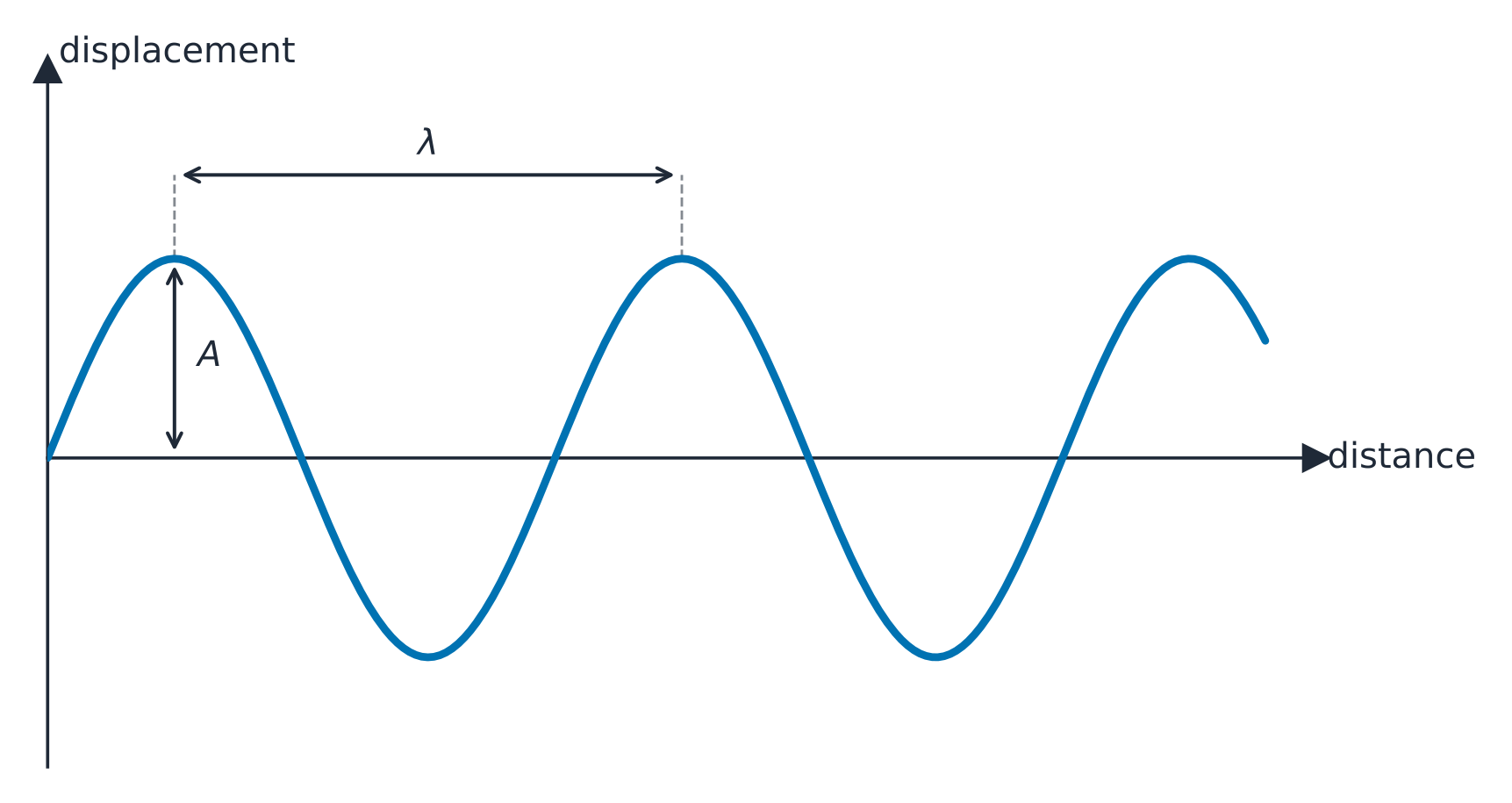
  • wavelength 波长 $\lambda$ (distance between repeats),
  • frequency 频率 $f$ (cycles per second) and period $T=1/f$,
  • amplitude 振幅 $A$ (maximum displacement – related to energy),
  • wave speed 波速 $v=f\lambda$, set by the medium, not the source.

Worked example. A musical note has frequency $340\ \text{Hz}$ and the speed of sound is $340\ \text{m/s}$. Its wavelength is $\lambda=v/f=340/340=1.0\ \text{m}$. If the same note travels into water (where sound moves at $\approx 1500\ \text{m/s}$) the frequency stays $340\ \text{Hz}$ but the wavelength stretches to $1500/340\approx 4.4\ \text{m}$ – the source sets the frequency, the medium sets the speed and hence the wavelength.

עברית
גלים רוחביים מול אורכיים

גל חוזר מתואר על ידי:

גרף תזוזה-מרחק מראה את המשרעת ואורך הגל
גרף הזזה-מרחק המציג את המשרעת ואורך הגל
  • אורך גל $\lambda$ (המרחק בין חזרות),
  • תדר $f$ (מחזורים לשנייה) ו-תקופה $T=1/f$,
  • משרעת $A$ (ההזזה המקסימלית – קשורה לאנרגיה),
  • מהירות גל $v=f\lambda$, נקבעת על ידי המדיה, ולא על ידי המקור.

דוגמה מפורטת. תווית מוזיקלית בעלת תדר $340\ \text{Hz}$ ומהירות הקול היא $340\ \text{m/s}$. אורך הגל שלה הוא $\lambda=v/f=340/340=1.0\ \text{m}$. אם אותו תווית עובר לתוך מים (בהם הקול נע ב$\approx 1500\ \text{m/s}$), התדר נשאר $340\ \text{Hz}$ אך אורך הגל מתאריך ל$1500/340\approx 4.4\ \text{m}$ – המקור קובע את התדר, המדיה קובעת את המהירות ולכן גם את אורך הגל.

Explore · ⁨חקור⁩

Send a periodic wave · ⁨שלח גל מחזורי⁩

A periodic wave carries energy without moving matter. Its speed $v=f\lambda$ links frequency and wavelength; raise the frequency and the wavelength shrinks. · ⁨גל מחזורי מוביל אנרגיה ללא תנועת חומר. ה-מהירות $v=f\lambda$ מקשרת בין התדר לאורך הגל; עליית התדר גוררת צמצום באורך הגל.⁩

Vocabulary · ⁨מילון מונחים⁩ Train · ⁨אימון⁩
English עברית
Longitudinal/ˌlɒŋɡɪˈtjuːdɪnl/ אורכי
wavelength/ˈweɪvleŋθ/ אורך גל
frequency/ˈfriːkwənsi/ תדר
amplitude/ˈæmplɪtjuːd/ משרעת
wave speed/weɪv spiːd/ מהירות גל
Polarization/ˌpəʊləraɪˈzeɪʃn/ קיטוב
intensity/ɪnˈtensɪti/ עוצמה
Electromagnetic waves/ɪˌlektrəʊməɡˈnetɪk weɪvz/ גלי אלקטרומגנטיים
14.3

Boundary Behavior and Polarization · ⁨התנהגות בגבול ופולריזציה⁩

Syllabus · ⁨סיילבוס⁩
English

Learning Objective 14.3.A: Describe the interaction between a wave and a boundary.

  • 14.3.A.1 A wave that travels from one medium to another can be transmitted or reflected, depending on the properties of the boundary separating the two media.
    • 14.3.A.1.i A wave traveling from one medium to another (for example, a wave traveling between low-mass and high-mass strings) will result in reflected and transmitted waves.
    • 14.3.A.1.ii A reflected wave is inverted if the transmitted wave travels into a medium in which the speed of the wave decreases.
    • 14.3.A.1.iii A reflected wave is not inverted if the transmitted wave travels into a medium in which the speed of the wave increases.
    • 14.3.A.1.iv The frequency of a wave does not change when it travels from one medium to another.
  • 14.3.A.2 Transverse waves that are reflected from a surface, refracted through a medium, or pass through specific openings may be polarized.
    • 14.3.A.2.i Transverse waves can be polarized and oscillate in a single plane.
    • 14.3.A.2.ii Longitudinal waves cannot be polarized.
  • 14.3.A.3 Polarization of a wave may result in a reduction of the wave's intensity.
    • 14.3.A.3.i Intensity is a measure of the amount of power transferred per unit area.
    • 14.3.A.3.ii The intensity of a wave is the average power per unit area over one period of the wave.
עברית

מטרות למידה 14.3.A: תאר את האינטראקציה בין גל לבין גבול.

  • 14.3.A.1 גל העובר מאחד תווך לשני אחר יכול להיות מעבר או החזר, בהתאם לתכונות הגבול המפריד בין שני התווכים.
    • 14.3.A.1.i גל הנע ממדיה אחד למדיה אחר (למשל, גל הנע בין מיתרים בעלי מסה נמוכה ומיתרים בעלי מסה גבוהה) יוביל לגלים מחוזזים ומעברים.
    • 14.3.A.1.ii גל מחוזז יהיה הפוך אם הגל המעבר נכנס למדיה שבה מהירות הגל יורדת.
    • 14.3.A.1.iii גל מחוזז אינו הופך אם הגל המעבר נכנס למדיה שבה מהירות הגל עולה.
    • 14.3.A.1.iv התדר של גל אינו משתנה כאשר הוא נע ממדיה אחת למדיה אחרת.
  • 14.3.A.2 גלים רוחביים המוחזרים מפני שטח, מתעוותים דרך תווך, או עוברים דרך פתחים ספציפיים עשויים להיות מקוטבים.
    • 14.3.A.2.i גלים רוחביים יכולים להיות מקוטבים ומתנודדים במישור יחיד.
    • 14.3.A.2.ii גלים אורכיים אינם יכולים להיות מקוטבים.
  • 14.3.A.3 קיטוב של גל עשוי להוביל לצמצום בעוצמת הגל.
    • 14.3.A.3.i עוצמה היא מדד לכמות ההספק המועבר ליחידת שטח.
    • 14.3.A.3.ii עוצמת גל היא הספק ממוצע ליחידת שטח לאורך תקופה אחת של הגל.

Source: College Board AP Course and Exam Description · ⁨מקור: תיאור הקורס והמבחן של College Board AP⁩

English
Total internal reflection

At a boundary a wave partly reflects and partly transmits. Reflecting off a denser medium inverts the wave; off a less-dense medium it does not. Polarization 偏振 applies to transverse waves only: a polarizer passes just one direction of oscillation, which is why polarized sunglasses cut glare.

The effect of a polarizer is measured through intensity 强度 - the average power a wave delivers per unit area over one period, in $\text{W m}^{-2}$. Because a polarizer removes the components of the oscillation that are not aligned with it, it reduces the wave's intensity: unpolarized light passing a single ideal polarizer drops to half its intensity, and a second polarizer at an angle cuts it further. Intensity also falls with distance from a source, since the same power spreads over a larger area.

עברית
השתכפות פנימית מלאה

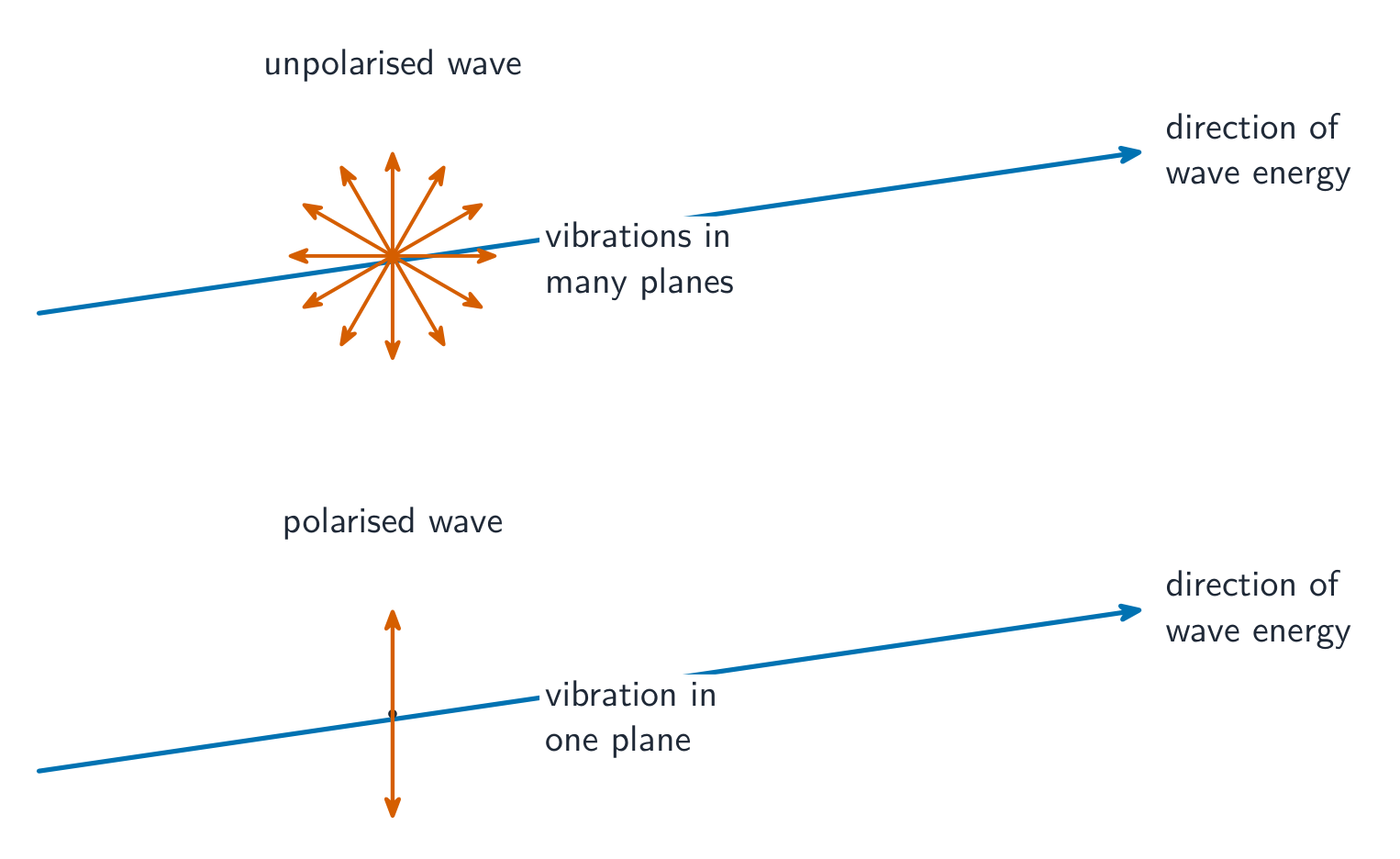
בגבול גל חלקית נשבר וחלקית עובר. השתכבות ממדיה צפופה יותר הופכת הפוכה את הגל; ממדיה פחות צפופה היא אינה הופכת אותו. פולריזציה חלה רק על גלים רוחביים: מקטב מעביר כיוון תנודה אחד בלבד, ומכאן שמשקפי שמש מקוטבים חוסמים סנוור.

האפקט של מקטב נמדד דרך עוצמה - ההספק הממוצע שהגל מספק לכל יחידת שטח בתוך תקופה אחת, ב$\text{W m}^{-2}$. מכיוון שמקטב מסיר את רכיבי התנודה שאינם מקבילים אליו, הוא מפחית את עוצמת הגל: אור לא מקוטב העובר דרך מקטב אידיאלי יורד לעומת חצי מעוצמתו, ומקטב שני בזווית מסוימת מפחית אותה עוד. עוצמה גם יורדת עם המרחק מהמקור, משום שהאותו הספק מתפשט על שטח גדול יותר.

גלים לא-מקוטבים רועדים בכמה מישורים; גל מקוטב רועד במישור אחד
גלים לא מקוטבים מתנדדים במספר מישורים; גל מקוטב מתנדד במישור אחד
14.4

Electromagnetic Waves · ⁨גלים אלקטרומגנטיים⁩

Syllabus · ⁨סיילבוס⁩
English

Learning Objective 14.4.A: Describe the properties of an electromagnetic wave.

  • 14.4.A.1 Electromagnetic waves consist of oscillating electric and magnetic fields that are mutually perpendicular.
    • 14.4.A.1.i Electromagnetic waves are transverse waves because the oscillations of the electric and magnetic fields are perpendicular to the direction of propagation.
    • 14.4.A.1.ii Electromagnetic waves are commonly assumed to be plane waves, which are characterized by planar wave fronts.
  • 14.4.A.2 Electromagnetic waves do not need a medium through which to propagate.
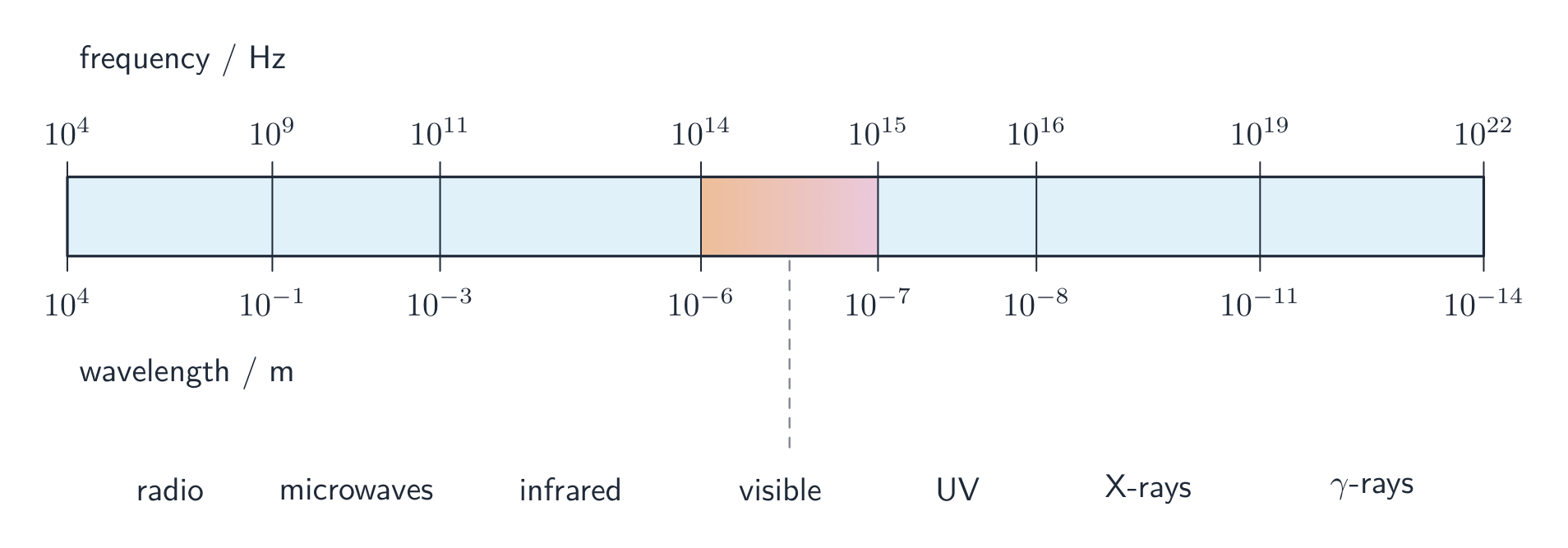
  • 14.4.A.3 Categories of electromagnetic waves are characterized by their wavelengths.
    • 14.4.A.3.i Categories of electromagnetic waves include (in order of decreasing wavelength, spanning a range from kilometers to picometers) radio waves, microwaves, infrared, visible, ultraviolet, X-rays, and gamma rays.
    • 14.4.A.3.ii Visible electromagnetic waves are further broken into categories of color, including (in order of decreasing wavelength) red, orange, yellow, green, blue, and violet.
    • 14.4.A.3.iii Visible electromagnetic waves are also called light. Sometimes, electromagnetic waves of all wavelengths are collectively referred to as light or electromagnetic radiation.

Boundary statement: AP Physics 2 expects students to know the ordering of the electromagnetic spectrum (including visible light). However, students will not be expected to define exact wavelength ranges within the electromagnetic spectrum.

עברית

מטרות למידה 14.4.A: תאר את תכונותיו של גל אלקטרומגנטי.

  • 14.4.A.1 גלים אלקטרומגנטיים מורכבים משדות חשמלי ומגנטיים מתנודדים שהם מאונכים זה לזה.
    • 14.4.A.1.i גלי אלקטרומגנטיים הם גלים רוחביים משום שהתנודות של השדות החשמלי והמגנטי מאונכות לכיוון ההתפשטות.
    • 14.4.A.1.ii נהוג להניח שגלי אלקטרומגנטיים הם גלי מישור, המאופיינים במיתרי גל מישוריים.
  • 14.4.A.2 גלי אלקטרומגנטיים אינם זקוקים לתווך דרכו יתפשטו.
  • 14.4.A.3 קטגוריות של גלי אלקטרומגנטיים מאופיינות באורכי הגל שלהן.
    • 14.4.A.3.i הקטגוריות הן (בסדר יורד של אורך גל, בטווח מילומטריות לפיקומטריות): גלי רדיו, מיקרוגלים, אינפרא אדום, אור נראה, אולטרה סגול, קרני X וקרני גاما.
    • 14.4.A.3.ii גלי אלקטרומגנטיים נראים מתחלקים ל categories צבע, כולל (בסדר יורד של אורך גל): אדום, כתום, צהוב, ירוק, תכלת וסגול.
    • 14.4.A.3.iii גלי אלקטרומגנטיים נראים מכונים גם אור. לעיתים, גלי אלקטרומגנטיים בכל אורכי הגל מכונים בקיצור אור או קרינה אלקטרומגנטית.

הצהרת גבול: ב-AP Physics 2 מצופה מהתלמידים לדעת את סדר הספקטרם האלקטרומגנטי (כולל אור נראה). עם זאת, לא מצופה מהם להגדיר טווחי אורך גל מדויקים בתוך הספקטרם.

Source: College Board AP Course and Exam Description · ⁨מקור: תיאור הקורס והמבחן של College Board AP⁩

English

Electromagnetic waves 电磁波 are oscillating electric and magnetic fields that travel through vacuum at the speed of light $c$, needing no medium. They span the spectrum from radio to gamma rays; higher frequency means shorter wavelength and higher photon energy.

עברית

גלים אלקטרומגנטיים הם שדות חשמלי ומגנטיים מתנדדים הנעים בוואקום במהירות האור $c$, ללא צורך במדיה. הם משתרעים על פני הספקטרום מאריות ועד קרני גמא; תדר גבוה יותר משמעותו אורך גל קצר יותר ואנרגיית פוטון גבוהה יותר.

הספקטרום האלקטרומגנטי, מגלי רדיו ועד קרני גاما
הספקטרום האלקטרומגנטי, מאריות ועד קרני גמא
14.5

The Doppler Effect · ⁨אפקט דופלר⁩

Syllabus · ⁨סיילבוס⁩
English

Learning Objective 14.5.A: Describe the properties of a wave based on the relative motion between the source of the wave and the observer of the wave.

  • 14.5.A.1 The Doppler effect describes the relationship between the rest frequency of a wave source, the observed frequency of the source, and the relative velocity of the source and the observer.
  • 14.5.A.2 A greater relative velocity results in a greater measured difference between the observed and rest frequencies.
    • 14.5.A.2.i For a wave source moving at the same velocity as the observer, the observed frequency is equal to the rest frequency.
    • 14.5.A.2.ii For a wave source moving toward an observer, the observed frequency is greater than the rest frequency.
    • 14.5.A.2.iii For a wave source moving away from an observer, the observed frequency is less than the rest frequency.

Boundary statement: Only qualitative treatments of the Doppler effect are required for AP Physics 2.

עברית

מטרת למידה 14.5.A: לתאר את תכונות הגל על בסיס התנועה היחסית בין מקור הגל לבין הצופה בגל.

  • 14.5.A.1 אפקט דופלר מתאר את הקשר בין תדירות השקט של מקור הגל, התדירות הנצפתה של המקור והמהירות היחסית של המקור והצופה.
  • 14.5.A.2 מהירות יחסית גדולה יותר מובילה להפרש גדול יותר שנמדד בין התדירות הנצפתה לתדירות השקט.
    • 14.5.A.2.i עבור מקור גל הנע באותה מהירות כמו הצופה, התדירות הנצפתה שווה לתדירות השקט.
    • 14.5.A.2.ii עבור מקור גל הנע כלפי צופה, התדירות הנצפתה גדולה מתדירות השקט.
    • 14.5.A.2.iii עבור מקור גל הנע הרחק מצופה, התדירות הנצפתה קטנה מתדירות השקט.

הצהרת גבול: ב-AP Physics 2 נדרשים רק טיפולים איכותניים של אפקט דופלר.

Source: College Board AP Course and Exam Description · ⁨מקור: תיאור הקורס והמבחן של College Board AP⁩

English
The Doppler effect

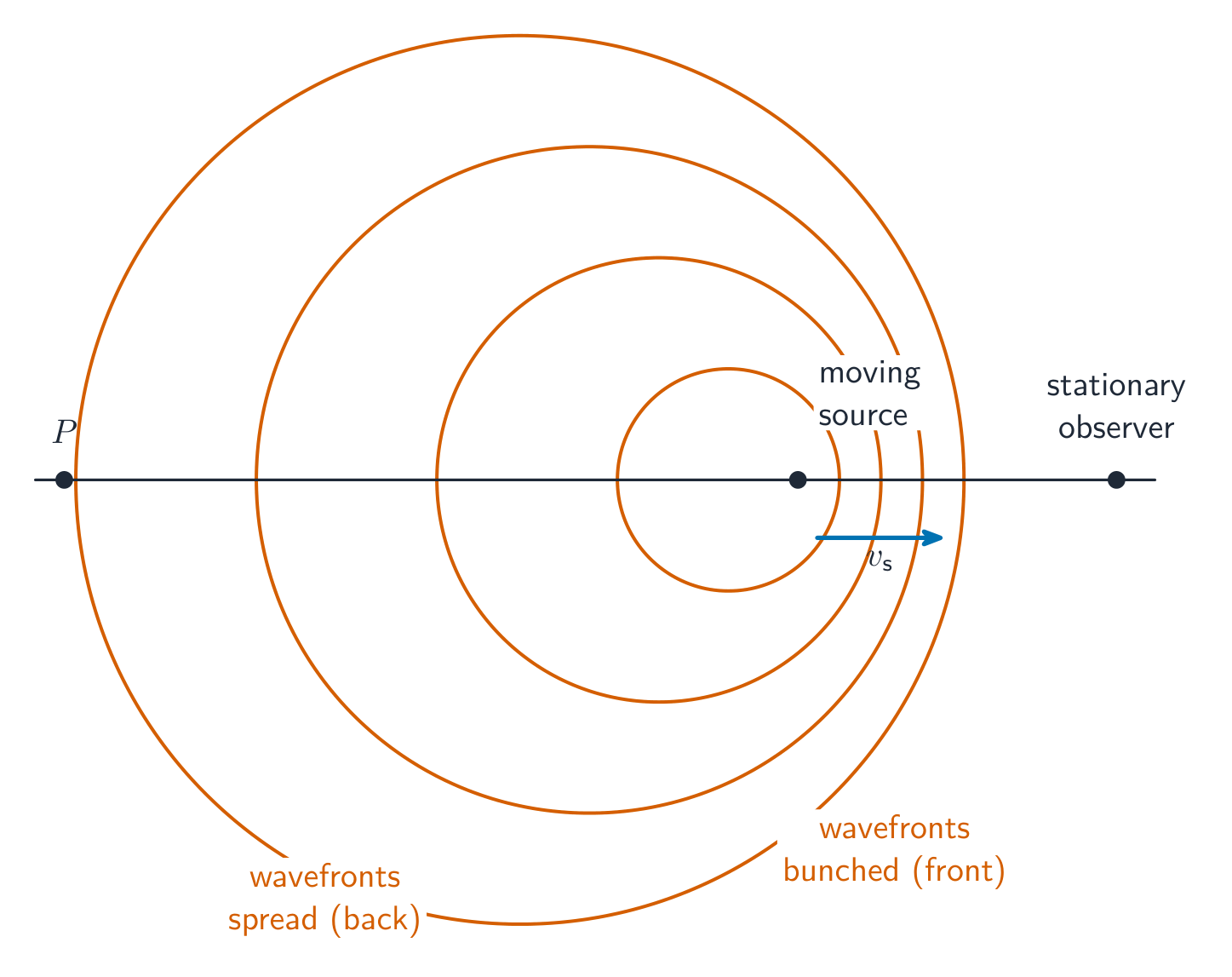
The Doppler effect 多普勒效应 is the change in observed frequency when a wave source and observer move relative to each other. Approaching $\Rightarrow$ higher frequency (shorter wavelength); receding $\Rightarrow$ lower frequency. It explains a passing siren's drop in pitch and the redshift of receding galaxies.

עברית
אפקט דופלר

אפקט דופלר הוא שינוי בתדר הנצפה כאשר מקור גל וצופה נעים יחסית זה לזה. קירוב $\Rightarrow$ תדר גבוה (גל קצר יותר); התרחקות $\Rightarrow$ תדר נמוך. האפקט מסביר את הירידה בגובה הצליל של סירנה עוברת וההתאדמות של גלקסיות הרחקות.

מקור נעוד צופר את חזית הגלים לפניו, מה שמעלה את התדר הנצפה
מקור נע דוחס את חזיתות הגל לפניו, ומרים את התדר הנצפה
Explore · ⁨חקור⁩

Hear the Doppler shift · ⁨שמע את שינוי דופלר⁩

When a source moves, waves bunch up ahead (higher frequency) and stretch behind (lower) — the Doppler effect. Speed it up to exaggerate the shift. · ⁨כאשר מקור נע, הגלים מצטופפים קדימה (תדר גבוה יותר) ומתינים אחורה (תדר נמוך יותר) — זהו אפקט דופלר. האץ את המהירות כדי להגדיל את השינוי.⁩

Vocabulary · ⁨מילון מונחים⁩ Train · ⁨אימון⁩
English עברית
Doppler effect/ˈdɒplə ɪˈfekt/ אפקט דופלר
Constructive interference/kənˈstrʌktɪv ˌɪntəˈfɪərəns/ התאבקות בונה
destructive interference/dɪˈstrʌktɪv ˌɪntəˈfɪərəns/ התערבות הרסנית
14.6

Wave Interference and Standing Waves · ⁨התאבכות גלים וגלי עומד⁩

Syllabus · ⁨סיילבוס⁩
English

Learning Objective 14.6.A: Describe the net disturbance that occurs when two or more wave pulses or waves overlap.

  • 14.6.A.1 Wave interference is the interaction of two or more wave pulses or waves.
  • 14.6.A.2 When two or more wave pulses or waves interact with each other, they travel through each other and overlap rather than bouncing off each other.
  • 14.6.A.3 When two or more wave pulses or waves overlap, the resulting displacement can be determined by adding the individual displacements. This is called superposition.
  • 14.6.A.4 Wave interference may be constructive or destructive.
    • 14.6.A.4.i When the displacements of the superposed wave pulses or waves are in the same direction, the interaction is called constructive interference.
    • 14.6.A.4.ii When the displacements of the superposed wave pulses or waves are in opposite directions, the interaction is called destructive interference.
    • 14.6.A.4.iii Two or more traveling wave pulses or waves can interact in such a way as to produce amplitude variations in the resultant wave pulse or wave.
  • 14.6.A.5 Visual representations of wave pulses or waves are useful in determining the result of two interacting wave pulses or waves.
  • 14.6.A.6 Beats arise from the addition of two waves of slightly different frequency.
    • 14.6.A.6.i Waves with different frequencies are sometimes in phase and sometimes out of phase at locations along the waves, causing periodic amplitude changes in the resultant wave.
    • 14.6.A.6.ii The beat frequency is the difference in the frequencies of the two waves.
      • Equation: $\left|f_{\text{beat}}\right| = \left|f_1 - f_2\right|$
    • 14.6.A.6.iii Tuning forks are devices that are commonly used to demonstrate beat frequencies.

Learning Objective 14.6.B: Describe the properties of a standing wave.

  • 14.6.B.1 Standing waves can result from interference between two waves that are confined to a region and traveling in opposite directions.
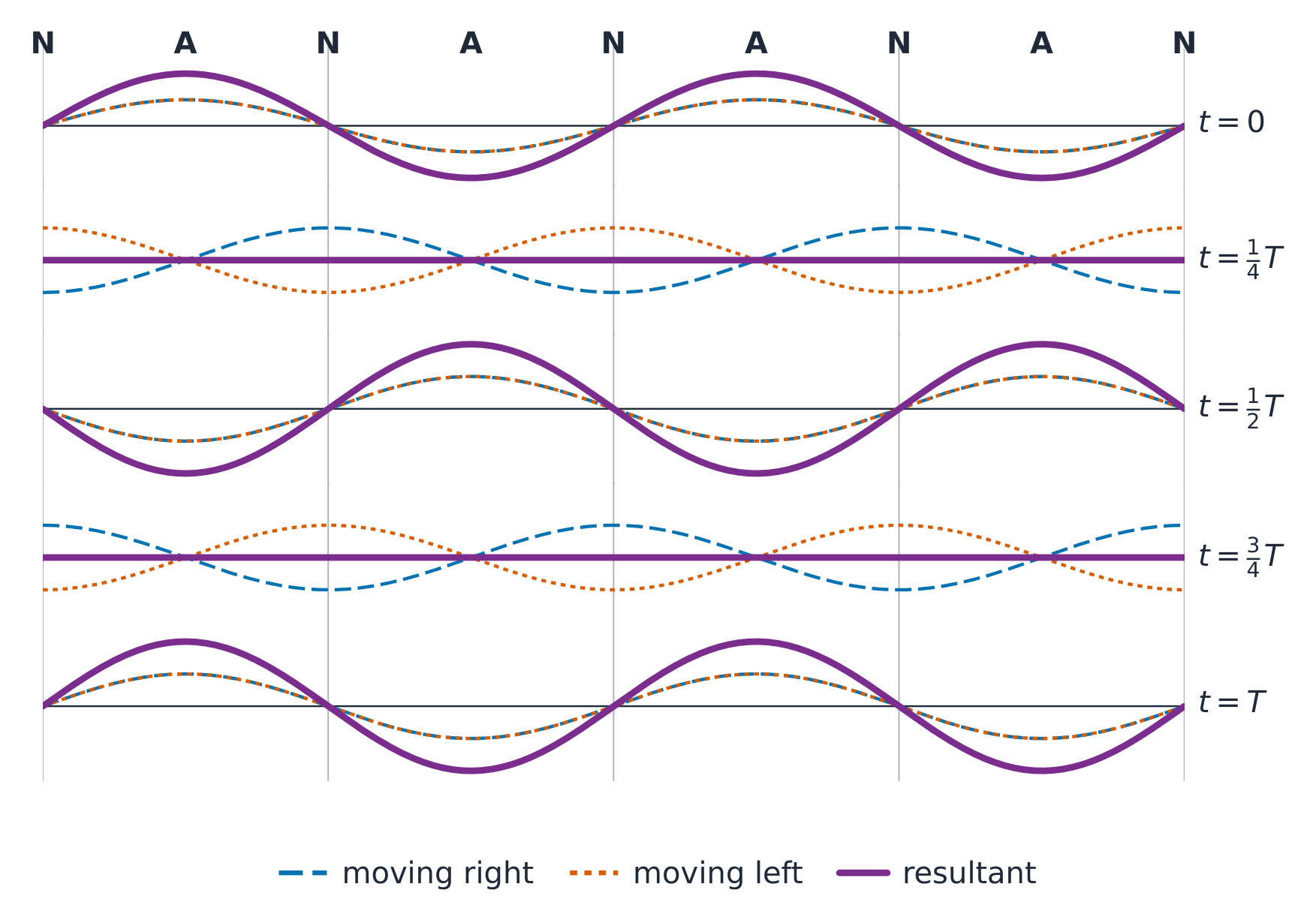
    • 14.6.B.1.i Standing waves have nodes and antinodes. A node is a point on the standing wave where the amplitude is always zero. An antinode is a point on the standing wave where the amplitude is always at maximum.
    • 14.6.B.1.ii The possible wavelengths of a standing wave are determined by the size and boundary conditions of the region to which it is confined.
    • 14.6.B.1.iii Common regions where standing waves can form include pipes with open or closed ends, as well as strings with fixed or loose ends.
  • 14.6.B.2 A standing wave with the longest possible wavelength is called the fundamental or first harmonic. The second-longest wavelength is typically called the second harmonic, the third-longest wavelength is called the third harmonic, and so on. However, for a standing wave with a node at one end and an antinode at the other end, only odd harmonics can be established.
  • 14.6.B.3 Visual representations of standing waves are useful in determining the relationships between length of the region, wavelength, frequency, wave speed, and harmonic.
עברית

מטרת למידה 14.6.A: לתאר את ההפרעה הכוללת המתרחשת כאשר שני פולסים או יותר של גלים חופפים זה על זה.

  • 14.6.A.1 התערבות גלים היא האינטראקציה בין שני פולסים או יותר של גלים.
  • 14.6.A.2 כאשר שני פולסים או יותר של גלים נפגשים זה עם זה, הם חודרים זה דרך זה וחופפים במקום לקפוץ זה על זה.
  • 14.6.A.3 כאשר שני פולסים גליים או יותר חופפים זה על גבי זה, ניתן לקבוע את ההפרעה הנוצרת על ידי חיבור ההפרעות הבודדות. תהום זה נקרא סופרפוזיציה.
  • 14.6.A.4 התערבות גלית עשויה להיות בונה או מרסה.
    • 14.6.A.4.i כאשר ההפרעות של פולסי הגלים החופפים או הגלים עצמם נמצאות באותה כיוון, האינטראקציה מכונה התערבות בונה.
    • 14.6.A.4.ii כאשר ההפרעות של פולסי הגלים החופפים או הגלים עצמם נמצאות בכיוונים הפוכים, האינטראקציה מכונה התערבות מרסה.
    • 14.6.A.4.iii שני פולסים גליים או יותר המעבר יכולים להתייחס זה לזה כך שיובילו לשינויים באמפליטודה בפולס הגלי או בגל הנובע.
  • 14.6.A.5 ייצוגים ויזואליים של פולסים גליים או גלים שימושיים לקביעת התוצאה של שני פולסים גליים או גלים המתאיירים זה עם זה.
  • 14.6.A.6 מקצבים (Beats) נוצרים כתוצאה מהוספת שני גלים בתדירות השונה מעט.
    • 14.6.A.6.i גלים בתדרים שונים נמצאים לעיתים קרובות באותו פאזה ולעיתים מחוץ לפאזה במיקומים לאורך הגלים, מה שמגרום לשינויים תקופתיים באמפליטודה בגל הנובע.
    • 14.6.A.6.ii תדירות המקצבים היא ההפרש בין תדרים של שני הגלים.
      • משוואה: $\left|f_{\text{beat}}\right| = \left|f_1 - f_2\right|$
    • 14.6.A.6.iii מזמזמים הם מכשירים המשמשים לעיתים קרובות להמחשת תדרי מקצבים.

מטרה לימודית 14.6.B: לתאר את מאפייני הגל העומד.

  • 14.6.B.1 גלים עומדים יכולים להיווצר כתוצאה מהתערבות בין שני גלים המוגבלים לאזור מסוים והמתקדמים בכיוונים הפוכים.
    • 14.6.B.1.i לגלים עומדים יש צמתים ונודות. צומת הוא נקודה בגל העומד בה האמפליטודה היא אפס תמיד. נודה היא נקודה בגל העומד בה האמפליטודה היא מקסימלית תמיד.
    • 14.6.B.1.ii אורכי הגל האפשריים לגל עומד נקבעים על ידי גודלו ותנאי הגבול של האזור אליו הוא מוגבל.
    • 14.6.B.1.iii אזורים נפוצים בהם גלים עומדים יכולים להתקיים כוללים צינורות עם קצוות פתוחים או סגורים, ainsi que מיתרים עם קצוות קבועים או רופפים.
  • 14.6.B.2 גל עומד בעל אורך הגל הארוך ביותר מכונה היסוד או הרמוניה הראשונה. אורך הגל השני באורכו נקרא בדרך כלל הרמוניה השנייה, אורך הגל השלישי באורכו נקרא הרמוניה השלישית, וכך הלאה. עם זאת, עבור גל עומד עם צומת בקצה אחד ונודה בקצה השני, רק הרמוניות אי-זוגיות יכולות להתקיים.
  • 14.6.B.3 ייצוגים ויזואליים של גלים עומדים שימושיים לקביעת הקשרים בין אורך האזור, אורך גל, תדר, מהירות גל והרמוניה.

Source: College Board AP Course and Exam Description · ⁨מקור: תיאור הקורס והמבחן של College Board AP⁩

English
Standing (stationary) waves

When waves overlap they superpose (add). Constructive interference 相长干涉 (crests aligned) gives a bigger wave; destructive interference 相消干涉 (crest on trough) cancels. Two waves travelling opposite ways in a bounded medium form a standing wave 驻波 with fixed nodes 波节 (no motion) and antinodes 波腹 (maximum motion) – the basis of resonance on strings and in pipes.

Worked example. A guitar string $0.65\ \text{m}$ long is fixed at both ends. Its fundamental (first harmonic) fits half a wavelength between the ends, so $\lambda=2L=1.30\ \text{m}$. If waves travel along the string at $260\ \text{m/s}$, the note's frequency is $f=v/\lambda=260/1.30=200\ \text{Hz}$. Shortening the string (a fret) raises the pitch.

When two waves of slightly different frequency overlap, they drift in and out of step, so the combined sound swells loud and soft in a slow throb called beats 拍. The beat frequency 拍频 is simply the difference of the two frequencies:

$$f_{\text{beat}}=|f_1-f_2|.$$
Two tuning forks of $256\ \text{Hz}$ and $260\ \text{Hz}$ sounded together give $|260-256|=4$ beats each second; a musician tunes an instrument by slowing these beats towards zero against a reference note.

עברית
גלי עומד (ניחוד)

כשגלים חופפים הם מתחברים (מוסיפים). התאבכות בונה (פסגות מיושרות) נותנת גל גדול יותר; התאבכות הורסת (פסגה על שפל) מבטלת. שני גלים המעבר בכיוונים מנוגדים בתווך מוגבל יוצרים גל עומד עם נקודות קשר קבועות (ללא תנועה) ו-נקודות אנטי-קשר (תנועה מקסימלית) – הבסיס לתהודה במיתרים ובצינורות.

גל עומד נוצר שם שני גלים המעברים בכיוונים מנוגדים חופפים

דוגמה פותרת. מיתר גיטרה $0.65\ \text{m}$ ארוך תקוע בשתי קצוותיו. ה-בסיסי (ההרמונית הראשונה) מתאים לחצי אורך גל בין הקצוות, ולכן $\lambda=2L=1.30\ \text{m}$. אם גלים מעברים לאורך המיתר ב$260\ \text{m/s}$, תדר הצליל הוא $f=v/\lambda=260/1.30=200\ \text{Hz}$. קיצור המיתר (באמצעות טונר) מגביה את הגובה הצלילי.

כששני גלים בעלי תדר שונה מעט חופפים, הם מחליפים אי-התאמה, ולכן הצליל המשולף מתנפץ חזק וחלש בקצב איטי הנקרא פולסים. תדר הפולסים הוא פשוט ההפרש בין שני התדרים:

$$f_{\text{beat}}=|f_1-f_2|.$$
שני מזמרים בעלי $256\ \text{Hz}$ ו$260\ \text{Hz}$ שמיע together נותנים $|260-256|=4$ פולסים בכל שנייה; מוזיקאי מתכוון כלי על ידי להאטת פולסים אלו לעבר אפס מול נקודת ייחוס.

Explore · ⁨חקור⁩

Set up a standing wave · ⁨הכן גל עומד⁩

Two waves travelling opposite ways interfere into a standing wave with fixed nodes and antinodes. Only certain frequencies fit, giving the harmonics. · ⁨שני גלים הנעים בכיוונים מנוגדים מתערבבים ליצירת גל עומד עם נקודות קיבוע ונקודות קוץ קבועות. רק תדרים מסוימים מתאימים, מה שמניב את ההרמוניות.⁩

Vocabulary · ⁨מילון מונחים⁩ Train · ⁨אימון⁩
English עברית
standing wave/ˈstændɪŋ weɪv/ גל עומד
nodes/nəʊdz/ צמתים
antinodes/ˌæntɪˈnəʊdz/ נקודות נטו
beats/biːts/ הפרעות
beat frequency/biːt ˈfriːkwənsi/ תדר הפרעות
14.7

Diffraction · ⁨פיזור⁩

Syllabus · ⁨סיילבוס⁩
English

Learning Objective 14.7.A: Describe the behavior of a wave and the diffraction pattern resulting from a wave passing through a single opening.

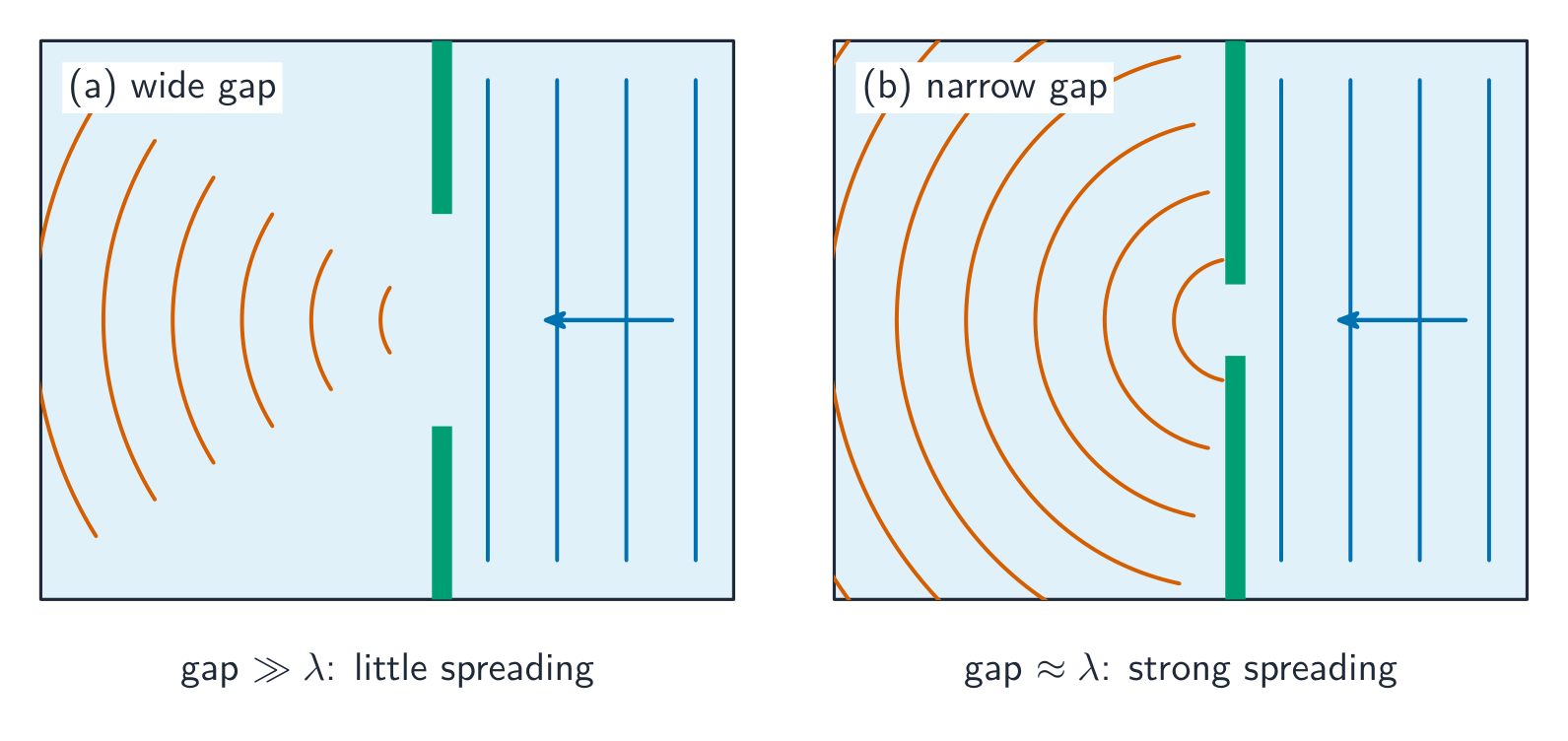
  • 14.7.A.1 Diffraction is the spreading of a wave around the edges of an obstacle or through an opening.
  • 14.7.A.2 Diffraction is most pronounced when the size of the opening is comparable to the wavelength of the wave.
  • 14.7.A.3 Diffraction of multiple wavefronts through a single opening leads to observable interference patterns.
  • 14.7.A.4 Diffraction is commonly demonstrated by monochromatic light of wavelength $\lambda$ incident on a narrow opening of width $a$ that is a distance $L$ from a screen.
    • 14.7.A.4.i Constructive and destructive interference of multiple wavefronts originating from the opening will result in bright and dark bands on the screen.
    • 14.7.A.4.ii The amount of interference between two wavefronts depends on the path length difference $\Delta D$ of the wavefronts.
    • 14.7.A.4.iii The path length difference $\Delta D$ can be described in terms of the opening width $a$ and the angle $\theta$ between the direction of propagation of the wavefront and the normal to the opening by the equation $\Delta D = a\sin\theta$.
    • 14.7.A.4.iv For small angles, where $\theta < 10°$, the small angle approximation can be used to relate $\lambda$, $a$, and $L$ to $y_{\min}$, the distance from the middle of the central bright fringe to the $m^{\text{th}}$ order of minimum brightness on the screen.
      • Equation: $a\left(\dfrac{y_{\min}}{L}\right) \approx m\lambda$
  • 14.7.A.5 The diffraction pattern produced by a wave passing through an opening depends on the shape of the opening.
  • 14.7.A.6 Visual representations of single-slit diffraction patterns are useful in determining the physical properties of the slit and the interacting waves.
עברית

מטרה לימודית 14.7.A: לתאר את התנהגותו של גל ואת דגם העקיפה הנובע מעברו דרך פתח יחיד.

  • 14.7.A.1 עקיפה היא התפשטותו של גל סביב קצוות של מכשול או דרך פתח.
  • 14.7.A.2 גלישה בולטת ביותר כאשר גודל הפתח דומה לאורך הגל.
  • 14.7.A.3 גלישה של מספר חזיתות גל דרך פתח יחיד מובילה להיווצרות תבניות התאבכות נצפות.
  • 14.7.A.4 דפraction מתבטא בדרך כלל באור חד-צבעי בעל אורך גל $\lambda$ הפוגע בפתיחה צרה בעלת רוחב $a$ הנמצאת במרחק $L$ ממסך.
    • 14.7.A.4.i התאבכות בונה והרסנית של חזיתות גל רבות שנובעות מהפתח תוביל ללהבנות בהירות וחשוכות על המסך.
    • 14.7.A.4.ii עוצמת ההתאבכות בין שתי חזיתות גל תלויה בהפרש האורך $\Delta D$ של החזיתות.
    • 14.7.A.4.iii הפרש האורך $\Delta D$ ניתן לתאר באמצעות רוחב הפתח $a$ והזווית $\theta$ בין כיוון התפשטות החזית לבין הנורמל לפתח, באמצעות המשוואה $\Delta D = a\sin\theta$.
    • 14.7.A.4.iv עבור זוויות קטנות, כאשר $\theta < 10°$, ניתן להשתמש בקירוב הזווית הקטנה כדי לקשר בין $\lambda$, $a$, ו$L$ ל$y_{\min}$, המרחק מאמצע הפס בהיר מרכזי אל סדר ה$m^{\text{th}}$ של מינימום תאורה על המסך.
      • משוואה: $a\left(\dfrac{y_{\min}}{L}\right) \approx m\lambda$
  • 14.7.A.5 תבנית הגלישה הנוצרת על ידי גל העובר דרך פתח תלויה בצורת הפתח.
  • 14.7.A.6 תצוגות ויזואליות של תבניות גלישה בפתח יחיד מועילות לקביעת התכונות הפיזיקליות של הפתח וגלים המתאבכים.

Source: College Board AP Course and Exam Description · ⁨מקור: תיאור הקורס והמבחן של College Board AP⁩

English

Diffraction 衍射 is the bending and spreading of waves around edges or through openings. The spreading is significant when the opening is comparable to the wavelength – so sound (long wavelength) bends around doorways easily, while light (tiny wavelength) needs a very narrow slit.

עברית

פיזור הוא כיפוף והתפשטות של גלים סביב קצוות או דרך פתחים. ההתפשטות משמעותית כאשר הפתח דומה באורכו לגל – כך שצליל (אורך גל ארוך) מתכופף סביב דלתות בקלות, בעוד שאור (אורך גל זעיר) דורש סדק צר מאוד.

גלים מתפשטים (מתפרקים) כאשר הם עוברים דרך פתח
גלים מתפשטים (מתפזרים) כשהם עוברים דרך חריץ
Vocabulary · ⁨מילון מונחים⁩ Train · ⁨אימון⁩
English עברית
Diffraction/dɪˈfrækʃn/ דיפרקציה
Coherent/kəʊˈhɪərənt/ קוהרנטי
diffraction grating/dɪˈfrækʃn ˈɡreɪtɪŋ/ רשת דיפרקציה
thin film/θɪn fɪlm/ סרט דק
antireflection coating/ˌæntɪrɪˈflekʃn ˈkəʊtɪŋ/ ציפוי אנטי-השתקפות
14.8

Double-Slit Interference and Diffraction Gratings · ⁨התאבכות בשני חריצים ורשתות פיזור⁩

Syllabus · ⁨סיילבוס⁩
English

Learning Objective 14.8.A: Describe the behavior of a wave and the diffraction pattern resulting from the wave passing through multiple openings.

  • 14.8.A.1 The pattern resulting from monochromatic light of wavelength $\lambda$ incident on two slits a distance $d$ apart is caused by a combination of wave diffraction and wave interference.
    • 14.8.A.1.i When only considering wave interference, a double slit creates a pattern of uniformly spaced maxima.
    • 14.8.A.1.ii Constructive and destructive interference of the wavefronts originating from each slit will result in bright and dark bands on the screen.
    • 14.8.A.1.iii The amount of interference between two wavefronts depends on the path length difference $\Delta D$ of the wavefronts.
    • 14.8.A.1.iv The path length difference $\Delta D$ can be described in terms of the slit separation $d$ and the angle $\theta$ between the direction of propagation of the wavefront and the normal to the opening by the equation $\Delta D = d\sin\theta$.
    • 14.8.A.1.v For small angles, where $\theta < 10°$, the small angle approximation can be used to relate $\lambda$, $d$, and $L$ to $y_{\max}$, the distance from the middle of the central bright fringe to the $m^{\text{th}}$ order of maximum brightness on the screen.
      • Equation: $d\left(\dfrac{y_{\max}}{L}\right) \approx m\lambda$
    • 14.8.A.1.vi When considering wave interference and wave diffraction, a double slit creates an interference pattern of maxima and minima superimposed within the envelope created by single-slit diffraction.
  • 14.8.A.2 Interference patterns produced by light interacting with a double slit indicate that light has wave properties. The source of this discovery was Young's double-slit experiment.
  • 14.8.A.3 Visual representations of double-slit diffraction patterns are useful in determining the physical properties of the slits and the interacting waves.
  • 14.8.A.4 A diffraction grating is a collection of evenly spaced parallel slits or openings that produce an interference pattern that is the combination of numerous diffraction patterns superimposed on each other.
  • 14.8.A.5 When white light is incident on a diffraction grating, the center maximum is white and the higher-order maxima disperse white light into a rainbow of colors, with the longest-wavelength light (red) appearing farthest from the central maximum.
עברית

מטרות למידה 14.8.A: תאר את התנהגותו של גל ותבנית הגלישה הנוצרת מתוך מעבר הגל דרך פתחים מרובים.

  • 14.8.A.1 התבנית הנוצרת מתוך אור מונוכרטי בעל אורך גל $\lambda$ הנפגש עם שני פס双-פתחים במרחק $d$ זה מזה נובעת משילוב של גלישת גלים והתאבכות גלים.
    • 14.8.A.1.i כאשר נסתכל רק על התאבכות גלים, פס双-פתח יוצר תבנית של מקסימומים במרווח אחיד.
    • 14.8.A.1.ii התאבכות בונה והרסנית של חזיתות הגל הנובעות מפס双-פתח כל אחד תוביל ללהבנות בהירות וחשוכות על המסך.
    • 14.8.A.1.iii עוצמת ההתאבכות בין שתי חזיתות גל תלויה בהפרש האורך $\Delta D$ של החזיתות.
    • 14.8.A.1.iv הפרש אורכי הדרך $\Delta D$ ניתן לתאר באמצעות הפרדת החריצים $d$ והזווית $\theta$ בין כיוון התפשטות חזית הגל לבין הנורמל לפתיחות על ידי המשוואה $\Delta D = d\sin\theta$.
    • 14.8.A.1.v עבור זוויות קטנות, כאשר $\theta < 10°$, ניתן להשתמש בקירוב הזווית הקטנה כדי לקשר בין $\lambda$, $d$ ו$L$ ל$y_{\max}$, המרחק מאמצע הפריזה הבהירה המרכזית עד לסדר ה$m^{\text{th}}$ של מקסימום בהירות על המסך.
      • משוואה: $d\left(\dfrac{y_{\max}}{L}\right) \approx m\lambda$
    • 14.8.A.1.vi כאשר נסתכל גם על התאבכות גלים וגם על גלישת גלים, פס双-פתח יוצר תבנית התאבכות של מקסימומים ומינימום המוטבעים בתוך האנבלופ הנוצר מגלישה בפתח יחיד.
  • 14.8.A.2 תבניות ההתאבכות הנוצרות מאור המגיב עם פס双-פתח מעידות על כך שאור הוא בעל תכונות גליות. מקור גילוי זה הוא ניסוי פס双-פתח של יאנג.
  • 14.8.A.3 תצוגות ויזואליות של תבניות גלישה בפס双-פתח מועילות לקביעת התכונות הפיזיקליות של הפס双-פתחים וגלים המתאבכים.
  • 14.8.A.4 רשת פיזור היא קבוצה של חריצים מקבילים המרווחים באופן אחיד או פתחים היוצרים דפוס התערבותי הנובע משילובם של מספר גדול של דפוסי פיזור המופיעים זה על גבי זה.
  • 14.8.A.5 כאשר אור לבן פוגע ברשת פיזור, המקסימום במרכז הוא לבן, והמקסימומים ברמות גבוהות מפזרים את האור הלבן לספקטרום צבעים, כאשר האור בעל אורך הגל הארוך ביותר (אדום) מופיע הרחק ביותר מהמקסימום המרכזי.

Source: College Board AP Course and Exam Description · ⁨מקור: תיאור הקורס והמבחן של College Board AP⁩

English
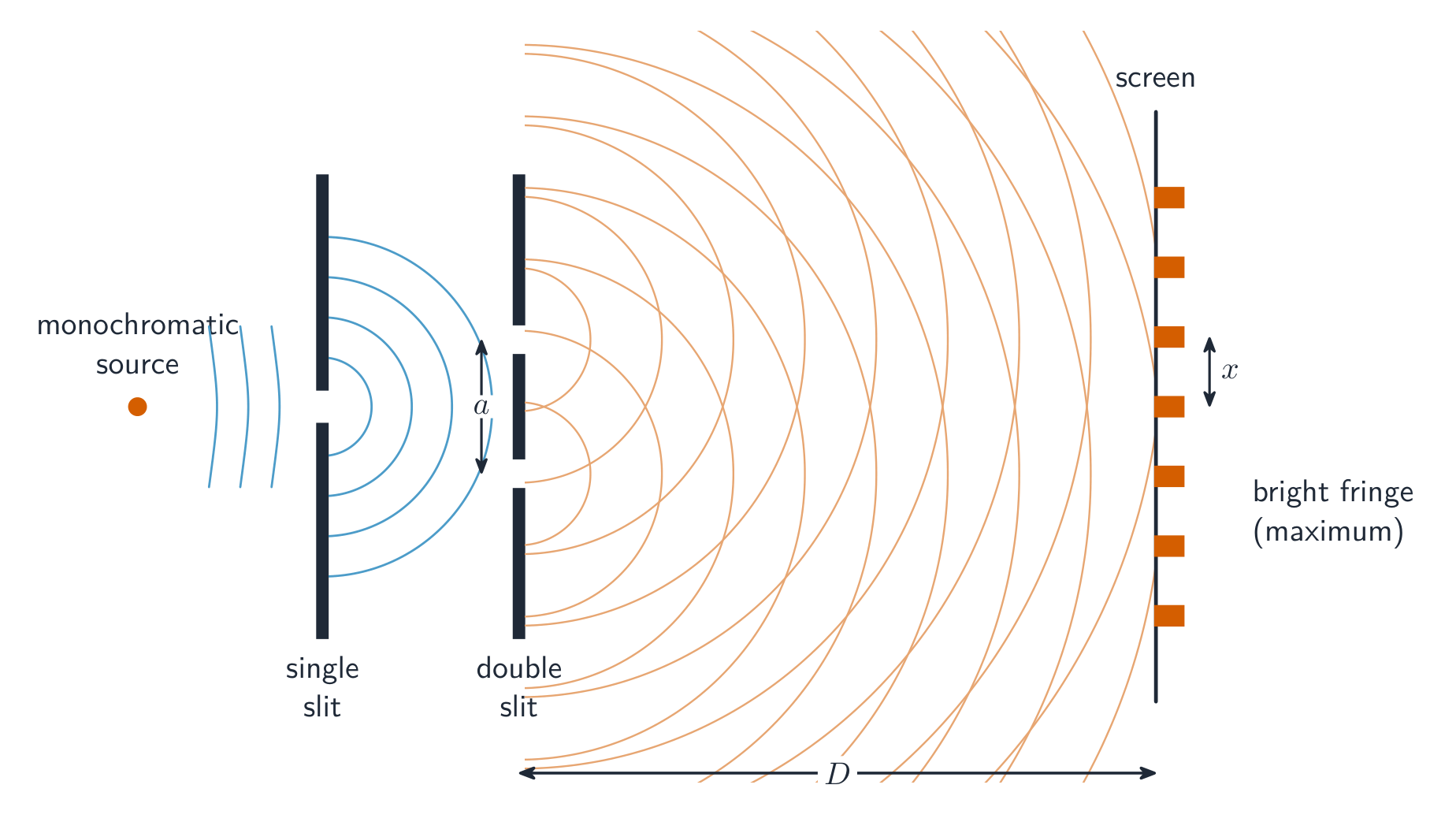
Two-source interference

Coherent 相干 light through two closely spaced slits produces a pattern of bright and dark fringes. Bright fringes occur where the path difference is a whole number of wavelengths:

$$d\sin\theta=m\lambda.$$
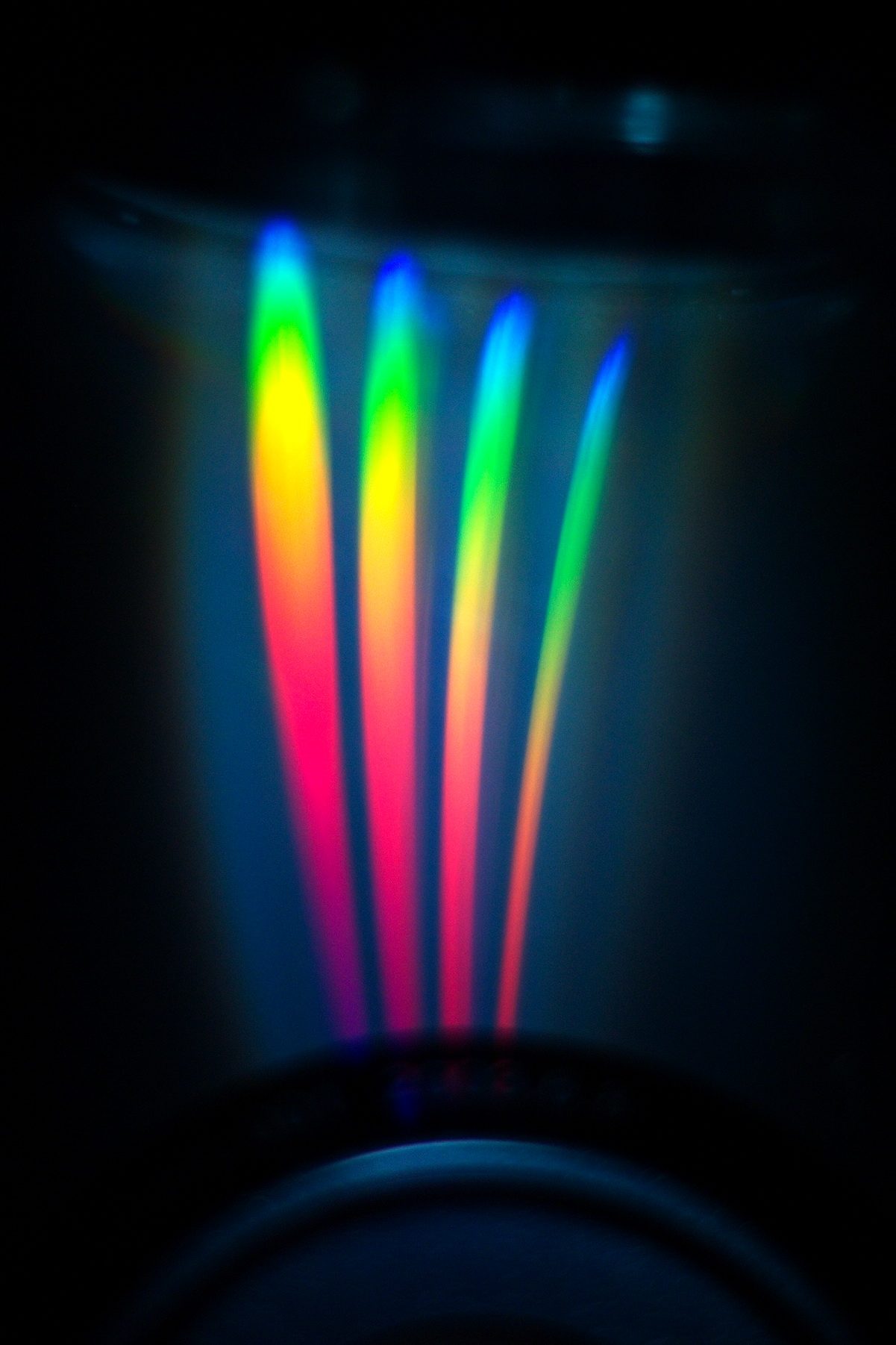
A diffraction grating 衍射光栅 has many slits, giving sharp, widely spaced bright lines – useful for separating light into its wavelengths.

Worked example. Light of wavelength $600\ \text{nm}$ passes through two slits $0.20\ \text{mm}$ apart. The first bright fringe ($m=1$) sits at

$$\sin\theta=\frac{m\lambda}{d}=\frac{1\times600\times10^{-9}}{0.20\times10^{-3}}=3.0\times10^{-3}\;\Rightarrow\;\theta=0.17^{\circ}.$$
The tiny angle is why the slits must be very close together and the screen far away to see the fringes clearly.

עברית
התאבכות משני מקורות

אור קוהרנטי העובר דרך שני חריצים קרובים מייצר דפוס של פסות בהירות וכהות. פסות בהירות נוצרות שם שההפרש במסלול הוא מספר שלם מאורכי גל:

$$d\sin\theta=m\lambda.$$
רשת פיזור היא רבה חריצים, ומייצרת קווים בהירים חדשים ומרוחקים – שימושי להפרדת אור למרכיביו לפי אורכי גל.

חריצי יאנג הכפולים נותנים דגם התערבות של פסים בהירים וכהים
חריצי Young יוצרים דפוס התאבכות של פסים בהירים וכהים

דוגמא מופת. אור באורך גל $600\ \text{nm}$ עובר דרך שני חריצים המרוחקים $0.20\ \text{mm}$ זה מזה. הפס הבהיר הראשון ($m=1$) ממוקם ב

$$\sin\theta=\frac{m\lambda}{d}=\frac{1\times600\times10^{-9}}{0.20\times10^{-3}}=3.0\times10^{-3}\;\Rightarrow\;\theta=0.17^{\circ}.$$
הזווית הקטנה היא הסיבה לכך שהחריצים חייבים להיות קרובים מאוד זה לזה והמסך רחוק כדי לראות את הפסים בבירור.

צבעי הקשת המוחזרים מפני השטח של דיסק CD
השבילים העדינים על דיסק CD פועלים כרשת הרצה, ומפרדים אור לבן לספקטרום
Explore · ⁨חקור⁩

Superpose two waves · ⁨הרכב שני גלים⁩

Where two waves arrive in phase they add (bright fringe); out of phase they cancel (dark fringe). That interference makes the double-slit pattern. · ⁨כאשר שני גלים מגיעים בפזה, הם מתחברים (פס בהיר); כשהם מחוץ לפזה, הם מבטלים זה את זה (פס כהה). ערבוב זה יוצר את דוגמת החריצים הכפולים.⁩

14.9

Thin-Film Interference · ⁨התאבכות בממברנות דקות⁩

Syllabus · ⁨סיילבוס⁩
English

Learning Objective 14.9.A: Describe the behavior of light that interacts with a thin film.

  • 14.9.A.1 When light travels from one medium to another, some of the light is transmitted, some is reflected, and some is absorbed.
  • 14.9.A.2 The phase change of a reflected ray depends on the relative indices of refraction of the materials with which the ray interacts.
    • 14.9.A.2.i A phase change of 180 degrees occurs when a light ray is reflected from a medium with a greater index of refraction than the medium through which the ray is traveling.
    • 14.9.A.2.ii No phase change occurs when a light ray is reflected from a medium with a lower index of refraction than the medium through which the ray is traveling.
  • 14.9.A.3 The phase of a wave does not change when it is refracted as it passes from one medium into another.
  • 14.9.A.4 Thin-film interference occurs when light interacts with a medium whose thickness is comparable to the light's wavelength.
    • 14.9.A.4.i The interactions between the initial reflected light and the light exiting the thin film after being reflected from the second interface exhibit wave interference behavior, resulting in a single wave that is the sum of the two interacting waves.
    • 14.9.A.4.ii The amount of constructive or destructive interference between the two reflected waves depends on the relationship between the thickness of the film, the wavelength of light, any phase shifts, and the angle at which the incident light strikes the film.
  • 14.9.A.5 Practical examples of thin-film interference include the color variations seen in soap bubbles and oil films, as well as antireflection coatings.
    • 14.9.A.5.i The spectrum of colors observed in oil films and soap bubbles arises from differences in the thickness of the film.
    • 14.9.A.5.ii Antireflection coatings eliminate reflected light by applying the relationships between indices of refraction, phase shift, and wave interference to create destructive interference of the light reflected from the two surfaces of the coating.
    • 14.9.A.5.iii The simplest antireflection coating has a thickness equal to one-quarter of the wavelength of the light in the coating, and the index of refraction of the coating is greater than that of air and less than that of the surface upon which the coating is applied. This assumes incident light is normal to the surface.

Boundary statement: Quantitative analysis of thin-film interference is limited to waves that are normal to the incident surface.

עברית

מטרות למידה 14.9.A: לתאר את התנהגות האור המתאימה עם סרט דק.

  • 14.9.A.1 כאשר אור עובר מתוך תווך אחד לתווך אחר, חלק מהאור מעבר, חלק נשקף וחלק נבלע.
  • 14.9.A.2 שינוי הפאזה של קרן נשקפת תלוי במקדם השבירה היחסי של החומרים בהם הקרן מתאימה.
    • 14.9.A.2.i מתרחש שינוי פאזה של 180 מעלות כאשר קרן אור נשקפת מתווך בעל מקדם שבירה גדול יותר מאשר התווך שבו הקרן נעה.
    • 14.9.A.2.ii אין שינוי פאזה כאשר קרן אור נשקפת מתווך בעל מקדם שבירה נמוך יותר מאשר התווך שבו הקרן נעה.
  • 14.9.A.3 הפאזה של גל אינה משתנה כאשר הוא מתשביר עובר מתוך תווך אחד לתווך אחר.
  • 14.9.A.4 התערבות בסרט דק מתרחשת כאשר אור מתאים לתווך שהעובי שלו כמותו של אורך הגל של האור.
    • 14.9.A.4.i האינטראקציה בין האור הנשקף ההתחלתי לבין האור היוצא מהסרט הדק לאחר שנשקף מהממשקה השנייה מציגה התנהגות התערבותית גלית, ויוצרת גל יחיד שהוא הסכום של שני הגלים המתאימים.
    • 14.9.A.4.ii כמות ההתערבות הבונה או ההרסנית בין שני הגלים הנשקפים תלויה בקשר בין עובי הסרט, אורך הגל של האור, כל שינוי פאזה, והזווית שבה האור הפוגע פוגע בסרט.
  • 14.9.A.5 דוגמאות מעשיות להתערבות בסרט דק כוללת את שינויי הצבע הנראים בבועות סבון ובסרטי שמן, כמו גם ציפויים אנטי-החזרתיים.
    • 14.9.A.5.i ספקטרום הצבעים הנצפה בסרטי שמן ובבועות סבון נובע מהבדלים בעובי הסרט.
    • 14.9.A.5.ii ציפויים אנטי-החזרתיים מבטלים אור נשקף על ידי יישום הקשרים בין מקדמי השבירה, שינוי פאזה והתערבות גלית כדי ליצור התערבות הרסנית של האור הנשקף משתי המשטחים של הציפוי.
    • 14.9.A.5.iii ציפוי אנטי-החזרתי פשוט ביותר הוא בעובי השווה לרביע מאורך הגל של האור בתוך הציפוי, ומקדם השבירה של הציפוי גדול ממקדם השבירה של האוויר וקטן ממקדם השבירה של המשטח עליו הציפוי מופעל. הנחה זו תקפה כאשר אור פוגע באופן ניצב למשטח.

הצהרת גבול: ניתוח כמותי של התערבות בסרט דק מוגבל לגלים הפוגעים באופן ניצב למשטח הפגיעה.

Source: College Board AP Course and Exam Description · ⁨מקור: תיאור הקורס והמבחן של College Board AP⁩

English

Light reflecting off the top and bottom of a thin film 薄膜 (soap bubble, oil slick) interferes with itself. Depending on the film's thickness and a possible half-wavelength phase flip on reflection off a denser medium, particular wavelengths interfere constructively – producing the shifting colours you see.

The same physics is put to work in an antireflection coating 增透膜 on camera lenses, glasses, and solar cells: a thin transparent layer whose two reflected waves interfere destructively, so almost no light reflects and more is transmitted. The simplest coating is one quarter of a wavelength thick (measured in the coating), and its refractive index sits between that of air and the glass beneath, so the reflected light cancels itself out.

עברית

אור המשתקף מהחלק העליון והתחתון של ממברנה דקה (בועת סבון, שכבת שמן) מתאבך עם עצמו. בהתאם לעובי הממברנה ולשינוי פאז של מחצית אורך הגל בשעת ההשתקפות ממדיה צפוף יותר, אורכי גל מסוימים מתאבכים בצורה בנייה – ויוצרים את צבעי המעבר שרואים.

אותו עיקרון פיזיקלי מונח בשימוש בציפוי אנטי-השתקפות על עדשות מצלמות, משקפיים ותאי סולאריים: שכבה שקופה דקה שבה שתי האורות המשתקפות מתאבכות הרסנית, כך שכמעט אף אור לא משתקף ויותר עובר דרכה. הציפוי הפשוט ביותר הוא בעובי של רביע מאורך הגל (נמדד בתוך הציפוי), ומדד השבירה שלו נמצא בין מדד השבירה של האוויר לזה של הזכוכית מתחתיו, כך שהאור המשתקף מבטל את עצמו.

14.9

Exam tips · ⁨טיפים לבחינות⁩

English
  • Use $v=f\lambda$; the source sets the frequency, and when a wave enters a new medium the frequency stays fixed while the speed and wavelength change.
  • Distinguish transverse (vibration perpendicular, can be polarised) from longitudinal (vibration along the travel, e.g. sound).
  • Constructive interference needs a path difference of a whole number of wavelengths; destructive needs a half-odd number.
  • On a string fixed at both ends the fundamental fits half a wavelength ($\lambda=2L$).
  • Diffraction is significant only when the gap is comparable to the wavelength — sound bends round doorways, light needs a very narrow slit.
  • Beats: two waves of slightly different frequency throb at $f_{\text{beat}}=|f_1-f_2|$ (e.g. two tuning forks; tuning to zero beats).
  • An antireflection coating is a quarter-wavelength-thick layer (index between air and glass) whose two reflections cancel, cutting the reflected light.
עברית
  • השתמש ב-$v=f\lambda$; ה-מקור קובע את התדר, וכשאור נכנס למדיה חדשה התדר נשאר קבוע בעוד שהמהירות ואורך הגל משתנים.
  • הבדל בין רוחבי (רעידה אנכית, ניתן לקוטב) ל-אורכי (רעידה לאורך הכיוון, כמו קול).
  • התאבכות בנייה דורשת הפרש מסלול של מספר שלם מאורכי גל; התאבכות הרסנית דורשת מספר אי-זוגי של מחציות.
  • במיתר המוצק בשתי קצוותיו, התדר היסודי מכיל חצי אורך גל ($\lambda=2L$).
  • הרצה משמעותית רק כאשר החריץ דומה בגודלו לאורך הגל – קול מתעקף סביב דלתות, בעוד שאור זקוק לחריץ צר מאוד.
  • עוצמות: שני אורות בתדר מעט שונה פולסים בקצב $f_{\text{beat}}=|f_1-f_2|$ (למשל, שתי מזמרות; התאמת תדרים לעוצמות אפס).
  • ציפוי אנטי-השתקפות הוא שכבה בעובי של רביע מאורך גל (מדד שבירה בין אוויר לזכוכית) שבה שתי ההשתקפויות מבטלות זו את זו, ומפחיתות את האור המשתקף.

Interactive lessons on this topic · ⁨שיעורים אינטראקטיביים בנושא זה⁩

Work through it step by step, with instant-check exercises. · ⁨לעבור על הדברים צעד אחר צעד, עם תרגילים לבדיקה מיידית.⁩

Past Papers · ⁨מבחני עבר⁩

More topics in AP Physics 2 · ⁨פיזיקה AP 2⁩ · ⁨נושאים נוספים בAP Physics 2 · ⁨פיזיקה AP 2⁩⁩

Log in or create account · ⁨היכנס או צור חשבון⁩

IGCSE, A-Level & AP