Wave Interference and Standing Waves
Introduced| English |
|---|
| standing wave/ˈstændɪŋ weɪv/ |
Two waves meet — and can make silence
- Point two loudspeakers at each other and, at certain spots, the sound cancels to near silence.
- At other spots it gets louder. Two waves have overlapped and added.
- When waves meet, they superpose — their displacements add point by point.
- This gives us interference patterns and the standing waves that make music.
Superposition and interference
- Superposition: where waves overlap, the total displacement is the sum of the individual ones.
- In phase (crest on crest) → they add → constructive interference (bigger amplitude).
- Out of phase (crest on trough) → they cancel → destructive interference (smaller or zero).
- After overlapping, the waves pass through and carry on unchanged.
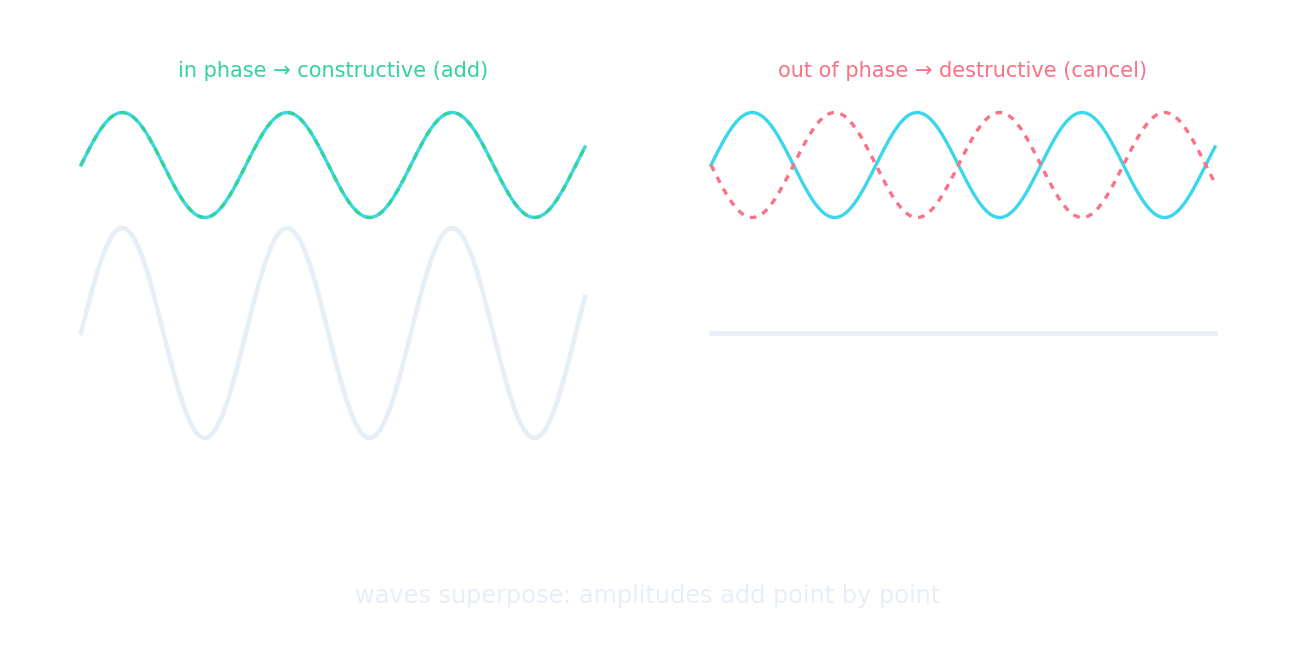
Two waves of amplitude $3\ \text{cm}$ meet exactly in phase. What is the amplitude where they overlap, in cm?
Constructive: $3 + 3 = 6\ \text{cm}$.
Two identical waves meet exactly out of phase (crest on trough). The result is:
Crest on trough cancels — destructive interference.
Standing waves
- A wave reflecting back on itself interferes with the incoming wave to make a standing wave 驻波.
- The pattern seems to stand still: some points never move, others swing widely.
- Nodes are points of no movement; antinodes swing with maximum amplitude.
- Standing waves form on guitar strings, in flutes, and in microwave ovens.
Nodes and antinodes
Change the harmonic number and watch the standing-wave pattern gain more nodes.
In a standing wave, a point that never moves is called a ____.
Nodes are the stationary points; antinodes swing the most.
A standing wave forms when:
A wave reflecting back interferes with the incoming wave to make a standing pattern.
Select all true statements about interference and standing waves.
In phase = constructive, out of phase = destructive, standing waves have nodes/antinodes. Energy is never destroyed.
Why instruments have set notes
- A string or air column only "fits" whole numbers of half-wavelengths — its harmonics.
- These allowed standing waves are the notes the instrument can play.
- A longer string or pipe fits longer waves, giving lower notes.
- Music is standing-wave physics you can hear.
Destructive interference does not destroy energy — it just redistributes it. Where waves cancel at one point, they add somewhere else, so the total energy is conserved. And a "standing" wave isn't frozen: its antinodes are vibrating hardest of all.
Destructive interference destroys energy at the points where waves cancel.
Energy is redistributed, not destroyed — it adds up elsewhere. Total energy is conserved.
Two waves of amplitude $3\ \text{cm}$ meet exactly in phase. What is the amplitude where they overlap?
- Constructive: the amplitudes add, $3 + 3 = 6\ \text{cm}$.
If they met exactly out of phase, they would cancel to $0\ \text{cm}$.
Overlapping waves superpose (displacements add). In phase → constructive (add); out of phase → destructive (cancel). A wave reflecting on itself makes a standing wave with fixed nodes and swinging antinodes — the physics behind musical notes. No energy is lost, only redistributed.