The Doppler Effect
Introduced| English |
|---|
| Doppler effect/ˈdɒplə ɪˈfekt/ |
A siren drops in pitch the instant it passes you
- An ambulance races toward you with a high-pitched wail, then drops to a lower pitch as it passes.
- The siren itself never changes — the motion shifts the pitch you hear.
- This is the Doppler effect 多普勒效应: motion changes the observed frequency of a wave.
- It works for sound, light and every kind of wave.
Why the pitch shifts
- As a source moves toward you, each wave is emitted a little closer, so the waves bunch up.
- Bunched waves have a shorter wavelength and a higher frequency — a higher pitch.
- As it moves away, the waves stretch out — longer wavelength, lower frequency.
- The source's frequency is unchanged; only the observed frequency shifts.
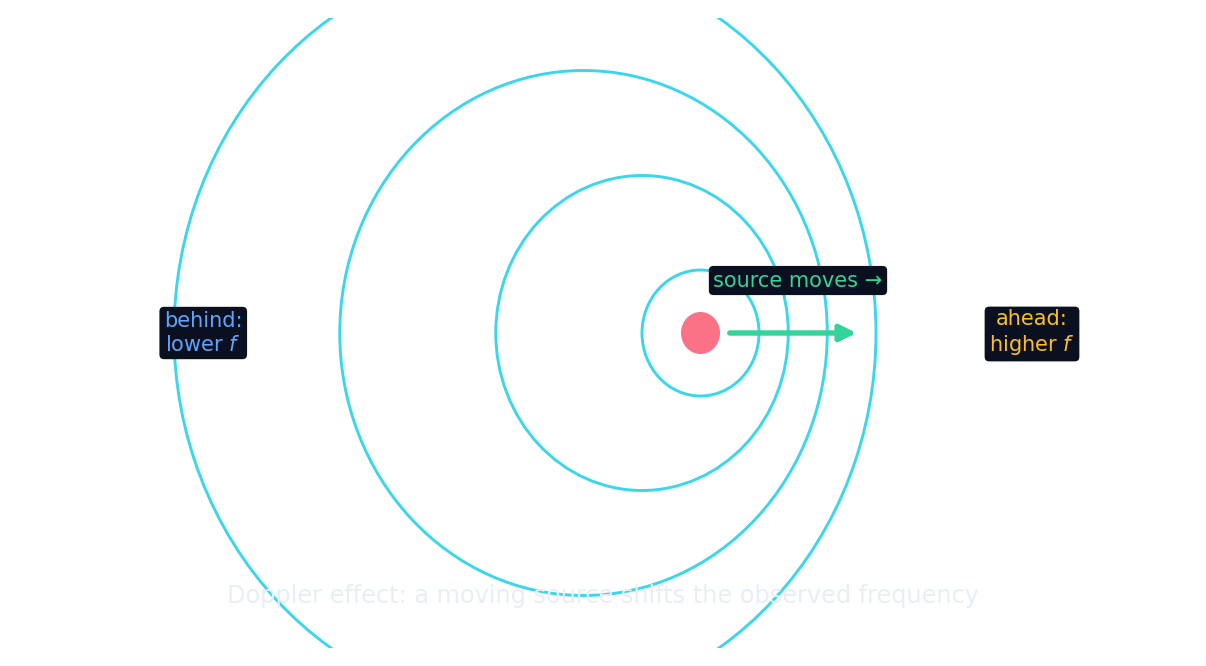
Move the source
Increase the source's speed and see the waves bunch up ahead and stretch out behind.
Toward = higher, away = lower
- Approaching: higher observed frequency (higher pitch, or light shifted toward blue).
- Receding: lower observed frequency (lower pitch, or light shifted toward red).
- The faster the motion, the bigger the shift.
- It happens whether the source moves, the observer moves, or both.
A siren moves toward you. Compared with its true note, you hear a:
Approaching bunches the waves, giving a higher observed frequency (higher pitch).
As a wave source moves away from you, the wavelength you observe is:
Receding stretches the waves — a longer wavelength and lower frequency.
The Doppler effect happens whether the source moves, the observer moves, or both.
Relative motion between source and observer produces the shift.
Doppler in the universe
- Light from galaxies moving away is shifted to lower frequency — the famous redshift.
- This is key evidence that the universe is expanding.
- Doppler radar tracks storms and speeding cars by the shift in reflected waves.
- The same simple idea spans a passing siren and the edge of the cosmos.
In the Doppler effect, the source's own frequency changes as it moves.
The source's frequency is unchanged; only the observed frequency shifts.
Light from a galaxy moving away is shifted toward lower frequency — a ____.
Receding light lowers in frequency: a redshift, evidence of an expanding universe.
Select all true statements about the Doppler effect.
Approach = higher, recede = lower, and it explains redshift. The source frequency itself is unchanged.
In the Doppler effect the source's frequency never changes — only the frequency you observe does. Approaching raises it (blueshift for light); receding lowers it (redshift). Don't say the siren "changes its note" — your received frequency changes.
A train sounds its horn as it speeds toward, then away from, a listener on the platform.
- Approaching: the listener hears a higher pitch than the true horn note.
- Receding: they hear a lower pitch. The drop happens as the train passes.
The Doppler effect: motion shifts the observed frequency of a wave. A source moving toward you bunches its waves (higher frequency/pitch, blueshift); moving away stretches them (lower frequency, redshift). The source's own frequency is unchanged. Redshift shows the universe is expanding.