Skip to content · ⁨דלג לתוכן⁩

Energy and Momentum of Rotating Systems · ⁨אנרגיה ותנע של מערכות מסתובבות⁩

AP Physics 1 · ⁨פיזיקה AP 1⁩ · Topic 6 · ⁨נושא 6⁩

Video lesson for this topic · ⁨שיעור וידאו לנושא זה⁩ Open the video page · ⁨פתח את עמוד הוידאו⁩
7:54

אנרגיה ותנע של מערכות מסתובבות

צפו לגולשת מסתובבת עם הידיים פרושות. היא מורידה אותן – והיא מסתובבת הרבה מהר יותר. אף אחד לא דחף אותה. אף מנוע לא נדלק. אז מאיפה came…

English narration · English + 中文 subtitles burned in · ⁨קריאת קול באנגלית · תרגום אנגלי + סינית שרוף בתוך הסרטון⁩

6.1

Rotational Kinetic Energy · ⁨אנרגיה קינטית סיבובית⁩

Syllabus · ⁨סיילבוס⁩
English

Learning Objective 6.1.A: Describe the rotational kinetic energy of a rigid system in terms of the rotational inertia and angular velocity of that rigid system.

  • 6.1.A.1 The rotational kinetic energy of an object or rigid system is related to the rotational inertia and angular velocity of the rigid system and is given by the equation $K = \frac{1}{2} I \omega^2$.
    • 6.1.A.1.i The rotational inertia of an object about a fixed axis can be used to show that the rotational kinetic energy of that object is equivalent to its translational kinetic energy, which is its total kinetic energy.
    • 6.1.A.1.ii The total kinetic energy of a rigid system is the sum of its rotational kinetic energy due to its rotation about its center of mass and the translational kinetic energy due to the linear motion of its center of mass.
  • 6.1.A.2 A rigid system can have rotational kinetic energy while its center of mass is at rest due to the individual points within the rigid system having linear speed and, therefore, kinetic energy.
  • 6.1.A.3 Rotational kinetic energy is a scalar quantity.
עברית

מטרת לימוד 6.1.A: לתאר את האנרגיה הקינטית הסיבובית של מערכת קשיחה בהתבסס על מומנט האינרציה הסיבובי והמהירות הזוויתית של מערכת זו.

  • 6.1.A.1 האנרגיה הקינטית הסיבובית של גוף או מערכת קשיחה קשורה למומנט האינרציה הסיבובי ולמהירות הזוויתית של המערכת הקשיחה, ונתונה על ידי המשוואה $K = \frac{1}{2} I \omega^2$.
    • 6.1.A.1.i מומנט האינרציה של גוף סביב ציר קבוע יכול לשמש להראות שהאנרגיה הקינטית הסיבובית של הגוף שקולה לאנרגיה הקינטית התרגולית שלו, שהיא האנרגיה הקינטית הכוללת שלו.
    • 6.1.A.1.ii האנרגיה הקינטית הכוללת של מערכת קשיחה היא סכום האנרגיה הקינטית הסיבובית הנובעת מסביבתה סביב מרכז המסה והאנרגיה הקינטית התנועתית הנובעת מתנועה ליניארית של מרכז המסה.
  • 6.1.A.2 למערכת קשיחה יכולה להיות אנרגיה קינטית סיבובית גם כאשר מרכז המסה שלה נמצא במנוחה, בשל העובדה שנקודות יחידיות בתוך המערכת הקשיחה בעלות מהירות ליניארית ולכן אנרגיה קינטית.
  • 6.1.A.3 אנרגיה קינטית סיבובית היא גודל סקלרי.
Source: College Board AP Course and Exam Description · ⁨מקור: תיאור הקורס והמבחן של College Board AP⁩

English

A spinning object has rotational kinetic energy 转动动能, the rotational twin of $\tfrac12 mv^2$:

$$K_{\text{rot}}=\tfrac{1}{2}I\omega^2.$$
An object that both moves and spins (like a rolling ball) has both translational and rotational kinetic energy, and its total is $K=\tfrac12 mv^2+\tfrac12 I\omega^2$.

עברית

גוף מסתובב בעל אנרגיה קינטית סיבובית, העתיק הסיבובי של $\tfrac12 mv^2$:

$$K_{\text{rot}}=\tfrac{1}{2}I\omega^2.$$
גוף שמשתנה וגם מסתובב (כמו כדור המתגלגל) יש לו שניהם: אנרגיה קינטית תנועתית ואנרגיה קינטית סיבובית, והסך הכל הוא $K=\tfrac12 mv^2+\tfrac12 I\omega^2$.

6.2

Torque and Work · ⁨מומנט ועבודה⁩

Syllabus · ⁨סיילבוס⁩
English

Learning Objective 6.2.A: Describe the work done on a rigid system by a given torque or collection of torques.

  • 6.2.A.1 A torque can transfer energy into or out of an object or rigid system if the torque is exerted over an angular displacement.
  • 6.2.A.2 The amount of work done on a rigid system by a torque is related to the magnitude of that torque and the angular displacement through which the rigid system rotates during the interval in which that torque is exerted.
    • Equation: $W = \tau \Delta\theta$
  • 6.2.A.3 Work done on a rigid system by a given torque can be found from the area under the curve of a graph of torque as a function of angular position.
עברית

מטרות למידה 6.2.A: לתאר את העבודה שנעשתה על מערכת קשיחה על ידי מומנט נתון או קבוצת מומנטים.

  • 6.2.A.1 מומנט יכול להעביר אנרגיה אל תוך אובייקט או מערכת קשיחה או מחוץ אליה אם המומנט מופעל לאורך הסטה זוויתית.
  • 6.2.A.2 כמות העבודה שנעשתה על מערכת קשיחה על ידי מומנת קשורה לגודלו של המומנט הזה ול ההסתה הזוויתית דרכה מסתובבת המערכת הקשיחה במהלך הפרק בזמן בו המומנט מופעל.
    • משוואה: $W = \tau \Delta\theta$
  • 6.2.A.3 עבודה שנעשתה על מערכת קשיחה על ידי מומנט נתון ניתן לחשב באמצעות השטח מתחת לעקומה של גרף של מומנט כפונקציה של מיקום זוויתי.

Source: College Board AP Course and Exam Description · ⁨מקור: תיאור הקורס והמבחן של College Board AP⁩

English

A torque acting through an angular displacement does work, changing rotational kinetic energy:

$$W=\tau\,\Delta\theta,\qquad P=\tau\omega.$$
This is the rotational form of $W=Fd$ and $P=Fv$, and it extends the work–energy theorem to rotation.

Worked example. A motor applies a steady torque of $8.0\ \text{N m}$ to a flywheel while it turns through $10\ \text{rad}$. The work done is $W=\tau\,\Delta\theta=8.0\times10=80\ \text{J}$, and if the flywheel started from rest this all becomes rotational kinetic energy.

עברית

מומנט הפועל דרך זווית סטייה מבצע עבודה, ומשנה את האנרגיה הקינטית הסיבובית:

$$W=\tau\,\Delta\theta,\qquad P=\tau\omega.$$
זוהי הצורה הסיבובית של $W=Fd$ ו-$P=Fv$, והיא הרחיבה את משפט העבודה-אנרגיה לסיבוב.

דוגמה מוצגת. מנוע מפעיל מומנט יציב של $8.0\ \text{N m}$ על גלגל משקל בזמן שהוא מסתובב בזווית של $10\ \text{rad}$. העבודה שנעשתה היא $W=\tau\,\Delta\theta=8.0\times10=80\ \text{J}$, ואם גלגל המשקל החל ממצב רגיע, כל זה הופך לאנרגיה קינטית סיבובית.

Explore · ⁨חקור⁩

Balance torques on a seesaw · ⁨איזון מומנטים באושר⁩

Torque is force times perpendicular distance, $\tau = Fd$. The beam balances when the torques on each side are equal — move the forces and distances to find the balance point. · ⁨מומנט הוא כוח כפול במרחק האנכי, $\tau = Fd$. הקורה מאוזנת כשהמומנטים בשני הצדדים שווים — הזז את הכוחות והמרחקים כדי למצוא את נקודת האיזון.⁩

6.3

Angular Momentum and Angular Impulse · ⁨תנע זוויתי ותנע זוויתי⁩

Syllabus · ⁨סיילבוס⁩
English

Learning Objective 6.3.A: Describe the angular momentum of an object or rigid system.

  • 6.3.A.1 The magnitude of the angular momentum of a rigid system about a specific axis can be described with the equation $L = I\omega$.
  • 6.3.A.2 The magnitude of the angular momentum of an object about a given point is $L = rmv \sin\theta$.
    • 6.3.A.2.i The selection of the axis about which an object is considered to rotate influences the determination of the angular momentum of that object.
    • 6.3.A.2.ii The measured angular momentum of an object traveling in a straight line depends on the distance between the reference point and the object, the mass of the object, the speed of the object, and the angle between the radial distance and the velocity of the object.

Learning Objective 6.3.B: Describe the angular impulse delivered to an object or rigid system by a torque.

  • 6.3.B.1 Angular impulse is defined as the product of the torque exerted on an object or rigid system and the time interval during which the torque is exerted.
    • Equation: $\text{angular impulse} = \tau \Delta t$
  • 6.3.B.2 Angular impulse has the same direction as the torque exerted on the object or system.
  • 6.3.B.3 The angular impulse delivered to an object or rigid system by a torque can be found from the area under the curve of a graph of the torque as a function of time.

Learning Objective 6.3.C: Relate the change in angular momentum of an object or rigid system to the angular impulse given to that object or rigid system.

  • 6.3.C.1 The magnitude of the change in angular momentum can be described by comparing the magnitudes of the final and initial angular momenta of the object or rigid system: $\Delta L = L - L_0$
  • 6.3.C.2 A rotational form of the impulse–momentum theorem relates the angular impulse delivered to an object or rigid system and the change in angular momentum of that object or rigid system.
    • 6.3.C.2.i The angular impulse exerted on an object or rigid system is equal to the change in angular momentum of that object or rigid system.
      • Equation: $\Delta L = \tau \Delta t$
    • 6.3.C.2.ii The rotational form of the impulse–momentum theorem is a direct result of the rotational form of Newton's second law of motion for cases in which rotational inertia is constant: $\tau_{\text{net}} = \dfrac{\Delta L}{\Delta t} = I \dfrac{\Delta\omega}{\Delta t} = I\alpha$
  • 6.3.C.3 The net torque exerted on an object is equal to the slope of the graph of the angular momentum of an object as a function of time.
  • 6.3.C.4 The angular impulse delivered to an object is equal to the area under the curve of a graph of the net external torque exerted on an object as a function of time.

Boundary statement: While AP Physics 1 expects that students can mathematically manipulate the magnitude of angular momentum using one-dimensional vector conventions, the direction of angular momentum and angular impulse is beyond the scope of the course.

עברית

מטרות למידה 6.3.A: לתאר את התנע הזוויתי של אובייקט או מערכת קשיחה.

  • 6.3.A.1 הגודל של התנע הזוויתי של מערכת קשיחה סביב ציר ספציפי ניתן לתאר באמצעות המשוואה $L = I\omega$.
  • 6.3.A.2 הגודל של התנע הזוויתי של אובייקט סביב נקודה נתונה הוא $L = rmv \sin\theta$.
    • 6.3.A.2.i בחירת הציר סביב אובייקט נחשב מסתובב משפיעה על קביעת התנע הזוויתי של אובייקט זה.
    • 6.3.A.2.ii התנע הזוויתי הנמדד של אובייקט הנע בקו ישר תלוי במרחק בין נקודת הייחס לבין האובייקט, במסת האובייקט, במהירות האובייקט ובזווית בין המרחק הרדיאלי לבין וקטור המהירות של האובייקט.

מטרות למידה 6.3.B: לתאר את תנע הזוויתי (האימפולס הזוויתי) שהועבר לאובייקט או מערכת קשיחה על ידי מומנט.

  • 6.3.B.1 תנע זוויתי מוגדר כמכפלת המומנט המופעל על אובייקט או מערכת קשיחה ופרק הזמן שבו המומנט מופעל.
    • משוואה: $\text{angular impulse} = \tau \Delta t$
  • 6.3.B.2 לתנע זוויתי יש אותו כיוון כמו המומנט המופעל על האובייקט או המערכת.
  • 6.3.B.3 תנע זוויתי שהועבר לאובייקט או מערכת קשיחה על ידי מומנט ניתן לחשב באמצעות השטח מתחת לעקומה של גרף של המומנט כפונקציה של זמן.

מטרות למידה 6.3.C: לקשר את השינוי בתנע הזוויתי של אובייקט או מערכת קשיחה לתנע הזוויתי (האימפולס הזוויתי) שהועבר לאובייקט או למערכת הקשיחה.

  • 6.3.C.1 גודל השינוי בתנע הזוויתי ניתן לתאר על ידי השוואת גדלים של תנעי זוויתיים סופיים והתחלתיים של האובייקט או המערכת הקשיחה: $\Delta L = L - L_0$
  • 6.3.C.2 צורה סיבובית של משפט ההשפעה-תנע מקשרת בין ההשפעה הזוויתית המופעלת על גוף או מערכת קשיחה לבין השינוי בתנע הזוויתי של הגוף או המערכת הקשיחה.
    • 6.3.C.2.i ההשפעה הזוויתית המופעלת על גוף או מערכת קשיחה שווה לשינוי בתנע הזוויתי של גוף או המערכת הקשיחה.
      • משוואה: $\Delta L = \tau \Delta t$
    • 6.3.C.2.ii הצורה הסיבובית של משפט ההשפעה-תנע היא תוצאה ישירה של הצורה הסיבובית של חוק התנועה השני של ניוטון עבור מקרים בהם מומנט אינרציה הוא קבוע: $\tau_{\text{net}} = \dfrac{\Delta L}{\Delta t} = I \dfrac{\Delta\omega}{\Delta t} = I\alpha$
  • 6.3.C.3 המומנט הכולל המופעל על גוף שווה לשיפוע הגרף של תנע זוויתי של גוף כפונקציה של זמן.
  • 6.3.C.4 ההשפעה הזוויתית המופעלת על גוף שווה לשטח מתחת לעקומה בגרף של המומנט החיצוני הכולל המופעל על גוף כפונקציה של זמן.

הצהרת גבול: בעוד שהמבחן AP Physics 1 מצפה שתלמידים יוכלו לבצע עיבוד מתמטי של הגודל של תנע זוויתי באמצעות מוסכמות וקטור חד-מימדיות, הכיוון של תנע זוויתי והשפעה זוויתית אינם בטווח הלימודים.

Source: College Board AP Course and Exam Description · ⁨מקור: תיאור הקורס והמבחן של College Board AP⁩

English

Angular momentum 角动量 is the rotational version of linear momentum:

$$L=I\omega.$$
A net torque acting over time delivers an angular impulse 角冲量 that changes it: $\tau\,\Delta t=\Delta L$ – the rotational impulse–momentum theorem.

עברית

תנע זוויתי הוא הגרסה הסיבובית של תנע ליניארי:

$$L=I\omega.$$
מומנט נטו הפועל לאורך זמן מספק אימפולס זוויתי המשנה אותו: $\tau\,\Delta t=\Delta L$ – משפט האימפולס-הזווית.

6.4

Conservation of Angular Momentum · ⁨שימור תנע זוויתי⁩

Syllabus · ⁨סיילבוס⁩
English

Learning Objective 6.4.A: Describe the behavior of a system using conservation of angular momentum.

  • 6.4.A.1 The total angular momentum of a system about a rotational axis is the sum of the angular momenta of the system's constituent parts about that axis.
  • 6.4.A.2 Any change to a system's angular momentum must be due to an interaction between the system and its surroundings.
    • 6.4.A.2.i The angular impulse exerted by one object or system on a second object or system is equal and opposite to the angular impulse exerted by the second object or system on the first. This is a direct result of Newton's third law.
    • 6.4.A.2.ii A system may be selected so that the total angular momentum of that system is constant.
    • 6.4.A.2.iii The angular speed of a nonrigid system may change without the angular momentum of the system changing if the system changes shape by moving mass closer to or further from the rotational axis.
    • 6.4.A.2.iv If the total angular momentum of a system changes, that change will be equivalent to the angular impulse exerted on the system.

Learning Objective 6.4.B: Describe how the selection of a system determines whether the angular momentum of that system changes.

  • 6.4.B.1 Angular momentum is conserved in all interactions.
  • 6.4.B.2 If the net external torque exerted on a selected object or rigid system is zero, the total angular momentum of that system is constant.
  • 6.4.B.3 If the net external torque exerted on a selected object or rigid system is nonzero, angular momentum is transferred between the system and the environment.
עברית

מטרות למידה 6.4.A: לתאר את התנהגות מערכת באמצעות שימור תנע זוויתי.

  • 6.4.A.1 התנע הזוויתי הכולל של מערכת סביב ציר סיבוב הוא הסכום של תנעי הזווית של חלקי המערכת המרכיבים אותה סביב ציר זה.
  • 6.4.A.2 כל שינוי בתנע הזוויתי של מערכת חייב להיות תוצאה של אינטראקציה בין המערכת לסביבתה.
    • 6.4.A.2.i ההשפעה הזוויתית המופעלת על ידי גוף או מערכת על גוף או מערכת שנייה שווה בכמותה אך הפוכה בכיוונה להשפעה הזוויתית המופעלת על ידי הגוף או המערכת השנייה על הראשונה. זוהי תוצאה ישירה של חוק השלישי של ניוטון.
    • 6.4.A.2.ii ניתן לבחור מערכת כך שאתר תנע הזוויתי הכולל שלה יהיה קבוע.
    • 6.4.A.2.iii מהירות הסיבוב של מערכת לא-קשיחה עשויהשתנות ללא שינוי בתנע הזוויתי של המערכת אם המערכת משנה צורה על ידי הזזת מסה קרובה יותר או רחוק יותר מציר הסיבוב.
    • 6.4.A.2.iv אם תנע הזוויתי הכולל של מערכת משתנה, השינוי הזה יהיה שקול להשפעה הזוויתית המופעלת על המערכת.

מטרות למידה 6.4.B: לתאר כיצד בחירת המערכת קובעת האם תנע הזוויתי שלה משתנה.

  • 6.4.B.1 תנע זוויתי שמר בכל האינטראקציות.
  • 6.4.B.2 אם המומנט החיצוני הכולל המופעל על גוף או מערכת קשיחה שנבחרה הוא אפס, תנע הזוויתי הכולל של מערכת זו יהיה קבוע.
  • 6.4.B.3 אם המומנט החיצוני הכולל המופעל על גוף או מערכת קשיחה שנבחרה אינו אפס, תנע זוויתי מועבר בין המערכת לסביבה.

Source: College Board AP Course and Exam Description · ⁨מקור: תיאור הקורס והמבחן של College Board AP⁩

English

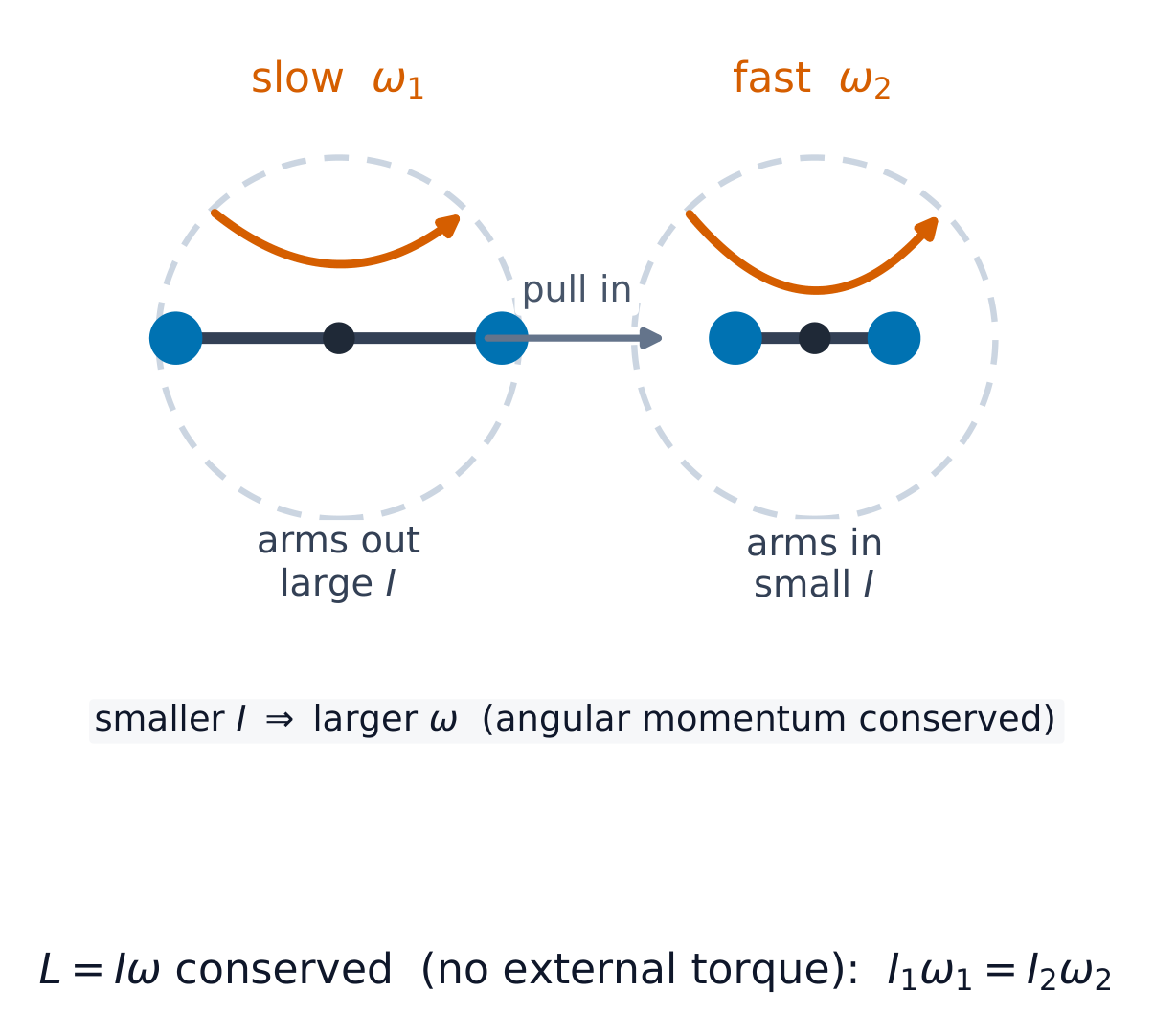
If the net external torque on a system is zero, its total angular momentum is conserved 守恒:

$$I_1\omega_1=I_2\omega_2.$$
So if $I$ decreases, $\omega$ increases to keep $L$ constant – this is why a spinning skater speeds up when pulling their arms in. It applies to collisions and explosions of rotating systems too.

Worked example. A skater spins at $2.0\ \text{rev/s}$ with rotational inertia $I_1=4.0\ \text{kg m}^2$. She pulls her arms in, dropping her rotational inertia to $I_2=1.6\ \text{kg m}^2$. With no external torque, angular momentum is conserved:

$$\omega_2=\frac{I_1}{I_2}\,\omega_1=\frac{4.0}{1.6}\times2.0=5.0\ \text{rev/s}.$$
Her kinetic energy actually rises – the extra energy comes from the work her muscles do pulling her arms in against the outward pull.

עברית

אם המומנט החיצוני הנטו על מערכת הוא אפס, התנע הזוויתי הכולל שלה שמור:

$$I_1\omega_1=I_2\omega_2.$$
לכן אם $I$ יורד, $\omega$ עולה כדי לשמור על $L$ קבוע – זוהי הסיבה שהגלידה המסתובבת מאיצה כשהיא מושכת את הידיים פנימה. הדבר חל גם על התנגשויות והתפוצצות של מערכות מסתובבות.

דוגמה מופתרת. גלידה מסתובבת ב-$2.0\ \text{rev/s}$ עם מומנט אינרציה סיבובי של $I_1=4.0\ \text{kg m}^2$. היא מושכת את הידיים פנימה, ומורידה את מומנט האינרציה ל-$I_2=1.6\ \text{kg m}^2$. ללא מומנט חיצוני, התנע הזוויתי שמור:

$$\omega_2=\frac{I_1}{I_2}\,\omega_1=\frac{4.0}{1.6}\times2.0=5.0\ \text{rev/s}.$$
אנרגיית ההקזה שלה למעשה עולה – האנרגיה הנוספת מגיעה מהעבודה שביצעו שריריה במשיכת הידיים פנימה נגד הכוח החוצי.

משיכת מסה פנימה מפחיתה את I, ולכן ω עולה כדי לשמור על L = Iω
Vocabulary · ⁨מילון מונחים⁩ Train · ⁨אימון⁩
English עברית
rotational kinetic energy/rəʊˈteɪʃənl kɪˈnetɪk ˈenədʒi/ אנרגיה קינטית סיבובית
Angular momentum/ˈæŋɡjʊlə məʊˈmentəm/ תנע זוויתי
angular impulse/ˈæŋɡjʊlə ˈɪmpʌls/ אימפולס זוויתי
conserved/kənˈsɜːvd/ שמור על ערכו
6.5

Rolling · ⁨גלילה⁩

Syllabus · ⁨סיילבוס⁩
English

Learning Objective 6.5.A: Describe the kinetic energy of a system that has translational and rotational motion.

  • 6.5.A.1 The total kinetic energy of a system is the sum of the system's translational and rotational kinetic energies.
    • Equation: $K_{\text{tot}} = K_{\text{trans}} + K_{\text{rot}}$

Learning Objective 6.5.B: Describe the motion of a system that is rolling without slipping.

  • 6.5.B.1 While rolling without slipping, the translational motion of a system's center of mass is related to the rotational motion of the system itself with the equations:
    • Equation: $\Delta x_{\text{cm}} = r\Delta\theta$
    • Equation: $v_{\text{cm}} = r\omega$
    • Equation: $a_{\text{cm}} = r\alpha$
  • 6.5.B.2 For ideal cases, rolling without slipping implies that the frictional force does not dissipate any energy from the rolling system.

Learning Objective 6.5.C: Describe the motion of a system that is rolling while slipping.

  • 6.5.C.1 When slipping, the motion of a system's center of mass and the system's rotational motion cannot be directly related.
  • 6.5.C.2 When a rotating system is slipping relative to another surface, the point of application of the force of kinetic friction exerted on the system moves with respect to the surface, so the force of kinetic friction will dissipate energy from the system.

Boundary statement: Rolling friction is beyond the scope of AP Physics 1.

Boundary statement: The precise mathematical relationships between linear and angular quantities while a rigid body is rolling while slipping are beyond the scope of AP Physics 1 and 2, and students will not be expected to model those relationships quantitatively. However, students are expected to qualitatively explain the changes to linear and angular quantities while a rigid body is rolling while slipping.

עברית

מטרות למידה 6.5.A: לתאר את האנרגיה הקינטית של מערכת שיש לה תנועה תרגומית וסיבובית.

  • 6.5.A.1 האנרגיה הקינטית הכוללת של מערכת היא סכום האנרגיה הקינטית התנועתית והאנרגיה הקינטית הסיבובית של המערכת.
    • משוואה: $K_{\text{tot}} = K_{\text{trans}} + K_{\text{rot}}$

מטרת למידה 6.5.B: לתאר את תנועת מערכת הנעה ללא החלקה.

  • 6.5.B.1 בזמן הנעה ללא החלקה, התנועה התנועתית של מרכז הכובד של המערכת קשורה לתנועה הסיבובית של המערכת עצמה באמצעות המשוואות:
    • משוואה: $\Delta x_{\text{cm}} = r\Delta\theta$
    • משוואה: $v_{\text{cm}} = r\omega$
    • משוואה: $a_{\text{cm}} = r\alpha$
  • 6.5.B.2 במקרים אידיאליים, הנעה ללא החלקה מציינת כי כוח החיכוך אינו מפזר אנרגיה מהמערכת הנעה.

מטרת למידה 6.5.C: לתאר את תנועת מערכת הנעה עם החלקה.

  • 6.5.C.1 כאשר ישנה החלקה, לא ניתן לקשר ישירות בין תנועת מרכז הכובד של המערכת לבין התנועה הסיבובית שלה.
  • 6.5.C.2 כאשר מערכת מסתובבת ומחליקה ביחס למשטח אחר, נקודת ההשפעה של כוח החיכוך הקינטי הפועל על המערכת נעה ביחס למשטח, ולכן כוח החיכוך הקינטי יפזר אנרגיה מהמערכת.

הצהרת גבול: חיכוך הנעה חוצה את גבולות AP Physics 1.

הצהרת גבול: הקשרים המתמטיים המדויקים בין גדלים ליניאריים וזוויתיים בזמן שגוף קשיח נע עם החלקה חוצים את גבולות AP Physics 1 ו-2, ולא צפויות מתלמידים לדגם קשרים אלו בכמות. עם זאת, צפויות מתלמידים להסביר באופן איכותי את השינויים בגדלים ליניאריים וזוויתיים בזמן שגוף קשיח נע עם החלקה.

Source: College Board AP Course and Exam Description · ⁨מקור: תיאור הקורס והמבחן של College Board AP⁩

English

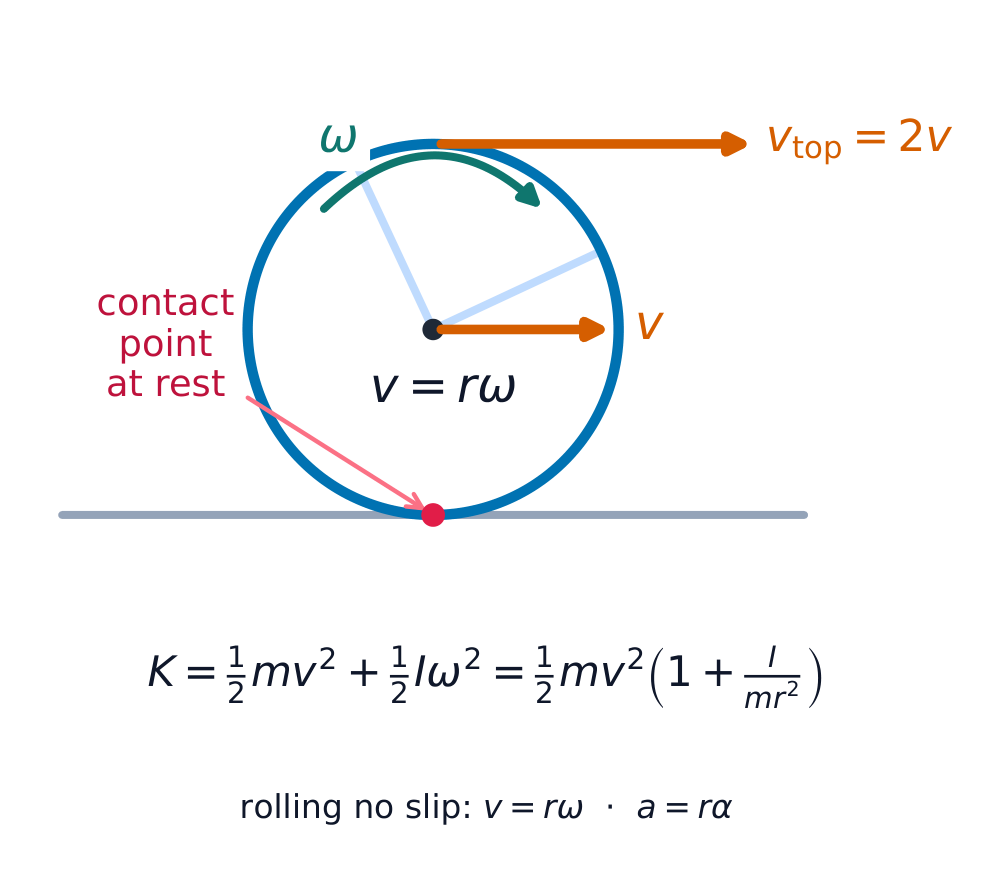
Rolling without slipping 纯滚动 links the translational and rotational motions: the contact point is momentarily at rest, so

$$v=r\omega \qquad\text{and}\qquad a=r\alpha.$$
A rolling object's energy splits between translation and rotation, so on an incline it accelerates more slowly than a frictionless sliding object – some energy goes into spin.

Worked example. For a solid disk ($I=\tfrac12 mR^2$) that rolls without slipping, what fraction of its kinetic energy is rotational? Using $v=R\omega$, the rotational part is $\tfrac12 I\omega^2=\tfrac12(\tfrac12 mR^2)\omega^2=\tfrac14 mv^2$, while the translational part is $\tfrac12 mv^2$. So the total is $\tfrac34 mv^2$ and the rotational share is $\tfrac{1/4}{3/4}=\tfrac13$. A hoop, with its mass farther out, stores half its energy in spin and rolls down a ramp even more slowly.

עברית

גלילה ללא החלקה מקשרת בין התנועה התרגולית והתנועה הסיבובית: נקודת המגע נמצאת רגעית במנוחה, ולכן

$$v=r\omega \qquad\text{and}\qquad a=r\alpha.$$
אנרגיה של גוף מתגלגלת מתחלקת בין תרגול וסיבוב, ולכן במדרון הוא מאיץ איט יותר מאשר גוף מחליק ללא חיכוך – חלק מאנרגייתו הולך לספינת סיבוב.

דוגמה מופתרת. עבור דיסק מוצק ($I=\tfrac12 mR^2$) המתגלגל ללא החלקה, מהו השבר של אנרגיית ההקזה שהוא סיבובי? באמצעות $v=R\omega$, החלק הסיבובי הוא $\tfrac12 I\omega^2=\tfrac12(\tfrac12 mR^2)\omega^2=\tfrac14 mv^2$, בעוד שהחלק התרגולי הוא $\tfrac12 mv^2$. לכן הסכום הכולל הוא $\tfrac34 mv^2$ והחלק הסיבובי הוא $\tfrac{1/4}{3/4}=\tfrac13$. טבעת, עם המסה הרחוקה יותר ממרכז, מאחסנת מחצית מאנרגיית הסיבוב ומתגלגלת למטה במדרון איט יותר עוד.

בגלילה ללא החלקה נקודת המגע במנוחה, ולכן v = rω
Vocabulary · ⁨מילון מונחים⁩ Train · ⁨אימון⁩
English עברית
Rolling without slipping/ˈrəʊlɪŋ wɪˈðaʊt ˈslɪpɪŋ/ גלילה ללא החלקה
satellite/ˈsætəlaɪt/ לוויין
Escape velocity/eˈskeɪp vəˈlɒsɪti/ מהירות בריחה
6.6

Motion of Orbiting Satellites · ⁨תנועת לוויינים במסלול⁩

Syllabus · ⁨סיילבוס⁩
English

Learning Objective 6.6.A: Describe the motions of a system consisting of two objects interacting only via gravitational forces.

  • 6.6.A.1 In a system consisting only of a massive central object and an orbiting satellite with mass that is negligible in comparison to the central object's mass, the motion of the central object itself is negligible.
  • 6.6.A.2 The motion of satellites in orbits is constrained by conservation laws.
    • 6.6.A.2.i In circular orbits, the system's total mechanical energy, the system's gravitational potential energy, and the satellite's angular momentum and kinetic energy are constant.
    • 6.6.A.2.ii In elliptical orbits, the system's total mechanical energy and the satellite's angular momentum are constant, but the system's gravitational potential energy and the satellite's kinetic energy can each change.
    • 6.6.A.2.iii The gravitational potential energy of a system consisting of a satellite and a massive central object is defined to be zero when the satellite is an infinite distance from the central object.
      • Equation: $U_g = -G\dfrac{m_1 m_2}{r}$
  • 6.6.A.3 The escape velocity of a satellite is the satellite's velocity such that the mechanical energy of the satellite–central-object system is equal to zero.
    • 6.6.A.3.i When the only force exerted on a satellite is gravity from a central object, a satellite that reaches escape velocity will move away from the central body until its speed reaches zero at an infinite distance from the central body.
    • 6.6.A.3.ii The escape velocity of a satellite from a central body of mass $M$ can be derived using conservation of energy laws.
      • Equation (derived): $v_{\text{esc}} = \sqrt{\dfrac{2GM}{r}}$
עברית

מטרת למידה 6.6.A: לתאר את תנועת מערכת המורכבת משני גופים האינטראקציה ביניהם היא רק דרך כוחות כבידה.

  • 6.6.A.1 במערכת המורכבת רק מגוף מרכזי בעל מסה וגוף לוויני שמסתו זניחה לעומת מסת הגוף המרכזי, התנועה של הגוף המרכזי עצמו היא זניחה.
  • 6.6.A.2 תנועת לווינים במסלולים מוגבלת על ידי חוקי שימור.
    • 6.6.A.2.i במסלולים מעגליים, האנרגיה המכנית הכוללת של המערכת, האנרגיה הפוטנציאלית הכבידתית של המערכת, המומנט הזוויתי והאנרגיה הקינטית של הלווינה הם קבועים.
    • 6.6.A.2.ii במסלולים אלפסיוئידים, האנרגיה המכנית הכוללת של המערכת והמומנט הזוויתי של הלווינה הם קבועים, אך האנרגיה הפוטנציאלית הכבידתית של המערכת והאנרגיה הקינטית של הלווינה עשויות להשתנות כל אחת בנפרד.
    • 6.6.A.2.iii האנרגיה הפוטנציאלית הכבידתית של מערכת המורכבת מלווינה וגוף מרכזי בעל מסה מוגדרת כאפס כאשר הלווינה נמצאת במרחק אינסופי מהגוף המרכזי.
      • משוואה: $U_g = -G\dfrac{m_1 m_2}{r}$
  • 6.6.A.3 מהירות המילוט של לווינה היא מהירות הלווינה כך שהאנרגיה המכנית של מערכת הלווינה–גוף המרכזי תהיה שווה לאפס.
    • 6.6.A.3.i כאשר הכוח היחיד הפועל על לווינה הוא כוח הכבידה ממקור מרכזי, לווינה שתגיע למהירות מילוט תתרחק מהגוף המרכזי עד שהמהירות שלה תגיע לאפס במרחק אינסופי מהגוף המרכזי.
    • 6.6.A.3.ii מהירות המילוט של לווינה ממקור בעל מסה $M$ יכולה להיות נגזרת באמצעות חוקי שימור אנרגיה.
      • משוואה (נגזרת): $v_{\text{esc}} = \sqrt{\dfrac{2GM}{r}}$

Source: College Board AP Course and Exam Description · ⁨מקור: תיאור הקורס והמבחן של College Board AP⁩

English
Orbital motion (Kepler's 2nd law)

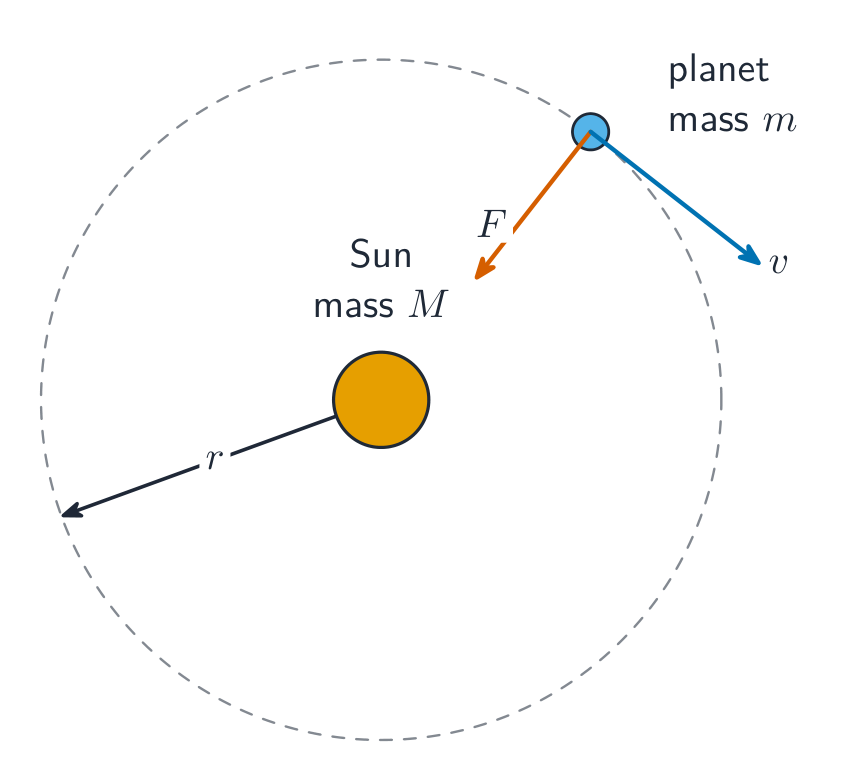
A satellite 卫星 in orbit is in free fall: gravity provides the exact centripetal force needed to curve its path into an orbit. Setting gravity equal to the centripetal requirement,

$$\frac{GMm}{r^2}=\frac{mv^2}{r}\ \Rightarrow\ v=\sqrt{\frac{GM}{r}}.$$
So a larger orbit means a slower speed. For a circular orbit, angular momentum and mechanical energy are both constant; for an elliptical orbit, angular momentum is conserved (no torque about the planet) while speed varies – fastest when closest.

Worked example. Find the speed of a satellite in a low orbit just above the Earth, radius $r=6.4\times10^{6}\ \text{m}$, with $GM=4.0\times10^{14}\ \text{m}^3/\text{s}^2$:

$$v=\sqrt{\frac{GM}{r}}=\sqrt{\frac{4.0\times10^{14}}{6.4\times10^{6}}}=\sqrt{6.25\times10^{7}}\approx 7.9\times10^{3}\ \text{m/s},$$
about $7.9\ \text{km/s}$ – and notice that the satellite's mass cancels, so all low orbits share this speed.

Escape velocity 逃逸速度 is the launch speed that just lets an object leave for good: its total mechanical energy is exactly zero, so it slows to zero speed only at infinite distance. Setting $\tfrac12 mv^2 - \dfrac{GMm}{r}=0$ (using the general gravitational PE $U_g=-GMm/r$) and solving for $v$,

$$v_{\text{esc}}=\sqrt{\frac{2GM}{r}}.$$
It is $\sqrt2$ times the circular-orbit speed at the same radius, and (like orbital speed) does not depend on the escaping object's mass.

עברית
תנועה אורביטלית (החוק ה-2 של קפלר)

לוויין במסלול נמצא במשקל חופשי: כוח הכבידה מספק את כוח המרכז המדויק הנדרש לעקומת המסלול. בהשוואת כוח הכבידה לדרישת המרכז,

$$\frac{GMm}{r^2}=\frac{mv^2}{r}\ \Rightarrow\ v=\sqrt{\frac{GM}{r}}.$$
לכן מסלול גדול יותר משמעו מהירות איטית יותר. עבור מסלול מעגלי, התנע הזוויתי ואנרגיה מכנית הם שניהם קבועים; עבור מסלול אלפטי, התנע הזוויתי שמור (אין מומנט ביחס לכוכב הלכת) בעוד שהמהירות משתנה – המהירות המקסימלית היא כשהוא הקרוב ביותר.

כוח הכבידה מספק את כוח המרכז שמחזיק את הלוויין במסלול

דוגמה מפורטת. מצאו את מהירותו של לוויין במסלול נמוך מעט מעל פני כדור הארץ, בקרן $r=6.4\times10^{6}\ \text{m}$, עם $GM=4.0\times10^{14}\ \text{m}^3/\text{s}^2$:

$$v=\sqrt{\frac{GM}{r}}=\sqrt{\frac{4.0\times10^{14}}{6.4\times10^{6}}}=\sqrt{6.25\times10^{7}}\approx 7.9\times10^{3}\ \text{m/s},$$
כאשר רדיוסו הוא כ-$7.9\ \text{km/s}$ — ושימו לב שמסת הלוויין מצטמצמת, ולכן כל המסלולים הנמוכים משתפים מהירות זו.

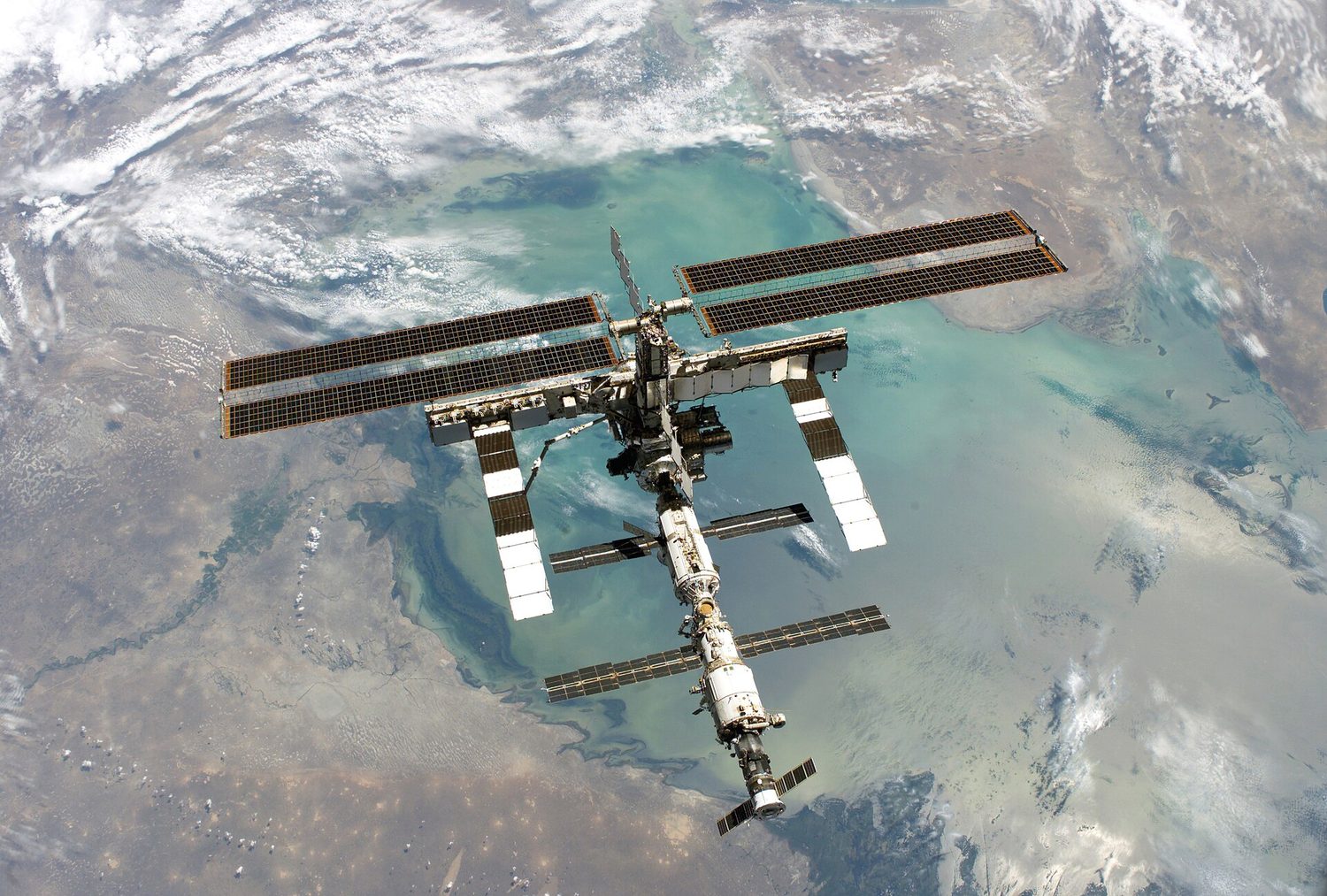
צילום של התחנה החללית הבינלאומית המקיפה את כדור הארץ
התחנה החללית הבינלאומית: לוויין אמיתי המוחזק במסלול על ידי כוח הכבידה בלבד

מהירות בריחה היא מהירות ההשקה המאפשרת לגוף לעזוב לצמיתות: אנרגיה מכנית סך הכל שלו שווה בדיוק לאפס, ולכן הוא מאט למהירות אפס רק במרחק אינסופי. על ידי השוואת $\tfrac12 mv^2 - \dfrac{GMm}{r}=0$ (בשימוש באנרגיה פוטנציאלית כבידתית כללית $U_g=-GMm/r$) ופתרון עבור $v$,

$$v_{\text{esc}}=\sqrt{\frac{2GM}{r}}.$$
היא שווה ל-$\sqrt2$ כפול מהירות המסלול העגול באותו רדיוס, ואם כן (כמו מהירות מסלול) אינה תלויה במסת הגוף שבורח.

Explore · ⁨חקור⁩

Compare orbits at different radii · ⁨השווה מסלולים בקרני רדיוס שונות⁩

A satellite is in free fall, its gravity supplying the centripetal force. A larger orbit means a slower speed and a longer period — Kepler's third law. · ⁨לוויין נמצא בנפילה חופשית, כאשר כוח הכובד מספק את כוח המרכז-מגמה. מסלול גדול יותר אומר מהירות איטית יותר ותקופה ארוכה יותר — משפט קפרל השלישי.⁩

6.6

Exam tips · ⁨טיפים לבחינות⁩

English
  • Conserve angular momentum $L=I\omega$ when no external torque acts: a smaller $I$ (arms pulled in) gives a larger $\omega$.
  • A rolling object splits its energy between $\tfrac12 mv^2$ and $\tfrac12 I\omega^2$, linked by $v=r\omega$ — so it accelerates down a ramp more slowly than a sliding one.
  • For a circular orbit set gravity equal to the centripetal requirement: $v=\sqrt{GM/r}$, so a larger orbit is slower and the satellite's mass cancels.
  • Pulling in raises the spin and the kinetic energy — the extra energy comes from the work done pulling inward; $L$ is unchanged.
  • Watch which rotational quantity is conserved: $L$ (no torque) versus energy (no friction) are different conditions.
עברית
  • שמרו על תנע זוויתי $L=I\omega$ כאשר אין מומנט חיצוני: קרן $I$ קטנה יותר (זרועות מקופלות) נותנת ערך גדול יותר ל-$\omega$.
  • גוף מתגלגל מחלק את אנרגייתו בין $\tfrac12 mv^2$ ל-$\tfrac12 I\omega^2$, הקשורים זה לזה על ידי $v=r\omega$ — ולכן הוא מאיץ מטה מדרון איט יותר מאשר גוף החולק.
  • עבור מסלול עגול שוו את כוח הכבידה לדרישה המרכזומטרית: $v=\sqrt{GM/r}$, ולכן מסלול גדול יותר הוא איטי יותר ומסת הלוויין מצטמצמת.
  • קיפול הזרועות מגביר גם את הסיבוב וגם את האנרגיה הקינטית — האנרגיה הנוספת נובעת מהעבודה שנעשתה במהלך משיכה פנימה; $L$ נשמר.
  • שימו לב איזה גודל סיבובי נשמר: $L$ (ללא מומנט) מול אנרגיה (ללא חיכוך) הם תנאים שונים.

Interactive lessons on this topic · ⁨שיעורים אינטראקטיביים בנושא זה⁩

Work through it step by step, with instant-check exercises. · ⁨לעבור על הדברים צעד אחר צעד, עם תרגילים לבדיקה מיידית.⁩

Past Papers · ⁨מבחני עבר⁩

More topics in AP Physics 1 · ⁨פיזיקה AP 1⁩ · ⁨נושאים נוספים בAP Physics 1 · ⁨פיזיקה AP 1⁩⁩

Log in or create account · ⁨היכנס או צור חשבון⁩

IGCSE, A-Level & AP